Education Periods of the
Philippines
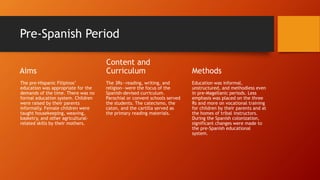
Pre-Spanish Period
Aims
The pre-Hispanic Filipinos’
education was appropriate for the
demands of the time. There was no
formal education system. Children
were raised by their parents
informally. Female children were
taught housekeeping, weaving,
basketry, and other agricultural-
related skills by their mothers.
Content and
Curriculum
The 3Rs—reading, writing, and
religion—were the focus of the
Spanish-devised curriculum.
Parochial or convent schools served
the students. The catecismo, the
caton, and the cartilla served as
the primary reading materials.
Methods
Education was informal,
unstructured, and methodless even
in pre-Magellanic periods. Less
emphasis was placed on the three
Rs and more on vocational training
for children by their parents and at
the homes of tribal instructors.
During the Spanish colonization,
significant changes were made to
the pre-Spanish educational
system.
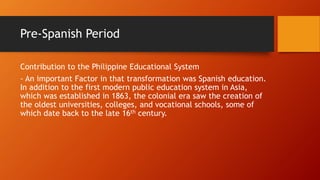
Pre-Spanish Period
Contribution to the Philippine Educational System
- An important Factor in that transformation was Spanish education.
In addition to the first modern public education system in Asia,
which was established in 1863, the colonial era saw the creation of
the oldest universities, colleges, and vocational schools, some of
which date back to the late 16th century.
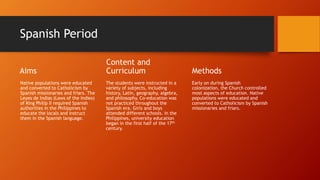
Spanish Period
Aims
Native populations were educated
and converted to Catholicism by
Spanish missionaries and friars. The
Leyes de Indias (Laws of the Indies)
of King Philip II required Spanish
authorities in the Philippines to
educate the locals and instruct
them in the Spanish language.
Content and
Curriculum
The students were instructed in a
variety of subjects, including
history, Latin, geography, algebra,
and philosophy. Co-education was
not practiced throughout the
Spanish era. Girls and boys
attended different schools. In the
Philippines, university education
began in the first half of the 17th
century.
Methods
Early on during Spanish
colonization, the Church controlled
most aspects of education. Native
populations were educated and
converted to Catholicism by Spanish
missionaries and friars.
Spanish Period
Contribution to the Philippine Educational System
- The development of science and technology in the archipelago was
aided by the colonization of the Philippines. The Spanish established
scientific institutions and introduced formal education. Early on in
the Philippines’ Spanish colonial era.
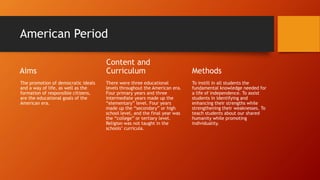
American Period
Aims
The promotion of democratic ideals
and a way of life, as well as the
formation of responsible citizens,
are the educational goals of the
American era.
Content and
Curriculum
There were three educational
levels throughout the American era.
Four primary years and three
intermediate years made up the
“elementary” level. Four years
made up the “secondary” or high
school level, and the final year was
the “college” or tertiary level.
Religion was not taught in the
schools’ curricula.
Methods
To instill in all students the
fundamental knowledge needed for
a life of independence. To assist
students in identifying and
enhancing their strengths while
strengthening their weaknesses. To
teach students about our shared
humanity while promoting
individuality.
American Period
Contribution to the Philippine Educational System
- Since it allowed the American colonial government to spread its
cultural values, particularly the English language, to the Filipino
people, education came to be seen as a very important issue. The
teaching of English and American history contributes to the
development of Filipino nationalism and a sense of national identity.
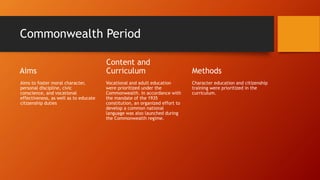
Commonwealth Period
Aims
Aims to foster moral character,
personal discipline, civic
conscience, and vocational
effectiveness, as well as to educate
citizenship duties
Content and
Curriculum
Vocational and adult education
were prioritized under the
Commonwealth. In accordance with
the mandate of the 1935
constitution, an organized effort to
develop a common national
language was also launched during
the Commonwealth regime.
Methods
Character education and citizenship
training were prioritized in the
curriculum.
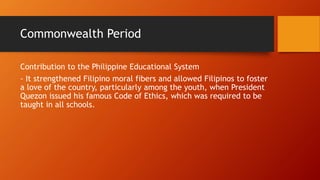
Commonwealth Period
Contribution to the Philippine Educational System
- It strengthened Filipino moral fibers and allowed Filipinos to foster
a love of the country, particularly among the youth, when President
Quezon issued his famous Code of Ethics, which was required to be
taught in all schools.
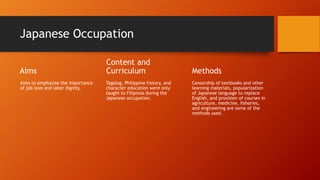
Japanese Occupation
Aims
Aims to emphasize the importance
of job love and labor dignity.
Content and
Curriculum
Tagalog, Philippine history, and
character education were only
taught to Filipinos during the
Japanese occupation.
Methods
Censorship of textbooks and other
learning materials, popularization
of Japanese language to replace
English, and provision of courses in
agriculture, medicine, fisheries,
and engineering are some of the
methods used.
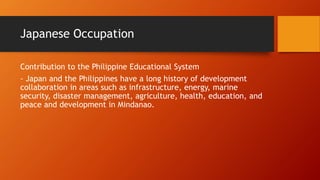
Japanese Occupation
Contribution to the Philippine Educational System
- Japan and the Philippines have a long history of development
collaboration in areas such as infrastructure, energy, marine
security, disaster management, agriculture, health, education, and
peace and development in Mindanao.
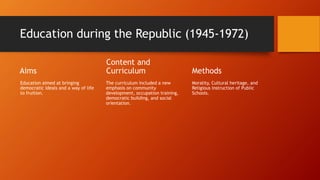
Education during the Republic (1945-1972)
Aims
Education aimed at bringing
democratic ideals and a way of life
to fruition.
Content and
Curriculum
The curriculum included a new
emphasis on community
development, occupation training,
democratic building, and social
orientation.
Methods
Morality, Cultural heritage, and
Religious instruction of Public
Schools.
Contribution to the Philippine Educational System
- Japan and the Philippines have a long history of development
collaboration in areas such as infrastructure, energy, marine
security, disaster management, agriculture, health, education, and
peace and development in Mindanao.

Presentation (3).pptx

  • 1.
    Education Periods ofthe Philippines
  • 2.
    Pre-Spanish Period Aims The pre-HispanicFilipinos’ education was appropriate for the demands of the time. There was no formal education system. Children were raised by their parents informally. Female children were taught housekeeping, weaving, basketry, and other agricultural- related skills by their mothers. Content and Curriculum The 3Rs—reading, writing, and religion—were the focus of the Spanish-devised curriculum. Parochial or convent schools served the students. The catecismo, the caton, and the cartilla served as the primary reading materials. Methods Education was informal, unstructured, and methodless even in pre-Magellanic periods. Less emphasis was placed on the three Rs and more on vocational training for children by their parents and at the homes of tribal instructors. During the Spanish colonization, significant changes were made to the pre-Spanish educational system.
  • 3.
    Pre-Spanish Period Contribution tothe Philippine Educational System - An important Factor in that transformation was Spanish education. In addition to the first modern public education system in Asia, which was established in 1863, the colonial era saw the creation of the oldest universities, colleges, and vocational schools, some of which date back to the late 16th century.
  • 4.
    Spanish Period Aims Native populationswere educated and converted to Catholicism by Spanish missionaries and friars. The Leyes de Indias (Laws of the Indies) of King Philip II required Spanish authorities in the Philippines to educate the locals and instruct them in the Spanish language. Content and Curriculum The students were instructed in a variety of subjects, including history, Latin, geography, algebra, and philosophy. Co-education was not practiced throughout the Spanish era. Girls and boys attended different schools. In the Philippines, university education began in the first half of the 17th century. Methods Early on during Spanish colonization, the Church controlled most aspects of education. Native populations were educated and converted to Catholicism by Spanish missionaries and friars.
  • 5.
    Spanish Period Contribution tothe Philippine Educational System - The development of science and technology in the archipelago was aided by the colonization of the Philippines. The Spanish established scientific institutions and introduced formal education. Early on in the Philippines’ Spanish colonial era.
  • 6.
    American Period Aims The promotionof democratic ideals and a way of life, as well as the formation of responsible citizens, are the educational goals of the American era. Content and Curriculum There were three educational levels throughout the American era. Four primary years and three intermediate years made up the “elementary” level. Four years made up the “secondary” or high school level, and the final year was the “college” or tertiary level. Religion was not taught in the schools’ curricula. Methods To instill in all students the fundamental knowledge needed for a life of independence. To assist students in identifying and enhancing their strengths while strengthening their weaknesses. To teach students about our shared humanity while promoting individuality.
  • 7.
    American Period Contribution tothe Philippine Educational System - Since it allowed the American colonial government to spread its cultural values, particularly the English language, to the Filipino people, education came to be seen as a very important issue. The teaching of English and American history contributes to the development of Filipino nationalism and a sense of national identity.
  • 8.
    Commonwealth Period Aims Aims tofoster moral character, personal discipline, civic conscience, and vocational effectiveness, as well as to educate citizenship duties Content and Curriculum Vocational and adult education were prioritized under the Commonwealth. In accordance with the mandate of the 1935 constitution, an organized effort to develop a common national language was also launched during the Commonwealth regime. Methods Character education and citizenship training were prioritized in the curriculum.
  • 9.
    Commonwealth Period Contribution tothe Philippine Educational System - It strengthened Filipino moral fibers and allowed Filipinos to foster a love of the country, particularly among the youth, when President Quezon issued his famous Code of Ethics, which was required to be taught in all schools.
  • 10.
    Japanese Occupation Aims Aims toemphasize the importance of job love and labor dignity. Content and Curriculum Tagalog, Philippine history, and character education were only taught to Filipinos during the Japanese occupation. Methods Censorship of textbooks and other learning materials, popularization of Japanese language to replace English, and provision of courses in agriculture, medicine, fisheries, and engineering are some of the methods used.
  • 11.
    Japanese Occupation Contribution tothe Philippine Educational System - Japan and the Philippines have a long history of development collaboration in areas such as infrastructure, energy, marine security, disaster management, agriculture, health, education, and peace and development in Mindanao.
  • 12.
    Education during theRepublic (1945-1972) Aims Education aimed at bringing democratic ideals and a way of life to fruition. Content and Curriculum The curriculum included a new emphasis on community development, occupation training, democratic building, and social orientation. Methods Morality, Cultural heritage, and Religious instruction of Public Schools.
  • 13.
    Contribution to thePhilippine Educational System - Japan and the Philippines have a long history of development collaboration in areas such as infrastructure, energy, marine security, disaster management, agriculture, health, education, and peace and development in Mindanao.