BRANCHES OF SOCIAL SCIENCES AND
THE THEMES OF SOCIAL
STUDIES
BRANCHES OF
SOCIAL STUDIES
Economics
Sociology
Psychology
Anthropology
Political Science
History
Geography
Linguistics
Archaeology
BRANCHES OF
SOCIAL SCIENCE
Economics - It Emphasises on understanding the way people
spend and utilize their available resources to satisfy their
increasing demands.
Sociology – It covers societal constructs like religion, class,
caste as well as social mobility to name a few.
Psychology – It is a unique amalgam of both theory and
experiments and is an intriguing discipline for those inclined
towards the intricate human mind and its multifarious
aspects.
Anthropology – It encompasses the study of different aspects of the
human condition and delves deep into a societies’ cultural moorings,
and how over the years culture has shaped human behaviour.
Political Science - It emerged as a significant field of study
focusing on different systems of governance as well as
political ideas and discourse.
History - t straddles into different territories of time and
explores every aspect of it, tries to reconstruct the past for
understanding of the present through various resources
available.
Geography - one of the fundamental branches of social sciences as it
studies lands, their salient features, crucial phenomena that impact the
earth along with the human population and the relationship between
the study of land and the human population.
Linguistics - an indispensable area of study amongst these disciplines as
it peruses upon how a language is formed, its main origins as well as
evolution.
Archaeology - encompasses the study of the material culture. The
remains of past human life and associated activities from the specific
past by collecting its residual remains, found during the excavation
process and involves a subsequent analysis of these recent or
prehistoric materials
TEN THEMES OF
SOCIAL STUDIES
THEMES OF
SOCIAL STUDIES
Culture
The continuity and change
People,Places, and Environments
Individual,Development and
Identity
Individualls,Groups and
Institutions
Power,Authority and Governance
Production,Distribution and
Consumption
Science,Technology and Society
Global Connections
Civic Ideals and Practices
Culture - The study of culture examines the socially transmitted beliefs, values,
institutions, behaviors, traditions and way of life of a group of people; it also
encompasses other cultural attributes and products, such as language, literature,
music, arts and artifacts, and foods.
The continuity and change – The historical experiences of societies, peoples and
nations reveal patterns of continuity and change. Historical analysis enables us to
identify continuities over time in core institutions, values, ideals, and traditions, as well
as processes that lead to change within societies and institutions, and that result in
innovation and the development of new ideas, values and ways of life.
People, Places and Environment - The study of people, places, and environments
enables us to understand the relationship between human populations and the
physical world. Students learn where people and places are located and why they are
there.
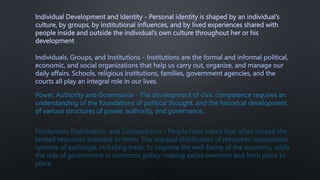
Individual Development and Identity - Personal identity is shaped by an individual’s
culture, by groups, by institutional influences, and by lived experiences shared with
people inside and outside the individual’s own culture throughout her or his
development
Individuals, Groups, and Institutions - Institutions are the formal and informal political,
economic, and social organizations that help us carry out, organize, and manage our
daily affairs. Schools, religious institutions, families, government agencies, and the
courts all play an integral role in our lives.
Power, Authority and Governance - The development of civic competence requires an
understanding of the foundations of political thought, and the historical development
of various structures of power, authority, and governance.
Production, Distribution, and Consumption - People have wants that often exceed the
limited resources available to them. The unequal distribution of resources necessitates
systems of exchange, including trade, to improve the well-being of the economy, while
the role of government in economic policy-making varies overtime and from place to
place.
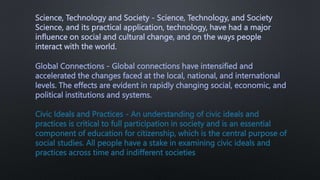
Science, Technology and Society - Science, Technology, and Society
Science, and its practical application, technology, have had a major
influence on social and cultural change, and on the ways people
interact with the world.
Global Connections - Global connections have intensified and
accelerated the changes faced at the local, national, and international
levels. The effects are evident in rapidly changing social, economic, and
political institutions and systems.
Civic Ideals and Practices - An understanding of civic ideals and
practices is critical to full participation in society and is an essential
component of education for citizenship, which is the central purpose of
social studies. All people have a stake in examining civic ideals and
practices across time and indifferent societies
TO SIMPLIFY…
• THIS THEMES ARE WHAT SOCIAL STUDIES ALL ABOUT AND
THIS ARE THE CONTENT OF WHAT WILL THE YOUNG
LEARNERS WILL ENCOUNTER IN ENTERING THE SUBJECT OF
SOCIAL STUDIES. THIS THEMES ARE THE ONES THAT
BUILDS WHAT SOCIAL STUDY IS AS A WHOLE. THESE WERE
THE THEMES THAT IDENTIFY WHAT SOCIAL STUDIES IS SO
THAT YOUNG PEOPLE WHO WANTS TO STUDY SOCIAL
STUDIES, THIS IS WHAT THEY WILL LEARN.
THANK
YOU
A PRESENTATION BY ASHLEY A. PETACIO

SSE 101N Presentation

  • 1.
    BRANCHES OF SOCIALSCIENCES AND THE THEMES OF SOCIAL STUDIES
  • 2.
  • 3.
  • 4.
    Economics - ItEmphasises on understanding the way people spend and utilize their available resources to satisfy their increasing demands. Sociology – It covers societal constructs like religion, class, caste as well as social mobility to name a few. Psychology – It is a unique amalgam of both theory and experiments and is an intriguing discipline for those inclined towards the intricate human mind and its multifarious aspects.
  • 5.
    Anthropology – Itencompasses the study of different aspects of the human condition and delves deep into a societies’ cultural moorings, and how over the years culture has shaped human behaviour. Political Science - It emerged as a significant field of study focusing on different systems of governance as well as political ideas and discourse. History - t straddles into different territories of time and explores every aspect of it, tries to reconstruct the past for understanding of the present through various resources available.
  • 6.
    Geography - oneof the fundamental branches of social sciences as it studies lands, their salient features, crucial phenomena that impact the earth along with the human population and the relationship between the study of land and the human population. Linguistics - an indispensable area of study amongst these disciplines as it peruses upon how a language is formed, its main origins as well as evolution. Archaeology - encompasses the study of the material culture. The remains of past human life and associated activities from the specific past by collecting its residual remains, found during the excavation process and involves a subsequent analysis of these recent or prehistoric materials
  • 7.
  • 8.
    THEMES OF SOCIAL STUDIES Culture Thecontinuity and change People,Places, and Environments Individual,Development and Identity Individualls,Groups and Institutions Power,Authority and Governance Production,Distribution and Consumption Science,Technology and Society Global Connections Civic Ideals and Practices
  • 9.
    Culture - Thestudy of culture examines the socially transmitted beliefs, values, institutions, behaviors, traditions and way of life of a group of people; it also encompasses other cultural attributes and products, such as language, literature, music, arts and artifacts, and foods. The continuity and change – The historical experiences of societies, peoples and nations reveal patterns of continuity and change. Historical analysis enables us to identify continuities over time in core institutions, values, ideals, and traditions, as well as processes that lead to change within societies and institutions, and that result in innovation and the development of new ideas, values and ways of life. People, Places and Environment - The study of people, places, and environments enables us to understand the relationship between human populations and the physical world. Students learn where people and places are located and why they are there.
  • 10.
    Individual Development andIdentity - Personal identity is shaped by an individual’s culture, by groups, by institutional influences, and by lived experiences shared with people inside and outside the individual’s own culture throughout her or his development Individuals, Groups, and Institutions - Institutions are the formal and informal political, economic, and social organizations that help us carry out, organize, and manage our daily affairs. Schools, religious institutions, families, government agencies, and the courts all play an integral role in our lives. Power, Authority and Governance - The development of civic competence requires an understanding of the foundations of political thought, and the historical development of various structures of power, authority, and governance. Production, Distribution, and Consumption - People have wants that often exceed the limited resources available to them. The unequal distribution of resources necessitates systems of exchange, including trade, to improve the well-being of the economy, while the role of government in economic policy-making varies overtime and from place to place.
  • 11.
    Science, Technology andSociety - Science, Technology, and Society Science, and its practical application, technology, have had a major influence on social and cultural change, and on the ways people interact with the world. Global Connections - Global connections have intensified and accelerated the changes faced at the local, national, and international levels. The effects are evident in rapidly changing social, economic, and political institutions and systems. Civic Ideals and Practices - An understanding of civic ideals and practices is critical to full participation in society and is an essential component of education for citizenship, which is the central purpose of social studies. All people have a stake in examining civic ideals and practices across time and indifferent societies
  • 12.
    TO SIMPLIFY… • THISTHEMES ARE WHAT SOCIAL STUDIES ALL ABOUT AND THIS ARE THE CONTENT OF WHAT WILL THE YOUNG LEARNERS WILL ENCOUNTER IN ENTERING THE SUBJECT OF SOCIAL STUDIES. THIS THEMES ARE THE ONES THAT BUILDS WHAT SOCIAL STUDY IS AS A WHOLE. THESE WERE THE THEMES THAT IDENTIFY WHAT SOCIAL STUDIES IS SO THAT YOUNG PEOPLE WHO WANTS TO STUDY SOCIAL STUDIES, THIS IS WHAT THEY WILL LEARN.
  • 13.
    THANK YOU A PRESENTATION BYASHLEY A. PETACIO