


COURSE TITLE: SEMINOR IN FINANCE COURSE CODE: MPH 622
Presentation on
Discussion of Financial Ratios as
Predictors of Failure
Written by: Prof. John Neter, University of Minnesota, USA
The main article was written by Prof. William H. Beaver
Published in: Empirical Research in Accounting: Selected Studies, 1966,
Supplement to Journal of Accounting Research, pp. 71-111
30th March, 2011
Presentation Outline
 Discussion produced by John Neter
 Discussion presented by Preston Mears
 Professor Beaver’s Reply to Professor
Neter
 Conclusions
 Comments
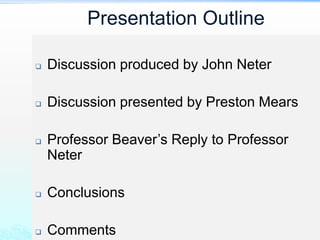
Strength
Methodology : Substantial care to avoid the bias
in sample
Much progression analysis : comparison of
means, simple discriminant
analysis, likelihood ratios and
Bayesian inference.
Calibrating samples : use of half of the samples
for developing the criterions and
the other half is used to test the
predictive power of the criterion.
Discussion of Fin..... by John Neter
Interpretation : assessing the predictive power of
ratios by comparing it with the
simple naïve model.
Implications and area of study : accounting data
and preference of research area.
Realization of limitations : On data and analysis
that states the possible existence
of major pitfalls.
Discussion of Fin..... by John
Neter
Weaknesses (methodology; analysis and implications)
Retrospective study : biases possible in the
selection of the sample, matching
the populations , measurements
(retrospective, prospective and an experimental study)
Matching factors : asset size and the industry vs
age of the business
Matching procedure : how the matching is not
clear.
Discussion of Fin..... by John
Neter
Problems on the dichotomous test : First, how
“naïve” the naïve model should be.
Secondly, the importance of the
context.
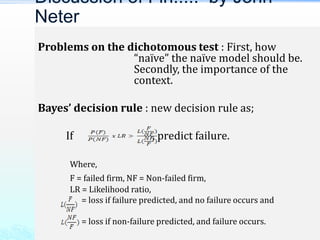
Bayes’ decision rule : new decision rule as;
If , predict failure.
Where,
F = failed firm, NF = Non-failed firm,
LR = Likelihood ratio,
= loss if failure predicted, and no failure occurs and
= loss if non-failure predicted, and failure occurs.
Discussion of Fin..... by John
Neter
Unrealistic proportion : 1:99 vs. 50:50 i.e. 99 non-
failed firms for every failed firm to
make the predictions of failure
Interpretation of likelihood ratio: Problem of
determining the loss ratio &
likelihood ratio in varying
contexts.
Small samples : do not provide enough
information about the tails of the
distributions.
Discussion of Fin..... by John
Neter
Prof. Neter has raised the issues:
The dangers of the selectivity of choosing the best
indicator on the basis of a given set of data
How the matching was done? Was it done according
to asset size as of the first year before failure, as of
some other year or how?
How to determine the loss ratio?
How effective is the use of multivariate analysis?
Discussion of Fin..... by John
Neter
Comments by John Neter
Predicting failure in case of non-failure would be much less
serious than predicting non-failure in case of failure.
In some contexts the financial ratios could turn out to be
very useful whereas in other contexts the predictability is
fairly low.
Thus, any general assessment of a ratio as an excellent (or
poor) predictor may be misleading.
Finally, the study might have been improved if it had not
used a sample of non-failed firms of the same size as that
for failed firms.
Discussion of Fin..... by John
Neter
Discussion of Financial Ratios as
Predictors of Failure
Written by: Prof. Preston K. Mears
Discussion of Fin... by Preston
Mears
The theme of the story of two MBA graduates and
Johnny
“I buy for one dollar and I sell for two dollars. I
must make 1 per cent.”
The replication of the idea with Beaver’s work is the
worth of his work is to explore the predictive
ability of accounting data or financial ratios. Thus,
make your 1 per cent and you are all right.
(Beaver did well in his job)
Discussion of Fin... by Preston
Mears
Conclusions in favor of Beaver’s work
Overwhelming support the definition of “failure”
and its “operational” criteria
Underline the Beaver’s primarily focus as ‘the
underlying predictive ability of the financial
statements themselves’ rather ratios.
Utility of the ratios to expose the area where further
information is needed and help to save from
failure.
Discussion of Fin... by Preston
Mears
Use the trend analysis to identify the trend effect as
early as five years before is a most significant
observation of the study
Conclusion against the Beaver’s study
The criterion for identifying the business failure can
also be the liabilities of the firm as used in the
earlier works.
Discussion of Fin... by Preston
Mears
In summary
i) Prediction of failure or success is a daily business
decision.
ii) Financial data are useful for them.
iii) Ratios of themselves will not predict failure
absolutely.
iv) The most useful way of using the financial ratios
are to finding the “poor” rati0 – then find out why
it is poor and be guided by the answer to curve
them.
v) Ratios analysis are the routine professional scope
of work.
vi) Further study along the lines of Professor Beaver
are welcome.
Discussion of Fin... by Preston
Mears
Professor Beaver’s Reply to
Professor Neter
Beaver’s Reply...
Broad questions
How does the context of analysis changes when the
probability of failure is different from 0.50?
When the costs of misclassification are
asymmetrical?
Beaver’s Reply...
Beaver accepted that Neter’s idea of 99:1 rather
50:50 has correctly pointed out.
i) The optimal cutoff point will shift when the
probability of failure changes
ii) An analysis of total percentage error can be
misleading and limited in its insights.
The type I and II errors will also change when the
cutoff point is changed.
Beaver’s Reply...
Loss when a failed firm is misclassified is greater
than the loss when a non-failed firm is
misclassified.
Using the likelihood ratio, the decision criterion for
minimization of expected loss is;
Predict failure if,
prior-odds ratio x likelihood ratio > 1/loss ratio
Beaver’s Reply...
Does the impact of the ratio analysis (likelihood
ratio) leads to a change in the behavior of the
decision makers?
Answer depends upon the loss ratio and the
likelihood ratio. The loss ratio is not easily
quantified but will be considered from the point
of view of a bank’s lending decision.
The analysis tentatively suggest that ratios are
useful predictors, in the sense that they change
the decision behavior.
Beaver’s Reply...
Critical likelihood ratio of the multidimensional decision
is lower than that implied by a dichotomous decision
model.
Conclusions
The primary interest of the study is; how useful ratios
are? Rather, are ratios useful?
The answer depends upon several sub-questions and
affected by the multiple factors. Thus, the clear
demarcation of the factors and their impact analysis is
desirable prior to conclude the predictive ability of
the accounting data.
Beaver’s Reply...
Comments
Beaver’s pioneering work has raised the different
frontier of knowledge and scope of the new
studies. It also creates the platform for
researchers to generate the new contributions in
this field and helps to learn how the pioneering
has been done.
The discussion of ratios as predictors of failure and
Beaver’s reply clarify the many confusions
pertaining in the earlier study.
Beaver’s Reply...
Thank you.

Discussion of Financial Ratios as Predictors of Failure

  • 1.
    COURSE TITLE: SEMINORIN FINANCE COURSE CODE: MPH 622 Presentation on Discussion of Financial Ratios as Predictors of Failure Written by: Prof. John Neter, University of Minnesota, USA The main article was written by Prof. William H. Beaver Published in: Empirical Research in Accounting: Selected Studies, 1966, Supplement to Journal of Accounting Research, pp. 71-111 30th March, 2011
  • 2.
    Presentation Outline  Discussionproduced by John Neter  Discussion presented by Preston Mears  Professor Beaver’s Reply to Professor Neter  Conclusions  Comments
  • 3.
    Strength Methodology : Substantialcare to avoid the bias in sample Much progression analysis : comparison of means, simple discriminant analysis, likelihood ratios and Bayesian inference. Calibrating samples : use of half of the samples for developing the criterions and the other half is used to test the predictive power of the criterion. Discussion of Fin..... by John Neter
  • 4.
    Interpretation : assessingthe predictive power of ratios by comparing it with the simple naïve model. Implications and area of study : accounting data and preference of research area. Realization of limitations : On data and analysis that states the possible existence of major pitfalls. Discussion of Fin..... by John Neter
  • 5.
    Weaknesses (methodology; analysisand implications) Retrospective study : biases possible in the selection of the sample, matching the populations , measurements (retrospective, prospective and an experimental study) Matching factors : asset size and the industry vs age of the business Matching procedure : how the matching is not clear. Discussion of Fin..... by John Neter
  • 6.
    Problems on thedichotomous test : First, how “naïve” the naïve model should be. Secondly, the importance of the context. Bayes’ decision rule : new decision rule as; If , predict failure. Where, F = failed firm, NF = Non-failed firm, LR = Likelihood ratio, = loss if failure predicted, and no failure occurs and = loss if non-failure predicted, and failure occurs. Discussion of Fin..... by John Neter
  • 7.
    Unrealistic proportion :1:99 vs. 50:50 i.e. 99 non- failed firms for every failed firm to make the predictions of failure Interpretation of likelihood ratio: Problem of determining the loss ratio & likelihood ratio in varying contexts. Small samples : do not provide enough information about the tails of the distributions. Discussion of Fin..... by John Neter
  • 8.
    Prof. Neter hasraised the issues: The dangers of the selectivity of choosing the best indicator on the basis of a given set of data How the matching was done? Was it done according to asset size as of the first year before failure, as of some other year or how? How to determine the loss ratio? How effective is the use of multivariate analysis? Discussion of Fin..... by John Neter
  • 9.
    Comments by JohnNeter Predicting failure in case of non-failure would be much less serious than predicting non-failure in case of failure. In some contexts the financial ratios could turn out to be very useful whereas in other contexts the predictability is fairly low. Thus, any general assessment of a ratio as an excellent (or poor) predictor may be misleading. Finally, the study might have been improved if it had not used a sample of non-failed firms of the same size as that for failed firms. Discussion of Fin..... by John Neter
  • 10.
    Discussion of FinancialRatios as Predictors of Failure Written by: Prof. Preston K. Mears Discussion of Fin... by Preston Mears
  • 11.
    The theme ofthe story of two MBA graduates and Johnny “I buy for one dollar and I sell for two dollars. I must make 1 per cent.” The replication of the idea with Beaver’s work is the worth of his work is to explore the predictive ability of accounting data or financial ratios. Thus, make your 1 per cent and you are all right. (Beaver did well in his job) Discussion of Fin... by Preston Mears
  • 12.
    Conclusions in favorof Beaver’s work Overwhelming support the definition of “failure” and its “operational” criteria Underline the Beaver’s primarily focus as ‘the underlying predictive ability of the financial statements themselves’ rather ratios. Utility of the ratios to expose the area where further information is needed and help to save from failure. Discussion of Fin... by Preston Mears
  • 13.
    Use the trendanalysis to identify the trend effect as early as five years before is a most significant observation of the study Conclusion against the Beaver’s study The criterion for identifying the business failure can also be the liabilities of the firm as used in the earlier works. Discussion of Fin... by Preston Mears
  • 14.
    In summary i) Predictionof failure or success is a daily business decision. ii) Financial data are useful for them. iii) Ratios of themselves will not predict failure absolutely. iv) The most useful way of using the financial ratios are to finding the “poor” rati0 – then find out why it is poor and be guided by the answer to curve them. v) Ratios analysis are the routine professional scope of work. vi) Further study along the lines of Professor Beaver are welcome. Discussion of Fin... by Preston Mears
  • 15.
    Professor Beaver’s Replyto Professor Neter Beaver’s Reply...
  • 16.
    Broad questions How doesthe context of analysis changes when the probability of failure is different from 0.50? When the costs of misclassification are asymmetrical? Beaver’s Reply...
  • 17.
    Beaver accepted thatNeter’s idea of 99:1 rather 50:50 has correctly pointed out. i) The optimal cutoff point will shift when the probability of failure changes ii) An analysis of total percentage error can be misleading and limited in its insights. The type I and II errors will also change when the cutoff point is changed. Beaver’s Reply...
  • 18.
    Loss when afailed firm is misclassified is greater than the loss when a non-failed firm is misclassified. Using the likelihood ratio, the decision criterion for minimization of expected loss is; Predict failure if, prior-odds ratio x likelihood ratio > 1/loss ratio Beaver’s Reply...
  • 19.
    Does the impactof the ratio analysis (likelihood ratio) leads to a change in the behavior of the decision makers? Answer depends upon the loss ratio and the likelihood ratio. The loss ratio is not easily quantified but will be considered from the point of view of a bank’s lending decision. The analysis tentatively suggest that ratios are useful predictors, in the sense that they change the decision behavior. Beaver’s Reply...
  • 20.
    Critical likelihood ratioof the multidimensional decision is lower than that implied by a dichotomous decision model. Conclusions The primary interest of the study is; how useful ratios are? Rather, are ratios useful? The answer depends upon several sub-questions and affected by the multiple factors. Thus, the clear demarcation of the factors and their impact analysis is desirable prior to conclude the predictive ability of the accounting data. Beaver’s Reply...
  • 21.
    Comments Beaver’s pioneering workhas raised the different frontier of knowledge and scope of the new studies. It also creates the platform for researchers to generate the new contributions in this field and helps to learn how the pioneering has been done. The discussion of ratios as predictors of failure and Beaver’s reply clarify the many confusions pertaining in the earlier study. Beaver’s Reply...
  • 22.