IUSD | Master Thesis Defence | Dina Mahdy 															September 2015
Dynamics of Development in Rural Egypt to
new Desert Communities: The Case of the
Basaisa
IUSD | Master Thesis Defence | Dina Mahdy 															September 2015
Keywords:
Community development: The process for improving the quality of life of communities, which according
to social science Several types of communities have been identified: community as a place, community as
relationships, and community as collective political power (Suttles 1972) 1
.
Rural village/community: a form of social group, organized according to historically determined norms, of
families tied to the land. These basic groups have collective or individual rights and ownership which vary
according to their social structure. They are tied by collective rulesand traditions that are so complex and has
historical roots (Lefevre 1970)2
.
1	 Suttles, G. D. (1972). The social construction of community. Chicago: University of ChicagoPress.
2	 Lefevre, H. (1970). Du rural a l'urbain. . The University of Minnestoat
IUSD | Master Thesis Defence | Dina Mahdy 															September 2015
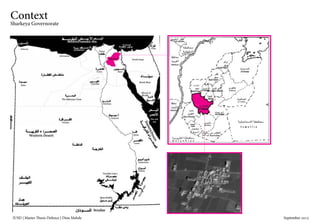
Context
Sharkeya Governorate
IUSD | Master Thesis Defence | Dina Mahdy 															September 2015
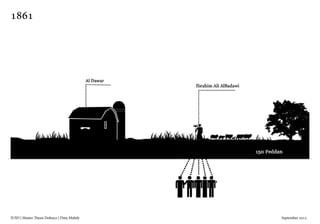
1861
IUSD | Master Thesis Defence | Dina Mahdy 															September 2015
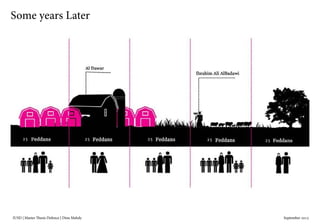
Some years Later
25 25 25 25 25
IUSD | Master Thesis Defence | Dina Mahdy 															September 2015
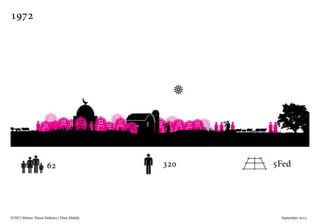
1972
62 320 5Fed
IUSD | Master Thesis Defence | Dina Mahdy 															September 2015
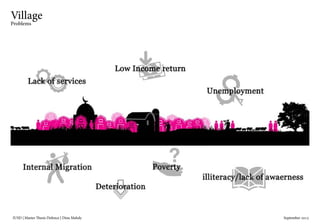
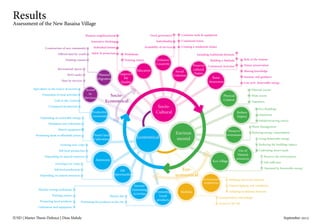
Village
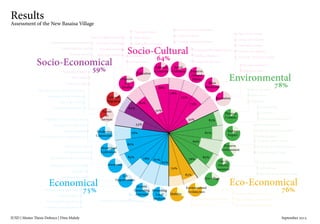
Problems
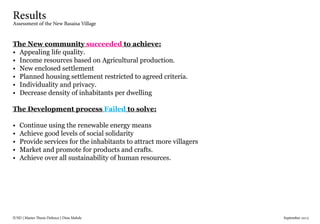
IUSD | Master Thesis Defence | Dina Mahdy 															September 2015
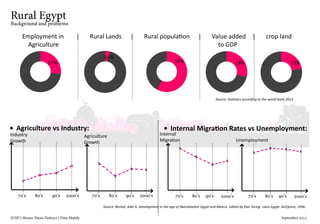
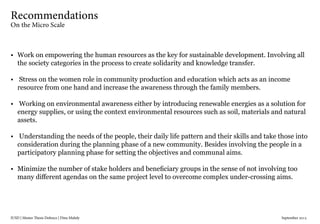
Rural Egypt
Background and problems
Employment in	 |	 Rural Lands	 |	 Rural population	 |	 Value added	 |	 crop land
Agriculture											 to GDP
•	 Agriculture vs Industry:					
	
•	 Internal Migration Rates vs Unemployment:	
		
rural
urban
1
2
27%
3.6%
57%
1
2
29%
1
2
22%
Source: Statistics according to the world bank 2013
Source: Beshal, Adel A. Development in the age of liberalization Egypt and Mexico. Edited by Dan Tscirgi. cairo Egypt: AUCpress, 1996.
70's 70's80's 80's90's 90's2000's 2000's
X
X X
X
Industry
Growth
Agriculture
Growth
Internal
Migration Unemployment
X
X
X X
2000's 2000's70's 70's80's 80's90's 90's
X
X
X
X
X
X X X
IUSD | Master Thesis Defence | Dina Mahdy 															September 2015
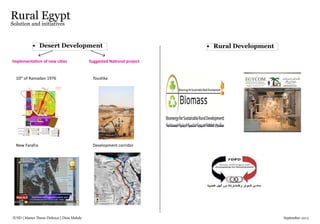
•	 Desert Development
Implementation of new cities
10th
of Ramadan 1976 Toushka
Development corridorNew Farafra
Suggested National project
•	 Rural Development
Rural Egypt
Solution and initiatives
IUSD | Master Thesis Defence | Dina Mahdy 															September 2015
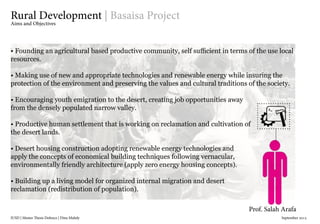
Prof. Salah Arafa
Rural Development | Basaisa Project
Aims and Objectives
• Founding an agricultural based productive community, self sufficient in terms of the use local
resources.
• Making use of new and appropriate technologies and renewable energy while insuring the
protection of the environment and preserving the values and cultural traditions of the society.
• Encouraging youth emigration to the desert, creating job opportunities away
from the densely populated narrow valley.
• Productive human settlement that is working on reclamation and cultivation of
the desert lands.
• Desert housing construction adopting renewable energy technologies and
apply the concepts of economical building techniques following vernacular,
environmentally friendly architecture (apply zero energy housing concepts).
• Building up a living model for organized internal migration and desert
reclamation (redistribution of population).
IUSD | Master Thesis Defence | Dina Mahdy 															September 2015
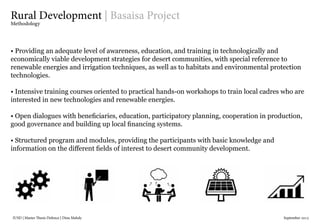
Rural Development | Basaisa Project
Methodology
• Providing an adequate level of awareness, education, and training in technologically and
economically viable development strategies for desert communities, with special reference to
renewable energies and irrigation techniques, as well as to habitats and environmental protection
technologies.
• Intensive training courses oriented to practical hands-on workshops to train local cadres who are
interested in new technologies and renewable energies.
• Open dialogues with beneficiaries, education, participatory planning, cooperation in production,
good governance and building up local financing systems.
• Structured program and modules, providing the participants with basic knowledge and
information on the different fields of interest to desert community development.
IUSD | Master Thesis Defence | Dina Mahdy 															September 2015
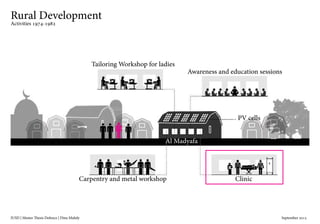
Rural Development
Activities 1974-1982
Al Madyafa
Tailoring Workshop for ladies
Awareness and education sessions
PV cells
ClinicCarpentry and metal workshop
IUSD | Master Thesis Defence | Dina Mahdy 															September 2015
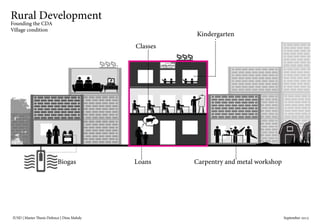
Rural Development
Founding the CDA
Village condition
Biogas Loans Carpentry and metal workshop
Kindergarten
Classes
IUSD | Master Thesis Defence | Dina Mahdy 															September 2015
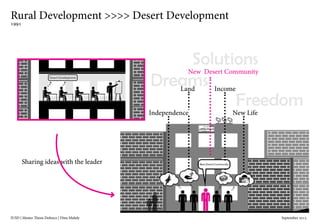
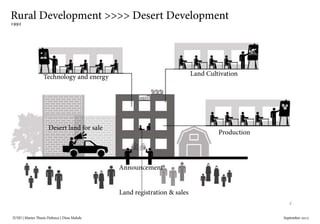
Rural Development >>>> Desert Development
1991
Sharing ideas with the leader
IncomeLand
Dreams
Solutions
Freedom
New LifeIndependence
New Desert Community
IUSD | Master Thesis Defence | Dina Mahdy 															September 2015
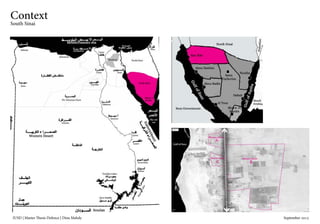
Context
South Sinai
IUSD | Master Thesis Defence | Dina Mahdy 															September 2015
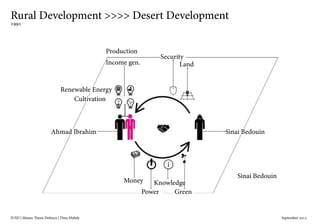
Rural Development >>>> Desert Development
1991
Sinai BedouinAhmad Ibrahim
Money
Power Green
Knowledge
Sinai Bedouin
Land
Security
Cultivation
Renewable Energy
Income gen.
Production
IUSD | Master Thesis Defence | Dina Mahdy 															September 2015
Rural Development >>>> Desert Development
1992
Land Cultivation
Production
Technology and energy
Land registration & sales
Announcement
Desert land for sale
IUSD | Master Thesis Defence | Dina Mahdy 															September 2015
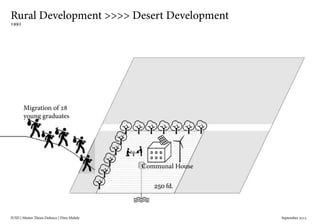
Rural Development >>>> Desert Development
1992
Migration of 28
young graduates
Communal House
IUSD | Master Thesis Defence | Dina Mahdy 															September 2015
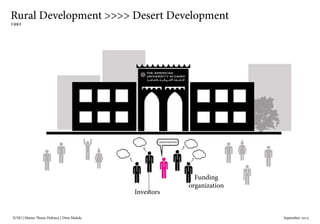
Rural Development >>>> Desert Development
1992
Investors
Funding
organization
IUSD | Master Thesis Defence | Dina Mahdy 															September 2015
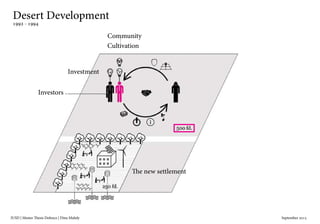
Desert Development
1992 - 1994
Investors
Cultivation
Investment
Community
The new settlement
IUSD | Master Thesis Defence | Dina Mahdy 															September 2015
Desert Development
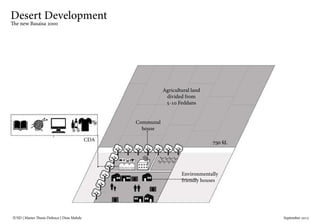
The new Basaisa 2000
CDA
Communal
house
Environmentally
friendly houses
Agricultural land
divided from
5-10 Feddans
IUSD | Master Thesis Defence | Dina Mahdy 															September 2015
Desert Development
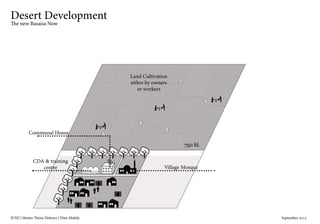
The new Basaisa Now
Land Cultivation
either by owners
or workers
Village Mosque
Communal House
CDA & training
centre
IUSD | Master Thesis Defence | Dina Mahdy 															September 2015
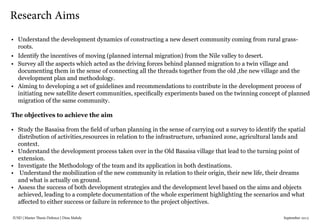
•	 Understand the development dynamics of constructing a new desert community coming from rural grass-
roots.
•	 Identify the incentives of moving (planned internal migration) from the Nile valley to desert.
•	 Survey all the aspects which acted as the driving forces behind planned migration to a twin village and
documenting them in the sense of connecting all the threads together from the old ,the new village and the
development plan and methodology.
•	 Aiming to developing a set of guidelines and recommendations to contribute in the development process of
initiating new satellite desert communities, specifically experiments based on the twinning concept of planned
migration of the same community.
The objectives to achieve the aim
•	 Study the Basaisa from the field of urban planning in the sense of carrying out a survey to identify the spatial
distribution of activities,resources in relation to the infrastructure, urbanized zone, agricultural lands and
context.
•	 Understand the development process taken over in the Old Basaisa village that lead to the turning point of
extension.
•	 Investigate the Methodology of the team and its application in both destinations.
•	 Understand the mobilization of the new community in relation to their origin, their new life, their dreams
and what is actually on ground.
•	 Assess the success of both development strategies and the development level based on the aims and objects
achieved, leading to a complete documentation of the whole experiment highlighting the scenarios and what
affected to either success or failure in reference to the project objectives.
Research Aims
IUSD | Master Thesis Defence | Dina Mahdy 															September 2015
•	 What was the development project aims, goals and methodology in 1974 (start of the project in the old
village)? How did the team approach and influence the community? What was the village status Quo at that
time in comparison to today?
•	 The methodology that resulted in mobilizing the whole community within different categories, interests and
age groups creating a new community in a desert.
•	 What were the driving forces that attracted the people to initiate a new community in the desert?
•	 How was the new Basaisa village born? The dream that combines different interest groups together to share
one idea?
•	 What is the connection between the old and the new Basaisa villages now?
•	 When creating a new satellite community that is a twin to an existing (rural) community what are the main
aspects that control the dynamics and mobilization of the members that has to be taken into consideration?
Research Questions >> Methodology
IUSD | Master Thesis Defence | Dina Mahdy 															September 2015
•	 The research is an exploratory research as it wants to gain more on site investigation based on analysing the
dynamics of development and the process of mobilizing the community to develop a new desert village. Due
to the research limitations the study will be based on qualitative primary resources.
Research Methodology
IUSD | Master Thesis Defence | Dina Mahdy 															September 2015
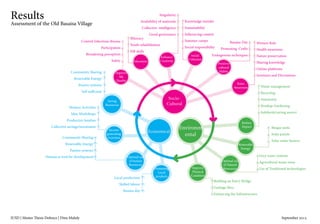
Results
Assessment of the Old Basaisa Village
Socio-
Cultural
Economical
Environm
ental
Education
Raise
Awareness
Reduce
Impact
Renewable
Energy
Optimal use
of Natural
ResourcesImprove
Physical
Condition
Promoting
Local
products
Income
generating
Activities
Saving
Resources
Optimal use
of human
Resources
Social
Cohesion
Preserve
cultural
Habits
Enhance
Creativity
Improve
life
Quality
Illiteracy
Youth rehabilitation
HR skills
Knowledge transfer
Sustainability
Influencing context
Summer camps
Social responsibility
Singularity
Availability of materials
Collective intelligence
Good governance
Basaisa Day
Promoting Crafts
Endogenous techniques
Women Role
Health awareness
Nature preservation
Sharing knowledge
Online platforms
Seminars and Discussions
Waste management
Recycling
Autonomy
Rooftop Gardening
Solidarity(saving assets)
Grey water systems
Agricultural waste reuse
Use of Traditional technologies
Building an Entry Bridge
Garbage Bins
Enhancing the Infrastructure
Biogas units
Solar panels
Solar water heaters
Control Infectious disease
Participation
Broadening perception
Safety
Community Sharing
Renewable Energy
Passive systems
Self sufficient
Women Activities
Men Workshops
Productive families
Collective savings/investment
Community Sharing
Renewable Energy
Passive systems
Human as tool for development
Local production
Skilled labour
Basaisa day
. .
.
.
.
.
...
.
. .
.
. .
.
.
.
.
.
.
.
.
.
.
.
.
.
.
.
.
.
.
.
.
.
.
.
.
.
.
.
.
.
.
.
.
.
.
.
.
.
.
.
IUSD | Master Thesis Defence | Dina Mahdy 															September 2015
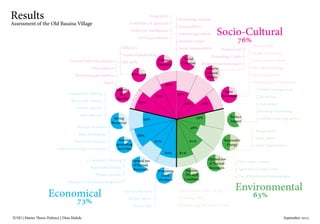
Results
Assessment of the Old Basaisa Village
improve life quality 0.8
0.95
0.8
0.85 15
3.4 85
Education 0.9
0.8
0.6 23.33333
2.3 76.66667
Enhance creativity 0.75
0.7
0.85
0.9 20
3.2 80
Social Cohesion 0.85
0.9
0.2
0.7
0.7 33
3.35 67
Preserve culltural habits 0.6
0.3
0.75 45
1.65 55
Awareness raising 0.85
0.75
0.7
0.7
0.65
0.85 25
4.5 75
Reduce Impact 0.5
0.3
0.85
0.6
0.7 41
Socio-
Cultural
Economical Environmental
Education
Raise
Awareness
Improve
Physical
Condition
Income
generating
Activities
Optimal use
of human
Resources
Preserve
cultural
Habits
Enhance
Creativity
Improve
life
Quality
Knowledge transfer
Sustainability
Influencing context
Summer camps
Social responsibility
.
.
.
.
. Basaisa Day
Promoting Crafts
Endogenous techniques .
.
.
Biogas units
Solar panels
Solar water heaters
.
.
.
Grey water systems
Agricultural waste reuse
Use of Traditional technologies
.
.
.
Building an Entry Bridge
Garbage Bins
Enhancing the Infrastructure
.
.
.
Women Role
Health awareness
Nature preservation
Sharing knowledge
Online platforms
Seminars and Discussions
.
.
.
.
.
.
Waste management
Recycling
Autonomy
Rooftop Gardening
Solidarity(saving assets)
.
.
.
.
.
Control Infectious disease
Participation
Broadening perception
Safety
.
.
.
.
Illiteracy
Youth rehabilitation
HR skills.
.
.
Singularity
Availability of materials
Collective intelligence
Good governance
.
.
.
.
Community Sharing
Renewable Energy
Passive systems
Self sufficient
.
.
.
.
Community Sharing
Renewable Energy
Passive systems
Human as tool for development
.
.
.
.
Local production
Skilled labour
Basaisa day
.
.
.
Reduce
Impact
Renewable
Energy
59%
48%
61%
81%80%
67%
73%
63%
76%
86%
59%
85%
76%
80%
67%
55% 75%
Optimal use
of Natural
Resources
Promoting
Local
Products
Saving
Resources
Social
Cohesion
Women Activities
Men Workshops
Productive families
Collective savings/investment
.
.
.
.
Economical
Environmental
Socio-Cultural
IUSD | Master Thesis Defence | Dina Mahdy 															September 2015
Results
Assessment of the Old Basaisa Village
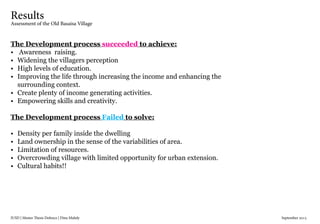
The Development process succeeded to achieve:
•	 Awareness raising.
•	 Widening the villagers perception
•	 High levels of education.
•	 Improving the life through increasing the income and enhancing the
surrounding context.
•	 Create plenty of income generating activities.
•	 Empowering skills and creativity.
The Development process Failed to solve:
•	 Density per family inside the dwelling
•	 Land ownership in the sense of the variabilities of area.
•	 Limitation of resources.
•	 Overcrowding village with limited opportunity for urban extension.
•	 Cultural habits!!
IUSD | Master Thesis Defence | Dina Mahdy 															September 2015
Socio-
Cultural
Economical
Environ
mental
Education
Raise
Awareness
Preserve
Environment
Reduce
Impact
Physical
Context
Use of
Natural
resources
Eco-village
Environmental
Architecture
Income
Generating
Activities
Promoting
Local
products
Mobility
Job
Opportunities
Desert land
Cultivation
Autonomy
Social
Cohesion
Preserve
cultural
Habits
Enhance
Creativity
Improve
life
Quality
Access
to
Services
Planned
Migration
Productive
Community
Construction of new community
Offered land for youth
Training courses
Recreational spaces
NGO outlet
Near by services
Agriculture as the source of income
Promotion of local activities
Link to the Centre
Communal production
Depending on renewable energy
Plantation and cultivation
Shared equipment
Promoting lands at affordable prices
Growing own crops
Self food production
Depending on natural resources
Growing own crops
Self food production
Depending on natural resources
Basaisa day
Promoting the products in the city
Transportation and linkage
Access to the city
Building with local material
Natural lighting and ventilation
Adopting traditional elements
Preserve the environment
Self Sufficient
Operated by Renewable energy
Using Renewable energy
Reducing the buildings impact
Cultivating desert lands
Waste Management
Reducing energy consumption
Eco-Buildings
Autonomy
Solidarity(saving assets)
Planned Layout
Wide streets
Vegetation
Role of the women
Nature preservation
Sharing knowledge
Seminar and guidance
Low tech- Renewable energy
Including traditional elements
Building a Madyafa
Communal Activities
Good governance
Individuality
Availability of services
Planned neighbourhood
Innovative thinking
Individual houses
Safety & protection Workshops
Training classes
Common tools & equipment
Communal house
Creating a residential cluster
Women sewing workshops
Training centres
Promoting local products
Cultivation and equipment
Socio-
Economical
Eco-
economical
Results
Assessment of the New Basaisa Village
IUSD | Master Thesis Defence | Dina Mahdy 															September 2015
Education
Raise
Awareness
Preserve
Environment
Reduce
Impact
Physical
Context
Eco-village
Environmental
Architecture
Job
Opportunities
Autonomy
Recreation
Preserve
cultural
Habits
Construction of new community
Offered land for youth
Training courses
Recreational spaces
NGO outlet
Near by services
Agriculture as the source of income
Promotion of local activities
Link to the Centre
Communal production
Depending on renewable energy
Plantation and cultivation
Shared equipment
Promoting lands at affordable prices
Growing own crops
Self food production
Depending on natural resources
Agricultural land cultivation
Sidr centre
Community centre
Basaisa day
Promoting the products in the city Transportation and linkage
Access to the city
Building with local material
Natural lighting and ventilation
Adopting traditional elements
Preserve the environment
Self Sufficient
Operated by Renewable energy
Using Renewable energy
Reducing the buildings impact
Cultivating desert lands
Waste Management
Reducing energy consumption
Building impacts
Eco-Buildings
Autonomy
Solidarity(saving assets)
Planned Layout
Wide streets
Vegetation
Role of the women
Nature preservation
Sharing knowledge
Seminar and guidance
Low tech- Renewable energy
Including traditional elements
Building a Madyafa
Communal Activities
Good governance
Individuality
Availability of services
Planned neighbourhood
Innovative thinking
Individual houses
Safety & protection Workshops
Training classes
Common tools & equipment
Communal house
Creating a residential cluster
Recreational Spaces
Offered activites
Women sewing workshops
Training centres
Promoting local products
Cultivation and equipment
Improve
life
Quality
80%
30%
86%
78%
75%
73%
30% 85%
81%
60%
Enhance
Creativity
Social
Cohesion
Use of
Natural
resources
85%76%
83%
70%
65%
67%78%83%
80%
76%
33%
85%
Mobility
Promoting
Local
products
Income
Generating
Activities
Desert land
Cultivation
Productive
Community
Access
to
Services
planned
Migration
75% 76%
78%
59%
Economical Eco-Economical
Environmental
Socio-Economical
Socio-Cultural
64%
Results
Assessment of the New Basaisa Village
IUSD | Master Thesis Defence | Dina Mahdy 															September 2015
Results
Assessment of the New Basaisa Village
The New community succeeded to achieve:
•	 Appealing life quality.
•	 Income resources based on Agricultural production.
•	 New enclosed settlement
•	 Planned housing settlement restricted to agreed criteria.
•	 Individuality and privacy.
•	 Decrease density of inhabitants per dwelling
The Development process Failed to solve:
•	 Continue using the renewable energy means
•	 Achieve good levels of social solidarity
•	 Provide services for the inhabitants to attract more villagers
•	 Market and promote for products and crafts.
•	 Achieve over all sustainability of human resources.
IUSD | Master Thesis Defence | Dina Mahdy 															September 2015
Recommendations
On the Micro Scale
•	 Work on empowering the human resources as the key for sustainable development. Involving all
the society categories in the process to create solidarity and knowledge transfer.
•	 Stress on the women role in community production and education which acts as an income
resource from one hand and increase the awareness through the family members.
•	 Working on environmental awareness either by introducing renewable energies as a solution for
energy supplies, or using the context environmental resources such as soil, materials and natural
assets.
•	 Understanding the needs of the people, their daily life pattern and their skills and take those into
consideration during the planning phase of a new community. Besides involving the people in a
participatory planning phase for setting the objectives and communal aims.
•	 Minimize the number of stake holders and beneficiary groups in the sense of not involving too
many different agendas on the same project level to overcome complex under-crossing aims.
IUSD | Master Thesis Defence | Dina Mahdy 															September 2015
Recommendations
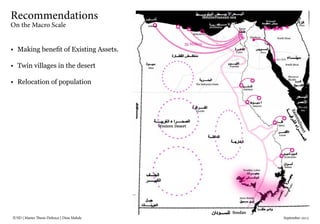
On the Macro Scale
•	 Making benefit of Existing Assets.
•	 Twin villages in the desert
•	 Relocation of population
IUSD | Master Thesis Defence | Dina Mahdy 															September 2015
Thank you for Listening

presentation 10092015

  • 1.
    IUSD | MasterThesis Defence | Dina Mahdy September 2015 Dynamics of Development in Rural Egypt to new Desert Communities: The Case of the Basaisa
  • 2.
    IUSD | MasterThesis Defence | Dina Mahdy September 2015 Keywords: Community development: The process for improving the quality of life of communities, which according to social science Several types of communities have been identified: community as a place, community as relationships, and community as collective political power (Suttles 1972) 1 . Rural village/community: a form of social group, organized according to historically determined norms, of families tied to the land. These basic groups have collective or individual rights and ownership which vary according to their social structure. They are tied by collective rulesand traditions that are so complex and has historical roots (Lefevre 1970)2 . 1 Suttles, G. D. (1972). The social construction of community. Chicago: University of ChicagoPress. 2 Lefevre, H. (1970). Du rural a l'urbain. . The University of Minnestoat
  • 3.
    IUSD | MasterThesis Defence | Dina Mahdy September 2015 Context Sharkeya Governorate
  • 4.
    IUSD | MasterThesis Defence | Dina Mahdy September 2015 1861
  • 5.
    IUSD | MasterThesis Defence | Dina Mahdy September 2015 Some years Later 25 25 25 25 25
  • 6.
    IUSD | MasterThesis Defence | Dina Mahdy September 2015 1972 62 320 5Fed
  • 7.
    IUSD | MasterThesis Defence | Dina Mahdy September 2015 Village Problems
  • 8.
    IUSD | MasterThesis Defence | Dina Mahdy September 2015 Rural Egypt Background and problems Employment in | Rural Lands | Rural population | Value added | crop land Agriculture to GDP • Agriculture vs Industry: • Internal Migration Rates vs Unemployment: rural urban 1 2 27% 3.6% 57% 1 2 29% 1 2 22% Source: Statistics according to the world bank 2013 Source: Beshal, Adel A. Development in the age of liberalization Egypt and Mexico. Edited by Dan Tscirgi. cairo Egypt: AUCpress, 1996. 70's 70's80's 80's90's 90's2000's 2000's X X X X Industry Growth Agriculture Growth Internal Migration Unemployment X X X X 2000's 2000's70's 70's80's 80's90's 90's X X X X X X X X
  • 9.
    IUSD | MasterThesis Defence | Dina Mahdy September 2015 • Desert Development Implementation of new cities 10th of Ramadan 1976 Toushka Development corridorNew Farafra Suggested National project • Rural Development Rural Egypt Solution and initiatives
  • 10.
    IUSD | MasterThesis Defence | Dina Mahdy September 2015 Prof. Salah Arafa Rural Development | Basaisa Project Aims and Objectives • Founding an agricultural based productive community, self sufficient in terms of the use local resources. • Making use of new and appropriate technologies and renewable energy while insuring the protection of the environment and preserving the values and cultural traditions of the society. • Encouraging youth emigration to the desert, creating job opportunities away from the densely populated narrow valley. • Productive human settlement that is working on reclamation and cultivation of the desert lands. • Desert housing construction adopting renewable energy technologies and apply the concepts of economical building techniques following vernacular, environmentally friendly architecture (apply zero energy housing concepts). • Building up a living model for organized internal migration and desert reclamation (redistribution of population).
  • 11.
    IUSD | MasterThesis Defence | Dina Mahdy September 2015 Rural Development | Basaisa Project Methodology • Providing an adequate level of awareness, education, and training in technologically and economically viable development strategies for desert communities, with special reference to renewable energies and irrigation techniques, as well as to habitats and environmental protection technologies. • Intensive training courses oriented to practical hands-on workshops to train local cadres who are interested in new technologies and renewable energies. • Open dialogues with beneficiaries, education, participatory planning, cooperation in production, good governance and building up local financing systems. • Structured program and modules, providing the participants with basic knowledge and information on the different fields of interest to desert community development.
  • 12.
    IUSD | MasterThesis Defence | Dina Mahdy September 2015 Rural Development Activities 1974-1982 Al Madyafa Tailoring Workshop for ladies Awareness and education sessions PV cells ClinicCarpentry and metal workshop
  • 13.
    IUSD | MasterThesis Defence | Dina Mahdy September 2015 Rural Development Founding the CDA Village condition Biogas Loans Carpentry and metal workshop Kindergarten Classes
  • 14.
    IUSD | MasterThesis Defence | Dina Mahdy September 2015 Rural Development >>>> Desert Development 1991 Sharing ideas with the leader IncomeLand Dreams Solutions Freedom New LifeIndependence New Desert Community
  • 15.
    IUSD | MasterThesis Defence | Dina Mahdy September 2015 Context South Sinai
  • 16.
    IUSD | MasterThesis Defence | Dina Mahdy September 2015 Rural Development >>>> Desert Development 1991 Sinai BedouinAhmad Ibrahim Money Power Green Knowledge Sinai Bedouin Land Security Cultivation Renewable Energy Income gen. Production
  • 17.
    IUSD | MasterThesis Defence | Dina Mahdy September 2015 Rural Development >>>> Desert Development 1992 Land Cultivation Production Technology and energy Land registration & sales Announcement Desert land for sale
  • 18.
    IUSD | MasterThesis Defence | Dina Mahdy September 2015 Rural Development >>>> Desert Development 1992 Migration of 28 young graduates Communal House
  • 19.
    IUSD | MasterThesis Defence | Dina Mahdy September 2015 Rural Development >>>> Desert Development 1992 Investors Funding organization
  • 20.
    IUSD | MasterThesis Defence | Dina Mahdy September 2015 Desert Development 1992 - 1994 Investors Cultivation Investment Community The new settlement
  • 21.
    IUSD | MasterThesis Defence | Dina Mahdy September 2015 Desert Development The new Basaisa 2000 CDA Communal house Environmentally friendly houses Agricultural land divided from 5-10 Feddans
  • 22.
    IUSD | MasterThesis Defence | Dina Mahdy September 2015 Desert Development The new Basaisa Now Land Cultivation either by owners or workers Village Mosque Communal House CDA & training centre
  • 23.
    IUSD | MasterThesis Defence | Dina Mahdy September 2015 • Understand the development dynamics of constructing a new desert community coming from rural grass- roots. • Identify the incentives of moving (planned internal migration) from the Nile valley to desert. • Survey all the aspects which acted as the driving forces behind planned migration to a twin village and documenting them in the sense of connecting all the threads together from the old ,the new village and the development plan and methodology. • Aiming to developing a set of guidelines and recommendations to contribute in the development process of initiating new satellite desert communities, specifically experiments based on the twinning concept of planned migration of the same community. The objectives to achieve the aim • Study the Basaisa from the field of urban planning in the sense of carrying out a survey to identify the spatial distribution of activities,resources in relation to the infrastructure, urbanized zone, agricultural lands and context. • Understand the development process taken over in the Old Basaisa village that lead to the turning point of extension. • Investigate the Methodology of the team and its application in both destinations. • Understand the mobilization of the new community in relation to their origin, their new life, their dreams and what is actually on ground. • Assess the success of both development strategies and the development level based on the aims and objects achieved, leading to a complete documentation of the whole experiment highlighting the scenarios and what affected to either success or failure in reference to the project objectives. Research Aims
  • 24.
    IUSD | MasterThesis Defence | Dina Mahdy September 2015 • What was the development project aims, goals and methodology in 1974 (start of the project in the old village)? How did the team approach and influence the community? What was the village status Quo at that time in comparison to today? • The methodology that resulted in mobilizing the whole community within different categories, interests and age groups creating a new community in a desert. • What were the driving forces that attracted the people to initiate a new community in the desert? • How was the new Basaisa village born? The dream that combines different interest groups together to share one idea? • What is the connection between the old and the new Basaisa villages now? • When creating a new satellite community that is a twin to an existing (rural) community what are the main aspects that control the dynamics and mobilization of the members that has to be taken into consideration? Research Questions >> Methodology
  • 25.
    IUSD | MasterThesis Defence | Dina Mahdy September 2015 • The research is an exploratory research as it wants to gain more on site investigation based on analysing the dynamics of development and the process of mobilizing the community to develop a new desert village. Due to the research limitations the study will be based on qualitative primary resources. Research Methodology
  • 26.
    IUSD | MasterThesis Defence | Dina Mahdy September 2015 Results Assessment of the Old Basaisa Village Socio- Cultural Economical Environm ental Education Raise Awareness Reduce Impact Renewable Energy Optimal use of Natural ResourcesImprove Physical Condition Promoting Local products Income generating Activities Saving Resources Optimal use of human Resources Social Cohesion Preserve cultural Habits Enhance Creativity Improve life Quality Illiteracy Youth rehabilitation HR skills Knowledge transfer Sustainability Influencing context Summer camps Social responsibility Singularity Availability of materials Collective intelligence Good governance Basaisa Day Promoting Crafts Endogenous techniques Women Role Health awareness Nature preservation Sharing knowledge Online platforms Seminars and Discussions Waste management Recycling Autonomy Rooftop Gardening Solidarity(saving assets) Grey water systems Agricultural waste reuse Use of Traditional technologies Building an Entry Bridge Garbage Bins Enhancing the Infrastructure Biogas units Solar panels Solar water heaters Control Infectious disease Participation Broadening perception Safety Community Sharing Renewable Energy Passive systems Self sufficient Women Activities Men Workshops Productive families Collective savings/investment Community Sharing Renewable Energy Passive systems Human as tool for development Local production Skilled labour Basaisa day . . . . . . ... . . . . . . . . . . . . . . . . . . . . . . . . . . . . . . . . . . . . . . . . . . . . .
  • 27.
    IUSD | MasterThesis Defence | Dina Mahdy September 2015 Results Assessment of the Old Basaisa Village improve life quality 0.8 0.95 0.8 0.85 15 3.4 85 Education 0.9 0.8 0.6 23.33333 2.3 76.66667 Enhance creativity 0.75 0.7 0.85 0.9 20 3.2 80 Social Cohesion 0.85 0.9 0.2 0.7 0.7 33 3.35 67 Preserve culltural habits 0.6 0.3 0.75 45 1.65 55 Awareness raising 0.85 0.75 0.7 0.7 0.65 0.85 25 4.5 75 Reduce Impact 0.5 0.3 0.85 0.6 0.7 41 Socio- Cultural Economical Environmental Education Raise Awareness Improve Physical Condition Income generating Activities Optimal use of human Resources Preserve cultural Habits Enhance Creativity Improve life Quality Knowledge transfer Sustainability Influencing context Summer camps Social responsibility . . . . . Basaisa Day Promoting Crafts Endogenous techniques . . . Biogas units Solar panels Solar water heaters . . . Grey water systems Agricultural waste reuse Use of Traditional technologies . . . Building an Entry Bridge Garbage Bins Enhancing the Infrastructure . . . Women Role Health awareness Nature preservation Sharing knowledge Online platforms Seminars and Discussions . . . . . . Waste management Recycling Autonomy Rooftop Gardening Solidarity(saving assets) . . . . . Control Infectious disease Participation Broadening perception Safety . . . . Illiteracy Youth rehabilitation HR skills. . . Singularity Availability of materials Collective intelligence Good governance . . . . Community Sharing Renewable Energy Passive systems Self sufficient . . . . Community Sharing Renewable Energy Passive systems Human as tool for development . . . . Local production Skilled labour Basaisa day . . . Reduce Impact Renewable Energy 59% 48% 61% 81%80% 67% 73% 63% 76% 86% 59% 85% 76% 80% 67% 55% 75% Optimal use of Natural Resources Promoting Local Products Saving Resources Social Cohesion Women Activities Men Workshops Productive families Collective savings/investment . . . . Economical Environmental Socio-Cultural
  • 28.
    IUSD | MasterThesis Defence | Dina Mahdy September 2015 Results Assessment of the Old Basaisa Village The Development process succeeded to achieve: • Awareness raising. • Widening the villagers perception • High levels of education. • Improving the life through increasing the income and enhancing the surrounding context. • Create plenty of income generating activities. • Empowering skills and creativity. The Development process Failed to solve: • Density per family inside the dwelling • Land ownership in the sense of the variabilities of area. • Limitation of resources. • Overcrowding village with limited opportunity for urban extension. • Cultural habits!!
  • 29.
    IUSD | MasterThesis Defence | Dina Mahdy September 2015 Socio- Cultural Economical Environ mental Education Raise Awareness Preserve Environment Reduce Impact Physical Context Use of Natural resources Eco-village Environmental Architecture Income Generating Activities Promoting Local products Mobility Job Opportunities Desert land Cultivation Autonomy Social Cohesion Preserve cultural Habits Enhance Creativity Improve life Quality Access to Services Planned Migration Productive Community Construction of new community Offered land for youth Training courses Recreational spaces NGO outlet Near by services Agriculture as the source of income Promotion of local activities Link to the Centre Communal production Depending on renewable energy Plantation and cultivation Shared equipment Promoting lands at affordable prices Growing own crops Self food production Depending on natural resources Growing own crops Self food production Depending on natural resources Basaisa day Promoting the products in the city Transportation and linkage Access to the city Building with local material Natural lighting and ventilation Adopting traditional elements Preserve the environment Self Sufficient Operated by Renewable energy Using Renewable energy Reducing the buildings impact Cultivating desert lands Waste Management Reducing energy consumption Eco-Buildings Autonomy Solidarity(saving assets) Planned Layout Wide streets Vegetation Role of the women Nature preservation Sharing knowledge Seminar and guidance Low tech- Renewable energy Including traditional elements Building a Madyafa Communal Activities Good governance Individuality Availability of services Planned neighbourhood Innovative thinking Individual houses Safety & protection Workshops Training classes Common tools & equipment Communal house Creating a residential cluster Women sewing workshops Training centres Promoting local products Cultivation and equipment Socio- Economical Eco- economical Results Assessment of the New Basaisa Village
  • 30.
    IUSD | MasterThesis Defence | Dina Mahdy September 2015 Education Raise Awareness Preserve Environment Reduce Impact Physical Context Eco-village Environmental Architecture Job Opportunities Autonomy Recreation Preserve cultural Habits Construction of new community Offered land for youth Training courses Recreational spaces NGO outlet Near by services Agriculture as the source of income Promotion of local activities Link to the Centre Communal production Depending on renewable energy Plantation and cultivation Shared equipment Promoting lands at affordable prices Growing own crops Self food production Depending on natural resources Agricultural land cultivation Sidr centre Community centre Basaisa day Promoting the products in the city Transportation and linkage Access to the city Building with local material Natural lighting and ventilation Adopting traditional elements Preserve the environment Self Sufficient Operated by Renewable energy Using Renewable energy Reducing the buildings impact Cultivating desert lands Waste Management Reducing energy consumption Building impacts Eco-Buildings Autonomy Solidarity(saving assets) Planned Layout Wide streets Vegetation Role of the women Nature preservation Sharing knowledge Seminar and guidance Low tech- Renewable energy Including traditional elements Building a Madyafa Communal Activities Good governance Individuality Availability of services Planned neighbourhood Innovative thinking Individual houses Safety & protection Workshops Training classes Common tools & equipment Communal house Creating a residential cluster Recreational Spaces Offered activites Women sewing workshops Training centres Promoting local products Cultivation and equipment Improve life Quality 80% 30% 86% 78% 75% 73% 30% 85% 81% 60% Enhance Creativity Social Cohesion Use of Natural resources 85%76% 83% 70% 65% 67%78%83% 80% 76% 33% 85% Mobility Promoting Local products Income Generating Activities Desert land Cultivation Productive Community Access to Services planned Migration 75% 76% 78% 59% Economical Eco-Economical Environmental Socio-Economical Socio-Cultural 64% Results Assessment of the New Basaisa Village
  • 31.
    IUSD | MasterThesis Defence | Dina Mahdy September 2015 Results Assessment of the New Basaisa Village The New community succeeded to achieve: • Appealing life quality. • Income resources based on Agricultural production. • New enclosed settlement • Planned housing settlement restricted to agreed criteria. • Individuality and privacy. • Decrease density of inhabitants per dwelling The Development process Failed to solve: • Continue using the renewable energy means • Achieve good levels of social solidarity • Provide services for the inhabitants to attract more villagers • Market and promote for products and crafts. • Achieve over all sustainability of human resources.
  • 32.
    IUSD | MasterThesis Defence | Dina Mahdy September 2015 Recommendations On the Micro Scale • Work on empowering the human resources as the key for sustainable development. Involving all the society categories in the process to create solidarity and knowledge transfer. • Stress on the women role in community production and education which acts as an income resource from one hand and increase the awareness through the family members. • Working on environmental awareness either by introducing renewable energies as a solution for energy supplies, or using the context environmental resources such as soil, materials and natural assets. • Understanding the needs of the people, their daily life pattern and their skills and take those into consideration during the planning phase of a new community. Besides involving the people in a participatory planning phase for setting the objectives and communal aims. • Minimize the number of stake holders and beneficiary groups in the sense of not involving too many different agendas on the same project level to overcome complex under-crossing aims.
  • 33.
    IUSD | MasterThesis Defence | Dina Mahdy September 2015 Recommendations On the Macro Scale • Making benefit of Existing Assets. • Twin villages in the desert • Relocation of population
  • 34.
    IUSD | MasterThesis Defence | Dina Mahdy September 2015 Thank you for Listening