INVESTIGATINGTHEINFLUENCE OF ADVERTISINGWITHIN VIDEO-GAMESON CONSUMER PURCHASE INTENTIONS
1 | P a g e
Investigating the Influence of
Advertising within
Video-Games on Consumer
Purchase Intentions
Tony Paul Harper
A report presented in the
Faculty of Health and Life
Sciences, Coventry University,
towards the degree of Bachelor
of Science with Honours in
Psychology
28th
April 2014
INVESTIGATINGTHEINFLUENCE OF ADVERTISINGWITHIN VIDEO-GAMESON CONSUMER PURCHASE INTENTIONS
2 | P a g e
Table of Contents
Acknowledgements ………......................................................................................................4
Abstract …...………………….................................................................................................5
Introduction ………………………………………………………………………………….6
An Introduction to Advertising and the Video-Game Industry ………………………………6
The Effectiveness of In-Game Advertising ………………………………………………….10
Building Upon the Findings of Contemporary Research ……………………………………13
Protagonist Immersement ……………………………………………………………………16
Realism as a Contributing Factor ……………………………………………………………17
Justification for the Current Study …………………………………………………………..19
Research Question and Hypothesis ………………………………………………………….21
Method ………………………………………………………………………………………21
Pre-test …………………………………………………...………………………………….22
Design ………………………………………………………………………………………..22
Participants …………………………………………………………………………………..22
Materials ……………………………………………………………………………………..22
Procedure …………………………………………………………………………………….23
Main Study …………………………………………………………………………………..24
Design ………………………………………………………………………………………..24
Participants …………………………………………………………………………………..24
Materials ……………………………………………………………………………………..25
Brand Purchase Intentions Questionnaire ...………………………………………………...25
Buffer Gender Differences Questionnaire …………………………………………………...26
Real Aims Questionnaire …………………………………………………………………….26
Procedure …………………………………………………………………………………….26
INVESTIGATINGTHEINFLUENCE OF ADVERTISINGWITHIN VIDEO-GAMESON CONSUMER PURCHASE INTENTIONS
3 | P a g e
Results …...………………………………………………………………………………….28
Hypothesis 1 …………………………………………………………………………………28
Hypothesis 2 …………………………………………………………………………………31
Hypothesis 3 …………………………………………………………………………………33
Power Analysis ………………………………………………………………………………34
Discussion …………………………………………………………………………………...34
References …...……………………………………………………………………………...42
Appendices ………………………………………………………………………………….51
Appendix 1 …………………………………………………………………………………..51
Appendix 2 …………………………………………………………………………………..52
Appendix 3 …………………………………………………………………………………..56
Appendix 4 …………………………………………………………………………………..59
Appendix 5 …………………………………………………………………………………..71
Appendix 6 …………………………………………………………………………………..74
Appendix 7 …………………………………………………………………………………..75
INVESTIGATINGTHEINFLUENCE OF ADVERTISINGWITHIN VIDEO-GAMESON CONSUMER PURCHASE INTENTIONS
4 | P a g e
Acknowledgements
I would like to take this opportunity to thank my supervisor, Dr. David Hughes, for
taking the time out of his busy schedule to support me through the process of writing up this
dissertation project, both in person and through e-mail. His enthusiastic approach and
insightful knowledge of psychology has truly aided my scholarly development.
I would also like to express my appreciation for the job that Dr. Charlotte Hilton has
carried out as leader of the independent research module. Her ability to successfully cope
with the demands of managing such a large body of students is genuinely commendable.
Thank you to Mrs. Susie Wilson, who has consistently been on hand to let me into the
laboratory, throughout the data collecting aspect of this dissertation project; always with a
smile on her face may I add.
I am also very grateful to Dr. Andy Johnson for his guidance on data analysis using
SPSS; this helped to make my life a lot easier.
I would like to state my gratitude to Coventry University for the outstanding modern
facilities available to the students.
Another big thank you goes out to Mr. Iain Harper and Midlands Power & Motion
who funded the printing costs of this dissertation project.
For everybody who took part in my study as a participant, I would like to extend an
enormous thank you. Without you this dissertation project would have not been possible.
Lastly, I offer the biggest thank you of all to my Grandmother, Mrs. Susan Huxtable,
who has believed in me from the beginning. She has frequently offered encouragement and
words of wisdom which have inspired me to never stop striving for success.
INVESTIGATINGTHEINFLUENCE OF ADVERTISINGWITHIN VIDEO-GAMESON CONSUMER PURCHASE INTENTIONS
5 | P a g e
Abstract
The current study looked into the effect that advertisements within video-games can
have on consumer purchase intentions. There has been sparse research into this topic area,
especially when it comes to measuring purchase intentions. It is hoped that the current study
can help to fill the void through use of a shrewd methodology. A between-participants design
was utilised in which 41 university students were randomly divided into either the FIFA 12
(advertisements present) or Pure Football (no advertisements present) condition. Participants
completed a 15-minute game playing session before completing a brand purchase intentions
questionnaire. Constant sum scaling was used to measure purchase intentions, wherein
participants had to divide 100 points between 4 brands (1 in-game, 3 out-game). This ensured
they would have to think about their decisions, enhancing the validity of the results, as this
thought process is representative of a real-life experience when deciding how to spend one’s
money (Louviere and Islam 2008). Original theoretical proposals were also investigated, such
as whether brands associated with the participant-controlled team will score higher purchase
intention scores than those associated with the opposing computer-controlled team. Results
indicated a non-significant difference between purchase intention scores of in-game and
out-game brands, however in-game brand EA was shown to score significantly higher than all
3 of its rival out-game brands through virtual hoarding advertisement. Theoretical
implications for advertisement companies who could shape their advertisement campaigns
around the methods shown to best enhance brand purchase intentions.
Keywords: brand, purchase intentions, in-game advertisement, video-games, constant sum
scaling
INVESTIGATINGTHEINFLUENCE OF ADVERTISINGWITHIN VIDEO-GAMESON CONSUMER PURCHASE INTENTIONS
6 | P a g e
To what extent does advertising within video-games affect
the brand purchase intentions of the gamers?
An Introduction to Advertising and the Video-Game Industry
Video-gaming is not a new phenomenon, with the first video-games appearing in the
1970s (Dill and Thill 2007). The commercial prominence of the video-gaming industry has
rocketed within the past decade however due to the vast number of readily available games
containing photorealistic graphics unimaginable 25 years ago (Aoyama and Izushi 2003).
During a time period where social media has enjoyed a major surge in popularity worldwide
(Kaplan and Haenlein 2010); the development of interactive online gaming has probably been
the leading factor in this substantial expansion (Marchand and Hennig-Thurau 2013). Recent
research has supported the success of the video-game market after suggesting that more
Americans opt to play video-games ahead of going to the cinema (Marchland and
Hennig-Thurau 2013: 141) and watching television (Cuneo 2004).
As a result of this mainstream popularity, the video-gaming industry is now a
multi-billion dollar business that spans worldwide (Swann 2002). Indeed, video-games,
consoles, and software accounted for $81.8 billion worth of sales across the world in 2012
(Marchand and Hennig-Thurau 2013). The Electronic Software Association (ESA) found that
in 1996 video-game sales accounted for $3 billion (ESA 2004), whereas 2012 sales amounted
to $14.8 billion (ESA 2013). This huge increase highlights just how far the video-game
market has intensified. Wade and Beck (2006) reported that 50% of all Americans play
video-games on a regular basis, while Vorderer and Bryant (2006) reported that up to 75% of
Americans play some variety of video-game every day. This, along with the fact that
video-games appear to be the fastest growing form of mass media worldwide has attracted the
attention of some of the world’s leading corporations, intent on evading competition currently
INVESTIGATINGTHEINFLUENCE OF ADVERTISINGWITHIN VIDEO-GAMESON CONSUMER PURCHASE INTENTIONS
7 | P a g e
filling the more conventional variations of media (Nelson 2002).
Although the average gamer falls into the 18-35 year old demographic (Glass 2007),
individuals of all ages have been found to regularly play video games. The ESA (2011)
declared that 29% of those playing video-games in America are over the age of 50, whereas
Rideout, Vandewater, and Wartella (2003) discovered that 49% of 0-6 year old American
children have a games console within their home. In addition, the structure of the
video-gaming population is not as radically dominated by males as commonly believed
(Vorderer and Bryant 2006). The ESA (2013) reinforce this after stating that 45% of all
gamers are female. Based on these statistics, it could be suggested that by integrating
advertisements into video-games, a wide male and female audience of all ages are likely to be
reached. Further evidence for this is provided after discovering that the average US
household contains at least one regularly used games console (ESA 2013), giving
organisations a potential target range of over half of the American population1. Assuming
in-game advertising is an effective publicity technique in positively increasing the brand
preference of those playing the game, then the probability of gaining an advantage over
business rivals through elevated sales could be considerable enhanced.
Product placement within video-games can be described as an integration of a
branded product into the game with the purpose of favourably influencing the gamer’s brand
awareness, preference and purchase intentions (Avery and Ferraro 2000; Hudson and Hudson
2006; Nelson 2002; Pechmann and Shih 1999; and Russell 2002). In-game advertising as an
umbrella term refers to any method of increasing brand awareness within a video-game, with
the intention of enhancing sale figures. This could be through the use of product placement or
something as straightforward as promoting their brand on an in-game billboard (Nelson,
1 It has been acknowledged that the majority of research cited within this introduction to advertising and the
video-gaming industry has originated from the US. After a thorough literature review, it appeared that there was
a shortage of UK-based research regarding the trends and figures of the video-gaming industry.Due to such
literature not being readily available; US-based studies have been used in their place as the American population
can generally be considered as generalisable to that of the UK (Garcia-Closas et al. 2006).
INVESTIGATINGTHEINFLUENCE OF ADVERTISINGWITHIN VIDEO-GAMESON CONSUMER PURCHASE INTENTIONS
8 | P a g e
Keumb, and Yarosc 2004).
From the in your face McDonald’s on the moon in Lunar Lander (Digital Equipment
Incorporated 1973) to Chupa Chups repetitively appearing in the background of Zool
(Gremlin Graphics 1992) advertising and product placement within video-games is not a new
marketing strategy by any means (Angelides and Agius 2014). The growth of the video-game
industry however, has led to a radically enhanced utilisation of this practice over the last
decade from a serious business standpoint in games of all genres, spanning every platform
(Nelson, Keumb, and Yarosc 2004). Nonetheless, the question remains as to whether in-game
advertising plays an effective role in the brand preference and purchasing behaviour of those
targeted (Acara 2007).
Product placements and advertisements have been shown to work in alternate forms
of entertainment such as films and television (Karrh, McKee, and Pardun 2003; Law and
Braun 2000). One of the most notable examples occurs within the film E.T. the
Extra-Terrestrial (Spielberg, 1982) where product placement was used to promote Reese’s
Pieces. Post-film sales of the chocolate increased by 66% within the first month, highlighting
the major impact advertising brands appropriately within mainstream media can have (Gurses
and Okan 2014). Due to its relatively recent rise to prominence, in-game advertising has been
scarcely studied in comparison to the effects of advertising within other major media forms
(Yang et al. 2006). This is supported by Tiwsakul, Hackley, and Szmigin (2005: 95) who
argue the need for further research into the topic after describing how “the rapid increase in
the volume and variety of product placement approaches has outpaced research in the field”.
Marchand and Hennig-Thurau (2013: 141) reinforce this after proposing that despite the
video-game industry now being recognised as an established “contributor to the global
entertainment economy”, academics have failed to conceptualise the value of in-game
advertising on the marketing landscape.
INVESTIGATINGTHEINFLUENCE OF ADVERTISINGWITHIN VIDEO-GAMESON CONSUMER PURCHASE INTENTIONS
9 | P a g e
Based upon the rapid increase in video-gaming as a global mainstream pastime
(Kaplan and Haenlein 2010; Nelson 2002) and the fact that it is now a multi-billion dollar
industry (Marchand and Hennig-Thurau 2013), it is of great importance to large-scale
organisations that they gain an enhanced understanding of the effectiveness of in-game
advertising (Nelson, Keumb, and Yarosc 2004). How, when, and where they should promote
their product within a game is also of substantial magnitude (Glass 2007; Russell 2002). This
can be the difference between investing vast sums of money into brand advertisement with
little reward and utilising a smart and cost-effective advertising method resulting in lucrative
profit (Di Cesare 2005). Despite this, there has been relatively little research into in-game
advertising compared with other core forms of media (Yang et al. 2006). It is for this reason
that the current study has been conducted.
The current study investigated the extent to which advertising within video-games
affected the brand purchase intentions of the gamers. Participants were randomly allocated
into one of two conditions. Condition A; in which they played FIFA 12 (EA 2011); a football
video-game where a number of in-game advertisements are present or Condition B, a control
group in which participants played Pure Football (Ubisoft 2010); a football video-game
where there is no advertising is present. They were deceived as to the real aims of the study,
being told the current study was investigating gender differences within video-games, in an
attempt to ensure that they did not answer in a way that they believed the investigator wanted
them to. Participants played a gaming session of 15-minutes before being given the purchase
intentions questionnaire to fill out (described as distractor task), as well as a gender
differences buffer questionnaire. Within the purchase intentions questionnaire, participants
were asked to allocate 100 points between the four brands listed in each category, based on
how likely they would be to purchase each of the brands in the future. This acted as the
method of operationalising the brand purchase intentions of the participants.
INVESTIGATINGTHEINFLUENCE OF ADVERTISINGWITHIN VIDEO-GAMESON CONSUMER PURCHASE INTENTIONS
10 | P a g e
The Effectiveness of In-Game Advertising
Nelson (2002) conducted a study in which 20 participants took part in a 15-minute
playing session on car racing game Grand Turismo 2 (Polyphony Digital 1999). The game
comprised of many background advertisements (e.g. billboards), as well as featuring various
motor oil, tyre, and car brands. To ensure the study was conducted in as natural an
environment as possible, participants were offered the chance to invite up to two friends to
join them. This, along with the fact that the room had been set out with comfy sofas and
snacks, considerably enhanced the realism of the study and consequently yielded results more
applicable to the real-world (Nelson 2002).
The results support the idea that gamers are aware of in-game advertising after finding
that every participant listed at least 1 in-game brand, with 95% recalling the brand of the car
they had selected. An average of 4.53 in-game brands were recalled directly after playing the
game. After a 5-month delay however, no participant recalled more than 2 in-game brands
and not a single participant recalled the brand of the car they were driving. This suggests that
although in-game brands remain in the players’ short-term memory, they can fade from the
memory in the long-term. A regular video-gamer will receive consistent and longitudinal
exposure (30 hour shelf-life) to such advertisements however, which will considerably
enhance the likelihood of the individual recollecting the brands. The current study built upon
the conclusion that gamers are consciously aware of in-game advertising and aimed to find
whether or not this recognition lead to enhanced brand purchase intentions. Due to time
restrictions however, the current study did not address the longitudinal prevalence of these
purchase intentions, as participants were only subject to the in-game content for 15 minutes.
Zhang, Trail, and Lutz (2008) carried out research similar to the current study in
which participants were randomly assigned to either an advertising or control condition. Both
conditions involved the participants playing a sports video-game, with the only difference
INVESTIGATINGTHEINFLUENCE OF ADVERTISINGWITHIN VIDEO-GAMESON CONSUMER PURCHASE INTENTIONS
11 | P a g e
being whether the game incorporated advertisements or not. Brand awareness, attitude, and
purchase intentions were measured through the use of a questionnaire. The results confirmed
that those within the advertising condition had a significantly greater mean brand awareness
score than those in the control group. Mean brand attitudes and purchase intention scores did
not differ to a significant level however, suggesting that although in-game advertising could
be deemed a valuable method of increasing brand awareness, it does not necessarily lead to
increased brand attitudes or subsequent purchase intentions.
Research conducted by The Nielson Company (2010), on behalf of Electronic Arts
(EA), contradicts this on the other hand, after finding a 24% increase in the amount of money
spent on Gatorade before and after individuals were exposed to the in-game advertisement of
the brand. A number of EA video-game titles contained Gatorade advertisements in the form
of players’ water bottles, arena signs, and score updates, including NBA Live 07 (EA 2006),
NBA Live 08 (EA 2007), NBA Live 09 (EA 2008), NBA Street Homecourt (EA 2007), NHL
09 (EA 2008), and NHL 2010 (EA 2009). Over 100,000 households were used as part of the
study which examined the average amount of money each household spent on Gatorade
before and after owning a copy of at least one of the specified EA titles.
Chaney, Lin, and Chaney (2004) aimed to find out just how much of an impact
embedded billboards have on the online gamer. Forty-two participants aged 16-45 from all
demographics were invited to play a 15-minute first-person shooter online gaming session
from the comfort of their own home via an online gaming website. The game contained
various billboards advertising real-life brands. After the online gaming session had ended,
participants completed a questionnaire regarding the billboard content. The findings revealed
that 50% of the participants failed to recall any of the brands advertised on the billboards,
suggesting that perhaps billboard advertising within video-games is not a particularly
effective method of targeting an audience. This could be due to the fact that
INVESTIGATINGTHEINFLUENCE OF ADVERTISINGWITHIN VIDEO-GAMESON CONSUMER PURCHASE INTENTIONS
12 | P a g e
first-person shooter games require the player to concentrate a lot more compared to other
game genres however. Participants’ reasons for failing to acknowledge the billboard brands
included being “too focused”, “too busy killing”, and “in the zone” (Chaney, Lin, and Chaney
2004: 42). This doesn’t necessarily mean that billboard advertising is completely ineffective;
though it could propose that first-person shooter games are not the best game genre for such
advertising campaigns. The study gained qualitative data by asking the participants why they
believed they failed to notice the advertisements, which advertising companies could use to
formulate intuitive methods of combating potential obstacles in the future. The findings of
Chaney, Lin, and Chaney (2004) were important to the current study as the current study
looked into was whether billboard/hoarding advertisements are an effective means of
developing purchase intentions within sports video-games, or whether this form of
advertising is also unsuccessful within games of a sporting genre.
The 2009 US presidential elections certainly highlighted the extent to which in-game
advertising is being utilised as a serious method of raising awareness (Hendricks and Denton
2010). Presidential candidate Barrack Obama was the face of one of the most innovative
advertising campaigns in election history, as he became the first ever candidate to promote
their campaign within the video-game environment (Hendricks and Denton 2010; Sudweeks,
Hrachovec, and Ess 2010). Virtual billboard space was utilised around the race tracks in
Burnout Paradise (Electronic Arts 2008) promoting Obama’s policies and encouraging the
individuals playing the game to vote Obama (Hendricks and Denton 2010). Obama went on
to win the election and whilst it can only be speculated as to the effect that this unprecedented
move had on his eventual success, it was noted that the voting process saw the third largest
youth turn-out in election history (Hendricks and Denton 2010; Sudweeks, Hrachovec, and
Ess 2010). Whether this phenomenon was a result of Obama’s choice to advertise his
capabilities within the video-game environment can only be estimated, as correlation does not
INVESTIGATINGTHEINFLUENCE OF ADVERTISINGWITHIN VIDEO-GAMESON CONSUMER PURCHASE INTENTIONS
13 | P a g e
necessarily mean causation. Regardless, this was a decision that gained the attention of the
world’s leading advertising companies and illustrated just how seriously in-game advertising
opportunities are being taken from a major business standpoint (Hendricks and Denton 2010).
Building Upon the Findings of Contemporary Research
Glass (2007) endeavoured to establish the efficiency of video-game product
placement on the brand attitudes of video-gamers. An initial online questionnaire was
conducted to ensure only the brands closest in rating to the in-game brands would be used
within the main study. This preliminary test helped to enhance the validity of results as it
allowed for a direct comparison between the in-game brands and their closest out-game
rivals, in terms of consumer popularity. The probability of a significant result occurring based
solely on prior general attitudes towards the brands, a type II error, was therefore
considerably reduced. The brands comprising the main questionnaire of the current study
were selected based on a similar pre-test, in which participants rated brands based on their
personal preference for them. The closest matching brands, in terms of preference, to the
in-game brands were subsequently chosen to assemble a total of four brands within each
category of the questionnaire.
Twenty-eight participants (17 male and 11 female American university students) took
part in the main study (Glass 2007). They were given 5 minutes to play Fight Night Round 3,
a boxing video-game on the Xbox 360. The generic sequence during this period involved the
in-game advertising of various brands (e.g. their fighter was outfitted in Under Armor attire,
with the Burger King mascot as their promoter). After the allotted period of play participants
completed an Implicit Associations Test (IAT; Greenwald, McGhee, and Schwartz 1998) in
which they had to rate brands as either good or bad as they flashed up on a computer screen
(Glass 2007).
INVESTIGATINGTHEINFLUENCE OF ADVERTISINGWITHIN VIDEO-GAMESON CONSUMER PURCHASE INTENTIONS
14 | P a g e
The results found that in-game brands were put into the good category significantly
faster than the brands not included in the game, leading Glass (2007) to conclude that
participants had a significant preference for the in-game brands compared to those not
advertised within the game. This proposes that organisations should take in-game advertising
seriously as a prospective method of increasing their brand preference among those playing
the game.
The fact that the in-game brands were assigned to the good category faster than the
out-game brands does not necessarily suggest a heightened brand preference for these labels
however. Regardless of how long it took, the participants can hardly be seen to favour one
brand over another if they were both categorised into the same category. It could be argued
this method of operationalising brand preference is actually measuring speed of brand
recognition and, as such, the current study will implement a method of measuring brand
purchase intentions. Constant sum scaling was used in which participants were asked to
divide 100 points between the four brands present within each category of the questionnaire,
based upon the likelihood of them purchasing this brand in the future. This method of
operationalising purchase intentions could be seen as being much more representative of a
real-life decision that the participants may have to make and, thus, the validity of the results
should be amplified (Carrington, Neville, and Whitwell 2010). The use of constant sum
scaling allowed for a clear comparison of the in-game and out-game purchase intentions of
the participants. This is supported by Wright, Sharp, and Sharp (2002) who reported the
usefulness of constant sum scaling as a tool in operationalising the real-life purchase
intentions of participants.
Another potential methodological flaw is that the participants may have been able to
guess the aims of Glass (2007). Although they were deceived as to the aims of the study, only
eight brands were used in the main portion of the data collection, four of which appeared
INVESTIGATINGTHEINFLUENCE OF ADVERTISINGWITHIN VIDEO-GAMESON CONSUMER PURCHASE INTENTIONS
15 | P a g e
within the game. This could have enhanced the chances of the participants figuring out of the
genuine intentions of the study. In an attempt to reduce this possibility, the current study also
deceived the participants as to the real objectives. Participants were told that the purpose of
the current study was to measure gender differences within video-games. It has been shown
that when an individual is representing their gender in a competitive environment they will be
more emotionally motivated and focused on doing well (Gneezy, Niederle, and Rustichini
2003), reducing the likelihood of them figuring out the intention of the current study. In
addition, the purchase intentions questionnaire contained 48 brands, 7 of which appeared
within the video-game. This radically reduced the likelihood of the participants predicting
that this questionnaire is actually looking into the effects of in-game advertising on their
purchase intentions. Furthermore, a buffer questionnaire, compiled of questions relating to
gender differences, was distributed at the same time as the brand purchase intentions
questionnaire to further mirror that of which would be expected within a study looking into
gender differences. Consequently, the answers given by the participants should have
represented their genuine opinions and not have been influenced by how they believed the
investigator would have wanted them to answer. The validity and real life-applications of the
results can therefore be seen as being enhanced.
Glass (2007) is an important piece of research because it focuses on the contemporary
underpinnings of modern advertising and has a unique methodology that will act as a great
building block for the current study. By utilising the successful procedural principles from
Glass (2007) and inputting fresh ideas to improve the aspects that could have been seen as
limitations, the results found in the current study should have high internal validity.
In the upcoming sections the key contributing factors that influence the effectiveness
of in-game advertisements are discussed. Protagonist immersement, video-game genre, and
realism of the advertisements are among the aspects that advertising organisations must
INVESTIGATINGTHEINFLUENCE OF ADVERTISINGWITHIN VIDEO-GAMESON CONSUMER PURCHASE INTENTIONS
16 | P a g e
consider before selecting their method of raising brand awareness. These are discussed in
more detail within the forthcoming sections.
Protagonist Immersement
An individual’s brand inclination has been found to enhance when associated with
favourable lead character(s) within films and TV shows. This relationship is intensified when
the individual is emotionally invested in what they are watching. Russell and Stern (2006)
provide evidence for this in their study looking into consumer attitudes towards product
placements within televised sitcoms. Attitude and parasocial attachment towards the
character were found to be the main two contributing factors when it came to distinguishing
how successful a product placement association would be in terms of enhancing brand
preference. In other words, the stronger the viewer’s feelings towards the character, the more
intensified their positive feelings towards the related advertised label.
One of the most notable examples of this relationship within a film setting was in E.T.
the Extra-Terrestrial (Spielberg 1982) where product placement was used to promote Reese’s
Pieces (Gurses and Okan 2014). Viewers were revealed to have had strong emotional bonds
to the main cast of the film, most of whom chose Reese’s Pieces as their treat of choice
throughout the film (Gurses and Okan 2014). Not only did the brand preference amplify as a
result, but so did purchasing behaviour. Sales figures increased by 66% within the first month
of the film being released, highlighting the major impact associating product placement with
highly loved characters can have on the success of a brand (Gurses and Okan 2014).
Glass (2007) supports this relationship within video-games after suggesting the
significant results found within his study could be attributed to the fact that the participants
felt immersed with the character they were controlling. They may have consequently
experienced somewhat of an emotional bond with this character leading to the favouring of
INVESTIGATINGTHEINFLUENCE OF ADVERTISINGWITHIN VIDEO-GAMESON CONSUMER PURCHASE INTENTIONS
17 | P a g e
the associated brands in real life. This is reinforced by Nelson (2002) who also proposed a
positive correlation between in-game advertising and favourable brand opinions when
associated with the lead protagonist. These findings have important real-world applications as
they have helped to inform businesses of the best methods of enhancing gamer opinions of
their brand for the better. Advertising agencies should ensure that they centre the association
of their product around the protagonist character to enhance the emotional ties to their brand
and thus strengthening the probability of increased purchase intentions. Using video-game
characters to facilitate the endorsement of a brand is the virtual equivalent of recruiting a
well-known and esteemed celebrity in the advertising process (Haugtvedt, Machleit, and
Yalch 2005).
The evidence from Glass (2007); Gurses and Okan (2014); Nelson (2002); and
Russell and Stern (2006) underlines the importance of how aligning a brand with the central
protagonist characters in films, TV, and video-games can enhance brand preference. Gamers
tend to become engrossed with the character they are controlling, leading to a strong
emotional bond and an increased likelihood of them following their characters’ brand choices
(Glass 2007; Nelson 2002). The current study aimed to test whether this pattern was the same
when playing as a team within a sports video-game by comparing the in-game kit
manufacturer associated with the team the participant will be controlling against the kit
manufacturer of the opposing team.
Realism as a Contributing Factor
The realism of in-game advertisements and product placements has consistently been
reported as a principal factor in its success. Nelson, Keumb, and Yarosc (2004) report the
qualitative opinions of gamers’ attitudes towards in-game advertisements. Gamers were
found to be generally fond of advertisements that add reality to their gaming experience, as
INVESTIGATINGTHEINFLUENCE OF ADVERTISINGWITHIN VIDEO-GAMESON CONSUMER PURCHASE INTENTIONS
18 | P a g e
long as they “stay in the background” and “don’t impede on or control” the gameplay or level
in any way (Nelson, Keumb, and Yarosc 2004: 3). Advertisements that were deemed realistic
to the game’s environment were found to enhance brand preference, whereas advertisements
deemed non-realistic to the game’s environment potentially hindered brand feelings (Nelson,
Keumb, and Yarosc 2004). This suggests that businesses need to be careful when deciding
which specific game(s) to have their brand publicised within, as well as which particular
levels/areas of the game, and what form the marketing their label is going to adopt within the
virtual world. Clever advertising can radically benefit sales figures, whereas poor decision
making can cause negative brand feelings, impeding the probability of gaining new
customers. Di Cesare (2005) supports this after stating that “if the marketing message
interrupts players’ immersion or makes the experience seem less realistic, the advertiser has
failed” (Di Cesare 2005: 5), whereas Lewis and Porter (2010) state that irrelevant
advertisements annoy players, especially when poorly coordinated with the game
environment.
Based on the findings of Di Cesare (2005); Lewis and Porter (2010); and Nelson,
Keumb, and Yarosc (2004), FIFA 12 (EA 2011) was chosen as the video-game that the
participants in condition A were to play. The advertisements incorporated within the game
are among the most representative of real-life advertisements available on any games console
(Consalvo, Mitgutsch, and Stein 2013) and, as such, FIFA 12 (EA 2011) was a perfect choice
for the current study.
Russell (2002: 307) reports that “too much repetition” is also a frequently stated
irritation by gamers in regards to in-game advertisements. Overly repetitive advertisements
can lead to reduced brand preference, which is something advertisers must consider when
pushing for advertising space within video-games. Recent advancements in video-game
online capabilities has allowed for dynamic advertising which allow for time-sensitive
INVESTIGATINGTHEINFLUENCE OF ADVERTISINGWITHIN VIDEO-GAMESON CONSUMER PURCHASE INTENTIONS
19 | P a g e
campaigns however (Ng and Wiemer-Hastings 2005). This can reduce the obstacle of
repetition as organisations can alter their advertising designs throughout their campaign
which will help to reduce the feeling of tedium associated with repetitive methods. This not
only benefits the gamer, but allows businesses more freedom when choosing when to
advertise their label. They do not need to have advertisements completed months / years
before the release of a game and can freely alter the design of their publicity strategy, as well
as the product being advertised. This advantage reduces the risk of a company investing a
huge amount of money into an advertisement that may well become outdated by the time the
video-game is released, or within a short period afterwards. Furthermore, if sales have not
increased by a profitable margin then organisations can choose not to renew their contract.
Connecting the findings of Russell (2002) and Nelson, Keumb, and Yarosc (2004),
this dynamic approach to marketing can majorly add to the realism of a video-game.
Hoardings within sports games and billboards in most other genres of video-game can be
edited freely to keep up with the latest releases and marketing campaigns of brands. With
in-game advertisements no longer becoming outdated; the realism of promotions within these
virtual worlds can almost be seen as mirroring that of real-life. Based on this, the results of
the current study’s investigation into whether in-game hoardings are an effective method of
advertising a brand could have important implications as to whether organisations should
utilise this method of advertising in the future.
Justification for the Current Study
Due to its relatively recent rise to prominence, in-game advertising has been scarcely
studied in comparison to the effects of advertising within other major media forms (Tiwsakul,
Hackley, and Szmigin 2005). The current study aimed to bolster the research looking into the
effect advertisements within video-games can have on brand preference and purchase
INVESTIGATINGTHEINFLUENCE OF ADVERTISINGWITHIN VIDEO-GAMESON CONSUMER PURCHASE INTENTIONS
20 | P a g e
intentions.
Numerous studies have found a significant positive relationship between in-game
advertising and brand awareness and/or brand preference (Glass 2007; Nelson 2002; Winkler
and Buckner 2006); relatively few have focused on the resulting buying potential however.
The current study intends on focusing specifically on purchase intentions as this is after all,
the purpose of advertising (Eichner and Maronick 2001).
Brand association with a leading character in TV, films, and more recently
video-games has been shown to enhance preference for that label (Glass 2007; Gurses and
Okan 2014; Nelson 2002; Russell and Stern 2006). The current study is investigating whether
this trend is evident when the gamer is controlling a team rather than a single protagonist, by
comparing the kit manufacturer associated with team they will be controlling to the kit
manufacturer of the computer-controlled opposing team.
The current study utilised a unique methodology compared to any previous research
and could provide important findings that could aid businesses looking to advertise within
sporting video-games in the future. The participants were deceived as to the aims of the study
by being told that it was investigating gender differences within video-games. Gneezy,
Niederle, and Rustichini (2003) explain how when an individual is representing their gender
in a competitive situation they will generally possess an added motivation to do well.
Consequently, the individuals should be entirely focused on succeeding within the game
playing situation, which would be representative of how an individual would usually play a
video-game in a real-life setting. Accordingly, the results could be considered of high
mundane realism. Furthermore, only 7 of the 48 brands featured within the purchase
intentions questionnaire were represented within FIFA 12 (EA 2011) radically reducing the
probability of the participants guessing the aims of the study.
The findings of the current study should also give fellow academics the impetus to
INVESTIGATINGTHEINFLUENCE OF ADVERTISINGWITHIN VIDEO-GAMESON CONSUMER PURCHASE INTENTIONS
21 | P a g e
build upon the results and conduct their own research to further strengthen the quantity of
literature regarding the effectiveness of in-game advertising on purchase intentions.
ResearchQuestion and Hypotheses
The current study will be looking to investigate the following research question: to
what extent does advertising within video-games affect the brand purchase intentions of the
gamers?
Hypothesis 1 - The participants in condition A (FIFA 12) will allocate more points to the
in-game brands represented in FIFA 12 (EA 2011) than the brands not represented within the
game on the constant sum scaling brand purchase intentions questionnaire.
Hypothesis 2 - The participants in Condition A (FIFA 12) will allocate more points to the
in-game brands represented within FIFA 12 (EA 2011) than the participants in Condition B
(Pure Football) on the constant sum scaling brand purchase intentions questionnaire.
Hypothesis 3 - The participants in Condition A (FIFA 12) will allocate more points to the
in-game brand directly associated with the team they are controlling (Puma) than the brand
directly associated with the team they are playing against (Adidas) on the constant sum
scaling brand purchase intentions questionnaire.
Method
Prior to the current study being conducted, a pre-test was carried out in an attempt to
establish the brands that would be included within the current study. Consequently, two
methods will be reported within this section.
INVESTIGATINGTHEINFLUENCE OF ADVERTISINGWITHIN VIDEO-GAMESON CONSUMER PURCHASE INTENTIONS
22 | P a g e
Pre-test
Design
The pre-test used a quantitative questionnaire that consisted of 6 sections, each
containing 8 brands which participants had to rate between 1 (very poor) and 10 (very good)
based on their opinion of the brands.
Participants
The pre-test sample consisted of 20 participants (13 male and 7 female) all of whom
were undergraduate students at Coventry University. Participants were aged between 19 and
23 years, giving an age range of 4 years. Their mean age was 20.85 years, with males
averaging 20.92 and females 20.71. All participants volunteered to take part after opportunity
sampling was used to recruit them. They were stopped and asked whether they wanted to take
part in the Coventry city centre. Informed consent was gained from all participants before
they took part in the questionnaire.
Materials
The pre-test used a quantitative questionnaire that consisted of 6 sections, each
containing 8 brands which participants had to rate on a Likert-scale between 1 (very poor)
and 10 (very good) based on their opinion of the brands. An example statement is “Please
rate the following sportswear / sport equipment manufacturers using the scale below by
circling the number you feel best represents your opinion of the brand”.
Procedure
The pre-test was submitted to the Coventry University Ethics Committee and ethical
approval was subsequently granted (see Appendix 1).
INVESTIGATINGTHEINFLUENCE OF ADVERTISINGWITHIN VIDEO-GAMESON CONSUMER PURCHASE INTENTIONS
23 | P a g e
Participants were approached in the street and asked whether they would take part in
the pre-test questionnaire. Those who agreed were given a participant information sheet that
explained what they would be required to do alongside an informed consent form.
Participants were given as long as they needed to read through the sheets and were given a
brief verbal overview of the study by the investigator upon completely reading through the
sheets. Once participants had signed the informed consent form they were reminded of their
right to withdraw at any point during the study and up to 48 hours afterwards and that they
were under no obligation to take part.
Next, they were given the questionnaire and allocated as long as they needed to
complete the ratings of all of the brands. In general, it took around 10 minutes for participants
to finish the questionnaire.
Participants were subsequently given a debrief sheet to read through as well as a
verbal debrief from the investigator, who also offered the chance for the participants to ask
any questions regarding the questionnaire, aims, or upcoming main study. Once all queries
had been answered participants were reminded of their right to withdraw and thanked for
their time and informed that the study had been completed.
The means of each of the brands were taken and the closest matching out-game
brands, in terms of brand preference score, to the in-game brand(s) were selected. This
produced a total of 4 brands within each brand category.
Main Study
Design
This study utilised an experimental between participants design and consisted of
independent (whether in-game advertising was present or not) and dependant (brand purchase
intentions) variables.
INVESTIGATINGTHEINFLUENCE OF ADVERTISINGWITHIN VIDEO-GAMESON CONSUMER PURCHASE INTENTIONS
24 | P a g e
There were two independent conditions. Condition A; in which participants played
FIFA 12 (EA 2011); a football video-game where in-game advertisements are present and
condition B; in which participants played Pure Football (Ubisoft 2010); a football
video-game completely free of in-game advertisements. The main objective of the current
study was to examine the effect that in-game advertisements can have on the brand purchase
intentions of the gamers.
A potential extraneous variable may have been the previous brand preferences of the
participants. The current study attempted to control this however, through the use of the most
similarly rated brands in terms of popularity (previously determined based on the results of
the pre-test).
Participants
The sample of the current study consisted of 41 participants (18 male and 23 female)
all of whom were undergraduate students at Coventry University. Participants were aged
between 19 and 34, giving an age range of 15 years. Their mean age was 21.48, with males
averaging 21.95 and females 21.09. All participants volunteered to take part after signing up
via participant recruitment website Sona. This method of gaining participants was utilised as
first and second year students of Coventry University require research participation credits to
progress to their final year. As such, this gave me the opportunity to reward them with a
portion of these credits in return for their participation. Informed consent was gained from all
participants before they took part in the current study.
Materials
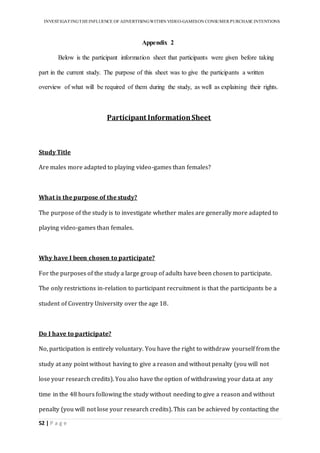
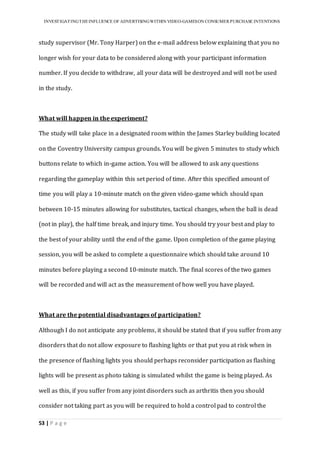
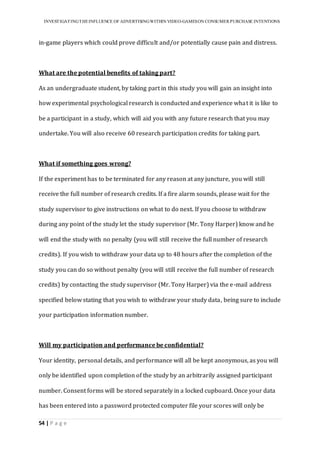
The main study consists of a(n) participant information sheet (see Appendix 2),
informed consent sheet (see Appendix 3), Xbox 360 games console, Xbox 360 control-pad,
INVESTIGATINGTHEINFLUENCE OF ADVERTISINGWITHIN VIDEO-GAMESON CONSUMER PURCHASE INTENTIONS
25 | P a g e
FIFA 12 (Xbox 360 video-game), FIFA 12 game manual, Pure Football (Xbox 360
video-game), Pure Football game manual, HDMI Cable, HD Projector, stool, debrief sheet
(see Appendix 7), and 3 questionnaires that will each be discussed in more detail in upcoming
individual sections.
Brand Purchase Intentions Questionnaire
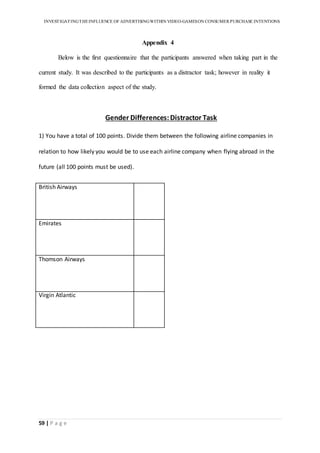
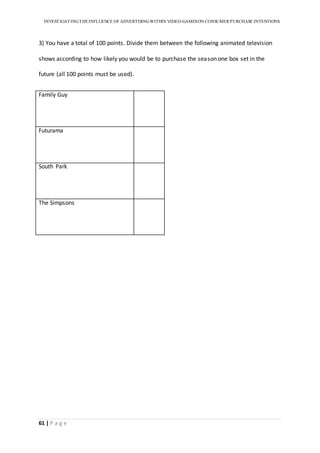
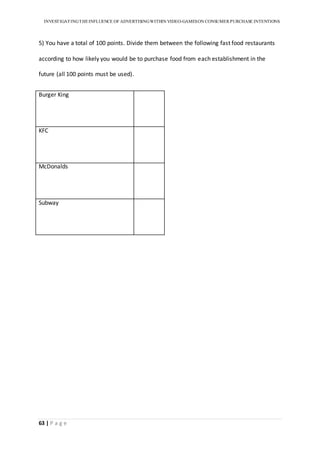
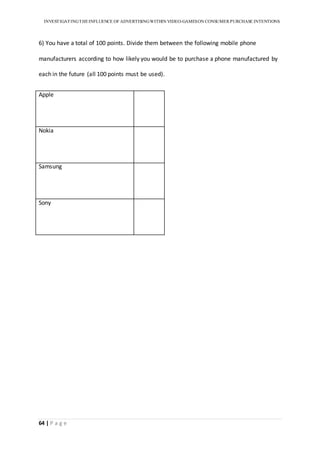
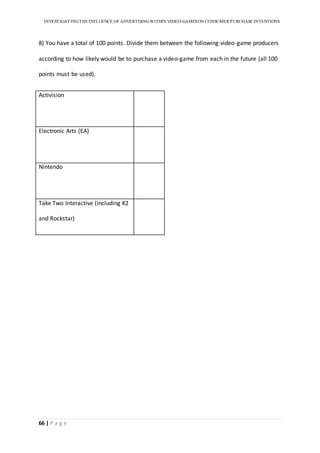
The brand purchase intentions questionnaire (see Appendix 4), labelled as “Gender
Differences: Distractor Task” for the purposes of deception, aimed to operationalise the brand
purchase intentions of the participants. It was the first questionnaire that the participants
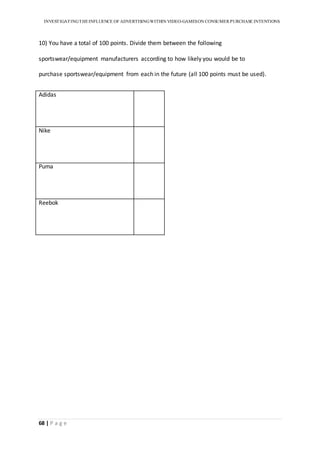
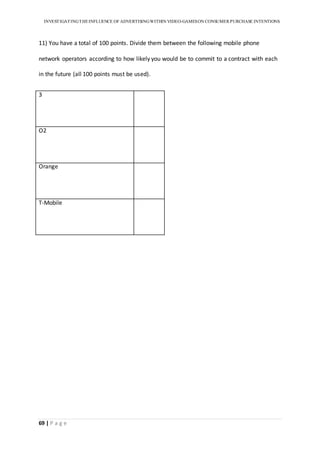
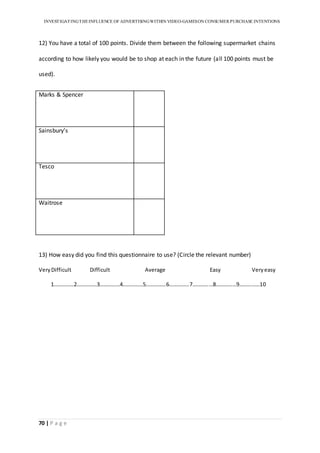
completed and consisted of 13 questions. The first 12 utilised constant sum scaling, in which
the participants were to allocate 100 points between the four brands within each brand
category, based upon their likelihood of purchasing each in the future. The thirteenth question
used a 10-point Likert-scale that measured how easy the participants found the questionnaire
to use. The questionnaire comprised of a total of 48 brands, 7 of which were represented
within FIFA 12 (EA 2011). Of the first 12 questions, 6 were relevant to the research question
in that they contained at least 1 of the in-game brands, whereas the other 6 acted as buffer
questions. An example question was “You have a total of 100 points. Divide them between
the following airline companies in relation to how likely you would be to use each airline
company when flying abroad in the future”. The participants then had to allocate the points
between “British Airways”, “Emirates”, “Thomson Airways”, and “Virgin Atlantic”.
Gender Differences Questionnaire
The gender differences questionnaire (see Appendix 5) was distributed at the same
time as the brand purchase intentions questionnaire, however participants were instructed to
fill it out after completion of the purchase intentions questionnaire. The gender differences
INVESTIGATINGTHEINFLUENCE OF ADVERTISINGWITHIN VIDEO-GAMESON CONSUMER PURCHASE INTENTIONS
26 | P a g e
questionnaire acted as a buffer questionnaire to help disguise the real aims of the study. It
consisted of 7 qualitative questions, with an example being “How many hours, on average, do
you spend playing video-games per week (to the nearest hour)?”.
Real Aims Questionnaire
The real aims questionnaire (see Appendix 6) comprised of a solitary qualitative
question that asked whether the participants had any idea of the real aims of the study whilst
taking part. It was used as a method of deciphering whether any data should be disregarded
within the analyses process. Participants answered this questionnaire once the study had been
completed and they had received a written and verbal debrief. The question was as follows
“Did you honestly know the real aims of this study whilst taking part?”.
Procedure
The current study was submitted to the Coventry University Ethics Committee and
ethical approval was subsequently granted (see Appendix 1).
Participants took part in the main study one at a time, with the condition that they
were assigned to being randomly generated using the random generator available on
RANDOM.ORG (2011) before they entered the laboratory. It was set to randomly produce a
number between 1 and 2, with 1 placing participants into condition A and 2 placing
participants into condition B.
The game was loaded up by the investigator and placed on the match start-up screen,
ensuring all the modes and team selections / strips were set to the pre-determined controlled
settings. This was important in making certain that participants do not see any additional
advertising in comparison to every other participant.
Upon participants entering they were asked to sit down and make themselves
INVESTIGATINGTHEINFLUENCE OF ADVERTISINGWITHIN VIDEO-GAMESON CONSUMER PURCHASE INTENTIONS
27 | P a g e
comfortable before being given the participant information sheet that explained what they
would be required to do, alongside an informed consent form. Participants were given as long
as they needed to read through the sheets and were given an accompanying brief verbal
overview of the study by the investigator after reading through the sheets. Participants were
reminded that they were under no obligation to take part and that they could withdraw at any
point during the study. Participants were deceived as to the real aims of the study as to not
alter the way that they would normally play the game and so that the consequential
questionnaire was answered honestly. They were told that the aim of the study was measuring
whether males were generally more adapted to playing video-games than females. Once,
participants had signed the informed consent form the study could officially begin.
Participants were told to sit in a comfortable position facing the screen on which the
game was projected. They were then given up 5 minutes to read through the instruction
manual, before being told to play the video-game to the best of their ability. Participants were
allowed to talk to the investigator if they so wished as to make them feel more relaxed,
attempting to create an atmosphere more closely related to a natural environment.
Upon completing one match of virtual football, that took approximately 15 minutes,
participants were given the brand purchase intentions questionnaire (disguised as “Gender
Differences: Distractor Task”) and the gender differences questionnaire. Participants were
told to complete the “Distractor Task” first, followed by the geneder differences
questionnaire. It was explained to participants that the distractor task would act as a
distraction and that their ability to remember the buttons in the (fictional) second game would
be recorded. They took around 5-10 minutes to answer this questionnaire, before
subsequently completing the gender differences questionnaire in around 2 minutes.
Once both questionnaires had been completed, participants were informed of the real
aims of the study. A verbal debrief was given by the investigator, alongside a written debrief
INVESTIGATINGTHEINFLUENCE OF ADVERTISINGWITHIN VIDEO-GAMESON CONSUMER PURCHASE INTENTIONS
28 | P a g e
and participants were reminded of their right to withdraw immediately or up to 48 hours upon
leaving the laboratory. Lastly, it was requested that participants answer one more question
regarding whether they had any idea of the true aims of the study whilst taking part. After
they had given a response they were thanked for their time and informed that the study was
over. The data collected within the study was subsequently statistically analysed, ensuring
appropriate parametric assumptions were met, using IBM SPSS Statistics 20 to test the
hypotheses.
Results
Hypothesis 1
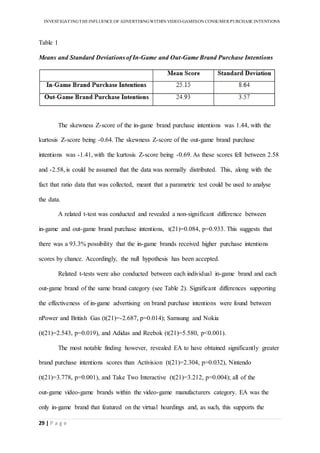
The mean in-game brand purchase intentions score given by participants was 25.15;
compared to a mean out-game brand purchase intentions score of 24.93 (see Table 1). Given
that the maximum score a participant could have allocated to each brand was 100, a mean
score of 25.15 for the in-game brands and 24.93 for the out-game brands, suggests that the
participants generally distributed the 100 point maximum evenly between the four potential
brands, regardless of whether the brand was represented within FIFA 12 (EA 2011) or not.
The standard deviation of the in-game brand purchase intention scores was 8.64, in
contrast to the standard deviation of the out-game brand purchase intention scores which was
3.57 (see Table 1). This showed that the in-game brand scores were subject to heightened
distribution than the scores given to the out-game brands.
INVESTIGATINGTHEINFLUENCE OF ADVERTISINGWITHIN VIDEO-GAMESON CONSUMER PURCHASE INTENTIONS
29 | P a g e
Table 1
Means and Standard Deviations of In-Game and Out-Game Brand Purchase Intentions
The skewness Z-score of the in-game brand purchase intentions was 1.44, with the
kurtosis Z-score being -0.64. The skewness Z-score of the out-game brand purchase
intentions was -1.41, with the kurtosis Z-score being -0.69. As these scores fell between 2.58
and -2.58, is could be assumed that the data was normally distributed. This, along with the
fact that ratio data that was collected, meant that a parametric test could be used to analyse
the data.
A related t-test was conducted and revealed a non-significant difference between
in-game and out-game brand purchase intentions, t(21)=0.084, p=0.933. This suggests that
there was a 93.3% possibility that the in-game brands received higher purchase intentions
scores by chance. Accordingly, the null hypothesis has been accepted.
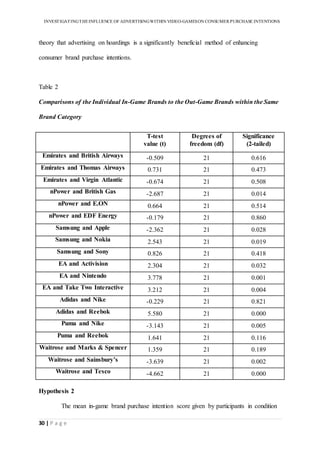
Related t-tests were also conducted between each individual in-game brand and each
out-game brand of the same brand category (see Table 2). Significant differences supporting
the effectiveness of in-game advertising on brand purchase intentions were found between
nPower and British Gas (t(21)=-2.687, p=0.014); Samsung and Nokia
(t(21)=2.543, p=0.019), and Adidas and Reebok (t(21)=5.580, p<0.001).
The most notable finding however, revealed EA to have obtained significantly greater
brand purchase intentions scores than Activision (t(21)=2.304, p=0.032), Nintendo
(t(21)=3.778, p=0.001), and Take Two Interactive (t(21)=3.212, p=0.004); all of the
out-game video-game brands within the video-game manufacturers category. EA was the
only in-game brand that featured on the virtual hoardings and, as such, this supports the
INVESTIGATINGTHEINFLUENCE OF ADVERTISINGWITHIN VIDEO-GAMESON CONSUMER PURCHASE INTENTIONS
30 | P a g e
theory that advertising on hoardings is a significantly beneficial method of enhancing
consumer brand purchase intentions.
Table 2
Comparisons of the Individual In-Game Brands to the Out-Game Brands within the Same
Brand Category
T-test
value (t)
Degrees of
freedom (df)
Significance
(2-tailed)
Emirates and British Airways -0.509 21 0.616
Emirates and Thomas Airways 0.731 21 0.473
Emirates and Virgin Atlantic -0.674 21 0.508
nPower and British Gas -2.687 21 0.014
nPower and E.ON 0.664 21 0.514
nPower and EDF Energy -0.179 21 0.860
Samsung and Apple -2.362 21 0.028
Samsung and Nokia 2.543 21 0.019
Samsung and Sony 0.826 21 0.418
EA and Activision 2.304 21 0.032
EA and Nintendo 3.778 21 0.001
EA and Take Two Interactive 3.212 21 0.004
Adidas and Nike -0.229 21 0.821
Adidas and Reebok 5.580 21 0.000
Puma and Nike -3.143 21 0.005
Puma and Reebok 1.641 21 0.116
Waitrose and Marks & Spencer 1.359 21 0.189
Waitrose and Sainsbury’s -3.639 21 0.002
Waitrose and Tesco -4.662 21 0.000
Hypothesis 2
The mean in-game brand purchase intention score given by participants in condition
INVESTIGATINGTHEINFLUENCE OF ADVERTISINGWITHIN VIDEO-GAMESON CONSUMER PURCHASE INTENTIONS
31 | P a g e
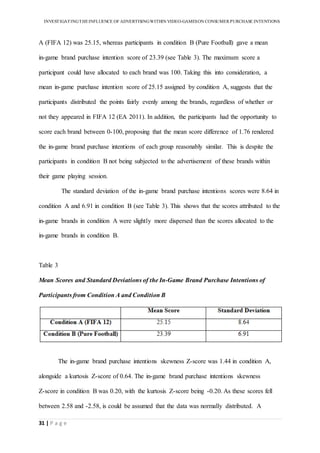
A (FIFA 12) was 25.15, whereas participants in condition B (Pure Football) gave a mean
in-game brand purchase intention score of 23.39 (see Table 3). The maximum score a
participant could have allocated to each brand was 100. Taking this into consideration, a
mean in-game purchase intention score of 25.15 assigned by condition A, suggests that the
participants distributed the points fairly evenly among the brands, regardless of whether or
not they appeared in FIFA 12 (EA 2011). In addition, the participants had the opportunity to
score each brand between 0-100, proposing that the mean score difference of 1.76 rendered
the in-game brand purchase intentions of each group reasonably similar. This is despite the
participants in condition B not being subjected to the advertisement of these brands within
their game playing session.
The standard deviation of the in-game brand purchase intentions scores were 8.64 in
condition A and 6.91 in condition B (see Table 3). This shows that the scores attributed to the
in-game brands in condition A were slightly more dispersed than the scores allocated to the
in-game brands in condition B.
Table 3
Mean Scores and Standard Deviations of the In-Game Brand Purchase Intentions of
Participants from Condition A and Condition B
The in-game brand purchase intentions skewness Z-score was 1.44 in condition A,
alongside a kurtosis Z-score of 0.64. The in-game brand purchase intentions skewness
Z-score in condition B was 0.20, with the kurtosis Z-score being -0.20. As these scores fell
between 2.58 and -2.58, is could be assumed that the data was normally distributed. A
INVESTIGATINGTHEINFLUENCE OF ADVERTISINGWITHIN VIDEO-GAMESON CONSUMER PURCHASE INTENTIONS
32 | P a g e
Levene’s Test was conducted and found equal variance, F=1.462, p=0.234, meaning
homogeneity of variance could be assumed. Ratio data was also collected, which allowed for
the use of a parametric test in the data analysis process.
An unrelated t-test was conducted and revealed a non-significant difference between
the in-game brand purchase intentions of the participants in condition A and B,
t(39)=0.711, p=0.481. This suggests that there was a 51.9% possibility that the differences
between the in-game brand purchase intentions between the groups were a consequence of
chance. Accordingly, the null hypothesis has been accepted.
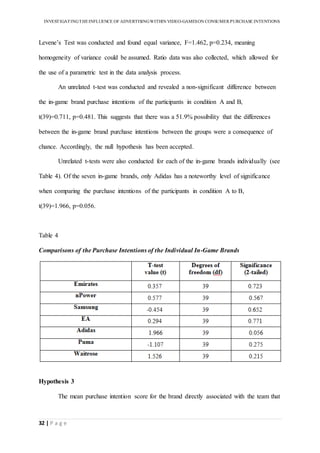
Unrelated t-tests were also conducted for each of the in-game brands individually (see
Table 4). Of the seven in-game brands, only Adidas has a noteworthy level of significance
when comparing the purchase intentions of the participants in condition A to B,
t(39)=1.966, p=0.056.
Table 4
Comparisons of the Purchase Intentions of the Individual In-Game Brands
Hypothesis 3
The mean purchase intention score for the brand directly associated with the team that
INVESTIGATINGTHEINFLUENCE OF ADVERTISINGWITHIN VIDEO-GAMESON CONSUMER PURCHASE INTENTIONS
33 | P a g e
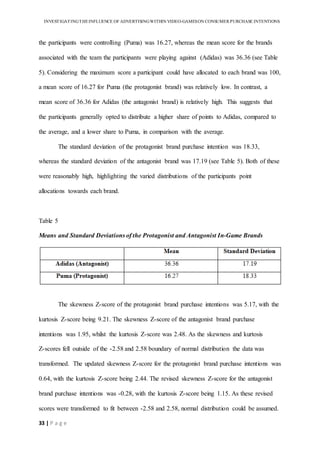
the participants were controlling (Puma) was 16.27, whereas the mean score for the brands
associated with the team the participants were playing against (Adidas) was 36.36 (see Table
5). Considering the maximum score a participant could have allocated to each brand was 100,
a mean score of 16.27 for Puma (the protagonist brand) was relatively low. In contrast, a
mean score of 36.36 for Adidas (the antagonist brand) is relatively high. This suggests that
the participants generally opted to distribute a higher share of points to Adidas, compared to
the average, and a lower share to Puma, in comparison with the average.
The standard deviation of the protagonist brand purchase intention was 18.33,
whereas the standard deviation of the antagonist brand was 17.19 (see Table 5). Both of these
were reasonably high, highlighting the varied distributions of the participants point
allocations towards each brand.
Table 5
Means and Standard Deviations of the Protagonist and Antagonist In-Game Brands
The skewness Z-score of the protagonist brand purchase intentions was 5.17, with the
kurtosis Z-score being 9.21. The skewness Z-score of the antagonist brand purchase
intentions was 1.95, whilst the kurtosis Z-score was 2.48. As the skewness and kurtosis
Z-scores fell outside of the -2.58 and 2.58 boundary of normal distribution the data was
transformed. The updated skewness Z-score for the protagonist brand purchase intentions was
0.64, with the kurtosis Z-score being 2.44. The revised skewness Z-score for the antagonist
brand purchase intentions was -0.28, with the kurtosis Z-score being 1.15. As these revised
scores were transformed to fit between -2.58 and 2.58, normal distribution could be assumed.
INVESTIGATINGTHEINFLUENCE OF ADVERTISINGWITHIN VIDEO-GAMESON CONSUMER PURCHASE INTENTIONS
34 | P a g e
A related t-test was conducted and revealed a strong significant difference between
the two brands, with Adidas receiving significantly higher purchase intention scores,
t(21)=-3.587, p=0.002. Despite a significant difference being observed; the direction of the
outcome was opposite to the hypothesis and consequently, the null hypothesis has been
accepted.
Power Analysis
Post hoc power analysis was conducted using GPower (Erdfelder, Faul, and Buchner
1996) to test whether the current modest sample size (N=41) may have been a contributing
factor in the acceptance of the null hypothesis of all three hypotheses. GPower (Erdfelder,
Faul, and Buchner 1996) revealed that 90 participants would have been needed to obtain
statistical power at the .80 level advised (Cohen 1992).
Discussion
A non-significant difference was found between the in-game and out-game brand
purchase intentions of the participants in condition A (FIFA 12), leading to the acceptance of
the null hypothesis. When the differences between the brands were measured from an
individual perspective however, EA was revealed to have been given significantly higher
scores than all three of the brands within the video-game manufacturer category. The in-game
brand purchase intentions between the participants in condition A (FIFA 12) and condition B
(Pure Football) also yielded a non-significant difference and the null hypothesis was
consequently accepted. Lastly, when the protagonist brand (Puma) was compared with the
antagonist brand (Adidas), a strong significant difference was found that opposed the
direction of the hypotheses. Adidas was revealed to have been given significantly higher
purchase intention scores than Puma by the participants in condition A (FIFA 12).
INVESTIGATINGTHEINFLUENCE OF ADVERTISINGWITHIN VIDEO-GAMESON CONSUMER PURCHASE INTENTIONS
35 | P a g e
The results from the current study clearly propose that advertisements within
video-games do not have a significant effect on the resulting purchase intentions of the
gamers. This lack of effect came as a surprise given the generally positive findings of past
contemporary research (Glass 2007; Nelson 2002; The Nielson Company 2010).
This could be explained through the fact that the current study utilised an original
method of operationalising brand purchase intentions in comparison to previous research who
have looked more into brand preference and attitudes. Previous research has supported
constant sum scaling as a valuable method of identifying participant purchase intentions
(Martin, Lang, and Wong 2003). By giving the participants a total number of points to divide
between a number of variables, it ensures that they will actually have to think about their
decision before distribution. This thought process is similar to that of which will be
experienced when deciding how to spend one’s money in real life through the weighing up of
the pros and cons of each brand (Louviere and Islam 2008). It is for this reason that the
current study chose to adopt this method of data collection.
Glass (2007) measured in-game brand preference by employing a task in which
participants had to rate brands as either good or bad. The speed at which participants rated the
brands as good was used as the method of operationalising brand preference. Participants
were found to have significant preferences for the in-game brands, over those that did not
appear within the video-game. Just because an individual assigned a brand to the good
category faster than another, it does not necessarily highlight a preference for this brand over
the other however. The speed at which they allocated the brand could have, perhaps, been
more telling of how quickly the participant recognised the brand.
Nelson (2002) found that participants recalled an average of 4.53 in-game brands after
a 15-minute playing session of Gran Turismo 2 (Polyphony Digital 1999), including a 95%
recall of the brand of car they were driving. This strongly implicates that gamers are aware of
INVESTIGATINGTHEINFLUENCE OF ADVERTISINGWITHIN VIDEO-GAMESON CONSUMER PURCHASE INTENTIONS
36 | P a g e
the brands being advertised within the game they are playing, however it does necessarily
suggest that they will have an enhanced intention to purchase any of these brands. Zhang,
Trail, and Lutz (2008) support this theory, as well as the findings of the current study, after
offering evidence that in-game advertisements are not significantly associated with enhanced
purchase intentions. Participants were randomly assigned to either an advertising or control
video-game condition, with results confirming that participants in the advertising condition
gave a significantly greater mean brand-awareness score than the participants in the control
group. Mean brand attitudes and purchase intention scores did not differ to a significant level
however, suggesting that although in-game advertising could be deemed a valuable method
of increasing awareness, it does not necessarily lead to increased positive brand attitudes or
subsequent purchase intentions.
Although these studies provide strong support for the ability of in-game advertising to
enhance brand awareness and recognition, they do not measure purchase intentions which is,
after all, the number one goal of advertising campaigns (Eichner and Maronick 2001).
Research conducted by The Nielson Company (2010), on behalf of Electronic Arts,
contradicts the findings of the current study after finding a 24% increase in the amount of
money spent on Gatorade before and after individuals were exposed to the in-game
advertisement of the brand. A number of EA video-game titles contained Gatorade
advertisements in the form of the players’ water bottles, arena signs, and score updates. Over
100,000 households were used as part of the study which examined the average amount of
money each household spent on Gatorade before and after owning a copy of at least one of
the specified EA titles. The fact that this was a study looking into the real-life buying
behaviours of over 100,000 households could be seen as drastically enhancing the reliability
of the results. The research in this study might be considered to be of great value as it actually
measures buying behaviours, rather than merely predictor values, such as purchase intentions
INVESTIGATINGTHEINFLUENCE OF ADVERTISINGWITHIN VIDEO-GAMESON CONSUMER PURCHASE INTENTIONS
37 | P a g e
or brand preference. It must also be noted however, that the research was conducted on behalf
of EA, who would want organisations to believe that it might be worth investing big money
into purchasing advertising space within their video-games. Consequently, the results may
have been presented in a way that amplified the key supporting figures, whilst failing to
present the findings that were not so supportive of the positive impact in-game advertising
can have on the buying behaviours of those playing the game. An example of this is that the
24% increase is in the amount of money that the average household additionally spent on the
brand after purchasing one of EA’s video-games. This looks impressive when taken at face
value, but had the number of additional bottles sold per household been reported as a
percentage increase it may have been radically lower.
Nelson, Keumb, and Yarosc (2004) emphasised the importance of in-game
advertisements being presented in a way that could be deemed representative of the
real-world. With FIFA (EA 2011) being considered to be one of the most realistic
video-games available (Consalvo, Mitgutsch, and Stein 2013), it could be assumed that the
in-game advertisements would have had a profound effect on the brand purchase intentions of
the gamer regarding the brands depicted within the game. Based on the findings of the current
study, this was not the case.
One potential methodological drawback could have been that the participants only
played the video-game for 15-minutes. Nelson (2002) claims that, on average, video-games
have a shelf-life of 30 hours and, consequently, the difference between in the in-game and
out-game brand purchase intention scores may have became more defined over time. There
have been very few studies looking into the longitudinal effects of in-game advertising on
brand purchase intentions (Ho, Lin, and Yang 2011). As such, future longitudinal studies
should be conducted in which the brand purchase intentions of the gamer are measured over a
prolonged period of time. This could have an imperative impact on the length of the
INVESTIGATINGTHEINFLUENCE OF ADVERTISINGWITHIN VIDEO-GAMESON CONSUMER PURCHASE INTENTIONS
38 | P a g e
advertising campaign put forward by companies. If the gamers’ purchase intentions of the
in-game brands continue to rise up until the 30 hour mark, before stabilising, advertising
companies could gain an invaluable insight into how long to run their campaign for, without
spending unnecessary money on advertising space that will not aid their sales figures any
further.
The lack of difference between the in-game and out-game brand purchase intention
scores noted within the current study could have also be attributed to the lack of sample
power. Forty-one participants took part, however upon completing a post hoc power analysis
using GPower (Erdfelder, Faul, and Buchner 1996) it was revealed that 90 participants would
have been needed to obtain statistical power at the .80 level advised (Cohen 1992). In view of
this, it may be argued that had the sample size reached a minimum of 90 participants then the
differences between the in-game and out-game brand purchase intentions of the participants
may have been considerably more pronounced.
An extremely unexpected result was observed when the data analysis revealed that
participants scored Adidas significantly higher on the in-game brand purchase intentions
questionnaire than Puma. Adidas was directly associated with the computer-controlled
‘antagonist’ opposition, whereas Puma was directly aligned the player controlled
‘protagonist’ team. Glass (2007); Gurses and Okan (2014); Nelson (2002); and Russell and
Stern (2006) described how aligning a brand with the central protagonist characters in films,
TV, and video-games can enhance brand preference. The current study aimed to examine
whether a comparable outcome was observed when in regards to the player-controlled team
representing the protagonist. The findings suggest that, perhaps, the protagonist phenomenon
is not transferable to brands associated with a team in a sporting video-game context.
One of the potential reasons for this unanticipated result may have been that Adidas is
more widely known brand internationally than Puma (Smit 2007). Winkler and Buckner
INVESTIGATINGTHEINFLUENCE OF ADVERTISINGWITHIN VIDEO-GAMESON CONSUMER PURCHASE INTENTIONS
39 | P a g e
(2006) support this stating that the in-game advertising of smaller brands is not as effective as
the in-game advertising of bigger brands. A pre-test was conducted prior to the present study
in an attempt to ensure all of the brands included within the main study were of a similar
popularity level however, which aimed to reduce the risk of prior brand preference acting as a
confounding variable. Nonetheless, it could be put forward that the participants prior brand
attitudes should not even be considered. In the real-world the advertising business is ruthless
(James 2003) and, regardless of the competition, the aim of all advertising organisations is to
enhance the sales of the brand.
It is important to note that the participants took control of a pre-determined team
during their 15-minute playing session. Thus, it could be debated that as the participant did
not select the team themselves, it could not be seen as a true ‘protagonist’ team because the
participant may have had no prior feelings towards their controlled team. Any academics
looking to replicate this study in the future should consider giving the participant the
opportunity to choose their own team. This could potentially completely alter the direction of
the findings and potentially produce a significant result, due to the participant having the
added sense of feeling an emotional tie to their controlled team.
Despite all three of the main hypotheses supporting the null hypothesis; one aspect of
the in-game advertising present within FIFA 12 (EA 2011) that was noted as leading to
significantly enhanced brand purchase intentions compared to all three of the most similarly
popular out-game rivals. EA achieved significantly higher purchase intention scores than
Activision, Nintendo, and Take Two Interactive. Given that EA was the only brand
advertised on the virtual hoardings surrounding the pitch within FIFA 12 (EA 2011), these
significant findings go some way to countering the evidence presented by Chaney, Lin, and
Chaney (2004). Participants’ billboard brand recognition was tested after a 15-minute playing
session of an online first-person shooter video-game (Chaney, Lin, and Chaney 2004).
INVESTIGATINGTHEINFLUENCE OF ADVERTISINGWITHIN VIDEO-GAMESON CONSUMER PURCHASE INTENTIONS
40 | P a g e
Results found that 50% of the participants failed to recall any of the brands advertised on the
billboards within the game, suggesting that virtual billboards are not the most effective
method of targeting an audience of gamers (Chaney, Lin, and Chaney 2004). The significant
results of the current study could propose however that billboards / hoardings can be an
effective technique in increasing the purchase intentions of a brand, although this method
may not be as successful in games that require intense concentration such as first-person
shooters. This is exemplified by post-study qualitative data collected from the participants in
Chaney, Lin, and Chaney (2004) who identified being “too focused” and “in the zone” among
the reasons for not noticing the in-game brands. The results of the current study, alongside
those of Chaney, Lin, and Chaney (2004) may provide important information for advertising
companies, in that it highlights just how essential it is to carefully consider the best potential
method of integrating a brand into the virtual world. Perhaps, games that require deep
concentration are not the most ideal for raising sales. Furthermore, this finding could pave the
way for academics to test the efficiency of billboard / hoarding based advertising across a
wide variety of video-game genres which could offer further supplementary evidence that
advertising organisations can build upon within their own video-game advertising strategies.
In regards to FIFA 12 (EA 2011), EA was observed as being the most frequently
visible to the participants. The advertisement hoardings surrounded the pitch and every time
the ball went out of play, placing EA was within sight of the participant. This could have
been the fundamental factor in the success of EA regarding the participants purchase
intention scores. Resultantly, this supplies advertising companies with an additional incentive
to purchase advertising hoarding space of a sporting video-game because their brand will
receive more coverage than the other in-game brands. Some of the participants may have a
prior knowledge that FIFA 12 (EA 2011) is a product of EA itself however, which may have
consequently provoked a higher brand purchasing intention score being given to EA,
INVESTIGATINGTHEINFLUENCE OF ADVERTISINGWITHIN VIDEO-GAMESON CONSUMER PURCHASE INTENTIONS
41 | P a g e
potentially reducing the validity of the results.
It is hoped that, despite not finding an overall significant difference between the
purchase intention scores of the in-game brands and out-game brands or between the
condition A (FIFA 12) and condition B (Pure Football) purchase intentions of the in-game
brands, the current study paves the way for future research into the topic. It is important that
academics continue to develop the literature within this topic area, as the findings can help to
shape the way that advertising companies target their audience in the future.
INVESTIGATINGTHEINFLUENCE OF ADVERTISINGWITHIN VIDEO-GAMESON CONSUMER PURCHASE INTENTIONS
42 | P a g e
References
Acara, A. (2007) ‘Testing the Effects of Incidental Advertising Exposure in Online
Gaming Environment’. Journal of Interactive Advertising 8 (1), 45-56
Angelides, M.C., and Agius, H. (2014) Handbook of Digital Games. New York:
Wiley-IEEE Press
Aoyama, Y., and Izushi, H. (2003) ‘Hardware gimmick or cultural innovation?
Technological, cultural, and social foundations of the Japanese video game industry’.
Research Policy 32 (3), 423-444
Avery, R.J., and Ferraro, R. (2000) ‘Verismilitude or Advertising? Brand
Appearances on Prime-Time Television’. The Journal of Consumer Affairs 34 (2), 217-244
Carrington, M.J., Neville, B.A., and Whitwell, G.J. (2010) ‘Why Ethical Consumers
Don’t Walk Their Talk: Towards a Framework for Understanding the Gap Between the
Ethical Purchase Intentions and Actual Buying Behaviour of Ethically Minded Consumers’.
Journal of Business Ethics 97 (1), 139-158
Chaney, I.M., Lin, K., and Chaney, J. (2004) ‘The Effect of Billboards within the
Gaming Environment’. Journal of Interactive Advertising 5 (1), 37-45
Cohen, J. (1992) ‘A power primer’. Psychological Bulletin 112 (1), 155-159.
INVESTIGATINGTHEINFLUENCE OF ADVERTISINGWITHIN VIDEO-GAMESON CONSUMER PURCHASE INTENTIONS
43 | P a g e
Consalvo, M., Mitgutsch, K, and Stein, A. (2013) Sports Videogames. London:
Routledge
Coventry University (2014) CU Ethics Application & Authorisation System [online]
available from <https://ethics.coventry.ac.uk/default.aspx?ReturnUrl=%2fApp%2fdefault.
aspx> [28/04/2014].
Cuneo, A.Z. (2004) ‘Marketers Game for Action’. Advertising Age 75 (3), 6-6
Di Cesare, C. (2005) ‘The Name of the Advergame’. Brand Strategy 195 (1), 5-5
Digital Equipment Incorporated (1973) Lunar Lander. [DEC GTA40] USA: Digital
Equipment Incorporated
Dill, K.E., and Thill, K.P. (2007) ‘Video Game Characters and the Socialization of
Gender Roles: Young People’s Perceptions Mirror Sexist Media Depictions’. Sex Roles 57
(11-12), 851-864
Eichner, R., and Maronick, T.J. (2001) ‘A Review of Direct-to-Consumer (DTC)
Advertising and Sales of Prescription Drugs: Does DTC Advertising Increase Sales and
Market Share?’. Journal of Pharmaceutical Marketing & Management 13 (4), 19-42
Electronic Arts (2008) Burnout Paradise. [CD] USA: Electronic Arts
INVESTIGATINGTHEINFLUENCE OF ADVERTISINGWITHIN VIDEO-GAMESON CONSUMER PURCHASE INTENTIONS
44 | P a g e
Electronic Arts (2012) FIFA 12. [CD] Canada: Electronic Arts
Electronic Arts (2006) NBA Live 07. [CD] Canada: Electronic Arts
Electronic Arts (2007) NBA Live 08. [CD] Canada: Electronic Arts
Electronic Arts (2008) NBA Live 09. [CD] Canada: Electronic Arts
Electronic Arts (2007) NBA Street Homecourt. [CD] Canada: Electronic Arts
Electronic Arts (2008) NHL 09. [CD] Canada: Electronic Arts
Electronic Arts (2009) NHL 10. [CD] Canada: Electronic Arts
Entertainment Software Association (2004) 2004 Sales, Demographic and Usage
Data: Essential Facts About the Computer and Video Game Industry. Washington, D.C..:
Entertainment Software Association
Entertainment Software Association (2011) 2011 Sales, Demographic and Usage
Data: Essential Facts About the Computer and Video Game Industry. Washington, D.C.:
Entertainment Software Association
INVESTIGATINGTHEINFLUENCE OF ADVERTISINGWITHIN VIDEO-GAMESON CONSUMER PURCHASE INTENTIONS
45 | P a g e
Entertainment Software Association (2013) 2013 Sales, Demographic and Usage
Data: Essential Facts About the Computer and Video Game Industry. Washington, D.C.:
Entertainment Software Association
Erdfelder, E., Faul, F., and Buchner, A. (1996) ‘GPOWER: A general power analysis
program’. Behavior Research Methods, Instruments, and Computers 28 (1), 1-11
Garcia-Closas, M., Brinton, L.A., Anderson, W.F., and Sherman, M.E. (2006) ‘Reply:
Study design and statistics in epidemiology of breast cancer’. British Journal of Cancer 95
(9), 1302-1303
Glass, Z. (2007) ‘The Effectiveness of Product Placement in Video Games’. Journal
of Interactive Advertising 8 (1), 23-32
Gneezy, U., Niederle, M., and Rustichini, A. (2003) ‘Performance in Competitive
Environments’. The Quarterly Journal of Economics 118 (3), 1049-1074
Greenwald, A.G., McGhee, D.E., and Schwartz, J.L.K. (1998) ‘Measuring individual
differences in implicit cognition: The implicit association test’. Journal of Personality and
Social Psychology 74 (6), 1464-1480
Gremlin Graphics (1992) Zool. [CD] United Kingdom: Gremlin Graphics
INVESTIGATINGTHEINFLUENCE OF ADVERTISINGWITHIN VIDEO-GAMESON CONSUMER PURCHASE INTENTIONS
46 | P a g e
Gurses, O.A., and Okan, E.Y. (2014) ‘Effectiveness of Product Placement: An
Experimental Study In Turkey’. Canadian Social Science 10 (1), 56-63
Hackley, C., Tiwsakul, A., and Preuss, L. (2008) ‘An Ethical Evaluation of Product
Placement – A Deceptive Practice?’. Business Ethics – A European Review 17 (2), 109-120
Haugtvedt, C.P., Machleit, K.A., and Yalch, R. (2005) Online Consumer Psychology:
Understanding and Influencing Consumer Behavior in the Virtual World. London: Taylor &
Francis
Hendricks, J., and Denton, R. (2010) Communicator-In-Chief. Maryland: Lexington
Books
Ho, S., Lin, Y., and Yang, Y. (2011) ‘In-game advertising: Consumers’ attitude and
the effect of product placement on memory’. African Journal of Business Management 5
(24), 10117-10127
Hudson, S. and Hudson, D. (2006) ‘Branded Entertainment: A New Advertising
Technique or Product Placement in Disguise?’. Journal or Marketing Management 22 (5-6),
489-504
James, T. (2003) ‘Pandemic Obesity: Is It Time for Change in Economic and
Development Policies Affecting the Food Industry?’. Nutrition and Business 38 (6), 242-246.
INVESTIGATINGTHEINFLUENCE OF ADVERTISINGWITHIN VIDEO-GAMESON CONSUMER PURCHASE INTENTIONS
47 | P a g e
Kaplan, A.M., and Haenlein, M. (2010) ‘Users of the world, unite! The challenges
and opportunities of Social Media’. Business Horizons 53 (1), 59-68
Karrh, J.A., McKee, K.A., and Pardun, C.J. (2003) ‘Practitioners’ Evolving Views on
Product Placement Effectiveness’. Journal of Advertising Research 43 (2), 138-149
Law, S., and Braun, K.A. (2000) ‘I’ll have what she’s having: Gauging the impact of
product placements on viewers’. Psychology & Marketing 17 (12), 1059-1075
Louviere, J.J., and Islam, T. (2008) ‘A comparison of importance weights and
willingness-to-pay measures derived from choice-based conjoint, constant sum scales, and
best-worst scaling’. Journal of Business Research 61 (9), 903-911
Marchand, A., and Hennig-Thurau, T. (2013) ‘Value Creation in the Video Game
Industry: Industry Economics, Consumer Benefits, and Research Opportunities. Journal of
Interactive Marketing 27 (3), 141-157
Martin, B.A.S., Lang, B., and Wong, S. (2003) ‘CONCLUSION EXPLICITNESS
ADVERTISING: The Moderating Role of Need for Cognition (NFC) and Argument Quality
(AQ) on Persuasion’. Journal of Advertising 32 (4), 57-66
Nelson, M.R. (2002) ‘Recall of Brand Placements in Computer/Video Games’.
Journal of Advertising Research 42 (2), 80-92
INVESTIGATINGTHEINFLUENCE OF ADVERTISINGWITHIN VIDEO-GAMESON CONSUMER PURCHASE INTENTIONS
48 | P a g e
Nelson, M.R., Keumb, H., and Yarosc, R.A. (2004) 'Advertainment or Adcreep Game
Players' Attitudes toward Advertising and Product Placements in Computer Games'. Journal
of Interactive Advertising 5 (1), 3-21
Ng, B.D., and Wiemer-Hastings, P. (2005) ‘The Name of the Advergame’.
Cyberpsychology & Behavior 8 (2), 110-113
Pechmann, C., and Shih, C.F. (1999) ‘Smoking Scenes in Movies and Antismoking
Advertisements Before Movies: Effect on Youth’. Journal of Marketing 63 (3), 1-13
Polyphony Digital (1999) Gran Turismo 2. [CD]: Japan: Polyphony Digital
RANDOM.ORG (2014) RANDOM.ORG – True Random Number Service [online]
available from <http://www.random.org/> [17/03/2014]
Rideout, V.J., Vandewater, E.A., and Wartella, E.A. (2003) Zero to Six: Electronic
Media in the Lives of Infants, Toddlers and Preschoolers. Washington, D.C.: The Henry J.
Kaiser Family Foundation
Russell, C.A. (2002) ‘Investigating the Effectiveness of Product Placements in
Television Shows: The Role of Modality and Plot Connection Congruence on Brand and
Memory Attitude’. Journal of Consumer Research 29 (3), 306-318
INVESTIGATINGTHEINFLUENCE OF ADVERTISINGWITHIN VIDEO-GAMESON CONSUMER PURCHASE INTENTIONS
49 | P a g e
Russell, C.A., and Stern, B.B. (2006) ‘Consumers, Characters, and Products: A
Balance Model of Sitcom Product Placement Effects’. Journal of Advertising 35 (1), 7-21
Smit, B. (2007) Pitch Invasion: “Adidas”, “Puma” and the Making of Modern Sport.
London: Penguin Books Ltd
Spielberg, S. (1982) E.T. The Extra Terrestrial. [DVD] United Kingdom: Universal
Studios
Sudweeks, F., Hrachovec, H., and Ess, C. (2010) ‘Obama’s Election Campaign and
the Integrated Use of Social Media’. Proceedings Cultural Attitudes Towards
Communication and Technology 1 (1), 315-330
Swann, P. (2002) ‘Let the Games Begin’. Electronic Media 21 (44), 13-13
The Nielson Company (2010) Video Game Advertising Playing to Win… and Sell
[online] available from <http://www.nielsen.com/us/en/newswire/2010/video-game-
advertising-playing-to-win%C3%A2%C2%80%C2%A6-and-sell.html> [16/03/2014]
Tiwsakul, R., Hackley, C., and Szmigin, I. (2005) ‘Explicit, Integrated Product
Placement in British Television Programmes’. International Journal of Advertising, 24 (1),
95–111
Ubisoft (2010) Pure Football. [CD] Vancouver: Ubisoft
INVESTIGATINGTHEINFLUENCE OF ADVERTISINGWITHIN VIDEO-GAMESON CONSUMER PURCHASE INTENTIONS
50 | P a g e
Vorderer, P., and Bryant, J. (2006) Playing Video Games: Motives, Responses, and
Consequences. New Jersey: Lawrence Erlbaum Associates
Wade, M., and Beck, J.C. (2006) The Kids are Alright: How the Gamer Generation is
Changing the Workplace. Cambridge, USA: Harvard Business Review Press
Zhang, J.J., Trail, G.T., and Lutz, R.J. (2008) ‘Effectiveness of In-Game
Advertisements in Sports Video Games: An Experimental Inquiry on Current Gamers’.
International Journal of Sports Communication 1 (2), 195-218
INVESTIGATINGTHEINFLUENCE OF ADVERTISINGWITHIN VIDEO-GAMESON CONSUMER PURCHASE INTENTIONS
51 | P a g e
Appendix 1
Below is a screen shot taken from the Coventry University (2014) Ethics Application
and Authorisation website proving that ethical approval was successfully granted by the
Coventry University Ethics Committee for both the current study and the pre-test.
INVESTIGATINGTHEINFLUENCE OF ADVERTISINGWITHIN VIDEO-GAMESON CONSUMER PURCHASE INTENTIONS
52 | P a g e
Appendix 2
Below is the participant information sheet that participants were given before taking
part in the current study. The purpose of this sheet was to give the participants a written
overview of what will be required of them during the study, as well as explaining their rights.
Participant InformationSheet
Study Title
Are males more adapted to playing video-games than females?
What is the purpose of the study?
The purpose of the study is to investigate whether males are generally more adapted to
playing video-games than females.
Why have I been chosen to participate?
For the purposes of the study a large group of adults have been chosen to participate.
The only restrictions in-relation to participant recruitment is that the participants be a
student of Coventry University over the age 18.
Do I have to participate?
No, participation is entirely voluntary. You have the right to withdraw yourself from the
study at any point without having to give a reason and without penalty (you will not
lose your research credits). You also have the option of withdrawing your data at any
time in the 48 hours following the study without needing to give a reason and without
penalty (you will not lose your research credits). This can be achieved by contacting the
INVESTIGATINGTHEINFLUENCE OF ADVERTISINGWITHIN VIDEO-GAMESON CONSUMER PURCHASE INTENTIONS
53 | P a g e
study supervisor (Mr. Tony Harper) on the e-mail address below explaining that you no
longer wish for your data to be considered along with your participant information
number. If you decide to withdraw, all your data will be destroyed and will not be used
in the study.
What will happen in the experiment?
The study will take place in a designated room within the James Starley building located
on the Coventry University campus grounds. You will be given 5 minutes to study which
buttons relate to which in-game action. You will be allowed to ask any questions
regarding the gameplay within this set period of time. After this specified amount of
time you will play a 10-minute match on the given video-game which should span
between 10-15 minutes allowing for substitutes, tactical changes, when the ball is dead
(not in play), the half time break, and injury time. You should try your best and play to
the best of your ability until the end of the game. Upon completion of the game playing
session, you will be asked to complete a questionnaire which should take around 10
minutes before playing a second 10-minute match. The final scores of the two games
will be recorded and will act as the measurement of how well you have played.
What are the potential disadvantages of participation?
Although I do not anticipate any problems, it should be stated that if you suffer from any
disorders that do not allow exposure to flashing lights or that put you at risk when in
the presence of flashing lights you should perhaps reconsider participation as flashing
lights will be present as photo taking is simulated whilst the game is being played. As
well as this, if you suffer from any joint disorders such as arthritis then you should
consider not taking part as you will be required to hold a control pad to control the
INVESTIGATINGTHEINFLUENCE OF ADVERTISINGWITHIN VIDEO-GAMESON CONSUMER PURCHASE INTENTIONS
54 | P a g e
in-game players which could prove difficult and/or potentially cause pain and distress.
What are the potential benefits of taking part?
As an undergraduate student, by taking part in this study you will gain an insight into
how experimental psychological research is conducted and experience what it is like to
be a participant in a study, which will aid you with any future research that you may
undertake. You will also receive 60 research participation credits for taking part.
What if something goes wrong?
If the experiment has to be terminated for any reason at any juncture, you will still
receive the full number of research credits. If a fire alarm sounds, please wait for the
study supervisor to give instructions on what to do next. If you choose to withdraw
during any point of the study let the study supervisor (Mr. Tony Harper) know and he
will end the study with no penalty (you will still receive the full number of research
credits). If you wish to withdraw your data up to 48 hours after the completion of the
study you can do so without penalty (you will still receive the full number of research
credits) by contacting the study supervisor (Mr. Tony Harper) via the e-mail address
specified below stating that you wish to withdraw your study data, being sure to include
your participation information number.
Will my participation and performance be confidential?
Your identity, personal details, and performance will all be kept anonymous, as you will
only be identified upon completion of the study by an arbitrarily assigned participant
number. Consent forms will be stored separately in a locked cupboard. Once your data
has been entered into a password protected computer file your scores will only be
INVESTIGATINGTHEINFLUENCE OF ADVERTISINGWITHIN VIDEO-GAMESON CONSUMER PURCHASE INTENTIONS
55 | P a g e
associated with a participant number. Hard-copies of the data will be stored in a locked
cupboard and once the data has been analysed all of the raw data will be destroyed.
What will happen to the results of the experiment?
It is intended that the results will be written-up and used for my final year dissertation
project. As well as this, it is also intended that the results will be written up for a
publication in a peer-reviewed journal and potentially presented at various academic
conferences or presentations.
Who is organising and funding the research?
The research is organised by Mr. Tony Harper. The project is not externally funded.
Who has reviewed the study?
The study has been submitted to and accepted by the Coventry University Ethics
Committee.
Contact for further information
Mr. Tony Harper at HarperT3@uni.Coventry.ac.uk.
If you wish to make a complaint with respect to any component of this experiment
procedure that you were dissatisfied with, you may contact Dr. Charlotte Hilton (Chair
of the Coventry University Undergraduate Ethics) at AB2478@Coventry.ac.uk.
This project has received ethical approval from the Coventry University Ethics Committee.
INVESTIGATINGTHEINFLUENCE OF ADVERTISINGWITHIN VIDEO-GAMESON CONSUMER PURCHASE INTENTIONS
56 | P a g e
Appendix 3
Below is the informed consent form that was given to every participant. Once they
understood what would be required of them during the study and agreed that they were happy
to take part, it was obligatory for them to sign this form before the study officially began.
CONSENTFORM
Aremales more adapted to playing video-gamesthan females?
Name of study supervisor: ____________________________________________________
Participant’s initials: _________________________________________________________
Participant student ID: _______________________________________________________
Participation number: ________________________________________________________
Participant’s gender: _________________________________________________________
Participant’s age: ____________________________________________________________




INVESTIGATINGTHEINFLUENCE OF ADVERTISINGWITHIN VIDEO-GAMESON CONSUMER PURCHASE INTENTIONS
57 | P a g e
 = Agree with the statement
 = Disagree with the statement
I confirm that I have read and understand the participant information sheet for the
study stated above.
I have had the opportunity to consider the information, ask questions, and have
had these questions answered to a satisfactory standard.
I understand that that my participation is voluntary and that I am free to withdraw
during and up until 48 hours after completion of the study without needing to give
a reason, without my medical care or legal rights being affected, and without any
penalty at all.
I understand that my identity, participation, and performance will be anonymous.
The study will take place in a designated room within the James Starley building
located on the Coventry University campus grounds.
I agree to take part in the study stated above.
Name of participant: _________________________________________________________
Date: ______________________________________________________________________
Signature: __________________________________________________________________
INVESTIGATINGTHEINFLUENCE OF ADVERTISINGWITHIN VIDEO-GAMESON CONSUMER PURCHASE INTENTIONS
58 | P a g e
To be completed by the study supervisor.
Name of study supervisor: _____________________________________________________
Date: ______________________________________________________________________
Signature: __________________________________________________________________
INVESTIGATINGTHEINFLUENCE OF ADVERTISINGWITHIN VIDEO-GAMESON CONSUMER PURCHASE INTENTIONS
59 | P a g e
Appendix 4
Below is the first questionnaire that the participants answered when taking part in the
current study. It was described to the participants as a distractor task; however in reality it
formed the data collection aspect of the study.
Gender Differences:Distractor Task
1) You have a total of 100 points. Divide them between the following airline companies in
relation to how likely you would be to use each airline company when flying abroad in the
future (all 100 points must be used).
British Airways
Emirates
Thomson Airways
Virgin Atlantic
INVESTIGATINGTHEINFLUENCE OF ADVERTISINGWITHIN VIDEO-GAMESON CONSUMER PURCHASE INTENTIONS
60 | P a g e
2) You have a total of 100 points. Divide them between the following artists according to
how likely you would be to go and see them live in concert in the future (all 100 points must
be used).
Arctic Monkeys
Blink-182
Coldplay
Rihanna
INVESTIGATINGTHEINFLUENCE OF ADVERTISINGWITHIN VIDEO-GAMESON CONSUMER PURCHASE INTENTIONS
61 | P a g e
3) You have a total of 100 points. Divide them between the following animated television
shows according to how likely you would be to purchase the season one box set in the
future (all 100 points must be used).
Family Guy
Futurama
South Park
The Simpsons
INVESTIGATINGTHEINFLUENCE OF ADVERTISINGWITHIN VIDEO-GAMESON CONSUMER PURCHASE INTENTIONS
62 | P a g e
4) You have a total of 100 points. Divide them between the following energy providers
according to how likely you would be to use their energy services in the future (all 100
points must be used).
British Gas
E.ON
EDF Energy
nPower
INVESTIGATINGTHEINFLUENCE OF ADVERTISINGWITHIN VIDEO-GAMESON CONSUMER PURCHASE INTENTIONS
63 | P a g e
5) You have a total of 100 points. Divide them between the following fast food restaurants
according to how likely you would be to purchase food from each establishment in the
future (all 100 points must be used).
Burger King
KFC
McDonalds
Subway
INVESTIGATINGTHEINFLUENCE OF ADVERTISINGWITHIN VIDEO-GAMESON CONSUMER PURCHASE INTENTIONS
64 | P a g e
6) You have a total of 100 points. Divide them between the following mobile phone
manufacturers according to how likely you would be to purchase a phone manufactured by
each in the future (all 100 points must be used).
Apple
Nokia
Samsung
Sony
INVESTIGATINGTHEINFLUENCE OF ADVERTISINGWITHIN VIDEO-GAMESON CONSUMER PURCHASE INTENTIONS
65 | P a g e
7) You have a total of 100 points. Divide them between the following comedians according
to how likely you would be to go and see them at a live comedy show in the future (all 100
points must be used).
Lee Evans
Ricky Gervais
Russell Howard
Tim Vine
INVESTIGATINGTHEINFLUENCE OF ADVERTISINGWITHIN VIDEO-GAMESON CONSUMER PURCHASE INTENTIONS
66 | P a g e
8) You have a total of 100 points. Divide them between the following video-game producers
according to how likely would be to purchase a video-game from each in the future (all 100
points must be used).
Activision
Electronic Arts (EA)
Nintendo
Take Two Interactive (including K2
and Rockstar)
INVESTIGATINGTHEINFLUENCE OF ADVERTISINGWITHIN VIDEO-GAMESON CONSUMER PURCHASE INTENTIONS
67 | P a g e
9) You have a total of 100 points. Divide them between the following newspapers according
to how likely you would be to purchase each in the future (all 100 points must be used).
The Daily Mail
The Guardian
The Sun
The Times
INVESTIGATINGTHEINFLUENCE OF ADVERTISINGWITHIN VIDEO-GAMESON CONSUMER PURCHASE INTENTIONS
68 | P a g e
10) You have a total of 100 points. Divide them between the following
sportswear/equipment manufacturers according to how likely you would be to
purchase sportswear/equipment from each in the future (all 100 points must be used).
Adidas
Nike
Puma
Reebok
INVESTIGATINGTHEINFLUENCE OF ADVERTISINGWITHIN VIDEO-GAMESON CONSUMER PURCHASE INTENTIONS
69 | P a g e
11) You have a total of 100 points. Divide them between the following mobile phone
network operators according to how likely you would be to commit to a contract with each
in the future (all 100 points must be used).
3
O2
Orange
T-Mobile
INVESTIGATINGTHEINFLUENCE OF ADVERTISINGWITHIN VIDEO-GAMESON CONSUMER PURCHASE INTENTIONS
70 | P a g e
12) You have a total of 100 points. Divide them between the following supermarket chains
according to how likely you would be to shop at each in the future (all 100 points must be
used).
Marks & Spencer
Sainsbury’s
Tesco
Waitrose
13) How easy did you find this questionnaire to use? (Circle the relevant number)
VeryDifficult Difficult Average Easy Veryeasy
1……………2……………3……………4……………5……………6……………7……………8……………9……………10
INVESTIGATINGTHEINFLUENCE OF ADVERTISINGWITHIN VIDEO-GAMESON CONSUMER PURCHASE INTENTIONS
71 | P a g e
Appendix 5
Below is the second questionnaire that the participants who took part in the current
study completed. They believed that this was the main questionnaire of the study, however it
was merely a buffer questionnaire used to preserve the real aims of the study.
1) How many hours, on average, do you spend playing video-games per week (to the
nearest hour)?
2) Do you think males or females generally spend more time playing video-games in their
free time?
INVESTIGATINGTHEINFLUENCE OF ADVERTISINGWITHIN VIDEO-GAMESON CONSUMER PURCHASE INTENTIONS
72 | P a g e
3) Do you believe that the number of females who play video-games in their spare time is
on the increase?
4) How well do you feel you managed to play the game?
5) How well did you manage to remember the buttons?
INVESTIGATINGTHEINFLUENCE OF ADVERTISINGWITHIN VIDEO-GAMESON CONSUMER PURCHASE INTENTIONS
73 | P a g e
6) Did the gender differences distractor task affect how well you remembered the buttons?
7) How easy did you find the game to play?
INVESTIGATINGTHEINFLUENCE OF ADVERTISINGWITHIN VIDEO-GAMESON CONSUMER PURCHASE INTENTIONS
74 | P a g e
Appendix 6
Below is the third questionnaire that the participants had to answer. This
questionnaire was made of a solitary question that asked to see whether the participants had
any ideas of what the real aims were. This questionnaire was distributed after the study had
been completed and the real aims of the study had been revealed to the participant.
Didyou honestlyknowthe real aimsof thisstudywhilsttakingpart?
INVESTIGATINGTHEINFLUENCE OF ADVERTISINGWITHIN VIDEO-GAMESON CONSUMER PURCHASE INTENTIONS
75 | P a g e
Appendix 7
Below is a copy of the debrief sheet handed out to each participant upon completion
of the current study.
Debrief Form
Does advertising and product placement within
video-games effect brand preference
Purpose
The purpose of this study was to investigate whether advertising and product
placement within video-games has an effect on brand preference.
Background
This study was predominantly based around previous research by Glass (2007) who
found that when participants were asked to put brands into either a good or bad
category they were significantly faster at putting in-game advertised brands into the
good category than the bad category.
Specific Predictions and Variables
Participants who have taken part in this study will have either been placed into
Condition A (advertisements and product placement present within the game) or
Condition B (no advertising or product placement present within the game). Those in
Condition A will have played FIFA 12, whereas those in Condition B will have played
INVESTIGATINGTHEINFLUENCE OF ADVERTISINGWITHIN VIDEO-GAMESON CONSUMER PURCHASE INTENTIONS
76 | P a g e
Pure Football.
The differing variable between Condition A and condition B is whether
advertisements/product placement is present within the game or not. Brand preference
will be measured by the sum of money given to each of the brands.
Prediction 1 – Participants in Condition A will give higher brand preference ratings to
the in-game advertised brands than those not present within the game.
Prediction 2 – Participants in Condition A will give higher brand preference ratings to
the brands advertised within their game than those in Condition B.
Prediction 3 – Participants in Condition A will give higher brand preference ratings to
brands directly associated with the team they are playing as.
Deception
Deception was used during this study as to not give away the true aims of the study.
Participants were told that the aim of the study was to investigate whether males were
generally more adapted to playing video-games than females. As well as this
participants were told that the questionnaire was simply a distractor task when in fact it
was a method of measuring how well the various in-game brands were rated in
comparison to their closest competition (based on the results of a pre-test in which
participants were asked to rate brands using a 1-10 scale).
INVESTIGATINGTHEINFLUENCE OF ADVERTISINGWITHIN VIDEO-GAMESON CONSUMER PURCHASE INTENTIONS
77 | P a g e
This was necessary as had participants known what the true aims of the study from the
beginning this may have significantly altered the way in which they played the game
and answered the subsequent questionnaire. Now that you know the true aims of the
study you have the right to withdraw your data now or at any point up and until 48
hours after the completion of the study. If you wish to withdraw your data you do not
need to provide a reason and you will not receive a penalty of any kind (you will not
lose your research credits).
Confidentiality
Your identity, personal details, and performance will all be kept anonymous, as you will
only be identified upon completion of the study by an arbitrarily assigned participant
number. Consent forms will be stored separately in a locked cupboard. Once your data
has been entered into a password protected computer file your scores will only be
associated with a participant number. Hard copies of the data will be stored in a locked
cupboard and once the data has been analysed all of the raw data will be destroyed.
The study will take place in a designated room within the James Starley building located
on the Coventry University campus grounds in which only the study supervisor will be
present. Your participation will therefore not be witnessed by any other individual(s)
and your identity will thus remain anonymous.
Right to Withdraw
Now that you know the true aims of the study you have the right to withdraw your data
now or at any point up and until 48 hours after the completion of the study. If you wish
to withdraw your data you do not need to provide a reason and you will not receive a
INVESTIGATINGTHEINFLUENCE OF ADVERTISINGWITHIN VIDEO-GAMESON CONSUMER PURCHASE INTENTIONS
78 | P a g e
penalty of any kind (you will not lose your research credits). If upon leaving the building
today you wish for your results to be withdrawn you can do so by contacting the study
supervisor (Mr. Tony Harper) by simply sending an e-mail to
HarperT3@uni.Coventry.ac.uk explaining that you wish to withdraw your data along
with your participant number. Anybody wishing to have their data withdrawn will have
their data disregarded and destroyed.
Final Report
For any participants wishing to receive a copy of the final report of this study they can
do so by contacting the study supervisor (Mr. Tony Harper) at
HarperT3@uni.Coventry.ac.uk. The final report is scheduled to be completed around the
end of April 2014. If you have any queries regarding the final report please contact
HarperT3@uni.Coventry.ac.uk and Mr. Tony Harper will get back to you as soon as
possible.
Contact Information
For information regarding this study please contact Mr. Tony Harper (study supervisor)
at HarperT3@uni.Coventry.ac.uk.
If you wish to make a complaint with respect to any component of this experiment
procedure that you were dissatisfied with, you may contact Dr. Charlotte Hilton (Chair
of the Coventry University Undergraduate Ethics) at AB2478@Coventry.ac.uk.

Dissertation Report

  • 1.
    INVESTIGATINGTHEINFLUENCE OF ADVERTISINGWITHINVIDEO-GAMESON CONSUMER PURCHASE INTENTIONS 1 | P a g e Investigating the Influence of Advertising within Video-Games on Consumer Purchase Intentions Tony Paul Harper A report presented in the Faculty of Health and Life Sciences, Coventry University, towards the degree of Bachelor of Science with Honours in Psychology 28th April 2014
  • 2.
    INVESTIGATINGTHEINFLUENCE OF ADVERTISINGWITHINVIDEO-GAMESON CONSUMER PURCHASE INTENTIONS 2 | P a g e Table of Contents Acknowledgements ………......................................................................................................4 Abstract …...………………….................................................................................................5 Introduction ………………………………………………………………………………….6 An Introduction to Advertising and the Video-Game Industry ………………………………6 The Effectiveness of In-Game Advertising ………………………………………………….10 Building Upon the Findings of Contemporary Research ……………………………………13 Protagonist Immersement ……………………………………………………………………16 Realism as a Contributing Factor ……………………………………………………………17 Justification for the Current Study …………………………………………………………..19 Research Question and Hypothesis ………………………………………………………….21 Method ………………………………………………………………………………………21 Pre-test …………………………………………………...………………………………….22 Design ………………………………………………………………………………………..22 Participants …………………………………………………………………………………..22 Materials ……………………………………………………………………………………..22 Procedure …………………………………………………………………………………….23 Main Study …………………………………………………………………………………..24 Design ………………………………………………………………………………………..24 Participants …………………………………………………………………………………..24 Materials ……………………………………………………………………………………..25 Brand Purchase Intentions Questionnaire ...………………………………………………...25 Buffer Gender Differences Questionnaire …………………………………………………...26 Real Aims Questionnaire …………………………………………………………………….26 Procedure …………………………………………………………………………………….26
  • 3.
    INVESTIGATINGTHEINFLUENCE OF ADVERTISINGWITHINVIDEO-GAMESON CONSUMER PURCHASE INTENTIONS 3 | P a g e Results …...………………………………………………………………………………….28 Hypothesis 1 …………………………………………………………………………………28 Hypothesis 2 …………………………………………………………………………………31 Hypothesis 3 …………………………………………………………………………………33 Power Analysis ………………………………………………………………………………34 Discussion …………………………………………………………………………………...34 References …...……………………………………………………………………………...42 Appendices ………………………………………………………………………………….51 Appendix 1 …………………………………………………………………………………..51 Appendix 2 …………………………………………………………………………………..52 Appendix 3 …………………………………………………………………………………..56 Appendix 4 …………………………………………………………………………………..59 Appendix 5 …………………………………………………………………………………..71 Appendix 6 …………………………………………………………………………………..74 Appendix 7 …………………………………………………………………………………..75
  • 4.
    INVESTIGATINGTHEINFLUENCE OF ADVERTISINGWITHINVIDEO-GAMESON CONSUMER PURCHASE INTENTIONS 4 | P a g e Acknowledgements I would like to take this opportunity to thank my supervisor, Dr. David Hughes, for taking the time out of his busy schedule to support me through the process of writing up this dissertation project, both in person and through e-mail. His enthusiastic approach and insightful knowledge of psychology has truly aided my scholarly development. I would also like to express my appreciation for the job that Dr. Charlotte Hilton has carried out as leader of the independent research module. Her ability to successfully cope with the demands of managing such a large body of students is genuinely commendable. Thank you to Mrs. Susie Wilson, who has consistently been on hand to let me into the laboratory, throughout the data collecting aspect of this dissertation project; always with a smile on her face may I add. I am also very grateful to Dr. Andy Johnson for his guidance on data analysis using SPSS; this helped to make my life a lot easier. I would like to state my gratitude to Coventry University for the outstanding modern facilities available to the students. Another big thank you goes out to Mr. Iain Harper and Midlands Power & Motion who funded the printing costs of this dissertation project. For everybody who took part in my study as a participant, I would like to extend an enormous thank you. Without you this dissertation project would have not been possible. Lastly, I offer the biggest thank you of all to my Grandmother, Mrs. Susan Huxtable, who has believed in me from the beginning. She has frequently offered encouragement and words of wisdom which have inspired me to never stop striving for success.
  • 5.
    INVESTIGATINGTHEINFLUENCE OF ADVERTISINGWITHINVIDEO-GAMESON CONSUMER PURCHASE INTENTIONS 5 | P a g e Abstract The current study looked into the effect that advertisements within video-games can have on consumer purchase intentions. There has been sparse research into this topic area, especially when it comes to measuring purchase intentions. It is hoped that the current study can help to fill the void through use of a shrewd methodology. A between-participants design was utilised in which 41 university students were randomly divided into either the FIFA 12 (advertisements present) or Pure Football (no advertisements present) condition. Participants completed a 15-minute game playing session before completing a brand purchase intentions questionnaire. Constant sum scaling was used to measure purchase intentions, wherein participants had to divide 100 points between 4 brands (1 in-game, 3 out-game). This ensured they would have to think about their decisions, enhancing the validity of the results, as this thought process is representative of a real-life experience when deciding how to spend one’s money (Louviere and Islam 2008). Original theoretical proposals were also investigated, such as whether brands associated with the participant-controlled team will score higher purchase intention scores than those associated with the opposing computer-controlled team. Results indicated a non-significant difference between purchase intention scores of in-game and out-game brands, however in-game brand EA was shown to score significantly higher than all 3 of its rival out-game brands through virtual hoarding advertisement. Theoretical implications for advertisement companies who could shape their advertisement campaigns around the methods shown to best enhance brand purchase intentions. Keywords: brand, purchase intentions, in-game advertisement, video-games, constant sum scaling
  • 6.
    INVESTIGATINGTHEINFLUENCE OF ADVERTISINGWITHINVIDEO-GAMESON CONSUMER PURCHASE INTENTIONS 6 | P a g e To what extent does advertising within video-games affect the brand purchase intentions of the gamers? An Introduction to Advertising and the Video-Game Industry Video-gaming is not a new phenomenon, with the first video-games appearing in the 1970s (Dill and Thill 2007). The commercial prominence of the video-gaming industry has rocketed within the past decade however due to the vast number of readily available games containing photorealistic graphics unimaginable 25 years ago (Aoyama and Izushi 2003). During a time period where social media has enjoyed a major surge in popularity worldwide (Kaplan and Haenlein 2010); the development of interactive online gaming has probably been the leading factor in this substantial expansion (Marchand and Hennig-Thurau 2013). Recent research has supported the success of the video-game market after suggesting that more Americans opt to play video-games ahead of going to the cinema (Marchland and Hennig-Thurau 2013: 141) and watching television (Cuneo 2004). As a result of this mainstream popularity, the video-gaming industry is now a multi-billion dollar business that spans worldwide (Swann 2002). Indeed, video-games, consoles, and software accounted for $81.8 billion worth of sales across the world in 2012 (Marchand and Hennig-Thurau 2013). The Electronic Software Association (ESA) found that in 1996 video-game sales accounted for $3 billion (ESA 2004), whereas 2012 sales amounted to $14.8 billion (ESA 2013). This huge increase highlights just how far the video-game market has intensified. Wade and Beck (2006) reported that 50% of all Americans play video-games on a regular basis, while Vorderer and Bryant (2006) reported that up to 75% of Americans play some variety of video-game every day. This, along with the fact that video-games appear to be the fastest growing form of mass media worldwide has attracted the attention of some of the world’s leading corporations, intent on evading competition currently
  • 7.
    INVESTIGATINGTHEINFLUENCE OF ADVERTISINGWITHINVIDEO-GAMESON CONSUMER PURCHASE INTENTIONS 7 | P a g e filling the more conventional variations of media (Nelson 2002). Although the average gamer falls into the 18-35 year old demographic (Glass 2007), individuals of all ages have been found to regularly play video games. The ESA (2011) declared that 29% of those playing video-games in America are over the age of 50, whereas Rideout, Vandewater, and Wartella (2003) discovered that 49% of 0-6 year old American children have a games console within their home. In addition, the structure of the video-gaming population is not as radically dominated by males as commonly believed (Vorderer and Bryant 2006). The ESA (2013) reinforce this after stating that 45% of all gamers are female. Based on these statistics, it could be suggested that by integrating advertisements into video-games, a wide male and female audience of all ages are likely to be reached. Further evidence for this is provided after discovering that the average US household contains at least one regularly used games console (ESA 2013), giving organisations a potential target range of over half of the American population1. Assuming in-game advertising is an effective publicity technique in positively increasing the brand preference of those playing the game, then the probability of gaining an advantage over business rivals through elevated sales could be considerable enhanced. Product placement within video-games can be described as an integration of a branded product into the game with the purpose of favourably influencing the gamer’s brand awareness, preference and purchase intentions (Avery and Ferraro 2000; Hudson and Hudson 2006; Nelson 2002; Pechmann and Shih 1999; and Russell 2002). In-game advertising as an umbrella term refers to any method of increasing brand awareness within a video-game, with the intention of enhancing sale figures. This could be through the use of product placement or something as straightforward as promoting their brand on an in-game billboard (Nelson, 1 It has been acknowledged that the majority of research cited within this introduction to advertising and the video-gaming industry has originated from the US. After a thorough literature review, it appeared that there was a shortage of UK-based research regarding the trends and figures of the video-gaming industry.Due to such literature not being readily available; US-based studies have been used in their place as the American population can generally be considered as generalisable to that of the UK (Garcia-Closas et al. 2006).
  • 8.
    INVESTIGATINGTHEINFLUENCE OF ADVERTISINGWITHINVIDEO-GAMESON CONSUMER PURCHASE INTENTIONS 8 | P a g e Keumb, and Yarosc 2004). From the in your face McDonald’s on the moon in Lunar Lander (Digital Equipment Incorporated 1973) to Chupa Chups repetitively appearing in the background of Zool (Gremlin Graphics 1992) advertising and product placement within video-games is not a new marketing strategy by any means (Angelides and Agius 2014). The growth of the video-game industry however, has led to a radically enhanced utilisation of this practice over the last decade from a serious business standpoint in games of all genres, spanning every platform (Nelson, Keumb, and Yarosc 2004). Nonetheless, the question remains as to whether in-game advertising plays an effective role in the brand preference and purchasing behaviour of those targeted (Acara 2007). Product placements and advertisements have been shown to work in alternate forms of entertainment such as films and television (Karrh, McKee, and Pardun 2003; Law and Braun 2000). One of the most notable examples occurs within the film E.T. the Extra-Terrestrial (Spielberg, 1982) where product placement was used to promote Reese’s Pieces. Post-film sales of the chocolate increased by 66% within the first month, highlighting the major impact advertising brands appropriately within mainstream media can have (Gurses and Okan 2014). Due to its relatively recent rise to prominence, in-game advertising has been scarcely studied in comparison to the effects of advertising within other major media forms (Yang et al. 2006). This is supported by Tiwsakul, Hackley, and Szmigin (2005: 95) who argue the need for further research into the topic after describing how “the rapid increase in the volume and variety of product placement approaches has outpaced research in the field”. Marchand and Hennig-Thurau (2013: 141) reinforce this after proposing that despite the video-game industry now being recognised as an established “contributor to the global entertainment economy”, academics have failed to conceptualise the value of in-game advertising on the marketing landscape.
  • 9.
    INVESTIGATINGTHEINFLUENCE OF ADVERTISINGWITHINVIDEO-GAMESON CONSUMER PURCHASE INTENTIONS 9 | P a g e Based upon the rapid increase in video-gaming as a global mainstream pastime (Kaplan and Haenlein 2010; Nelson 2002) and the fact that it is now a multi-billion dollar industry (Marchand and Hennig-Thurau 2013), it is of great importance to large-scale organisations that they gain an enhanced understanding of the effectiveness of in-game advertising (Nelson, Keumb, and Yarosc 2004). How, when, and where they should promote their product within a game is also of substantial magnitude (Glass 2007; Russell 2002). This can be the difference between investing vast sums of money into brand advertisement with little reward and utilising a smart and cost-effective advertising method resulting in lucrative profit (Di Cesare 2005). Despite this, there has been relatively little research into in-game advertising compared with other core forms of media (Yang et al. 2006). It is for this reason that the current study has been conducted. The current study investigated the extent to which advertising within video-games affected the brand purchase intentions of the gamers. Participants were randomly allocated into one of two conditions. Condition A; in which they played FIFA 12 (EA 2011); a football video-game where a number of in-game advertisements are present or Condition B, a control group in which participants played Pure Football (Ubisoft 2010); a football video-game where there is no advertising is present. They were deceived as to the real aims of the study, being told the current study was investigating gender differences within video-games, in an attempt to ensure that they did not answer in a way that they believed the investigator wanted them to. Participants played a gaming session of 15-minutes before being given the purchase intentions questionnaire to fill out (described as distractor task), as well as a gender differences buffer questionnaire. Within the purchase intentions questionnaire, participants were asked to allocate 100 points between the four brands listed in each category, based on how likely they would be to purchase each of the brands in the future. This acted as the method of operationalising the brand purchase intentions of the participants.
  • 10.
    INVESTIGATINGTHEINFLUENCE OF ADVERTISINGWITHINVIDEO-GAMESON CONSUMER PURCHASE INTENTIONS 10 | P a g e The Effectiveness of In-Game Advertising Nelson (2002) conducted a study in which 20 participants took part in a 15-minute playing session on car racing game Grand Turismo 2 (Polyphony Digital 1999). The game comprised of many background advertisements (e.g. billboards), as well as featuring various motor oil, tyre, and car brands. To ensure the study was conducted in as natural an environment as possible, participants were offered the chance to invite up to two friends to join them. This, along with the fact that the room had been set out with comfy sofas and snacks, considerably enhanced the realism of the study and consequently yielded results more applicable to the real-world (Nelson 2002). The results support the idea that gamers are aware of in-game advertising after finding that every participant listed at least 1 in-game brand, with 95% recalling the brand of the car they had selected. An average of 4.53 in-game brands were recalled directly after playing the game. After a 5-month delay however, no participant recalled more than 2 in-game brands and not a single participant recalled the brand of the car they were driving. This suggests that although in-game brands remain in the players’ short-term memory, they can fade from the memory in the long-term. A regular video-gamer will receive consistent and longitudinal exposure (30 hour shelf-life) to such advertisements however, which will considerably enhance the likelihood of the individual recollecting the brands. The current study built upon the conclusion that gamers are consciously aware of in-game advertising and aimed to find whether or not this recognition lead to enhanced brand purchase intentions. Due to time restrictions however, the current study did not address the longitudinal prevalence of these purchase intentions, as participants were only subject to the in-game content for 15 minutes. Zhang, Trail, and Lutz (2008) carried out research similar to the current study in which participants were randomly assigned to either an advertising or control condition. Both conditions involved the participants playing a sports video-game, with the only difference
  • 11.
    INVESTIGATINGTHEINFLUENCE OF ADVERTISINGWITHINVIDEO-GAMESON CONSUMER PURCHASE INTENTIONS 11 | P a g e being whether the game incorporated advertisements or not. Brand awareness, attitude, and purchase intentions were measured through the use of a questionnaire. The results confirmed that those within the advertising condition had a significantly greater mean brand awareness score than those in the control group. Mean brand attitudes and purchase intention scores did not differ to a significant level however, suggesting that although in-game advertising could be deemed a valuable method of increasing brand awareness, it does not necessarily lead to increased brand attitudes or subsequent purchase intentions. Research conducted by The Nielson Company (2010), on behalf of Electronic Arts (EA), contradicts this on the other hand, after finding a 24% increase in the amount of money spent on Gatorade before and after individuals were exposed to the in-game advertisement of the brand. A number of EA video-game titles contained Gatorade advertisements in the form of players’ water bottles, arena signs, and score updates, including NBA Live 07 (EA 2006), NBA Live 08 (EA 2007), NBA Live 09 (EA 2008), NBA Street Homecourt (EA 2007), NHL 09 (EA 2008), and NHL 2010 (EA 2009). Over 100,000 households were used as part of the study which examined the average amount of money each household spent on Gatorade before and after owning a copy of at least one of the specified EA titles. Chaney, Lin, and Chaney (2004) aimed to find out just how much of an impact embedded billboards have on the online gamer. Forty-two participants aged 16-45 from all demographics were invited to play a 15-minute first-person shooter online gaming session from the comfort of their own home via an online gaming website. The game contained various billboards advertising real-life brands. After the online gaming session had ended, participants completed a questionnaire regarding the billboard content. The findings revealed that 50% of the participants failed to recall any of the brands advertised on the billboards, suggesting that perhaps billboard advertising within video-games is not a particularly effective method of targeting an audience. This could be due to the fact that
  • 12.
    INVESTIGATINGTHEINFLUENCE OF ADVERTISINGWITHINVIDEO-GAMESON CONSUMER PURCHASE INTENTIONS 12 | P a g e first-person shooter games require the player to concentrate a lot more compared to other game genres however. Participants’ reasons for failing to acknowledge the billboard brands included being “too focused”, “too busy killing”, and “in the zone” (Chaney, Lin, and Chaney 2004: 42). This doesn’t necessarily mean that billboard advertising is completely ineffective; though it could propose that first-person shooter games are not the best game genre for such advertising campaigns. The study gained qualitative data by asking the participants why they believed they failed to notice the advertisements, which advertising companies could use to formulate intuitive methods of combating potential obstacles in the future. The findings of Chaney, Lin, and Chaney (2004) were important to the current study as the current study looked into was whether billboard/hoarding advertisements are an effective means of developing purchase intentions within sports video-games, or whether this form of advertising is also unsuccessful within games of a sporting genre. The 2009 US presidential elections certainly highlighted the extent to which in-game advertising is being utilised as a serious method of raising awareness (Hendricks and Denton 2010). Presidential candidate Barrack Obama was the face of one of the most innovative advertising campaigns in election history, as he became the first ever candidate to promote their campaign within the video-game environment (Hendricks and Denton 2010; Sudweeks, Hrachovec, and Ess 2010). Virtual billboard space was utilised around the race tracks in Burnout Paradise (Electronic Arts 2008) promoting Obama’s policies and encouraging the individuals playing the game to vote Obama (Hendricks and Denton 2010). Obama went on to win the election and whilst it can only be speculated as to the effect that this unprecedented move had on his eventual success, it was noted that the voting process saw the third largest youth turn-out in election history (Hendricks and Denton 2010; Sudweeks, Hrachovec, and Ess 2010). Whether this phenomenon was a result of Obama’s choice to advertise his capabilities within the video-game environment can only be estimated, as correlation does not
  • 13.
    INVESTIGATINGTHEINFLUENCE OF ADVERTISINGWITHINVIDEO-GAMESON CONSUMER PURCHASE INTENTIONS 13 | P a g e necessarily mean causation. Regardless, this was a decision that gained the attention of the world’s leading advertising companies and illustrated just how seriously in-game advertising opportunities are being taken from a major business standpoint (Hendricks and Denton 2010). Building Upon the Findings of Contemporary Research Glass (2007) endeavoured to establish the efficiency of video-game product placement on the brand attitudes of video-gamers. An initial online questionnaire was conducted to ensure only the brands closest in rating to the in-game brands would be used within the main study. This preliminary test helped to enhance the validity of results as it allowed for a direct comparison between the in-game brands and their closest out-game rivals, in terms of consumer popularity. The probability of a significant result occurring based solely on prior general attitudes towards the brands, a type II error, was therefore considerably reduced. The brands comprising the main questionnaire of the current study were selected based on a similar pre-test, in which participants rated brands based on their personal preference for them. The closest matching brands, in terms of preference, to the in-game brands were subsequently chosen to assemble a total of four brands within each category of the questionnaire. Twenty-eight participants (17 male and 11 female American university students) took part in the main study (Glass 2007). They were given 5 minutes to play Fight Night Round 3, a boxing video-game on the Xbox 360. The generic sequence during this period involved the in-game advertising of various brands (e.g. their fighter was outfitted in Under Armor attire, with the Burger King mascot as their promoter). After the allotted period of play participants completed an Implicit Associations Test (IAT; Greenwald, McGhee, and Schwartz 1998) in which they had to rate brands as either good or bad as they flashed up on a computer screen (Glass 2007).
  • 14.
    INVESTIGATINGTHEINFLUENCE OF ADVERTISINGWITHINVIDEO-GAMESON CONSUMER PURCHASE INTENTIONS 14 | P a g e The results found that in-game brands were put into the good category significantly faster than the brands not included in the game, leading Glass (2007) to conclude that participants had a significant preference for the in-game brands compared to those not advertised within the game. This proposes that organisations should take in-game advertising seriously as a prospective method of increasing their brand preference among those playing the game. The fact that the in-game brands were assigned to the good category faster than the out-game brands does not necessarily suggest a heightened brand preference for these labels however. Regardless of how long it took, the participants can hardly be seen to favour one brand over another if they were both categorised into the same category. It could be argued this method of operationalising brand preference is actually measuring speed of brand recognition and, as such, the current study will implement a method of measuring brand purchase intentions. Constant sum scaling was used in which participants were asked to divide 100 points between the four brands present within each category of the questionnaire, based upon the likelihood of them purchasing this brand in the future. This method of operationalising purchase intentions could be seen as being much more representative of a real-life decision that the participants may have to make and, thus, the validity of the results should be amplified (Carrington, Neville, and Whitwell 2010). The use of constant sum scaling allowed for a clear comparison of the in-game and out-game purchase intentions of the participants. This is supported by Wright, Sharp, and Sharp (2002) who reported the usefulness of constant sum scaling as a tool in operationalising the real-life purchase intentions of participants. Another potential methodological flaw is that the participants may have been able to guess the aims of Glass (2007). Although they were deceived as to the aims of the study, only eight brands were used in the main portion of the data collection, four of which appeared
  • 15.
    INVESTIGATINGTHEINFLUENCE OF ADVERTISINGWITHINVIDEO-GAMESON CONSUMER PURCHASE INTENTIONS 15 | P a g e within the game. This could have enhanced the chances of the participants figuring out of the genuine intentions of the study. In an attempt to reduce this possibility, the current study also deceived the participants as to the real objectives. Participants were told that the purpose of the current study was to measure gender differences within video-games. It has been shown that when an individual is representing their gender in a competitive environment they will be more emotionally motivated and focused on doing well (Gneezy, Niederle, and Rustichini 2003), reducing the likelihood of them figuring out the intention of the current study. In addition, the purchase intentions questionnaire contained 48 brands, 7 of which appeared within the video-game. This radically reduced the likelihood of the participants predicting that this questionnaire is actually looking into the effects of in-game advertising on their purchase intentions. Furthermore, a buffer questionnaire, compiled of questions relating to gender differences, was distributed at the same time as the brand purchase intentions questionnaire to further mirror that of which would be expected within a study looking into gender differences. Consequently, the answers given by the participants should have represented their genuine opinions and not have been influenced by how they believed the investigator would have wanted them to answer. The validity and real life-applications of the results can therefore be seen as being enhanced. Glass (2007) is an important piece of research because it focuses on the contemporary underpinnings of modern advertising and has a unique methodology that will act as a great building block for the current study. By utilising the successful procedural principles from Glass (2007) and inputting fresh ideas to improve the aspects that could have been seen as limitations, the results found in the current study should have high internal validity. In the upcoming sections the key contributing factors that influence the effectiveness of in-game advertisements are discussed. Protagonist immersement, video-game genre, and realism of the advertisements are among the aspects that advertising organisations must
  • 16.
    INVESTIGATINGTHEINFLUENCE OF ADVERTISINGWITHINVIDEO-GAMESON CONSUMER PURCHASE INTENTIONS 16 | P a g e consider before selecting their method of raising brand awareness. These are discussed in more detail within the forthcoming sections. Protagonist Immersement An individual’s brand inclination has been found to enhance when associated with favourable lead character(s) within films and TV shows. This relationship is intensified when the individual is emotionally invested in what they are watching. Russell and Stern (2006) provide evidence for this in their study looking into consumer attitudes towards product placements within televised sitcoms. Attitude and parasocial attachment towards the character were found to be the main two contributing factors when it came to distinguishing how successful a product placement association would be in terms of enhancing brand preference. In other words, the stronger the viewer’s feelings towards the character, the more intensified their positive feelings towards the related advertised label. One of the most notable examples of this relationship within a film setting was in E.T. the Extra-Terrestrial (Spielberg 1982) where product placement was used to promote Reese’s Pieces (Gurses and Okan 2014). Viewers were revealed to have had strong emotional bonds to the main cast of the film, most of whom chose Reese’s Pieces as their treat of choice throughout the film (Gurses and Okan 2014). Not only did the brand preference amplify as a result, but so did purchasing behaviour. Sales figures increased by 66% within the first month of the film being released, highlighting the major impact associating product placement with highly loved characters can have on the success of a brand (Gurses and Okan 2014). Glass (2007) supports this relationship within video-games after suggesting the significant results found within his study could be attributed to the fact that the participants felt immersed with the character they were controlling. They may have consequently experienced somewhat of an emotional bond with this character leading to the favouring of
  • 17.
    INVESTIGATINGTHEINFLUENCE OF ADVERTISINGWITHINVIDEO-GAMESON CONSUMER PURCHASE INTENTIONS 17 | P a g e the associated brands in real life. This is reinforced by Nelson (2002) who also proposed a positive correlation between in-game advertising and favourable brand opinions when associated with the lead protagonist. These findings have important real-world applications as they have helped to inform businesses of the best methods of enhancing gamer opinions of their brand for the better. Advertising agencies should ensure that they centre the association of their product around the protagonist character to enhance the emotional ties to their brand and thus strengthening the probability of increased purchase intentions. Using video-game characters to facilitate the endorsement of a brand is the virtual equivalent of recruiting a well-known and esteemed celebrity in the advertising process (Haugtvedt, Machleit, and Yalch 2005). The evidence from Glass (2007); Gurses and Okan (2014); Nelson (2002); and Russell and Stern (2006) underlines the importance of how aligning a brand with the central protagonist characters in films, TV, and video-games can enhance brand preference. Gamers tend to become engrossed with the character they are controlling, leading to a strong emotional bond and an increased likelihood of them following their characters’ brand choices (Glass 2007; Nelson 2002). The current study aimed to test whether this pattern was the same when playing as a team within a sports video-game by comparing the in-game kit manufacturer associated with the team the participant will be controlling against the kit manufacturer of the opposing team. Realism as a Contributing Factor The realism of in-game advertisements and product placements has consistently been reported as a principal factor in its success. Nelson, Keumb, and Yarosc (2004) report the qualitative opinions of gamers’ attitudes towards in-game advertisements. Gamers were found to be generally fond of advertisements that add reality to their gaming experience, as
  • 18.
    INVESTIGATINGTHEINFLUENCE OF ADVERTISINGWITHINVIDEO-GAMESON CONSUMER PURCHASE INTENTIONS 18 | P a g e long as they “stay in the background” and “don’t impede on or control” the gameplay or level in any way (Nelson, Keumb, and Yarosc 2004: 3). Advertisements that were deemed realistic to the game’s environment were found to enhance brand preference, whereas advertisements deemed non-realistic to the game’s environment potentially hindered brand feelings (Nelson, Keumb, and Yarosc 2004). This suggests that businesses need to be careful when deciding which specific game(s) to have their brand publicised within, as well as which particular levels/areas of the game, and what form the marketing their label is going to adopt within the virtual world. Clever advertising can radically benefit sales figures, whereas poor decision making can cause negative brand feelings, impeding the probability of gaining new customers. Di Cesare (2005) supports this after stating that “if the marketing message interrupts players’ immersion or makes the experience seem less realistic, the advertiser has failed” (Di Cesare 2005: 5), whereas Lewis and Porter (2010) state that irrelevant advertisements annoy players, especially when poorly coordinated with the game environment. Based on the findings of Di Cesare (2005); Lewis and Porter (2010); and Nelson, Keumb, and Yarosc (2004), FIFA 12 (EA 2011) was chosen as the video-game that the participants in condition A were to play. The advertisements incorporated within the game are among the most representative of real-life advertisements available on any games console (Consalvo, Mitgutsch, and Stein 2013) and, as such, FIFA 12 (EA 2011) was a perfect choice for the current study. Russell (2002: 307) reports that “too much repetition” is also a frequently stated irritation by gamers in regards to in-game advertisements. Overly repetitive advertisements can lead to reduced brand preference, which is something advertisers must consider when pushing for advertising space within video-games. Recent advancements in video-game online capabilities has allowed for dynamic advertising which allow for time-sensitive
  • 19.
    INVESTIGATINGTHEINFLUENCE OF ADVERTISINGWITHINVIDEO-GAMESON CONSUMER PURCHASE INTENTIONS 19 | P a g e campaigns however (Ng and Wiemer-Hastings 2005). This can reduce the obstacle of repetition as organisations can alter their advertising designs throughout their campaign which will help to reduce the feeling of tedium associated with repetitive methods. This not only benefits the gamer, but allows businesses more freedom when choosing when to advertise their label. They do not need to have advertisements completed months / years before the release of a game and can freely alter the design of their publicity strategy, as well as the product being advertised. This advantage reduces the risk of a company investing a huge amount of money into an advertisement that may well become outdated by the time the video-game is released, or within a short period afterwards. Furthermore, if sales have not increased by a profitable margin then organisations can choose not to renew their contract. Connecting the findings of Russell (2002) and Nelson, Keumb, and Yarosc (2004), this dynamic approach to marketing can majorly add to the realism of a video-game. Hoardings within sports games and billboards in most other genres of video-game can be edited freely to keep up with the latest releases and marketing campaigns of brands. With in-game advertisements no longer becoming outdated; the realism of promotions within these virtual worlds can almost be seen as mirroring that of real-life. Based on this, the results of the current study’s investigation into whether in-game hoardings are an effective method of advertising a brand could have important implications as to whether organisations should utilise this method of advertising in the future. Justification for the Current Study Due to its relatively recent rise to prominence, in-game advertising has been scarcely studied in comparison to the effects of advertising within other major media forms (Tiwsakul, Hackley, and Szmigin 2005). The current study aimed to bolster the research looking into the effect advertisements within video-games can have on brand preference and purchase
  • 20.
    INVESTIGATINGTHEINFLUENCE OF ADVERTISINGWITHINVIDEO-GAMESON CONSUMER PURCHASE INTENTIONS 20 | P a g e intentions. Numerous studies have found a significant positive relationship between in-game advertising and brand awareness and/or brand preference (Glass 2007; Nelson 2002; Winkler and Buckner 2006); relatively few have focused on the resulting buying potential however. The current study intends on focusing specifically on purchase intentions as this is after all, the purpose of advertising (Eichner and Maronick 2001). Brand association with a leading character in TV, films, and more recently video-games has been shown to enhance preference for that label (Glass 2007; Gurses and Okan 2014; Nelson 2002; Russell and Stern 2006). The current study is investigating whether this trend is evident when the gamer is controlling a team rather than a single protagonist, by comparing the kit manufacturer associated with team they will be controlling to the kit manufacturer of the computer-controlled opposing team. The current study utilised a unique methodology compared to any previous research and could provide important findings that could aid businesses looking to advertise within sporting video-games in the future. The participants were deceived as to the aims of the study by being told that it was investigating gender differences within video-games. Gneezy, Niederle, and Rustichini (2003) explain how when an individual is representing their gender in a competitive situation they will generally possess an added motivation to do well. Consequently, the individuals should be entirely focused on succeeding within the game playing situation, which would be representative of how an individual would usually play a video-game in a real-life setting. Accordingly, the results could be considered of high mundane realism. Furthermore, only 7 of the 48 brands featured within the purchase intentions questionnaire were represented within FIFA 12 (EA 2011) radically reducing the probability of the participants guessing the aims of the study. The findings of the current study should also give fellow academics the impetus to
  • 21.
    INVESTIGATINGTHEINFLUENCE OF ADVERTISINGWITHINVIDEO-GAMESON CONSUMER PURCHASE INTENTIONS 21 | P a g e build upon the results and conduct their own research to further strengthen the quantity of literature regarding the effectiveness of in-game advertising on purchase intentions. ResearchQuestion and Hypotheses The current study will be looking to investigate the following research question: to what extent does advertising within video-games affect the brand purchase intentions of the gamers? Hypothesis 1 - The participants in condition A (FIFA 12) will allocate more points to the in-game brands represented in FIFA 12 (EA 2011) than the brands not represented within the game on the constant sum scaling brand purchase intentions questionnaire. Hypothesis 2 - The participants in Condition A (FIFA 12) will allocate more points to the in-game brands represented within FIFA 12 (EA 2011) than the participants in Condition B (Pure Football) on the constant sum scaling brand purchase intentions questionnaire. Hypothesis 3 - The participants in Condition A (FIFA 12) will allocate more points to the in-game brand directly associated with the team they are controlling (Puma) than the brand directly associated with the team they are playing against (Adidas) on the constant sum scaling brand purchase intentions questionnaire. Method Prior to the current study being conducted, a pre-test was carried out in an attempt to establish the brands that would be included within the current study. Consequently, two methods will be reported within this section.
  • 22.
    INVESTIGATINGTHEINFLUENCE OF ADVERTISINGWITHINVIDEO-GAMESON CONSUMER PURCHASE INTENTIONS 22 | P a g e Pre-test Design The pre-test used a quantitative questionnaire that consisted of 6 sections, each containing 8 brands which participants had to rate between 1 (very poor) and 10 (very good) based on their opinion of the brands. Participants The pre-test sample consisted of 20 participants (13 male and 7 female) all of whom were undergraduate students at Coventry University. Participants were aged between 19 and 23 years, giving an age range of 4 years. Their mean age was 20.85 years, with males averaging 20.92 and females 20.71. All participants volunteered to take part after opportunity sampling was used to recruit them. They were stopped and asked whether they wanted to take part in the Coventry city centre. Informed consent was gained from all participants before they took part in the questionnaire. Materials The pre-test used a quantitative questionnaire that consisted of 6 sections, each containing 8 brands which participants had to rate on a Likert-scale between 1 (very poor) and 10 (very good) based on their opinion of the brands. An example statement is “Please rate the following sportswear / sport equipment manufacturers using the scale below by circling the number you feel best represents your opinion of the brand”. Procedure The pre-test was submitted to the Coventry University Ethics Committee and ethical approval was subsequently granted (see Appendix 1).
  • 23.
    INVESTIGATINGTHEINFLUENCE OF ADVERTISINGWITHINVIDEO-GAMESON CONSUMER PURCHASE INTENTIONS 23 | P a g e Participants were approached in the street and asked whether they would take part in the pre-test questionnaire. Those who agreed were given a participant information sheet that explained what they would be required to do alongside an informed consent form. Participants were given as long as they needed to read through the sheets and were given a brief verbal overview of the study by the investigator upon completely reading through the sheets. Once participants had signed the informed consent form they were reminded of their right to withdraw at any point during the study and up to 48 hours afterwards and that they were under no obligation to take part. Next, they were given the questionnaire and allocated as long as they needed to complete the ratings of all of the brands. In general, it took around 10 minutes for participants to finish the questionnaire. Participants were subsequently given a debrief sheet to read through as well as a verbal debrief from the investigator, who also offered the chance for the participants to ask any questions regarding the questionnaire, aims, or upcoming main study. Once all queries had been answered participants were reminded of their right to withdraw and thanked for their time and informed that the study had been completed. The means of each of the brands were taken and the closest matching out-game brands, in terms of brand preference score, to the in-game brand(s) were selected. This produced a total of 4 brands within each brand category. Main Study Design This study utilised an experimental between participants design and consisted of independent (whether in-game advertising was present or not) and dependant (brand purchase intentions) variables.
  • 24.
    INVESTIGATINGTHEINFLUENCE OF ADVERTISINGWITHINVIDEO-GAMESON CONSUMER PURCHASE INTENTIONS 24 | P a g e There were two independent conditions. Condition A; in which participants played FIFA 12 (EA 2011); a football video-game where in-game advertisements are present and condition B; in which participants played Pure Football (Ubisoft 2010); a football video-game completely free of in-game advertisements. The main objective of the current study was to examine the effect that in-game advertisements can have on the brand purchase intentions of the gamers. A potential extraneous variable may have been the previous brand preferences of the participants. The current study attempted to control this however, through the use of the most similarly rated brands in terms of popularity (previously determined based on the results of the pre-test). Participants The sample of the current study consisted of 41 participants (18 male and 23 female) all of whom were undergraduate students at Coventry University. Participants were aged between 19 and 34, giving an age range of 15 years. Their mean age was 21.48, with males averaging 21.95 and females 21.09. All participants volunteered to take part after signing up via participant recruitment website Sona. This method of gaining participants was utilised as first and second year students of Coventry University require research participation credits to progress to their final year. As such, this gave me the opportunity to reward them with a portion of these credits in return for their participation. Informed consent was gained from all participants before they took part in the current study. Materials The main study consists of a(n) participant information sheet (see Appendix 2), informed consent sheet (see Appendix 3), Xbox 360 games console, Xbox 360 control-pad,
  • 25.
    INVESTIGATINGTHEINFLUENCE OF ADVERTISINGWITHINVIDEO-GAMESON CONSUMER PURCHASE INTENTIONS 25 | P a g e FIFA 12 (Xbox 360 video-game), FIFA 12 game manual, Pure Football (Xbox 360 video-game), Pure Football game manual, HDMI Cable, HD Projector, stool, debrief sheet (see Appendix 7), and 3 questionnaires that will each be discussed in more detail in upcoming individual sections. Brand Purchase Intentions Questionnaire The brand purchase intentions questionnaire (see Appendix 4), labelled as “Gender Differences: Distractor Task” for the purposes of deception, aimed to operationalise the brand purchase intentions of the participants. It was the first questionnaire that the participants completed and consisted of 13 questions. The first 12 utilised constant sum scaling, in which the participants were to allocate 100 points between the four brands within each brand category, based upon their likelihood of purchasing each in the future. The thirteenth question used a 10-point Likert-scale that measured how easy the participants found the questionnaire to use. The questionnaire comprised of a total of 48 brands, 7 of which were represented within FIFA 12 (EA 2011). Of the first 12 questions, 6 were relevant to the research question in that they contained at least 1 of the in-game brands, whereas the other 6 acted as buffer questions. An example question was “You have a total of 100 points. Divide them between the following airline companies in relation to how likely you would be to use each airline company when flying abroad in the future”. The participants then had to allocate the points between “British Airways”, “Emirates”, “Thomson Airways”, and “Virgin Atlantic”. Gender Differences Questionnaire The gender differences questionnaire (see Appendix 5) was distributed at the same time as the brand purchase intentions questionnaire, however participants were instructed to fill it out after completion of the purchase intentions questionnaire. The gender differences
  • 26.
    INVESTIGATINGTHEINFLUENCE OF ADVERTISINGWITHINVIDEO-GAMESON CONSUMER PURCHASE INTENTIONS 26 | P a g e questionnaire acted as a buffer questionnaire to help disguise the real aims of the study. It consisted of 7 qualitative questions, with an example being “How many hours, on average, do you spend playing video-games per week (to the nearest hour)?”. Real Aims Questionnaire The real aims questionnaire (see Appendix 6) comprised of a solitary qualitative question that asked whether the participants had any idea of the real aims of the study whilst taking part. It was used as a method of deciphering whether any data should be disregarded within the analyses process. Participants answered this questionnaire once the study had been completed and they had received a written and verbal debrief. The question was as follows “Did you honestly know the real aims of this study whilst taking part?”. Procedure The current study was submitted to the Coventry University Ethics Committee and ethical approval was subsequently granted (see Appendix 1). Participants took part in the main study one at a time, with the condition that they were assigned to being randomly generated using the random generator available on RANDOM.ORG (2011) before they entered the laboratory. It was set to randomly produce a number between 1 and 2, with 1 placing participants into condition A and 2 placing participants into condition B. The game was loaded up by the investigator and placed on the match start-up screen, ensuring all the modes and team selections / strips were set to the pre-determined controlled settings. This was important in making certain that participants do not see any additional advertising in comparison to every other participant. Upon participants entering they were asked to sit down and make themselves
  • 27.
    INVESTIGATINGTHEINFLUENCE OF ADVERTISINGWITHINVIDEO-GAMESON CONSUMER PURCHASE INTENTIONS 27 | P a g e comfortable before being given the participant information sheet that explained what they would be required to do, alongside an informed consent form. Participants were given as long as they needed to read through the sheets and were given an accompanying brief verbal overview of the study by the investigator after reading through the sheets. Participants were reminded that they were under no obligation to take part and that they could withdraw at any point during the study. Participants were deceived as to the real aims of the study as to not alter the way that they would normally play the game and so that the consequential questionnaire was answered honestly. They were told that the aim of the study was measuring whether males were generally more adapted to playing video-games than females. Once, participants had signed the informed consent form the study could officially begin. Participants were told to sit in a comfortable position facing the screen on which the game was projected. They were then given up 5 minutes to read through the instruction manual, before being told to play the video-game to the best of their ability. Participants were allowed to talk to the investigator if they so wished as to make them feel more relaxed, attempting to create an atmosphere more closely related to a natural environment. Upon completing one match of virtual football, that took approximately 15 minutes, participants were given the brand purchase intentions questionnaire (disguised as “Gender Differences: Distractor Task”) and the gender differences questionnaire. Participants were told to complete the “Distractor Task” first, followed by the geneder differences questionnaire. It was explained to participants that the distractor task would act as a distraction and that their ability to remember the buttons in the (fictional) second game would be recorded. They took around 5-10 minutes to answer this questionnaire, before subsequently completing the gender differences questionnaire in around 2 minutes. Once both questionnaires had been completed, participants were informed of the real aims of the study. A verbal debrief was given by the investigator, alongside a written debrief
  • 28.
    INVESTIGATINGTHEINFLUENCE OF ADVERTISINGWITHINVIDEO-GAMESON CONSUMER PURCHASE INTENTIONS 28 | P a g e and participants were reminded of their right to withdraw immediately or up to 48 hours upon leaving the laboratory. Lastly, it was requested that participants answer one more question regarding whether they had any idea of the true aims of the study whilst taking part. After they had given a response they were thanked for their time and informed that the study was over. The data collected within the study was subsequently statistically analysed, ensuring appropriate parametric assumptions were met, using IBM SPSS Statistics 20 to test the hypotheses. Results Hypothesis 1 The mean in-game brand purchase intentions score given by participants was 25.15; compared to a mean out-game brand purchase intentions score of 24.93 (see Table 1). Given that the maximum score a participant could have allocated to each brand was 100, a mean score of 25.15 for the in-game brands and 24.93 for the out-game brands, suggests that the participants generally distributed the 100 point maximum evenly between the four potential brands, regardless of whether the brand was represented within FIFA 12 (EA 2011) or not. The standard deviation of the in-game brand purchase intention scores was 8.64, in contrast to the standard deviation of the out-game brand purchase intention scores which was 3.57 (see Table 1). This showed that the in-game brand scores were subject to heightened distribution than the scores given to the out-game brands.
  • 29.
    INVESTIGATINGTHEINFLUENCE OF ADVERTISINGWITHINVIDEO-GAMESON CONSUMER PURCHASE INTENTIONS 29 | P a g e Table 1 Means and Standard Deviations of In-Game and Out-Game Brand Purchase Intentions The skewness Z-score of the in-game brand purchase intentions was 1.44, with the kurtosis Z-score being -0.64. The skewness Z-score of the out-game brand purchase intentions was -1.41, with the kurtosis Z-score being -0.69. As these scores fell between 2.58 and -2.58, is could be assumed that the data was normally distributed. This, along with the fact that ratio data that was collected, meant that a parametric test could be used to analyse the data. A related t-test was conducted and revealed a non-significant difference between in-game and out-game brand purchase intentions, t(21)=0.084, p=0.933. This suggests that there was a 93.3% possibility that the in-game brands received higher purchase intentions scores by chance. Accordingly, the null hypothesis has been accepted. Related t-tests were also conducted between each individual in-game brand and each out-game brand of the same brand category (see Table 2). Significant differences supporting the effectiveness of in-game advertising on brand purchase intentions were found between nPower and British Gas (t(21)=-2.687, p=0.014); Samsung and Nokia (t(21)=2.543, p=0.019), and Adidas and Reebok (t(21)=5.580, p<0.001). The most notable finding however, revealed EA to have obtained significantly greater brand purchase intentions scores than Activision (t(21)=2.304, p=0.032), Nintendo (t(21)=3.778, p=0.001), and Take Two Interactive (t(21)=3.212, p=0.004); all of the out-game video-game brands within the video-game manufacturers category. EA was the only in-game brand that featured on the virtual hoardings and, as such, this supports the
  • 30.
    INVESTIGATINGTHEINFLUENCE OF ADVERTISINGWITHINVIDEO-GAMESON CONSUMER PURCHASE INTENTIONS 30 | P a g e theory that advertising on hoardings is a significantly beneficial method of enhancing consumer brand purchase intentions. Table 2 Comparisons of the Individual In-Game Brands to the Out-Game Brands within the Same Brand Category T-test value (t) Degrees of freedom (df) Significance (2-tailed) Emirates and British Airways -0.509 21 0.616 Emirates and Thomas Airways 0.731 21 0.473 Emirates and Virgin Atlantic -0.674 21 0.508 nPower and British Gas -2.687 21 0.014 nPower and E.ON 0.664 21 0.514 nPower and EDF Energy -0.179 21 0.860 Samsung and Apple -2.362 21 0.028 Samsung and Nokia 2.543 21 0.019 Samsung and Sony 0.826 21 0.418 EA and Activision 2.304 21 0.032 EA and Nintendo 3.778 21 0.001 EA and Take Two Interactive 3.212 21 0.004 Adidas and Nike -0.229 21 0.821 Adidas and Reebok 5.580 21 0.000 Puma and Nike -3.143 21 0.005 Puma and Reebok 1.641 21 0.116 Waitrose and Marks & Spencer 1.359 21 0.189 Waitrose and Sainsbury’s -3.639 21 0.002 Waitrose and Tesco -4.662 21 0.000 Hypothesis 2 The mean in-game brand purchase intention score given by participants in condition
  • 31.
    INVESTIGATINGTHEINFLUENCE OF ADVERTISINGWITHINVIDEO-GAMESON CONSUMER PURCHASE INTENTIONS 31 | P a g e A (FIFA 12) was 25.15, whereas participants in condition B (Pure Football) gave a mean in-game brand purchase intention score of 23.39 (see Table 3). The maximum score a participant could have allocated to each brand was 100. Taking this into consideration, a mean in-game purchase intention score of 25.15 assigned by condition A, suggests that the participants distributed the points fairly evenly among the brands, regardless of whether or not they appeared in FIFA 12 (EA 2011). In addition, the participants had the opportunity to score each brand between 0-100, proposing that the mean score difference of 1.76 rendered the in-game brand purchase intentions of each group reasonably similar. This is despite the participants in condition B not being subjected to the advertisement of these brands within their game playing session. The standard deviation of the in-game brand purchase intentions scores were 8.64 in condition A and 6.91 in condition B (see Table 3). This shows that the scores attributed to the in-game brands in condition A were slightly more dispersed than the scores allocated to the in-game brands in condition B. Table 3 Mean Scores and Standard Deviations of the In-Game Brand Purchase Intentions of Participants from Condition A and Condition B The in-game brand purchase intentions skewness Z-score was 1.44 in condition A, alongside a kurtosis Z-score of 0.64. The in-game brand purchase intentions skewness Z-score in condition B was 0.20, with the kurtosis Z-score being -0.20. As these scores fell between 2.58 and -2.58, is could be assumed that the data was normally distributed. A
  • 32.
    INVESTIGATINGTHEINFLUENCE OF ADVERTISINGWITHINVIDEO-GAMESON CONSUMER PURCHASE INTENTIONS 32 | P a g e Levene’s Test was conducted and found equal variance, F=1.462, p=0.234, meaning homogeneity of variance could be assumed. Ratio data was also collected, which allowed for the use of a parametric test in the data analysis process. An unrelated t-test was conducted and revealed a non-significant difference between the in-game brand purchase intentions of the participants in condition A and B, t(39)=0.711, p=0.481. This suggests that there was a 51.9% possibility that the differences between the in-game brand purchase intentions between the groups were a consequence of chance. Accordingly, the null hypothesis has been accepted. Unrelated t-tests were also conducted for each of the in-game brands individually (see Table 4). Of the seven in-game brands, only Adidas has a noteworthy level of significance when comparing the purchase intentions of the participants in condition A to B, t(39)=1.966, p=0.056. Table 4 Comparisons of the Purchase Intentions of the Individual In-Game Brands Hypothesis 3 The mean purchase intention score for the brand directly associated with the team that
  • 33.
    INVESTIGATINGTHEINFLUENCE OF ADVERTISINGWITHINVIDEO-GAMESON CONSUMER PURCHASE INTENTIONS 33 | P a g e the participants were controlling (Puma) was 16.27, whereas the mean score for the brands associated with the team the participants were playing against (Adidas) was 36.36 (see Table 5). Considering the maximum score a participant could have allocated to each brand was 100, a mean score of 16.27 for Puma (the protagonist brand) was relatively low. In contrast, a mean score of 36.36 for Adidas (the antagonist brand) is relatively high. This suggests that the participants generally opted to distribute a higher share of points to Adidas, compared to the average, and a lower share to Puma, in comparison with the average. The standard deviation of the protagonist brand purchase intention was 18.33, whereas the standard deviation of the antagonist brand was 17.19 (see Table 5). Both of these were reasonably high, highlighting the varied distributions of the participants point allocations towards each brand. Table 5 Means and Standard Deviations of the Protagonist and Antagonist In-Game Brands The skewness Z-score of the protagonist brand purchase intentions was 5.17, with the kurtosis Z-score being 9.21. The skewness Z-score of the antagonist brand purchase intentions was 1.95, whilst the kurtosis Z-score was 2.48. As the skewness and kurtosis Z-scores fell outside of the -2.58 and 2.58 boundary of normal distribution the data was transformed. The updated skewness Z-score for the protagonist brand purchase intentions was 0.64, with the kurtosis Z-score being 2.44. The revised skewness Z-score for the antagonist brand purchase intentions was -0.28, with the kurtosis Z-score being 1.15. As these revised scores were transformed to fit between -2.58 and 2.58, normal distribution could be assumed.
  • 34.
    INVESTIGATINGTHEINFLUENCE OF ADVERTISINGWITHINVIDEO-GAMESON CONSUMER PURCHASE INTENTIONS 34 | P a g e A related t-test was conducted and revealed a strong significant difference between the two brands, with Adidas receiving significantly higher purchase intention scores, t(21)=-3.587, p=0.002. Despite a significant difference being observed; the direction of the outcome was opposite to the hypothesis and consequently, the null hypothesis has been accepted. Power Analysis Post hoc power analysis was conducted using GPower (Erdfelder, Faul, and Buchner 1996) to test whether the current modest sample size (N=41) may have been a contributing factor in the acceptance of the null hypothesis of all three hypotheses. GPower (Erdfelder, Faul, and Buchner 1996) revealed that 90 participants would have been needed to obtain statistical power at the .80 level advised (Cohen 1992). Discussion A non-significant difference was found between the in-game and out-game brand purchase intentions of the participants in condition A (FIFA 12), leading to the acceptance of the null hypothesis. When the differences between the brands were measured from an individual perspective however, EA was revealed to have been given significantly higher scores than all three of the brands within the video-game manufacturer category. The in-game brand purchase intentions between the participants in condition A (FIFA 12) and condition B (Pure Football) also yielded a non-significant difference and the null hypothesis was consequently accepted. Lastly, when the protagonist brand (Puma) was compared with the antagonist brand (Adidas), a strong significant difference was found that opposed the direction of the hypotheses. Adidas was revealed to have been given significantly higher purchase intention scores than Puma by the participants in condition A (FIFA 12).
  • 35.
    INVESTIGATINGTHEINFLUENCE OF ADVERTISINGWITHINVIDEO-GAMESON CONSUMER PURCHASE INTENTIONS 35 | P a g e The results from the current study clearly propose that advertisements within video-games do not have a significant effect on the resulting purchase intentions of the gamers. This lack of effect came as a surprise given the generally positive findings of past contemporary research (Glass 2007; Nelson 2002; The Nielson Company 2010). This could be explained through the fact that the current study utilised an original method of operationalising brand purchase intentions in comparison to previous research who have looked more into brand preference and attitudes. Previous research has supported constant sum scaling as a valuable method of identifying participant purchase intentions (Martin, Lang, and Wong 2003). By giving the participants a total number of points to divide between a number of variables, it ensures that they will actually have to think about their decision before distribution. This thought process is similar to that of which will be experienced when deciding how to spend one’s money in real life through the weighing up of the pros and cons of each brand (Louviere and Islam 2008). It is for this reason that the current study chose to adopt this method of data collection. Glass (2007) measured in-game brand preference by employing a task in which participants had to rate brands as either good or bad. The speed at which participants rated the brands as good was used as the method of operationalising brand preference. Participants were found to have significant preferences for the in-game brands, over those that did not appear within the video-game. Just because an individual assigned a brand to the good category faster than another, it does not necessarily highlight a preference for this brand over the other however. The speed at which they allocated the brand could have, perhaps, been more telling of how quickly the participant recognised the brand. Nelson (2002) found that participants recalled an average of 4.53 in-game brands after a 15-minute playing session of Gran Turismo 2 (Polyphony Digital 1999), including a 95% recall of the brand of car they were driving. This strongly implicates that gamers are aware of
  • 36.
    INVESTIGATINGTHEINFLUENCE OF ADVERTISINGWITHINVIDEO-GAMESON CONSUMER PURCHASE INTENTIONS 36 | P a g e the brands being advertised within the game they are playing, however it does necessarily suggest that they will have an enhanced intention to purchase any of these brands. Zhang, Trail, and Lutz (2008) support this theory, as well as the findings of the current study, after offering evidence that in-game advertisements are not significantly associated with enhanced purchase intentions. Participants were randomly assigned to either an advertising or control video-game condition, with results confirming that participants in the advertising condition gave a significantly greater mean brand-awareness score than the participants in the control group. Mean brand attitudes and purchase intention scores did not differ to a significant level however, suggesting that although in-game advertising could be deemed a valuable method of increasing awareness, it does not necessarily lead to increased positive brand attitudes or subsequent purchase intentions. Although these studies provide strong support for the ability of in-game advertising to enhance brand awareness and recognition, they do not measure purchase intentions which is, after all, the number one goal of advertising campaigns (Eichner and Maronick 2001). Research conducted by The Nielson Company (2010), on behalf of Electronic Arts, contradicts the findings of the current study after finding a 24% increase in the amount of money spent on Gatorade before and after individuals were exposed to the in-game advertisement of the brand. A number of EA video-game titles contained Gatorade advertisements in the form of the players’ water bottles, arena signs, and score updates. Over 100,000 households were used as part of the study which examined the average amount of money each household spent on Gatorade before and after owning a copy of at least one of the specified EA titles. The fact that this was a study looking into the real-life buying behaviours of over 100,000 households could be seen as drastically enhancing the reliability of the results. The research in this study might be considered to be of great value as it actually measures buying behaviours, rather than merely predictor values, such as purchase intentions
  • 37.
    INVESTIGATINGTHEINFLUENCE OF ADVERTISINGWITHINVIDEO-GAMESON CONSUMER PURCHASE INTENTIONS 37 | P a g e or brand preference. It must also be noted however, that the research was conducted on behalf of EA, who would want organisations to believe that it might be worth investing big money into purchasing advertising space within their video-games. Consequently, the results may have been presented in a way that amplified the key supporting figures, whilst failing to present the findings that were not so supportive of the positive impact in-game advertising can have on the buying behaviours of those playing the game. An example of this is that the 24% increase is in the amount of money that the average household additionally spent on the brand after purchasing one of EA’s video-games. This looks impressive when taken at face value, but had the number of additional bottles sold per household been reported as a percentage increase it may have been radically lower. Nelson, Keumb, and Yarosc (2004) emphasised the importance of in-game advertisements being presented in a way that could be deemed representative of the real-world. With FIFA (EA 2011) being considered to be one of the most realistic video-games available (Consalvo, Mitgutsch, and Stein 2013), it could be assumed that the in-game advertisements would have had a profound effect on the brand purchase intentions of the gamer regarding the brands depicted within the game. Based on the findings of the current study, this was not the case. One potential methodological drawback could have been that the participants only played the video-game for 15-minutes. Nelson (2002) claims that, on average, video-games have a shelf-life of 30 hours and, consequently, the difference between in the in-game and out-game brand purchase intention scores may have became more defined over time. There have been very few studies looking into the longitudinal effects of in-game advertising on brand purchase intentions (Ho, Lin, and Yang 2011). As such, future longitudinal studies should be conducted in which the brand purchase intentions of the gamer are measured over a prolonged period of time. This could have an imperative impact on the length of the
  • 38.
    INVESTIGATINGTHEINFLUENCE OF ADVERTISINGWITHINVIDEO-GAMESON CONSUMER PURCHASE INTENTIONS 38 | P a g e advertising campaign put forward by companies. If the gamers’ purchase intentions of the in-game brands continue to rise up until the 30 hour mark, before stabilising, advertising companies could gain an invaluable insight into how long to run their campaign for, without spending unnecessary money on advertising space that will not aid their sales figures any further. The lack of difference between the in-game and out-game brand purchase intention scores noted within the current study could have also be attributed to the lack of sample power. Forty-one participants took part, however upon completing a post hoc power analysis using GPower (Erdfelder, Faul, and Buchner 1996) it was revealed that 90 participants would have been needed to obtain statistical power at the .80 level advised (Cohen 1992). In view of this, it may be argued that had the sample size reached a minimum of 90 participants then the differences between the in-game and out-game brand purchase intentions of the participants may have been considerably more pronounced. An extremely unexpected result was observed when the data analysis revealed that participants scored Adidas significantly higher on the in-game brand purchase intentions questionnaire than Puma. Adidas was directly associated with the computer-controlled ‘antagonist’ opposition, whereas Puma was directly aligned the player controlled ‘protagonist’ team. Glass (2007); Gurses and Okan (2014); Nelson (2002); and Russell and Stern (2006) described how aligning a brand with the central protagonist characters in films, TV, and video-games can enhance brand preference. The current study aimed to examine whether a comparable outcome was observed when in regards to the player-controlled team representing the protagonist. The findings suggest that, perhaps, the protagonist phenomenon is not transferable to brands associated with a team in a sporting video-game context. One of the potential reasons for this unanticipated result may have been that Adidas is more widely known brand internationally than Puma (Smit 2007). Winkler and Buckner
  • 39.
    INVESTIGATINGTHEINFLUENCE OF ADVERTISINGWITHINVIDEO-GAMESON CONSUMER PURCHASE INTENTIONS 39 | P a g e (2006) support this stating that the in-game advertising of smaller brands is not as effective as the in-game advertising of bigger brands. A pre-test was conducted prior to the present study in an attempt to ensure all of the brands included within the main study were of a similar popularity level however, which aimed to reduce the risk of prior brand preference acting as a confounding variable. Nonetheless, it could be put forward that the participants prior brand attitudes should not even be considered. In the real-world the advertising business is ruthless (James 2003) and, regardless of the competition, the aim of all advertising organisations is to enhance the sales of the brand. It is important to note that the participants took control of a pre-determined team during their 15-minute playing session. Thus, it could be debated that as the participant did not select the team themselves, it could not be seen as a true ‘protagonist’ team because the participant may have had no prior feelings towards their controlled team. Any academics looking to replicate this study in the future should consider giving the participant the opportunity to choose their own team. This could potentially completely alter the direction of the findings and potentially produce a significant result, due to the participant having the added sense of feeling an emotional tie to their controlled team. Despite all three of the main hypotheses supporting the null hypothesis; one aspect of the in-game advertising present within FIFA 12 (EA 2011) that was noted as leading to significantly enhanced brand purchase intentions compared to all three of the most similarly popular out-game rivals. EA achieved significantly higher purchase intention scores than Activision, Nintendo, and Take Two Interactive. Given that EA was the only brand advertised on the virtual hoardings surrounding the pitch within FIFA 12 (EA 2011), these significant findings go some way to countering the evidence presented by Chaney, Lin, and Chaney (2004). Participants’ billboard brand recognition was tested after a 15-minute playing session of an online first-person shooter video-game (Chaney, Lin, and Chaney 2004).
  • 40.
    INVESTIGATINGTHEINFLUENCE OF ADVERTISINGWITHINVIDEO-GAMESON CONSUMER PURCHASE INTENTIONS 40 | P a g e Results found that 50% of the participants failed to recall any of the brands advertised on the billboards within the game, suggesting that virtual billboards are not the most effective method of targeting an audience of gamers (Chaney, Lin, and Chaney 2004). The significant results of the current study could propose however that billboards / hoardings can be an effective technique in increasing the purchase intentions of a brand, although this method may not be as successful in games that require intense concentration such as first-person shooters. This is exemplified by post-study qualitative data collected from the participants in Chaney, Lin, and Chaney (2004) who identified being “too focused” and “in the zone” among the reasons for not noticing the in-game brands. The results of the current study, alongside those of Chaney, Lin, and Chaney (2004) may provide important information for advertising companies, in that it highlights just how essential it is to carefully consider the best potential method of integrating a brand into the virtual world. Perhaps, games that require deep concentration are not the most ideal for raising sales. Furthermore, this finding could pave the way for academics to test the efficiency of billboard / hoarding based advertising across a wide variety of video-game genres which could offer further supplementary evidence that advertising organisations can build upon within their own video-game advertising strategies. In regards to FIFA 12 (EA 2011), EA was observed as being the most frequently visible to the participants. The advertisement hoardings surrounded the pitch and every time the ball went out of play, placing EA was within sight of the participant. This could have been the fundamental factor in the success of EA regarding the participants purchase intention scores. Resultantly, this supplies advertising companies with an additional incentive to purchase advertising hoarding space of a sporting video-game because their brand will receive more coverage than the other in-game brands. Some of the participants may have a prior knowledge that FIFA 12 (EA 2011) is a product of EA itself however, which may have consequently provoked a higher brand purchasing intention score being given to EA,
  • 41.
    INVESTIGATINGTHEINFLUENCE OF ADVERTISINGWITHINVIDEO-GAMESON CONSUMER PURCHASE INTENTIONS 41 | P a g e potentially reducing the validity of the results. It is hoped that, despite not finding an overall significant difference between the purchase intention scores of the in-game brands and out-game brands or between the condition A (FIFA 12) and condition B (Pure Football) purchase intentions of the in-game brands, the current study paves the way for future research into the topic. It is important that academics continue to develop the literature within this topic area, as the findings can help to shape the way that advertising companies target their audience in the future.
  • 42.
    INVESTIGATINGTHEINFLUENCE OF ADVERTISINGWITHINVIDEO-GAMESON CONSUMER PURCHASE INTENTIONS 42 | P a g e References Acara, A. (2007) ‘Testing the Effects of Incidental Advertising Exposure in Online Gaming Environment’. Journal of Interactive Advertising 8 (1), 45-56 Angelides, M.C., and Agius, H. (2014) Handbook of Digital Games. New York: Wiley-IEEE Press Aoyama, Y., and Izushi, H. (2003) ‘Hardware gimmick or cultural innovation? Technological, cultural, and social foundations of the Japanese video game industry’. Research Policy 32 (3), 423-444 Avery, R.J., and Ferraro, R. (2000) ‘Verismilitude or Advertising? Brand Appearances on Prime-Time Television’. The Journal of Consumer Affairs 34 (2), 217-244 Carrington, M.J., Neville, B.A., and Whitwell, G.J. (2010) ‘Why Ethical Consumers Don’t Walk Their Talk: Towards a Framework for Understanding the Gap Between the Ethical Purchase Intentions and Actual Buying Behaviour of Ethically Minded Consumers’. Journal of Business Ethics 97 (1), 139-158 Chaney, I.M., Lin, K., and Chaney, J. (2004) ‘The Effect of Billboards within the Gaming Environment’. Journal of Interactive Advertising 5 (1), 37-45 Cohen, J. (1992) ‘A power primer’. Psychological Bulletin 112 (1), 155-159.
  • 43.
    INVESTIGATINGTHEINFLUENCE OF ADVERTISINGWITHINVIDEO-GAMESON CONSUMER PURCHASE INTENTIONS 43 | P a g e Consalvo, M., Mitgutsch, K, and Stein, A. (2013) Sports Videogames. London: Routledge Coventry University (2014) CU Ethics Application & Authorisation System [online] available from <https://ethics.coventry.ac.uk/default.aspx?ReturnUrl=%2fApp%2fdefault. aspx> [28/04/2014]. Cuneo, A.Z. (2004) ‘Marketers Game for Action’. Advertising Age 75 (3), 6-6 Di Cesare, C. (2005) ‘The Name of the Advergame’. Brand Strategy 195 (1), 5-5 Digital Equipment Incorporated (1973) Lunar Lander. [DEC GTA40] USA: Digital Equipment Incorporated Dill, K.E., and Thill, K.P. (2007) ‘Video Game Characters and the Socialization of Gender Roles: Young People’s Perceptions Mirror Sexist Media Depictions’. Sex Roles 57 (11-12), 851-864 Eichner, R., and Maronick, T.J. (2001) ‘A Review of Direct-to-Consumer (DTC) Advertising and Sales of Prescription Drugs: Does DTC Advertising Increase Sales and Market Share?’. Journal of Pharmaceutical Marketing & Management 13 (4), 19-42 Electronic Arts (2008) Burnout Paradise. [CD] USA: Electronic Arts
  • 44.
    INVESTIGATINGTHEINFLUENCE OF ADVERTISINGWITHINVIDEO-GAMESON CONSUMER PURCHASE INTENTIONS 44 | P a g e Electronic Arts (2012) FIFA 12. [CD] Canada: Electronic Arts Electronic Arts (2006) NBA Live 07. [CD] Canada: Electronic Arts Electronic Arts (2007) NBA Live 08. [CD] Canada: Electronic Arts Electronic Arts (2008) NBA Live 09. [CD] Canada: Electronic Arts Electronic Arts (2007) NBA Street Homecourt. [CD] Canada: Electronic Arts Electronic Arts (2008) NHL 09. [CD] Canada: Electronic Arts Electronic Arts (2009) NHL 10. [CD] Canada: Electronic Arts Entertainment Software Association (2004) 2004 Sales, Demographic and Usage Data: Essential Facts About the Computer and Video Game Industry. Washington, D.C..: Entertainment Software Association Entertainment Software Association (2011) 2011 Sales, Demographic and Usage Data: Essential Facts About the Computer and Video Game Industry. Washington, D.C.: Entertainment Software Association
  • 45.
    INVESTIGATINGTHEINFLUENCE OF ADVERTISINGWITHINVIDEO-GAMESON CONSUMER PURCHASE INTENTIONS 45 | P a g e Entertainment Software Association (2013) 2013 Sales, Demographic and Usage Data: Essential Facts About the Computer and Video Game Industry. Washington, D.C.: Entertainment Software Association Erdfelder, E., Faul, F., and Buchner, A. (1996) ‘GPOWER: A general power analysis program’. Behavior Research Methods, Instruments, and Computers 28 (1), 1-11 Garcia-Closas, M., Brinton, L.A., Anderson, W.F., and Sherman, M.E. (2006) ‘Reply: Study design and statistics in epidemiology of breast cancer’. British Journal of Cancer 95 (9), 1302-1303 Glass, Z. (2007) ‘The Effectiveness of Product Placement in Video Games’. Journal of Interactive Advertising 8 (1), 23-32 Gneezy, U., Niederle, M., and Rustichini, A. (2003) ‘Performance in Competitive Environments’. The Quarterly Journal of Economics 118 (3), 1049-1074 Greenwald, A.G., McGhee, D.E., and Schwartz, J.L.K. (1998) ‘Measuring individual differences in implicit cognition: The implicit association test’. Journal of Personality and Social Psychology 74 (6), 1464-1480 Gremlin Graphics (1992) Zool. [CD] United Kingdom: Gremlin Graphics
  • 46.
    INVESTIGATINGTHEINFLUENCE OF ADVERTISINGWITHINVIDEO-GAMESON CONSUMER PURCHASE INTENTIONS 46 | P a g e Gurses, O.A., and Okan, E.Y. (2014) ‘Effectiveness of Product Placement: An Experimental Study In Turkey’. Canadian Social Science 10 (1), 56-63 Hackley, C., Tiwsakul, A., and Preuss, L. (2008) ‘An Ethical Evaluation of Product Placement – A Deceptive Practice?’. Business Ethics – A European Review 17 (2), 109-120 Haugtvedt, C.P., Machleit, K.A., and Yalch, R. (2005) Online Consumer Psychology: Understanding and Influencing Consumer Behavior in the Virtual World. London: Taylor & Francis Hendricks, J., and Denton, R. (2010) Communicator-In-Chief. Maryland: Lexington Books Ho, S., Lin, Y., and Yang, Y. (2011) ‘In-game advertising: Consumers’ attitude and the effect of product placement on memory’. African Journal of Business Management 5 (24), 10117-10127 Hudson, S. and Hudson, D. (2006) ‘Branded Entertainment: A New Advertising Technique or Product Placement in Disguise?’. Journal or Marketing Management 22 (5-6), 489-504 James, T. (2003) ‘Pandemic Obesity: Is It Time for Change in Economic and Development Policies Affecting the Food Industry?’. Nutrition and Business 38 (6), 242-246.
  • 47.
    INVESTIGATINGTHEINFLUENCE OF ADVERTISINGWITHINVIDEO-GAMESON CONSUMER PURCHASE INTENTIONS 47 | P a g e Kaplan, A.M., and Haenlein, M. (2010) ‘Users of the world, unite! The challenges and opportunities of Social Media’. Business Horizons 53 (1), 59-68 Karrh, J.A., McKee, K.A., and Pardun, C.J. (2003) ‘Practitioners’ Evolving Views on Product Placement Effectiveness’. Journal of Advertising Research 43 (2), 138-149 Law, S., and Braun, K.A. (2000) ‘I’ll have what she’s having: Gauging the impact of product placements on viewers’. Psychology & Marketing 17 (12), 1059-1075 Louviere, J.J., and Islam, T. (2008) ‘A comparison of importance weights and willingness-to-pay measures derived from choice-based conjoint, constant sum scales, and best-worst scaling’. Journal of Business Research 61 (9), 903-911 Marchand, A., and Hennig-Thurau, T. (2013) ‘Value Creation in the Video Game Industry: Industry Economics, Consumer Benefits, and Research Opportunities. Journal of Interactive Marketing 27 (3), 141-157 Martin, B.A.S., Lang, B., and Wong, S. (2003) ‘CONCLUSION EXPLICITNESS ADVERTISING: The Moderating Role of Need for Cognition (NFC) and Argument Quality (AQ) on Persuasion’. Journal of Advertising 32 (4), 57-66 Nelson, M.R. (2002) ‘Recall of Brand Placements in Computer/Video Games’. Journal of Advertising Research 42 (2), 80-92
  • 48.
    INVESTIGATINGTHEINFLUENCE OF ADVERTISINGWITHINVIDEO-GAMESON CONSUMER PURCHASE INTENTIONS 48 | P a g e Nelson, M.R., Keumb, H., and Yarosc, R.A. (2004) 'Advertainment or Adcreep Game Players' Attitudes toward Advertising and Product Placements in Computer Games'. Journal of Interactive Advertising 5 (1), 3-21 Ng, B.D., and Wiemer-Hastings, P. (2005) ‘The Name of the Advergame’. Cyberpsychology & Behavior 8 (2), 110-113 Pechmann, C., and Shih, C.F. (1999) ‘Smoking Scenes in Movies and Antismoking Advertisements Before Movies: Effect on Youth’. Journal of Marketing 63 (3), 1-13 Polyphony Digital (1999) Gran Turismo 2. [CD]: Japan: Polyphony Digital RANDOM.ORG (2014) RANDOM.ORG – True Random Number Service [online] available from <http://www.random.org/> [17/03/2014] Rideout, V.J., Vandewater, E.A., and Wartella, E.A. (2003) Zero to Six: Electronic Media in the Lives of Infants, Toddlers and Preschoolers. Washington, D.C.: The Henry J. Kaiser Family Foundation Russell, C.A. (2002) ‘Investigating the Effectiveness of Product Placements in Television Shows: The Role of Modality and Plot Connection Congruence on Brand and Memory Attitude’. Journal of Consumer Research 29 (3), 306-318
  • 49.
    INVESTIGATINGTHEINFLUENCE OF ADVERTISINGWITHINVIDEO-GAMESON CONSUMER PURCHASE INTENTIONS 49 | P a g e Russell, C.A., and Stern, B.B. (2006) ‘Consumers, Characters, and Products: A Balance Model of Sitcom Product Placement Effects’. Journal of Advertising 35 (1), 7-21 Smit, B. (2007) Pitch Invasion: “Adidas”, “Puma” and the Making of Modern Sport. London: Penguin Books Ltd Spielberg, S. (1982) E.T. The Extra Terrestrial. [DVD] United Kingdom: Universal Studios Sudweeks, F., Hrachovec, H., and Ess, C. (2010) ‘Obama’s Election Campaign and the Integrated Use of Social Media’. Proceedings Cultural Attitudes Towards Communication and Technology 1 (1), 315-330 Swann, P. (2002) ‘Let the Games Begin’. Electronic Media 21 (44), 13-13 The Nielson Company (2010) Video Game Advertising Playing to Win… and Sell [online] available from <http://www.nielsen.com/us/en/newswire/2010/video-game- advertising-playing-to-win%C3%A2%C2%80%C2%A6-and-sell.html> [16/03/2014] Tiwsakul, R., Hackley, C., and Szmigin, I. (2005) ‘Explicit, Integrated Product Placement in British Television Programmes’. International Journal of Advertising, 24 (1), 95–111 Ubisoft (2010) Pure Football. [CD] Vancouver: Ubisoft
  • 50.
    INVESTIGATINGTHEINFLUENCE OF ADVERTISINGWITHINVIDEO-GAMESON CONSUMER PURCHASE INTENTIONS 50 | P a g e Vorderer, P., and Bryant, J. (2006) Playing Video Games: Motives, Responses, and Consequences. New Jersey: Lawrence Erlbaum Associates Wade, M., and Beck, J.C. (2006) The Kids are Alright: How the Gamer Generation is Changing the Workplace. Cambridge, USA: Harvard Business Review Press Zhang, J.J., Trail, G.T., and Lutz, R.J. (2008) ‘Effectiveness of In-Game Advertisements in Sports Video Games: An Experimental Inquiry on Current Gamers’. International Journal of Sports Communication 1 (2), 195-218
  • 51.
    INVESTIGATINGTHEINFLUENCE OF ADVERTISINGWITHINVIDEO-GAMESON CONSUMER PURCHASE INTENTIONS 51 | P a g e Appendix 1 Below is a screen shot taken from the Coventry University (2014) Ethics Application and Authorisation website proving that ethical approval was successfully granted by the Coventry University Ethics Committee for both the current study and the pre-test.
  • 52.
    INVESTIGATINGTHEINFLUENCE OF ADVERTISINGWITHINVIDEO-GAMESON CONSUMER PURCHASE INTENTIONS 52 | P a g e Appendix 2 Below is the participant information sheet that participants were given before taking part in the current study. The purpose of this sheet was to give the participants a written overview of what will be required of them during the study, as well as explaining their rights. Participant InformationSheet Study Title Are males more adapted to playing video-games than females? What is the purpose of the study? The purpose of the study is to investigate whether males are generally more adapted to playing video-games than females. Why have I been chosen to participate? For the purposes of the study a large group of adults have been chosen to participate. The only restrictions in-relation to participant recruitment is that the participants be a student of Coventry University over the age 18. Do I have to participate? No, participation is entirely voluntary. You have the right to withdraw yourself from the study at any point without having to give a reason and without penalty (you will not lose your research credits). You also have the option of withdrawing your data at any time in the 48 hours following the study without needing to give a reason and without penalty (you will not lose your research credits). This can be achieved by contacting the
  • 53.
    INVESTIGATINGTHEINFLUENCE OF ADVERTISINGWITHINVIDEO-GAMESON CONSUMER PURCHASE INTENTIONS 53 | P a g e study supervisor (Mr. Tony Harper) on the e-mail address below explaining that you no longer wish for your data to be considered along with your participant information number. If you decide to withdraw, all your data will be destroyed and will not be used in the study. What will happen in the experiment? The study will take place in a designated room within the James Starley building located on the Coventry University campus grounds. You will be given 5 minutes to study which buttons relate to which in-game action. You will be allowed to ask any questions regarding the gameplay within this set period of time. After this specified amount of time you will play a 10-minute match on the given video-game which should span between 10-15 minutes allowing for substitutes, tactical changes, when the ball is dead (not in play), the half time break, and injury time. You should try your best and play to the best of your ability until the end of the game. Upon completion of the game playing session, you will be asked to complete a questionnaire which should take around 10 minutes before playing a second 10-minute match. The final scores of the two games will be recorded and will act as the measurement of how well you have played. What are the potential disadvantages of participation? Although I do not anticipate any problems, it should be stated that if you suffer from any disorders that do not allow exposure to flashing lights or that put you at risk when in the presence of flashing lights you should perhaps reconsider participation as flashing lights will be present as photo taking is simulated whilst the game is being played. As well as this, if you suffer from any joint disorders such as arthritis then you should consider not taking part as you will be required to hold a control pad to control the
  • 54.
    INVESTIGATINGTHEINFLUENCE OF ADVERTISINGWITHINVIDEO-GAMESON CONSUMER PURCHASE INTENTIONS 54 | P a g e in-game players which could prove difficult and/or potentially cause pain and distress. What are the potential benefits of taking part? As an undergraduate student, by taking part in this study you will gain an insight into how experimental psychological research is conducted and experience what it is like to be a participant in a study, which will aid you with any future research that you may undertake. You will also receive 60 research participation credits for taking part. What if something goes wrong? If the experiment has to be terminated for any reason at any juncture, you will still receive the full number of research credits. If a fire alarm sounds, please wait for the study supervisor to give instructions on what to do next. If you choose to withdraw during any point of the study let the study supervisor (Mr. Tony Harper) know and he will end the study with no penalty (you will still receive the full number of research credits). If you wish to withdraw your data up to 48 hours after the completion of the study you can do so without penalty (you will still receive the full number of research credits) by contacting the study supervisor (Mr. Tony Harper) via the e-mail address specified below stating that you wish to withdraw your study data, being sure to include your participation information number. Will my participation and performance be confidential? Your identity, personal details, and performance will all be kept anonymous, as you will only be identified upon completion of the study by an arbitrarily assigned participant number. Consent forms will be stored separately in a locked cupboard. Once your data has been entered into a password protected computer file your scores will only be
  • 55.
    INVESTIGATINGTHEINFLUENCE OF ADVERTISINGWITHINVIDEO-GAMESON CONSUMER PURCHASE INTENTIONS 55 | P a g e associated with a participant number. Hard-copies of the data will be stored in a locked cupboard and once the data has been analysed all of the raw data will be destroyed. What will happen to the results of the experiment? It is intended that the results will be written-up and used for my final year dissertation project. As well as this, it is also intended that the results will be written up for a publication in a peer-reviewed journal and potentially presented at various academic conferences or presentations. Who is organising and funding the research? The research is organised by Mr. Tony Harper. The project is not externally funded. Who has reviewed the study? The study has been submitted to and accepted by the Coventry University Ethics Committee. Contact for further information Mr. Tony Harper at HarperT3@uni.Coventry.ac.uk. If you wish to make a complaint with respect to any component of this experiment procedure that you were dissatisfied with, you may contact Dr. Charlotte Hilton (Chair of the Coventry University Undergraduate Ethics) at AB2478@Coventry.ac.uk. This project has received ethical approval from the Coventry University Ethics Committee.
  • 56.
    INVESTIGATINGTHEINFLUENCE OF ADVERTISINGWITHINVIDEO-GAMESON CONSUMER PURCHASE INTENTIONS 56 | P a g e Appendix 3 Below is the informed consent form that was given to every participant. Once they understood what would be required of them during the study and agreed that they were happy to take part, it was obligatory for them to sign this form before the study officially began. CONSENTFORM Aremales more adapted to playing video-gamesthan females? Name of study supervisor: ____________________________________________________ Participant’s initials: _________________________________________________________ Participant student ID: _______________________________________________________ Participation number: ________________________________________________________ Participant’s gender: _________________________________________________________ Participant’s age: ____________________________________________________________    
  • 57.
    INVESTIGATINGTHEINFLUENCE OF ADVERTISINGWITHINVIDEO-GAMESON CONSUMER PURCHASE INTENTIONS 57 | P a g e  = Agree with the statement  = Disagree with the statement I confirm that I have read and understand the participant information sheet for the study stated above. I have had the opportunity to consider the information, ask questions, and have had these questions answered to a satisfactory standard. I understand that that my participation is voluntary and that I am free to withdraw during and up until 48 hours after completion of the study without needing to give a reason, without my medical care or legal rights being affected, and without any penalty at all. I understand that my identity, participation, and performance will be anonymous. The study will take place in a designated room within the James Starley building located on the Coventry University campus grounds. I agree to take part in the study stated above. Name of participant: _________________________________________________________ Date: ______________________________________________________________________ Signature: __________________________________________________________________
  • 58.
    INVESTIGATINGTHEINFLUENCE OF ADVERTISINGWITHINVIDEO-GAMESON CONSUMER PURCHASE INTENTIONS 58 | P a g e To be completed by the study supervisor. Name of study supervisor: _____________________________________________________ Date: ______________________________________________________________________ Signature: __________________________________________________________________
  • 59.
    INVESTIGATINGTHEINFLUENCE OF ADVERTISINGWITHINVIDEO-GAMESON CONSUMER PURCHASE INTENTIONS 59 | P a g e Appendix 4 Below is the first questionnaire that the participants answered when taking part in the current study. It was described to the participants as a distractor task; however in reality it formed the data collection aspect of the study. Gender Differences:Distractor Task 1) You have a total of 100 points. Divide them between the following airline companies in relation to how likely you would be to use each airline company when flying abroad in the future (all 100 points must be used). British Airways Emirates Thomson Airways Virgin Atlantic
  • 60.
    INVESTIGATINGTHEINFLUENCE OF ADVERTISINGWITHINVIDEO-GAMESON CONSUMER PURCHASE INTENTIONS 60 | P a g e 2) You have a total of 100 points. Divide them between the following artists according to how likely you would be to go and see them live in concert in the future (all 100 points must be used). Arctic Monkeys Blink-182 Coldplay Rihanna
  • 61.
    INVESTIGATINGTHEINFLUENCE OF ADVERTISINGWITHINVIDEO-GAMESON CONSUMER PURCHASE INTENTIONS 61 | P a g e 3) You have a total of 100 points. Divide them between the following animated television shows according to how likely you would be to purchase the season one box set in the future (all 100 points must be used). Family Guy Futurama South Park The Simpsons
  • 62.
    INVESTIGATINGTHEINFLUENCE OF ADVERTISINGWITHINVIDEO-GAMESON CONSUMER PURCHASE INTENTIONS 62 | P a g e 4) You have a total of 100 points. Divide them between the following energy providers according to how likely you would be to use their energy services in the future (all 100 points must be used). British Gas E.ON EDF Energy nPower
  • 63.
    INVESTIGATINGTHEINFLUENCE OF ADVERTISINGWITHINVIDEO-GAMESON CONSUMER PURCHASE INTENTIONS 63 | P a g e 5) You have a total of 100 points. Divide them between the following fast food restaurants according to how likely you would be to purchase food from each establishment in the future (all 100 points must be used). Burger King KFC McDonalds Subway
  • 64.
    INVESTIGATINGTHEINFLUENCE OF ADVERTISINGWITHINVIDEO-GAMESON CONSUMER PURCHASE INTENTIONS 64 | P a g e 6) You have a total of 100 points. Divide them between the following mobile phone manufacturers according to how likely you would be to purchase a phone manufactured by each in the future (all 100 points must be used). Apple Nokia Samsung Sony
  • 65.
    INVESTIGATINGTHEINFLUENCE OF ADVERTISINGWITHINVIDEO-GAMESON CONSUMER PURCHASE INTENTIONS 65 | P a g e 7) You have a total of 100 points. Divide them between the following comedians according to how likely you would be to go and see them at a live comedy show in the future (all 100 points must be used). Lee Evans Ricky Gervais Russell Howard Tim Vine
  • 66.
    INVESTIGATINGTHEINFLUENCE OF ADVERTISINGWITHINVIDEO-GAMESON CONSUMER PURCHASE INTENTIONS 66 | P a g e 8) You have a total of 100 points. Divide them between the following video-game producers according to how likely would be to purchase a video-game from each in the future (all 100 points must be used). Activision Electronic Arts (EA) Nintendo Take Two Interactive (including K2 and Rockstar)
  • 67.
    INVESTIGATINGTHEINFLUENCE OF ADVERTISINGWITHINVIDEO-GAMESON CONSUMER PURCHASE INTENTIONS 67 | P a g e 9) You have a total of 100 points. Divide them between the following newspapers according to how likely you would be to purchase each in the future (all 100 points must be used). The Daily Mail The Guardian The Sun The Times
  • 68.
    INVESTIGATINGTHEINFLUENCE OF ADVERTISINGWITHINVIDEO-GAMESON CONSUMER PURCHASE INTENTIONS 68 | P a g e 10) You have a total of 100 points. Divide them between the following sportswear/equipment manufacturers according to how likely you would be to purchase sportswear/equipment from each in the future (all 100 points must be used). Adidas Nike Puma Reebok
  • 69.
    INVESTIGATINGTHEINFLUENCE OF ADVERTISINGWITHINVIDEO-GAMESON CONSUMER PURCHASE INTENTIONS 69 | P a g e 11) You have a total of 100 points. Divide them between the following mobile phone network operators according to how likely you would be to commit to a contract with each in the future (all 100 points must be used). 3 O2 Orange T-Mobile
  • 70.
    INVESTIGATINGTHEINFLUENCE OF ADVERTISINGWITHINVIDEO-GAMESON CONSUMER PURCHASE INTENTIONS 70 | P a g e 12) You have a total of 100 points. Divide them between the following supermarket chains according to how likely you would be to shop at each in the future (all 100 points must be used). Marks & Spencer Sainsbury’s Tesco Waitrose 13) How easy did you find this questionnaire to use? (Circle the relevant number) VeryDifficult Difficult Average Easy Veryeasy 1……………2……………3……………4……………5……………6……………7……………8……………9……………10
  • 71.
    INVESTIGATINGTHEINFLUENCE OF ADVERTISINGWITHINVIDEO-GAMESON CONSUMER PURCHASE INTENTIONS 71 | P a g e Appendix 5 Below is the second questionnaire that the participants who took part in the current study completed. They believed that this was the main questionnaire of the study, however it was merely a buffer questionnaire used to preserve the real aims of the study. 1) How many hours, on average, do you spend playing video-games per week (to the nearest hour)? 2) Do you think males or females generally spend more time playing video-games in their free time?
  • 72.
    INVESTIGATINGTHEINFLUENCE OF ADVERTISINGWITHINVIDEO-GAMESON CONSUMER PURCHASE INTENTIONS 72 | P a g e 3) Do you believe that the number of females who play video-games in their spare time is on the increase? 4) How well do you feel you managed to play the game? 5) How well did you manage to remember the buttons?
  • 73.
    INVESTIGATINGTHEINFLUENCE OF ADVERTISINGWITHINVIDEO-GAMESON CONSUMER PURCHASE INTENTIONS 73 | P a g e 6) Did the gender differences distractor task affect how well you remembered the buttons? 7) How easy did you find the game to play?
  • 74.
    INVESTIGATINGTHEINFLUENCE OF ADVERTISINGWITHINVIDEO-GAMESON CONSUMER PURCHASE INTENTIONS 74 | P a g e Appendix 6 Below is the third questionnaire that the participants had to answer. This questionnaire was made of a solitary question that asked to see whether the participants had any ideas of what the real aims were. This questionnaire was distributed after the study had been completed and the real aims of the study had been revealed to the participant. Didyou honestlyknowthe real aimsof thisstudywhilsttakingpart?
  • 75.
    INVESTIGATINGTHEINFLUENCE OF ADVERTISINGWITHINVIDEO-GAMESON CONSUMER PURCHASE INTENTIONS 75 | P a g e Appendix 7 Below is a copy of the debrief sheet handed out to each participant upon completion of the current study. Debrief Form Does advertising and product placement within video-games effect brand preference Purpose The purpose of this study was to investigate whether advertising and product placement within video-games has an effect on brand preference. Background This study was predominantly based around previous research by Glass (2007) who found that when participants were asked to put brands into either a good or bad category they were significantly faster at putting in-game advertised brands into the good category than the bad category. Specific Predictions and Variables Participants who have taken part in this study will have either been placed into Condition A (advertisements and product placement present within the game) or Condition B (no advertising or product placement present within the game). Those in Condition A will have played FIFA 12, whereas those in Condition B will have played
  • 76.
    INVESTIGATINGTHEINFLUENCE OF ADVERTISINGWITHINVIDEO-GAMESON CONSUMER PURCHASE INTENTIONS 76 | P a g e Pure Football. The differing variable between Condition A and condition B is whether advertisements/product placement is present within the game or not. Brand preference will be measured by the sum of money given to each of the brands. Prediction 1 – Participants in Condition A will give higher brand preference ratings to the in-game advertised brands than those not present within the game. Prediction 2 – Participants in Condition A will give higher brand preference ratings to the brands advertised within their game than those in Condition B. Prediction 3 – Participants in Condition A will give higher brand preference ratings to brands directly associated with the team they are playing as. Deception Deception was used during this study as to not give away the true aims of the study. Participants were told that the aim of the study was to investigate whether males were generally more adapted to playing video-games than females. As well as this participants were told that the questionnaire was simply a distractor task when in fact it was a method of measuring how well the various in-game brands were rated in comparison to their closest competition (based on the results of a pre-test in which participants were asked to rate brands using a 1-10 scale).
  • 77.
    INVESTIGATINGTHEINFLUENCE OF ADVERTISINGWITHINVIDEO-GAMESON CONSUMER PURCHASE INTENTIONS 77 | P a g e This was necessary as had participants known what the true aims of the study from the beginning this may have significantly altered the way in which they played the game and answered the subsequent questionnaire. Now that you know the true aims of the study you have the right to withdraw your data now or at any point up and until 48 hours after the completion of the study. If you wish to withdraw your data you do not need to provide a reason and you will not receive a penalty of any kind (you will not lose your research credits). Confidentiality Your identity, personal details, and performance will all be kept anonymous, as you will only be identified upon completion of the study by an arbitrarily assigned participant number. Consent forms will be stored separately in a locked cupboard. Once your data has been entered into a password protected computer file your scores will only be associated with a participant number. Hard copies of the data will be stored in a locked cupboard and once the data has been analysed all of the raw data will be destroyed. The study will take place in a designated room within the James Starley building located on the Coventry University campus grounds in which only the study supervisor will be present. Your participation will therefore not be witnessed by any other individual(s) and your identity will thus remain anonymous. Right to Withdraw Now that you know the true aims of the study you have the right to withdraw your data now or at any point up and until 48 hours after the completion of the study. If you wish to withdraw your data you do not need to provide a reason and you will not receive a
  • 78.
    INVESTIGATINGTHEINFLUENCE OF ADVERTISINGWITHINVIDEO-GAMESON CONSUMER PURCHASE INTENTIONS 78 | P a g e penalty of any kind (you will not lose your research credits). If upon leaving the building today you wish for your results to be withdrawn you can do so by contacting the study supervisor (Mr. Tony Harper) by simply sending an e-mail to HarperT3@uni.Coventry.ac.uk explaining that you wish to withdraw your data along with your participant number. Anybody wishing to have their data withdrawn will have their data disregarded and destroyed. Final Report For any participants wishing to receive a copy of the final report of this study they can do so by contacting the study supervisor (Mr. Tony Harper) at HarperT3@uni.Coventry.ac.uk. The final report is scheduled to be completed around the end of April 2014. If you have any queries regarding the final report please contact HarperT3@uni.Coventry.ac.uk and Mr. Tony Harper will get back to you as soon as possible. Contact Information For information regarding this study please contact Mr. Tony Harper (study supervisor) at HarperT3@uni.Coventry.ac.uk. If you wish to make a complaint with respect to any component of this experiment procedure that you were dissatisfied with, you may contact Dr. Charlotte Hilton (Chair of the Coventry University Undergraduate Ethics) at AB2478@Coventry.ac.uk.