The Cycle Tool
Laurel Mellin, PhD
Associate Professor of Family and Community Medicine, UCSF

Igor Mitrovic, MD
Professor of Physiology, UCSF
SESSION 6 OBJECTIVES
• Describe the neurophysiology of allostatic circuit
reconsolidation through use of the Cycle Tool.
• Use the Cycle Tool Test to evaluate the effectiveness of
use of the Cycle Tool.
The Neurophysiology
of the Cycle Tool
Igor Mitrovic, MD
Professor of Physiology, UCSF
Experiential Learning
The Cycle Tool
Laurel Mellin, PhD
Associate Professor of Family and Community Medicine, UCSF
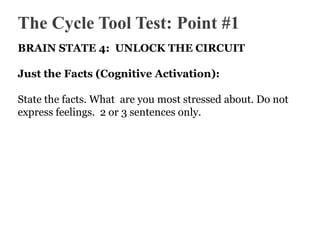
The Cycle Tool Test: Point #1
BRAIN STATE 4: UNLOCK THE CIRCUIT
Just the Facts (Cognitive Activation):
State the facts. What are you most stressed about. Do not
express feelings. 2 or 3 sentences only.
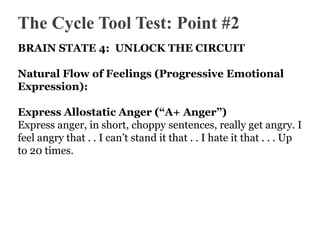
The Cycle Tool Test: Point #2
BRAIN STATE 4: UNLOCK THE CIRCUIT
Natural Flow of Feelings (Progressive Emotional
Expression):
Express Allostatic Anger (“A+ Anger”)
Express anger, in short, choppy sentences, really get angry. I
feel angry that . . I can’t stand it that . . I hate it that . . . Up
to 20 times.
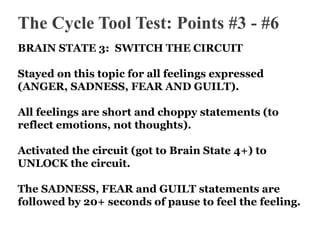
The Cycle Tool Test: Points #3 - #6
BRAIN STATE 3: SWITCH THE CIRCUIT
Stayed on this topic for all feelings expressed
(ANGER, SADNESS, FEAR AND GUILT).
All feelings are short and choppy statements (to
reflect emotions, not thoughts).
Activated the circuit (got to Brain State 4+) to
UNLOCK the circuit.
The SADNESS, FEAR and GUILT statements are
followed by 20+ seconds of pause to feel the feeling.
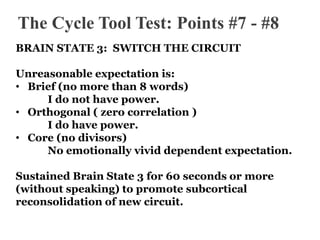
The Cycle Tool Test: Points #7 - #8
BRAIN STATE 3: SWITCH THE CIRCUIT
Unreasonable expectation is:
• Brief (no more than 8 words)
I do not have power.
• Orthogonal ( zero correlation )
I do have power.
• Core (no divisors)
No emotionally vivid dependent expectation.
Sustained Brain State 3 for 60 seconds or more
(without speaking) to promote subcortical
reconsolidation of new circuit.
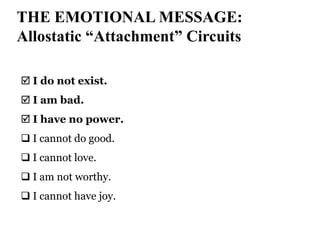
THE EMOTIONAL MESSAGE:
Allostatic “Attachment” Circuits
 I do not exist.
 I am bad.

 I have no power.
 I cannot do good.
 I cannot love.
 I am not worthy.
 I cannot have joy.
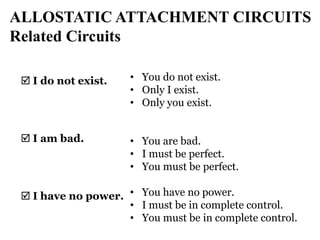
ALLOSTATIC ATTACHMENT CIRCUITS
Related Circuits
 I do not exist.

• You do not exist.
• Only I exist.
• Only you exist.

 I am bad.

• You are bad.
• I must be perfect.
• You must be perfect.

 I have no power. • You have no power.
• I must be in complete control.
• You must be in complete control.
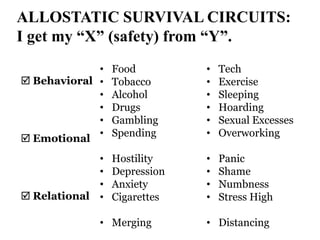
ALLOSTATIC SURVIVAL CIRCUITS:
I get my “X” (safety) from “Y”.
•
 Behavioral •
•
•
•
•
 Emotional

Food
Tobacco
Alcohol
Drugs
Gambling
Spending

•
•
•
•
•
•

Tech
Exercise
Sleeping
Hoarding
Sexual Excesses
Overworking

•
•
•
 Relational •

Hostility
Depression
Anxiety
Cigarettes

•
•
•
•

Panic
Shame
Numbness
Stress High

• Merging

• Distancing
The Cycle Tool Test Point #9
BRAIN STATE 1: LOCK IN NEW CIRCUIT
Differentiate 4 Circuit from 5 Circuit
Would it be rewarding to you to negate the circuit?
If not, it is a 5 Circuit.
The Cycle Tool Test Point #10 (4 Circuit)
BRAIN STATE 1: LOCK IN NEW CIRCUIT
•

Grind In (Repeat opposite): Based on Hebb’s Law,
neurons that fire together wire together and get stronger
and the opposite ones get weaker. State the opposite to
weaken the circuit. (Add the word “not”).
• Stage 1. Low emotional expression, slow pace –
decrease stress activation
• Stage 2. Moderate emotional expression, moderate
pace – increase endogenous dopamine.
• Stage 3. High emotional expression, moderate page,
elevated emotions – increase endogenous dopamine
and oxytocin.
The Cycle Tool Test Point #10 (5 Circuit)
BRAIN STATE 1: LOCK IN NEW CIRCUIT
Acute Care Applications
• Co-regulate with provider to get to Brain State 1, then
facilitate awareness and set aside.
EBT Training with Certified EBT Provider
• Co-regulation with provider to get to Brain State
1, then instruct on use 10 Step Survival Circuit
Technology.
CYCLE TOOL FOR PREVENTION OF
Secondary Traumatic Stress (STS)
• Do a Cycle a Day (“whether you need it or not”).
• Train colleagues to use the Cycle Tool & Connecting
Messages
• Train family members to use the Cycle Tool & Connecting
Messages.
The Cycle Tool Activities
•

Use the Cycle Tool Test to score your Cycle to evaluate
your skill in using the tool.

•

Check to determine your reconsolidation success based
on attaining the 4-3-1 Pattern.

•

Experiment with co-regulating with another as you use
the Cycle Tool.

•

Receive a Connecting Message after the Cycle, noticing
the change in Brain State that it evokes.

UCSF 6 1

  • 1.
    The Cycle Tool LaurelMellin, PhD Associate Professor of Family and Community Medicine, UCSF Igor Mitrovic, MD Professor of Physiology, UCSF
  • 2.
    SESSION 6 OBJECTIVES •Describe the neurophysiology of allostatic circuit reconsolidation through use of the Cycle Tool. • Use the Cycle Tool Test to evaluate the effectiveness of use of the Cycle Tool.
  • 3.
    The Neurophysiology of theCycle Tool Igor Mitrovic, MD Professor of Physiology, UCSF
  • 4.
    Experiential Learning The CycleTool Laurel Mellin, PhD Associate Professor of Family and Community Medicine, UCSF
  • 5.
    The Cycle ToolTest: Point #1 BRAIN STATE 4: UNLOCK THE CIRCUIT Just the Facts (Cognitive Activation): State the facts. What are you most stressed about. Do not express feelings. 2 or 3 sentences only.
  • 6.
    The Cycle ToolTest: Point #2 BRAIN STATE 4: UNLOCK THE CIRCUIT Natural Flow of Feelings (Progressive Emotional Expression): Express Allostatic Anger (“A+ Anger”) Express anger, in short, choppy sentences, really get angry. I feel angry that . . I can’t stand it that . . I hate it that . . . Up to 20 times.
  • 7.
    The Cycle ToolTest: Points #3 - #6 BRAIN STATE 3: SWITCH THE CIRCUIT Stayed on this topic for all feelings expressed (ANGER, SADNESS, FEAR AND GUILT). All feelings are short and choppy statements (to reflect emotions, not thoughts). Activated the circuit (got to Brain State 4+) to UNLOCK the circuit. The SADNESS, FEAR and GUILT statements are followed by 20+ seconds of pause to feel the feeling.
  • 8.
    The Cycle ToolTest: Points #7 - #8 BRAIN STATE 3: SWITCH THE CIRCUIT Unreasonable expectation is: • Brief (no more than 8 words) I do not have power. • Orthogonal ( zero correlation ) I do have power. • Core (no divisors) No emotionally vivid dependent expectation. Sustained Brain State 3 for 60 seconds or more (without speaking) to promote subcortical reconsolidation of new circuit.
  • 9.
    THE EMOTIONAL MESSAGE: Allostatic“Attachment” Circuits  I do not exist.  I am bad.  I have no power.  I cannot do good.  I cannot love.  I am not worthy.  I cannot have joy.
  • 10.
    ALLOSTATIC ATTACHMENT CIRCUITS RelatedCircuits  I do not exist. • You do not exist. • Only I exist. • Only you exist.  I am bad. • You are bad. • I must be perfect. • You must be perfect.  I have no power. • You have no power. • I must be in complete control. • You must be in complete control.
  • 11.
    ALLOSTATIC SURVIVAL CIRCUITS: Iget my “X” (safety) from “Y”. •  Behavioral • • • • •  Emotional Food Tobacco Alcohol Drugs Gambling Spending • • • • • • Tech Exercise Sleeping Hoarding Sexual Excesses Overworking • • •  Relational • Hostility Depression Anxiety Cigarettes • • • • Panic Shame Numbness Stress High • Merging • Distancing
  • 12.
    The Cycle ToolTest Point #9 BRAIN STATE 1: LOCK IN NEW CIRCUIT Differentiate 4 Circuit from 5 Circuit Would it be rewarding to you to negate the circuit? If not, it is a 5 Circuit.
  • 13.
    The Cycle ToolTest Point #10 (4 Circuit) BRAIN STATE 1: LOCK IN NEW CIRCUIT • Grind In (Repeat opposite): Based on Hebb’s Law, neurons that fire together wire together and get stronger and the opposite ones get weaker. State the opposite to weaken the circuit. (Add the word “not”). • Stage 1. Low emotional expression, slow pace – decrease stress activation • Stage 2. Moderate emotional expression, moderate pace – increase endogenous dopamine. • Stage 3. High emotional expression, moderate page, elevated emotions – increase endogenous dopamine and oxytocin.
  • 14.
    The Cycle ToolTest Point #10 (5 Circuit) BRAIN STATE 1: LOCK IN NEW CIRCUIT Acute Care Applications • Co-regulate with provider to get to Brain State 1, then facilitate awareness and set aside. EBT Training with Certified EBT Provider • Co-regulation with provider to get to Brain State 1, then instruct on use 10 Step Survival Circuit Technology.
  • 15.
    CYCLE TOOL FORPREVENTION OF Secondary Traumatic Stress (STS) • Do a Cycle a Day (“whether you need it or not”). • Train colleagues to use the Cycle Tool & Connecting Messages • Train family members to use the Cycle Tool & Connecting Messages.
  • 16.
    The Cycle ToolActivities • Use the Cycle Tool Test to score your Cycle to evaluate your skill in using the tool. • Check to determine your reconsolidation success based on attaining the 4-3-1 Pattern. • Experiment with co-regulating with another as you use the Cycle Tool. • Receive a Connecting Message after the Cycle, noticing the change in Brain State that it evokes.

Editor's Notes

  • #17 Presence of PTSD in the caregiver. California study of 67 nurses in Emergency Departments showed that Secondary Traumatic Stress (STS) 85% had 1 or more of the criteria, and 33% had all.IntrusionAvoidance –- encoding of a Survival CircuitArousal – the activation of a Survival CircuitIntrusion – stress symptoms from the activation of the Survival Circuit and decline in Set Point (avoidance, numbing, burnout)