PART B
Interaction is compulsory in this workshop
Stop
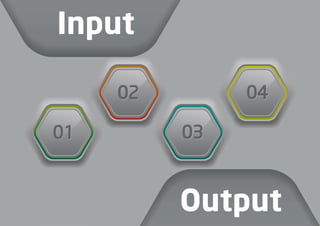
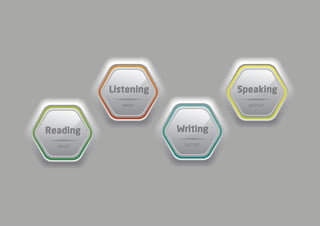
Input
Output
You can’t produce what you don’t own:
Inputs drive outputs
Input skills should always precede output skills
The brain of the beginner student is like an empty
warehouse that must be filled with the information
Do you agree with this idea or you prefer to think
about integrated skills?. What would be the natural
sequence the learning should follow at the beginning
stages of foreign languages?
Q:
Input
Output
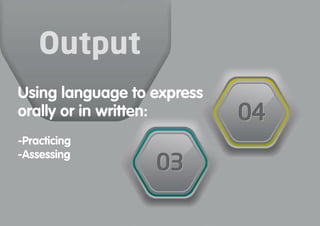
Output
-Practicing
-Assessing
Using language to express
orally or in written:
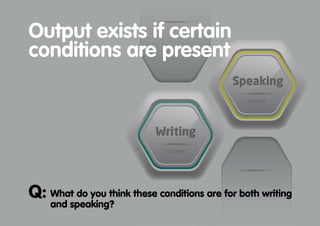
What do you think these conditions are for both writing
and speaking?
Q:
Output exists if certain
conditions are present
Output:
•	Promotes learning through interaction
•	Allows assessment of prior learning
Output
SPEAKING
Understanding written words,
phases, chapters, paragraphs to set the
basis for speaking and interact in
a language. Ut enim ad minim veniam.
SPEAKING
Understanding written words,
phases, chapters, paragraphs to set the
basis for speaking and interact in
a language. Ut enim ad minim veniam.
Speaking is a way to
communicate in the L2
language.
Speaking.
An activity is communicative if
•	Learners are involved
•	There is a purpose to speak
•	There is a real exchange of information
•	Success depends on the communicative
results
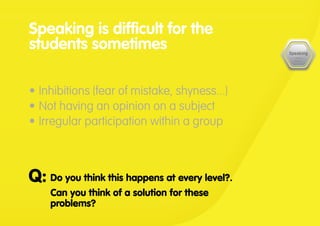
Do you think this happens at every level?.
Can you think of a solution for these
problems?
Q:
Speaking is difficult for the
students sometimes
•	Inhibitions (fear of mistake, shyness...)
•	Not having an opinion on a subject
•	Irregular participation within a group
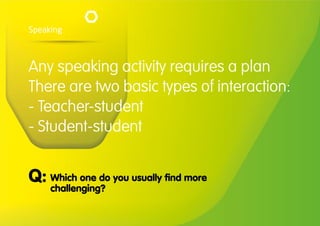
Any speaking activity requires a plan
There are two basic types of interaction:
- Teacher-student
- Student-student
Speaking
Which one do you usually find more
challenging?
Q:
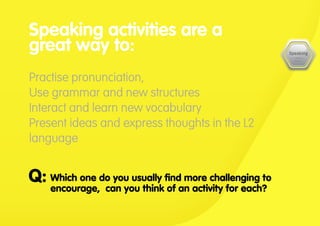
Which one do you usually find more challenging to
encourage, can you think of an activity for each?
Q:
Speaking activities are a
great way to:
Practise pronunciation,
Use grammar and new structures
Interact and learn new vocabulary
Present ideas and express thoughts in the L2
language
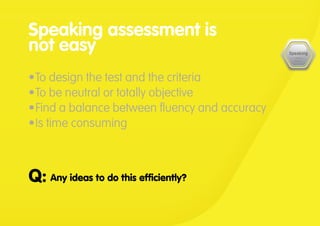
Any ideas to do this efficiently?Q:
Speaking assessment is
not easy
•	To design the test and the criteria
•	To be neutral or totally objective
•	Find a balance between fluency and accuracy
•	Is time consuming
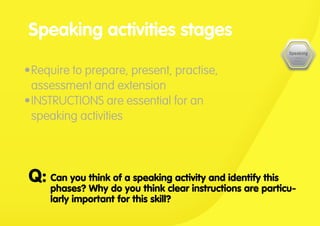
•	Require to prepare, present, practise,
assessment and extension
•	INSTRUCTIONS are essential for an
speaking activities
Speaking activities stages
Can you think of a speaking activity and identify this
phases? Why do you think clear instructions are particu-
larly important for this skill?
Q:
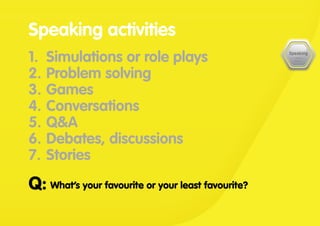
1.	 Simulations or role plays
2.	Problem solving
3.	Games
4.	Conversations
5.	Q&A
6.	Debates, discussions
7.	Stories
What’s your favourite or your least favourite?Q:
Speaking activities
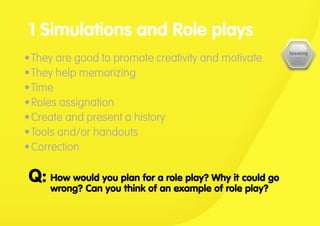
•	They are good to promote creativity and motivate
•	They help memorizing
•	Time
•	Roles assignation
•	Create and present a history
•	Tools and/or handouts
•	Correction
1 Simulations and Role plays
How would you plan for a role play? Why it could go
wrong? Can you think of an example of role play?
Q:
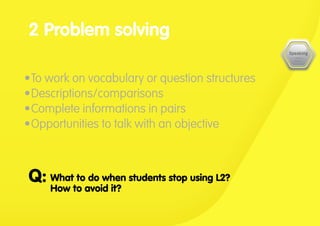
•	To work on vocabulary or question structures
•	Descriptions/comparisons
•	Complete informations in pairs
•	Opportunities to talk with an objective
2 Problem solving
What to do when students stop using L2?
How to avoid it?
Q:
•	Students love games
•	Is a good way to work on anything that needs
practising : numbers, places, objects, verbs,..
•	Guessing keeps the students engaged
•	Physical games are good for ice breaking and
remember
3 Games
Any ideas to make this efficient?Q:
•	Good for higher levels
•	Each student presents orally on a topic of their
choice or the teachers choice
•	Is followed by a discussion
4 Presentation
What can be challenging?				Q:
Output
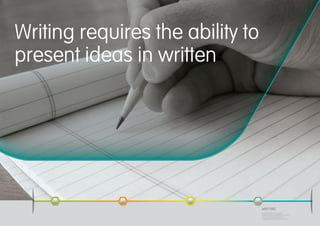
Writing requires the ability to
present ideas in written
WRITING
Understanding written words,
phases, chapters, paragraphs to set the
basis for speaking and interact in
a language. Ut enim ad minim veniam.
•	Writing requires an ability to write in L1
•	A text remains and allows to think, organise
and assess more easily than the speech
•	In the communicative approach writing can be
left behind
Why is writing important?Q:
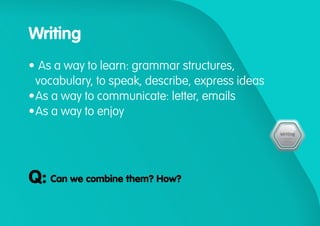
Writing
Writing
•	As a way to learn: grammar structures,
vocabulary, to speak, describe, express ideas
•	As a way to communicate: letter, emails
•	As a way to enjoy
Can we combine them? How?Q:
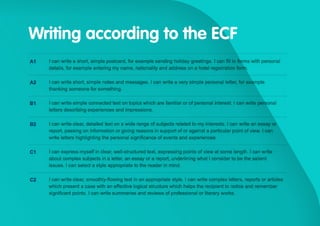
Writing according to the ECF
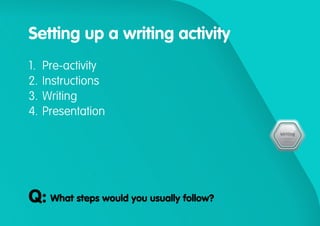
Setting up a writing activity
1.	 Pre-activity
2.	Instructions
3.	Writing
4.	Presentation
What steps would you usually follow?Q:
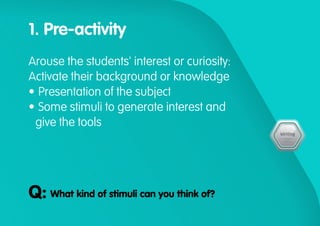
1. Pre-activity
Arouse the students' interest or curiosity:
Activate their background or knowledge
•	Presentation of the subject
•	Some stimuli to generate interest and
give the tools
What kind of stimuli can you think of?Q:
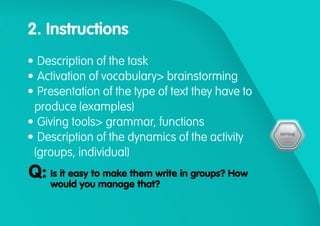
2. Instructions
•	Description of the task
•	Activation of vocabulary> brainstorming
•	Presentation of the type of text they have to
produce (examples)
•	Giving tools> grammar, functions
•	Description of the dynamics of the activity
(groups, individual)
Is it easy to make them write in groups? How
would you manage that?
Q:
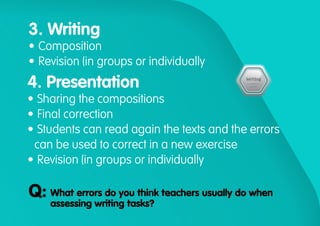
3. Writing
•	Composition
•	Revision (in groups or individually
4. Presentation
•	Sharing the compositions
•	Final correction
•	Students can read again the texts and the errors
can be used to correct in a new exercise
•	Revision (in groups or individually
What errors do you think teachers usually do when
assessing writing tasks?
Q:
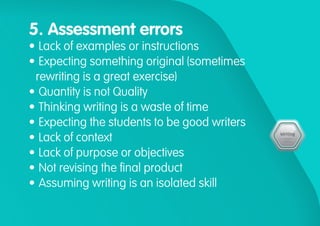
5. Assessment errors
•	Lack of examples or instructions
•	Expecting something original (sometimes
rewriting is a great exercise)
•	Quantity is not Quality
•	Thinking writing is a waste of time
•	Expecting the students to be good writers
•	Lack of context
•	Lack of purpose or objectives
•	Not revising the final product
•	Assuming writing is an isolated skill
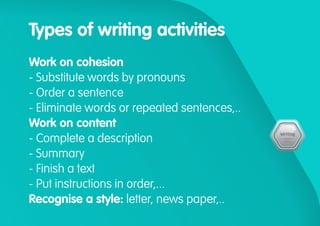
Types of writing activities
Work on cohesion
- Substitute words by pronouns
- Order a sentence
- Eliminate words or repeated sentences,..
Work on content
- Complete a description
- Summary
- Finish a text
- Put instructions in order,...
Recognise a style: letter, news paper,..
Thank you

Presentacion ana 0508 part b

  • 1.
  • 2.
    Interaction is compulsoryin this workshop Stop
  • 3.
    Input Output You can’t producewhat you don’t own: Inputs drive outputs
  • 4.
    Input skills shouldalways precede output skills The brain of the beginner student is like an empty warehouse that must be filled with the information Do you agree with this idea or you prefer to think about integrated skills?. What would be the natural sequence the learning should follow at the beginning stages of foreign languages? Q:
  • 5.
  • 7.
  • 8.
    What do youthink these conditions are for both writing and speaking? Q: Output exists if certain conditions are present
  • 9.
    Output: • Promotes learning throughinteraction • Allows assessment of prior learning
  • 10.
  • 12.
    SPEAKING Understanding written words, phases,chapters, paragraphs to set the basis for speaking and interact in a language. Ut enim ad minim veniam. SPEAKING Understanding written words, phases, chapters, paragraphs to set the basis for speaking and interact in a language. Ut enim ad minim veniam. Speaking is a way to communicate in the L2 language.
  • 13.
    Speaking. An activity iscommunicative if • Learners are involved • There is a purpose to speak • There is a real exchange of information • Success depends on the communicative results
  • 14.
    Do you thinkthis happens at every level?. Can you think of a solution for these problems? Q: Speaking is difficult for the students sometimes • Inhibitions (fear of mistake, shyness...) • Not having an opinion on a subject • Irregular participation within a group
  • 15.
    Any speaking activityrequires a plan There are two basic types of interaction: - Teacher-student - Student-student Speaking Which one do you usually find more challenging? Q:
  • 16.
    Which one doyou usually find more challenging to encourage, can you think of an activity for each? Q: Speaking activities are a great way to: Practise pronunciation, Use grammar and new structures Interact and learn new vocabulary Present ideas and express thoughts in the L2 language
  • 17.
    Any ideas todo this efficiently?Q: Speaking assessment is not easy • To design the test and the criteria • To be neutral or totally objective • Find a balance between fluency and accuracy • Is time consuming
  • 18.
    • Require to prepare,present, practise, assessment and extension • INSTRUCTIONS are essential for an speaking activities Speaking activities stages Can you think of a speaking activity and identify this phases? Why do you think clear instructions are particu- larly important for this skill? Q:
  • 19.
    1. Simulations orrole plays 2. Problem solving 3. Games 4. Conversations 5. Q&A 6. Debates, discussions 7. Stories What’s your favourite or your least favourite?Q: Speaking activities
  • 20.
    • They are goodto promote creativity and motivate • They help memorizing • Time • Roles assignation • Create and present a history • Tools and/or handouts • Correction 1 Simulations and Role plays How would you plan for a role play? Why it could go wrong? Can you think of an example of role play? Q:
  • 21.
    • To work onvocabulary or question structures • Descriptions/comparisons • Complete informations in pairs • Opportunities to talk with an objective 2 Problem solving What to do when students stop using L2? How to avoid it? Q:
  • 22.
    • Students love games • Isa good way to work on anything that needs practising : numbers, places, objects, verbs,.. • Guessing keeps the students engaged • Physical games are good for ice breaking and remember 3 Games Any ideas to make this efficient?Q:
  • 23.
    • Good for higherlevels • Each student presents orally on a topic of their choice or the teachers choice • Is followed by a discussion 4 Presentation What can be challenging? Q:
  • 24.
  • 26.
    Writing requires theability to present ideas in written WRITING Understanding written words, phases, chapters, paragraphs to set the basis for speaking and interact in a language. Ut enim ad minim veniam.
  • 27.
    • Writing requires anability to write in L1 • A text remains and allows to think, organise and assess more easily than the speech • In the communicative approach writing can be left behind Why is writing important?Q: Writing
  • 28.
    Writing • As a wayto learn: grammar structures, vocabulary, to speak, describe, express ideas • As a way to communicate: letter, emails • As a way to enjoy Can we combine them? How?Q:
  • 29.
  • 30.
    Setting up awriting activity 1. Pre-activity 2. Instructions 3. Writing 4. Presentation What steps would you usually follow?Q:
  • 31.
    1. Pre-activity Arouse thestudents' interest or curiosity: Activate their background or knowledge • Presentation of the subject • Some stimuli to generate interest and give the tools What kind of stimuli can you think of?Q:
  • 32.
    2. Instructions • Description ofthe task • Activation of vocabulary> brainstorming • Presentation of the type of text they have to produce (examples) • Giving tools> grammar, functions • Description of the dynamics of the activity (groups, individual) Is it easy to make them write in groups? How would you manage that? Q:
  • 33.
    3. Writing • Composition • Revision (ingroups or individually 4. Presentation • Sharing the compositions • Final correction • Students can read again the texts and the errors can be used to correct in a new exercise • Revision (in groups or individually What errors do you think teachers usually do when assessing writing tasks? Q:
  • 34.
    5. Assessment errors • Lackof examples or instructions • Expecting something original (sometimes rewriting is a great exercise) • Quantity is not Quality • Thinking writing is a waste of time • Expecting the students to be good writers • Lack of context • Lack of purpose or objectives • Not revising the final product • Assuming writing is an isolated skill
  • 35.
    Types of writingactivities Work on cohesion - Substitute words by pronouns - Order a sentence - Eliminate words or repeated sentences,.. Work on content - Complete a description - Summary - Finish a text - Put instructions in order,... Recognise a style: letter, news paper,..
  • 36.