BLOCK I
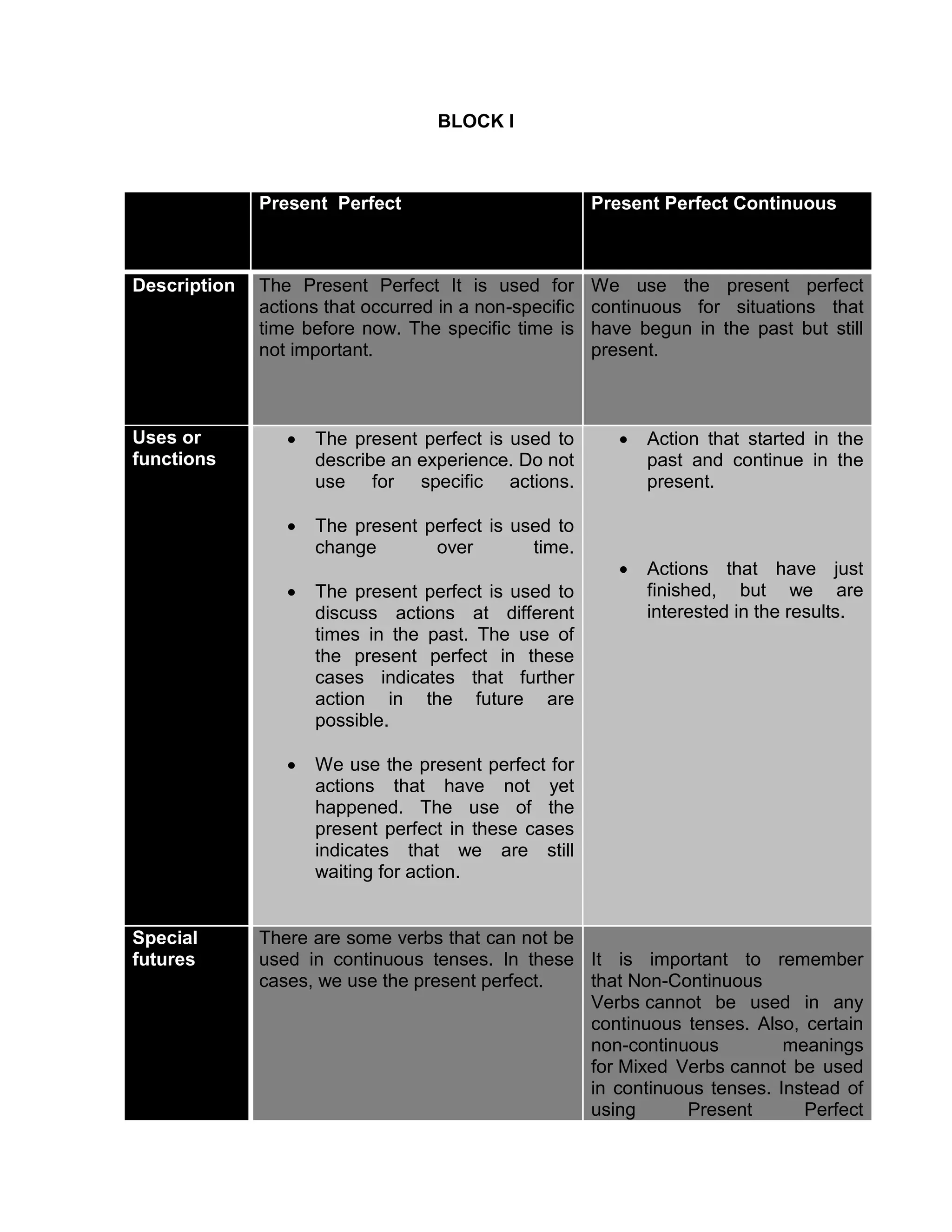
Present Perfect Present Perfect Continuous
Description The Present Perfect It is used for
actions that occurred in a non-specific
time before now. The specific time is
not important.
We use the present perfect
continuous for situations that
have begun in the past but still
present.
Uses or
functions
 The present perfect is used to
describe an experience. Do not
use for specific actions.
 The present perfect is used to
change over time.
 The present perfect is used to
discuss actions at different
times in the past. The use of
the present perfect in these
cases indicates that further
action in the future are
possible.
 We use the present perfect for
actions that have not yet
happened. The use of the
present perfect in these cases
indicates that we are still
waiting for action.
 Action that started in the
past and continue in the
present.
 Actions that have just
finished, but we are
interested in the results.
Special
futures
There are some verbs that can not be
used in continuous tenses. In these
cases, we use the present perfect.
It is important to remember
that Non-Continuous
Verbs cannot be used in any
continuous tenses. Also, certain
non-continuous meanings
for Mixed Verbs cannot be used
in continuous tenses. Instead of
using Present Perfect
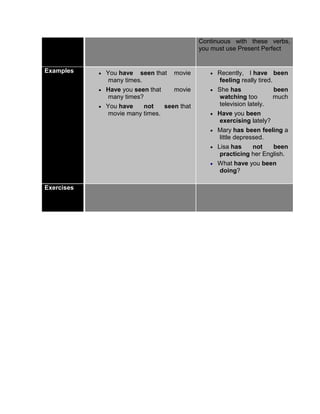
Continuous with these verbs,
you must use Present Perfect
Examples  You have seen that movie
many times.
 Have you seen that movie
many times?
 You have not seen that
movie many times.
 Recently, I have been
feeling really tired.
 She has been
watching too much
television lately.
 Have you been
exercising lately?
 Mary has been feeling a
little depressed.
 Lisa has not been
practicing her English.
 What have you been
doing?
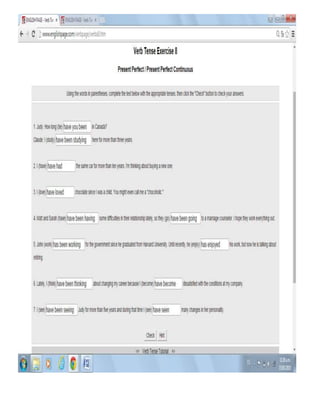
Exercises
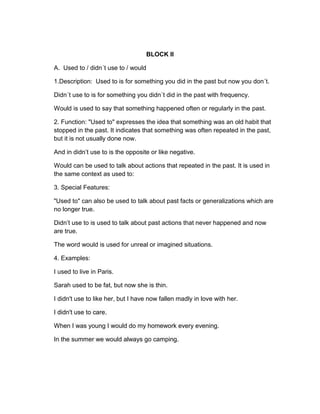
BLOCK II
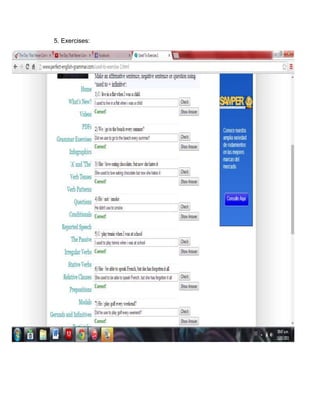
A. Used to / didn´t use to / would
1.Description: Used to is for something you did in the past but now you don´t.
Didn´t use to is for something you didn´t did in the past with frequency.
Would is used to say that something happened often or regularly in the past.
2. Function: "Used to" expresses the idea that something was an old habit that
stopped in the past. It indicates that something was often repeated in the past,
but it is not usually done now.
And in didn’t use to is the opposite or like negative.
Would can be used to talk about actions that repeated in the past. It is used in
the same context as used to:
3. Special Features:
"Used to" can also be used to talk about past facts or generalizations which are
no longer true.
Didn’t use to is used to talk about past actions that never happened and now
are true.
The word would is used for unreal or imagined situations.
4. Examples:
I used to live in Paris.
Sarah used to be fat, but now she is thin.
I didn't use to like her, but I have now fallen madly in love with her.
I didn't use to care.
When I was young I would do my homework every evening.
In the summer we would always go camping.
5. Exercises:
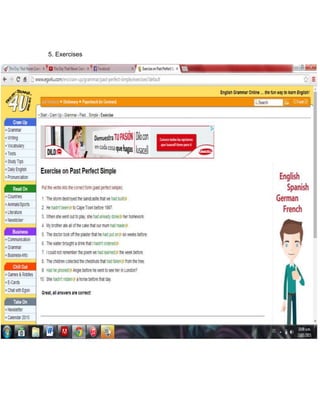
B Past Perfect Simple
1. Description
The Past Perfect expresses the idea that something occurred before another
action in the past. It can also show that something happened before a specific
time in the past.
2. Function
With Non-Continuous Verbs and some non-continuous uses of Mixed Verbs, we
use the Past Perfect to show that something started in the past and continued up
until another action in the past. [had + past participle]
3. Special Features
Unlike with the Present Perfect, it is possible to use specific time words or
phrases with the Past Perfect. Although this is possible, it is usually not
necessary.
4. Examples
You had studied English before you moved to New York.
I had never seen such a beautiful beach before I went to Kauai.
5. Exercises
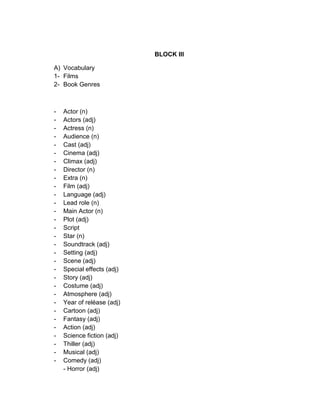
BLOCK III
A) Vocabulary
1- Films
2- Book Genres
- Actor (n)
- Actors (adj)
- Actress (n)
- Audience (n)
- Cast (adj)
- Cinema (adj)
- Climax (adj)
- Director (n)
- Extra (n)
- Film (adj)
- Language (adj)
- Lead role (n)
- Main Actor (n)
- Plot (adj)
- Script
- Star (n)
- Soundtrack (adj)
- Setting (adj)
- Scene (adj)
- Special effects (adj)
- Story (adj)
- Costume (adj)
- Atmosphere (adj)
- Year of reléase (adj)
- Cartoon (adj)
- Fantasy (adj)
- Action (adj)
- Science fiction (adj)
- Thiller (adj)
- Musical (adj)
- Comedy (adj)
- Horror (adj)
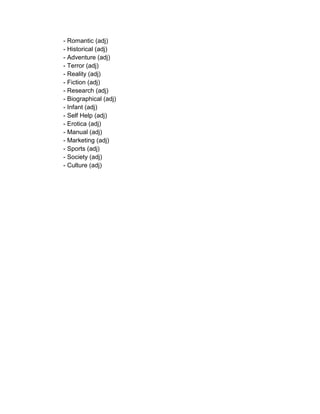
- Romantic (adj)
- Historical (adj)
- Adventure (adj)
- Terror (adj)
- Reality (adj)
- Fiction (adj)
- Research (adj)
- Biographical (adj)
- Infant (adj)
- Self Help (adj)
- Erotica (adj)
- Manual (adj)
- Marketing (adj)
- Sports (adj)
- Society (adj)
- Culture (adj)
B) Writing
Film review
Exciting and epic
The film (based on the second novel by suzanne collins).The Hunger Games:
Catching Fire is a spectacle both visuals and special (much higher than their
previous release) effect as in the actions and plot.
I have to say I read me the trilogy and perfectly captures the essence and the
message of the book, if it is true that there are certain details that do not appear in
the movie (because otherwise its serious lasting too) but do not affect at all to
history.
The actions of the entire team greatly improved, and the evolution that follow all the
characters, making this film a much more mature and darker adaptation shows.
In short, a film that loved everyone (readers and non-readers) with good casting,
spectacular effects, and a development of the story that will not leave anyone
indifferent. Now have to wait a year to see how they develop the exciting story of
Katniss Everdeen.
Book review
Good Chronic
"Chronicle of a Death Foretold" leads us to reflect on how García Márquez
combined social problems, as was the violence of the twentieth century with magic
and breadth of what is literature; not only this but also his unique talent to tell the
story from different perspectives that catch the reader. The foregoing leads me to
believe in my country even as violence persists; to the point of being recognized by
the world, and this book is a perfect example of what once was and will remain our
Colombian reality, and the ability to integrate Gabriel García Márquez fictional
aspects in everyday situations. I can only pose a question, we should ask all; not
only as individuals but as Colombians, is there any excuse for ending a human
life? Each may have a different answer ... but with God there is only one correct
answer.

Present perfect vs present perfect continuous

  • 1.
    BLOCK I Present PerfectPresent Perfect Continuous Description The Present Perfect It is used for actions that occurred in a non-specific time before now. The specific time is not important. We use the present perfect continuous for situations that have begun in the past but still present. Uses or functions  The present perfect is used to describe an experience. Do not use for specific actions.  The present perfect is used to change over time.  The present perfect is used to discuss actions at different times in the past. The use of the present perfect in these cases indicates that further action in the future are possible.  We use the present perfect for actions that have not yet happened. The use of the present perfect in these cases indicates that we are still waiting for action.  Action that started in the past and continue in the present.  Actions that have just finished, but we are interested in the results. Special futures There are some verbs that can not be used in continuous tenses. In these cases, we use the present perfect. It is important to remember that Non-Continuous Verbs cannot be used in any continuous tenses. Also, certain non-continuous meanings for Mixed Verbs cannot be used in continuous tenses. Instead of using Present Perfect
  • 2.
    Continuous with theseverbs, you must use Present Perfect Examples  You have seen that movie many times.  Have you seen that movie many times?  You have not seen that movie many times.  Recently, I have been feeling really tired.  She has been watching too much television lately.  Have you been exercising lately?  Mary has been feeling a little depressed.  Lisa has not been practicing her English.  What have you been doing? Exercises
  • 4.
    BLOCK II A. Usedto / didn´t use to / would 1.Description: Used to is for something you did in the past but now you don´t. Didn´t use to is for something you didn´t did in the past with frequency. Would is used to say that something happened often or regularly in the past. 2. Function: "Used to" expresses the idea that something was an old habit that stopped in the past. It indicates that something was often repeated in the past, but it is not usually done now. And in didn’t use to is the opposite or like negative. Would can be used to talk about actions that repeated in the past. It is used in the same context as used to: 3. Special Features: "Used to" can also be used to talk about past facts or generalizations which are no longer true. Didn’t use to is used to talk about past actions that never happened and now are true. The word would is used for unreal or imagined situations. 4. Examples: I used to live in Paris. Sarah used to be fat, but now she is thin. I didn't use to like her, but I have now fallen madly in love with her. I didn't use to care. When I was young I would do my homework every evening. In the summer we would always go camping.
  • 5.
  • 6.
    B Past PerfectSimple 1. Description The Past Perfect expresses the idea that something occurred before another action in the past. It can also show that something happened before a specific time in the past. 2. Function With Non-Continuous Verbs and some non-continuous uses of Mixed Verbs, we use the Past Perfect to show that something started in the past and continued up until another action in the past. [had + past participle] 3. Special Features Unlike with the Present Perfect, it is possible to use specific time words or phrases with the Past Perfect. Although this is possible, it is usually not necessary. 4. Examples You had studied English before you moved to New York. I had never seen such a beautiful beach before I went to Kauai.
  • 7.
  • 8.
    BLOCK III A) Vocabulary 1-Films 2- Book Genres - Actor (n) - Actors (adj) - Actress (n) - Audience (n) - Cast (adj) - Cinema (adj) - Climax (adj) - Director (n) - Extra (n) - Film (adj) - Language (adj) - Lead role (n) - Main Actor (n) - Plot (adj) - Script - Star (n) - Soundtrack (adj) - Setting (adj) - Scene (adj) - Special effects (adj) - Story (adj) - Costume (adj) - Atmosphere (adj) - Year of reléase (adj) - Cartoon (adj) - Fantasy (adj) - Action (adj) - Science fiction (adj) - Thiller (adj) - Musical (adj) - Comedy (adj) - Horror (adj)
  • 9.
    - Romantic (adj) -Historical (adj) - Adventure (adj) - Terror (adj) - Reality (adj) - Fiction (adj) - Research (adj) - Biographical (adj) - Infant (adj) - Self Help (adj) - Erotica (adj) - Manual (adj) - Marketing (adj) - Sports (adj) - Society (adj) - Culture (adj)
  • 10.
    B) Writing Film review Excitingand epic The film (based on the second novel by suzanne collins).The Hunger Games: Catching Fire is a spectacle both visuals and special (much higher than their previous release) effect as in the actions and plot. I have to say I read me the trilogy and perfectly captures the essence and the message of the book, if it is true that there are certain details that do not appear in the movie (because otherwise its serious lasting too) but do not affect at all to history. The actions of the entire team greatly improved, and the evolution that follow all the characters, making this film a much more mature and darker adaptation shows. In short, a film that loved everyone (readers and non-readers) with good casting, spectacular effects, and a development of the story that will not leave anyone indifferent. Now have to wait a year to see how they develop the exciting story of Katniss Everdeen.
  • 11.
    Book review Good Chronic "Chronicleof a Death Foretold" leads us to reflect on how García Márquez combined social problems, as was the violence of the twentieth century with magic and breadth of what is literature; not only this but also his unique talent to tell the story from different perspectives that catch the reader. The foregoing leads me to believe in my country even as violence persists; to the point of being recognized by the world, and this book is a perfect example of what once was and will remain our Colombian reality, and the ability to integrate Gabriel García Márquez fictional aspects in everyday situations. I can only pose a question, we should ask all; not only as individuals but as Colombians, is there any excuse for ending a human life? Each may have a different answer ... but with God there is only one correct answer.