Communicative function
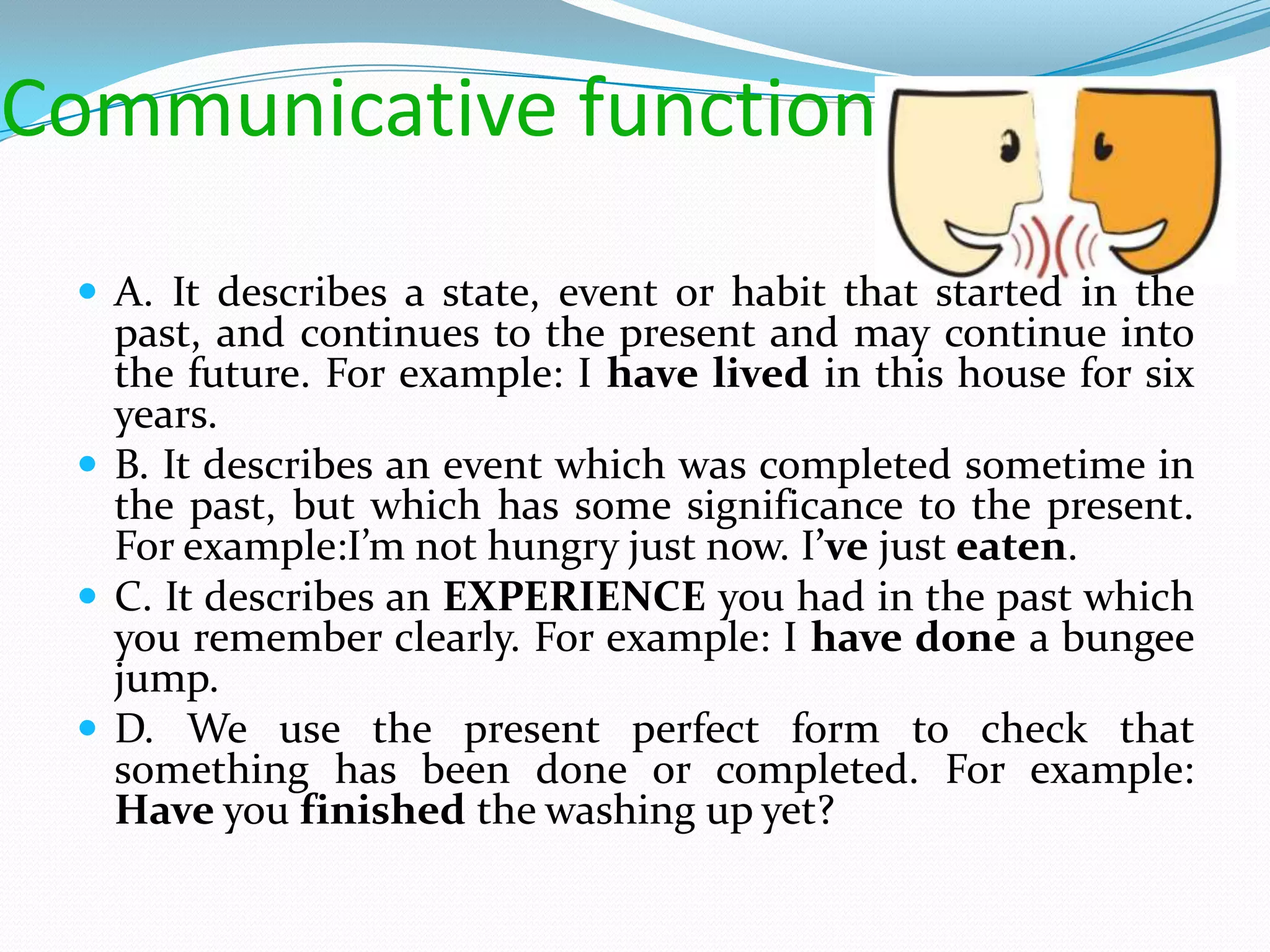
  A. It describes a state, event or habit that started in the
   past, and continues to the present and may continue into
   the future. For example: I have lived in this house for six
   years.
  B. It describes an event which was completed sometime in
   the past, but which has some significance to the present.
   For example:I’m not hungry just now. I’ve just eaten.
  C. It describes an EXPERIENCE you had in the past which
   you remember clearly. For example: I have done a bungee
   jump.
  D. We use the present perfect form to check that
   something has been done or completed. For example:
   Have you finished the washing up yet?
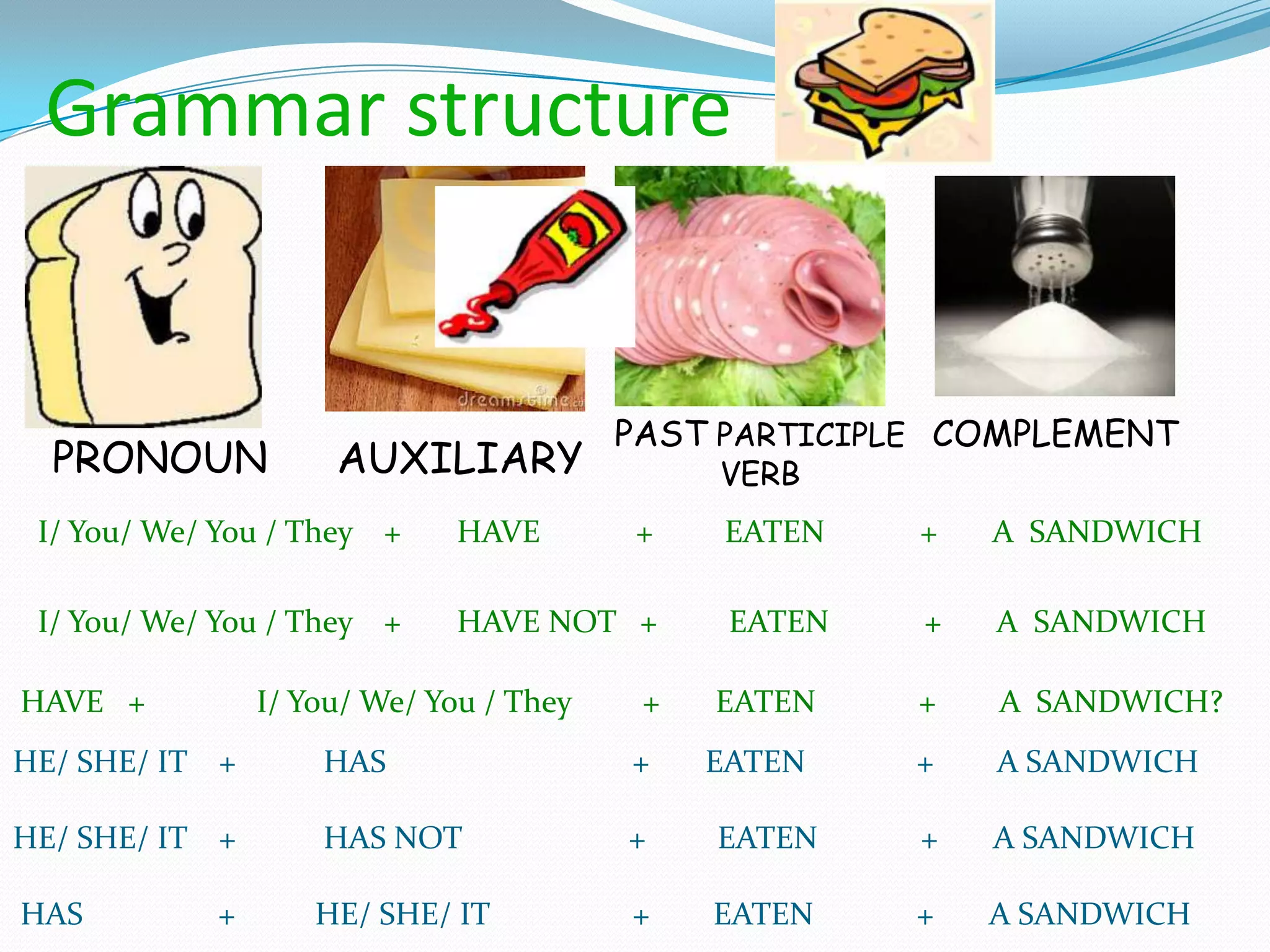
Grammar structure


                                         PAST PARTICIPLE COMPLEMENT
  PRONOUN            AUXILIARY                VERB
 I/ You/ We/ You / They +    HAVE        +    EATEN    +   A SANDWICH

 I/ You/ We/ You / They +    HAVE NOT +        EATEN   +   A SANDWICH

HAVE +          I/ You/ We/ You / They    +   EATEN    +   A SANDWICH?
HE/ SHE/ IT +       HAS                  +    EATEN    +   A SANDWICH

HE/ SHE/ IT +       HAS NOT              +    EATEN    +   A SANDWICH

HAS         +       HE/ SHE/ IT          +    EATEN    +   A SANDWICH
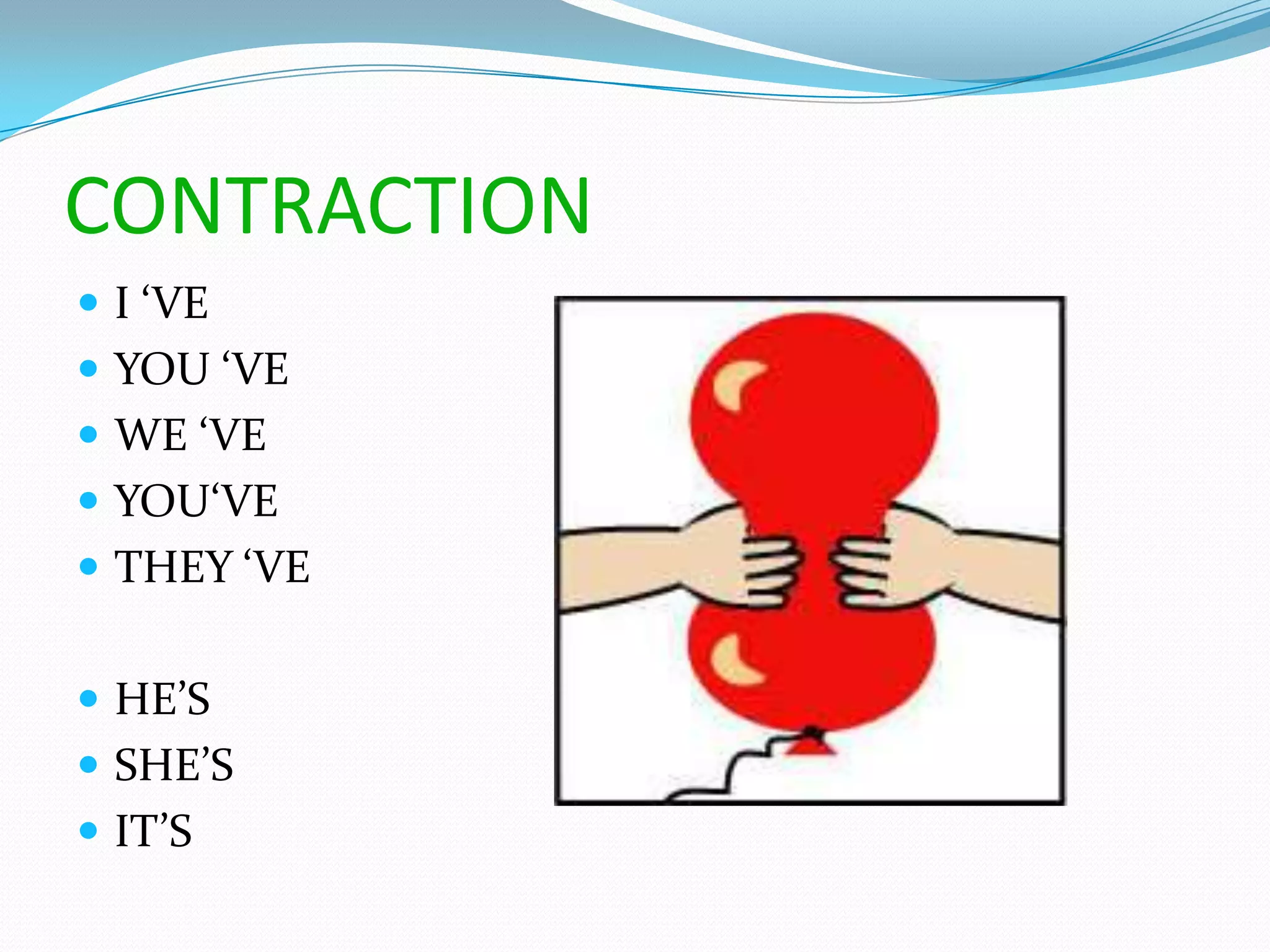
CONTRACTION
 I ‘VE
 YOU ‘VE
 WE ‘VE
 YOU‘VE
 THEY ‘VE


 HE’S
 SHE’S
 IT’S
TIME EXPRESSIONS
 When we use the Present Perfect it means that something has
  happened at some point in our lives before now. Remember,
  the exact time the action happened is not important.
 Sometimes, we want to limit the time we are looking in for an
  experience. We can do this with expressions such as: in the
  last week, in the last year, this week, this month, so far, up to
  now, etc.
EXAMPLES:
 Have you been to Mexico in the last year?
 I have seen that movie six times in the last month.
 They have had three tests in the last week.
 She graduated from university less than three years ago.
  She has worked for three different companies so far.
 My car has broken down three times this week.
TIME EXPRESSIONS
 USE 2 Duration From the Past Until Now (Non-Continuous
  Verbs)
 With Non-Continuous Verbs and non-continuous uses of Mixed
  Verbs, we use the Present Perfect to show that something started
  in the past and has continued up until now. "For five minutes,"
  "for two weeks," and "since Tuesday" are all durations which can
  be used with the Present Perfect.
Examples:
 I have had a cold for two weeks.
 She has been in England for six months.
 Mary has loved chocolate since she was a little girl.
 Although the above use of Present Perfect is normally limited to
  Non-Continuous Verbs and non-continuous uses of Mixed
  Verbs, the words "live," "work," "teach," and "study" are
  sometimes used in this way even though they are NOT Non-
  Continuous Verbs.
TIME EXPRESSIONS
 ADVERB PLACEMENT
The examples below show the placement for grammar adverbs
  such as: always, only, never, ever, still, just, etc.
Examples:
 You have only seen that movie one time.
 Have you only seen that movie one time?
 ACTIVE / PASSIVE
 Examples:
 Many tourists have visited that castle. ACTIVE
 That castle has been visited by many tourists. PASSIVE
TIME EXPRESSIONS
 NOTICE
 "Last year" and "in the last year" are very different in
  meaning. "Last year" means the year before now, and it is
  considered a specific time which requires simple past. "In
  the last year" means from 365 days ago until now. It is not
  considered a specific time, so it requires Present Perfect.
 Examples:
 I went to Mexico last year.
  I WENT TO MEXICO IN THE CALENDAR YEAR BEFORE THIS ONE.
 I have been to Mexico in the last year.
  I HAVE BEEN TO MEXICO AT LEAST ONCE AT SOME POINT
  BETWEEN 365 DAYS AGO AND NOW.
PRONUNCIATION

 http://www.youtube.com/watch?v=zh_DM7qJGWo&fea
   ture=fvwrel
TO SEE MORE


 http://www.impact-
 english.com/members/Grammar_Explanations/Maps/Prese
 ntPerfect-Map.htm
EXERCISE
 http://www.monash.edu.au/lls/llonline/grammar/ten
  se/2.1.xml
 http://genkienglish.net/haveyouever.htm
 and if you have time share your experience on
  http://www.voxopop.com/group/3f85988b-bad3-4ee2-
  a95e-4220762e872f
BIBLIOGRAPHY
   INFO
   www.englishforums.com/.../PresentPerfectConfusing.../post.htmwww.englishpage.com › Verb Tense
    Tutorial
   http://www.youtube.com/watch?v=zh_DM7qJGWo&feature=fvwrel
   http://www.impact-english.com/members/Grammar_Explanations/Maps/PresentPerfect-Map.htm
   http://www.monash.edu.au/lls/llonline/grammar/tense/2.1.xml
   http://www.voxopop.com/group/3f85988b-bad3-4ee2-a95e-4220762e872f
   IMAGES
   esl.about.com
   espocnhol.blogspot.com
   escuelatic.com
   bibliotecadeinvestigaciones.wordpress.com
   commfiles.com
   eldropbox.com
   saberesysabores.com.ar
   es.dreamstime.com
   chistesdiarios.wordpress.com
   lahierbaroja.wordpress.com
   d-salud.blogspot.com
   tadega.net
   mamenenglish.blogspot.com
   wausaukeespanish.pbworks.com
   blogs.elcomercio.pe
   effbartontraining.com
   unibague.edu.co

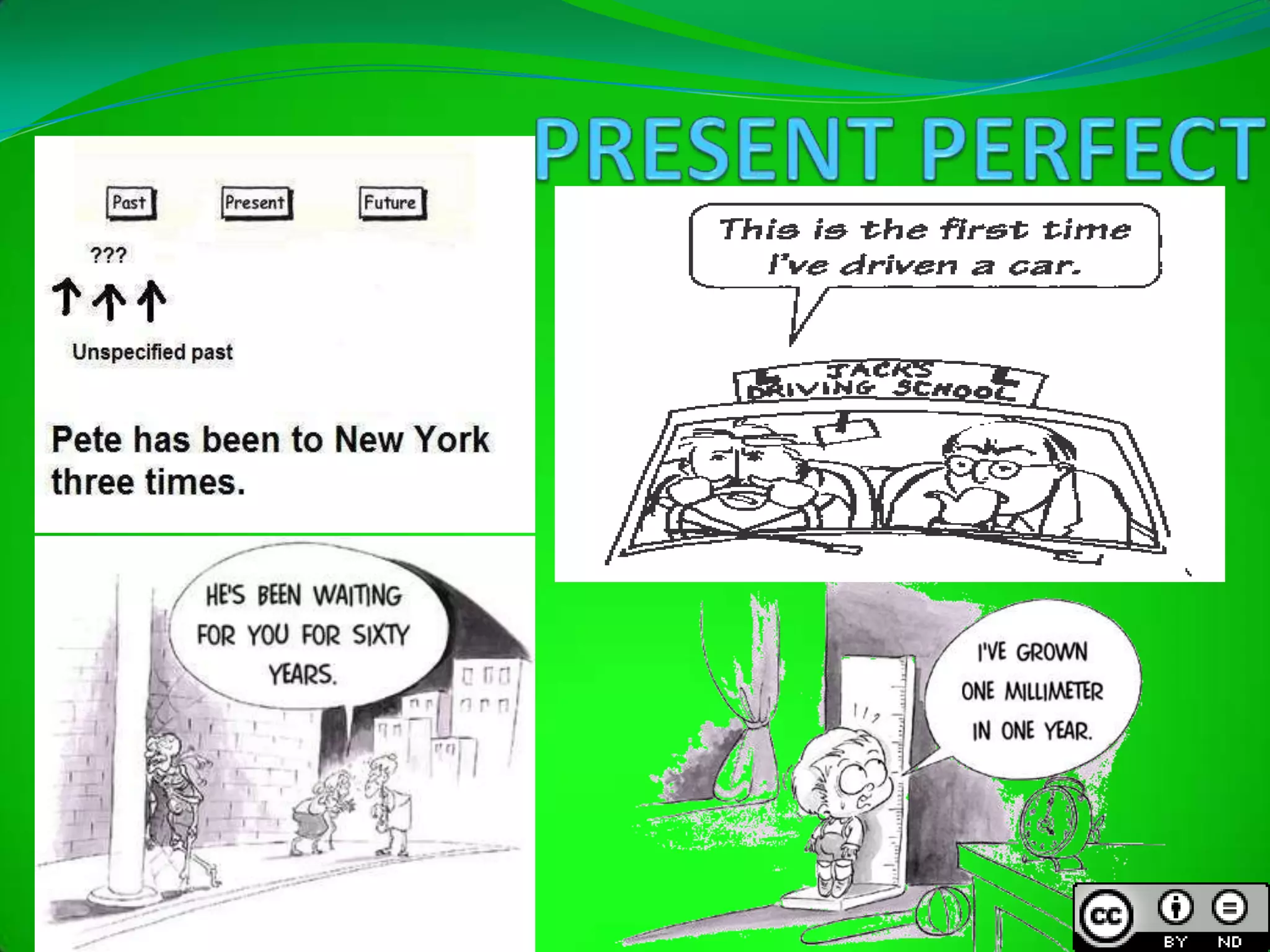
Present perfect

  • 2.
    Communicative function A. It describes a state, event or habit that started in the past, and continues to the present and may continue into the future. For example: I have lived in this house for six years.  B. It describes an event which was completed sometime in the past, but which has some significance to the present. For example:I’m not hungry just now. I’ve just eaten.  C. It describes an EXPERIENCE you had in the past which you remember clearly. For example: I have done a bungee jump.  D. We use the present perfect form to check that something has been done or completed. For example: Have you finished the washing up yet?
  • 3.
    Grammar structure PAST PARTICIPLE COMPLEMENT PRONOUN AUXILIARY VERB I/ You/ We/ You / They + HAVE + EATEN + A SANDWICH I/ You/ We/ You / They + HAVE NOT + EATEN + A SANDWICH HAVE + I/ You/ We/ You / They + EATEN + A SANDWICH? HE/ SHE/ IT + HAS + EATEN + A SANDWICH HE/ SHE/ IT + HAS NOT + EATEN + A SANDWICH HAS + HE/ SHE/ IT + EATEN + A SANDWICH
  • 4.
    CONTRACTION  I ‘VE YOU ‘VE  WE ‘VE  YOU‘VE  THEY ‘VE  HE’S  SHE’S  IT’S
  • 5.
    TIME EXPRESSIONS  Whenwe use the Present Perfect it means that something has happened at some point in our lives before now. Remember, the exact time the action happened is not important.  Sometimes, we want to limit the time we are looking in for an experience. We can do this with expressions such as: in the last week, in the last year, this week, this month, so far, up to now, etc. EXAMPLES:  Have you been to Mexico in the last year?  I have seen that movie six times in the last month.  They have had three tests in the last week.  She graduated from university less than three years ago. She has worked for three different companies so far.  My car has broken down three times this week.
  • 6.
    TIME EXPRESSIONS  USE2 Duration From the Past Until Now (Non-Continuous Verbs)  With Non-Continuous Verbs and non-continuous uses of Mixed Verbs, we use the Present Perfect to show that something started in the past and has continued up until now. "For five minutes," "for two weeks," and "since Tuesday" are all durations which can be used with the Present Perfect. Examples:  I have had a cold for two weeks.  She has been in England for six months.  Mary has loved chocolate since she was a little girl.  Although the above use of Present Perfect is normally limited to Non-Continuous Verbs and non-continuous uses of Mixed Verbs, the words "live," "work," "teach," and "study" are sometimes used in this way even though they are NOT Non- Continuous Verbs.
  • 7.
    TIME EXPRESSIONS  ADVERBPLACEMENT The examples below show the placement for grammar adverbs such as: always, only, never, ever, still, just, etc. Examples:  You have only seen that movie one time.  Have you only seen that movie one time?  ACTIVE / PASSIVE  Examples:  Many tourists have visited that castle. ACTIVE  That castle has been visited by many tourists. PASSIVE
  • 8.
    TIME EXPRESSIONS  NOTICE "Last year" and "in the last year" are very different in meaning. "Last year" means the year before now, and it is considered a specific time which requires simple past. "In the last year" means from 365 days ago until now. It is not considered a specific time, so it requires Present Perfect.  Examples:  I went to Mexico last year. I WENT TO MEXICO IN THE CALENDAR YEAR BEFORE THIS ONE.  I have been to Mexico in the last year. I HAVE BEEN TO MEXICO AT LEAST ONCE AT SOME POINT BETWEEN 365 DAYS AGO AND NOW.
  • 9.
  • 10.
    TO SEE MORE http://www.impact- english.com/members/Grammar_Explanations/Maps/Prese ntPerfect-Map.htm
  • 11.
    EXERCISE  http://www.monash.edu.au/lls/llonline/grammar/ten se/2.1.xml  http://genkienglish.net/haveyouever.htm  and if you have time share your experience on http://www.voxopop.com/group/3f85988b-bad3-4ee2- a95e-4220762e872f
  • 12.
    BIBLIOGRAPHY  INFO  www.englishforums.com/.../PresentPerfectConfusing.../post.htmwww.englishpage.com › Verb Tense Tutorial  http://www.youtube.com/watch?v=zh_DM7qJGWo&feature=fvwrel  http://www.impact-english.com/members/Grammar_Explanations/Maps/PresentPerfect-Map.htm  http://www.monash.edu.au/lls/llonline/grammar/tense/2.1.xml  http://www.voxopop.com/group/3f85988b-bad3-4ee2-a95e-4220762e872f  IMAGES  esl.about.com  espocnhol.blogspot.com  escuelatic.com  bibliotecadeinvestigaciones.wordpress.com  commfiles.com  eldropbox.com  saberesysabores.com.ar  es.dreamstime.com  chistesdiarios.wordpress.com  lahierbaroja.wordpress.com  d-salud.blogspot.com  tadega.net  mamenenglish.blogspot.com  wausaukeespanish.pbworks.com  blogs.elcomercio.pe  effbartontraining.com  unibague.edu.co