Present Continuous
Understanding Functions and Creating Sentences Using
Present ContinuousTense
By AndriWibisono
How to Form Present Continuous Tense
• Positive (+)
• Subject + to be +V-ing + Object
• Negative (-)
• Subject + to be + not +V-ing + Object
• Interrogative (?)
• To be + Subject +V-ing + Object
Anita is writing a letter.
Anita is not (isn’t) writing a letter.
Is Anita writing a letter?
Note:
Present to be
I  AM
He, She, It  IS
They, We,You  ARE
Note:
Adverb of Time
Now, at the moment,
today, nowdays, this
week.
Function of Present Continuous Tense
• Showing an activity which is happening now, at the moment.
• Temporary action
• A long action which is still in Progress Now
• To show something changing, growing, or developing.
• Fixed Plan (often in the near future)
Showing an activity which is happening
now, at the moment.
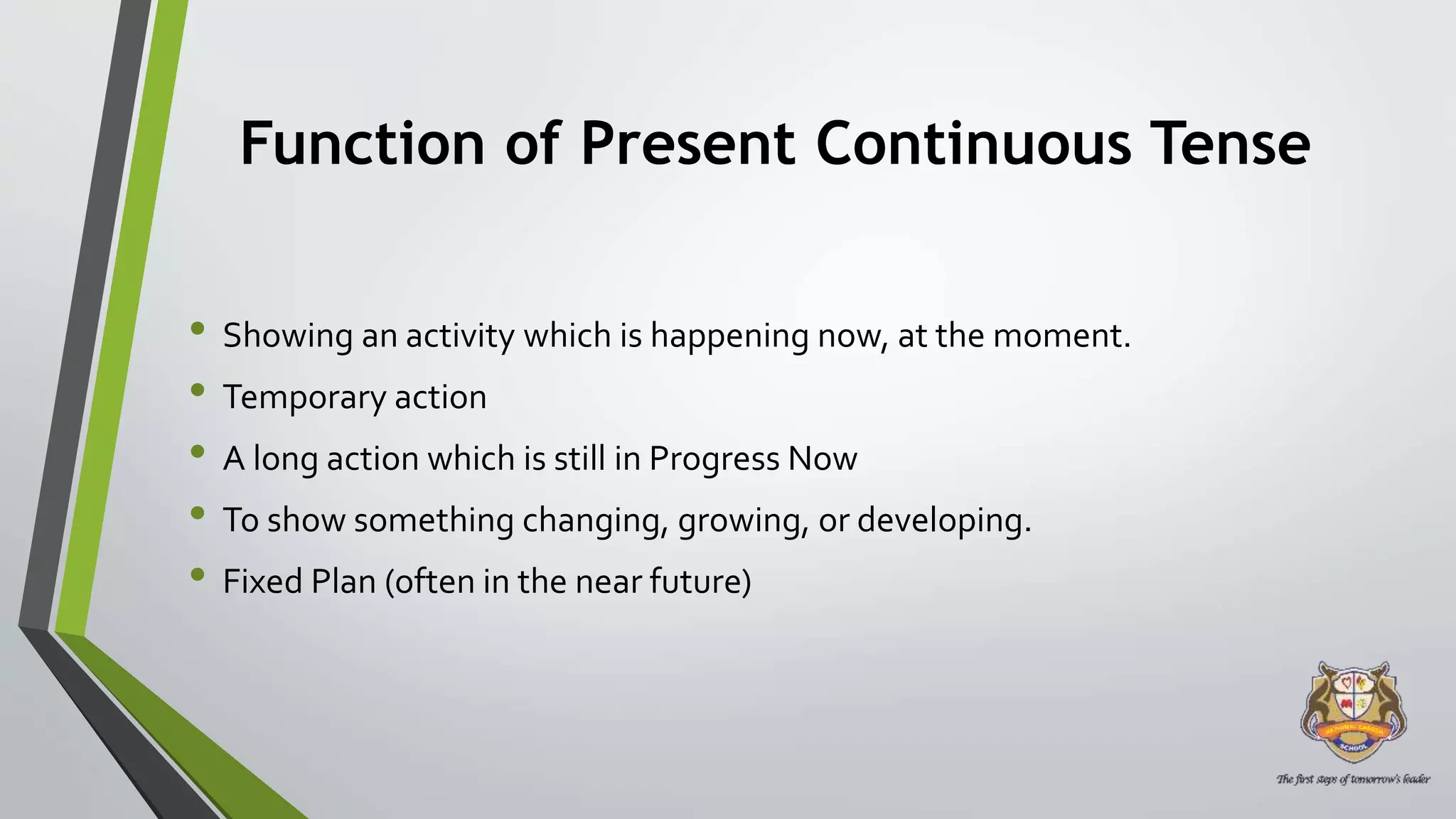
• Anthony is reading a book now.
• Anthony isn’t watchingTV at the moment.
• Is Anthony writing an essay now?
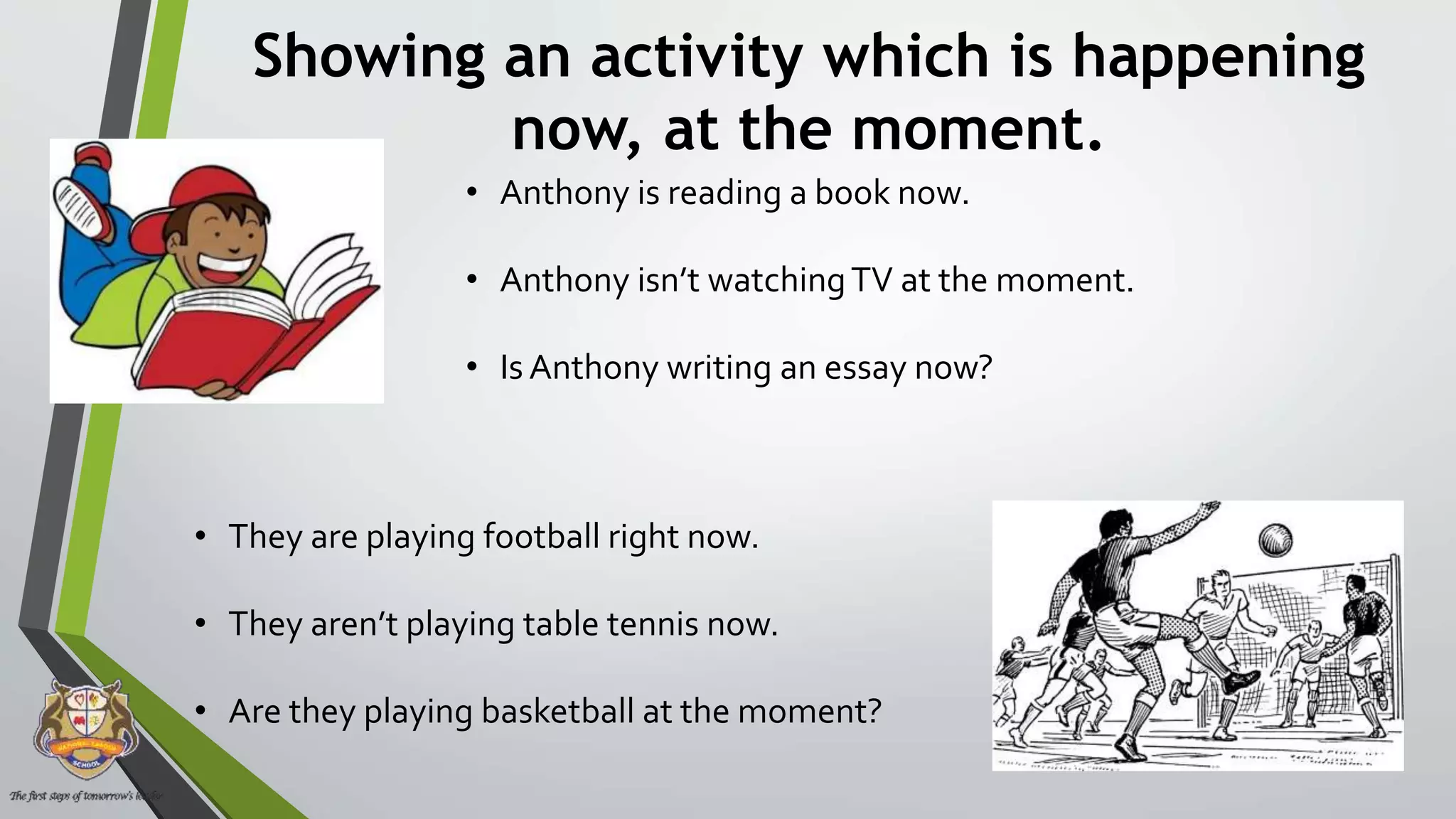
• They are playing football right now.
• They aren’t playing table tennis now.
• Are they playing basketball at the moment?
Temporary action
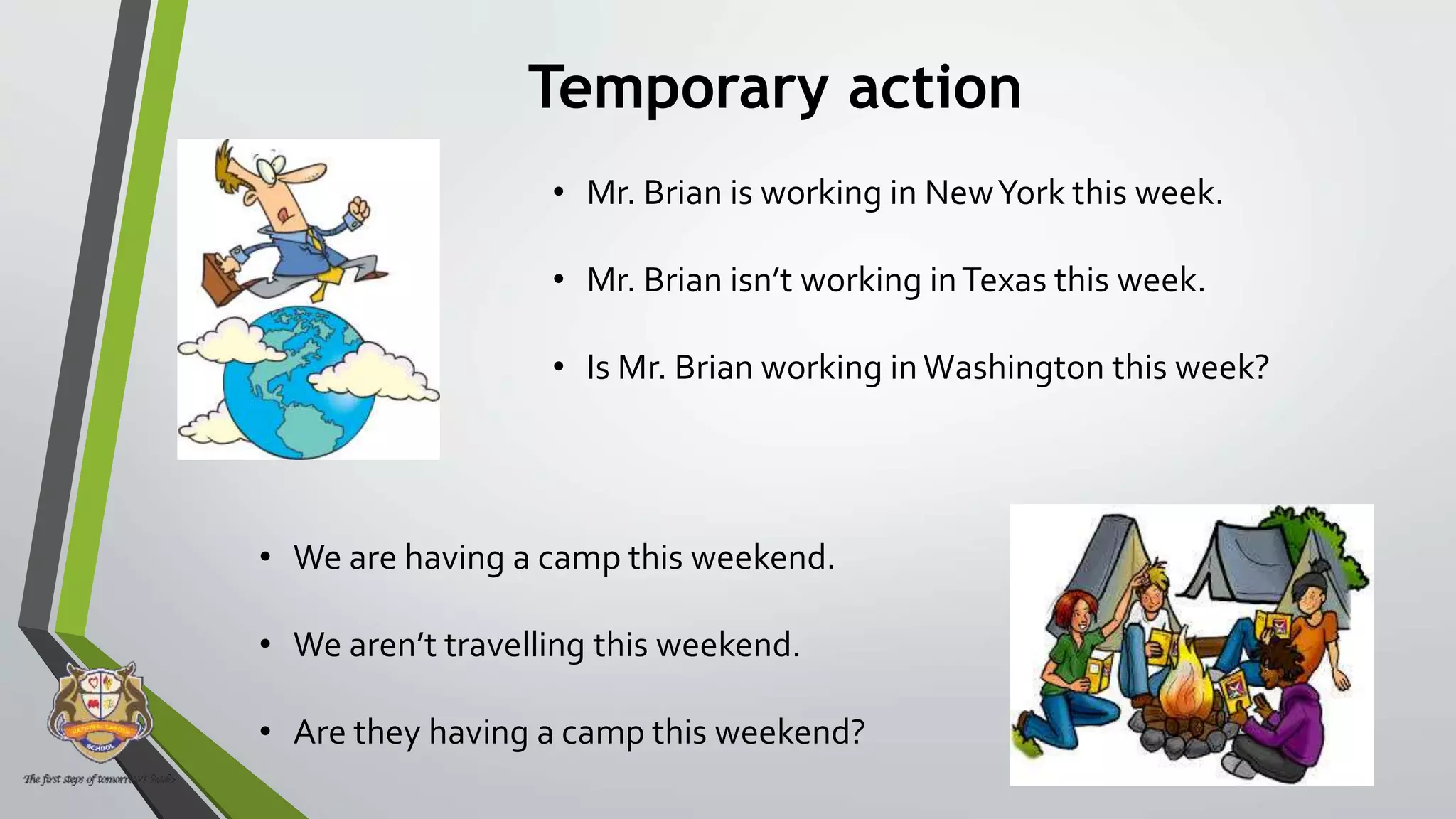
• Mr. Brian is working in NewYork this week.
• Mr. Brian isn’t working inTexas this week.
• Is Mr. Brian working inWashington this week?
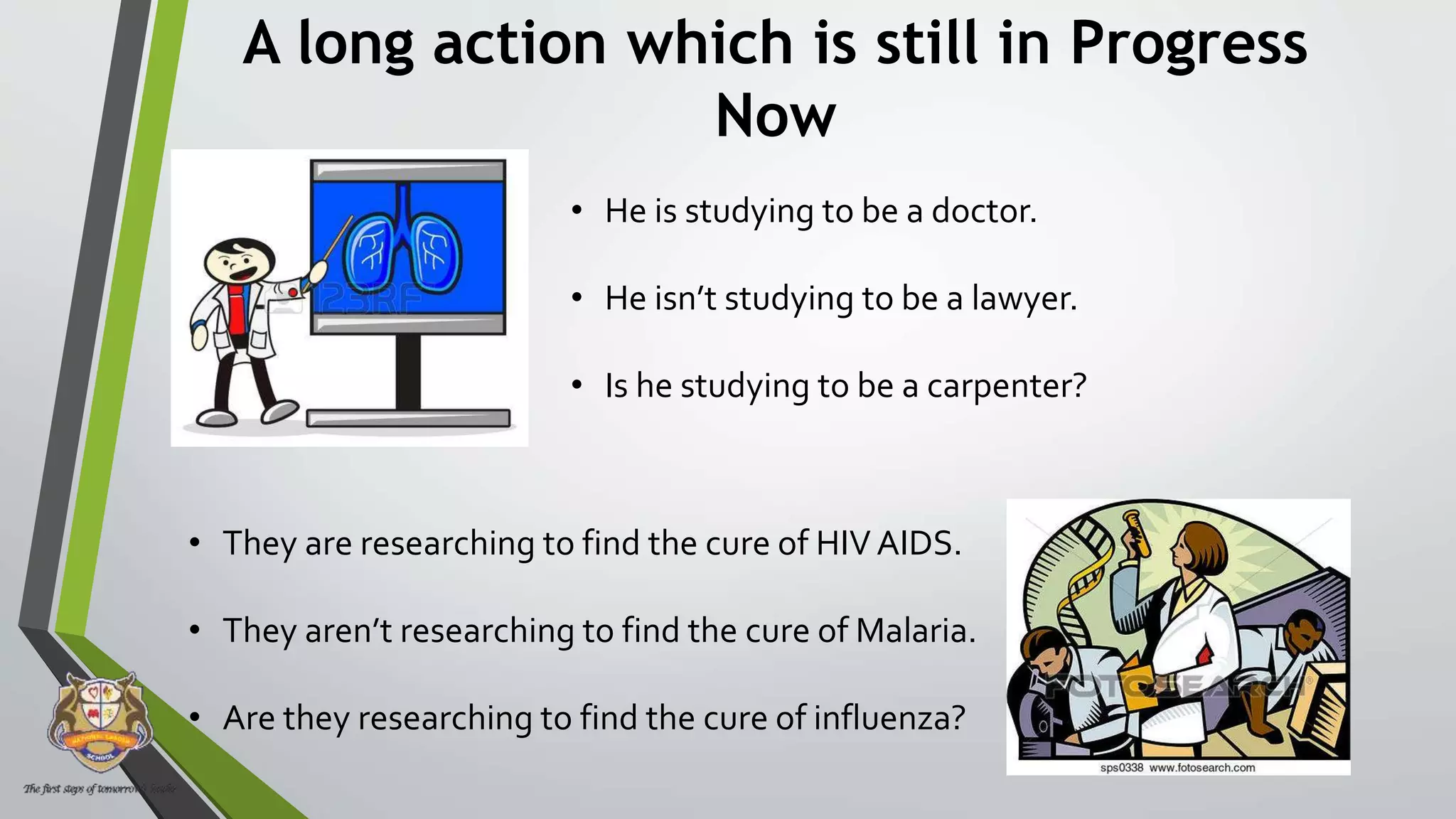
• We are having a camp this weekend.
• We aren’t travelling this weekend.
• Are they having a camp this weekend?
A long action which is still in Progress
Now
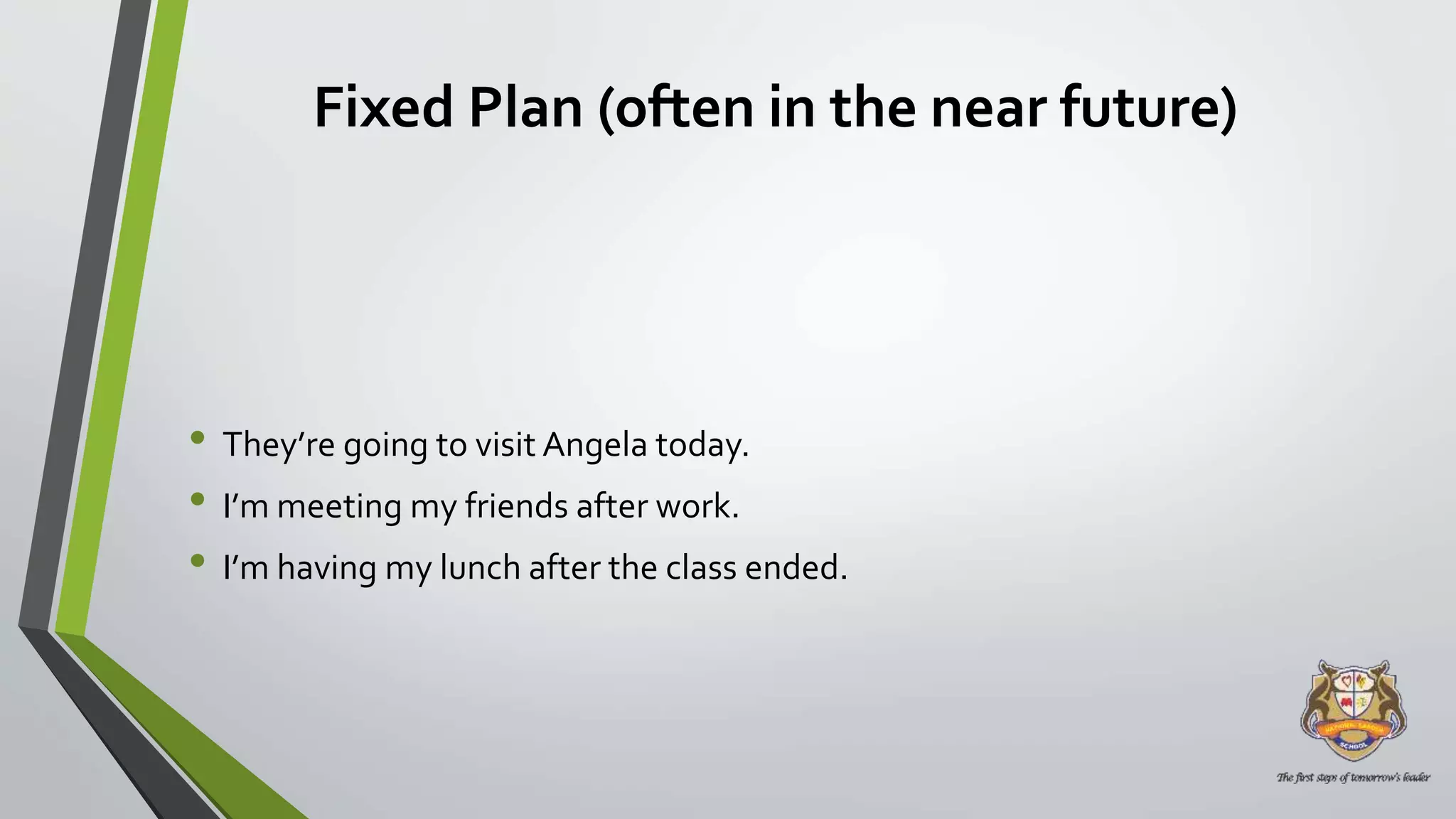
• They are researching to find the cure of HIVAIDS.
• They aren’t researching to find the cure of Malaria.
• Are they researching to find the cure of influenza?
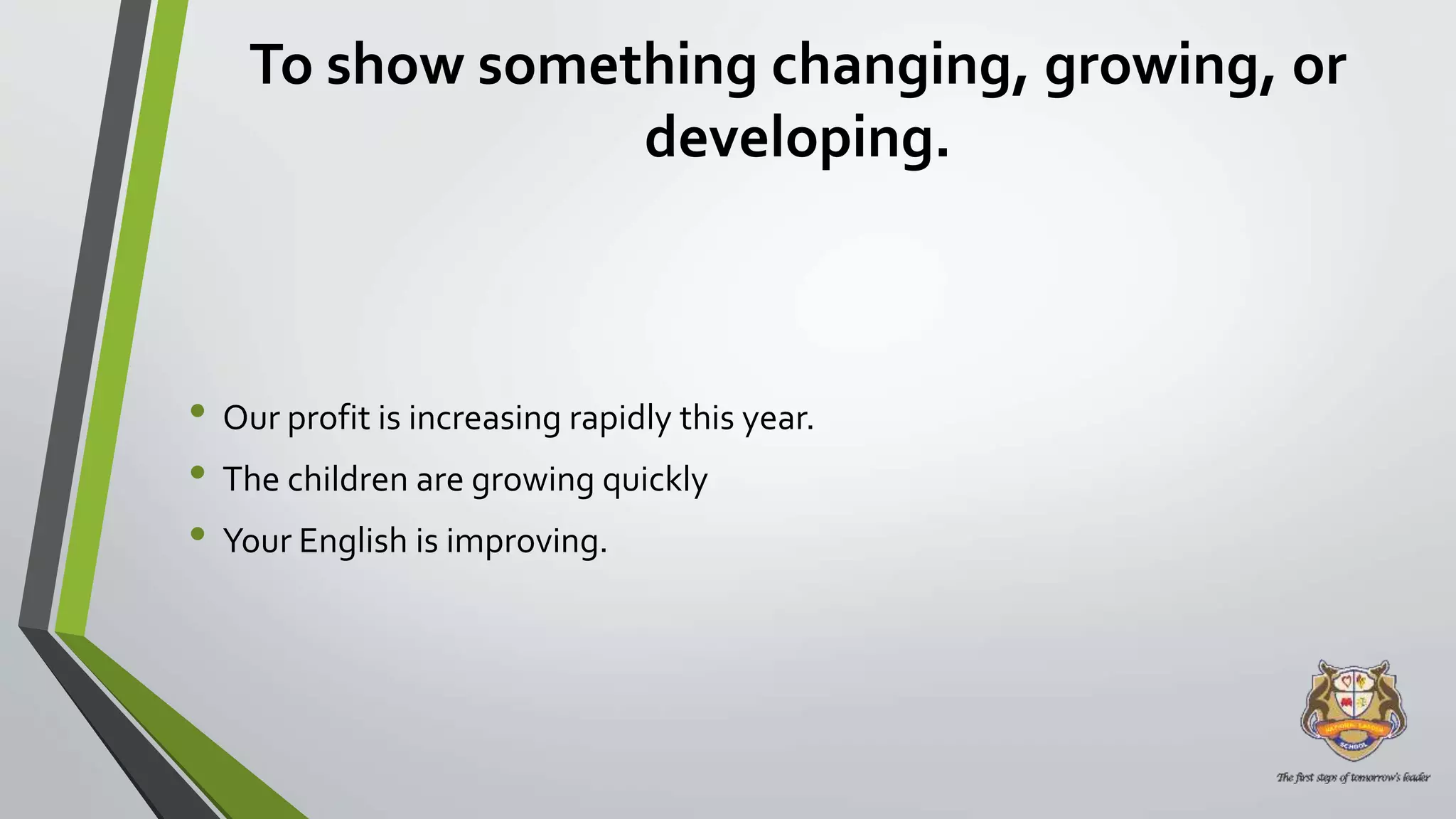
• He is studying to be a doctor.
• He isn’t studying to be a lawyer.
• Is he studying to be a carpenter?
To show something changing, growing, or
developing.
• Our profit is increasing rapidly this year.
• The children are growing quickly
• Your English is improving.
Fixed Plan (often in the near future)
• They’re going to visit Angela today.
• I’m meeting my friends after work.
• I’m having my lunch after the class ended.
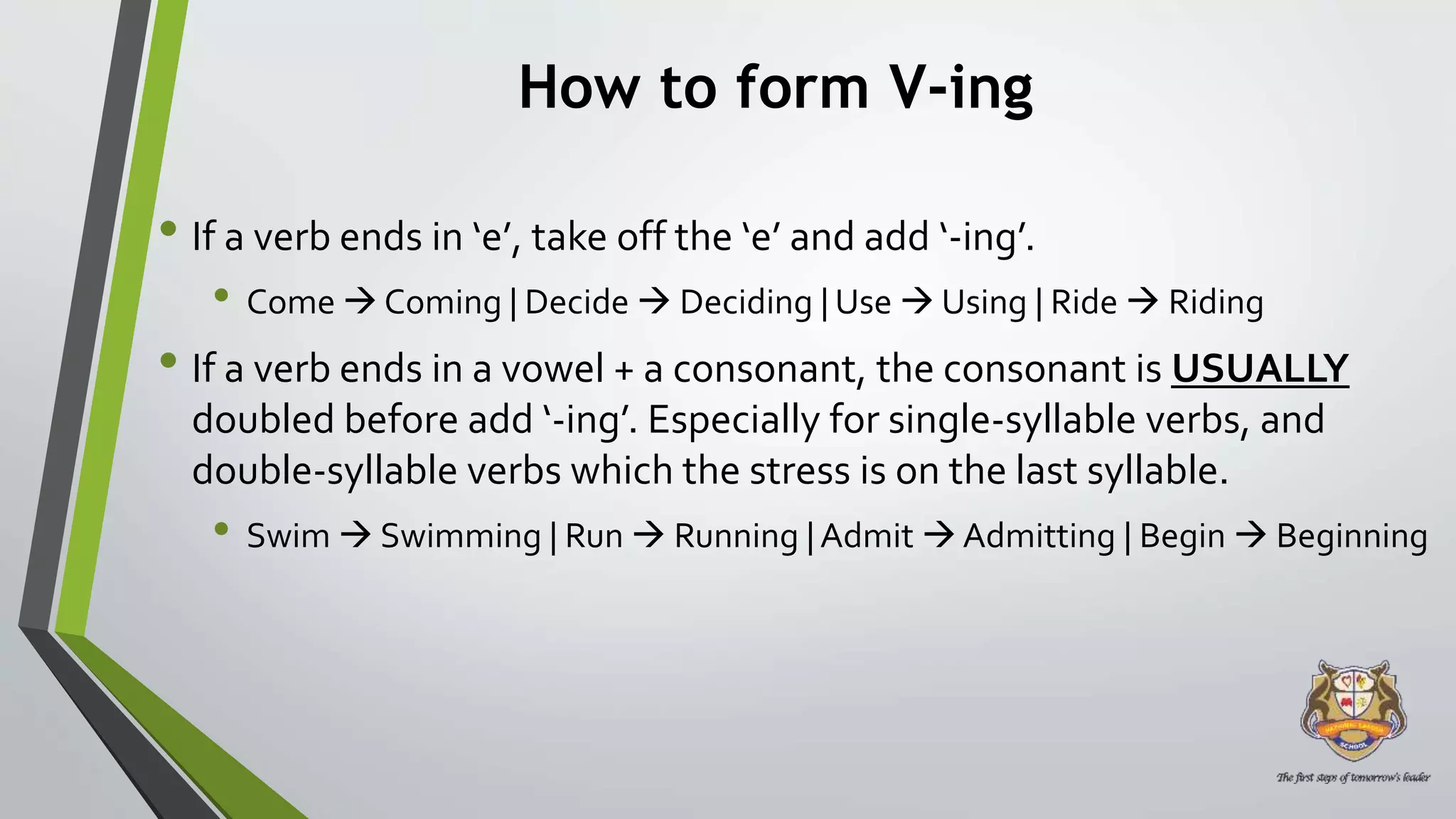
How to form V-ing
• If a verb ends in ‘e’, take off the ‘e’ and add ‘-ing’.
• Come  Coming | Decide  Deciding | Use  Using | Ride  Riding
• If a verb ends in a vowel + a consonant, the consonant is USUALLY
doubled before add ‘-ing’. Especially for single-syllable verbs, and
double-syllable verbs which the stress is on the last syllable.
• Swim  Swimming | Run  Running | Admit  Admitting | Begin  Beginning
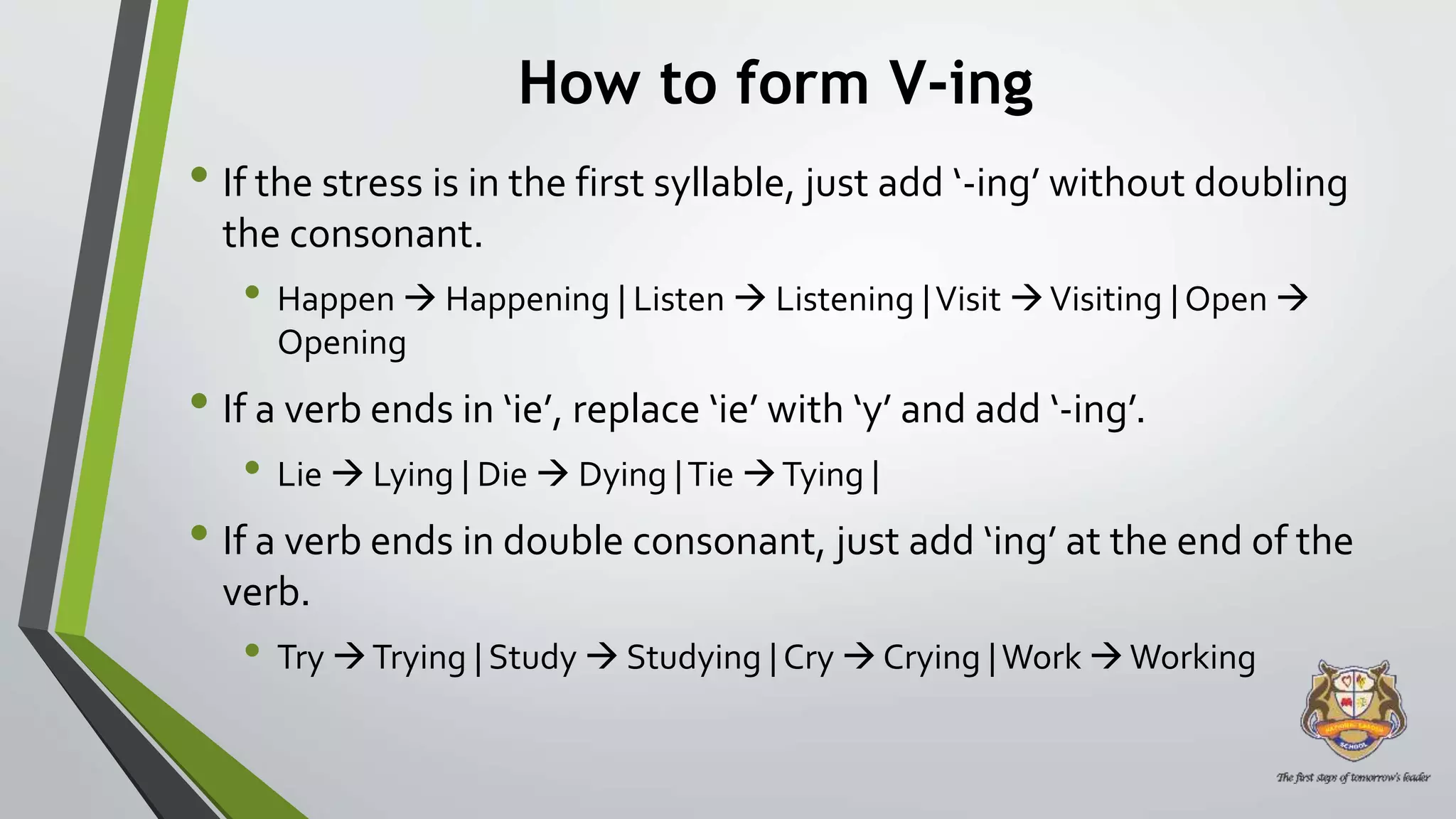
How to form V-ing
• If the stress is in the first syllable, just add ‘-ing’ without doubling
the consonant.
• Happen  Happening | Listen  Listening |Visit Visiting | Open 
Opening
• If a verb ends in ‘ie’, replace ‘ie’ with ‘y’ and add ‘-ing’.
• Lie  Lying | Die  Dying |Tie Tying |
• If a verb ends in double consonant, just add ‘ing’ at the end of the
verb.
• Try Trying | Study  Studying | Cry  Crying |Work Working
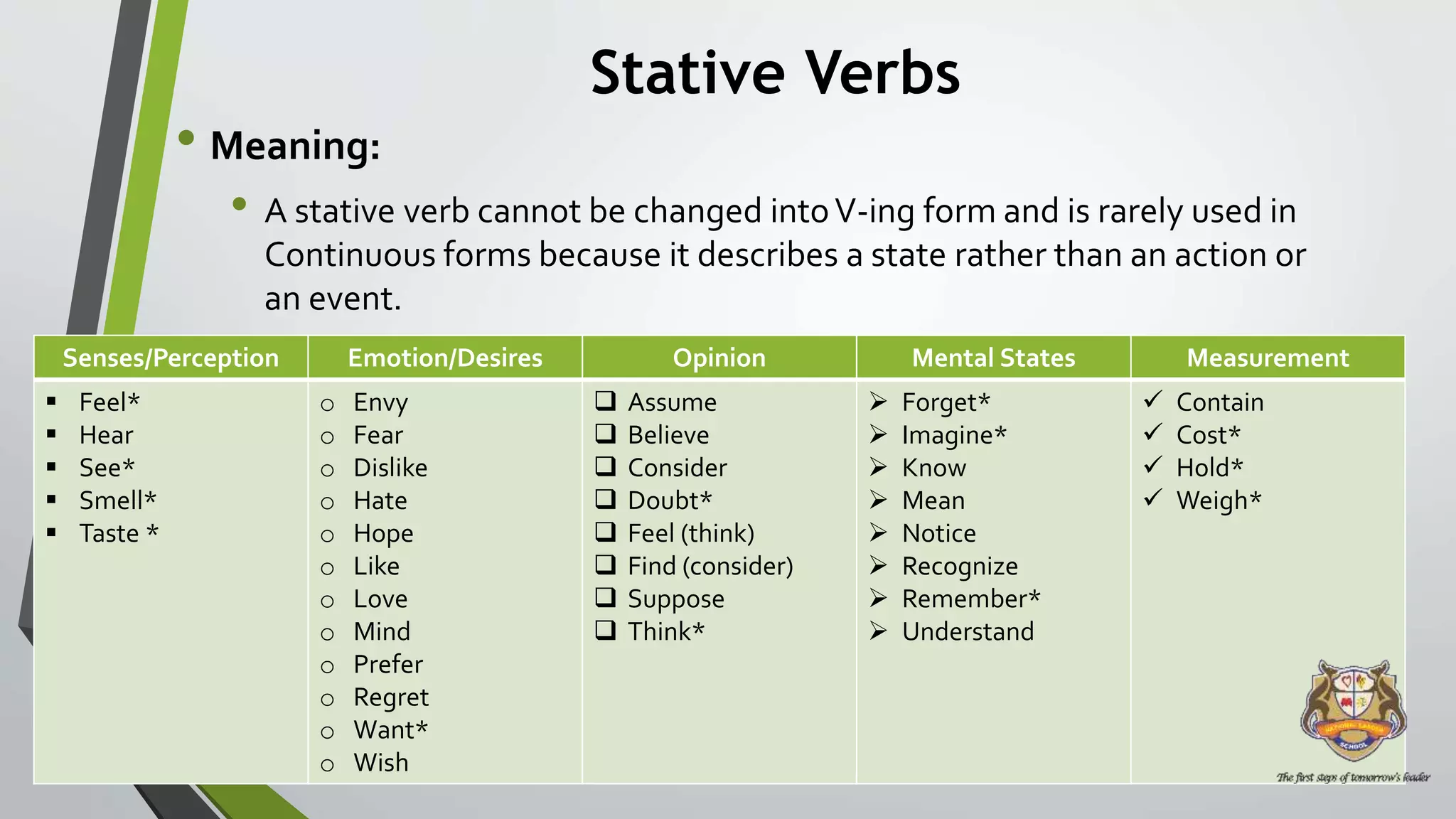
Stative Verbs
• Meaning:
• A stative verb cannot be changed intoV-ing form and is rarely used in
Continuous forms because it describes a state rather than an action or
an event.
Senses/Perception Emotion/Desires Opinion Mental States Measurement
 Feel*
 Hear
 See*
 Smell*
 Taste *
o Envy
o Fear
o Dislike
o Hate
o Hope
o Like
o Love
o Mind
o Prefer
o Regret
o Want*
o Wish
 Assume
 Believe
 Consider
 Doubt*
 Feel (think)
 Find (consider)
 Suppose
 Think*
 Forget*
 Imagine*
 Know
 Mean
 Notice
 Recognize
 Remember*
 Understand
 Contain
 Cost*
 Hold*
 Weigh*
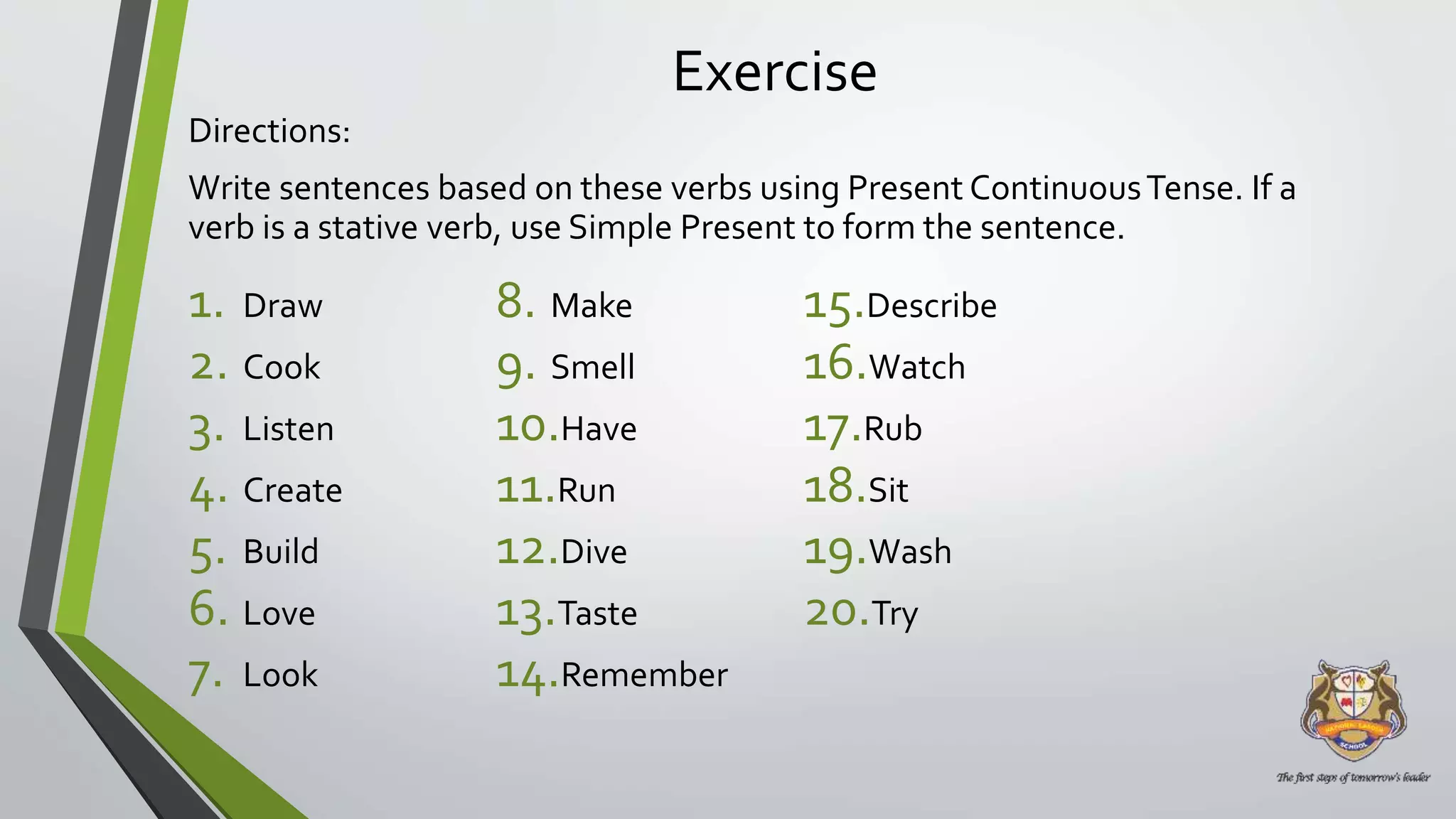
Exercise
Directions:
Write sentences based on these verbs using Present ContinuousTense. If a
verb is a stative verb, use Simple Present to form the sentence.
1. Draw
2. Cook
3. Listen
4. Create
5. Build
6. Love
7. Look
8. Make
9. Smell
10.Have
11.Run
12.Dive
13.Taste
14.Remember
15.Describe
16.Watch
17.Rub
18.Sit
19.Wash
20.Try

Present continuous - by Andri Wibisono

  • 1.
    Present Continuous Understanding Functionsand Creating Sentences Using Present ContinuousTense By AndriWibisono
  • 2.
    How to FormPresent Continuous Tense • Positive (+) • Subject + to be +V-ing + Object • Negative (-) • Subject + to be + not +V-ing + Object • Interrogative (?) • To be + Subject +V-ing + Object Anita is writing a letter. Anita is not (isn’t) writing a letter. Is Anita writing a letter? Note: Present to be I  AM He, She, It  IS They, We,You  ARE Note: Adverb of Time Now, at the moment, today, nowdays, this week.
  • 3.
    Function of PresentContinuous Tense • Showing an activity which is happening now, at the moment. • Temporary action • A long action which is still in Progress Now • To show something changing, growing, or developing. • Fixed Plan (often in the near future)
  • 4.
    Showing an activitywhich is happening now, at the moment. • Anthony is reading a book now. • Anthony isn’t watchingTV at the moment. • Is Anthony writing an essay now? • They are playing football right now. • They aren’t playing table tennis now. • Are they playing basketball at the moment?
  • 5.
    Temporary action • Mr.Brian is working in NewYork this week. • Mr. Brian isn’t working inTexas this week. • Is Mr. Brian working inWashington this week? • We are having a camp this weekend. • We aren’t travelling this weekend. • Are they having a camp this weekend?
  • 6.
    A long actionwhich is still in Progress Now • They are researching to find the cure of HIVAIDS. • They aren’t researching to find the cure of Malaria. • Are they researching to find the cure of influenza? • He is studying to be a doctor. • He isn’t studying to be a lawyer. • Is he studying to be a carpenter?
  • 7.
    To show somethingchanging, growing, or developing. • Our profit is increasing rapidly this year. • The children are growing quickly • Your English is improving.
  • 8.
    Fixed Plan (oftenin the near future) • They’re going to visit Angela today. • I’m meeting my friends after work. • I’m having my lunch after the class ended.
  • 9.
    How to formV-ing • If a verb ends in ‘e’, take off the ‘e’ and add ‘-ing’. • Come  Coming | Decide  Deciding | Use  Using | Ride  Riding • If a verb ends in a vowel + a consonant, the consonant is USUALLY doubled before add ‘-ing’. Especially for single-syllable verbs, and double-syllable verbs which the stress is on the last syllable. • Swim  Swimming | Run  Running | Admit  Admitting | Begin  Beginning
  • 10.
    How to formV-ing • If the stress is in the first syllable, just add ‘-ing’ without doubling the consonant. • Happen  Happening | Listen  Listening |Visit Visiting | Open  Opening • If a verb ends in ‘ie’, replace ‘ie’ with ‘y’ and add ‘-ing’. • Lie  Lying | Die  Dying |Tie Tying | • If a verb ends in double consonant, just add ‘ing’ at the end of the verb. • Try Trying | Study  Studying | Cry  Crying |Work Working
  • 11.
    Stative Verbs • Meaning: •A stative verb cannot be changed intoV-ing form and is rarely used in Continuous forms because it describes a state rather than an action or an event. Senses/Perception Emotion/Desires Opinion Mental States Measurement  Feel*  Hear  See*  Smell*  Taste * o Envy o Fear o Dislike o Hate o Hope o Like o Love o Mind o Prefer o Regret o Want* o Wish  Assume  Believe  Consider  Doubt*  Feel (think)  Find (consider)  Suppose  Think*  Forget*  Imagine*  Know  Mean  Notice  Recognize  Remember*  Understand  Contain  Cost*  Hold*  Weigh*
  • 12.
    Exercise Directions: Write sentences basedon these verbs using Present ContinuousTense. If a verb is a stative verb, use Simple Present to form the sentence. 1. Draw 2. Cook 3. Listen 4. Create 5. Build 6. Love 7. Look 8. Make 9. Smell 10.Have 11.Run 12.Dive 13.Taste 14.Remember 15.Describe 16.Watch 17.Rub 18.Sit 19.Wash 20.Try