Preprosthetic surgery
Presenter
Dr sunain
Preprosthetic surgery
- Defined as “surgical procedures carried out to reform /
redesign denture bearing area to create an oral environment
to support a functional prosthetic appliances”
Objectives of preprosthetic surgery
1) Creating ideal support for prosthesis
2) Restoration of best possible masticatory function
3) Restoration / improvement of dental & facial esthetics
While achieving these goals max. preservation of hard
& soft tissues is utmost important .
Classification of preprosthetic surgery
A) Basic procedures – short procedures possible under LA
on dental chair, eg Frenectomy Alveoloplasty
Advanced procedures – Major proc. , reguire GA & hospitalization
eg FOM extension, Ridge augmentation
B) Initial procedures – At the time of extn. or before insertion of 1s denture
eg Frenectomy, Alveoloplasty Exostosis/ tori removal
Secondary procedures – After a period of denture wearing
eg Excision of epulis fissuratum, Ridge augmentation
contd. Classification
c) Ridge preservation procedures -Vital root retention
Root cone implants
Ridge correction procedures – Alveoloplasty
Frenectomy
Ridge extension procedures – Vestibuloplasties
Ridge augmentation procedures –
Interpositional bone grafting
Hydroxyapatite augment.
Evaluation of patients
A) Hard tissue evaluation
Inspection – width, height, contour or
any irregularity
Palpation – both ridges , tuberosity,
palatal vault , mylohyoid ridge
or any irregularity
Radiographs ( OPG / Lat. ceph. / CT )
,
root pieces, cysts, tumors,
level of mental foramen, overview
of ridges, size of pneumatization
of max. sinus.
Models – Interarch relationship in all 3 planes
B) Soft tissue evalution
Quality & quantity of denture bearing
tissue (fixed / movable / hyperplastic /
inflammed / scarred )
Vestibular depth
Level of muscle/ freni attachment
RIDGE
PRESERVATION
PROCEDURES
1) Supra mucosal vital root retention
2) Submucosal vital root retention
3) Root replacement implants
(Root cone implants)
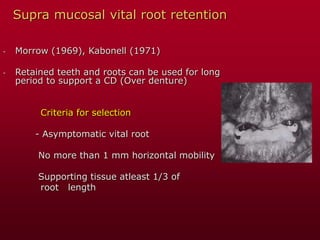
Supra mucosal vital root retention
- Morrow (1969), Kabonell (1971)
- Retained teeth and roots can be used for long
period to support a CD (Over denture)
Criteria for selection
- Asymptomatic vital root
No more than 1 mm horizontal mobility
Supporting tissue atleast 1/3 of
root length
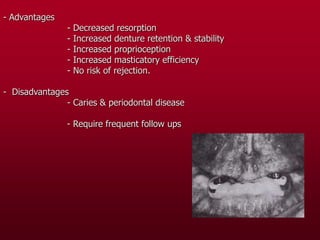
- Advantages
- Decreased resorption
- Increased denture retention & stability
- Increased proprioception
- Increased masticatory efficiency
- No risk of rejection.
- Disadvantages
- Caries & periodontal disease
- Require frequent follow ups
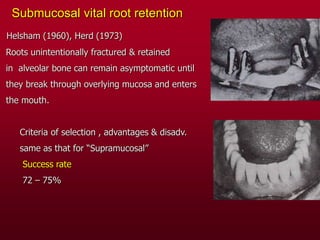
Submucosal vital root retention
Helsham (1960), Herd (1973)
Roots unintentionally fractured & retained
in alveolar bone can remain asymptomatic until
they break through overlying mucosa and enters
the mouth.
Criteria of selection , advantages & disadv.
same as that for “Supramucosal”
Success rate
72 – 75%
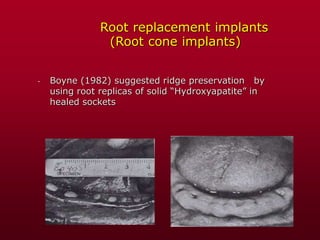
Root replacement implants
(Root cone implants)
- Boyne (1982) suggested ridge preservation by
using root replicas of solid “Hydroxyapatite” in
healed sockets
RIDGE CORRECTION
PROCEDURES
- Hard tissue procedures
- Soft tissue procedures
1) Alveolectomy
2) Alveoplasty
3) Maxillary tuberosity reduction
4) Mylohyoid ridge reduction
5) Genial tubercle reduction
6) Maxillary tori
7) Mandibular tori
8) Buccal exostosis
9) Lateral palatal exostosis
Hard tissue procedures
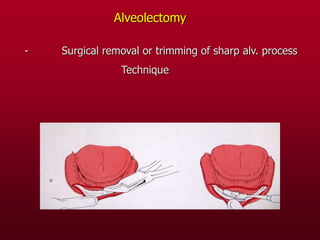
Alveolectomy
- Surgical removal or trimming of sharp alv. process
Technique
Alveoplasty
- Surgical reconturing of alv. process
Aim is to provide best possible tissue contour
for denture support
Types
1) Simple/cortical alveoplasty
2) Dean’s intercortical alveoplasty
3) Obwegeser’s modification of intercortical alveoloplasty
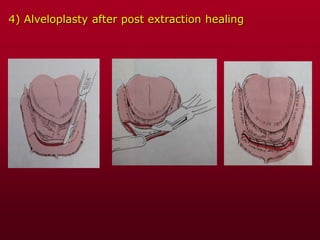
4) Alveoloplasty after postextraction healing
Obwegesers modification of deans
technique.
 After tooth removal sockets are connected and a burr is used to
remove interradicular bone.
 Both labial and palatal cortical plates are cut vertically at the
canine region to weaken the bone.
 A broad ,flat periosteal elevator is inserted in to the socket and is
used to fracture the labial cortical plate and palatal plate palatally.
 Using digital pressure the ridge is then compressed
to obtain desired shape and contour.
 Sutures close gingiva over the sockets.
 Dentures-placed-heals 4-6 weeks
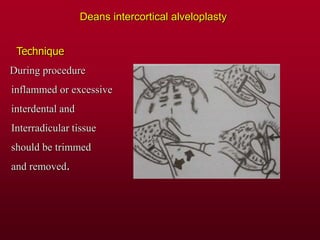
Deans intercortical alveloplasty
Technique
During procedure
inflammed or excessive
interdental and
Interradicular tissue
should be trimmed
and removed.
 Crest of the ridge is exposed by reflecting
a mucoperiosteal flap.
 A small ronger or burr may be used to
remove interseptal part of alveolar bone.
 After adequate bone removal has been achieved,
digital pressure is usually sufficient to fracture
the labial cortical plate of alveolar ridge inwards
to aproximate palatal plate more closely.
 Alveolar mucosa is reapproximated and sutured.
 A splint or immediate denture lined with a soft
liner may be placed to maintain the position .
4) Alveloplasty after post extraction healing
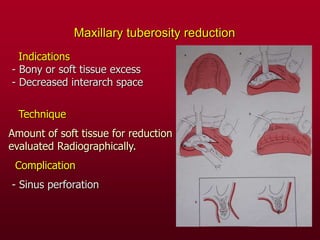
Maxillary tuberosity reduction
Indications
- Bony or soft tissue excess
- Decreased interarch space
Technique
Amount of soft tissue for reduction
evaluated Radiographically.
Complication
- Sinus perforation
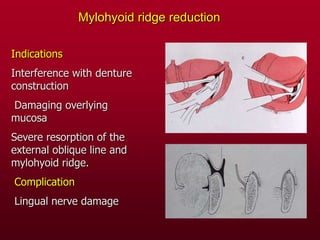
Mylohyoid ridge reduction
Indications
Interference with denture
construction
Damaging overlying
mucosa
Severe resorption of the
external oblique line and
mylohyoid ridge.
Complication
Lingual nerve damage
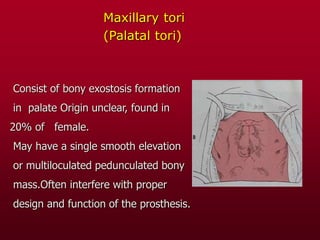
Maxillary tori
(Palatal tori)
Consist of bony exostosis formation
in palate Origin unclear, found in
20% of female.
May have a single smooth elevation
or multiloculated pedunculated bony
mass.Often interfere with proper
design and function of the prosthesis.
Indications for removal
- A large tori
- Food lodgement
Severe undercuts
- Traumatization/ulceration
- Interference with function(speech/deglutition)
- Interfering with denture construction
Maxillary Tori Removal
 Careful attention must be paid to the
depth of the cuts to avoid perforation of
the floor of the nose.
 The maxillary sinus lies over the teeth.
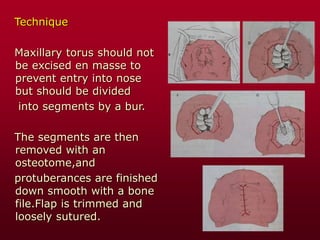
Technique
Maxillary torus should not
be excised en masse to
prevent entry into nose
but should be divided
into segments by a bur.
The segments are then
removed with an
osteotome,and
protuberances are finished
down smooth with a bone
file.Flap is trimmed and
loosely sutured.
Complications
Oroantral/oronasalcommunication
Injury to greater palatine vessels
Fracture of palatal vault
Postop. haematoma
Wound dehiscence &wound exposure
Soft tissue procedures
1) Hypermobile / Hyperplastic tissue
2) Fibrous hyperplasia of maxillary tuberosity
3) Lateral palatal soft tissue excess
4) Inflammatory fibrous hyperplasia
5) Papillary palatal hyperplasia
6) Hypertrophic labial frenum
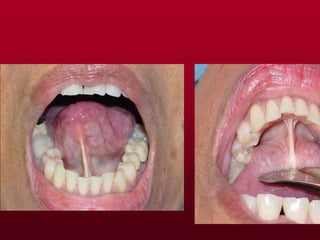
7) Abnormal lingual frenum
8) High buccal frenum attachment
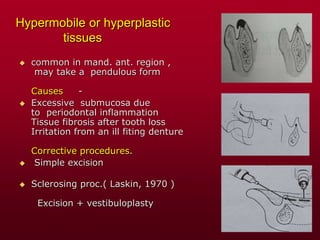
Hypermobile or hyperplastic
tissues
 common in mand. ant. region ,
may take a pendulous form
Causes -
 Excessive submucosa due
to periodontal inflammation
Tissue fibrosis after tooth loss
Irritation from an ill fiting denture
Corrective procedures.
 Simple excision
 Sclerosing proc.( Laskin, 1970 )
Excision + vestibuloplasty
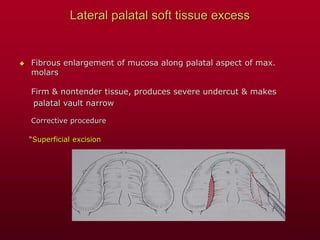
Lateral palatal soft tissue excess
 Fibrous enlargement of mucosa along palatal aspect of max.
molars
Firm & nontender tissue, produces severe undercut & makes
palatal vault narrow
Corrective procedure
“Superficial excision
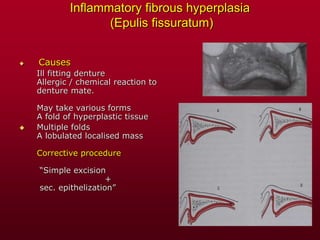
Inflammatory fibrous hyperplasia
(Epulis fissuratum)
 Causes
Ill fitting denture
Allergic / chemical reaction to
denture mate.
May take various forms
A fold of hyperplastic tissue
 Multiple folds
A lobulated localised mass
Corrective procedure
“Simple excision
+
sec. epithelization”
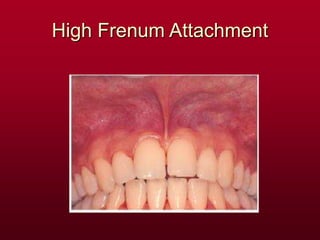
High Frenum Attachment
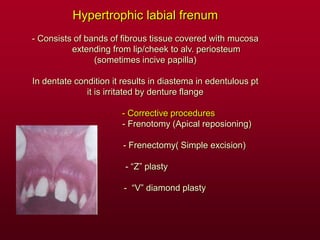
Hypertrophic labial frenum
- Consists of bands of fibrous tissue covered with mucosa
extending from lip/cheek to alv. periosteum
(sometimes incive papilla)
In dentate condition it results in diastema in edentulous pt
it is irritated by denture flange
- Corrective procedures
- Frenotomy (Apical reposioning)
- Frenectomy( Simple excision)
- “Z” plasty
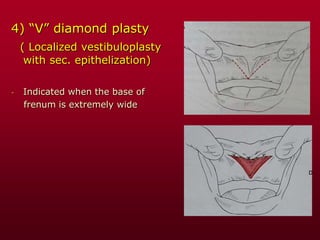
- “V” diamond plasty
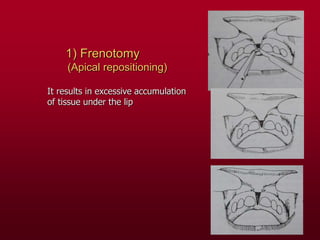
1) Frenotomy
(Apical repositioning)
It results in excessive accumulation
of tissue under the lip
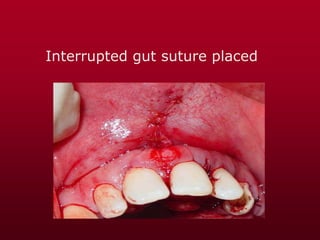
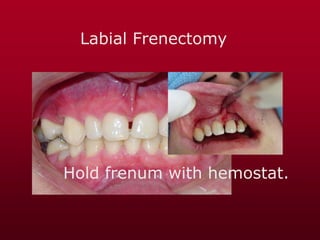
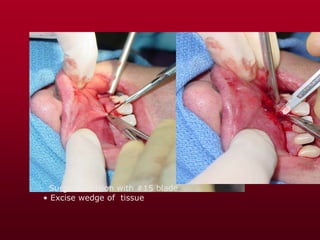
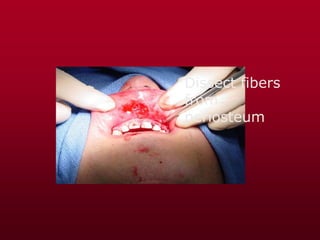
Labial Frenectomy
Hold frenum with hemostat.
Surgical incision with #15 blade
• Excise wedge of tissue
Dissect fibers
from
periosteum
Interrupted gut suture placed
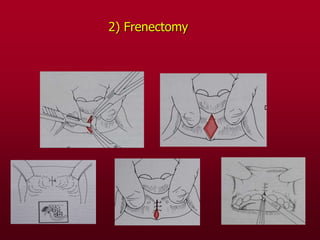
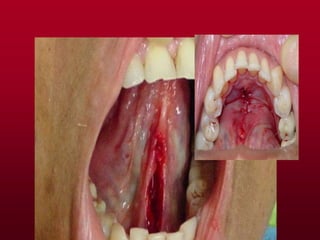
2) Frenectomy
Frenectomy
 The diamond technique
Using two hemostats, secure the frenum
adjacent to the gingiva and adjacent to
the vestibule.
Cut on the outside of the hemostats to
avoid leaving crushed tissue in place
The key to healing is to open up the
submucosal tissue
Frenectomy
 If you close the wound in its present state, a scar
will form, and you will lose what you have
attempted to accomplish.
Undermine the wound to prevent scar formation.
This will ensure a tension-free wound.
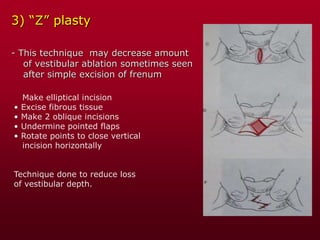
3) “Z” plasty
- This technique may decrease amount
of vestibular ablation sometimes seen
after simple excision of frenum
Make elliptical incision
• Excise fibrous tissue
• Make 2 oblique incisions
• Undermine pointed flaps
• Rotate points to close vertical
incision horizontally
Technique done to reduce loss
of vestibular depth.
4) “V” diamond plasty
( Localized vestibuloplasty
with sec. epithelization)
- Indicated when the base of
frenum is extremely wide
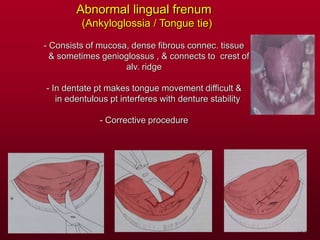
Abnormal lingual frenum
(Ankyloglossia / Tongue tie)
- Consists of mucosa, dense fibrous connec. tissue
& sometimes genioglossus , & connects to crest of
alv. ridge
- In dentate pt makes tongue movement difficult &
in edentulous pt interferes with denture stability
- Corrective procedure
 Ridge extension procedures –
Vestibuloplasties
 Ridge augmentation procedures –
Interpositional bone grafting
Hydroxyapatite augmentation
RIDGE EXTENSION PROCEDURES
“Correct the alv. ridge by compensating for
atrophy”
1) Vestibuloplasty
4) Lowering the mental foramen
2) Tuberoplasty
3) Zygomaticoplasty
Vestibuloplasty
(Sulcoplasty / Sulcus extension )
- “Surgical procedures where oral vestibule is
deepened by changing the soft tissue
attachments.”
This increases height of alv. ridge & size of denture
bearing area .
- Classification
A) Labiobuccal – 1) Mucosal advancement
(Submucous)
2) Sec. epithelization
3) Tissue grafting
B) Lingual vestibuloplasty / FOM plasty
Mucosal advancement / Submucous vestibuloplasty
“ Mucous mem.of the vest. is undermined & advanced to line
both sides of extended vest.”
- Prime criteria , “presence of adequate amount of bone & freely
movable healthy mucosa”.
Types
1) Closed submucous vest. ( Obwegesser ,1959 )
Specially applicable for upper vest.
Objectives
a) To increase ridge height.
b) To excise / transfer submucous connec.
tissue & adjacent muscles far from crest
of ridge to prevent relapse.
.
Technique
 Vertical incision made through mucosa only.
 Incision extended from mucogingival junction in to labial
mucosa.
 Blunt dissection then done in a submucosal plane to
separate mucosa from submucosa.
Vertical incision through mucosa is then deepened to reach
periosteum.
A wedge shaped strip of connective tissue remains between
submucosal tunnel and subperiosteal tunnel.
This wedge shaped tissue is excised.
 Mucosa is now adapted to the deepened sulcus and a stent
is placed to retain the mucosa in that position.
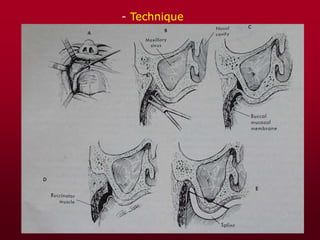
 2.Open submucosal vestibuloplasty
Technique
A horizontal incision is made through Mucosa only at the
mucogingival junction. Mucosa is dissected or separated
from the submucosa towards the lip so that a large
mucosal flap is formed.
.
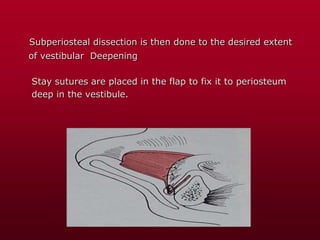
Subperiosteal dissection is then done to the desired extent
of vestibular Deepening
Stay sutures are placed in the flap to fix it to periosteum
deep in the vestibule.
- Technique
Secondary Epithelization
 Done to deepen the vestibule for the placement of a
denture.
 Procedure done in cases where the bone present is
sufficient but the mucosa is either insufficient or of poor
quality e.g inflammatory hyperplasia,ulcerated etc.
 Secondary epithelial vestibuloplasty basically of two types,
the side in which the flap is raised and also which surface of
the vestibule is left raw to heal by secondary intension.
Secondary epithelization vestibuloplasty
Indicated when sufficient bone is present but mucosa is
either insufficient in quantity or of poor quality.
Types
1) KAZANJIAN’s (1935)
- “Lipswitch”(1966)
2) CLARK’s (1953)
Godwin’s double flap techn. (1947)
Obwegesser’s modification (1964)
Tortorelli’s modification (1968)
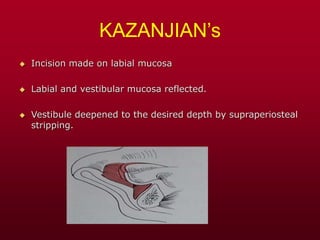
KAZANJIAN’s
 Incision made on labial mucosa
 Labial and vestibular mucosa reflected.
 Vestibule deepened to the desired depth by supraperiosteal
stripping.
 Mucosal flap is turned downwards from its attachment on
the alveolar ridge and is placed against periosteum and
sutured at the depth
 Labial or soft tissue surface is left to granulate and heal by
secondary epithelization.
 A stent is placed and left in place for atleast a week for
healing to take place and to maintain depth of vestibule.
CLARK’s technique
 Reverse of Kazanjian’s procedure.
Principle, “raw surface overlying bone can’t contract”.
 Technique
(supraperiosteal dissection)
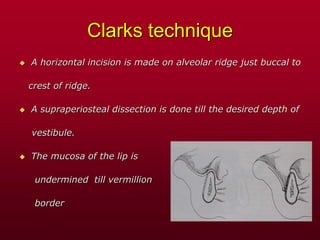
Clarks technique
 A horizontal incision is made on alveolar ridge just buccal to
crest of ridge.
 A supraperiosteal dissection is done till the desired depth of
vestibule.
 The mucosa of the lip is
undermined till vermillion
border
 The free margin of mucosal flap is sutured to the depth of
newly created vestibule.
 Therefore mucosal surface or soft tissue side of vestibule is
covered with mucosa whereas on the osseous side the raw
periosteal surface is left to granulate and epithelise
secondarily.
 Clarks procedure leaves a raw periosteal surface.
 This surface heals by secondary intention but this
raw surface covering bone cannot contract.
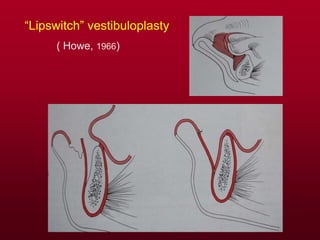
“Lipswitch” vestibuloplasty
( Howe, 1966)
Tissue grafting vestibuloplasty
- Indications
1) Insufficient bone to compensate for potential
relapse of sec. epithelization vest.
2) Vestibular depth is needed after a bone graft
ridge augmentation.
- Advantages
1) Reduces wound contracture.
2) Provides coverage to denuded area.
3) Promotes rapid healing.
4) Permitts early use of prosthesis.
Graft materials
1) Skin
2) Palatal mucosa
3) Buccal mucosa
4) Dermal grafts
5) Xenografts
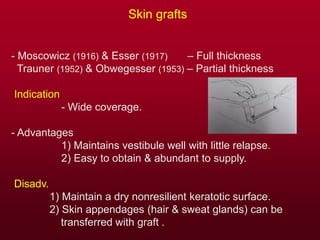
Skin grafts
- Moscowicz (1916) & Esser (1917) – Full thickness
Trauner (1952) & Obwegesser (1953) – Partial thickness
Indication
- Wide coverage.
- Advantages
1) Maintains vestibule well with little relapse.
2) Easy to obtain & abundant to supply.
Disadv.
1) Maintain a dry nonresilient keratotic surface.
2) Skin appendages (hair & sweat glands) can be
transferred with graft .
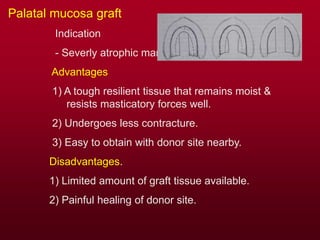
Palatal mucosa graft
Indication
- Severly atrophic mandible.
Advantages
1) A tough resilient tissue that remains moist &
resists masticatory forces well.
2) Undergoes less contracture.
3) Easy to obtain with donor site nearby.
Disadvantages.
1) Limited amount of graft tissue available.
2) Painful healing of donor site.
Buccal mucosa graft
(Partial thickness)
- Steinhauser (1969) & Maloney (1972).
Indication
To create a smooth vestibule
when bone loss is moderate
( for holding down soft tissue attachments).
Advantages
1) Creates a smooth transition b/n attached &
free mucosa.
2) Remains displaceable , therefore aids in
denture retention.
3) Donor site presents little problem & heals
without scarring.
Xenografts
(Porcine frozen skin graft )
Friedman (1944).
Indication
- Donor site morbidity / medically
compromised pt.
Advantages
1) Minimizes contracture & scarring.
2) Decreased susceptibility to infection.
3) Less pain.
Lingual vestibuloplasty
( FOM plasty / Lowering the FOM)
- Types
1) Anterior lingual vestibuloplasty
( Repositioning of genioglossus )
Cooley’s (1952)
2) Posterior lingual vestibuloplasty
( Repositioning of mylohyoid muscle )
Caldwell’s (1955)
Trauner’s (1952)
Obwegesser’s (1963)
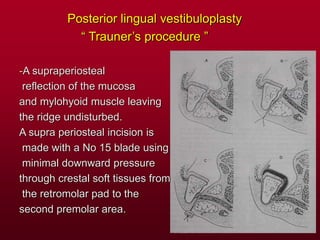
Posterior lingual vestibuloplasty
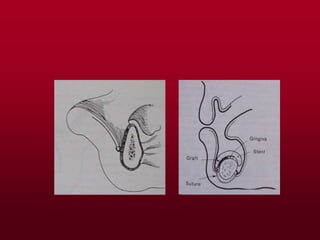
“ Trauner’s procedure ”
-A supraperiosteal
reflection of the mucosa
and mylohyoid muscle leaving
the ridge undisturbed.
A supra periosteal incision is
made with a No 15 blade using
minimal downward pressure
through crestal soft tissues from
the retromolar pad to the
second premolar area.
 Free edge of the flap is grasped with
toothed dissection forceps and
supraperiosteal dissection by the scalpel
blade is continued reflecting mucosa from
periosteum of the alveolus.
 Anterior mylohyoid muscle fibres are
separated from mylohyoid ridge.
 Lingual nerve is now exposed in the depth
of the wound.
 Depth of sulcus may be packed with moistened
gauze to achieve haemostasis
while same procedure is completed on the
opposite side.
Lingual mucosa and mylohyoid muscle must now
be secured to the lower border of mandible.
The tip of curved atraumatic 90 mm needle
carrying no 1 monofilament nylon is introduced
through wall of one of the tubes in to the lumen .
 When lingual tissues are at the lower
border of the mandible, knots are tied
over the tube.
An absorbent dressing may be placed over
skin tubes to collect escaping blood.
After tubes and nylon have been removed
re-epithelisation continues .
When it is complete fixed soft tissues
cover lingual plate.
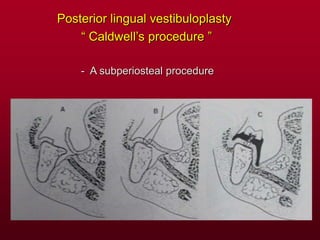
Posterior lingual vestibuloplasty
“ Caldwell’s procedure ”
- A subperiosteal procedure
Surgical techniques
 A vasoconstictor-mylohyoid muscles.
Crestal incision is made from the retromolar pad
forward to the second premolar area to produce
easy flap elevation.
A Limited Lingual extension is made at right
angles through retromolar pad to provide access.
Insertion of mylohyoid muscle then reflected off
the ridge by a sharp ,periosteal elevator.
An assessment of the undercut deep to the ridge
is made by periosteal elevator with tongue
retractor repositioned displaying prominent
mylohyoid ridge.
 Mylohyoid ridge may be split off by a 5 mm chisel
with bevel placed towards the tongue as the
assistant supports the lower jaw to prevent
damage to the tmj.
Before flap is sutured its undersurface is examined
Mylohyoid muscle filaments will be found inserted
in the connective tissue attached to the mucosa
should be carefully dissected to avoid
penetration of mucosa.
 Monofilament nylon is used to anchor polythene
tubes in lingual sulcus and on the external skin .
 An alternative method of maintaining the lingual
mucosa to bone contact is to insert a splint lined
with thermoplastic material.
Posterior lingual vestibuloplasty
“ Obwegesser’s procedure ”
[ Skin graft labiobuccal vest. + Trauner’s FOM plasty ]
This operation increases the denture
bearing area deepening the labial ,
buccal and lingual sulci.
Incision is made through mucosa but not
underlying periosteum at the junction of
the attached and nonattached crestal
tissues.
 Lightest touch with blade is advised to
avoid nerve damage and periosteal
incision.
 Incision is taken around the lower jaw to
join a 1.5 cm long incision made at right
angles to the alveolar crest at each
retromolar pad.This will allow mucosal
reflection.
 Mentalis muscle is incised from periosteum by a
scalpel .The initial lateral dissection of the muscle
extends up to the mental nerve trunks which can
be seen emerging from their foramina which are
freed from superficial muscles by careful
dissection.
 Blunt ended scissors are then passed deep to the
nerve and as their blades are opened nerve
trunk is separated from underlying muscles.
 A Supraperiosteal incision has been made
through attached and nonattached mucosa
around lingual aspect of jaw and mucosa has
been reflected in a lingual direction.
Blades have been inserted deep to muscle to
separate it from deeper tissues.
Superficial muscle fibres and connective tissue
are dissected off genial shelf.
 Superficial and lateral fibres of genioglossus
muscle are being sectioned.
Soft tissue dissection is now completed.
Six hammock sutures will be inserted around
lower jaw.
Awl is passed through submandibular skin deep
to mandible and in to lingual sulcus.
 Two ends of vicryl are clipped and left outside of
mouth.
When desired depths have been achieved,knot is
tied securely and vicryl cut close to knot.
An impression of softened gutta percha carried in
a splint has been taken out of new alveolus.
Splint will be inserted in to mouth and fixed to
lower jaw by three monofilament nylon sutures.
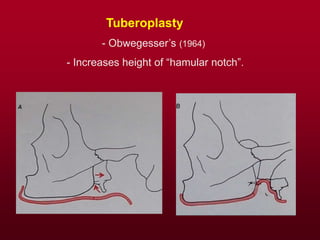
Tuberoplasty
- Obwegesser’s (1964)
- Increases height of “hamular notch”.
 Tuberoplasty is designed to provide increased height on the
distal aspect of maxillary tuberosity and thereby prevent
anterior displacement of the denture.
 A curved transverse incision from buccal vestibule to the
palatal side of remaining tuberosity.
 The region of pterygomaxillary notch is exposed and lower
portion of lateral and medial pterygoid plates is separated
from tuberosity with a curved osteotome. Segment is then
pushed posteriorly.
 Obwegeser recommends suturing the
palatal edge of mucosal flap to the
pterygoid muscle tendons leaving
posterior aspect of tuberosity to heal by
secondary epithelisation.
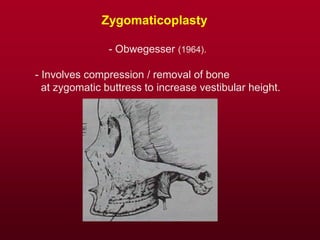
Zygomaticoplasty
- Obwegesser (1964).
- Involves compression / removal of bone
at zygomatic buttress to increase vestibular height.
 Zygomaticoplasty involves removal or
compression of bone at the butress of zygoma to
provide added vestibular height and lateral
stability.
A horizontal incision is made just below the base
of process.
The mucoperiosteum is reflected and a horizontal
cut is made with a bur at the upper aspect of
buttress.
 From this cut three or four vertical cuts
are made inferiorly to the base of the
process.
Bone then compressed medially in to
antrum.
An alternative procedure involves removal
of bone with a bur trying to remain
parallel with remaining maxillary antrum.
RIDGE AUGMENTATION PROCEDURES
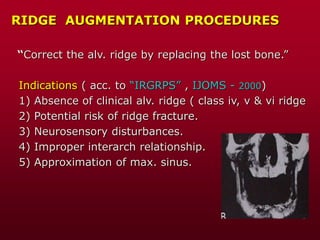
“Correct the alv. ridge by replacing the lost bone.”
Indications ( acc. to “IRGRPS” , IJOMS - 2000)
1) Absence of clinical alv. ridge ( class iv, v & vi ridge
2) Potential risk of ridge fracture.
3) Neurosensory disturbances.
4) Improper interarch relationship.
5) Approximation of max. sinus.
- Augmentation procedures
1) Direct augmentation of atrophic ridge with a bone
graft .
2) Augmentation of atrophic ridge
with pedicle & interpositional bone grafts.
3) Augmentation with synthetic graft material.
4) Maxillary sinus lift procedure.
-
Augmentation materials
 Augmentation materials
1) Autogenous bone (Rib / iliac crest )
- Most biologically acceptable material.
Disadv. –
- 1) Need for donor site surgery.
2) Morbidity of donor site.
3) Extensive resorption after
grafting ( 65 – 70%).
2) Allogeneic bone
( Freeze dried cadaver bone)
- Eliminates need for donor site surgery.
- Disadv., when used for large augmentation
it results in dehiscence & resorption.
3) Alloplastic material( Hydroxyapatite)
- Adv.
1) Eliminates need for donor site surgery.
2) Since nonresorbable ,provides long
term maintenance of ridge height &
contour.
3) Readily available.
- Disadv, not as strong as bone graft.
Direct augmentation of atrophic ridge
with a bone graft
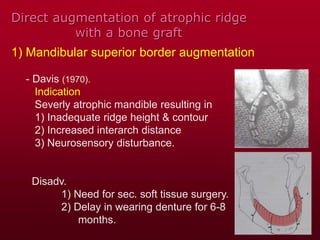
1) Mandibular superior border augmentation
- Davis (1970).
Indication
Severly atrophic mandible resulting in
1) Inadequate ridge height & contour
2) Increased interarch distance
3) Neurosensory disturbance.
Disadv.
1) Need for sec. soft tissue surgery.
2) Delay in wearing denture for 6-8
months.
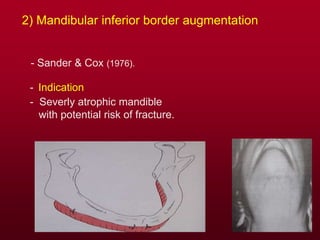
2) Mandibular inferior border augmentation
- Sander & Cox (1976).
- Indication
- Severly atrophic mandible
with potential risk of fracture.
- Advantages
1) Doesn’t change vertical dimension.
2) Doesn’t obliterate the vestibule.
3) Doesn’t subject the graft to
direct masticatory forces,
therefore reduces resorption of graft.
4) Old denture can be weared immediately.
5) Increases height of lower 1/3 of face
& improves esthetics.
- Disadvantages
1) Doesn’t improve ridge contour ,
interarch relation or nerve position.
2) May affect facial appearance adversely.
3) E/O scar.
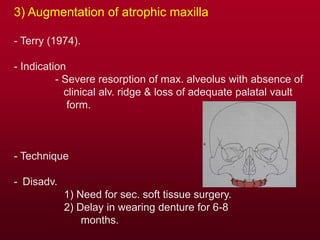
3) Augmentation of atrophic maxilla
- Terry (1974).
- Indication
- Severe resorption of max. alveolus with absence of
clinical alv. ridge & loss of adequate palatal vault
form.
- Technique
- Disadv.
1) Need for sec. soft tissue surgery.
2) Delay in wearing denture for 6-8
months.
Augmentation of atrophic ridge with pedicle &
interpositional bone grafts (“Sandwich”
grafting)
- Barros Saint – Pasteur (1970).
- Advantages
1) Retain original mucoperiosteum
bone interface on denture bearing surface.
2) Results in more predictable & less
extensive bone resorption (30 - 40%).
3) More stable height & contour of ridge.
4) Osseointegrated implants can be put
simultaneously ( success rate 90%).
- Disadvantages
1) Techniques not simple.
2) Need for sec. soft tissue surgery.
3) PO neurosensory deficit.
4) Inability to wear denture for
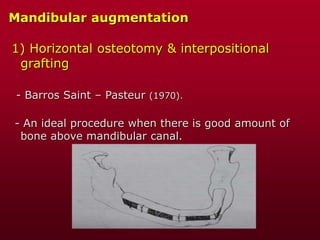
Mandibular augmentation
1) Horizontal osteotomy & interpositional
grafting
- Barros Saint – Pasteur (1970).
- An ideal procedure when there is good amount of
bone above mandibular canal.
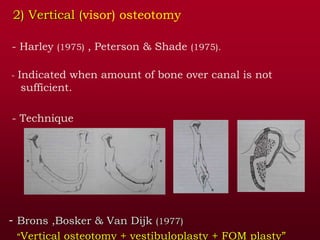
2) Vertical (visor) osteotomy
- Harley (1975) , Peterson & Shade (1975).
- Indicated when amount of bone over canal is not
sufficient.
- Technique
- Brons ,Bosker & Van Dijk (1977)
“Vertical osteotomy + vestibuloplasty + FOM plasty”
3) Combination of post. vertical osteotomy &
ant. horizontal osteotomy with interpositional
grafting in ant. region
- Koomen (1979).
- Advantage
Horizontal osteotomy in ant. region
1) Facilitates better sup. &
post. repositoning of pedicled segment.
2) Increases amount of augmentation.
3) Corrects A-P & lateral ridge discrepancy.
Less chances of # if vertical osteotomy
is done in mandibular body region.
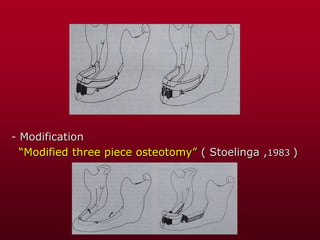
- Modification
“Modified three piece osteotomy” ( Stoelinga ,1983 )
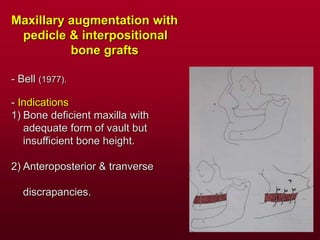
Maxillary augmentation with
pedicle & interpositional
bone grafts
- Bell (1977).
- Indications
1) Bone deficient maxilla with
adequate form of vault but
insufficient bone height.
2) Anteroposterior & tranverse
discrapancies.
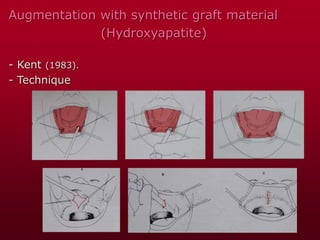
Augmentation with synthetic graft material
(Hydroxyapatite)
- Kent (1983).
- Technique
- Advantages
1) Simple procedure, can be done
in outpatient.
2) Improves ridge contour ,
fit & comfort of denture.
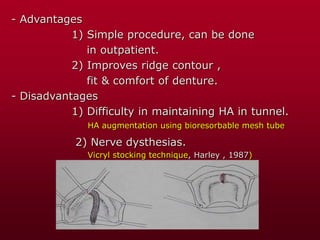
- Disadvantages
1) Difficulty in maintaining HA in tunnel.
2) Nerve dysthesias.
HA augmentation using bioresorbable mesh tube
Vicryl stocking technique, Harley , 1987)
References
 Peterson.Contemporary ORAL AND MAXILLOFACIAL SURGERY.
Fourth Edition.
Reconstructive preprosthetic oral and maxillofacial surgery.
Fonseca and Davis.
Text book of Oral and Maxillofacial surgery. Gustav Kruger.
Text book of practical oral and maxillofacial surgery. Daniel white.
LASKIN.
 Thank u

preprosthetic surgery hard and soft tissue.ppt

  • 1.
  • 2.
    Preprosthetic surgery - Definedas “surgical procedures carried out to reform / redesign denture bearing area to create an oral environment to support a functional prosthetic appliances” Objectives of preprosthetic surgery 1) Creating ideal support for prosthesis 2) Restoration of best possible masticatory function 3) Restoration / improvement of dental & facial esthetics While achieving these goals max. preservation of hard & soft tissues is utmost important .
  • 3.
    Classification of preprostheticsurgery A) Basic procedures – short procedures possible under LA on dental chair, eg Frenectomy Alveoloplasty Advanced procedures – Major proc. , reguire GA & hospitalization eg FOM extension, Ridge augmentation B) Initial procedures – At the time of extn. or before insertion of 1s denture eg Frenectomy, Alveoloplasty Exostosis/ tori removal Secondary procedures – After a period of denture wearing eg Excision of epulis fissuratum, Ridge augmentation
  • 4.
    contd. Classification c) Ridgepreservation procedures -Vital root retention Root cone implants Ridge correction procedures – Alveoloplasty Frenectomy Ridge extension procedures – Vestibuloplasties Ridge augmentation procedures – Interpositional bone grafting Hydroxyapatite augment.
  • 5.
    Evaluation of patients A)Hard tissue evaluation Inspection – width, height, contour or any irregularity Palpation – both ridges , tuberosity, palatal vault , mylohyoid ridge or any irregularity Radiographs ( OPG / Lat. ceph. / CT ) , root pieces, cysts, tumors, level of mental foramen, overview of ridges, size of pneumatization of max. sinus. Models – Interarch relationship in all 3 planes
  • 6.
    B) Soft tissueevalution Quality & quantity of denture bearing tissue (fixed / movable / hyperplastic / inflammed / scarred ) Vestibular depth Level of muscle/ freni attachment
  • 7.
    RIDGE PRESERVATION PROCEDURES 1) Supra mucosalvital root retention 2) Submucosal vital root retention 3) Root replacement implants (Root cone implants)
  • 8.
    Supra mucosal vitalroot retention - Morrow (1969), Kabonell (1971) - Retained teeth and roots can be used for long period to support a CD (Over denture) Criteria for selection - Asymptomatic vital root No more than 1 mm horizontal mobility Supporting tissue atleast 1/3 of root length
  • 9.
    - Advantages - Decreasedresorption - Increased denture retention & stability - Increased proprioception - Increased masticatory efficiency - No risk of rejection. - Disadvantages - Caries & periodontal disease - Require frequent follow ups
  • 10.
    Submucosal vital rootretention Helsham (1960), Herd (1973) Roots unintentionally fractured & retained in alveolar bone can remain asymptomatic until they break through overlying mucosa and enters the mouth. Criteria of selection , advantages & disadv. same as that for “Supramucosal” Success rate 72 – 75%
  • 11.
    Root replacement implants (Rootcone implants) - Boyne (1982) suggested ridge preservation by using root replicas of solid “Hydroxyapatite” in healed sockets
  • 12.
    RIDGE CORRECTION PROCEDURES - Hardtissue procedures - Soft tissue procedures
  • 13.
    1) Alveolectomy 2) Alveoplasty 3)Maxillary tuberosity reduction 4) Mylohyoid ridge reduction 5) Genial tubercle reduction 6) Maxillary tori 7) Mandibular tori 8) Buccal exostosis 9) Lateral palatal exostosis Hard tissue procedures
  • 14.
    Alveolectomy - Surgical removalor trimming of sharp alv. process Technique
  • 15.
    Alveoplasty - Surgical reconturingof alv. process Aim is to provide best possible tissue contour for denture support Types 1) Simple/cortical alveoplasty 2) Dean’s intercortical alveoplasty 3) Obwegeser’s modification of intercortical alveoloplasty 4) Alveoloplasty after postextraction healing
  • 16.
    Obwegesers modification ofdeans technique.  After tooth removal sockets are connected and a burr is used to remove interradicular bone.  Both labial and palatal cortical plates are cut vertically at the canine region to weaken the bone.  A broad ,flat periosteal elevator is inserted in to the socket and is used to fracture the labial cortical plate and palatal plate palatally.
  • 17.
     Using digitalpressure the ridge is then compressed to obtain desired shape and contour.  Sutures close gingiva over the sockets.  Dentures-placed-heals 4-6 weeks
  • 18.
    Deans intercortical alveloplasty Technique Duringprocedure inflammed or excessive interdental and Interradicular tissue should be trimmed and removed.
  • 19.
     Crest ofthe ridge is exposed by reflecting a mucoperiosteal flap.  A small ronger or burr may be used to remove interseptal part of alveolar bone.  After adequate bone removal has been achieved, digital pressure is usually sufficient to fracture the labial cortical plate of alveolar ridge inwards to aproximate palatal plate more closely.
  • 20.
     Alveolar mucosais reapproximated and sutured.  A splint or immediate denture lined with a soft liner may be placed to maintain the position .
  • 21.
    4) Alveloplasty afterpost extraction healing
  • 22.
    Maxillary tuberosity reduction Indications -Bony or soft tissue excess - Decreased interarch space Technique Amount of soft tissue for reduction evaluated Radiographically. Complication - Sinus perforation
  • 23.
    Mylohyoid ridge reduction Indications Interferencewith denture construction Damaging overlying mucosa Severe resorption of the external oblique line and mylohyoid ridge. Complication Lingual nerve damage
  • 24.
    Maxillary tori (Palatal tori) Consistof bony exostosis formation in palate Origin unclear, found in 20% of female. May have a single smooth elevation or multiloculated pedunculated bony mass.Often interfere with proper design and function of the prosthesis.
  • 25.
    Indications for removal -A large tori - Food lodgement Severe undercuts - Traumatization/ulceration - Interference with function(speech/deglutition) - Interfering with denture construction
  • 26.
    Maxillary Tori Removal Careful attention must be paid to the depth of the cuts to avoid perforation of the floor of the nose.  The maxillary sinus lies over the teeth.
  • 27.
    Technique Maxillary torus shouldnot be excised en masse to prevent entry into nose but should be divided into segments by a bur. The segments are then removed with an osteotome,and protuberances are finished down smooth with a bone file.Flap is trimmed and loosely sutured.
  • 28.
    Complications Oroantral/oronasalcommunication Injury to greaterpalatine vessels Fracture of palatal vault Postop. haematoma Wound dehiscence &wound exposure
  • 29.
    Soft tissue procedures 1)Hypermobile / Hyperplastic tissue 2) Fibrous hyperplasia of maxillary tuberosity 3) Lateral palatal soft tissue excess 4) Inflammatory fibrous hyperplasia 5) Papillary palatal hyperplasia 6) Hypertrophic labial frenum 7) Abnormal lingual frenum 8) High buccal frenum attachment
  • 30.
    Hypermobile or hyperplastic tissues common in mand. ant. region , may take a pendulous form Causes -  Excessive submucosa due to periodontal inflammation Tissue fibrosis after tooth loss Irritation from an ill fiting denture Corrective procedures.  Simple excision  Sclerosing proc.( Laskin, 1970 ) Excision + vestibuloplasty
  • 31.
    Lateral palatal softtissue excess  Fibrous enlargement of mucosa along palatal aspect of max. molars Firm & nontender tissue, produces severe undercut & makes palatal vault narrow Corrective procedure “Superficial excision
  • 32.
    Inflammatory fibrous hyperplasia (Epulisfissuratum)  Causes Ill fitting denture Allergic / chemical reaction to denture mate. May take various forms A fold of hyperplastic tissue  Multiple folds A lobulated localised mass Corrective procedure “Simple excision + sec. epithelization”
  • 33.
  • 34.
    Hypertrophic labial frenum -Consists of bands of fibrous tissue covered with mucosa extending from lip/cheek to alv. periosteum (sometimes incive papilla) In dentate condition it results in diastema in edentulous pt it is irritated by denture flange - Corrective procedures - Frenotomy (Apical reposioning) - Frenectomy( Simple excision) - “Z” plasty - “V” diamond plasty
  • 35.
    1) Frenotomy (Apical repositioning) Itresults in excessive accumulation of tissue under the lip
  • 36.
  • 37.
    Surgical incision with#15 blade • Excise wedge of tissue
  • 38.
  • 39.
  • 40.
  • 41.
    Frenectomy  The diamondtechnique Using two hemostats, secure the frenum adjacent to the gingiva and adjacent to the vestibule. Cut on the outside of the hemostats to avoid leaving crushed tissue in place The key to healing is to open up the submucosal tissue
  • 42.
    Frenectomy  If youclose the wound in its present state, a scar will form, and you will lose what you have attempted to accomplish. Undermine the wound to prevent scar formation. This will ensure a tension-free wound.
  • 45.
    3) “Z” plasty -This technique may decrease amount of vestibular ablation sometimes seen after simple excision of frenum Make elliptical incision • Excise fibrous tissue • Make 2 oblique incisions • Undermine pointed flaps • Rotate points to close vertical incision horizontally Technique done to reduce loss of vestibular depth.
  • 46.
    4) “V” diamondplasty ( Localized vestibuloplasty with sec. epithelization) - Indicated when the base of frenum is extremely wide
  • 47.
    Abnormal lingual frenum (Ankyloglossia/ Tongue tie) - Consists of mucosa, dense fibrous connec. tissue & sometimes genioglossus , & connects to crest of alv. ridge - In dentate pt makes tongue movement difficult & in edentulous pt interferes with denture stability - Corrective procedure
  • 48.
     Ridge extensionprocedures – Vestibuloplasties  Ridge augmentation procedures – Interpositional bone grafting Hydroxyapatite augmentation
  • 49.
    RIDGE EXTENSION PROCEDURES “Correctthe alv. ridge by compensating for atrophy” 1) Vestibuloplasty 4) Lowering the mental foramen 2) Tuberoplasty 3) Zygomaticoplasty
  • 50.
    Vestibuloplasty (Sulcoplasty / Sulcusextension ) - “Surgical procedures where oral vestibule is deepened by changing the soft tissue attachments.” This increases height of alv. ridge & size of denture bearing area . - Classification A) Labiobuccal – 1) Mucosal advancement (Submucous) 2) Sec. epithelization 3) Tissue grafting B) Lingual vestibuloplasty / FOM plasty
  • 51.
    Mucosal advancement /Submucous vestibuloplasty “ Mucous mem.of the vest. is undermined & advanced to line both sides of extended vest.” - Prime criteria , “presence of adequate amount of bone & freely movable healthy mucosa”. Types 1) Closed submucous vest. ( Obwegesser ,1959 ) Specially applicable for upper vest. Objectives a) To increase ridge height. b) To excise / transfer submucous connec. tissue & adjacent muscles far from crest of ridge to prevent relapse. .
  • 52.
    Technique  Vertical incisionmade through mucosa only.  Incision extended from mucogingival junction in to labial mucosa.  Blunt dissection then done in a submucosal plane to separate mucosa from submucosa. Vertical incision through mucosa is then deepened to reach periosteum. A wedge shaped strip of connective tissue remains between submucosal tunnel and subperiosteal tunnel. This wedge shaped tissue is excised.
  • 53.
     Mucosa isnow adapted to the deepened sulcus and a stent is placed to retain the mucosa in that position.  2.Open submucosal vestibuloplasty Technique A horizontal incision is made through Mucosa only at the mucogingival junction. Mucosa is dissected or separated from the submucosa towards the lip so that a large mucosal flap is formed. .
  • 54.
    Subperiosteal dissection isthen done to the desired extent of vestibular Deepening Stay sutures are placed in the flap to fix it to periosteum deep in the vestibule.
  • 55.
  • 56.
    Secondary Epithelization  Doneto deepen the vestibule for the placement of a denture.  Procedure done in cases where the bone present is sufficient but the mucosa is either insufficient or of poor quality e.g inflammatory hyperplasia,ulcerated etc.  Secondary epithelial vestibuloplasty basically of two types, the side in which the flap is raised and also which surface of the vestibule is left raw to heal by secondary intension.
  • 57.
    Secondary epithelization vestibuloplasty Indicatedwhen sufficient bone is present but mucosa is either insufficient in quantity or of poor quality. Types 1) KAZANJIAN’s (1935) - “Lipswitch”(1966) 2) CLARK’s (1953) Godwin’s double flap techn. (1947) Obwegesser’s modification (1964) Tortorelli’s modification (1968)
  • 58.
    KAZANJIAN’s  Incision madeon labial mucosa  Labial and vestibular mucosa reflected.  Vestibule deepened to the desired depth by supraperiosteal stripping.
  • 59.
     Mucosal flapis turned downwards from its attachment on the alveolar ridge and is placed against periosteum and sutured at the depth  Labial or soft tissue surface is left to granulate and heal by secondary epithelization.  A stent is placed and left in place for atleast a week for healing to take place and to maintain depth of vestibule.
  • 60.
    CLARK’s technique  Reverseof Kazanjian’s procedure. Principle, “raw surface overlying bone can’t contract”.  Technique (supraperiosteal dissection)
  • 61.
    Clarks technique  Ahorizontal incision is made on alveolar ridge just buccal to crest of ridge.  A supraperiosteal dissection is done till the desired depth of vestibule.  The mucosa of the lip is undermined till vermillion border
  • 62.
     The freemargin of mucosal flap is sutured to the depth of newly created vestibule.  Therefore mucosal surface or soft tissue side of vestibule is covered with mucosa whereas on the osseous side the raw periosteal surface is left to granulate and epithelise secondarily.
  • 63.
     Clarks procedureleaves a raw periosteal surface.  This surface heals by secondary intention but this raw surface covering bone cannot contract.
  • 64.
  • 65.
    Tissue grafting vestibuloplasty -Indications 1) Insufficient bone to compensate for potential relapse of sec. epithelization vest. 2) Vestibular depth is needed after a bone graft ridge augmentation. - Advantages 1) Reduces wound contracture. 2) Provides coverage to denuded area. 3) Promotes rapid healing. 4) Permitts early use of prosthesis.
  • 66.
    Graft materials 1) Skin 2)Palatal mucosa 3) Buccal mucosa 4) Dermal grafts 5) Xenografts
  • 67.
    Skin grafts - Moscowicz(1916) & Esser (1917) – Full thickness Trauner (1952) & Obwegesser (1953) – Partial thickness Indication - Wide coverage. - Advantages 1) Maintains vestibule well with little relapse. 2) Easy to obtain & abundant to supply. Disadv. 1) Maintain a dry nonresilient keratotic surface. 2) Skin appendages (hair & sweat glands) can be transferred with graft .
  • 68.
    Palatal mucosa graft Indication -Severly atrophic mandible. Advantages 1) A tough resilient tissue that remains moist & resists masticatory forces well. 2) Undergoes less contracture. 3) Easy to obtain with donor site nearby. Disadvantages. 1) Limited amount of graft tissue available. 2) Painful healing of donor site.
  • 69.
    Buccal mucosa graft (Partialthickness) - Steinhauser (1969) & Maloney (1972). Indication To create a smooth vestibule when bone loss is moderate ( for holding down soft tissue attachments). Advantages 1) Creates a smooth transition b/n attached & free mucosa. 2) Remains displaceable , therefore aids in denture retention. 3) Donor site presents little problem & heals without scarring.
  • 70.
    Xenografts (Porcine frozen skingraft ) Friedman (1944). Indication - Donor site morbidity / medically compromised pt. Advantages 1) Minimizes contracture & scarring. 2) Decreased susceptibility to infection. 3) Less pain.
  • 72.
    Lingual vestibuloplasty ( FOMplasty / Lowering the FOM) - Types 1) Anterior lingual vestibuloplasty ( Repositioning of genioglossus ) Cooley’s (1952) 2) Posterior lingual vestibuloplasty ( Repositioning of mylohyoid muscle ) Caldwell’s (1955) Trauner’s (1952) Obwegesser’s (1963)
  • 73.
    Posterior lingual vestibuloplasty “Trauner’s procedure ” -A supraperiosteal reflection of the mucosa and mylohyoid muscle leaving the ridge undisturbed. A supra periosteal incision is made with a No 15 blade using minimal downward pressure through crestal soft tissues from the retromolar pad to the second premolar area.
  • 74.
     Free edgeof the flap is grasped with toothed dissection forceps and supraperiosteal dissection by the scalpel blade is continued reflecting mucosa from periosteum of the alveolus.  Anterior mylohyoid muscle fibres are separated from mylohyoid ridge.  Lingual nerve is now exposed in the depth of the wound.
  • 75.
     Depth ofsulcus may be packed with moistened gauze to achieve haemostasis while same procedure is completed on the opposite side. Lingual mucosa and mylohyoid muscle must now be secured to the lower border of mandible. The tip of curved atraumatic 90 mm needle carrying no 1 monofilament nylon is introduced through wall of one of the tubes in to the lumen .
  • 76.
     When lingualtissues are at the lower border of the mandible, knots are tied over the tube. An absorbent dressing may be placed over skin tubes to collect escaping blood. After tubes and nylon have been removed re-epithelisation continues . When it is complete fixed soft tissues cover lingual plate.
  • 77.
    Posterior lingual vestibuloplasty “Caldwell’s procedure ” - A subperiosteal procedure
  • 78.
    Surgical techniques  Avasoconstictor-mylohyoid muscles. Crestal incision is made from the retromolar pad forward to the second premolar area to produce easy flap elevation. A Limited Lingual extension is made at right angles through retromolar pad to provide access.
  • 79.
    Insertion of mylohyoidmuscle then reflected off the ridge by a sharp ,periosteal elevator. An assessment of the undercut deep to the ridge is made by periosteal elevator with tongue retractor repositioned displaying prominent mylohyoid ridge.
  • 80.
     Mylohyoid ridgemay be split off by a 5 mm chisel with bevel placed towards the tongue as the assistant supports the lower jaw to prevent damage to the tmj. Before flap is sutured its undersurface is examined Mylohyoid muscle filaments will be found inserted in the connective tissue attached to the mucosa should be carefully dissected to avoid penetration of mucosa.
  • 81.
     Monofilament nylonis used to anchor polythene tubes in lingual sulcus and on the external skin .  An alternative method of maintaining the lingual mucosa to bone contact is to insert a splint lined with thermoplastic material.
  • 82.
    Posterior lingual vestibuloplasty “Obwegesser’s procedure ” [ Skin graft labiobuccal vest. + Trauner’s FOM plasty ]
  • 83.
    This operation increasesthe denture bearing area deepening the labial , buccal and lingual sulci. Incision is made through mucosa but not underlying periosteum at the junction of the attached and nonattached crestal tissues.
  • 84.
     Lightest touchwith blade is advised to avoid nerve damage and periosteal incision.  Incision is taken around the lower jaw to join a 1.5 cm long incision made at right angles to the alveolar crest at each retromolar pad.This will allow mucosal reflection.
  • 85.
     Mentalis muscleis incised from periosteum by a scalpel .The initial lateral dissection of the muscle extends up to the mental nerve trunks which can be seen emerging from their foramina which are freed from superficial muscles by careful dissection.  Blunt ended scissors are then passed deep to the nerve and as their blades are opened nerve trunk is separated from underlying muscles.
  • 86.
     A Supraperiostealincision has been made through attached and nonattached mucosa around lingual aspect of jaw and mucosa has been reflected in a lingual direction. Blades have been inserted deep to muscle to separate it from deeper tissues. Superficial muscle fibres and connective tissue are dissected off genial shelf.
  • 87.
     Superficial andlateral fibres of genioglossus muscle are being sectioned. Soft tissue dissection is now completed. Six hammock sutures will be inserted around lower jaw. Awl is passed through submandibular skin deep to mandible and in to lingual sulcus.
  • 88.
     Two endsof vicryl are clipped and left outside of mouth. When desired depths have been achieved,knot is tied securely and vicryl cut close to knot. An impression of softened gutta percha carried in a splint has been taken out of new alveolus. Splint will be inserted in to mouth and fixed to lower jaw by three monofilament nylon sutures.
  • 89.
    Tuberoplasty - Obwegesser’s (1964) -Increases height of “hamular notch”.
  • 90.
     Tuberoplasty isdesigned to provide increased height on the distal aspect of maxillary tuberosity and thereby prevent anterior displacement of the denture.  A curved transverse incision from buccal vestibule to the palatal side of remaining tuberosity.  The region of pterygomaxillary notch is exposed and lower portion of lateral and medial pterygoid plates is separated from tuberosity with a curved osteotome. Segment is then pushed posteriorly.
  • 91.
     Obwegeser recommendssuturing the palatal edge of mucosal flap to the pterygoid muscle tendons leaving posterior aspect of tuberosity to heal by secondary epithelisation.
  • 92.
    Zygomaticoplasty - Obwegesser (1964). -Involves compression / removal of bone at zygomatic buttress to increase vestibular height.
  • 93.
     Zygomaticoplasty involvesremoval or compression of bone at the butress of zygoma to provide added vestibular height and lateral stability. A horizontal incision is made just below the base of process. The mucoperiosteum is reflected and a horizontal cut is made with a bur at the upper aspect of buttress.
  • 94.
     From thiscut three or four vertical cuts are made inferiorly to the base of the process. Bone then compressed medially in to antrum. An alternative procedure involves removal of bone with a bur trying to remain parallel with remaining maxillary antrum.
  • 95.
    RIDGE AUGMENTATION PROCEDURES “Correctthe alv. ridge by replacing the lost bone.” Indications ( acc. to “IRGRPS” , IJOMS - 2000) 1) Absence of clinical alv. ridge ( class iv, v & vi ridge 2) Potential risk of ridge fracture. 3) Neurosensory disturbances. 4) Improper interarch relationship. 5) Approximation of max. sinus.
  • 96.
    - Augmentation procedures 1)Direct augmentation of atrophic ridge with a bone graft . 2) Augmentation of atrophic ridge with pedicle & interpositional bone grafts. 3) Augmentation with synthetic graft material. 4) Maxillary sinus lift procedure. -
  • 97.
    Augmentation materials  Augmentationmaterials 1) Autogenous bone (Rib / iliac crest ) - Most biologically acceptable material. Disadv. – - 1) Need for donor site surgery. 2) Morbidity of donor site. 3) Extensive resorption after grafting ( 65 – 70%).
  • 98.
    2) Allogeneic bone (Freeze dried cadaver bone) - Eliminates need for donor site surgery. - Disadv., when used for large augmentation it results in dehiscence & resorption. 3) Alloplastic material( Hydroxyapatite) - Adv. 1) Eliminates need for donor site surgery. 2) Since nonresorbable ,provides long term maintenance of ridge height & contour. 3) Readily available. - Disadv, not as strong as bone graft.
  • 99.
    Direct augmentation ofatrophic ridge with a bone graft 1) Mandibular superior border augmentation - Davis (1970). Indication Severly atrophic mandible resulting in 1) Inadequate ridge height & contour 2) Increased interarch distance 3) Neurosensory disturbance. Disadv. 1) Need for sec. soft tissue surgery. 2) Delay in wearing denture for 6-8 months.
  • 100.
    2) Mandibular inferiorborder augmentation - Sander & Cox (1976). - Indication - Severly atrophic mandible with potential risk of fracture.
  • 101.
    - Advantages 1) Doesn’tchange vertical dimension. 2) Doesn’t obliterate the vestibule. 3) Doesn’t subject the graft to direct masticatory forces, therefore reduces resorption of graft. 4) Old denture can be weared immediately. 5) Increases height of lower 1/3 of face & improves esthetics. - Disadvantages 1) Doesn’t improve ridge contour , interarch relation or nerve position. 2) May affect facial appearance adversely. 3) E/O scar.
  • 102.
    3) Augmentation ofatrophic maxilla - Terry (1974). - Indication - Severe resorption of max. alveolus with absence of clinical alv. ridge & loss of adequate palatal vault form. - Technique - Disadv. 1) Need for sec. soft tissue surgery. 2) Delay in wearing denture for 6-8 months.
  • 103.
    Augmentation of atrophicridge with pedicle & interpositional bone grafts (“Sandwich” grafting) - Barros Saint – Pasteur (1970). - Advantages 1) Retain original mucoperiosteum bone interface on denture bearing surface. 2) Results in more predictable & less extensive bone resorption (30 - 40%). 3) More stable height & contour of ridge. 4) Osseointegrated implants can be put simultaneously ( success rate 90%). - Disadvantages 1) Techniques not simple. 2) Need for sec. soft tissue surgery. 3) PO neurosensory deficit. 4) Inability to wear denture for
  • 104.
    Mandibular augmentation 1) Horizontalosteotomy & interpositional grafting - Barros Saint – Pasteur (1970). - An ideal procedure when there is good amount of bone above mandibular canal.
  • 105.
    2) Vertical (visor)osteotomy - Harley (1975) , Peterson & Shade (1975). - Indicated when amount of bone over canal is not sufficient. - Technique - Brons ,Bosker & Van Dijk (1977) “Vertical osteotomy + vestibuloplasty + FOM plasty”
  • 106.
    3) Combination ofpost. vertical osteotomy & ant. horizontal osteotomy with interpositional grafting in ant. region - Koomen (1979). - Advantage Horizontal osteotomy in ant. region 1) Facilitates better sup. & post. repositoning of pedicled segment. 2) Increases amount of augmentation. 3) Corrects A-P & lateral ridge discrepancy. Less chances of # if vertical osteotomy is done in mandibular body region.
  • 107.
    - Modification “Modified threepiece osteotomy” ( Stoelinga ,1983 )
  • 108.
    Maxillary augmentation with pedicle& interpositional bone grafts - Bell (1977). - Indications 1) Bone deficient maxilla with adequate form of vault but insufficient bone height. 2) Anteroposterior & tranverse discrapancies.
  • 109.
    Augmentation with syntheticgraft material (Hydroxyapatite) - Kent (1983). - Technique
  • 110.
    - Advantages 1) Simpleprocedure, can be done in outpatient. 2) Improves ridge contour , fit & comfort of denture. - Disadvantages 1) Difficulty in maintaining HA in tunnel. 2) Nerve dysthesias. HA augmentation using bioresorbable mesh tube Vicryl stocking technique, Harley , 1987)
  • 111.
    References  Peterson.Contemporary ORALAND MAXILLOFACIAL SURGERY. Fourth Edition. Reconstructive preprosthetic oral and maxillofacial surgery. Fonseca and Davis. Text book of Oral and Maxillofacial surgery. Gustav Kruger. Text book of practical oral and maxillofacial surgery. Daniel white. LASKIN.
  • 113.