Preposition of Time For Class 10
What is a Preposition?
Preposition : A preposition describes a relationship between other words in a sentence. In itself, a word like "in" or "after" is rather meaningless and hard to define in mere words. For instance, when you do try to define a preposition like "in" or "between" or "on," you invariably use your hands to show how something is situated in relationship to something else.
Preposition of Time : In   (We use  in  for nonspecific times during a day, a month, a season, or a year). At   (We use  at  to designate specific times). On   (We use  on  to designate days and dates)
Examples : In: - She likes to jog in the morning. - It's too cold in winter to run outside. - He started the job in 1971. - He's going to quit in August.
At : - The train is due at 12:15 p.m.  - The bus will arrive at 5 a.m. - Andrew will go home at 9 p.m.
On : - My brother is coming on Monday. - We're having a party on the Fourth of July.  - My grandma will come on Saturday this week.
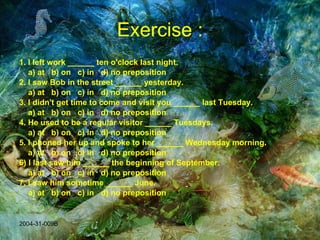
Exercise : 1. I left work ______ ten o'clock last night. a) at  b) on  c) in  d) no preposition 2. I saw Bob in the street ______ yesterday. a) at  b) on  c) in  d) no preposition 3. I didn't get time to come and visit you ______ last Tuesday.   a) at  b) on  c) in  d) no preposition 4. He used to be a regular visitor ______ Tuesdays.   a) at  b) on  c) in  d) no preposition 5. I phoned her up and spoke to her ______ Wednesday morning.   a) at  b) on  c) in  d) no preposition 6) I last saw him ______ the beginning of September.   a) at  b) on  c) in  d) no preposition 7. I saw him sometime ______ June.   a) at  b) on  c) in  d) no preposition
Finish

Preposition Of Time

  • 1.
    Preposition of TimeFor Class 10
  • 2.
    What is aPreposition?
  • 3.
    Preposition : Apreposition describes a relationship between other words in a sentence. In itself, a word like "in" or "after" is rather meaningless and hard to define in mere words. For instance, when you do try to define a preposition like "in" or "between" or "on," you invariably use your hands to show how something is situated in relationship to something else.
  • 4.
    Preposition of Time: In (We use in for nonspecific times during a day, a month, a season, or a year). At (We use at to designate specific times). On (We use on to designate days and dates)
  • 5.
    Examples : In:- She likes to jog in the morning. - It's too cold in winter to run outside. - He started the job in 1971. - He's going to quit in August.
  • 6.
    At : -The train is due at 12:15 p.m. - The bus will arrive at 5 a.m. - Andrew will go home at 9 p.m.
  • 7.
    On : -My brother is coming on Monday. - We're having a party on the Fourth of July. - My grandma will come on Saturday this week.
  • 8.
    Exercise : 1.I left work ______ ten o'clock last night. a) at b) on c) in d) no preposition 2. I saw Bob in the street ______ yesterday. a) at b) on c) in d) no preposition 3. I didn't get time to come and visit you ______ last Tuesday. a) at b) on c) in d) no preposition 4. He used to be a regular visitor ______ Tuesdays. a) at b) on c) in d) no preposition 5. I phoned her up and spoke to her ______ Wednesday morning. a) at b) on c) in d) no preposition 6) I last saw him ______ the beginning of September. a) at b) on c) in d) no preposition 7. I saw him sometime ______ June. a) at b) on c) in d) no preposition
  • 9.