Automatic traceability between
descriptive and analytical models
UC3-Functional design
Prof. Jose María Alvarez Rodríguez (UC3M, speaker)
Roy Mendieta (REUSE)
Eduardo Cibrián (UC3M)
Ainhoa Aristimuno (ULMA)
www.arrowhead.eu
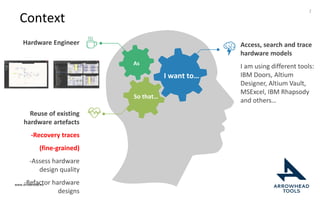
Context
2
As
So that…
I want to…
Reuse of existing
hardware artefacts
-Recovery traces
(fine-grained)
-Assess hardware
design quality
-Refactor hardware
designs
Hardware Engineer Access, search and trace
hardware models
I am using different tools:
IBM Doors, Altium
Designer, Altium Vault,
MSExcel, IBM Rhapsody
and others…
www.arrowhead.eu
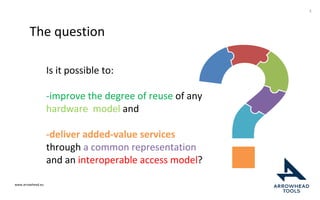
The question
3
Is it possible to:
-improve the degree of reuse of any
hardware model and
-deliver added-value services
through a common representation
and an interoperable access model?
Definitions & needs
4
www.arrowhead.eu
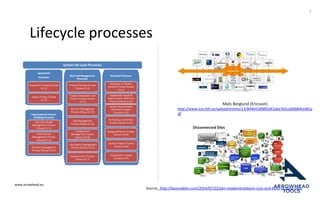
Lifecycle processes
5
Mats Berglund (Ericsson)
http://www.ices.kth.se/upload/events/13/84404189f85d41a6a7d1cafd0db4ee80.p
df
Source: http://beyondplm.com/2014/07/22/plm-implementations-nuts-and-bolts-of-data-silos/
www.arrowhead.eu
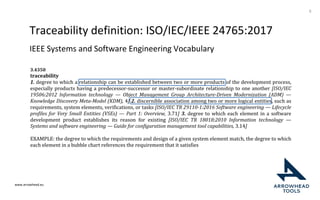
Traceability definition: ISO/IEC/IEEE 24765:2017
IEEE Systems and Software Engineering Vocabulary
6
www.arrowhead.eu
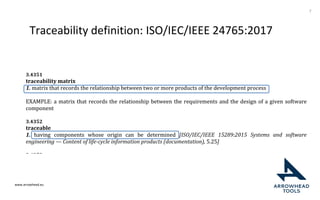
Traceability definition: ISO/IEC/IEEE 24765:2017
7
www.arrowhead.eu
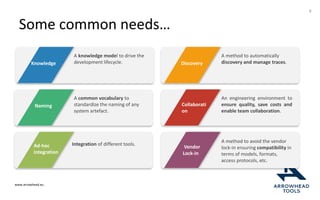
Some common needs…
8
A knowledge model to drive the
development lifecycle.Knowledge
Naming
Ad-hoc
integration
Discovery
Collaborati
on
Vendor
Lock-in
A common vocabulary to
standardize the naming of any
system artefact.
Integration of different tools.
A method to automatically
discovery and manage traces.
An engineering environment to
ensure quality, save costs and
enable team collaboration.
A method to avoid the vendor
lock-in ensuring compatibility in
terms of models, formats,
access protocols, etc.
www.arrowhead.eu
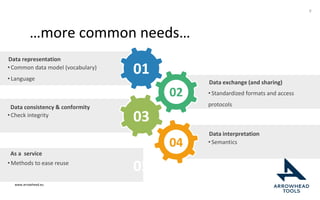
…more common needs…
9
• Common data model (vocabulary)
• Language
Data representation
• Check integrity
Data consistency & conformity
• Methods to ease reuse
As a service
• Standardized formats and access
protocols
Data exchange (and sharing)
• Semantics
Data interpretation
01
02
03
04
05
Conceptual approach
10
www.arrowhead.eu
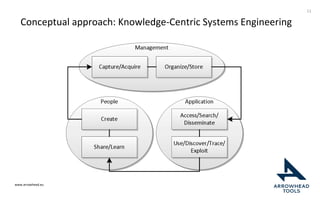
Conceptual approach: Knowledge-Centric Systems Engineering
11
www.arrowhead.eu
12
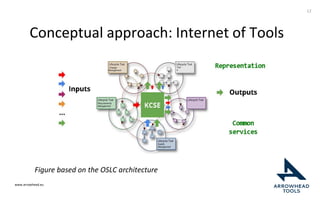
Conceptual approach: Internet of Tools
Figure based on the OSLC architecture
www.arrowhead.eu
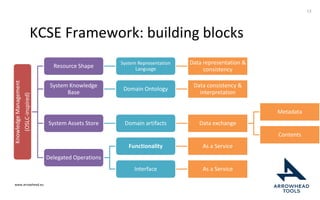
KCSE Framework: building blocks
13
KnowledgeManagement
(OSLC-inspired)
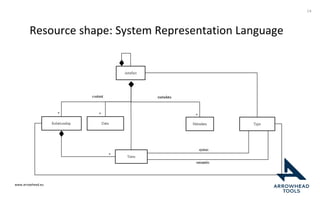
Resource Shape
System Representation
Language
Data representation &
consistency
System Knowledge
Base
Domain Ontology
Data consistency &
interpretation
System Assets Store Domain artifacts Data exchange
Metadata
Contents
Delegated Operations
Functionality As a Service
Interface As a Service
www.arrowhead.eu
Resource shape: System Representation Language
14
www.arrowhead.eu
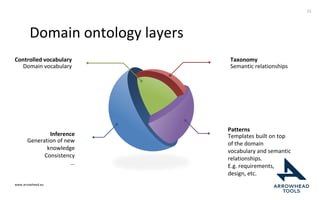
Domain ontology layers
15
Taxonomy
Semantic relationships
Controlled vocabulary
Domain vocabulary
Patterns
Templates built on top
of the domain
vocabulary and semantic
relationships.
E.g. requirements,
design, etc.
Inference
Generation of new
knowledge
Consistency
…
www.arrowhead.eu
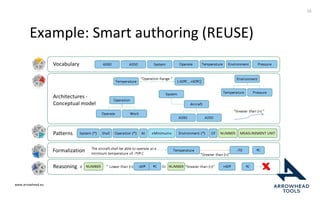
Example: Smart authoring (REUSE)
16
www.arrowhead.eu
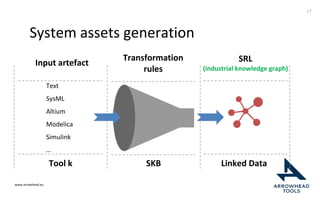
System assets generation
17
Input artefact
Tool k
Transformation
rules
SKB
SRL
(industrial knowledge graph)
Linked Data
Text
SysML
Altium
Modelica
Simulink
…
www.arrowhead.eu
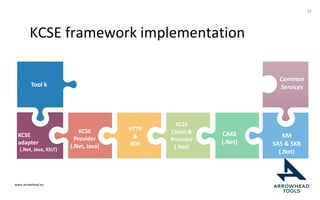
KCSE framework implementation
18
Tool k
Step 5
Common
Services
KCSE
Provider
(.Net, Java)
HTTP
&
RDF
KCSE
Client &
Provider
(.Net)
CAKE
(.Net)
KM
SAS & SKB
(.Net)
KCSE
adapter
(.Net, Java, XSLT)
www.arrowhead.eu
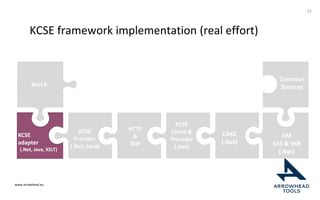
KCSE framework implementation (real effort)
19
Tool k
Step 5
Common
Services
KCSE
Provider
(.Net, Java)
HTTP
&
RDF
KCSE
Client &
Provider
(.Net)
CAKE
(.Net)
KM
SAS & SKB
(.Net)
KCSE
adapter
(.Net, Java, XSLT)
Application to the UC3
20
www.arrowhead.eu
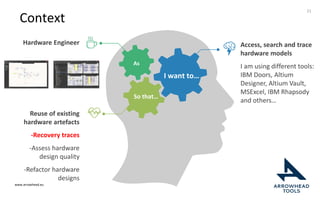
Context
21
As
So that…
I want to…
Reuse of existing
hardware artefacts
-Recovery traces
-Assess hardware
design quality
-Refactor hardware
designs
Hardware Engineer Access, search and trace
hardware models
I am using different tools:
IBM Doors, Altium
Designer, Altium Vault,
MSExcel, IBM Rhapsody
and others…
www.arrowhead.eu
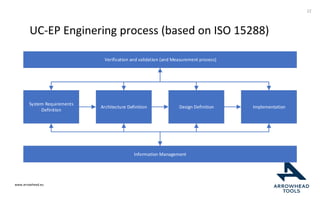
UC-EP Enginering process (based on ISO 15288)
22
System Requirements
Definition
Architecture Definition Design Definition Implementation
Verification and validation (and Measurement process)
Information Management
www.arrowhead.eu
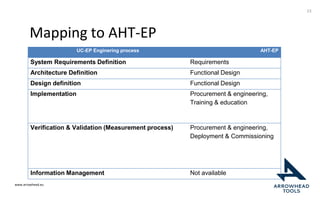
Mapping to AHT-EP
23
UC-EP Enginering process AHT-EP
System Requirements Definition Requirements
Architecture Definition Functional Design
Design definition Functional Design
Implementation Procurement & engineering,
Training & education
Verification & Validation (Measurement process) Procurement & engineering,
Deployment & Commissioning
Information Management Not available
www.arrowhead.eu
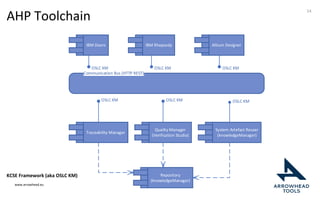
AHP Toolchain
KCSE Framework (aka OSLC KM)
24
Traceability Manager
System Artefact Reuser
(knowledgeManager)
Repository
(knowledgeManager)
OSLC KM
IBM Doors IBM Rhapsody Altium Designer
OSLC KMOSLC KM
OSLC KM OSLC KM
Quality Manager
(Verification Studio)
OSLC KM
Communication Bus (HTTP REST)
www.arrowhead.eu
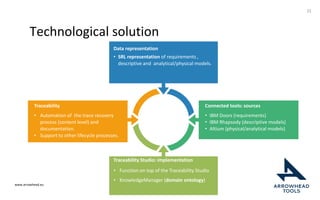
Technological solution
25
Data representation
• SRL representation of requirements ,
descriptive and analytical/physical models.
Connected tools: sources
• IBM Doors (requirements)
• IBM Rhapsody (descriptive models)
• Altium (physical/analytical models)
Traceability Studio: implementation
• Function on top of the Traceability Studio
• KnowledgeManager (domain ontology)
Traceability
• Automation of the trace recovery
process (content level) and
documentation.
• Support to other lifecycle processes.
www.arrowhead.eu
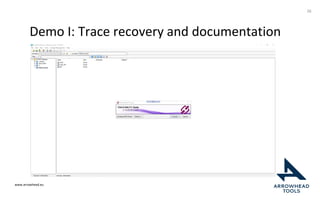
Demo I: Trace recovery and documentation
26
www.arrowhead.eu
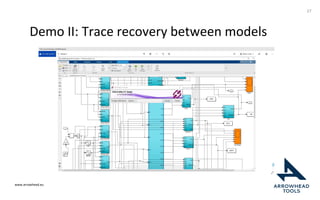
Demo II: Trace recovery between models
27
www.arrowhead.eu
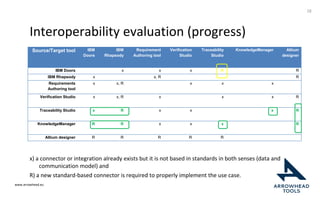
Interoperability evaluation (progress)
x) a connector or integration already exists but it is not based in standards in both senses (data and
communication model) and
R) a new standard-based connector is required to properly implement the use case.
28
Source/Target tool IBM
Doors
IBM
Rhapsody
Requirement
Authoring tool
Verification
Studio
Traceability
Studio
KnowledgeManager Altium
designer
IBM Doors x x x R R
IBM Rhapsody x x, R R
Requirements
Authoring tool
x x, R x x x
Verification Studio x x, R x x x R
Traceability Studio x R x x x R
KnowledgeManager R R x x x R
Altium designer R R R R R
www.arrowhead.eu
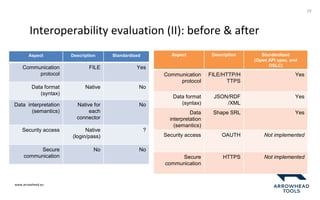
Interoperability evaluation (II): before & after
29
Aspect Description Standardized
Communication
protocol
FILE Yes
Data format
(syntax)
Native No
Data interpretation
(semantics)
Native for
each
connector
No
Security access Native
(login/pass)
?
Secure
communication
No No
Aspect Description Standardized
(Open API spec. and
OSLC)
Communication
protocol
FILE/HTTP/H
TTPS
Yes
Data format
(syntax)
JSON/RDF
/XML
Yes
Data
interpretation
(semantics)
Shape SRL Yes
Security access OAUTH Not implemented
Secure
communication
HTTPS Not implemented
www.arrowhead.eu
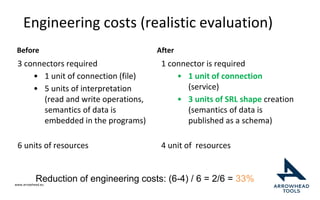
Engineering costs (realistic evaluation)
Before
3 connectors required
• 1 unit of connection (file)
• 5 units of interpretation
(read and write operations,
semantics of data is
embedded in the programs)
6 units of resources
After
1 connector is required
• 1 unit of connection
(service)
• 3 units of SRL shape creation
(semantics of data is
published as a schema)
4 unit of resources
Reduction of engineering costs: (6-4) / 6 = 2/6 = 33%
www.arrowhead.eu
Conclusions & Next Steps
• Altium connector not fully developed (official SDK under
development)
• Traceability scenario (fine-grained granularity) ready to
be validated with real data from the UC
• Data ready but configuration (ontology) still missing
• Focus on the reuse scenario
• Interoperability evaluation (many models)
• Connection through the Arrowhead Framework
31
www.arrowhead.eu
Some references
[1] Jose María Álvarez Rodríguez, Roy Mendieta, Jose Luis de la Vara, Anabel
Fraga, Juan Lloréns: Enabling System Artefact Exchange and Selection
through a Linked Data Layer. J. UCS 24(11): 1536-1560 (2018)
[2] Jose María Álvarez Rodríguez, Valentin Moreno, Juan Lloréns: Formal
ontologies and data shapes within the Software Engineering development
lifecycle. SEKE 2019: 64-93
32
Automatic traceability between
descriptive and analytical models
UC3-Functional design
Prof. Jose María Alvarez Rodríguez (UC3M, speaker)
Roy Mendieta (REUSE)
Eduardo Cibrián (UC3M)
Ainhoa Aristimuno (ULMA)

H2020-AHTOOLS Use Case 3 Functional Design

  • 1.
    Automatic traceability between descriptiveand analytical models UC3-Functional design Prof. Jose María Alvarez Rodríguez (UC3M, speaker) Roy Mendieta (REUSE) Eduardo Cibrián (UC3M) Ainhoa Aristimuno (ULMA)
  • 2.
    www.arrowhead.eu Context 2 As So that… I wantto… Reuse of existing hardware artefacts -Recovery traces (fine-grained) -Assess hardware design quality -Refactor hardware designs Hardware Engineer Access, search and trace hardware models I am using different tools: IBM Doors, Altium Designer, Altium Vault, MSExcel, IBM Rhapsody and others…
  • 3.
    www.arrowhead.eu The question 3 Is itpossible to: -improve the degree of reuse of any hardware model and -deliver added-value services through a common representation and an interoperable access model?
  • 4.
  • 5.
    www.arrowhead.eu Lifecycle processes 5 Mats Berglund(Ericsson) http://www.ices.kth.se/upload/events/13/84404189f85d41a6a7d1cafd0db4ee80.p df Source: http://beyondplm.com/2014/07/22/plm-implementations-nuts-and-bolts-of-data-silos/
  • 6.
    www.arrowhead.eu Traceability definition: ISO/IEC/IEEE24765:2017 IEEE Systems and Software Engineering Vocabulary 6
  • 7.
  • 8.
    www.arrowhead.eu Some common needs… 8 Aknowledge model to drive the development lifecycle.Knowledge Naming Ad-hoc integration Discovery Collaborati on Vendor Lock-in A common vocabulary to standardize the naming of any system artefact. Integration of different tools. A method to automatically discovery and manage traces. An engineering environment to ensure quality, save costs and enable team collaboration. A method to avoid the vendor lock-in ensuring compatibility in terms of models, formats, access protocols, etc.
  • 9.
    www.arrowhead.eu …more common needs… 9 •Common data model (vocabulary) • Language Data representation • Check integrity Data consistency & conformity • Methods to ease reuse As a service • Standardized formats and access protocols Data exchange (and sharing) • Semantics Data interpretation 01 02 03 04 05
  • 10.
  • 11.
  • 12.
    www.arrowhead.eu 12 Conceptual approach: Internetof Tools Figure based on the OSLC architecture
  • 13.
    www.arrowhead.eu KCSE Framework: buildingblocks 13 KnowledgeManagement (OSLC-inspired) Resource Shape System Representation Language Data representation & consistency System Knowledge Base Domain Ontology Data consistency & interpretation System Assets Store Domain artifacts Data exchange Metadata Contents Delegated Operations Functionality As a Service Interface As a Service
  • 14.
    www.arrowhead.eu Resource shape: SystemRepresentation Language 14
  • 15.
    www.arrowhead.eu Domain ontology layers 15 Taxonomy Semanticrelationships Controlled vocabulary Domain vocabulary Patterns Templates built on top of the domain vocabulary and semantic relationships. E.g. requirements, design, etc. Inference Generation of new knowledge Consistency …
  • 16.
  • 17.
    www.arrowhead.eu System assets generation 17 Inputartefact Tool k Transformation rules SKB SRL (industrial knowledge graph) Linked Data Text SysML Altium Modelica Simulink …
  • 18.
    www.arrowhead.eu KCSE framework implementation 18 Toolk Step 5 Common Services KCSE Provider (.Net, Java) HTTP & RDF KCSE Client & Provider (.Net) CAKE (.Net) KM SAS & SKB (.Net) KCSE adapter (.Net, Java, XSLT)
  • 19.
    www.arrowhead.eu KCSE framework implementation(real effort) 19 Tool k Step 5 Common Services KCSE Provider (.Net, Java) HTTP & RDF KCSE Client & Provider (.Net) CAKE (.Net) KM SAS & SKB (.Net) KCSE adapter (.Net, Java, XSLT)
  • 20.
  • 21.
    www.arrowhead.eu Context 21 As So that… I wantto… Reuse of existing hardware artefacts -Recovery traces -Assess hardware design quality -Refactor hardware designs Hardware Engineer Access, search and trace hardware models I am using different tools: IBM Doors, Altium Designer, Altium Vault, MSExcel, IBM Rhapsody and others…
  • 22.
    www.arrowhead.eu UC-EP Enginering process(based on ISO 15288) 22 System Requirements Definition Architecture Definition Design Definition Implementation Verification and validation (and Measurement process) Information Management
  • 23.
    www.arrowhead.eu Mapping to AHT-EP 23 UC-EPEnginering process AHT-EP System Requirements Definition Requirements Architecture Definition Functional Design Design definition Functional Design Implementation Procurement & engineering, Training & education Verification & Validation (Measurement process) Procurement & engineering, Deployment & Commissioning Information Management Not available
  • 24.
    www.arrowhead.eu AHP Toolchain KCSE Framework(aka OSLC KM) 24 Traceability Manager System Artefact Reuser (knowledgeManager) Repository (knowledgeManager) OSLC KM IBM Doors IBM Rhapsody Altium Designer OSLC KMOSLC KM OSLC KM OSLC KM Quality Manager (Verification Studio) OSLC KM Communication Bus (HTTP REST)
  • 25.
    www.arrowhead.eu Technological solution 25 Data representation •SRL representation of requirements , descriptive and analytical/physical models. Connected tools: sources • IBM Doors (requirements) • IBM Rhapsody (descriptive models) • Altium (physical/analytical models) Traceability Studio: implementation • Function on top of the Traceability Studio • KnowledgeManager (domain ontology) Traceability • Automation of the trace recovery process (content level) and documentation. • Support to other lifecycle processes.
  • 26.
    www.arrowhead.eu Demo I: Tracerecovery and documentation 26
  • 27.
    www.arrowhead.eu Demo II: Tracerecovery between models 27
  • 28.
    www.arrowhead.eu Interoperability evaluation (progress) x)a connector or integration already exists but it is not based in standards in both senses (data and communication model) and R) a new standard-based connector is required to properly implement the use case. 28 Source/Target tool IBM Doors IBM Rhapsody Requirement Authoring tool Verification Studio Traceability Studio KnowledgeManager Altium designer IBM Doors x x x R R IBM Rhapsody x x, R R Requirements Authoring tool x x, R x x x Verification Studio x x, R x x x R Traceability Studio x R x x x R KnowledgeManager R R x x x R Altium designer R R R R R
  • 29.
    www.arrowhead.eu Interoperability evaluation (II):before & after 29 Aspect Description Standardized Communication protocol FILE Yes Data format (syntax) Native No Data interpretation (semantics) Native for each connector No Security access Native (login/pass) ? Secure communication No No Aspect Description Standardized (Open API spec. and OSLC) Communication protocol FILE/HTTP/H TTPS Yes Data format (syntax) JSON/RDF /XML Yes Data interpretation (semantics) Shape SRL Yes Security access OAUTH Not implemented Secure communication HTTPS Not implemented
  • 30.
    www.arrowhead.eu Engineering costs (realisticevaluation) Before 3 connectors required • 1 unit of connection (file) • 5 units of interpretation (read and write operations, semantics of data is embedded in the programs) 6 units of resources After 1 connector is required • 1 unit of connection (service) • 3 units of SRL shape creation (semantics of data is published as a schema) 4 unit of resources Reduction of engineering costs: (6-4) / 6 = 2/6 = 33%
  • 31.
    www.arrowhead.eu Conclusions & NextSteps • Altium connector not fully developed (official SDK under development) • Traceability scenario (fine-grained granularity) ready to be validated with real data from the UC • Data ready but configuration (ontology) still missing • Focus on the reuse scenario • Interoperability evaluation (many models) • Connection through the Arrowhead Framework 31
  • 32.
    www.arrowhead.eu Some references [1] JoseMaría Álvarez Rodríguez, Roy Mendieta, Jose Luis de la Vara, Anabel Fraga, Juan Lloréns: Enabling System Artefact Exchange and Selection through a Linked Data Layer. J. UCS 24(11): 1536-1560 (2018) [2] Jose María Álvarez Rodríguez, Valentin Moreno, Juan Lloréns: Formal ontologies and data shapes within the Software Engineering development lifecycle. SEKE 2019: 64-93 32
  • 33.
    Automatic traceability between descriptiveand analytical models UC3-Functional design Prof. Jose María Alvarez Rodríguez (UC3M, speaker) Roy Mendieta (REUSE) Eduardo Cibrián (UC3M) Ainhoa Aristimuno (ULMA)