
Presentatie titel Rotterdam, 00 januari 2007 Presentatie  titel Rotterdam, January 2011 Hogeschool Rotterdam Rotterdam University  of applied sciences
 
Introduction lecturers and topics School of Education School of Social Work Introduction to the programme bridging cultures learning tracks final assignments (and portfolio) International students diversity of students, countries and numbers Teaching in an international classroom Discussion issues Overview
School of Social Work Lecturers from 4 different bachelor programmes: CMV (Cultural Social Work, Community Work) MWD (Social Work and Social Services) Pedagogiek (Pedagogical Work) SPH (Social Educational Care Work) Sometimes also active in OPGM, a general orientation year preparing for one of the above-mentioned programmes
School of Education Teacher Education: primary schools (PABO) Teacher Education: secondary schools (LERO) All in all, 30  lecturers perform roles in International Class !
International Class programme Result of cooperation between the Schools : Coordinators from the School of Education: Els Fonville (primary education) Janneke Verloop – Meijer (secondary education) Coordinators from the School of Social Work Ester Oosterveen (Pedagogical Work) Anja Stofberg (Cultural Social Work)
 
Please introduce yourself I am  and I teach …. Who are you ? What will you teach(in short)?
Six Learning Tracks Theories of Education & Development Intercultural Toolbox Global Citizenship Group based Project Assignment Practical Work / Field Work Visits Dutch Classes
Features of the I C programme A dialogue based classroom A cross disciplinary approach A balance between theoretical, methodical and practical courses Enhancing thoughtful reflection An innovative approach A positive classroom atmosphere
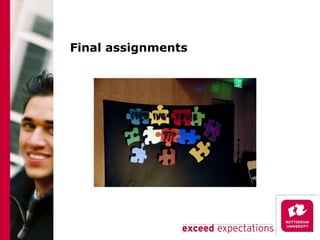
Final assignments
Reflective diaries Reflection  Coaching by lecturers Peer reflection in pairs
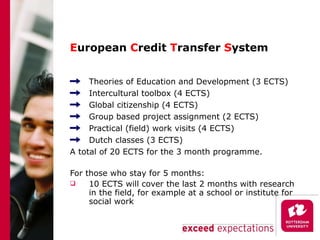
E uropean  C redit   T ransfer  S ystem Theories of Education and Development (3 ECTS) Intercultural toolbox (4 ECTS) Global citizenship (4 ECTS) Group based project assignment (2 ECTS) Practical (field) work visits (4 ECTS) Dutch classes (3 ECTS) A total of 20 ECTS for the 3 month programme. For those who stay for 5 months: 10 ECTS will cover the last 2 months with research in the field, for example at a school or institute for social work
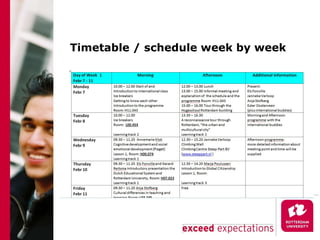
Timetable / schedule week by week
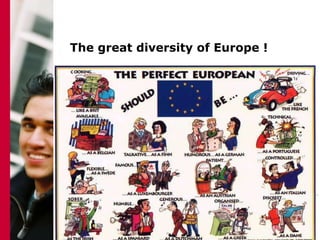
The great diversity of Europe !
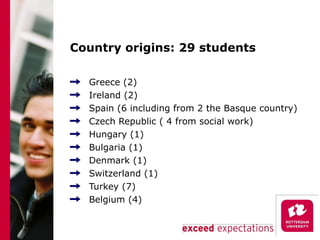
Country origins: 29 students Greece (2) Ireland (2) Spain (6 including from 2 the Basque country) Czech Republic ( 4 from social work) Hungary (1) Bulgaria (1) Denmark (1) Switzerland (1) Turkey (7) Belgium (4)
Teaching in the international classroom
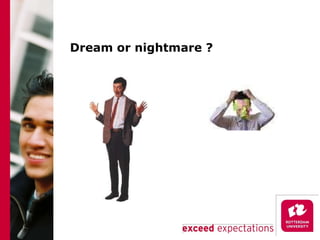
Dream or nightmare ?
Eye opener ? That values play a critical role in teaching & learning processes appears to make sense, common sense even. Are you aware of the (typically Dutch ?) values that you transmit in your lessons and lectures ? Or put differently: what student behaviour do you “reward” or “punish” ?
Values in education Which ones do you consider important ? Obedience ? Independence ? Imagination ? Respect for the teacher / lecturer ? Doing exactly what is required ? (no more no less) Appropriate student behaviour:  Is that listening or dialoguing  or asking (critical) questions? Individual or collective responsibility ? Humanistic values ?
What about assessment criteria ? Quality of expression ? Completeness ? Originality ? Hard work ? Succinctness ? Accuracy ? Tidy work ? Relevance ?  Emphasis on theoretical perspectives ? Practical application value ? Innovative solutions ?
What is “good” or “excellent” ? Example of specific requirements laid done in an Australian module: “ the argument is logically correct and clear in all important aspects; the argument is also surprising, original, or very elegantly put.”
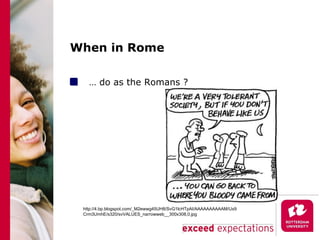
When in Rome  …  do as the Romans ? http://4.bp.blogspot.com/_M2ewwg45UH8/SvG1lcHTpAI/AAAAAAAAAAM/Ux9Crm3UmhE/s320/svVALUES_narrowweb__300x308,0.jpg
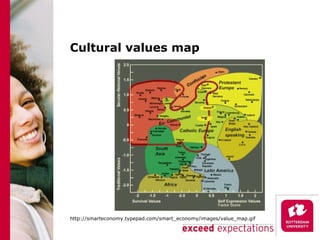
Cultural values map http://smarteconomy.typepad.com/smart_economy/images/value_map.gif
How to solve the issue Geert Hofstede: “ Teach the teacher how to teach, and  teach the learner how to learn.”
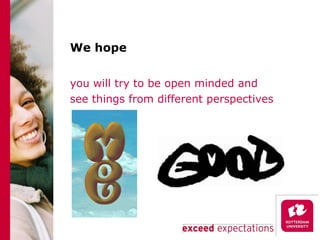
We hope you will try to be open minded and see things from different perspectives
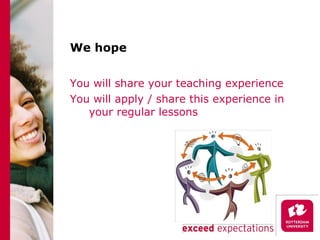
We hope You will share your teaching experience  You will apply / share this experience in your regular lessons
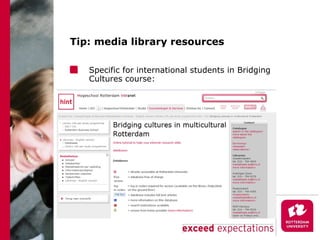
Tip: media library resources Specific for international students in Bridging Cultures course:
Miscellaneous tips Support your lessons with visual aids Apply general vocabulary and discipline-specific vocabulary  Define any new or unfamiliar words or concepts, and provide opportunities for clarification. Like to know more about teaching international students ? http://www.brookes.ac.uk/services/ocsd/2_learntch/briefing_papers/international_students.pdf
“ It’s better to travel one mile than to read a thousand books !”  (Confucius)
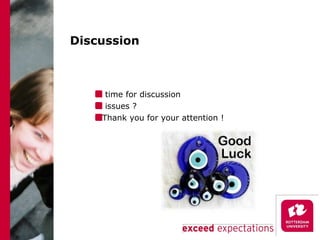
Discussion time for discussion issues ? Thank you for your attention !

Preparatory meeting lecturers International Class

  • 1.
  • 2.
    Presentatie titel Rotterdam,00 januari 2007 Presentatie titel Rotterdam, January 2011 Hogeschool Rotterdam Rotterdam University of applied sciences
  • 3.
  • 4.
    Introduction lecturers andtopics School of Education School of Social Work Introduction to the programme bridging cultures learning tracks final assignments (and portfolio) International students diversity of students, countries and numbers Teaching in an international classroom Discussion issues Overview
  • 5.
    School of SocialWork Lecturers from 4 different bachelor programmes: CMV (Cultural Social Work, Community Work) MWD (Social Work and Social Services) Pedagogiek (Pedagogical Work) SPH (Social Educational Care Work) Sometimes also active in OPGM, a general orientation year preparing for one of the above-mentioned programmes
  • 6.
    School of EducationTeacher Education: primary schools (PABO) Teacher Education: secondary schools (LERO) All in all, 30 lecturers perform roles in International Class !
  • 7.
    International Class programmeResult of cooperation between the Schools : Coordinators from the School of Education: Els Fonville (primary education) Janneke Verloop – Meijer (secondary education) Coordinators from the School of Social Work Ester Oosterveen (Pedagogical Work) Anja Stofberg (Cultural Social Work)
  • 8.
  • 9.
    Please introduce yourselfI am and I teach …. Who are you ? What will you teach(in short)?
  • 10.
    Six Learning TracksTheories of Education & Development Intercultural Toolbox Global Citizenship Group based Project Assignment Practical Work / Field Work Visits Dutch Classes
  • 11.
    Features of theI C programme A dialogue based classroom A cross disciplinary approach A balance between theoretical, methodical and practical courses Enhancing thoughtful reflection An innovative approach A positive classroom atmosphere
  • 12.
  • 13.
    Reflective diaries Reflection Coaching by lecturers Peer reflection in pairs
  • 14.
    E uropean C redit T ransfer S ystem Theories of Education and Development (3 ECTS) Intercultural toolbox (4 ECTS) Global citizenship (4 ECTS) Group based project assignment (2 ECTS) Practical (field) work visits (4 ECTS) Dutch classes (3 ECTS) A total of 20 ECTS for the 3 month programme. For those who stay for 5 months: 10 ECTS will cover the last 2 months with research in the field, for example at a school or institute for social work
  • 15.
  • 16.
  • 17.
    Country origins: 29students Greece (2) Ireland (2) Spain (6 including from 2 the Basque country) Czech Republic ( 4 from social work) Hungary (1) Bulgaria (1) Denmark (1) Switzerland (1) Turkey (7) Belgium (4)
  • 18.
    Teaching in theinternational classroom
  • 19.
  • 20.
    Eye opener ?That values play a critical role in teaching & learning processes appears to make sense, common sense even. Are you aware of the (typically Dutch ?) values that you transmit in your lessons and lectures ? Or put differently: what student behaviour do you “reward” or “punish” ?
  • 21.
    Values in educationWhich ones do you consider important ? Obedience ? Independence ? Imagination ? Respect for the teacher / lecturer ? Doing exactly what is required ? (no more no less) Appropriate student behaviour: Is that listening or dialoguing or asking (critical) questions? Individual or collective responsibility ? Humanistic values ?
  • 22.
    What about assessmentcriteria ? Quality of expression ? Completeness ? Originality ? Hard work ? Succinctness ? Accuracy ? Tidy work ? Relevance ? Emphasis on theoretical perspectives ? Practical application value ? Innovative solutions ?
  • 23.
    What is “good”or “excellent” ? Example of specific requirements laid done in an Australian module: “ the argument is logically correct and clear in all important aspects; the argument is also surprising, original, or very elegantly put.”
  • 24.
    When in Rome … do as the Romans ? http://4.bp.blogspot.com/_M2ewwg45UH8/SvG1lcHTpAI/AAAAAAAAAAM/Ux9Crm3UmhE/s320/svVALUES_narrowweb__300x308,0.jpg
  • 25.
    Cultural values maphttp://smarteconomy.typepad.com/smart_economy/images/value_map.gif
  • 26.
    How to solvethe issue Geert Hofstede: “ Teach the teacher how to teach, and teach the learner how to learn.”
  • 27.
    We hope youwill try to be open minded and see things from different perspectives
  • 28.
    We hope Youwill share your teaching experience You will apply / share this experience in your regular lessons
  • 29.
    Tip: media libraryresources Specific for international students in Bridging Cultures course:
  • 30.
    Miscellaneous tips Supportyour lessons with visual aids Apply general vocabulary and discipline-specific vocabulary Define any new or unfamiliar words or concepts, and provide opportunities for clarification. Like to know more about teaching international students ? http://www.brookes.ac.uk/services/ocsd/2_learntch/briefing_papers/international_students.pdf
  • 31.
    “ It’s betterto travel one mile than to read a thousand books !” (Confucius)
  • 32.
    Discussion time fordiscussion issues ? Thank you for your attention !