MODULE 3 UNIT 1

DAILY ACTIVITIES
Learning Objectives
Goals
 To be able to understand and talk about
  daily activities in the specific past and
  future.
 To be able to understand, express, and
  ask about the events of today, from this
  morning through tonight.
 To be able to ask about past, present
  and future.
Grammar and Structure focus
Past time and past tense form
 of verbs:
  – regular and irregular
be going to
be doing
time relations, sequence
  – earlier, later, an hour ago, and in an
    hour.
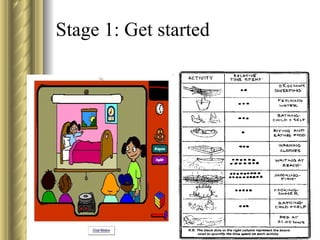
Stage 1: Get started
Stage 2: Preview, comprehend and
confirm
 access the courseware and do the
  task required to get the general
  idea about the lesson without any
  stop.
What is the main idea of the passage ?
        Kathy’s daily activities
 listen again to get better
  understanding and do the
  comprehension questions
 listen again and use the ABC
  button to see the text and check
  their understanding
New words
 Result [ri'zʌ lt]
 Large [lɑ :dʒ ]
 Request [ri'kwest]
 Nuclear ['nju:kliə]
 Safety ['seifti]
Stage 3: Shadow, Record and
Compare
 Use the button       to listen
  each sentence and repeat silently.
 Press the button         to record
  your voice.
 Press the button         to listen
  to your voice again
 Press the button         to
  compare your voice with native
  speaker.
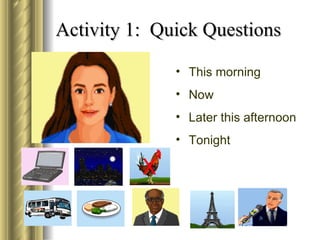
Activity 1: Quick Questions

              • This morning
              • Now
              • Later this afternoon
              • Tonight
Activity 2: Still with Kathy
Step 1: Pair work: ( 2‘ )
Work with a partner close to you. Try to retell
  Kathy’s story.
Be prepared to do a short presentation about
  Kathy.

Pay attention to
   – General introduction to Kathy
   –   What Kathy did this morning
   –   What Kathy is doing now
   –   What Kathy is going to do later this afternoon
   –   What Kathy is going to do this evening
Activity 2: Still with Kathy
Step 2: Short presentation: ( 3’ )
 Please stand up to give us a short
 presentation about Kathy’s
 activities for the day.
Starting from: Kathy is a writer….
Useful Words & Expressions
 Interview
 schedule
 take a bus down town
 have a meeting with
 make a request
 take a week off
Activity 3: About Diane


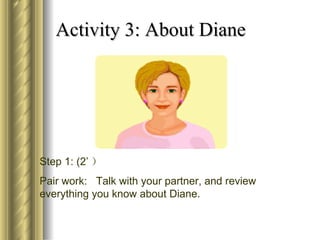
Step 1: (2’ )
Pair work: Talk with your partner, and review
everything you know about Diane.
Activity 3: About Diane
Step 2: (6’ ) Hot-seat
Question Practice: Ask questions about Diane and
her activities for the day.
Ask about:
   Who is Diane/ Diane’s family
   What Diane did this morning, and when
   What Diane is doing now (at 2pm)
   What Diane is going to do later this afternoon
   What Diane is going to do this afternoon
Activity 4: Speech Speed
Contest
 Say as many sentences as you can
  in 1 minute, about Diane.
  (2-3’ ) Use time phrases to
  express time sequence:
  – Earlier today:
  – Right now:
  – Later today:
Time Sequence

 This morning… at 6:30.… at 7:00…at 7:15. At
  7:45
 After taking her kids to school,… After that
  …,…for about an hour.
 Now …
 In about an hour, at 3:00,…
 After dinner…
 This evening….
 Twice a week, in the evenings,...
 She just had a cup of coffee

 This evening she is going to interview
  an important person.

 Their school is about twenty minutes
  away.

 went to / bought some / in about an
  hour/
Activity 5: A game
 Passing my words
Part 2

  Personalization &
      Extension
      Activities
Activity 1: My Day
Step 1: Individual preparation (1’)
Follow the list of time phrases, tell us
about your schedule for today.
Rule:
Follow exactly the same order, using
every phrase on the list.
Activity 1: My Day
Step 2: Short Speech (1’)
Follow the list of time phrases, tell us
about your schedule for today.
Same Rule with step 1:
Requirement: Loud, clear,
confident!
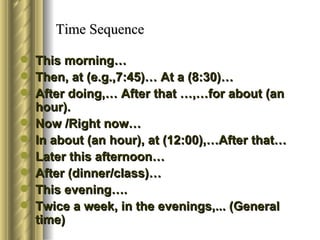
Time Sequence

   This morning…
   Then, at (e.g.,7:45)… At a (8:30)…
   After doing,… After that …,…for about (an
    hour).
   Now /Right now…
   In about (an hour), at (12:00),…After that…
   Later this afternoon…
   After (dinner/class)…
   This evening….
   Twice a week, in the evenings,... (General
    time)
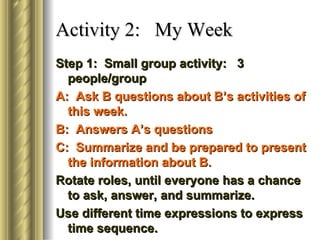
Activity 2: My Week
Step 1: Small group activity: 3
  people/group
A: Ask B questions about B’s activities of
  this week.
B: Answers A’s questions
C: Summarize and be prepared to present
  the information about B.
Rotate roles, until everyone has a chance
  to ask, answer, and summarize.
Use different time expressions to express
  time sequence.
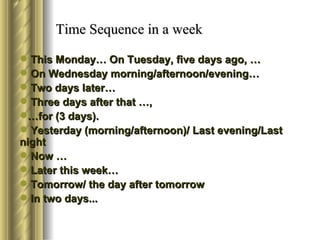
Time Sequence in a week

 This Monday… On Tuesday, five days ago, …
 On Wednesday morning/afternoon/evening…
 Two days later…
 Three days after that …,
…for (3 days).
 Yesterday (morning/afternoon)/ Last evening/Last
night
 Now …
 Later this week…
 Tomorrow/ the day after tomorrow
 In two days...
Activity 2: My Week
Step 2: Whole class activity
ONE person from each group comes
  to the front. Tell us about the
  weekly schedule of another person
  in your group.

Give us at least 5 sentences.
Activity 3: Story Telling
Work in groups of 4:
 Each group will be given a picture
  card.
 Create a story about the person in
  the picture
    Name, occupation, age… of your character:
    his/her schedule for today,
    Decide your point of time.
 Be prepared to tell your story
Activity 3: Story Telling

Let’s hear the stories!
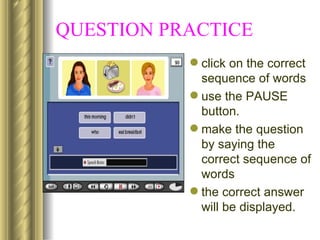
QUESTION PRACTICE
            click on the correct
             sequence of words
            use the PAUSE
             button.
            make the question
             by saying the
             correct sequence of
             words
            the correct answer
             will be displayed.
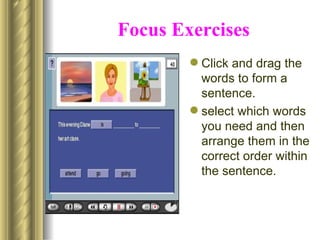
Focus Exercises
         Click and drag the
          words to form a
          sentence.
         select which words
          you need and then
          arrange them in the
          correct order within
          the sentence.

Module 3 unit 1

  • 1.
    MODULE 3 UNIT1 DAILY ACTIVITIES
  • 2.
    Learning Objectives Goals  Tobe able to understand and talk about daily activities in the specific past and future.  To be able to understand, express, and ask about the events of today, from this morning through tonight.  To be able to ask about past, present and future.
  • 3.
    Grammar and Structurefocus Past time and past tense form of verbs: – regular and irregular be going to be doing time relations, sequence – earlier, later, an hour ago, and in an hour.
  • 4.
    Stage 1: Getstarted
  • 5.
    Stage 2: Preview,comprehend and confirm  access the courseware and do the task required to get the general idea about the lesson without any stop. What is the main idea of the passage ? Kathy’s daily activities
  • 6.
     listen againto get better understanding and do the comprehension questions  listen again and use the ABC button to see the text and check their understanding
  • 7.
    New words  Result[ri'zʌ lt]  Large [lɑ :dʒ ]  Request [ri'kwest]  Nuclear ['nju:kliə]  Safety ['seifti]
  • 8.
    Stage 3: Shadow,Record and Compare  Use the button to listen each sentence and repeat silently.  Press the button to record your voice.  Press the button to listen to your voice again  Press the button to compare your voice with native speaker.
  • 9.
    Activity 1: QuickQuestions • This morning • Now • Later this afternoon • Tonight
  • 10.
    Activity 2: Stillwith Kathy Step 1: Pair work: ( 2‘ ) Work with a partner close to you. Try to retell Kathy’s story. Be prepared to do a short presentation about Kathy. Pay attention to – General introduction to Kathy – What Kathy did this morning – What Kathy is doing now – What Kathy is going to do later this afternoon – What Kathy is going to do this evening
  • 11.
    Activity 2: Stillwith Kathy Step 2: Short presentation: ( 3’ ) Please stand up to give us a short presentation about Kathy’s activities for the day. Starting from: Kathy is a writer….
  • 12.
    Useful Words &Expressions  Interview  schedule  take a bus down town  have a meeting with  make a request  take a week off
  • 13.
    Activity 3: AboutDiane Step 1: (2’ ) Pair work: Talk with your partner, and review everything you know about Diane.
  • 14.
    Activity 3: AboutDiane Step 2: (6’ ) Hot-seat Question Practice: Ask questions about Diane and her activities for the day. Ask about: Who is Diane/ Diane’s family What Diane did this morning, and when What Diane is doing now (at 2pm) What Diane is going to do later this afternoon What Diane is going to do this afternoon
  • 15.
    Activity 4: SpeechSpeed Contest  Say as many sentences as you can in 1 minute, about Diane. (2-3’ ) Use time phrases to express time sequence: – Earlier today: – Right now: – Later today:
  • 16.
    Time Sequence  Thismorning… at 6:30.… at 7:00…at 7:15. At 7:45  After taking her kids to school,… After that …,…for about an hour.  Now …  In about an hour, at 3:00,…  After dinner…  This evening….  Twice a week, in the evenings,...
  • 17.
     She justhad a cup of coffee  This evening she is going to interview an important person.  Their school is about twenty minutes away.  went to / bought some / in about an hour/
  • 18.
    Activity 5: Agame  Passing my words
  • 19.
    Part 2 Personalization & Extension Activities
  • 20.
    Activity 1: MyDay Step 1: Individual preparation (1’) Follow the list of time phrases, tell us about your schedule for today. Rule: Follow exactly the same order, using every phrase on the list.
  • 21.
    Activity 1: MyDay Step 2: Short Speech (1’) Follow the list of time phrases, tell us about your schedule for today. Same Rule with step 1: Requirement: Loud, clear, confident!
  • 22.
    Time Sequence  This morning…  Then, at (e.g.,7:45)… At a (8:30)…  After doing,… After that …,…for about (an hour).  Now /Right now…  In about (an hour), at (12:00),…After that…  Later this afternoon…  After (dinner/class)…  This evening….  Twice a week, in the evenings,... (General time)
  • 23.
    Activity 2: MyWeek Step 1: Small group activity: 3 people/group A: Ask B questions about B’s activities of this week. B: Answers A’s questions C: Summarize and be prepared to present the information about B. Rotate roles, until everyone has a chance to ask, answer, and summarize. Use different time expressions to express time sequence.
  • 24.
    Time Sequence ina week  This Monday… On Tuesday, five days ago, …  On Wednesday morning/afternoon/evening…  Two days later…  Three days after that …, …for (3 days).  Yesterday (morning/afternoon)/ Last evening/Last night  Now …  Later this week…  Tomorrow/ the day after tomorrow  In two days...
  • 25.
    Activity 2: MyWeek Step 2: Whole class activity ONE person from each group comes to the front. Tell us about the weekly schedule of another person in your group. Give us at least 5 sentences.
  • 26.
    Activity 3: StoryTelling Work in groups of 4:  Each group will be given a picture card.  Create a story about the person in the picture Name, occupation, age… of your character: his/her schedule for today, Decide your point of time.  Be prepared to tell your story
  • 27.
    Activity 3: StoryTelling Let’s hear the stories!
  • 28.
    QUESTION PRACTICE  click on the correct sequence of words  use the PAUSE button.  make the question by saying the correct sequence of words  the correct answer will be displayed.
  • 29.
    Focus Exercises  Click and drag the words to form a sentence.  select which words you need and then arrange them in the correct order within the sentence.

Editor's Notes

  • #3 In this lesson you will extend your ability to talk about your occupation, family, and daily activities in the past, present, and future. The main focus is on the past tense, V(d), the present tense with be+V(ing), and the future tense with be going to. You will also learn how to ask information questions relating to past, present and future time.
  • #4 Objective 1 : To be able to understand and use the past tense form of regular and irregular verbs to talk about events that happened earlier today. Objective 2 : To be able to understand and use be going to to talk about events that are assumed to happen later today. Objective 3 : To be able to understand and use common verbs to talk about today’s activities, both for one’s job and for activities at home. Objective 4 : To be able to understand and express time relations, such as earlier , later , an hour ago, and in an hour. Learning Points future time, be going to This evening she's going to interview an important person. In about an hour she's going to pick up her kids. Later this afternoon, she’s going to have a meeting with her boss. Her best friend, who lives in Paris, is going to get married. What is she going to do this evening? past time This morning she got up... Today, for example, she didn’t get up until 9:15. She ate lunch an hour ago. At 11:45 she left home. After taking her kids to school, she and a friend went shopping. past tense (regular and irregular verbs) She got up at... She didn’t get up until... She didn’t eat... They ate breakfast... She worked on her computer... She left home and took a bus... They started eating at... They went shopping together. They went to a shopping center and bought some clothes for their children. She drove her kids to school. present progressive It’s now 2:00 and she is eating a late lunch. Her friend is trying to lose weight. She’s cleaning the house. According to her teacher she’s getting to be pretty good. present simple works for a newspaper, she writes books, her schedule changes, her schedule varies, she gets up late, we all need energy, their two children both go to school. Twice a week she studies painting. She enjoys her class. He drives a taxi. questions about past, present and future Who took a bus...? What did she do...? What does her husband do? What is Diane doing right now? Who is she going to interview? Does she ever...? sequence Then she worked on her computer. Later this afternoon she's going to... After the interview she's going to... Before she goes to bed, she... time expressions It’s now 2:00, this morning, later this afternoon, this evening, an hour ago, in an hour, after dinner, after that, at 11:45, after taking her kids to school. She has an hour before she’s going to leave. short answers Yes, she did. No, she didn't. Yes, she is (going to). No, she isn’t (going to). Yes, she does. No, she doesn’t. pronunciation /d/ called, married; /t/ cooked, worked
  • #10 In the current unit, Module 3 Unit 1, we followed up on the same theme: people and people life. This time, we learned about 2 individual women, each living a very different life. Through telling their stories, we are taken a step further in language development. We moved away from using present simple tense to some more complicated structures and the sentences are getting longer. 1. Quick Questions Purpose: Warming up, get everybody to open mouth. Review the First part of the unit. Rules: The teacher asks all these questions quickly, and students answer together. Who is Kathy? (ask about general information about Kathy) What does she do? What does she often do at night? As a result, what doesn’t she like to do in the morning? 2. This morning What time did Kathy get up? Did she eat breakfast? What did she do after she had some coffee? When did she leave for work? How did she go downtown? 3. Now Is she having an early lunch or a late lunch? Is she enjoying her meal? 4. Later in the afternoon What is she going to do later this afternoon? Why is she going to meet her boss? What is she going to do this evening? When is the interview going to start? What is the interview going to be about?
  • #11 This exercise is not difficult So I ask for accuracy, as much as possible. I will look for 1. verbs in present single tenses, especially in third person single: is, writes, likes, does, doesn’t. 2. Verbs in past tense with past time phrases: got up, didn’t have time, had a cup of coffee, worked, left home, took a bus… 3. Is doing sth 4. Is going to do ..
  • #12 Requirement: Whoever give the speech has to stand up, facing the audience. Speak as loudly as it is needed to be heard by everyone in the room without difficulty Speak as clearly as possible, Meanwhile, Speak as fast as you can. Rule I may stop you at anytime I want, and invite another person to continue with the presentation. So, please listen to your classmates carefully, so that when you are to follow him/her, you don’t repeat unnecessarily.
  • #13 Explain in English: What is an interview? When do people do interviews? Who often does interviews? What is a schedule? What kinds of information are usually included in a schedule? Make sentences by using Schedule and Interview There might be other expressions that you are not familiar with, or you are not used to using them when you speak. Pay attention Try to use them.
  • #15 Purpose: Practice asking questions about people’ daily activities. Hot-seat Ask one student to play “Diane” . She will come to the frond and stand facing the class. Start with a short self-introduction, starting with: “My name is Diane…”,. Then others will ask her questions about all her activities of the day, as if a police is questioning a suspect. Examples: What time did you get up? Did you eat breakfast? What does your husband do? How long does it take them to get to their school? How do your kids usually get to school? When did they leave for school? Where did you go after she took her kids to school? Who did you go shopping with? How long were they at the health club? What are you doing right now? How much longer are you going to be at home? How do you feel about your class? Rules: Every body has to ask at least one question , based on the context of the text, or extend it a little bit. “ Diane” will answer every question as fast as she can. Repeat the activity once more, but change the character to Diane’s husband Dick. “ Dick” starts by saying, “My name is Dick. Diane is my wife. She doesn’t have a job. …” Later, people can ask: “Dick, what does your wife usually do in the morning?” “When did she get up this morning?”
  • #16 Now that we are all very familiar with Diane and her life, let’s try summarize what we learnt about her. But this time, I want you to do it as fluently as you can. Earlier today : got up, cooked, drove, went, bought, went, were at… Right now : is cleaning Later today : is going to pick up…take a class, attend a class…
  • #18 Linking, omitting sounds, stress, intonation Additional examples: an apartment in Australia
  • #19 Divide the class into two groups, each stand in a line. I’ll ask the first person in each line to come to the front, and tell them the following information. I’ll repeat my message twice. Then, the two students go back to their teams, and pass my words to the next person behind him/her. Rules: Each person has to speak to another person’s ears, without letting a third person hear. The last person writes down the message he/she gets on paper, and read out aloud to all of us. The team which finished first and get the message right wins. This morning I woke up at 7:00 but fell asleep again. I didn’t get up until 9:00. So I didn’t have time for breakfast and I took a taxi to work right away. Luckily I wasn’t late! We choose these sentences because They are all very short, simple. No difficult words or complicated sentence structure. Using these sentences, we are reviewing the language from this unit: past tense, verbs of daily activities. Sequence is the key. We close the Review activities with a game like this, so that students can relax and have some fun. Meanwhile, they learn a lesson. The lesson is: Often students thought they had understood the language, but they didn’t. Only when people can accurately retell the information he/she heard, can we say that he/she really understood. In this case, students’ understanding is not enough for them to carry out an effective communication. Often, students fail to deliver the message correctly because when they listen to the message, they try very hardly to remember each individual words and the sentence structures. This distracted them from paying attention to the meanings and the logical connection among meanings. If they were able to pay attention to the meanings and logical connections and sequence, rather than the forms, they will be able the remember much more sentences at a time. Language is used for communicating meanings, not just as a school subject for people to grasp.--- Always remember that!
  • #21 Purpose: Practice saying about a series of activities in time sequence. Practice saying many sentences at a time. Rule: Follow exactly the same order, using every phrase on the list. Your account doesn’t have to be real. You can make up a story to make it interesting.
  • #22 Purpose: Practice saying about a series of activities in time sequence. Practice saying many sentences at a time. Ask 2-3 students to do it for the whole class. Rules: Follow exactly the same order, using every phrase on the list. Your account doesn’t have to be real. You can make up a story to make it interesting. Try to speak with confidence
  • #23 Remind students that they will need to use the past tense and encourage them to use words and phrases such as the following to indicate sequence: Then I… After that I…, At …o’clock I..., In an hour…, Right now I’ll….
  • #24 Purpose: talk about students’ real daily activities. Meanwhile practice ask questions. Listening and note taking skills is also addressed.
  • #26 Purpose: talk about students’ real weekly activities. Meanwhile practice ask questions. Listening and note taking skills is also addressed.
  • #27 Pay attention to the time phrases you use, differentiate general time and specific time. Pay attention to the regular and irregular verbs in different tenses. Try to give a logical and clearly sequenced story.
  • #28 Pay attention to the time phrases you use, differentiate general time and specific time. Pay attention to the regular and irregular verbs in different tenses. Try to give a logical and clearly sequenced story.