Sanjani
Fernando
B.Ed English
(Hons)
1
 A prefix is a group of letters placed before the root of a word.
For example, the word “unhappy” consists of the prefix “un-” [which means
“not”] combined with the root (or stem) word “happy”; the word “unhappy”
means “not happy.”
2
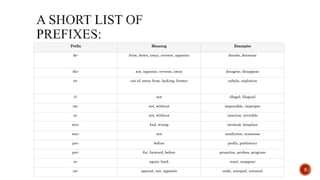
Prefix Meaning Examples
de- from, down, away, reverse, opposite decode, decrease
dis- not, opposite, reverse, away disagree, disappear
ex- out of, away from, lacking, former exhale, explosion
il- not illegal, illogical
im- not, without impossible, improper
in- not, without inaction, invisible
mis- bad, wrong mislead, misplace
non- not nonfiction, nonsense
pre- before prefix, prehistory
pro- for, forward, before proactive, profess, program
re- again, back react, reappear
un- against, not, opposite undo, unequal, unusual 3
 A suffix is a group of letters placed after the root of a word.
For example, the word flavorless consists of the root word “flavor” combined
with the suffix “-less” [which means “without”]; the word “flavorless” means
“having no flavor.”
4
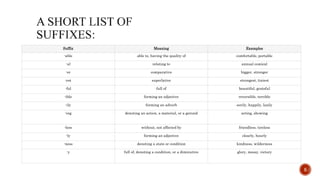
Suffix Meaning Examples
-able able to, having the quality of comfortable, portable
-al relating to annual comical
-er comparative bigger, stronger
-est superlative strongest, tiniest
-ful full of beautiful, grateful
-ible forming an adjective reversible, terrible
-ily forming an adverb eerily, happily, lazily
-ing denoting an action, a material, or a gerund acting, showing
-less without, not affected by friendless, tireless
-ly forming an adjective clearly, hourly
-ness denoting a state or condition kindness, wilderness
-y full of, denoting a condition, or a diminutive glory, messy, victory
5
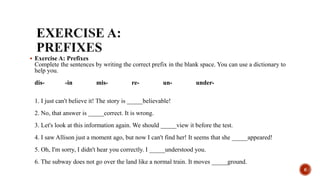
 Exercise A: Prefixes
Complete the sentences by writing the correct prefix in the blank space. You can use a dictionary to
help you.
dis- -in mis- re- un- under-
1. I just can't believe it! The story is _____believable!
2. No, that answer is _____correct. It is wrong.
3. Let's look at this information again. We should _____view it before the test.
4. I saw Allison just a moment ago, but now I can't find her! It seems that she _____appeared!
5. Oh, I'm sorry, I didn't hear you correctly. I _____understood you.
6. The subway does not go over the land like a normal train. It moves _____ground.
6
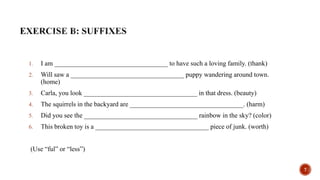
1. I am __________________________________ to have such a loving family. (thank)
2. Will saw a __________________________________ puppy wandering around town.
(home)
3. Carla, you look __________________________________ in that dress. (beauty)
4. The squirrels in the backyard are __________________________________. (harm)
5. Did you see the __________________________________ rainbow in the sky? (color)
6. This broken toy is a __________________________________ piece of junk. (worth)
(Use “ful” or “less”)
7
8

Prefixes and suffixes

  • 1.
  • 2.
     A prefixis a group of letters placed before the root of a word. For example, the word “unhappy” consists of the prefix “un-” [which means “not”] combined with the root (or stem) word “happy”; the word “unhappy” means “not happy.” 2
  • 3.
    Prefix Meaning Examples de-from, down, away, reverse, opposite decode, decrease dis- not, opposite, reverse, away disagree, disappear ex- out of, away from, lacking, former exhale, explosion il- not illegal, illogical im- not, without impossible, improper in- not, without inaction, invisible mis- bad, wrong mislead, misplace non- not nonfiction, nonsense pre- before prefix, prehistory pro- for, forward, before proactive, profess, program re- again, back react, reappear un- against, not, opposite undo, unequal, unusual 3
  • 4.
     A suffixis a group of letters placed after the root of a word. For example, the word flavorless consists of the root word “flavor” combined with the suffix “-less” [which means “without”]; the word “flavorless” means “having no flavor.” 4
  • 5.
    Suffix Meaning Examples -ableable to, having the quality of comfortable, portable -al relating to annual comical -er comparative bigger, stronger -est superlative strongest, tiniest -ful full of beautiful, grateful -ible forming an adjective reversible, terrible -ily forming an adverb eerily, happily, lazily -ing denoting an action, a material, or a gerund acting, showing -less without, not affected by friendless, tireless -ly forming an adjective clearly, hourly -ness denoting a state or condition kindness, wilderness -y full of, denoting a condition, or a diminutive glory, messy, victory 5
  • 6.
     Exercise A:Prefixes Complete the sentences by writing the correct prefix in the blank space. You can use a dictionary to help you. dis- -in mis- re- un- under- 1. I just can't believe it! The story is _____believable! 2. No, that answer is _____correct. It is wrong. 3. Let's look at this information again. We should _____view it before the test. 4. I saw Allison just a moment ago, but now I can't find her! It seems that she _____appeared! 5. Oh, I'm sorry, I didn't hear you correctly. I _____understood you. 6. The subway does not go over the land like a normal train. It moves _____ground. 6
  • 7.
    1. I am__________________________________ to have such a loving family. (thank) 2. Will saw a __________________________________ puppy wandering around town. (home) 3. Carla, you look __________________________________ in that dress. (beauty) 4. The squirrels in the backyard are __________________________________. (harm) 5. Did you see the __________________________________ rainbow in the sky? (color) 6. This broken toy is a __________________________________ piece of junk. (worth) (Use “ful” or “less”) 7
  • 8.