A prefix is a group of letters added to the beginning of a word to change its meaning. Prefixes help create new words and make communication more precise. They can indicate negation, time, amount, or direction.
Prefixes and Their
Meanings
Studentswill be able to:
● Define the term "prefix"
● Identify common prefixes and
their meanings
● Use prefixes to determine the
meaning of unfamiliar words
2.
What Are
Prefixes?
● Aprefix is a word part added to the
beginning of a word.
● It changes the word's meaning.
● Knowing common prefixes helps you
understand new words!
● We will:
● Learn what prefixes mean
● Find prefixes in words
● Use prefixes to learn new word
meanings
3.
Prefixes: Key
Learning Objectives
●Define "prefix" and explain its function.
● Show how prefixes change word meanings.
● Introduce common prefixes and their
meanings.
● Guide students to find prefixes within words.
● Practice using prefixes to decode unfamiliar
words.
● Apply prefix knowledge to expand
vocabulary.
4.
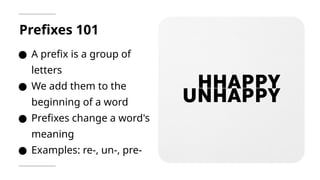
Prefixes 101
● Aprefix is a group of
letters
● We add them to the
beginning of a word
● Prefixes change a word's
meaning
● Examples: re-, un-, pre-
5.
Prefixes Change WordMeanings
● Prefixes change the meaning of a word.
● They can make a word's meaning
opposite; for example, unkind means
not kind.
● They can add to a word's meaning; for
example, repay means to pay again.
● They can change the intensity of a
word's meaning.
Finding Prefixes inWords
● Find the prefix in a word by looking for a
group of letters at the beginning of the
word.
● Remember that not all words have
prefixes.
● Once you find the prefix, think about its
meaning.
● Put the prefix's meaning together with
the rest of the word to find the word's
meaning.
8.
Prefix Detective
Work 🔍
●Find the prefix in new words!
● Knowing the prefix and its meaning
gives you clues about the whole
word.
● Example: "rewind"
● The prefix "re-" means again
● "wind" means to wrap something
around something else
● "rewind" means to wrap something
around something else again
9.
Prefixes Expand
Your Vocabulary
●Knowing common prefixes
expands your vocabulary.
● You can figure out new words
without a dictionary!
● The more prefixes you know,
the more words you'll
understand!
10.
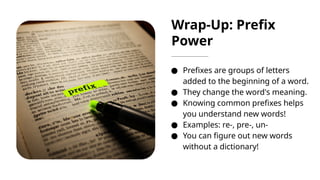
Wrap-Up: Prefix
Power
● Prefixesare groups of letters
added to the beginning of a word.
● They change the word's meaning.
● Knowing common prefixes helps
you understand new words!
● Examples: re-, pre-, un-
● You can figure out new words
without a dictionary!
11.
Let's Discuss:
Prefixes
● Whatdoes the prefix "re-"
mean?
● What are some other prefixes
you know?
● Can you use a prefix to make
a word's meaning opposite?
● Make a list of 3 words that
use prefixes.