Precursor Chemicals
BY: RAGHU KHIMANI
M.S. FORENSIC PHARMACY
PHD (R) (QUALITY ASSURANCE)
Precursor Chemicals
Precursor Chemicals, are also known as scheduled substances or
drug precursors, are chemicals that are known to be used in the
illegal manufacture of narcotic drugs and psychotropic substances.
These precursor chemicals also have legitimate commercial uses and
are legally used in wide variety of industrial processes and consumer
products, such as medicines, flavorings and fragrances.
They can be distinguished from other chemicals used in the
manufacturing process, such as “reagents” and “solvents”.
Precursor Chemicals
There is harmonized legislation across Europe which puts a control
system in place with the aim to achieve a balance between preventing
diversion of, without inhibiting legal trade in, these precursor chemicals.
This legalization requires mother states to monitor the trade in their
country including the movement of precursor chemicals into and out of
their country.
Monitoring is carried out through measures such as the licensing and
registration of operators, procedures and requirements governing
movement of the chemicals, as well as documentation and labelling.
Drug Precursor Diversion
Drug precursor diversion happens when criminals, or criminal
organizations, take these products out of the legal market and use
them for illegal purposes.
Two examples:
1. Acetic anhydride (AA) is used in many industrial processes for the
production of plastics, textiles, dyes, photochemical agents,
perfumes, explosives and cigarette filters.
However, AA is also an important reaction agent for the illicit
production of heroin. For the production of 1 kg of heroin, 1 to
1.5 litre of AA is required.
Drug Precursor Diversion
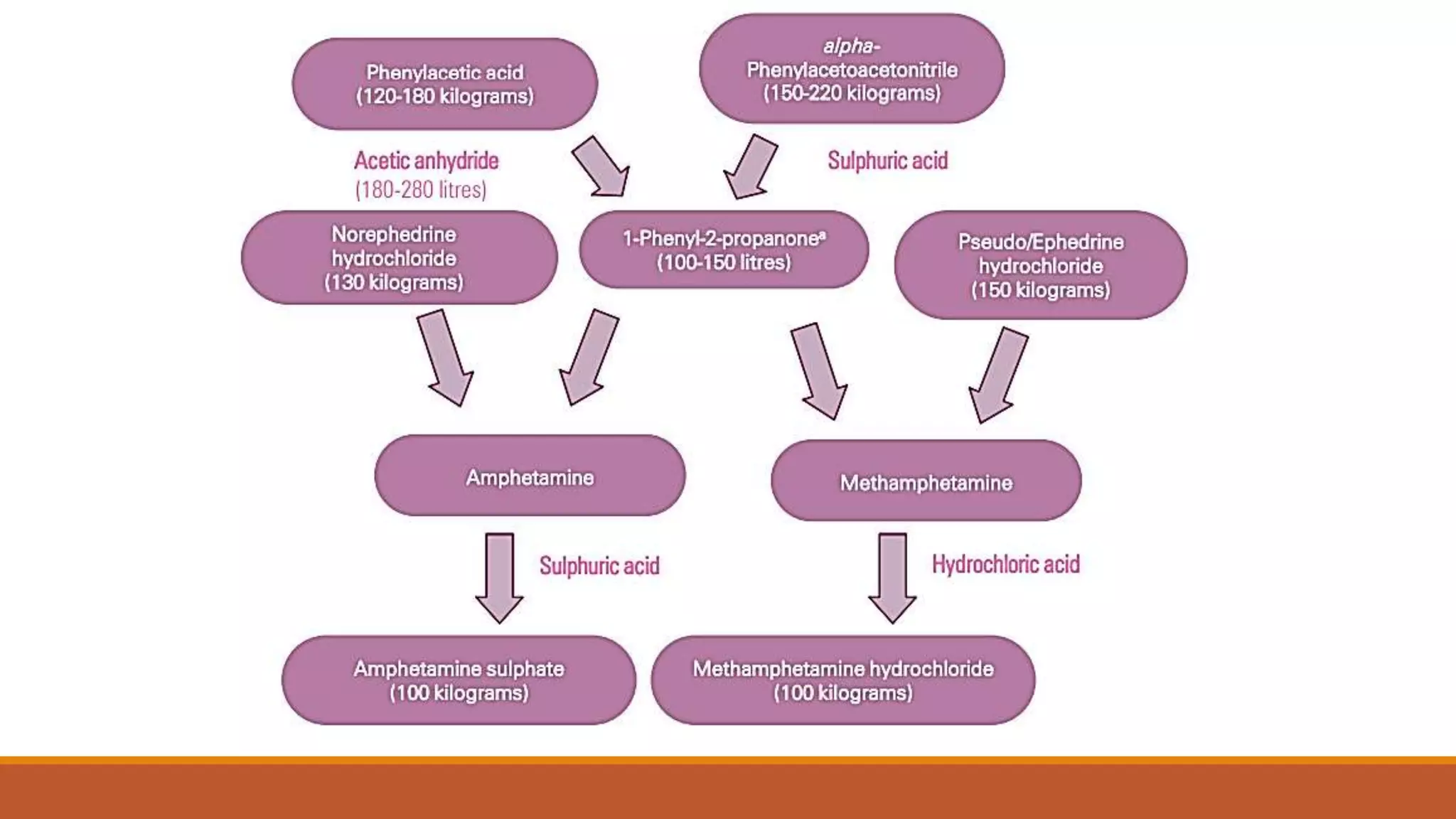
2. Ephedrine or pseudo-ephedrine — strong nasal-decongestants —
are legally used to manufacture medicinal products against flu or
allergies, but they are also key products used in illicit production
of methamphetamine. Only 1.5 kg of
ephedrine/pseudoephedrine is needed to obtain 1 kg of
methamphetamine. Assuming that one tablet contains 60mg of
ephedrine/pseudoephedrine, 25 000 tablets are needed to obtain
1 kg of methamphetamine.
Categories of Precursor Chemicals
The International Narcotics Control Board has defined a list of
precursor chemicals frequently used in the illicit manufacture of
narcotic drugs and psychotropic substances under international
control.
Currently there are 24 precursor chemicals under control in the
Europe Legislation.
These are split into 4 categories, based on the risk they pose
balanced against their level of legitimate use.
Each category has different requirements under the main pieces of
legislation:
Categories of Precursor Chemicals
1. Category 1 covers the most sensitive substances, from which illicit
drugs can be produced most easily;
2. Category 2 covers less sensitive substances
3. Category 3 covers bulk chemicals that can have different types of
uses in the manufacturing process (also solvents, impurities
remover, etc.).
4. Since December 2013, a new category (category 4) has been
introduced in the legislation concerning trade between the EU
and third countries, covering medicinal products for human and
veterinary use containing ephedrine or pseudoephedrine.
Categories of Precursor Chemicals
Category 1:
 1-phenyl-2-propanone (BMK), N-acetylanthranilic acid, isosafrol, 3.4-
methymethylenedioxyphenyl-propan-2-one (PMK), piperanol, safrole, ephedrine,
pseudoephedrine, norephedrine, ergometrine, ergotamine, lysergic acid, alpha-
phenylacetoacetonitrile (APAAN).
Category 2:
 Subcategory 2A - Acetic anhydride
 Subcategory 2B - Phenylacetic acid, anthranilic acid, piperidine, potassium permanganate.
Category 3:
 Hydrochloric acid, Suplhuric acid, Toluene, Ethyl ether, Acetone, Methylethylketone (MEK)
Category 4:
 Human medicinal products and veterinary medicinal products containing ephedrine and
pseudoephedrine
Precursor chemicals
Precursor chemicals
Precursor chemicals
Precursor chemicals

Precursor chemicals

  • 1.
    Precursor Chemicals BY: RAGHUKHIMANI M.S. FORENSIC PHARMACY PHD (R) (QUALITY ASSURANCE)
  • 2.
    Precursor Chemicals Precursor Chemicals,are also known as scheduled substances or drug precursors, are chemicals that are known to be used in the illegal manufacture of narcotic drugs and psychotropic substances. These precursor chemicals also have legitimate commercial uses and are legally used in wide variety of industrial processes and consumer products, such as medicines, flavorings and fragrances. They can be distinguished from other chemicals used in the manufacturing process, such as “reagents” and “solvents”.
  • 3.
    Precursor Chemicals There isharmonized legislation across Europe which puts a control system in place with the aim to achieve a balance between preventing diversion of, without inhibiting legal trade in, these precursor chemicals. This legalization requires mother states to monitor the trade in their country including the movement of precursor chemicals into and out of their country. Monitoring is carried out through measures such as the licensing and registration of operators, procedures and requirements governing movement of the chemicals, as well as documentation and labelling.
  • 4.
    Drug Precursor Diversion Drugprecursor diversion happens when criminals, or criminal organizations, take these products out of the legal market and use them for illegal purposes. Two examples: 1. Acetic anhydride (AA) is used in many industrial processes for the production of plastics, textiles, dyes, photochemical agents, perfumes, explosives and cigarette filters. However, AA is also an important reaction agent for the illicit production of heroin. For the production of 1 kg of heroin, 1 to 1.5 litre of AA is required.
  • 5.
    Drug Precursor Diversion 2.Ephedrine or pseudo-ephedrine — strong nasal-decongestants — are legally used to manufacture medicinal products against flu or allergies, but they are also key products used in illicit production of methamphetamine. Only 1.5 kg of ephedrine/pseudoephedrine is needed to obtain 1 kg of methamphetamine. Assuming that one tablet contains 60mg of ephedrine/pseudoephedrine, 25 000 tablets are needed to obtain 1 kg of methamphetamine.
  • 6.
    Categories of PrecursorChemicals The International Narcotics Control Board has defined a list of precursor chemicals frequently used in the illicit manufacture of narcotic drugs and psychotropic substances under international control. Currently there are 24 precursor chemicals under control in the Europe Legislation. These are split into 4 categories, based on the risk they pose balanced against their level of legitimate use. Each category has different requirements under the main pieces of legislation:
  • 7.
    Categories of PrecursorChemicals 1. Category 1 covers the most sensitive substances, from which illicit drugs can be produced most easily; 2. Category 2 covers less sensitive substances 3. Category 3 covers bulk chemicals that can have different types of uses in the manufacturing process (also solvents, impurities remover, etc.). 4. Since December 2013, a new category (category 4) has been introduced in the legislation concerning trade between the EU and third countries, covering medicinal products for human and veterinary use containing ephedrine or pseudoephedrine.
  • 8.
    Categories of PrecursorChemicals Category 1:  1-phenyl-2-propanone (BMK), N-acetylanthranilic acid, isosafrol, 3.4- methymethylenedioxyphenyl-propan-2-one (PMK), piperanol, safrole, ephedrine, pseudoephedrine, norephedrine, ergometrine, ergotamine, lysergic acid, alpha- phenylacetoacetonitrile (APAAN). Category 2:  Subcategory 2A - Acetic anhydride  Subcategory 2B - Phenylacetic acid, anthranilic acid, piperidine, potassium permanganate. Category 3:  Hydrochloric acid, Suplhuric acid, Toluene, Ethyl ether, Acetone, Methylethylketone (MEK) Category 4:  Human medicinal products and veterinary medicinal products containing ephedrine and pseudoephedrine

Editor's Notes

  • #3 Legitimate = કાયદેસર
  • #4 Harmonized Legislation= સમન્વયિત / સંવાદિત કાયદો