Precipitating a KM Solution
    David G. Jones, B.A., M.A.
    Shibumi.management@gmail.com


                                   1
An Opening Word
   “For (years) business leaders have taught
   bureaucracy-busting, teamwork coaching,
   etc. Here’s all you really need to know:
   provide safe places where people can share
   ideas about work without getting shut down
   by bosses and bureaucrats”.
    – Thomas Stewart: Intellectual Capital,
      The New Wealth of Organizations

                                            2
A metaphor from chemistry,
which is all about…..
    Physical Properties
    Metals and Ions; Acids and Bases
    Kinetics and Equilibrium
    Reactions of Elements and Gases
    Solutions and Solubility
    Changes in Energy
    Reduction and Synthesis
                                       3
Chemical Precipitation
    Happens in aqueous solutions, where
    Some ions react;
    Some are unchanged (called
    “spectators”);
    Others are insoluble and “settle out”


                                            4
Workplace Characteristics
    Hierarchial structures
    Stovepipes
    Rules
    Specialized functions,
    tasks
    Continual change
    Absurd mobility
    Mission shortfall
                             5
Management is..
    Troubled by,
    – Increasing isolation, division, gaps
    – Decreasing aptitude, commitment and energy
    – Increasing costs and decreasing returns
    And burdened with “solutions”:
    – How-to tools, methods and processes
    – Metrics, benchmarks, “best” practices
    – Information and knowledge as product
                                                   6
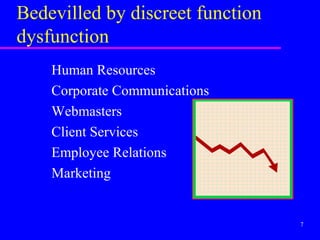
Bedevilled by discreet function
dysfunction
    Human Resources
    Corporate Communications
    Webmasters
    Client Services
    Employee Relations
    Marketing


                                  7
Ion 1 (business):

  •Knows there is a very serious problem
  •Expending energy in organizing workers, not work
  •Has not articulated its plans and requirements
  •Patches and Band-Aids
  •Really not sure whether IT is a management function or
  a service delivery


                                                      8
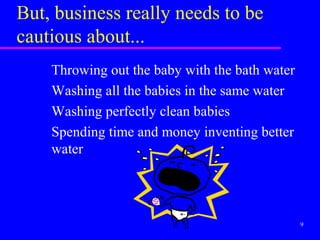
But, business really needs to be
cautious about...
    Throwing out the baby with the bath water
    Washing all the babies in the same water
    Washing perfectly clean babies
    Spending time and money inventing better
    water


                                                9
Therefore, we need to spend time
on “work”...
    Developing a better understanding of:
    – what it is and how to manage it
    – what is a “good decision”, and how to make
      good ones
    – who needs to be involved with what, when,
      where, how
    – how we can bring functional specialization
      back into generic work and management

                                                   10
And more time on planning and
managing...
    getting the objectives right
    focusing on the strategic must-do’s
    eliminating stupid change
    re-inventing plodding
    involving the right people up front
    having the courage to toss out things
    that don’t work
                                            11
And more time on people...
    Defining appropriate:
    – skills
    – recruitment strategies
    – institutionalized risk-taking and,
       » reduced fear of failure
    – minimalist position descriptions
    – effective rewards systems


                                           12
And more time...
    Making sure we really understand work
    processing before we re-engineer it
    Embracing minimalism
    Laying the groundwork for innovation and
    improvement
    Developing systematic work that IT can
    facilitate

                                               13
And more time...
    Getting the technology right:
    – enhance capability on what is already in place
    – understand that needs differ at individual and
      organizational levels
    – empower users (Down With Defaults!)
    – stop focusing on volume and connections
    – start focusing on content and utility
    Making IM/IT a management function
                                                       14
The condition of ion 2 (IT):
    Really unclear about what the business
    wants and needs
    (and can’t extract the answers)
    Preoccupied with being “current”
    Fixated on logic and “improvement”
    Really believes it has (the) answers
    Has been taught to wait
    Is giving up on waiting
                                             15
Two hundred and five companies participated in ProSci's
 benchmarking study on the future role of IT in business
 process reengineering.


Current IT role and performance
In nearly 50% of reengineering projects, IT managers
or staff had conflicts with the project team, and almost
80% of operational managers and staff rated IT
support and performance as mediocre to poor. IT
managers gave themselves slightly higher
performance reviews, but still only 40% considered
their performance very good or excellent.


                                                           16
Participants stated that the primary contributor to IT's
poor reputation was their lack of operational knowledge
and understanding of business needs. In some cases, IT
failed to match technology to the desired business
processes, was unable to meet commitments, or was not
customer-service oriented.
IT managers and staff indicated that IT should be the
driver in reengineering. In strong disagreement,
operational managers and consultants stated that IT
should be an enabler, a team member and a partner in
the reengineering process.
                                                    17
KM presents an opportunity


   To bring together what we have learned
   about work, management and information
   technology in a way that will profit all the
   players.


                                                  18
But to precipitate such change...
    We need to set down our organization
    requirements, opportunities and vehicles for
    leveraging intellectual capital
    Integrate “knowledge” as an asset and utility
    Establish discipline, and integrate technologies for
    managing the information life cycle
    Bring diverse talents together to work on this


                                                      19
Business and IT management have a
common stake in settling out:
    The consequences of:
     – Sharing information widely (never mind the
       quality question at this point)
     – A better informed workforce
     – Collaborative work; real and virtual interaction
     – How people come to understand, and use the
       power of the tools at their disposal


                                                      20
I think we have to dump some
models and assumptions
    1. The data-information-knowledge
    pyramid
    2. That our clients will be satisfied much
    longer with having only “access to
    information”
    3. That “knowledge” as an “asset” will
    conform to the same rules we apply to other
    corporate assets
                                              21
A final word:
    “The Work of New Age Managers” is:
    –   Conceive and Execute Complex Strategies
    –   Share and Protect Intellectual property
    –   Manage the Public-private Interface
    –   Provide Intellectual and Administrative
        Leadership

        C.K. Prahalad in The Organization of the
        Future by the Drucker Foundation
                                                   22

Precipitating Knowledge Management (KM)

  • 1.
    Precipitating a KMSolution David G. Jones, B.A., M.A. Shibumi.management@gmail.com 1
  • 2.
    An Opening Word “For (years) business leaders have taught bureaucracy-busting, teamwork coaching, etc. Here’s all you really need to know: provide safe places where people can share ideas about work without getting shut down by bosses and bureaucrats”. – Thomas Stewart: Intellectual Capital, The New Wealth of Organizations 2
  • 3.
    A metaphor fromchemistry, which is all about….. Physical Properties Metals and Ions; Acids and Bases Kinetics and Equilibrium Reactions of Elements and Gases Solutions and Solubility Changes in Energy Reduction and Synthesis 3
  • 4.
    Chemical Precipitation Happens in aqueous solutions, where Some ions react; Some are unchanged (called “spectators”); Others are insoluble and “settle out” 4
  • 5.
    Workplace Characteristics Hierarchial structures Stovepipes Rules Specialized functions, tasks Continual change Absurd mobility Mission shortfall 5
  • 6.
    Management is.. Troubled by, – Increasing isolation, division, gaps – Decreasing aptitude, commitment and energy – Increasing costs and decreasing returns And burdened with “solutions”: – How-to tools, methods and processes – Metrics, benchmarks, “best” practices – Information and knowledge as product 6
  • 7.
    Bedevilled by discreetfunction dysfunction Human Resources Corporate Communications Webmasters Client Services Employee Relations Marketing 7
  • 8.
    Ion 1 (business): •Knows there is a very serious problem •Expending energy in organizing workers, not work •Has not articulated its plans and requirements •Patches and Band-Aids •Really not sure whether IT is a management function or a service delivery 8
  • 9.
    But, business reallyneeds to be cautious about... Throwing out the baby with the bath water Washing all the babies in the same water Washing perfectly clean babies Spending time and money inventing better water 9
  • 10.
    Therefore, we needto spend time on “work”... Developing a better understanding of: – what it is and how to manage it – what is a “good decision”, and how to make good ones – who needs to be involved with what, when, where, how – how we can bring functional specialization back into generic work and management 10
  • 11.
    And more timeon planning and managing... getting the objectives right focusing on the strategic must-do’s eliminating stupid change re-inventing plodding involving the right people up front having the courage to toss out things that don’t work 11
  • 12.
    And more timeon people... Defining appropriate: – skills – recruitment strategies – institutionalized risk-taking and, » reduced fear of failure – minimalist position descriptions – effective rewards systems 12
  • 13.
    And more time... Making sure we really understand work processing before we re-engineer it Embracing minimalism Laying the groundwork for innovation and improvement Developing systematic work that IT can facilitate 13
  • 14.
    And more time... Getting the technology right: – enhance capability on what is already in place – understand that needs differ at individual and organizational levels – empower users (Down With Defaults!) – stop focusing on volume and connections – start focusing on content and utility Making IM/IT a management function 14
  • 15.
    The condition ofion 2 (IT): Really unclear about what the business wants and needs (and can’t extract the answers) Preoccupied with being “current” Fixated on logic and “improvement” Really believes it has (the) answers Has been taught to wait Is giving up on waiting 15
  • 16.
    Two hundred andfive companies participated in ProSci's benchmarking study on the future role of IT in business process reengineering. Current IT role and performance In nearly 50% of reengineering projects, IT managers or staff had conflicts with the project team, and almost 80% of operational managers and staff rated IT support and performance as mediocre to poor. IT managers gave themselves slightly higher performance reviews, but still only 40% considered their performance very good or excellent. 16
  • 17.
    Participants stated thatthe primary contributor to IT's poor reputation was their lack of operational knowledge and understanding of business needs. In some cases, IT failed to match technology to the desired business processes, was unable to meet commitments, or was not customer-service oriented. IT managers and staff indicated that IT should be the driver in reengineering. In strong disagreement, operational managers and consultants stated that IT should be an enabler, a team member and a partner in the reengineering process. 17
  • 18.
    KM presents anopportunity To bring together what we have learned about work, management and information technology in a way that will profit all the players. 18
  • 19.
    But to precipitatesuch change... We need to set down our organization requirements, opportunities and vehicles for leveraging intellectual capital Integrate “knowledge” as an asset and utility Establish discipline, and integrate technologies for managing the information life cycle Bring diverse talents together to work on this 19
  • 20.
    Business and ITmanagement have a common stake in settling out: The consequences of: – Sharing information widely (never mind the quality question at this point) – A better informed workforce – Collaborative work; real and virtual interaction – How people come to understand, and use the power of the tools at their disposal 20
  • 21.
    I think wehave to dump some models and assumptions 1. The data-information-knowledge pyramid 2. That our clients will be satisfied much longer with having only “access to information” 3. That “knowledge” as an “asset” will conform to the same rules we apply to other corporate assets 21
  • 22.
    A final word: “The Work of New Age Managers” is: – Conceive and Execute Complex Strategies – Share and Protect Intellectual property – Manage the Public-private Interface – Provide Intellectual and Administrative Leadership C.K. Prahalad in The Organization of the Future by the Drucker Foundation 22