THE GREAT COURSES®
Corporate Headquarters
4840 Westfields Boulevard, Suite 500
Chantilly, VA 20151-2299
USA
Phone: 1-800-832-2412
www.thegreatcourses.com
Course No. 1005 © 2011 The Teaching Company.
Cover Image: © Marek Uliasz/iStockphoto.
PB1005A
“Pure intellectual stimulation that can be popped
into the [audio or video player] anytime.”
—Harvard Magazine
“Passionate, erudite, living legend lecturers. Academia’s
best lecturers are being captured on tape.”
—The Los Angeles Times
“A serious force in American education.”
—The Wall Street Journal
High School
Topic
Mathematics
Subtopic
Course Workbook
Mathematics Describing
the Real World:
Precalculus and Trigonometry
Professor Bruce H. Edwards
University of Florida
Professor Bruce H. Edwards is Professor of Mathematics at the University of Florida, where
he has won a host of awards and recognitions. He was named Teacher of the Year in the
College of Liberal Arts and Sciences and was selected as a Distinguished Alumni Professor
by the Office of Alumni Affairs. Professor Edwards’s coauthored mathematics textbooks
have earned awards from the Text and Academic Authors Association.
PrecalculusandTrigonometryWorkbook
PUBLISHED BY:
THE GREAT COURSES
Corporate Headquarters
4840 Westfields Boulevard, Suite 500
Chantilly, Virginia 20151-2299
Phone: 1-800-832-2412
Fax: 703-378-3819
www.thegreatcourses.com
Copyright © The Teaching Company, 2011
Printed in the United States of America
This book is in copyright. All rights reserved.
Without limiting the rights under copyright reserved above,
no part of this publication may be reproduced, stored in
or introduced into a retrieval system, or transmitted,
in any form, or by any means
(electronic, mechanical, photocopying, recording, or otherwise),
without the prior written permission of
The Teaching Company.
i
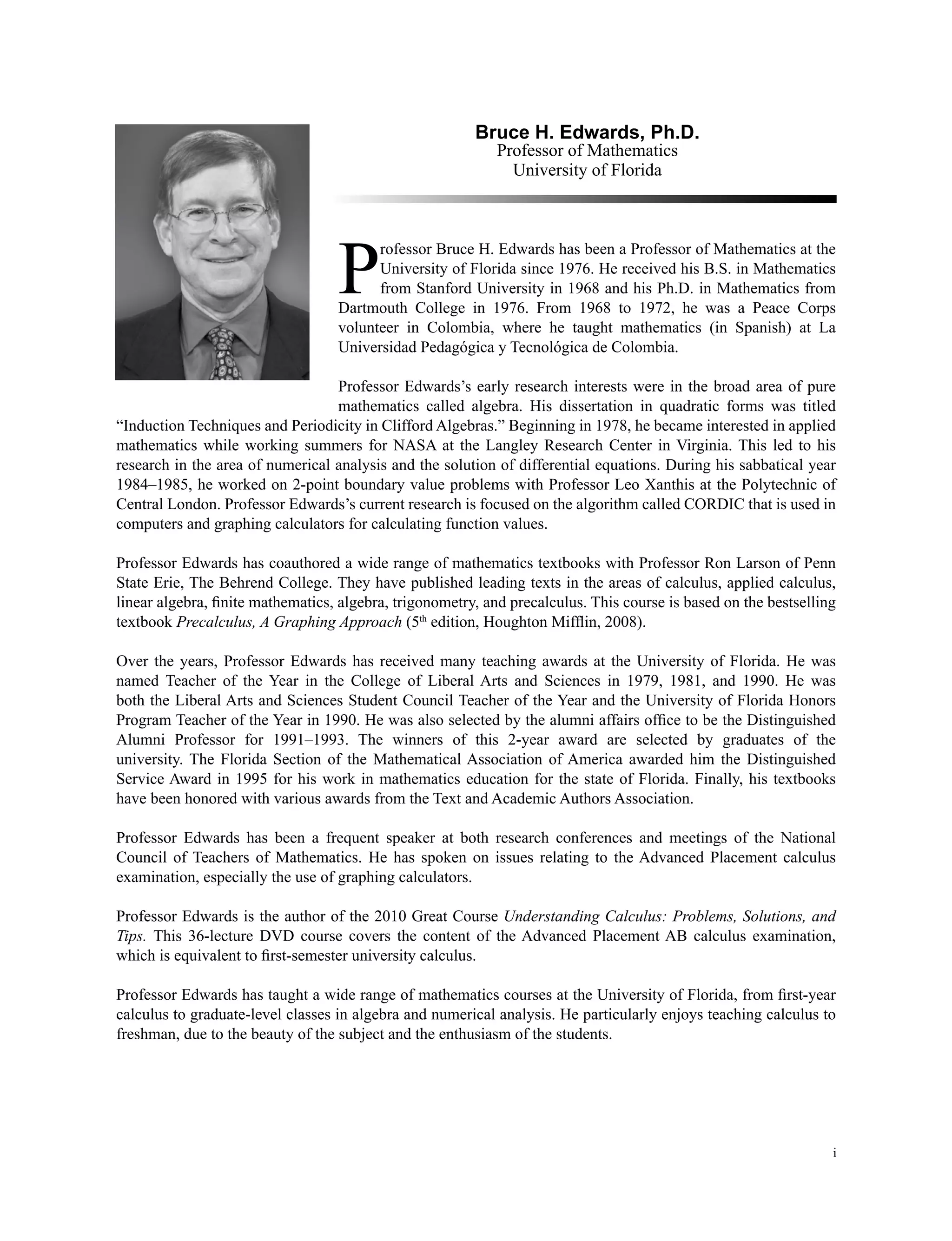
Bruce H. Edwards, Ph.D.
Professor of Mathematics
University of Florida
P
rofessor Bruce H. Edwards has been a Professor of Mathematics at the
University of Florida since 1976. He received his B.S. in Mathematics
from Stanford University in 1968 and his Ph.D. in Mathematics from
Dartmouth College in 1976. From 1968 to 1972, he was a Peace Corps
volunteer in Colombia, where he taught mathematics (in Spanish) at La
Universidad Pedagógica y Tecnológica de Colombia.
Professor Edwards’s early research interests were in the broad area of pure
mathematics called algebra. His dissertation in quadratic forms was titled
“Induction Techniques and Periodicity in Clifford Algebras.” Beginning in 1978, he became interested in applied
mathematics while working summers for NASA at the Langley Research Center in Virginia. This led to his
research in the area of numerical analysis and the solution of differential equations. During his sabbatical year
1984–1985, he worked on 2-point boundary value problems with Professor Leo Xanthis at the Polytechnic of
Central London. Professor Edwards’s current research is focused on the algorithm called CORDIC that is used in
computers and graphing calculators for calculating function values.
Professor Edwards has coauthored a wide range of mathematics textbooks with Professor Ron Larson of Penn
State Erie, The Behrend College. They have published leading texts in the areas of calculus, applied calculus,
linear algebra, finite mathematics, algebra, trigonometry, and precalculus. This course is based on the bestselling
textbook Precalculus, A Graphing Approach (5th
edition, Houghton Mifflin, 2008).
Over the years, Professor Edwards has received many teaching awards at the University of Florida. He was
named Teacher of the Year in the College of Liberal Arts and Sciences in 1979, 1981, and 1990. He was
both the Liberal Arts and Sciences Student Council Teacher of the Year and the University of Florida Honors
Program Teacher of the Year in 1990. He was also selected by the alumni affairs office to be the Distinguished
Alumni Professor for 1991–1993. The winners of this 2-year award are selected by graduates of the
university. The Florida Section of the Mathematical Association of America awarded him the Distinguished
Service Award in 1995 for his work in mathematics education for the state of Florida. Finally, his textbooks
have been honored with various awards from the Text and Academic Authors Association.
Professor Edwards has been a frequent speaker at both research conferences and meetings of the National
Council of Teachers of Mathematics. He has spoken on issues relating to the Advanced Placement calculus
examination, especially the use of graphing calculators.
Professor Edwards is the author of the 2010 Great Course Understanding Calculus: Problems, Solutions, and
Tips. This 36-lecture DVD course covers the content of the Advanced Placement AB calculus examination,
which is equivalent to first-semester university calculus.
Professor Edwards has taught a wide range of mathematics courses at the University of Florida, from first-year
calculus to graduate-level classes in algebra and numerical analysis. He particularly enjoys teaching calculus to
freshman, due to the beauty of the subject and the enthusiasm of the students.
Table of Contents
ii
LEsson GUIDES
INTRODUCTION
Professor Biography��������������������������������������������������������������������������������������������������������������������������������i
Scope�����������������������������������������������������������������������������������������������������������������������������������������������������1
LeSSON 1
Introduction to Precalculus—Functions��������������������������������������������������������������������������������������������������2
LeSSON 2
Polynomial Functions and Zeros������������������������������������������������������������������������������������������������������������7
LeSSON 3
Complex Numbers��������������������������������������������������������������������������������������������������������������������������������12
LeSSON 4
Rational Functions �������������������������������������������������������������������������������������������������������������������������������16
LeSSON 5
Inverse Functions���������������������������������������������������������������������������������������������������������������������������������21
LeSSON 6
Solving Inequalities������������������������������������������������������������������������������������������������������������������������������26
LeSSON 7
Exponential Functions��������������������������������������������������������������������������������������������������������������������������30
LeSSON 8
Logarithmic Functions��������������������������������������������������������������������������������������������������������������������������36
LeSSON 9
Properties of Logarithms����������������������������������������������������������������������������������������������������������������������40
LeSSON 10
Exponential and Logarithmic Equations�����������������������������������������������������������������������������������������������44
LeSSON 11
Exponential and Logarithmic Models ��������������������������������������������������������������������������������������������������48
LeSSON 12
Introduction to Trigonometry and Angles����������������������������������������������������������������������������������������������52
LeSSON 13
Trigonometric Functions—Right Triangle Definition�����������������������������������������������������������������������������57
LeSSON 14
Trigonometric Functions—Arbitrary Angle Definition����������������������������������������������������������������������������63
LeSSON 15
Graphs of Sine and Cosine Functions��������������������������������������������������������������������������������������������������68
iii
Table of Contents
LeSSON 16
Graphs of Other Trigonometric Functions��������������������������������������������������������������������������������������������73
LeSSON 17
Inverse Trigonometric Functions����������������������������������������������������������������������������������������������������������79
LeSSON 18
Trigonometric Identities������������������������������������������������������������������������������������������������������������������������84
LeSSON 19
Trigonometric Equations�����������������������������������������������������������������������������������������������������������������������89
LeSSON 20
Sum and Difference Formulas��������������������������������������������������������������������������������������������������������������92
LeSSON 21
Law of Sines ����������������������������������������������������������������������������������������������������������������������������������������96
LeSSON 22
Law of Cosines���������������������������������������������������������������������������������������������������������������������������������� 100
LeSSON 23
Introduction to Vectors����������������������������������������������������������������������������������������������������������������������� 105
LeSSON 24
Trigonometric Form of a Complex Number��������������������������������������������������������������������������������������� 109
LeSSON 25
Systems of Linear Equations and Matrices����������������������������������������������������������������������������������������114
LeSSON 26
Operations with Matrices��������������������������������������������������������������������������������������������������������������������118
LeSSON 27
Inverses and Determinants of Matrices��������������������������������������������������������������������������������������������� 122
LeSSON 28
Applications of Linear Systems and Matrices ����������������������������������������������������������������������������������� 126
LeSSON 29
Circles and Parabolas����������������������������������������������������������������������������������������������������������������������� 130
LeSSON 30
Ellipses and Hyperbolas�������������������������������������������������������������������������������������������������������������������� 134
LeSSON 31
Parametric Equations������������������������������������������������������������������������������������������������������������������������ 139
LeSSON 32
Polar Coordinates������������������������������������������������������������������������������������������������������������������������������ 143
Table of Contents
iv
Solutions�������������������������������������������������������������������������������������������������������������������������������������������� 163
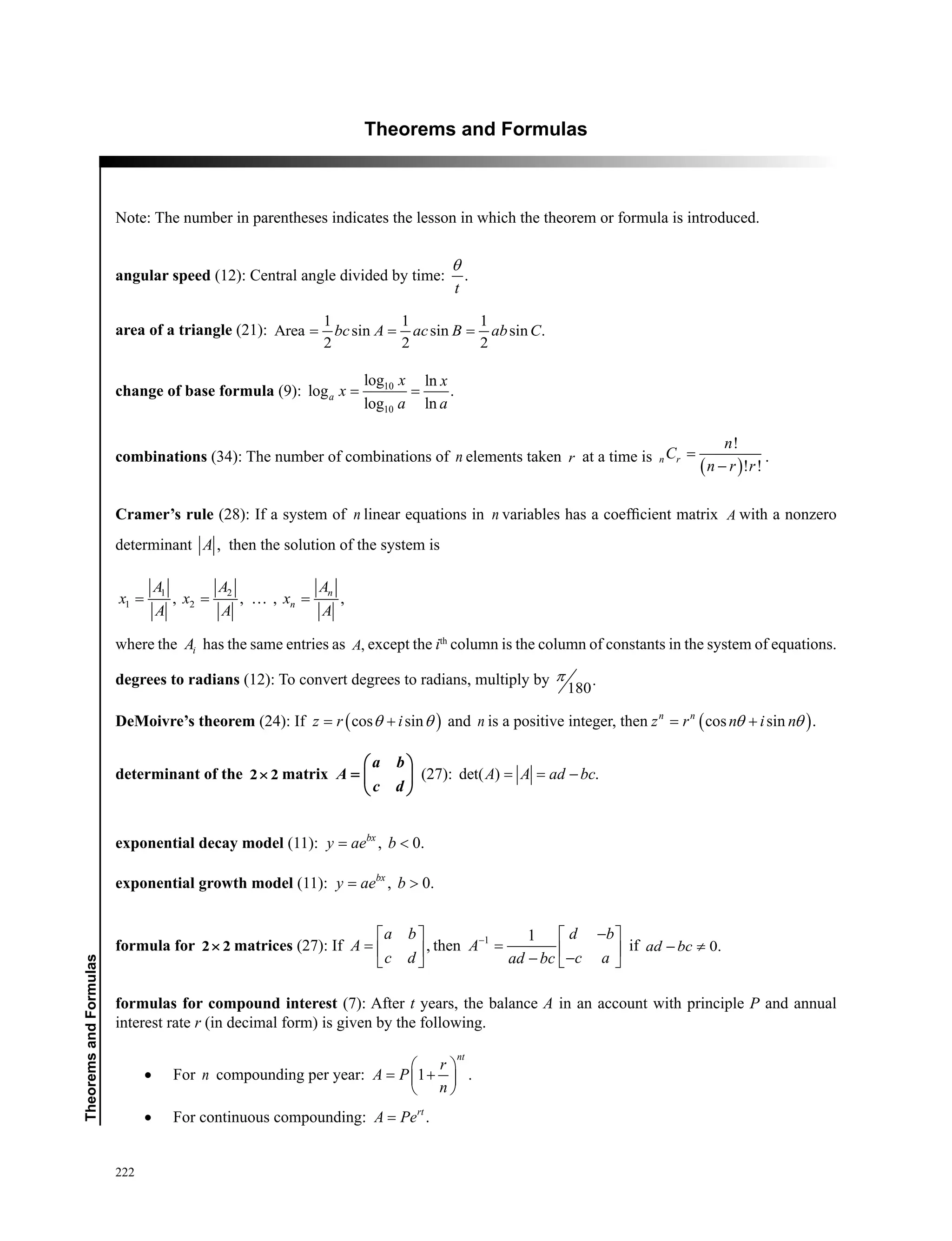
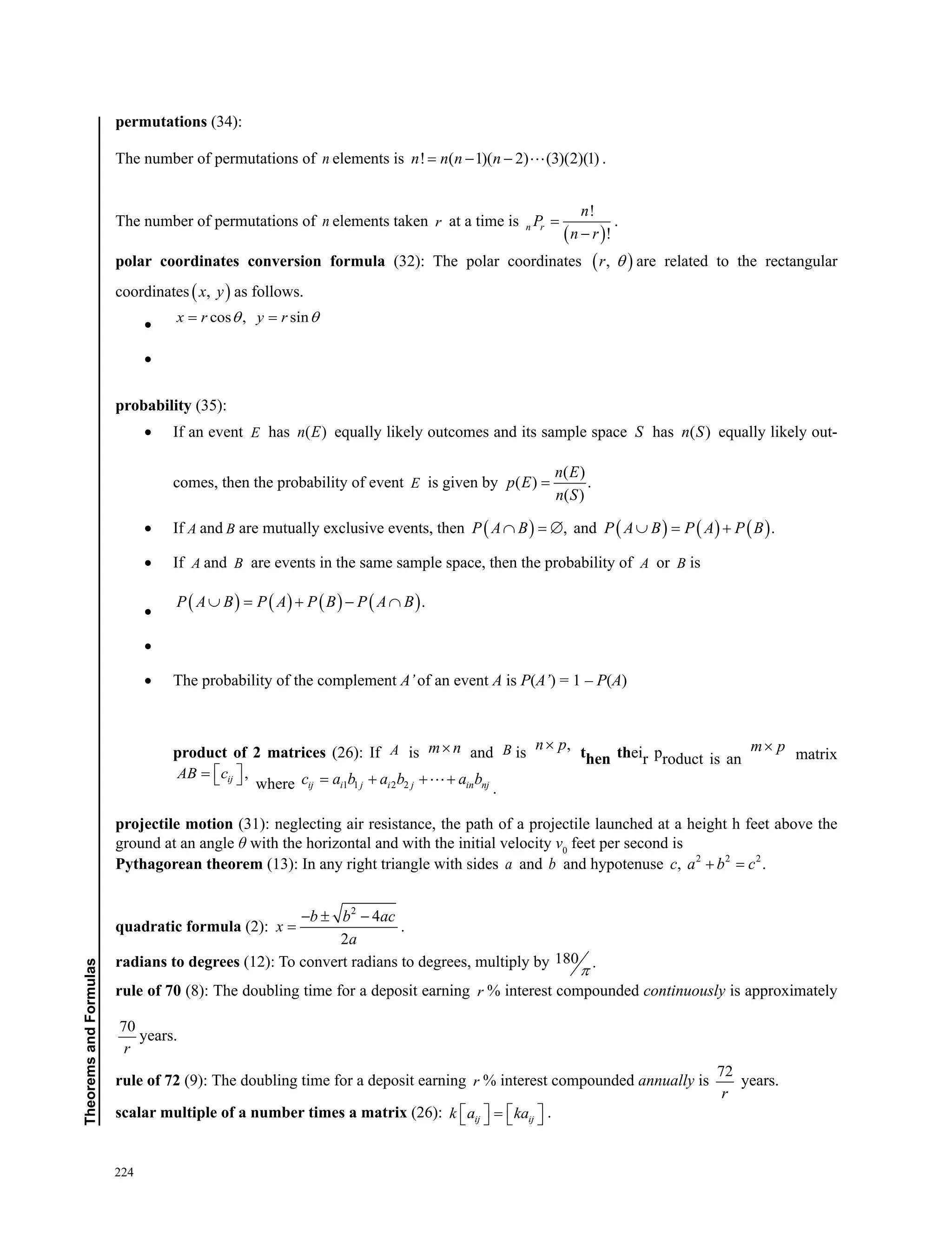
Theorems and Formulas������������������������������������������������������������������������������������������������������������������� 222
Algebra Summary������������������������������������������������������������������������������������������������������������������������������ 226
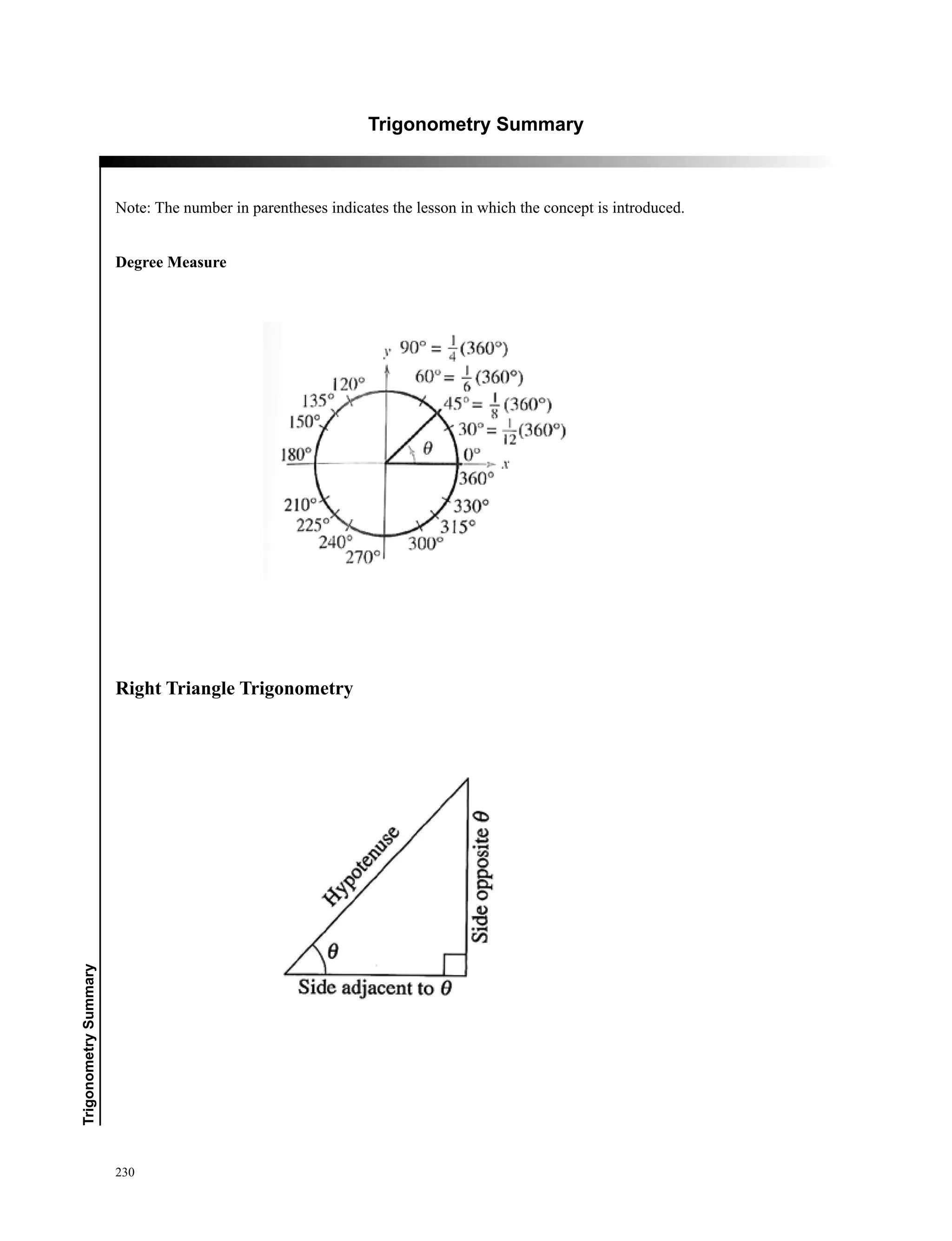
Trigonometry Summary��������������������������������������������������������������������������������������������������������������������� 230
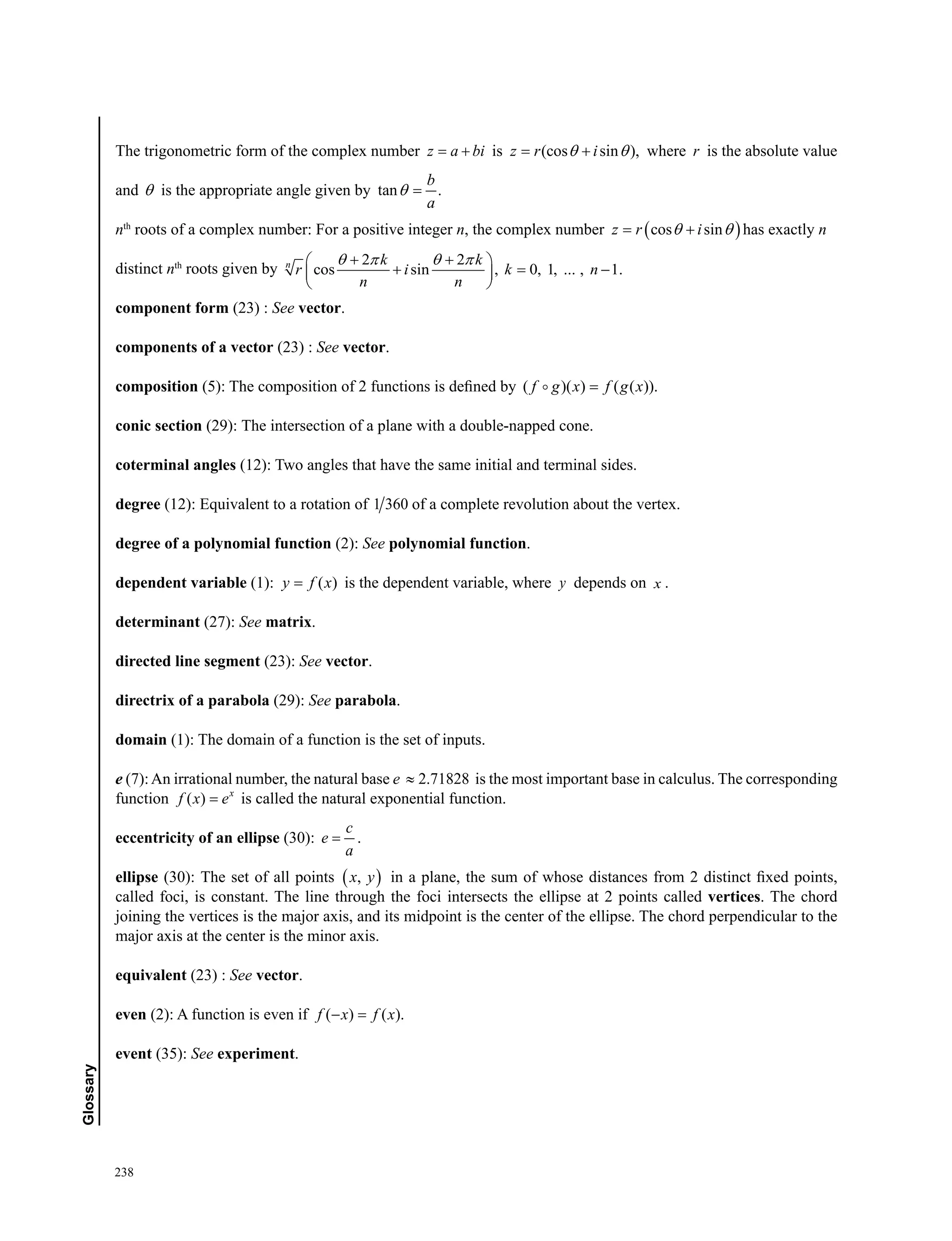
Glossary�������������������������������������������������������������������������������������������������������������������������������������������� 237
Bibliography��������������������������������������������������������������������������������������������������������������������������������������� 245
LeSSON 33
Sequences and Series���������������������������������������������������������������������������������������������������������������������� 147
LeSSON 34
Counting Principles��������������������������������������������������������������������������������������������������������������������������� 151
LeSSON 35
Elementary Probability���������������������������������������������������������������������������������������������������������������������� 154
LeSSON 36
GPS Devices and Looking Forward to Calculus������������������������������������������������������������������������������� 158
Supplemental Material
1
Mathematics Describing the Real World: Precalculus and Trigonometry
Scope:
T
he goal of this course is for you to appreciate the beautiful and practical subject of precalculus. You will
see how precalculus plays a fundamental role in all of science and engineering, as well as business and
economics. As the name “precalculus” indicates, a thorough knowledge of this material is crucial for the
study of calculus, and in my many years of teaching, I have found that success in calculus is assured if students
have a strong background in precalculus.
The principal topics in precalculus are algebra and trigonometry. In fact, at many universities and high schools,
the title of the course is Algebra and Trigonometry. However, precalculus covers much more: logarithms and
exponents, systems of linear equations, matrices, conic sections, counting methods and probability, sequences
and series, parametric equations, and polar coordinates. We will look at all these topics and their applications to
real-world problems.
Our study of precalculus will be presented in the same order as a university-level precalculus course. The
material is based on the 5th
edition of the bestselling textbook Precalculus: A Graphing Approach by Ron Larson
and Bruce H. Edwards (Houghton Mifflin, 2008). However, any standard precalculus textbook can be used for
reference and support throughout the course. Please see the bibliography for an annotated list of appropriate
supplementary textbooks.
We will begin our study of precalculus with a course overview and a brief look at functions. The concept of
functions is fundamental in all of mathematics and will be a constant theme throughout the course. We will study
all kinds of important and interesting functions: polynomial, rational, exponential, logarithmic, trigonometric,
and parametric, to name a few.
As we progress through the course, most concepts will be introduced using illustrative examples. All the
important theoretical ideas and theorems will be presented, but we will not dwell on their technical proofs.
You will find that it is easy to understand and apply precalculus to real-world problems without knowing these
theoretical intricacies.
Graphing calculators and computers are playing an increasing role in the mathematics classroom. Without a
doubt, graphing technology can enhance the understanding of precalculus; hence, we will often use technology
to verify and confirm our results.
You are encouraged to use all course materials to their maximum benefit, including the video lectures, which
you can review as many times as you wish; the individual lecture summaries and accompanying problems in the
workbook; and the supporting materials in the back of the workbook, such as the solutions to all problems, the
glossary, and the review sheets of key theorems and formulas in algebra and trigonometry.
Good luck in your study of precalculus! I hope you enjoy these lectures as much as I did preparing them.
2
Lesson1:IntroductiontoPrecalculus—Functions
Introduction to Precalculus—Functions
Lesson 1
Topics
 Course overview.
 What is precalculus?
 Functions.
 Domain and range.
 What makes precalculus difficult?
Definitions and Properties
Note: Terms in bold correspond to entries in the Glossary or other appendixes.
 A function, f, from a set A to a set B is a relation that assigns to each element x in set A exactly one
element y in set B. The notation is y = f(x) where y is the value of the function at x.
 Set A is the domain of the function, or the set of inputs.
 The range is the set of all outputs, which is a subset of set B.
 The variable x is called the independent variable and y = f(x) is the dependent variable.
 The vertical line test for functions states that if a vertical line intersects a graph at more than one
point, then the graph is not of a function.
Summary
In this introductory lesson, we talk about the content, structure, and use of this precalculus course. We also turn
to the study of functions, one of the most important concepts in all of mathematics.
Example 1: The Graph of a Function
Sketch the graph of the function ( ) 2 3.f x x 
Solution
It is helpful to evaluate the function at a few numbers in the domain. For example,
(2) 7
(0) 3
( 2) 1
f
f
f


 
You can then plot these 3 points and connect them with a straight line, see figure 1.1.
3
Figure 1.1
Example 2: The Graph of the Absolute Value Function
The absolute value function is defined as follows.
, 0
( )
, 0
x x
f x x
x x

  
 
Note: The absolute value of a number is always nonnegative.
The graph of the absolute value function looks like the letter V; it has a sharp corner at the origin, as in
figure 1.2.
4
Lesson1:IntroductiontoPrecalculus—Functions
Figure 1.2
Example 3: An Application to Compound Interest
In this example, we use the letter t (time) for the independent variable. Suppose you invest $1000 in a bank
account that pays 5% interest compounded annually. How much money will you have in the account after
t years?
Solution
After the first year, you will have
1000 1000(0.05) 1000(1 0.05) 1000(1.05) $1050.    
For the second year, you will earn 5% interest on the amount after the first year, as follows.
2
1000(1.05) 1000(1.05)(0.05) 1000(1.05)(1 0.05) 1000(1.05) $1102.50    
Notice that you earned $50 interest the first year and $52.50 the second year. Continuing this pattern, you see
that the amount in the bank after t years is given by ( ) 1000(1.05) .t
A t 
5
Study Tips
 To find the domain of a function, keep in mind that you cannot divide by zero, nor can you take square
roots (or even roots) of negative numbers. In addition, in applications of precalculus, the domain might
be limited by the context of the application.
 In general, it is more difficult to determine the range of a function than its domain.
 To analyze a function, it is often helpful to evaluate the function at a few numbers in order to get a feel
for its behavior.
 If a vertical line intersects a graph at more than one point, then the graph is not of a function.
 Mathematics is not a spectator sport. Precalculus requires practice, so you will benefit from doing the
problems at the end of each lesson. The worked-out solutions appear at the end of this workbook.
Pitfall
 Although we usually write ( )y f x for a typical function, different letters are often used. The
underlying concept is the same.
1. Evaluate the function
2
( ) 2h t t t  at each specified value of the independent variable below and
simplify.
a. (2)h
b. (1.5)h
c. ( 2)h x 
2. Evaluate the function 2
1
( )
9
q x
x


at each specified value of the independent variable below and
simplify.
a. (0)q
b. (3)q
c. ( 3)q y 
3. Find the domain of the function
4
( )h t
t
 .
4. Find the domain of the function
2
( )
10
y
g y
y



.
Problems
6
Lesson1:IntroductiontoPrecalculus—Functions
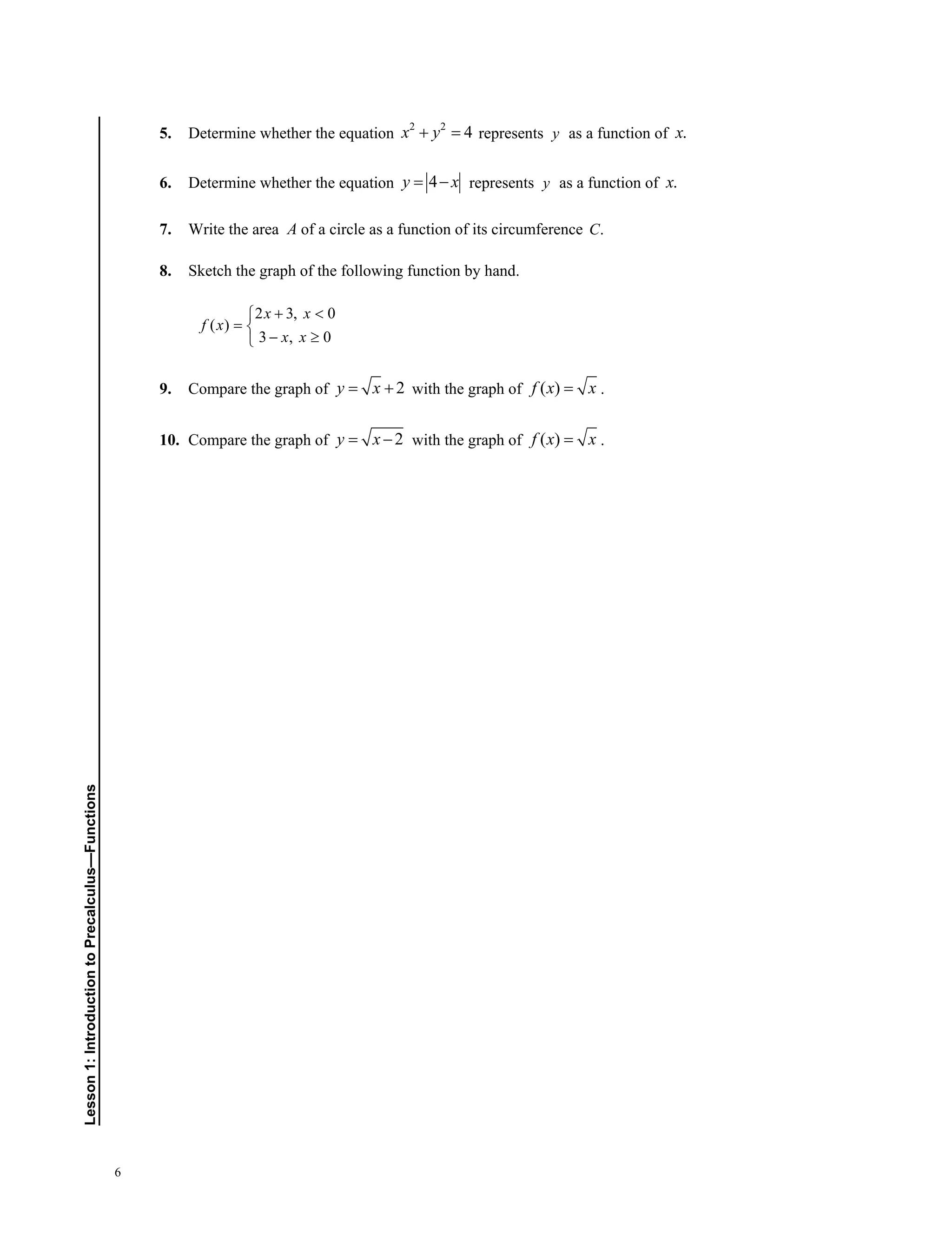
5. Determine whether the equation
2 2
4x y  represents y as a function of .x
6. Determine whether the equation 4y x  represents y as a function of .x
7. Write the area A of a circle as a function of its circumference .C
8. Sketch the graph of the following function by hand.
2 3, 0
( )
3 , 0
x x
f x
x x
 
 
 
9. Compare the graph of 2y x  with the graph of ( )f x x .
10. Compare the graph of 2y x  with the graph of ( )f x x .
7
Polynomial Functions and Zeros
Lesson 2
Topics
 Polynomial functions.
 Linear and quadratic functions.
 Zeros or roots of functions.
 The quadratic formula.
 Even and odd functions.
 The intermediate value theorem.
Definitions and Properties
 Let n be a nonnegative integer and let 1 2 1 0, , , , ,n na a a a a  be real numbers with 0.na  The
function given by
1 2
1 2 1 0( ) n n
n nf x a x a x a x a x a
      is called a polynomial function in x of
degree ,n where na is the leading coefficient.
 A linear polynomial has the form 1 0( )f x a x a  or .y mx b 
 A quadratic polynomial, or parabola, has the form
2
( ) , 0.f x ax bx c a   
 A zero, or root, of a function ( )y f x is a number a such that ( ) 0.f a 
 A function is even if ( ) ( ).f x f x  A function is odd if ( ) ( ).f x f x 
Theorem and Formula
 The zeros of a quadratic function are given by the quadratic formula:
2
4
2
b b ac
x
a
  
 .
 The intermediate value theorem says that if a and b are real numbers, ,a b and if f is a
polynomial function such that ( ) ( ),f a f b then in the interval  , ,a b f takes on every value between
( )f a and ( ).f b In particular, if ( )f a and ( )f b have opposite signs, then f has a zero in the
interval  , .a b
8
Lesson2:PolynomialFunctionsandZeros
Summary
In this lesson, we study polynomial functions. The domain of a polynomial function consists of all real numbers
and the graph is a smooth curve without any breaks or sharp corners. The graph of a polynomial function of
degree 0 or 1 is a line of the form ,y mx b  with slope m and y-intercept .b
Example 1: The Graph of a Linear Polynomial
Sketch the graph of the first degree polynomial ( ) 3 5.f x x 
Solution
The slope is 3, and the graph intercepts the y-axis at  0, 5 . Plotting some more points, you obtain the graph
shown in figure 2.1.
Figure 2.1
Example 2: Using the Quadratic Formula
Find the zeros of the quadratic polynomial
2
( ) 2 3.f x x x  
9
Solution
We use the quadratic formula with 2, 1,a b  and 3.c  
 2
2 1 1 4(2)( 3)4 1 25 1 5
2 2(2) 4 4
b b ac
x
a
         
   
Thus, there are 2 zeros:
1 5
1
4
x
 
  and
1 5 3
4 2
x
 
   .
If you graph this polynomial, you will see that the curve is a parabola that intersects the horizontal axis at 2
points, 1 and 3 .
2
 However, if you apply the quadratic formula to the polynomial 2 13
( ) 2
4
f x x x   , you
obtain an expression involving the square root of a negative number. In that case, there are no real zeros.
Example 3: Locating Zeros
Use the intermediate value theorem to locate a zero of the function
4 3
( ) 3 4 3.f x x x  
Solution
Notice that (0) 3f   and (1) 4.f  Therefore, there is a sign change on the interval  0, 1 . According to the
intermediate value theorem, f must have a zero in this interval. Using a graphing utility (as shown in figure
2.2), you will see that the zero is approximately 0.779. In fact, there is a second zero, approximately 1.585.
10
Lesson2:PolynomialFunctionsandZeros
Figure 2.2
Study Tips
 Parallel lines have the same slope. The slopes of perpendicular lines are negative reciprocals of
each other.
 The equation of a horizontal line is y = c, a constant. The equation of a vertical line is x = c.
 The real zeros of a function correspond to the points where the graph intersects the x-axis.
 Quadratic polynomials are often analyzed by completing the square.
Pitfalls
 If the quadratic formula yields the square root of a negative number, then the quadratic polynomial
has no real roots.
 Finding the zeros of polynomials often requires factoring, which can be difficult.
1. Find the slope and y-intercept of the line 5 3 0x y  . Then sketch the line by hand.
2. Find an equation of the line with slope 3m  and passing through the point  0, 2 .
3. Find the slope-intercept form of the line that passes through the points  5, 1 and  5, 5 .
4. Use factoring to solve the quadratic equation 2
4 12x x  .
Problems
11
5. Use the quadratic formula to solve the equation 2
2 2 0.x x  
6. Solve the quadratic equation 2
4 32 0x x  by completing the square.
7. Find 2 quadratic equations having the solutions −6 and 5.
8. Find a polynomial function that has zeros 4, −3, 3, 0.
9. Use the intermediate value theorem and a graphing utility to find any intervals of length 1 in which the
polynomial function
3 2
( ) 3 3f x x x   is guaranteed to have a zero. Then use the zero or root feature
of the graphing utility to approximate the real zeros of the function.
10. Find all solutions of the equation 3 2
5 30 45 0.x x x  
11. Find all solutions of the equation 4 2
4 3 0.x x  
12. Find 2 positive real numbers whose product is a maximum if the sum of the first number and twice the
second number is 24.
12
Lesson3:ComplexNumbers
Complex Numbers
Lesson 3
Topics
• The imaginary unit .i
• The set of complex numbers.
• Complex conjugates.
• Sums, products, and quotients of complex numbers.
• The fundamental theorem of algebra.
• Graphing complex numbers in the complex plane.
• Fractals and the Mandelbrot set.
Definitions and Properties
• The imaginary unit i is 1.− In other words, 2
1.i = −
• A set of complex numbers, or imaginary numbers, consists of all numbers of the form ,a bi+ where
a and b are real numbers.
• The standard form of a complex number is a bi+ . If 0,b = then the number is real.
• The complex conjugate of a bi+ is .a bi−
• In the complex plane, the horizontal axis is the real axis and the vertical axis is the imaginary axis. A
complex number a bi+ has coordinates ( ), .a b
• A complex number c is contained in the Mandelbrot set if and only if the following sequence is
bounded: ( ) ( )( )
22 22 2 2
, , , , .c c c c c c c c c c+ + + + + + 
Theorem
• The fundamental theorem of algebra says that if f is a polynomial of degree , 0,n n  then f has
precisely n linear factors: ( )( ) ( )1 2( ) ,n nf x a x c x c x c= − − − where 1 2, , nc c c are complex
numbers.
Summary
In this lesson, we look at an extension of real numbers, called the set of complex numbers. Using complex
numbers and the quadratic formula, we can now find the zeros of any quadratic polynomial.
13
Example 1: Using the Quadratic Formula
Find the zeros of the quadratic polynomial 2 13
( ) 2 .
4
f x x x  
Solution
We use the quadratic formula as follows.
 
2
2
13
( 2) 2 4(1)
44 2 9
2 2(1) 2
2 3 1 2 3 3
1
2 2 2
b b ac
x
a
i
i
 
      
     
  
  
   
Thus, there are 2 complex zeros:
3
1
2
x i  and
3
1 .
2
x i 
Addition and multiplication of complex numbers are straightforward, as long as you replace 2
i with 1.
Example 2: Operations with Complex Numbers
The fundamental theorem of algebra states that in theory, all polynomials can be factored into linear factors.
The zeros could be real or complex, and even repeated.
 
   
  
2
2
9 3 1 3 1 3
7 3 7 3 14
2 4 3 8 6 4 3 11 2
i
i i
i i i i i i
     
   
       
Example 3: Factoring Polynomials over the Complex Numbers
Factor the polynomial
4 2
( ) 20.f x x x  
14
Lesson3:ComplexNumbers
Solution
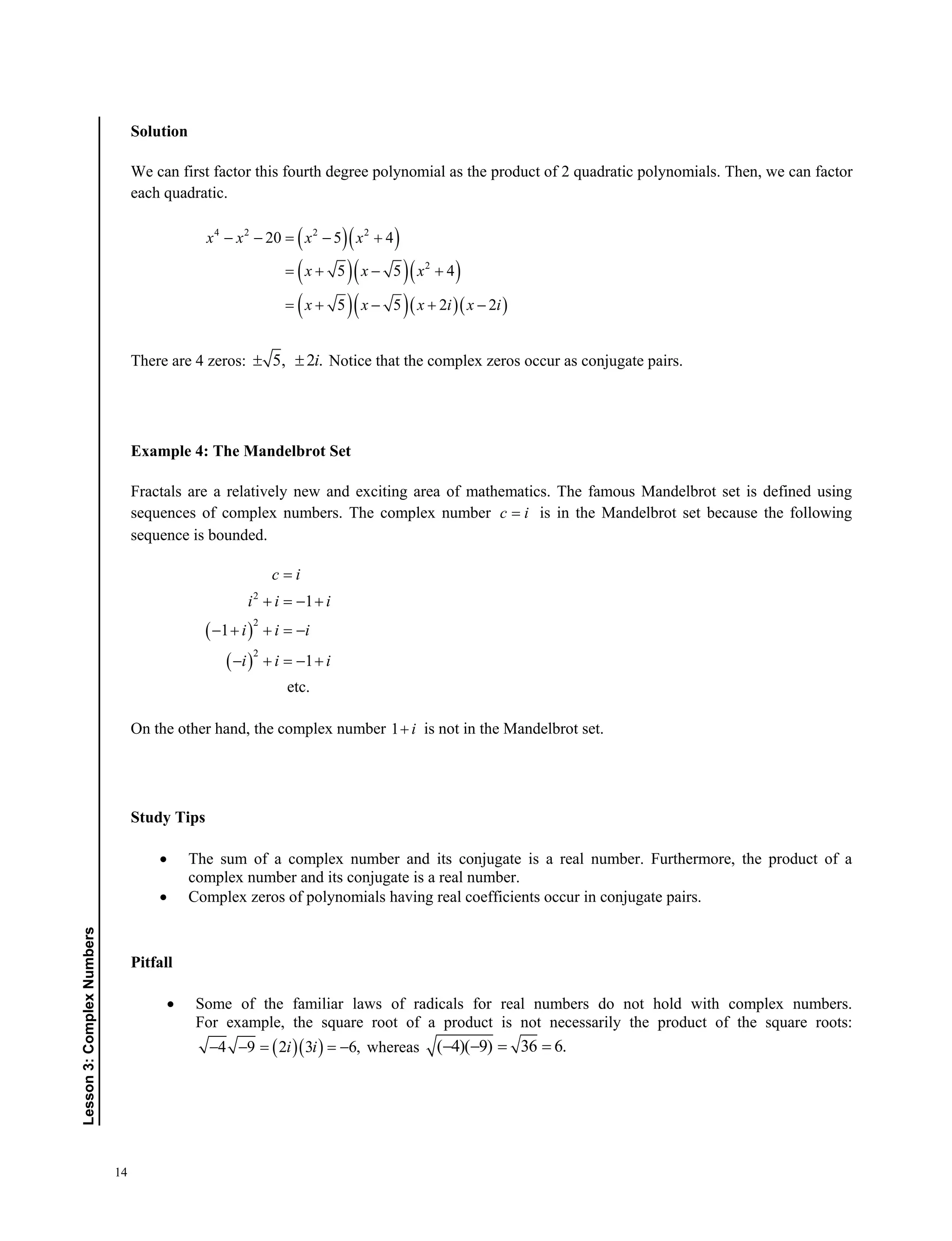
We can first factor this fourth degree polynomial as the product of 2 quadratic polynomials. Then, we can factor
each quadratic.
  
   
    
4 2 2 2
2
20 5 4
5 5 4
5 5 2 2
x x x x
x x x
x x x i x i
    
  
   
There are 4 zeros: 5, 2 .i  Notice that the complex zeros occur as conjugate pairs.
Example 4: The Mandelbrot Set
Fractals are a relatively new and exciting area of mathematics. The famous Mandelbrot set is defined using
sequences of complex numbers. The complex number c i is in the Mandelbrot set because the following
sequence is bounded.
 
 
2
2
2
1
1
1
etc.
c i
i i i
i i i
i i i

  
   
   
On the other hand, the complex number 1 i is not in the Mandelbrot set.
Study Tips
 The sum of a complex number and its conjugate is a real number. Furthermore, the product of a
complex number and its conjugate is a real number.
 Complex zeros of polynomials having real coefficients occur in conjugate pairs.
Pitfall
 Some of the familiar laws of radicals for real numbers do not hold with complex numbers.
For example, the square root of a product is not necessarily the product of the square roots:
  4 9 2 3 6,i i    whereas ( 4)( 9) 36 6.   
15
1. Simplify 13 (14 7 ).i i− −
2. Simplify 6 2.− −
3. Simplify ( )1 (3 2 ).i i+ −
4. Simplify ( )4 8 5 .i i+
5. Write the complex conjugate of the complex number 4 3 ,i+ then multiply by its complex conjugate.
6. Write the complex conjugate of the complex number 3 2,− − then multiply by its complex conjugate.
7. Write the quotient in standard form:
2
4 5i−
.
8. Find all zeros of the function
2
( ) 12 26,f x x x= − + and write the polynomial as a product of linear
factors.
9. Find all zeros of the function
4 2
( ) 10 9,f x x x= + + and write the polynomial as a product of linear
factors.
10. Find a polynomial function with real coefficients that has zeros 2, 2, 4 .i−
11. For
1
2
c i= , find the first 4 terms of the sequence given by
( ) ( )
22 2
2 2 2
, , , , .c c c c c c c c c c + + + + + +
  

From the terms, do you think the number is in the Mandelbrot set?
Problems
16
Lesson4:RationalFunctions
Rational Functions
Lesson 4
Topics
 Rational functions.
 Horizontal and vertical asymptotes.
Definitions and Properties
 A rational function can be written in the form
( )
( ) ,
( )
N x
f x
D x
 where ( )N x and ( )D x are polynomials.
 The domain of a rational function consists of all values of x such that the denominator is not zero.
 The vertical line x a is a vertical asymptote of the graph of f if ( )f x   or ( )f x   as
,x a either from the right or from the left.
 The horizontal line y b is a horizontal asymptote of the graph of f if ( )f x b as x  or
.x  
Test for Horizontal Asympotes
Let
( )
( )
( )
N x
f x
D x
 be a rational function.
 If the degree of the numerator is less than the degree of the denominator, then y = 0 is a
horizontal asymptote.
 If the degree of the numerator equals the degree of the denominator, then the horizontal asymptote is
the ratio of the leading coefficients.
 If the degree of the numerator is greater than the degree of the denominator, then there is no
horizontal asymptote.
Summary
In this lesson, we look at a class of functions called rational functions, which are quotients of polynomials.
Many rational functions have vertical and/or horizontal asymptotes.
17
Example 1: Finding Asymptotes
Find the vertical and horizontal asymptotes of the graph of the rational function
2
2
2
( ) .
1
x
f x
x


Solution
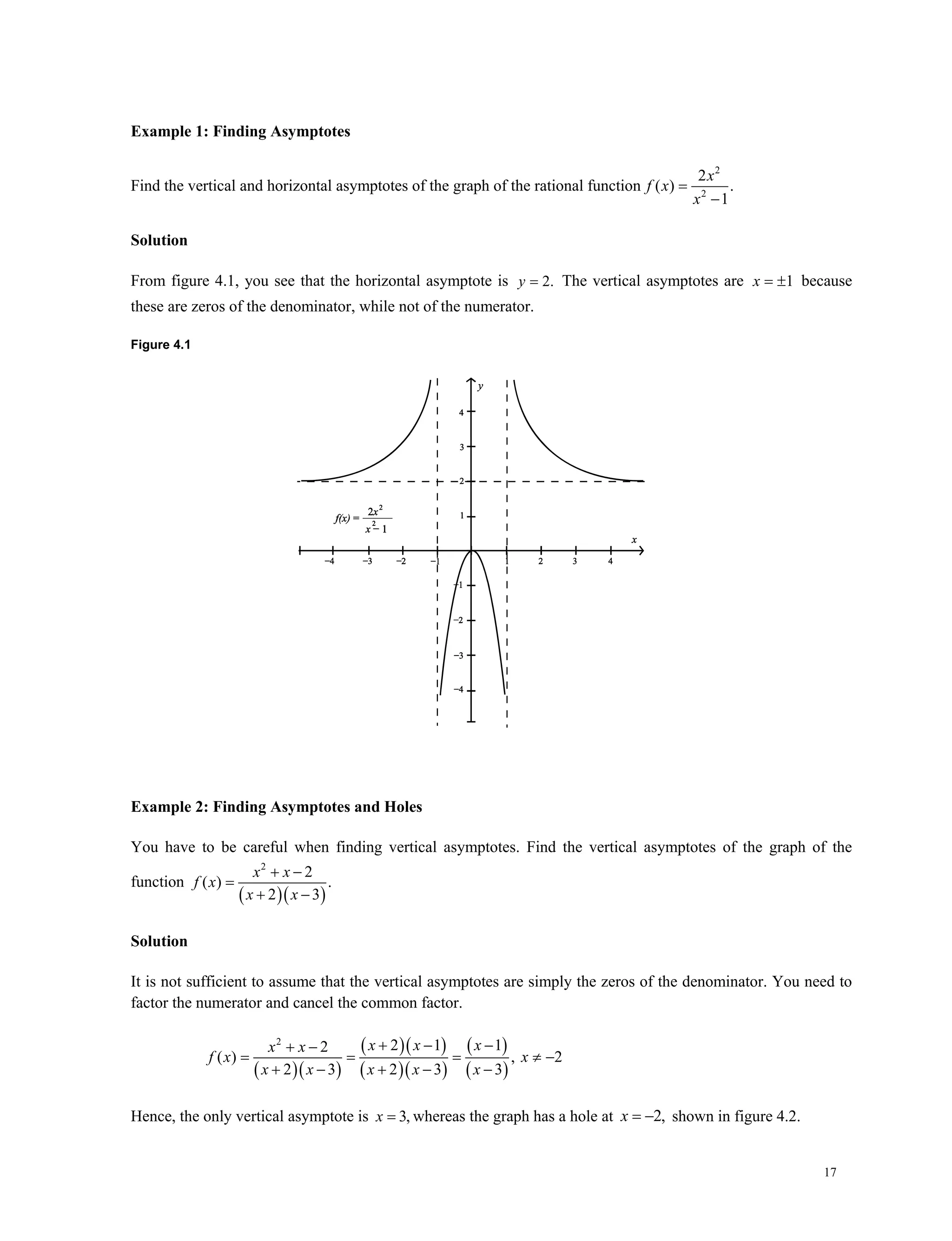
From figure 4.1, you see that the horizontal asymptote is 2.y  The vertical asymptotes are 1x   because
these are zeros of the denominator, while not of the numerator.
Figure 4.1
Example 2: Finding Asymptotes and Holes
You have to be careful when finding vertical asymptotes. Find the vertical asymptotes of the graph of the
function
  
2
2
( ) .
2 3
x x
f x
x x
 

 
Solution
It is not sufficient to assume that the vertical asymptotes are simply the zeros of the denominator. You need to
factor the numerator and cancel the common factor.
  
  
  
 
 
2
2 1 12
( ) , 2
2 3 2 3 3
x x xx x
f x x
x x x x x
   
    
    
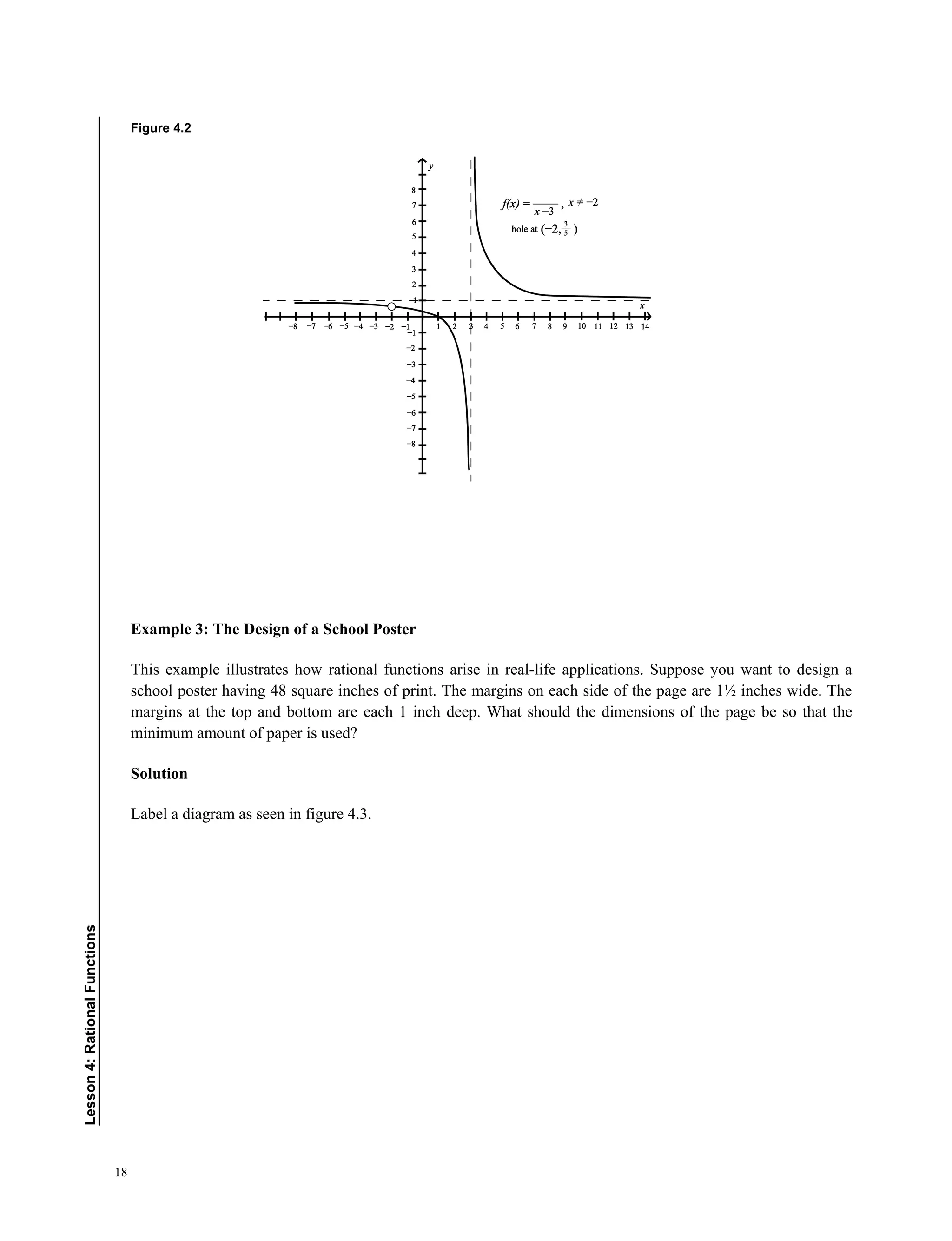
Hence, the only vertical asymptote is 3,x  whereas the graph has a hole at 2,x   shown in figure 4.2.
18
Lesson4:RationalFunctions
Figure 4.2
Example 3: The Design of a School Poster
This example illustrates how rational functions arise in real-life applications. Suppose you want to design a
school poster having 48 square inches of print. The margins on each side of the page are 1½ inches wide. The
margins at the top and bottom are each 1 inch deep. What should the dimensions of the page be so that the
minimum amount of paper is used?
Solution
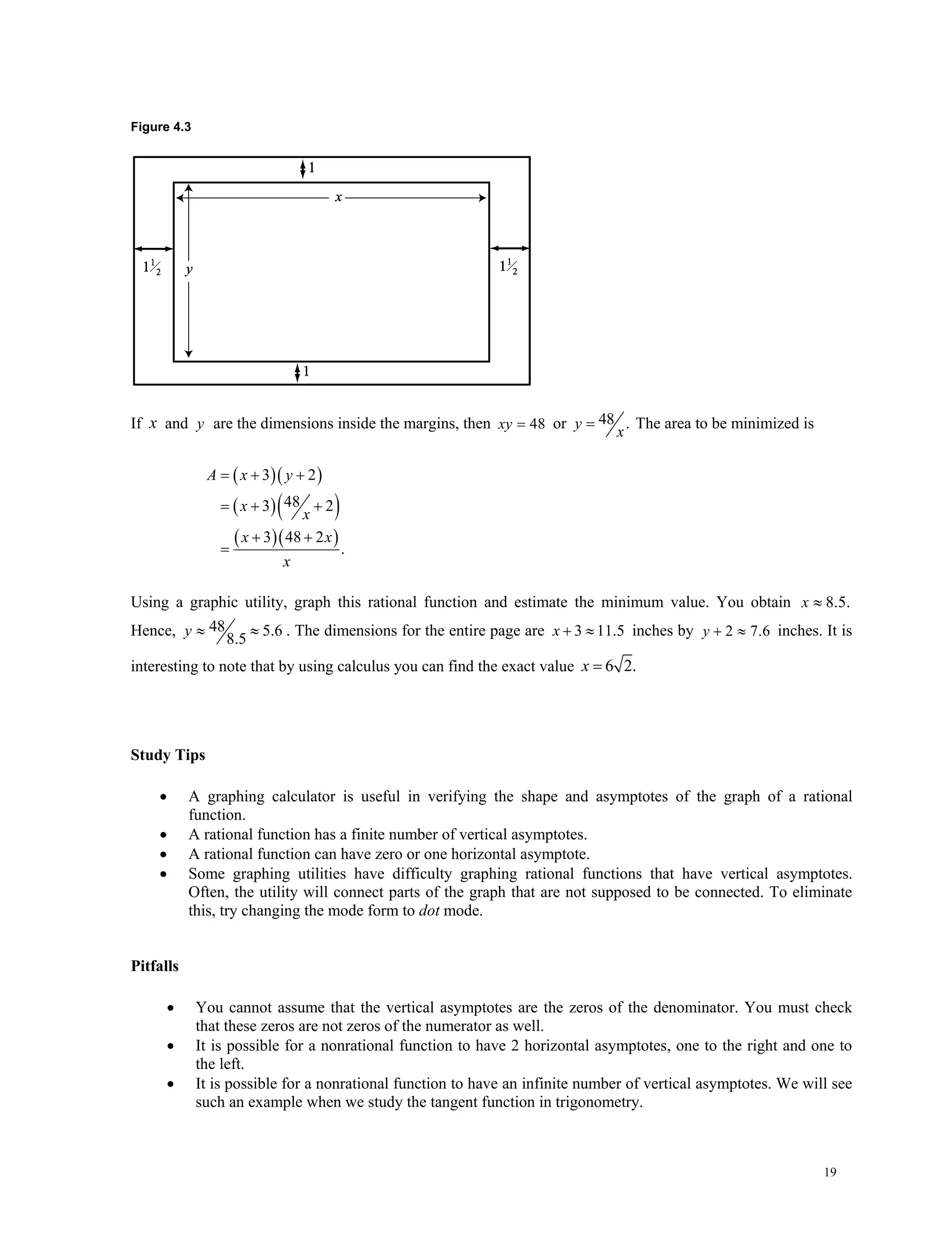
Label a diagram as seen in figure 4.3.
19
Figure 4.3
If x and y are the dimensions inside the margins, then 48xy  or 48 .y
x
 The area to be minimized is
  
  
  
3 2
483 2
3 48 2
.
A x y
x
x
x x
x
  
 
 

Using a graphic utility, graph this rational function and estimate the minimum value. You obtain 8.5.x 
Hence, 48 5.6
8.5
y   . The dimensions for the entire page are 3 11.5x   inches by 2 7.6y   inches. It is
interesting to note that by using calculus you can find the exact value 6 2.x 
Study Tips
 A graphing calculator is useful in verifying the shape and asymptotes of the graph of a rational
function.
 A rational function has a finite number of vertical asymptotes.
 A rational function can have zero or one horizontal asymptote.
 Some graphing utilities have difficulty graphing rational functions that have vertical asymptotes.
Often, the utility will connect parts of the graph that are not supposed to be connected. To eliminate
this, try changing the mode form to dot mode.
Pitfalls
 You cannot assume that the vertical asymptotes are the zeros of the denominator. You must check
that these zeros are not zeros of the numerator as well.
 It is possible for a nonrational function to have 2 horizontal asymptotes, one to the right and one to
the left.
 It is possible for a nonrational function to have an infinite number of vertical asymptotes. We will see
such an example when we study the tangent function in trigonometry.
20
Lesson4:RationalFunctions
1. Sketch the graph of the following rational function, indicating any intercepts and asymptotes.
a.
1
( )
2
f x
x


b.
1
( )
6
f x
x


c.
2
2
( )
4
x
f x
x


d.
2
2
3
( )
6
x x
f x
x x


 
2. Identify any horizontal and vertical asymptotes of the following functions
a.
2
1
( ) .f x
x

b.
2
2
25
( ) .
5
x
f x
x x



3. Find the zeros of the rational function
2
4
( )
3
x
f x
x



.
4. Write a rational function f having a vertical asymptote 2,x  a horizontal asymptote 0,y  and a
zero at 1.x 
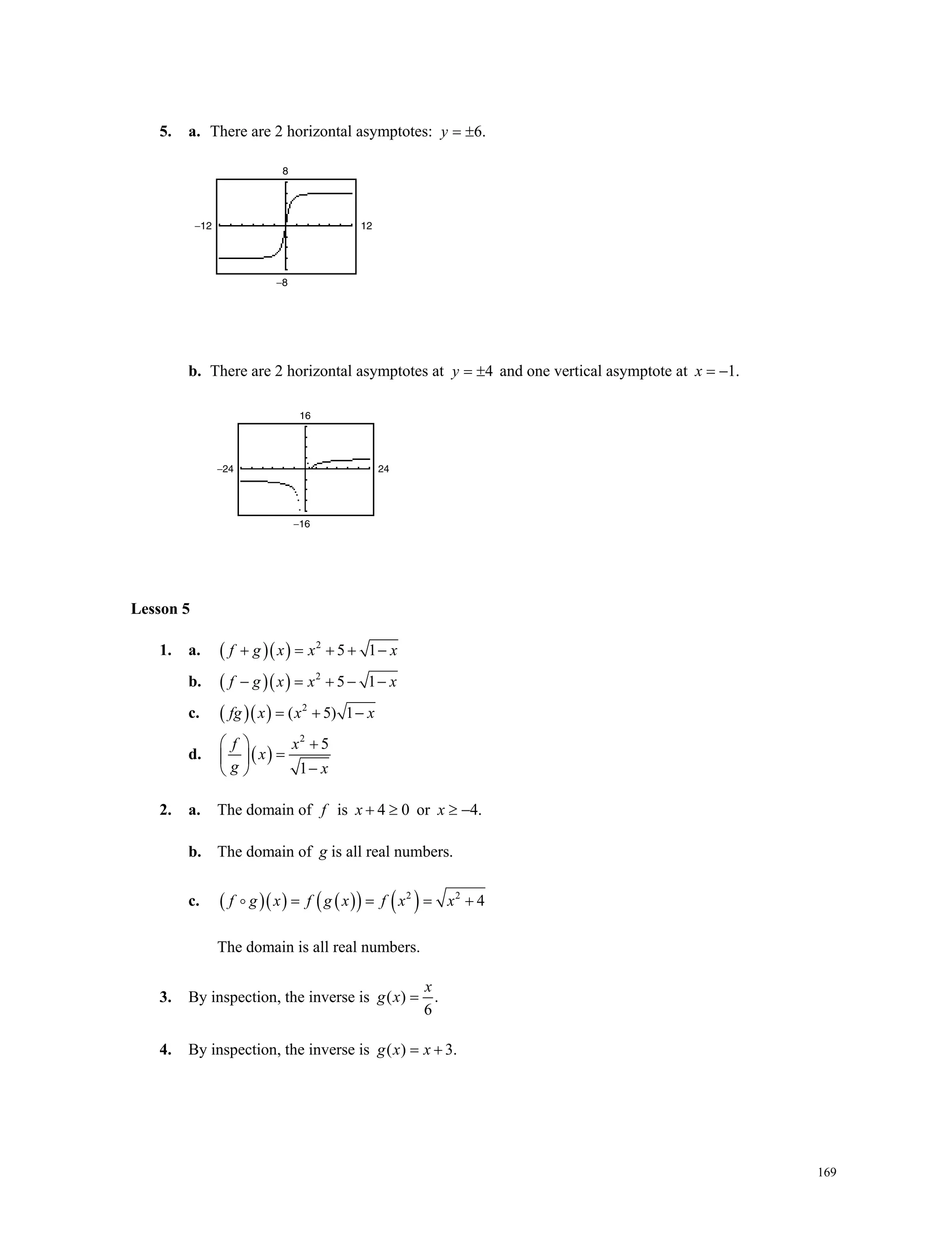
5. Using a graphing utility, graph the following functions and indicate any asymptotes.
a.
2
6
( )
1
x
h x
x


b.
4 2
( )
1
x
g x
x



Problems
21
Inverse Functions
Lesson 5
Topics
• Combinations of functions.
• Inverse functions.
• Graphs of inverse functions.
• One-to-one functions and the horizontal line test.
• Finding inverse functions.
Definitions and Properties
• Addition and multiplication of functions is defined by:
( )( ) ( ) ( )
( )( ) ( ) ( ).
f g x f x g x
fg x f x g x
+ = +
=
• The composition of 2 functions is defined by ( )( ) ( ( )).f g x f g x=
• Let f and g be 2 functions such that ( ( ))f g x x= for all x in the domain of ,g and ( ( ))g f x x= for
all x in the domain of .f Then g is the inverse of ,f denoted
1
.f −
• If a function has an inverse, then the inverse is unique. If f is the inverse of ,g then g is the inverse
of .f The domain of f is the range of ,g and the domain of g is the range of .f
• The graphs of inverse functions are symmetric across the line .y x=
• A function is one-to-one if, for a and b in the domain, ( ) ( )f a f b= implies .a b= A function has an
inverse if and only if it is one-to-one.
• A function is one-to-one if its graph passes the horizontal line test: Every horizontal line intersects the
graph at most once.
Summary
You can combine functions in many ways, including addition, multiplication, and composition. In particular,
inverse functions, such as ( ) 5f x x= and ( ) ,
5
x
g x = satisfy ( )( )f g x x= and ( )( ) .g f x x=
22
Lesson5:InverseFunctions
Example 1: Verifying Inverse Functions Algebraically
The functions
3
( ) 2 1f x x  and 3
1
( )
2
x
g x

 are inverses of each other because
 
3
3 3
1 1 1
( ) 2 1 2 1 ( 1) 1 ,
2 2 2
x x x
f g x f x x
      
                     
and similarly, ( ( )) .g f x x Notice that the graph of g is a reflection of the graph of f in the line y x
(figure 5.1).
Figure 5.1
Example 2: Finding Inverse Functions
If a function is one-to-one, then it has an inverse. To illustrate a technique for finding the inverse function, find
the inverse function of ( ) 1.f x x 
23
Solution
Begin with the equation 1,y x  interchange the roles of x and ,y and solve for .y
 
 
2
21
1, 0, 1
1
1
1 , 1, 0
( ) 1 , 1, 0
y x x y
x y
x y
y x x y
f x x x y
   
 
 
   
   
Notice how the domains and ranges have been interchanged.
Example 3: Temperature Scales
Inverse relationships can arise in applications. The Fahrenheit (F) and Celsius (C) temperature scales are related
by 2 equivalent formulas:
9
F C 32
5
  and  
5
C F 32 .
9
  If the temperature is C = 35° on the Celsius scale,
then the corresponding Fahrenheit temperature is  
9
F 35 32 63 32 95 .
5
     
Study Tips
 Inverse functions satisfy the equations  1
( )f f x x
 and  1
( ) .f f x x

 Graphically, if  ,a b is a point on the graph of the function ,f then  ,b a is on the graph of the
inverse.
Pitfalls
 The notation for an inverse function can be misleading.
1
f 
does not mean the reciprocal of ,f
1
f
.
 A function must be one-to-one in order to have an inverse. For example, the function
2
( )f x x does
not have an inverse because the parabola does not pass the horizontal line test. However, if you restrict
the domain to 0,x  then the inverse exists:
1
( ) .f x x

 In general, the composition of functions is not commutative. That is, in general,    .f g g f 
24
Lesson5:InverseFunctions
1. Let
2
( ) 5 and ( ) 1 .f x x g x x  Find the following.
a. (f + g)(x)
b. (f – g)(x)
c. (fg)(x)
d. ( )
f
x
g
 
 
 
2. Let
2
( ) 4 and ( ) .f x x g x x Determine the domains of the following.
a. f
b. g
c. f g
3. Find the inverse of the function ( ) 6 .f x x
4. Find the inverse of the function ( ) 3.f x x 
5. Show that the functions
3
( ) 5f x x  and 3
( ) 5g x x  are inverses of each other.
6. Determine whether the function 2
1
( )f x
x
 is one-to-one.
7. Determine whether the function ( ) 2 3f x x  is one-to-one.
Problems
25
8. Find the inverse function of ( ) 2 3.f x x  Describe the relationship between the graphs of f and
its inverse.
9. Find the inverse function of 2
( ) 4 , 0 2.f x x x    Describe the relationship between the graphs
of f and its inverse.
10. Restrict the domain of the function ( ) 2f x x  so that the function is one-to-one and has an inverse.
Then find the inverse function
1
f 
. State the domains and ranges of f and
1
.f 
26
Lesson6:SolvingInequalities
solving Inequalities
Lesson 6
Topics
 Interval notation.
 Properties of inequalities.
 Inequalities involving absolute values.
Interval Notation
 Closed interval  ,a b means .a x b 
 Open interval  ,a b means .a x b 
 Infinite interval  ,a  means .x a
 Infinite interval  , b means .x b
Properties of Inequalities
 a b and b c implies a c (transitivity).
 a b and c d implies .a c b d  
 a b implies .a c b c  
 a b and 0c  implies .ac bc
 a b and 0c  implies .ac bc
 Let 0.a  Then
o x a if and only if .a x a  
o x a if and only if x a  or .x a
Summary
We have already used inequalities throughout these lessons, especially when studying domains of functions. We
see how the properties of inequalities are used in solving the following examples.
27
Example 1: Solving an Inequality
Solve the inequality
3
1 4.
2
x x  
Solution
Notice how the inequality is reversed when you divide by 5.
3
1 4
2
2 3 2 8
2 5 8
5 10
10
5
2
x x
x x
x
x
x
x
  
  
  
  




Example 2: Solving an Inequality Involving Absolute Values
Inequalities involving absolute values occur frequently in calculus. Solve the inequality 5 2.x 
Solution
5 2
2 5 2
3 7
x
x
x
 
   
 
The solution consists of all real numbers in the closed interval  3, 7 . If the problem had asked for the solution
to 5 2,x  then the solution set would be all numbers less than 3 or greater than 7    , 3 7, .  
Example 3: An Application of Inequalities
Inequalities can arise in applications. If a student has scored 68 and 77 on 2 tests, what must the student score
on the third test to bring the average up to 80?
28
Lesson6:SolvingInequalities
Solution
Let x be the score on the third test. The average of the 3 scores must be greater than or equal to 80.
68 77
80
3
145 3(80) 240
240 145 95
x
x
x
 

  
  
The student needs at least a score of 95 on the third test.
Study Tips
 The set theory expression A B means the set of all numbers in the set A together with all the
numbers in the set .B The symbol is called the union symbol.
 The set theory expression A B means all numbers that are contained in both sets A and .B The
symbol ∩ is called the intersection symbol.
 The set of all real numbers can be expressed as  , . 
 The horizontal line over an answer indicates a recurring number: 0.9 0.9999999... .
Pitfalls
 Infinity   is not a number. You should not write infinite intervals using a bracket next to the infinity
symbol. That is, write  4,  not  4,  .
 If you multiply or divide both sides of an inequality by a negative number, you must reverse the
inequality.
 It is incorrect to write an inequality in the form 7 3x  . There are no values of x that are greater
than 7 and also less than 3.
1. Find the domain of the following functions.
a. ( ) 5.f x x 
b. 2
( ) 4.f x x 
2. Solve the following inequalities.
Problems
29
a. 10 40.x 
b. 4( 1) 2 3.x x  
c.  8 1 3 2 13.x    
d.
3
0 5.
2
x 
 
e. 7 6.x 
f. 14 3 17.x  
3. Determine the intervals on which the polynomial 2
4 5x x  is entirely negative and those on which it
is entirely positive.
4. Use absolute value notation to describe the set of all real numbers that lie within 10 units of 7.
5. Use absolute value notation to describe the set of all real numbers that are at least 5 units from 3.
30
Lesson7:ExponentialFunctions
Exponential Functions
Lesson 7
Topics
 Exponential functions.
 Review of exponents.
 Graphs of exponential functions.
 The natural base e.
 The natural exponential function.
Definitions and Properties
 The exponential function f with base ( 0, 1)a a a  is defined ( ) ,x
f x a where x is any real
number.
 The domain of the exponential function is  , ,  and the range is  0, . The exponential
function is increasing if 0a  and decreasing if 0 1.a  The intercept is  0, 1 . The x-axis is the
horizontal asymptote.
 The exponential function is one-to-one and hence has an inverse (the logarithmic function, to be
defined in the next lesson).
 The natural base e 2.71828 is the most important base in calculus. The corresponding function
( ) x
f x e is called the natural exponential function.
Properties of Exponents
Let ,a b be real numbers and ,m n integers.
 m n m n
a a a 
 ,
m
m n
n
a
a
a



20 2 21
, 1 ( 0),n
n
a a a a a a
a

    
   ,
m m
m m m
m
a a
ab a b
b b
 
  
 
  
n
m mn
a a
31
Formulas for Compound Interest
After t years, the balance A in an account with principle P and annual interest rate r (in decimal form) is given
by the following.
 For n compounding per year: 1 .
nt
r
A P
n
 
  
 
 For continuous compounding: .rt
A Pe
Summary
In the next block of lessons, we define and explore exponential and logarithmic functions. The exponential
function is defined for all real numbers. You can graph an exponential function by plotting points or using a
graphing utility.
Example 1: The Graph of an Exponential Function
Graph the exponential function ( ) 2 .x
f x 
Solution
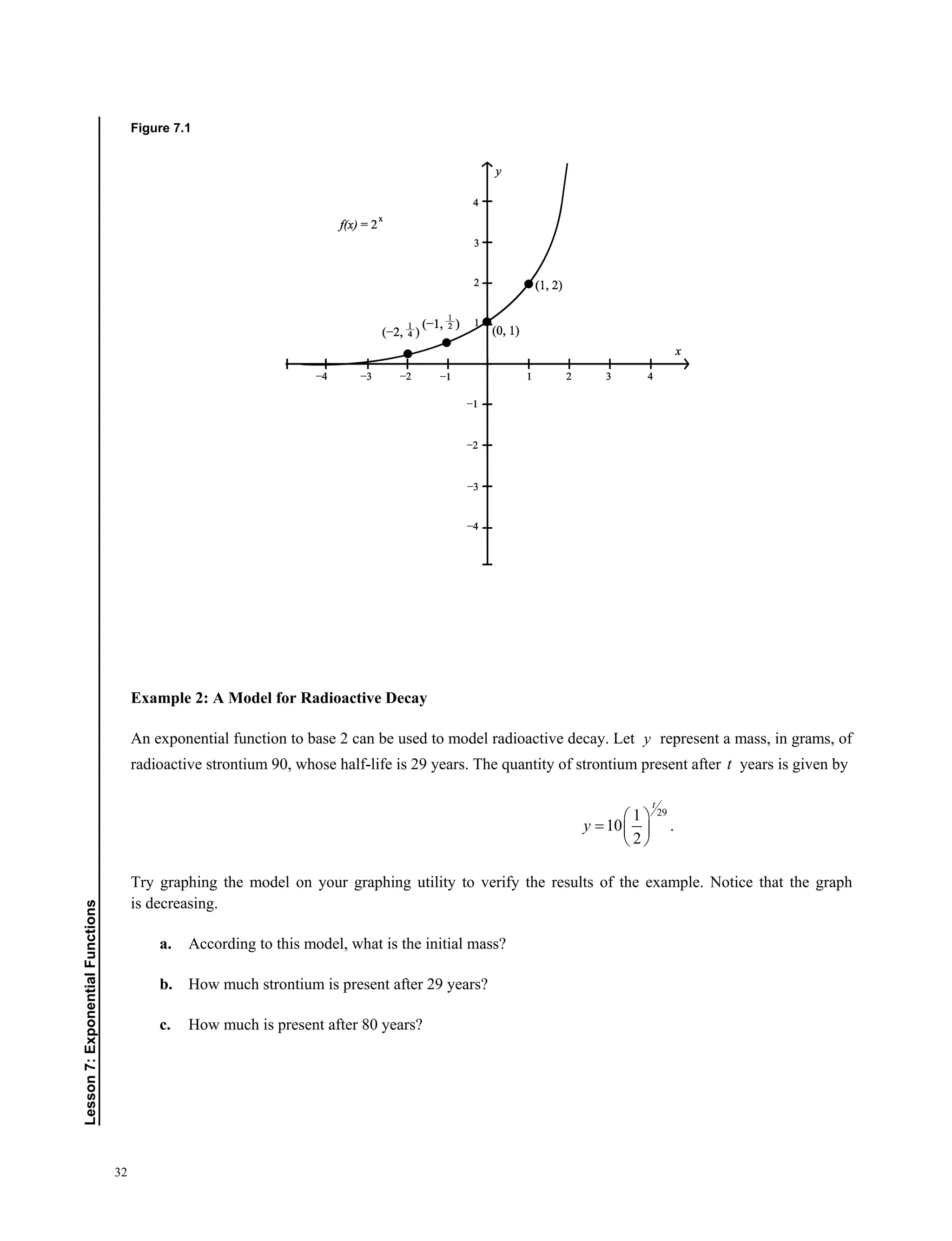
Plot the following ordered pairs and connect them with a smooth curve:
           1 13, 8 , 2, 4 , 1, 2 , 0, 1 , 1, , 2,
2 4
  . Note that the resulting graph is continuous and passes
the horizontal line test, see figure 7.1.
32
Lesson7:ExponentialFunctions
Figure 7.1
Example 2: A Model for Radioactive Decay
An exponential function to base 2 can be used to model radioactive decay. Let y represent a mass, in grams, of
radioactive strontium 90, whose half-life is 29 years. The quantity of strontium present after t years is given by
291
10 .
2
t
y
 
  
 
Try graphing the model on your graphing utility to verify the results of the example. Notice that the graph
is decreasing. 
a. According to this model, what is the initial mass?
b. How much strontium is present after 29 years?
c. How much is present after 80 years?
33
Solution
a. Letting 0,t  you see that the initial mass is
0 0
291 1
10 10 10(1) 10
2 2
y
   
      
   
grams.
b. Letting 29,t  you see that half the amount remains:
29 1
291 1
10 10 5
2 2
y
   
     
   
grams.
The solution to this part illustrates that the half-life is 29 years.
c. When 80,t  you need a calculator to obtain
80
291
10 1.48
2
y
 
  
 
grams.
Example 3: An Application to Compound Interest
We can apply exponential functions to compound interest. A total of $12,000 is invested at an annual interest
rate of 3%. Find the balance after 4 years if the interest is compounded
a. quarterly, and
b. continuously.
Solution
We use a calculator for both calculations.
a.
4(4)
.03
1 12,000 1 $13,523.91
4
nt
r
A P
n
   
       
   
b.
 0.03 4
12,000 $13,529.96rt
A Pe e  
Notice that the account has earned slightly more interest under continuous compounding.
Study Tips
 The base of the exponential function must be positive because x
a is undefined for certain negative
values of .x Similarly, the base cannot be 1 because ( ) 1 1x
f x   is a linear function.
34
Lesson7:ExponentialFunctions
• The number e can be defined as the limit as x tends to infinity of the expression
1
1 .
x
x
 
+ 
 
In calculus, this is written
1
lim 1 .
x
x
e
x→∞
 
+ = 
 
Pitfall
• The tower of exponents
cba means
cb
a
 
 
 
not ( )
cb
a .
1. Evaluate the expressions.
a.
2
4 (3)
b.
3
3(3 )
2. Evaluate the expressions.
a. 4
3
3−
b. ( )
5
24 2
−
−
3. Graph the following exponential functions by hand. Identify any asymptotes and intercepts, and
determine whether the graph of the function is increasing or decreasing.
a. ( ) 5x
f x =
b. ( ) 5 x
f x −
=
4. Use the graph of ( ) 3x
f x = to describe the transformation that yields the graph of
5
( ) 3 .x
g x −
=
5. Use the graph of ( ) 0.3x
f x = to describe the transformation that yields the graph of ( ) 0.3 5.x
g x =− +
6. Use a calculator to evaluate the function
4
( ) 50 x
f x e= for 0.02.x = Round your result to the
nearest thousandth.
Problems
35
7. Graph the following functions by hand. Identify any asymptotes and intercepts, and determine whether
the graph of the function is increasing or decreasing.
a. ( ) x
f x e−
=
b.
5
( ) 2 x
f x e −
= +
8. Determine the balance for $2500 invested at 2.5% interest if
a. interest is compounded annually,
b. interest is compounded daily, and
c. interest is compounded continuously.
36
Lesson8:LogarithmicFunctions
Logarithmic Functions
Lesson 8
Topics
 Logarithmic functions.
 Common logarithms and natural logarithms.
 Properties of logarithms.
 Graphs of logarithmic functions.
 The rule of 70.
Definitions and Properties
 The logarithmic function f with base ( 0, 1)a a a  is defined by logay x if and only if .y
x a
Logarithms to base 10 are called common logarithms.
 The domain of the logarithmic function is  0, , and the range is  , .  The logarithmic
function is increasing if 0a  and decreasing if 0 1.a  The intercept is  1, 0 . The y-axis is the
vertical asymptote.
 The logarithmic function is one-to-one, and the inverse is the exponential function.
 The graphs of the logarithmic and exponential functions (with the same base) are reflections of each
other across the line .y x
 The natural logarithmic function is the inverse of the natural exponential function: logey x if and
only if .y
x e The usual notation is ln .y x
The Rule of 70
The doubling time for a deposit earning r % interest compounded continuously is approximately
70
r
years.
Properties of Logarithms
 log 1 0a 
 log 1a a 
 log x
a a x
 loga x
a x
 If log log ,a ax y then .x y
37
Summary
The inverse of the one-to-one exponential function is the logarithmic function. You can calculate logarithms by
referring back to the corresponding exponential function.
Example 1: Calculating Logarithms
  2log 32 5 because 5
2 32.
  3log 1 0 because 0
3 1.
  4
1
log 2
2
 because
1
24 2.
  10log 1000 3 because 3
10 1000.
The graph of the logarithmic function logay x is a reflection of the graph of the exponential function
x
y a
about the line .y x It is easy to graph horizontal and vertical shifts of logarithmic functions.
Example 2: Graphing Logarithmic Functions
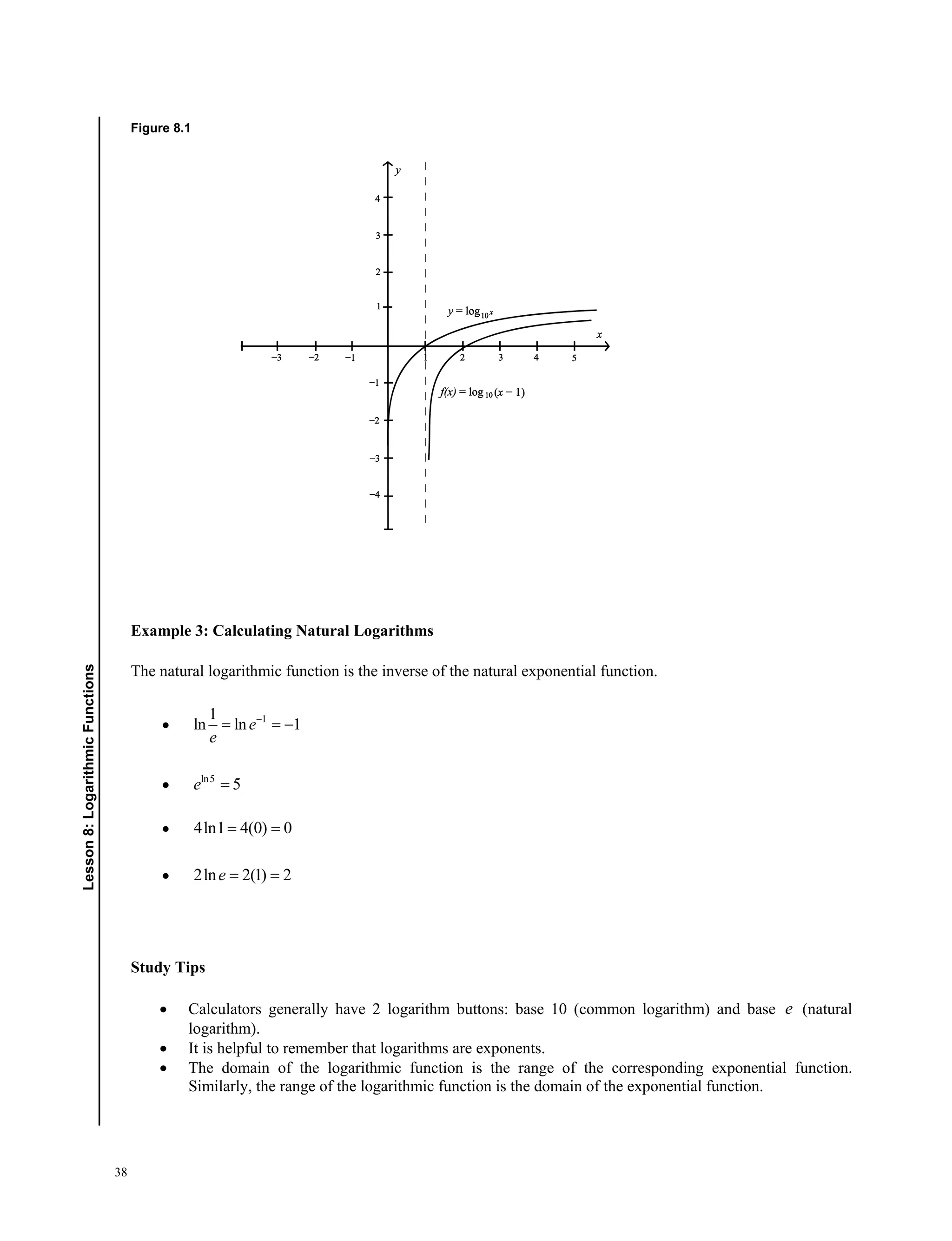
Graph and compare the functions 10( ) logg x x and  10( ) log 1 .f x x 
Solution
The graph of f is the graph of g shifted one unit to the right (figure 8.1). The intercept for f is  2, 0 , and
the vertical asymptote is 1.x 
38
 Lesson 8: Logarithmic FunctionsLesson8:LogarithmicFunctions
Figure 8.1
Example 3: Calculating Natural Logarithms
The natural logarithmic function is the inverse of the natural exponential function.
 11
ln ln 1e
e

  
 ln5
5e 
 4ln1 4(0) 0 
 2ln 2(1) 2e 
Study Tips
 Calculators generally have 2 logarithm buttons: base 10 (common logarithm) and base e (natural
logarithm).
 It is helpful to remember that logarithms are exponents.
 The domain of the logarithmic function is the range of the corresponding exponential function.
Similarly, the range of the logarithmic function is the domain of the exponential function.
39
Pitfall
 You cannot evaluate the logarithm of zero or a negative number.
1. Write the following logarithmic equations in exponential form.
a. 4log 64 3
b. 32
2
log 4
5

2. Evaluate the function 2( ) logf x x at 16.x 
3. Evaluate the function 10( ) logf x x at
1
1000
x  .
4. Use a calculator to evaluate 10log 345. Round your answer to 3 decimal places.
5. Use a calculator to evaluate ln 42. Round your answer to 3 decimal places.
6. Solve the equation for
2
6:log 6 .x x
7. Sketch the graph of ( ) 3 ,x
f x  and use the graph to sketch the graph of 3( ) log .g x x
8. Find the domain, vertical asymptote, and x-intercept of the following logarithmic functions. Then
sketch the graphs by hand.
a.  2( ) log 2f x x  .
b.  ( ) ln 1f x x  .
c.  ( ) lnf x x  .
Problems
40
Lesson9:PropertiesofLogarithms
Properties of Logarithms
Lesson 9
Topics
 The change of base formula.
 Logarithms of products, quotients, and powers.
 Applications of logarithms.
Theorems and Properties
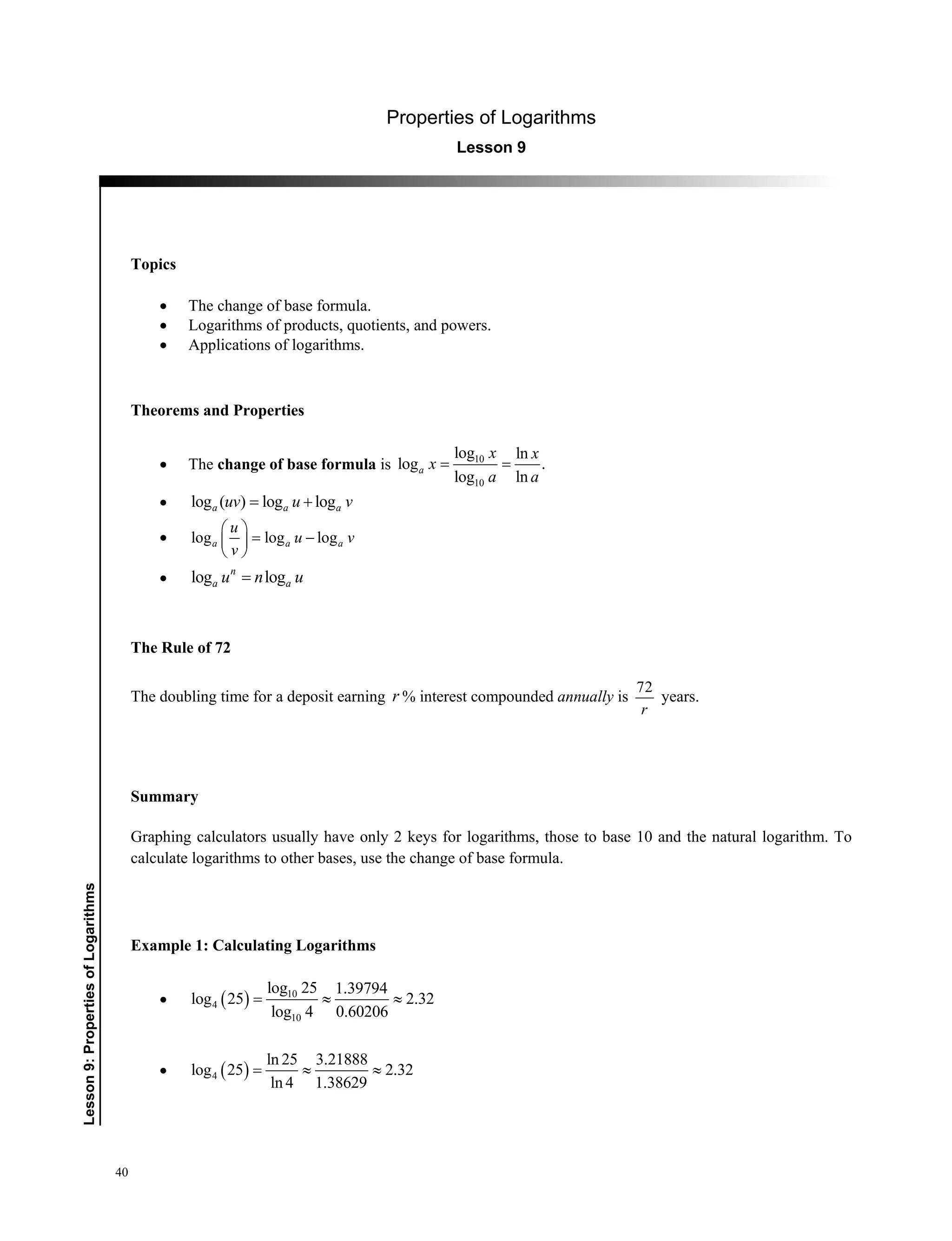
 The change of base formula is 10
10
log ln
log .
log ln
a
x x
x
a a
 
 log ( ) log loga a auv u v 
 log log loga a a
u
u v
v
 
  
 
 log logn
a au n u
The Rule of 72
The doubling time for a deposit earning r % interest compounded annually is
72
r
years.
Summary
Graphing calculators usually have only 2 keys for logarithms, those to base 10 and the natural logarithm. To
calculate logarithms to other bases, use the change of base formula.
Example 1: Calculating Logarithms
   10
4
10
log 25 1.39794
log 25 2.32
log 4 0.60206
  
  4
ln 25 3.21888
log 25 2.32
ln 4 1.38629
  
41
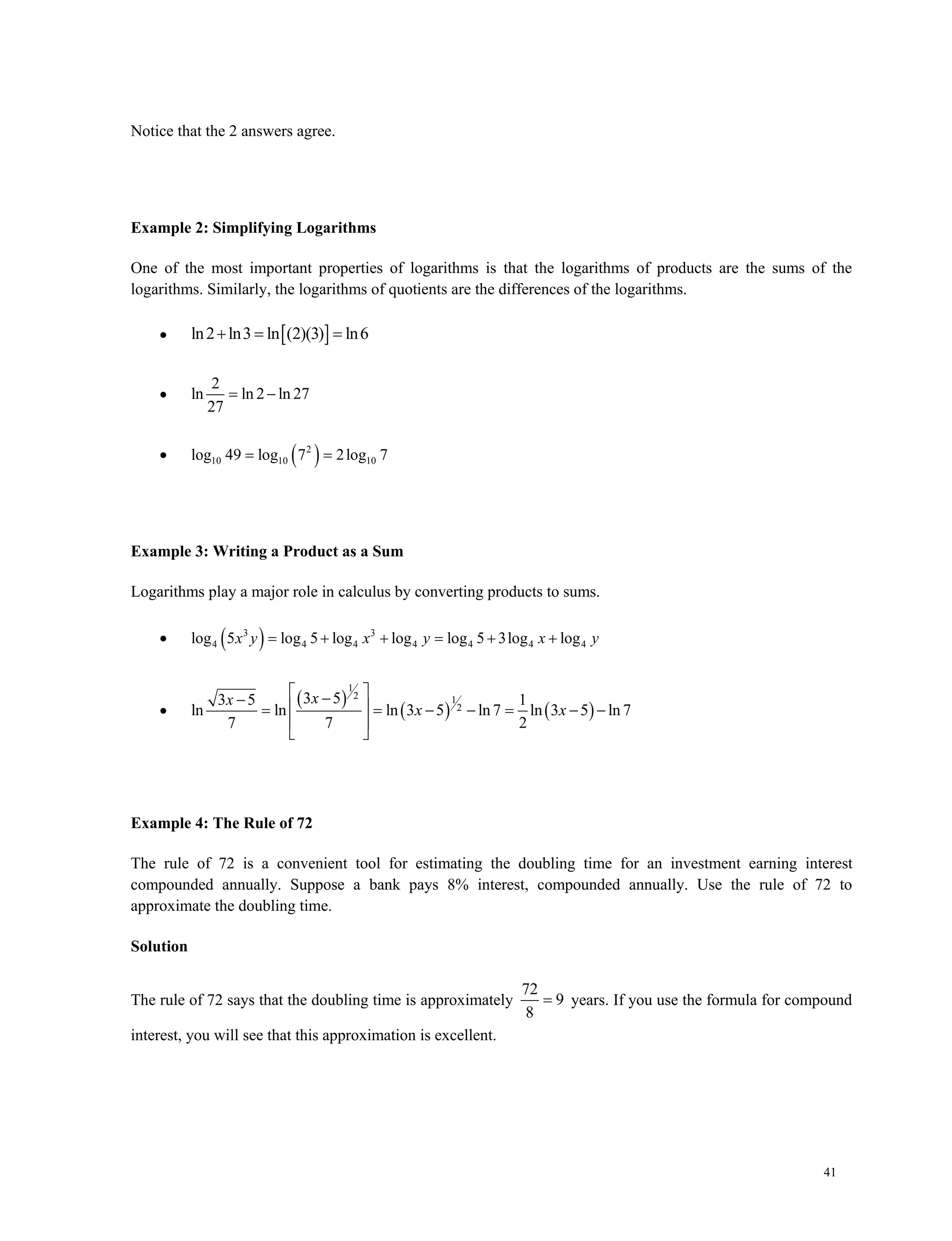
Notice that the 2 answers agree.
Example 2: Simplifying Logarithms
One of the most important properties of logarithms is that the logarithms of products are the sums of the
logarithms. Similarly, the logarithms of quotients are the differences of the logarithms.
  ln2 ln3 ln (2)(3) ln6 

2
ln ln 2 ln 27
27
 
  2
10 10 10log 49 log 7 2log 7 
Example 3: Writing a Product as a Sum
Logarithms play a major role in calculus by converting products to sums.
  3 3
4 4 4 4 4 4 4log 5 log 5 log log log 5 3log logx y x y x y     

 
   
1
2 1
2
3 53 5 1
ln ln ln 3 5 ln7 ln 3 5 ln 7
7 7 2
xx
x x
         
 
 
Example 4: The Rule of 72
The rule of 72 is a convenient tool for estimating the doubling time for an investment earning interest
compounded annually. Suppose a bank pays 8% interest, compounded annually. Use the rule of 72 to
approximate the doubling time.
Solution
The rule of 72 says that the doubling time is approximately
72
9
8
 years. If you use the formula for compound
interest, you will see that this approximation is excellent.
42
Lesson9:PropertiesofLogarithms
Study Tips
 Calculators generally have 2 buttons for logarithms: base 10 (common logarithm) and base e (natural
logarithm). Use the change of base formula for other bases.
 The rule of 72 is for compound interest, as contrasted with the rule of 70 for continuous compounding.
Pitfalls
 There is no formula for the logarithm of a sum or difference. In particular,
 log log log .a a au v u v  
 Be careful of domain changes when using properties of logarithms. For example, the domain of
2
lny x is all 0,x  whereas the domain of 2lny x is all 0.x 
 The notation for logarithms can be confusing. Note that  ln ln .
n
x n x
1. Evaluate the following logarithms using the change of base formula. Round your answer to 3 decimal
places.
a. 3log 7
b. 15log 1460
2. Rewrite the following expressions in terms of ln 4 and ln5.
a. ln 20
b.
5
ln
64
3. Use the properties of logarithms to rewrite and simplify the following logarithmic expressions
a. 4log 8.
b.  6
ln 5 .e
4. Use the properties of logarithms to expand the expression ln z as a sum, difference, and/or constant
multiple of logarithms.
Problems
43
5. Condense the expression ln 3ln( 1)x x  to the logarithm of a single quantity.
6. Find the exact value of 3log 9 without using a calculator.
7. Find the exact value of 3 7
ln lne e without using a calculator.
44
Lesson10:ExponentialandLogarithmicEquations
Exponential and Logarithmic Equations
Lesson 10
Topics
 Equations involving logarithms and exponents.
 Approximate solutions.
 Applications.
Summary
In this lesson, we solve a variety of equations involving logarithms and exponents.
Example 1: Solving an Exponential Equation
Solve the equation 2
4 3 2.x
e  
Solution
We use the properties of logarithms and exponents to solve for .x
2
2
2
2
4 3 2
4 5
5
4
5
ln ln
4
5
2 ln
4
1 5
ln 0.11
2 4
x
x
x
x
e
e
e
e
x
x
 


 
  
 
 
  
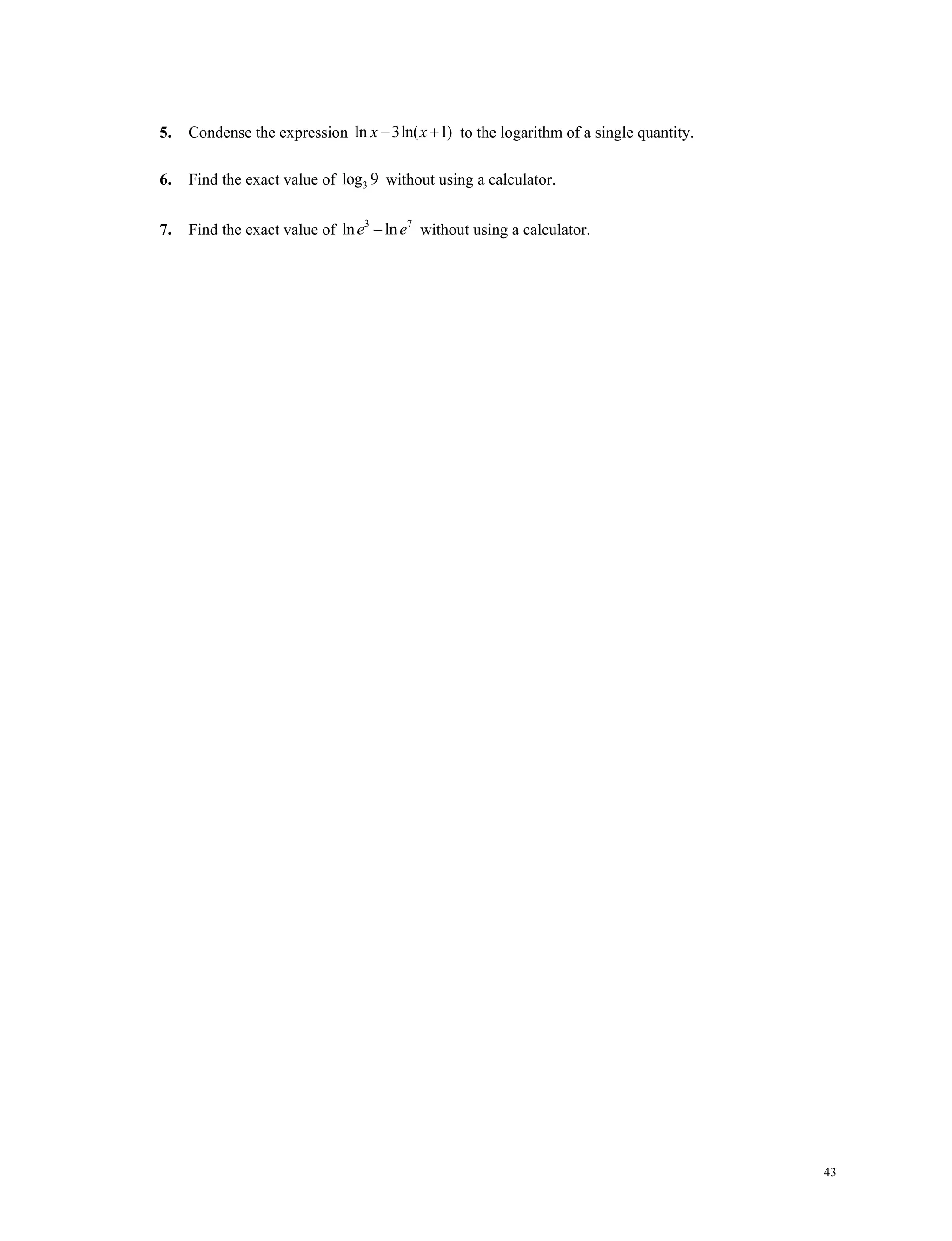
 
 
  
 
Example 2: Solving a Logarithmic Equation
You should be careful to check your answers after solving an equation. In this example, you will see that one of
the “solutions” is not valid. The appearance of these “extraneous” solutions occurs frequently with logarithmic
equations because the domain of the logarithmic function is restricted to positive real numbers.
45
Solve the equation ln( 2) ln(2 3) 2ln .x x x   
Solution
Notice how we use the properties of logarithms to simplify both sides and remove the logarithms.
  
  
  
2
2
2 2
2
ln( 2) ln(2 3) 2ln
ln 2 2 3 ln
2 2 3
2 7 6
7 6 0
6 1 0
x x x
x x x
x x x
x x x
x x
x x
   
    
  
  
  
  
There are 2 solutions to this quadratic equation: 1x  and 6.x  However, 1x  is an extraneous solution
because it is not in the domain of the original expression. Therefore, the only solution is 6.x 
Example 3: Approximating the Solution of an Equation
In this example, we are forced to use a computer or graphing calculator to approximate the solution of the
equation. Approximate the solution to the equation 2
ln 2.x x 
Solution
Write the equation as a function:
2
( ) ln 2f x x x   . The zeros of this function are the solutions to the original
equation. Using a graphing utility, you see that the graph has 2 zeros, approximately 0.138 and 1.564. Note that
it is impossible to find the exact solutions to the equation.
Study Tips
 There many ways to write an answer. For instance, in the first example, you could have written the
answer as  
1
21 5 5 5 5 1
ln , ln , ln , ln , or ln5 ln 4
2 4 4 4 2 2
   
   
   
. All of these are correct.
 Recall that the logarithm of a sum is not the sum of the logarithms. That is, the equation
 10 10 10log 10 log log 10x x   for all values of .x However, you can show that this equation does
have a solution: 10
9
x  .
46
 Lesson 10: Exponential and Logarithmic EquationsLesson10:ExponentialandLogarithmicEquations
Pitfalls
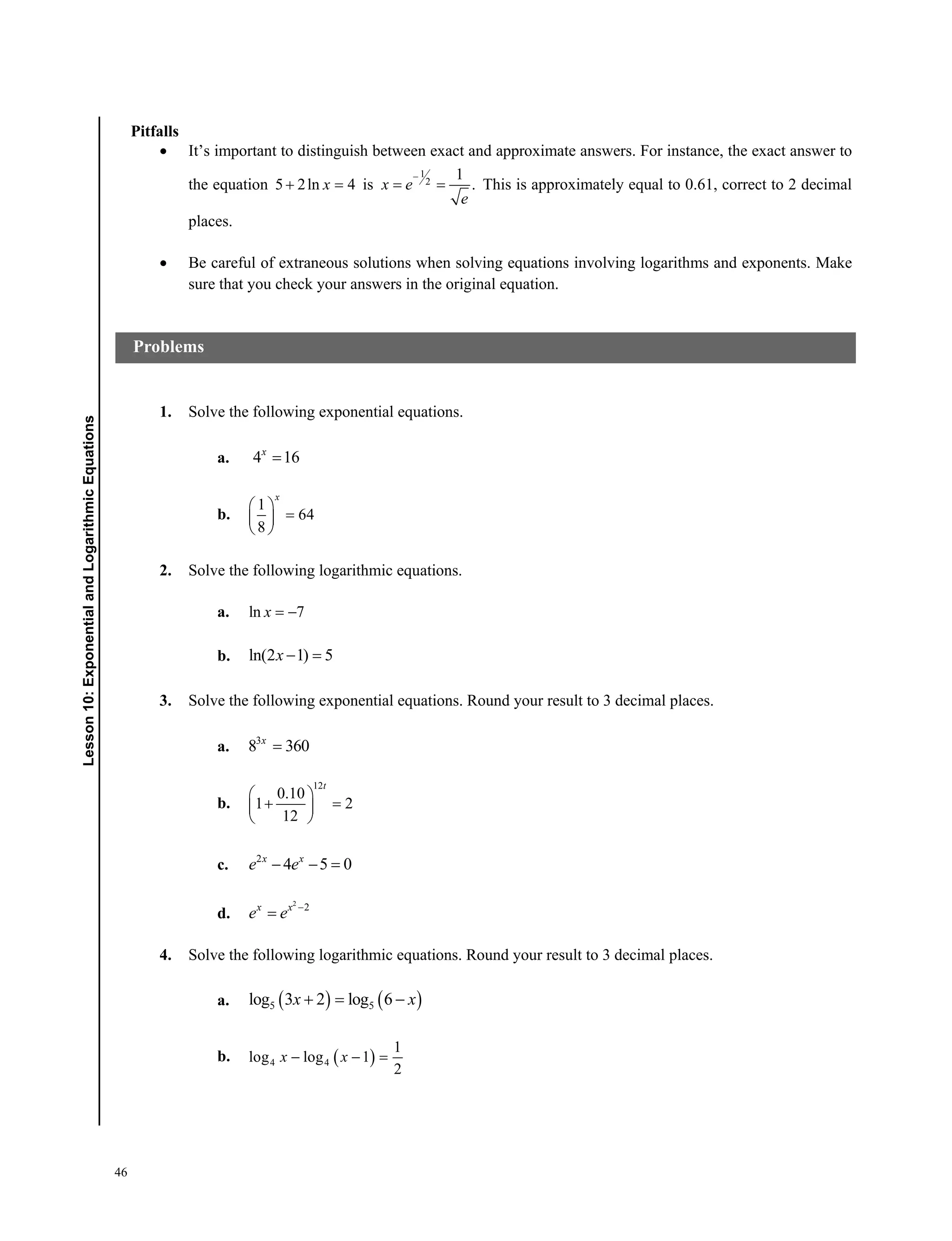
 It’s important to distinguish between exact and approximate answers. For instance, the exact answer to
the equation 5 2ln 4x is
1
2
1
.x e
e

  This is approximately equal to 0.61, correct to 2 decimal
places.
 Be careful of extraneous solutions when solving equations involving logarithms and exponents. Make
sure that you check your answers in the original equation.
1. Solve the following exponential equations.
a. 4 16x

b.
1
64
8
x
 
 
 
2. Solve the following logarithmic equations.
a. ln 7x  
b. ln(2 1) 5x  
3. Solve the following exponential equations. Round your result to 3 decimal places.
a. 3
8 360x

b.
12
0.10
1 2
12
t
 
  
 
c. 2
4 5 0x x
e e  
d.
2
2x x
e e 

4. Solve the following logarithmic equations. Round your result to 3 decimal places.
a.    5 5log 3 2 log 6x x 
b.  4 4
1
log log 1
2
x x  
Problems
47
5. Use a graphing utility to approximate the solution of the equation
3
10log 3,x x  accurate to 3
decimal places.
48
Lesson11:ExponentialandLogarithmicModels
Exponential and Logarithmic models
Lesson 11
Topics
 Exponential and logarithmic models.
 Exponential growth and decay.
 Gaussian models.
 Logistic growth models.
 Newton’s law of cooling.
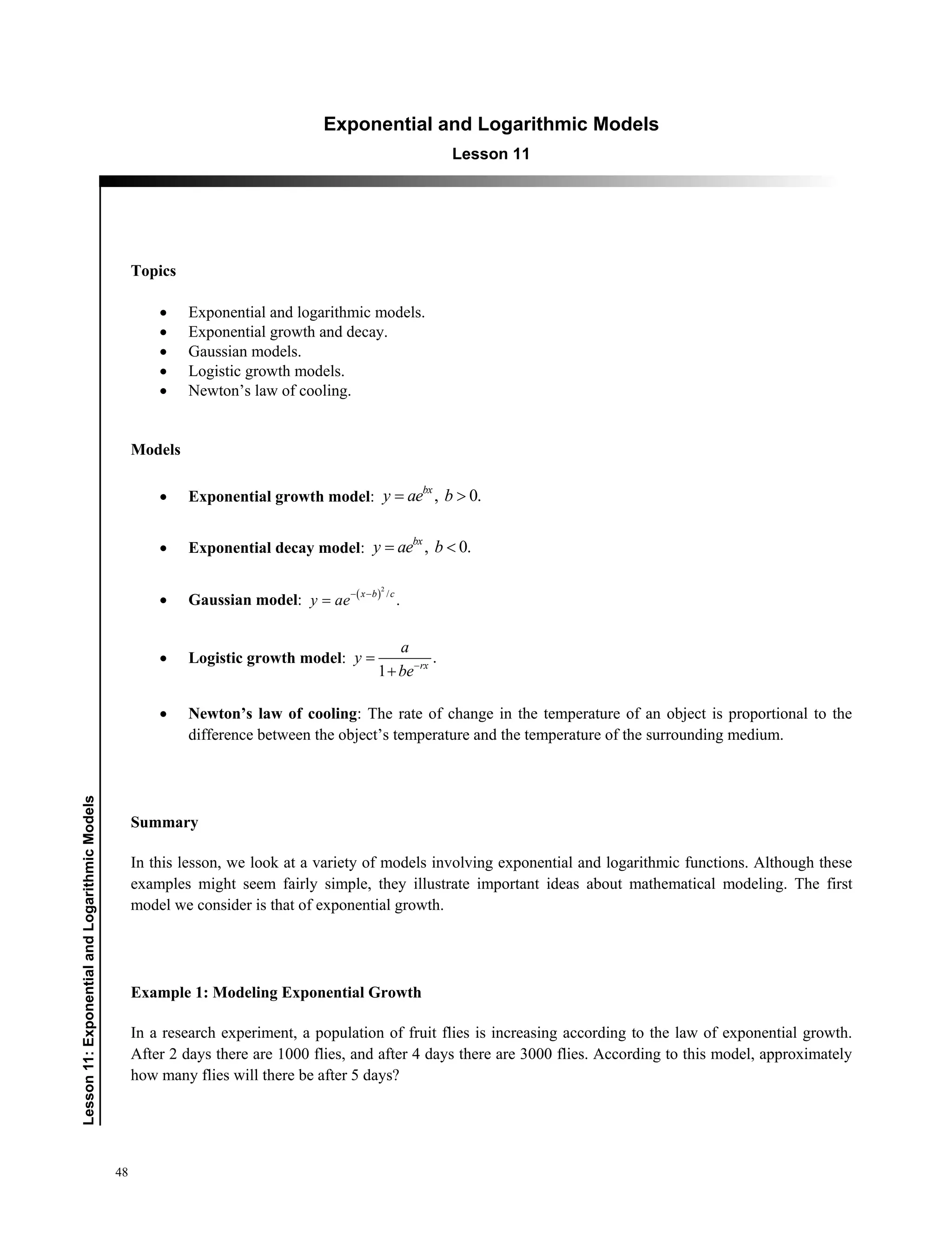
Models
 Exponential growth model: , 0.bx
y ae b 
 Exponential decay model: , 0.bx
y ae b 
 Gaussian model:  2
/
.
x b c
y ae
 

 Logistic growth model: .
1 rx
a
y
be


 Newton’s law of cooling: The rate of change in the temperature of an object is proportional to the
difference between the object’s temperature and the temperature of the surrounding medium.
Summary
In this lesson, we look at a variety of models involving exponential and logarithmic functions. Although these
examples might seem fairly simple, they illustrate important ideas about mathematical modeling. The first
model we consider is that of exponential growth.
Example 1: Modeling Exponential Growth
In a research experiment, a population of fruit flies is increasing according to the law of exponential growth.
After 2 days there are 1000 flies, and after 4 days there are 3000 flies. According to this model, approximately
how many flies will there be after 5 days?
49
Solution
Let y be the number of fruit flies at time t (in days). The model for exponential growth is .bt
y ae We can
determine the unknown constants by solving the following 2 equations.
2
4
2: 1000
4: 3000
b
b
t y ae
t y ae
  
  
From the first equation, you have 2
1000
b
a
e
 .
Substituting this value into the second equation, you obtain
4 4 2
2
1000
3000 3 .b b b
b
ae e e
e
 
    
 
Using the inverse relationship between logarithms and exponents, we have
1
2 ln 3 ln 3 0.5493.
2
b b    Now we can find the value of the other constant:
 2 12 ln3
2
1000 1000 1000
333.33.
3b
a
e
e
 
 
   
Hence, our model is approximately
0.5493
333.33 .bt t
y ae e 
When 5,t 
0.5493(5)
333.33 5196y e  fruit flies. Note that by letting 0t  in the
model, you see that the initial amount of flies is approximately 333.
Example 2: A Gaussian Model for SAT Scores
In 2005, the SAT math scores for college-bound seniors roughly followed the normal distribution
 2
520 /26,450
0.0035 , 200 800.
x
y e x
 
  Graph this model and estimate the average SAT score .x
Solution
You can use a graphing utility to produce the bell-shaped curve in figure 11.1. The average score is the x-
coordinate of the maximum value, 520.x 
50
Lesson11:ExponentialandLogarithmicModels
Figure 11.1
Example 3: Newton’s Law of Cooling
In this example, we analyze a specific application of Newton’s law of cooling. Using calculus, it is possible to
derive a mathematical model for Newton’s law of cooling. Imagine a cup of coffee at 100 F placed in a room
at 60 . According to this law, the temperature of the coffee will decrease according to the equation
0.02877
60 40 ,t
y e
  where t is the time in minutes. By evaluating this model for various values of ,t you will
see that the coffee is 90 after 10 minutes, and 82 10 minutes later.
Study Tips
 For the exponential growth model, 0,b  whereas 0b  for exponential decay. The constant a
indicates the initial amount of the substance under consideration.
 The logistic growth model is used for populations that initially experience rapid growth, followed by a
declining rate of growth. For example, a bacteria culture might grow rapidly at the beginning, but then
increase more slowly as the amount of food and space diminishes.
1. Suppose you deposit $10,000 at 3.5% interest, compounded continuously. How long will it take for the
deposit to double?
Problems
51
2. The half-life of Radium-226 is 1599 years. If there are 10 grams now, how much will there be after
1000 years?
3. The population P (in thousands) of Reno, Nevada, can be modeled by 134.0 ,kt
P e
3. where t is the year, with t = 0 corresponding to 1990. In 2000, the population was 180,000.
a. Find the value of k for the model. Round your result to 4 decimal places.
b. Use your model to predict the population in 2010.
4. The IQ scores for adults roughly follow the normal distribution  2
100 /450
0.0266 , 70 115,
x
y e x
 
  
where x is the IQ score.
a. Use a graphing utility to graph the function.
b. From the graph, estimate the average IQ score.
5. A conservation organization releases 100 animals of an endangered species into a game preserve. The
organization believes that the preserve has a carrying capacity of 1000 animals and that the growth of
the herd will follow the logistic curve
0.1656
1000
( ) ,
1 9 t
p t
e


where t is measured in months.
a. What is the population after 5 months?
b. After how many months will the population reach 500?
c. Use a graphing utility to graph the function. Use the graph to determine the values of p at
which the horizontal asymptotes will occur. Interpret the meaning of the larger asymptote in
the context of the problem.
52
Lesson12:IntroductiontoTrigonometryandAngles
Introduction to Trigonometry and angles
Lesson 12
Topics
 Definition of angle.
 Coterminal angles.
 Complementary and supplementary angles.
 Degree measure and radian measure.
 Other units of angle measurement: minutes and seconds.
 Arc length formula.
 Linear and angular speed.
Definitions and Formulas
 An angle is determined by rotating a ray, or half-line, about its endpoint. The starting position of the
ray is the initial side, and the end position is the terminal side. The endpoint of the ray is the vertex. If
the origin is the vertex and the initial side is the positive x-axis, then the angle is in standard position.
 Positive angles are generated by a counterclockwise rotation, and negative angles by a clockwise
rotation. If 2 angles have the same initial and terminal sides, then they are called coterminal angles.
 A measure of one degree, 1°, is equivalent to a rotation of 1 360 of a complete revolution about the
vertex.
 An acute angle is between 0 and 90 ; a right angle is 90 ; an obtuse angle is between 90 and
180 ;
a straight angle is 180 . A full revolution is 360 .
 Two positive angles are complementary, or complements of each other, if their sum is 90 . Two
positive angles are supplementary, or supplements of each other, if their sum is 180 .
 Given a circle of radius 1, a radian is the measure of the central angle  that intercepts (subtends) an
arc s equal in length to the radius 1 of the circle.
 180 radians, and 1 radian 57 degrees. 
 One minute is 1
60
of a degree. One second is 1
3600
of a degree.
 Linear speed measures how fast a particle moves. Linear speed is arc length divided by time: .
s
t
 Angular speed measures how fast the angle is changing. Angular speed is central angle divided by
time: .
t

 Quadrant: the 4 parts into which a plane is evenly divided by rectangular coordinate axes, see
figure 12.1
53
Figure 12.1
Summary
In this lesson, we begin the study of trigonometry. Before we define the trigonometric functions, we study
angles and their measures. After some preliminary definitions, we define coterminal angles, those that have the
same initial and terminal sides.
Example 1: Finding Coterminal Angles
Find 2 coterminal angles (one positive and one negative) for 120 .   
Solution
You can add or subtract multiples of 360 to obtain coterminal angles, as follows.
120 360 240
120 360 480
    
     
Example 2: Converting Degrees to Radians
Radian measure is another way to measure angles. One radian is the measure of a central angle  that
intercepts an arc s equal in length to the radius of a unit circle (radius 1). That is,  radians equals 180 . A
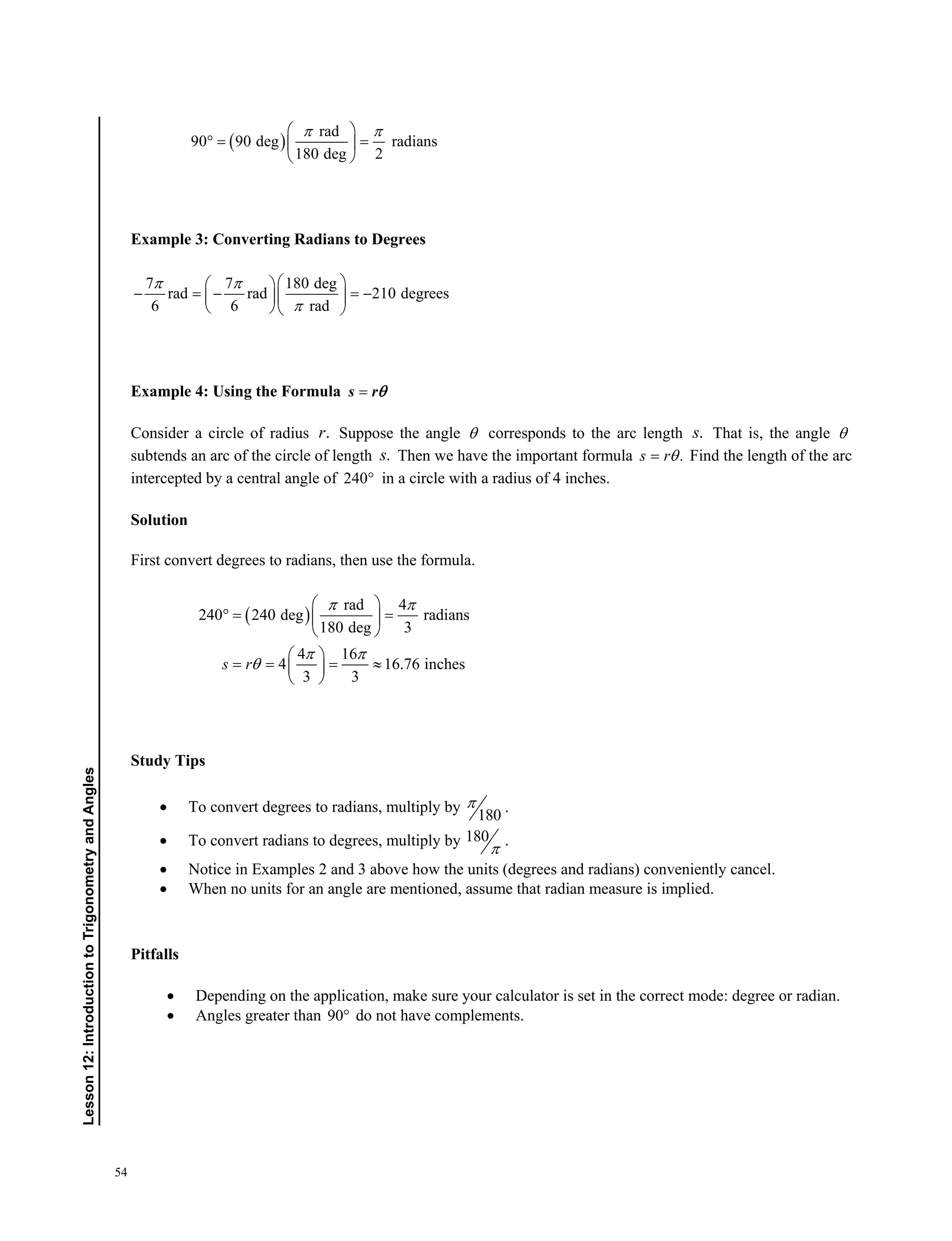
radian is approximately 57 .
54
Lesson12:IntroductiontoTrigonometryandAngles
 
rad
90 90 deg radians
180 deg 2
  
  
 
Example 3: Converting Radians to Degrees
7 7 180 deg
rad rad 210 degrees
6 6 rad
 

  
    
  
Example 4: Using the Formula s r
Consider a circle of radius .r Suppose the angle  corresponds to the arc length .s That is, the angle 
subtends an arc of the circle of length .s Then we have the important formula .s r Find the length of the arc
intercepted by a central angle of 240 in a circle with a radius of 4 inches.
Solution
First convert degrees to radians, then use the formula.
 
rad 4
240 240 deg radians
180 deg 3
4 16
4 16.76 inches
3 3
s r
 
 

 
  
 
 
    
 
Study Tips
 To convert degrees to radians, multiply by
180
 .
 To convert radians to degrees, multiply by 180
 .
 Notice in Examples 2 and 3 above how the units (degrees and radians) conveniently cancel.
 When no units for an angle are mentioned, assume that radian measure is implied.
Pitfalls
 Depending on the application, make sure your calculator is set in the correct mode: degree or radian.
 Angles greater than 90 do not have complements.
55
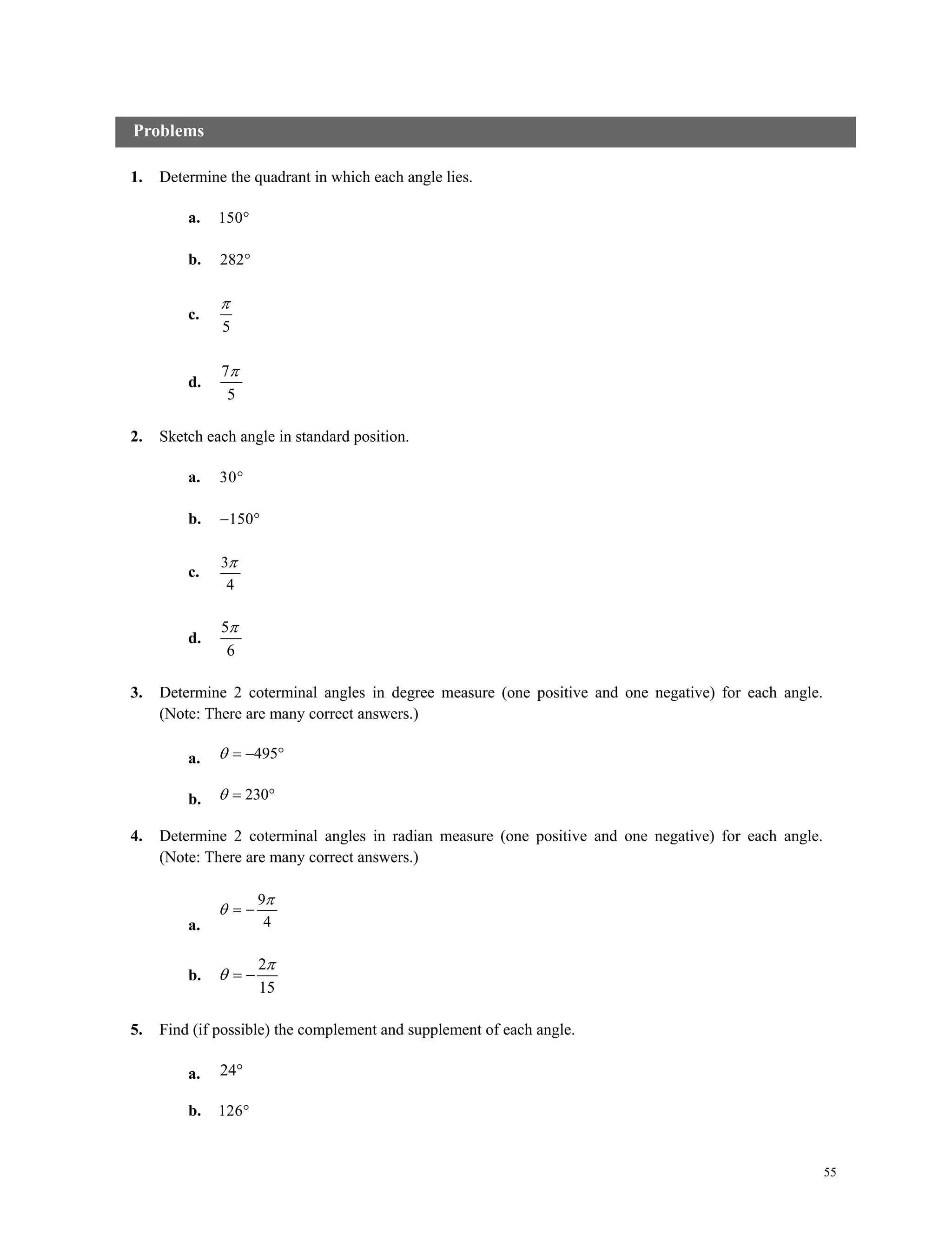
1. Determine the quadrant in which each angle lies.
a. 150
b. 282
c.
5

d.
7
5

2. Sketch each angle in standard position.
a. 30
b. 150 
c.
3
4

d.
5
6

3. Determine 2 coterminal angles in degree measure (one positive and one negative) for each angle.
(Note: There are many correct answers.)
a. 495  
b. 230 
4. Determine 2 coterminal angles in radian measure (one positive and one negative) for each angle.
(Note: There are many correct answers.)
a.
9
4

  
b.
2
15

  
5. Find (if possible) the complement and supplement of each angle.
a. 24
b. 126
Problems
56
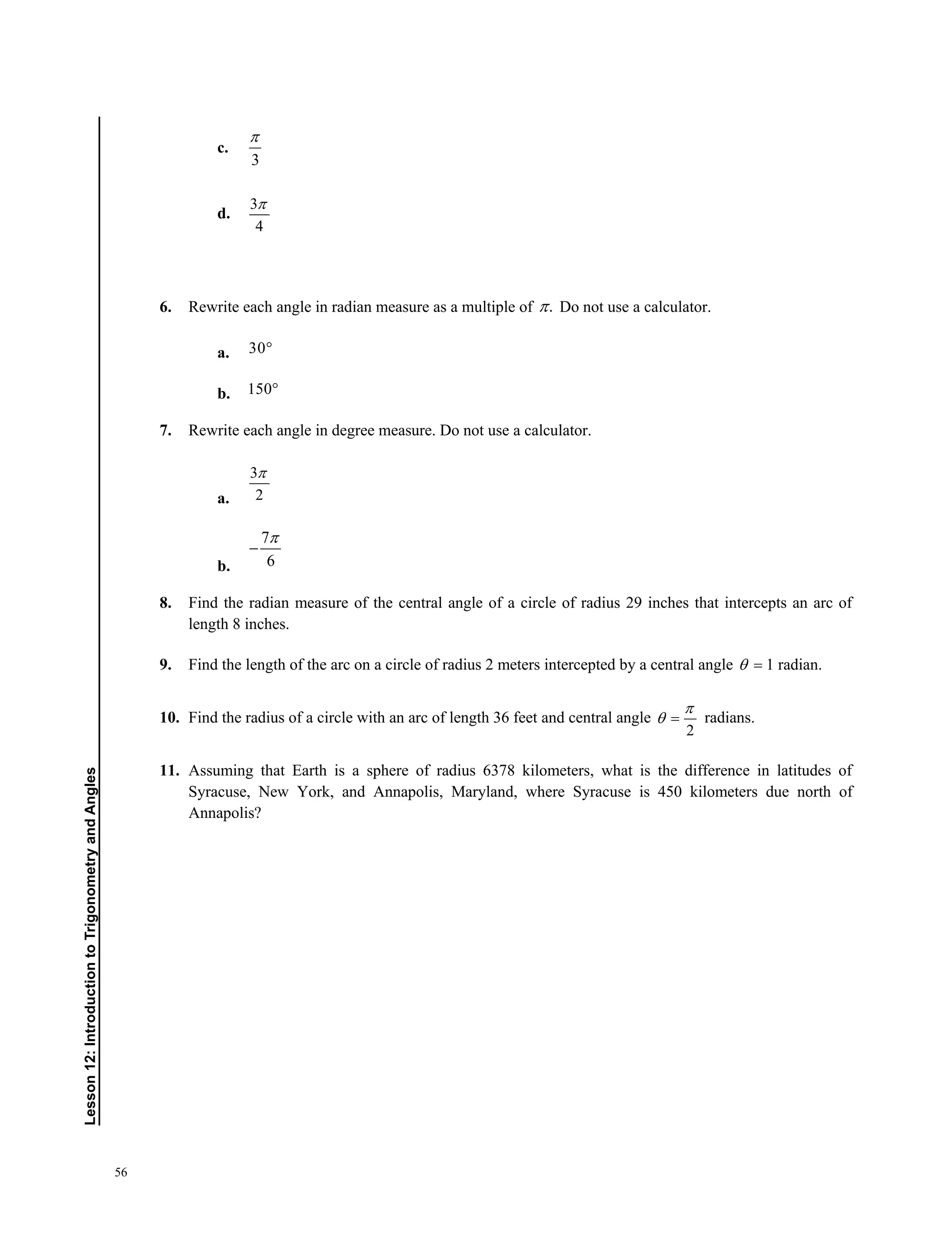
Lesson12:IntroductiontoTrigonometryandAngles
c.
3

d.
3
4

6. Rewrite each angle in radian measure as a multiple of . Do not use a calculator.
a. 30
b. 150
7. Rewrite each angle in degree measure. Do not use a calculator.
a.
3
2

b.
7
6


8. Find the radian measure of the central angle of a circle of radius 29 inches that intercepts an arc of
length 8 inches.
9. Find the length of the arc on a circle of radius 2 meters intercepted by a central angle   1 radian.
10. Find the radius of a circle with an arc of length 36 feet and central angle
2

  radians.
11. Assuming that Earth is a sphere of radius 6378 kilometers, what is the difference in latitudes of
Syracuse, New York, and Annapolis, Maryland, where Syracuse is 450 kilometers due north of
Annapolis?
57
Trigonometric Functions—Right Triangle Definition
Lesson 13
Topics
 Pythagorean theorem.
 Triangle definition of the trigonometric functions.
 Trigonometric values for 30, 45, and 60 degrees.
Definitions and Properties
 Consider a right triangle with an acute angle . The 6 trigonometric functions are defined as follows.
opposite hypotenuse
sin csc
hypotenuse opposite
adjacent hypotenuse
cos sec
hypotenuse adjacent
opposite adjacent
tan cot
adjacent opposite
 
 
 
 
 
 
Theorem and Identities
 In any right triangle, the Pythagorean theorem is with sides a and b, and hypotenuse c,
then a2
+ b2
= c2
.
 Pythagorean identities are defined as follows.
o 2 2
sin cos 1  
o 2 2
tan 1 sec  
o
2 2
1 cot csc  
58
Lesson13:TrigonometricFunctions—RightTriangleDefinition
 Reciprocal relationships found in trigonometry are as follows.
o
1
sec
cos


o
1
csc
sin


o
1
cot
tan


Summary
In this lesson, we develop the trigonometric functions using a right triangle definition. If you know the lengths
of the 3 sides of a right triangle, then you can find the trigonometric functions of either acute angle.
Example 1: Calculating Trigonometric Functions
Calculate the 6 trigonometric functions for the right triangle in figure 13.1.
Figure 13.1
59
Solution
Using the Pythagorean theorem, the hypotenuse is 5: hypotenuse 2 2
3 4 25 5.   
4 3 4
sin , cos , tan
5 5 3
5 5 3
csc , sec , cot
4 3 4
  
  
  
  
Example 2: The 30-60-90 Right Triangle
Certain angles occur often in trigonometry. For example, the trigonometric values for 30 and 60 degrees are
important to memorize.
Use the equilateral triangle in figure 13.2 to evaluate the sine and cosine of 30 and 60 degrees.
Figure 13.2
Solution
By drawing the altitude in the equilateral triangle, you have a 30-60-90 right triangle. If the hypotenuse is 2,
then the shortest side is 1, and the third side is 3. The angle opposite the shortest side is 30. Hence, you have
the following values.
60
Lesson13:TrigonometricFunctions—RightTriangleDefinition
1
sin30 sin cos60 cos
6 2 3
3
cos30 cos sin 60 sin
6 2 3
 
 
   
   
Observe in this example that cofunctions of complementary angles are equal. This is true in general.
Example 3: Finding Trigonometric Functions
The fundamental identities permit you to use a known value of one trigonometric function to determine the
values of the other functions. Find the sine of the angle if you know that cos 0.8. 
Solution
We use the fundamental identity as follows.
 
 
2 2
22
22
sin cos 1
sin 0.8 1
sin 1 0.8 0.36
sin 0.6
 



 
 
 

Knowing the sine and cosine, it is easy to determine the other 4 trigonometric functions.
Study Tips
 Notice that the tangent function could have been defined as the quotient of the sine and cosine.
 The power of a trigonometric function, such as  
2
sin is written 2
sin .
 It is important to know the values of the trigonometric functions for common angles, such as
30 , 45 , 60
6 4 3
  
      . Using an isosceles right triangle, for example, you can show that
2
sin cos
4 4 2
 
  and tan 1.
4


 You can use a calculator to verify your answers. In fact, you must use a calculator to evaluate
trigonometric functions for most angles.
 Cofunctions of complementary angles are equal. For example, tan50 cot 40 . 
 On a calculator, you can evaluate the secant, cosecant, and cotangent as the reciprocal of cosine, sine,
and tangent, respectively.
 The sine and cosine of any angle is less than or equal to one in absolute value.
Pitfall
 Make sure you have set your calculator in the correct mode: degree or radian. Not doing this is one of
the most common mistakes in trigonometry.
61
1. Find the exact values of the 6 trigonometric functions of the angle  shown in the following figures.
a. Figure 13.3
b. Figure 13.4
Problems
62
 Lesson 13: Trigonometric Functions—Right Triangle DefinitionLesson13:TrigonometricFunctions—RightTriangleDefinition
2. Sketch a right triangle corresponding to the trigonometric function of the acute angle  given that
2
sin
3
  . Use the Pythagorean theorem to determine the third side of the triangle, and then find the
other 5 trigonometric functions of the angle.
3. Sketch a right triangle corresponding to the trigonometric function of the acute angle  given that
tan 3  . Use the Pythagorean theorem to determine the third side of the triangle, and then find the
other 5 trigonometric functions of the angle.
4. Find the acute angle  (in degrees and in radians) if
3
cot .
3
 
5. Find the acute angle  (in degrees and in radians) if csc 2. 
6. Given the function values
3
sin60
2
  and
1
cos60 ,
2
  find the following trigonometric functions.
a. tan60
b. sin30
c. cos 30
d. c o t 6 0 
7. Given the function values csc 3  and
3 2
sec ,
4
  find the following trigonometric functions.
a. sin
b. cos
c. tan
d.  sec 90 
8. Use trigonometric identities to show that    2
1 cos 1 cos sin .    
9. Use a calculator to evaluate each function. Round your answers to 4 decimal places.
a. sin12°
b. cos72°
10. Without using a calculator, find the value of the acute angle (in degrees and radians) if sec 2  .
63
Trigonometric Functions—Arbitrary Angle Definition
Lesson 14
Topics
 Trigonometric functions for an arbitrary angle.
 Quadrants and the sign of trigonometric functions.
 Trigonometric values for common angles.
 Reference angles.
 Trigonometric functions as functions of real numbers.
Definitions
 Let  be an angle in standard position, let  ,x y be a point on the terminal side, and let
2 2
0.r x y   The 6 trigonometric functions are defined as follows.
sin csc
cos sec
tan cot
y r
r y
x r
r x
y x
x y
 
 
 
 
 
 
 Let  be an angle in standard position. Its reference angle is the acute angle , formed by the
terminal side of  and the horizontal axis.
64
Lesson14:TrigonometricFunctions—ArbitraryAngleDefinition
Quadrants and the Signs of the Trigonometric Functions
Trigonometric Values of Common Angles
65
Summary
In this lesson, we define the trigonometric functions for an arbitrary angle. The definition is equivalent to the
right triangle definition for acute angles. However, with this more general definition, we are able to calculate
trigonometric values for any angle.
Example 1: Calculating Trigonometric Functions
Let 3, 4 be on the terminal side of the angle . Calculate the sine, cosine, and tangent of this angle.
Solution
We have 3, 4,x y  and  
2 2
3 4 25 5.r      Then you have
4 3
sin , cos ,
5 5
y x
r r
     
4
and tan .
3
y
x
   Notice that the cosine and tangent are negative because the angle is in the Quadrant II.
Example 2: Important Angles
It is important to be familiar with the values of the trigonometric functions for frequently occurring angles.
From the definitions of the sine, cosine, and tangent, you have the following.
sin0 0, cos0 1, tan0 0,
sin 1, cos 0, tan is undefined.
2 2 2
  
  
 
Example 3: Using Reference Angles to Calculate Trigonometric Functions
Reference angles permit you to calculate trigonometric values for angles located in any quadrant. Calculate
sin 300 .
Solution
The reference angle for 300 is 60 . Furthermore, 300 lies in Quadrant IV, so its sine is negative. Since
3
sin60
2
  , we have
3
sin300 .
2
  
66
Lesson14:TrigonometricFunctions—ArbitraryAngleDefinition
We have defined the trigonometric functions for any angle—positive or negative. Hence, we can consider the
trigonometric functions as functions of a real variable. Using xas the independent variable, you see that the
domains of ( ) sinf x x and ( ) cosg x x are all real numbers, and their ranges consist of all real numbers in
the interval  1, 1 .
Study Tips
 For the definition of the 6 trigonometric functions, some authors specify that r = 1 in place of
2 2
.r x y  Both approaches yield the same values.
 Notice that some trigonometric functions are undefined for certain angles. For example, tan
2

is
undefined because cos 0.
2


 To find the value of a trigonometric function of an arbitrary angle  :
1. Determine the function value of the associated reference angle .
2. Depending on the quadrant, affix the appropriate plus or minus sign.
 You can use a calculator to verify your answer. For example,
11 1
csc 1.41421
114 sin
4


  , which
approximates the exact answer
2
2.
2

Pitfall
 Make sure you have set your calculator in the correct mode: degree or radian. This is one of the most
common mistakes in trigonometry.
1. The point  7, 24 is on the terminal side of an angle in standard position. Determine the exact
values of the 6 trigonometric functions of the angle.
2. Find the values of the 6 trigonometric functions of the angle  if
3
sin
5
  and  lies in Quadrant
II.
3. Find the values of the 6 trigonometric functions of the angle  if csc 4  and cot 0. 
4. Evaluate the following trigonometric functions.
a. sec
Problems
67
b. tan
2

c. cot
d. csc
5. Find the reference angle   corresponding to the angle 120 .   Sketch the 2 angles in
standard position.
6. Evaluate the sine, cosine, and tangent of 225   without using a calculator.
7. Evaluate the sine, cosine, and tangent of
7
6

   without using a calculator.
8. Use a calculator to evaluate sin10 . Round your answer to 4 decimal places.
9. Use a calculator to evaluate
2
tan .
9

Round your answer to 4 decimal places.
10. The initial current and charge in an electric circuit are zero. When 100 volts is applied to the circuit,
the current is given by 2
5 sin ,t
I e t
 where the resistance, inductance, and capacitance are 80
ohms, 20 henrys, and 0.01 farad, respectively. Approximate the current in amperes 0.7t  seconds
after the voltage is applied.
68
Lesson15:GraphsofSineandCosineFunctions
Graphs of Sine and Cosine Functions
Lesson 15
Topics
 Graphs of sine and cosine functions.
 Graphs of general sine and cosine functions: sin( ), cos( ).y d a bx c y d a bx c    
 Amplitude.
 Period.
 Horizontal translations and phase shifts.
 Vertical translations.
Definitions
Given the general sine and cosine functions sin( ), cos( ),y d a bx c y d a bx c     where b  0,
 The amplitude is .a This number represents half the distance between the maximum and
minimum values of the function.
 The period is
2
b

when angles are measured in radians.
 The phase shift is .
c
b
 The constant d determines the vertical translation.
Summary
In this lesson, we study the graphs of sine and cosine functions. Recall that the domain of both siny x and
cosy x is the set of all real numbers, and the range consists of all real numbers in the closed interval  1, 1 .
Example 1: The Graph of the Sine Function
To sketch the graph of ( ) sin ,f x x begin calculating some values, such as
1 2
sin 0 0, sin , sin ,
6 2 4 2
  
 
and sin 1.
2


Then connect these points with a smooth curve, as in figure 15.1.
69
Figure 15.1
Notice that the sine function is odd (symmetric with respect to the origin). The x-intercepts are
0, , 2 , ...   . The maximum value of the sine function is 1, occurring at
5 3 7
, , ... , , , ... .
2 2 2 2
x
   
   The minimum value is 1, occurring at
3 7 5
, , ... , , , ... .
2 2 2 2
x
   
  
The graph of the cosine function is similar to that of the sine function. If you graph the cosine function on your
calculator, you will see that it looks like the sine graph shifted to the left
2

units.
Example 2: Periodicity
One of the most important properties of trigonometric functions is their periodicity. Sketch the graph of the
function ( ) sin .
2
x
f x 
Solution
The period is
2 2
4 .
1
2
b
 
  That means that the graph completes one cycle on the interval  0, 4 . The
x-intercepts are 0, 2 , 4 , ... .x     Figure 15.2 shows both siny x and ( ) sin .
2
x
f x 
70
Lesson15:GraphsofSineandCosineFunctions
Figure 15.2
Example 3: Analyzing a Trigonometric Graph
This example analyzes a more complicated trigonometric graph, the function
1
sin .
2 3
y x
 
  
 
Solution
The amplitude is
1 1
.
2 2
a  The period is
2 2
2 .
1b
 
  You can determine the left and right
endpoints of one cycle by solving the equations 0
3
x

  and 2 .
3
x

  You will obtain
3
x


and
7
3
x

 as the endpoints of one complete cycle, as shown in figure 15.3. There is no vertical
shift ( 0).d 
71
Figure 15.3
Study Tips
 The amplitude and vertical shift are generally easy to determine. For example, the graph of
2 3cos2y x  is a vertical shift 2 units upward of the graph of 3cos2 .y x
 The horizontal translations are determined by solving the equations 0bx c  and 2 .bx c  
 It is always a good idea to plot some points when analyzing a graph.
 You can also verify your graphs with a computer or graphing calculator.
1. Sketch the graph of the following functions by hand. Include 2 full periods.
a. 3siny x
b.
1
cos
4
y x .
c. cos
2
x
y 
d. sin 4y x
Problems
72
Lesson15:GraphsofSineandCosineFunctions
e. sin
4
y x
 
  
 
f.  siny x  
2. Use a graphing utility to graph the following functions. Include 2 full periods. Identify the
amplitude and period of the graphs.
a.
2
2sin
3
x
y  

b. 4 5cos
12
t
y  

c.  5sin 2 10y x  
3. The pressure in millimeters of mercury, P, against the walls of the blood vessels of a person is
modeled by
8
100 20cos ,
3
t
P

  where t is the time in seconds. Use a graphing utility to graph
the model, where one cycle is equivalent to one heartbeat. What is the person’s pulse rate in
heartbeats per minute?
73
Graphs of Other Trigonometric Functions
Lesson 16
Topics
 Graphs of other trigonometric functions.
 Graphs of general trigonometric functions.
 Damped trigonometric graphs.
Summary
In this lesson, we study graphs of the remaining 4 trigonometric functions. We begin with the graph of
tan .y x
Example 1: The Graph of the Tangent Function
The function
sin
( ) tan
cos
x
f x x
x
  is not defined when cos 0.x  The graph of the tangent function has vertical
asymptotes at
3 5
, , , ...
2 2 2
x
  
   and intercepts at 0, , 2 , ... .x     If you plot some values and
connect the points with smooth curves, you will obtain figure 16.1. Notice that the tangent is an odd function.
Figure 16.1
74
Lesson16:GraphsofOtherTrigonometricFunctions
The period of the tangent function is . The domain is the set of all real numbers except
3 5
, , , ... .
2 2 2
x
  
   The range is the set of all real numbers.
The graph of the cotangent function is similar to that of the tangent function, as shown in figure 16.2.
Figure 16.2
Example 2: The Graph of the Secant Function
Analyze the graph of
1
( ) sec ,
cos
f x x
x
  shown together with the cosine graph, as in figure 16.3. What are
the period, x-intercepts, and vertical asymptotes.
75
Figure 16.3
The period is 2 , and there are no x-intercepts. The graph has vertical asymptotes at
3 5
, , , ... .
2 2 2
x
  
   The graph of the cosecant function is similar to that of the secant function.
Example 3: Analyzing a Damped Trigonometric Graph
In this example, we analyze a damped trigonometric graph. Analyze the graph of the function ( ) sin .x
f x e x

Solution
Using a graphing utility, you will obtain the graph in figure 16.4.
76
Lesson16:GraphsofOtherTrigonometricFunctions
Figure 16.4
Notice that the graph approaches zero as x tends to infinity. This damping effect can be described in
limit notation as lim sin 0.x
x
e x


Study Tips
 The vertical asymptotes of the tangent function, or secant function, are
3 5
, , , ... .
2 2 2
x
  
  
This can be written as ,
2
x n

  where nis an integer.
 You can obtain the graphs of cotangent, secant, and cosecant on a graphing utility by using
1 1 1
cot , sec , and csc .
tan cos sin
x x x
x x x
  
 The function
1
( ) sinf x
x
 is fun to graph on your calculator. Zoom in on the graph near the origin and
you will see some bizarre behavior.
Pitfall
 A graphing calculator might connect parts of the graphs of tangent, cotangent, secant, and cosecant that
are not supposed to be connected. You can avoid this by using dot mode instead of connected mode.
77
1. Sketch the graph of the following functions by hand. Include 2 full periods
a.
1
tan
2
y x
b.
1
sec
4
y x
c. 3csc
2
x
y 
d.
1
cot
2 2
x
y 
2. Use a graphing utility to graph the following function, include 2 full periods: 2csc3 .y x Graph
the corresponding reciprocal function, and compare the 2 graphs.
3. Use a graphing utility to graph the function, include 2 full periods: 2sec4 .y x  Graph the
corresponding reciprocal function, and compare the 2 graphs.
4. Use the graph of the function to approximate the solutions to the equation tan 1x  on the interval
 2 , 2  .
5. Use a graphing utility to graph the 2 equations 2
1 sec 1y x  and 2
2 tany x in the same
viewing window. Use the graphs to determine whether the expressions are equivalent. Verify the
result algebraically.
6. Use a graphing utility to graph the function ( ) cosx
f x e x
 and the damping factor of the function
in the same viewing window. Describe the behavior of the function as x increases without bound.
Problems
78
Lesson16:GraphsofOtherTrigonometricFunctions
7. An object weighing W pounds is suspended from a ceiling by a steel spring, see figure below. The
weight is pulled downward (positive direction) from its equilibrium position and released. The
resulting motion of the weight is described by the function 4
1
cos4 ,
2
t
y e t
−
= where y is the
distance in feet, and t is the time in seconds ( )0 .t 
a. Use a graphing utility to graph the function.
b. Describe the behavior of the displacement function for increasing values of time .t
79
Inverse Trigonometric Functions
Lesson 17
Topics
 Inverse trigonometric functions.
 Graphs of inverse trigonometric functions.
 Inverse properties.
Properties
 y = arcsin x if and only if sin y = x, 1 1, and .
2 2
x y     
 
 y = arcos x if and only if cos y = x, 1 1, and 0 .x y     
 y = arctan x if and only if tan y = x, , and .
2 2
x y     
 
 sin(arcsin x) = x and arcsin(sin y) = y if 1 1, .
2 2
x y     
 
There are sSimilar properties for the other functions.
Summary
In this lesson, we study the inverse trigonometric functions. Because the 6 trigonometric functions are not one-
to-one, we must restrict their domains in order to define their inverses. We begin with the inverse sine function.
Example 1: The Definition of the Inverse Sine Function
On the restricted interval , ,
2 2
  
 
 
the sine function is one-to-one. We can define its inverse as follows:
1
arcsin sin if and only if sin , 1 1, and .
2 2
y x x y x x y
        
 
For example,
1
arcsin
2 6

 because
1
sin
6 2


and
6

lies in the interval , .
2 2
  
 
 
80
Lesson17:InverseTrigonometricFunctions
The graph of the inverse sine function is a reflection in the line y x of the graph of the restricted sine
function, see figure 17.1.
Figure 17.1
Example 2: The Inverse Tangent Function
The remaining inverse trigonometric functions are defined in a similar manner by suitably restricting their
domains. If we restrict the domain of the tangent function to the open interval , ,
2 2
  
 
 
then it will be one-
to-one, and we can define the inverse tangent function as follows:
arctan if and only if tan , , and .
2 2
y x y x x y        
 
For example,  arctan 1
4

  because tan 1
4
 
   
 

and
4

 lies in the interval , .
2 2
  
 
 
Notice that the graph of the arctangent function has 2 horizontal asymptotes:
2
y

 to the right and
2
y

  to
the left. See figure 17.2.
81
Figure 17.2
Example 3: Inverse Properties
We can take advantage of the properties of inverse functions, as long as we remember to verify the restricted
domains.
sin(arcsin1) 1
1 1
sin arcsin
5 5
 
 
 
 
3
arcsin sin arcsin 1
2 2
  
   
 
Study Tips
 The key to defining the inverse trigonometric functions is to appropriately restrict the domains of the
corresponding trigonometric functions.
 The 2 common notations for the inverse trigonometric functions are 1
siny x
 and arcsiny x (and
similarly for the other 5 inverse functions).
 Textbooks disagree on the definition of the inverse secant function. The difficulty is how to restrict the
domain of the secant function so that it becomes one-to-one. Two popular choices are
0, ,
2 2
 

   
  
   
and
3
0, ,
2 2
 

   
  
   
.
82
Lesson17:InverseTrigonometricFunctions
Pitfalls
 Pay special attention to the restricted domains of the inverse trigonometric functions. For example,
 arccos 1    even though  cos 1.   In fact,  arccos 1   .
 Similarly,  arcsin 2 is undefined because there is no number xsatisfying sin 2.x 
 The notation for inverse trigonometric functions can be confusing. That is, 1
siny x
 does not mean
1
sin x
.
1. Find the exact value of each expression without using a calculator.
a.
1
arccos
2
b. arccos0
c. arcsin1
d. arccos1
e. arctan1
f. arctan0
g. 1 2
cos
2

 
  
 
h. 1 2
sin
2

 
  
 
2. Use a calculator to approximate the following values. Round your answer to the nearest hundredth.
a. 1
cos 0.75
b.  arcsin 0.75
3. Use the properties of inverse functions to find the exact value of the following expressions
a. sin(arcsin 0.7)
Problems
83
b. arcsin(sin3 )
c. 1 5
sin tan
4
  
 
 

4. Find the exact value of the expression
24
cos arcsin .
25
  
  
  
5. Write an algebraic expression that is equivalent to cot(arctan ).x
84
Lesson18:TrigonometricIdentities
Trigonometric Identities
Lesson 18
Topics
 Trigonometric identities.
 Graphs of inverse trigonometric functions.
Formulas and Identities
 Fundamental identities used to calculate trigonometric functions.
o 2 2
sin cos 1u u 
o 2 2
tan 1 secu u 
o 2 2
1 cot cscu u 
o sin( ) sinu u 
o cos( ) cosu u 
o tan( ) tan( )u u 
 Confunction identities found in trigonometry are as follows.
o sin cos
2
u u
 
  
 

o cos sin
2
u u
 
  
 

o tan cot
2
u u
 
  
 

 Reciprocal identities found in trigonometry are as follows.
o
1
sec
cos
u
u

o
1
csc
sin
u
u

85
o
1
cot
tan
u
u

Summary
In this lesson, we study trigonometric identities. In the first example, we use the fundamental identity
2 2
sin cos 1u u to calculate trigonometric functions.
Example 1: Using Identities to Evaluate Trigonometric Functions
Find the values of the trigonometric functions if
3
sec
2
u   and tan 0.u 
Solution
We immediately know that
1 2
cos .
sec 3
u
u
   Furthermore, since cosine is negative and tangent is positive,
angle u must be in Quadrant III. We can find the sine using the fundamental identity:
2
2 2 2 4 5 5
sin 1 cos 1 1 sin .
3 9 9 3
u u u
 
           
 
Notice that we take the negative square root since the angle is in Quadrant III. The remaining values are now
simple to calculate:
5
1 3 3 5 sin 53csc , tan , and
2sin 5 cos 25
3
u
u u
u u

     

1 2 2 5
cot .
tan 55
u
u
  
Example 2: Verifying a Trigonometric Identity
Verifying trigonometric identities is an important calculus topic. The secret is to begin with one side of the
equation, and use your knowledge of trigonometric properties to arrive at the other side.
Verify the identity
2
2
2
sec 1
sin .
sec





86
Lesson18:TrigonometricIdentities
Solution
There are many ways to proceed. See if you can provide the reason for each step.
2 2
2 2 2
2
2
sec 1 sec 1
sec sec sec
1 cos
sin
 
  



 
 

Example 3: Verifying a Trigonometric Identity
Verify the identity 4 2 2 2
tan tan sec tan .x x x x 
Solution
We begin with the right-hand side, as follows.
   2 2 2 2 2 2 2 4
tan sec tan tan sec 1 tan tan tanx x x x x x x x  
Study Tips
 In Example 1 above, we rationalized the denominator. Make sure to ask your teacher if this is
necessary to do.
 A trigonometric equation is not an identity if it is false for at least one value in the domain. For
example, 2
sin 1 cosx x  is not an identity because it is false for
3
.
2
x


 Keep in mind the notation for powers of trigonometric functions. For example, 2
sin x means  2
sin ,x
not  2 2
sin sin .x x
 You can confirm an identity by graphing both sides in the same viewing window. If the graphs look
distinct, then the equation is not an identity. However, if the graphs appear to coincide, this is still not a
valid proof.
 The sine and tangent functions are odd, so their graphs are symmetric about the origin. The cosine
function is even, so its graph is symmetric about the y-axis.
Pitfalls
 Your answer to a problem might look different from another answer. For example, the expression
ln sec is equivalent to ln cos because
1
ln cos ln cos ln sec  

   .
 When verifying a trigonometric identity, don’t begin with the identity and simplify both sides
simultaneously until you arrive at a true statement. This is not a proof technique. Here is an example of
such a “false proof.” The original statement is not true for all values of .x
87
2
2 2
2 2
sin 1 cos
sin 1 cos
sin cos 1
x x
x x
x x
 
 
 
1. Find the remaining trigonometric functions if
1 3
sin and cos .
2 2
x x 
2. Find the remaining trigonometric functions if
2 2 5
sin( ) and tan .
3 5
x x  
3. Use the fundamental identities to simplify the following expressions.
a. cot sinx x
b.
sin
sec
tan



4. Verify the following identities algebraically.
a.
cos
sec tan
1 sin
 


 

b.
2
sin
1 cos
1 cos
 




5. Factor the following expression and use the fundamental identities to simplify: 4 2
tan 2tan 1.x x 
6. Simplify the expression
1 1
.
1 cos 1 cosx x

 
7. Verify the following identities.
a.
2 2 2
cos sin 1 2sin .   
b.
tan tan cot cot
.
1 tan tan cot cot 1
x y x y
x y x y
 

 
Problems
88
Lesson18:TrigonometricIdentities
8. Use the properties of logarithms and trigonometric identities to verify the identity
ln cot ln cos ln sin .   
89
Trigonometric Equations
Lesson 19
Topics
 Trigonometric equations.
 Approximate solutions to trigonometric equations.
Summary
In this lesson, we study trigonometric equations. Our goal is to identify all the values of the variable that satisfy
the given equation. It is no exaggeration to say that this skill plays a major role in calculus. In our first example,
notice how we first solve the equation on the interval  0, 2 and then use the periodicity of the sine function
to obtain all solutions.
Example 1: Solving a Trigonometric Equation
Find all solutions to the equation 2sin 1 0.x  
Solution
The given equation is equivalent to
1
sin .
2
x  On the interval  0, 2 , the solutions are
6
x

 and
5
.
6
x


By adding 2n to each solution, where n is an integer, we obtain the complete set of solutions:
5
2 , 2 .
6 6
 x n x n
 
 
Example 2: Solving a Trigonometric Equation
Find all solutions to the equation 2
2sin sin 1 0x x   on the interval 0, 2 .
90
Lesson19:TrigonometricEquations
Solution
Begin by factoring the quadratic.
  
2
2sin sin 1 0
2sin 1 sin 1 0
x x
x x
  
  
1 7 11
2sin 1 0 sin ,
2 6 6
sin 1 0 sin 1
2
     
     
x x x
x x x
 

Thus, there are 3 solutions in the given interval:
7 11
, , .
6 6 2
x
  
You are invited to verify these solutions by
graphing 2
2sin sin 1y x x   and observing that the graph intersects the x-axis 3 times on the interval
 0, 2 .
Example 3: Approximating Solutions to a Trigonometric Equation
In many applications, it is impossible to find the exact solutions to a trigonometric equation. However, you can
approximate the solutions with a computer or graphing utility. Use a graphing utility to approximate the
solutions to the equation 2sinx x on the interval  , . 
Solution
Begin by graphing the function 2siny x x  on the given interval. You will see that there are 3 solutions to
the equation. Using the root feature, you obtain 1.8955, 0, and 1.8955.   x x x Notice the symmetry of the
solutions because the function is odd.
Study Tips
 In order to be successful in solving trigonometric equations, you have to know the values of common
trigonometric functions. Many students memorize the values for important angles such as
0, 30 , 45 , 60 , 90 ,     and so on.
 You are encouraged to verify your solutions with a graphing utility. In fact, most graphing utilities
have built-in root-finding capabilities.
 Some equations are easy to solve. For example, the fundamental identity 2 2
sin cos 1x x is valid for
all .x Similarly, cos 2x  has no solutions because the range of the cosine function is  1, 1 .
91
1. Find all solutions to the equation
1
cos
2
x   in the interval  0 , 360 . 
2. Find all solutions to the equation
2
sin
2
x   in the interval  0 , 360 . 
3. Find all solutions to the equation cot 1x   in the interval  0, 2 .
4. Find all solutions to the equation csc 2x   in the interval  0, 2 .
5. Solve the equation 2
3csc 4 0.x  
6. Find all solutions to the equation 2
sec sec 2x x  in the interval  0, 2 algebraically.
7. Find all solutions to the equation 2sin csc 0x x  in the interval  0, 2 algebraically.
8. Use a graphing utility to approximate the solutions to the equation 2
2sin 3sin 1 0x x   in the
interval  0, 2 . Round your answer to 3 decimal places.
9. Use a graphing utility to approximate the solutions to the equation 2
3tan 5tan 4 0x x   in the
interval , .
2 2
 
 
 
 
Round your answer to 3 decimal places.
10. Solve the multiple angle equation sin 4 1.x 
11. Use a graphing utility to graph the function
1
( ) cos .f x
x

a. What is the domain of the function?
b. Identify any symmetry or asymptotes of the graph.
c. Describe the behavior of the function as 0.x 
Problems
92
Lesson20:SumandDifferenceFormulas
Sum and Difference Formulas
Lesson 20
Topics
• Sum and difference formulas.
• Double-angle formulas.
• Power reducing formulas.
Formulas
• Sum and difference formulas in trigonometry are as follows.
o ( )sin sin cos cos sinu v u v u v±= ±
o ( )cos cos cos sin sinu v u v u v± = 
o ( )
tan tan
tan
1 tan tan
u v
u v
u v
±
± =

• Double-angle formulas in trigonometry are as follows.
o sin 2 2sin cosu u u=
o 2 2 2 2
cos2 cos sin 2cos 1 1 2sinu u u u u= − = − = −
• Power-reducing formulas in trigonometry are as follows.
o 2 1 cos2
sin
2
u
u
−
=
o 2 1 cos2
cos
2
u
u
+
=
Summary
In this lesson, we study the important formulas for the sum and difference of sines, cosines, and tangents.
Unfortunately, the formulas are not as simple as we would like. For instance, in general,
( )sin sin sin .+ ≠ +u v u v We illustrate one of these new formulas in the first example.
93
Example 1: Evaluating a Trigonometric Function
Find the exact value of sin .
12

Solution
12

is not a common angle, but we can rewrite it as the difference between 2 common angles. The formula for
the sine of the difference of 2 angles yields the final result.
sin sin
12 3 4
sin cos cos sin
3 4 3 4
3 2 1 2 6 2
0.258819
2 2 2 2 4
  
   
 
  
 
 

   
Example 2: Deriving a Double-Angle Formula
Double-angle formulas are derived from the sum and difference formulas. You can derive the formula for
sin 2u by using the formula for the sine of a sum.
sin 2 sin( )
sin cos cos sin
2sin cos
u u u
u u u u
u u
 
 

A similar argument and the fundamental identity yield the 3 formulas for cos 2u. These formulas are given in
the Theorems and Formula appendix.
Example 3: Solving a Trigonometric Equation
Double-angle formulas permit us to solve more complicated trigonometric equations. Solve the equation
2cos sin 2 0x x on the interval  0, 2 .
94
Lesson20:SumandDifferenceFormulas
Solution
We use the double-angle formula for the sine function, and then factor.
 
2cos sin 2 0
2cos 2sin cos 0
2cos 1 sin 0
x x
x x x
x x
 
 
 
3
cos 0 ,
2 2
3
sin 1
2
  
  
x x
x x
 

Thus there are 2 solutions on the interval,
3
and .
2 2
x x
 
  Try verifying this result by graphing the function
2cos sin 2y x x  on the interval  0, 2 .
Study Tips
 A computer or graphing calculator might give a different form of a correct answer. For instance, in
Example 1, my calculator gave
 3 1 2
4

, which is also correct.

The symbol s and  are used to conveniently combine formulas. For example, the formula
 cos cos cos sin sinu v u v u v   is shorthand for the 2 formulas  cos cos cos sin sinu v u v u v 
 andcos cos cos sin sin .u v u v u v 
 There are many more formulas in trigonometry. Please see the Theorem and Formula appendix for a
list of the most important ones.
Pitfall
 You have to be careful with notation. There is a difference between the sine of the angle ,h
sin sin( ),h h and the so-called hyperbolic function sinh. This latter is a function used in engineering
and is defined sinh
2
x x
e e
x


 .
95
1. Find the exact value of each expression.
a. cos(240° − 0°)
b. cos240° − cos0°
c.
2 5
sin
3 6
π π 
+ 
 
d.
2 5
sin sin
3 6
π π
+
2. Find the exact values of the sine, cosine, and tangent of the angle 75 .°
3. Find the exact values of the sine, cosine, and tangent of the angle
13
.
12
π
4. Write the expression cos60 cos20 sin 60 sin 20° ° − ° ° as the sine, cosine, or tangent of an angle.
5. Write the expression cos cos sin sin
9 7 9 7
π π π π
− as the sine, cosine, or tangent of an angle.
6. Find the exact value of tan(u + v) given that
5 3
sin and cos .
13 5
u v= = − Both u and v are in
Quadrant II.
7. Find the exact value of the expression ( )1 1
sin sin 1 cos 1− −
+ without using a calculator.
8. Verify the identity sin( ) sin( ) 2sin cos .+ + − =x y x y x y
9. Use a double-angle formula to rewrite the expression 8sin cos .x x
10. Rewrite the expression 2
sin 2x in terms of the first power of the cosine.
Problems
96
Lesson21:LawofSines
Law of Sines
Lesson 21
Topics
 The law of sines.
 Angle-angle-side (AAS) and angle-side-angle (ASA) problems.
 Side-side-angle (SSA) problems.
 Area formula.
Definitions
 Given the image above, the law of sines is defined as
sin sin sin
a b c
A B C
 
 Given the image above, the area formula is defined as
1 1 1
Area sin sin sin .
2 2 2
bc A ac B ab C  
Summary
In this lesson and the next, we use trigonometry to “solve triangles.” That is, given some sides and angles of a
triangle, we will use the law of sines in this lesson, and the law of cosines in the next lesson, to determine the
remaining sides and angles. The law of sines is used when you know 2 angles and a side, or 2 sides and one
opposite angle. The law of cosines is used when you know 2 sides and the included angle, or all 3 sides. We
illustrate an application of the law of sines in our first example.
97
Example 1: Using the Law of Sines
Given the triangle in figure 21.1, find the remaining sides and angle.
Figure 21.1
Solution
The third angle is easy to determine: 180 180 25 60 95 .C A B        We use the law of sines to
calculate the remaining 2 sides. Note that we need to use our calculator set in degree mode.
   
   
12
sin sin 60 24.59 in.
sin sin sin sin 25
12
sin sin95 28.29 in.
sin sin sin sin 25
b a a
b B
B A A
c a a
c C
C A A
    

    

Example 2: The 2-Solution Case
Two angles and one side determine a unique triangle (AAS or ASA). However, the situation is more
complicated if you are given 2 sides and one opposite angle. In this case, there might be exactly one triangle, no
triangle, or 2 different triangles. This example illustrates the 2-triangle case. Solve the triangle if you are given
2, 12, a b and 30 . A
98
 Lesson 21: Law of SinesLesson21:LawofSines
Solution
The law of sines gives    
1
sin sin sin sin30 32sin 12 (2 3)
2 2 2
B A A
B b
b a a

      .
There are 2 angles whose sine equals
3
, 60
2
 B and 120 .B   In the first case, 180 30 60 90 .C    
The triangle is a 30-60-90 right triangle and the hypotenuse is  
2
2
2 12 4 12 4.c      For the second
case, 180 30 120 30 .C     The triangle is isosceles and the third side is 2.
Example 3: An Area Application
The law of sines can be used to develop a convenient formula for the area of any triangle. Find the area of the
triangular lot having 2 sides of lengths 90 meters and 52 meters and an included angle of 102 .
Solution
Since we are given 2 sides and the included angle, we can use the area formula to find the following.
   21 1
sin 90 52 sin102 2288.87 m .
2 2
   A ab C
Study Tips
 The law of sines is often presented in the equivalent form
sin sin sinA B C
a b c
  .
 The side-side-angle case is the most difficult. As Example 2 above shows, it is possible to have 2
distinct solutions. It is also possible to have exactly one solution or no solution at all.
 It is always helpful to draw a sketch when solving triangles.
1. Use the law of sines to solve the triangle if 36 , 8,A a  and 5.b 
2. Use the law of sines to solve the triangle if 60 , 9,A a  and 10.c 
3. Use the law of sines to solve the triangle if 102.4 , 16.7 ,A C    and 21.6.a 
4. Use the law of sines to solve the triangle if 76 , 18,A a   and 20.b 
5. Use the law of sines to solve the triangle if 58 , 4.5,A a   and 12.8.b 
Problems
99
6. Find the area of the triangle if 110 , 6,C a= ° = and 10.b =
7. Find the area of the triangle if 38 45 , 67,A b′=° = and 85.c =
8. The circular arc of a railroad curve has a chord of length 3000 feet and a central angle of 40 .° Find the
radius and length of the circular arc.
100
Lesson22:LawofCosines
Law of Cosines
Lesson 22
Topics
• The law of cosines.
• Side-side-side (SSS) and side-angle-side (SAS) problems.
• Side-side-angle (SSA) problems.
• Heron’s area formula.
Definitions
• Given the image above, the law of cosines is defined as follows.
o 2 2 2
2 cosa b c bc A= + −
o 2 2 2
2 cosb a c ac B= + −
o 2 2 2
2 cosc a b ab C= + −
• Given a triangle with sides a, b, and c, Heron’s area formula states the area ( )( )( ),s s a s b s c= − − −
where .
2
a b c
s
+ +
=
101
Summary
This is our second lesson on “solving triangles.” Here we use the law of cosines, a generalization of the
Pythagorean theorem, to determine the remaining sides and angles in the cases side-side-side (SSS) and side-
angle-side (SAS). Our first example illustrates the case side-side-side.
Example 1: Using the Law of Cosines for the Case SSS
Given the triangle in figure 22.1, find the 3 angles.
Figure 22.1
Solution
We begin by using the law of cosines to calculate the angle opposite the longest side.
2 2 2
2 2 2 2 2 2
2 cos
8 14 19
cos 0.45089
2 2(8)(14)
b a c ac B
a c b
B
ac
  
   
   
Using a calculator, you obtain 116.80 .B   Notice that the angle is obtuse because its cosine is negative. For
the second angle, you can use the law of cosines again or the law of sines. Using the latter, we obtain the
following.
sin sin sin sin116.80
sin 8 0.37583
19
22.08
A B B
A a
a b b
A
   
       
   
 
Finally, 180 180 22.08 116.80 41.12 .      C A B
102
Lesson22:LawofCosines
Example 2: Using the Law of Cosines for the Case SAS
This example considers the case side-angle-side. Solve the triangle in figure 22.2.
Figure 22.2
Solution
Using the law of cosines, 2 2 2 2 2
2 cos 9 12 2(9)(12)cos25 29.2375,a b c bc A       
29.2375 5.4072a  
Now use the law of sines to find the angle B:
sin sin sin sin 25
sin 9 0.7034.
5.4072
B A A
B b
b a a
   
       
   
Because
c is the longest side, the angle B must be acute, and you can use a calculator to obtain 44.7 .B  
Finally, 180 44.7 25 110.3 .C    
103
Example 3: An Area Application
The law of cosines can be used to develop another convenient formula for the area of a triangle. Use Heron’s
formula to find the area of a 3-4-5 right triangle.
Solution
The semiperimeter is
3 4 5
6
2 2
a b c
s
   
   . Hence, Heron’s formula gives
( )( )( ) 6(6 3)(6 4)(6 5) 36 6.         A s s a s b s c
Study Tips
 The law of cosines can be written many ways. For example,
2 2 2
cos
2
b c a
A
bc
 
 .
 If a triangle is a right triangle, cos90° = 0, the law of cosines simplifies to the Pythagorean theorem.
 In the first example, we found the largest angle first. If this angle is obtuse, then the other 2 angles are
acute. And if this angle is acute, then so are the others. Recall that cos 0 angle acute and 
cos 0 angle obtuse.
Pitfalls
 You cannot apply the law of cosines to any 3 lengths , , and .a b c For example, if 16, 4, a b and
10,c you would obtain
2 2 2
cos 1.75,
2
 
  
b c a
A
bc
which is impossible. In fact, these 3 lengths
cannot form a triangle because 16 4 10. 
 Similarly, Heron’s area formula would not work for these 3 lengths because you would obtain the
square root of a negative number.
1. Use the law of cosines to solve the triangle if 6, 8,a b  and 12.c 
2. Use the law of cosines to solve the triangle if 50 , 15,a b   and 30.c 
3. Use the law of cosines to solve the triangle if 9, 12,a b  and 15.c 
4. Use Heron’s area formula to find the area of the triangle if 5, 8,a b  and 10.c 
5. Use Heron’s area formula to find the area of the triangle if 3.5, 10.2,a b  and 9.c 
Problems
104
Lesson22:LawofCosines
6. Two ships leave a port at 9 a.m. One travels at a bearing of N 53W at 12 miles per hour, and the
other travels at a bearing of S 67 W at 16 miles per hour. Approximate how far apart the ships are at
noon that day.
105
Introduction to Vectors
Lesson 23
Topics
 Vectors.
 Vector operations.
 Unit vectors.
Definitions and Formulas
 Given a directed line segment ,

PQ P is the initial point, and Q is the terminal point.
 The length or magnitude of a directed line segment is denoted PQ

.
 Directed line segments having the same length and direction are called equivalent. The set of all
directed line segments that are equivalent to a given PQ

is a vector in the plane, .v

PQ
 If the initial point of a directed line segment is at the origin, then the vector is in standard position. It
is uniquely represented by the coordinates  1 2,v v of its terminal point: 1 2, .v v v These
coordinates are the components of the vector.
 The component form of a vector with initial point  1 2,P p p and terminal point  1 2,Q q q is
1 1 2 2 1 2, , .    v

PQ q p q p v v
106
Lesson23:IntroductiontoVectors
 2 2
1 2 .v v v  The vector v is a unit vector if 1.v
 The standard unit vectors are 1, 0 and 0, 1 . i j
 The trigonometric form of a vector is  cos sin .v v i j   Here, the direction angle  is the
angle the vector makes with the positive x-axis.
 The term scalar is just another word for a real number.
Vector Operations
Let 1 2 1 2, , , , and let be a real number. u vu u v v k
 Addition: 1 1 2 2, .   u v u v u v
 Scalar multiplication: 1 2 1 2, , . uk k u u ku ku
Summary
In this lesson, vectors are used to represent quantities that have both magnitude and direction (e.g., velocity,
acceleration, force). We use directed line segments joining 2 points to represent vectors. Two directed line
segments are equivalent if they have the same magnitude and direction, as illustrated in the first example.
Example 1: Equivalent Directed Line Segments
Let u be represented by the directed line segment from (0, 0)P to (3, 2),Q and let v be represented by
the directed line from (1, 2)R to (4, 4).S Show that .u v
Solution
We begin by using the distance formula to show that the magnitudes are equal.
   
   
2 2
2 2
3 0 2 0 9 4 13
4 1 4 2 9 4 13
PQ
RS
      
      


107
We verify that the directions are the same by calculating the slopes of each line segment.
2 0 2
slope of
3 0 3
4 2 2
slope of
4 1 3
PQ
RS

 


 



The directed line segments have the same length and direction, which verifies that .u v
Example 2: Vector Operations
You can add vectors and multiply them by real numbers. Find 2v w if 2, 5 v and 3, 4 .w
Solution
2 2 3, 4 6, 8 2 2, 5 6, 8 4, 13       w v w
Example 3: The Trigonometric Form of a Vector
We can combine our knowledge of trigonometry to express vectors in trigonometric form. Express the vector
3, 3v in trigonometric form.
Solution
The magnitude of the vector is 2 2
3 3 18 3 2   v . The vector makes an angle of 45 with the
positive x-axis. Hence, the trigonometric form is the following.
   cos sin 3 2 cos45 sin45     v v i j i j
Study Tips
 The notation for vectors varies in science and engineering, as does the notation for magnitude. This can
be confusing, so make sure to check your textbook.
 A vector v is the zero vector 0, 0 if and only if 0.v
 In this course, we consider vectors in the plane. In engineering and science, you also study vectors in
space (3 dimensions).
 Scalar multiplication by a negative number reverses the direction of a nonzero vector.
 Given a nonzero vector ,v the vector
v
v
is a unit vector in the same direction as .v
108
Lesson23:IntroductiontoVectors
Pitfalls
 Do not confuse the standard unit vector i with the imaginary number 1.i  
 The magnitude of a sum of 2 vectors is not generally equal to the sum of their magnitudes. For
example, 1 i j but 1,1 2 i + j .
1. Find the component form and magnitude of the vector with initial point
2
, 1
5
 
 
 
and terminal point
2
1, .
5
 
 
 
2. Find the component form and magnitude of the vector with initial point
2
, 1
3
 
  
 
and terminal point
1 4
, .
2 5
 
 
 
3. Find 2 3u v if 4, 2 and 7, 1 . u v
4. Find a unit vector in the direction of the vector 6, 0 .
5. Find a unit vector in the direction of the vector 24, 7 . 
6. Find the vector v having magnitude 8 and direction 2 . u i
7. The initial point of a vector is  3, 1 , and the terminal point is  4, 5 . Write this vector as a linear
combination of the unit vectors and .i j
8. Find the magnitude and direction angle of the vector 6 6 . v i j
9. Find the component form of the vector v if 3 2v and v makes an angle of 150  with the
positive x-axis.
10. Find the component form of the vector that represents the velocity of an airplane descending at a speed
of 100 miles per hour at an angle of 30 below the horizontal.
Problems
109
Trigonometric Form of a Complex Number
Lesson 24
Topics
 The trigonometric form of a complex number.
 Multiplication and division using the trigonometric form.
 DeMoivre’s theorem.
Definitions and Theorem
 The absolute value or modulus of a complex number a bi is 2 2
.  a bi a b

The trigonometric form of the complex number z a bi  is (cos sin ), z r i  where r is the
absolute value and  is the appropriate angle given by tan .
b
a
 
110
Lesson24:TrigonometricFormofaComplexNumber
 Let    1 1 1 1 2 2 2 2cos sin , and cos sin .   z r i z r i    Multiplication and division using
trigonometric form is defined as follows.
o Multiplication:    1 2 1 2 1 2 1 2cos sin .     z z r r i   
o Division:    1 1
1 2 1 2 2
2 2
cos sin , 0.      
z r
i z
z r
   
 DeMoivre’s Theorem is defined as follows: If  cos sinz r i   and n is a positive integer, then
 cos sin . n n
z r n i n 
 For a positive integer n, the complex number  cos sinz r i   has exactly n distinct nth
roots given
by
2 2
cos sin , 0, 1, ... , 1.
  
   
 
n k k
r i k n
n n
   
Summary
In this lesson, we apply our trigonometric skills to complex numbers. We will see how to represent complex
numbers in a new way and how to conveniently multiply and divide them. Finally, we will study the famous
DeMoivre’s theorem concerning powers and roots of complex numbers. We begin by showing how to find the
trigonometric form of a complex number.
Example 1: The Trigonometric Form of a Complex Number
If 2 2 3 , z i then its absolute value is    
22
2 2 3 2 2 3 4 12 4.r i          If you graph this
complex number, you will see that it lies in the Quadrant III and
2 3 4
tan 3 .
2 3

    

b
a

  Hence, the
trigonometric form is  
4 4
cos sin 4 cos sin .
3 3
z r i i
 
 
 
    
 
You can easily check this answer by
converting back to the original Cartesian coordinates.
111
Example 2: Multiplication
To multiply 2 complex numbers in trigonometric form, add their angles and multiply their
absolute values. Find the product of the complex numbers 1
2 2
1 3 2 cos sin
3 3
z i i
  
    
 
and
2
11 11
4 3 4 8 cos sin .
6 6
z i i
  
    
 
Solution
  
1 2
2 2 11 11
2 cos sin 8 cos sin
3 3 6 6
2 11 2 11
2 8 cos sin
3 6 3 6
15 15
16 cos sin
6 6
16 cos sin 16
2 2
z z i i
i
i
i i
   
   
 
 
      
        
      
    
       
    
    
     
    
    
      
    
You can check this result by multiplying the original numbers as we learned earlier in the course. Finally,
division is similar to multiplication, except that you subtract the angles and divide the absolute values.
Example 3: An Application of DeMoivre’s Theorem
DeMoivre’s theorem permits us to conveniently find powers of complex numbers. Use DeMoivre’s theorem to
calculate  
12
1 3 .  i
Solution
We first find the trigonometric form of 1 3 .i     
22
1 3 1 3 2.r      
We have
3 2
tan 3 .
1 3
b
a

     

112
Lesson24:TrigonometricFormofaComplexNumber
Now we can use DeMoivre’s theorem.
 
 
12
12
12
2 2
1 3 2 cos sin
3 3
2 2
2 cos (12) sin (12)
3 3
4096 cos8 sin8 4096
i i
i
i
 
 
 
  
    
  
    
     
    
  
Notice that we have just shown that one of the twelve 12th
roots of 4096 is 1 3 .i 
Study Tips
 Recall from our earlier work with complex numbers that we can graphically represent the complex
number a bi as the ordered pair  ,a b in the complex plane.
 If a complex number a bi is real  0 ,b then the absolute value is the usual absolute value .a
 The absolute value of a complex number represents its distance to the origin. For example,
 
2 2
1 3 1 3 10i      means that the complex number 1 3i  is 10 units from the origin.
 The trigonometric form is often called the polar form of a complex number. We will study polar
coordinates later in this course.
Pitfall
 The trigonometric form of a complex number is not unique. For example, you can add 2 to the angle
 and obtain another representation of the same complex number. And the number 0 has an infinite
number of representations.
1. Plot the complex numbers 6i and 2i in the complex plane, and find their absolute values.
2. Plot the complex numbers 4 4i  and 5 12i  in the complex plane, and find their absolute values.
3. Find the trigonometric form of the following complex numbers
a. 5 5i
b. 3 i
c. 8i
d. 3
Problems
113
4. Calculate the product 3 cos sin 4 cos sin .
3 3 6 6
i i
         
       
      
5. Calculate the quotient
cos50 sin50
cos20 sin 20
i
i
  
  
.
6. Use DeMoivre’s theorem to calculate  
6
2 2 .i
7. Find the 3 cube roots of 64 .i
114
Lesson25:SystemsofLinearEquationsandMatrices
Systems of Linear Equations and Matrices
Lesson 25
Topics
 Systems of linear equations.
 The method of substitution.
 Gaussian elimination and elementary row operations.
 Matrix representation of a linear system.
Definitions
 Elementary row operations for systems of equations are defined as follows.
o Interchange 2 equations.
o Multiply one of the equations by a nonzero constant.
o Add a multiple of one equation to another equation.
 Elementary row operations for matrices are defined as follows.
o Interchange 2 rows.
o Multiply a row by a nonzero constant.
o Add a multiple of one row to another row.
Summary
This is the first of 4 lessons on solving systems of linear equations and matrices. We begin by using the method
of substitution to solve a simple system of 2 equations and 2 unknowns.
Example 1: The Method of Substitution
Solve the following system of equations.
4
2
x y
x y
 

 
115
Solution
We begin by solving for the unknown y in the first equation: 4 . y x
Then substitute this expression for y in the second equation: 2 (4 ) 2 2 6 3.         x y x x x x
Finally, we can solve for :y 4 4 3 1.    y x The solution is 3, 1 x y or  3, 1 .
Example 2: Solving a System by Elimination
The method of elimination, known as the Gaussian elimination, is the preferred technique for solving systems of
linear equations. The key step is adding a multiple of one equation to another equation in order to eliminate a
particular variable. Solve the following system of equations.
2 3 9
3 2
2 5 5 17
x y z
x y z
x y z
  

   
   
Solution
We begin by adding the first equation to the second equation, producing a new second equation with the
variable x eliminated. The first and third equations remain the same.
2 3 9
4 7
2 5 5 17
x y z
y z
x y z
  

 
   
Now add  2 times the first equation to the third equation, eliminating the x-term in the third equation.
2 3 9
4 7
1
x y z
y z
y z
  

 
   
Add the second equation to the third equation, and then divide the third equation by 3.
2 3 9 2 3 9
4 7 4 7
3 6 2
x y z x y z
y z y z
z z
    
 
     
   
Knowing the value of ,z we can use back substitution to find the remaining unknowns, as follows.
2 4(2) 7 1
2( 1) 3(2) 9 1
z y y
x x
     
     
116
 Lesson 25: Systems of Linear Equations and MatricesLesson25:SystemsofLinearEquationsandMatrices
The solution is 1, 1, 2  x y z or  1, 1, 2 .
Example 3: Matrix Representation of a Linear System
A convenient notation for systems of linear equations involves rectangular arrays of numbers called matrices.
Notice how the following system of 3 equations in 2 unknowns is represented. The linear system
2 5
2 3 3
3 8
x y
x y
x y
 

 
  
can be represented by the matrix
1 2 5
2 3 3 .
3 1 8
 
 
 
 
 
The third column of the matrix is the right-hand side of the system, and the first 2 columns represent the
coefficients of the unknowns x and y. You can use row reduction on the matrix just as you would do with the
original system.
2 5 1 2 5
2 3 3 2 3 3
3 8 3 1 8
x y
x y
x y
   
  
    
     
2 5 1 2 5
7 7 0 7 7
3 8 3 1 8
x y
y
x y
   
  
    
     
2 5 1 2 5
7 7 0 7 7
7 7 0 7 7
x y
y
y
   
  
    
     
2 5 1 2 5
1 0 1 1
0 0 0 0 0
x y
y
   
  
    
    
Hence, 1, y and 2( 1) 5 3.    x x The solution is  3, 1 .
Study Tips
 An equation is linear if the variables occur to the first power.
 Solving systems of equations by hand involves a lot of arithmetic. Make sure you check your
calculations as you go along. Fortunately, computers and graphing calculators have built-in programs
for solving linear equations.
 For a system of linear equations, there are exactly 3 possibilities: a unique solution, no solution, or an
infinite number of solutions.
 Some textbooks use vertical dots to separate the right-hand column of the matrix representing a
linear system.
117
1. Solve the following systems by the method of substitution.
a.
2 6
0
x y
x y
 

  
b.
0
5 3 10
x y
x y
 

 
2. Solve the following systems by the method of elimination.
a.
2 4
2 1
x y
x y
 

 
b.
2 5 0
3
x y
x y
 

 
c.
2 3
4
5 2
1 3
2
5 4
x y
x y

 

  

d.
2.5 3 1.5
2 2.4 1.2
x y
x y
 

 
3. Solve the following systems of linear equations by the method of elimination.
a.
6
2 3
3 0
x y z
x y z
x z
  

  
  
b.
3 2 4 1
2 3
2 3 6 8
x y z
x y z
x y z
  

  
   
4. The University of Georgia and Florida State University scored a total of 39 points during
the 2003 Sugar Bowl. The points came from a total of 11 scoring plays, which were a
combination of touchdowns worth 6 points, extra points worth 1 point, and field goals
worth 3 points. The same number of touchdowns and field goals were scored. How many
touchdowns, extra points, and field goals were scored during the game?
Problems
118
Lesson26:OperationswithMatrices
Operations with Matrices
Lesson 26
Topics
 Matrices.
 Addition and scalar multiplication of matrices.
 Matrix multiplication.
 Applications to systems of linear equations.
Definitions
 A matrix is a rectangular array of numbers.
11 12 1
21 22 2
1 2
n
n
ij
m m mn
a a a
a a a
A a
a a a
 
 
      
 
 


  

. The order or size of a
matrix is the number of rows and number of columns, m n .
 Two matrices are equal if they have the same order and corresponding entries are the same.
 The sum of 2 matrices of the same order is .ij ij ij ija b a b            
 The scalar multiple of a number times a matrix is .ij ijk a ka      
 A zero matrix is a matrix whose entries are all zero.
 An identity matrix is a square matrix of all zeros except for 1s down the main diagonal.
 If A is m n and B is ,n p then their product is an m p matrix ,   ijAB c where
1 1 2 2   ij i j i j in njc a b a b a b
.
Summary
In this lesson, we study operations with matrices: addition, scalar multiplication, and matrix multiplication. The
sum of 2 matrices of the same size is simply the matrix obtained by adding the corresponding entries. The scalar
multiple of a number times a matrix is obtained by multiplying the number (scalar) with each entry of the
matrix. Both operations are illustrated in the first example.
119
Example 1: Addition and Scalar Multiplication of Matrices
Addition of 2 matrices of the same size:
1 2 1 0 1 1 2 0 0 2
.
3 4 2 4 3 2 4 4 5 8
         
                 
A number times a matrix:
1 2 3(1) 3(2) 3 6
3 .
3 4 3(3) 3(4) 9 12
     
      
     
Observe that 0 , A A where 0 is the zero matrix of the same order as .A
Example 2: Matrix Multiplication
Matrix multiplication is more complicated than matrix addition or scalar multiplication. The product AB is
defined if the number of columns of A equals the number of rows of .B Notice in this example how the rows
of the left matrix are “multiplied” by the columns of the right matrix.
Find the product of the matrices
1 3
4 2
5 0
A
 
   
  
and
3 2
.
4 1
 
   
B
Solution
1 3 ( 1)( 3) 3( 4) ( 1)(2) 3(1) 9 1
3 2
4 2 4( 3) ( 2)( 4) 4(2) ( 2)(1) 4 6
4 1
5 0 5( 3) 0( 4) 5(2) 0(1) 15 10
AB
            
                                     
Example 3: Matrix Multiplication and Linear Systems
You can conveniently use matrix multiplication to rewrite systems of linear equations. Rewrite the linear system
2 2
.
2 1
  

  
x y z
x y z
Solution
We define the following matrices:
1 2 1 2
, , .
2 1 1 1
 
                   
x
A B X y
z
Then the original linear system can be
represented by the simple matrix equation .AX B
120
Lesson26:OperationswithMatrices
Study Tips
 You can use brackets or parentheses to denote matrices.
 The identity matrix I serves as the multiplicative identity: AI A .
 In general, matrix multiplication is not commutative. But, it is associative: ( ) ( ) .A BC AB C
Pitfalls
 Matrix equations can be confusing; be careful about the notation. For example, the scalar
multiplication equation 0 0A  has 2 different zeros. The first zero is the real number zero, whereas
the second zero is the zero matrix (of the same order as A ).
 Matrix multiplication requires that the 2 matrices be of the appropriate sizes. For example, in Example
2 above, the product BA is not defined.
 Many familiar properties from algebra do not hold with matrices. For example, the cancellation law is
not true in general: , 0 AC BC C does not imply .A B
1. Find 3 2A B if:
a.
1 1
2 1
A
 
  
 
and
2 1
1 8
B
 
  
 
.
b.
8 1
2 3
4 5
A
 
 
  
  
and
1 6
1 5
1 10
B
 
 
   
 
 
.
2. Find ,AB if possible, where:
a.
2 1
3 4
1 6
A
 
 
  
  
and
0 3 0
4 0 2
8 2 7
B
 
 
  
  
.
b.
0 1 2
6 0 3
7 1 8
A
 
 
  
  
and
2 1
4 5 .
1 6
B
 
 
  
 
 
Problems
121
3. Find AB and ,BA where:
a.
1 2
5 2
A
 
  
 
and
2 1
1 8
B
 
  
 
.
b.
3 1
1 3
A
 
  
 
and
1 3
3 1
B
 
  
 
.
4. Write the following system of equations as a matrix equation .AX B
a. 1 2
1 2
2 3 4
6 36
x x
x x
  

 
b.
2 3 9
3 6
2 5 5 17
x y z
x y z
x y z
  

   
   
5. Show that  
2 2 2
2A B A AB B    does not hold for matrices.
6. If a and b are real numbers, then 0ab  implies 0a  or 0.b Show that this property does not
hold for matrices.
122
Lesson27:InversesandDeterminantsofMatrices
Inverses and Determinants of Matrices
Lesson 27
Topics
 Inverses of matrices.
 The inverse of a 2 2 matrix.
 Determinants.
Definitions and Formula
 The matrix B is the inverse of the square matrix A if , AB BA I where I is the identity matrix. A
square matrix is singular if it does not have an inverse.
 The determinant of the 2 2 matrix
a b
A
c d
 
  
 
is det( ) .  A A ad bc
 The matrix inverse algorithm is used to find the inverse of the n n square matrix A: Adjoin the
n n identity matrix and row reduce. If you are able to reduce A to ,I then I will simultaneously
reduce to the inverse 1
A
:  1
A I I A
     . Otherwise, the matrix A doesn’t have an inverse.
 The formula for 2 2 matrices: If ,
 
  
 
a b
A
c d
then 1 1 d b
A
c aad bc
  
    
if 0.ad bc 
Summary
In this lesson, we look at inverses and determinants of square matrices. The algorithm for calculating the
inverse of a matrix, if it exists, relies on row reduction.
Example 1: Finding the Inverse of a Matrix
Find the inverse of the matrix
1 4
.
1 3
 
    
A
123
Solution
First adjoin the identity matrix to .A  
1 4 1 0
.
1 3 0 1
 
    



A I
Then row reduce this rectangular matrix until we obtain the identity matrix on the left.
  11 4 1 0 1 0 3 4
1 3 0 1 0 1 1 1
A I I A    
            
 
 
 
The inverse is the matrix on the right, 1 3 4
1 1
A   
  
 
.
Example 2: The Inverse of a 2 2 Matrix
Calculating the inverse of a large matrix can be time consuming, and fortunately computers and calculators
have built-in capabilities for matrix inversion. For small 2 2 matrices, there is a convenient formula for the
inverse, if it exists.
The inverse of
3 1
2 2
A
 
   
is 1
1 1
2 1 2 11 1 2 4
.
32 3 2 3 13(2) ( 1)( 2) 4
2 4

 
                  
 
A
The inverse of
1 2
3 6
A
 
  
 
does not exist because 1(6) 2(3) 0.ad bc   
Example 3: Calculating Determinants
The expression ad bc in the previous example is called the determinant of the matrix. Determinants are
defined for all square matrices and can be calculated with a graphing utility.
2 3
det 2(2) ( 3)(1) 7
1 2
2 1
det 2(2) 1(4) 0
4 2
A A
B B
 
      
 
 
     
 
Study Tips
 If a matrix has an inverse, then the inverse is unique.
 If A is the inverse of ,B then B is the inverse of .A
 A matrix is singular if and only if its determinant is zero.
124
Lesson27:InversesandDeterminantsofMatrices
Pitfall
 The notation for the inverse of a matrix, 1
,
A does not mean the reciprocal of
1
, .A
A
1. Show that
3 1
5 2
B
 
  
 
is the inverse of
2 1
.
5 3
 
  
 
A
2. Find the inverse of the following matrices, if it exists
a.
2 0
0 3
A
 
  
 
b.
2 7 1
3 9 2
A
 
  
  
c.
1 1 1
3 5 4
3 6 5
A
 
 
  
 
 
d.
5 0 0
2 0 0
1 5 7
A
 
 
  
  
3. Use the formula for the inverse of a 2 2 matrix to calculate the inverse of
5 1
.
2 2
 
 
  
4. Use an inverse matrix to solve the system of linear equations
2 5
.
2 3 10
x y
x y
 

 
5. Find the determinant of the following matrices.
a.
8 4
2 3
 
 
 
b.
7 6
1
3
2
 
 
  
 
Problems
125
6. Use a calculator to find the determinant of the matrix
1 2 5
0 3 4 .
0 0 3
  
 
 
 
 
126
Lesson28:ApplicationsofLinearSystemsandMatrices
Applications of Linear Systems and Matrices
Lesson 28
Topics
 Cramer’s rule.
 Applications of linear systems.
 Computer graphics.
Definition
 According to Cramer’s rule if a system of n linear equations in n variables has a coefficient matrix A
with a nonzero determinant ,A then the solution of the system is 1 2
1 2, , , ,   n
n
AA A
x x x
A A A
where the Ai has the same entries as A, except the column is the ith
column of constants in the system of
equations.
Summary
In this lesson, we look at some applications of systems of linear equations and matrices. Our first example
illustrates Cramer’s rule, a method for solving linear equations using determinants.
Example 1: Cramer’s Rule
Use Cramer’s rule to solve the linear system of equations 1 2
1 2
4 2 10
.
3 5 11
 

 
x x
x x
Solution
Notice how the numerators are similar to the denominators, except for the substitution of the right-hand side.
1 2
1 2
10 2 4 10
11 5 3 1128 14
2 1
4 2 4 214 14
3 5 3 5
A A
x x
A A

 
        
  
 
The solution is  2, 1 .
127
Example 2: An Application of Linear Systems
Many applications in science and engineering lead to systems of linear equations. This example illustrates how
systems can be used to study automobile stopping distances.
During the testing of a new automobile braking system, the speeds x (in miles per hour) and the stopping
distances y (in feet) were recorded as follows.
Speed Stopping Distance
30 55
40 105
50 188
x y
Fit a parabola to the data, and estimate the stopping distance for a speed of 70 miles per hour.
Solution
Let 2
y ax bx c   be the equation of the parabola. To find the coefficients, we substitute the given data into
this equation, producing a system of 3 equations and 3 unknowns.
   
 
   
2
2
2
30 30 55
40 (40) 105
50 50 188
a b c
a b c
a b c
   


  

  
Using Gaussian elimination, the solution is 0.165, 6.55, 103.a b c   Hence, the parabola is
2
0.165 6.55 103.y x x   When 70,x you obtain    
2
0.165 70 6.55 70 103 453 feet.  y
Example 3: Computer Graphics
Matrices are an important tool in the field of computer graphics. You can use 2 2 matrices and matrix
multiplication to model simple transformations in the plane, as illustrated in this example.
The 2 2 matrix
1 0
0 1
T
 
  
 
represents a reflection in the y-axis because for any point
x
P
y
 
  
 
in the plane
(written as a column), you have
1 0
.
0 1
     
     
    
x x
TP
y y
Similarly, the matrix
1 0
0 1
 
 
 
reflects points in the
x-axis.
128
Lesson28:ApplicationsofLinearSystemsandMatrices
Study Tips
 Although the formula for Cramer’s rule seems simple, it is not a practical method for solving systems
of equations because of the need to evaluate determinants.
 In real-life applications, scientists often need to solve large systems of equations. Fortunately,
computers are usually able to do this quickly and accurately. Moreover, graphing calculators have
built-in programs for solving systems of linear equations.
Pitfall
 Cramer’s rule only works for systems of n equations with n unknowns having a nonzero determinant.
If the determinant of the coefficient matrix is zero, then the system has either no solution or infinitely
many solutions.
1. Use Cramer’s rule to solve (if possible) the following systems of equations.
a.
7 11 1
3 9 9
x y
x y
  

 
b.
3 2 2
6 4 4
x y
x y
 

 
2. You are offered 2 different jobs selling dental supplies. One company offers a straight salary
commission of 6% of sales. The other company offers a salary of $350 per week plus 3% of sales.
How much would you have to sell in a week in order to make the straight commission offer the better
offer?
3. What are the dimensions of a rectangular tract of land if its perimeter is 40 miles and its area is 96
square miles?
4. A grocer sells oranges for $0.95 each and grapefruit for $1.05 each. You purchase a mix of 16 pieces
of fruit and pay $15.90. How many of each type of fruit did you buy?
5. Describe the transformation given by the following matrices.
a.
0 1
1 0
 
  
 
T
Problems
129
b.
0 1
1 0
T
 
  
 
6. Find the equation of the circle 2 2
0x y Dx Ey F     that passes through the points
   0, 0 , 2, 2 , and  4, 0 .
130
Lesson29:CirclesandParabolas
Circles and Parabolas
Lesson 29
Topics
 Conic sections.
 Circles.
 Parabolas.
Definitions
 A conic section is the intersection of a plane with a double-napped cone.
 A circle is the set of all points  ,x y in a plane that are equidistant from a fixed point  , ,h k called
the center of the circle. The distance r between the center and any point  ,x y on the circle is the
radius.
 A parabola is the set of all points  ,x y in a plane that are equidistant from a fixed line, called the
directrix, and a fixed point, called the focus, not on the line. The midpoint between the focus and the
directrix is the vertex, and the line through the focus and the vertex is the axis of the parabola.
Formulas
 Standard form of a circle:    
2 2 2
.   x h y k r
 Standard form of parabolas with vertex at  , :h k
o Vertical axis; directrix y k p  :    2
4 , 0.   x h p y k p
o Horizontal axis; directrix x h p  :    
2
4 , 0.   y k p x h p
Summary
This is the first of 2 lessons on conic sections. In this lesson, we look at circles and parabolas; in the next lesson,
we study ellipses and hyperbolas. All of these conic sections are defined as a set of points satisfying a certain
property. Our first example deals with circles.
131
Example 1: Finding the Equation of a Circle
The point  1, 4 is on a circle whose center is at  2, 3 .  Write the standard form of the circle.
Solution
The radius is the distance between the 2 points:      
2 2 2 2
1 2 4 3 3 7 58.r        
Using the standard equation of a circle, we have the following.
   
       
   
2 2 2
22 2
2 2
2 3 58
2 3 58
x h y k r
x y
x y
   
     
   
Example 2: Completing the Square
Find the standard equation of the circle given by 2 2
6 2 6 0.x x y y    
Solution
In this example, we need to complete the square. Notice how we add and subtract appropriate constants to make
the terms in the parentheses perfect squares. Write the equation as    2 2
6 ? 2 ? 6.     x x y y In order to
complete the 2 squares, you need to add
2
6
9
2
 
 
 
to the first term and
2
2
1
2
 
 
 
to the second term. Make
sure to also add these values to the right-hand side so as to not change the equation.
   
   
2 2
2 2
6 9 2 1 6 9 1
3 1 4
x x y y
x y
       
   
Example 3: Standard Form of the Equation of a Parabola
The standard form of the equation of a parabola permits us to analyze its focus and directrix. Find the standard
form of the equation of the parabola with vertex at the origin and focus  0, 4 .
132
Lesson29:CirclesandParabolas
Solution
The axis is vertical and passes through the vertex  0, 0 and focus  0, 4 . We also have 4.p  Hence,
   
2 2
4 4 4(4) 16 .      x h p y k x py y y The equation is 2
16x y or 21
.
16
y x
Study Tips
 An important skill for analyzing conic sections is completing the square, as illustrated in Example 2.
 Circles are special cases of ellipses, which we study in the next lesson.
 If the center of the circle is at the origin, then its equation simplifies to 2 2 2
. x y r
1. Find the standard form of the equation of the circle with center at the origin and radius 18.
2. Find the standard form of the equation of the circle if the point  1, 0 is on the circle and the center is
 3, 7 .
3. Find the standard form of the equation of the circle 2 2
2 6 9 0.x y x y    
4. Find the standard form of the equation of the circle 2 2
4 4 12 24 41 0.x y x y    
5. Find the standard form of the equation of the parabola with vertex at the origin and focus at
3
0, .
2
 
 
 
6. Find the standard form of the equation of the parabola with vertex at the origin and focus at  2, 0 .
7. Find the vertex, focus, and directrix of the parabola 2
6 .y x 
8. Find the standard form of the equation of the parabola with vertex  2, 0 and focus
3
, 0 .
2
 
 
 
Problems
133
9. Find the standard form of the equation of the parabola with vertex  0, 4 and directrix 2.y 
10. Each cable of the Golden Gate Bridge is suspended between 2 towers that are 1280 meters apart in the
shape of a parabola. The top of each tower is 152 meters above the roadway. The cables touch the
roadway midway between the towers. Write an equation that models the cables by placing the origin of
the coordinate system at the center of the roadway.
134
Lesson30:EllipsesandHyperbolas
Ellipses and Hyperbolas
Lesson 30
Topics
 Ellipses.
 Hyperbolas.
Definitions
 An ellipse is the set of all points  ,x y in a plane, the sum of whose distances from 2 distinct fixed
points, called foci, is constant. The line through the foci intersects the ellipse at 2 points called
vertices. The chord joining the vertices is the major axis, and its midpoint is the center of the ellipse.
The chord perpendicular to the major axis at the center is the minor axis.
 The eccentricity of an ellipse is 
c
e
a
.
 A hyperbola is the set of all points  ,x y in a plane, the difference of whose distances from 2 distinct
fixed points, called foci, is a positive constant. The graph of a hyperbola has 2 branches. The line
through the foci intersects the hyperbola at the vertices. The line segment joining the vertices is the
transverse axis. The midpoint of the transverse axis is the center.
Formulas
 Standard form of ellipses with center at  ,h k and major and minor axes of lengths 2a and 2 ,b
respectively, where 0 b a  :
o Horizontal major axis:
   
2 2
2 2
1.
 
 
x h y k
a b
o Vertical major axis:
   
2 2
2 2
1.
 
 
x h y k
b a
o The foci lie on the major axis, cunits from the center, with 2 2 2
. c a b
 Standard form of hyperbolas with center at  , :h k
o Transverse axis is horizontal:
   
2 2
2 2
1.
 
 
x h y k
a b
135
o Transverse axis is vertical:
   
2 2
2 2
1.
 
 
y k x h
a b
o The vertices are a units from the center. The foci are cunits from the center, with
2 2 2
. c a b
Summary
In this lesson, we continue our study of conic sections by looking at ellipses and hyperbolas. Again, there are
many applications of these conic sections, including orbits of planets and comets and whispering galleries. Our
first example analyzes an ellipse centered at the origin.
Example 1: Sketching an Ellipse
Sketch the ellipse given by the equation 2 2
4 36. x y
Solution
We first rewrite the equation in standard form.
2 2
2 2
2 2
2 2
4 36
1
9 36
1
3 6
x y
x y
x y
 
 
 
As shown in figure 30.1, the center is  0, 0 , and the major axis is vertical. 6, 3, anda b 
2 2
6 3 27 3 3.c     The vertices are  0, 6 and  0, 6 , and the foci are  0, 3 3 and
 0, 3 3 .
136
Lesson30:EllipsesandHyperbolas
Figure 30.1
Example 2: A Whispering Gallery
Statuary Hall is an elliptical room in the United States Capitol Building in Washington DC. The room is also
referred to as the Whispering Gallery because a person standing at one focus of the room can hear even a
whisper spoken by a person standing at the other focus. Given that the dimensions of Statuary Hall are 46 feet
wide and 97 feet long, find an equation for the shape of the floor. Assume that the center is at the origin.
Solution
We have
97
,
2
a
46
23,
2
 b and
2
297
23 42.7.
2
 
   
 
c
An equation for the ellipse is
 
2 2 2 2
2 2 2 2
1 1.
2397
2
   
x y x y
a b
Example 3: Standard Form of the Equation of a Hyperbola
In this example, we analyze a hyperbola. Find the standard form of the equation of the hyperbola with foci
 1, 2 and  5, 2 , and vertices 0, 2 and  4, 2 .
137
Solution
The center of the hyperbola is the midpoint between the foci:  2, 2 . The transverse axis is horizontal, and
2 2
2, 3, and 9 4 5.a c b c a       The equation is the following.
   
   
 
2 2
2 2
2 2
2 2
1
2 2
1
2 5
x h y k
a b
x y
 
 
 
 
Study Tips
 Circles are special cases of ellipses in which the 2 foci are the same.
 The eccentricity , 0 1, e e of an ellipse measures its “roundness.” If 1,e the ellipse is elongated,
and if 0,e the ellipse is more circular.
 The orbits of comets are elliptical, hyperbolic, or parabolic. For example, Halley’s comet has an
elliptical orbit.
 If the center of an ellipse is the origin, then its equation simplifies to either
2 2
2 2
1
x y
a b
 
2 2
2 2
or 1.
x y
b a
 
 If the center of a hyperbola is the origin, then its equation simplifies to either
2 2
2 2
1
x y
a b
 
2 2
2 2
or 1.
y x
a b
 
Pitfall
 Be careful to distinguish the formulas for ellipses and hyperbolas. There is a minus sign in the
hyperbola formula.
1. Find the center, vertices, foci, and eccentricity of the following ellipses.
a.
2 2
1
64 9
x y
 
Problems
138
Lesson30:EllipsesandHyperbolas
b.
   
2 2
4 1
1
16 25
x y 
 
c. 2 2
9 36x y 
d. 2 2
9 4 36 24 36 0x y x y    
2. Find the standard form of the equation of the ellipse with vertices  3, 0 and foci  2, 0 .
3. Find the eccentricity of the ellipse
2 2
1.
4 9
x y
 
4. Find the center, vertices, and foci of the following hyperbolas
a. 2 2
4 9 36x y 
b. 2 2
9 36 6 18 0x y x y    
5. Find the standard form of the equation of the hyperbola with vertices  2, 0 and  6, 0 , and foci
 0, 0 and  8, 0 .
139
Parametric Equations
Lesson 31
Topics
 Parametric equations.
 Eliminating the parameter.
Definitions
 If f and g are functions of the variable t on an interval ,I then the set of ordered pairs
   , ( ), ( )x y f t g t is a plane curve .C The equations given by ( )x f t and ( )y g t are
parametric equations for the curve, and t is the parameter.
 As the parameter t increases, the curve is traced out in a specific direction called the orientation of the
curve.
Formulas
 The parametric equations of the line through the 2 points  1 1,x y and  2 2,x y are
   1 2 1 1 2 1, .     x x t x x y y t y y
 Neglecting air resistance, the path of a projectile launched at a height h feet above the ground
at an angle  with the horizontal, and with initial velocity 0v feet per second is
    2
0 0cos , sin 16 .  x v t y h v t t 
Summary
In this lesson, we look at parametric equations. Up to now, we have considered y as a function of the
independent variable , ( ).x y f x Now both x and y will be functions of a third variable, say .t Each value of
t generates an ordered pair    , ( ), ( ) ,x y x t y t as illustrated in the first example.
Example 1: Sketching a Plane Curve
Sketch the curve given by the parametric equations 2
4, , 2 3.
2
     
t
x t y t
140
Lesson31:ParametricEquations
Solution
We first use the equations to generate some points on the curve. For example, when  
2
2, 2 4 0   t x
and
2
1
2
y

   . Thus, the point  0, 1 is on the graph. We can continue to calculate points, as indicted in
the table.
2 1 0 1 2 3
0 3 4 3 0 5
31 11 0 1
2 2 2
t
x
y
 
  
 
Now connect these points with a smooth curve to obtain the graph in figure 31.1. Note how the
orientation is indicated by a small arrow.
Figure 31.1
In this example, we can eliminate the parameter t :  22 2
2 , 4 2 4 4 4.      t y x t y y We recognize this
as the equation of a parabola.
Example 2: An Ellipse
In this example, we use our knowledge of trigonometry to trace out an ellipse. Eliminate the parameter, and
sketch the curve represented by the parametric equations 3cosx  , 4sin .y  Notice that the parameter is
, not .t
141
Solution
We have cos
3
x
  and sin
4
y
  . From the fundamental trigonometric identity, we obtain
2 2 2 2
2 2
cos sin 1 1,
3 4 9 16
   
        
   
x y x y
  which is the equation of an ellipse centered at the origin.
Example 3: Parametric Equations for a Line
In our final example, we develop the parametric equations for a line in the plane. This idea is very important for
calculus, especially in 3 dimensions. Find a set of parametric equations for the line passing through the 2 points
 1, 4 and  6, 3 .
Solution
We use the equations for a line as follows.
 
 
1 2 1
1 2 1
1 (6 1) 1 5
4 ( 3 4) 4 7
x x t x x t t
y y t y y t t
       
        
Notice in these parametric equations that when  0, , (1, 4), t x y and when  1, , (6, 3).  t x y
Study Tips
 It is not always possible to eliminate the parameter, as we did in Example 1. Furthermore, the
orientation is lost when the parameter is eliminated.
 The parametric equations for a curve are not unique. For instance, you could replace the parameter t
with 2t to obtain a different set of equations.
 Graphing calculators have a built-in parametric mode. Try graphing the following cycloid on your
graphing calculator: sin , 1 cos . x y  
Pitfall
 Parametric equations can be tricky. For example, the equations , x t y t and the equations
2 2
, x t y t do not describe the same curve. The first curve is the line ,y x whereas the second
curve is the ray , 0. y x x
142
 Lesson 31: Parametric EquationsLesson31:ParametricEquations
1. Sketch the curve represented by the following parametric equations Then eliminate the parameter, and
determine the corresponding rectangular equation.
a. , 4x t y t  
b. 3 3, 2 1x t y t   
c. 2
2,x t y t 
d. 2cos , 3sinx y  
e. 3
,t t
x e y e
 
f. 3
, 3lnx t y t 
2. Eliminate the parameter and obtain the standard form of the equation of the circle given by
cos , sin . x h r y k r 
3. Eliminate the parameter and obtain the standard form of the equation of the ellipse given by
cos , sin . x h a y k b 
4. Use a graphing utility to graph the witch of Agnesi: 2
2cot , 2sin . x y 
5. Use a graphing utility to graph the folium of Descartes:
2
3 3
3 3
, .
1 1
 
 
t t
x y
t t
Problems
143
Polar Coordinates
Lesson 32
Topics
 Polar coordinates.
 Coordinate conversion.
 Polar equations and graphs.
Definition
 Let  ,P x y be a point in the plane. Let r be the distance from the origin O to .P Let  be the
angle from the positive x-axis to the segment .OP Then  ,r  are the polar coordinates of the point
 , .x y
Conversion Formulas
 The polar coordinates  ,r  are related to the rectangular coordinates  ,x y as follows.
o cos , sinx r y r  
o 2 2 2
tan ,
y
r x y
x
  
Summary
In this lesson, we describe points and graphs in the plane using polar coordinates. The location of a point can be
determined if we know its distance to the origin and the angle it makes with the positive x-axis, as illustrated in
the first example.
Example 1: Plotting a Point in Polar Coordinates
The point    , 3,
6
 r  is graphed in figure 32.1. It is 3 units from the origin and makes an angle of
6
 with the positive x-axis. This point can also be described by the polar coordinates    11, 3, .
6
r 
144
Lesson32:PolarCoordinates
Figure 32.1
Example 2: Polar to Rectangular Conversion
It is relatively easy to determine the rectangular coordinates of a point given in polar coordinates. If the polar
coordinates of a point are    , 2, ,r   then the rectangular coordinates are given by
cos 2cos 2, sin 2sin 0.     x r y r    Hence, the rectangular coordinates are    , 2, 0 . x y
Example 3: Rectangular to Polar Conversion
It is more difficult to convert from rectangular coordinates to polar coordinates than from polar
coordinates to rectangular coordinates. If the rectangular coordinates of a point are
   , 1, 1 , x y then
1 3
tan 1
1 4
y
x

     

because the point is in Quadrant II.
Furthermore, 2 2 2
1 1 2.r x y     So one set of polar coordinates is    3, 2, .
4
r 
Example 4: A Polar Equation
Many graphs are easily described using polar coordinates. Describe the polar graph 2.r
Solution
This graph consists of all points at a distance 2 from the origin, which is a circle. You can confirm
this if you convert to rectangular coordinates: 2 2 2
2 4 4.r r x y     
145
Study Tips
 Whereas the rectangular coordinates  ,x y are unique, polar coordinates are not, as illustrated in
Example 1 above.
 Sometimes it is convenient to use negative values of .r For example, the following 3 polar
representations of a point are equivalent:      5 33, , 3, , 3, .
4 4 4
   
 It is helpful to indicate which coordinate system you are using. For example, writing just  2, 0 does
not tell you whether the coordinates are rectangular or polar. If you mean rectangular coordinates, then
write   , 2, 0 , x y which corresponds to    , 2, .r  
 When graphing polar curves, you might find it helpful to write down a table of values. Graphing
utilities have a built-in polar mode, which uses radian measure.
1. Find the corresponding rectangular coordinates for the point  
5
, 1, .
4
 
  
 
r


2. Find the corresponding rectangular coordinates for the point  
5
, 3, .
6
 
  
 
r


3. Plot the point  , 4, ,
3
 
  
 
r

 and find the corresponding rectangular coordinates.
4. Plot the point  
3
, 1, ,
4
 
   
 
r

 and find the corresponding rectangular coordinates.
5. Plot the point    , 7, 0 , x y and find 2 sets of polar coordinates for the point with 0 2 .  
6. Plot the point    , 3, 3 , x y and find 2 sets of polar coordinates for the point with
0 2 .  
7. Convert the following rectangular equations to polar forms.
a. 2 2
9x y 
b. 4y 
c. 8x 
8. Convert the following polar equations to rectangular form.
a. 4r 
b. 2cosr  .
Problems
146
Lesson32:PolarCoordinates
9. Sketch the graph of the polar equation  3 1 cos .r  
147
Sequences and Series
Lesson 33
Topics
 Sequences.
 Limits of sequences.
 Summation notation.
 Series.
 Geometric series.
Definitions
 An infinite sequence is a function whose domain is the set of positive integers. The function values
1 2 3, , , , , na a a a are the terms of the sequence.
 The Fibonacci sequence is defined by 0 1 2 11, 1, , 1.     k k ka a a a a k
 Factorial notation: ! 1(2)(3) ( 1)( ). n n n 0! 1.
 The sum of the first n terms of a sequence is represented by 1 2
1
.

   
n
i n
i
a a a a The index of
summation is ,i n is the upper limit of summation, and 1 is the lower limit.
 The sum of the terms of an infinite geometric sequence is called an infinite geometric series or simply
a geometric series.
Theorems
 Sum of a finite geometric series:
1
0
1
1
n
n
i
i
r
r
r





 .
 Sum of an infinite geometric series:
0
1
, 1.
1


 

 i
i
r r
r
(If 1,r the infinite series does not have a sum.)
Summary
Infinite sequences and series play a major role in calculus. Informally, an infinite sequence is a list of numbers,
usually described by a rule or formula. Here are some examples.
148
Lesson33:SequencesandSeries
Example 1: Writing the Terms of a Sequence
Write out the first 3 terms of the following sequences, beginning with 1.n 
1.  3 1
n
na   
2.
1
2
n
na
 
  
 
Solution
1.      1 2 3
1 2 33 1 2, 3 1 4, 3 1 2           a a a
2.
1 2 3
1 2 3
1 1 1 1 1 1
, ,
2 2 2 4 2 8
     
          
     
a a a
A key issue in the theory of sequences is that of limits. Informally, a sequence has a limit L if the terms of the
sequence get arbitrarily close to L as n tends to infinity. In Example 1 above, the second sequence has limit 0,
whereas the first sequence does not have a limit.
Example 2: The Fibonacci Sequence
The Fibonacci sequence is described by a recursive formula. Write out the first 8 terms of the Fibonacci
sequence given that 1 21, 1, a a and 2 1k k ka a a   for 2, 3, 4, ... .k
Solution
We know that the first 2 terms are 1 and 1. The third term is the sum of the first 2 terms, 3 1 2 1 1 2.a a a    
The fourth term is 4 2 3 1 2 3.    a a a Continuing in this manner, you obtain 1, 1, 2, 3, 5, 8, 13, 21, ... .
Example 3: Summation Notation
Summation notation is used to describe the sum of a finite number of terms of a sequence.
1.
4
1
3 3(1) 3(2) 3(3) 3(4) 3 6 9 12 30
i
i

        
2.
8
0
1 1 1 1 1 1 1 1 1
1 1 2.71828
! 0! 1! 2! 3! 8! 2 6 40,320n n
              
149
Do you recognize the sum in this second example? If you were to add more and more terms, the
sum would approach the number .e
Example 4: A Geometric Series
The theory of infinite series is major topic in calculus courses. One of the most familiar infinite series is the
geometric series:
 0
1 1 1 1 1 1
1 2.
12 2 4 8 1 1
2
i
i r


 
        
  
 
Study Tips
 It is often convenient to begin subscripting a sequence with n = 0 instead of n = 1 instead of In fact, a
sequence can begin with any value of n. Furthermore, any convenient letter can be used as the index
of summation.
 Graphing utilities have a built-in feature for calculating factorials. Try calculating 20! with your
graphing utility. The answer will have 19 digits!
 The formula for a sequence is not unique. For example, the following 3 rules describe the same
sequence of odd numbers.
1. 2 1, 1, 2, 3, ...  na n n
2. 2 1, 0, 1, 2, ...  nb n n
3. 2 3, 2, 3, 4, ...  nc n n
Pitfall
 Real numbers can have multiple representations. For example, the number 1 is equal to the infinite
decimal expansion 0.99999... .
1. Write the first 5 terms of the following sequences. Assume n begins with 1.
a. 2 5na n 
b.
1
n
n
a
n


Problems
150
Lesson33:SequencesandSeries
2. Write an expression for the apparent nth
term of the following sequences.
a. 1, 4, 7, 10, 13, ...
b. 0, 3, 8, 15, 24, ...
3. Simplify the following factorial expressions.
a.
12!
4! 8!
b.
 
 
2 1 !
2 1 !
n
n


4. Find the following sums.
a.  
5
1
2 1
i
i


b.
4
2
0i
i


5. Find the sum of the following infinite series.
a.
0
4
10
5
n
n


 
 
 

b.
0
1
5
2
n
n


 
 
 

c.
1
1
7
2
3
n
n


 
 
 

151
Counting Principles
Lesson 34
Topics
 Counting principles.
 Permutations.
 Combinations.
Definitions
 Let 1E and 2E be 2 events. The first event, 1,E can occur in 1m different ways. After 1E has
occurred, 2E can occur in 2m different ways. The fundamental counting principle says that the 2
events can occur in 1 2m m ways.
 A permutation of n elements is an ordering of the elements such that one element is first, one is
second, one is third, and so on.
Formulas
 The number of permutations of n elements is ! ( 1)( 2) (3)(2)(1)n n n n    .
 The number of permutations of n elements taken r at a time is
 
!
!
n r
n
P
n r


.
 The number of combinations of n elements taken r at a time is
 
!
! !
n r
n
C
n r r


.
Summary
In this lesson, we develop some basic counting principles. This will lead into our next lesson on elementary
probability. Our first example uses the fundamental counting principle.
Example 1: Using the Fundamental Counting Principle
How many different pairs of letters from the English alphabet are possible?
152
Lesson34:CountingPrinciples
Solution
There are 2 events in this situation. The first event is the choice of the first letter, and the second event is the
choice of the second letter. Since there are 26 letters in the English alphabet, there are 26 26 676  possible
pairs of letters.
Example 2: Counting Horse Race Finishes
For permutations, order is important. Eight horses are running in a race. In how many ways can these horses
come in first, second, and third? Assume no ties.
Solution
There are 8 choices for the winning horse, 7 for the second place horse, and 6 for the third place horse. The total
number of ways is 8 7 6 336.   You could also use the formula for n permutations taken r at a time:
 8 3
8! 8! 8(7)(6)5!
8 7 6 336.
8 3 ! 5! 5!
      

P
Example 3: Counting Card Hands
For combinations, order is not important. For example, in a poker hand, the order of the cards is not relevant. A
standard poker hand consists of 5 cards dealt from a deck of 52. How many different poker hands are possible?
Solution
We use the formula for n combinations taken r at a time, along with a graphing utility. The number of hands is
 52 5
52! 52(51)(50)(49)(48)47! 52(51)(50)(49)(48)
2,598,960.
52 5 !5! 47!5! 5!
   

C
Study Tips
 Problems involving permutations and combinations require factorial calculations. Fortunately,
these formulas are built into graphing calculators.
 Keep in mind that permutations involve order, whereas combinations do not.
153
1. Determine the number of ways a computer can randomly generate an odd integer from the integers 1
through 12.
2. Determine the number of ways a computer can randomly generate a prime number from the integers 1
through 12.
3. A customer can choose 1 of 4 amplifiers, 1 of 6 compact disc players, and 1 of 5 speaker models for an
entertainment system. Determine the number of possible system configurations.
4. A college student is preparing a course schedule for the next semester. The student must select 1 of 2
mathematics courses, 1 of 3 science courses, and 1 of 5 courses from the social sciences. How many
schedules are possible?
5. Evaluate 8 3.P
6. In how many ways can 5 children posing for a photograph line up in a row?
7. Evaluate 4 1.C
8. You can answer any 12 questions from a total of 14 questions on an exam. In how many ways can you
select the questions?
9. As of June 2006, the U.S. Senate Committee on Indian Affairs had 14 members. If party affiliation is
not a factor in selection, how many different committees are possible from the 100 U.S. Senators?
10. In Washington’s Lottery game, a player chooses 6 distinct numbers from 1 to 49. In how many ways
can a player select the 6 numbers?
Problems
154
Lesson35:ElementaryProbability
Elementary Probability
Lesson 35
Topics
 Sample spaces.
 Probability.
 Mutually exclusive events.
 The complement of an event.
Definitions
 Any happening whose result is uncertain is called an experiment. The possible results of the
experiment are outcomes. The set of all possible outcomes of the experiment is the sample space of
the experiment, and any subcollection of a sample space is an event.
 If an event E has ( )n E equally likely outcomes and its sample space S has ( )n S equally likely
outcomes, then the probability of event E is given by
( )
( ) .
( )

n E
p E
n S
 Two events A and B (from the same sample space) are mutually exclusive if A and B have no
outcomes in common.
 The complement of an event A is the collection of all outcomes in the sample space that are not in ,A
and is denoted .A
Formulas
 If A and B are mutually exclusive events, then   ,  P A B and      .  P A B P A P B
 If A and B are events in the same sample space, then the probability of A or B is
       .    P A B P A P B P A B
 The probability of the complement .A of an event A is    1 .  P A P A
155
Summary
In this lesson, we study elementary probability. Probability can be used to determine what are the chances of
winning the lottery, or of rolling a 7 with 2 dic. To begin, we need to develop the concept of a sample space, as
illustrated in the first example.
Example 1: Finding the Sample Space
Examples of finding the sample space include using a 6-sided die if it is tossed once. Its sample space is {1, 2,
3, 4, 5, 6}, and the sample space for tossing a coin once would be {H, T}
Example 2: Finding the Probability of an Event
To calculate the probability of an event, you need to use the formula
( )
( )
( )
n E
p E
n S
 . If 2 6-sided dice are tossed,
what is the probability that a total of 7 is rolled?
Solution
There are 6 possible outcomes on each die, which means that there are 6 6 36  different outcomes when 2
dice are tossed. A 7 can occur 6 ways:             1, 6 , 2, 5 , 3, 4 , 4, 3 , 5, 2 , 6, 1 .
Therefore, the probability of a total of 7 is
( ) 6 1
( )
( ) 36 6
n E
p E
n S
   .
Example 3: Mutually Exclusive Events
In this example, we develop the idea of mutually exclusive events. If 1 card is selected from a standard deck of
52 cards: 1. What is the probability that the card is either a king or a queen? 2. What is the probability that the
card is either a heart or a face card?
Solution
1. The 2 events are mutually exclusive, so the answer is 84 4 2
52 52 52 13
   .
2. The probability of selecting a heart (event A ) is 13
52
. The probability of selecting a face card (event
B ) is 12
52
. However, 3 cards are both hearts and face cards (jack, queen, and king of hearts). So we
have      
13 12 3 22 11
( ) 0.42.
52 52 52 52 26
          P A B P A P B P A B
156
Lesson35:ElementaryProbability
Example 4: The Complement of an Event
In this example we use the result of Example 2 to calculate the complement of an event. What is the probability
of not getting a 7 when rolling 2 dice?
Solution
From Example 2, we know that the probability of getting a 7 when rolling 2 dice is 1 .
6
Therefore, the
probability of not getting a 7 is the complement, 511 .
6 6
 
Study Tip
 The probability of an event is always a number between 0 and 1.
Pitfall
 Finding the probability of an event can be tricky. For example, suppose a couple intends to have 2
children. What is the probability that they will have one boy and one girl? The answer is 1 ,
2
not
1 ,
3
because the possible outcomes are  , , , .BB GG BG GB
1. A coin and a 6-sided die are tossed. What is the sample space for this experiment?
2. A taste tester has to rank 3 varieties of orange juice, A, B, and C, according to preference. What is the
sample space for this experiment?
3. A coin is tossed 3 times. What is the probability of getting exactly 2 tails?
4. A coin is tossed 3 times. What is the probability of getting at least 1 head?
5. Exactly 1 card is selected from a standard deck of 52 playing cards. What is the probability that the
card is a face card?
Problems
157
6. Exactly 1 card is selected from a standard deck of 52 playing cards. What is the probability that the
card is a face card or an ace?
7. A 6-sided die is tossed twice. What is the probability that the sum is 6?
8. A 6-sided die is tossed twice. What is the probability that the sum is less than 11?
9. The probability of event E is 0.75. What is the probability that the event will not occur?
10. Taylor, Moore, and Perez are candidates for public office. It is estimated that Moore and Perez have
about the same probability of winning, and Taylor is believed to be twice as likely to win as either of
the others. Find the probability of each candidate’s winning the election.
11. A shipment of 12 microwave ovens contains 3 defective units. A vending company has ordered 4 of
these units, and because all are packaged identically, the selection will be random. What is the
probability that all 4 units are good?
158
Lesson36:GPSDevicesandLookingForwardtoCalculus
GPS Devices and Looking Forward to Calculus
Lesson 36
Topics
 The Global Positioning System (GPS).
 Introduction to calculus: the tangent line problem.
Definition
 The Global Positioning System (GPS) is a set of 27 orbiting satellites, of which 24 are operational at
any one time and 3 are backups. At any one time, at least 4 satellites are within view of a GPS device
(receiver) from anywhere in the world.
Summary
In our final lesson, we look at 2 different topics. First, we study how the Global Positioning System (GPS)
works. Then, we take a peek at calculus, and show how to find the equation of a tangent line to the graph of a
function.
Example 1: Finding a Point of Intersection
The GPS requires a complicated analysis in 3 dimensions. Hence, we will simplify the discussion by
considering a 2-dimensional system. Imagine that there are “satellites” at 3 points in the plane, as indicated in
figure 36.1.
159
Figure 36.1
Suppose that my receiver indicates that I am 5 miles from satellite A at  0, 0 , 5 miles from satellite B at
 8, 0 , and 10 miles from satellite C at  2, 5 . Then my location is the point of intersection of the following
3 circles, as shown in figure 36.2.
1. 2 2
25 x y
2.  
2 2
8 25  x y
3.    
2 2
2 5 100   x y
160
Lesson36:GPSDevicesandLookingForwardtoCalculus
Figure 36.2
To find the point of intersection of these 3 circles, you can subtract equation 2 from equation 1 to
obtain    22 2 2
8 0 16 64 0 16 64 0 4.            x x x x x x x From equation 1, we
see that 4x  implies 3y   .
Substitute 4x  into equation 3:
     
2 2 2
4 2 5 100 5 64 5 8 5 8 13y y y y y            
or 3.y  
Hence, we see that 3, y and our location is the point  4, 3 .
Example 2: Finding the Slope of a Tangent Line to a Curve
You know how to find the slope of a line in the plane. But how would you find the slope of a tangent line to a
curve in the plane? This tangent line problem is the heart of the so-called differential calculus. Let’s illustrate
the tangent line problem with a specific example: Find the slope of the tangent line to the parabola 2
y x at the
point  2, 4 .P
Solution
Let  2
,Q x x be another point on the graph of the parabola, shown in figure 36.3.
161
Figure 36.3
The slope of the line joining P and Q is
  2
2 24
2, 2.
2 2
 
   
 
x xx
m x x
x x
As the point Qgets closer to ,P the value of x gets closer to 2, and the slope approaches 4.
Calculus says that the slope of the tangent line at P is precisely 4.
Example 3: The Tangent Line to a Curve
We can use our knowledge of lines to find the equation of the tangent line at .P We know that the slope at
 2, 4P is 4, so the point-slope form of a line gives the following.
4 4( 2)
4 4 8
4 4
y x
y x
y x
  
  
 
Try graphing the parabola 2
y x together with the tangent line 4 4y x  in the same viewing window of
your graphing calculator.
162
Lesson36:GPSDevicesandLookingForwardtoCalculus
Study Tips
 Determining the location of a receiver in space requires finding the point of intersection of a set of
spheres rather than circles.
 The slope calculation of the tangent line in Example 2 can be expressed in limit notation:
 
2
2 2
4
lim lim 2 4.
2 
 
   
 x x
x
x
x
 Notice that you needed your precalculus skills to find the solutions to both of these problems. You
are ready to study calculus!
1. Your GPS device indicates that you are 5 miles from the point  0, 0 ,A 10 miles from the point
 5, 2 , B and 5 miles from the point  0, 8 . C Where are you located?
2. Find the equation of the tangent line to the graph of the parabola 2
( )f x x at the point  3, 9 .
Problems
163
Lesson 1
1. a. 2
(2) 2 2(2) 0h = − =
b. 2
(1.5) 1.5 2(1.5) 0.75h =− =−
c. 2 2 2
( 2) ( 2) 2( 2) 4 4 2 4 2h x x x x x x x x+ = + − + = + + − − = +
2. a. 2
1 1
(0)
90 9
q = = −
−
b. 2
1
(3)
3 9
q =
−
is undefined because of division by zero.
c.
( )
2 2
1 1
( 3)
63 9
q y
y yy
+= =
++ −
3. Domain: All real numbers except 0.t =
4. The term in the radical cannot be zero or negative. Hence, 10 0 10.y y−  ⇒  Domain: All 10.y 
5. This is not a function of .x For example, 2y = and 2y = − both correspond to 0.x =
6. This is a function of .x Its graph passes the vertical line test.
7. 2
2 2
, 2
2 2 4
A r C r
C C C
r A
π π
π
π π π
= =
 
= ⇒ = = 
 
8.
9. The graph of 2y x= + is the graph of ( )f x x= shifted vertically upward 2 units.
10. The graph of 2y x= − is the graph of ( )f x x= shifted to the right 2 units.
Solutions
Lesson 1
1. a. 2
(2) 2 2(2) 0h = − =
b. 2
(1.5) 1.5 2(1.5) 0.75h =− =−
c. 2 2 2
( 2) ( 2) 2( 2) 4 4 2 4 2h x x x x x x x x+ = + − + = + + − − = +
2. a. 2
1 1
(0)
90 9
q = = −
−
b. 2
1
(3)
3 9
q =
−
is undefined because of division by zero.
c.
( )
2 2
1 1
( 3)
63 9
q y
y yy
+= =
++ −
3. Domain: All real numbers except 0.t =
4. The term in the radical cannot be zero or negative. Hence, 10 0 10.y y−  ⇒  Domain: All 10.y 
5. This is not a function of .x For example, 2y = and 2y = − both correspond to 0.x =
6. This is a function of .x Its graph passes the vertical line test.
7. 2
2 2
, 2
2 2 4
A r C r
C C C
r A
π π
π
π π π
= =
 
= ⇒ = = 
 
8.
9. The graph of 2y x= + is the graph of ( )f x x= shifted vertically upward 2 units.
10. The graph of 2y x= − is the graph of ( )f x x= shifted to the right 2 units.
164
Solutions
Lesson 2
1. In slope-intercept form, the equation is 5 3.y x= + The slope is 5 and the y-intercept is ( )0, 3 .
2. Using point-slope form, 2 3( 0) 3 2.y x y x+ = − ⇒ = −
3. The slope of the line is
5 ( 1) 6 3
.
5 5 10 5
− −
= = −
− − −
The equation of the line is
( )
3 3
1 5 2.
5 5
y x y x+ =− − ⇒ =− +
4.
( )
2
2
4 12
4 12 0
6 ( 2) 0
6, 2
x x
x x
x x
x
+ =
+ − =
+ − =
= −
5. 2
22
2 2 0, 1, 2, 2
2 2 4( 1)(2)4 2 12 1 3
2 2( 1) 2 1
1 3
x x a b c
b b ac
x
a
x
− + + = =− = =
− ± − −− ± − − ± − ±
= = = =
− − −
= ±
6.
( )
2
2
2
4 32
4 4 32 4
2 36
2 6
2 6 8, 4
x x
x x
x
x
x x
+ =
+ + = +
+ =
+ =±
=− ± ⇒ =−
7. There are many correct answers. For example, ( )( ) 2
6 5 0 30 0.x x x x+ − = ⇒ + − = Or, another
equation is – x2
– x + 30 = 0.
165
8. ( )( )( )( )
( )( )2
4 3 2
( ) 4 3 3 0
4 9
4 9 36
f x x x x x
x x x
x x x x
= − + − −
=− −
= − − +
9. Using a graphic utility you see that the polynomial has 3 zeros. They are in the intervals
( ) ( )1, 0 , 1, 2 ,− and ( )2, 3 . The approximate zeros are 0.879, 1.347,− and 2.532.
10.
( )
( )
3 2
2
2
5 30 45 0
5 6 9 0
5 3 0
0, 3
x x x
x x x
x x
x x
+ + =
+ + =
+ =
= = −
11.
( )( )
( )( )( )( )
4 2
2 2
4 3 0
3 1 0
3 3 1 1 0
3, 3, 1, 1
x x
x x
x x x x
x
− + =
− − =
+ − + − =
=− −
12. Let x be the first number and y the second number. Then 2 24 24 2 .x y x y+ = ⇒ = − The product is
( ) 2
24 2 24 2 .P xy y y y y= = − = − Completing the square,
( )
( )
2
2
2
2 24
2 12 36 72
2 6 72.
P y y
y y
y
=− +
=− − + +
=− − +
The maximum value occurs at the vertex of the parabola and equals 72. This happens when 6y = and
24 2(6) 12.x = − =
Lesson 3
1. ( )13 14 7 13 14 7 14 20i i i i i− − = − + =− +
2. ( )( ) 2
6 2 6 2 12 2 3( 1) 2 3i i i− − = = = − =−
3. ( )( ) 2
1 3 2 3 2 3 2 3 2 5i i i i i i i+ − = − + − = + + = +
4. ( ) 2
4 8 5 32 20 32 20( 1) 20 32i i i i i i+ = + = + − = − +
5. 4 3i− is the complex conjugate of 4 3 .i+
( )( )4 3 4 3 16 9 25i i+ − = + =
6. 3 2i+ is the complex conjugate of 3 2 3 2 .i− − = −
166
Solutions
  3 2 3 2 9 2 11i i    
7.
2 2 4 5 8 10 8 10
4 5 4 5 4 5 16 25 41 41
i i
i
i i i
 
   
   
8. By the quadratic formula, the zeros are
 
2
12 12 4(26)
6 10.
2
x
  
  
   ( ) 6 10 6 10 6 10 6 10f x x x x x                      
9.        4 2 2 2
( ) 10 9 1 9 3 3f x x x x x x i x i x i x i          
The zeros are , 3 .x i i 
10. Since 4 i is a zero, so is its conjugate 4 .i Hence, you have the following.
    
   
  
2
2 2
2 2
4 3 2
( ) 2 4 4
2 8 16 1
4 4 8 17
12 53 100 68
f x x x i x i
x x x
x x x x
x x x x
     
    
    
    
11. The Mandelbrot sequence is
2
1 1 1 1 1 3 1 7 13
, , , .
2 2 2 4 2 16 4 256 32
i i i i i i
 
       
 
This sequence is bounded, so the number is in the Mandelbrot set.
Lesson 4
1. a. y-intercept:
1
0, ;
2
 
 
 
vertical asymptote: 2;x   horizontal asymptote: 0.y 
167
b. y-intercept:
1
0, ;
6
 
 
 
vertical asymptote: 6;x  horizontal asymptote: 0.y   
c. Intercept:  0,0 ; vertical asymptotes: 2, 2;x   horizontal asymptote: 1.y 
168
Solutions
d.
( )
( )( )
2
2
33
( ) , 3
2 3 26
x xx x x
f x x
x x xx x
++
= = = ≠ −
− + −+ −
Intercept: ( )0, 0 ; vertical asymptote: 2;x = horizontal asymptote: 1.y =
There is a hole at ( )33, .
5
−
2. a. Horizontal asymptote: 0;y = vertical asymptote: 0.x =
b.
( )( )
( )
2
2
5 525 5
( ) , 5
55
x xx x
f x x
x x xx x
− +− −
= = = ≠ −
++
Horizontal asymptote: 1;y = vertical asymptote: 0.x = (Hole at ( )5, 2 .− )
3.
( )( )2 2
( )
3
x x
f x
x
− +
=
+
The zeros are the zeros of the numerator: 2.x = ±
4.
( )( )2
1
( )
2 1
x
f x
x x
−
=
− +
is one possible answer.
d.
( )
( )( )
2
2
33
( ) , 3
2 3 26
x xx x x
f x x
x x xx x
++
= = = ≠ −
− + −+ −
Intercept: ( )0, 0 ; vertical asymptote: 2;x = horizontal asymptote: 1.y =
There is a hole at ( )33, .
5
−
2. a. Horizontal asymptote: 0;y = vertical asymptote: 0.x =
b.
( )( )
( )
2
2
5 525 5
( ) , 5
55
x xx x
f x x
x x xx x
− +− −
= = = ≠ −
++
Horizontal asymptote: 1;y = vertical asymptote: 0.x = (Hole at ( )5, 2 .− )
3.
( )( )2 2
( )
3
x x
f x
x
− +
=
+
The zeros are the zeros of the numerator: 2.x = ±
4.
( )( )2
1
( )
2 1
x
f x
x x
−
=
− +
is one possible answer.
d.
( )
( )( )
2
2
33
( ) , 3
2 3 26
x xx x x
f x x
x x xx x
++
= = = ≠ −
− + −+ −
Intercept: ( )0, 0 ; vertical asymptote: 2;x = horizontal asymptote: 1.y =
There is a hole at ( )33, .
5
−
2. a. Horizontal asymptote: 0;y = vertical asymptote: 0.x =
b.
( )( )
( )
2
2
5 525 5
( ) , 5
55
x xx x
f x x
x x xx x
− +− −
= = = ≠ −
++
Horizontal asymptote: 1;y = vertical asymptote: 0.x = (Hole at ( )5, 2 .− )
3.
( )( )2 2
( )
3
x x
f x
x
− +
=
+
The zeros are the zeros of the numerator: 2.x = ±
4.
( )( )2
1
( )
2 1
x
f x
x x
−
=
− +
is one possible answer.
d.
( )
( )( )
2
2
33
( ) , 3
2 3 26
x xx x x
f x x
x x xx x
++
= = = ≠ −
− + −+ −
Intercept: ( )0, 0 ; vertical asymptote: 2;x = horizontal asymptote: 1.y =
There is a hole at ( )33, .
5
−
2. a. Horizontal asymptote: 0;y = vertical asymptote: 0.x =
b.
( )( )
( )
2
2
5 525 5
( ) , 5
55
x xx x
f x x
x x xx x
− +− −
= = = ≠ −
++
Horizontal asymptote: 1;y = vertical asymptote: 0.x = (Hole at ( )5, 2 .− )
3.
( )( )2 2
( )
3
x x
f x
x
− +
=
+
The zeros are the zeros of the numerator: 2.x = ±
4.
( )( )2
1
( )
2 1
x
f x
x x
−
=
− +
is one possible answer.
d.
( )
( )( )
2
2
33
( ) , 3
2 3 26
x xx x x
f x x
x x xx x
++
= = = ≠ −
− + −+ −
Intercept: ( )0, 0 ; vertical asymptote: 2;x = horizontal asymptote: 1.y =
There is a hole at ( )33, .
5
−
2. a. Horizontal asymptote: 0;y = vertical asymptote: 0.x =
b.
( )( )
( )
2
2
5 525 5
( ) , 5
55
x xx x
f x x
x x xx x
− +− −
= = = ≠ −
++
Horizontal asymptote: 1;y = vertical asymptote: 0.x = (Hole at ( )5, 2 .− )
3.
( )( )2 2
( )
3
x x
f x
x
− +
=
+
The zeros are the zeros of the numerator: 2.x = ±
4.
( )( )2
1
( )
2 1
x
f x
x x
−
=
− +
is one possible answer.
d.
( )
( )( )
2
2
33
( ) , 3
2 3 26
x xx x x
f x x
x x xx x
++
= = = ≠ −
− + −+ −
Intercept: ( )0, 0 ; vertical asymptote: 2;x = horizontal asymptote: 1.y =
There is a hole at ( )33, .
5
−
2. a. Horizontal asymptote: 0;y = vertical asymptote: 0.x =
b.
( )( )
( )
2
2
5 525 5
( ) , 5
55
x xx x
f x x
x x xx x
− +− −
= = = ≠ −
++
Horizontal asymptote: 1;y = vertical asymptote: 0.x = (Hole at ( )5, 2 .− )
3.
( )( )2 2
( )
3
x x
f x
x
− +
=
+
The zeros are the zeros of the numerator: 2.x = ±
4.
( )( )2
1
( )
2 1
x
f x
x x
−
=
− +
is one possible answer.
Intercept: ( )0, 0 ; vertical asymptote: 2;x = horizon
There is a hole at ( )33, .
5
−
2. a. Horizontal asymptote: 0;y = vertical asymptote: x =
b.
( )( )
( )
2
2
5 525 5
( ) , 5
55
x xx x
f x x
x x xx x
− +− −
= = = ≠ −
++
Horizontal asymptote: 1;y = vertical asymptote: x =
169
5. a. There are 2 horizontal asymptotes: 6.y  
b. There are 2 horizontal asymptotes at 4y   and one vertical asymptote at 1.x  
Lesson 5
1. a.    2
5 1f g x x x    
b.    2
5 1f g x x x    
c.    2
( 5) 1fg x x x  
d.  
2
5
1
f x
x
g x
  
 
 
2. a. The domain of f is 4 0x   or 4.x  
b. The domain of g is all real numbers.
c.        2 2
4f g x f g x f x x   
The domain is all real numbers.
3. By inspection, the inverse is ( ) .
6
x
g x 
4. By inspection, the inverse is ( ) 3.g x x 
−12
−8
12
8
−24
−16
24
16
170
Solutions
5.      
3
3 3
( ( )) 5 5 5 5 5f g x f x x x x        
    33 3 33( ( )) 5 5 5g f x g x x x x      
6. The function is not one-to-one. For example, (1) ( 1) 1.f f   The graph does not pass the horizontal
line test.
7. This function is one-to-one. The graph passes the horizontal line test.
8. 2 3y x 
 1
2 3
3
2
3
2
x y
x
y
x
f x
 




The graphs are reflections of each other in the line .y x
9. 2
4 , 0 2y x x   
 
2
2 2
2 2
2
1 2
4 , 0 2, 0 2
4
4
4
4 , 0 2
x y y x
x y
y x
y x
f x x x
     
 
 
 
   
The graphs are reflections of each other in the line .y x
10. If we let ( ) 2 , 2,f x x x    then f has an inverse. (Note: we could have also let 2.)x  
 1
2 2, 2
2
2
2, 0
y x x x
x y
y x
f x x x
     
 
 
 
The domain of f is 2,x   and the range is 0.y  The domain of 1
f 
is 0,x  and the range is
2.y  
171
Lesson 6
1. a. The domain is 5x  or  5, .
b.
2
4 0x   implies 2x  or 2.x   The domain is    , 2 2, .   
2. a. −10  40
 
1 1
10 (40)
10 10
4
x
x
   
 
b. 4( 1) 2 3x x  
4 4 2 3
2 1
1
2
x x
x
x
  
 
 
c.  8 1 3 2 13x    
8 1 3 6 13
8 3 7 13
15 3 6
5 2 2 5
x
x
x
x x
    
    
   
      
d.
3
0 5
2
x 
 
0 3 10
3 7
x
x
  
  
e. 7 6x  
6 7 6
1 13
x
x
   
 
f. 14 3 17x   
14 14
14 14 or 14 14
0 or 28
x
x x
x x
 
    
  
3. 2
4 5 0x x  
  5 1 0x x  
Testing the intervals    , 1 , 1, 5 ,   and 5, , we have 2
4 5 0x x   on  , 1  and
 5, , and 2
4 5 0x x   on  1, 5 .
4. 7 10x  
172
Solutions
5. 3 5x  
Lesson 7
1. a. 2
4 (3) 16(3) 48 
b. 3
3(3 ) 3(27) 81 
2. a. 1 4 5
4
3
3 3 243
3


  
b.  
 
5
5
24 24 3
24 2
32 42

   

3. a. Horizontal asymptote: 0;y  intercept:  0, 1 ; increasing.
b. Horizontal asymptote: 0;y  intercept:  0, 1 ; decreasing.
4. The graph of g is a horizontal shift of 5 units to the right.
5. The graph of g is a reflection in the x-axis followed by a vertical shift 5 units upward.
6.
 4 0.02 0.08
50 50 54.164e e 
173
7. a. Asymptote: 0;y  intercept:  0, 1 ; decreasing.
b. Asymptote: 2;y  intercept:    5
0, 2 0, 2.007 ;e
  increasing.
8. a.
1(10)
0.025
1 2500 1 $3200.21
1
nt
r
A P
n
   
       
   
b.
365(10)
0.025
1 2500 1 $3210.04
365
nt
r
A P
n
   
       
   
c. 0.025(10)
2500 $3210.06rt
A Pe e  
Lesson 8
1. a. 3
4log 64 3 4 64  
b.
2
5
32
2
log 4 32 4
5
 
2. 4
2 2log 16 log 2 4 
174
Solutions
3.  3
10 10
1
log log 10 3
1000
 
   
 
4. 10log 345 2.538
5. ln 42 1.869
6.  2
6 6log 6 2log 6 2 1 2x   
7. The functions f and g are inverses of each other.
8. a. Domain: 2;x   vertical asymptote: 2;x   intercept:  1, 0 .
175
b. Domain: 1;x   vertical asymptote: 1;x   intercept:  0, 0 .
c. Domain: 0;x  vertical asymptote: 0;x  intercept:  1, 0 .
Lesson 9
1. a. 3
ln 7 1.9459
log 7 1.771
ln3 1.0986
  
b.
15
ln1460 7.2862
log 1460 2.691
ln15 2.7081
  
.
2. a. ln 20 ln(4 5) ln 4 ln5   
b.
35
ln ln5 ln 64 ln5 ln 4 ln5 3ln 4
64
     
3. a.  
13 2
4 4 4 4 4
1 3
log 8 ln 2 3ln 2 3ln 4 3 ln 4
2 2
 
     
 
b.  6 6
ln 5 ln5 ln ln5 6ln ln5 6e e e     
176
Solutions
4.
1
2
1
ln ln ln
2
z z z 
5.  
 
3
3
ln 3ln( 1) ln ln 1 ln
1
x
x x x x
x
     

6. 2
3 3 3log 9 log 3 2log 3 2(1) 2   
7. 3 7
ln ln 3ln 7ln 3 7 4e e e e     
Lesson 10
1. a. 2
4 16 4 2x
x   
b.
21
64 8 8 2 2
8
x
x
x x 
         
 
2. a. 7
ln 7x x e
  
b.  5 5 51
ln(2 1) 5 2 1 2 1 1
2
x x e x e x e          
3. a. 3 3 ln360
8 360 ln8 3 ln8 ln360 0.944
3ln8
x x
x x      
4.
b.
12
0.10
1 2
12
t
 
  
 
 
12
12.1
2
12
12.1
12 ln ln 2
12
1 ln 2
6.960
12.112 ln
12
t
t
t
 
 
 

 
c. 2
4 5 0x x
e e  
5 ln5 1.609
1, impossible.
x
x
e x
e
   
 
d.
2
2 2
2x x
e e x x
   
  
2
2 0
2 1 0
2, 1
x x
x x
x
  
  
 
177
4. a.    5 5log 3 2 log 6x x 
3 2 6
4 4
1
x x
x
x
  


b.  4 4
1
log log 1
2
x x  
4
1
2
1
log
1 2
4 2
1
2( 1) 2 2
2
x
x
x
x
x x x
x
 
 
 
 

   

5. Using a graphing utility, graph the function 3
10log 3.y x x   You will obtain the 2 zeros,
1.469 and 0.001.x x 
Lesson 11
1. We want to find the time needed for the amount to reach $20,000.
0.035
0.035
20,000 10,000
2
ln 2 0.035
ln 2
19.8 years
0.035
t
t
e
e
t
t



 
2. Let C be the initial amount. We first use the half-life information to calculate the value of .k
 
(1599) 15991 1
2 2
ln 1 21
ln 1599
2 1599
k k
C Ce e
k k
 
 
Now we can use the decay model to find the amount after 1000 years.
 ln 1 2 /1599 1000
10 6.48 gramskt
y Ce e
  
  
178
Solutions
3. a.  10
180 134.0
k
e
10180
134.0
180
10 ln 0.0295
134.0
k
e
k k

  
b. For 2010, 20t  and 20
134.0 241,734 people.k
P e 
4. a.
b. The maximum point is 100, the average IQ score.
 
5. a. 
0.1656(5)
1000
(5) 203 animals
1 9
p
e
 
  
 
0.1656( ) 0.1656( )
0.1656( )
1000 1
500= 1 9 2
91 9
1ln1 90.1656 ln 13 months
9 0.1656
t t
t
e e
e
t t
 

    

   

b. The horizontal asymptotes occur at p = 1000 and p = 0. The asymptote at p = 1000 means that
there will not be more than 1000 animals in the preserve. As time goes on, the population
approaches 1000 animals.
70
0
115
0.05
179
Lesson 12
1. a. Since 90 150 180 , 150      lies in Quadrant II.
b. Since 270 282 360 , 282      lies in Quadrant IV.
c. Since 0 ,
5 2 5
  
  lies in Quadrant I.
d. Since
7 3 7
,
5 2 5
  
   lies in Quadrant III.
(c)(c)
(d)
(d)
(d)
180
Solutions
2. a. 495 360 135− ° + ° =− °
495 720 225− ° + °= °
b. 230 360 590° + °= °
230 360 130° − ° = − °
3. a.
9 7
4
4 4
− + =
π π
π
9
2
4 4
− + =−
π π
π
b.
2 28
2
15 15
π π
π− + =
2 32
2
15 15
− − =−
π π
π
4. a. Complement of 24 : 90 24 66 ;° °− °= ° supplement: 180 24 156 .° − °= °
b. Complement of 126° not possible; supplement: 180 126 54 .° − °= °
c. Complement of : ;
3 2 3 6
π π π π
− = supplement:
2
.
3 3
π π
π − =
d. Complement of
3
4
π
not possible; supplement:
3
.
4 4
π π
π − =
5. a. 30 30
180 6
π π 
°= = 
° 
b.
5
150 150
180 6
π π 
°= = 
° 
6. a.
3 3 180
270
2 2
π π
π
° 
= = ° 
 
b.
7 7 180
210
6 6
π π
π
° 
− =− =− ° 
 
7.
8
8 29 radians
29
s rθ θ θ= ⇒ = ⇒ =
8. ( )2 1 2 meterss r sθ= ⇒ = =
9.
36 72
feet 22.92 feet
2
s
r
πθ π
= = = ≈
10.
450
0.07056 radian 4.04 4 2 33.02
6378
s
r
θ ′ ′′= = ≈ ≈ ° ≈ °
181
Lesson 13
1. a. 2 2
13 5 169 25 144 12b     
opp 5 adj 12 opp 5
sin , cos , tan
hyp 13 hyp 13 adj 12
csc , sec , cot
opp 5 adj 12 opp 5
  
  
     
     
b. 2 2
18 12 324 144 468 6 13c      
opp 18 3 adj 12 2 opp 18 3
sin , cos , tan
hyp hyp adj 12 26 13 13 6 13 13
hyp 13 hyp 13 adj 2
csc , sec , cot
opp 3 adj 2 opp 3
  
  
        
     
2.
 
22 2
2 adj 3 adj 5   
2 5 2
sin , cos , tan
3 3 5
3 3 5
csc , sec , cot
2 25
  
  
  
  
   
Lesson 13
1. a. 2 2
13 5 169 25 144 12b     
opp 5 adj 12 opp 5
sin , cos , tan
hyp 13 hyp 13 adj 12
csc , sec , cot
opp 5 adj 12 opp 5
  
  
     
     
b. 2 2
18 12 324 144 468 6 13c      
opp 18 3 adj 12 2 opp 18 3
sin , cos , tan
hyp hyp adj 12 26 13 13 6 13 13
hyp 13 hyp 13 adj 2
csc , sec , cot
opp 3 adj 2 opp 3
  
  
        
     
2.
 
22 2
2 adj 3 adj 5   
2 5 2
sin , cos , tan
3 3 5
3 3 5
csc , sec , cot
2 25
  
  
  
  
   
182
Solutions
3.
 
22 2
3 1 hyp hyp 10  
3 1
sin , cos , tan 3
10 10
10 1
csc , sec 10, cot
3 3
  
  
  
  
4. 60
3

  because
1
cos60 1 32cot 60 .
sin 60 33 3
2

   

5.
1 2
csc 2 sin 45
2 42

        
6. a.
sin 60
tan 60 3
cos60

 

b.
1
sin30 cos60
2
 
c.
3
cos30 sin 60
2
 
d.
1 1 3
cot 60
tan 60 33
  

7. a.
1 1
sin
csc 3


 
b.
1 4 2 2
cos
sec 33 2


  
c.
1
sin 1 23tan
cos 42 2 2 2
3



   
d.  sec 90 csc 3  
8. 2 2
(1 cos )(1 cos ) 1 cos sin      
183
9. a. sin12 0.2079 
b. cos72 0.3090 
10.
1
sec 2 cos 60
2 3

       
Lesson 14
1. 2 2
7 24 49 576 625 25r      
24 7
sin cos
25 25
24 7
tan cot
7 24
25 25
sec csc
7 24
y x
r r
y x
x y
r r
x y
   
   
   
 
 
 
2. 23
sin 25 9 16
5
y
x
r
      
The angle is in Quadrant II; hence, 4.x  
3 4
sin cos
5 5
3 4
tan cot
4 3
5 5
sec csc
4 3
y x
r r
y x
x y
r r
x y
 
 
 
    
 
 
3. 21
csc 4 sin 16 1 15
4
y
x
r
        
cot 0   the angle is in Quadrant II; hence, 15.x  
1 15
sin cos
4 4
1 15
tan cot 15
1515
4 4 15
sec csc 4
1515
y x
r r
y x
x y
r r
x y
 
 
 
    
  
  
9. a. sin12 0.2079 
b. cos72 0.3090 
10.
1
sec 2 cos 60
2 3

       
Lesson 14
1. 2 2
7 24 49 576 625 25r      
24 7
sin cos
25 25
24 7
tan cot
7 24
25 25
sec csc
7 24
y x
r r
y x
x y
r r
x y
   
   
   
 
 
 
2. 23
sin 25 9 16
5
y
x
r
      
The angle is in Quadrant II; hence, 4.x  
3 4
sin cos
5 5
3 4
tan cot
4 3
5 5
sec csc
4 3
y x
r r
y x
x y
r r
x y
 
 
 
    
 
 
3. 21
csc 4 sin 16 1 15
4
y
x
r
        
cot 0   the angle is in Quadrant II; hence, 15.x  
1 15
sin cos
4 4
1 15
tan cot 15
1515
4 4 15
sec csc 4
1515
y x
r r
y x
x y
r r
x y
 
 
 
    
  
  
184
Solutions
4. a.    
1
, 1, 0 , 1 sec 1
1
r
x y r
x
  

b.    
1
, 0, 1 , 1 tan (undefined)
2 0
y
x y r
x

  
c.    
1
, 1, 0 , 1 cot (undefined)
0
x
x y r
y


  
d.    
1
, 1, 0 , 1 csc (undefined)
0
r
x y r
y
  
5. 180 120 60   
6. 225  lies in Quadrant III, and the reference angle is 45 .  
2 2
sin 225 sin 45 , cos225 cos45 , tan 225 tan 45 1
2 2
               
7.
7
6

   lies in Quadrant II, and the reference angle is
6

  .
7 1 7 3 7 3
sin sin , cos cos , tan tan
6 6 2 6 6 2 6 6 3
                
                   
           
8. sin10 0.1736 
9.
2
tan 0.8391
9


10. 2
1.4
5 sin
(0.7) 5 sin 0.7 0.79 amperes
t
I e t
I e



 
185
Lesson 15
1. a. Period: 2 ; amplitude: 3.
b. Period: 2 ; amplitude:
1
.
4
c. Period:
2
4
1
2

 ; amplitude: 1.
Lesson 15
1. a. Period: 2 ; amplitude: 3.
b. Period: 2 ; amplitude:
1
.
4
c. Period:
2
4
1
2

 ; amplitude: 1.
186
Solutions
d. Period:
2
4 2
π π
= ; amplitude: 1.
e. Period: 2π ; amplitude: 1.
Shift: Set 0
4
x
π
− =and 2 .
4
x
π
π− =
9
, .
4 4
x x
π π
= =
Horizontal shift
4
π
units to the right.
187
f. Period: 2π ; amplitude: 1.
Shift: Set 0x π− = and 2 .x π π− =
, 3 .x xπ π= =
Horizontal shift π units to the right. In fact, ( )sin sin .x xπ− =−
2. a. Period:
2
3
2
3
π
π
= ; amplitude: 2.
b. Period:
2
24
12
π
π
= ; amplitude: 5.
6−6
−4
4
30−30
−20
20
188
Solutions
c. Period:
2
2
π
π=
; amplitude: 5.
5sin( 2 ) 10y xπ= − +
3. Period:
2 3
.
8 4
3
π
π
=
( )
one heartbeat 4
heartbeats/second 80 heartbeats/minute.
3 3
4
= =
Lesson 16
1. a. Period: .π
Two consecutive asymptotes: , .
2 2
x x
π π
=− =
-4 -2 2 4
-5
5
10
15
20
0
60
1.5
130
c. Period:
2
2


; amplitude: 5.
3. Period:
2 3
.
8 4
3



 
one heartbeat 4
heartbeats/second 80 heartbeats/minute.
3 3
4
 
Lesson 16
1. a. Period: .
Two consecutive asymptotes: , .
2 2
x x
 
 
c. Period:
2
2
π
π=
; amplitude: 5.
5sin( 2 ) 10y xπ= − +
3. Period:
2 3
.
8 4
3
π
π
=
( )
one heartbeat 4
heartbeats/second 80 heartbeats/minute.
3 3
4
= =
Lesson 16
1. a. Period: .π
Two consecutive asymptotes: , .
2 2
x x
π π
=− =
189
b. Period: 2 .
c. Period:
2
4 .
1
2


190
Solutions
d. Period:
2 .
1
2


Two consecutive asymptotes: 0, 2 .x x  
191
2. Period:
2
.
3
π
Reciprocal function: 2sin3x
3. Period:
2
.
4 2
π π
= Reciprocal function:
2
.
cos4x
−
4. There are 4 solutions on the given interval:
7 3 5
, , , .
4 4 4 4
x
π π π π
=− −
5.
The 2 graphs appear to be the same. Algebraically, 2 2 2 2
2 1tan 1 sec tan sec 1 .x x x x y y+= ⇒ = − ⇒=
192
Solutions
6. The damping factor is .x
e
As , ( ) 0.x f x  
7. a.
b. The displacement function is not periodic, but damped. It approaches 0 as t increases.
Lesson 17
1. a.
1 1
arccos cos , 0
2 2 3
y y y y

      
b. arccos0 cos 0, 0
2
y y y y

      
c. arcsin1 sin 1,
2 2 2
y y y y
  
       
d. arccos1 cos 1, 0 0y y y y      
e. arctan1 tan 1,
2 2 4
y y y y
  
       
f. arctan 0 tan 0, 0
2 2
y y y y
 
       
g. 1 2 2 3
cos cos , 0
2 2 4
y y y y


 
         
 
h.
1 2 2
sin sin ,
2 2 2 2 4
y y y y
  
 
          
 
−3
3
6−3
0
−0.6
0.6
␲4
6. The damping factor is .x
e
As , ( ) 0.x f x  
7. a.
b. The displacement function is not periodic, but damped. It approaches 0 as t increases.
Lesson 17
1. a.
1 1
arccos cos , 0
2 2 3
y y y y

      
b. arccos0 cos 0, 0
2
y y y y

      
c. arcsin1 sin 1,
2 2 2
y y y y
  
       
d. arccos1 cos 1, 0 0y y y y      
e. arctan1 tan 1,
2 2 4
y y y y
  
       
f. arctan 0 tan 0, 0
2 2
y y y y
 
       
g. 1 2 2 3
cos cos , 0
2 2 4
y y y y


 
         
 
h.
1 2 2
sin sin ,
2 2 2 2 4
y y y y
  
 
          
 
193
2. a.
1
cos 0.75 0.72

b.  arcsin 0.75 0.85  
3 a.
sin(arcsin 0.7) 0.7
b. arcsin(sin3 ) arcsin(0) 0 
c.  1 15
sin tan sin 1
4 2
   
  
 
4. Let
24
arcsin .
25
y  Then,
24
sin
25
y  and
7
cos .
25
y 
5. Let arctan .y x Then, tan y x and
1
cot y
x
 .
194
Solutions
Lesson 18
1. Since both the sine and cosine are positive, x is in Quadrant I.
1
sin 1 3 12tan , cot 3
cos 3 tan3 3
2
1 2 2 3 1
sec , csc 2
cos 3 sin3
x
x x
x x
x x
x x
     
    
2.  
2 2
sin sin sin
3 3
x x x    
Since both the sine is positive and the tangent is negative, x is in Quadrant II.
2 4 5 5 1 5 5
cos 1 sin 1 , cot
9 9 3 tan 22 5
1 3 3 5 1 3
sec , csc
cos 5 sin 25
x x x
x
x x
x x
        
    
3. a.
cos
cot sin sin cos
sin
x
x x x x
x
 
b.
sin 1 1 cos
sec sin cot sin 1
tan cos cos sin
 
   
   
  
4. a.
 
2
cos 1 sincos cos 1 sin
1 sin 1 sin 1 sin 1 sin

 
   
   
   
 
2
cos 1 sin 1 sin 1 sin
sec tan
cos cos coscos
 
     
   
 
  
b.
 2 2 2
cos cos 1sin 1 cos sin cos cos
1 cos
1 cos 1 cos 1 cos 1 cos
     

   
  
    
   
5.    
2 24 2 2 2 4
tan 2tan 1 tan 1 sec secx x      
6.
  
2
2 2
1 1 1 cos 1 cos 2 2
2csc
1 cos 1 cos 1 cos 1 cos 1 cos sin
x x
x
x x x x x x
  
    
    
7. a.  2 2 2 2 2
cos sin 1 sin sin 1 2sin       
b.
1 1
tan tan cot cot cot cot cot cotcot cot
1 11 tan tan cot cot cot cot 1 cot cot 11
cot cot
x y x y y x x yx y
x y x y x y x y
x y

  
  
  
Lesson 18
1. Since both the sine and cosine are positive, x is in Quadrant I.
1
sin 1 3 12tan , cot 3
cos 3 tan3 3
2
1 2 2 3 1
sec , csc 2
cos 3 sin3
x
x x
x x
x x
x x
     
    
2.  
2 2
sin sin sin
3 3
x x x    
Since both the sine is positive and the tangent is negative, x is in Quadrant II.
2 4 5 5 1 5 5
cos 1 sin 1 , cot
9 9 3 tan 22 5
1 3 3 5 1 3
sec , csc
cos 5 sin 25
x x x
x
x x
x x
        
    
3. a.
cos
cot sin sin cos
sin
x
x x x x
x
 
b.
sin 1 1 cos
sec sin cot sin 1
tan cos cos sin
 
   
   
  
4. a.
 
2
cos 1 sincos cos 1 sin
1 sin 1 sin 1 sin 1 sin

 
   
   
   
 
2
cos 1 sin 1 sin 1 sin
sec tan
cos cos coscos
 
     
   
 
  
b.
 2 2 2
cos cos 1sin 1 cos sin cos cos
1 cos
1 cos 1 cos 1 cos 1 cos
     

   
  
    
   
5.    
2 24 2 2 2 4
tan 2tan 1 tan 1 sec secx x      
6.
  
2
2 2
1 1 1 cos 1 cos 2 2
2csc
1 cos 1 cos 1 cos 1 cos 1 cos sin
x x
x
x x x x x x
  
    
    
7. a.  2 2 2 2 2
cos sin 1 sin sin 1 2sin       
b.
1 1
tan tan cot cot cot cot cot cotcot cot
1 11 tan tan cot cot cot cot 1 cot cot 11
cot cot
x y x y y x x yx y
x y x y x y x y
x y

  
  
  
195
8.
coscos
ln cot ln ln ln cos ln sin
sin sin

  
 
   
Lesson 19
1.
1
cos 120 , 240
2
x x    
2.
2
sin 225 , 315
2
x    
3.
3 7
cot 1 ,
4 4
x x
 
  
4.
1 7 11
csc 2 sin ,
2 6 6
x x x
 
    
5. 2 2 4 2
3csc 4 0 csc csc
3 3
x x x     
3 2
sin ,
2 3 3
x x n x n      
 
 
6. 2
sec sec 2 0x x  
  sec 2 sec 1 0
1 5
sec 2 cos ,
2 3 3
sec 1 cos 1
x x
x x x
x x x
  
    
    
 

7. 2sin csc 0x x 
2
2
1
2sin 0
sin
2sin 1 0
1
sin
2
x
x
x
x
 
 
 
Since this equation has no real solutions, there are no solutions to the original equation.
8. When you graph 2
2sin 3sin 1,y x x   you will see that it has 3 zeros on the interval:
3.665, 4.712, 5.760.x 
9. When you graph 2
3tan 5tan 4,y x x   you will see that it has 2 zeros on the interval:
1.154, 0.534.x  
10. sin 4 1 4 2
2
x x n  


8 2
n
x 
 
Lesson 19
1.
1
cos 120 , 240
2
x x    
2.
2
sin 225 , 315
2
x    
3.
3 7
cot 1 ,
4 4
x x
 
  
4.
1 7 11
csc 2 sin ,
2 6 6
x x x
 
    
5. 2 2 4 2
3csc 4 0 csc csc
3 3
x x x     
3 2
sin ,
2 3 3
x x n x n      
 
 
6. 2
sec sec 2 0x x  
  sec 2 sec 1 0
1 5
sec 2 cos ,
2 3 3
sec 1 cos 1
x x
x x x
x x x
  
    
    
 

7. 2sin csc 0x x 
2
2
1
2sin 0
sin
2sin 1 0
1
sin
2
x
x
x
x
 
 
 
Since this equation has no real solutions, there are no solutions to the original equation.
8. When you graph 2
2sin 3sin 1,y x x   you will see that it has 3 zeros on the interval:
3.665, 4.712, 5.760.x 
9. When you graph 2
3tan 5tan 4,y x x   you will see that it has 2 zeros on the interval:
1.154, 0.534.x  
10. sin 4 1 4 2
2
x x n  


8 2
n
x 
 
196
Solutions
11. a. The domain of the function is all real numbers except 0.x 
b. The graph has y-axis symmetry (even function) and a horizontal asymptote at 1.y 
c. As 0,x  the graph oscillates infinitely often between 1 and 1.
Lesson 20
1. a.  
1
cos(240 0 ) cos 240
2
      
b.
1 3
cos240 cos0 1
2 2
      
c.
2 5 9 3
sin sin sin 1
3 6 6 2
      
      
   
d.
2 5 3 1 3 1
sin sin
3 6 2 2 2
  
   
2.    
1 2 3 2 2 6
sin 75 sin 30 45 sin30 cos45 cos30 sin 45
2 2 2 2 4

          
   
3 2 1 2 6 2
cos 75 cos 30 45 cos30 cos45 sin30 sin 45
2 2 2 2 4

          
 
2 6
sin 75 6 24tan 75
cos75 6 2 6 2
4

 
  
  
This can be simplified to 3 2. You could also obtain the same answer by using the formula for the
tangent of a sum.
3.
13 3 3 3 2 1 3 2 2 6
sin sin sin cos sin cos
12 4 3 4 3 3 4 2 2 2 2 4
          
              
13 3 3 3 2 1 2 3 2 6
cos cos cos cos sin sin
12 4 3 4 3 4 3 2 2 2 2 4
          
             
13 2 6
sin
13 6 24 4tan
134 2 6 6 2cos
4 4





  
 

This can be simplified to 2 3. You could also obtain the same answer by using the formula for the
tangent of a sum.
4.  cos60 cos20 sin60 sin 20 cos 60 20 cos80      
5.
16
cos cos sin sin cos cos
9 7 9 7 9 7 63
         
      
   
3.665, 4.712, 5.760.x 
9. When you graph 2
3tan 5tan 4,y x x   you will see that it has 2 zeros on the interval:
1.154, 0.534.x  
10. sin 4 1 4 2
2
x x n  


8 2
n
x 
 
11. a. The domain of the function is all real numbers except 0.x 
b. The graph has y-axis symmetry (even function) and a horizontal asymptote at 1.y 
c. As 0,x  the graph oscillates infinitely often between 1 and 1.
Lesson 20
1. a.  
1
cos(240 0 ) cos 240
2
      
b.
1 3
cos240 cos0 1
2 2
      
c.
2 5 9 3
sin sin sin 1
3 6 6 2
      
      
   
d.
2 5 3 1 3 1
sin sin
3 6 2 2 2
  
   
2.    
1 2 3 2 2 6
sin 75 sin 30 45 sin30 cos45 cos30 sin 45
2 2 2 2 4

          
   
3 2 1 2 6 2
cos 75 cos 30 45 cos30 cos45 sin30 sin 45
2 2 2 2 4

          
 
2 6
sin 75 6 24tan 75
cos75 6 2 6 2
4

 
  
  
This can be simplified to 3 2. You could also obtain the same answer by using the formula for the
tangent of a sum.
3.
13 3 3 3 2 1 3 2 2 6
sin sin sin cos sin cos
12 4 3 4 3 3 4 2 2 2 2 4
          
              
13 3 3 3 2 1 2 3 2 6
cos cos cos cos sin sin
12 4 3 4 3 4 3 2 2 2 2 4
          
             
13 2 6
sin
13 6 24 4tan
134 2 6 6 2cos
4 4





  
 

This can be simplified to 2 3. You could also obtain the same answer by using the formula for the
tangent of a sum.
4.  cos60 cos20 sin60 sin 20 cos 60 20 cos80      
5.
16
cos cos sin sin cos cos
9 7 9 7 9 7 63
         
      
   
197
6. First, note that both u and v are in Quadrant II so that you have 2 12
cos 1 sin
13
u u    and
2 4
sin 1 cos .
5
v v  Hence,
5
tan
12
u   and
4
tan .
3
v  
   
  
5 4 63
tan tan 6312 3 36tan( )
165 41 tan tan 161 3612 3
u v
u v
u v
   
    
   
7. 1
sin 1
2

 because sin 1.
2

 1
cos 1 0
 because cos0 1 .
 1 1
sin sin 1 cos 1 sin 0 1
2
   
    
 
8. sin( ) sin( ) (sin cos sin cos ) (sin cos sin cos ) 2sin cosx y x y x y y x x y y x x y       
9. 8sin cos 4(2cos sin ) 4sin 2x x x x x 
10.  2 1 cos4 1
sin 2 1 cos4
2 2
x
x x

  
Lesson 21
1.
 5sin 36sin
sin 0.3674 21.6
8
b A
B B
a

     
   
180 180 36 21.6 122.4
8
sin sin122.4 11.49
sin sin36
C A B
a
c C
A
         
   

2.
 10sin 60sin 10 3
sin 0.9623 74.2 or 105.8
9 9 2
c A
C C C
a

        
   
   
Case 1: 74.2 , 180 45.8
9
sin sin 45.8 7.45
sin sin 60
Case 2 : 105.8 , 180 14.2
9
sin sin14.2 2.55
sin sin 60
C B A C
a
b B
A
C B A C
a
b B
A
       
   

       
   

13 6 24 4tan
134 2 6 6 2cos
4 4



  
 

This can be simplified to 2 3. You could also obtain the same answer by using the formula for the
tangent of a sum.
4.  cos60 cos20 sin60 sin 20 cos 60 20 cos80      
5.
16
cos cos sin sin cos cos
9 7 9 7 9 7 63
         
      
   
6. First, note that both u and v are in Quadrant II so that you have 2 12
cos 1 sin
13
u u    and
2 4
sin 1 cos .
5
v v  Hence,
5
tan
12
u   and
4
tan .
3
v  
   
  
5 4 63
tan tan 6312 3 36tan( )
165 41 tan tan 161 3612 3
u v
u v
u v
   
    
   
7. 1
sin 1
2

 because sin 1.
2

 1
cos 1 0
 because cos0 1 .
 1 1
sin sin 1 cos 1 sin 0 1
2
   
    
 
8. sin( ) sin( ) (sin cos sin cos ) (sin cos sin cos ) 2sin cosx y x y x y y x x y y x x y       
9. 8sin cos 4(2cos sin ) 4sin 2x x x x x 
10.  2 1 cos4 1
sin 2 1 cos4
2 2
x
x x

  
Lesson 21
1.
 5sin 36sin
sin 0.3674 21.6
8
b A
B B
a

     
   
180 180 36 21.6 122.4
8
sin sin122.4 11.49
sin sin36
C A B
a
c C
A
         
   

2.
 10sin 60sin 10 3
sin 0.9623 74.2 or 105.8
9 9 2
c A
C C C
a

        
   
   
Case 1: 74.2 , 180 45.8
9
sin sin 45.8 7.45
sin sin 60
Case 2 : 105.8 , 180 14.2
9
sin sin14.2 2.55
sin sin 60
C B A C
a
b B
A
C B A C
a
b B
A
       
   

       
   

198
Solutions
3. 180 180 102.4 16.7 60.9B A C       
   
   
21.6
sin sin 60.9 19.32
sin sin102.4
21.6
sin sin16.7 6.36
sin sin102.4
a
b B
A
a
c C
A
   

   

4.
sin 20sin 76
sin 1.078.
18
b A
B
a

   No solution.
5.
sin 12.8sin58
sin 2.26.
4.5
b A
B
a

   No solution.
6.     
1 1
sin 6 10 sin 110 28.2
2 2
A ab C    square units
7.     
1 1
sin 67 85 sin 38 45 1782.3
2 2
A bc A     square units
8. The triangle in the figure is isosceles, and the other 2 angles measure 70 each. Using the law of sines, you
can find the radius and length.
Radius:
3000 3000sin 70
4385.71
sin 70 sin 40 sin 40
r
r

  
  
feet
Length: (4385.71)40 3061.80
180
s r


 
   
 
feet
Lesson 22
1.
2 2 2
64 144 36
cos 0.8958 26.4
2 2(8)(12)
b c a
A A
bc
   
     
sin 8sin 26.4
sin 0.5928 36.3
6
180 26.4 36.3 117.3
b A
B B
a
C

     
     
2. 2 2 2
2 cos 225 900 2(15)(30)cos50 546.49 23.4a b c bc A a         
2 2 2
546.49 900 225
cos 0.8708 29.4
2 2(23.4)(30)
180 50 29.4 100.6
a c b
B B
ac
C
   
     
      
3. 180 180 102.4 16.7 60.9B A C       
   
   
21.6
sin sin 60.9 19.32
sin sin102.4
21.6
sin sin16.7 6.36
sin sin102.4
a
b B
A
a
c C
A
   

   

4.
sin 20sin 76
sin 1.078.
18
b A
B
a

   No solution.
5.
sin 12.8sin58
sin 2.26.
4.5
b A
B
a

   No solution.
6.     
1 1
sin 6 10 sin 110 28.2
2 2
A ab C    square units
7.     
1 1
sin 67 85 sin 38 45 1782.3
2 2
A bc A     square units
8. The triangle in the figure is isosceles, and the other 2 angles measure 70 each. Using the law of sines, you
can find the radius and length.
Radius:
3000 3000sin 70
4385.71
sin 70 sin 40 sin 40
r
r

  
  
feet
Length: (4385.71)40 3061.80
180
s r


 
   
 
feet
Lesson 22
1.
2 2 2
64 144 36
cos 0.8958 26.4
2 2(8)(12)
b c a
A A
bc
   
     
sin 8sin 26.4
sin 0.5928 36.3
6
180 26.4 36.3 117.3
b A
B B
a
C

     
     
2. 2 2 2
2 cos 225 900 2(15)(30)cos50 546.49 23.4a b c bc A a         
2 2 2
546.49 900 225
cos 0.8708 29.4
2 2(23.4)(30)
180 50 29.4 100.6
a c b
B B
ac
C
   
     
      
199
3.
2 2 2
81 144 225
cos 0 90 (right triangle!)
2 2(9)(12)
a b c
C C
ab
   
     
9 3
sin 36.9
15 5
180 90 36.9 53.1
A A
B
    
     
4.
5 8 10 23
11.5
2 2 2
a b c
s
   
   
( )( )( ) 11.5(11.5 5)(11.5 8)(11.5 10) 19.81 square unitsA s s a s b s c        
5.
3.5 10.2 9 22.7
11.35
2 2 2
a b c
s
   
   
( )( )( ) 11.35(11.35 3.5)(11.35 10.2)(11.35 9) 15.52 square unitsA s s a s b s c        
6. After 3 hours, the ships are located at the positions indicated in the figure.
2 2 2 2 2
180 53 67 60
2 cos 36 48 2(36)(48)cos60 1872
43.3 miles
C
c a b ab C
c
      
      

Lesson 23
1.
2 2 3 3
1 , 1 ,
5 5 5 5
    v
2 2
3 3 18 3
2
5 5 25 5
   
       
   
v
3.
2 2 2
81 144 225
cos 0 90 (right triangle!)
2 2(9)(12)
a b c
C C
ab
   
     
9 3
sin 36.9
15 5
180 90 36.9 53.1
A A
B
    
     
4.
5 8 10 23
11.5
2 2 2
a b c
s
   
   
( )( )( ) 11.5(11.5 5)(11.5 8)(11.5 10) 19.81 square unitsA s s a s b s c        
5.
3.5 10.2 9 22.7
11.35
2 2 2
a b c
s
   
   
( )( )( ) 11.35(11.35 3.5)(11.35 10.2)(11.35 9) 15.52 square unitsA s s a s b s c        
6. After 3 hours, the ships are located at the positions indicated in the figure.
2 2 2 2 2
180 53 67 60
2 cos 36 48 2(36)(48)cos60 1872
43.3 miles
C
c a b ab C
c
      
      

Lesson 23
1.
2 2 3 3
1 , 1 ,
5 5 5 5
    v
2 2
3 3 18 3
2
5 5 25 5
   
       
   
v
200
Solutions
2.
1 2 4 7 9
, ( 1) ,
2 3 5 6 5
 
      
 
v
2 2
7 9 4141
2.1450
6 5 30
   
      
   
v
3. 2 3 2 4, 2 3 7, 1 8, 4 21, 3 13, 1u v     
4. 6, 0 6
1
Unit vector : 6, 0 1, 0 .
6
 u
5.    
2 2
24, 7 24 7 25      
1 24 7
Unit vector : 24, 7 , .
25 25 25
     u
6.
1 1
8 8 2, 0 8, 0 8
2
u i
u
   
          
7. 4 ( 3), 5 1 7, 4 7 4v i j      
8.  
22
6 6 72 6 2    v
6
tan 1
6
 
Since the vector lies in Quadrant IV, 315 .  
9.
3 1 3 6 3 2
3 2 cos150 , sin150 3 2 , ,
2 2 2 2
v       
10. The direction angle is 180 30 210 .  
3 1
100 cos210 , sin 210 100 , 50 3, 50
2 2
v         
201
Lesson 24
1.
2.
3. a. The point lies in Quadrant IV.
 
22
5 5 50 5 2
5 7
tan 1
5 4
7 7
5 2 cos sin
4 4
r
z i

 
 
    

   
 
  
 
Lesson 24
1.
2.
3. a. The point lies in Quadrant IV.
 
22
5 5 50 5 2
5 7
tan 1
5 4
7 7
5 2 cos sin
4 4
r
z i

 
 
    

   
 
  
 
202
Solutions
b. The point lies in Quadrant I.
 
2
2
3 1 4 2
1 3
tan
3 63
2 cos sin
6 6
r
z i

 
 
   
   
 
  
 
c. The point lies on the imaginary axis.
 
22
0 8 64 8
8 3
tan undefined
0 2
3 3
8 cos sin
2 2
r
z i

 
 
    
 
 
  
 
d. 3, 0 3(cos0 sin 0)r z i    
4. 3 cos sin 4 cos sin (3)(4) cos sin
3 3 6 6 3 6 3 6
i i i
            
                
            
       
12 cos sin
2 2
i
 
  
 
 
5.
cos50 sin50 3 1
cos(50 20 ) sin(50 20 ) cos30 sin30
cos20 sin 20 2 2
i
i i i
i
  
           
  
6.    
6
66 6 6
2 2 2 2 cos sin 2 2 cos sin
4 4 4 4
i i i
    
       
    
   
3 3
512 cos sin 512
2 2
i i
 
   
 
 
7. The cube roots of 64 64 cos sin
2 2
i i
  
  
 
are
1
3
2 2
2 264 cos sin , 0, 1, 2.
3 3
k k
i k
       
     
    
    
Hence, the 3 cube roots are the following.
0 : 4 cos sin 2 3 2
6 6
k i i
  
    
 
5 5
1: 4 cos sin 2 3 2
6 6
k i i
  
    
 
203
9 9
2 : 4 cos sin 4
6 6
k i i
  
   
 
Lesson 25
1. a. Solve for y in Equation 1: 6 2 .y x 
Substitute for y in Equation 2: (6 2 ) 0 3 6 2.x x x x        
Back substitute: 2, 6 2(2) 2.x y  
Answer:  2, 2 .
b. Solve for y in Equation 1: .y x
Substitute for y in Equation 2: 5 3( ) 10 2 10 5.x x x x     
Back substitute: 5, 5.x y x  
Answer:  5, 5 .
2. a. We add  1 times Equation 1 to Equation 2.
2 4
2 4 2 4
3
2 1 4 3
4
3 3 5
2 4 4
4 2 2
x y
x y x y
x y y y
x x
 
     
   
      
 
      
 
Answer:
5 3
, .
2 4
 
 
 
b. We first interchange the equations. Then, add  2 times Equation 1 to Equation 2.
2 5 0 3 3 3
3 2 5 0 3 6 2
2 3 5
x y x y x y x y
x y x y y y
x x
      
     
         
   
Answer:  5, 2 .
c. If you multiply Equation 1 by  1
2
 and add to Equation 2, you obtain the inconsistent equation 0 4. 
No solution.
d. First, multiply both equations by 10 to eliminate the decimals. Then, multiply Equation 1 by  4
5
 and
add to Equation 2, which eliminates Equation 2.
2.5 3 1.5 25 30 15 25 30 15 5 6 3
2 2.4 1.2 20 24 12 0 0 0 0
x y x y x y x y
x y x y
      
     
      
There are an infinite number of solutions: Let  
1
, 3 6 .
5
y a x a  
Answer:  
1
3 6 , ,
5
a a
 
 
 
where a is any real number.
Lesson 25
204
Solutions
3. a.
6 6 6
2 3 3 9 3 9
3 0 3 4 18 3 9
x y z x y z x y z
x y z y z y z
x z y z z
       
  
            
          
3, 3 3 9 2, 2 3 6 1z y y x x          
Answer:  1, 2, 3 .
b.
3 2 4 1 2 3 2 3 2 3
2 3 3 2 4 1 5 10 8 5 10 8
2 3 6 8 2 3 6 8 5 10 2 0 10
x y z x y z x y z x y z
x y z x y z y z y z
x y z x y z y z
          
   
                 
               
The system is inconsistent. No solution.
4. Let x  the number of touchdowns, y  the number of extra points, and z  the number of field goals. Then,
we have the following system of 3 equations and 3 unknowns.
11
6 3 39
0
x y z
x y z
x z
  
  
 
Solving this system, you obtain 4, 3 4.x y z   (By the way, Georgia won 26-13.)
Lesson 26
1. a.
1 1 2 1 3 3 4 2 1 1
3 2 3 2
2 1 1 8 6 3 2 16 8 19
A B
              
             
             
b.
8 1 1 6 24 3 2 12 22 15
3 2 3 2 3 2 1 5 6 9 2 10 8 19
4 5 1 10 12 15 2 20 14 5
A B
           
         
               
                     
2. a. The product is not defined because A is 3 2 and B is 3 3.
b.
0 1 2 2 1 2 17
6 0 3 4 5 15 12
7 1 8 1 6 18 46
AB
      
    
     
        
2.5 3 1.5 25 30 15 25 30 15 5 6 3
2 2.4 1.2 20 24 12 0 0 0 0
x y x y x y x y
x y x y
      
     
      
There are an infinite number of solutions: Let  
1
, 3 6 .
5
y a x a  
Answer:  
1
3 6 , ,
5
a a
 
 
 
where a is any real number.
Lesson 26
205
3. a.
1 2 2 1 0 15
5 2 1 8 8 11
AB
    
     
    
2 1 1 2 3 2
1 8 5 2 39 14
BA
     
     
    
b.
3 1 1 3 0 10
1 3 3 1 10 0
AB
      
     
    
1 3 3 1 0 10
3 1 1 3 10 0
BA
      
     
    
4. a. 1
2
2 3 4
, ,
6 1 36
x
A X B AX B
x
      
        
    
b.
1 2 3 9
1 3 1 , , 6
2 5 5 17
x
A X y B AX B
z
     
     
            
          
5. There are many possible counterexamples. For example, let
1 0
3 1
A
 
  
 
and
1 0
.
1 0
B
 
  
 
    
2 2
2
2 2
1 0 1 0 2 0 2 0
, , , 2
6 1 1 0 4 1 8 0
4 0
12 1
1 0 2 0 1 0 4 0
2
6 1 8 0 1 0 15 1
A B A B AB
A B A B A B
A AB B
       
          
       
 
      
 
       
            
       
6. There are many possible counterexamples. For example, let
3 3
4 4
A
 
  
 
and
1 1
.
1 1
B
 
  
 
3 3 1 1 0 0
4 4 1 1 0 0
0, 0, 0
AB
AB A B
    
     
    
  
Lesson 27
1.
2 1 3 1 1 0
5 3 5 2 0 1
AB
    
     
    
3 1 2 1 1 0
5 2 5 3 0 1
BA
    
     
    
Lesson 27
206
Solutions
2. a.  
2 0 1 0
0 3 0 1
A I
 
  
 
 row reduces as follows:
  1 1
1
011 0 02 0 1 0 2 2
.
1 10 3 0 1 0 1 0 03
3
A I I A A 
 
                     
   
 
 
b. The matrix does not have an inverse because it is not square.
c. You can row reduce the augmented matrix by hand or use a graphing utility. In either case, you will obtain
the following.
  1 1
1 1 1 1 0 0 1 0 0 1 1 1 1 1 1
3 5 4 0 1 0 0 1 0 3 2 1 3 2 1
3 6 5 0 0 1 0 0 1 3 3 2 3 3 2
A I I A A 
      
                   
           
 
d. The inverse does not exist. If you try the matrix inverse algorithm, you will obtain a row of zeros on the
left.
3.
1 1 1
5 1 2 1 2 11 1 4 8
52 2 2 5 2 5 15( 2) ( 2)(1) 8
4 8
                                 
 
4. The inverse of the coefficient matrix
1 2
2 3
A
 
  
 
is 1 3 2
.
2 1
A  
  
 
Hence,
1 3 2 5 5
.
2 1 10 0
X A B     
      
    
The answer is  5, 0 .
5. a.
8 4
det 8(3) 4(2) 24 8 16
2 3
 
     
 
b.
7 6
1
det ( 7)(3) 6( ) 21 3 241
23
2
 
      
  
 
6. Using a graphing utility or expanding along the first row, you obtain
1 2 5
det 0 3 4 9.
0 0 3
  
 
  
 
 
Note that the matrix is upper triangular, so its determinant is the product of the diagonal entries.
207
Lesson 28
1. a.
1 11 7 1
9 9 3 990 60
3 2
7 11 7 1130 30
3 9 3 9
x y
  
  
     
 
 
Answer:  3, 2 . 
b. Cramer’s rule cannot be used because the determinant of the coefficient matrix is 0. In fact, the system is
inconsistent.
2. Let x represent the dollar sales amount. Then, you have the following.
0.06 0.03 350
0.03 350
$11,666.67
x x
x
x
 


To make the straight commission offer better, you would have to sell more than $11,666.67 per week.
3. Let x be the length and y the width. Then, you have the following.
2
2
2 2 40 20
96 (20 ) 96
20 96
20 96 0
( 8)( 12) 0
x y y x
xy x x
x x
x x
x x
    
   
 
  
  
Since ,x y 12x  and 8y  are the dimensions.
4. Let M  number of oranges and R  number of grapefruit.
16
0.95 1.05 15.90
M R
M R
 

 
Solving this system of 2 equations and 2 unknowns, you obtain 9M  and 7.R 
5. a.
0 1
1 0
x y
y x
    
    
    
This is a reflection across the line .y x
Lesson 28
208
Solutions
b.
0 1
1 0
x y
y x
     
    
    
This is a counterclockwise rotation of 90 .
6. We substitute the 3 points into the equation of the circle to obtain the following.
 
 
 
0, 0 : 0
2, 2 :8 2 2 0 4
4, 0 :16 4 0 4
F
D E F D E
D F D

     
   
Hence, 0,E  and the equation is 2 2
4 0.x y x  
Lesson 29
1.  
2
2 2 2 2
18 18x y x y    
2. Radius =    
2 2
3 1 7 0 4 49 53.     
       
2 2 2 22
3 7 53x h y k r x y        
3. We complete the square as follows.
   
   
2 2
2 2
2 1 6 9 9 1 9
1 3 1
x x y y
x y
       
   
Center:  1, 3 ; radius: 1.
4. We complete the square as follows.
 
 
 
2 2
2
2
2
2
9
4 3 4 6 9 41 9 36
4
3
4 4 3 4
2
3
3 1
2
x x y y
x y
x y
 
        
 
 
    
 
 
    
 
Center:
3
, 3 ;
2
 
 
 
radius: 1.
Lesson 29
209
5. Vertex:  0, 0 0, 0;h k   focus:
3 3
0, .
2 2
p
 
   
 
 
2
2 2
4
3
4 6
2
x h py
x y x y
 
 
    
 
6. Vertex:  0, 0 0, 0;h k   focus:  2, 0 2.p  
 
 
2
2 2
4 ( )
4 2 8
y k p x h
y x y x
  
  
7. 2 3 3
6 4
2 2
y x x p
 
     
 
Vertex:  0, 0 ; focus:
3
, 0 ;
2
 
 
 
directrix:
3
.
2
x 
8. The parabola opens to the right, and
1
.
2
p 
2 21
4 ( 2) 2( 2)
2
y x y x
 
     
 
9. The parabola opens upward, and 2.p 
   
2 2
0 4 2 ( 4) 8( 4)x y x y     
10. The point  640, 152 is on the parabola, so we can find the value of .p
 
2
2
2
2 2
4
640 12,800
640 4 152
608 19
12,800 19
4
19 51,200
x py
p p
x y y x

   
 
  
 
210
Solutions
Lesson 30
1. a. Center:  0, 0 ; 8, 3, 64 9 55.a b c     Vertices:  8, 0 ; foci:  55, 0 ; eccentricity:
55
.
8
c
e
a
 
b. Center:  4, 1 ; 5, 4, 25 16 9 3.a b c      Vertices:      4, 1 5 : 4, 6 , 4, 4 ;   foci:
     4, 1 3 : 4, 4 , 4, 2 ;   eccentricity:
3
.
5
c
e
a
 
c.
2 2
2 2
9 36 1
36 4
x y
x y    
6, 2 36 4 32 4 2a b c      
Center:  0, 0 ; vertices:  6, 0 . Foci:  4 2, 0 ; eccentricity:
4 2 2 2
.
6 3
c
e
a
  
d. We complete the square as follows.
   
   
   
2 2
2 2
2 2
9 4 4 4 6 9 36 36 36
9 2 4 3 36
2 3
1
4 9
x x y y
x y
x y
       
   
 
 
3, 2, 9 4 5a b c    
Center:  2, 3 ; vertices:      2, 3 3 : 2, 6 , 2, 0 .    Foci:      2, 3 5 : 2, 3 5 , 2, 3 5 ;     
eccentricity:
5
.
3
c
e
a
 
2. Center:  0, 0 ; 3, 2, 9 4 5.a c b    
Horizontal major axis:
2 2
1.
9 5
x y
 
3. 3, 2, 9 4 5a b c    
5
3
c
e
a
 
Lesson 30
211
4. a.
2 2
2 2
4 9 36 1
9 4
x y
x y    
3, 2, 9 4 13a b c    
Center:  0, 0 ; vertices:  3, 0 ; foci:  13, 0 .
b. We complete the square as follows.
   
   
   
2 2
2 2
2 2
9 4 4 6 9 18 36 9
9 2 3 9
2 3
1
1 9
x x y y
x y
x y
       
   
 
 
1, 3, 1 9 10a b c    
Center:  2, 3 ; vertices:    2 1, 3 : 3, 3 , (1, 3);    foci:
    2 10, 3 : 2 10, 3 2 10, 3 .     
5. 2, 4 16 4 12;a c b      center:  4, 0 .
     
2 2 2 2
2 2
4
1 1
4 12
x h y k x y
a b
  
   
Lesson 31
1. a. 4 4 4y t x y x   
Lesson 31
212
Solutions
b.
3
3 3
3
x
x t t

   
3 2 2
2 1 2 1 3 3
3 3 3
x
y t x y x
 
         
 
c. 2 2x t t x    
   
2 22
2 2y t x y x     
213
d.
2 2 2 2
2 2 2 2
cos , sin cos sin 1
2 3 2 3
x y x y       
             
       
   
2 2
1 (ellipse)
4 9
x y
 
e.
1t t
x e e
x

  
 
3
3
3 1t t
y e e y
x
 
     
 
214
Solutions
f. 3
x t
3
3ln ln ln lny t t x y x    
2. cos , sin
x h y k
r r
 
  
   
2 2
2 2
2 2 2
cos sin 1
x h y k
r r
x h y k r
    
      
   
   
 
3. cos , sin
x h y k
a b
 
  
   
2 2
2 2
2 2
2 2
cos sin 1
1
x h y k
a b
x h y k
a b
    
      
   
 
 
 
4.
−4
4
6−6
x ϭ 2 cot ␪, y ϭ 2 sin2 ␪
215
5.
Lesson 32
1.
5 2 5 2
cos ( 1)cos ; sin ( 1)sin .
4 2 4 2
x r y r
 
   
Rectangular coordinates:
2 2
, .
2 2
 
  
 
2.
5 3 3 5 1 3
cos 3 cos 3 ; sin 3sin 3 .
6 2 2 6 2 2
x r y r
 
 
   
              
Rectangular coordinates:
3 3
, .
2 2
 
  
 
3.
1 3
cos 4cos 4 2; sin 4sin 4 2 3.
3 2 3 2
x r y r
 
 
      
                        
Rectangular coordinates:  2, 2 3 .
−4
4
6−6
y ϭ
3t2
1 ϩ t3
x ϭ
3t
1 ϩ t3
,
Lesson 32
216
Solutions
4.        
3 2 2 3 2 2
cos 1 cos 1 ; sin 1 sin 1 .
4 2 2 4 2 2
x r y r
 
 
      
                          
Rectangular coordinates:
2 2
, .
2 2
 
  
 
5. 7; tan 0 .r      
Polar coordinates:      , 7, , 7, 0 .r   
217
6.
3
3 3 6; tan 1 .
4
r

      
Polar coordinates:  
5
, 6, , 6, .
4 4
r
 

   
    
   
7. a. 2 2 2
9 9 3x y r r     
b. 4 sin 4 4cscy r r     
c. 8 cos 8 8secx r r     
8. a. 2 2
4 16 16r r x y     
b. 2 2 2
2cos 2 cos 2r r r x y x      
 
2 2
2 2
2 1 1
1 1
x x y
x y
   
  
218
Solutions
9. If you plot some points, or use a graphing utility, you will obtain the cardioids below.
Lesson 33
1. a. 1 2 32(1) 5 7, 2(2) 5 9, 2(3) 5 11a a a        
4 52(4) 5 13, 2(5) 5 15a a     
b. 1 2 3 4 5
1 1 2 1 3 4 5 6
2, , , ,
1 2 2 3 4 5
a a a a a
 
      
2. a. 3 2na n  (Beginning with 1.n  There are many possible answers.)
b. 2
1na n  (Beginning with 1.n  There are many possible answers.)
3. a.
12! 12(11)(10)(9)8! 12(11)(10)(9) 11,880
495
4! 8! 4!8! 4! 24
   
b.
 
 
 
 
2 1 ! 2 1 ! 1
2 1 ! (2 1)(2 ) 2 1 ! (2 1)(2 )
n n
n n n n n n
 
 
   
4. a.  
5
1
2 1 (2 1) (4 1) (6 1) (8 1) (10 1) 35
i
i

           
b.
4
2 2 2 2 2 2
0
0 1 2 3 4 30
i
i

     
5. a.
0 0
4 4 1
10 10 10 50
45 5 1
5
n n
n n
 
 
 
                
 
 
Lesson 33
219
b.
 0 0
1 1 1 10
5 5 5
12 2 31
2
n n
n n
 
 
   
       
     
 
c. The series does not have a finite sum because
7
1.
3

Lesson 34
1. Odd integers are 1, 3, 5, 7, 9, 11. Hence, there are 6 ways.
2. Prime numbers are 2, 3, 5, 7, 11. Hence, there are 5 ways.
3. Total: 4(6)(5) = 120 ways.
4. Total: 2(3)(5) = 30 ways.
5. 8 3
8! 8!
8(7)(6) 336
(8 3)! 5!
P   

6. 5! 120 ways
7. 4 1
4! 4!
4
(4 1)!1! 3!
C  

8. 14 12
14! 14! 14(13)
91
(14 12)!12! 2!12! 2
C   

ways
9. We use a calculator to evaluate the combination.
16
100 14
100!
4.42 10
(100 14)!14!
C  
 ways
10. We use a calculator to evaluate the combination.
49 6
49!
13,983,816
(49 6)! 6!
C 
 ways
Lesson 35
1.                         , 1 , , 2 , , 3 , , 4 , , 5 , , 6 , , 1 , , 2 , , 3 , , 4 , , 5 , , 6H H H H H H T T T T T T
2.  , , , , ,ABC ACB BAC BCA CAB CBA
Lesson 34
Lesson 35
220
Solutions
3.  , ,E HTT THT TTH
( ) 3
( )
( ) 8
n E
P E
n S
 
4.  , , , , , ,E HHH HHT HTH HTT THH THT TTH
( ) 7
( )
( ) 8
n E
P E
n S
 
5. There are 12 face cards in the deck.
( ) 12 3
( )
( ) 52 13
n E
P E
n S
  
6. There are 16 face cards and aces.
( ) 16 4
( )
( ) 52 13
n E
P E
n S
  
7.  (1, 5), (2, 4), (3, 3), (4, 2), (5, 1)E 
( ) 5
( )
( ) 36
n E
P E
n S
 
8. The complement is  (5, 6), (6, 5), (6, 6) .E 
( ) 3 33 11
( ) 1 ( ) 1 1
( ) 36 36 12
n E
P E P E
n S

   
9.  ( ) 1 1 0.75 0.25P E P E   
10. 2 4 1 0.25p p p p p     
Taylor: 0.50; Moore: 0.25; Perez: 0.25.
11. The probability that all 4 units are good is 9 4
12 4
126 14
.
495 55
C
C
 
221
Lesson 36
1. You must find the intersection point of the 3 circles: 2 2
25,x y     
2 2
5 2 100,x y    and
 
22
8 25.x y   Subtracting the first and third circles, you obtain
   22 2 2
8 0 16 64 16 64 0 4.y y y y y y y            Then, from the first circle you have
3.x   Substituting 4y   into the second circle gives
     
2 2 2
5 6 100 5 64 5 8 3, 13.x x x x             Hence, 3,x  and your location is the point
 3, 4 .
2. Let  2
,x x be another point on the parabola. The slope of the line joining this point and  3, 9 is
  2
3 39
3, 3.
( 3) 3
x xx
m x x
x x
 
     
  
As x approaches 3, the slope approaches 3 3 6.   Calculus says that the slope is 6 at the point. The
equation of the tangent line is 9 ( 6)( 3) 6 9.y x y x     
Lesson 36
222
TheoremsandFormulas
Theorems and Formulas
Note: The number in parentheses indicates the lesson in which the theorem or formula is introduced.
angular speed (12): Central angle divided by time: .
t
θ
area of a triangle (21):
1 1 1
Area sin sin sin .
2 2 2
bc A ac B ab C= = =
change of base formula (9): 10
10
log ln
log .
log ln
a
x x
x
a a
= =
combinations (34): The number of combinations of n elements taken r at a time is
( )
!
! !
n r
n
C
n r r
=
−
.
Cramer’s rule (28): If a system of n linear equations in n variables has a coefficient matrix A with a nonzero
determinant ,A then the solution of the system is
1 2
1 2, , , ,n
n
AA A
x x x
A A A
= = =
where the iA has the same entries as ,A except the ith
column is the column of constants in the system of equations.
degrees to radians (12): To convert degrees to radians, multiply by .
180
π
DeMoivre’s theorem (24): If ( )cos sinz r iθ θ= + and n is a positive integer, then ( )cos sin .n n
z r n i nθ θ= +
determinant of the 2 2× matrix
a b
A
c d
 
=  
 
(27): det( ) .A A ad bc= = −
exponential decay model (11): , 0.bx
y ae b= 
exponential growth model (11): , 0.bx
y ae b= 
formula for 2 2× matrices (27): If ,
a b
A
c d
 
=  
 
then 1 1 d b
A
c aad bc
− − 
=  −−  
if 0.ad bc− ≠
formulas for compound interest (7): After t years, the balance A in an account with principle P and annual
interest rate r (in decimal form) is given by the following.
•	 For n compounding per year: 1 .
nt
r
A P
n
 
= + 
 
•	 For continuous compounding: .rt
A Pe=
223
fundamental theorem of algebra (3): If f is a polynomial of degree , 0,n n  then f has precisely n linear
factors: ( )( ) ( )1 2( ) ,n nf x a x c x c x c= − − − where 1 2, , nc c c are complex numbers.
Gaussian model (11): ( )2
/
.
x b c
y ae
− −
=
Heron’s area formula (22): A triangle with sides a, b, and c: where .
2
a b c
s
+ +
=
horizontal translations (15): Determined by solving the equations 0bx c− = and 2 .bx c π− =
intermediate value theorem (2): If a and b are real numbers, ,a b and if f is a polynomial function such that
( ) ( ),f a f b≠ then in the interval [ ], ,a b f takes on every value between ( )f a and ( ).f b In particular, if ( )f a
and ( )f b have opposite signs, then f has a zero in the interval [ ], .a b
law of cosines (22): 2 2 2 2 2 2 2 2 2
2 cos ; 2 cos ; 2 cos .a b c bc A b a c ac B c a b ab C= + − = + − = + −
law of sines (21): .
sin sin sin
a b c
A B C
= =
linear speed (12): Arc length divided by time: .
s
t
logistic growth model (11): .
1 rx
a
y
be−
=
+
magnitude (or length) of v (23):
matrix inverse algorithm (27): To find the inverse of the n n× square matrix ,A adjoin the n n× identity
matrix and row reduce. If you are able to reduce A to ,I then I will simultaneously reduce to the inverse 1
A−
:
[ ] 1
A I I A−
 →    . Otherwise, the matrix A does not have an inverse.
multiplication and division of complex numbers (24): Let ( )1 1 1 1cos sinz r iθ θ= + and ( )2 2 2 2cos sin .z r iθ θ= +
•	 Multiplication: ( ) ( )1 2 1 2 1 2 1 2cos sin .z z r r iθ θ θ θ= + + +  
•	 Division: ( ) ( )1 1
1 2 1 2 2
2 2
cos sin , 0.
z r
i z
z r
θ θ θ θ= − + − ≠  
Newton’s law of cooling (11): The rate of change in the temperature of an object is proportional to the difference
between the object’s temperature and the temperature of the surrounding medium.
parametric equations (31): The parametric equations of the line through the 2 points ( )1 1,x y and ( )2 2,x y are
( ) ( )1 2 1 1 2 1, .x x t x x y y t y y= + − = + −
224
TheoremsandFormulas
permutations (34):
The number of permutations of n elements is ! ( 1)( 2) (3)(2)(1)n n n n= − −  .
The number of permutations of n elements taken r at a time is
( )
!
!
n r
n
P
n r
=
−
.
polar coordinates conversion formula (32): The polar coordinates ( ),r θ are related to the rectangular
coordinates ( ),x y as follows.
•	 cos , sinx r y rθ θ= =
•	
probability (35):
•	 If an event E has ( )n E equally likely outcomes and its sample space S has ( )n S equally likely out-
comes, then the probability of event E is given by
( )
( ) .
( )
n E
p E
n S
=
•	 If A and B are mutually exclusive events, then ( ) ,P A B∩ =∅ and ( ) ( ) ( ).P A B P A P B∪ = +
•	 If A and B are events in the same sample space, then the probability of A or B is
•	
( ) ( ) ( ) ( ).P A B P A P B P A B∪ = + − ∩
•	
•	 The probability of the complement A’of an event A is P(A’) = 1 – P(A)
product of 2 matrices (26): If A is m n× and B is
,n p×
then their product is an
m p×
matrix
,ijAB c =   where 1 1 2 2ij i j i j in njc a b a b a b= + + +
.
projectile motion (31): neglecting air resistance, the path of a projectile launched at a height h feet above the
ground at an angle θ with the horizontal and with the initial velocity v0
feet per second is
Pythagorean theorem (13): In any right triangle with sides a and b and hypotenuse 2 2 2
, .c a b c+ =
quadratic formula (2):
2
4
2
b b ac
x
a
− ± −
= .
radians to degrees (12): To convert radians to degrees, multiply by 180 .
π
rule of 70 (8): The doubling time for a deposit earning r % interest compounded continuously is approximately
70
r
years.
rule of 72 (9): The doubling time for a deposit earning r % interest compounded annually is
72
r
years.
scalar multiple of a number times a matrix (26): ij ijk a ka   =    .
225
standard form of a circle (29): ( ) ( )
2 2 2
.x h y k r− + − =
standard form of ellipses (30): Standard form of ellipses with center at ( ),h k and major and minor axes of
lengths 2a and 2 ,b respectively, where 0 b a  :
•	 Horizontal major axis:
( ) ( )
2 2
2 2
1.
x h y k
a b
− −
+ =
•	 Vertical major axis:
( ) ( )
2 2
2 2
1.
x h y k
b a
− −
+ =
•	 The foci lie on the major axis, c units from the center, with 2 2 2
.c a b= −
standard form of hyperbolas (30): Standard form of hyperbolas with center at ( ), :h k
•	 Transverse axis is horizontal:
( ) ( )
2 2
2 2
1.
x h y k
a b
− −
− =
•	 Transverse axis is vertical:
( ) ( )
2 2
2 2
1.
y k x h
a b
− −
− =
•	 The vertices are a units from the center. The foci are c units from the center with 2 2 2
.c a b= +
standard form of parabolas (29): Standard form of parabolas with vertex at ( ), :h k
•	 Vertical axis; directrix y k p= − : ( ) ( )
2
4 , 0.x h p y k p− = − ≠
•	 Horizontal axis; directrix x h p= − : ( ) ( )
2
4 , 0.y k p x h p− = − ≠
sum of 2 matrices of the same order (26): ij ij ij ija b a b     + = +      .
sum of a finite geometric series (33):
1
0
1
1
n
n
i
i
r
r
r
+
=
−
=
−
∑ .
sum of an infinite geometric series (33):
0
1
, 1.
1
i
i
r r
r
∞
=
= 
−
∑ (If 1,r ≥ the infinite series does not have
a sum.)
trigonometric form of a vector (23): ( )cos sinv v i jθ θ= + . Here, the direction angle θ is the angle the vector
makes with the positive x-axis.
vector operations (23): Let 1 2 1 2, , , , and let be a real number.u vu u v v k= =
•	 Addition: 1 1 2 2, .u v u v u v+ = + +
•	 Scalar multiplication: 1 2 1 2, , .uk k u u ku ku= =
226
AlgebraSummary
Algebra Summary
Note: The number in parentheses indicates the lesson in which the concept is introduced.
Properties of Exponents (7)
Let ,a b be real numbers and ,m n integers.
•	
m n m n
a a a +
= ,
m
m n
n
a
a
a
−
=
•	
20 2 21
, 1 ( 0),n
n
a a a a a a
a
−
= = ≠ = =
•	
( ) ,
m m
m m m
m
a a
ab a b
b b
 
= = 
 
•	
( )
n
m mn
a a=
Properties of Logarithms (9)
•	 log 1 0a =
•	 log 1a a =
•	 log x
a a x=
•	
log
, 0a x
a x x= 
•	 If log log ,a ax y= then .x y=
•	 log ( ) log loga a auv u v= +
•	
log log loga a a
u
u v
v
 
= − 
 
•	 log log , 0n
a au n u u=
227
Graphs of Common Functions
Squaring Function
Cubing Function
Square Root Function
228
AlgebraSummary
Absolute Value Function
Rational Function
Natural Logarithmic Function
229
Natural Exponential Function
Exponential and Logarithmic Models
230
TrigonometrySummary
Trigonometry Summary
Note: The number in parentheses indicates the lesson in which the concept is introduced.
Degree Measure
Right Triangle Trigonometry
231
Definition of the 6 Trigonometric Functions (13)
Right triangle definitions, where 0 .
2
π
θ 
	
Circular function definitions, where θ is any angle.
Trigonometric Functions (14)
	 	
opposite hypotenuse
sin csc
hypotenuse opposite
adjacent hypotenuse
cos sec
hypotenuse adjacent
opposite adjacent
tan cot
adjacent opposite
θ θ
θ θ
θ θ
= =
= =
= =
sin
cos
tan
y
r
x
r
y
x
θ
θ
θ
=
=
=
csc
sec
cot
r
y
r
x
x
y
θ
θ
θ
=
=
=
232
TrigonometrySummary
Reciprocal Identities (16)
1
sec
cos
θ
θ
=
1
csc
sin
θ
θ
=
1
cot
tan
θ
θ
=
Tangent and Cotangent Identities (16)
sin cos
tan cot
cos sin
x x
x x
x x
= =
Pythagorean Identities (13)
Symmetry Relations (18)
Sum and Difference Formulas (20)
Cofunction Identities (18)
2 2
2 2
2 2
sin cos 1
1 tan sec
1 cot csc
x x
x x
x x
+ =
+ =
+ =
sin( ) sin cos( ) cos
csc( ) csc tan( ) tan
sec( ) sec cot( ) cot .
x x x x
x x x x
x x x x
− =− − =
− =− − =−
− = − =−
sin( ) sin cos cos sin
cos( ) cos cos sin sin
tan tan
tan( )
1 tan tan
u v u v u v
u v u v u v
u v
u v
u v
±= ±
± =
±
± =


sin cos
2
cos sin
2
tan cot
2
u u
u u
u u
π
π
π
 
− = 
 
 
− = 
 
 
− = 
 
233
Double-Angle Formulas (20)
Power-Reducing Formulas (20)
Trigonometric Values of Common Angles (14)
Inverse Trigonometric Functions (Definitions) (17)
2 2 2 2
sin 2 2sin cos
cos2 cos sin 2cos 1 1 2sin
u u u
u u u u u
=
= − = − = −
2
2
1 cos2
sin
2
1 cos2
cos
2
u
u
u
u
−
=
+
=
arcsin if and only if sin , 1 1, .
2 2
arccos if and only if cos , 1 1, 0 .
arctan if and only if tan , , .
2 2
y x y x x y
y x y x x y
y x y x x y
π π
π
π π
= = − ≤ ≤ − ≤ ≤
= = − ≤ ≤ ≤ ≤
= = − ∞   ∞ −
234
TrigonometrySummary
Graphs of Common Functions
Sine Function (15)
Cosine Function (15)
235
Tangent Function
Cosecant Function
236
TrigonometrySummary
Secant Function
Cotangent Function
237
Glossary
Note: The number in parentheses indicates the lesson in which the concept or term is introduced.
absolute value function (1):
, 0
( ) .
, 0
x x
f x x
x x
≥
= = 
− 
The absolute value of a number is always nonnegative.
absolute value of a complex number (24): See complex numbers.
acute angle (12): An angle between 0° and 90 .°
addition of functions (5): ( )( ) ( ) ( ).f g x f x g x+ = +
amplitude (15): Given the general sine and cosine functions sin( ), cos( ),y d a bx c y d a bx c=+ − =+ − where
b  0, amplitude is .a This number represents half the distance between the maximum and minimum values of
the function.
angle (12): Is determined by rotating a ray (half-line) about its endpoint. The starting position of the ray is the
initial side, and the end position is the terminal side. The endpoint of the ray is the vertex. If the origin is the
vertex and the initial side is the positive x-axis, then the angle is in standard position.
angular speed (12): Measures how fast the angle is changing. It is the central angle divided by time: .
t
θ
axis of a parabola (29): See parabola.
center of a circle (29): See circle.
center of a hyperbola (30): See hyperbola.
center of an ellipse (30): See ellipse.
circle (29): The set of all points ( ),x y in a plane that are equidistant from a fixed point ( ), ,h k called the center
of the circle. The distance between the center and any point ( ),x y on the circle is the radius, r.
closed interval (6): Closed interval [ ],a b means .a x b≤ ≤
common logarithms (8): Logarithms to base 10.
complementary angles (12): Two positive angles are complements of each other if their sum is 90 .°
complement of an event (35): See experiment.
complex conjugate (3): The complex conjugate of a bi+ is .a bi−
complex numbers (3): The set of complex or imaginary numbers consists of all numbers of the form ,a bi+
where a and b are real numbers.
The absolute value or modulus of a complex number a bi+ is 2 2
.a bi a b+ = +
238
Glossary
The trigonometric form of the complex number z a bi= + is (cos sin ),z r iθ θ= + where r is the absolute value
and θ is the appropriate angle given by tan .
b
a
θ =
nth
roots of a complex number: For a positive integer n, the complex number ( )cos sinz r i= +θ θ has exactly n
distinct nth
roots given by
2 2
cos sin , 0, 1, ... , 1.n k k
r i k n
n n
θ π θ π+ + 
+ = − 
 
component form (23) : See vector.
components of a vector (23) : See vector.
composition (5): The composition of 2 functions is defined by ( )( ) ( ( )).f g x f g x=
conic section (29): The intersection of a plane with a double-napped cone.
coterminal angles (12): Two angles that have the same initial and terminal sides.
degree (12): Equivalent to a rotation of 1 360 of a complete revolution about the vertex.
degree of a polynomial function (2): See polynomial function.
dependent variable (1): ( )y f x= is the dependent variable, where y depends on x .
determinant (27): See matrix.
directed line segment (23): See vector.
directrix of a parabola (29): See parabola.
domain (1): The domain of a function is the set of inputs.
e (7):An irrational number, the natural base e 2.71828≈ is the most important base in calculus. The corresponding
function ( ) x
f x e= is called the natural exponential function.
eccentricity of an ellipse (30):
c
e
a
= .
ellipse (30): The set of all points ( ),x y in a plane, the sum of whose distances from 2 distinct fixed points,
called foci, is constant. The line through the foci intersects the ellipse at 2 points called vertices. The chord
joining the vertices is the major axis, and its midpoint is the center of the ellipse. The chord perpendicular to the
major axis at the center is the minor axis.
equivalent (23) : See vector.
even (2): A function is even if ( ) ( ).f x f x− =
event (35): See experiment.
239
experiment (35): Any happening whose result is uncertain is called an experiment. The possible results of
the experiment are outcomes. The set of all possible outcomes of the experiment is the sample space of the
experiment, and any subcollection of a sample space is an event.
Two events A and B (from the same sample space) are mutually exclusive if A and B have no outcomes in
common.
The complement of an event A is the collection of all outcomes in the sample space that are not in ,A and is
denoted .A′
exponential function (7): The exponential function f with base ( 0, 1)a a a ≠ is defined by ( ) ,x
f x a=
where x is any real number. The domain of the exponential function is ( ), ,−∞ ∞ and the range is ( )0, .∞
The exponential function is increasing if 0a  and decreasing if 0 1.a  The intercept is ( )0, 1 . The x-axis
is the horizontal asymptote. The exponential function is one-to-one and hence has an inverse (the logarithmic
function).
factorial notation (33): ! 1(2)(3) ( 1)( ). 0! 1.n n n= − =
Fibonacci sequence (33): 0 1 2 11, 1, , 1.k k ka a a a a k− −= = = + 
foci of a hyperbola (30): See hyperbola.
foci of an ellipse (30): See ellipse.
focus of a parabola (29): See parabola.
full revolution (12): A full revolution around the vertex of a circle is 360 .°
function (1): A function, ,f from a set A to a set B is a relation that assigns to each element x in the set A
exactly one element y in the set .B The notation is ( ),y f x= where y is the value of the function at .x
fundamental counting principle (34): Let 1E and 2E be 2 events. The first event, 1,E can occur in 1m different
ways. After 1E has occurred, 2E can occur in 2m different ways. The fundamental counting principle says that
the 2 events can occur in 1 2m m ways.
geometric series (33): See infinite geometric series.
Global Positioning System (GPS) (36): A set of 27 orbiting satellites, of which 24 are operational at any one
time, and 3 are backups. At any one time, at least 4 satellites are within view of a GPS device (receiver) from
anywhere in the world.
horizontal asymptote (4): The horizontal line y b= is a horizontal asymptote of the graph of f if ( )f x b→ as
x → ∞ or .x → −∞
horizontal line test (5): See one-to-one function.
hyperbola (30): The set of all points ( ),x y in a plane, the difference of whose distances from 2 distinct fixed
points, called foci, is a positive constant. The graph of a hyperbola has 2 branches. The line through the foci
intersects the hyperbola at the vertices. The line segment joining the vertices is the transverse axis. The midpoint
of the transverse axis is the center.
240
Glossary
identity matrix (26): See matrix.
imaginary numbers (3): See complex numbers.
imaginary unit i (3): The imaginary unit i 1.= − In other words, 2
1.i = −
independent variable (1): For the function ( ),y f x= the variable x is called the independent variable.
inequalities (6): The properties of inequalities are:
a b and b c implies a c (transitivity).
a b and c d implies .a c b d+  +
a b implies .a c b c+  +
a b and 0c  implies .ac bc
Let 0.a  Then
x a if and only if .a x a−  
x a if and only if x a − or .x a
infinite geometric series (33): The sum of the terms of an infinite geometric sequence is called an infinite
geometric series or simply a geometric series.
infinite interval (6): Infinite interval [ ),a ∞ means .x a≥ Infinite interval ( ), b−∞ means .x b
infinite sequence (33): A function whose domain is the set of positive integers. The function values
1 2 3, , , , ,na a a a  are the terms of the sequence.
initial side of a ray of an angle (12): See angle.
intersection symbol ( ∩ ) (6): The expression A B∩ means all numbers contained in both sets A and .B
inverse functions (5): Let f and g be 2 functions such that ( ( ))f g x x= for all x in the domain of ,g and
( ( ))g f x x= for all x in the domain of .f Then g is the inverse of ,f denoted 1
.f −
If a function has an inverse,
then the inverse is unique. If f is the inverse of ,g then g is the inverse of .f The domain of f is the range of
,g and the domain of g is the range of .f The graphs of inverse functions are symmetric across the line .y x=
inverse of a square matrix (27): See matrix.
inverse trigonometric functions (definitions) (17):
arcsin if and only if sin , 1 1,
2 2
y x y x x y= = − ≤ ≤ − ≤ ≤
π π
arccos if and only if cos , 1 1, 0y x y x x y= = − ≤ ≤ ≤ ≤ π
241
arctan if and only if tan , ,
2 2
y x y x x y= = − ∞   ∞ −  
π π
leading coefficient (2): See polynomial function.
linear polynomial (2): Has the form 1 0( )f x a x a= + or .y mx b= +
linear speed (12): Measures how fast a particle moves. It is arc length divided by time: .
s
t
logarithmic function (8): The logarithmic function f with base ( 0, 1)a a a ≠ is defined by logay x= if and
only if .y
x a= The domain of the logarithmic function is ( )0, ,∞ and the range is ( ), .−∞ ∞ The logarithmic
function is increasing if 0a  and decreasing if 0 1.a  The intercept is ( )1, 0 . The y-axis is the vertical
asymptote. The logarithmic function is one-to-one, and the inverse is the exponential function. The graphs of the
logarithmic and exponential functions (with the same base) are reflections of each other across the line .y x=
magnitude (23): See vector.
major axis of an ellipse (30): See ellipse.
matrix (26): A rectangular array of numbers.
11 12 1
21 22 2
1 2
n
n
ij
m m mn
a a a
a a a
A a
a a a
 
 
  = =   
 
 


  

. The order or size of a matrix is
the number of rows and number of columns, m n× .
Two matrices are equal if they have the same order and corresponding entries are the same.
A zero matrix is a matrix whose entries are all zero.
An identity matrix is a square matrix of all zeros except for 1’s down the main diagonal.
The matrix B is the inverse of the square matrix A if ,AB BA I= = where I is the identity matrix. A square
matrix is singular if it does not have an inverse.
The determinant of the 2 2× matrix
a b
A
c d
 
=  
 
is det( ) .A A ad bc= = −
minor axis of an ellipse (30): See ellipse.
minute (12): One minute is 1
60
of a degree.
modulus of a complex number (24): See complex numbers.
multiplication of function (5): ( )( ) ( ) ( ).fg x f x g x=
mutually exclusive events (35): See experiment.
natural base (7): The irrational number e 2.71828.≈
natural logarithmic function (8): The natural logarithmic function is the inverse of the natural exponential
function: logey x= if and only if .y
x e= The usual notation is ln .y x=
negative angle (12): A negative angle is generated by a clockwise rotation.
242
Glossary
nth
roots of a complex number (24): See complex numbers.
obtuse angle (12): An obtuse angle is between 90° and 180 .°
odd (2): A function is odd if ( ) ( ).f x f x− =−
one-to-one function (5): A function is one-to-one if, for a and b in the domain, ( ) ( )f a f b= implies .a b= A
function has an inverse if and only if it is one-to-one. A function is one-to-one if its graph passes the horizontal
line test: Every horizontal line intersects the graph at most once.
open interval (6): Open interval ( ),a b means .a x b 
orientation of the curve (31): See plane curve.
outcomes (35): See experiment.
parabola (29): The set of all points ( ),x y in a plane that are equidistant from a fixed line, called the directrix,
and a fixed point, called the focus, not on the line. The midpoint between the focus and the directrix is the vertex,
and the line through the focus and the vertex is the axis of the parabola.
parameter (31): See plane curve.
parametric equations (31): See plane curve.
period (15): Given the general sine and cosine functions sin( ), cos( ),y d a bx c y d a bx c=+ − =+ − where
b  0, the period is
2
b
π
(when angles are measured in radians). In general, a function f is periodic if there exists a
positive number p such that f(x + p) = f(x).
permutation (34): A permutation of n elements is an ordering of the elements such that one element is first, one
is second, one is third, and so on.
phase shift (15): Given the general sine and cosine functions sin( ), cos( ),y d a bx c y d a bx c=+ − =+ − where b
 0, the phase shift is .
c
b
plane curve (31): If and g are functions of the variable t on an interval ,I then the set of ordered pairs
( ) ( ), ( ), ( )x y f t g t= is a plane curve .C The equations given by ( )x f t= and ( )y g t= are parametric equations
for the curve, and t is the parameter. As the parameter t increases, the curve is traced out in a specific direction
called the orientation of the curve.
polar coordinates (32): Let ( ),P x y= be a point in the plane. Let r be the distance from the origin O to .P Let
θ be the angle from the positive x-axis to the segment .OP Then ( ),r θ are the polar coordinates of the point
( ), .x y
polynomial function (2): Let n be a nonnegative integer and let 1 2 1 0, , , , ,n na a a a a−  be real numbers with
0.na ≠ The function given by 1 2
1 2 1 0( ) n n
n nf x a x a x a x a x a−
−= + + + + + is called a polynomial function in x
of degree ,n where na is the leading coefficient.
positive angle (12): A positive angle is generated by a counterclockwise rotation.
243
probability (35): If an event E has ( )n E equally likely outcomes and its sample space S has ( )n S equally
likely outcomes, then the probability of event E is given by
( )
( ) .
( )
n E
p E
n S
=
Pythagorean theorem (13): In any right triangle with sides a and b and hypotenuse 2 2 2
, then .c a b c+ =
quadratic polynomial (2): Parabola with has the form 2
( ) , 0.f x ax bx c a= + + ≠
radian (12): Given a circle of radius 1, a radian is the measure of the central angle θ that intercepts (subtends)
an arc s equal in length to the radius 1 of the circle. 180 radians, and 1 radian 57 degrees.π°= ≈
radius of a circle (29): See circle.
range (1): The set of all outputs, which is a subset of .B
rational function (4): Can be written in the form
( )
( ) ,
( )
N x
f x
D x
= where ( )N x and ( )D x are polynomials. The
domain of a rational function consists of all values of x such that the denominator is not zero.
recurring number (6): The horizontal line over an answer indicates a recurring number: 0.9 0.9999999... .=
reference angle (14): Let θ be an angle in standard position. Its reference angle is the acute angle ,θ′ formed by
the terminal side of θ and the horizontal axis.
right angle (12): An angle that is 90 .°
root (2): See zero.
rule of 70 (8): The doubling time for a deposit earning r % interest compounded continuously is
approximately
70
r
years.
rule of 72 (9): The doubling time for a deposit earning r % interest compounded annually is
72
r
years.
sample space (35): See experiment.
scalar (23): Another word for a real number.
second (12): One second is 1
3600
of a degree.
standard form of a complex number (3): In a bi+ , when 0,b = then the number is real.
standard position of an angle (12): See angle.
standard position of a vector (23): See vector.
straight angle (12): A straight angle is 180 .°
sum of a sequence (33): The sum of the first n terms of a sequence is represented by 1 2
1
.
n
i n
i
a a a a
=
= + +∑  The
index of summation is ,i is the upper limit of summation, and 1 is the lower limit.
244
Glossary
supplementary angles (12): Two positive angles are supplements of each other if their sum is 180 .°
terminal side of a ray of an angle (12): See angle.
transverse axis of a hyperbola (30): See hyperbola.
trigonometric form (3): See complex numbers.
union symbol ( ∪ ) (6): The set theory expression A B∪ means the set of all numbers in set A together with all
the numbers in set .B
unit vector (23): The standard unit vectors are 1, 0 and 0, 1 .i j= =
vector (23): Directed line segments having the same length and direction are called equivalent. The set of all
directed line segments that are equivalent to a given PQ

is a vector v in the plane .v PQ=

Given a directed line segment ,PQ

P is the initial point, and Q is the terminal point.
The length or magnitude of a directed line segment is denoted PQ

.
If the initial point of a directed line segment is at the origin, then the vector is in standard position. It is uniquely
represented by the coordinates ( )1 2,v v of its terminal point: 1 2,v v v= . These coordinates are the components
of the vector.
The component form of a vector with initial point ( )1 2,P p p and terminal point ( )1 2,Q q q= is
1 1 2 2 1 2, , .vPQ q p q p v v= − − = =

vertex of an angle (12): See angle.
vertex of a parabola (29): See parabola.
vertical asymptote (4): The vertical line x a= is a vertical asymptote of the graph of f if ( )f x → ∞ or
( )f x → −∞ as ,x a→ either from the right or from the left.
vertical line test (1): If a vertical line intersects a graph in more than one point, then the graph is not the graph
of a function.
vertical translation (15): Given the general sine and cosine functions sin( ), cos( ),y d a bx c y d a bx c=+ − =+ −
where b  0, the constant d determines the vertical translation.
vertices of a hyperbola (30): See hyperbola.
vertices of an ellipse (30): See ellipse.
zero (2): A root of a function ( )y f x= is a number a such that ( ) 0.f a =
zero matrix (26): See matrix.
245
Bibliography
Boswell, Laurie, Timothy D. Kanold, Ron Larson, and Lee Stiff. McDougal Littell Algebra 2. 5th
ed. Boston,
MA: Houghton Mifflin, 2003. This is a comprehensive intermediate algebra text with excellent coverage of
many different topics, including a good section on matrix algebra. Real-world applications are plentiful and each
chapter has many problems with solutions at the back of the book.
Edwards, Bruce, Robert Hostetler, and Ron Larson. Precalculus: A Graphing Approach. 5th
ed. Boston, MA:
Houghton Mifflin, 2008. This textbook provides a thorough coverage of precalculus. The book encourages the
use of graphing technology. These Great Courses lectures are based on this best-selling textbook.
Edwards, Bruce, and Ron Larson. Calculus. 9th
ed. Florence, KY: Brooks/Cole, 2010. A leading calculus textbook
at both universities and high schools. Many of the calculus applications covered in this course are developed in
this best-selling textbook.
Saxon, John. Algebra 2. Norman, OK: Saxon Publishers, Inc., 1997. A strong supportive text for the course.
Real-world problems are included along with applications to other subjects such as physics and chemistry.
Algebra I Texts for Review:
Saxon, John. Algebra I: An Incremental Development. Norman, OK: Saxon Publishers, Inc., 1997. A strong
review text.
Selby, Peter, and Steve Slavin. Practical Algebra: A Self-Teaching Guide. 2nd
ed. Hoboken, NJ: John Wiley and
Sons, 1991. This book provides all the basic concepts and tools of algebra with practical, real-life examples and
applications and thousands of practice problems, questions, and answers.
 

Precalculus and trigonometry

  • 1.
    THE GREAT COURSES® CorporateHeadquarters 4840 Westfields Boulevard, Suite 500 Chantilly, VA 20151-2299 USA Phone: 1-800-832-2412 www.thegreatcourses.com Course No. 1005 © 2011 The Teaching Company. Cover Image: © Marek Uliasz/iStockphoto. PB1005A “Pure intellectual stimulation that can be popped into the [audio or video player] anytime.” —Harvard Magazine “Passionate, erudite, living legend lecturers. Academia’s best lecturers are being captured on tape.” —The Los Angeles Times “A serious force in American education.” —The Wall Street Journal High School Topic Mathematics Subtopic Course Workbook Mathematics Describing the Real World: Precalculus and Trigonometry Professor Bruce H. Edwards University of Florida Professor Bruce H. Edwards is Professor of Mathematics at the University of Florida, where he has won a host of awards and recognitions. He was named Teacher of the Year in the College of Liberal Arts and Sciences and was selected as a Distinguished Alumni Professor by the Office of Alumni Affairs. Professor Edwards’s coauthored mathematics textbooks have earned awards from the Text and Academic Authors Association. PrecalculusandTrigonometryWorkbook
  • 2.
    PUBLISHED BY: THE GREATCOURSES Corporate Headquarters 4840 Westfields Boulevard, Suite 500 Chantilly, Virginia 20151-2299 Phone: 1-800-832-2412 Fax: 703-378-3819 www.thegreatcourses.com Copyright © The Teaching Company, 2011 Printed in the United States of America This book is in copyright. All rights reserved. Without limiting the rights under copyright reserved above, no part of this publication may be reproduced, stored in or introduced into a retrieval system, or transmitted, in any form, or by any means (electronic, mechanical, photocopying, recording, or otherwise), without the prior written permission of The Teaching Company.
  • 3.
    i Bruce H. Edwards,Ph.D. Professor of Mathematics University of Florida P rofessor Bruce H. Edwards has been a Professor of Mathematics at the University of Florida since 1976. He received his B.S. in Mathematics from Stanford University in 1968 and his Ph.D. in Mathematics from Dartmouth College in 1976. From 1968 to 1972, he was a Peace Corps volunteer in Colombia, where he taught mathematics (in Spanish) at La Universidad Pedagógica y Tecnológica de Colombia. Professor Edwards’s early research interests were in the broad area of pure mathematics called algebra. His dissertation in quadratic forms was titled “Induction Techniques and Periodicity in Clifford Algebras.” Beginning in 1978, he became interested in applied mathematics while working summers for NASA at the Langley Research Center in Virginia. This led to his research in the area of numerical analysis and the solution of differential equations. During his sabbatical year 1984–1985, he worked on 2-point boundary value problems with Professor Leo Xanthis at the Polytechnic of Central London. Professor Edwards’s current research is focused on the algorithm called CORDIC that is used in computers and graphing calculators for calculating function values. Professor Edwards has coauthored a wide range of mathematics textbooks with Professor Ron Larson of Penn State Erie, The Behrend College. They have published leading texts in the areas of calculus, applied calculus, linear algebra, finite mathematics, algebra, trigonometry, and precalculus. This course is based on the bestselling textbook Precalculus, A Graphing Approach (5th edition, Houghton Mifflin, 2008). Over the years, Professor Edwards has received many teaching awards at the University of Florida. He was named Teacher of the Year in the College of Liberal Arts and Sciences in 1979, 1981, and 1990. He was both the Liberal Arts and Sciences Student Council Teacher of the Year and the University of Florida Honors Program Teacher of the Year in 1990. He was also selected by the alumni affairs office to be the Distinguished Alumni Professor for 1991–1993. The winners of this 2-year award are selected by graduates of the university. The Florida Section of the Mathematical Association of America awarded him the Distinguished Service Award in 1995 for his work in mathematics education for the state of Florida. Finally, his textbooks have been honored with various awards from the Text and Academic Authors Association. Professor Edwards has been a frequent speaker at both research conferences and meetings of the National Council of Teachers of Mathematics. He has spoken on issues relating to the Advanced Placement calculus examination, especially the use of graphing calculators. Professor Edwards is the author of the 2010 Great Course Understanding Calculus: Problems, Solutions, and Tips. This 36-lecture DVD course covers the content of the Advanced Placement AB calculus examination, which is equivalent to first-semester university calculus. Professor Edwards has taught a wide range of mathematics courses at the University of Florida, from first-year calculus to graduate-level classes in algebra and numerical analysis. He particularly enjoys teaching calculus to freshman, due to the beauty of the subject and the enthusiasm of the students.
  • 4.
    Table of Contents ii LEssonGUIDES INTRODUCTION Professor Biography��������������������������������������������������������������������������������������������������������������������������������i Scope�����������������������������������������������������������������������������������������������������������������������������������������������������1 LeSSON 1 Introduction to Precalculus—Functions��������������������������������������������������������������������������������������������������2 LeSSON 2 Polynomial Functions and Zeros������������������������������������������������������������������������������������������������������������7 LeSSON 3 Complex Numbers��������������������������������������������������������������������������������������������������������������������������������12 LeSSON 4 Rational Functions �������������������������������������������������������������������������������������������������������������������������������16 LeSSON 5 Inverse Functions���������������������������������������������������������������������������������������������������������������������������������21 LeSSON 6 Solving Inequalities������������������������������������������������������������������������������������������������������������������������������26 LeSSON 7 Exponential Functions��������������������������������������������������������������������������������������������������������������������������30 LeSSON 8 Logarithmic Functions��������������������������������������������������������������������������������������������������������������������������36 LeSSON 9 Properties of Logarithms����������������������������������������������������������������������������������������������������������������������40 LeSSON 10 Exponential and Logarithmic Equations�����������������������������������������������������������������������������������������������44 LeSSON 11 Exponential and Logarithmic Models ��������������������������������������������������������������������������������������������������48 LeSSON 12 Introduction to Trigonometry and Angles����������������������������������������������������������������������������������������������52 LeSSON 13 Trigonometric Functions—Right Triangle Definition�����������������������������������������������������������������������������57 LeSSON 14 Trigonometric Functions—Arbitrary Angle Definition����������������������������������������������������������������������������63 LeSSON 15 Graphs of Sine and Cosine Functions��������������������������������������������������������������������������������������������������68
  • 5.
    iii Table of Contents LeSSON16 Graphs of Other Trigonometric Functions��������������������������������������������������������������������������������������������73 LeSSON 17 Inverse Trigonometric Functions����������������������������������������������������������������������������������������������������������79 LeSSON 18 Trigonometric Identities������������������������������������������������������������������������������������������������������������������������84 LeSSON 19 Trigonometric Equations�����������������������������������������������������������������������������������������������������������������������89 LeSSON 20 Sum and Difference Formulas��������������������������������������������������������������������������������������������������������������92 LeSSON 21 Law of Sines ����������������������������������������������������������������������������������������������������������������������������������������96 LeSSON 22 Law of Cosines���������������������������������������������������������������������������������������������������������������������������������� 100 LeSSON 23 Introduction to Vectors����������������������������������������������������������������������������������������������������������������������� 105 LeSSON 24 Trigonometric Form of a Complex Number��������������������������������������������������������������������������������������� 109 LeSSON 25 Systems of Linear Equations and Matrices����������������������������������������������������������������������������������������114 LeSSON 26 Operations with Matrices��������������������������������������������������������������������������������������������������������������������118 LeSSON 27 Inverses and Determinants of Matrices��������������������������������������������������������������������������������������������� 122 LeSSON 28 Applications of Linear Systems and Matrices ����������������������������������������������������������������������������������� 126 LeSSON 29 Circles and Parabolas����������������������������������������������������������������������������������������������������������������������� 130 LeSSON 30 Ellipses and Hyperbolas�������������������������������������������������������������������������������������������������������������������� 134 LeSSON 31 Parametric Equations������������������������������������������������������������������������������������������������������������������������ 139 LeSSON 32 Polar Coordinates������������������������������������������������������������������������������������������������������������������������������ 143
  • 6.
    Table of Contents iv Solutions��������������������������������������������������������������������������������������������������������������������������������������������163 Theorems and Formulas������������������������������������������������������������������������������������������������������������������� 222 Algebra Summary������������������������������������������������������������������������������������������������������������������������������ 226 Trigonometry Summary��������������������������������������������������������������������������������������������������������������������� 230 Glossary�������������������������������������������������������������������������������������������������������������������������������������������� 237 Bibliography��������������������������������������������������������������������������������������������������������������������������������������� 245 LeSSON 33 Sequences and Series���������������������������������������������������������������������������������������������������������������������� 147 LeSSON 34 Counting Principles��������������������������������������������������������������������������������������������������������������������������� 151 LeSSON 35 Elementary Probability���������������������������������������������������������������������������������������������������������������������� 154 LeSSON 36 GPS Devices and Looking Forward to Calculus������������������������������������������������������������������������������� 158 Supplemental Material
  • 7.
    1 Mathematics Describing theReal World: Precalculus and Trigonometry Scope: T he goal of this course is for you to appreciate the beautiful and practical subject of precalculus. You will see how precalculus plays a fundamental role in all of science and engineering, as well as business and economics. As the name “precalculus” indicates, a thorough knowledge of this material is crucial for the study of calculus, and in my many years of teaching, I have found that success in calculus is assured if students have a strong background in precalculus. The principal topics in precalculus are algebra and trigonometry. In fact, at many universities and high schools, the title of the course is Algebra and Trigonometry. However, precalculus covers much more: logarithms and exponents, systems of linear equations, matrices, conic sections, counting methods and probability, sequences and series, parametric equations, and polar coordinates. We will look at all these topics and their applications to real-world problems. Our study of precalculus will be presented in the same order as a university-level precalculus course. The material is based on the 5th edition of the bestselling textbook Precalculus: A Graphing Approach by Ron Larson and Bruce H. Edwards (Houghton Mifflin, 2008). However, any standard precalculus textbook can be used for reference and support throughout the course. Please see the bibliography for an annotated list of appropriate supplementary textbooks. We will begin our study of precalculus with a course overview and a brief look at functions. The concept of functions is fundamental in all of mathematics and will be a constant theme throughout the course. We will study all kinds of important and interesting functions: polynomial, rational, exponential, logarithmic, trigonometric, and parametric, to name a few. As we progress through the course, most concepts will be introduced using illustrative examples. All the important theoretical ideas and theorems will be presented, but we will not dwell on their technical proofs. You will find that it is easy to understand and apply precalculus to real-world problems without knowing these theoretical intricacies. Graphing calculators and computers are playing an increasing role in the mathematics classroom. Without a doubt, graphing technology can enhance the understanding of precalculus; hence, we will often use technology to verify and confirm our results. You are encouraged to use all course materials to their maximum benefit, including the video lectures, which you can review as many times as you wish; the individual lecture summaries and accompanying problems in the workbook; and the supporting materials in the back of the workbook, such as the solutions to all problems, the glossary, and the review sheets of key theorems and formulas in algebra and trigonometry. Good luck in your study of precalculus! I hope you enjoy these lectures as much as I did preparing them.
  • 8.
    2 Lesson1:IntroductiontoPrecalculus—Functions Introduction to Precalculus—Functions Lesson1 Topics  Course overview.  What is precalculus?  Functions.  Domain and range.  What makes precalculus difficult? Definitions and Properties Note: Terms in bold correspond to entries in the Glossary or other appendixes.  A function, f, from a set A to a set B is a relation that assigns to each element x in set A exactly one element y in set B. The notation is y = f(x) where y is the value of the function at x.  Set A is the domain of the function, or the set of inputs.  The range is the set of all outputs, which is a subset of set B.  The variable x is called the independent variable and y = f(x) is the dependent variable.  The vertical line test for functions states that if a vertical line intersects a graph at more than one point, then the graph is not of a function. Summary In this introductory lesson, we talk about the content, structure, and use of this precalculus course. We also turn to the study of functions, one of the most important concepts in all of mathematics. Example 1: The Graph of a Function Sketch the graph of the function ( ) 2 3.f x x  Solution It is helpful to evaluate the function at a few numbers in the domain. For example, (2) 7 (0) 3 ( 2) 1 f f f     You can then plot these 3 points and connect them with a straight line, see figure 1.1.
  • 9.
    3 Figure 1.1 Example 2:The Graph of the Absolute Value Function The absolute value function is defined as follows. , 0 ( ) , 0 x x f x x x x       Note: The absolute value of a number is always nonnegative. The graph of the absolute value function looks like the letter V; it has a sharp corner at the origin, as in figure 1.2.
  • 10.
    4 Lesson1:IntroductiontoPrecalculus—Functions Figure 1.2 Example 3:An Application to Compound Interest In this example, we use the letter t (time) for the independent variable. Suppose you invest $1000 in a bank account that pays 5% interest compounded annually. How much money will you have in the account after t years? Solution After the first year, you will have 1000 1000(0.05) 1000(1 0.05) 1000(1.05) $1050.     For the second year, you will earn 5% interest on the amount after the first year, as follows. 2 1000(1.05) 1000(1.05)(0.05) 1000(1.05)(1 0.05) 1000(1.05) $1102.50     Notice that you earned $50 interest the first year and $52.50 the second year. Continuing this pattern, you see that the amount in the bank after t years is given by ( ) 1000(1.05) .t A t 
  • 11.
    5 Study Tips  Tofind the domain of a function, keep in mind that you cannot divide by zero, nor can you take square roots (or even roots) of negative numbers. In addition, in applications of precalculus, the domain might be limited by the context of the application.  In general, it is more difficult to determine the range of a function than its domain.  To analyze a function, it is often helpful to evaluate the function at a few numbers in order to get a feel for its behavior.  If a vertical line intersects a graph at more than one point, then the graph is not of a function.  Mathematics is not a spectator sport. Precalculus requires practice, so you will benefit from doing the problems at the end of each lesson. The worked-out solutions appear at the end of this workbook. Pitfall  Although we usually write ( )y f x for a typical function, different letters are often used. The underlying concept is the same. 1. Evaluate the function 2 ( ) 2h t t t  at each specified value of the independent variable below and simplify. a. (2)h b. (1.5)h c. ( 2)h x  2. Evaluate the function 2 1 ( ) 9 q x x   at each specified value of the independent variable below and simplify. a. (0)q b. (3)q c. ( 3)q y  3. Find the domain of the function 4 ( )h t t  . 4. Find the domain of the function 2 ( ) 10 y g y y    . Problems
  • 12.
    6 Lesson1:IntroductiontoPrecalculus—Functions 5. Determine whetherthe equation 2 2 4x y  represents y as a function of .x 6. Determine whether the equation 4y x  represents y as a function of .x 7. Write the area A of a circle as a function of its circumference .C 8. Sketch the graph of the following function by hand. 2 3, 0 ( ) 3 , 0 x x f x x x       9. Compare the graph of 2y x  with the graph of ( )f x x . 10. Compare the graph of 2y x  with the graph of ( )f x x .
  • 13.
    7 Polynomial Functions andZeros Lesson 2 Topics  Polynomial functions.  Linear and quadratic functions.  Zeros or roots of functions.  The quadratic formula.  Even and odd functions.  The intermediate value theorem. Definitions and Properties  Let n be a nonnegative integer and let 1 2 1 0, , , , ,n na a a a a  be real numbers with 0.na  The function given by 1 2 1 2 1 0( ) n n n nf x a x a x a x a x a       is called a polynomial function in x of degree ,n where na is the leading coefficient.  A linear polynomial has the form 1 0( )f x a x a  or .y mx b   A quadratic polynomial, or parabola, has the form 2 ( ) , 0.f x ax bx c a     A zero, or root, of a function ( )y f x is a number a such that ( ) 0.f a   A function is even if ( ) ( ).f x f x  A function is odd if ( ) ( ).f x f x  Theorem and Formula  The zeros of a quadratic function are given by the quadratic formula: 2 4 2 b b ac x a     .  The intermediate value theorem says that if a and b are real numbers, ,a b and if f is a polynomial function such that ( ) ( ),f a f b then in the interval  , ,a b f takes on every value between ( )f a and ( ).f b In particular, if ( )f a and ( )f b have opposite signs, then f has a zero in the interval  , .a b
  • 14.
    8 Lesson2:PolynomialFunctionsandZeros Summary In this lesson,we study polynomial functions. The domain of a polynomial function consists of all real numbers and the graph is a smooth curve without any breaks or sharp corners. The graph of a polynomial function of degree 0 or 1 is a line of the form ,y mx b  with slope m and y-intercept .b Example 1: The Graph of a Linear Polynomial Sketch the graph of the first degree polynomial ( ) 3 5.f x x  Solution The slope is 3, and the graph intercepts the y-axis at  0, 5 . Plotting some more points, you obtain the graph shown in figure 2.1. Figure 2.1 Example 2: Using the Quadratic Formula Find the zeros of the quadratic polynomial 2 ( ) 2 3.f x x x  
  • 15.
    9 Solution We use thequadratic formula with 2, 1,a b  and 3.c    2 2 1 1 4(2)( 3)4 1 25 1 5 2 2(2) 4 4 b b ac x a               Thus, there are 2 zeros: 1 5 1 4 x     and 1 5 3 4 2 x      . If you graph this polynomial, you will see that the curve is a parabola that intersects the horizontal axis at 2 points, 1 and 3 . 2  However, if you apply the quadratic formula to the polynomial 2 13 ( ) 2 4 f x x x   , you obtain an expression involving the square root of a negative number. In that case, there are no real zeros. Example 3: Locating Zeros Use the intermediate value theorem to locate a zero of the function 4 3 ( ) 3 4 3.f x x x   Solution Notice that (0) 3f   and (1) 4.f  Therefore, there is a sign change on the interval  0, 1 . According to the intermediate value theorem, f must have a zero in this interval. Using a graphing utility (as shown in figure 2.2), you will see that the zero is approximately 0.779. In fact, there is a second zero, approximately 1.585.
  • 16.
    10 Lesson2:PolynomialFunctionsandZeros Figure 2.2 Study Tips Parallel lines have the same slope. The slopes of perpendicular lines are negative reciprocals of each other.  The equation of a horizontal line is y = c, a constant. The equation of a vertical line is x = c.  The real zeros of a function correspond to the points where the graph intersects the x-axis.  Quadratic polynomials are often analyzed by completing the square. Pitfalls  If the quadratic formula yields the square root of a negative number, then the quadratic polynomial has no real roots.  Finding the zeros of polynomials often requires factoring, which can be difficult. 1. Find the slope and y-intercept of the line 5 3 0x y  . Then sketch the line by hand. 2. Find an equation of the line with slope 3m  and passing through the point  0, 2 . 3. Find the slope-intercept form of the line that passes through the points  5, 1 and  5, 5 . 4. Use factoring to solve the quadratic equation 2 4 12x x  . Problems
  • 17.
    11 5. Use thequadratic formula to solve the equation 2 2 2 0.x x   6. Solve the quadratic equation 2 4 32 0x x  by completing the square. 7. Find 2 quadratic equations having the solutions −6 and 5. 8. Find a polynomial function that has zeros 4, −3, 3, 0. 9. Use the intermediate value theorem and a graphing utility to find any intervals of length 1 in which the polynomial function 3 2 ( ) 3 3f x x x   is guaranteed to have a zero. Then use the zero or root feature of the graphing utility to approximate the real zeros of the function. 10. Find all solutions of the equation 3 2 5 30 45 0.x x x   11. Find all solutions of the equation 4 2 4 3 0.x x   12. Find 2 positive real numbers whose product is a maximum if the sum of the first number and twice the second number is 24.
  • 18.
    12 Lesson3:ComplexNumbers Complex Numbers Lesson 3 Topics •The imaginary unit .i • The set of complex numbers. • Complex conjugates. • Sums, products, and quotients of complex numbers. • The fundamental theorem of algebra. • Graphing complex numbers in the complex plane. • Fractals and the Mandelbrot set. Definitions and Properties • The imaginary unit i is 1.− In other words, 2 1.i = − • A set of complex numbers, or imaginary numbers, consists of all numbers of the form ,a bi+ where a and b are real numbers. • The standard form of a complex number is a bi+ . If 0,b = then the number is real. • The complex conjugate of a bi+ is .a bi− • In the complex plane, the horizontal axis is the real axis and the vertical axis is the imaginary axis. A complex number a bi+ has coordinates ( ), .a b • A complex number c is contained in the Mandelbrot set if and only if the following sequence is bounded: ( ) ( )( ) 22 22 2 2 , , , , .c c c c c c c c c c+ + + + + +  Theorem • The fundamental theorem of algebra says that if f is a polynomial of degree , 0,n n then f has precisely n linear factors: ( )( ) ( )1 2( ) ,n nf x a x c x c x c= − − − where 1 2, , nc c c are complex numbers. Summary In this lesson, we look at an extension of real numbers, called the set of complex numbers. Using complex numbers and the quadratic formula, we can now find the zeros of any quadratic polynomial.
  • 19.
    13 Example 1: Usingthe Quadratic Formula Find the zeros of the quadratic polynomial 2 13 ( ) 2 . 4 f x x x   Solution We use the quadratic formula as follows.   2 2 13 ( 2) 2 4(1) 44 2 9 2 2(1) 2 2 3 1 2 3 3 1 2 2 2 b b ac x a i i                          Thus, there are 2 complex zeros: 3 1 2 x i  and 3 1 . 2 x i  Addition and multiplication of complex numbers are straightforward, as long as you replace 2 i with 1. Example 2: Operations with Complex Numbers The fundamental theorem of algebra states that in theory, all polynomials can be factored into linear factors. The zeros could be real or complex, and even repeated.          2 2 9 3 1 3 1 3 7 3 7 3 14 2 4 3 8 6 4 3 11 2 i i i i i i i i i                   Example 3: Factoring Polynomials over the Complex Numbers Factor the polynomial 4 2 ( ) 20.f x x x  
  • 20.
    14 Lesson3:ComplexNumbers Solution We can firstfactor this fourth degree polynomial as the product of 2 quadratic polynomials. Then, we can factor each quadratic.             4 2 2 2 2 20 5 4 5 5 4 5 5 2 2 x x x x x x x x x x i x i             There are 4 zeros: 5, 2 .i  Notice that the complex zeros occur as conjugate pairs. Example 4: The Mandelbrot Set Fractals are a relatively new and exciting area of mathematics. The famous Mandelbrot set is defined using sequences of complex numbers. The complex number c i is in the Mandelbrot set because the following sequence is bounded.     2 2 2 1 1 1 etc. c i i i i i i i i i i             On the other hand, the complex number 1 i is not in the Mandelbrot set. Study Tips  The sum of a complex number and its conjugate is a real number. Furthermore, the product of a complex number and its conjugate is a real number.  Complex zeros of polynomials having real coefficients occur in conjugate pairs. Pitfall  Some of the familiar laws of radicals for real numbers do not hold with complex numbers. For example, the square root of a product is not necessarily the product of the square roots:   4 9 2 3 6,i i    whereas ( 4)( 9) 36 6.   
  • 21.
    15 1. Simplify 13(14 7 ).i i− − 2. Simplify 6 2.− − 3. Simplify ( )1 (3 2 ).i i+ − 4. Simplify ( )4 8 5 .i i+ 5. Write the complex conjugate of the complex number 4 3 ,i+ then multiply by its complex conjugate. 6. Write the complex conjugate of the complex number 3 2,− − then multiply by its complex conjugate. 7. Write the quotient in standard form: 2 4 5i− . 8. Find all zeros of the function 2 ( ) 12 26,f x x x= − + and write the polynomial as a product of linear factors. 9. Find all zeros of the function 4 2 ( ) 10 9,f x x x= + + and write the polynomial as a product of linear factors. 10. Find a polynomial function with real coefficients that has zeros 2, 2, 4 .i− 11. For 1 2 c i= , find the first 4 terms of the sequence given by ( ) ( ) 22 2 2 2 2 , , , , .c c c c c c c c c c + + + + + +     From the terms, do you think the number is in the Mandelbrot set? Problems
  • 22.
    16 Lesson4:RationalFunctions Rational Functions Lesson 4 Topics Rational functions.  Horizontal and vertical asymptotes. Definitions and Properties  A rational function can be written in the form ( ) ( ) , ( ) N x f x D x  where ( )N x and ( )D x are polynomials.  The domain of a rational function consists of all values of x such that the denominator is not zero.  The vertical line x a is a vertical asymptote of the graph of f if ( )f x   or ( )f x   as ,x a either from the right or from the left.  The horizontal line y b is a horizontal asymptote of the graph of f if ( )f x b as x  or .x   Test for Horizontal Asympotes Let ( ) ( ) ( ) N x f x D x  be a rational function.  If the degree of the numerator is less than the degree of the denominator, then y = 0 is a horizontal asymptote.  If the degree of the numerator equals the degree of the denominator, then the horizontal asymptote is the ratio of the leading coefficients.  If the degree of the numerator is greater than the degree of the denominator, then there is no horizontal asymptote. Summary In this lesson, we look at a class of functions called rational functions, which are quotients of polynomials. Many rational functions have vertical and/or horizontal asymptotes.
  • 23.
    17 Example 1: FindingAsymptotes Find the vertical and horizontal asymptotes of the graph of the rational function 2 2 2 ( ) . 1 x f x x   Solution From figure 4.1, you see that the horizontal asymptote is 2.y  The vertical asymptotes are 1x   because these are zeros of the denominator, while not of the numerator. Figure 4.1 Example 2: Finding Asymptotes and Holes You have to be careful when finding vertical asymptotes. Find the vertical asymptotes of the graph of the function    2 2 ( ) . 2 3 x x f x x x      Solution It is not sufficient to assume that the vertical asymptotes are simply the zeros of the denominator. You need to factor the numerator and cancel the common factor.              2 2 1 12 ( ) , 2 2 3 2 3 3 x x xx x f x x x x x x x               Hence, the only vertical asymptote is 3,x  whereas the graph has a hole at 2,x   shown in figure 4.2.
  • 24.
    18 Lesson4:RationalFunctions Figure 4.2 Example 3:The Design of a School Poster This example illustrates how rational functions arise in real-life applications. Suppose you want to design a school poster having 48 square inches of print. The margins on each side of the page are 1½ inches wide. The margins at the top and bottom are each 1 inch deep. What should the dimensions of the page be so that the minimum amount of paper is used? Solution Label a diagram as seen in figure 4.3.
  • 25.
    19 Figure 4.3 If xand y are the dimensions inside the margins, then 48xy  or 48 .y x  The area to be minimized is          3 2 483 2 3 48 2 . A x y x x x x x         Using a graphic utility, graph this rational function and estimate the minimum value. You obtain 8.5.x  Hence, 48 5.6 8.5 y   . The dimensions for the entire page are 3 11.5x   inches by 2 7.6y   inches. It is interesting to note that by using calculus you can find the exact value 6 2.x  Study Tips  A graphing calculator is useful in verifying the shape and asymptotes of the graph of a rational function.  A rational function has a finite number of vertical asymptotes.  A rational function can have zero or one horizontal asymptote.  Some graphing utilities have difficulty graphing rational functions that have vertical asymptotes. Often, the utility will connect parts of the graph that are not supposed to be connected. To eliminate this, try changing the mode form to dot mode. Pitfalls  You cannot assume that the vertical asymptotes are the zeros of the denominator. You must check that these zeros are not zeros of the numerator as well.  It is possible for a nonrational function to have 2 horizontal asymptotes, one to the right and one to the left.  It is possible for a nonrational function to have an infinite number of vertical asymptotes. We will see such an example when we study the tangent function in trigonometry.
  • 26.
    20 Lesson4:RationalFunctions 1. Sketch thegraph of the following rational function, indicating any intercepts and asymptotes. a. 1 ( ) 2 f x x   b. 1 ( ) 6 f x x   c. 2 2 ( ) 4 x f x x   d. 2 2 3 ( ) 6 x x f x x x     2. Identify any horizontal and vertical asymptotes of the following functions a. 2 1 ( ) .f x x  b. 2 2 25 ( ) . 5 x f x x x    3. Find the zeros of the rational function 2 4 ( ) 3 x f x x    . 4. Write a rational function f having a vertical asymptote 2,x  a horizontal asymptote 0,y  and a zero at 1.x  5. Using a graphing utility, graph the following functions and indicate any asymptotes. a. 2 6 ( ) 1 x h x x   b. 4 2 ( ) 1 x g x x    Problems
  • 27.
    21 Inverse Functions Lesson 5 Topics •Combinations of functions. • Inverse functions. • Graphs of inverse functions. • One-to-one functions and the horizontal line test. • Finding inverse functions. Definitions and Properties • Addition and multiplication of functions is defined by: ( )( ) ( ) ( ) ( )( ) ( ) ( ). f g x f x g x fg x f x g x + = + = • The composition of 2 functions is defined by ( )( ) ( ( )).f g x f g x= • Let f and g be 2 functions such that ( ( ))f g x x= for all x in the domain of ,g and ( ( ))g f x x= for all x in the domain of .f Then g is the inverse of ,f denoted 1 .f − • If a function has an inverse, then the inverse is unique. If f is the inverse of ,g then g is the inverse of .f The domain of f is the range of ,g and the domain of g is the range of .f • The graphs of inverse functions are symmetric across the line .y x= • A function is one-to-one if, for a and b in the domain, ( ) ( )f a f b= implies .a b= A function has an inverse if and only if it is one-to-one. • A function is one-to-one if its graph passes the horizontal line test: Every horizontal line intersects the graph at most once. Summary You can combine functions in many ways, including addition, multiplication, and composition. In particular, inverse functions, such as ( ) 5f x x= and ( ) , 5 x g x = satisfy ( )( )f g x x= and ( )( ) .g f x x=
  • 28.
    22 Lesson5:InverseFunctions Example 1: VerifyingInverse Functions Algebraically The functions 3 ( ) 2 1f x x  and 3 1 ( ) 2 x g x   are inverses of each other because   3 3 3 1 1 1 ( ) 2 1 2 1 ( 1) 1 , 2 2 2 x x x f g x f x x                              and similarly, ( ( )) .g f x x Notice that the graph of g is a reflection of the graph of f in the line y x (figure 5.1). Figure 5.1 Example 2: Finding Inverse Functions If a function is one-to-one, then it has an inverse. To illustrate a technique for finding the inverse function, find the inverse function of ( ) 1.f x x 
  • 29.
    23 Solution Begin with theequation 1,y x  interchange the roles of x and ,y and solve for .y     2 21 1, 0, 1 1 1 1 , 1, 0 ( ) 1 , 1, 0 y x x y x y x y y x x y f x x x y                 Notice how the domains and ranges have been interchanged. Example 3: Temperature Scales Inverse relationships can arise in applications. The Fahrenheit (F) and Celsius (C) temperature scales are related by 2 equivalent formulas: 9 F C 32 5   and   5 C F 32 . 9   If the temperature is C = 35° on the Celsius scale, then the corresponding Fahrenheit temperature is   9 F 35 32 63 32 95 . 5       Study Tips  Inverse functions satisfy the equations  1 ( )f f x x  and  1 ( ) .f f x x   Graphically, if  ,a b is a point on the graph of the function ,f then  ,b a is on the graph of the inverse. Pitfalls  The notation for an inverse function can be misleading. 1 f  does not mean the reciprocal of ,f 1 f .  A function must be one-to-one in order to have an inverse. For example, the function 2 ( )f x x does not have an inverse because the parabola does not pass the horizontal line test. However, if you restrict the domain to 0,x  then the inverse exists: 1 ( ) .f x x   In general, the composition of functions is not commutative. That is, in general,    .f g g f 
  • 30.
    24 Lesson5:InverseFunctions 1. Let 2 ( )5 and ( ) 1 .f x x g x x  Find the following. a. (f + g)(x) b. (f – g)(x) c. (fg)(x) d. ( ) f x g       2. Let 2 ( ) 4 and ( ) .f x x g x x Determine the domains of the following. a. f b. g c. f g 3. Find the inverse of the function ( ) 6 .f x x 4. Find the inverse of the function ( ) 3.f x x  5. Show that the functions 3 ( ) 5f x x  and 3 ( ) 5g x x  are inverses of each other. 6. Determine whether the function 2 1 ( )f x x  is one-to-one. 7. Determine whether the function ( ) 2 3f x x  is one-to-one. Problems
  • 31.
    25 8. Find theinverse function of ( ) 2 3.f x x  Describe the relationship between the graphs of f and its inverse. 9. Find the inverse function of 2 ( ) 4 , 0 2.f x x x    Describe the relationship between the graphs of f and its inverse. 10. Restrict the domain of the function ( ) 2f x x  so that the function is one-to-one and has an inverse. Then find the inverse function 1 f  . State the domains and ranges of f and 1 .f 
  • 32.
    26 Lesson6:SolvingInequalities solving Inequalities Lesson 6 Topics Interval notation.  Properties of inequalities.  Inequalities involving absolute values. Interval Notation  Closed interval  ,a b means .a x b   Open interval  ,a b means .a x b   Infinite interval  ,a  means .x a  Infinite interval  , b means .x b Properties of Inequalities  a b and b c implies a c (transitivity).  a b and c d implies .a c b d    a b implies .a c b c    a b and 0c  implies .ac bc  a b and 0c  implies .ac bc  Let 0.a  Then o x a if and only if .a x a   o x a if and only if x a  or .x a Summary We have already used inequalities throughout these lessons, especially when studying domains of functions. We see how the properties of inequalities are used in solving the following examples.
  • 33.
    27 Example 1: Solvingan Inequality Solve the inequality 3 1 4. 2 x x   Solution Notice how the inequality is reversed when you divide by 5. 3 1 4 2 2 3 2 8 2 5 8 5 10 10 5 2 x x x x x x x x                 Example 2: Solving an Inequality Involving Absolute Values Inequalities involving absolute values occur frequently in calculus. Solve the inequality 5 2.x  Solution 5 2 2 5 2 3 7 x x x         The solution consists of all real numbers in the closed interval  3, 7 . If the problem had asked for the solution to 5 2,x  then the solution set would be all numbers less than 3 or greater than 7    , 3 7, .   Example 3: An Application of Inequalities Inequalities can arise in applications. If a student has scored 68 and 77 on 2 tests, what must the student score on the third test to bring the average up to 80?
  • 34.
    28 Lesson6:SolvingInequalities Solution Let x bethe score on the third test. The average of the 3 scores must be greater than or equal to 80. 68 77 80 3 145 3(80) 240 240 145 95 x x x          The student needs at least a score of 95 on the third test. Study Tips  The set theory expression A B means the set of all numbers in the set A together with all the numbers in the set .B The symbol is called the union symbol.  The set theory expression A B means all numbers that are contained in both sets A and .B The symbol ∩ is called the intersection symbol.  The set of all real numbers can be expressed as  , .   The horizontal line over an answer indicates a recurring number: 0.9 0.9999999... . Pitfalls  Infinity   is not a number. You should not write infinite intervals using a bracket next to the infinity symbol. That is, write  4,  not  4,  .  If you multiply or divide both sides of an inequality by a negative number, you must reverse the inequality.  It is incorrect to write an inequality in the form 7 3x  . There are no values of x that are greater than 7 and also less than 3. 1. Find the domain of the following functions. a. ( ) 5.f x x  b. 2 ( ) 4.f x x  2. Solve the following inequalities. Problems
  • 35.
    29 a. 10 40.x b. 4( 1) 2 3.x x   c.  8 1 3 2 13.x     d. 3 0 5. 2 x    e. 7 6.x  f. 14 3 17.x   3. Determine the intervals on which the polynomial 2 4 5x x  is entirely negative and those on which it is entirely positive. 4. Use absolute value notation to describe the set of all real numbers that lie within 10 units of 7. 5. Use absolute value notation to describe the set of all real numbers that are at least 5 units from 3.
  • 36.
    30 Lesson7:ExponentialFunctions Exponential Functions Lesson 7 Topics Exponential functions.  Review of exponents.  Graphs of exponential functions.  The natural base e.  The natural exponential function. Definitions and Properties  The exponential function f with base ( 0, 1)a a a  is defined ( ) ,x f x a where x is any real number.  The domain of the exponential function is  , ,  and the range is  0, . The exponential function is increasing if 0a  and decreasing if 0 1.a  The intercept is  0, 1 . The x-axis is the horizontal asymptote.  The exponential function is one-to-one and hence has an inverse (the logarithmic function, to be defined in the next lesson).  The natural base e 2.71828 is the most important base in calculus. The corresponding function ( ) x f x e is called the natural exponential function. Properties of Exponents Let ,a b be real numbers and ,m n integers.  m n m n a a a   , m m n n a a a    20 2 21 , 1 ( 0),n n a a a a a a a          , m m m m m m a a ab a b b b           n m mn a a
  • 37.
    31 Formulas for CompoundInterest After t years, the balance A in an account with principle P and annual interest rate r (in decimal form) is given by the following.  For n compounding per year: 1 . nt r A P n         For continuous compounding: .rt A Pe Summary In the next block of lessons, we define and explore exponential and logarithmic functions. The exponential function is defined for all real numbers. You can graph an exponential function by plotting points or using a graphing utility. Example 1: The Graph of an Exponential Function Graph the exponential function ( ) 2 .x f x  Solution Plot the following ordered pairs and connect them with a smooth curve:            1 13, 8 , 2, 4 , 1, 2 , 0, 1 , 1, , 2, 2 4   . Note that the resulting graph is continuous and passes the horizontal line test, see figure 7.1.
  • 38.
    32 Lesson7:ExponentialFunctions Figure 7.1 Example 2:A Model for Radioactive Decay An exponential function to base 2 can be used to model radioactive decay. Let y represent a mass, in grams, of radioactive strontium 90, whose half-life is 29 years. The quantity of strontium present after t years is given by 291 10 . 2 t y        Try graphing the model on your graphing utility to verify the results of the example. Notice that the graph is decreasing.  a. According to this model, what is the initial mass? b. How much strontium is present after 29 years? c. How much is present after 80 years?
  • 39.
    33 Solution a. Letting 0,t you see that the initial mass is 0 0 291 1 10 10 10(1) 10 2 2 y                grams. b. Letting 29,t  you see that half the amount remains: 29 1 291 1 10 10 5 2 2 y               grams. The solution to this part illustrates that the half-life is 29 years. c. When 80,t  you need a calculator to obtain 80 291 10 1.48 2 y        grams. Example 3: An Application to Compound Interest We can apply exponential functions to compound interest. A total of $12,000 is invested at an annual interest rate of 3%. Find the balance after 4 years if the interest is compounded a. quarterly, and b. continuously. Solution We use a calculator for both calculations. a. 4(4) .03 1 12,000 1 $13,523.91 4 nt r A P n                 b.  0.03 4 12,000 $13,529.96rt A Pe e   Notice that the account has earned slightly more interest under continuous compounding. Study Tips  The base of the exponential function must be positive because x a is undefined for certain negative values of .x Similarly, the base cannot be 1 because ( ) 1 1x f x   is a linear function.
  • 40.
    34 Lesson7:ExponentialFunctions • The numbere can be defined as the limit as x tends to infinity of the expression 1 1 . x x   +    In calculus, this is written 1 lim 1 . x x e x→∞   + =    Pitfall • The tower of exponents cba means cb a       not ( ) cb a . 1. Evaluate the expressions. a. 2 4 (3) b. 3 3(3 ) 2. Evaluate the expressions. a. 4 3 3− b. ( ) 5 24 2 − − 3. Graph the following exponential functions by hand. Identify any asymptotes and intercepts, and determine whether the graph of the function is increasing or decreasing. a. ( ) 5x f x = b. ( ) 5 x f x − = 4. Use the graph of ( ) 3x f x = to describe the transformation that yields the graph of 5 ( ) 3 .x g x − = 5. Use the graph of ( ) 0.3x f x = to describe the transformation that yields the graph of ( ) 0.3 5.x g x =− + 6. Use a calculator to evaluate the function 4 ( ) 50 x f x e= for 0.02.x = Round your result to the nearest thousandth. Problems
  • 41.
    35 7. Graph thefollowing functions by hand. Identify any asymptotes and intercepts, and determine whether the graph of the function is increasing or decreasing. a. ( ) x f x e− = b. 5 ( ) 2 x f x e − = + 8. Determine the balance for $2500 invested at 2.5% interest if a. interest is compounded annually, b. interest is compounded daily, and c. interest is compounded continuously.
  • 42.
    36 Lesson8:LogarithmicFunctions Logarithmic Functions Lesson 8 Topics Logarithmic functions.  Common logarithms and natural logarithms.  Properties of logarithms.  Graphs of logarithmic functions.  The rule of 70. Definitions and Properties  The logarithmic function f with base ( 0, 1)a a a  is defined by logay x if and only if .y x a Logarithms to base 10 are called common logarithms.  The domain of the logarithmic function is  0, , and the range is  , .  The logarithmic function is increasing if 0a  and decreasing if 0 1.a  The intercept is  1, 0 . The y-axis is the vertical asymptote.  The logarithmic function is one-to-one, and the inverse is the exponential function.  The graphs of the logarithmic and exponential functions (with the same base) are reflections of each other across the line .y x  The natural logarithmic function is the inverse of the natural exponential function: logey x if and only if .y x e The usual notation is ln .y x The Rule of 70 The doubling time for a deposit earning r % interest compounded continuously is approximately 70 r years. Properties of Logarithms  log 1 0a   log 1a a   log x a a x  loga x a x  If log log ,a ax y then .x y
  • 43.
    37 Summary The inverse ofthe one-to-one exponential function is the logarithmic function. You can calculate logarithms by referring back to the corresponding exponential function. Example 1: Calculating Logarithms   2log 32 5 because 5 2 32.   3log 1 0 because 0 3 1.   4 1 log 2 2  because 1 24 2.   10log 1000 3 because 3 10 1000. The graph of the logarithmic function logay x is a reflection of the graph of the exponential function x y a about the line .y x It is easy to graph horizontal and vertical shifts of logarithmic functions. Example 2: Graphing Logarithmic Functions Graph and compare the functions 10( ) logg x x and  10( ) log 1 .f x x  Solution The graph of f is the graph of g shifted one unit to the right (figure 8.1). The intercept for f is  2, 0 , and the vertical asymptote is 1.x 
  • 44.
    38  Lesson 8:Logarithmic FunctionsLesson8:LogarithmicFunctions Figure 8.1 Example 3: Calculating Natural Logarithms The natural logarithmic function is the inverse of the natural exponential function.  11 ln ln 1e e      ln5 5e   4ln1 4(0) 0   2ln 2(1) 2e  Study Tips  Calculators generally have 2 logarithm buttons: base 10 (common logarithm) and base e (natural logarithm).  It is helpful to remember that logarithms are exponents.  The domain of the logarithmic function is the range of the corresponding exponential function. Similarly, the range of the logarithmic function is the domain of the exponential function.
  • 45.
    39 Pitfall  You cannotevaluate the logarithm of zero or a negative number. 1. Write the following logarithmic equations in exponential form. a. 4log 64 3 b. 32 2 log 4 5  2. Evaluate the function 2( ) logf x x at 16.x  3. Evaluate the function 10( ) logf x x at 1 1000 x  . 4. Use a calculator to evaluate 10log 345. Round your answer to 3 decimal places. 5. Use a calculator to evaluate ln 42. Round your answer to 3 decimal places. 6. Solve the equation for 2 6:log 6 .x x 7. Sketch the graph of ( ) 3 ,x f x  and use the graph to sketch the graph of 3( ) log .g x x 8. Find the domain, vertical asymptote, and x-intercept of the following logarithmic functions. Then sketch the graphs by hand. a.  2( ) log 2f x x  . b.  ( ) ln 1f x x  . c.  ( ) lnf x x  . Problems
  • 46.
    40 Lesson9:PropertiesofLogarithms Properties of Logarithms Lesson9 Topics  The change of base formula.  Logarithms of products, quotients, and powers.  Applications of logarithms. Theorems and Properties  The change of base formula is 10 10 log ln log . log ln a x x x a a    log ( ) log loga a auv u v   log log loga a a u u v v         log logn a au n u The Rule of 72 The doubling time for a deposit earning r % interest compounded annually is 72 r years. Summary Graphing calculators usually have only 2 keys for logarithms, those to base 10 and the natural logarithm. To calculate logarithms to other bases, use the change of base formula. Example 1: Calculating Logarithms    10 4 10 log 25 1.39794 log 25 2.32 log 4 0.60206      4 ln 25 3.21888 log 25 2.32 ln 4 1.38629   
  • 47.
    41 Notice that the2 answers agree. Example 2: Simplifying Logarithms One of the most important properties of logarithms is that the logarithms of products are the sums of the logarithms. Similarly, the logarithms of quotients are the differences of the logarithms.   ln2 ln3 ln (2)(3) ln6   2 ln ln 2 ln 27 27     2 10 10 10log 49 log 7 2log 7  Example 3: Writing a Product as a Sum Logarithms play a major role in calculus by converting products to sums.   3 3 4 4 4 4 4 4 4log 5 log 5 log log log 5 3log logx y x y x y             1 2 1 2 3 53 5 1 ln ln ln 3 5 ln7 ln 3 5 ln 7 7 7 2 xx x x               Example 4: The Rule of 72 The rule of 72 is a convenient tool for estimating the doubling time for an investment earning interest compounded annually. Suppose a bank pays 8% interest, compounded annually. Use the rule of 72 to approximate the doubling time. Solution The rule of 72 says that the doubling time is approximately 72 9 8  years. If you use the formula for compound interest, you will see that this approximation is excellent.
  • 48.
    42 Lesson9:PropertiesofLogarithms Study Tips  Calculatorsgenerally have 2 buttons for logarithms: base 10 (common logarithm) and base e (natural logarithm). Use the change of base formula for other bases.  The rule of 72 is for compound interest, as contrasted with the rule of 70 for continuous compounding. Pitfalls  There is no formula for the logarithm of a sum or difference. In particular,  log log log .a a au v u v    Be careful of domain changes when using properties of logarithms. For example, the domain of 2 lny x is all 0,x  whereas the domain of 2lny x is all 0.x   The notation for logarithms can be confusing. Note that  ln ln . n x n x 1. Evaluate the following logarithms using the change of base formula. Round your answer to 3 decimal places. a. 3log 7 b. 15log 1460 2. Rewrite the following expressions in terms of ln 4 and ln5. a. ln 20 b. 5 ln 64 3. Use the properties of logarithms to rewrite and simplify the following logarithmic expressions a. 4log 8. b.  6 ln 5 .e 4. Use the properties of logarithms to expand the expression ln z as a sum, difference, and/or constant multiple of logarithms. Problems
  • 49.
    43 5. Condense theexpression ln 3ln( 1)x x  to the logarithm of a single quantity. 6. Find the exact value of 3log 9 without using a calculator. 7. Find the exact value of 3 7 ln lne e without using a calculator.
  • 50.
    44 Lesson10:ExponentialandLogarithmicEquations Exponential and LogarithmicEquations Lesson 10 Topics  Equations involving logarithms and exponents.  Approximate solutions.  Applications. Summary In this lesson, we solve a variety of equations involving logarithms and exponents. Example 1: Solving an Exponential Equation Solve the equation 2 4 3 2.x e   Solution We use the properties of logarithms and exponents to solve for .x 2 2 2 2 4 3 2 4 5 5 4 5 ln ln 4 5 2 ln 4 1 5 ln 0.11 2 4 x x x x e e e e x x                          Example 2: Solving a Logarithmic Equation You should be careful to check your answers after solving an equation. In this example, you will see that one of the “solutions” is not valid. The appearance of these “extraneous” solutions occurs frequently with logarithmic equations because the domain of the logarithmic function is restricted to positive real numbers.
  • 51.
    45 Solve the equationln( 2) ln(2 3) 2ln .x x x    Solution Notice how we use the properties of logarithms to simplify both sides and remove the logarithms.          2 2 2 2 2 ln( 2) ln(2 3) 2ln ln 2 2 3 ln 2 2 3 2 7 6 7 6 0 6 1 0 x x x x x x x x x x x x x x x x                      There are 2 solutions to this quadratic equation: 1x  and 6.x  However, 1x  is an extraneous solution because it is not in the domain of the original expression. Therefore, the only solution is 6.x  Example 3: Approximating the Solution of an Equation In this example, we are forced to use a computer or graphing calculator to approximate the solution of the equation. Approximate the solution to the equation 2 ln 2.x x  Solution Write the equation as a function: 2 ( ) ln 2f x x x   . The zeros of this function are the solutions to the original equation. Using a graphing utility, you see that the graph has 2 zeros, approximately 0.138 and 1.564. Note that it is impossible to find the exact solutions to the equation. Study Tips  There many ways to write an answer. For instance, in the first example, you could have written the answer as   1 21 5 5 5 5 1 ln , ln , ln , ln , or ln5 ln 4 2 4 4 4 2 2             . All of these are correct.  Recall that the logarithm of a sum is not the sum of the logarithms. That is, the equation  10 10 10log 10 log log 10x x   for all values of .x However, you can show that this equation does have a solution: 10 9 x  .
  • 52.
    46  Lesson 10:Exponential and Logarithmic EquationsLesson10:ExponentialandLogarithmicEquations Pitfalls  It’s important to distinguish between exact and approximate answers. For instance, the exact answer to the equation 5 2ln 4x is 1 2 1 .x e e    This is approximately equal to 0.61, correct to 2 decimal places.  Be careful of extraneous solutions when solving equations involving logarithms and exponents. Make sure that you check your answers in the original equation. 1. Solve the following exponential equations. a. 4 16x  b. 1 64 8 x       2. Solve the following logarithmic equations. a. ln 7x   b. ln(2 1) 5x   3. Solve the following exponential equations. Round your result to 3 decimal places. a. 3 8 360x  b. 12 0.10 1 2 12 t        c. 2 4 5 0x x e e   d. 2 2x x e e   4. Solve the following logarithmic equations. Round your result to 3 decimal places. a.    5 5log 3 2 log 6x x  b.  4 4 1 log log 1 2 x x   Problems
  • 53.
    47 5. Use agraphing utility to approximate the solution of the equation 3 10log 3,x x  accurate to 3 decimal places.
  • 54.
    48 Lesson11:ExponentialandLogarithmicModels Exponential and Logarithmicmodels Lesson 11 Topics  Exponential and logarithmic models.  Exponential growth and decay.  Gaussian models.  Logistic growth models.  Newton’s law of cooling. Models  Exponential growth model: , 0.bx y ae b   Exponential decay model: , 0.bx y ae b   Gaussian model:  2 / . x b c y ae     Logistic growth model: . 1 rx a y be    Newton’s law of cooling: The rate of change in the temperature of an object is proportional to the difference between the object’s temperature and the temperature of the surrounding medium. Summary In this lesson, we look at a variety of models involving exponential and logarithmic functions. Although these examples might seem fairly simple, they illustrate important ideas about mathematical modeling. The first model we consider is that of exponential growth. Example 1: Modeling Exponential Growth In a research experiment, a population of fruit flies is increasing according to the law of exponential growth. After 2 days there are 1000 flies, and after 4 days there are 3000 flies. According to this model, approximately how many flies will there be after 5 days?
  • 55.
    49 Solution Let y bethe number of fruit flies at time t (in days). The model for exponential growth is .bt y ae We can determine the unknown constants by solving the following 2 equations. 2 4 2: 1000 4: 3000 b b t y ae t y ae       From the first equation, you have 2 1000 b a e  . Substituting this value into the second equation, you obtain 4 4 2 2 1000 3000 3 .b b b b ae e e e          Using the inverse relationship between logarithms and exponents, we have 1 2 ln 3 ln 3 0.5493. 2 b b    Now we can find the value of the other constant:  2 12 ln3 2 1000 1000 1000 333.33. 3b a e e         Hence, our model is approximately 0.5493 333.33 .bt t y ae e  When 5,t  0.5493(5) 333.33 5196y e  fruit flies. Note that by letting 0t  in the model, you see that the initial amount of flies is approximately 333. Example 2: A Gaussian Model for SAT Scores In 2005, the SAT math scores for college-bound seniors roughly followed the normal distribution  2 520 /26,450 0.0035 , 200 800. x y e x     Graph this model and estimate the average SAT score .x Solution You can use a graphing utility to produce the bell-shaped curve in figure 11.1. The average score is the x- coordinate of the maximum value, 520.x 
  • 56.
    50 Lesson11:ExponentialandLogarithmicModels Figure 11.1 Example 3:Newton’s Law of Cooling In this example, we analyze a specific application of Newton’s law of cooling. Using calculus, it is possible to derive a mathematical model for Newton’s law of cooling. Imagine a cup of coffee at 100 F placed in a room at 60 . According to this law, the temperature of the coffee will decrease according to the equation 0.02877 60 40 ,t y e   where t is the time in minutes. By evaluating this model for various values of ,t you will see that the coffee is 90 after 10 minutes, and 82 10 minutes later. Study Tips  For the exponential growth model, 0,b  whereas 0b  for exponential decay. The constant a indicates the initial amount of the substance under consideration.  The logistic growth model is used for populations that initially experience rapid growth, followed by a declining rate of growth. For example, a bacteria culture might grow rapidly at the beginning, but then increase more slowly as the amount of food and space diminishes. 1. Suppose you deposit $10,000 at 3.5% interest, compounded continuously. How long will it take for the deposit to double? Problems
  • 57.
    51 2. The half-lifeof Radium-226 is 1599 years. If there are 10 grams now, how much will there be after 1000 years? 3. The population P (in thousands) of Reno, Nevada, can be modeled by 134.0 ,kt P e 3. where t is the year, with t = 0 corresponding to 1990. In 2000, the population was 180,000. a. Find the value of k for the model. Round your result to 4 decimal places. b. Use your model to predict the population in 2010. 4. The IQ scores for adults roughly follow the normal distribution  2 100 /450 0.0266 , 70 115, x y e x      where x is the IQ score. a. Use a graphing utility to graph the function. b. From the graph, estimate the average IQ score. 5. A conservation organization releases 100 animals of an endangered species into a game preserve. The organization believes that the preserve has a carrying capacity of 1000 animals and that the growth of the herd will follow the logistic curve 0.1656 1000 ( ) , 1 9 t p t e   where t is measured in months. a. What is the population after 5 months? b. After how many months will the population reach 500? c. Use a graphing utility to graph the function. Use the graph to determine the values of p at which the horizontal asymptotes will occur. Interpret the meaning of the larger asymptote in the context of the problem.
  • 58.
    52 Lesson12:IntroductiontoTrigonometryandAngles Introduction to Trigonometryand angles Lesson 12 Topics  Definition of angle.  Coterminal angles.  Complementary and supplementary angles.  Degree measure and radian measure.  Other units of angle measurement: minutes and seconds.  Arc length formula.  Linear and angular speed. Definitions and Formulas  An angle is determined by rotating a ray, or half-line, about its endpoint. The starting position of the ray is the initial side, and the end position is the terminal side. The endpoint of the ray is the vertex. If the origin is the vertex and the initial side is the positive x-axis, then the angle is in standard position.  Positive angles are generated by a counterclockwise rotation, and negative angles by a clockwise rotation. If 2 angles have the same initial and terminal sides, then they are called coterminal angles.  A measure of one degree, 1°, is equivalent to a rotation of 1 360 of a complete revolution about the vertex.  An acute angle is between 0 and 90 ; a right angle is 90 ; an obtuse angle is between 90 and 180 ; a straight angle is 180 . A full revolution is 360 .  Two positive angles are complementary, or complements of each other, if their sum is 90 . Two positive angles are supplementary, or supplements of each other, if their sum is 180 .  Given a circle of radius 1, a radian is the measure of the central angle  that intercepts (subtends) an arc s equal in length to the radius 1 of the circle.  180 radians, and 1 radian 57 degrees.   One minute is 1 60 of a degree. One second is 1 3600 of a degree.  Linear speed measures how fast a particle moves. Linear speed is arc length divided by time: . s t  Angular speed measures how fast the angle is changing. Angular speed is central angle divided by time: . t   Quadrant: the 4 parts into which a plane is evenly divided by rectangular coordinate axes, see figure 12.1
  • 59.
    53 Figure 12.1 Summary In thislesson, we begin the study of trigonometry. Before we define the trigonometric functions, we study angles and their measures. After some preliminary definitions, we define coterminal angles, those that have the same initial and terminal sides. Example 1: Finding Coterminal Angles Find 2 coterminal angles (one positive and one negative) for 120 .    Solution You can add or subtract multiples of 360 to obtain coterminal angles, as follows. 120 360 240 120 360 480            Example 2: Converting Degrees to Radians Radian measure is another way to measure angles. One radian is the measure of a central angle  that intercepts an arc s equal in length to the radius of a unit circle (radius 1). That is,  radians equals 180 . A radian is approximately 57 .
  • 60.
    54 Lesson12:IntroductiontoTrigonometryandAngles   rad 90 90deg radians 180 deg 2         Example 3: Converting Radians to Degrees 7 7 180 deg rad rad 210 degrees 6 6 rad               Example 4: Using the Formula s r Consider a circle of radius .r Suppose the angle  corresponds to the arc length .s That is, the angle  subtends an arc of the circle of length .s Then we have the important formula .s r Find the length of the arc intercepted by a central angle of 240 in a circle with a radius of 4 inches. Solution First convert degrees to radians, then use the formula.   rad 4 240 240 deg radians 180 deg 3 4 16 4 16.76 inches 3 3 s r                      Study Tips  To convert degrees to radians, multiply by 180  .  To convert radians to degrees, multiply by 180  .  Notice in Examples 2 and 3 above how the units (degrees and radians) conveniently cancel.  When no units for an angle are mentioned, assume that radian measure is implied. Pitfalls  Depending on the application, make sure your calculator is set in the correct mode: degree or radian.  Angles greater than 90 do not have complements.
  • 61.
    55 1. Determine thequadrant in which each angle lies. a. 150 b. 282 c. 5  d. 7 5  2. Sketch each angle in standard position. a. 30 b. 150  c. 3 4  d. 5 6  3. Determine 2 coterminal angles in degree measure (one positive and one negative) for each angle. (Note: There are many correct answers.) a. 495   b. 230  4. Determine 2 coterminal angles in radian measure (one positive and one negative) for each angle. (Note: There are many correct answers.) a. 9 4     b. 2 15     5. Find (if possible) the complement and supplement of each angle. a. 24 b. 126 Problems
  • 62.
    56 Lesson12:IntroductiontoTrigonometryandAngles c. 3  d. 3 4  6. Rewrite eachangle in radian measure as a multiple of . Do not use a calculator. a. 30 b. 150 7. Rewrite each angle in degree measure. Do not use a calculator. a. 3 2  b. 7 6   8. Find the radian measure of the central angle of a circle of radius 29 inches that intercepts an arc of length 8 inches. 9. Find the length of the arc on a circle of radius 2 meters intercepted by a central angle   1 radian. 10. Find the radius of a circle with an arc of length 36 feet and central angle 2    radians. 11. Assuming that Earth is a sphere of radius 6378 kilometers, what is the difference in latitudes of Syracuse, New York, and Annapolis, Maryland, where Syracuse is 450 kilometers due north of Annapolis?
  • 63.
    57 Trigonometric Functions—Right TriangleDefinition Lesson 13 Topics  Pythagorean theorem.  Triangle definition of the trigonometric functions.  Trigonometric values for 30, 45, and 60 degrees. Definitions and Properties  Consider a right triangle with an acute angle . The 6 trigonometric functions are defined as follows. opposite hypotenuse sin csc hypotenuse opposite adjacent hypotenuse cos sec hypotenuse adjacent opposite adjacent tan cot adjacent opposite             Theorem and Identities  In any right triangle, the Pythagorean theorem is with sides a and b, and hypotenuse c, then a2 + b2 = c2 .  Pythagorean identities are defined as follows. o 2 2 sin cos 1   o 2 2 tan 1 sec   o 2 2 1 cot csc  
  • 64.
    58 Lesson13:TrigonometricFunctions—RightTriangleDefinition  Reciprocal relationshipsfound in trigonometry are as follows. o 1 sec cos   o 1 csc sin   o 1 cot tan   Summary In this lesson, we develop the trigonometric functions using a right triangle definition. If you know the lengths of the 3 sides of a right triangle, then you can find the trigonometric functions of either acute angle. Example 1: Calculating Trigonometric Functions Calculate the 6 trigonometric functions for the right triangle in figure 13.1. Figure 13.1
  • 65.
    59 Solution Using the Pythagoreantheorem, the hypotenuse is 5: hypotenuse 2 2 3 4 25 5.    4 3 4 sin , cos , tan 5 5 3 5 5 3 csc , sec , cot 4 3 4             Example 2: The 30-60-90 Right Triangle Certain angles occur often in trigonometry. For example, the trigonometric values for 30 and 60 degrees are important to memorize. Use the equilateral triangle in figure 13.2 to evaluate the sine and cosine of 30 and 60 degrees. Figure 13.2 Solution By drawing the altitude in the equilateral triangle, you have a 30-60-90 right triangle. If the hypotenuse is 2, then the shortest side is 1, and the third side is 3. The angle opposite the shortest side is 30. Hence, you have the following values.
  • 66.
    60 Lesson13:TrigonometricFunctions—RightTriangleDefinition 1 sin30 sin cos60cos 6 2 3 3 cos30 cos sin 60 sin 6 2 3             Observe in this example that cofunctions of complementary angles are equal. This is true in general. Example 3: Finding Trigonometric Functions The fundamental identities permit you to use a known value of one trigonometric function to determine the values of the other functions. Find the sine of the angle if you know that cos 0.8.  Solution We use the fundamental identity as follows.     2 2 22 22 sin cos 1 sin 0.8 1 sin 1 0.8 0.36 sin 0.6             Knowing the sine and cosine, it is easy to determine the other 4 trigonometric functions. Study Tips  Notice that the tangent function could have been defined as the quotient of the sine and cosine.  The power of a trigonometric function, such as   2 sin is written 2 sin .  It is important to know the values of the trigonometric functions for common angles, such as 30 , 45 , 60 6 4 3          . Using an isosceles right triangle, for example, you can show that 2 sin cos 4 4 2     and tan 1. 4    You can use a calculator to verify your answers. In fact, you must use a calculator to evaluate trigonometric functions for most angles.  Cofunctions of complementary angles are equal. For example, tan50 cot 40 .   On a calculator, you can evaluate the secant, cosecant, and cotangent as the reciprocal of cosine, sine, and tangent, respectively.  The sine and cosine of any angle is less than or equal to one in absolute value. Pitfall  Make sure you have set your calculator in the correct mode: degree or radian. Not doing this is one of the most common mistakes in trigonometry.
  • 67.
    61 1. Find theexact values of the 6 trigonometric functions of the angle  shown in the following figures. a. Figure 13.3 b. Figure 13.4 Problems
  • 68.
    62  Lesson 13:Trigonometric Functions—Right Triangle DefinitionLesson13:TrigonometricFunctions—RightTriangleDefinition 2. Sketch a right triangle corresponding to the trigonometric function of the acute angle  given that 2 sin 3   . Use the Pythagorean theorem to determine the third side of the triangle, and then find the other 5 trigonometric functions of the angle. 3. Sketch a right triangle corresponding to the trigonometric function of the acute angle  given that tan 3  . Use the Pythagorean theorem to determine the third side of the triangle, and then find the other 5 trigonometric functions of the angle. 4. Find the acute angle  (in degrees and in radians) if 3 cot . 3   5. Find the acute angle  (in degrees and in radians) if csc 2.  6. Given the function values 3 sin60 2   and 1 cos60 , 2   find the following trigonometric functions. a. tan60 b. sin30 c. cos 30 d. c o t 6 0  7. Given the function values csc 3  and 3 2 sec , 4   find the following trigonometric functions. a. sin b. cos c. tan d.  sec 90  8. Use trigonometric identities to show that    2 1 cos 1 cos sin .     9. Use a calculator to evaluate each function. Round your answers to 4 decimal places. a. sin12° b. cos72° 10. Without using a calculator, find the value of the acute angle (in degrees and radians) if sec 2  .
  • 69.
    63 Trigonometric Functions—Arbitrary AngleDefinition Lesson 14 Topics  Trigonometric functions for an arbitrary angle.  Quadrants and the sign of trigonometric functions.  Trigonometric values for common angles.  Reference angles.  Trigonometric functions as functions of real numbers. Definitions  Let  be an angle in standard position, let  ,x y be a point on the terminal side, and let 2 2 0.r x y   The 6 trigonometric functions are defined as follows. sin csc cos sec tan cot y r r y x r r x y x x y              Let  be an angle in standard position. Its reference angle is the acute angle , formed by the terminal side of  and the horizontal axis.
  • 70.
    64 Lesson14:TrigonometricFunctions—ArbitraryAngleDefinition Quadrants and theSigns of the Trigonometric Functions Trigonometric Values of Common Angles
  • 71.
    65 Summary In this lesson,we define the trigonometric functions for an arbitrary angle. The definition is equivalent to the right triangle definition for acute angles. However, with this more general definition, we are able to calculate trigonometric values for any angle. Example 1: Calculating Trigonometric Functions Let 3, 4 be on the terminal side of the angle . Calculate the sine, cosine, and tangent of this angle. Solution We have 3, 4,x y  and   2 2 3 4 25 5.r      Then you have 4 3 sin , cos , 5 5 y x r r       4 and tan . 3 y x    Notice that the cosine and tangent are negative because the angle is in the Quadrant II. Example 2: Important Angles It is important to be familiar with the values of the trigonometric functions for frequently occurring angles. From the definitions of the sine, cosine, and tangent, you have the following. sin0 0, cos0 1, tan0 0, sin 1, cos 0, tan is undefined. 2 2 2         Example 3: Using Reference Angles to Calculate Trigonometric Functions Reference angles permit you to calculate trigonometric values for angles located in any quadrant. Calculate sin 300 . Solution The reference angle for 300 is 60 . Furthermore, 300 lies in Quadrant IV, so its sine is negative. Since 3 sin60 2   , we have 3 sin300 . 2   
  • 72.
    66 Lesson14:TrigonometricFunctions—ArbitraryAngleDefinition We have definedthe trigonometric functions for any angle—positive or negative. Hence, we can consider the trigonometric functions as functions of a real variable. Using xas the independent variable, you see that the domains of ( ) sinf x x and ( ) cosg x x are all real numbers, and their ranges consist of all real numbers in the interval  1, 1 . Study Tips  For the definition of the 6 trigonometric functions, some authors specify that r = 1 in place of 2 2 .r x y  Both approaches yield the same values.  Notice that some trigonometric functions are undefined for certain angles. For example, tan 2  is undefined because cos 0. 2    To find the value of a trigonometric function of an arbitrary angle  : 1. Determine the function value of the associated reference angle . 2. Depending on the quadrant, affix the appropriate plus or minus sign.  You can use a calculator to verify your answer. For example, 11 1 csc 1.41421 114 sin 4     , which approximates the exact answer 2 2. 2  Pitfall  Make sure you have set your calculator in the correct mode: degree or radian. This is one of the most common mistakes in trigonometry. 1. The point  7, 24 is on the terminal side of an angle in standard position. Determine the exact values of the 6 trigonometric functions of the angle. 2. Find the values of the 6 trigonometric functions of the angle  if 3 sin 5   and  lies in Quadrant II. 3. Find the values of the 6 trigonometric functions of the angle  if csc 4  and cot 0.  4. Evaluate the following trigonometric functions. a. sec Problems
  • 73.
    67 b. tan 2  c. cot d.csc 5. Find the reference angle   corresponding to the angle 120 .   Sketch the 2 angles in standard position. 6. Evaluate the sine, cosine, and tangent of 225   without using a calculator. 7. Evaluate the sine, cosine, and tangent of 7 6     without using a calculator. 8. Use a calculator to evaluate sin10 . Round your answer to 4 decimal places. 9. Use a calculator to evaluate 2 tan . 9  Round your answer to 4 decimal places. 10. The initial current and charge in an electric circuit are zero. When 100 volts is applied to the circuit, the current is given by 2 5 sin ,t I e t  where the resistance, inductance, and capacitance are 80 ohms, 20 henrys, and 0.01 farad, respectively. Approximate the current in amperes 0.7t  seconds after the voltage is applied.
  • 74.
    68 Lesson15:GraphsofSineandCosineFunctions Graphs of Sineand Cosine Functions Lesson 15 Topics  Graphs of sine and cosine functions.  Graphs of general sine and cosine functions: sin( ), cos( ).y d a bx c y d a bx c      Amplitude.  Period.  Horizontal translations and phase shifts.  Vertical translations. Definitions Given the general sine and cosine functions sin( ), cos( ),y d a bx c y d a bx c     where b 0,  The amplitude is .a This number represents half the distance between the maximum and minimum values of the function.  The period is 2 b  when angles are measured in radians.  The phase shift is . c b  The constant d determines the vertical translation. Summary In this lesson, we study the graphs of sine and cosine functions. Recall that the domain of both siny x and cosy x is the set of all real numbers, and the range consists of all real numbers in the closed interval  1, 1 . Example 1: The Graph of the Sine Function To sketch the graph of ( ) sin ,f x x begin calculating some values, such as 1 2 sin 0 0, sin , sin , 6 2 4 2      and sin 1. 2   Then connect these points with a smooth curve, as in figure 15.1.
  • 75.
    69 Figure 15.1 Notice thatthe sine function is odd (symmetric with respect to the origin). The x-intercepts are 0, , 2 , ...   . The maximum value of the sine function is 1, occurring at 5 3 7 , , ... , , , ... . 2 2 2 2 x        The minimum value is 1, occurring at 3 7 5 , , ... , , , ... . 2 2 2 2 x        The graph of the cosine function is similar to that of the sine function. If you graph the cosine function on your calculator, you will see that it looks like the sine graph shifted to the left 2  units. Example 2: Periodicity One of the most important properties of trigonometric functions is their periodicity. Sketch the graph of the function ( ) sin . 2 x f x  Solution The period is 2 2 4 . 1 2 b     That means that the graph completes one cycle on the interval  0, 4 . The x-intercepts are 0, 2 , 4 , ... .x     Figure 15.2 shows both siny x and ( ) sin . 2 x f x 
  • 76.
    70 Lesson15:GraphsofSineandCosineFunctions Figure 15.2 Example 3:Analyzing a Trigonometric Graph This example analyzes a more complicated trigonometric graph, the function 1 sin . 2 3 y x        Solution The amplitude is 1 1 . 2 2 a  The period is 2 2 2 . 1b     You can determine the left and right endpoints of one cycle by solving the equations 0 3 x    and 2 . 3 x    You will obtain 3 x   and 7 3 x   as the endpoints of one complete cycle, as shown in figure 15.3. There is no vertical shift ( 0).d 
  • 77.
    71 Figure 15.3 Study Tips The amplitude and vertical shift are generally easy to determine. For example, the graph of 2 3cos2y x  is a vertical shift 2 units upward of the graph of 3cos2 .y x  The horizontal translations are determined by solving the equations 0bx c  and 2 .bx c    It is always a good idea to plot some points when analyzing a graph.  You can also verify your graphs with a computer or graphing calculator. 1. Sketch the graph of the following functions by hand. Include 2 full periods. a. 3siny x b. 1 cos 4 y x . c. cos 2 x y  d. sin 4y x Problems
  • 78.
    72 Lesson15:GraphsofSineandCosineFunctions e. sin 4 y x       f.  siny x   2. Use a graphing utility to graph the following functions. Include 2 full periods. Identify the amplitude and period of the graphs. a. 2 2sin 3 x y    b. 4 5cos 12 t y    c.  5sin 2 10y x   3. The pressure in millimeters of mercury, P, against the walls of the blood vessels of a person is modeled by 8 100 20cos , 3 t P    where t is the time in seconds. Use a graphing utility to graph the model, where one cycle is equivalent to one heartbeat. What is the person’s pulse rate in heartbeats per minute?
  • 79.
    73 Graphs of OtherTrigonometric Functions Lesson 16 Topics  Graphs of other trigonometric functions.  Graphs of general trigonometric functions.  Damped trigonometric graphs. Summary In this lesson, we study graphs of the remaining 4 trigonometric functions. We begin with the graph of tan .y x Example 1: The Graph of the Tangent Function The function sin ( ) tan cos x f x x x   is not defined when cos 0.x  The graph of the tangent function has vertical asymptotes at 3 5 , , , ... 2 2 2 x       and intercepts at 0, , 2 , ... .x     If you plot some values and connect the points with smooth curves, you will obtain figure 16.1. Notice that the tangent is an odd function. Figure 16.1
  • 80.
    74 Lesson16:GraphsofOtherTrigonometricFunctions The period ofthe tangent function is . The domain is the set of all real numbers except 3 5 , , , ... . 2 2 2 x       The range is the set of all real numbers. The graph of the cotangent function is similar to that of the tangent function, as shown in figure 16.2. Figure 16.2 Example 2: The Graph of the Secant Function Analyze the graph of 1 ( ) sec , cos f x x x   shown together with the cosine graph, as in figure 16.3. What are the period, x-intercepts, and vertical asymptotes.
  • 81.
    75 Figure 16.3 The periodis 2 , and there are no x-intercepts. The graph has vertical asymptotes at 3 5 , , , ... . 2 2 2 x       The graph of the cosecant function is similar to that of the secant function. Example 3: Analyzing a Damped Trigonometric Graph In this example, we analyze a damped trigonometric graph. Analyze the graph of the function ( ) sin .x f x e x  Solution Using a graphing utility, you will obtain the graph in figure 16.4.
  • 82.
    76 Lesson16:GraphsofOtherTrigonometricFunctions Figure 16.4 Notice thatthe graph approaches zero as x tends to infinity. This damping effect can be described in limit notation as lim sin 0.x x e x   Study Tips  The vertical asymptotes of the tangent function, or secant function, are 3 5 , , , ... . 2 2 2 x       This can be written as , 2 x n    where nis an integer.  You can obtain the graphs of cotangent, secant, and cosecant on a graphing utility by using 1 1 1 cot , sec , and csc . tan cos sin x x x x x x     The function 1 ( ) sinf x x  is fun to graph on your calculator. Zoom in on the graph near the origin and you will see some bizarre behavior. Pitfall  A graphing calculator might connect parts of the graphs of tangent, cotangent, secant, and cosecant that are not supposed to be connected. You can avoid this by using dot mode instead of connected mode.
  • 83.
    77 1. Sketch thegraph of the following functions by hand. Include 2 full periods a. 1 tan 2 y x b. 1 sec 4 y x c. 3csc 2 x y  d. 1 cot 2 2 x y  2. Use a graphing utility to graph the following function, include 2 full periods: 2csc3 .y x Graph the corresponding reciprocal function, and compare the 2 graphs. 3. Use a graphing utility to graph the function, include 2 full periods: 2sec4 .y x  Graph the corresponding reciprocal function, and compare the 2 graphs. 4. Use the graph of the function to approximate the solutions to the equation tan 1x  on the interval  2 , 2  . 5. Use a graphing utility to graph the 2 equations 2 1 sec 1y x  and 2 2 tany x in the same viewing window. Use the graphs to determine whether the expressions are equivalent. Verify the result algebraically. 6. Use a graphing utility to graph the function ( ) cosx f x e x  and the damping factor of the function in the same viewing window. Describe the behavior of the function as x increases without bound. Problems
  • 84.
    78 Lesson16:GraphsofOtherTrigonometricFunctions 7. An objectweighing W pounds is suspended from a ceiling by a steel spring, see figure below. The weight is pulled downward (positive direction) from its equilibrium position and released. The resulting motion of the weight is described by the function 4 1 cos4 , 2 t y e t − = where y is the distance in feet, and t is the time in seconds ( )0 .t a. Use a graphing utility to graph the function. b. Describe the behavior of the displacement function for increasing values of time .t
  • 85.
    79 Inverse Trigonometric Functions Lesson17 Topics  Inverse trigonometric functions.  Graphs of inverse trigonometric functions.  Inverse properties. Properties  y = arcsin x if and only if sin y = x, 1 1, and . 2 2 x y         y = arcos x if and only if cos y = x, 1 1, and 0 .x y       y = arctan x if and only if tan y = x, , and . 2 2 x y         sin(arcsin x) = x and arcsin(sin y) = y if 1 1, . 2 2 x y        There are sSimilar properties for the other functions. Summary In this lesson, we study the inverse trigonometric functions. Because the 6 trigonometric functions are not one- to-one, we must restrict their domains in order to define their inverses. We begin with the inverse sine function. Example 1: The Definition of the Inverse Sine Function On the restricted interval , , 2 2        the sine function is one-to-one. We can define its inverse as follows: 1 arcsin sin if and only if sin , 1 1, and . 2 2 y x x y x x y            For example, 1 arcsin 2 6   because 1 sin 6 2   and 6  lies in the interval , . 2 2       
  • 86.
    80 Lesson17:InverseTrigonometricFunctions The graph ofthe inverse sine function is a reflection in the line y x of the graph of the restricted sine function, see figure 17.1. Figure 17.1 Example 2: The Inverse Tangent Function The remaining inverse trigonometric functions are defined in a similar manner by suitably restricting their domains. If we restrict the domain of the tangent function to the open interval , , 2 2        then it will be one- to-one, and we can define the inverse tangent function as follows: arctan if and only if tan , , and . 2 2 y x y x x y           For example,  arctan 1 4    because tan 1 4          and 4   lies in the interval , . 2 2        Notice that the graph of the arctangent function has 2 horizontal asymptotes: 2 y   to the right and 2 y    to the left. See figure 17.2.
  • 87.
    81 Figure 17.2 Example 3:Inverse Properties We can take advantage of the properties of inverse functions, as long as we remember to verify the restricted domains. sin(arcsin1) 1 1 1 sin arcsin 5 5         3 arcsin sin arcsin 1 2 2          Study Tips  The key to defining the inverse trigonometric functions is to appropriately restrict the domains of the corresponding trigonometric functions.  The 2 common notations for the inverse trigonometric functions are 1 siny x  and arcsiny x (and similarly for the other 5 inverse functions).  Textbooks disagree on the definition of the inverse secant function. The difficulty is how to restrict the domain of the secant function so that it becomes one-to-one. Two popular choices are 0, , 2 2               and 3 0, , 2 2               .
  • 88.
    82 Lesson17:InverseTrigonometricFunctions Pitfalls  Pay specialattention to the restricted domains of the inverse trigonometric functions. For example,  arccos 1    even though  cos 1.   In fact,  arccos 1   .  Similarly,  arcsin 2 is undefined because there is no number xsatisfying sin 2.x   The notation for inverse trigonometric functions can be confusing. That is, 1 siny x  does not mean 1 sin x . 1. Find the exact value of each expression without using a calculator. a. 1 arccos 2 b. arccos0 c. arcsin1 d. arccos1 e. arctan1 f. arctan0 g. 1 2 cos 2         h. 1 2 sin 2         2. Use a calculator to approximate the following values. Round your answer to the nearest hundredth. a. 1 cos 0.75 b.  arcsin 0.75 3. Use the properties of inverse functions to find the exact value of the following expressions a. sin(arcsin 0.7) Problems
  • 89.
    83 b. arcsin(sin3 ) c.1 5 sin tan 4         4. Find the exact value of the expression 24 cos arcsin . 25          5. Write an algebraic expression that is equivalent to cot(arctan ).x
  • 90.
    84 Lesson18:TrigonometricIdentities Trigonometric Identities Lesson 18 Topics Trigonometric identities.  Graphs of inverse trigonometric functions. Formulas and Identities  Fundamental identities used to calculate trigonometric functions. o 2 2 sin cos 1u u  o 2 2 tan 1 secu u  o 2 2 1 cot cscu u  o sin( ) sinu u  o cos( ) cosu u  o tan( ) tan( )u u   Confunction identities found in trigonometry are as follows. o sin cos 2 u u         o cos sin 2 u u         o tan cot 2 u u          Reciprocal identities found in trigonometry are as follows. o 1 sec cos u u  o 1 csc sin u u 
  • 91.
    85 o 1 cot tan u u  Summary In this lesson,we study trigonometric identities. In the first example, we use the fundamental identity 2 2 sin cos 1u u to calculate trigonometric functions. Example 1: Using Identities to Evaluate Trigonometric Functions Find the values of the trigonometric functions if 3 sec 2 u   and tan 0.u  Solution We immediately know that 1 2 cos . sec 3 u u    Furthermore, since cosine is negative and tangent is positive, angle u must be in Quadrant III. We can find the sine using the fundamental identity: 2 2 2 2 4 5 5 sin 1 cos 1 1 sin . 3 9 9 3 u u u                 Notice that we take the negative square root since the angle is in Quadrant III. The remaining values are now simple to calculate: 5 1 3 3 5 sin 53csc , tan , and 2sin 5 cos 25 3 u u u u u         1 2 2 5 cot . tan 55 u u    Example 2: Verifying a Trigonometric Identity Verifying trigonometric identities is an important calculus topic. The secret is to begin with one side of the equation, and use your knowledge of trigonometric properties to arrive at the other side. Verify the identity 2 2 2 sec 1 sin . sec     
  • 92.
    86 Lesson18:TrigonometricIdentities Solution There are manyways to proceed. See if you can provide the reason for each step. 2 2 2 2 2 2 2 sec 1 sec 1 sec sec sec 1 cos sin              Example 3: Verifying a Trigonometric Identity Verify the identity 4 2 2 2 tan tan sec tan .x x x x  Solution We begin with the right-hand side, as follows.    2 2 2 2 2 2 2 4 tan sec tan tan sec 1 tan tan tanx x x x x x x x   Study Tips  In Example 1 above, we rationalized the denominator. Make sure to ask your teacher if this is necessary to do.  A trigonometric equation is not an identity if it is false for at least one value in the domain. For example, 2 sin 1 cosx x  is not an identity because it is false for 3 . 2 x    Keep in mind the notation for powers of trigonometric functions. For example, 2 sin x means  2 sin ,x not  2 2 sin sin .x x  You can confirm an identity by graphing both sides in the same viewing window. If the graphs look distinct, then the equation is not an identity. However, if the graphs appear to coincide, this is still not a valid proof.  The sine and tangent functions are odd, so their graphs are symmetric about the origin. The cosine function is even, so its graph is symmetric about the y-axis. Pitfalls  Your answer to a problem might look different from another answer. For example, the expression ln sec is equivalent to ln cos because 1 ln cos ln cos ln sec       .  When verifying a trigonometric identity, don’t begin with the identity and simplify both sides simultaneously until you arrive at a true statement. This is not a proof technique. Here is an example of such a “false proof.” The original statement is not true for all values of .x
  • 93.
    87 2 2 2 2 2 sin1 cos sin 1 cos sin cos 1 x x x x x x       1. Find the remaining trigonometric functions if 1 3 sin and cos . 2 2 x x  2. Find the remaining trigonometric functions if 2 2 5 sin( ) and tan . 3 5 x x   3. Use the fundamental identities to simplify the following expressions. a. cot sinx x b. sin sec tan    4. Verify the following identities algebraically. a. cos sec tan 1 sin        b. 2 sin 1 cos 1 cos       5. Factor the following expression and use the fundamental identities to simplify: 4 2 tan 2tan 1.x x  6. Simplify the expression 1 1 . 1 cos 1 cosx x    7. Verify the following identities. a. 2 2 2 cos sin 1 2sin .    b. tan tan cot cot . 1 tan tan cot cot 1 x y x y x y x y      Problems
  • 94.
    88 Lesson18:TrigonometricIdentities 8. Use theproperties of logarithms and trigonometric identities to verify the identity ln cot ln cos ln sin .   
  • 95.
    89 Trigonometric Equations Lesson 19 Topics Trigonometric equations.  Approximate solutions to trigonometric equations. Summary In this lesson, we study trigonometric equations. Our goal is to identify all the values of the variable that satisfy the given equation. It is no exaggeration to say that this skill plays a major role in calculus. In our first example, notice how we first solve the equation on the interval  0, 2 and then use the periodicity of the sine function to obtain all solutions. Example 1: Solving a Trigonometric Equation Find all solutions to the equation 2sin 1 0.x   Solution The given equation is equivalent to 1 sin . 2 x  On the interval  0, 2 , the solutions are 6 x   and 5 . 6 x   By adding 2n to each solution, where n is an integer, we obtain the complete set of solutions: 5 2 , 2 . 6 6  x n x n     Example 2: Solving a Trigonometric Equation Find all solutions to the equation 2 2sin sin 1 0x x   on the interval 0, 2 .
  • 96.
    90 Lesson19:TrigonometricEquations Solution Begin by factoringthe quadratic.    2 2sin sin 1 0 2sin 1 sin 1 0 x x x x       1 7 11 2sin 1 0 sin , 2 6 6 sin 1 0 sin 1 2             x x x x x x    Thus, there are 3 solutions in the given interval: 7 11 , , . 6 6 2 x    You are invited to verify these solutions by graphing 2 2sin sin 1y x x   and observing that the graph intersects the x-axis 3 times on the interval  0, 2 . Example 3: Approximating Solutions to a Trigonometric Equation In many applications, it is impossible to find the exact solutions to a trigonometric equation. However, you can approximate the solutions with a computer or graphing utility. Use a graphing utility to approximate the solutions to the equation 2sinx x on the interval  , .  Solution Begin by graphing the function 2siny x x  on the given interval. You will see that there are 3 solutions to the equation. Using the root feature, you obtain 1.8955, 0, and 1.8955.   x x x Notice the symmetry of the solutions because the function is odd. Study Tips  In order to be successful in solving trigonometric equations, you have to know the values of common trigonometric functions. Many students memorize the values for important angles such as 0, 30 , 45 , 60 , 90 ,     and so on.  You are encouraged to verify your solutions with a graphing utility. In fact, most graphing utilities have built-in root-finding capabilities.  Some equations are easy to solve. For example, the fundamental identity 2 2 sin cos 1x x is valid for all .x Similarly, cos 2x  has no solutions because the range of the cosine function is  1, 1 .
  • 97.
    91 1. Find allsolutions to the equation 1 cos 2 x   in the interval  0 , 360 .  2. Find all solutions to the equation 2 sin 2 x   in the interval  0 , 360 .  3. Find all solutions to the equation cot 1x   in the interval  0, 2 . 4. Find all solutions to the equation csc 2x   in the interval  0, 2 . 5. Solve the equation 2 3csc 4 0.x   6. Find all solutions to the equation 2 sec sec 2x x  in the interval  0, 2 algebraically. 7. Find all solutions to the equation 2sin csc 0x x  in the interval  0, 2 algebraically. 8. Use a graphing utility to approximate the solutions to the equation 2 2sin 3sin 1 0x x   in the interval  0, 2 . Round your answer to 3 decimal places. 9. Use a graphing utility to approximate the solutions to the equation 2 3tan 5tan 4 0x x   in the interval , . 2 2         Round your answer to 3 decimal places. 10. Solve the multiple angle equation sin 4 1.x  11. Use a graphing utility to graph the function 1 ( ) cos .f x x  a. What is the domain of the function? b. Identify any symmetry or asymptotes of the graph. c. Describe the behavior of the function as 0.x  Problems
  • 98.
    92 Lesson20:SumandDifferenceFormulas Sum and DifferenceFormulas Lesson 20 Topics • Sum and difference formulas. • Double-angle formulas. • Power reducing formulas. Formulas • Sum and difference formulas in trigonometry are as follows. o ( )sin sin cos cos sinu v u v u v±= ± o ( )cos cos cos sin sinu v u v u v± =  o ( ) tan tan tan 1 tan tan u v u v u v ± ± =  • Double-angle formulas in trigonometry are as follows. o sin 2 2sin cosu u u= o 2 2 2 2 cos2 cos sin 2cos 1 1 2sinu u u u u= − = − = − • Power-reducing formulas in trigonometry are as follows. o 2 1 cos2 sin 2 u u − = o 2 1 cos2 cos 2 u u + = Summary In this lesson, we study the important formulas for the sum and difference of sines, cosines, and tangents. Unfortunately, the formulas are not as simple as we would like. For instance, in general, ( )sin sin sin .+ ≠ +u v u v We illustrate one of these new formulas in the first example.
  • 99.
    93 Example 1: Evaluatinga Trigonometric Function Find the exact value of sin . 12  Solution 12  is not a common angle, but we can rewrite it as the difference between 2 common angles. The formula for the sine of the difference of 2 angles yields the final result. sin sin 12 3 4 sin cos cos sin 3 4 3 4 3 2 1 2 6 2 0.258819 2 2 2 2 4                      Example 2: Deriving a Double-Angle Formula Double-angle formulas are derived from the sum and difference formulas. You can derive the formula for sin 2u by using the formula for the sine of a sum. sin 2 sin( ) sin cos cos sin 2sin cos u u u u u u u u u      A similar argument and the fundamental identity yield the 3 formulas for cos 2u. These formulas are given in the Theorems and Formula appendix. Example 3: Solving a Trigonometric Equation Double-angle formulas permit us to solve more complicated trigonometric equations. Solve the equation 2cos sin 2 0x x on the interval  0, 2 .
  • 100.
    94 Lesson20:SumandDifferenceFormulas Solution We use thedouble-angle formula for the sine function, and then factor.   2cos sin 2 0 2cos 2sin cos 0 2cos 1 sin 0 x x x x x x x       3 cos 0 , 2 2 3 sin 1 2       x x x x    Thus there are 2 solutions on the interval, 3 and . 2 2 x x     Try verifying this result by graphing the function 2cos sin 2y x x  on the interval  0, 2 . Study Tips  A computer or graphing calculator might give a different form of a correct answer. For instance, in Example 1, my calculator gave  3 1 2 4  , which is also correct.  The symbol s and  are used to conveniently combine formulas. For example, the formula  cos cos cos sin sinu v u v u v   is shorthand for the 2 formulas  cos cos cos sin sinu v u v u v   andcos cos cos sin sin .u v u v u v   There are many more formulas in trigonometry. Please see the Theorem and Formula appendix for a list of the most important ones. Pitfall  You have to be careful with notation. There is a difference between the sine of the angle ,h sin sin( ),h h and the so-called hyperbolic function sinh. This latter is a function used in engineering and is defined sinh 2 x x e e x    .
  • 101.
    95 1. Find theexact value of each expression. a. cos(240° − 0°) b. cos240° − cos0° c. 2 5 sin 3 6 π π  +    d. 2 5 sin sin 3 6 π π + 2. Find the exact values of the sine, cosine, and tangent of the angle 75 .° 3. Find the exact values of the sine, cosine, and tangent of the angle 13 . 12 π 4. Write the expression cos60 cos20 sin 60 sin 20° ° − ° ° as the sine, cosine, or tangent of an angle. 5. Write the expression cos cos sin sin 9 7 9 7 π π π π − as the sine, cosine, or tangent of an angle. 6. Find the exact value of tan(u + v) given that 5 3 sin and cos . 13 5 u v= = − Both u and v are in Quadrant II. 7. Find the exact value of the expression ( )1 1 sin sin 1 cos 1− − + without using a calculator. 8. Verify the identity sin( ) sin( ) 2sin cos .+ + − =x y x y x y 9. Use a double-angle formula to rewrite the expression 8sin cos .x x 10. Rewrite the expression 2 sin 2x in terms of the first power of the cosine. Problems
  • 102.
    96 Lesson21:LawofSines Law of Sines Lesson21 Topics  The law of sines.  Angle-angle-side (AAS) and angle-side-angle (ASA) problems.  Side-side-angle (SSA) problems.  Area formula. Definitions  Given the image above, the law of sines is defined as sin sin sin a b c A B C    Given the image above, the area formula is defined as 1 1 1 Area sin sin sin . 2 2 2 bc A ac B ab C   Summary In this lesson and the next, we use trigonometry to “solve triangles.” That is, given some sides and angles of a triangle, we will use the law of sines in this lesson, and the law of cosines in the next lesson, to determine the remaining sides and angles. The law of sines is used when you know 2 angles and a side, or 2 sides and one opposite angle. The law of cosines is used when you know 2 sides and the included angle, or all 3 sides. We illustrate an application of the law of sines in our first example.
  • 103.
    97 Example 1: Usingthe Law of Sines Given the triangle in figure 21.1, find the remaining sides and angle. Figure 21.1 Solution The third angle is easy to determine: 180 180 25 60 95 .C A B        We use the law of sines to calculate the remaining 2 sides. Note that we need to use our calculator set in degree mode.         12 sin sin 60 24.59 in. sin sin sin sin 25 12 sin sin95 28.29 in. sin sin sin sin 25 b a a b B B A A c a a c C C A A             Example 2: The 2-Solution Case Two angles and one side determine a unique triangle (AAS or ASA). However, the situation is more complicated if you are given 2 sides and one opposite angle. In this case, there might be exactly one triangle, no triangle, or 2 different triangles. This example illustrates the 2-triangle case. Solve the triangle if you are given 2, 12, a b and 30 . A
  • 104.
    98  Lesson 21:Law of SinesLesson21:LawofSines Solution The law of sines gives     1 sin sin sin sin30 32sin 12 (2 3) 2 2 2 B A A B b b a a        . There are 2 angles whose sine equals 3 , 60 2  B and 120 .B   In the first case, 180 30 60 90 .C     The triangle is a 30-60-90 right triangle and the hypotenuse is   2 2 2 12 4 12 4.c      For the second case, 180 30 120 30 .C     The triangle is isosceles and the third side is 2. Example 3: An Area Application The law of sines can be used to develop a convenient formula for the area of any triangle. Find the area of the triangular lot having 2 sides of lengths 90 meters and 52 meters and an included angle of 102 . Solution Since we are given 2 sides and the included angle, we can use the area formula to find the following.    21 1 sin 90 52 sin102 2288.87 m . 2 2    A ab C Study Tips  The law of sines is often presented in the equivalent form sin sin sinA B C a b c   .  The side-side-angle case is the most difficult. As Example 2 above shows, it is possible to have 2 distinct solutions. It is also possible to have exactly one solution or no solution at all.  It is always helpful to draw a sketch when solving triangles. 1. Use the law of sines to solve the triangle if 36 , 8,A a  and 5.b  2. Use the law of sines to solve the triangle if 60 , 9,A a  and 10.c  3. Use the law of sines to solve the triangle if 102.4 , 16.7 ,A C    and 21.6.a  4. Use the law of sines to solve the triangle if 76 , 18,A a   and 20.b  5. Use the law of sines to solve the triangle if 58 , 4.5,A a   and 12.8.b  Problems
  • 105.
    99 6. Find thearea of the triangle if 110 , 6,C a= ° = and 10.b = 7. Find the area of the triangle if 38 45 , 67,A b′=° = and 85.c = 8. The circular arc of a railroad curve has a chord of length 3000 feet and a central angle of 40 .° Find the radius and length of the circular arc.
  • 106.
    100 Lesson22:LawofCosines Law of Cosines Lesson22 Topics • The law of cosines. • Side-side-side (SSS) and side-angle-side (SAS) problems. • Side-side-angle (SSA) problems. • Heron’s area formula. Definitions • Given the image above, the law of cosines is defined as follows. o 2 2 2 2 cosa b c bc A= + − o 2 2 2 2 cosb a c ac B= + − o 2 2 2 2 cosc a b ab C= + − • Given a triangle with sides a, b, and c, Heron’s area formula states the area ( )( )( ),s s a s b s c= − − − where . 2 a b c s + + =
  • 107.
    101 Summary This is oursecond lesson on “solving triangles.” Here we use the law of cosines, a generalization of the Pythagorean theorem, to determine the remaining sides and angles in the cases side-side-side (SSS) and side- angle-side (SAS). Our first example illustrates the case side-side-side. Example 1: Using the Law of Cosines for the Case SSS Given the triangle in figure 22.1, find the 3 angles. Figure 22.1 Solution We begin by using the law of cosines to calculate the angle opposite the longest side. 2 2 2 2 2 2 2 2 2 2 cos 8 14 19 cos 0.45089 2 2(8)(14) b a c ac B a c b B ac            Using a calculator, you obtain 116.80 .B   Notice that the angle is obtuse because its cosine is negative. For the second angle, you can use the law of cosines again or the law of sines. Using the latter, we obtain the following. sin sin sin sin116.80 sin 8 0.37583 19 22.08 A B B A a a b b A                   Finally, 180 180 22.08 116.80 41.12 .      C A B
  • 108.
    102 Lesson22:LawofCosines Example 2: Usingthe Law of Cosines for the Case SAS This example considers the case side-angle-side. Solve the triangle in figure 22.2. Figure 22.2 Solution Using the law of cosines, 2 2 2 2 2 2 cos 9 12 2(9)(12)cos25 29.2375,a b c bc A        29.2375 5.4072a   Now use the law of sines to find the angle B: sin sin sin sin 25 sin 9 0.7034. 5.4072 B A A B b b a a                 Because c is the longest side, the angle B must be acute, and you can use a calculator to obtain 44.7 .B   Finally, 180 44.7 25 110.3 .C    
  • 109.
    103 Example 3: AnArea Application The law of cosines can be used to develop another convenient formula for the area of a triangle. Use Heron’s formula to find the area of a 3-4-5 right triangle. Solution The semiperimeter is 3 4 5 6 2 2 a b c s        . Hence, Heron’s formula gives ( )( )( ) 6(6 3)(6 4)(6 5) 36 6.         A s s a s b s c Study Tips  The law of cosines can be written many ways. For example, 2 2 2 cos 2 b c a A bc    .  If a triangle is a right triangle, cos90° = 0, the law of cosines simplifies to the Pythagorean theorem.  In the first example, we found the largest angle first. If this angle is obtuse, then the other 2 angles are acute. And if this angle is acute, then so are the others. Recall that cos 0 angle acute and  cos 0 angle obtuse. Pitfalls  You cannot apply the law of cosines to any 3 lengths , , and .a b c For example, if 16, 4, a b and 10,c you would obtain 2 2 2 cos 1.75, 2      b c a A bc which is impossible. In fact, these 3 lengths cannot form a triangle because 16 4 10.   Similarly, Heron’s area formula would not work for these 3 lengths because you would obtain the square root of a negative number. 1. Use the law of cosines to solve the triangle if 6, 8,a b  and 12.c  2. Use the law of cosines to solve the triangle if 50 , 15,a b   and 30.c  3. Use the law of cosines to solve the triangle if 9, 12,a b  and 15.c  4. Use Heron’s area formula to find the area of the triangle if 5, 8,a b  and 10.c  5. Use Heron’s area formula to find the area of the triangle if 3.5, 10.2,a b  and 9.c  Problems
  • 110.
    104 Lesson22:LawofCosines 6. Two shipsleave a port at 9 a.m. One travels at a bearing of N 53W at 12 miles per hour, and the other travels at a bearing of S 67 W at 16 miles per hour. Approximate how far apart the ships are at noon that day.
  • 111.
    105 Introduction to Vectors Lesson23 Topics  Vectors.  Vector operations.  Unit vectors. Definitions and Formulas  Given a directed line segment ,  PQ P is the initial point, and Q is the terminal point.  The length or magnitude of a directed line segment is denoted PQ  .  Directed line segments having the same length and direction are called equivalent. The set of all directed line segments that are equivalent to a given PQ  is a vector in the plane, .v  PQ  If the initial point of a directed line segment is at the origin, then the vector is in standard position. It is uniquely represented by the coordinates  1 2,v v of its terminal point: 1 2, .v v v These coordinates are the components of the vector.  The component form of a vector with initial point  1 2,P p p and terminal point  1 2,Q q q is 1 1 2 2 1 2, , .    v  PQ q p q p v v
  • 112.
    106 Lesson23:IntroductiontoVectors  2 2 12 .v v v  The vector v is a unit vector if 1.v  The standard unit vectors are 1, 0 and 0, 1 . i j  The trigonometric form of a vector is  cos sin .v v i j   Here, the direction angle  is the angle the vector makes with the positive x-axis.  The term scalar is just another word for a real number. Vector Operations Let 1 2 1 2, , , , and let be a real number. u vu u v v k  Addition: 1 1 2 2, .   u v u v u v  Scalar multiplication: 1 2 1 2, , . uk k u u ku ku Summary In this lesson, vectors are used to represent quantities that have both magnitude and direction (e.g., velocity, acceleration, force). We use directed line segments joining 2 points to represent vectors. Two directed line segments are equivalent if they have the same magnitude and direction, as illustrated in the first example. Example 1: Equivalent Directed Line Segments Let u be represented by the directed line segment from (0, 0)P to (3, 2),Q and let v be represented by the directed line from (1, 2)R to (4, 4).S Show that .u v Solution We begin by using the distance formula to show that the magnitudes are equal.         2 2 2 2 3 0 2 0 9 4 13 4 1 4 2 9 4 13 PQ RS                
  • 113.
    107 We verify thatthe directions are the same by calculating the slopes of each line segment. 2 0 2 slope of 3 0 3 4 2 2 slope of 4 1 3 PQ RS           The directed line segments have the same length and direction, which verifies that .u v Example 2: Vector Operations You can add vectors and multiply them by real numbers. Find 2v w if 2, 5 v and 3, 4 .w Solution 2 2 3, 4 6, 8 2 2, 5 6, 8 4, 13       w v w Example 3: The Trigonometric Form of a Vector We can combine our knowledge of trigonometry to express vectors in trigonometric form. Express the vector 3, 3v in trigonometric form. Solution The magnitude of the vector is 2 2 3 3 18 3 2   v . The vector makes an angle of 45 with the positive x-axis. Hence, the trigonometric form is the following.    cos sin 3 2 cos45 sin45     v v i j i j Study Tips  The notation for vectors varies in science and engineering, as does the notation for magnitude. This can be confusing, so make sure to check your textbook.  A vector v is the zero vector 0, 0 if and only if 0.v  In this course, we consider vectors in the plane. In engineering and science, you also study vectors in space (3 dimensions).  Scalar multiplication by a negative number reverses the direction of a nonzero vector.  Given a nonzero vector ,v the vector v v is a unit vector in the same direction as .v
  • 114.
    108 Lesson23:IntroductiontoVectors Pitfalls  Do notconfuse the standard unit vector i with the imaginary number 1.i    The magnitude of a sum of 2 vectors is not generally equal to the sum of their magnitudes. For example, 1 i j but 1,1 2 i + j . 1. Find the component form and magnitude of the vector with initial point 2 , 1 5       and terminal point 2 1, . 5       2. Find the component form and magnitude of the vector with initial point 2 , 1 3        and terminal point 1 4 , . 2 5       3. Find 2 3u v if 4, 2 and 7, 1 . u v 4. Find a unit vector in the direction of the vector 6, 0 . 5. Find a unit vector in the direction of the vector 24, 7 .  6. Find the vector v having magnitude 8 and direction 2 . u i 7. The initial point of a vector is  3, 1 , and the terminal point is  4, 5 . Write this vector as a linear combination of the unit vectors and .i j 8. Find the magnitude and direction angle of the vector 6 6 . v i j 9. Find the component form of the vector v if 3 2v and v makes an angle of 150  with the positive x-axis. 10. Find the component form of the vector that represents the velocity of an airplane descending at a speed of 100 miles per hour at an angle of 30 below the horizontal. Problems
  • 115.
    109 Trigonometric Form ofa Complex Number Lesson 24 Topics  The trigonometric form of a complex number.  Multiplication and division using the trigonometric form.  DeMoivre’s theorem. Definitions and Theorem  The absolute value or modulus of a complex number a bi is 2 2 .  a bi a b  The trigonometric form of the complex number z a bi  is (cos sin ), z r i  where r is the absolute value and  is the appropriate angle given by tan . b a  
  • 116.
    110 Lesson24:TrigonometricFormofaComplexNumber  Let   1 1 1 1 2 2 2 2cos sin , and cos sin .   z r i z r i    Multiplication and division using trigonometric form is defined as follows. o Multiplication:    1 2 1 2 1 2 1 2cos sin .     z z r r i    o Division:    1 1 1 2 1 2 2 2 2 cos sin , 0.       z r i z z r      DeMoivre’s Theorem is defined as follows: If  cos sinz r i   and n is a positive integer, then  cos sin . n n z r n i n   For a positive integer n, the complex number  cos sinz r i   has exactly n distinct nth roots given by 2 2 cos sin , 0, 1, ... , 1.          n k k r i k n n n     Summary In this lesson, we apply our trigonometric skills to complex numbers. We will see how to represent complex numbers in a new way and how to conveniently multiply and divide them. Finally, we will study the famous DeMoivre’s theorem concerning powers and roots of complex numbers. We begin by showing how to find the trigonometric form of a complex number. Example 1: The Trigonometric Form of a Complex Number If 2 2 3 , z i then its absolute value is     22 2 2 3 2 2 3 4 12 4.r i          If you graph this complex number, you will see that it lies in the Quadrant III and 2 3 4 tan 3 . 2 3        b a    Hence, the trigonometric form is   4 4 cos sin 4 cos sin . 3 3 z r i i              You can easily check this answer by converting back to the original Cartesian coordinates.
  • 117.
    111 Example 2: Multiplication Tomultiply 2 complex numbers in trigonometric form, add their angles and multiply their absolute values. Find the product of the complex numbers 1 2 2 1 3 2 cos sin 3 3 z i i           and 2 11 11 4 3 4 8 cos sin . 6 6 z i i           Solution    1 2 2 2 11 11 2 cos sin 8 cos sin 3 3 6 6 2 11 2 11 2 8 cos sin 3 6 3 6 15 15 16 cos sin 6 6 16 cos sin 16 2 2 z z i i i i i i                                                                                       You can check this result by multiplying the original numbers as we learned earlier in the course. Finally, division is similar to multiplication, except that you subtract the angles and divide the absolute values. Example 3: An Application of DeMoivre’s Theorem DeMoivre’s theorem permits us to conveniently find powers of complex numbers. Use DeMoivre’s theorem to calculate   12 1 3 .  i Solution We first find the trigonometric form of 1 3 .i      22 1 3 1 3 2.r       We have 3 2 tan 3 . 1 3 b a        
  • 118.
    112 Lesson24:TrigonometricFormofaComplexNumber Now we canuse DeMoivre’s theorem.     12 12 12 2 2 1 3 2 cos sin 3 3 2 2 2 cos (12) sin (12) 3 3 4096 cos8 sin8 4096 i i i i                                     Notice that we have just shown that one of the twelve 12th roots of 4096 is 1 3 .i  Study Tips  Recall from our earlier work with complex numbers that we can graphically represent the complex number a bi as the ordered pair  ,a b in the complex plane.  If a complex number a bi is real  0 ,b then the absolute value is the usual absolute value .a  The absolute value of a complex number represents its distance to the origin. For example,   2 2 1 3 1 3 10i      means that the complex number 1 3i  is 10 units from the origin.  The trigonometric form is often called the polar form of a complex number. We will study polar coordinates later in this course. Pitfall  The trigonometric form of a complex number is not unique. For example, you can add 2 to the angle  and obtain another representation of the same complex number. And the number 0 has an infinite number of representations. 1. Plot the complex numbers 6i and 2i in the complex plane, and find their absolute values. 2. Plot the complex numbers 4 4i  and 5 12i  in the complex plane, and find their absolute values. 3. Find the trigonometric form of the following complex numbers a. 5 5i b. 3 i c. 8i d. 3 Problems
  • 119.
    113 4. Calculate theproduct 3 cos sin 4 cos sin . 3 3 6 6 i i                          5. Calculate the quotient cos50 sin50 cos20 sin 20 i i       . 6. Use DeMoivre’s theorem to calculate   6 2 2 .i 7. Find the 3 cube roots of 64 .i
  • 120.
    114 Lesson25:SystemsofLinearEquationsandMatrices Systems of LinearEquations and Matrices Lesson 25 Topics  Systems of linear equations.  The method of substitution.  Gaussian elimination and elementary row operations.  Matrix representation of a linear system. Definitions  Elementary row operations for systems of equations are defined as follows. o Interchange 2 equations. o Multiply one of the equations by a nonzero constant. o Add a multiple of one equation to another equation.  Elementary row operations for matrices are defined as follows. o Interchange 2 rows. o Multiply a row by a nonzero constant. o Add a multiple of one row to another row. Summary This is the first of 4 lessons on solving systems of linear equations and matrices. We begin by using the method of substitution to solve a simple system of 2 equations and 2 unknowns. Example 1: The Method of Substitution Solve the following system of equations. 4 2 x y x y     
  • 121.
    115 Solution We begin bysolving for the unknown y in the first equation: 4 . y x Then substitute this expression for y in the second equation: 2 (4 ) 2 2 6 3.         x y x x x x Finally, we can solve for :y 4 4 3 1.    y x The solution is 3, 1 x y or  3, 1 . Example 2: Solving a System by Elimination The method of elimination, known as the Gaussian elimination, is the preferred technique for solving systems of linear equations. The key step is adding a multiple of one equation to another equation in order to eliminate a particular variable. Solve the following system of equations. 2 3 9 3 2 2 5 5 17 x y z x y z x y z             Solution We begin by adding the first equation to the second equation, producing a new second equation with the variable x eliminated. The first and third equations remain the same. 2 3 9 4 7 2 5 5 17 x y z y z x y z           Now add  2 times the first equation to the third equation, eliminating the x-term in the third equation. 2 3 9 4 7 1 x y z y z y z           Add the second equation to the third equation, and then divide the third equation by 3. 2 3 9 2 3 9 4 7 4 7 3 6 2 x y z x y z y z y z z z                  Knowing the value of ,z we can use back substitution to find the remaining unknowns, as follows. 2 4(2) 7 1 2( 1) 3(2) 9 1 z y y x x            
  • 122.
    116  Lesson 25:Systems of Linear Equations and MatricesLesson25:SystemsofLinearEquationsandMatrices The solution is 1, 1, 2  x y z or  1, 1, 2 . Example 3: Matrix Representation of a Linear System A convenient notation for systems of linear equations involves rectangular arrays of numbers called matrices. Notice how the following system of 3 equations in 2 unknowns is represented. The linear system 2 5 2 3 3 3 8 x y x y x y         can be represented by the matrix 1 2 5 2 3 3 . 3 1 8           The third column of the matrix is the right-hand side of the system, and the first 2 columns represent the coefficients of the unknowns x and y. You can use row reduction on the matrix just as you would do with the original system. 2 5 1 2 5 2 3 3 2 3 3 3 8 3 1 8 x y x y x y                   2 5 1 2 5 7 7 0 7 7 3 8 3 1 8 x y y x y                   2 5 1 2 5 7 7 0 7 7 7 7 0 7 7 x y y y                   2 5 1 2 5 1 0 1 1 0 0 0 0 0 x y y                  Hence, 1, y and 2( 1) 5 3.    x x The solution is  3, 1 . Study Tips  An equation is linear if the variables occur to the first power.  Solving systems of equations by hand involves a lot of arithmetic. Make sure you check your calculations as you go along. Fortunately, computers and graphing calculators have built-in programs for solving linear equations.  For a system of linear equations, there are exactly 3 possibilities: a unique solution, no solution, or an infinite number of solutions.  Some textbooks use vertical dots to separate the right-hand column of the matrix representing a linear system.
  • 123.
    117 1. Solve thefollowing systems by the method of substitution. a. 2 6 0 x y x y       b. 0 5 3 10 x y x y      2. Solve the following systems by the method of elimination. a. 2 4 2 1 x y x y      b. 2 5 0 3 x y x y      c. 2 3 4 5 2 1 3 2 5 4 x y x y         d. 2.5 3 1.5 2 2.4 1.2 x y x y      3. Solve the following systems of linear equations by the method of elimination. a. 6 2 3 3 0 x y z x y z x z           b. 3 2 4 1 2 3 2 3 6 8 x y z x y z x y z            4. The University of Georgia and Florida State University scored a total of 39 points during the 2003 Sugar Bowl. The points came from a total of 11 scoring plays, which were a combination of touchdowns worth 6 points, extra points worth 1 point, and field goals worth 3 points. The same number of touchdowns and field goals were scored. How many touchdowns, extra points, and field goals were scored during the game? Problems
  • 124.
    118 Lesson26:OperationswithMatrices Operations with Matrices Lesson26 Topics  Matrices.  Addition and scalar multiplication of matrices.  Matrix multiplication.  Applications to systems of linear equations. Definitions  A matrix is a rectangular array of numbers. 11 12 1 21 22 2 1 2 n n ij m m mn a a a a a a A a a a a                      . The order or size of a matrix is the number of rows and number of columns, m n .  Two matrices are equal if they have the same order and corresponding entries are the same.  The sum of 2 matrices of the same order is .ij ij ij ija b a b              The scalar multiple of a number times a matrix is .ij ijk a ka        A zero matrix is a matrix whose entries are all zero.  An identity matrix is a square matrix of all zeros except for 1s down the main diagonal.  If A is m n and B is ,n p then their product is an m p matrix ,   ijAB c where 1 1 2 2   ij i j i j in njc a b a b a b . Summary In this lesson, we study operations with matrices: addition, scalar multiplication, and matrix multiplication. The sum of 2 matrices of the same size is simply the matrix obtained by adding the corresponding entries. The scalar multiple of a number times a matrix is obtained by multiplying the number (scalar) with each entry of the matrix. Both operations are illustrated in the first example.
  • 125.
    119 Example 1: Additionand Scalar Multiplication of Matrices Addition of 2 matrices of the same size: 1 2 1 0 1 1 2 0 0 2 . 3 4 2 4 3 2 4 4 5 8                             A number times a matrix: 1 2 3(1) 3(2) 3 6 3 . 3 4 3(3) 3(4) 9 12                    Observe that 0 , A A where 0 is the zero matrix of the same order as .A Example 2: Matrix Multiplication Matrix multiplication is more complicated than matrix addition or scalar multiplication. The product AB is defined if the number of columns of A equals the number of rows of .B Notice in this example how the rows of the left matrix are “multiplied” by the columns of the right matrix. Find the product of the matrices 1 3 4 2 5 0 A          and 3 2 . 4 1       B Solution 1 3 ( 1)( 3) 3( 4) ( 1)(2) 3(1) 9 1 3 2 4 2 4( 3) ( 2)( 4) 4(2) ( 2)(1) 4 6 4 1 5 0 5( 3) 0( 4) 5(2) 0(1) 15 10 AB                                                    Example 3: Matrix Multiplication and Linear Systems You can conveniently use matrix multiplication to rewrite systems of linear equations. Rewrite the linear system 2 2 . 2 1        x y z x y z Solution We define the following matrices: 1 2 1 2 , , . 2 1 1 1                       x A B X y z Then the original linear system can be represented by the simple matrix equation .AX B
  • 126.
    120 Lesson26:OperationswithMatrices Study Tips  Youcan use brackets or parentheses to denote matrices.  The identity matrix I serves as the multiplicative identity: AI A .  In general, matrix multiplication is not commutative. But, it is associative: ( ) ( ) .A BC AB C Pitfalls  Matrix equations can be confusing; be careful about the notation. For example, the scalar multiplication equation 0 0A  has 2 different zeros. The first zero is the real number zero, whereas the second zero is the zero matrix (of the same order as A ).  Matrix multiplication requires that the 2 matrices be of the appropriate sizes. For example, in Example 2 above, the product BA is not defined.  Many familiar properties from algebra do not hold with matrices. For example, the cancellation law is not true in general: , 0 AC BC C does not imply .A B 1. Find 3 2A B if: a. 1 1 2 1 A        and 2 1 1 8 B        . b. 8 1 2 3 4 5 A           and 1 6 1 5 1 10 B             . 2. Find ,AB if possible, where: a. 2 1 3 4 1 6 A           and 0 3 0 4 0 2 8 2 7 B           . b. 0 1 2 6 0 3 7 1 8 A           and 2 1 4 5 . 1 6 B            Problems
  • 127.
    121 3. Find ABand ,BA where: a. 1 2 5 2 A        and 2 1 1 8 B        . b. 3 1 1 3 A        and 1 3 3 1 B        . 4. Write the following system of equations as a matrix equation .AX B a. 1 2 1 2 2 3 4 6 36 x x x x       b. 2 3 9 3 6 2 5 5 17 x y z x y z x y z             5. Show that   2 2 2 2A B A AB B    does not hold for matrices. 6. If a and b are real numbers, then 0ab  implies 0a  or 0.b Show that this property does not hold for matrices.
  • 128.
    122 Lesson27:InversesandDeterminantsofMatrices Inverses and Determinantsof Matrices Lesson 27 Topics  Inverses of matrices.  The inverse of a 2 2 matrix.  Determinants. Definitions and Formula  The matrix B is the inverse of the square matrix A if , AB BA I where I is the identity matrix. A square matrix is singular if it does not have an inverse.  The determinant of the 2 2 matrix a b A c d        is det( ) .  A A ad bc  The matrix inverse algorithm is used to find the inverse of the n n square matrix A: Adjoin the n n identity matrix and row reduce. If you are able to reduce A to ,I then I will simultaneously reduce to the inverse 1 A :  1 A I I A      . Otherwise, the matrix A doesn’t have an inverse.  The formula for 2 2 matrices: If ,        a b A c d then 1 1 d b A c aad bc         if 0.ad bc  Summary In this lesson, we look at inverses and determinants of square matrices. The algorithm for calculating the inverse of a matrix, if it exists, relies on row reduction. Example 1: Finding the Inverse of a Matrix Find the inverse of the matrix 1 4 . 1 3        A
  • 129.
    123 Solution First adjoin theidentity matrix to .A   1 4 1 0 . 1 3 0 1           A I Then row reduce this rectangular matrix until we obtain the identity matrix on the left.   11 4 1 0 1 0 3 4 1 3 0 1 0 1 1 1 A I I A                        The inverse is the matrix on the right, 1 3 4 1 1 A         . Example 2: The Inverse of a 2 2 Matrix Calculating the inverse of a large matrix can be time consuming, and fortunately computers and calculators have built-in capabilities for matrix inversion. For small 2 2 matrices, there is a convenient formula for the inverse, if it exists. The inverse of 3 1 2 2 A       is 1 1 1 2 1 2 11 1 2 4 . 32 3 2 3 13(2) ( 1)( 2) 4 2 4                         A The inverse of 1 2 3 6 A        does not exist because 1(6) 2(3) 0.ad bc    Example 3: Calculating Determinants The expression ad bc in the previous example is called the determinant of the matrix. Determinants are defined for all square matrices and can be calculated with a graphing utility. 2 3 det 2(2) ( 3)(1) 7 1 2 2 1 det 2(2) 1(4) 0 4 2 A A B B                      Study Tips  If a matrix has an inverse, then the inverse is unique.  If A is the inverse of ,B then B is the inverse of .A  A matrix is singular if and only if its determinant is zero.
  • 130.
    124 Lesson27:InversesandDeterminantsofMatrices Pitfall  The notationfor the inverse of a matrix, 1 , A does not mean the reciprocal of 1 , .A A 1. Show that 3 1 5 2 B        is the inverse of 2 1 . 5 3        A 2. Find the inverse of the following matrices, if it exists a. 2 0 0 3 A        b. 2 7 1 3 9 2 A         c. 1 1 1 3 5 4 3 6 5 A            d. 5 0 0 2 0 0 1 5 7 A           3. Use the formula for the inverse of a 2 2 matrix to calculate the inverse of 5 1 . 2 2        4. Use an inverse matrix to solve the system of linear equations 2 5 . 2 3 10 x y x y      5. Find the determinant of the following matrices. a. 8 4 2 3       b. 7 6 1 3 2          Problems
  • 131.
    125 6. Use acalculator to find the determinant of the matrix 1 2 5 0 3 4 . 0 0 3           
  • 132.
    126 Lesson28:ApplicationsofLinearSystemsandMatrices Applications of LinearSystems and Matrices Lesson 28 Topics  Cramer’s rule.  Applications of linear systems.  Computer graphics. Definition  According to Cramer’s rule if a system of n linear equations in n variables has a coefficient matrix A with a nonzero determinant ,A then the solution of the system is 1 2 1 2, , , ,   n n AA A x x x A A A where the Ai has the same entries as A, except the column is the ith column of constants in the system of equations. Summary In this lesson, we look at some applications of systems of linear equations and matrices. Our first example illustrates Cramer’s rule, a method for solving linear equations using determinants. Example 1: Cramer’s Rule Use Cramer’s rule to solve the linear system of equations 1 2 1 2 4 2 10 . 3 5 11      x x x x Solution Notice how the numerators are similar to the denominators, except for the substitution of the right-hand side. 1 2 1 2 10 2 4 10 11 5 3 1128 14 2 1 4 2 4 214 14 3 5 3 5 A A x x A A                  The solution is  2, 1 .
  • 133.
    127 Example 2: AnApplication of Linear Systems Many applications in science and engineering lead to systems of linear equations. This example illustrates how systems can be used to study automobile stopping distances. During the testing of a new automobile braking system, the speeds x (in miles per hour) and the stopping distances y (in feet) were recorded as follows. Speed Stopping Distance 30 55 40 105 50 188 x y Fit a parabola to the data, and estimate the stopping distance for a speed of 70 miles per hour. Solution Let 2 y ax bx c   be the equation of the parabola. To find the coefficients, we substitute the given data into this equation, producing a system of 3 equations and 3 unknowns.           2 2 2 30 30 55 40 (40) 105 50 50 188 a b c a b c a b c              Using Gaussian elimination, the solution is 0.165, 6.55, 103.a b c   Hence, the parabola is 2 0.165 6.55 103.y x x   When 70,x you obtain     2 0.165 70 6.55 70 103 453 feet.  y Example 3: Computer Graphics Matrices are an important tool in the field of computer graphics. You can use 2 2 matrices and matrix multiplication to model simple transformations in the plane, as illustrated in this example. The 2 2 matrix 1 0 0 1 T        represents a reflection in the y-axis because for any point x P y        in the plane (written as a column), you have 1 0 . 0 1                  x x TP y y Similarly, the matrix 1 0 0 1       reflects points in the x-axis.
  • 134.
    128 Lesson28:ApplicationsofLinearSystemsandMatrices Study Tips  Althoughthe formula for Cramer’s rule seems simple, it is not a practical method for solving systems of equations because of the need to evaluate determinants.  In real-life applications, scientists often need to solve large systems of equations. Fortunately, computers are usually able to do this quickly and accurately. Moreover, graphing calculators have built-in programs for solving systems of linear equations. Pitfall  Cramer’s rule only works for systems of n equations with n unknowns having a nonzero determinant. If the determinant of the coefficient matrix is zero, then the system has either no solution or infinitely many solutions. 1. Use Cramer’s rule to solve (if possible) the following systems of equations. a. 7 11 1 3 9 9 x y x y       b. 3 2 2 6 4 4 x y x y      2. You are offered 2 different jobs selling dental supplies. One company offers a straight salary commission of 6% of sales. The other company offers a salary of $350 per week plus 3% of sales. How much would you have to sell in a week in order to make the straight commission offer the better offer? 3. What are the dimensions of a rectangular tract of land if its perimeter is 40 miles and its area is 96 square miles? 4. A grocer sells oranges for $0.95 each and grapefruit for $1.05 each. You purchase a mix of 16 pieces of fruit and pay $15.90. How many of each type of fruit did you buy? 5. Describe the transformation given by the following matrices. a. 0 1 1 0        T Problems
  • 135.
    129 b. 0 1 1 0 T       6. Find the equation of the circle 2 2 0x y Dx Ey F     that passes through the points    0, 0 , 2, 2 , and  4, 0 .
  • 136.
    130 Lesson29:CirclesandParabolas Circles and Parabolas Lesson29 Topics  Conic sections.  Circles.  Parabolas. Definitions  A conic section is the intersection of a plane with a double-napped cone.  A circle is the set of all points  ,x y in a plane that are equidistant from a fixed point  , ,h k called the center of the circle. The distance r between the center and any point  ,x y on the circle is the radius.  A parabola is the set of all points  ,x y in a plane that are equidistant from a fixed line, called the directrix, and a fixed point, called the focus, not on the line. The midpoint between the focus and the directrix is the vertex, and the line through the focus and the vertex is the axis of the parabola. Formulas  Standard form of a circle:     2 2 2 .   x h y k r  Standard form of parabolas with vertex at  , :h k o Vertical axis; directrix y k p  :    2 4 , 0.   x h p y k p o Horizontal axis; directrix x h p  :     2 4 , 0.   y k p x h p Summary This is the first of 2 lessons on conic sections. In this lesson, we look at circles and parabolas; in the next lesson, we study ellipses and hyperbolas. All of these conic sections are defined as a set of points satisfying a certain property. Our first example deals with circles.
  • 137.
    131 Example 1: Findingthe Equation of a Circle The point  1, 4 is on a circle whose center is at  2, 3 .  Write the standard form of the circle. Solution The radius is the distance between the 2 points:       2 2 2 2 1 2 4 3 3 7 58.r         Using the standard equation of a circle, we have the following.                 2 2 2 22 2 2 2 2 3 58 2 3 58 x h y k r x y x y               Example 2: Completing the Square Find the standard equation of the circle given by 2 2 6 2 6 0.x x y y     Solution In this example, we need to complete the square. Notice how we add and subtract appropriate constants to make the terms in the parentheses perfect squares. Write the equation as    2 2 6 ? 2 ? 6.     x x y y In order to complete the 2 squares, you need to add 2 6 9 2       to the first term and 2 2 1 2       to the second term. Make sure to also add these values to the right-hand side so as to not change the equation.         2 2 2 2 6 9 2 1 6 9 1 3 1 4 x x y y x y             Example 3: Standard Form of the Equation of a Parabola The standard form of the equation of a parabola permits us to analyze its focus and directrix. Find the standard form of the equation of the parabola with vertex at the origin and focus  0, 4 .
  • 138.
    132 Lesson29:CirclesandParabolas Solution The axis isvertical and passes through the vertex  0, 0 and focus  0, 4 . We also have 4.p  Hence,     2 2 4 4 4(4) 16 .      x h p y k x py y y The equation is 2 16x y or 21 . 16 y x Study Tips  An important skill for analyzing conic sections is completing the square, as illustrated in Example 2.  Circles are special cases of ellipses, which we study in the next lesson.  If the center of the circle is at the origin, then its equation simplifies to 2 2 2 . x y r 1. Find the standard form of the equation of the circle with center at the origin and radius 18. 2. Find the standard form of the equation of the circle if the point  1, 0 is on the circle and the center is  3, 7 . 3. Find the standard form of the equation of the circle 2 2 2 6 9 0.x y x y     4. Find the standard form of the equation of the circle 2 2 4 4 12 24 41 0.x y x y     5. Find the standard form of the equation of the parabola with vertex at the origin and focus at 3 0, . 2       6. Find the standard form of the equation of the parabola with vertex at the origin and focus at  2, 0 . 7. Find the vertex, focus, and directrix of the parabola 2 6 .y x  8. Find the standard form of the equation of the parabola with vertex  2, 0 and focus 3 , 0 . 2       Problems
  • 139.
    133 9. Find thestandard form of the equation of the parabola with vertex  0, 4 and directrix 2.y  10. Each cable of the Golden Gate Bridge is suspended between 2 towers that are 1280 meters apart in the shape of a parabola. The top of each tower is 152 meters above the roadway. The cables touch the roadway midway between the towers. Write an equation that models the cables by placing the origin of the coordinate system at the center of the roadway.
  • 140.
    134 Lesson30:EllipsesandHyperbolas Ellipses and Hyperbolas Lesson30 Topics  Ellipses.  Hyperbolas. Definitions  An ellipse is the set of all points  ,x y in a plane, the sum of whose distances from 2 distinct fixed points, called foci, is constant. The line through the foci intersects the ellipse at 2 points called vertices. The chord joining the vertices is the major axis, and its midpoint is the center of the ellipse. The chord perpendicular to the major axis at the center is the minor axis.  The eccentricity of an ellipse is  c e a .  A hyperbola is the set of all points  ,x y in a plane, the difference of whose distances from 2 distinct fixed points, called foci, is a positive constant. The graph of a hyperbola has 2 branches. The line through the foci intersects the hyperbola at the vertices. The line segment joining the vertices is the transverse axis. The midpoint of the transverse axis is the center. Formulas  Standard form of ellipses with center at  ,h k and major and minor axes of lengths 2a and 2 ,b respectively, where 0 b a  : o Horizontal major axis:     2 2 2 2 1.     x h y k a b o Vertical major axis:     2 2 2 2 1.     x h y k b a o The foci lie on the major axis, cunits from the center, with 2 2 2 . c a b  Standard form of hyperbolas with center at  , :h k o Transverse axis is horizontal:     2 2 2 2 1.     x h y k a b
  • 141.
    135 o Transverse axisis vertical:     2 2 2 2 1.     y k x h a b o The vertices are a units from the center. The foci are cunits from the center, with 2 2 2 . c a b Summary In this lesson, we continue our study of conic sections by looking at ellipses and hyperbolas. Again, there are many applications of these conic sections, including orbits of planets and comets and whispering galleries. Our first example analyzes an ellipse centered at the origin. Example 1: Sketching an Ellipse Sketch the ellipse given by the equation 2 2 4 36. x y Solution We first rewrite the equation in standard form. 2 2 2 2 2 2 2 2 4 36 1 9 36 1 3 6 x y x y x y       As shown in figure 30.1, the center is  0, 0 , and the major axis is vertical. 6, 3, anda b  2 2 6 3 27 3 3.c     The vertices are  0, 6 and  0, 6 , and the foci are  0, 3 3 and  0, 3 3 .
  • 142.
    136 Lesson30:EllipsesandHyperbolas Figure 30.1 Example 2:A Whispering Gallery Statuary Hall is an elliptical room in the United States Capitol Building in Washington DC. The room is also referred to as the Whispering Gallery because a person standing at one focus of the room can hear even a whisper spoken by a person standing at the other focus. Given that the dimensions of Statuary Hall are 46 feet wide and 97 feet long, find an equation for the shape of the floor. Assume that the center is at the origin. Solution We have 97 , 2 a 46 23, 2  b and 2 297 23 42.7. 2         c An equation for the ellipse is   2 2 2 2 2 2 2 2 1 1. 2397 2     x y x y a b Example 3: Standard Form of the Equation of a Hyperbola In this example, we analyze a hyperbola. Find the standard form of the equation of the hyperbola with foci  1, 2 and  5, 2 , and vertices 0, 2 and  4, 2 .
  • 143.
    137 Solution The center ofthe hyperbola is the midpoint between the foci:  2, 2 . The transverse axis is horizontal, and 2 2 2, 3, and 9 4 5.a c b c a       The equation is the following.           2 2 2 2 2 2 2 2 1 2 2 1 2 5 x h y k a b x y         Study Tips  Circles are special cases of ellipses in which the 2 foci are the same.  The eccentricity , 0 1, e e of an ellipse measures its “roundness.” If 1,e the ellipse is elongated, and if 0,e the ellipse is more circular.  The orbits of comets are elliptical, hyperbolic, or parabolic. For example, Halley’s comet has an elliptical orbit.  If the center of an ellipse is the origin, then its equation simplifies to either 2 2 2 2 1 x y a b   2 2 2 2 or 1. x y b a    If the center of a hyperbola is the origin, then its equation simplifies to either 2 2 2 2 1 x y a b   2 2 2 2 or 1. y x a b   Pitfall  Be careful to distinguish the formulas for ellipses and hyperbolas. There is a minus sign in the hyperbola formula. 1. Find the center, vertices, foci, and eccentricity of the following ellipses. a. 2 2 1 64 9 x y   Problems
  • 144.
    138 Lesson30:EllipsesandHyperbolas b.    2 2 4 1 1 16 25 x y    c. 2 2 9 36x y  d. 2 2 9 4 36 24 36 0x y x y     2. Find the standard form of the equation of the ellipse with vertices  3, 0 and foci  2, 0 . 3. Find the eccentricity of the ellipse 2 2 1. 4 9 x y   4. Find the center, vertices, and foci of the following hyperbolas a. 2 2 4 9 36x y  b. 2 2 9 36 6 18 0x y x y     5. Find the standard form of the equation of the hyperbola with vertices  2, 0 and  6, 0 , and foci  0, 0 and  8, 0 .
  • 145.
    139 Parametric Equations Lesson 31 Topics Parametric equations.  Eliminating the parameter. Definitions  If f and g are functions of the variable t on an interval ,I then the set of ordered pairs    , ( ), ( )x y f t g t is a plane curve .C The equations given by ( )x f t and ( )y g t are parametric equations for the curve, and t is the parameter.  As the parameter t increases, the curve is traced out in a specific direction called the orientation of the curve. Formulas  The parametric equations of the line through the 2 points  1 1,x y and  2 2,x y are    1 2 1 1 2 1, .     x x t x x y y t y y  Neglecting air resistance, the path of a projectile launched at a height h feet above the ground at an angle  with the horizontal, and with initial velocity 0v feet per second is     2 0 0cos , sin 16 .  x v t y h v t t  Summary In this lesson, we look at parametric equations. Up to now, we have considered y as a function of the independent variable , ( ).x y f x Now both x and y will be functions of a third variable, say .t Each value of t generates an ordered pair    , ( ), ( ) ,x y x t y t as illustrated in the first example. Example 1: Sketching a Plane Curve Sketch the curve given by the parametric equations 2 4, , 2 3. 2       t x t y t
  • 146.
    140 Lesson31:ParametricEquations Solution We first usethe equations to generate some points on the curve. For example, when   2 2, 2 4 0   t x and 2 1 2 y     . Thus, the point  0, 1 is on the graph. We can continue to calculate points, as indicted in the table. 2 1 0 1 2 3 0 3 4 3 0 5 31 11 0 1 2 2 2 t x y        Now connect these points with a smooth curve to obtain the graph in figure 31.1. Note how the orientation is indicated by a small arrow. Figure 31.1 In this example, we can eliminate the parameter t :  22 2 2 , 4 2 4 4 4.      t y x t y y We recognize this as the equation of a parabola. Example 2: An Ellipse In this example, we use our knowledge of trigonometry to trace out an ellipse. Eliminate the parameter, and sketch the curve represented by the parametric equations 3cosx  , 4sin .y  Notice that the parameter is , not .t
  • 147.
    141 Solution We have cos 3 x  and sin 4 y   . From the fundamental trigonometric identity, we obtain 2 2 2 2 2 2 cos sin 1 1, 3 4 9 16                  x y x y   which is the equation of an ellipse centered at the origin. Example 3: Parametric Equations for a Line In our final example, we develop the parametric equations for a line in the plane. This idea is very important for calculus, especially in 3 dimensions. Find a set of parametric equations for the line passing through the 2 points  1, 4 and  6, 3 . Solution We use the equations for a line as follows.     1 2 1 1 2 1 1 (6 1) 1 5 4 ( 3 4) 4 7 x x t x x t t y y t y y t t                  Notice in these parametric equations that when  0, , (1, 4), t x y and when  1, , (6, 3).  t x y Study Tips  It is not always possible to eliminate the parameter, as we did in Example 1. Furthermore, the orientation is lost when the parameter is eliminated.  The parametric equations for a curve are not unique. For instance, you could replace the parameter t with 2t to obtain a different set of equations.  Graphing calculators have a built-in parametric mode. Try graphing the following cycloid on your graphing calculator: sin , 1 cos . x y   Pitfall  Parametric equations can be tricky. For example, the equations , x t y t and the equations 2 2 , x t y t do not describe the same curve. The first curve is the line ,y x whereas the second curve is the ray , 0. y x x
  • 148.
    142  Lesson 31:Parametric EquationsLesson31:ParametricEquations 1. Sketch the curve represented by the following parametric equations Then eliminate the parameter, and determine the corresponding rectangular equation. a. , 4x t y t   b. 3 3, 2 1x t y t    c. 2 2,x t y t  d. 2cos , 3sinx y   e. 3 ,t t x e y e   f. 3 , 3lnx t y t  2. Eliminate the parameter and obtain the standard form of the equation of the circle given by cos , sin . x h r y k r  3. Eliminate the parameter and obtain the standard form of the equation of the ellipse given by cos , sin . x h a y k b  4. Use a graphing utility to graph the witch of Agnesi: 2 2cot , 2sin . x y  5. Use a graphing utility to graph the folium of Descartes: 2 3 3 3 3 , . 1 1     t t x y t t Problems
  • 149.
    143 Polar Coordinates Lesson 32 Topics Polar coordinates.  Coordinate conversion.  Polar equations and graphs. Definition  Let  ,P x y be a point in the plane. Let r be the distance from the origin O to .P Let  be the angle from the positive x-axis to the segment .OP Then  ,r  are the polar coordinates of the point  , .x y Conversion Formulas  The polar coordinates  ,r  are related to the rectangular coordinates  ,x y as follows. o cos , sinx r y r   o 2 2 2 tan , y r x y x    Summary In this lesson, we describe points and graphs in the plane using polar coordinates. The location of a point can be determined if we know its distance to the origin and the angle it makes with the positive x-axis, as illustrated in the first example. Example 1: Plotting a Point in Polar Coordinates The point    , 3, 6  r  is graphed in figure 32.1. It is 3 units from the origin and makes an angle of 6  with the positive x-axis. This point can also be described by the polar coordinates    11, 3, . 6 r 
  • 150.
    144 Lesson32:PolarCoordinates Figure 32.1 Example 2:Polar to Rectangular Conversion It is relatively easy to determine the rectangular coordinates of a point given in polar coordinates. If the polar coordinates of a point are    , 2, ,r   then the rectangular coordinates are given by cos 2cos 2, sin 2sin 0.     x r y r    Hence, the rectangular coordinates are    , 2, 0 . x y Example 3: Rectangular to Polar Conversion It is more difficult to convert from rectangular coordinates to polar coordinates than from polar coordinates to rectangular coordinates. If the rectangular coordinates of a point are    , 1, 1 , x y then 1 3 tan 1 1 4 y x         because the point is in Quadrant II. Furthermore, 2 2 2 1 1 2.r x y     So one set of polar coordinates is    3, 2, . 4 r  Example 4: A Polar Equation Many graphs are easily described using polar coordinates. Describe the polar graph 2.r Solution This graph consists of all points at a distance 2 from the origin, which is a circle. You can confirm this if you convert to rectangular coordinates: 2 2 2 2 4 4.r r x y     
  • 151.
    145 Study Tips  Whereasthe rectangular coordinates  ,x y are unique, polar coordinates are not, as illustrated in Example 1 above.  Sometimes it is convenient to use negative values of .r For example, the following 3 polar representations of a point are equivalent:      5 33, , 3, , 3, . 4 4 4      It is helpful to indicate which coordinate system you are using. For example, writing just  2, 0 does not tell you whether the coordinates are rectangular or polar. If you mean rectangular coordinates, then write   , 2, 0 , x y which corresponds to    , 2, .r    When graphing polar curves, you might find it helpful to write down a table of values. Graphing utilities have a built-in polar mode, which uses radian measure. 1. Find the corresponding rectangular coordinates for the point   5 , 1, . 4        r   2. Find the corresponding rectangular coordinates for the point   5 , 3, . 6        r   3. Plot the point  , 4, , 3        r   and find the corresponding rectangular coordinates. 4. Plot the point   3 , 1, , 4         r   and find the corresponding rectangular coordinates. 5. Plot the point    , 7, 0 , x y and find 2 sets of polar coordinates for the point with 0 2 .   6. Plot the point    , 3, 3 , x y and find 2 sets of polar coordinates for the point with 0 2 .   7. Convert the following rectangular equations to polar forms. a. 2 2 9x y  b. 4y  c. 8x  8. Convert the following polar equations to rectangular form. a. 4r  b. 2cosr  . Problems
  • 152.
    146 Lesson32:PolarCoordinates 9. Sketch thegraph of the polar equation  3 1 cos .r  
  • 153.
    147 Sequences and Series Lesson33 Topics  Sequences.  Limits of sequences.  Summation notation.  Series.  Geometric series. Definitions  An infinite sequence is a function whose domain is the set of positive integers. The function values 1 2 3, , , , , na a a a are the terms of the sequence.  The Fibonacci sequence is defined by 0 1 2 11, 1, , 1.     k k ka a a a a k  Factorial notation: ! 1(2)(3) ( 1)( ). n n n 0! 1.  The sum of the first n terms of a sequence is represented by 1 2 1 .      n i n i a a a a The index of summation is ,i n is the upper limit of summation, and 1 is the lower limit.  The sum of the terms of an infinite geometric sequence is called an infinite geometric series or simply a geometric series. Theorems  Sum of a finite geometric series: 1 0 1 1 n n i i r r r       .  Sum of an infinite geometric series: 0 1 , 1. 1       i i r r r (If 1,r the infinite series does not have a sum.) Summary Infinite sequences and series play a major role in calculus. Informally, an infinite sequence is a list of numbers, usually described by a rule or formula. Here are some examples.
  • 154.
    148 Lesson33:SequencesandSeries Example 1: Writingthe Terms of a Sequence Write out the first 3 terms of the following sequences, beginning with 1.n  1.  3 1 n na    2. 1 2 n na        Solution 1.      1 2 3 1 2 33 1 2, 3 1 4, 3 1 2           a a a 2. 1 2 3 1 2 3 1 1 1 1 1 1 , , 2 2 2 4 2 8                        a a a A key issue in the theory of sequences is that of limits. Informally, a sequence has a limit L if the terms of the sequence get arbitrarily close to L as n tends to infinity. In Example 1 above, the second sequence has limit 0, whereas the first sequence does not have a limit. Example 2: The Fibonacci Sequence The Fibonacci sequence is described by a recursive formula. Write out the first 8 terms of the Fibonacci sequence given that 1 21, 1, a a and 2 1k k ka a a   for 2, 3, 4, ... .k Solution We know that the first 2 terms are 1 and 1. The third term is the sum of the first 2 terms, 3 1 2 1 1 2.a a a     The fourth term is 4 2 3 1 2 3.    a a a Continuing in this manner, you obtain 1, 1, 2, 3, 5, 8, 13, 21, ... . Example 3: Summation Notation Summation notation is used to describe the sum of a finite number of terms of a sequence. 1. 4 1 3 3(1) 3(2) 3(3) 3(4) 3 6 9 12 30 i i           2. 8 0 1 1 1 1 1 1 1 1 1 1 1 2.71828 ! 0! 1! 2! 3! 8! 2 6 40,320n n               
  • 155.
    149 Do you recognizethe sum in this second example? If you were to add more and more terms, the sum would approach the number .e Example 4: A Geometric Series The theory of infinite series is major topic in calculus courses. One of the most familiar infinite series is the geometric series:  0 1 1 1 1 1 1 1 2. 12 2 4 8 1 1 2 i i r                   Study Tips  It is often convenient to begin subscripting a sequence with n = 0 instead of n = 1 instead of In fact, a sequence can begin with any value of n. Furthermore, any convenient letter can be used as the index of summation.  Graphing utilities have a built-in feature for calculating factorials. Try calculating 20! with your graphing utility. The answer will have 19 digits!  The formula for a sequence is not unique. For example, the following 3 rules describe the same sequence of odd numbers. 1. 2 1, 1, 2, 3, ...  na n n 2. 2 1, 0, 1, 2, ...  nb n n 3. 2 3, 2, 3, 4, ...  nc n n Pitfall  Real numbers can have multiple representations. For example, the number 1 is equal to the infinite decimal expansion 0.99999... . 1. Write the first 5 terms of the following sequences. Assume n begins with 1. a. 2 5na n  b. 1 n n a n   Problems
  • 156.
    150 Lesson33:SequencesandSeries 2. Write anexpression for the apparent nth term of the following sequences. a. 1, 4, 7, 10, 13, ... b. 0, 3, 8, 15, 24, ... 3. Simplify the following factorial expressions. a. 12! 4! 8! b.     2 1 ! 2 1 ! n n   4. Find the following sums. a.   5 1 2 1 i i   b. 4 2 0i i   5. Find the sum of the following infinite series. a. 0 4 10 5 n n          b. 0 1 5 2 n n          c. 1 1 7 2 3 n n         
  • 157.
    151 Counting Principles Lesson 34 Topics Counting principles.  Permutations.  Combinations. Definitions  Let 1E and 2E be 2 events. The first event, 1,E can occur in 1m different ways. After 1E has occurred, 2E can occur in 2m different ways. The fundamental counting principle says that the 2 events can occur in 1 2m m ways.  A permutation of n elements is an ordering of the elements such that one element is first, one is second, one is third, and so on. Formulas  The number of permutations of n elements is ! ( 1)( 2) (3)(2)(1)n n n n    .  The number of permutations of n elements taken r at a time is   ! ! n r n P n r   .  The number of combinations of n elements taken r at a time is   ! ! ! n r n C n r r   . Summary In this lesson, we develop some basic counting principles. This will lead into our next lesson on elementary probability. Our first example uses the fundamental counting principle. Example 1: Using the Fundamental Counting Principle How many different pairs of letters from the English alphabet are possible?
  • 158.
    152 Lesson34:CountingPrinciples Solution There are 2events in this situation. The first event is the choice of the first letter, and the second event is the choice of the second letter. Since there are 26 letters in the English alphabet, there are 26 26 676  possible pairs of letters. Example 2: Counting Horse Race Finishes For permutations, order is important. Eight horses are running in a race. In how many ways can these horses come in first, second, and third? Assume no ties. Solution There are 8 choices for the winning horse, 7 for the second place horse, and 6 for the third place horse. The total number of ways is 8 7 6 336.   You could also use the formula for n permutations taken r at a time:  8 3 8! 8! 8(7)(6)5! 8 7 6 336. 8 3 ! 5! 5!         P Example 3: Counting Card Hands For combinations, order is not important. For example, in a poker hand, the order of the cards is not relevant. A standard poker hand consists of 5 cards dealt from a deck of 52. How many different poker hands are possible? Solution We use the formula for n combinations taken r at a time, along with a graphing utility. The number of hands is  52 5 52! 52(51)(50)(49)(48)47! 52(51)(50)(49)(48) 2,598,960. 52 5 !5! 47!5! 5!      C Study Tips  Problems involving permutations and combinations require factorial calculations. Fortunately, these formulas are built into graphing calculators.  Keep in mind that permutations involve order, whereas combinations do not.
  • 159.
    153 1. Determine thenumber of ways a computer can randomly generate an odd integer from the integers 1 through 12. 2. Determine the number of ways a computer can randomly generate a prime number from the integers 1 through 12. 3. A customer can choose 1 of 4 amplifiers, 1 of 6 compact disc players, and 1 of 5 speaker models for an entertainment system. Determine the number of possible system configurations. 4. A college student is preparing a course schedule for the next semester. The student must select 1 of 2 mathematics courses, 1 of 3 science courses, and 1 of 5 courses from the social sciences. How many schedules are possible? 5. Evaluate 8 3.P 6. In how many ways can 5 children posing for a photograph line up in a row? 7. Evaluate 4 1.C 8. You can answer any 12 questions from a total of 14 questions on an exam. In how many ways can you select the questions? 9. As of June 2006, the U.S. Senate Committee on Indian Affairs had 14 members. If party affiliation is not a factor in selection, how many different committees are possible from the 100 U.S. Senators? 10. In Washington’s Lottery game, a player chooses 6 distinct numbers from 1 to 49. In how many ways can a player select the 6 numbers? Problems
  • 160.
    154 Lesson35:ElementaryProbability Elementary Probability Lesson 35 Topics Sample spaces.  Probability.  Mutually exclusive events.  The complement of an event. Definitions  Any happening whose result is uncertain is called an experiment. The possible results of the experiment are outcomes. The set of all possible outcomes of the experiment is the sample space of the experiment, and any subcollection of a sample space is an event.  If an event E has ( )n E equally likely outcomes and its sample space S has ( )n S equally likely outcomes, then the probability of event E is given by ( ) ( ) . ( )  n E p E n S  Two events A and B (from the same sample space) are mutually exclusive if A and B have no outcomes in common.  The complement of an event A is the collection of all outcomes in the sample space that are not in ,A and is denoted .A Formulas  If A and B are mutually exclusive events, then   ,  P A B and      .  P A B P A P B  If A and B are events in the same sample space, then the probability of A or B is        .    P A B P A P B P A B  The probability of the complement .A of an event A is    1 .  P A P A
  • 161.
    155 Summary In this lesson,we study elementary probability. Probability can be used to determine what are the chances of winning the lottery, or of rolling a 7 with 2 dic. To begin, we need to develop the concept of a sample space, as illustrated in the first example. Example 1: Finding the Sample Space Examples of finding the sample space include using a 6-sided die if it is tossed once. Its sample space is {1, 2, 3, 4, 5, 6}, and the sample space for tossing a coin once would be {H, T} Example 2: Finding the Probability of an Event To calculate the probability of an event, you need to use the formula ( ) ( ) ( ) n E p E n S  . If 2 6-sided dice are tossed, what is the probability that a total of 7 is rolled? Solution There are 6 possible outcomes on each die, which means that there are 6 6 36  different outcomes when 2 dice are tossed. A 7 can occur 6 ways:             1, 6 , 2, 5 , 3, 4 , 4, 3 , 5, 2 , 6, 1 . Therefore, the probability of a total of 7 is ( ) 6 1 ( ) ( ) 36 6 n E p E n S    . Example 3: Mutually Exclusive Events In this example, we develop the idea of mutually exclusive events. If 1 card is selected from a standard deck of 52 cards: 1. What is the probability that the card is either a king or a queen? 2. What is the probability that the card is either a heart or a face card? Solution 1. The 2 events are mutually exclusive, so the answer is 84 4 2 52 52 52 13    . 2. The probability of selecting a heart (event A ) is 13 52 . The probability of selecting a face card (event B ) is 12 52 . However, 3 cards are both hearts and face cards (jack, queen, and king of hearts). So we have       13 12 3 22 11 ( ) 0.42. 52 52 52 52 26           P A B P A P B P A B
  • 162.
    156 Lesson35:ElementaryProbability Example 4: TheComplement of an Event In this example we use the result of Example 2 to calculate the complement of an event. What is the probability of not getting a 7 when rolling 2 dice? Solution From Example 2, we know that the probability of getting a 7 when rolling 2 dice is 1 . 6 Therefore, the probability of not getting a 7 is the complement, 511 . 6 6   Study Tip  The probability of an event is always a number between 0 and 1. Pitfall  Finding the probability of an event can be tricky. For example, suppose a couple intends to have 2 children. What is the probability that they will have one boy and one girl? The answer is 1 , 2 not 1 , 3 because the possible outcomes are  , , , .BB GG BG GB 1. A coin and a 6-sided die are tossed. What is the sample space for this experiment? 2. A taste tester has to rank 3 varieties of orange juice, A, B, and C, according to preference. What is the sample space for this experiment? 3. A coin is tossed 3 times. What is the probability of getting exactly 2 tails? 4. A coin is tossed 3 times. What is the probability of getting at least 1 head? 5. Exactly 1 card is selected from a standard deck of 52 playing cards. What is the probability that the card is a face card? Problems
  • 163.
    157 6. Exactly 1card is selected from a standard deck of 52 playing cards. What is the probability that the card is a face card or an ace? 7. A 6-sided die is tossed twice. What is the probability that the sum is 6? 8. A 6-sided die is tossed twice. What is the probability that the sum is less than 11? 9. The probability of event E is 0.75. What is the probability that the event will not occur? 10. Taylor, Moore, and Perez are candidates for public office. It is estimated that Moore and Perez have about the same probability of winning, and Taylor is believed to be twice as likely to win as either of the others. Find the probability of each candidate’s winning the election. 11. A shipment of 12 microwave ovens contains 3 defective units. A vending company has ordered 4 of these units, and because all are packaged identically, the selection will be random. What is the probability that all 4 units are good?
  • 164.
    158 Lesson36:GPSDevicesandLookingForwardtoCalculus GPS Devices andLooking Forward to Calculus Lesson 36 Topics  The Global Positioning System (GPS).  Introduction to calculus: the tangent line problem. Definition  The Global Positioning System (GPS) is a set of 27 orbiting satellites, of which 24 are operational at any one time and 3 are backups. At any one time, at least 4 satellites are within view of a GPS device (receiver) from anywhere in the world. Summary In our final lesson, we look at 2 different topics. First, we study how the Global Positioning System (GPS) works. Then, we take a peek at calculus, and show how to find the equation of a tangent line to the graph of a function. Example 1: Finding a Point of Intersection The GPS requires a complicated analysis in 3 dimensions. Hence, we will simplify the discussion by considering a 2-dimensional system. Imagine that there are “satellites” at 3 points in the plane, as indicated in figure 36.1.
  • 165.
    159 Figure 36.1 Suppose thatmy receiver indicates that I am 5 miles from satellite A at  0, 0 , 5 miles from satellite B at  8, 0 , and 10 miles from satellite C at  2, 5 . Then my location is the point of intersection of the following 3 circles, as shown in figure 36.2. 1. 2 2 25 x y 2.   2 2 8 25  x y 3.     2 2 2 5 100   x y
  • 166.
    160 Lesson36:GPSDevicesandLookingForwardtoCalculus Figure 36.2 To findthe point of intersection of these 3 circles, you can subtract equation 2 from equation 1 to obtain    22 2 2 8 0 16 64 0 16 64 0 4.            x x x x x x x From equation 1, we see that 4x  implies 3y   . Substitute 4x  into equation 3:       2 2 2 4 2 5 100 5 64 5 8 5 8 13y y y y y             or 3.y   Hence, we see that 3, y and our location is the point  4, 3 . Example 2: Finding the Slope of a Tangent Line to a Curve You know how to find the slope of a line in the plane. But how would you find the slope of a tangent line to a curve in the plane? This tangent line problem is the heart of the so-called differential calculus. Let’s illustrate the tangent line problem with a specific example: Find the slope of the tangent line to the parabola 2 y x at the point  2, 4 .P Solution Let  2 ,Q x x be another point on the graph of the parabola, shown in figure 36.3.
  • 167.
    161 Figure 36.3 The slopeof the line joining P and Q is   2 2 24 2, 2. 2 2         x xx m x x x x As the point Qgets closer to ,P the value of x gets closer to 2, and the slope approaches 4. Calculus says that the slope of the tangent line at P is precisely 4. Example 3: The Tangent Line to a Curve We can use our knowledge of lines to find the equation of the tangent line at .P We know that the slope at  2, 4P is 4, so the point-slope form of a line gives the following. 4 4( 2) 4 4 8 4 4 y x y x y x         Try graphing the parabola 2 y x together with the tangent line 4 4y x  in the same viewing window of your graphing calculator.
  • 168.
    162 Lesson36:GPSDevicesandLookingForwardtoCalculus Study Tips  Determiningthe location of a receiver in space requires finding the point of intersection of a set of spheres rather than circles.  The slope calculation of the tangent line in Example 2 can be expressed in limit notation:   2 2 2 4 lim lim 2 4. 2         x x x x x  Notice that you needed your precalculus skills to find the solutions to both of these problems. You are ready to study calculus! 1. Your GPS device indicates that you are 5 miles from the point  0, 0 ,A 10 miles from the point  5, 2 , B and 5 miles from the point  0, 8 . C Where are you located? 2. Find the equation of the tangent line to the graph of the parabola 2 ( )f x x at the point  3, 9 . Problems
  • 169.
    163 Lesson 1 1. a.2 (2) 2 2(2) 0h = − = b. 2 (1.5) 1.5 2(1.5) 0.75h =− =− c. 2 2 2 ( 2) ( 2) 2( 2) 4 4 2 4 2h x x x x x x x x+ = + − + = + + − − = + 2. a. 2 1 1 (0) 90 9 q = = − − b. 2 1 (3) 3 9 q = − is undefined because of division by zero. c. ( ) 2 2 1 1 ( 3) 63 9 q y y yy += = ++ − 3. Domain: All real numbers except 0.t = 4. The term in the radical cannot be zero or negative. Hence, 10 0 10.y y− ⇒ Domain: All 10.y 5. This is not a function of .x For example, 2y = and 2y = − both correspond to 0.x = 6. This is a function of .x Its graph passes the vertical line test. 7. 2 2 2 , 2 2 2 4 A r C r C C C r A π π π π π π = =   = ⇒ = =    8. 9. The graph of 2y x= + is the graph of ( )f x x= shifted vertically upward 2 units. 10. The graph of 2y x= − is the graph of ( )f x x= shifted to the right 2 units. Solutions Lesson 1 1. a. 2 (2) 2 2(2) 0h = − = b. 2 (1.5) 1.5 2(1.5) 0.75h =− =− c. 2 2 2 ( 2) ( 2) 2( 2) 4 4 2 4 2h x x x x x x x x+ = + − + = + + − − = + 2. a. 2 1 1 (0) 90 9 q = = − − b. 2 1 (3) 3 9 q = − is undefined because of division by zero. c. ( ) 2 2 1 1 ( 3) 63 9 q y y yy += = ++ − 3. Domain: All real numbers except 0.t = 4. The term in the radical cannot be zero or negative. Hence, 10 0 10.y y− ⇒ Domain: All 10.y 5. This is not a function of .x For example, 2y = and 2y = − both correspond to 0.x = 6. This is a function of .x Its graph passes the vertical line test. 7. 2 2 2 , 2 2 2 4 A r C r C C C r A π π π π π π = =   = ⇒ = =    8. 9. The graph of 2y x= + is the graph of ( )f x x= shifted vertically upward 2 units. 10. The graph of 2y x= − is the graph of ( )f x x= shifted to the right 2 units.
  • 170.
    164 Solutions Lesson 2 1. Inslope-intercept form, the equation is 5 3.y x= + The slope is 5 and the y-intercept is ( )0, 3 . 2. Using point-slope form, 2 3( 0) 3 2.y x y x+ = − ⇒ = − 3. The slope of the line is 5 ( 1) 6 3 . 5 5 10 5 − − = = − − − − The equation of the line is ( ) 3 3 1 5 2. 5 5 y x y x+ =− − ⇒ =− + 4. ( ) 2 2 4 12 4 12 0 6 ( 2) 0 6, 2 x x x x x x x + = + − = + − = = − 5. 2 22 2 2 0, 1, 2, 2 2 2 4( 1)(2)4 2 12 1 3 2 2( 1) 2 1 1 3 x x a b c b b ac x a x − + + = =− = = − ± − −− ± − − ± − ± = = = = − − − = ± 6. ( ) 2 2 2 4 32 4 4 32 4 2 36 2 6 2 6 8, 4 x x x x x x x x + = + + = + + = + =± =− ± ⇒ =− 7. There are many correct answers. For example, ( )( ) 2 6 5 0 30 0.x x x x+ − = ⇒ + − = Or, another equation is – x2 – x + 30 = 0.
  • 171.
    165 8. ( )()( )( ) ( )( )2 4 3 2 ( ) 4 3 3 0 4 9 4 9 36 f x x x x x x x x x x x x = − + − − =− − = − − + 9. Using a graphic utility you see that the polynomial has 3 zeros. They are in the intervals ( ) ( )1, 0 , 1, 2 ,− and ( )2, 3 . The approximate zeros are 0.879, 1.347,− and 2.532. 10. ( ) ( ) 3 2 2 2 5 30 45 0 5 6 9 0 5 3 0 0, 3 x x x x x x x x x x + + = + + = + = = = − 11. ( )( ) ( )( )( )( ) 4 2 2 2 4 3 0 3 1 0 3 3 1 1 0 3, 3, 1, 1 x x x x x x x x x − + = − − = + − + − = =− − 12. Let x be the first number and y the second number. Then 2 24 24 2 .x y x y+ = ⇒ = − The product is ( ) 2 24 2 24 2 .P xy y y y y= = − = − Completing the square, ( ) ( ) 2 2 2 2 24 2 12 36 72 2 6 72. P y y y y y =− + =− − + + =− − + The maximum value occurs at the vertex of the parabola and equals 72. This happens when 6y = and 24 2(6) 12.x = − = Lesson 3 1. ( )13 14 7 13 14 7 14 20i i i i i− − = − + =− + 2. ( )( ) 2 6 2 6 2 12 2 3( 1) 2 3i i i− − = = = − =− 3. ( )( ) 2 1 3 2 3 2 3 2 3 2 5i i i i i i i+ − = − + − = + + = + 4. ( ) 2 4 8 5 32 20 32 20( 1) 20 32i i i i i i+ = + = + − = − + 5. 4 3i− is the complex conjugate of 4 3 .i+ ( )( )4 3 4 3 16 9 25i i+ − = + = 6. 3 2i+ is the complex conjugate of 3 2 3 2 .i− − = −
  • 172.
    166 Solutions   32 3 2 9 2 11i i     7. 2 2 4 5 8 10 8 10 4 5 4 5 4 5 16 25 41 41 i i i i i i           8. By the quadratic formula, the zeros are   2 12 12 4(26) 6 10. 2 x          ( ) 6 10 6 10 6 10 6 10f x x x x x                       9.        4 2 2 2 ( ) 10 9 1 9 3 3f x x x x x x i x i x i x i           The zeros are , 3 .x i i  10. Since 4 i is a zero, so is its conjugate 4 .i Hence, you have the following.             2 2 2 2 2 4 3 2 ( ) 2 4 4 2 8 16 1 4 4 8 17 12 53 100 68 f x x x i x i x x x x x x x x x x x                      11. The Mandelbrot sequence is 2 1 1 1 1 1 3 1 7 13 , , , . 2 2 2 4 2 16 4 256 32 i i i i i i             This sequence is bounded, so the number is in the Mandelbrot set. Lesson 4 1. a. y-intercept: 1 0, ; 2       vertical asymptote: 2;x   horizontal asymptote: 0.y 
  • 173.
    167 b. y-intercept: 1 0, ; 6      vertical asymptote: 6;x  horizontal asymptote: 0.y    c. Intercept:  0,0 ; vertical asymptotes: 2, 2;x   horizontal asymptote: 1.y 
  • 174.
    168 Solutions d. ( ) ( )() 2 2 33 ( ) , 3 2 3 26 x xx x x f x x x x xx x ++ = = = ≠ − − + −+ − Intercept: ( )0, 0 ; vertical asymptote: 2;x = horizontal asymptote: 1.y = There is a hole at ( )33, . 5 − 2. a. Horizontal asymptote: 0;y = vertical asymptote: 0.x = b. ( )( ) ( ) 2 2 5 525 5 ( ) , 5 55 x xx x f x x x x xx x − +− − = = = ≠ − ++ Horizontal asymptote: 1;y = vertical asymptote: 0.x = (Hole at ( )5, 2 .− ) 3. ( )( )2 2 ( ) 3 x x f x x − + = + The zeros are the zeros of the numerator: 2.x = ± 4. ( )( )2 1 ( ) 2 1 x f x x x − = − + is one possible answer. d. ( ) ( )( ) 2 2 33 ( ) , 3 2 3 26 x xx x x f x x x x xx x ++ = = = ≠ − − + −+ − Intercept: ( )0, 0 ; vertical asymptote: 2;x = horizontal asymptote: 1.y = There is a hole at ( )33, . 5 − 2. a. Horizontal asymptote: 0;y = vertical asymptote: 0.x = b. ( )( ) ( ) 2 2 5 525 5 ( ) , 5 55 x xx x f x x x x xx x − +− − = = = ≠ − ++ Horizontal asymptote: 1;y = vertical asymptote: 0.x = (Hole at ( )5, 2 .− ) 3. ( )( )2 2 ( ) 3 x x f x x − + = + The zeros are the zeros of the numerator: 2.x = ± 4. ( )( )2 1 ( ) 2 1 x f x x x − = − + is one possible answer. d. ( ) ( )( ) 2 2 33 ( ) , 3 2 3 26 x xx x x f x x x x xx x ++ = = = ≠ − − + −+ − Intercept: ( )0, 0 ; vertical asymptote: 2;x = horizontal asymptote: 1.y = There is a hole at ( )33, . 5 − 2. a. Horizontal asymptote: 0;y = vertical asymptote: 0.x = b. ( )( ) ( ) 2 2 5 525 5 ( ) , 5 55 x xx x f x x x x xx x − +− − = = = ≠ − ++ Horizontal asymptote: 1;y = vertical asymptote: 0.x = (Hole at ( )5, 2 .− ) 3. ( )( )2 2 ( ) 3 x x f x x − + = + The zeros are the zeros of the numerator: 2.x = ± 4. ( )( )2 1 ( ) 2 1 x f x x x − = − + is one possible answer. d. ( ) ( )( ) 2 2 33 ( ) , 3 2 3 26 x xx x x f x x x x xx x ++ = = = ≠ − − + −+ − Intercept: ( )0, 0 ; vertical asymptote: 2;x = horizontal asymptote: 1.y = There is a hole at ( )33, . 5 − 2. a. Horizontal asymptote: 0;y = vertical asymptote: 0.x = b. ( )( ) ( ) 2 2 5 525 5 ( ) , 5 55 x xx x f x x x x xx x − +− − = = = ≠ − ++ Horizontal asymptote: 1;y = vertical asymptote: 0.x = (Hole at ( )5, 2 .− ) 3. ( )( )2 2 ( ) 3 x x f x x − + = + The zeros are the zeros of the numerator: 2.x = ± 4. ( )( )2 1 ( ) 2 1 x f x x x − = − + is one possible answer. d. ( ) ( )( ) 2 2 33 ( ) , 3 2 3 26 x xx x x f x x x x xx x ++ = = = ≠ − − + −+ − Intercept: ( )0, 0 ; vertical asymptote: 2;x = horizontal asymptote: 1.y = There is a hole at ( )33, . 5 − 2. a. Horizontal asymptote: 0;y = vertical asymptote: 0.x = b. ( )( ) ( ) 2 2 5 525 5 ( ) , 5 55 x xx x f x x x x xx x − +− − = = = ≠ − ++ Horizontal asymptote: 1;y = vertical asymptote: 0.x = (Hole at ( )5, 2 .− ) 3. ( )( )2 2 ( ) 3 x x f x x − + = + The zeros are the zeros of the numerator: 2.x = ± 4. ( )( )2 1 ( ) 2 1 x f x x x − = − + is one possible answer. d. ( ) ( )( ) 2 2 33 ( ) , 3 2 3 26 x xx x x f x x x x xx x ++ = = = ≠ − − + −+ − Intercept: ( )0, 0 ; vertical asymptote: 2;x = horizontal asymptote: 1.y = There is a hole at ( )33, . 5 − 2. a. Horizontal asymptote: 0;y = vertical asymptote: 0.x = b. ( )( ) ( ) 2 2 5 525 5 ( ) , 5 55 x xx x f x x x x xx x − +− − = = = ≠ − ++ Horizontal asymptote: 1;y = vertical asymptote: 0.x = (Hole at ( )5, 2 .− ) 3. ( )( )2 2 ( ) 3 x x f x x − + = + The zeros are the zeros of the numerator: 2.x = ± 4. ( )( )2 1 ( ) 2 1 x f x x x − = − + is one possible answer. Intercept: ( )0, 0 ; vertical asymptote: 2;x = horizon There is a hole at ( )33, . 5 − 2. a. Horizontal asymptote: 0;y = vertical asymptote: x = b. ( )( ) ( ) 2 2 5 525 5 ( ) , 5 55 x xx x f x x x x xx x − +− − = = = ≠ − ++ Horizontal asymptote: 1;y = vertical asymptote: x =
  • 175.
    169 5. a. Thereare 2 horizontal asymptotes: 6.y   b. There are 2 horizontal asymptotes at 4y   and one vertical asymptote at 1.x   Lesson 5 1. a.    2 5 1f g x x x     b.    2 5 1f g x x x     c.    2 ( 5) 1fg x x x   d.   2 5 1 f x x g x        2. a. The domain of f is 4 0x   or 4.x   b. The domain of g is all real numbers. c.        2 2 4f g x f g x f x x    The domain is all real numbers. 3. By inspection, the inverse is ( ) . 6 x g x  4. By inspection, the inverse is ( ) 3.g x x  −12 −8 12 8 −24 −16 24 16
  • 176.
    170 Solutions 5.      3 3 3 ( ( )) 5 5 5 5 5f g x f x x x x             33 3 33( ( )) 5 5 5g f x g x x x x       6. The function is not one-to-one. For example, (1) ( 1) 1.f f   The graph does not pass the horizontal line test. 7. This function is one-to-one. The graph passes the horizontal line test. 8. 2 3y x   1 2 3 3 2 3 2 x y x y x f x       The graphs are reflections of each other in the line .y x 9. 2 4 , 0 2y x x      2 2 2 2 2 2 1 2 4 , 0 2, 0 2 4 4 4 4 , 0 2 x y y x x y y x y x f x x x                 The graphs are reflections of each other in the line .y x 10. If we let ( ) 2 , 2,f x x x    then f has an inverse. (Note: we could have also let 2.)x    1 2 2, 2 2 2 2, 0 y x x x x y y x f x x x             The domain of f is 2,x   and the range is 0.y  The domain of 1 f  is 0,x  and the range is 2.y  
  • 177.
    171 Lesson 6 1. a.The domain is 5x  or  5, . b. 2 4 0x   implies 2x  or 2.x   The domain is    , 2 2, .    2. a. −10 40   1 1 10 (40) 10 10 4 x x       b. 4( 1) 2 3x x   4 4 2 3 2 1 1 2 x x x x        c.  8 1 3 2 13x     8 1 3 6 13 8 3 7 13 15 3 6 5 2 2 5 x x x x x                      d. 3 0 5 2 x    0 3 10 3 7 x x       e. 7 6x   6 7 6 1 13 x x       f. 14 3 17x    14 14 14 14 or 14 14 0 or 28 x x x x x           3. 2 4 5 0x x     5 1 0x x   Testing the intervals    , 1 , 1, 5 ,   and 5, , we have 2 4 5 0x x   on  , 1  and  5, , and 2 4 5 0x x   on  1, 5 . 4. 7 10x  
  • 178.
    172 Solutions 5. 3 5x  Lesson 7 1. a. 2 4 (3) 16(3) 48  b. 3 3(3 ) 3(27) 81  2. a. 1 4 5 4 3 3 3 243 3      b.     5 5 24 24 3 24 2 32 42       3. a. Horizontal asymptote: 0;y  intercept:  0, 1 ; increasing. b. Horizontal asymptote: 0;y  intercept:  0, 1 ; decreasing. 4. The graph of g is a horizontal shift of 5 units to the right. 5. The graph of g is a reflection in the x-axis followed by a vertical shift 5 units upward. 6.  4 0.02 0.08 50 50 54.164e e 
  • 179.
    173 7. a. Asymptote:0;y  intercept:  0, 1 ; decreasing. b. Asymptote: 2;y  intercept:    5 0, 2 0, 2.007 ;e   increasing. 8. a. 1(10) 0.025 1 2500 1 $3200.21 1 nt r A P n                 b. 365(10) 0.025 1 2500 1 $3210.04 365 nt r A P n                 c. 0.025(10) 2500 $3210.06rt A Pe e   Lesson 8 1. a. 3 4log 64 3 4 64   b. 2 5 32 2 log 4 32 4 5   2. 4 2 2log 16 log 2 4 
  • 180.
    174 Solutions 3.  3 1010 1 log log 10 3 1000         4. 10log 345 2.538 5. ln 42 1.869 6.  2 6 6log 6 2log 6 2 1 2x    7. The functions f and g are inverses of each other. 8. a. Domain: 2;x   vertical asymptote: 2;x   intercept:  1, 0 .
  • 181.
    175 b. Domain: 1;x  vertical asymptote: 1;x   intercept:  0, 0 . c. Domain: 0;x  vertical asymptote: 0;x  intercept:  1, 0 . Lesson 9 1. a. 3 ln 7 1.9459 log 7 1.771 ln3 1.0986    b. 15 ln1460 7.2862 log 1460 2.691 ln15 2.7081    . 2. a. ln 20 ln(4 5) ln 4 ln5    b. 35 ln ln5 ln 64 ln5 ln 4 ln5 3ln 4 64       3. a.   13 2 4 4 4 4 4 1 3 log 8 ln 2 3ln 2 3ln 4 3 ln 4 2 2           b.  6 6 ln 5 ln5 ln ln5 6ln ln5 6e e e     
  • 182.
    176 Solutions 4. 1 2 1 ln ln ln 2 zz z  5.     3 3 ln 3ln( 1) ln ln 1 ln 1 x x x x x x        6. 2 3 3 3log 9 log 3 2log 3 2(1) 2    7. 3 7 ln ln 3ln 7ln 3 7 4e e e e      Lesson 10 1. a. 2 4 16 4 2x x    b. 21 64 8 8 2 2 8 x x x x              2. a. 7 ln 7x x e    b.  5 5 51 ln(2 1) 5 2 1 2 1 1 2 x x e x e x e           3. a. 3 3 ln360 8 360 ln8 3 ln8 ln360 0.944 3ln8 x x x x       4. b. 12 0.10 1 2 12 t          12 12.1 2 12 12.1 12 ln ln 2 12 1 ln 2 6.960 12.112 ln 12 t t t          c. 2 4 5 0x x e e   5 ln5 1.609 1, impossible. x x e x e       d. 2 2 2 2x x e e x x        2 2 0 2 1 0 2, 1 x x x x x        
  • 183.
    177 4. a.   5 5log 3 2 log 6x x  3 2 6 4 4 1 x x x x      b.  4 4 1 log log 1 2 x x   4 1 2 1 log 1 2 4 2 1 2( 1) 2 2 2 x x x x x x x x               5. Using a graphing utility, graph the function 3 10log 3.y x x   You will obtain the 2 zeros, 1.469 and 0.001.x x  Lesson 11 1. We want to find the time needed for the amount to reach $20,000. 0.035 0.035 20,000 10,000 2 ln 2 0.035 ln 2 19.8 years 0.035 t t e e t t      2. Let C be the initial amount. We first use the half-life information to calculate the value of .k   (1599) 15991 1 2 2 ln 1 21 ln 1599 2 1599 k k C Ce e k k     Now we can use the decay model to find the amount after 1000 years.  ln 1 2 /1599 1000 10 6.48 gramskt y Ce e      
  • 184.
    178 Solutions 3. a. 10 180 134.0 k e 10180 134.0 180 10 ln 0.0295 134.0 k e k k     b. For 2010, 20t  and 20 134.0 241,734 people.k P e  4. a. b. The maximum point is 100, the average IQ score.   5. a.  0.1656(5) 1000 (5) 203 animals 1 9 p e        0.1656( ) 0.1656( ) 0.1656( ) 1000 1 500= 1 9 2 91 9 1ln1 90.1656 ln 13 months 9 0.1656 t t t e e e t t               b. The horizontal asymptotes occur at p = 1000 and p = 0. The asymptote at p = 1000 means that there will not be more than 1000 animals in the preserve. As time goes on, the population approaches 1000 animals. 70 0 115 0.05
  • 185.
    179 Lesson 12 1. a.Since 90 150 180 , 150      lies in Quadrant II. b. Since 270 282 360 , 282      lies in Quadrant IV. c. Since 0 , 5 2 5      lies in Quadrant I. d. Since 7 3 7 , 5 2 5       lies in Quadrant III. (c)(c) (d) (d) (d)
  • 186.
    180 Solutions 2. a. 495360 135− ° + ° =− ° 495 720 225− ° + °= ° b. 230 360 590° + °= ° 230 360 130° − ° = − ° 3. a. 9 7 4 4 4 − + = π π π 9 2 4 4 − + =− π π π b. 2 28 2 15 15 π π π− + = 2 32 2 15 15 − − =− π π π 4. a. Complement of 24 : 90 24 66 ;° °− °= ° supplement: 180 24 156 .° − °= ° b. Complement of 126° not possible; supplement: 180 126 54 .° − °= ° c. Complement of : ; 3 2 3 6 π π π π − = supplement: 2 . 3 3 π π π − = d. Complement of 3 4 π not possible; supplement: 3 . 4 4 π π π − = 5. a. 30 30 180 6 π π  °= =  °  b. 5 150 150 180 6 π π  °= =  °  6. a. 3 3 180 270 2 2 π π π °  = = °    b. 7 7 180 210 6 6 π π π °  − =− =− °    7. 8 8 29 radians 29 s rθ θ θ= ⇒ = ⇒ = 8. ( )2 1 2 meterss r sθ= ⇒ = = 9. 36 72 feet 22.92 feet 2 s r πθ π = = = ≈ 10. 450 0.07056 radian 4.04 4 2 33.02 6378 s r θ ′ ′′= = ≈ ≈ ° ≈ °
  • 187.
    181 Lesson 13 1. a.2 2 13 5 169 25 144 12b      opp 5 adj 12 opp 5 sin , cos , tan hyp 13 hyp 13 adj 12 hyp 13 hyp 13 adj 12 csc , sec , cot opp 5 adj 12 opp 5                   b. 2 2 18 12 324 144 468 6 13c       opp 18 3 adj 12 2 opp 18 3 sin , cos , tan hyp hyp adj 12 26 13 13 6 13 13 hyp 13 hyp 13 adj 2 csc , sec , cot opp 3 adj 2 opp 3                      2.   22 2 2 adj 3 adj 5    2 5 2 sin , cos , tan 3 3 5 3 3 5 csc , sec , cot 2 25                 Lesson 13 1. a. 2 2 13 5 169 25 144 12b      opp 5 adj 12 opp 5 sin , cos , tan hyp 13 hyp 13 adj 12 hyp 13 hyp 13 adj 12 csc , sec , cot opp 5 adj 12 opp 5                   b. 2 2 18 12 324 144 468 6 13c       opp 18 3 adj 12 2 opp 18 3 sin , cos , tan hyp hyp adj 12 26 13 13 6 13 13 hyp 13 hyp 13 adj 2 csc , sec , cot opp 3 adj 2 opp 3                      2.   22 2 2 adj 3 adj 5    2 5 2 sin , cos , tan 3 3 5 3 3 5 csc , sec , cot 2 25                
  • 188.
    182 Solutions 3.   22 2 31 hyp hyp 10   3 1 sin , cos , tan 3 10 10 10 1 csc , sec 10, cot 3 3             4. 60 3    because 1 cos60 1 32cot 60 . sin 60 33 3 2       5. 1 2 csc 2 sin 45 2 42           6. a. sin 60 tan 60 3 cos60     b. 1 sin30 cos60 2   c. 3 cos30 sin 60 2   d. 1 1 3 cot 60 tan 60 33     7. a. 1 1 sin csc 3     b. 1 4 2 2 cos sec 33 2      c. 1 sin 1 23tan cos 42 2 2 2 3        d.  sec 90 csc 3   8. 2 2 (1 cos )(1 cos ) 1 cos sin      
  • 189.
    183 9. a. sin120.2079  b. cos72 0.3090  10. 1 sec 2 cos 60 2 3          Lesson 14 1. 2 2 7 24 49 576 625 25r       24 7 sin cos 25 25 24 7 tan cot 7 24 25 25 sec csc 7 24 y x r r y x x y r r x y                   2. 23 sin 25 9 16 5 y x r        The angle is in Quadrant II; hence, 4.x   3 4 sin cos 5 5 3 4 tan cot 4 3 5 5 sec csc 4 3 y x r r y x x y r r x y                3. 21 csc 4 sin 16 1 15 4 y x r          cot 0   the angle is in Quadrant II; hence, 15.x   1 15 sin cos 4 4 1 15 tan cot 15 1515 4 4 15 sec csc 4 1515 y x r r y x x y r r x y                  9. a. sin12 0.2079  b. cos72 0.3090  10. 1 sec 2 cos 60 2 3          Lesson 14 1. 2 2 7 24 49 576 625 25r       24 7 sin cos 25 25 24 7 tan cot 7 24 25 25 sec csc 7 24 y x r r y x x y r r x y                   2. 23 sin 25 9 16 5 y x r        The angle is in Quadrant II; hence, 4.x   3 4 sin cos 5 5 3 4 tan cot 4 3 5 5 sec csc 4 3 y x r r y x x y r r x y                3. 21 csc 4 sin 16 1 15 4 y x r          cot 0   the angle is in Quadrant II; hence, 15.x   1 15 sin cos 4 4 1 15 tan cot 15 1515 4 4 15 sec csc 4 1515 y x r r y x x y r r x y                 
  • 190.
    184 Solutions 4. a.    1 , 1, 0 , 1 sec 1 1 r x y r x     b.     1 , 0, 1 , 1 tan (undefined) 2 0 y x y r x     c.     1 , 1, 0 , 1 cot (undefined) 0 x x y r y      d.     1 , 1, 0 , 1 csc (undefined) 0 r x y r y    5. 180 120 60    6. 225  lies in Quadrant III, and the reference angle is 45 .   2 2 sin 225 sin 45 , cos225 cos45 , tan 225 tan 45 1 2 2                 7. 7 6     lies in Quadrant II, and the reference angle is 6    . 7 1 7 3 7 3 sin sin , cos cos , tan tan 6 6 2 6 6 2 6 6 3                                                  8. sin10 0.1736  9. 2 tan 0.8391 9   10. 2 1.4 5 sin (0.7) 5 sin 0.7 0.79 amperes t I e t I e     
  • 191.
    185 Lesson 15 1. a.Period: 2 ; amplitude: 3. b. Period: 2 ; amplitude: 1 . 4 c. Period: 2 4 1 2   ; amplitude: 1. Lesson 15 1. a. Period: 2 ; amplitude: 3. b. Period: 2 ; amplitude: 1 . 4 c. Period: 2 4 1 2   ; amplitude: 1.
  • 192.
    186 Solutions d. Period: 2 4 2 ππ = ; amplitude: 1. e. Period: 2π ; amplitude: 1. Shift: Set 0 4 x π − =and 2 . 4 x π π− = 9 , . 4 4 x x π π = = Horizontal shift 4 π units to the right.
  • 193.
    187 f. Period: 2π; amplitude: 1. Shift: Set 0x π− = and 2 .x π π− = , 3 .x xπ π= = Horizontal shift π units to the right. In fact, ( )sin sin .x xπ− =− 2. a. Period: 2 3 2 3 π π = ; amplitude: 2. b. Period: 2 24 12 π π = ; amplitude: 5. 6−6 −4 4 30−30 −20 20
  • 194.
    188 Solutions c. Period: 2 2 π π= ; amplitude:5. 5sin( 2 ) 10y xπ= − + 3. Period: 2 3 . 8 4 3 π π = ( ) one heartbeat 4 heartbeats/second 80 heartbeats/minute. 3 3 4 = = Lesson 16 1. a. Period: .π Two consecutive asymptotes: , . 2 2 x x π π =− = -4 -2 2 4 -5 5 10 15 20 0 60 1.5 130 c. Period: 2 2   ; amplitude: 5. 3. Period: 2 3 . 8 4 3      one heartbeat 4 heartbeats/second 80 heartbeats/minute. 3 3 4   Lesson 16 1. a. Period: . Two consecutive asymptotes: , . 2 2 x x     c. Period: 2 2 π π= ; amplitude: 5. 5sin( 2 ) 10y xπ= − + 3. Period: 2 3 . 8 4 3 π π = ( ) one heartbeat 4 heartbeats/second 80 heartbeats/minute. 3 3 4 = = Lesson 16 1. a. Period: .π Two consecutive asymptotes: , . 2 2 x x π π =− =
  • 195.
    189 b. Period: 2. c. Period: 2 4 . 1 2  
  • 196.
    190 Solutions d. Period: 2 . 1 2   Twoconsecutive asymptotes: 0, 2 .x x  
  • 197.
    191 2. Period: 2 . 3 π Reciprocal function:2sin3x 3. Period: 2 . 4 2 π π = Reciprocal function: 2 . cos4x − 4. There are 4 solutions on the given interval: 7 3 5 , , , . 4 4 4 4 x π π π π =− − 5. The 2 graphs appear to be the same. Algebraically, 2 2 2 2 2 1tan 1 sec tan sec 1 .x x x x y y+= ⇒ = − ⇒=
  • 198.
    192 Solutions 6. The dampingfactor is .x e As , ( ) 0.x f x   7. a. b. The displacement function is not periodic, but damped. It approaches 0 as t increases. Lesson 17 1. a. 1 1 arccos cos , 0 2 2 3 y y y y         b. arccos0 cos 0, 0 2 y y y y         c. arcsin1 sin 1, 2 2 2 y y y y            d. arccos1 cos 1, 0 0y y y y       e. arctan1 tan 1, 2 2 4 y y y y            f. arctan 0 tan 0, 0 2 2 y y y y           g. 1 2 2 3 cos cos , 0 2 2 4 y y y y                 h. 1 2 2 sin sin , 2 2 2 2 4 y y y y                   −3 3 6−3 0 −0.6 0.6 ␲4 6. The damping factor is .x e As , ( ) 0.x f x   7. a. b. The displacement function is not periodic, but damped. It approaches 0 as t increases. Lesson 17 1. a. 1 1 arccos cos , 0 2 2 3 y y y y         b. arccos0 cos 0, 0 2 y y y y         c. arcsin1 sin 1, 2 2 2 y y y y            d. arccos1 cos 1, 0 0y y y y       e. arctan1 tan 1, 2 2 4 y y y y            f. arctan 0 tan 0, 0 2 2 y y y y           g. 1 2 2 3 cos cos , 0 2 2 4 y y y y                 h. 1 2 2 sin sin , 2 2 2 2 4 y y y y                  
  • 199.
    193 2. a. 1 cos 0.750.72  b.  arcsin 0.75 0.85   3 a. sin(arcsin 0.7) 0.7 b. arcsin(sin3 ) arcsin(0) 0  c.  1 15 sin tan sin 1 4 2          4. Let 24 arcsin . 25 y  Then, 24 sin 25 y  and 7 cos . 25 y  5. Let arctan .y x Then, tan y x and 1 cot y x  .
  • 200.
    194 Solutions Lesson 18 1. Sinceboth the sine and cosine are positive, x is in Quadrant I. 1 sin 1 3 12tan , cot 3 cos 3 tan3 3 2 1 2 2 3 1 sec , csc 2 cos 3 sin3 x x x x x x x x x            2.   2 2 sin sin sin 3 3 x x x     Since both the sine is positive and the tangent is negative, x is in Quadrant II. 2 4 5 5 1 5 5 cos 1 sin 1 , cot 9 9 3 tan 22 5 1 3 3 5 1 3 sec , csc cos 5 sin 25 x x x x x x x x               3. a. cos cot sin sin cos sin x x x x x x   b. sin 1 1 cos sec sin cot sin 1 tan cos cos sin              4. a.   2 cos 1 sincos cos 1 sin 1 sin 1 sin 1 sin 1 sin                  2 cos 1 sin 1 sin 1 sin sec tan cos cos coscos                  b.  2 2 2 cos cos 1sin 1 cos sin cos cos 1 cos 1 cos 1 cos 1 cos 1 cos                        5.     2 24 2 2 2 4 tan 2tan 1 tan 1 sec secx x       6.    2 2 2 1 1 1 cos 1 cos 2 2 2csc 1 cos 1 cos 1 cos 1 cos 1 cos sin x x x x x x x x x              7. a.  2 2 2 2 2 cos sin 1 sin sin 1 2sin        b. 1 1 tan tan cot cot cot cot cot cotcot cot 1 11 tan tan cot cot cot cot 1 cot cot 11 cot cot x y x y y x x yx y x y x y x y x y x y           Lesson 18 1. Since both the sine and cosine are positive, x is in Quadrant I. 1 sin 1 3 12tan , cot 3 cos 3 tan3 3 2 1 2 2 3 1 sec , csc 2 cos 3 sin3 x x x x x x x x x            2.   2 2 sin sin sin 3 3 x x x     Since both the sine is positive and the tangent is negative, x is in Quadrant II. 2 4 5 5 1 5 5 cos 1 sin 1 , cot 9 9 3 tan 22 5 1 3 3 5 1 3 sec , csc cos 5 sin 25 x x x x x x x x               3. a. cos cot sin sin cos sin x x x x x x   b. sin 1 1 cos sec sin cot sin 1 tan cos cos sin              4. a.   2 cos 1 sincos cos 1 sin 1 sin 1 sin 1 sin 1 sin                  2 cos 1 sin 1 sin 1 sin sec tan cos cos coscos                  b.  2 2 2 cos cos 1sin 1 cos sin cos cos 1 cos 1 cos 1 cos 1 cos 1 cos                        5.     2 24 2 2 2 4 tan 2tan 1 tan 1 sec secx x       6.    2 2 2 1 1 1 cos 1 cos 2 2 2csc 1 cos 1 cos 1 cos 1 cos 1 cos sin x x x x x x x x x              7. a.  2 2 2 2 2 cos sin 1 sin sin 1 2sin        b. 1 1 tan tan cot cot cot cot cot cotcot cot 1 11 tan tan cot cot cot cot 1 cot cot 11 cot cot x y x y y x x yx y x y x y x y x y x y          
  • 201.
    195 8. coscos ln cot lnln ln cos ln sin sin sin           Lesson 19 1. 1 cos 120 , 240 2 x x     2. 2 sin 225 , 315 2 x     3. 3 7 cot 1 , 4 4 x x      4. 1 7 11 csc 2 sin , 2 6 6 x x x        5. 2 2 4 2 3csc 4 0 csc csc 3 3 x x x      3 2 sin , 2 3 3 x x n x n           6. 2 sec sec 2 0x x     sec 2 sec 1 0 1 5 sec 2 cos , 2 3 3 sec 1 cos 1 x x x x x x x x                 7. 2sin csc 0x x  2 2 1 2sin 0 sin 2sin 1 0 1 sin 2 x x x x       Since this equation has no real solutions, there are no solutions to the original equation. 8. When you graph 2 2sin 3sin 1,y x x   you will see that it has 3 zeros on the interval: 3.665, 4.712, 5.760.x  9. When you graph 2 3tan 5tan 4,y x x   you will see that it has 2 zeros on the interval: 1.154, 0.534.x   10. sin 4 1 4 2 2 x x n     8 2 n x    Lesson 19 1. 1 cos 120 , 240 2 x x     2. 2 sin 225 , 315 2 x     3. 3 7 cot 1 , 4 4 x x      4. 1 7 11 csc 2 sin , 2 6 6 x x x        5. 2 2 4 2 3csc 4 0 csc csc 3 3 x x x      3 2 sin , 2 3 3 x x n x n           6. 2 sec sec 2 0x x     sec 2 sec 1 0 1 5 sec 2 cos , 2 3 3 sec 1 cos 1 x x x x x x x x                 7. 2sin csc 0x x  2 2 1 2sin 0 sin 2sin 1 0 1 sin 2 x x x x       Since this equation has no real solutions, there are no solutions to the original equation. 8. When you graph 2 2sin 3sin 1,y x x   you will see that it has 3 zeros on the interval: 3.665, 4.712, 5.760.x  9. When you graph 2 3tan 5tan 4,y x x   you will see that it has 2 zeros on the interval: 1.154, 0.534.x   10. sin 4 1 4 2 2 x x n     8 2 n x   
  • 202.
    196 Solutions 11. a. Thedomain of the function is all real numbers except 0.x  b. The graph has y-axis symmetry (even function) and a horizontal asymptote at 1.y  c. As 0,x  the graph oscillates infinitely often between 1 and 1. Lesson 20 1. a.   1 cos(240 0 ) cos 240 2        b. 1 3 cos240 cos0 1 2 2        c. 2 5 9 3 sin sin sin 1 3 6 6 2                   d. 2 5 3 1 3 1 sin sin 3 6 2 2 2        2.     1 2 3 2 2 6 sin 75 sin 30 45 sin30 cos45 cos30 sin 45 2 2 2 2 4                 3 2 1 2 6 2 cos 75 cos 30 45 cos30 cos45 sin30 sin 45 2 2 2 2 4               2 6 sin 75 6 24tan 75 cos75 6 2 6 2 4          This can be simplified to 3 2. You could also obtain the same answer by using the formula for the tangent of a sum. 3. 13 3 3 3 2 1 3 2 2 6 sin sin sin cos sin cos 12 4 3 4 3 3 4 2 2 2 2 4                           13 3 3 3 2 1 2 3 2 6 cos cos cos cos sin sin 12 4 3 4 3 4 3 2 2 2 2 4                          13 2 6 sin 13 6 24 4tan 134 2 6 6 2cos 4 4            This can be simplified to 2 3. You could also obtain the same answer by using the formula for the tangent of a sum. 4.  cos60 cos20 sin60 sin 20 cos 60 20 cos80       5. 16 cos cos sin sin cos cos 9 7 9 7 9 7 63                      3.665, 4.712, 5.760.x  9. When you graph 2 3tan 5tan 4,y x x   you will see that it has 2 zeros on the interval: 1.154, 0.534.x   10. sin 4 1 4 2 2 x x n     8 2 n x    11. a. The domain of the function is all real numbers except 0.x  b. The graph has y-axis symmetry (even function) and a horizontal asymptote at 1.y  c. As 0,x  the graph oscillates infinitely often between 1 and 1. Lesson 20 1. a.   1 cos(240 0 ) cos 240 2        b. 1 3 cos240 cos0 1 2 2        c. 2 5 9 3 sin sin sin 1 3 6 6 2                   d. 2 5 3 1 3 1 sin sin 3 6 2 2 2        2.     1 2 3 2 2 6 sin 75 sin 30 45 sin30 cos45 cos30 sin 45 2 2 2 2 4                 3 2 1 2 6 2 cos 75 cos 30 45 cos30 cos45 sin30 sin 45 2 2 2 2 4               2 6 sin 75 6 24tan 75 cos75 6 2 6 2 4          This can be simplified to 3 2. You could also obtain the same answer by using the formula for the tangent of a sum. 3. 13 3 3 3 2 1 3 2 2 6 sin sin sin cos sin cos 12 4 3 4 3 3 4 2 2 2 2 4                           13 3 3 3 2 1 2 3 2 6 cos cos cos cos sin sin 12 4 3 4 3 4 3 2 2 2 2 4                          13 2 6 sin 13 6 24 4tan 134 2 6 6 2cos 4 4            This can be simplified to 2 3. You could also obtain the same answer by using the formula for the tangent of a sum. 4.  cos60 cos20 sin60 sin 20 cos 60 20 cos80       5. 16 cos cos sin sin cos cos 9 7 9 7 9 7 63                     
  • 203.
    197 6. First, notethat both u and v are in Quadrant II so that you have 2 12 cos 1 sin 13 u u    and 2 4 sin 1 cos . 5 v v  Hence, 5 tan 12 u   and 4 tan . 3 v          5 4 63 tan tan 6312 3 36tan( ) 165 41 tan tan 161 3612 3 u v u v u v              7. 1 sin 1 2   because sin 1. 2   1 cos 1 0  because cos0 1 .  1 1 sin sin 1 cos 1 sin 0 1 2            8. sin( ) sin( ) (sin cos sin cos ) (sin cos sin cos ) 2sin cosx y x y x y y x x y y x x y        9. 8sin cos 4(2cos sin ) 4sin 2x x x x x  10.  2 1 cos4 1 sin 2 1 cos4 2 2 x x x     Lesson 21 1.  5sin 36sin sin 0.3674 21.6 8 b A B B a            180 180 36 21.6 122.4 8 sin sin122.4 11.49 sin sin36 C A B a c C A                2.  10sin 60sin 10 3 sin 0.9623 74.2 or 105.8 9 9 2 c A C C C a                   Case 1: 74.2 , 180 45.8 9 sin sin 45.8 7.45 sin sin 60 Case 2 : 105.8 , 180 14.2 9 sin sin14.2 2.55 sin sin 60 C B A C a b B A C B A C a b B A                           13 6 24 4tan 134 2 6 6 2cos 4 4          This can be simplified to 2 3. You could also obtain the same answer by using the formula for the tangent of a sum. 4.  cos60 cos20 sin60 sin 20 cos 60 20 cos80       5. 16 cos cos sin sin cos cos 9 7 9 7 9 7 63                      6. First, note that both u and v are in Quadrant II so that you have 2 12 cos 1 sin 13 u u    and 2 4 sin 1 cos . 5 v v  Hence, 5 tan 12 u   and 4 tan . 3 v          5 4 63 tan tan 6312 3 36tan( ) 165 41 tan tan 161 3612 3 u v u v u v              7. 1 sin 1 2   because sin 1. 2   1 cos 1 0  because cos0 1 .  1 1 sin sin 1 cos 1 sin 0 1 2            8. sin( ) sin( ) (sin cos sin cos ) (sin cos sin cos ) 2sin cosx y x y x y y x x y y x x y        9. 8sin cos 4(2cos sin ) 4sin 2x x x x x  10.  2 1 cos4 1 sin 2 1 cos4 2 2 x x x     Lesson 21 1.  5sin 36sin sin 0.3674 21.6 8 b A B B a            180 180 36 21.6 122.4 8 sin sin122.4 11.49 sin sin36 C A B a c C A                2.  10sin 60sin 10 3 sin 0.9623 74.2 or 105.8 9 9 2 c A C C C a                   Case 1: 74.2 , 180 45.8 9 sin sin 45.8 7.45 sin sin 60 Case 2 : 105.8 , 180 14.2 9 sin sin14.2 2.55 sin sin 60 C B A C a b B A C B A C a b B A                          
  • 204.
    198 Solutions 3. 180 180102.4 16.7 60.9B A C                21.6 sin sin 60.9 19.32 sin sin102.4 21.6 sin sin16.7 6.36 sin sin102.4 a b B A a c C A           4. sin 20sin 76 sin 1.078. 18 b A B a     No solution. 5. sin 12.8sin58 sin 2.26. 4.5 b A B a     No solution. 6.      1 1 sin 6 10 sin 110 28.2 2 2 A ab C    square units 7.      1 1 sin 67 85 sin 38 45 1782.3 2 2 A bc A     square units 8. The triangle in the figure is isosceles, and the other 2 angles measure 70 each. Using the law of sines, you can find the radius and length. Radius: 3000 3000sin 70 4385.71 sin 70 sin 40 sin 40 r r        feet Length: (4385.71)40 3061.80 180 s r           feet Lesson 22 1. 2 2 2 64 144 36 cos 0.8958 26.4 2 2(8)(12) b c a A A bc           sin 8sin 26.4 sin 0.5928 36.3 6 180 26.4 36.3 117.3 b A B B a C              2. 2 2 2 2 cos 225 900 2(15)(30)cos50 546.49 23.4a b c bc A a          2 2 2 546.49 900 225 cos 0.8708 29.4 2 2(23.4)(30) 180 50 29.4 100.6 a c b B B ac C                  3. 180 180 102.4 16.7 60.9B A C                21.6 sin sin 60.9 19.32 sin sin102.4 21.6 sin sin16.7 6.36 sin sin102.4 a b B A a c C A           4. sin 20sin 76 sin 1.078. 18 b A B a     No solution. 5. sin 12.8sin58 sin 2.26. 4.5 b A B a     No solution. 6.      1 1 sin 6 10 sin 110 28.2 2 2 A ab C    square units 7.      1 1 sin 67 85 sin 38 45 1782.3 2 2 A bc A     square units 8. The triangle in the figure is isosceles, and the other 2 angles measure 70 each. Using the law of sines, you can find the radius and length. Radius: 3000 3000sin 70 4385.71 sin 70 sin 40 sin 40 r r        feet Length: (4385.71)40 3061.80 180 s r           feet Lesson 22 1. 2 2 2 64 144 36 cos 0.8958 26.4 2 2(8)(12) b c a A A bc           sin 8sin 26.4 sin 0.5928 36.3 6 180 26.4 36.3 117.3 b A B B a C              2. 2 2 2 2 cos 225 900 2(15)(30)cos50 546.49 23.4a b c bc A a          2 2 2 546.49 900 225 cos 0.8708 29.4 2 2(23.4)(30) 180 50 29.4 100.6 a c b B B ac C                 
  • 205.
    199 3. 2 2 2 81144 225 cos 0 90 (right triangle!) 2 2(9)(12) a b c C C ab           9 3 sin 36.9 15 5 180 90 36.9 53.1 A A B            4. 5 8 10 23 11.5 2 2 2 a b c s         ( )( )( ) 11.5(11.5 5)(11.5 8)(11.5 10) 19.81 square unitsA s s a s b s c         5. 3.5 10.2 9 22.7 11.35 2 2 2 a b c s         ( )( )( ) 11.35(11.35 3.5)(11.35 10.2)(11.35 9) 15.52 square unitsA s s a s b s c         6. After 3 hours, the ships are located at the positions indicated in the figure. 2 2 2 2 2 180 53 67 60 2 cos 36 48 2(36)(48)cos60 1872 43.3 miles C c a b ab C c                Lesson 23 1. 2 2 3 3 1 , 1 , 5 5 5 5     v 2 2 3 3 18 3 2 5 5 25 5                 v 3. 2 2 2 81 144 225 cos 0 90 (right triangle!) 2 2(9)(12) a b c C C ab           9 3 sin 36.9 15 5 180 90 36.9 53.1 A A B            4. 5 8 10 23 11.5 2 2 2 a b c s         ( )( )( ) 11.5(11.5 5)(11.5 8)(11.5 10) 19.81 square unitsA s s a s b s c         5. 3.5 10.2 9 22.7 11.35 2 2 2 a b c s         ( )( )( ) 11.35(11.35 3.5)(11.35 10.2)(11.35 9) 15.52 square unitsA s s a s b s c         6. After 3 hours, the ships are located at the positions indicated in the figure. 2 2 2 2 2 180 53 67 60 2 cos 36 48 2(36)(48)cos60 1872 43.3 miles C c a b ab C c                Lesson 23 1. 2 2 3 3 1 , 1 , 5 5 5 5     v 2 2 3 3 18 3 2 5 5 25 5                 v
  • 206.
    200 Solutions 2. 1 2 47 9 , ( 1) , 2 3 5 6 5            v 2 2 7 9 4141 2.1450 6 5 30                v 3. 2 3 2 4, 2 3 7, 1 8, 4 21, 3 13, 1u v      4. 6, 0 6 1 Unit vector : 6, 0 1, 0 . 6  u 5.     2 2 24, 7 24 7 25       1 24 7 Unit vector : 24, 7 , . 25 25 25      u 6. 1 1 8 8 2, 0 8, 0 8 2 u i u                7. 4 ( 3), 5 1 7, 4 7 4v i j       8.   22 6 6 72 6 2    v 6 tan 1 6   Since the vector lies in Quadrant IV, 315 .   9. 3 1 3 6 3 2 3 2 cos150 , sin150 3 2 , , 2 2 2 2 v        10. The direction angle is 180 30 210 .   3 1 100 cos210 , sin 210 100 , 50 3, 50 2 2 v         
  • 207.
    201 Lesson 24 1. 2. 3. a.The point lies in Quadrant IV.   22 5 5 50 5 2 5 7 tan 1 5 4 7 7 5 2 cos sin 4 4 r z i                       Lesson 24 1. 2. 3. a. The point lies in Quadrant IV.   22 5 5 50 5 2 5 7 tan 1 5 4 7 7 5 2 cos sin 4 4 r z i                      
  • 208.
    202 Solutions b. The pointlies in Quadrant I.   2 2 3 1 4 2 1 3 tan 3 63 2 cos sin 6 6 r z i                     c. The point lies on the imaginary axis.   22 0 8 64 8 8 3 tan undefined 0 2 3 3 8 cos sin 2 2 r z i                    d. 3, 0 3(cos0 sin 0)r z i     4. 3 cos sin 4 cos sin (3)(4) cos sin 3 3 6 6 3 6 3 6 i i i                                                    12 cos sin 2 2 i          5. cos50 sin50 3 1 cos(50 20 ) sin(50 20 ) cos30 sin30 cos20 sin 20 2 2 i i i i i                   6.     6 66 6 6 2 2 2 2 cos sin 2 2 cos sin 4 4 4 4 i i i                       3 3 512 cos sin 512 2 2 i i           7. The cube roots of 64 64 cos sin 2 2 i i         are 1 3 2 2 2 264 cos sin , 0, 1, 2. 3 3 k k i k                         Hence, the 3 cube roots are the following. 0 : 4 cos sin 2 3 2 6 6 k i i           5 5 1: 4 cos sin 2 3 2 6 6 k i i          
  • 209.
    203 9 9 2 :4 cos sin 4 6 6 k i i          Lesson 25 1. a. Solve for y in Equation 1: 6 2 .y x  Substitute for y in Equation 2: (6 2 ) 0 3 6 2.x x x x         Back substitute: 2, 6 2(2) 2.x y   Answer:  2, 2 . b. Solve for y in Equation 1: .y x Substitute for y in Equation 2: 5 3( ) 10 2 10 5.x x x x      Back substitute: 5, 5.x y x   Answer:  5, 5 . 2. a. We add  1 times Equation 1 to Equation 2. 2 4 2 4 2 4 3 2 1 4 3 4 3 3 5 2 4 4 4 2 2 x y x y x y x y y y x x                               Answer: 5 3 , . 2 4       b. We first interchange the equations. Then, add  2 times Equation 1 to Equation 2. 2 5 0 3 3 3 3 2 5 0 3 6 2 2 3 5 x y x y x y x y x y x y y y x x                            Answer:  5, 2 . c. If you multiply Equation 1 by  1 2  and add to Equation 2, you obtain the inconsistent equation 0 4.  No solution. d. First, multiply both equations by 10 to eliminate the decimals. Then, multiply Equation 1 by  4 5  and add to Equation 2, which eliminates Equation 2. 2.5 3 1.5 25 30 15 25 30 15 5 6 3 2 2.4 1.2 20 24 12 0 0 0 0 x y x y x y x y x y x y                     There are an infinite number of solutions: Let   1 , 3 6 . 5 y a x a   Answer:   1 3 6 , , 5 a a       where a is any real number. Lesson 25
  • 210.
    204 Solutions 3. a. 6 66 2 3 3 9 3 9 3 0 3 4 18 3 9 x y z x y z x y z x y z y z y z x z y z z                                    3, 3 3 9 2, 2 3 6 1z y y x x           Answer:  1, 2, 3 . b. 3 2 4 1 2 3 2 3 2 3 2 3 3 2 4 1 5 10 8 5 10 8 2 3 6 8 2 3 6 8 5 10 2 0 10 x y z x y z x y z x y z x y z x y z y z y z x y z x y z y z                                                  The system is inconsistent. No solution. 4. Let x  the number of touchdowns, y  the number of extra points, and z  the number of field goals. Then, we have the following system of 3 equations and 3 unknowns. 11 6 3 39 0 x y z x y z x z         Solving this system, you obtain 4, 3 4.x y z   (By the way, Georgia won 26-13.) Lesson 26 1. a. 1 1 2 1 3 3 4 2 1 1 3 2 3 2 2 1 1 8 6 3 2 16 8 19 A B                                            b. 8 1 1 6 24 3 2 12 22 15 3 2 3 2 3 2 1 5 6 9 2 10 8 19 4 5 1 10 12 15 2 20 14 5 A B                                                             2. a. The product is not defined because A is 3 2 and B is 3 3. b. 0 1 2 2 1 2 17 6 0 3 4 5 15 12 7 1 8 1 6 18 46 AB                            2.5 3 1.5 25 30 15 25 30 15 5 6 3 2 2.4 1.2 20 24 12 0 0 0 0 x y x y x y x y x y x y                     There are an infinite number of solutions: Let   1 , 3 6 . 5 y a x a   Answer:   1 3 6 , , 5 a a       where a is any real number. Lesson 26
  • 211.
    205 3. a. 1 22 1 0 15 5 2 1 8 8 11 AB                 2 1 1 2 3 2 1 8 5 2 39 14 BA                  b. 3 1 1 3 0 10 1 3 3 1 10 0 AB                   1 3 3 1 0 10 3 1 1 3 10 0 BA                   4. a. 1 2 2 3 4 , , 6 1 36 x A X B AX B x                      b. 1 2 3 9 1 3 1 , , 6 2 5 5 17 x A X y B AX B z                                     5. There are many possible counterexamples. For example, let 1 0 3 1 A        and 1 0 . 1 0 B             2 2 2 2 2 1 0 1 0 2 0 2 0 , , , 2 6 1 1 0 4 1 8 0 4 0 12 1 1 0 2 0 1 0 4 0 2 6 1 8 0 1 0 15 1 A B A B AB A B A B A B A AB B                                                                    6. There are many possible counterexamples. For example, let 3 3 4 4 A        and 1 1 . 1 1 B        3 3 1 1 0 0 4 4 1 1 0 0 0, 0, 0 AB AB A B                    Lesson 27 1. 2 1 3 1 1 0 5 3 5 2 0 1 AB                 3 1 2 1 1 0 5 2 5 3 0 1 BA                 Lesson 27
  • 212.
    206 Solutions 2. a.  2 0 1 0 0 3 0 1 A I         row reduces as follows:   1 1 1 011 0 02 0 1 0 2 2 . 1 10 3 0 1 0 1 0 03 3 A I I A A                                  b. The matrix does not have an inverse because it is not square. c. You can row reduce the augmented matrix by hand or use a graphing utility. In either case, you will obtain the following.   1 1 1 1 1 1 0 0 1 0 0 1 1 1 1 1 1 3 5 4 0 1 0 0 1 0 3 2 1 3 2 1 3 6 5 0 0 1 0 0 1 3 3 2 3 3 2 A I I A A                                           d. The inverse does not exist. If you try the matrix inverse algorithm, you will obtain a row of zeros on the left. 3. 1 1 1 5 1 2 1 2 11 1 4 8 52 2 2 5 2 5 15( 2) ( 2)(1) 8 4 8                                     4. The inverse of the coefficient matrix 1 2 2 3 A        is 1 3 2 . 2 1 A        Hence, 1 3 2 5 5 . 2 1 10 0 X A B                  The answer is  5, 0 . 5. a. 8 4 det 8(3) 4(2) 24 8 16 2 3           b. 7 6 1 det ( 7)(3) 6( ) 21 3 241 23 2               6. Using a graphing utility or expanding along the first row, you obtain 1 2 5 det 0 3 4 9. 0 0 3             Note that the matrix is upper triangular, so its determinant is the product of the diagonal entries.
  • 213.
    207 Lesson 28 1. a. 111 7 1 9 9 3 990 60 3 2 7 11 7 1130 30 3 9 3 9 x y                 Answer:  3, 2 .  b. Cramer’s rule cannot be used because the determinant of the coefficient matrix is 0. In fact, the system is inconsistent. 2. Let x represent the dollar sales amount. Then, you have the following. 0.06 0.03 350 0.03 350 $11,666.67 x x x x     To make the straight commission offer better, you would have to sell more than $11,666.67 per week. 3. Let x be the length and y the width. Then, you have the following. 2 2 2 2 40 20 96 (20 ) 96 20 96 20 96 0 ( 8)( 12) 0 x y y x xy x x x x x x x x                  Since ,x y 12x  and 8y  are the dimensions. 4. Let M  number of oranges and R  number of grapefruit. 16 0.95 1.05 15.90 M R M R      Solving this system of 2 equations and 2 unknowns, you obtain 9M  and 7.R  5. a. 0 1 1 0 x y y x                This is a reflection across the line .y x Lesson 28
  • 214.
    208 Solutions b. 0 1 1 0 xy y x                 This is a counterclockwise rotation of 90 . 6. We substitute the 3 points into the equation of the circle to obtain the following.       0, 0 : 0 2, 2 :8 2 2 0 4 4, 0 :16 4 0 4 F D E F D E D F D            Hence, 0,E  and the equation is 2 2 4 0.x y x   Lesson 29 1.   2 2 2 2 2 18 18x y x y     2. Radius =     2 2 3 1 7 0 4 49 53.              2 2 2 22 3 7 53x h y k r x y         3. We complete the square as follows.         2 2 2 2 2 1 6 9 9 1 9 1 3 1 x x y y x y             Center:  1, 3 ; radius: 1. 4. We complete the square as follows.       2 2 2 2 2 2 9 4 3 4 6 9 41 9 36 4 3 4 4 3 4 2 3 3 1 2 x x y y x y x y                                Center: 3 , 3 ; 2       radius: 1. Lesson 29
  • 215.
    209 5. Vertex: 0, 0 0, 0;h k   focus: 3 3 0, . 2 2 p           2 2 2 4 3 4 6 2 x h py x y x y            6. Vertex:  0, 0 0, 0;h k   focus:  2, 0 2.p       2 2 2 4 ( ) 4 2 8 y k p x h y x y x       7. 2 3 3 6 4 2 2 y x x p           Vertex:  0, 0 ; focus: 3 , 0 ; 2       directrix: 3 . 2 x  8. The parabola opens to the right, and 1 . 2 p  2 21 4 ( 2) 2( 2) 2 y x y x           9. The parabola opens upward, and 2.p      2 2 0 4 2 ( 4) 8( 4)x y x y      10. The point  640, 152 is on the parabola, so we can find the value of .p   2 2 2 2 2 4 640 12,800 640 4 152 608 19 12,800 19 4 19 51,200 x py p p x y y x            
  • 216.
    210 Solutions Lesson 30 1. a.Center:  0, 0 ; 8, 3, 64 9 55.a b c     Vertices:  8, 0 ; foci:  55, 0 ; eccentricity: 55 . 8 c e a   b. Center:  4, 1 ; 5, 4, 25 16 9 3.a b c      Vertices:      4, 1 5 : 4, 6 , 4, 4 ;   foci:      4, 1 3 : 4, 4 , 4, 2 ;   eccentricity: 3 . 5 c e a   c. 2 2 2 2 9 36 1 36 4 x y x y     6, 2 36 4 32 4 2a b c       Center:  0, 0 ; vertices:  6, 0 . Foci:  4 2, 0 ; eccentricity: 4 2 2 2 . 6 3 c e a    d. We complete the square as follows.             2 2 2 2 2 2 9 4 4 4 6 9 36 36 36 9 2 4 3 36 2 3 1 4 9 x x y y x y x y                 3, 2, 9 4 5a b c     Center:  2, 3 ; vertices:      2, 3 3 : 2, 6 , 2, 0 .    Foci:      2, 3 5 : 2, 3 5 , 2, 3 5 ;      eccentricity: 5 . 3 c e a   2. Center:  0, 0 ; 3, 2, 9 4 5.a c b     Horizontal major axis: 2 2 1. 9 5 x y   3. 3, 2, 9 4 5a b c     5 3 c e a   Lesson 30
  • 217.
    211 4. a. 2 2 22 4 9 36 1 9 4 x y x y     3, 2, 9 4 13a b c     Center:  0, 0 ; vertices:  3, 0 ; foci:  13, 0 . b. We complete the square as follows.             2 2 2 2 2 2 9 4 4 6 9 18 36 9 9 2 3 9 2 3 1 1 9 x x y y x y x y                 1, 3, 1 9 10a b c     Center:  2, 3 ; vertices:    2 1, 3 : 3, 3 , (1, 3);    foci:     2 10, 3 : 2 10, 3 2 10, 3 .      5. 2, 4 16 4 12;a c b      center:  4, 0 .       2 2 2 2 2 2 4 1 1 4 12 x h y k x y a b        Lesson 31 1. a. 4 4 4y t x y x    Lesson 31
  • 218.
    212 Solutions b. 3 3 3 3 x x tt      3 2 2 2 1 2 1 3 3 3 3 3 x y t x y x               c. 2 2x t t x         2 22 2 2y t x y x     
  • 219.
    213 d. 2 2 22 2 2 2 2 cos , sin cos sin 1 2 3 2 3 x y x y                                  2 2 1 (ellipse) 4 9 x y   e. 1t t x e e x       3 3 3 1t t y e e y x          
  • 220.
    214 Solutions f. 3 x t 3 3lnln ln lny t t x y x     2. cos , sin x h y k r r          2 2 2 2 2 2 2 cos sin 1 x h y k r r x h y k r                       3. cos , sin x h y k a b          2 2 2 2 2 2 2 2 cos sin 1 1 x h y k a b x h y k a b                       4. −4 4 6−6 x ϭ 2 cot ␪, y ϭ 2 sin2 ␪
  • 221.
    215 5. Lesson 32 1. 5 25 2 cos ( 1)cos ; sin ( 1)sin . 4 2 4 2 x r y r       Rectangular coordinates: 2 2 , . 2 2        2. 5 3 3 5 1 3 cos 3 cos 3 ; sin 3sin 3 . 6 2 2 6 2 2 x r y r                        Rectangular coordinates: 3 3 , . 2 2        3. 1 3 cos 4cos 4 2; sin 4sin 4 2 3. 3 2 3 2 x r y r                                     Rectangular coordinates:  2, 2 3 . −4 4 6−6 y ϭ 3t2 1 ϩ t3 x ϭ 3t 1 ϩ t3 , Lesson 32
  • 222.
    216 Solutions 4.        3 2 2 3 2 2 cos 1 cos 1 ; sin 1 sin 1 . 4 2 2 4 2 2 x r y r                                       Rectangular coordinates: 2 2 , . 2 2        5. 7; tan 0 .r       Polar coordinates:      , 7, , 7, 0 .r   
  • 223.
    217 6. 3 3 3 6;tan 1 . 4 r         Polar coordinates:   5 , 6, , 6, . 4 4 r                 7. a. 2 2 2 9 9 3x y r r      b. 4 sin 4 4cscy r r      c. 8 cos 8 8secx r r      8. a. 2 2 4 16 16r r x y      b. 2 2 2 2cos 2 cos 2r r r x y x         2 2 2 2 2 1 1 1 1 x x y x y       
  • 224.
    218 Solutions 9. If youplot some points, or use a graphing utility, you will obtain the cardioids below. Lesson 33 1. a. 1 2 32(1) 5 7, 2(2) 5 9, 2(3) 5 11a a a         4 52(4) 5 13, 2(5) 5 15a a      b. 1 2 3 4 5 1 1 2 1 3 4 5 6 2, , , , 1 2 2 3 4 5 a a a a a          2. a. 3 2na n  (Beginning with 1.n  There are many possible answers.) b. 2 1na n  (Beginning with 1.n  There are many possible answers.) 3. a. 12! 12(11)(10)(9)8! 12(11)(10)(9) 11,880 495 4! 8! 4!8! 4! 24     b.         2 1 ! 2 1 ! 1 2 1 ! (2 1)(2 ) 2 1 ! (2 1)(2 ) n n n n n n n n         4. a.   5 1 2 1 (2 1) (4 1) (6 1) (8 1) (10 1) 35 i i              b. 4 2 2 2 2 2 2 0 0 1 2 3 4 30 i i        5. a. 0 0 4 4 1 10 10 10 50 45 5 1 5 n n n n                            Lesson 33
  • 225.
    219 b.  0 0 11 1 10 5 5 5 12 2 31 2 n n n n                         c. The series does not have a finite sum because 7 1. 3  Lesson 34 1. Odd integers are 1, 3, 5, 7, 9, 11. Hence, there are 6 ways. 2. Prime numbers are 2, 3, 5, 7, 11. Hence, there are 5 ways. 3. Total: 4(6)(5) = 120 ways. 4. Total: 2(3)(5) = 30 ways. 5. 8 3 8! 8! 8(7)(6) 336 (8 3)! 5! P     6. 5! 120 ways 7. 4 1 4! 4! 4 (4 1)!1! 3! C    8. 14 12 14! 14! 14(13) 91 (14 12)!12! 2!12! 2 C     ways 9. We use a calculator to evaluate the combination. 16 100 14 100! 4.42 10 (100 14)!14! C    ways 10. We use a calculator to evaluate the combination. 49 6 49! 13,983,816 (49 6)! 6! C   ways Lesson 35 1.                         , 1 , , 2 , , 3 , , 4 , , 5 , , 6 , , 1 , , 2 , , 3 , , 4 , , 5 , , 6H H H H H H T T T T T T 2.  , , , , ,ABC ACB BAC BCA CAB CBA Lesson 34 Lesson 35
  • 226.
    220 Solutions 3.  ,,E HTT THT TTH ( ) 3 ( ) ( ) 8 n E P E n S   4.  , , , , , ,E HHH HHT HTH HTT THH THT TTH ( ) 7 ( ) ( ) 8 n E P E n S   5. There are 12 face cards in the deck. ( ) 12 3 ( ) ( ) 52 13 n E P E n S    6. There are 16 face cards and aces. ( ) 16 4 ( ) ( ) 52 13 n E P E n S    7.  (1, 5), (2, 4), (3, 3), (4, 2), (5, 1)E  ( ) 5 ( ) ( ) 36 n E P E n S   8. The complement is  (5, 6), (6, 5), (6, 6) .E  ( ) 3 33 11 ( ) 1 ( ) 1 1 ( ) 36 36 12 n E P E P E n S      9.  ( ) 1 1 0.75 0.25P E P E    10. 2 4 1 0.25p p p p p      Taylor: 0.50; Moore: 0.25; Perez: 0.25. 11. The probability that all 4 units are good is 9 4 12 4 126 14 . 495 55 C C  
  • 227.
    221 Lesson 36 1. Youmust find the intersection point of the 3 circles: 2 2 25,x y      2 2 5 2 100,x y    and   22 8 25.x y   Subtracting the first and third circles, you obtain    22 2 2 8 0 16 64 16 64 0 4.y y y y y y y            Then, from the first circle you have 3.x   Substituting 4y   into the second circle gives       2 2 2 5 6 100 5 64 5 8 3, 13.x x x x             Hence, 3,x  and your location is the point  3, 4 . 2. Let  2 ,x x be another point on the parabola. The slope of the line joining this point and  3, 9 is   2 3 39 3, 3. ( 3) 3 x xx m x x x x            As x approaches 3, the slope approaches 3 3 6.   Calculus says that the slope is 6 at the point. The equation of the tangent line is 9 ( 6)( 3) 6 9.y x y x      Lesson 36
  • 228.
    222 TheoremsandFormulas Theorems and Formulas Note:The number in parentheses indicates the lesson in which the theorem or formula is introduced. angular speed (12): Central angle divided by time: . t θ area of a triangle (21): 1 1 1 Area sin sin sin . 2 2 2 bc A ac B ab C= = = change of base formula (9): 10 10 log ln log . log ln a x x x a a = = combinations (34): The number of combinations of n elements taken r at a time is ( ) ! ! ! n r n C n r r = − . Cramer’s rule (28): If a system of n linear equations in n variables has a coefficient matrix A with a nonzero determinant ,A then the solution of the system is 1 2 1 2, , , ,n n AA A x x x A A A = = = where the iA has the same entries as ,A except the ith column is the column of constants in the system of equations. degrees to radians (12): To convert degrees to radians, multiply by . 180 π DeMoivre’s theorem (24): If ( )cos sinz r iθ θ= + and n is a positive integer, then ( )cos sin .n n z r n i nθ θ= + determinant of the 2 2× matrix a b A c d   =     (27): det( ) .A A ad bc= = − exponential decay model (11): , 0.bx y ae b= exponential growth model (11): , 0.bx y ae b= formula for 2 2× matrices (27): If , a b A c d   =     then 1 1 d b A c aad bc − −  =  −−   if 0.ad bc− ≠ formulas for compound interest (7): After t years, the balance A in an account with principle P and annual interest rate r (in decimal form) is given by the following. • For n compounding per year: 1 . nt r A P n   = +    • For continuous compounding: .rt A Pe=
  • 229.
    223 fundamental theorem ofalgebra (3): If f is a polynomial of degree , 0,n n then f has precisely n linear factors: ( )( ) ( )1 2( ) ,n nf x a x c x c x c= − − − where 1 2, , nc c c are complex numbers. Gaussian model (11): ( )2 / . x b c y ae − − = Heron’s area formula (22): A triangle with sides a, b, and c: where . 2 a b c s + + = horizontal translations (15): Determined by solving the equations 0bx c− = and 2 .bx c π− = intermediate value theorem (2): If a and b are real numbers, ,a b and if f is a polynomial function such that ( ) ( ),f a f b≠ then in the interval [ ], ,a b f takes on every value between ( )f a and ( ).f b In particular, if ( )f a and ( )f b have opposite signs, then f has a zero in the interval [ ], .a b law of cosines (22): 2 2 2 2 2 2 2 2 2 2 cos ; 2 cos ; 2 cos .a b c bc A b a c ac B c a b ab C= + − = + − = + − law of sines (21): . sin sin sin a b c A B C = = linear speed (12): Arc length divided by time: . s t logistic growth model (11): . 1 rx a y be− = + magnitude (or length) of v (23): matrix inverse algorithm (27): To find the inverse of the n n× square matrix ,A adjoin the n n× identity matrix and row reduce. If you are able to reduce A to ,I then I will simultaneously reduce to the inverse 1 A− : [ ] 1 A I I A−  →    . Otherwise, the matrix A does not have an inverse. multiplication and division of complex numbers (24): Let ( )1 1 1 1cos sinz r iθ θ= + and ( )2 2 2 2cos sin .z r iθ θ= + • Multiplication: ( ) ( )1 2 1 2 1 2 1 2cos sin .z z r r iθ θ θ θ= + + +   • Division: ( ) ( )1 1 1 2 1 2 2 2 2 cos sin , 0. z r i z z r θ θ θ θ= − + − ≠   Newton’s law of cooling (11): The rate of change in the temperature of an object is proportional to the difference between the object’s temperature and the temperature of the surrounding medium. parametric equations (31): The parametric equations of the line through the 2 points ( )1 1,x y and ( )2 2,x y are ( ) ( )1 2 1 1 2 1, .x x t x x y y t y y= + − = + −
  • 230.
    224 TheoremsandFormulas permutations (34): The numberof permutations of n elements is ! ( 1)( 2) (3)(2)(1)n n n n= − −  . The number of permutations of n elements taken r at a time is ( ) ! ! n r n P n r = − . polar coordinates conversion formula (32): The polar coordinates ( ),r θ are related to the rectangular coordinates ( ),x y as follows. • cos , sinx r y rθ θ= = • probability (35): • If an event E has ( )n E equally likely outcomes and its sample space S has ( )n S equally likely out- comes, then the probability of event E is given by ( ) ( ) . ( ) n E p E n S = • If A and B are mutually exclusive events, then ( ) ,P A B∩ =∅ and ( ) ( ) ( ).P A B P A P B∪ = + • If A and B are events in the same sample space, then the probability of A or B is • ( ) ( ) ( ) ( ).P A B P A P B P A B∪ = + − ∩ • • The probability of the complement A’of an event A is P(A’) = 1 – P(A) product of 2 matrices (26): If A is m n× and B is ,n p× then their product is an m p× matrix ,ijAB c =   where 1 1 2 2ij i j i j in njc a b a b a b= + + + . projectile motion (31): neglecting air resistance, the path of a projectile launched at a height h feet above the ground at an angle θ with the horizontal and with the initial velocity v0 feet per second is Pythagorean theorem (13): In any right triangle with sides a and b and hypotenuse 2 2 2 , .c a b c+ = quadratic formula (2): 2 4 2 b b ac x a − ± − = . radians to degrees (12): To convert radians to degrees, multiply by 180 . π rule of 70 (8): The doubling time for a deposit earning r % interest compounded continuously is approximately 70 r years. rule of 72 (9): The doubling time for a deposit earning r % interest compounded annually is 72 r years. scalar multiple of a number times a matrix (26): ij ijk a ka   =    .
  • 231.
    225 standard form ofa circle (29): ( ) ( ) 2 2 2 .x h y k r− + − = standard form of ellipses (30): Standard form of ellipses with center at ( ),h k and major and minor axes of lengths 2a and 2 ,b respectively, where 0 b a : • Horizontal major axis: ( ) ( ) 2 2 2 2 1. x h y k a b − − + = • Vertical major axis: ( ) ( ) 2 2 2 2 1. x h y k b a − − + = • The foci lie on the major axis, c units from the center, with 2 2 2 .c a b= − standard form of hyperbolas (30): Standard form of hyperbolas with center at ( ), :h k • Transverse axis is horizontal: ( ) ( ) 2 2 2 2 1. x h y k a b − − − = • Transverse axis is vertical: ( ) ( ) 2 2 2 2 1. y k x h a b − − − = • The vertices are a units from the center. The foci are c units from the center with 2 2 2 .c a b= + standard form of parabolas (29): Standard form of parabolas with vertex at ( ), :h k • Vertical axis; directrix y k p= − : ( ) ( ) 2 4 , 0.x h p y k p− = − ≠ • Horizontal axis; directrix x h p= − : ( ) ( ) 2 4 , 0.y k p x h p− = − ≠ sum of 2 matrices of the same order (26): ij ij ij ija b a b     + = +      . sum of a finite geometric series (33): 1 0 1 1 n n i i r r r + = − = − ∑ . sum of an infinite geometric series (33): 0 1 , 1. 1 i i r r r ∞ = = − ∑ (If 1,r ≥ the infinite series does not have a sum.) trigonometric form of a vector (23): ( )cos sinv v i jθ θ= + . Here, the direction angle θ is the angle the vector makes with the positive x-axis. vector operations (23): Let 1 2 1 2, , , , and let be a real number.u vu u v v k= = • Addition: 1 1 2 2, .u v u v u v+ = + + • Scalar multiplication: 1 2 1 2, , .uk k u u ku ku= =
  • 232.
    226 AlgebraSummary Algebra Summary Note: Thenumber in parentheses indicates the lesson in which the concept is introduced. Properties of Exponents (7) Let ,a b be real numbers and ,m n integers. • m n m n a a a + = , m m n n a a a − = • 20 2 21 , 1 ( 0),n n a a a a a a a − = = ≠ = = • ( ) , m m m m m m a a ab a b b b   = =    • ( ) n m mn a a= Properties of Logarithms (9) • log 1 0a = • log 1a a = • log x a a x= • log , 0a x a x x= • If log log ,a ax y= then .x y= • log ( ) log loga a auv u v= + • log log loga a a u u v v   = −    • log log , 0n a au n u u=
  • 233.
    227 Graphs of CommonFunctions Squaring Function Cubing Function Square Root Function
  • 234.
    228 AlgebraSummary Absolute Value Function RationalFunction Natural Logarithmic Function
  • 235.
  • 236.
    230 TrigonometrySummary Trigonometry Summary Note: Thenumber in parentheses indicates the lesson in which the concept is introduced. Degree Measure Right Triangle Trigonometry
  • 237.
    231 Definition of the6 Trigonometric Functions (13) Right triangle definitions, where 0 . 2 π θ Circular function definitions, where θ is any angle. Trigonometric Functions (14) opposite hypotenuse sin csc hypotenuse opposite adjacent hypotenuse cos sec hypotenuse adjacent opposite adjacent tan cot adjacent opposite θ θ θ θ θ θ = = = = = = sin cos tan y r x r y x θ θ θ = = = csc sec cot r y r x x y θ θ θ = = =
  • 238.
    232 TrigonometrySummary Reciprocal Identities (16) 1 sec cos θ θ = 1 csc sin θ θ = 1 cot tan θ θ = Tangentand Cotangent Identities (16) sin cos tan cot cos sin x x x x x x = = Pythagorean Identities (13) Symmetry Relations (18) Sum and Difference Formulas (20) Cofunction Identities (18) 2 2 2 2 2 2 sin cos 1 1 tan sec 1 cot csc x x x x x x + = + = + = sin( ) sin cos( ) cos csc( ) csc tan( ) tan sec( ) sec cot( ) cot . x x x x x x x x x x x x − =− − = − =− − =− − = − =− sin( ) sin cos cos sin cos( ) cos cos sin sin tan tan tan( ) 1 tan tan u v u v u v u v u v u v u v u v u v ±= ± ± = ± ± =   sin cos 2 cos sin 2 tan cot 2 u u u u u u π π π   − =      − =      − =   
  • 239.
    233 Double-Angle Formulas (20) Power-ReducingFormulas (20) Trigonometric Values of Common Angles (14) Inverse Trigonometric Functions (Definitions) (17) 2 2 2 2 sin 2 2sin cos cos2 cos sin 2cos 1 1 2sin u u u u u u u u = = − = − = − 2 2 1 cos2 sin 2 1 cos2 cos 2 u u u u − = + = arcsin if and only if sin , 1 1, . 2 2 arccos if and only if cos , 1 1, 0 . arctan if and only if tan , , . 2 2 y x y x x y y x y x x y y x y x x y π π π π π = = − ≤ ≤ − ≤ ≤ = = − ≤ ≤ ≤ ≤ = = − ∞ ∞ −
  • 240.
    234 TrigonometrySummary Graphs of CommonFunctions Sine Function (15) Cosine Function (15)
  • 241.
  • 242.
  • 243.
    237 Glossary Note: The numberin parentheses indicates the lesson in which the concept or term is introduced. absolute value function (1): , 0 ( ) . , 0 x x f x x x x ≥ = =  −  The absolute value of a number is always nonnegative. absolute value of a complex number (24): See complex numbers. acute angle (12): An angle between 0° and 90 .° addition of functions (5): ( )( ) ( ) ( ).f g x f x g x+ = + amplitude (15): Given the general sine and cosine functions sin( ), cos( ),y d a bx c y d a bx c=+ − =+ − where b 0, amplitude is .a This number represents half the distance between the maximum and minimum values of the function. angle (12): Is determined by rotating a ray (half-line) about its endpoint. The starting position of the ray is the initial side, and the end position is the terminal side. The endpoint of the ray is the vertex. If the origin is the vertex and the initial side is the positive x-axis, then the angle is in standard position. angular speed (12): Measures how fast the angle is changing. It is the central angle divided by time: . t θ axis of a parabola (29): See parabola. center of a circle (29): See circle. center of a hyperbola (30): See hyperbola. center of an ellipse (30): See ellipse. circle (29): The set of all points ( ),x y in a plane that are equidistant from a fixed point ( ), ,h k called the center of the circle. The distance between the center and any point ( ),x y on the circle is the radius, r. closed interval (6): Closed interval [ ],a b means .a x b≤ ≤ common logarithms (8): Logarithms to base 10. complementary angles (12): Two positive angles are complements of each other if their sum is 90 .° complement of an event (35): See experiment. complex conjugate (3): The complex conjugate of a bi+ is .a bi− complex numbers (3): The set of complex or imaginary numbers consists of all numbers of the form ,a bi+ where a and b are real numbers. The absolute value or modulus of a complex number a bi+ is 2 2 .a bi a b+ = +
  • 244.
    238 Glossary The trigonometric formof the complex number z a bi= + is (cos sin ),z r iθ θ= + where r is the absolute value and θ is the appropriate angle given by tan . b a θ = nth roots of a complex number: For a positive integer n, the complex number ( )cos sinz r i= +θ θ has exactly n distinct nth roots given by 2 2 cos sin , 0, 1, ... , 1.n k k r i k n n n θ π θ π+ +  + = −    component form (23) : See vector. components of a vector (23) : See vector. composition (5): The composition of 2 functions is defined by ( )( ) ( ( )).f g x f g x= conic section (29): The intersection of a plane with a double-napped cone. coterminal angles (12): Two angles that have the same initial and terminal sides. degree (12): Equivalent to a rotation of 1 360 of a complete revolution about the vertex. degree of a polynomial function (2): See polynomial function. dependent variable (1): ( )y f x= is the dependent variable, where y depends on x . determinant (27): See matrix. directed line segment (23): See vector. directrix of a parabola (29): See parabola. domain (1): The domain of a function is the set of inputs. e (7):An irrational number, the natural base e 2.71828≈ is the most important base in calculus. The corresponding function ( ) x f x e= is called the natural exponential function. eccentricity of an ellipse (30): c e a = . ellipse (30): The set of all points ( ),x y in a plane, the sum of whose distances from 2 distinct fixed points, called foci, is constant. The line through the foci intersects the ellipse at 2 points called vertices. The chord joining the vertices is the major axis, and its midpoint is the center of the ellipse. The chord perpendicular to the major axis at the center is the minor axis. equivalent (23) : See vector. even (2): A function is even if ( ) ( ).f x f x− = event (35): See experiment.
  • 245.
    239 experiment (35): Anyhappening whose result is uncertain is called an experiment. The possible results of the experiment are outcomes. The set of all possible outcomes of the experiment is the sample space of the experiment, and any subcollection of a sample space is an event. Two events A and B (from the same sample space) are mutually exclusive if A and B have no outcomes in common. The complement of an event A is the collection of all outcomes in the sample space that are not in ,A and is denoted .A′ exponential function (7): The exponential function f with base ( 0, 1)a a a ≠ is defined by ( ) ,x f x a= where x is any real number. The domain of the exponential function is ( ), ,−∞ ∞ and the range is ( )0, .∞ The exponential function is increasing if 0a and decreasing if 0 1.a The intercept is ( )0, 1 . The x-axis is the horizontal asymptote. The exponential function is one-to-one and hence has an inverse (the logarithmic function). factorial notation (33): ! 1(2)(3) ( 1)( ). 0! 1.n n n= − = Fibonacci sequence (33): 0 1 2 11, 1, , 1.k k ka a a a a k− −= = = + foci of a hyperbola (30): See hyperbola. foci of an ellipse (30): See ellipse. focus of a parabola (29): See parabola. full revolution (12): A full revolution around the vertex of a circle is 360 .° function (1): A function, ,f from a set A to a set B is a relation that assigns to each element x in the set A exactly one element y in the set .B The notation is ( ),y f x= where y is the value of the function at .x fundamental counting principle (34): Let 1E and 2E be 2 events. The first event, 1,E can occur in 1m different ways. After 1E has occurred, 2E can occur in 2m different ways. The fundamental counting principle says that the 2 events can occur in 1 2m m ways. geometric series (33): See infinite geometric series. Global Positioning System (GPS) (36): A set of 27 orbiting satellites, of which 24 are operational at any one time, and 3 are backups. At any one time, at least 4 satellites are within view of a GPS device (receiver) from anywhere in the world. horizontal asymptote (4): The horizontal line y b= is a horizontal asymptote of the graph of f if ( )f x b→ as x → ∞ or .x → −∞ horizontal line test (5): See one-to-one function. hyperbola (30): The set of all points ( ),x y in a plane, the difference of whose distances from 2 distinct fixed points, called foci, is a positive constant. The graph of a hyperbola has 2 branches. The line through the foci intersects the hyperbola at the vertices. The line segment joining the vertices is the transverse axis. The midpoint of the transverse axis is the center.
  • 246.
    240 Glossary identity matrix (26):See matrix. imaginary numbers (3): See complex numbers. imaginary unit i (3): The imaginary unit i 1.= − In other words, 2 1.i = − independent variable (1): For the function ( ),y f x= the variable x is called the independent variable. inequalities (6): The properties of inequalities are: a b and b c implies a c (transitivity). a b and c d implies .a c b d+ + a b implies .a c b c+ + a b and 0c implies .ac bc a b and 0c implies .ac bc Let 0.a Then x a if and only if .a x a− x a if and only if x a − or .x a infinite geometric series (33): The sum of the terms of an infinite geometric sequence is called an infinite geometric series or simply a geometric series. infinite interval (6): Infinite interval [ ),a ∞ means .x a≥ Infinite interval ( ), b−∞ means .x b infinite sequence (33): A function whose domain is the set of positive integers. The function values 1 2 3, , , , ,na a a a  are the terms of the sequence. initial side of a ray of an angle (12): See angle. intersection symbol ( ∩ ) (6): The expression A B∩ means all numbers contained in both sets A and .B inverse functions (5): Let f and g be 2 functions such that ( ( ))f g x x= for all x in the domain of ,g and ( ( ))g f x x= for all x in the domain of .f Then g is the inverse of ,f denoted 1 .f − If a function has an inverse, then the inverse is unique. If f is the inverse of ,g then g is the inverse of .f The domain of f is the range of ,g and the domain of g is the range of .f The graphs of inverse functions are symmetric across the line .y x= inverse of a square matrix (27): See matrix. inverse trigonometric functions (definitions) (17): arcsin if and only if sin , 1 1, 2 2 y x y x x y= = − ≤ ≤ − ≤ ≤ π π arccos if and only if cos , 1 1, 0y x y x x y= = − ≤ ≤ ≤ ≤ π
  • 247.
    241 arctan if andonly if tan , , 2 2 y x y x x y= = − ∞ ∞ − π π leading coefficient (2): See polynomial function. linear polynomial (2): Has the form 1 0( )f x a x a= + or .y mx b= + linear speed (12): Measures how fast a particle moves. It is arc length divided by time: . s t logarithmic function (8): The logarithmic function f with base ( 0, 1)a a a ≠ is defined by logay x= if and only if .y x a= The domain of the logarithmic function is ( )0, ,∞ and the range is ( ), .−∞ ∞ The logarithmic function is increasing if 0a and decreasing if 0 1.a The intercept is ( )1, 0 . The y-axis is the vertical asymptote. The logarithmic function is one-to-one, and the inverse is the exponential function. The graphs of the logarithmic and exponential functions (with the same base) are reflections of each other across the line .y x= magnitude (23): See vector. major axis of an ellipse (30): See ellipse. matrix (26): A rectangular array of numbers. 11 12 1 21 22 2 1 2 n n ij m m mn a a a a a a A a a a a       = =              . The order or size of a matrix is the number of rows and number of columns, m n× . Two matrices are equal if they have the same order and corresponding entries are the same. A zero matrix is a matrix whose entries are all zero. An identity matrix is a square matrix of all zeros except for 1’s down the main diagonal. The matrix B is the inverse of the square matrix A if ,AB BA I= = where I is the identity matrix. A square matrix is singular if it does not have an inverse. The determinant of the 2 2× matrix a b A c d   =     is det( ) .A A ad bc= = − minor axis of an ellipse (30): See ellipse. minute (12): One minute is 1 60 of a degree. modulus of a complex number (24): See complex numbers. multiplication of function (5): ( )( ) ( ) ( ).fg x f x g x= mutually exclusive events (35): See experiment. natural base (7): The irrational number e 2.71828.≈ natural logarithmic function (8): The natural logarithmic function is the inverse of the natural exponential function: logey x= if and only if .y x e= The usual notation is ln .y x= negative angle (12): A negative angle is generated by a clockwise rotation.
  • 248.
    242 Glossary nth roots of acomplex number (24): See complex numbers. obtuse angle (12): An obtuse angle is between 90° and 180 .° odd (2): A function is odd if ( ) ( ).f x f x− =− one-to-one function (5): A function is one-to-one if, for a and b in the domain, ( ) ( )f a f b= implies .a b= A function has an inverse if and only if it is one-to-one. A function is one-to-one if its graph passes the horizontal line test: Every horizontal line intersects the graph at most once. open interval (6): Open interval ( ),a b means .a x b orientation of the curve (31): See plane curve. outcomes (35): See experiment. parabola (29): The set of all points ( ),x y in a plane that are equidistant from a fixed line, called the directrix, and a fixed point, called the focus, not on the line. The midpoint between the focus and the directrix is the vertex, and the line through the focus and the vertex is the axis of the parabola. parameter (31): See plane curve. parametric equations (31): See plane curve. period (15): Given the general sine and cosine functions sin( ), cos( ),y d a bx c y d a bx c=+ − =+ − where b 0, the period is 2 b π (when angles are measured in radians). In general, a function f is periodic if there exists a positive number p such that f(x + p) = f(x). permutation (34): A permutation of n elements is an ordering of the elements such that one element is first, one is second, one is third, and so on. phase shift (15): Given the general sine and cosine functions sin( ), cos( ),y d a bx c y d a bx c=+ − =+ − where b 0, the phase shift is . c b plane curve (31): If and g are functions of the variable t on an interval ,I then the set of ordered pairs ( ) ( ), ( ), ( )x y f t g t= is a plane curve .C The equations given by ( )x f t= and ( )y g t= are parametric equations for the curve, and t is the parameter. As the parameter t increases, the curve is traced out in a specific direction called the orientation of the curve. polar coordinates (32): Let ( ),P x y= be a point in the plane. Let r be the distance from the origin O to .P Let θ be the angle from the positive x-axis to the segment .OP Then ( ),r θ are the polar coordinates of the point ( ), .x y polynomial function (2): Let n be a nonnegative integer and let 1 2 1 0, , , , ,n na a a a a−  be real numbers with 0.na ≠ The function given by 1 2 1 2 1 0( ) n n n nf x a x a x a x a x a− −= + + + + + is called a polynomial function in x of degree ,n where na is the leading coefficient. positive angle (12): A positive angle is generated by a counterclockwise rotation.
  • 249.
    243 probability (35): Ifan event E has ( )n E equally likely outcomes and its sample space S has ( )n S equally likely outcomes, then the probability of event E is given by ( ) ( ) . ( ) n E p E n S = Pythagorean theorem (13): In any right triangle with sides a and b and hypotenuse 2 2 2 , then .c a b c+ = quadratic polynomial (2): Parabola with has the form 2 ( ) , 0.f x ax bx c a= + + ≠ radian (12): Given a circle of radius 1, a radian is the measure of the central angle θ that intercepts (subtends) an arc s equal in length to the radius 1 of the circle. 180 radians, and 1 radian 57 degrees.π°= ≈ radius of a circle (29): See circle. range (1): The set of all outputs, which is a subset of .B rational function (4): Can be written in the form ( ) ( ) , ( ) N x f x D x = where ( )N x and ( )D x are polynomials. The domain of a rational function consists of all values of x such that the denominator is not zero. recurring number (6): The horizontal line over an answer indicates a recurring number: 0.9 0.9999999... .= reference angle (14): Let θ be an angle in standard position. Its reference angle is the acute angle ,θ′ formed by the terminal side of θ and the horizontal axis. right angle (12): An angle that is 90 .° root (2): See zero. rule of 70 (8): The doubling time for a deposit earning r % interest compounded continuously is approximately 70 r years. rule of 72 (9): The doubling time for a deposit earning r % interest compounded annually is 72 r years. sample space (35): See experiment. scalar (23): Another word for a real number. second (12): One second is 1 3600 of a degree. standard form of a complex number (3): In a bi+ , when 0,b = then the number is real. standard position of an angle (12): See angle. standard position of a vector (23): See vector. straight angle (12): A straight angle is 180 .° sum of a sequence (33): The sum of the first n terms of a sequence is represented by 1 2 1 . n i n i a a a a = = + +∑  The index of summation is ,i is the upper limit of summation, and 1 is the lower limit.
  • 250.
    244 Glossary supplementary angles (12):Two positive angles are supplements of each other if their sum is 180 .° terminal side of a ray of an angle (12): See angle. transverse axis of a hyperbola (30): See hyperbola. trigonometric form (3): See complex numbers. union symbol ( ∪ ) (6): The set theory expression A B∪ means the set of all numbers in set A together with all the numbers in set .B unit vector (23): The standard unit vectors are 1, 0 and 0, 1 .i j= = vector (23): Directed line segments having the same length and direction are called equivalent. The set of all directed line segments that are equivalent to a given PQ  is a vector v in the plane .v PQ=  Given a directed line segment ,PQ  P is the initial point, and Q is the terminal point. The length or magnitude of a directed line segment is denoted PQ  . If the initial point of a directed line segment is at the origin, then the vector is in standard position. It is uniquely represented by the coordinates ( )1 2,v v of its terminal point: 1 2,v v v= . These coordinates are the components of the vector. The component form of a vector with initial point ( )1 2,P p p and terminal point ( )1 2,Q q q= is 1 1 2 2 1 2, , .vPQ q p q p v v= − − = =  vertex of an angle (12): See angle. vertex of a parabola (29): See parabola. vertical asymptote (4): The vertical line x a= is a vertical asymptote of the graph of f if ( )f x → ∞ or ( )f x → −∞ as ,x a→ either from the right or from the left. vertical line test (1): If a vertical line intersects a graph in more than one point, then the graph is not the graph of a function. vertical translation (15): Given the general sine and cosine functions sin( ), cos( ),y d a bx c y d a bx c=+ − =+ − where b 0, the constant d determines the vertical translation. vertices of a hyperbola (30): See hyperbola. vertices of an ellipse (30): See ellipse. zero (2): A root of a function ( )y f x= is a number a such that ( ) 0.f a = zero matrix (26): See matrix.
  • 251.
    245 Bibliography Boswell, Laurie, TimothyD. Kanold, Ron Larson, and Lee Stiff. McDougal Littell Algebra 2. 5th ed. Boston, MA: Houghton Mifflin, 2003. This is a comprehensive intermediate algebra text with excellent coverage of many different topics, including a good section on matrix algebra. Real-world applications are plentiful and each chapter has many problems with solutions at the back of the book. Edwards, Bruce, Robert Hostetler, and Ron Larson. Precalculus: A Graphing Approach. 5th ed. Boston, MA: Houghton Mifflin, 2008. This textbook provides a thorough coverage of precalculus. The book encourages the use of graphing technology. These Great Courses lectures are based on this best-selling textbook. Edwards, Bruce, and Ron Larson. Calculus. 9th ed. Florence, KY: Brooks/Cole, 2010. A leading calculus textbook at both universities and high schools. Many of the calculus applications covered in this course are developed in this best-selling textbook. Saxon, John. Algebra 2. Norman, OK: Saxon Publishers, Inc., 1997. A strong supportive text for the course. Real-world problems are included along with applications to other subjects such as physics and chemistry. Algebra I Texts for Review: Saxon, John. Algebra I: An Incremental Development. Norman, OK: Saxon Publishers, Inc., 1997. A strong review text. Selby, Peter, and Steve Slavin. Practical Algebra: A Self-Teaching Guide. 2nd ed. Hoboken, NJ: John Wiley and Sons, 1991. This book provides all the basic concepts and tools of algebra with practical, real-life examples and applications and thousands of practice problems, questions, and answers.