Better Living
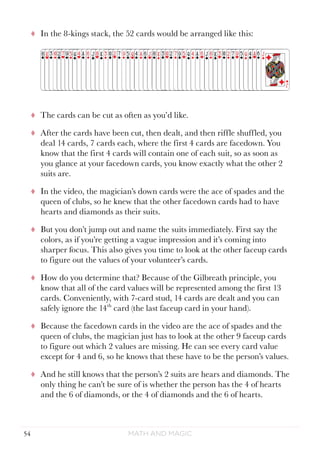
Topic
Hobby & Leisure
Subtopic
Math and Magic
Arthur T. Benjamin
Harvey Mudd College
Course Guidebook
Published by
THE GREAT COURSES
Corporate Headquarters
4840 Westfields Boulevard | Suite 500 | Chantilly, Virginia | 20151‑2299
[phone] 1.800.832.2412 | [fax] 703.378.3819 | [web] www.thegreatcourses.com
Copyright © The Teaching Company, 2018
Printed in the United States of America
This book is in copyright. All rights reserved. Without limiting the rights under copyright reserved above, no
part of this publication may be reproduced, stored in or introduced into a retrieval system, or transmitted, in
any form, or by any means (electronic, mechanical, photocopying, recording, or otherwise), without the prior
written permission of The Teaching Company.
iProfessor Biography
Arthur T. Benjamin, PhD
Smallwood Family Professor
of Mathematics
Harvey Mudd College
Arthur T. Benjamin is the Smallwood Family Professor of
Mathematics at Harvey Mudd College, where he has also served
as the chair of the Department of Mathematics. He earned his BS in
Applied Mathematics from Carnegie Mellon University and his PhD in
Mathematical Sciences from Johns Hopkins University.
From the Mathematical Association of America (MAA), Professor
Benjamin has received the Southern California-Nevada Section Award
for Distinguished College or University Teaching of Mathematics and
the national Deborah and Franklin Tepper Haimo Award. He was also
named the George Pólya Lecturer by the MAA from 2006 to 2008.
Professor Benjamin was chosen by The Princeton Review as one of its
Best 300 Professors. He was also selected as an inaugural Fellow of the
American Mathematical Society. Reader’s Digest named him “America’s
Best Math Whiz.”
Professor Benjamin’s research interests include combinatorics and number
theory, with a special fondness for Fibonacci numbers. Many of these
ideas appear in his book (coauthored with Jennifer Quinn) Proofs That
Really Count: The Art of Combinatorial Proof, which received the MAA’s
Beckenbach Book Prize. From 2004 to 2008, Professors Benjamin and
Quinn served as the coeditors of Math Horizons magazine. Professor
Benjamin’s mental calculation techniques are explained in his book Secrets
Math and Magicii
of Mental Math: The Mathemagician’s Guide to Lightning Calculation and
Amazing Math Tricks. Prolific math and science writer Martin Gardner
called the book “the clearest, simplest, most entertaining, and best book
yet on the art of calculating in your head.” Professor Benjamin’s most
recent book, The Magic of Math: Solving for x and Figuring Out Why, was a
New York Times Best Seller.
In addition to his academic career, Professor Benjamin is also a
professional magician who performs his mixture of math and magic to
audiences all over the world, including at the Magic Castle in Hollywood,
California. He has appeared on dozens of television and radio programs,
including the TODAY show and The Colbert Report as well as CNN and
National Public Radio. He has been featured in Scientific American, Omni,
Discover, People, Esquire, The New York Times, the Los Angeles Times, and
Reader’s Digest. Professor Benjamin has given numerous wide-reaching
TED Talks that have been viewed more than 20 million times.
Professor Benjamin’s other Great Courses are The Joy of Mathematics,
Discrete Mathematics, The Secrets of Mental Math, and The Mathematics of
Games and Puzzles: From Cards to Sudoku. ¨
iiiAcknowledgments
ACKNOWLEDGMENTS
Putting this course together was a true labor of love, and there are so
many people I wish to thank that made this course possible.
Professor Victoria Noquez was my primary research assistant on this
project, and her mathematical knowledge and magical expertise proved
invaluable. Thanks also to my department chair, Lisette de Pillis, and
John Sundeman for providing funds to support Dr. Noquez and for books,
props, materials, and travel that were essential to this project.
Naturally, there are many mathematicians and magicians to thank, many
of whose ideas and suggestions made their way into this course.
I am especially grateful to the following mathematicians: Barry Balof,
Steve Butler, Jay Cordes, Joyati Debnath, Doug Ensley, Allison Henrich,
John Harris, Jon Jacobsen, Jason Lee, Mario Micheli, Brent Morris, Colm
Mulcahy, Sam Nelson, Mohamed Omar, Michael Orrison, Matt Parker,
Lizard Reiland, Sarah Rundell, Ricardo Teixeira, Tadashi Tokieda,
Robert Vallin, and Glen Whitney.
For their magical assistance and advice, I am delighted to thank Paul
Gertner, Howard Hamburg, Jonathan Levitt, Max Maven, Brent Morris,
Diamond Jim Tyler, Phil Van Tee, and Magic Castle librarians Lisa
Cousins and Bill Goodwin. The following magicians, past and present,
were also a great source of inspiration: John Bannon, Alex Elmsley,
Norman Gilbreath, Bob Hummer, Nick Trost, and especially Martin
Gardner, who was the greatest mathemagician of all time and the most
prolific author in the field.
Special thanks to John Harris for creating the beautiful number logs, Bill
Ritchie of ThinkFun for the use of the Cheshire Cat geometrical vanish,
and especially Mario Micheli for his magic square templates, 3-D–printed
interlocking bagels, and other marvelously manufactured Möbius miracles.
For displaying their special talents on camera, I am grateful for the poker
prowess of Lizard Reiland, the perfect shuffling of Brent Morris, and
the beguiling bagel carving of Michelle Pellatt (with a shout-out to Glen
Whitney for providing us with expert instruction). Special thanks to whiz
Math and Magiciv
kids Lucy Ingram, Nikita Lugovoy, and Stephan Lugovoy for showing
off their calculating cleverness and to the many staff members from
The Great Courses who helped out as unsuspecting volunteers for my
magic tricks: Randy Kraemer, Tammy Cornelious, Kevin Barnhill, Art
Jaruphaiboon, Michelle Pellatt, Torrance Hill, Amy Derr, Mark Ginesi,
Leslie Meade, Andrew Volpe, Ines Perez Thompson, Kenya Hughes,
Courtney Westphal, Josh Rodriguez, James Nidel, Peter Dwyer, and Erin
O’Riley. Thanks also to the studio crew for this course: Roberto de Moraes
(director), Justin Thomas (camera), Kelly Tagliaferri (camera), and Sherri
Macdonald-Hagelen (production assistant). It is always a pleasure to work
with the staff of The Great Courses, both on camera and off. I especially
want to thank Maureen Faley and Michelle Pellatt for their tireless
devotion to this project.
Last but not least (indeed, most!), I thank my wife, Deena, and daughters
Laurel and Ariel, who supported me and assisted me throughout this
project. Thank you for bringing so much magic to my life! ¨
vTable of Contents
GUIDES
1	 Mathematical Card Tricks  . . . . . . . . . . . . . . . . . . . 3
2	 What’s Your Deal?  . . . . . . . . . . . . . . . . . . . . . . .  10
3	 Look like a Card Shark  . . . . . . . . . . . . . . . . . . . .  20
4	 The Deck Is Stacked . . . . . . . . . . . . . . . . . . . . . .  32
5	 Perfect Shuffles . . . . . . . . . . . . . . . . . . . . . . . . .  42
6	 Riffle Shuffles  . . . . . . . . . . . . . . . . . . . . . . . . . . . 51
7	 Magic with Numbers . . . . . . . . . . . . . . . . . . . . . .  57
8	 Look like a Genius  . . . . . . . . . . . . . . . . . . . . . . .  68
9	 The Magic of Nine  . . . . . . . . . . . . . . . . . . . . . . . . 81
10	 Look like a Psychic . . . . . . . . . . . . . . . . . . . . . . .  95
11	 Geometric and Topological Magic  . . . . . . . . . . . . 106
12	 Magic Squares . . . . . . . . . . . . . . . . . . . . . . . . . .  115
INTRODUCTION
Professor Biography . . . . . . . . . . . . . . . . . . . . . . . . . . . .  i
Acknowledgments . . . . . . . . . . . . . . . . . . . . . . . . . . . . . iii
Course Scope . . . . . . . . . . . . . . . . . . . . . . . . . . . . . . . . .  1
SUPPLEMENTARY MATERIAL
Bibliography  . . . . . . . . . . . . . . . . . . . . . . . . . . . . . . . . 124
Exercise Solutions . . . . . . . . . . . . . . . . . . . . . . . . . . . . . 126
TABLE OF CONTENTS
Math and Magicvi
1Course Scope
MATH AND MAGIC
On the surface, mathematics and magic seem to be very different,
yet they have an awful lot in common. In both subjects, you have a
problem to solve: What is the value of x? How did the magician find my
card? Both seem mysterious at first, but with a little bit of practice (okay,
sometimes a lot of practice), you can become quite good at both. And once
mastered, both subjects are a great deal of fun. Most people enjoy magic
tricks, especially if they are performed well, and one of the goals of this
course is that by the end of it you’ll enjoy math more, too—or at least see
how it can be applied in magical ways.
By the time you finish this course, you’ll learn to dazzle your friends and
family with some impressive feats designed to make you look like a card
shark, a psychic, a genius, or just a very talented magician.
None of the magic will involve any difficult sleight of hand. If there is any
physical dexterity required, it’ll be so easy to learn that you should be able
learn it in just a few minutes.
All the magic tricks in this course use ordinary, everyday objects, such as
cards, coins, and paper. Some of the tricks use numbers visibly, but with
some of them, the math is pretty well hidden.
The first 6 lessons focus on mathematical card tricks. In lesson 1,
the presence of mathematics is noticeably present, as cards are being
counted, added, or spelled out. In lesson 2, the mathematics is much
more concealed, as cards are being mixed and dealt, culminating in the
appearance of 4 aces and a royal flush. You’ll also learn how to create the
illusion of being able to memorize a well-mixed deck of cards. In lesson 3,
you’ll learn how to handle cards like a professional gambler—whether
that involves cutting to the 4 aces, always winning at high-card poker, or
determining the facedown card in a game of stud poker.
Imagine being given any number of cards from a deck and being able to
determine the exact number of cards by seemingly weighing the cards
in your hand. One way of doing this is shown in lesson 4, where you’ll
learn how to perform miracles with a stacked deck. In lesson 5, you’ll
Math and Magic2
learn the mathematical properties of various kinds of shuffles, including
the perfect shuffle, in which the cards are interleaved so precisely that,
despite outward appearances, the location of the cards is still known to
the magician. In lesson 6—the final card lesson—you’ll discover that even
when the cards are mixed imperfectly after being cut and given a riffle
shuffle, there are still many astonishing miracles that can be performed
using the Gilbreath principle, a surprisingly beautiful application
of mathematics.
In the second half of the course, you’ll turn your attention away from cards
and explore magical topics designed to make you look like a psychic or a
genius—or a mathemagician. In lesson 7, you’ll discover magic tricks based
solely on numbers, including the Fibonacci numbers and the golden ratio.
You’ll also briefly explore the underlying algebra that makes the magic
happen. Imagine being able to add, divide, and multiply numbers faster
than a calculator; in lesson 8, you’ll learn the tricks of the trade that are
so easy even children can do them with just a small amount of practice. In
lesson 9, special attention will be given to the number 9, which has a magic
all its own, including a way to determine someone’s age by performing a
few simple calculations.
In lesson 10, you’ll use everyday objects—such as coins, dice, and
calculators—to give you the appearance of possessing psychic powers.
You’ll have fun with geometrical and topological magic in lesson 11,
where you’ll learn how to make a (paper) rabbit disappear by the power of
mathematics and explore the marvelously magical properties of Möbius
strips. You’ll even learn how to carve a bagel into 2 identical halves that
are completely linked together. Finally, in lesson 12, you’ll explore a topic
that has been the object of fascination of mathematicians and magicians
alike: magic squares. You’ll even learn the instructor’s own method for
creating a magic square based on anyone’s birthday.
Now go get yourself a deck of cards, prepare to be amazed, and soon you’ll
be amazing others! ¨
Lesson 1 ♠ Mathematical Card Tricks 3
LESSON 1
MATHEMATICAL
CARD TRICKS
This first lesson will focus on card tricks in
which there is clearly some mathematics being
used but the secret is not so easy to figure out. To
get started, all you need is a complete deck of 52
cards (no jokers).
EXPLANATIONS
SPELLER
tt In this trick, you mix up 9 cards and then look at the third card from
the top.
tt When you spell your card’s value, it will have at least 3 letters.
A-C-E F-O-U-R S-E-V-E-N T-E-N K-I-N-G
T-W-O F-I-V-E E-I-G-H-T J-A-C-K
T-H-R-E-E S-I-X N-I-N-E Q-U-E-E-N
This book includes explanations for the tricks performed in the video by
mathemagician Arthur T. Benjamin.
1
Math and Magic4 ©mizar_21984/iStock/Thinkstock.
tt When this trick was performed for you, the third card was the 10 of
clubs. But no matter what it is, after you spell it, it will be third from
the bottom. After spelling the word “of,” the card is now fifth from the
bottom (which is also fifth from the top). And after spelling any suit—
spades, hearts, diamonds, or clubs—because they all have at least 5
letters, your card will still be fifth from the top.
tt Finally, because the word “magic” has 5 letters, you are guaranteed to
end on the chosen card.
MATHEMATICAL DECK
tt The final trick that was performed in the video lesson has a more
complicated secret. The advantage of doing this one after the spelling
trick is that you already have 9 cards in use. If you don’t do the spelling
trick, then just have the cards shuffled and deal out 9 cards. Then, have
a volunteer pick one of them and put it on top of the pile.
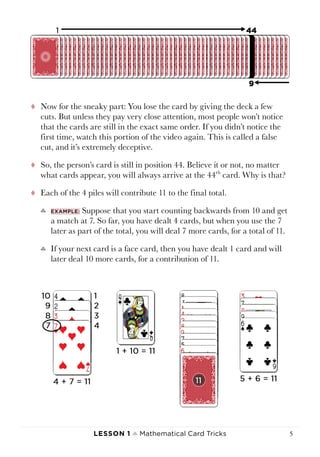
tt After placing the deck on top, where is the person’s card now? It is ninth
from the bottom, which means there are 43 cards above it. Thus, the
card is in position 44.
Magicians are not supposed to reveal their secrets. But by taking this
course, you are considered a serious student of magic, so sharing this
information is allowed. Also, nearly all of the tricks in this course are
based on mathematics, and math should be open to everyone.
However, if you perform these tricks for your family or friends, you’ll find
that they will be much more amazed if you keep the secrets to yourself.
Lesson 1 ♠ Mathematical Card Tricks 5
tt Now for the sneaky part: You lose the card by giving the deck a few
cuts. But unless they pay very close attention, most people won’t notice
that the cards are still in the exact same order. If you didn’t notice the
first time, watch this portion of the video again. This is called a false
cut, and it’s extremely deceptive.
tt So, the person’s card is still in position 44. Believe it or not, no matter
what cards appear, you will always arrive at the 44th
card. Why is that?
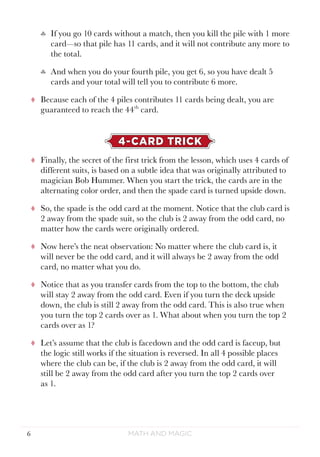
tt Each of the 4 piles will contribute 11 to the final total.
♣♣ Example: Suppose that you start counting backwards from 10 and get
a match at 7. So far, you have dealt 4 cards, but when you use the 7
later as part of the total, you will deal 7 more cards, for a total of 11.
♣♣ If your next card is a face card, then you have dealt 1 card and will
later deal 10 more cards, for a contribution of 11.
Math and Magic6
♣♣ If you go 10 cards without a match, then you kill the pile with 1 more
card—so that pile has 11 cards, and it will not contribute any more to
the total.
♣♣ And when you do your fourth pile, you get 6, so you have dealt 5
cards and your total will tell you to contribute 6 more.
tt Because each of the 4 piles contributes 11 cards being dealt, you are
guaranteed to reach the 44th
card.
4-CARD TRICK
tt Finally, the secret of the first trick from the lesson, which uses 4 cards of
different suits, is based on a subtle idea that was originally attributed to
magician Bob Hummer. When you start the trick, the cards are in the
alternating color order, and then the spade card is turned upside down.
tt So, the spade is the odd card at the moment. Notice that the club card is
2 away from the spade suit, so the club is 2 away from the odd card, no
matter how the cards were originally ordered.
tt Now here’s the neat observation: No matter where the club card is, it
will never be the odd card, and it will always be 2 away from the odd
card, no matter what you do.
tt Notice that as you transfer cards from the top to the bottom, the club
will stay 2 away from the odd card. Even if you turn the deck upside
down, the club is still 2 away from the odd card. This is also true when
you turn the top 2 cards over as 1. What about when you turn the top 2
cards over as 1?
tt Let’s assume that the club is facedown and the odd card is faceup, but
the logic still works if the situation is reversed. In all 4 possible places
where the club can be, if the club is 2 away from the odd card, it will
still be 2 away from the odd card after you turn the top 2 cards over
as 1.
Lesson 1 ♠ Mathematical Card Tricks 7
tt This is called the invariant principle, which means that even though the
order of the cards is changing, there is some quality that stays the same.
In this case, the invariant is that the club will always be 2 away from
the odd card.
tt Finally, you will go through your final flipping procedure at the end of
the trick, flipping 1 card, then 2, then 3, and then 4. Let’s look at all 4
situations where the club could be and see what happens after you do
your final flipping procedure. You will start with the club faceup, but
the same logic applies when you start with the club facedown.
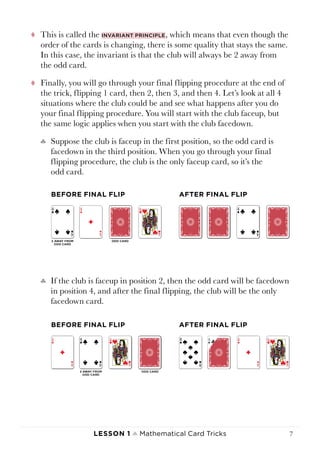
♣♣ Suppose the club is faceup in the first position, so the odd card is
facedown in the third position. When you go through your final
flipping procedure, the club is the only faceup card, so it’s the
odd card.
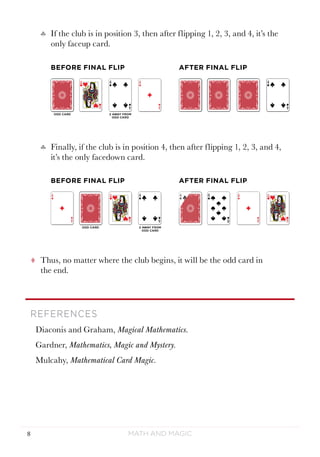
♣♣ If the club is faceup in position 2, then the odd card will be facedown
in position 4, and after the final flipping, the club will be the only
facedown card.
BEFORE FINAL FLIP AFTER FINAL FLIP
Math and Magic8
tt Thus, no matter where the club begins, it will be the odd card in
the end.
REFERENCES
Diaconis and Graham, Magical Mathematics.
Gardner, Mathematics, Magic and Mystery.
Mulcahy, Mathematical Card Magic.
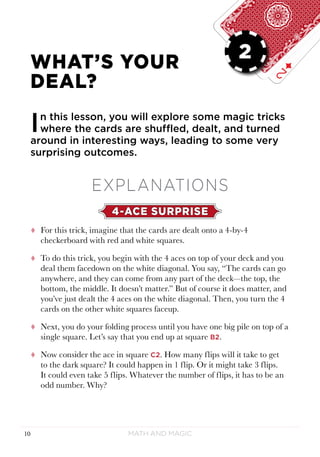
♣♣ Finally, if the club is in position 4, then after flipping 1, 2, 3, and 4,
it’s the only facedown card.
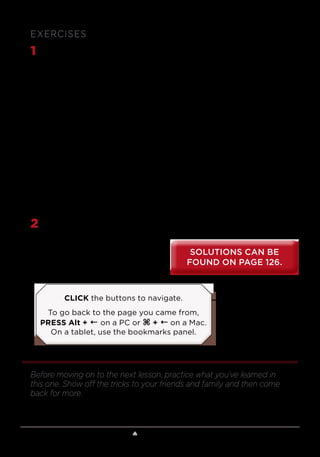
♣♣ If the club is in position 3, then after flipping 1, 2, 3, and 4, it’s the
only faceup card.
BEFORE FINAL FLIP AFTER FINAL FLIP
Lesson 1 ♠ Mathematical Card Tricks 9
EXERCISES
1	 One of the first mathematical card tricks that people learn is known
as the 21-card trick or the princess card trick. It is an easy trick to
do, and the magician never has to look at the cards at any point in
the trick. The magician begins by showing 21 cards, displayed in 3
columns of cards, each with 7 cards. The volunteer is asked to think of
a card and to indicate which column it is in. The cards are gathered,
one column at a time, with the selected pile sandwiched between the
other 2 columns. The 21 cards are redealt into 3 columns, one card at
a time, with the first card going to column 1, the second card going to
column 2, and so on, and the spectator is again asked which column
the card is in. Again, the columns are gathered with the selected
column between the other 2. This process is repeated one more time—
after which the magician deals all the cards into a single pile, and after
a bunch of cards are dealt, he or she claims that the next card that is
turned over will be the selected card. Although the volunteer is often
skeptical, the magician turns over the selected card. What’s the secret?
2	 Explain the “tearable” card trick at the end of the video lesson.
Before moving on to the next lesson, practice what you’ve learned in
this one. Show off the tricks to your friends and family and then come
back for more.
SOLUTIONS CAN BE
FOUND ON PAGE 126.
SOLUTIONS CAN BE
FOUND ON PAGE 126.
CLICK the buttons to navigate.
To go back to the page you came from,
PRESS Alt + ← on a PC or ⌘ + ← on a Mac.
On a tablet, use the bookmarks panel.
Math and Magic10
LESSON 2
WHAT’S YOUR
DEAL?
In this lesson, you will explore some magic tricks
where the cards are shuffled, dealt, and turned
around in interesting ways, leading to some very
surprising outcomes.
EXPLANATIONS
4-ACE SURPRISE
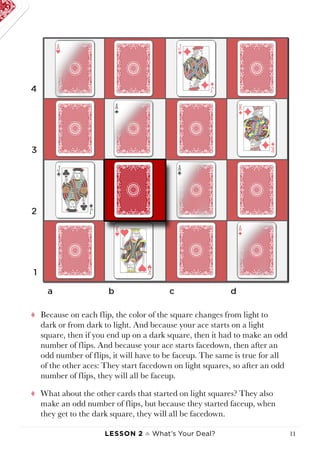
tt For this trick, imagine that the cards are dealt onto a 4-by-4
checkerboard with red and white squares.
tt To do this trick, you begin with the 4 aces on top of your deck and you
deal them facedown on the white diagonal. You say, “The cards can go
anywhere, and they can come from any part of the deck—the top, the
bottom, the middle. It doesn’t matter.” But of course it does matter, and
you’ve just dealt the 4 aces on the white diagonal. Then, you turn the 4
cards on the other white squares faceup.
tt Next, you do your folding process until you have one big pile on top of a
single square. Let’s say that you end up at square B2.
tt Now consider the ace in square C2. How many flips will it take to get
to the dark square? It could happen in 1 flip. Or it might take 3 flips.
It could even take 5 flips. Whatever the number of flips, it has to be an
odd number. Why?
2
Lesson 2 ♠ What’s Your Deal? 11
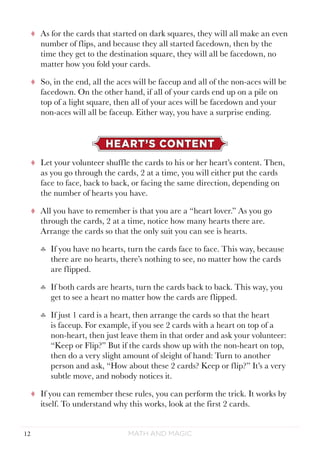
tt Because on each flip, the color of the square changes from light to
dark or from dark to light. And because your ace starts on a light
square, then if you end up on a dark square, then it had to make an odd
number of flips. And because your ace starts facedown, then after an
odd number of flips, it will have to be faceup. The same is true for all
of the other aces: They start facedown on light squares, so after an odd
number of flips, they will all be faceup.
tt What about the other cards that started on light squares? They also
make an odd number of flips, but because they started faceup, when
they get to the dark square, they will all be facedown.
Math and Magic12
tt As for the cards that started on dark squares, they will all make an even
number of flips, and because they all started facedown, then by the
time they get to the destination square, they will all be facedown, no
matter how you fold your cards.
tt So, in the end, all the aces will be faceup and all of the non-aces will be
facedown. On the other hand, if all of your cards end up on a pile on
top of a light square, then all of your aces will be facedown and your
non-aces will all be faceup. Either way, you have a surprise ending.
HEART’S CONTENT
tt Let your volunteer shuffle the cards to his or her heart’s content. Then,
as you go through the cards, 2 at a time, you will either put the cards
face to face, back to back, or facing the same direction, depending on
the number of hearts you have.
tt All you have to remember is that you are a “heart lover.” As you go
through the cards, 2 at a time, notice how many hearts there are.
Arrange the cards so that the only suit you can see is hearts.
♣♣ If you have no hearts, turn the cards face to face. This way, because
there are no hearts, there’s nothing to see, no matter how the cards
are flipped.
♣♣ If both cards are hearts, turn the cards back to back. This way, you
get to see a heart no matter how the cards are flipped.
♣♣ If just 1 card is a heart, then arrange the cards so that the heart
is faceup. For example, if you see 2 cards with a heart on top of a
non-heart, then just leave them in that order and ask your volunteer:
“Keep or Flip?” But if the cards show up with the non-heart on top,
then do a very slight amount of sleight of hand: Turn to another
person and ask, “How about these 2 cards? Keep or flip?” It’s a very
subtle move, and nobody notices it.
tt If you can remember these rules, you can perform the trick. It works by
itself. To understand why this works, look at the first 2 cards.
Lesson 2 ♠ What’s Your Deal? 13
tt All 3 rules produce the same situation: Where will the hearts be? Either
they are faceup on top or facedown on the bottom. This will be true
even if the cards are flipped.
tt The same is true with the next pair of cards—3 and 4.
tt After you’re done going through the cards, where will the hearts be?
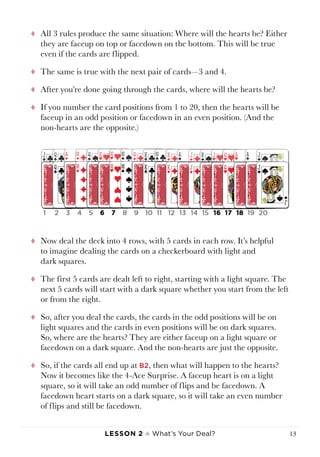
tt If you number the card positions from 1 to 20, then the hearts will be
faceup in an odd position or facedown in an even position. (And the
non-hearts are the opposite.)
tt Now deal the deck into 4 rows, with 5 cards in each row. It’s helpful
to imagine dealing the cards on a checkerboard with light and
dark squares.
tt The first 5 cards are dealt left to right, starting with a light square. The
next 5 cards will start with a dark square whether you start from the left
or from the right.
tt So, after you deal the cards, the cards in the odd positions will be on
light squares and the cards in even positions will be on dark squares.
So, where are the hearts? They are either faceup on a light square or
facedown on a dark square. And the non-hearts are just the opposite.
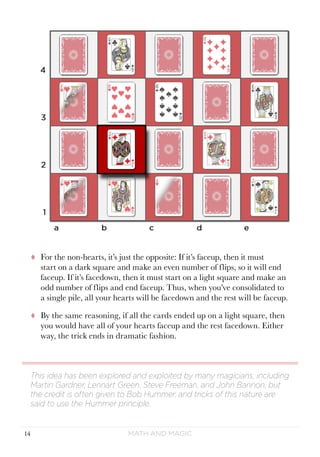
tt So, if the cards all end up at B2, then what will happen to the hearts?
Now it becomes like the 4-Ace Surprise. A faceup heart is on a light
square, so it will take an odd number of flips and be facedown. A
facedown heart starts on a dark square, so it will take an even number
of flips and still be facedown.
Math and Magic14
tt For the non-hearts, it’s just the opposite: If it’s faceup, then it must
start on a dark square and make an even number of flips, so it will end
faceup. If it’s facedown, then it must start on a light square and make an
odd number of flips and end faceup. Thus, when you’ve consolidated to
a single pile, all your hearts will be facedown and the rest will be faceup.
tt By the same reasoning, if all the cards ended up on a light square, then
you would have all of your hearts faceup and the rest facedown. Either
way, the trick ends in dramatic fashion.
This idea has been explored and exploited by many magicians, including
Martin Gardner, Lennart Green, Steve Freeman, and John Bannon, but
the credit is often given to Bob Hummer, and tricks of this nature are
said to use the Hummer principle.
Lesson 2 ♠ What’s Your Deal? 15
CARD MEMORY
tt Believe it or not, despite all of the shuffling, cutting, flipping, and
transferring of cards in this trick, the magician knew exactly where
all the cards would end up. This is sort of like the 4-Ace Surprise on
steroids! As you’ll see, the cards that Tammy and Randy end up with
are exactly the same cards that they started with.
tt The magician placed the jokers in the very middle of the deck. When
he removed the jokers, he gave the cards below the jokers to Randy and
the top cards to Tammy.
tt The top cards are the ones that the magician “memorized.” He chose
these cards to make them easy to remember. And once you know the
pattern, you’ll never forget them!
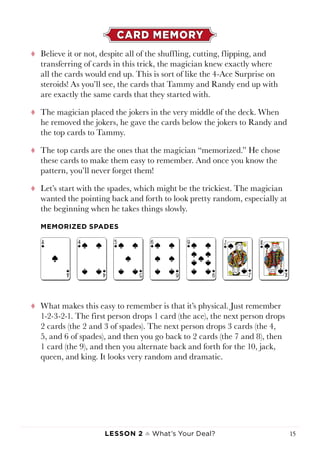
tt Let’s start with the spades, which might be the trickiest. The magician
wanted the pointing back and forth to look pretty random, especially at
the beginning when he takes things slowly.
tt What makes this easy to remember is that it’s physical. Just remember
1-2-3-2-1. The first person drops 1 card (the ace), the next person drops
2 cards (the 2 and 3 of spades). The next person drops 3 cards (the 4,
5, and 6 of spades), and then you go back to 2 cards (the 7 and 8), then
1 card (the 9), and then you alternate back and forth for the 10, jack,
queen, and king. It looks very random and dramatic.
MEMORIZED SPADES
Math and Magic16
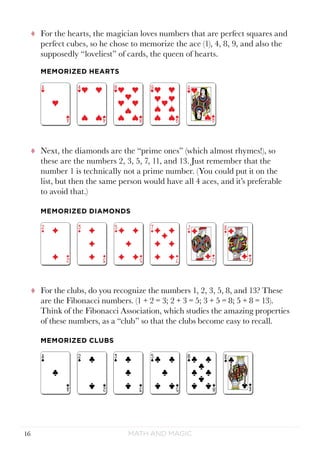
tt For the hearts, the magician loves numbers that are perfect squares and
perfect cubes, so he chose to memorize the ace (1), 4, 8, 9, and also the
supposedly “loveliest” of cards, the queen of hearts.
tt Next, the diamonds are the “prime ones” (which almost rhymes!), so
these are the numbers 2, 3, 5, 7, 11, and 13. Just remember that the
number 1 is technically not a prime number. (You could put it on the
list, but then the same person would have all 4 aces, and it’s preferable
to avoid that.)
tt For the clubs, do you recognize the numbers 1, 2, 3, 5, 8, and 13? These
are the Fibonacci numbers. (1 + 2 = 3; 2 + 3 = 5; 3 + 5 = 8; 5 + 8 = 13).
Think of the Fibonacci Association, which studies the amazing properties
of these numbers, as a “club” so that the clubs become easy to recall.
MEMORIZED DIAMONDS
MEMORIZED HEARTS
MEMORIZED CLUBS
Lesson 2 ♠ What’s Your Deal? 17
tt Feel free to modify the list of memorized cards however you like;
whatever will make it easiest for you to remember is what you should use.
tt Now that you’ve memorized all the suits, how do you know they will all
end back together? Initially, all the memorized cards are facedown on
your right (and the other cards are facedown on your left). Remember
that every time you move a pile from one side to the other, you turn it
over. That’s important.
tt The ace of spades starts facedown on your right, and if it stays there,
then it will stay facedown. But if you move it, then it becomes faceup on
your left, where it will stay unless it gets moved back, in which case it
will be facedown on your right.
tt In other words, no matter how much transferring of cards you do, the
ace of spades will either be facedown on your right or faceup on your
left. So, when the process finishes, the ace of spades—and all the cards
that you have memorized—will be facedown on your right or facedown
on your left.
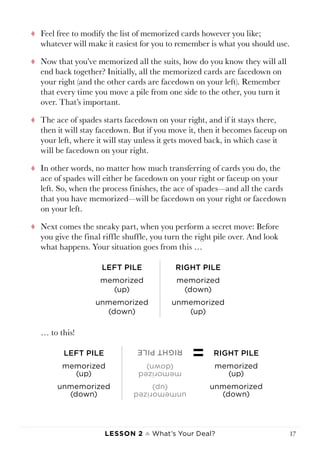
tt Next comes the sneaky part, when you perform a secret move: Before
you give the final riffle shuffle, you turn the right pile over. And look
what happens. Your situation goes from this …
LEFT PILE RIGHT PILE
memorized
(up)
memorized
(down)
unmemorized
(down)
unmemorized
(up)
… to this!
LEFT PILE
RIGHTPILE
RIGHT PILE
memorized
(up)
memorized
(down)
memorized
(up)
unmemorized
(down)
unmemorized
(up)
unmemorized
(down)
Math and Magic18
©sidmay/iStock/Thinkstock.
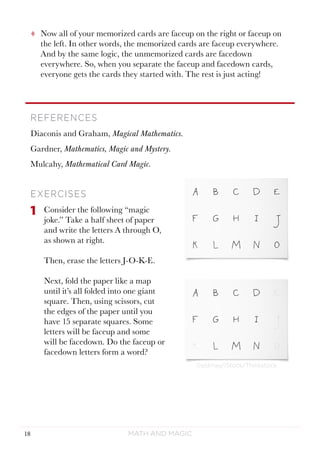
tt Now all of your memorized cards are faceup on the right or faceup on
the left. In other words, the memorized cards are faceup everywhere.
And by the same logic, the unmemorized cards are facedown
everywhere. So, when you separate the faceup and facedown cards,
everyone gets the cards they started with. The rest is just acting!
REFERENCES
Diaconis and Graham, Magical Mathematics.
Gardner, Mathematics, Magic and Mystery.
Mulcahy, Mathematical Card Magic.
EXERCISES
1	 Consider the following “magic
joke.” Take a half sheet of paper
and write the letters A through O,
as shown at right.
Then, erase the letters J-O-K-E.
Next, fold the paper like a map
until it’s all folded into one giant
square. Then, using scissors, cut
the edges of the paper until you
have 15 separate squares. Some
letters will be faceup and some
will be facedown. Do the faceup or
facedown letters form a word?
Lesson 2 ♠ What’s Your Deal? 19
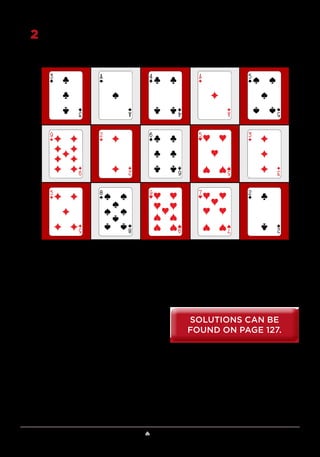
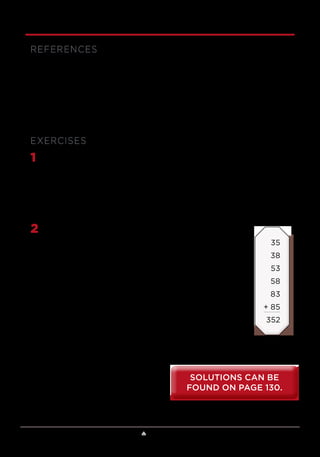
2	 This time, let’s use number cards. Deal the following 15 number cards
(inspired by the digits of pi) on a table.
Next, fold the cards in any order you wish, folding the left, right, top,
and bottom edges until you are left with a single pile of cards, some of
which are faceup and some of which are facedown. What will be the
sum of the faceup cards?
SOLUTIONS CAN BE
FOUND ON PAGE 127.
SOLUTIONS CAN BE
FOUND ON PAGE 127.
Math and Magic20
LESSON 3
LOOK LIKE A
CARD SHARK
People assume that magicians must be skillful
card players, yet we all have the ability to
perform card miracles—if we allow our inner
magic to flow. In this lesson, you will learn some
magic tricks that are designed to make you look
like a professional gambler or card shark.
EXPLANATIONS
SPECTATOR CUTS TO THE ACES
tt This is a fun and easy trick to perform. You start with the aces on the
top of the deck. If you want, you can even give the deck a riffle shuffle
that keeps the 4 aces on the top.
tt After your spectator has cut into 4 piles, make sure you remember
which pile has the 4 aces on top. For example, have the person first cut
the cards to your right and then cut each pile toward you. This way,
the pile of aces is always the pile closest to you on the right. (You’ll turn
those aces faceup so that you can watch what happens to them.)
tt With the first pile on your left, you deal 3 cards down and then 3 across
the tops of the other piles. This adds 1 card to the pile with the aces.
tt Then, you let the spectator do the same with the other 3 piles, ending with
the pile on your right. Now, when your spectator gets to the last pile, he or
she deals 3 cards down and then 3 cards across and end up with an ace on
each pile! It’s a very easy trick to do, but it always gets a big reaction.
3
Lesson 3 ♠ Look like a Card Shark 21
ALWAYS WIN AT POKER
tt The secret to learning how to never lose in poker is really quite clever.
In the video, the magician only played with the 9s through aces, but
what he didn’t tell you was that only 3 of each of these cards were
used—9s, 10s, jacks, queens, kings, and aces—for a total of 18 cards.
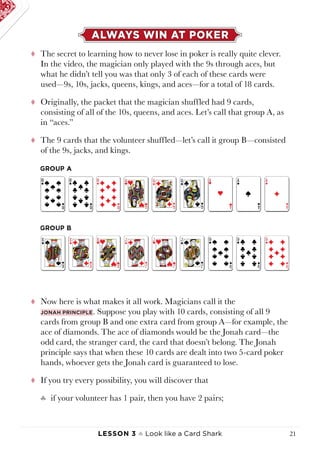
tt Originally, the packet that the magician shuffled had 9 cards,
consisting of all of the 10s, queens, and aces. Let’s call that group A, as
in “aces.”
tt The 9 cards that the volunteer shuffled—let’s call it group B—consisted
of the 9s, jacks, and kings.
tt Now here is what makes it all work. Magicians call it the
Jonah principle. Suppose you play with 10 cards, consisting of all 9
cards from group B and one extra card from group A—for example, the
ace of diamonds. The ace of diamonds would be the Jonah card—the
odd card, the stranger card, the card that doesn’t belong. The Jonah
principle says that when these 10 cards are dealt into two 5-card poker
hands, whoever gets the Jonah card is guaranteed to lose.
tt If you try every possibility, you will discover that
♣♣ if your volunteer has 1 pair, then you have 2 pairs;
Math and Magic22
♣♣ if your volunteer has 2 pairs, then
you have 3 of a kind; and
♣♣ if your volunteer has 3 of a kind,
then you have a full house.
tt The upshot is that if your volunteer ends up with the Jonah card, then
he or she is guaranteed to lose the hand. The challenge for you, as a
magician, is to give your volunteer the Jonah card without him or her
realizing it. Here’s how to do it. It’s pretty sneaky.
tt You begin by shuffling the 9 cards of group A while your volunteer
shuffles the 9 cards of group B. Then, you let him or her shuffle the
cards of group A, and you place one pile on top of the other.
tt It doesn’t matter which pile goes on top, so let’s say that pile B is on the
top. You now give your volunteer the cards and ask him or her to deal
10 cards. As is the custom when dealing, he or she deals the cards one at
a time, back and forth, starting with you.
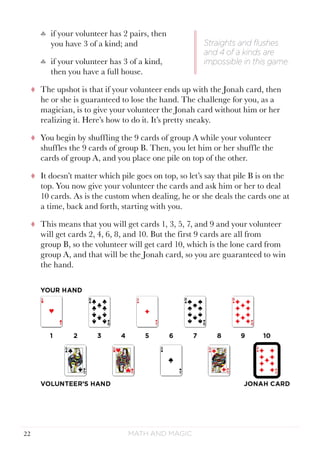
tt This means that you will get cards 1, 3, 5, 7, and 9 and your volunteer
will get cards 2, 4, 6, 8, and 10. But the first 9 cards are all from
group B, so the volunteer will get card 10, which is the lone card from
group A, and that will be the Jonah card, so you are guaranteed to win
the hand.
Straights and flushes
and 4 of a kinds are
impossible in this game.
Lesson 3 ♠ Look like a Card Shark 23
tt Conveniently, when you flip over your volunteer’s cards, the Jonah card
will be at the bottom of his or her pile. You place your cards faceup
on top of your volunteer’s, and when you turn that pile facedown, the
Jonah card will be on top.
tt So, these cards have a card from group A on top, followed by 9 cards
from group B. When your volunteer shuffles the remaining 8 cards,
which are all from group A, and then places them on top, then the first
9 cards will be from group A and the 10th
card will be from group B, so
when your volunteer deals the cards back and forth, you will win again.
tt Once again, you place your cards faceup on top of your volunteer’s and
turn the pile over, so the top card is from group B and the rest are from
group A. When he or she shuffles the remaining 8 cards and puts them
on top, you are back to the setup with 9 cards from group B and then 9
cards from group A.
tt In the last phase of the trick, you tell
your volunteer that you will deal the
cards. Then, ask him or her, “Do you
want us to use the top 10 cards or the
bottom 10 cards?” If your volunteer
wants the bottom half, then you
quickly remove the top 8 cards and
you will have 10 cards left over, with
the Jonah card on top.
tt If instead your volunteer asks for the top 10 cards, then you deal the
cards 1 at a time on the table, counting 1 through 10, putting the other
cards aside, and again the Jonah card will be on top.
tt Either way, the Jonah card is on top. So, when you deal the 2 cards
facedown, starting with your volunteer, he or she is guaranteed to get
the Jonah card, so you are guaranteed to win the hand, no matter what
choices your volunteer makes afterward.
At no point in the trick do
you tell the audience that
you have exactly 18 cards.
Many people will assume
that you are using 20 or
24 cards, which is fine.
That will make it much
harder to figure out later.
Math and Magic24
5-CARD STUD
tt This trick, known as Cheney’s 5-card trick, is a perfect blend of
mathematics and magic. It involves teaching your assistant a special
code so that when he or she looks at 4 faceup cards, he or she can figure
out the facedown card.
tt Keep in mind that when your volunteer gives you the cards, you choose
which card goes facedown and how to arrange the 4 other cards. No
matter what 5 cards he or she gives you, there will always be a way to
arrange them that will tell your assistant exactly what the facedown
card is.
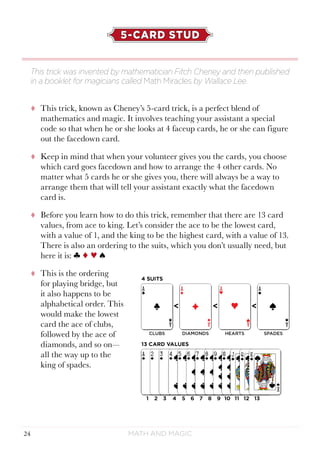
tt Before you learn how to do this trick, remember that there are 13 card
values, from ace to king. Let’s consider the ace to be the lowest card,
with a value of 1, and the king to be the highest card, with a value of 13.
There is also an ordering to the suits, which you don’t usually need, but
here it is: § ¨ ♥ ª
tt This is the ordering
for playing bridge, but
it also happens to be
alphabetical order. This
would make the lowest
card the ace of clubs,
followed by the ace of
diamonds, and so on—
all the way up to the
king of spades.
This trick was invented by mathematician Fitch Cheney and then published
in a booklet for magicians called Math Miracles by Wallace Lee.
Lesson 3 ♠ Look like a Card Shark 25
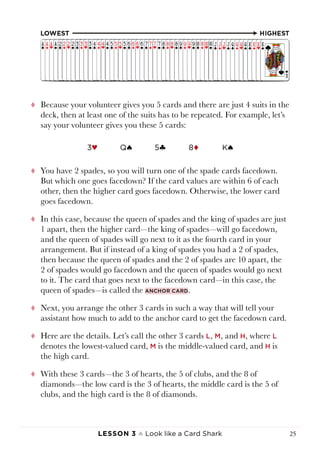
tt Because your volunteer gives you 5 cards and there are just 4 suits in the
deck, then at least one of the suits has to be repeated. For example, let’s
say your volunteer gives you these 5 cards:
3♥ Qª 5§ 8¨ Kª
tt You have 2 spades, so you will turn one of the spade cards facedown.
But which one goes facedown? If the card values are within 6 of each
other, then the higher card goes facedown. Otherwise, the lower card
goes facedown.
tt In this case, because the queen of spades and the king of spades are just
1 apart, then the higher card—the king of spades—will go facedown,
and the queen of spades will go next to it as the fourth card in your
arrangement. But if instead of a king of spades you had a 2 of spades,
then because the queen of spades and the 2 of spades are 10 apart, the
2 of spades would go facedown and the queen of spades would go next
to it. The card that goes next to the facedown card—in this case, the
queen of spades—is called the anchor card.
tt Next, you arrange the other 3 cards in such a way that will tell your
assistant how much to add to the anchor card to get the facedown card.
tt Here are the details. Let’s call the other 3 cards L, M, and H, where L
denotes the lowest-valued card, M is the middle-valued card, and H is
the high card.
tt With these 3 cards—the 3 of hearts, the 5 of clubs, and the 8 of
diamonds—the low card is the 3 of hearts, the middle card is the 5 of
clubs, and the high card is the 8 of diamonds.
Math and Magic26
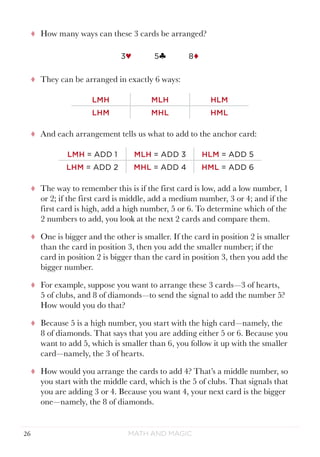
tt How many ways can these 3 cards be arranged?
3♥ 5§ 8¨
tt They can be arranged in exactly 6 ways:
LMH MLH HLM
LHM MHL HML
tt And each arrangement tells us what to add to the anchor card:
LMH = ADD 1 MLH = ADD 3 HLM = ADD 5
LHM = ADD 2 MHL = ADD 4 HML = ADD 6
tt The way to remember this is if the first card is low, add a low number, 1
or 2; if the first card is middle, add a medium number, 3 or 4; and if the
first card is high, add a high number, 5 or 6. To determine which of the
2 numbers to add, you look at the next 2 cards and compare them.
tt One is bigger and the other is smaller. If the card in position 2 is smaller
than the card in position 3, then you add the smaller number; if the
card in position 2 is bigger than the card in position 3, then you add the
bigger number.
tt For example, suppose you want to arrange these 3 cards—3 of hearts,
5 of clubs, and 8 of diamonds—to send the signal to add the number 5?
How would you do that?
tt Because 5 is a high number, you start with the high card—namely, the
8 of diamonds. That says that you are adding either 5 or 6. Because you
want to add 5, which is smaller than 6, you follow it up with the smaller
card—namely, the 3 of hearts.
tt How would you arrange the cards to add 4? That’s a middle number, so
you start with the middle card, which is the 5 of clubs. That signals that
you are adding 3 or 4. Because you want 4, your next card is the bigger
one—namely, the 8 of diamonds.
Lesson 3 ♠ Look like a Card Shark 27
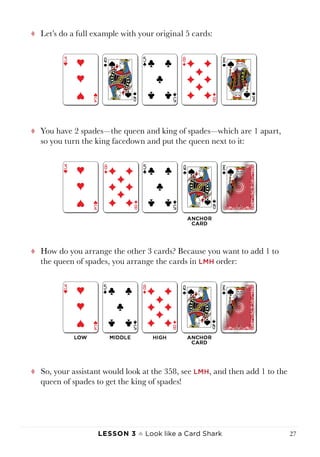
tt Let’s do a full example with your original 5 cards:
tt You have 2 spades—the queen and king of spades—which are 1 apart,
so you turn the king facedown and put the queen next to it:
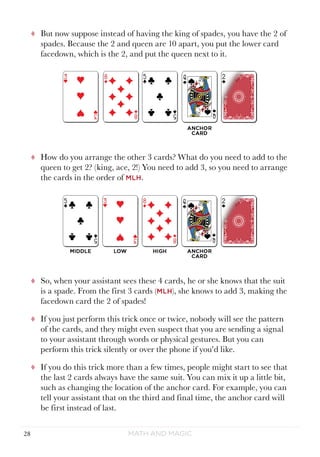
tt How do you arrange the other 3 cards? Because you want to add 1 to
the queen of spades, you arrange the cards in LMH order:
tt So, your assistant would look at the 358, see LMH, and then add 1 to the
queen of spades to get the king of spades!
Math and Magic28
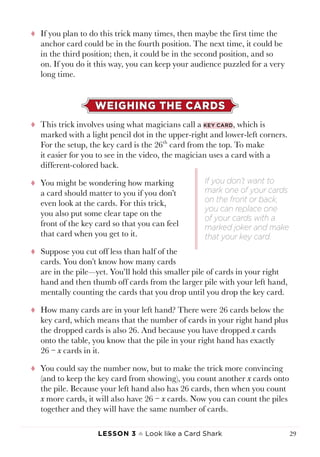
tt But now suppose instead of having the king of spades, you have the 2 of
spades. Because the 2 and queen are 10 apart, you put the lower card
facedown, which is the 2, and put the queen next to it.
tt How do you arrange the other 3 cards? What do you need to add to the
queen to get 2? (king, ace, 2!) You need to add 3, so you need to arrange
the cards in the order of MLH.
tt So, when your assistant sees these 4 cards, he or she knows that the suit
is a spade. From the first 3 cards (MLH), she knows to add 3, making the
facedown card the 2 of spades!
tt If you just perform this trick once or twice, nobody will see the pattern
of the cards, and they might even suspect that you are sending a signal
to your assistant through words or physical gestures. But you can
perform this trick silently or over the phone if you’d like.
tt If you do this trick more than a few times, people might start to see that
the last 2 cards always have the same suit. You can mix it up a little bit,
such as changing the location of the anchor card. For example, you can
tell your assistant that on the third and final time, the anchor card will
be first instead of last.
Lesson 3 ♠ Look like a Card Shark 29
tt If you plan to do this trick many times, then maybe the first time the
anchor card could be in the fourth position. The next time, it could be
in the third position; then, it could be in the second position, and so
on. If you do it this way, you can keep your audience puzzled for a very
long time.
WEIGHING THE CARDS
tt This trick involves using what magicians call a key card, which is
marked with a light pencil dot in the upper-right and lower-left corners.
For the setup, the key card is the 26th
card from the top. To make
it easier for you to see in the video, the magician uses a card with a
different-colored back.
tt You might be wondering how marking
a card should matter to you if you don’t
even look at the cards. For this trick,
you also put some clear tape on the
front of the key card so that you can feel
that card when you get to it.
tt Suppose you cut off less than half of the
cards. You don’t know how many cards
are in the pile—yet. You’ll hold this smaller pile of cards in your right
hand and then thumb off cards from the larger pile with your left hand,
mentally counting the cards that you drop until you drop the key card.
tt How many cards are in your left hand? There were 26 cards below the
key card, which means that the number of cards in your right hand plus
the dropped cards is also 26. And because you have dropped x cards
onto the table, you know that the pile in your right hand has exactly
26 − x cards in it.
tt You could say the number now, but to make the trick more convincing
(and to keep the key card from showing), you count another x cards onto
the pile. Because your left hand also has 26 cards, then when you count
x more cards, it will also have 26 − x cards. Now you can count the piles
together and they will have the same number of cards.
If you don’t want to
mark one of your cards
on the front or back,
you can replace one
of your cards with a
marked joker and make
that your key card.
Math and Magic30
tt In general, when you take the larger pile, if the key card is the nth
card
that you drop, then the smaller pile has 26 − n cards in it. If you drop n
more cards on top of the key card, then both piles will match.
tt When you are done with this trick, the key card has n cards on top of
it, so it is in position n + 1. If you take the top of these cards and scoop
all of the cards below it, the key card will be in position n, so when you
put it underneath either of the counted piles, it will be back in the 26th
position and you’re ready to perform the trick again.
REFERENCES
Fulves, Self-Working Card Tricks.
Mulcahy, Mathematical Card Magic.
Scarne, Scarne on Card Tricks.
EXERCISES
1	 Consider the following card arrangements in Cheney’s 5-card trick. In
each example, the anchor card will be the fourth card. Determine the
facedown card.
a) 5♥ 9ª 10ª 6¨
b) 8♥ J¨ 3ª 8ª
c) K¨ 4♥ Aª J¨
d) 6¨ 9ª 9♥ 4§
2	 Naturally, if the anchor card is always the fourth card, then people will
discover part of the secret pretty quickly. To make it harder to figure
out, it’s a good idea to rotate the anchor card. One particularly subtle
way to do so is to let the location of the anchor card be determined by
the sum of the 4 faceup values. Specifically, let’s let picture cards count
Lesson 3 ♠ Look like a Card Shark 31
as 0 and the number cards (A through 10) count as 1 through 10. If the
total is a multiple of 4, then the anchor card goes in the fourth position,
as normal. If the sum is 1, 2, or 3 larger than a multiple of 4, then the
anchor card is in the first, second, or third position, respectively.
For example, with cards 2§, 3§, 5¨, 8ª, and K♥, you know that the
facedown card will be 3§. Adding the other values, you get 2 + 5 + 8 +
0 = 15, which is 3 bigger than a multiple of 4. Hence, the anchor card
will go in the third position, and you would order the cards as follows:
5¨ 8ª 2§ K♥
Your assistant would add the values (5 + 8 + 2 + 0 = 15) and determine
that the anchor card is 2§. The other 3 cards are in LMH order, which
signals to add 1 to 2§, for 3§.
Use the above system to determine the facedown card for the
following arrangements:
a) 2ª 7♥ A§ 8ª
b) Kª Q♥ 9§ 4ª
SOLUTIONS CAN BE
FOUND ON PAGE 128.
SOLUTIONS CAN BE
FOUND ON PAGE 128.
Math and Magic32
LESSON 4
THE DECK IS
STACKED
In the previous lesson, you learned a way to
determine the number of cards in a deck by
using a key card. In this lesson, you will learn
another way to accomplish the same effect using
an entirely different method that you might
find superior. You will learn a very useful and
mathematically interesting way to stack a deck of
cards as well as a way to give a deck a false cut
and a false shuffle.
EXPLANATIONS
SI STEBBINS STACK
¸¸ The secret to the “pick a card” trick performed in the lesson lies in
how the cards are arranged beforehand; magicians say that a deck like
this is stacked. The name of this stack is called Si Stebbins, named
after a magician who popularized it in the early 20th
century, yet it was
written about in the 16th
century in one of the first books on magic
ever published.
¸¸ In the video, the magician briefly showed you the cards as he looked for
jokers. That was his way of showing the cards to you so that you saw that
they were different and in no apparent order, without drawing too much
attention to the cards.
4
Lesson 4 ♠ The Deck Is Stacked 33
¸¸ But if you look closely at the cards, you will see that there is a pattern to
them. First, the colors alternate from black to red.
¸¸ In addition, the suits are arranged in a very specific order: clubs, hearts,
spades, diamonds. We say that the suits are in CHaSeD (clubs, hearts,
spades, diamonds) order.
¸¸ Next, the values of the cards start at 3, 6, 9, and 12, where 12 is
represented by the queen, and they continue to grow by 3 as you go. If
you add 3 to queen, you get 2 (going past king and then ace), so the next
card is 2, followed by 5, 8, 11 (jack), 14 (ace), 4, 7, 10, and 13 (king)—and
the pattern repeats.
PICK A CARD
tt Let’s use the Si Stebbins pattern to figure out this trick, where the
magician had a volunteer pick a card and then seemingly read her
thoughts. The volunteer pointed to a card and then looked at it, showed
it to others, and put it back in its original location.
tt If somehow the magician could see the card above the chosen card,
then he could figure out the chosen card using the pattern. In this case,
the card above the chosen card is 9§, so what would the chosen card,
the one that follows, have to be? The suit would have to be hearts and
the value would have to be 12; therefore, the chosen card would be Q♥.
tt How does the magician spot the bottom card? After the volunteer takes
her card, while she shows her card to others, the magician squares
up the cards above and below her card. Then, the magician tells the
volunteer to put the card back in the deck and points to the cards below
her selection. In that brief moment, as he points downward in a very
natural gesture, the card above her card is staring the magician in
the face.
Math and Magic34
tt Once the magician see that the card is the 9§, he simply adds 3 to the
value and shifts the suit, and he knows your card. Then, he can reveal
the card in any dramatic fashion that he chooses.
OTHER SI STEBBINS PATTERNS
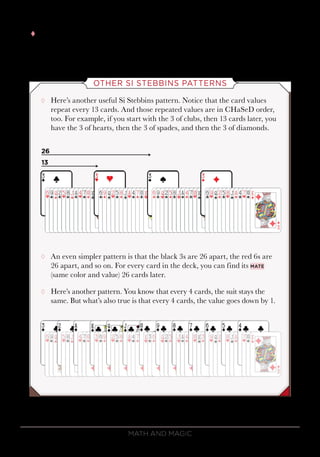
¸¸ Here’s another useful Si Stebbins pattern. Notice that the card values
repeat every 13 cards. And those repeated values are in CHaSeD order,
too. For example, if you start with the 3 of clubs, then 13 cards later, you
have the 3 of hearts, then the 3 of spades, and then the 3 of diamonds.
¸¸ An even simpler pattern is that the black 3s are 26 apart, the red 6s are
26 apart, and so on. For every card in the deck, you can find its mate
(same color and value) 26 cards later.
¸¸ Here’s another pattern. You know that every 4 cards, the suit stays the
same. But what’s also true is that every 4 cards, the value goes down by 1.
Lesson 4 ♠ The Deck Is Stacked 35
¸¸ For example, if you take any card—for example, a 6—then 4 cards later
you have a 5, and then 4 cards later you have a 4, and so on. The reason
for this is because every 4 cards is like adding 12. Think of it this way: If
you look at the clock on your wall and it says 7, then 12 hours from now
it will still say 7. Thus, if you add 11 hours to it, it will say 6. But if you
think of your card values on a clock with 13 hours, then adding 12 is the
same as going back 1. So, for example, adding 12 to the 3 of clubs, you
would get the 2 of clubs.
NO WEIGH
tt The magician exploited Si Stebbins patterns when he pretended to
weigh the deck of cards in the beginning of the lesson. A volunteer holds
the cards faceup in her hand. It’s easiest when the faceup card is a king,
so let’s do that example first. Then, the volunteer cuts any number of
cards from the magician’s pile.
tt How many cards are left? Look at the value of the card that was cut
to. Suppose you see a value of v. Based on the earlier pattern, you can
exploit the following handy formula:
n = (13 − v) × 4
tt In this case, the value of the card that was cut to is v = 2. When you plug
this into the formula, you get
n = (13 − 2) × 4 = 11 × 4 = 44.
tt This tells you that there is a card with value of 2 in the 44th
position. But
does the magician have 44 cards in his hand? Definitely not. But you
know that the card values repeat every 13 cards, so you can subtract 13
from 44 to get 31. Does he have 31 cards now? No, he definitely has less
than half of the deck. So, how about 31 − 13 = 18? That feels more like
it. If you subtract 13 again, you’d get 5, and the magician definitely has
more than 5 cards in his hand. So, you can say with certainty that the 2
of hearts is the 18th
card.
Math and Magic36
tt You can verify this by counting 18 cards, starting with the 3 of clubs.
Hold the deck facedown and flip each card faceup while counting, and
put either pile on top. This way, the cards are still in Si Stebbins order
and the trick can be done again.
tt Let’s do the trick again with a card that is not a king on the bottom—
with a value of b (as in “bottom”).
tt When you look at the faceup
card, you subtract it from the
bottom card and then multiply
it by 4. In other words, you
calculate
n = (b − v) × 4,
where b is the bottom card and v is the card that is cut to.
tt That tells you the number of cards remaining in your hand, plus or
minus a multiple of 13. So, in this case, because the magician has a 9 on
the bottom and, after cutting off a large number of cards, has v = 3 on
top, when you subtract 3 from 9 and multiply by 4, you get 24.
tt What if v has a value that is larger than the bottom card?
tt Let’s say the deck is cut to the jack of diamonds.
(b − v) = 9 − 11 = −2
tt Before you multiply by 4, you add 13 to it to get 11.
tt Then, you multiply by 4 to get 44. So, there is a jack in position 44, and
that seems to be what the magician has. (He certainly has more than 31
cards). You can check this by seeing that there are 8 cards on the table,
so there must be 44 cards remaining.
tt When v is bigger than b, the general formula is:
n = (13 + b − v) × 4.
It’s okay if you need some
time to do the calculation.
You have plenty of time to do
it while you are pretending to
weigh the cards.
Lesson 4 ♠ The Deck Is Stacked 37
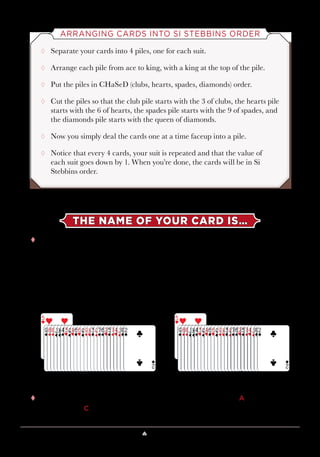
ARRANGING CARDS INTO SI STEBBINS ORDER
¸¸ Separate your cards into 4 piles, one for each suit.
¸¸ Arrange each pile from ace to king, with a king at the top of the pile.
¸¸ Put the piles in CHaSeD (clubs, hearts, spades, diamonds) order.
¸¸ Cut the piles so that the club pile starts with the 3 of clubs, the hearts pile
starts with the 6 of hearts, the spades pile starts with the 9 of spades, and
the diamonds pile starts with the queen of diamonds.
¸¸ Now you simply deal the cards one at a time faceup into a pile.
¸¸ Notice that every 4 cards, your suit is repeated and that the value of
each suit goes down by 1. When you’re done, the cards will be in Si
Stebbins order.
THE NAME OF YOUR CARD IS…
tt For this trick, although it may appear that the magician has 52 different
cards, he actually has the same 26 cards repeated twice. The first set of
26 cards can be in any order. The second set of 26 cards then matches
the first set of 26 exactly. The key point here is that for every card, its
twin is located exactly 26 cards later.
tt Let’s suppose that the deck initially had this order, where A denotes the
top pile and C denotes the bottom pile.
Math and Magic38
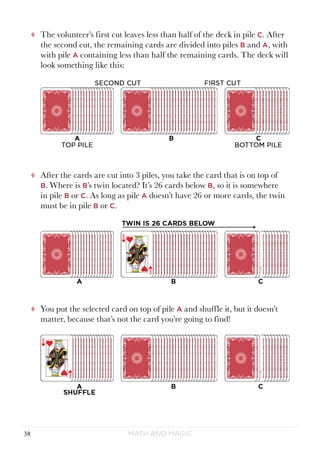
tt The volunteer’s first cut leaves less than half of the deck in pile C. After
the second cut, the remaining cards are divided into piles B and A, with
with pile A containing less than half the remaining cards. The deck will
look something like this:
tt After the cards are cut into 3 piles, you take the card that is on top of
B. Where is B’s twin located? It’s 26 cards below B, so it is somewhere
in pile B or C. As long as pile A doesn’t have 26 or more cards, the twin
must be in pile B or C.
tt You put the selected card on top of pile A and shuffle it, but it doesn’t
matter, because that’s not the card you’re going to find!
Lesson 4 ♠ The Deck Is Stacked 39
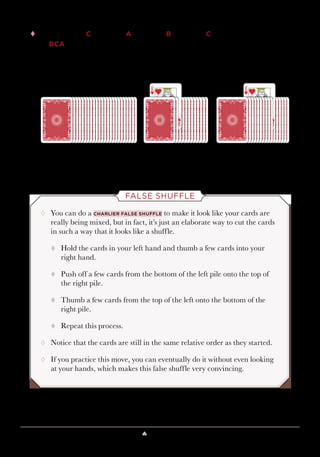
tt You now put C on top of A and then B on top of C, resulting in an order
of BCA. Now all you have to do is count 26 cards and your card’s twin is
guaranteed to be there.
FALSE SHUFFLE
¸¸ You can do a Charlier false shuffle to make it look like your cards are
really being mixed, but in fact, it’s just an elaborate way to cut the cards
in such a way that it looks like a shuffle.
¹¹ Hold the cards in your left hand and thumb a few cards into your
right hand.
¹¹ Push off a few cards from the bottom of the left pile onto the top of
the right pile.
¹¹ Thumb a few cards from the top of the left onto the bottom of the
right pile.
¹¹ Repeat this process.
¸¸ Notice that the cards are still in the same relative order as they started.
¸¸ If you practice this move, you can eventually do it without even looking
at your hands, which makes this false shuffle very convincing.
Math and Magic40
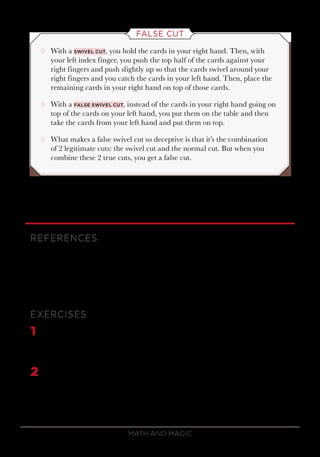
FALSE CUT
¸¸ With a swivel cut, you hold the cards in your right hand. Then, with
your left index finger, you push the top half of the cards against your
right fingers and push slightly up so that the cards swivel around your
right fingers and you catch the cards in your left hand. Then, place the
remaining cards in your right hand on top of those cards.
¸¸ With a false swivel cut, instead of the cards in your right hand going on
top of the cards on your left hand, you put them on the table and then
take the cards from your left hand and put them on top.
¸¸ What makes a false swivel cut so deceptive is that it’s the combination
of 2 legitimate cuts: the swivel cut and the normal cut. But when you
combine these 2 true cuts, you get a false cut.
REFERENCES
Scarne, Scarne on Card Tricks.
Simon, Mathematical Magic.
Trost, The Card Magic of Nick Trost.
EXERCISES
1	 Suppose a deck in Si Stebbins order is cut with Jª on the bottom of
the deck. What is the 20th
card in the deck? What is the 23rd
card in
the deck?
2	 Explain the following magic trick. The magician invites you to cut the
deck and complete the cut. You then remove the top card and put it
in your pocket. The magician then asks the deck for the color of the
selected card by spelling C-O-L-O-R and looking at the next card,
Lesson 4 ♠ The Deck Is Stacked 41
which happens to be red and thus concludes that the chosen card is
red. The magician then asks the deck for the number of the selected
card by spelling N-U-M-B-E-R and looking at the next card, which
happens to be a black queen and thus concludes that the chosen card is
also a queen. But which red queen? The magician then spells M-A-T-
C-H-I-N-G C-A-R-D, and the next card is the queen of diamonds and
therefore concludes that the selected card is the queen of hearts, which
proves to be correct. How did the trick work?
SOLUTIONS CAN BE
FOUND ON PAGE 128.
SOLUTIONS CAN BE
FOUND ON PAGE 128.
Math and Magic42
LESSON 5
PERFECT
SHUFFLES
In this lesson, you will discover various ways to
mix up the cards in a deck that are not the same
as cutting the cards. But the mixing isn’t quite
as random as you may think. The focus of the
lesson is on the perfect shuffle and some of its
mathemagical properties.
PERFECT SHUFFLES
¸¸ When you do a riffle shuffle, you are cutting the cards approximately
in half and then merging those halves together so that the cards interlace
together in approximately alternating fashion.
¸¸ In what mathematicians call a perfect shuffle, the cards are cut exactly
in half—a deck of 52 cards is cut into 2 piles of 26—and then the cards
are interlaced perfectly. Magicians call this the faro shuffle, named
after an old casino game, faro,
where the cards were mixed in a
not-so-random way.
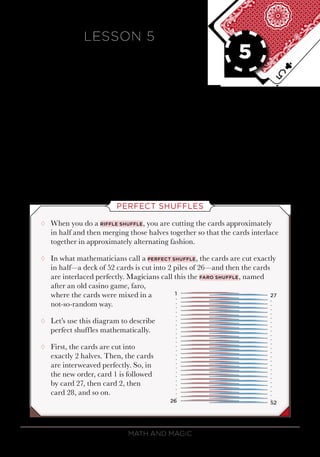
¸¸ Let’s use this diagram to describe
perfect shuffles mathematically.
¸¸ First, the cards are cut into
exactly 2 halves. Then, the cards
are interweaved perfectly. So, in
the new order, card 1 is followed
by card 27, then card 2, then
card 28, and so on.
5
Lesson 5 ♠ Perfect Shuffles 43
¸¸ After one perfect shuffle, that top card stays on top. In other words,
card 1 is still in position 1, but card 2 is now in position 3, card 3 is in
position 5, card 4 is in position 7, and so on down to card 26, which is in
position 51.
¸¸ The rule is that for the first 26 cards, card n is sent to position 2n − 1.
¸¸ For the next 26 cards, we see that card 27 is in position 2, card 28 is in
position 4, card 29 is in position 6, and so own down to card 52 which is
still on the bottom in position 52.
¸¸ The general formula for these cards is that card n ends up in position
2n − 52.
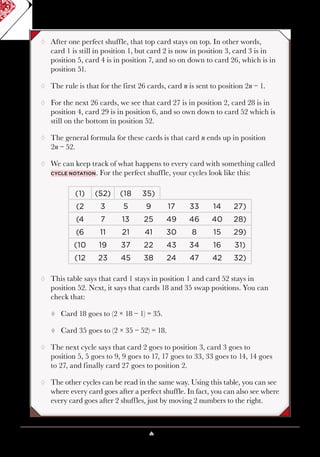
¸¸ We can keep track of what happens to every card with something called
cycle notation. For the perfect shuffle, your cycles look like this:
(1) (52) (18 35)
(2 3 5 9 17 33 14 27)
(4 7 13 25 49 46 40 28)
(6 11 21 41 30 8 15 29)
(10 19 37 22 43 34 16 31)
(12 23 45 38 24 47 42 32)
¸¸ This table says that card 1 stays in position 1 and card 52 stays in
position 52. Next, it says that cards 18 and 35 swap positions. You can
check that:
¹¹ Card 18 goes to (2 × 18 − 1) = 35.
¹¹ Card 35 goes to (2 × 35 − 52) = 18.
¸¸ The next cycle says that card 2 goes to position 3, card 3 goes to
position 5, 5 goes to 9, 9 goes to 17, 17 goes to 33, 33 goes to 14, 14 goes
to 27, and finally card 27 goes to position 2.
¸¸ The other cycles can be read in the same way. Using this table, you can see
where every card goes after a perfect shuffle. In fact, you can also see where
every card goes after 2 shuffles, just by moving 2 numbers to the right.
Math and Magic44
¸¸ For example, after 2 shuffles, the card in position 17 will be in position
14. The card in position 29 will be in position 11. Where will the card in
position 42 be after 3 shuffles? Just go 3 spaces to the right and it will be
in position 23.
¸¸ Now here’s a surprise: Where will each card be after 8 shuffles? Notice
that because all of your cycles have length 1, 2, or 8, every card will be
back in its original position after 8 perfect shuffles.
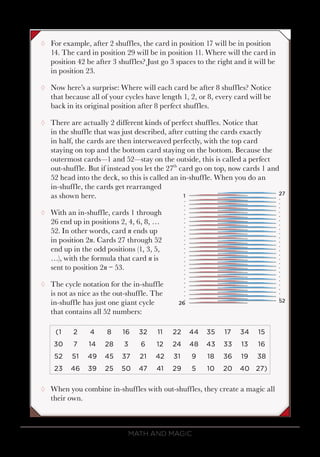
¸¸ There are actually 2 different kinds of perfect shuffles. Notice that
in the shuffle that was just described, after cutting the cards exactly
in half, the cards are then interweaved perfectly, with the top card
staying on top and the bottom card staying on the bottom. Because the
outermost cards—1 and 52—stay on the outside, this is called a perfect
out-shuffle. But if instead you let the 27th
card go on top, now cards 1 and
52 head into the deck, so this is called an in-shuffle. When you do an
in-shuffle, the cards get rearranged
as shown here.
¸¸ With an in-shuffle, cards 1 through
26 end up in positions 2, 4, 6, 8, …
52. In other words, card n ends up
in position 2n. Cards 27 through 52
end up in the odd positions (1, 3, 5,
…), with the formula that card n is
sent to position 2n − 53.
¸¸ The cycle notation for the in-shuffle
is not as nice as the out-shuffle. The
in-shuffle has just one giant cycle
that contains all 52 numbers:
(1 2 4 8 16 32 11 22 44 35 17 34 15
30 7 14 28 3 6 12 24 48 43 33 13 16
52 51 49 45 37 21 42 31 9 18 36 19 38
23 46 39 25 50 47 41 29 5 10 20 40 27)
¸¸ When you combine in-shuffles with out-shuffles, they create a magic all
their own.
Lesson 5 ♠ Perfect Shuffles 45
¸¸ Suppose you want to bring the top card to a certain position of the
deck—for example, position 40. What is the fastest way to do it using
perfect shuffles?
¸¸ The answer is pretty amazing. First, you subtract 1 from the position:
40 − 1 = 39.
¸¸ Then, you write that number as a sum of powers of 2. In this case, 39 is
expressed as the sum of powers of 2. The relevant powers of 2 are these:
32	16	 8	4	2	1
¸¸ Notice that
39 = 32 + 4 + 2 + 1.
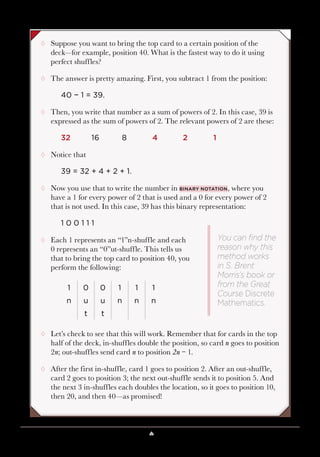
¸¸ Now you use that to write the number in binary notation, where you
have a 1 for every power of 2 that is used and a 0 for every power of 2
that is not used. In this case, 39 has this binary representation:
1 0 0 1 1 1
¸¸ Each 1 represents an “1”n-shuffle and each
0 represents an “0”ut-shuffle. This tells us
that to bring the top card to position 40, you
perform the following:
1 0 0 1 1 1
n u u n n n
t t
¸¸ Let’s check to see that this will work. Remember that for cards in the top
half of the deck, in-shuffles double the position, so card n goes to position
2n; out-shuffles send card n to position 2n − 1.
¸¸ After the first in-shuffle, card 1 goes to position 2. After an out-shuffle,
card 2 goes to position 3; the next out-shuffle sends it to position 5. And
the next 3 in-shuffles each doubles the location, so it goes to position 10,
then 20, and then 40—as promised!
You can find the
reason why this
method works
in S. Brent
Morris’s book or
from the Great
Course Discrete
Mathematics.
Math and Magic46
EXPLANATIONS
LEFT OR RIGHT?
tt It takes a lot of practice to be able to perform a perfect shuffle. There
are tricks that use other kinds of shuffles that require no skill to perform
but, like the perfect shuffle, don’t mix the cards as much as they appear.
tt In this trick, when dealing the cards into 2
piles, the magician is doing a different sort
of shuffle, and depending on which pile goes
on top, it is called either a left shuffle or a
right shuffle.
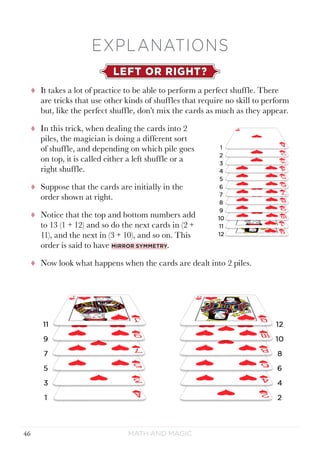
tt Suppose that the cards are initially in the
order shown at right.
tt Notice that the top and bottom numbers add
to 13 (1 + 12) and so do the next cards in (2 +
11), and the next in (3 + 10), and so on. This
order is said to have mirror symmetry.
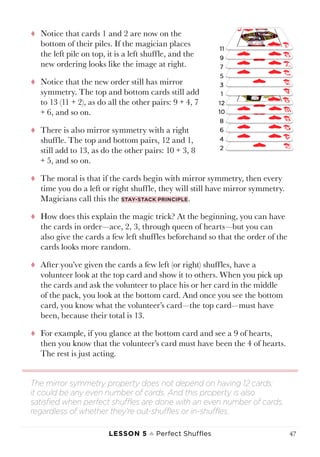
tt Now look what happens when the cards are dealt into 2 piles.
Lesson 5 ♠ Perfect Shuffles 47
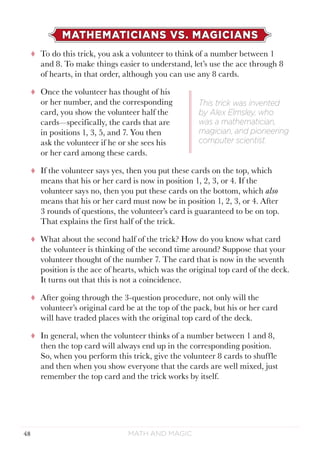
tt Notice that cards 1 and 2 are now on the
bottom of their piles. If the magician places
the left pile on top, it is a left shuffle, and the
new ordering looks like the image at right.
tt Notice that the new order still has mirror
symmetry. The top and bottom cards still add
to 13 (11 + 2), as do all the other pairs: 9 + 4, 7
+ 6, and so on.
tt There is also mirror symmetry with a right
shuffle. The top and bottom pairs, 12 and 1,
still add to 13, as do the other pairs: 10 + 3, 8
+ 5, and so on.
tt The moral is that if the cards begin with mirror symmetry, then every
time you do a left or right shuffle, they will still have mirror symmetry.
Magicians call this the stay-stack principle.
tt How does this explain the magic trick? At the beginning, you can have
the cards in order—ace, 2, 3, through queen of hearts—but you can
also give the cards a few left shuffles beforehand so that the order of the
cards looks more random.
tt After you’ve given the cards a few left (or right) shuffles, have a
volunteer look at the top card and show it to others. When you pick up
the cards and ask the volunteer to place his or her card in the middle
of the pack, you look at the bottom card. And once you see the bottom
card, you know what the volunteer’s card—the top card—must have
been, because their total is 13.
tt For example, if you glance at the bottom card and see a 9 of hearts,
then you know that the volunteer’s card must have been the 4 of hearts.
The rest is just acting.
The mirror symmetry property does not depend on having 12 cards;
it could be any even number of cards. And this property is also
satisfied when perfect shuffles are done with an even number of cards,
regardless of whether they’re out-shuffles or in-shuffles.
Math and Magic48
MATHEMATICIANS VS. MAGICIANS
tt To do this trick, you ask a volunteer to think of a number between 1
and 8. To make things easier to understand, let’s use the ace through 8
of hearts, in that order, although you can use any 8 cards.
tt Once the volunteer has thought of his
or her number, and the corresponding
card, you show the volunteer half the
cards—specifically, the cards that are
in positions 1, 3, 5, and 7. You then
ask the volunteer if he or she sees his
or her card among these cards.
tt If the volunteer says yes, then you put these cards on the top, which
means that his or her card is now in position 1, 2, 3, or 4. If the
volunteer says no, then you put these cards on the bottom, which also
means that his or her card must now be in position 1, 2, 3, or 4. After
3 rounds of questions, the volunteer’s card is guaranteed to be on top.
That explains the first half of the trick.
tt What about the second half of the trick? How do you know what card
the volunteer is thinking of the second time around? Suppose that your
volunteer thought of the number 7. The card that is now in the seventh
position is the ace of hearts, which was the original top card of the deck.
It turns out that this is not a coincidence.
tt After going through the 3-question procedure, not only will the
volunteer’s original card be at the top of the pack, but his or her card
will have traded places with the original top card of the deck.
tt In general, when the volunteer thinks of a number between 1 and 8,
then the top card will always end up in the corresponding position.
So, when you perform this trick, give the volunteer 8 cards to shuffle
and then when you show everyone that the cards are well mixed, just
remember the top card and the trick works by itself.
This trick was invented
by Alex Elmsley, who
was a mathematician,
magician, and pioneering
computer scientist.
Lesson 5 ♠ Perfect Shuffles 49
tt Naturally, the trick will work with any 8 cards, but perhaps the hardest
part of the trick is remembering the top card for the entire trick. But
if you perform this trick after the last one and just use 8 hearts, then
you know what the suit will be, so you only need to remember the
card’s value.
WHAT ARE THE ODDS?
tt This trick always gets a great reaction, and it’s entirely self-working. You
set up the deck so that the first, second, fourth, and eighth cards are
aces, and your prediction card—for example, the 3 of clubs—is the 16th
card. If you want extra security, you can put a joker in the 32nd
position.
Give the deck a false cut and then ask a volunteer to cut approximately
half of the cards.
tt You would think that the final card would depend on where the cards
were cut, but it essentially doesn’t matter as long as the volunteer cuts at
least 16 cards. Once he or she has cut the cards, put the bottom half of
the cards aside and then out-jog every other card.
tt For example, if the volunteer cuts 25 cards, then you are removing
cards 1, 3, 5, 7, … , 25, so the first ace will be on top of this discard
pile. The remaining cards are the cards originally in positions 2, 4, 6,
8, … , 24, so now when you out-jog every other card, you are removing
cards 2, 6, 10, 14, … , so card 2 (another ace) is on top.
tt The remaining cards are the cards originally in positions 4, 8, 12, 16,
… . After out-jogging again, you remove cards 4, 12, 20, … , giving you
the third ace and leaving cards that were in positions 8, 16, and possibly
24 or 32.
This trick will also work with 16 cards; you just have to ask 4 questions
instead of 3. But using 8 cards makes the trick goes much faster, and
there’s less of a chance for you or the volunteer to make a mistake.
Math and Magic50
tt Now if the volunteer cuts 31 cards or fewer (which will usually be the
case because you asked him or her to cut about half of the cards), the
last pile will have the eighth card on top, another ace, and the only card
remaining will be the 16th
card, which was the card you predicted.
tt But what if the volunteer actually cuts 32 cards or more? Then you say,
“That’s strange! There was only supposed to be one card left over, the
3 of clubs,” which you reveal. Then you say, “Oh, you know what went
wrong? It was that darned joker. He’s always messing me up!”
tt This trick is guaranteed to work as long as the volunteer cuts between
16 and 47 cards, which is practically guaranteed. The main thing to be
careful about is that during your first deal, you carefully out-jog every
other card, and be sure to grab all of the out-jogged cards, or else you
might not get the 16th
card at the end. With just a little practice, you’ll
get it right all the time.
REFERENCES
Craven and Gordon, The Second 16th
Card Book.
Kaufman, Paul Gertner’s Steel and Silver.
Minch, The Collected Works of Alex Elmsley.
Morris, Magic Tricks, Card Shuffling and Dynamic Computer Memories.
EXERCISES
1	 Give a sequence of perfect shuffles (in-shuffles and out-shuffles) that
will bring the top card to position 29. How about position 42?
2	 After a deck is given 2 in-shuffles followed by 4 out-shuffles, where
does the top card go? Where does the 17th
card go?
SOLUTIONS CAN BE FOUND ON PAGE 129.SOLUTIONS CAN BE FOUND ON PAGE 129.
Lesson 6 ♠ Riffle Shuffles 51
LESSON 6
RIFFLE
SHUFFLES
In the previous lesson, you learned that there
are ways of mixing cards, such as with perfect
shuffles, that are not quite as random as they
appear. This lesson will explore what happens
when you do an ordinary riffle shuffle, where
the cards are cut approximately in half (but not
necessarily exactly in half) and the cards interlace
approximately (but don’t have to interlace
perfectly).
EXPLANATIONS
SUIT SENSING
tt The secret to this trick, and many others presented in this lesson, is
known as the Gilbreath principle, discovered by amateur magician and
professional engineer Norman Gilbreath in the 1960s.
tt Gilbreath’s original application was in a trick called Magnetic Colors,
where a deck was cut and then riffle shuffled, yet the magician
could pull out cards 2 at a time in such a way that they always had
opposite colors.
tt To begin, the cards are set up so that the colors alternate perfectly—red-
black-red-black-red-black all the way through. Once your deck is set up
like this, notice that you can cut the cards as often as you’d like and the
colors would still alternate.
6
Math and Magic52
tt Now cut about half the cards and pick up both piles. Before you or your
assistant does a riffle shuffle, check to make sure that the bottom cards
of the 2 piles have different colors. If they don’t, then just move the
bottom card from the right pile to the top of the left pile and say, “Here,
let’s make the piles a little more even.”
tt Now give the cards a riffle shuffle (or let your volunteer do it) and watch
what happens. No matter how good or bad the riffle shuffle is, it will
always be the case that—starting from the top or the bottom—every
2 cards will contain a red card and a black card. Even when one pile
runs out of cards, the other pile will still continue to put cards down in
alternating colors.
tt When you cut the cards, if both bottoms have the same color, you can
still do a riffle shuffle. Then, if you just move the bottom card to the
top or the top card to the bottom, or cut the cards any place where 2
matching colors are next to each other, the trick will still work.
tt This principle, which has been in the magic literature for about
60 years, has been extended in many interesting ways. In fact, it is
often called Gilbreath’s first principle. The general principle is even
more amazing.
tt For the trick where you find one card of each suit—just like for the
color-matching trick—you begin with the deck set up in a special
way. But instead of just having the colors alternate, you have the suits
alternate in a regular pattern—clubs, hearts, spades, diamonds—all
the way through the deck. Notice that you can cut the cards as often as
you’d like and the suits will still have a cyclic pattern.
tt Before you do the riffle shuffle, you need to reverse the cards in one of
the piles. Ask your volunteer for a number between 15 and 30, although
truly any number will work. (It’s just easier to do a riffle shuffle when
the piles are close to the same size.) After dealing any number of cards
down, the first pile is reversed and the cards can be riffle shuffled.
tt Even though the cards are no longer in cyclic order, it is still the case
that every group of 4, starting from the top and going all the way to
the bottom, still has one card of each suit (in some order). So, as you go
Lesson 6 ♠ Riffle Shuffles 53
through the deck, you just deal 4 cards at a time into piles. Sometimes
you can bring 4 cards to the bottom of the pile, or put 4 cards in a pile
on the side, but that’s just to make the trick look harder.
tt In general, the Gilbreath principle says this: Suppose your cards start
with any repeated cyclic pattern—whether it be red and black; club,
heart, spade, diamond; or even ace to king throughout. Deal any
number of cards into a pile and then riffle shuffle the 2 piles together.
The Gilbreath principle says that if your original pattern had n cards
in cyclic order, then after the riffle shuffle, it will still be the case that,
starting from the top, every group of n cards will contain one card of
each type.
tt So, for example, if you start with cards ace through king and deal into 1
pile with any number of cards and then give the 2 piles a riffle shuffle,
then starting from the top or bottom, every 13 cards will have 1 card of
each value—no matter how the cards fall.
7-CARD STUD
tt The cards in this trick are set up to exploit the Gilbreath principle.
You could start with the Si Stebbins stack (lesson 4), in which the suits
appear in cyclic fashion every 4 cards (CHSD, CHSD, ... ) and the
values also appear in cyclic fashion every 13 cards.
tt Any arrangement of the 13 values
is acceptable. In fact, this stack—
called the 8-kings stack—has the
advantage that the cards do not form a
mathematical pattern:
8 K 3 10 2 7 9 5 Q 4 A 6 J
tt It can be memorized by this rhyming mnemonic: 8 Kings ThreaTen To
Save 95 Ladies For One Sick Knave!
In games like 7-card stud
and Texas Hold’em, there
are 2 facedown cards
and 5 faceup cards.
Math and Magic54
tt In the 8-kings stack, the 52 cards would be arranged like this:
tt The cards can be cut as often as you’d like.
tt After the cards have been cut, then dealt, and then riffle shuffled, you
deal 14 cards, 7 cards each, where the first 4 cards are facedown. You
know that the first 4 cards will contain one of each suit, so as soon as
you glance at your facedown cards, you know exactly what the other 2
suits are.
tt In the video, the magician’s down cards were the ace of spades and the
queen of clubs, so he knew that the other facedown cards had to have
hearts and diamonds as their suits.
tt But you don’t jump out and name the suits immediately. First say the
colors, as if you’re getting a vague impression and it’s coming into
sharper focus. This also gives you time to look at the other faceup cards
to figure out the values of your volunteer’s cards.
tt How do you determine that? Because of the Gilbreath principle, you
know that all of the card values will be represented among the first 13
cards. Conveniently, with 7-card stud, 14 cards are dealt and you can
safely ignore the 14th
card (the last faceup card in your hand).
tt Because the facedown cards in the video are the ace of spades and the
queen of clubs, the magician just has to look at the other 9 faceup cards
to figure out which 2 values are missing. He can see every card value
except for 4 and 6, so he knows that these have to be the person’s values.
tt And he still knows that the person’s 2 suits are hears and diamonds. The
only thing he can’t be sure of is whether the person has the 4 of hearts
and the 6 of diamonds, or the 4 of diamonds and the 6 of hearts.
Lesson 6 ♠ Riffle Shuffles 55
tt At this point, you can cover yourself by saying something like this: “I
see that one of your values is lower than the other. Is that the heart
suit?” You have at least a 50% chance of being right, and it won’t matter
if you’re wrong, because it doesn’t seem like your volunteer has given
you much information, and then you name the 2 cards exactly.
2 PREDICTIONS
tt This trick uses 2 predictions—a double application of the Gilbreath
principle. The cards are set up with 16 red cards (4 of which are picture
cards) and 8 black cards (2 of which are picture cards) so that every
third card is black and every fourth card is a picture card.
tt As usual, the cards retain their cyclic
structure even after being cut. Then,
you can use the smoosh shuffle, which
involves dealing about half the cards and
smooshing them together. The smoosh
shuffle is really just a riffle shuffle in
disguise, even though they don’t look the
same. Or you can use what is sometimes
called the rosary shuffle, made popular
by Swedish magician Lennart Green.
tt After any of these shuffles, the Gilbreath principle guarantees that,
starting from the top, every 3 cards will contain 1 black and 2 red
cards. Thus, the top 12 cards and the bottom 12 cards are each
guaranteed to contain 4 black cards and 8 red cards, as predicted. Also,
starting from the top, every 4 cards will have one picture card, so the
top 12 cards and bottom 12 cards will have 3 picture cards. Thus, your
prediction will be accurate, no matter which pile they take.
Remember when you perform this to ignore the 14th
card, which is the
last card faceup. The good news is that this card is guaranteed to have
the same value as one of the other 13 cards, so there is at least one pair
on the table, and it provides good camouflage for the secret.
This trick was inspired
by a card trick called
the Schizoid Rosary and
was invented by Max
Maven, one of the world’s
greatest mentalists and a
leading authority on the
Gilbreath principle.
Math and Magic56
REFERENCES
Diaconis and Graham, Magical Mathematics.
Mulcahy, Mathematical Card Magic.
EXERCISES
1	 Suppose that you are performing the 7-card stud trick using the
8-kings stack. After dealing 14 cards to you and your volunteer, your
volunteer has these cards, from left to right: Jª K§ A♥ Q¨ 10ª ?? ??.
Your cards are 6♥ 8¨ 6ª 4§ 3♥ ?? ??.
Your facedown cards are 2¨ and 9♥.
What are the volunteer’s facedown cards?
2	 Consider the following psychic challenge. You display a deck of cards
that looks randomly mixed and ask the spectator to cut the cards. (This
person can give the deck as many complete cuts as he or she wishes.)
Then have the volunteer give the cards a riffle shuffle. You deal a few
cards faceup from the top to show that there is no pattern to the cards
and ask him or her to guess the color of the next card. Then, you’ll do
the same with the following card, and you keep doing so for the first 10
cards or so. The volunteer guesses right about half the time, but your
guess is right every time. How do you do it?
This completes the portion of the course that addresses mathematical
card magic, but there is still plenty of magic remaining, most of which
has nothing to do with cards.
SOLUTIONS CAN BE FOUND ON PAGE 129.SOLUTIONS CAN BE FOUND ON PAGE 129.
Lesson 7 ♠ Magic with Numbers 57
LESSON 7
MAGIC WITH
NUMBERS
Perhaps the most natural mathemagical objects
are numbers themselves, and they are the
topic of this lesson. Even though the tricks in
this lesson are all based on very simple algebra,
they will still fool and impress most people. A
few of the tricks involve are so-called nature’s
numbers, which show up everywhere—in nature,
mathematics, art, and even magic.
EXPLANATIONS
2n + 10 TRICK
tt In this trick, you start by asking participants to think of any number
between 1 and 10. (In fact, your participants can think of any number—
small or large—and it could even be negative or a fraction.)
tt You don’t know the number they are
thinking of, so let’s call it n, as in “number.”
Then, you ask them to double their original
number. Now they are thinking of the
number
2n.
tt Next, you ask the participants to add 10:
2n + 10.
The notion of letting
an unknown quantity
be represented by
a letter—called a
variable—is probably
the most important
idea in algebra.
7
Math and Magic58
tt Then, you tell them to divide by 2, and when both terms are cut in half,
this is the result:
n + 5.
tt Finally, you ask your participants to subtract the number they started
with—which was n! When n is subtracted,
n + 5 − n,
which is 5, as predicted.
tt Naturally, you can modify this trick to get any number you want. For
example, if you wanted to reach 100, you can go through the same
steps to reach 5, but don’t end the trick there. You could have your
participants double the number, which you know to be 10, and then
multiply that number by itself, which is 100.
tt Instead, if you want to reach a number other than 5, you can just
have your participants add a different number at the second step. For
example, if they add the number 8 instead of 10, then you have the
number 2n + 8, which—when cut in half and the original number
subtracted—is 4.
BLACK AND RED TRICK
tt For this trick, you begin by dealing any 30 cards on the table. Let’s call
the number of black cards in the pile B.
tt If there are B black cards in that pile, that means there are 30 − B red
cards in that same pile.
tt Now consider the other pile of cards. How many red cards will it
contain? There is a total of 26 red cards between both piles, and the
first pile has 30 − B of them, so the second pile must have B − 4:
26 − (30 − B) = B − 4.
Lesson 7 ♠ Magic with Numbers 59
tt So, even though you don’t how many black cards or red cards that you
have in either pile, you do know that when you take the number of black
cards in pile 1 and subtract the number of red cards in pile 2, you are
guaranteed to get
B − (B − 4),
which equals 4.
tt Let’s hear it for algebra!
3 HEAPS
tt This trick begins with every pile having the same number of cards.
How many cards does each pile have? n.
tt Then, you take 3 cards from the left pile and 3 cards from the right pile
and place them in the middle pile. Your situation now looks like this,
where the left and right pile each have n − 3 cards and the middle pile
has n + 6 cards.
Instead of cards, you can use any objects—such as coins or paperclips—
for this trick.
Math and Magic60
tt Next, you count the cards on the left pile and then remove that many
cards from the middle pile and place those cards on the right pile.
When you remove the n − 3 cards from the middle pile and place them
on top of the n − 3 cards on the right pile, then the number of cards in
the right pile becomes 2n − 6.
tt That’s fine. But here’s the surprising part: How many cards are now in
the middle pile?
tt Finally, when you add 1 more card to the middle pile from either pile, it
is guaranteed to have exactly 10 cards, as predicted.
1089 TRICK
tt The algebra behind this trick is just a little more complicated than the
previous tricks, but you can do it.
tt Originally, you choose a 3-digit number, abc, where a is the largest digit
and c is the smallest digit. Notice that a represents the hundreds digit, b
represents the tens digit, and c is the ones digit. Therefore, the number
abc really represents 100a + 10b + c.
tt Next, you reverse the number to get cba, which represents 100c + 10b + a.
tt When you subtract this from the first number, you get this:
(100a + 10b + c) − (100c + 10b + a).
tt Notice that the 10b numbers cancel and you are left with this:
99a − 99c = 99(a − c).
Lesson 7 ♠ Magic with Numbers 61
tt In other words, after you do the first subtraction, the answer has to be
one of these multiples of 99:
99 × 2 = 198 99 × 6 = 594
99 × 3 = 297 99 × 7 = 693
99 × 4 = 396 99 × 8 = 792
99 × 5 = 495 99 × 9 = 891
tt When you add any of these numbers to its reversal, you always get
1089. You can verify this with algebra, but it’s easier just to verify the 4
possible situations:
198 297 396 495
+ 891 + 792 + 693 + 594
1089 1089 1089 1089
tt Thus, no matter what number you have at this step, when you add its
reversal, you are guaranteed to end up with 1089.
EASY AS PHI
tt One of the most interesting numbers in mathematics is phi. This trick
uses the first 16 digits of phi: 1.618033988749894…
tt You need 4 volunteers; let’s call them a, b, c, and d. You give the last 4
digits (9894) to d; the 3 digits before those last 4 digits, along with the
number 6, to c (6874); the middle digits (8033) to a; and the remaining
digits (1198) to b.
tt Notice that when you create the four 4-digit numbers, a always gives
the first digit, b gives the second digit, and so on.
Math and Magic62
tt So, your final 4 numbers will have to look like this, where the first
column contains the digits 8 0 3 3 in some order, the second column has
1 1 9 8 in some order, and so on.
tt The last column of numbers—no matter what the order of numbers
is—will always add to 30, so the total will end in 0. Putting down the 0
and carrying the 3, the next column must add to 28. Writing the 8 and
carrying the 2, the next column will add to 21. Putting down the 1 and
carrying the 2, the first column will add to 16, producing the predicted
total of 16,180. And when you throw in the decimal points, you are
guaranteed to get 1.6180, which are the first 5 digits of phi.
2
8 2
1 3
6 9
0 1 8 8
3 9 7 9
+ 3 8 4 4
16 1 8 0
tt As it turns out, there is nothing particularly special about the number
phi here. Once you give your 4 volunteers any group of numbers, you
know what their final total will be, regardless of how each individual
arranges his or her cards.
PHI AND FIBONACCI
¸¸ Often referred to as the golden ratio, phi
has been deliberately used by artists,
architects, and advertisers to produce
appealing designs.
¸¸ The number of petals on a flower or
the number of spirals on a pinecone
or pineapple often turns out to be a
Fibonacci number.
©Imo/iStock/Thinkstock.
Lesson 7 ♠ Magic with Numbers 63
FIBONACCI SUM AND QUOTIENT
tt The numbers in this trick are created like the Fibonacci numbers.
tt Let’s call the numbers you start with x and y. Thus, the number in row 3
will be x + y.
tt Row 4 is the sum of rows 2 and 3, so when you add y to x + y, you get
x + 2y.
¸¸ Phi is intimately connected with the Fibonacci numbers—1, 1, 2, 3, 5, 8,
13, 21, 34, 55, 89, 144, … ,—which start with 1 and 1, and then every
number is the sum of the 2 numbers before it. For example, 3 + 5 = 8, 5 +
8 = 13, and so on.
¸¸ The ratios of consecutive Fibonacci numbers get closer and closer to
1.618—closer and closer to phi.
1
⁄1 1
2
⁄1 2
3
⁄2 1.5
5
⁄3 1.666...
8
⁄5 1.6
13
⁄8 1.625
21
⁄13 1.6153846153862
34
⁄21 1.61904761904762
55
⁄34 1.61764705882353
89
⁄55 1.61818181818182
φ 1.618033988749894...
Math and Magic64
tt Continuing in this way, the rest of the rows will
appear as shown at right. (It’s no coincidence
that all of these coefficients are Fibonacci
numbers.)
tt If you add all 10 of these numbers together,
you get a grand total of 55x + 88y
tt What makes that number special is that
		55x + 88y
=	11 × (5x + 8y)
=	11 × row 7.
tt Thus, to add all the numbers, as soon as you
see the number in row 7, you just multiply it
by 11. For example, if the number in row 7 is 81, then the grand total is
guaranteed to be 891.
tt How can you guarantee that the final ratio of row 10 divided by row 9
would start with 1.61? The secret has to do with a surprising property
of fractions that isn’t taught in school. When you first learned about
fractions, you were probably taught that to add 2 fractions, such as
1
⁄2 + 1
⁄3, you add them by putting them over a common denominator.
Here you have
3
⁄6 + 2
⁄6 = 5
⁄6.
tt But what happens if you take 2 fractions and add the numerators
together and add the denominators together? This has a special name
called the mediant. For example, the mediant of 1
⁄2 and 1
⁄3 is
1 x
2 y
3 x + y
4 x + 2y
5 2x + 3y
6 3x + 5y
7 5x + 8y
8 8x + 13y
9 13x + 21y
10 21x + 34y
You will learn a quick way to multiply by 11
in the next lesson.
1 1
2 3
2
5
.+
+
=
Lesson 7 ♠ Magic with Numbers 65
tt The mediant has the interesting property that it always lies in between
the original 2 fractions. For example, with the fractions 1
⁄3 and 1
⁄2, their
median, 2
⁄5, lies between them:
1
⁄3 < 2
⁄5 < 1
⁄2,
which you can verify, because 1
⁄3 is about 0.333, 2
⁄5 is 0.4, and 1
⁄2 is 0.5.
tt In general, for any positive numbers a, b, c, and d, if
then the mediant (a + b)
⁄(c + d) will always lie between them:
tt Let’s see how this applies to the magic trick. When you divide row 10 by
row 9, you are looking at the quotient
but that’s the mediant of the fractions 21x
⁄13x and 34y
⁄21y, so it must lie in
between them:
tt And because 21
⁄13 begins with 1.615 and 34
⁄21 begins with 1.619, then the
ratio (21x + 34y)
⁄(13x + 21y) must lie between 1.615 and 1.619:
so the first 3 digits of the quotient must begin with 1.61.
tt If you continue the process of creating more and more numbers in
leapfrog Fibonacci fashion, the ratio will get closer and closer to the
golden ratio, phi: 1.618….
x
x
x y
x y
y
y
1.615 21
13
21
13
21 34
13 21
34
21
34
21
1.619 ,= = <
+
+
< = = 
a
b
c
d
,<
a
b
a c
b d
c
d
.< +
+
<
x y
x y
21 34
13 21
,
+
+
x
x
x y
x y
y
y
21
13
21 34
13 21
34
21
.<
+
+
<
Math and Magic66
PINPIN
tt The secret behind this trick is pretty simple, yet it usually gets a very big
reaction. It’s based on the fact that if you take any 4-digit number—let’s
say your bank account PIN is 2358—and write it twice so that it appears
as an 8-digit number, such as 23582358, that’s the same as the 4-digit
PIN multiplied by 10,001.
2358 × 10001 = 23582358
tt Thus, when you divide this 8-digit number by the 4-digit PIN, you are
guaranteed to get back to 10,001. And if you divide this number by 9
and then 9 again, your answer begins with 123.469.
tt What makes this trick so deceptive is that you divide the 8-digit number
in the opposite order. First, you divide by 9, then 9 again, and then by
the 4-digit PIN. But either way, you are guaranteed to get 123.469.
tt This trick gets such a good reaction that you might be asked to do it a
second time. If so, then have your audience take their 4-digit PIN, enter
it twice, then divide by 7, and then divide by 7 again, and then divide
by the original PIN. They’ll get 10,001 divided by 49, which begins
204.102….
tt You can either memorize this number or bring out a calculator as
if it will help you figure out the audience’s random answer. Just
calculate 10,001 divided by 49 and their answer, 204.102, will be
staring you in the face.
tt It turns out that 10,001 = 73 × 137, so if you ask someone to take the
8-digit number, divide it by 73, and then divide that by his or her PIN,
you are guaranteed to get exactly 137—which is easier to remember
but seems suspicious. After all, if you take a large random number and
divide it by a bunch of numbers, you expect to see an answer with a
bunch of digits after the decimal point.
Lesson 7 ♠ Magic with Numbers 67
REFERENCES
Benjamin, The Magic of Math.
Benjamin and Shermer, Secrets of Mental Math.
Gardner, Mathematics, Magic and Mystery.
Gardner, Mental Magic.
EXERCISES
1	 Take any 3-digit PIN and enter it twice so that it reads as a 6-digit
number. (For example, the PIN 123 would be entered as 123123.) Using
a calculator, divide that number by 13, then divide by 11, and then
divide by the original PIN. You should now be looking at the number
7. Why does that work? What would you get if you first divided by 23,
then by 16, and then by the PIN?
2	 Start with any 3 different positive numbers from 1 to
9 and create all possible 2-digit numbers that you can
from them, listing them in a column. (There should be 6
numbers.) For example, if you started with 358, you would
create the numbers as shown at right.
Next, divide this total by the sum of the original 3
numbers. Here, 3 + 5 + 8 = 16, and when you divide 352
by this you get 352 ÷ 16 = 22. Explain why you will always
get an answer of 22.
35
38
53
58
83
+ 85
352
SOLUTIONS CAN BE
FOUND ON PAGE 130.
SOLUTIONS CAN BE
FOUND ON PAGE 130.
Math and Magic68
LESSON 8
LOOK LIKE
A GENIUS
In this lesson, you will learn skills that will make
you look like a mathematical genius. Some
of these take some practice, but some can be
learned immediately. You will learn methods that
are easy to do, and you will get the answers so
fast that it will seem like magic.
EXPLANATIONS
MULTIPLYING BY 11S
tt Let’s start with a small 2-digit number: 23. Multiplying 23 by 11 is as
easy as 2 + 3, which is 5. And there’s your answer: 2 5 3.
23 × 11 = 253
tt Let’s do a bigger problem: 63 × 11. The sum of 6 and 3 is 9, so the
answer is 6 9 3:
63 × 11 = 693.
tt But suppose the numbers add up to a number that is higher than 9. For
example, what is 86 × 11? The sum of 8 and 6 is 14, but the answer is
not 8 14 6. The 1 makes the 8 carry, and the answer is 9 4 6.
For more methods that will make you look like a mathematical genius,
check out the Great Course Secrets of Mental Math by Arthur T. Benjamin.
8
Lesson 8 ♠ Look like a Genius 69
WHY DOES THIS WORK?
¸¸ If you were doing a problem like 23 × 11 on paper, the calculation would
look like what is shown at right.
¸¸ The answer begins with 2, ends in 3, and in between is 2 + 3 (which is 5).
¸¸ This method even works for larger numbers. Take, for
example, the first 3 digits of pi and multiply that by 11:
3 1 4 × 11.
¸¸ The answer begins with a 3 and ends with a 4. But in
between is 3 + 1 (which is 4) and 1 + 4 (which is 5), so
here’s the answer:
3 4 5 4.
DIVIDING BY 91
tt Once you’ve learned how to multiply by 11s, it is practically as easy to
divide numbers by 91. Take any number less than 91—for example, 34.
34 ÷ 91
tt STEP 1 | Multiply your number by 11:
34 × 11 = 374.
tt STEP 2 | Subtract 1:
374 − 1 = 373.
tt STEP 3 | These are the first 3 digits of your answer after the decimal
point. In this case, 34 ÷ 91 begins like this:
0.373.
tt STEP 4 | For the next 3 digits of the answer, subtract the first 3 digits
from 999:
999 − 373 = 626.
2 3
× 1 1
2 3
2 3 0
2 5 3
Math and Magic70
tt Hence, 34 ÷ 91 begins like this:
0.373626….
tt In fact, the exact answer is a repeating decimal with those 6 digits
repeating indefinitely:
34 ÷ 91 = 0.373626 373626 373626….
WHY DOES THIS WORK?
¸¸ This method is based on the fact that 91 × 11 = 1001. So, the fraction
when you multiply the top and bottom by 11, is equal to
¸¸ As it happens,
1
⁄1001 = 0.000999 000999 000999…,
so when each group of 6 gets multiplied by 374, then each group of 6
becomes
374 × 999 = 374 × (1000 − 1),
which equals 374,000 − 374, which is 373,626.
34
91
,
34
91
34
91
11
11
374
1001
.= × =
3 7 4 0 0 0
− 3 7 4
3 7 3 6 2 6
Lesson 8 ♠ Look like a Genius 71
MULTIPLYING NEAR 100
tt Let’s now look at how to multiply numbers that are close to 100. Let’s
begin with 2 numbers that are a little bit above 100. For example:
1 06
× 1 1 1
tt First note how far each number is above 100; let’s call these
distance numbers.
tt In this case, 106 is 6 above 100 and 111 is 11 above 100, which you will
denote as follows.
1 06 (6)
× 1 1 1 (1 1)
tt Next, add 106 + 11 or 111 + 6; either way, you’ll get 117, which you can
write down.
tt Finally, multiply your distance numbers together; in this case,
6 × 11 = 66, which you write down as follows.
1 06 (6)
× 1 1 1 (1 1)
1 1 7 6 6
tt And that’s the answer!
106 × 111 = 11,766
6 11 66× =
1 06 (6)
× 1 1 1 (1 1)
1 1 7
111 6
106 11
117
117
+ =
+ =
1 06 (6)
× 1 1 1 (1 1)
1 1 7
111 6
106 11
117
117
+ =
+ =
Math and Magic72
tt The same method works when multiplying numbers below 100, except
the distance numbers are negative. For example, to do 96 × 93, your
distance numbers are −4 and −7, giving you what follows.
96 (−4)
×93 (−7)
tt Next, you subtract either 96 − 7 or 93 − 4. Either way, you get 89.
96 (−4)
×93 (−7)
89
tt Then, you multiply (−4)(−7) = 28 to get the answer.
96 (−4)
×93 (−7)
89 2 8
WHY DOES THIS WORK?
¸¸ Here’s the algebra behind this method:
	(z + a)(z + b)
= z2
+ za + zb + ab
=	z(z + a + b) + ab
¸¸ This says that if you take the number (z + a) times the number (z + b), then
after 2 lines of algebra, you get z times the quantity (z + a + b) plus ab.
¸¸ The variables z, a, and b can be any numbers, but typically z is some
number with lots of zeros in it. When z = 100,
(100 + a)(100 + b) = 100(100 + a + b) + ab.
¸¸ The numbers a and b are the distance numbers.
Lesson 8 ♠ Look like a Genius 73
tt But suppose you had larger numbers, such as 109 × 112. Your distance
numbers are 9 and 12.
1 09 (9)
× 1 1 2 (1 2)
tt Adding 109 + 12 (or 112 + 9), you get 121, but that really represents
121 × 100, which is 12,100.
1 09 (9)
× 1 1 2 (1 2)
1 2 1
× 1 00
1 2 1 00
tt Now when you multiply your distance numbers,
1 09 (9)
× 1 1 2 (1 2)
1 2 1 1 0 8
× 1 00
1 2 1 00
you add that to 12,100, resulting in what follows.
1 09 (9)
× 1 1 2 (1 2)
1 2 1 1 0 8
× 1 00
1 2 1 00
+ 1 08
1 2 208
tt Note that the answer is not 121 108.
Math and Magic74
tt You can even use this idea to multiply numbers where one is above 100
and the other is below 100.
tt Let’s try 116 × 97. You start by doing 116 − 3 (or 97 + 16) to get 113,
which you multiply by 100 to get 11,300.
1 1 6 (1 6)
× 97 (−3)
1 1 3
× 1 00
1 1 300
tt Next, because 16 × (− 3) = −48, you subtract 48.
1 1 6 (1 6)
× 97 (−3)
1 1 3 −48
× 1 00
1 1 300
− 48
1 1 2 52
tt Once you understand the algebra, you can apply this method to
all kinds of multiplication problems whenever the 2 numbers being
multiplied are close together.
For more details, check out the Great Course Secrets of Mental Math.
Lesson 8 ♠ Look like a Genius 75
MENTAL LOGS
tt How do you add big numbers quickly?
9563
8459
68 3 7
+ 1 9 76
2 68 3 5
tt The answer is actually staring you in the face.
tt The answer appears in the second row from the bottom.
tt To get the answer, take the third number, 6837; place a 2 in front of
it, 26,837; and then subtract 2 from the last digit:
26,835.
tt Now try it with these special numbers:
5 7 63
4939
8 5 3 3
+ 9 2 96
tt From the third number, 8533, you get the answer (put 2 in front and
then subtract 2 from the end):
28,531.
Math and Magic76
WHY DOES THIS WORK?
¸¸ The numbers on each side are chosen so that the first, second, and
fourth numbers of each log always add up to 18.
¸¸ For example, in the last example, you have what follows.
5 7 6 3
4 9 3 9
8 5 3 3
+ 9 2 9 6
¸¸ As a result, the ones digits contribute 18, the tens digits contribute 180,
the hundreds digits contribute 1800, and the thousands digits
contribute 18,000 for a grand total of 19,998.
1 8
1 8 0
1 8 0 0
+ 1 8 0 0 0
1 9 9 9 8
¸¸ Now, when you add the third number—for example, 8533—it gets added
to 19,998 (which is 20,000 − 2).
¸¸ So, all you need to do is add 20,000 to 8533 (by placing a 2 in front) and
then subtract 2 to get 28,531.
Lesson 8 ♠ Look like a Genius 77
9 3 8 6 4 9
1 7 0 3 0 7
2 6 7 4 9 2
5 7 8 7 7 3
6 2 3 5 5 0
DO IT YOURSELF
¸¸ You can do the mental logs trick at home using popsicle sticks. Create 10
popsicle sticks, each with 5 numbers on the front and back. You can use
any numbers that you like; all that is needed is that with each number,
the first, second, third, and fifth digits add to 18.
¸¸ For example, on the first stick, you can put
7 + 6 + 5 + 0 = 18.
¸¸ On the second stick, you can put
3 + 7 + 6 + 2 = 18.
¸¸ Thus, no matter which popsicle sticks are chosen, regardless of what
side is showing or what order is used, to get their total, all you have to
do is take the second number from the bottom, attach 2 in the front, and
subtract 2 from the end.
¸¸ For example, what’s the total if your
volunteer chooses 6 sticks that give
you these five 6-digit numbers shown
at right.
¸¸ It will be a 7-digit number, beginning
with 2.
¸¸ When you attach that to your key number, 578773, and subtract 2 from
the end, you get the answer:
2,578,771.
¸¸ Try not to use more than 5 or 6 digits because the more digits you
use, the longer it takes for your volunteer to check your answer with a
calculator, and there is the increased chance that he or she will make a
mistake themselves. Also, the more digits that you have in your answer,
the more likely it is that your volunteer might notice that it has a lot in
common with the fourth row.
Math and Magic78
SQUARING
tt Squaring is the act of multiplying a number with itself. To square
a number that ends in 5, you just have to remember 2 things: The
answer will always end in 25, and it begins by taking the first digit and
multiplying it by the next-higher digit.
tt For example, for the square of 35, the first digit of 35 is 3, so the answer
begins with 3 times 4,
3 × 4 = 12,
and ends with 25. Therefore, the answer is
352
= 1225.
tt It even works with larger numbers. For example, let’s do the square of
115. You start with 11 and its next-higher number:
11 × 12 = 132.
tt Therefore,
1152
= 13,225.
WHY DOES THIS WORK?
¸¸ The reason this works is based on the algebra:
a2
= (a − 5)(a + 5) + 25.
¸¸ For example, this says that the square of 35 is
(30 × 40) + 25 = 1200 + 25 = 1225.
¸¸ Let’s extend this in 2 different ways. If you multiply both sides by a, you
get a fast way to cube—or take to the third power—a 2-digit number that
ends in 5 (or at least get a quick approximation):
a3
= (a − 5)a(a + 5) + 25a.
Lesson 8 ♠ Look like a Genius 79
¸¸ For example, 35 cubed is approximately
353
≈ 30 × 35 × 40 = 42,000.
¸¸ To get the exact answer, add 25 × 35 = 875:
42,875.
¸¸ A more useful generalization is that with practice, you can square any
2-digit number (or higher) based on this formula:
a2
= (a − d)(a + d) + d2
.
¸¸ For example, you may already know that 12 squared is 144, but here’s
how you would calculate that with this method. Just let d = 2 to get
122
	= (12 − 2)(12 + 2) + 22
	 = 10 × 14 + 4 = 144.
¸¸ You don’t have to think about the algebra when you square numbers.
For example, when you square 12, you can go down 2 to 10 and then to
balance it go up 2 to 14. Multiply those together to get 140. And because
you went up and down 2, you add 22
, which is 4, to get 144.
REFERENCES
Benjamin, The Magic of Math.
Benjamin and Shermer, Secrets of Mental Math.
Gardner, Mental Magic.
Gardner, Martin Gardner’s Mathematical Games.
Math and Magic80
EXERCISE
1	 Using the skills from this lesson, quickly mentally compute the answers
to the following problems:
a) 54 × 11
b) 76 × 11
c) 76 ÷ 91
d) 852
e) 542
f) 106 × 109
g) 98 × 95
h) 112 × 94
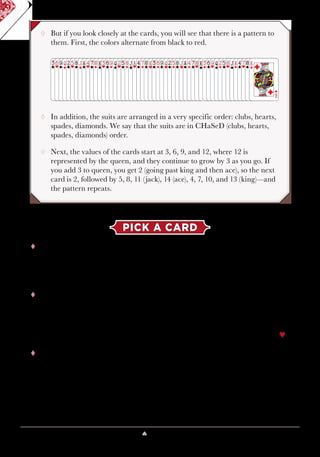
SOLUTIONS CAN BE
FOUND ON PAGE 130.
SOLUTIONS CAN BE
FOUND ON PAGE 130.
Lesson 9 ♠ The Magic of Nine 81
LESSON 9
THE MAGIC
OF NINE
In this lesson, you will learn how to do some
impressive calculations and feats of mind that
are based on the number 9. You will also learn
how to apply cube roots in magic tricks as well as
how to figure out how old someone is from just a
few seemingly random calculations.
EXPLANATIONS
MISSING DIGIT
tt People usually assume that this trick requires superhuman calculating
abilities, yet it’s all based on the magic property of the number 9. What
does 9 have to do with it?
tt Let’s look at the first few multiples of 9.
9, 18, 27, 36, 45, 54, 63, 72, 81, 90, 99, 108, 117, 126, 135, …
tt What do they all have in common? If you add the digits, you get 9.
1 + 8 = 9; 2 + 7 = 9; 5 + 4 = 9; 1 + 2 + 6 = 9
tt An exception is 99, which adds to 18. But that’s okay, because 18 is a
multiple of 9.
9
Math and Magic82
tt Here’s the deal: A number is a multiple of 9 if and only if when you add
the digits, you either get
9 or 18 or 27 or 36 …
tt The digits have to add up to a multiple of 9.
WHY DOES THIS WORK?
¸¸ Let’s take the number 3456.
3456	= (3 × 1000) + (4 × 100) + (5 × 10) + 6
	 = 3 × (999 + 1) + 4 × (99 + 1) + 5 × (9 + 1) + 6
	 = (3 × 999) + (4 × 99) + (5 × 9) + 3 + 4 + 5 + 6
¸¸ Because 999 is a multiple of 9, then so is 3 × 999. And so is 4 × 99 and
5 × 9. And when you add these multiples of 9 together, you still have a
multiple of 9:
3456	= (a multiple of 9) + 3 + 4 + 5 + 6
	 = (a multiple of 9) + 18,
which is still a multiple of 9.
¸¸ By the same argument, if you take any number and add its digits, it tells
you how far it is above a multiple of 9.
¸¸ For example, the number 64 has
6 + 4 = 10,
so it’s 10 bigger than a multiple of 9. That can be verified, because
64 − 10 = 54
is a multiple of 9.
Lesson 9 ♠ The Magic of Nine 83
tt In this trick, you ask your audience to choose a 3-digit number,
mentally add the digits, and then subtract that number from the total.
You do that to force them to start with a multiple of 9.
tt For example, if they start with the number
352,
sum the digits,
3 + 5 + 2 = 10,
and then subtract that from their original number, they get
352 − 10 = 342,
which is a multiple of 9. You can tell that it’s a multiple of 9 because the
digits of 342 add up to 9.
tt Another way to start the trick without doing the subtraction step is to
just give them a multiple of 9 to start with, such as
3456 or 567,
which add to 18.
tt To make this number more personal, you can use a year that is
meaningful to you, or you can just use the first 4 digits of pi: 3141,
which adds to 9.
tt Next, have your audience multiply their number by any 3-digit number.
The number can be of any length, but it’s probably most impressive if
the answer is 6 or 7 digits long. (If it’s any longer than that, then there
is too much of a chance that the person you choose to call out his or her
digits will make a mistake.)
tt Let’s suppose that the person calls out 6 of his or her 7 digits in random
order, and they happen to be
235711.
Math and Magic84
tt You don’t know what that person’s 7-digit number is, but you do know
that his or her answer has to be a multiple of 9. This is because the
person started with a multiple of 9 and multiplied it by something,
so his or her answer still has to be a multiple of 9. So, as the person is
calling out his or her numbers, you add them up. In this case,
2 + 3 + 5 + 7 + 1 + 1 = 19.
tt So, what do you need to add to reach a multiple of 9?
19 + 8 = 27,
so the missing digit has to be 8.
tt Remember that the person can call out his or her 6 digits in any order
and you can still figure it out.
tt Let’s do a trickier example. Suppose the person calls out the digits
442557,
which adds to 27. What did they leave out? You may be tempted to
call out 0—and it might be 0, but it could also be 9. You don’t know if
the 7-digit numbers add to 27 or if they add to 36. In that situation,
you guess!
tt But as a magician, you can do it in such a way that it does not look like
you’re guessing. For example, you can say you are having trouble with
one of the person’s numbers—that’s because he or she left out a 0 or 9.
When this happens, ask the person to concentrate on his or her number
and say, “It seems like you’re thinking of nothing. You didn’t leave out
a 0, did you?” If the person says yes, then you say, “Ah, that’s why I was
getting a lot of nothing!” and you take your bow. If the person says no,
then you say, “I didn’t think so, but it seemed like you were thinking of
nothing, so really concentrate this time. Then say, “You’re thinking of
the number 9” and take a bow.
Lesson 9 ♠ The Magic of Nine 85
tt If you want to avoid the 0 or 9 issue altogether, there’s another approach
that some magicians use. When the person looks at his or her 7-digit
number, have him or her mentally circle any one of his or her numbers.
But tell the person, “Just don’t circle a 0, because that’s already a circle.”
That seems reasonable, or at least humorous. Then have the person
call out his or her other digits, and if they add to a multiple of 9, then
because the person agreed to not think of 0, you know he or she left out
the number 9.
DIGITAL ROOTS
¸¸ If you take a number, such as
1776,
and add its digits,
1+ 7 + 7 + 6 = 21,
and if you get a 2-digit number, add those digits,
2 + 1 = 3,
then the 1-digit number that you end up with is called the digital root.
So, in this example, 1776 has a digital root of 3.
¸¸ What does the digital root tell you about the number?
¸¸ If the digital root is 9, then your number is definitely a multiple of 9.
¸¸ If the digital root is not 9, then the number that you get tells you the
remainder that you get when you divide that number by 9. In the case
of 1776, because it has a digital root of 3, then you know that it is 3
bigger than a multiple of 9.
¸¸ Incidentally, if the digital root is 3, 6, or 9, then your original number is
a multiple of 3. So, 1776, though not a multiple of 9, is a multiple of 3.
Math and Magic86
CASTING OUT 9S
¸¸ There is another surprising way to create a multiple of 9: Take any
number, such as 1618, and scramble the digits to create a new number,
such as 8116, and when you subtract the smaller number from the larger
one, you are guaranteed to get a multiple of 9.
¸¸ In this case, you have
8116 − 1618 = 6498,
which (because the digits add to 27) is a multiple of 9.
¸¸ The reason this works is because when you scramble the digits, you don’t
change the digital root. In this case, 8116 and 1618 both add to 16, so
they both have a digital root of 7. So, both of these numbers are 7 bigger
than a multiple of 9. In this case,
8116 = 9x + 7
for some integer x, and
1618 = 9y + 7
for some integer y.
¸¸ Hence, their difference will be
(9x + 7) − (9y + 7) = 9x − 9y = 9(x − y),
which is definitely a multiple of 9.
¸¸ The process of simplifying and reducing numbers to their digital roots
and doing arithmetic with them is sometimes called casting out 9s
because every number is reduced to a single digit, casting out—or
subtracting—a multiple of 9. This can be used as a useful way for
checking your work or even solving tricky math problems.
Lesson 9 ♠ The Magic of Nine 87
CUBE ROOTS
tt Let’s do another calculation that seems extremely hard but is in fact
very easy to do. This time, instead of multiplying, squaring, or even
cubing, you will work with cube roots.
tt In this trick, you ask a volunteer to cube a 2-digit or 3-digit number.
You know that the number that he or she is giving you is a perfect cube.
If the number is not a perfect cube—for example, if the person asked for
the cube root of 10—then the answer is not a whole number (the cube
root of 10 is about 2.154).
tt This method only works when the
person’s answer is a perfect cube,
and it’s very easy to do. All you
need to know are the cubes of the
numbers from 1 to 10.
13
= 1 63
= 216
23
= 8 73
= 343
33
= 27 83
= 512
43
= 64 93
= 729
53
= 125 103
= 1000
tt Look at the last digit of each number:
1, 8, 7, 4, 5, 6, 3, 2, 9, 0.
tt Notice that all of the digits are different. There’s only one cube that
ends in 1—namely, 1. There’s only one cube that ends in 2—namely, 8.
In fact, the last digit of the cube is either the same as the original digit
or is 10 minus the original digit. For example, 3 cubed, or 27, has a last
digit of 7, and 3 + 7 = 10.
tt How does this help you? Let’s suppose you ask a volunteer to cube
a 2-digit number and the answer is 74,088. To figure out his or her
original 2-digit number, you start by finding the cube root of 74,088.
Recall that cubing a number
is taking a number to the
third power. For example, 5
cubed is 53
= 5 × 5 × 5 = 125.
The cube root is the reverse
of this process. For example,
the cube root of 125 is 5.
Math and Magic88
tt When you hear this answer, you listen for 2 things. The first thing you
listen for are the thousands—that is, the numbers before the comma. In
this case, that would be 74.
74,088
tt Now 74 lies between 4 cubed and 5 cubed.
43
= 64
53
= 125
tt This means that the first digit of the cube root must be 4. Why? Well,
403
= 64,000
503
= 125,000
tt Hence, the cube root of 74,088 must lie between 40 and 50, so the
answer must be in the 40s.
tt To find the last digit of the cube root, you just look at the last digit of
the cube. The number ends in 8,
74,088,
tt and only one number when cubed ends in 8—namely, 2. Thus, the
original 2-digit number must have been
42.
tt Let’s try another example. Suppose that a 3-digit number is cubed and
the 9-digit answer is
197,137,368.
tt How can you figure out the original 3-digit number? Again, you look at
the number before the first comma, representing the millions, which is
197. From the table of cubes, you see that 197 lies between 125 and 216.
53
= 125
63
= 216
Lesson 9 ♠ The Magic of Nine 89
tt So, the first digit has to be 5. And because the 9-digit number ends
in 8, the original 3-digit number ends in 2. Hence, the cube root looks
like this:
5 ? 2.
tt How do you find the middle digit? Notice that if you add the digits of
the 9-digit number, you get 45.
1 + 9 + 7 + 1 + 3 + 7 + 3 + 6 + 8 = 45
tt This means that the 9-digit number is a multiple of 9 and therefore the
original 3-digit number has to be a multiple of 3. This means that the
digits of the original number have to add up to a multiple of 3. Thus,
the 3-digit number has to be either
522 or 552 or 582.
tt Which one is it? You saw that the millions
number, 197, is between 125 and 216.
53
= 125
63
= 216
tt And it’s much closer to 216 than it is to 125.
Thus, your answer should be the largest of
the 3 candidates, so the cube root is
582.
AGE DETERMINATION
tt This trick applies the ideas of this lesson to figure out how old someone
is from just a few seemingly random calculations. Let’s go through the
steps of the first calculation of this trick.
tt Your volunteer starts with his or her age, but it can be any random
2-digit number. Next, he or she adds 7, which creates another random
number. Nothing has happened yet.
If the cube root
is not a multiple
of 3, then the
situation is a little
trickier. The details
are provided in
the Exercises
section at the end
of this lesson.
Math and Magic90
tt Then, the volunteer multiplies by 24, which creates a multiple of 3.
When the person adds or subtracts 60, he or she still has a multiple of 3.
Then, when the volunteer multiplies by 12, this creates a multiple of 9.
In addition, it has to be an even number. Then, the person multiplies by
another number, so it’s still an even multiple of 9.
tt But after the volunteer adds his or her age, 2 things happen. First, if the
person’s age is even, then his or her answer will still be even, and if the
person’s age is odd, then his or her answer will be odd. So, by looking at
the last digit of the answer, you can tell whether the person’s age is even
or odd.
tt Second, when the volunteer adds his or her age to a multiple of 9, the
digital root changes from 9 to whatever the digital root of his or her age
is. For example, if the person is 43, which has a digital root of 7, when
he or she adds that to a multiple of 9, the answer will have a digital root
of 7. So, by adding up the digits of the answer, you know the digital root
of the person’s age.
tt For example, suppose that after asking your questions, your volunteer
produces an answer of
314159.
tt How do you determine their age?
tt First, by looking at the last digit, you know that his or her age is an
odd number.
tt Next, you add the digits of their answer. In this case, the numbers add
to 23:
3 + 1 + 4 + 1 + 5 + 9 + 2 = 23.
tt This person’s age has the same digital root as 23. And because his or
her age is an odd number, the answer might be 23. If it’s not, then all
you have to do is add or subtract 18 until you reach his or her age.
tt Remember that the digital root stays the same as you add and subtract
multiples of 9, and because you know that the last digit of the person’s
age is odd, you can just add multiples of 18.
Lesson 9 ♠ The Magic of Nine 91
tt So, starting with 23, and adding or subtracting 18, the person’s age
must be one of these numbers:
5, 23, 41, 59, 77, or 95.
tt And that should be enough information for you.
tt Let’s do another example. Suppose the person shows you the number
1618033.
tt You can tell from the last digit that this person’s age must be an
odd number.
tt Next, add the digits of this number:
1 + 6 + 1 + 8 + 0 + 3 + 3 = 22.
tt Can this person’s age be 22? No, because his or her age is odd. And
because 22 has a digital root of 4, if the person is younger than 22, then
subtract 9 and his or her age must be 13, which also has a digital root
of 4. If the person is older than 22, then you add 9 to get 31. So, the
person’s age must be 31 or be larger by a multiple of 18. So, his or her
age is either
31 or 49 or 67 or 85 or 103.
tt If you’re still not sure, then play it safe and guess young! For example,
suppose you’re not sure if the person is 49 or 67. Guess 49 and if the
person says, “I wish,” you say, “Well, the numbers were saying that 67
was most likely, but I didn’t believe it, so I went with the second-most-
likely option. Are you really 67? You look much younger!” So, even if
your first guess is wrong, the person will be happy with your answer.
tt If you don’t want to take any chances, then the second calculation gives
you the answer without any guesswork.
tt This time, the first few steps are random, but as soon as your volunteer
multiplies by 12 and then by 30, he or she has a multiple of 360, which
is a multiple of 9. In addition, you know that it ends in 0. And that’s still
true, even after the person multiplies by another 2-digit number.
Math and Magic92
tt For example, at this point, the person’s number could be
17,357,760.
(Notice that it’s a multiple of 9 because the digits add to 36.)
tt Then, you have the person subtract 3141, which is a multiple of 9, so
the answer is still a multiple of 9. Moreover, the last digit will now be 9,
which is less conspicuous than the 0.
tt Subtracting 3141 from the last answer gives this:
17,357,760 − 3141 = 17,354,619.
tt Next, when the person adds the age of his or her friend, 2 things
happen. First, as before, the digital root of the answer becomes the
digital root of the age. And second, because the number used to end
in 9, as soon as you see the final answer, you will know the last digit of
the age, by simply increasing the last digit by 1.
tt For example, if the friend’s age was 42, the new answer would be
17,354,619 + 42 = 17,354,661.
tt When the person shows you this big number, you know 2 things. By
looking at the last digit, which is 1, you know immediately that the age
the person is thinking of ends in 2. Second, when you add the digits of
the big number, you get 33:
1 + 7 + 3 + 5 + 4 + 6 + 6 + 1 = 33,
which has a digital root of
3 + 3 = 6.
tt So, the person’s secret 2-digit number has a digital root of 6. This
means that the sum of the digits must be 6 or 9 bigger, which is 15. And
because the person’s final digit was 2, you know that his or her secret
age must be 42.
Lesson 9 ♠ The Magic of Nine 93
REFERENCES
Benjamin, The Magic of Math.
Benjamin and Shermer, Secrets of Mental Math.
Gardner, Mathematics, Magic and Mystery.
Gardner, Mental Magic.
EXERCISES
Here’s another interesting pattern about cubes. Look at the table of cubes
from 1 to 10 and notice the digital root of each number:
DIGITAL
ROOT
DIGITAL
ROOT
13
= 1 1 63
= 216 9
23
= 8 8 73
= 343 1
33
= 27 9 83
= 512 8
43
= 64 1 93
= 729 9
53
= 125 8 103
= 1000 1
What’s going on here? When you cube a multiple of 3 (such as 3, 6, 9, etc.),
then it makes sense that the result will have a digital root of 9 (because
it will be a multiple of 9). What this table also shows is that if you cube a
number that is 1 or 2 more than a multiple of 3, then the digital root will
be 1 or 8, respectively. This pattern can be useful when doing cube roots of
3-digit cubes, as described in some of the following exercises.
Math and Magic94
1	 Find the cube roots of the following perfect cubes. The first 2 have
2-digit answers and the last 3 have 3-digit answers.
a) 148,877
b) 704,969
c) 34,012,224
d) 273,359,449
e) 656,234,909
2	 Here’s another way to determine anyone’s age between 10 and 99 with
no guesswork required at all. Suppose you ask a volunteer to perform
the following steps, making sure that he or she presses the equals (=)
button after each step.
STEP 1 | Enter a random 3-digit number on your calculator.
STEP 2 | Multiply by 12 (number of months in a year).
STEP 3 | Add or subtract 24 (hours in a day).
STEP 4 | Multiply by 30 (average number of days per month).
STEP 5 | Multiply by any 2-digit number.
STEP 6 | Subtract 3141 (digits of pi: circular reasoning).
STEP 7 | Add any age.
When your volunteer shows you the answer, you tell him or her the age
with just a little bit of thought. How do you do it?
SOLUTIONS CAN BE
FOUND ON PAGE 131.
SOLUTIONS CAN BE
FOUND ON PAGE 131.
Lesson 10 ♠ Look like a Psychic 95
LESSON 10
LOOK LIKE
A PSYCHIC
In this lesson, you will learn some magic tricks
that will give the illusion of your ability to read
someone’s mind or predict the future—all using
the power of mathematics.
EXPLANATIONS
EXACT BIRTHDATE CALCULATION
tt The secret to figuring out someone’s birthday exactly is a little
special algebra.
tt Let’s say that your volunteer’s birthday has month m, date d (written as a
2-digit number), and year y (also written as a 2-digit number).
tt You start with the month and add 16, producing
m + 16.
tt Then, you multiply this by 25, which is
25(m + 16) = 25m + 400.
tt Then, you subtract 36, giving you
25m + 364.
tt Then, you multiply this by 8, which is
200m + 2912.
10
Math and Magic96
tt Then, you subtract 64, giving you
200m + 2848.
tt Next, you divide by 2, giving you
100m + 1424.
tt Then, you add the date, leaving you with
100m + d + 1424.
tt If your volunteer doesn’t want to give you the year, you could end the
trick now by asking them to subtract
1424,
which will produce
100m + d,
which is the person’s birthday.
tt For example, if the birthday is March 19, then m = 3 and d = 19, so the
number would be
319,
which is the birthday
03/19.
tt Assuming that your volunteer is willing to enter his or her year of birth,
then instead of subtracting 1424, multiply by 5, producing
5(100m + d + 1424) = 500m + 5d + 7120.
tt Then, you add 314, giving you
500m + 5d + 7434.
tt And when you multiply this by 20, you get
20(500m + 5d + 7434) = 10,000m + 100d + 148680
Lesson 10 ♠ Look like a Psychic 97
tt Next, you subtract your fudge factor of 5823, giving you
10,000m + 100d + 142,857.
tt Finally, when you add the year y,
10,000m + 100d + 142,857 + y,
and then subtract 142,857, you get what you want, which is
10,000m + 100d + y.
tt So, if you take March 19, 1961, where m = 3, d = 19 and y = 61, this
would give you what follows.
30000
1 900
+ 6 1
3 1 96 1
tt And this is the birthday 03/19/61.
MAGIC NUMBER 142,857
¸¸ The number 142857 is a magical one. When you write the fraction 1
⁄7 in
decimal notation, you get
1
⁄7 = 0.142857 142857 142857 ….
¸¸ As a consequence of that, it has a curious property: If you multiply
142857 by 1, you get the same number! Okay, that’s not so amazing. But
if you multiply it by 2, you get
2 × 142857 = 285714,
which are the same numbers as before, starting with the number 2.
Math and Magic98
¸¸ Furthermore,
3 × 142857 = 428571
4 × 142857 = 571428
5 × 142857 = 714285
6 × 142857 = 857142,
which are the same digits in the
same circular order.
¸¸ And if you multiply this magical
number by 7, then you get
7 × 142857 = 999999.
STACKED DICE
tt This trick is very simple, but it still fools most people,
even those who play with dice a lot. The secret of this
trick is to look at the number on top of the top die and
subtract it from 21. That’s it.
tt So, if the dice were stacked like this, with a 3 on top,
then the total must be 21 − 3 = 18.
WHY DOES THIS WORK?
¸¸ This trick exploits the well-known feature that the numbers on the
opposite sides of a die always sum to 7. If you were to sum the top and
bottom number of each stacked die, the total would come to 21. But you
are only summing the numbers on 5 of the 6 sides, so you subtract the
top side.
¸¸ In general, you can let your volunteer roll any number of dice, and if he
or she uses n dice, then the sum of all the “hidden numbers” is
7n − the top number.
Lesson 10 ♠ Look like a Psychic 99
ALPHABET CARDS
tt The secret to this trick is almost staring you in the face, and it has a lot
in common with some of the card tricks in lesson 2, which were based
on parity. Imagine that the letters of the alphabet were placed on a
5-by-5 checkerboard, plus 1 extra square at the bottom for the letter Z.
tt When you do so, you’ll notice
that all of the vowels happen
to be on light squares. That’s
because the vowels A, E, I,
O, U, W, and Y are in odd
positions of the alphabet: 1,
5, 9, 15, 21, 23, and 25. In other
words, all of the vowels have
the same parity, because they
correspond to odd numbers. As
a result, you are guaranteed to
start on a light square.
tt Every time you make a move—
whether it is up, down, left, or
right—you will always move
to a square of opposite color:
either from light to dark or from dark to light. More specifically, if you
take 1 step, or 3 steps, or 5 steps, or any odd number of steps, the ending
square will be of opposite color of the starting square.
tt So, because you know that your volunteer started off on a light square,
then after he or she has taken 3 steps, (by going 1 step and then 2 steps
more), you know that the person is now on a dark square.
tt At this point, you can safely remove some light squares because you
know that your volunteer can’t be on them. After that, you have the
person move an odd number of steps again and then you remove some
dark squares because you know he or she won’t be on any of those.
tt Eventually, you are led to the only dark square that remains on the
board at the end (which was the letter P in the video).
Math and Magic100
PILE-SPLITTING PREDICTION
tt This is a trick where the secret might be more
interesting than the trick itself.
tt If you start with 10 chips and split them into
piles and record the pile sizes as you go along,
then somehow, when you multiply the pile sizes
at each step and add them together, you always
get a total of 45. That’s pretty surprising, because there are almost 100
ways that you can split these piles up into smaller and smaller piles, yet
they all result in the number 45. Why is that?
tt If you start with a pile that contains n chips, then when you finish the
calculation, the final result will be
tt So, with 10 chips, the final number will be
tt Let’s check out smaller piles and see what they contribute.
tt Notice that a pile of 2 chips can only be split into piles of size 1 and 1, so
its total, after 1 split, will be
1 × 1 = 1,
which agrees with the formula because
tt A pile of 3 chips must be split into a 2 1 pile, and
then a 1 1 pile.
tt This will lead to products of 2 × 1 = 2 and 1 × 1 = 1,
with a total of 3.
For this trick,
you can use
coins, buttons,
poker chips, etc.
n n
2
.
2
−
10 10
2
90
2
45.
2
− = =
2 2
2
2
2
1.
2
− = =
Lesson 10 ♠ Look like a Psychic 101
tt This also agrees with the calculation because
tt As the number of chips grows, there are more possibilities for how the
chips will be split.
PROOF BY STRONG INDUCTION
¸¸ Suppose you verified the formula whenever you had less than n chips.
Here’s a quick proof that the formula will continue to work when you
have exactly n chips. (This is known as a proof by strong induction.)
¸¸ Suppose that you split your first pile of n chips into piles with size x and y,
where x + y = n.
¸¸ This means that this split will directly contribute a product of xy to
your total.
¸¸ Also, because x is smaller than n, then by the assumed formula, no
matter how you split it into smaller piles, it will produce a grand total of
¸¸ Likewise, the y pile will produce a grand total of
¸¸ So, altogether, the grand total starting from n chips will be
which algebraically simplifies to
x xy y x y x y x y2 ( )
2
( ) ( )
2
.
2 2 2
+ + − +
=
+ − +
xy
x x y y
2 2
.
2 2
+
−
+
−
x x
2
.
2
−
3 3
2
6
2
3.
2
− = =
y y
2
.
2
−
Math and Magic102
¸¸ And because x + y = n, this is none other than
which is what you wanted to see.
¸¸ If you haven’t done a proof by induction before, don’t sweat it. Luckily,
the trick will always work whether you completely understand the theory
or not.
TOXIC PREDICTION
tt At the end of this trick, the fact is that you can produce any number
on your calculator. It could be 1.618033 (as it was in the video), or pi,
or even your phone number. You just have to set things up with your
calculator in advance.
tt This is how to force an answer of pi—but you can use any number that
you want. To do this, you will need a scientific calculator. In fact, if you
have a smartphone, you probably have a scientific calculator on it. If
you bring up the calculator and turn the phone on its side, the simple
calculator turns into a scientific one.
The Teaching Company Collection.
n n
2
.
2
−
Lesson 10 ♠ Look like a Psychic 103
tt First, enter the number pi (or press the p button). Then, follow these
simple instructions:
♣♣ Press the + sign.
♣♣ Press 0.
♣♣ Press the multiplication button, ×.
♣♣ Press the left parenthesis button, (.
tt It’s easy to remember these steps because the
4 symbols
+ 0 × (
seem to look like the letters
t o x c
and this is why magicians call it the toxic calculation.
tt What does this accomplish? When you add 0 times anything, you are
just adding 0, so your answer won’t change. Everything you type after
the left parenthesis will eventually be multiplied by 0, so it doesn’t
matter what numbers your volunteer gives you.
tt Note: Don’t press the equals button until you are done with the
calculation. When you press the equals button, that acts like a right
parenthesis, and everything before it will get multiplied by 0 and then
added to your original number and the trick will be over.
tt Let’s go through the trick so that you learn some important details.
tt On your smartphone, bring up the calculator and then turn the
phone on its side so that you are working with the scientific calculator.
Enter your force number, pi (or press the p button), and then press the
toxic buttons.
+ 0 × (
You can even
perform this trick
on someone else’s
calculator if you
can quickly get to
the scientific mode
for a few seconds
to set things up.
That will make the
effect even more
amazing.
Math and Magic104
tt Next, turn your phone upright so that the simple calculator is in
the display.
tt When your phone is on its side, the multiplication button might still be
lit up in the scientific mode, and that might cause suspicion, so don’t
turn the phone upright—and into the simple calculator mode—until
after the volunteer gives you his or her first number.
tt Let’s say that the person chooses the number 5. Once you press 5,
the multiplication button is no longer lit up and you’ll show that to
your audience.
tt Then, ask for a 1- or 2-digit number to multiply. Let’s say the volunteer
chooses 7. You hit ×, then 7, and then + (don’t press =). This will show
the answer of 5 × 7, which is 35, so the audience will see that the
calculator is working properly.
tt Next, ask the volunteer to add a 2- or 3-digit number. (You’ve already
pressed +, but there’s no harm in pressing it again.) When the person
gives you his or her number, you enter it and then press − (not =). Again,
the calculation will display the right answer.
tt Then, have your volunteer subtract a smaller number. Enter it and then
press ÷. When you do this, the calculator will not yet show an answer
because it’s waiting for the next number to complete its calculation.
Most people won’t seem to notice this, and they will stop thinking hard
about the numbers on the display when they hear the word “division”
anyway.
tt Finally, ask the volunteer to divide by another number. You can ask
for a number that will be somewhere in the range of the answer you
want, but it’s not that important. You can just ask for a random 2-digit
number if you want. After the person gives you his or her number, you
press = and, voilà, out pops your force number, which in this case is pi.
tt If you keep the method of this trick secret—and please do—then you
will amaze a whole lot of people!
Lesson 10 ♠ Look like a Psychic 105
REFERENCES
Gardner, Mathematics, Magic and Mystery.
Gardner, Mental Magic.
Scarne, Scarne on Card Tricks.
Simon, Mathematical Magic.
EXERCISES
1	 Think of a number between 1 and 30. The magician shows you the
following 5 cards and asks you which cards contain your number.
Card 1: 1 3 5 7 9 11 13 15 17 19 21 23 25 27 29
Card 2: 2 3 6 7 10 11 14 15 18 19 22 23 26 27 30
Card 3: 4 5 6 7 12 13 14 15 20 21 22 23 28 29 30
Card 4: 8 9 10 11 12 13 14 15 24 25 26 27 28 29 30
Card 5: 16 17 18 19 20 21 22 23 24 25 26 27 28 29 30
After indicating which cards have your number, the magician
immediately reveals the number. How?
2	 The following curiosity can be turned into a feat of psychic power or
supersensitivity. Take any number of coins—for example, 10—and
notice how many of them are showing heads. Suppose that h of the
coins are showing heads. Divide the coins into 2 piles by choosing any
h coins and putting them in a pile on your right, and the rest of the
coins go to the left. Then, turn over every coin in the right pile so that
it shows the opposite side. It should now be the case that the right pile
and the left pile have an equal number of heads. Why?
SOLUTIONS CAN BE FOUND ON PAGE 133.SOLUTIONS CAN BE FOUND ON PAGE 133.
Math and Magic106
LESSON 11
GEOMETRIC AND
TOPOLOGICAL
MAGIC
This lesson focuses on things that seem
physically impossible—that seem to violate
the laws of geometry and topological intuition.
You will be exposed to geometric and topological
mysteries that are based on mathematics.
EXPLANATIONS
VANISHING RABBIT
tt Every course on magic should include the illusion of making a rabbit
disappear. This trick is a mathemagical version. It is an example of
what mathemagicians call a geometrical vanish. But before this trick
is explained, let’s look at a few other puzzling geometrical vanishes—
starting with one that wouldn’t fool anybody but illustrates the point.
tt In the video, there are 5 long lines on the screen.
tt With a wave of the magician’s hands, the 5 lines become 4 lines. Which
line disappeared?
tt Technically, none of them did. Instead, he switched the 5 lines for 4
lines that are each slightly longer than they were before. That’s the basic
premise of most geometrical vanishes.
11
Lesson 11 ♠ Geometric and Topological Magic 107
tt Let’s start with an 8-by-8 square,
which has an area of exactly 64. Cut
out a 3-by-8 rectangle; then cut that
along the diagonal to form 2 right
triangles. From the other rectangle,
cut 2 trapezoids with sides of length 5
and 3.
tt When you rearrange the pieces in the
way they are displayed in the video,
you get a 5-by-13 rectangle. Note
that the sides really do have lengths 5
and 13, but this figure has an area of
65. Where does the extra area come from?
tt The secret, which you can see if you look closely at the screen on the
video, is that the diagonal from the bottom left to the upper right is not
really a straight line. If it were a straight line, then it would have a slope
of 5
⁄13, which is approximately 0.38.
5
⁄13 ≈ 0.385
tt But note that the bottom triangle has slope 3
⁄8, which is
3
⁄8 = 0.375,
which is slightly lower.
8
3
3
3
5 5
5
Math and Magic108
tt And the upper part of the diagonal that comes from the other trapezoid
has slope 2
⁄5, which is
2
⁄5 = 0.4,
which is slightly higher. So, what looks like a diagonal line actually has
a little bit of a dent in it.
tt Similarly, if you look above the diagonal, you see that the trapezoid has
a slope of 0.4 and then the triangle has a slope of 0.375. The result is
that there is a little bit of open space inside the rectangle. In fact, it’s a
tiny parallelogram that goes through the points (0, 0), (5, 2), (8,3), and
(13, 5).
tt The area of that parallelogram turns out to be exactly 1.
FURTHER EXPLANATION
¸¸ The area of a parallelogram that goes through the points (0, 0), (a, b), (c,
d), and (a + c, b + d) is the absolute value of ad − bc.
¸¸ In this example, because the parallelogram goes from (0,0) to the points
(5, 2) and (8, 3), that gives you an absolute value of
(5 × 3) − (8 × 2) = 15 − 16 = −1.
¸¸ So, the area of the parallelogram is 1.
Lesson 11 ♠ Geometric and Topological Magic 109
tt Incidentally, you may have noticed that the numbers that appeared in
the parallelogram—2, 3, 5, 8, and 13—are all Fibonacci numbers! Even
the dimensions of the original square (8 by 8) and final rectangle (5 by
13) are Fibonacci numbers. That is not a coincidence.
tt The Fibonacci numbers have many amazing mathematical properties.
One of them is that if you take a Fibonacci number, such as 8, and
multiply its immediate neighbors—5 and 13—you get 65, which is just 1
away from 82
, or 64.
tt The Fibonacci numbers also have the parallelogram property. If you
take any 4 consecutive Fibonacci numbers a, b, c, and d, then it can be
shown that ad − bc is always 1 or −1.
tt For example, with 2, 3, 5, and 8, you have
(2 × 8) − (3 × 5) = 16 − 15 = 1.
tt You can use the Fibonacci numbers to create larger geometrical vanishes
where the tiny parallelogram becomes even more invisible. In the case of
a 13-by-13 square, the new 8-by-21 rectangle loses 1 unit of area because
the diagonals just barely overlap to form a parallelogram of area 1.
tt Here’s a variation on the last geometrical vanish. This idea is attributed
to Paul Curry, an amateur magician who created some amazing
card tricks.
tt Start with the 5-by-13
triangle shown at right.
THE FIBONACCI NUMBERS
1, 1, 2, 3, 5, 8, 13, 21, 34, 55, …
A
A
B
Math and Magic110
tt Notice how you can rearrange the pieces to obtain a new 5-by-13
triangle but with an entire 1-by-1 square missing from it. Essentially,
what’s happening here is the same idea as before, but it’s more difficult
to see the missing parallelogram.
tt You start with a right triangle with sides of length 8 and 3. Let’s call it
triangle A, and it has an area of 12. Triangle B is a 5-by-2 right triangle,
which has an area of 5. There are also figures that look like a comb and
a toothbrush, with 7 and 8 squares, respectively. The total area of these
pieces is
12 + 5 + 7 + 8 = 32.
tt When you put them together, it looks like a triangle. But it’s not, because
triangle A has a slope of 3
⁄8 = 0.375 and triangle B has a slope of 2
⁄5 = 0.4.
So, the figure, which looks like a right triangle with a hypotenuse going
from (0, 0) to (13, 5), actually has a tiny dent in it at the point (8, 3) that
is hard for the eye to detect.
tt After the pieces are rearranged, again it looks like a right triangle with a
hypotenuse going from (0, 0) to (13, 5), but this time there is a tiny bulge
at the point (5, 2). So, once again, the difference in the area of this new
triangle minus the difference of the old triangle is the parallelogram
from before, which has an area of 1.
tt Hence, this bulging triangle would have an area of 33, which allows you
to squeeze in an extra 1-by-1 square.
A
A
B
B
Lesson 11 ♠ Geometric and Topological Magic 111
tt In the original disappearing rabbit
trick, instead of using a 5-by-13
triangle, a 6-by-13 rectangle is used.
Here, there’s an extra legitimate
6-by-13 right triangle that doesn’t
move. Also, there are 13 extra
rabbits that are attached to the 2
triangles so that they appear as
trapezoids. But otherwise, the same
mathematics shows that the bulge
of the rearranged object (which is
partly hidden by the upper triangle)
has an area of 1, which allows
you to have an extra space for the
unit square.
MÖBIUS MAGIC
tt When you tape the ends of a simple strip of paper together, they form
a loop. Naturally, if you cut through the loop, you end up with 2 loops.
But suppose you take your strip and give the end a half twist before
taping the ends together. Mathematicians call this a Möbius strip,
named after the 19th
-century mathematician August Ferdinand Möbius,
who discovered many of its properties.
tt The Möbius strip only has 1 side. If you run your finger around the
“outside,” you eventually reach the “inside.” This is in contrast with
the previous loop, which is 2-sided, because if you run your finger on
the outside, then it stays on the outside, and if your finger starts on the
inside, then it stays on the inside.
tt The video shows what happens if you cut
through Möbius strips in various ways—
leading to mysterious and surprising results!
Try these experiments yourself and explore
variations to see what you can discover.
There are many fascinating
variations of geometric vanishes,
and the principle goes back
centuries.
In the video, there is an Alice
in Wonderland–themed vanish
created by ThinkFun, a company
that produces games and
puzzles based on mathematics
and logic. The puzzle is in honor
of Martin Gardner, who was the
world’s expert on mathematical
magic, geometrical vanishes,
and Alice in Wonderland. See if
you can figure it out!
©PeterHermesFurian/iStock/Thinkstock.
Math and Magic112
BAGEL CARVING
tt This trick applies the Möbius ideas presented in the video. It involves
taking a regular bagel and carving it in just the right way to create 2
linked bagels—a Möbius bagel.
tt The steps that follow outline the method of Glen Whitney, founder
of the National Museum of Mathematics in New York. You just have
to learn 1 move and repeat it 4 times. The key points to note on your
bagel are the north pole (in the top center), the south pole (at the bottom
center), and the points that represent 3 o’clock and 9 o’clock on the front
and back of the bagel.
tt First, you carve a curve from the north pole to 3 o’clock. As you carve,
your knife should always be perpendicular to the surface and go all the
way through. In other words, when your knife is at the north pole, it
is pointing down vertically, and when it reaches 3 o’clock, it’s pointing
horizontally. It’s helpful to go back through the same path again, just to
make sure that the knife went all the way through.
tt Next, you flip the bagel over so that the north and south poles switch
places; then, you do the same move again, carving from the north pole
to 3 o’clock, where you join up with the previous cut. Again, it’s good to
go through it a second time.
tt Next, twirl the bagel around so that 9 o’clock and 3 o’clock switch
position. Then, perform the same move again, carving from the north
pole to 3 o’clock. Finally, you switch the north and south poles and do
the same move one last time, joining up with the previous cut.
tt Then, carefully pull the bagel apart, and if all has gone well, you will
have linked bagels!
This lesson requires the careful and skillful use of a knife and is
potentially dangerous. Please use extreme caution in attempting this or
any tricks involving knives.
Lesson 11 ♠ Geometric and Topological Magic 113
REFERENCES
Gardner, Mathematics, Magic and Mystery.
Pickover, The Möbius Strip.
Prevos, The Möbius Strip in Magic.
Simon, Mathematical Magic.
EXERCISES
1	 Using a sheet of graph paper take
an 8-by-8 square and cut it into 2
right triangles (with legs of length
3 and 8) and 2 trapezoids (each
with a height of 5 and parallel
sides with lengths of 3 and 5).
Clearly, the 8-by-8 square has an
area of 64.
Next, rearrange the pieces to form
an object that looks like the triangle
shown at left. Because the triangle
has a width of 10 and a height
of 13, then its area is 65. What’s
going on?
8
3
3
3
5 5
5
Math and Magic114
2	 Reproduce this template on
a full-size sheet of paper. (It
doesn’t have to be exact.) Cut
out the cross shape along the
solid line.
Give strip A a half twist and
tape the ends together.
Make a separate loop with
strip B (do not twist) and tape
the ends together. Loop A and
loop B should not intersect.
In a moment, you will cut
through each loop, but before
you do, what shape do you
think you’ll get?
Cut along the dashed lines
of loop A and then along the
dotted lines of loop B.
What shape did you get?
Was your guess right?
SOLUTIONS CAN BE
FOUND ON PAGE 133.
SOLUTIONS CAN BE
FOUND ON PAGE 133.
Lesson 12 ♠ Magic Squares 115
LESSON 12
MAGIC SQUARES
This final lesson explores the magic and
mystery of what mathemagicians refer to as
magic squares. Although there are many ways
to create magic squares, the video focuses on 3
methods: one that is fast, one that is “smooth,”
and one that is personal.
EXPLANATIONS
FAST MAGIC SQUARE
tt There is a quick way to come up with a
magic square that uses all the numbers
from 1 through 16. To make it, start
with the numbers 1 through 16 in their
natural order.
tt Draw an X through the square, which goes
through 8 of the numbers.
tt Swap each number that is on the X with
the number that is diagonally opposite
it. So, you swap 1 with 16, 4 with 13, 6
with 11, and 7 with 10.
tt Removing the X gives you a magic square
where every row, column, and diagonal
add to 34.
1 2 3 4
5 6 7 8
9 10 11 12
13 14 15 16
16 2 3 13
5 11 10 8
9 7 6 12
4 14 15 1
12
Math and Magic116
tt It turns out that there are 880 different
ways to arrange the numbers 1 through
16 to create a magic square. Such a
magic square must always add to 34
because the numbers 1 through 16 add
up to 136, which is 4 times 34.
tt The magic square shown at right
has even more symmetries. In this
magic square, not only does every
row, column, and both diagonals
add to 34, but so does every 2-by-
2 square inside of it, as well as the
wraparound diagonals.
tt How do you create a magic square for
any total, besides 34? To use the fastest
method, all you have to remember is
the magic square shown above. In fact,
you only need to remember 12 of the
16 numbers: the numbers 1 through 12.
tt If you’re given a total of t, then all you
have to do is subtract 20 from that
total and put it in the first missing spot.
For example, if the total was 76, you
would subtract 20 and put 56 in the
higlighted square.
tt For the other 3 squares, you just
subtract 1, resulting in 55; then add 3,
resulting in 58; and subtract 1 again,
resulting in 57. You end up with the
square shown at right.
tt You can check that every row, column,
diagonal, and most symmetrically
placed groups of 4 squares will add
to 76.
8 11 56 1
2 7 12
3 9 6
10 5 4
8 11 56 1
55 2 7 12
3 58 9 6
10 5 4 57
8 11 14 1
13 2 7 12
3 16 9 6
10 5 4 15
Lesson 12 ♠ Magic Squares 117
tt In general, if you want a total of t,
you get the square shown here.
tt As you can check, every row,
every column, both diagonals, and
many other groups of 4 add up
to the total t. This method is fast,
because you always write the same
12 numbers down and the other
4 numbers are easy to remember.
But this method tends to produce
a very lopsided magic square,
where 4 of the numbers can be
much larger than the others.
“SMOOTH” MAGIC SQUARE
tt In this version, all 16 numbers are close together. In fact, they are
almost consecutive, with no large gaps to be seen. Also, this version
gives your assistant something to do because he or she can point to the
squares in any order and you can fill in the square immediately.
tt First, show the original magic square with the numbers 1 through 16.
As you’ll see, that’s not just for the audience’s benefit, but for yours as
well. You will use this magic square to create a magic square for your
assistant’s total.
tt Then, you ask for any 2-digit number larger than 30—prefereably
bigger than 40. Let’s say your assistant chose 74. If you can somehow
add 40 the first magic square, which adds to 34, then you can create a
magic square with a total of 74. The easiest way to do that is to add 10
to each number in the original square, because that will add 40 to every
group of 4. Thus, all the groups of 4 that add to 34 in the first magic
square will now add to 74 in the square you create.
8 11 t − 20 1
t − 21 2 7 12
3 t − 18 9 6
10 5 4 t − 19
Math and Magic118
tt So, as your assistant points to a square,
all you do is look at the corresponding
square and add 10 to it. The resulting
magic square would look like the one
shown at right, which adds to 74 in
dozens of different ways.
tt But now suppose that instead of a total
of 74, your assistant asked for a total of
76. What do you do in that situation?
(You’re certainly not going to add 12.5
to every square because that would be
ugly.) You pretty much do the same thing
as before, but now you have to squeeze
in an extra 2 to each row, column,
and diagonal.
tt To do this, you take the 4 largest
numbers of the original square: 13,
14, 15, and 16 (circled). And for these
numbers, instead of adding 10, you
add 12, which is 2 more than 10.
tt Notice that every row, every column,
and both diagonals have one circled
number in it. This means that they
will all increase by
10 + 10 + 10 + 12 = 42.
tt So, the new total is guaranteed to add
to 76.
34 + 42 = 76
tt In other words, if this were the magic
square that added to 74, then by
adding 2 more to the circled numbers,
you get the magic square for 76.
8 11 14 1
13 2 7 12
3 16 9 6
10 5 4 15
18 21 24 11
23 12 17 22
13 26 19 16
20 15 14 25
18 21 26 11
25 12 17 22
13 28 19 16
20 15 14 27
Lesson 12 ♠ Magic Squares 119
tt A word of caution: It is no longer the case that every 2-by-2 block that
added to 74 will add to 76. To get a total of 76, you need exactly 1
circled number. But luckily that does include every row, every column,
both diagonals, the 4 corners, and all the other 2-by-2 blocks (except for
one that has 2 circled numbers and one that has no circled numbers).
tt In general, to create a magic square with total t, you need to add t − 34
to the original magic square. If this number is divisible by 4—that is, if
t − 34 = 4q,
where q stands for quotient—then you simply add q to every number.
tt For example, if the requested number was 62, then because
62 − 34 = 28 = 4 × 7,
then you simply add 7 to every entry of the first magic square to get the
new magic square.
tt On the other hand, if your assistant
chose the number 63, which is 1
more than 28, then you still add 7
to most of the squares, but whenever
he or she points to one of the squares
corresponding to the 13, 14, 15, or 16,
then you add 1 more than 7—namely,
8—giving you the square shown
at right.
The reason that the 4 circled numbers were chosen to correspond to
the 13, 14, 15, and 16 in the original square is that because you are adding
12 to the 4 largest numbers of the original square, the new magic square
will still consist of 16 different numbers. No numbers will be repeated,
which is aesthetically nice.
15 18 22 8
21 9 14 19
10 24 16 13
17 12 11 23
Math and Magic120
tt The general rule is this: Given your total t, if t − 34 is not a multiple of
4—for example,
r − 34 = 4q + r,
tt where the remainder r is equal to 1, 2, or 3—then when your assistant
chooses a square that corresponds to one of the 12 small numbers, you
add q to it. But when your assistant chooses a square that corresponds
to 13, 14, 15, or 16, you add q + r.
DOUBLE-BIRTHDAY MAGIC SQUARE
tt Although this method’s resulting magic square is not as “smooth” as the
one you were just introduced to, it looks much more challenging, has a
surprise ending, and is much more personalized because you base it on
your assistant’s birthday.
tt To start, your assistant’s birthday
goes in the top row. In the video,
the magician used his assistant’s
daughter’s birthday, which is
12/3/2013.
tt The most important step is to
add these 4 numbers—12, 3, 20,
and 13—correctly, because if
you make a mistake here, there’s
no recovery.
12 + 3 + 20 + 13 = 48
After you create the new magic square, say to your assistant, “Now we
noticed that the first magic square adds to 34; let’s see how we did with
your magic square.” Then, put the first magic square away. That’s called
ditching the evidence—so nobody has the time to compare the 2 magic
squares.
People really enjoy this magic
square routine, especially if
you base it on someone’s
birthday. And if you do it on
the back of your business
card, you can be sure that the
person will keep that card as a
souvenir for a very long time.
Lesson 12 ♠ Magic Squares 121
tt Because you’ve seen this trick before,
you know that the person’s birthday
not only appears in the top row but
also in the 4 corners, so write down a
3 in the bottom left corner. (Save the
20 from the year for last to keep it a
surprise.)
tt Next, you start heading up the
diagonal. The secret to the magic
square is this: You can essentially
place any number you want in the
highlighted square and the rest of the
square is essentially forced. The only
number you don’t want to put in this square is the number that appears
in the third square in the top row, which is 20 in this case. If you do,
you’ll still get a magic square, but every row and column will have the
same 4 numbers—12, 3, 20, and 13—and that won’t look very magical.
tt On the other hand, the farther you get
away from this number (in this case,
20), the more likely it is that you will
end up with negative numbers, which
you should try to avoid if possible.
So, all you do is take this number
(again, 20) and add 1 to it. In this case,
20 + 1 = 21, and you write that number
in the highlighted square.
tt Now this magic square becomes like
the easiest Sudoku you’ve ever done.
tt As you can verify, there are dozens of
groups of 4 that add to 48.
12 3 20 13
19 14 11 4
14 21 2 11
3 10 15 20
12 3 20 13
?
3
Math and Magic122
tt But how can you be sure they will always work? The answer is
through algebra.
tt For any birthdate with numbers a, b, c, and d, the grand total will be
a + b + c + d.
tt The end result is the magic square
shown here, where adding 1 to a
number is denoted by +, adding 2 to a
number is denoted by + +, subtracting
1 from a number is denoted by −,
and subtracting 2 from a number is
denoted by − −.
tt Notice that every row, every column,
and both diagonals contain an a, a b, a
c, and a d as well as an equal number
of pluses and minuses. Hence, they will
add up to the total: a + b + c + d.
tt If your assistant is born between 2000 and 2009, avoid using c = 0
in the top row because that forces a c− = −1 in the second row and
you want to avoid negative numbers if possible. Instead, for a date
like 2005, put c = 20 in the top row and d = 05 next to it so that the
entire year is spelled out. When this happens, it’s worth noting that you
will always have c+ = 21 and c− = 19 in your magic square, which saves
calculating time.
The reason most magicians don’t explain their tricks is because they’ve
all made that mistake before and haven’t gotten the reaction they want.
As a magician, you want people to say, “Wow, that’s clever. You’re
good!” But they never do once you’ve shared the secret of how the trick
is done. Instead, they say, “Oh, that’s simple! I thought you were good,
but I just wasn’t paying attention!”
So, if a magician shares his or her method with you, remember how
impressed you were before he or she explained it.
a b c d
c− d+ a− b+
d+ c+ b− a−
b a− − d++ c
Lesson 12 ♠ Magic Squares 123
tt Finally, although you might try to avoid negative numbers in your
square, sometimes they are unavoidable. For example, any birthdays
in January will have a = 1 and will therefore have an a− − = −1 in the
bottom row. But you can live with that.
tt If you look for them, there are more than 3 dozen different neatly
arranged groups of 4 that are guaranteed to add to your total. In
addition to the 10 main rows and diagonals, there are 12 other 2-by-2
squares (including the 4 corners), 2 broken diagonals, 2 pentagons, 4
corners of 3-by-3 squares, 4 stalagmite-stalactite pairs, and 4 L-shaped
regions. See if you can find more!
REFERENCES
Benjamin, The Magic of Math.
Benjamin and Shermer, Secrets of Mental Math.
Pickover, The Zen of Magic Squares.
Simon, Mathematical Magic.
EXERCISES
1	 a) Create a fast magic square for the total 38.
b) Create a “smooth” magic square for the total 38.
c) Create a double-birthday magic square for the date 11/18/36.
d) Use the algebraic magic square chart to verify that the magic
square will give the proper total for at least 40 different groups of 4.
2	 What is the secret to the magic matrix trick at the end of the
video lesson?
SOLUTIONS CAN BE FOUND ON PAGE 134.SOLUTIONS CAN BE FOUND ON PAGE 134.
Math and Magic124
BIBLIOGRAPHY
Benjamin, Arthur. The Magic of Math: Solving for X and Figuring Out Why.
New York: Basic Books, 2015.
Benjamin, Arthur, and Michael Shermer. Secrets of Mental Math: The
Mathemagician’s Guide to Lightning Calculation and Amazing Math Tricks.
New York: Random House, 2006.
Craven, Tom, and Paul Gordon. The Second 16th
Card Book. Worthing, UK:
Natzler Enterprises, 2007.
Diaconis, Persi, and Ron Graham. Magical Mathematics: The Mathematical
Ideas That Animate Great Magic Tricks. Princeton, NJ: Princeton University
Press, 2012.
Fulves, Karl. Self-Working Card Tricks. New York: Dover Publications, 1976.
Gardner, Martin. Martin Gardner’s Mathematical Games. Providence, RI:
American Mathematical Society, 2005. CD.
———. Mathematics, Magic and Mystery. New York: Dover Publications,
1956.
———. Mental Magic: Surefire Tricks to Amaze Your Friends. New York: Dover
Publications, 2009.
Kaufman, Richard. Paul Gertner’s Steel and Silver. Silver Spring, MD:
Kaufman and Greenberg, 1994.
Minch, Stephen. The Collected Works of Alex Elmsley. vol. 1. Tahoma, CA: L
& L Publishing, 1991.
Morris, S. Brent. Magic Tricks, Card Shuffling and Dynamic Computer
Memories. Washington, DC: Mathematical Association of America, 1998.
125Bibliography
Mulcahy, Colm. Mathematical Card Magic: Fifty-Two New Effects. Boca
Raton, FL: CRC Press, 2013.
Pickover, Clifford. The Möbius Strip: Dr. Augustus Möbius’s Marvelous Band
in Mathematics, Games, Literature, Art, Technology, and Cosmology. New York:
Thunder’s Mouth Press, 2006.
———. The Zen of Magic Squares: An Exhibition of Surprising Structures across
Dimensions. Princeton, NJ: Princeton University Press, 2002.
Prevos, Peter. The Möbius Strip in Magic. Kangaroo Flat, AU: Third
Hemisphere Publishing, 2018.
Scarne, John. Scarne on Card Tricks. New York: Dover Publications, 2003.
Simon, William. Mathematical Magic. New York: Dover Publications, 2012.
Trost, Nick. The Card Magic of Nick Trost. Tahoma, CA: L & L Publishing,
1997.
Math and Magic126
EXERCISE SOLUTIONS
LESSON 1
1	 After performing the procedure described above, the selected card
will be the 11th
card from the top. The way you should perform it is to
deal about 15 cards faceup, mentally noting the 11th
card, and then say
to your volunteer, “Would you be surprised if the next card I turned
over was your card?” Because he or she has seen you deal past his or
her card, the volunteer will usually say that he or she would be very
surprised. Your volunteer expects you to deal the 16th
card, but instead
you simply turn the 11th
card from faceup to facedown!
Why does the selected card go to the 11th
position? After the first
deal, the card’s column is picked up second, so it will be in position 8,
9, 10, 11, 12, 13, or 14. After the second deal, the card will be in the
third, fourth, or fifth position in the column. Thus, after the cards are
gathered, it will be in the 10th
, 11th
, or 12th
position. After the third
deal, the card will be in the fourth position of its column, and after
those cards are gathered, it will be the 11th
card of the deck.
2	 The trick begins with 4 cards, and after they are torn, you have 8 half
cards arranged in some order abcdabcd. Let’s see what happens after
each step.
STEP 1 | Transfer the top card to the bottom: bcdabcdab.
STEP 2 | Transfer the top 2 cards to the bottom: dabcdabc.
STEP 3 | Bury the top 3 cards in the middle: c(6 other cards)c.
STEP 4 | Put the top card in your pocket: (6 other cards)c.
At this point, you have taken card c, and its mate is at the
bottom of the packet.
CLICK to go back
to the lesson.
127Exercise Solutions
STEP 5 | Take the top 1, 2, or 3 cards and put them in the middle of
the packet. Card c is still at the bottom.
STEP 6 | Take 1, 2, or 3 cards and either put them in the middle or
throw them away. You now have 4, 5, 6, or 7 cards, and card c
remains at the bottom.
STEP 7 | Transfer the top card to the bottom 7 times. Depending on
whether you have 4, 5, 6, or 7 cards, your new arrangement
will now be one of these 4 arrangements, where x represents
any card that is not c: cxxx, xxcxx, xxxxcx, or xxxxxxc.
STEP 8 | Play She Loves Me, She Loves Me Not, where every other
card is eliminated until you are left with a single card. Notice
that in all 4 arrangements, the card that survives is card c. For
example, with 6 cards, numbered 123456, you first eliminate
numbers 2, 4, and 6 and then card 3 and then 1, so the
surviving card would be the fifth card, which is card c.
LESSON 2
1	 Either the faceup or facedown letters
will spell the word “MAGIC.” The
reason is that if you imagine that the
letters are written on a checkerboard
with alternating light and dark squares,
then the light-colored squares consist
only of the letters M, A, G, I, C, and
some blank squares.
2	 The faceup cards (and the facedown cards) will sum to 35. That’s
because the cards on the light squares and dark squares each add to
35. Note that the first 14 numbers of the table come from the digits of
pi but the 15th
digit was chosen to make the trick work. (The 15th
digit
of pi would be 9 instead of 2.)
Math and Magic128
LESSON 3
1	 a) LMH (low, medium, high) adds 1 to 6¨, so the facedown card is 7¨.
b) MHL (medium, high, low) adds 4 to 8ª, yielding Qª.
c) HML (high, medium, low) adds 6 to J¨, yielding 4¨.
d) LHM adds 2 to 4§, yielding 6§.
2	 a) 2 + 7 + 1 + 8 = 18 is 2 greater than 16, so the anchor card is in the
second position—namely, 7♥. The other 3 cards, 2A8, are in MLH
order, so you add 3 to 7♥ to obtain 10♥.
b) 0 + 0 + 9 + 4 = 13 is 1 greater than 12, so the anchor card is in the
first position—namely, Kª. The other 3 cards, Q94, are in HML
order, so the facedown card is 6ª.
LESSON 4
1	 Recall that every 4 cards is the same suit and causes the value to go
down by 1. Because 20 is a multiple of 4 (4 × 5), then 20 cards after the
Jª the card must still be a spade, and the value has decreased by 5, so
the card would be 6ª. To find the 23rd
card, just count 3 cards forward
from 6ª. Adding 9 and shifting 3 suits farther gives you 15♥, which
is 2♥.
2	 The cards are in Si Stebbins order, and cutting the cards will not
disturb that. After spelling “COLOR” and looking at the next card,
the magician has counted 6 cards, which will be the same color (and
different suit) from the chosen card. After spelling “NUMBER,” the
following card would be 13 cards after the original card, which will
have the same value. (Incidentally, it will also be of the opposite color.)
Then, after spelling “MATCHING CARD,” the next card will be
another 13 cards and therefore will be 26 cards away from the original
card, which will be the mate of the selected card.
129Exercise Solutions
LESSON 5
1	 28 = 16 + 8 + 4 has binary representation 11100. So, the proper
sequence would be in-in-in-out-out. For position 42, you note that 41 =
32 + 8 + 1 = 101001, so you would perform in-out-in-out-out-in.
2	 The binary number 110000 represents the number 32 + 16 = 48, so the
top card will go to position 49. For the 17th
card, recall that for cards
in the top half of the deck, an in-shuffle sends a card in position n to
position 2n, whereas an out-shuffle sends the card to position 2n − 1.
For cards in the bottom half, the in-shuffle sends the card in position
n to position 2n − 53 and the out-shuffle sends it to position 2n − 52.
Hence, the 2 in-shuffles will send the card at position 17 to position
34 and then to position 68 − 53 = 15. The next 4 out-shuffles will send
the card to position 29, then to position 6, then to 11, and finally to
position 21.
LESSON 6
1	 Because of the Gilbreath principle, the first 4 cards consist of all 4
suits. Because your facedown cards are a diamond and a heart, then
you know that your volunteer’s facedown cards must be a club and a
spade. Also by the Gilbreath principle, the first 13 cards will consist
of all 13 different values. Because you can see all values except for
the 5 and 7 among these 13 cards (ignoring 6♥), you know that your
volunteer’s facedown cards must be 5 and 7. Thus, his or her cards
must either be 5§ and 7ª, or 5ª and 7§. You can ask (or guess) which
suit has the larger number, but you can do better than guessing. Look
at your facedown cards. In the 8-kings stack, 9♥ comes before 5ª, so
the chances are very, very good that the 5 is 5ª instead of 5§. Also,
2¨ and 7§ are adjacent in the 8-kings stack, so you can say with
confidence that the facedown cards are 5ª and 7§.
2	 Begin with the cards in alternating color order, which won’t be
disturbed when the cards are cut. After the volunteer gives the cards
a riffle shuffle, deal a few cards to show that there is no pattern to the
cards. Deal until you get 2 cards of the same color next to each other;
Math and Magic130
then, deal one more card. The cards will now have the property that
every pair of cards will have a black card and a red card. So, when the
volunteer guesses the color of the card, you turn up the card to see if
his or her guess is right or wrong. Look at the turned-up card and then
guess the opposite color for your card. You will be right every time.
LESSON 7
1	 Starting with PIN abc, the number abcabc is equal to abc × 1001. And
because 1001 = 7 × 11 × 13, when you divide the 6-digit number by 11,
13, and the PIN, then you must end up with 7. But it’s more impressive
to end up with something that is not a whole number. By dividing
by 23, then 16, and then the PIN, you will end up with 1001 ÷ 368 =
2.72010869…. Provide as many digits as you want to.
2	 If you start with the numbers a, b, and c, then when you create the
numbers ab, ac, ba, bc, ca, and cb, you note that each letter appears
twice in the ones column and twice in the tens column. Hence, the
ones digits will contribute 2a + 2b + 2c to the total, and the tens digits
will contribute 20a + 20b + 20c to the total, so the numbers must add to
22a + 22b + 22c = 22(a + b + c). When this number is divided by the sum
of the digits, a + b + c, you must get 22.
LESSON 8
1	 a) 594
b) 836
c) 0.835164…
d) 7225
e) 2916
f) 11,554
131Exercise Solutions
g)
98 (−2)
×95 (−5)
In this case, you compute 98 − 5 = 93 and then multiply by 100 to
obtain 9300. Adding (−2) × (−5) = 10 to this gives you 9310.
h)
1 1 2 (1 2)
× 94 (−6)
In this case, you compute 112 − 6 = 106 and then multiply by 100 to
obtain 10,600. Adding 12 × (−6) = −72 gives you 10,528.
LESSON 9
1	 a) The cube root is 53, because 148 lies between 53
and 63
, and 33
ends
in 7.
b) The cube root is 89, because 704 lies between 83
and 93
, and 93
ends
in 9.
c) The cube root is 324. Because 34 lies between 33
= 27 and 43
= 64,
the first digit of the cube root must be 3. And because 43
ends in 4, the
last digit must be 4. Thus, the cube root has the form 3 ? 4.
To find the middle digit, you add the digits of the cube:
3 + 4 + 0 + 1 + 2 + 2 + 2 + 4 = 18,
which has a digital root of 9, which means that the original 3-digit
number must be a multiple of 3. Thus, the digits of 3 ? 4 must sum to
a multiple of 3, so the middle digit is either 2 or 5 or 8. And because
the 9-digit number is much closer to 27 than it is to 64, you choose the
smallest of the middle numbers for a cube root of 324.
Math and Magic132
d) Comparing 273 with 63
= 216 and 73
= 343, you see that the first
digit is 6, and because 93
ends in 9, the last digit is 7. So, the cube root
has the form 6 ? 9. For the middle digit, you sum the digits
2 + 7 + 3 + 3 + 5 + 9 + 4 + 4 + 9 = 46,
which has a digital root of 1. Thus, 6 ? 7 must be 1 more than a
multiple of 3, so the middle digit is either 1 or 4 or 7. Because 273 is
squarely in between 216 and 343, you choose the middle candidate for
a cube root of 649. To verify this, notice that 6503
is approximately
(and a little larger than) 600 × 650 × 700 = 273,000,000.
e) As in the previous 2 problems, because 656 lies between 83
= 512
and 93
= 729, you know that the first digit is 8, and because the cube
ends in 9, you know that the last digit is 9. Hence, your cube root
is of the form 8 ? 8. To find the middle digit, you see that the digits
of 656,234,909 sum to 44, so it has a digital root of 8. This means that
8 ? 9 must be 2 bigger than a multiple of 3, so the middle digit must
be 0, 3, 6, or 9. Because 656 is not especially close to 512 or 729, you
can rule out 0 or 9 as the middle digit, and because 656 is a bit closer
to 729 than it is to 512, you choose the larger candidate for a cube
root of 869. (Also, 8503
is about 800 × 850 × 900 = 612,000,000, so the
middle digit should be greater than 5.)
2	 After step 5, the number on the volunteer’s calculator will be a multiple
of 9 that ends in 0. After step 6, the number is a multiple of 9 that ends
in 9. After adding the age, the final answer will have the same digital
root as the age, and the last digit of the answer will be 1 less than the
last digit of the age. This will completely determine the age, because
you know the last digit and you know what the sum must be. For
example, suppose you see the final answer 5,545,981. By looking at the
last digit, you know that the chosen age ends in 2. Also, by summing
the digits of the final answer,
5 + 5 + 4 + 5 + 9 + 8 + 1 = 37,
and 37 sums to 10. So, you know that the age has a digital root of
1 and therefore sums to 1 or 10. Because the last digit is 2, the only
possible first digit is 8, so the chosen age was 82.
133Exercise Solutions
LESSON 10
1	 Every number from 1 to 30 can be uniquely expressed as the sum of
some of these powers of 2:
1, 2, 4, 8, and 16.
The numbers on cards 1, 2, 3, 4, and 5 are the numbers that use the
numbers 1, 2, 4, 8, and 16, respectively, in their representation. For
example, the number 19 = 16 + 2 + 1 appears on cards 1, 2, and 5. All
the magician needs to do is add the first numbers that appear on each
card that is used. For example, if your number is on cards 3, 4, and 5,
the magician knows that the chosen number must be 4 + 8 + 16 = 28.
2	 Suppose you start with n coins, h of which are heads. You move any h
coins to the pile on the right. Let’s say that among these h coins, x of
them are currently heads and h − x of them are tails. How many coins
in the left pile are heads? h − x. When you flip the coins in the right
pile, you will have x tails and h − x heads, so the number of heads in
each pile will now be equal.
LESSON 11
1	 The 4 rearranged pieces don’t form an
exact triangle—because the slopes of
the triangles, 8
⁄3 = 2.67 and 13
⁄5 = 2.6,
are close but not equal.
2	 You get a small Möbius loop
interlocked with a big square.
Try it!
Math and Magic134
LESSON 12
1	
d) Every group of 4 that contains an a,
a b, a c, and a d and an equal number of
plus signs as minus signs will add to the
magic total of 38. It’s easy to check that
all 4 rows, 4 columns, and 2 diagonals
have this property. But there are many
others. For example, there are seven 2-by-
2 squares like these 4 in the middle that
add to a + b + c + d (at right).
See below for more examples.
There are 2 broken diagonals:
8 11 18 1
17 2 7 12
3 20 9 6
10 5 4 19
9 12 15 2
14 3 8 13
4 17 10 7
11 6 5 16
11 18 3 6
2 7 10 19
7 4 17 10
18 9 8 3
a b c d
c− d+ a− b+
d+ c+ b− a−
b a− − d++ c
a b c d
c− d+ a− b+
d+ c+ b− a−
b a− − d++ c
a b c d
c− d+ a− b+
d+ c+ b− a−
b a− − d++ c
a b c d
c− d+ a− b+
d+ c+ b− a−
b a− − d++ c
a b c d
c− d+ a− b+
d+ c+ b− a−
b a− − d++ c
a b c d
c− d+ a− b+
d+ c+ b− a−
b a− − d++ c
a b c d
c− d+ a− b+
d+ c+ b− a−
b a− − d++ c
135Exercise Solutions
There are 4 that are shaped like a pentagon:
The corners of the 3-by-3 squares sum to the proper total:
There are 4 stalagmite-stalactite pairs:
There are 4 L-shaped patterns:
And last but not least (and by design), there are the 4 corners.
a b c d
c− d+ a− b+
d+ c+ b− a−
b a− − d++ c
a b c d
c− d+ a− b+
d+ c+ b− a−
b a− − d++ c
a b c d
c− d+ a− b+
d+ c+ b− a−
b a− − d++ c
a b c d
c− d+ a− b+
d+ c+ b− a−
b a− − d++ c
a b c d
c− d+ a− b+
d+ c+ b− a−
b a− − d++ c
a b c d
c− d+ a− b+
d+ c+ b− a−
b a− − d++ c
a b c d
c− d+ a− b+
d+ c+ b− a−
b a− − d++ c
a b c d
c− d+ a− b+
d+ c+ b− a−
b a− − d++ c
a b c d
c− d+ a− b+
d+ c+ b− a−
b a− − d++ c
a b c d
c− d+ a− b+
d+ c+ b− a−
b a− − d++ c
a b c d
c− d+ a− b+
d+ c+ b− a−
b a− − d++ c
a b c d
c− d+ a− b+
d+ c+ b− a−
b a− − d++ c
a b c d
c− d+ a− b+
d+ c+ b− a−
b a− − d++ c
a b c d
c− d+ a− b+
d+ c+ b− a−
b a− − d++ c
a b c d
c− d+ a− b+
d+ c+ b− a−
b a− − d++ c
a b c d
c− d+ a− b+
d+ c+ b− a−
b a− − d++ c
Math and Magic136
2	 Let’s look more closely at the numbers in
the matrix.
It’s true that the first 5 squares come from
the digits of pi, but that’s just a red herring.
What’s really going on is that this is an
addition table.
Every entry in the matrix is
the sum of the corresponding
row and column numbers.
For example, the number 42
in the fourth row and third
column is equal to 14 + 28.
When you find the matching
colors, you will have 4 entries
that each lie in different rows
and columns.
For example, consider what happens if you end up like this:
Each of the 4 selected
numbers will be the sum of
one of the row numbers and
one of the column numbers.
So, the grand total must be
the sum of the 8 row and
column numbers, specifically.
Any 4 numbers from different
rows and columns must add to
31 + 5 + 17 + 14 + 0 +
10 + 28 − 5 = 100.
Notice what happens when you put numbers alongside the rows and
columns of the matrix like this:
31 41 59 26
5 15 33 0
17 27 45 12
14 24 42 9
0 10 28 −5
31 31 41 59 26
5 5 15 33 0
17 17 27 45 12
14 14 24 42 9
0 10 28 −5
31 31 41 59 26
5 5 15 33 0
17 17 27 45 12
14 14 24 42 9

Math and magic

  • 1.
    Better Living Topic Hobby &Leisure Subtopic Math and Magic Arthur T. Benjamin Harvey Mudd College Course Guidebook
  • 2.
    Published by THE GREATCOURSES Corporate Headquarters 4840 Westfields Boulevard | Suite 500 | Chantilly, Virginia | 20151‑2299 [phone] 1.800.832.2412 | [fax] 703.378.3819 | [web] www.thegreatcourses.com Copyright © The Teaching Company, 2018 Printed in the United States of America This book is in copyright. All rights reserved. Without limiting the rights under copyright reserved above, no part of this publication may be reproduced, stored in or introduced into a retrieval system, or transmitted, in any form, or by any means (electronic, mechanical, photocopying, recording, or otherwise), without the prior written permission of The Teaching Company.
  • 3.
    iProfessor Biography Arthur T.Benjamin, PhD Smallwood Family Professor of Mathematics Harvey Mudd College Arthur T. Benjamin is the Smallwood Family Professor of Mathematics at Harvey Mudd College, where he has also served as the chair of the Department of Mathematics. He earned his BS in Applied Mathematics from Carnegie Mellon University and his PhD in Mathematical Sciences from Johns Hopkins University. From the Mathematical Association of America (MAA), Professor Benjamin has received the Southern California-Nevada Section Award for Distinguished College or University Teaching of Mathematics and the national Deborah and Franklin Tepper Haimo Award. He was also named the George Pólya Lecturer by the MAA from 2006 to 2008. Professor Benjamin was chosen by The Princeton Review as one of its Best 300 Professors. He was also selected as an inaugural Fellow of the American Mathematical Society. Reader’s Digest named him “America’s Best Math Whiz.” Professor Benjamin’s research interests include combinatorics and number theory, with a special fondness for Fibonacci numbers. Many of these ideas appear in his book (coauthored with Jennifer Quinn) Proofs That Really Count: The Art of Combinatorial Proof, which received the MAA’s Beckenbach Book Prize. From 2004 to 2008, Professors Benjamin and Quinn served as the coeditors of Math Horizons magazine. Professor Benjamin’s mental calculation techniques are explained in his book Secrets
  • 4.
    Math and Magicii ofMental Math: The Mathemagician’s Guide to Lightning Calculation and Amazing Math Tricks. Prolific math and science writer Martin Gardner called the book “the clearest, simplest, most entertaining, and best book yet on the art of calculating in your head.” Professor Benjamin’s most recent book, The Magic of Math: Solving for x and Figuring Out Why, was a New York Times Best Seller. In addition to his academic career, Professor Benjamin is also a professional magician who performs his mixture of math and magic to audiences all over the world, including at the Magic Castle in Hollywood, California. He has appeared on dozens of television and radio programs, including the TODAY show and The Colbert Report as well as CNN and National Public Radio. He has been featured in Scientific American, Omni, Discover, People, Esquire, The New York Times, the Los Angeles Times, and Reader’s Digest. Professor Benjamin has given numerous wide-reaching TED Talks that have been viewed more than 20 million times. Professor Benjamin’s other Great Courses are The Joy of Mathematics, Discrete Mathematics, The Secrets of Mental Math, and The Mathematics of Games and Puzzles: From Cards to Sudoku. ¨
  • 5.
    iiiAcknowledgments ACKNOWLEDGMENTS Putting this coursetogether was a true labor of love, and there are so many people I wish to thank that made this course possible. Professor Victoria Noquez was my primary research assistant on this project, and her mathematical knowledge and magical expertise proved invaluable. Thanks also to my department chair, Lisette de Pillis, and John Sundeman for providing funds to support Dr. Noquez and for books, props, materials, and travel that were essential to this project. Naturally, there are many mathematicians and magicians to thank, many of whose ideas and suggestions made their way into this course. I am especially grateful to the following mathematicians: Barry Balof, Steve Butler, Jay Cordes, Joyati Debnath, Doug Ensley, Allison Henrich, John Harris, Jon Jacobsen, Jason Lee, Mario Micheli, Brent Morris, Colm Mulcahy, Sam Nelson, Mohamed Omar, Michael Orrison, Matt Parker, Lizard Reiland, Sarah Rundell, Ricardo Teixeira, Tadashi Tokieda, Robert Vallin, and Glen Whitney. For their magical assistance and advice, I am delighted to thank Paul Gertner, Howard Hamburg, Jonathan Levitt, Max Maven, Brent Morris, Diamond Jim Tyler, Phil Van Tee, and Magic Castle librarians Lisa Cousins and Bill Goodwin. The following magicians, past and present, were also a great source of inspiration: John Bannon, Alex Elmsley, Norman Gilbreath, Bob Hummer, Nick Trost, and especially Martin Gardner, who was the greatest mathemagician of all time and the most prolific author in the field. Special thanks to John Harris for creating the beautiful number logs, Bill Ritchie of ThinkFun for the use of the Cheshire Cat geometrical vanish, and especially Mario Micheli for his magic square templates, 3-D–printed interlocking bagels, and other marvelously manufactured Möbius miracles. For displaying their special talents on camera, I am grateful for the poker prowess of Lizard Reiland, the perfect shuffling of Brent Morris, and the beguiling bagel carving of Michelle Pellatt (with a shout-out to Glen Whitney for providing us with expert instruction). Special thanks to whiz
  • 6.
    Math and Magiciv kidsLucy Ingram, Nikita Lugovoy, and Stephan Lugovoy for showing off their calculating cleverness and to the many staff members from The Great Courses who helped out as unsuspecting volunteers for my magic tricks: Randy Kraemer, Tammy Cornelious, Kevin Barnhill, Art Jaruphaiboon, Michelle Pellatt, Torrance Hill, Amy Derr, Mark Ginesi, Leslie Meade, Andrew Volpe, Ines Perez Thompson, Kenya Hughes, Courtney Westphal, Josh Rodriguez, James Nidel, Peter Dwyer, and Erin O’Riley. Thanks also to the studio crew for this course: Roberto de Moraes (director), Justin Thomas (camera), Kelly Tagliaferri (camera), and Sherri Macdonald-Hagelen (production assistant). It is always a pleasure to work with the staff of The Great Courses, both on camera and off. I especially want to thank Maureen Faley and Michelle Pellatt for their tireless devotion to this project. Last but not least (indeed, most!), I thank my wife, Deena, and daughters Laurel and Ariel, who supported me and assisted me throughout this project. Thank you for bringing so much magic to my life! ¨
  • 7.
    vTable of Contents GUIDES 1 Mathematical Card Tricks . . . . . . . . . . . . . . . . . . . 3 2 What’s Your Deal? . . . . . . . . . . . . . . . . . . . . . . . 10 3 Look like a Card Shark . . . . . . . . . . . . . . . . . . . . 20 4 The Deck Is Stacked . . . . . . . . . . . . . . . . . . . . . . 32 5 Perfect Shuffles . . . . . . . . . . . . . . . . . . . . . . . . . 42 6 Riffle Shuffles . . . . . . . . . . . . . . . . . . . . . . . . . . . 51 7 Magic with Numbers . . . . . . . . . . . . . . . . . . . . . . 57 8 Look like a Genius . . . . . . . . . . . . . . . . . . . . . . . 68 9 The Magic of Nine . . . . . . . . . . . . . . . . . . . . . . . . 81 10 Look like a Psychic . . . . . . . . . . . . . . . . . . . . . . . 95 11 Geometric and Topological Magic . . . . . . . . . . . . 106 12 Magic Squares . . . . . . . . . . . . . . . . . . . . . . . . . . 115 INTRODUCTION Professor Biography . . . . . . . . . . . . . . . . . . . . . . . . . . . . i Acknowledgments . . . . . . . . . . . . . . . . . . . . . . . . . . . . . iii Course Scope . . . . . . . . . . . . . . . . . . . . . . . . . . . . . . . . . 1 SUPPLEMENTARY MATERIAL Bibliography . . . . . . . . . . . . . . . . . . . . . . . . . . . . . . . . 124 Exercise Solutions . . . . . . . . . . . . . . . . . . . . . . . . . . . . . 126 TABLE OF CONTENTS
  • 8.
  • 9.
    1Course Scope MATH ANDMAGIC On the surface, mathematics and magic seem to be very different, yet they have an awful lot in common. In both subjects, you have a problem to solve: What is the value of x? How did the magician find my card? Both seem mysterious at first, but with a little bit of practice (okay, sometimes a lot of practice), you can become quite good at both. And once mastered, both subjects are a great deal of fun. Most people enjoy magic tricks, especially if they are performed well, and one of the goals of this course is that by the end of it you’ll enjoy math more, too—or at least see how it can be applied in magical ways. By the time you finish this course, you’ll learn to dazzle your friends and family with some impressive feats designed to make you look like a card shark, a psychic, a genius, or just a very talented magician. None of the magic will involve any difficult sleight of hand. If there is any physical dexterity required, it’ll be so easy to learn that you should be able learn it in just a few minutes. All the magic tricks in this course use ordinary, everyday objects, such as cards, coins, and paper. Some of the tricks use numbers visibly, but with some of them, the math is pretty well hidden. The first 6 lessons focus on mathematical card tricks. In lesson 1, the presence of mathematics is noticeably present, as cards are being counted, added, or spelled out. In lesson 2, the mathematics is much more concealed, as cards are being mixed and dealt, culminating in the appearance of 4 aces and a royal flush. You’ll also learn how to create the illusion of being able to memorize a well-mixed deck of cards. In lesson 3, you’ll learn how to handle cards like a professional gambler—whether that involves cutting to the 4 aces, always winning at high-card poker, or determining the facedown card in a game of stud poker. Imagine being given any number of cards from a deck and being able to determine the exact number of cards by seemingly weighing the cards in your hand. One way of doing this is shown in lesson 4, where you’ll learn how to perform miracles with a stacked deck. In lesson 5, you’ll
  • 10.
    Math and Magic2 learnthe mathematical properties of various kinds of shuffles, including the perfect shuffle, in which the cards are interleaved so precisely that, despite outward appearances, the location of the cards is still known to the magician. In lesson 6—the final card lesson—you’ll discover that even when the cards are mixed imperfectly after being cut and given a riffle shuffle, there are still many astonishing miracles that can be performed using the Gilbreath principle, a surprisingly beautiful application of mathematics. In the second half of the course, you’ll turn your attention away from cards and explore magical topics designed to make you look like a psychic or a genius—or a mathemagician. In lesson 7, you’ll discover magic tricks based solely on numbers, including the Fibonacci numbers and the golden ratio. You’ll also briefly explore the underlying algebra that makes the magic happen. Imagine being able to add, divide, and multiply numbers faster than a calculator; in lesson 8, you’ll learn the tricks of the trade that are so easy even children can do them with just a small amount of practice. In lesson 9, special attention will be given to the number 9, which has a magic all its own, including a way to determine someone’s age by performing a few simple calculations. In lesson 10, you’ll use everyday objects—such as coins, dice, and calculators—to give you the appearance of possessing psychic powers. You’ll have fun with geometrical and topological magic in lesson 11, where you’ll learn how to make a (paper) rabbit disappear by the power of mathematics and explore the marvelously magical properties of Möbius strips. You’ll even learn how to carve a bagel into 2 identical halves that are completely linked together. Finally, in lesson 12, you’ll explore a topic that has been the object of fascination of mathematicians and magicians alike: magic squares. You’ll even learn the instructor’s own method for creating a magic square based on anyone’s birthday. Now go get yourself a deck of cards, prepare to be amazed, and soon you’ll be amazing others! ¨
  • 11.
    Lesson 1 ♠Mathematical Card Tricks 3 LESSON 1 MATHEMATICAL CARD TRICKS This first lesson will focus on card tricks in which there is clearly some mathematics being used but the secret is not so easy to figure out. To get started, all you need is a complete deck of 52 cards (no jokers). EXPLANATIONS SPELLER tt In this trick, you mix up 9 cards and then look at the third card from the top. tt When you spell your card’s value, it will have at least 3 letters. A-C-E F-O-U-R S-E-V-E-N T-E-N K-I-N-G T-W-O F-I-V-E E-I-G-H-T J-A-C-K T-H-R-E-E S-I-X N-I-N-E Q-U-E-E-N This book includes explanations for the tricks performed in the video by mathemagician Arthur T. Benjamin. 1
  • 12.
    Math and Magic4©mizar_21984/iStock/Thinkstock. tt When this trick was performed for you, the third card was the 10 of clubs. But no matter what it is, after you spell it, it will be third from the bottom. After spelling the word “of,” the card is now fifth from the bottom (which is also fifth from the top). And after spelling any suit— spades, hearts, diamonds, or clubs—because they all have at least 5 letters, your card will still be fifth from the top. tt Finally, because the word “magic” has 5 letters, you are guaranteed to end on the chosen card. MATHEMATICAL DECK tt The final trick that was performed in the video lesson has a more complicated secret. The advantage of doing this one after the spelling trick is that you already have 9 cards in use. If you don’t do the spelling trick, then just have the cards shuffled and deal out 9 cards. Then, have a volunteer pick one of them and put it on top of the pile. tt After placing the deck on top, where is the person’s card now? It is ninth from the bottom, which means there are 43 cards above it. Thus, the card is in position 44. Magicians are not supposed to reveal their secrets. But by taking this course, you are considered a serious student of magic, so sharing this information is allowed. Also, nearly all of the tricks in this course are based on mathematics, and math should be open to everyone. However, if you perform these tricks for your family or friends, you’ll find that they will be much more amazed if you keep the secrets to yourself.
  • 13.
    Lesson 1 ♠Mathematical Card Tricks 5 tt Now for the sneaky part: You lose the card by giving the deck a few cuts. But unless they pay very close attention, most people won’t notice that the cards are still in the exact same order. If you didn’t notice the first time, watch this portion of the video again. This is called a false cut, and it’s extremely deceptive. tt So, the person’s card is still in position 44. Believe it or not, no matter what cards appear, you will always arrive at the 44th card. Why is that? tt Each of the 4 piles will contribute 11 to the final total. ♣♣ Example: Suppose that you start counting backwards from 10 and get a match at 7. So far, you have dealt 4 cards, but when you use the 7 later as part of the total, you will deal 7 more cards, for a total of 11. ♣♣ If your next card is a face card, then you have dealt 1 card and will later deal 10 more cards, for a contribution of 11.
  • 14.
    Math and Magic6 ♣♣If you go 10 cards without a match, then you kill the pile with 1 more card—so that pile has 11 cards, and it will not contribute any more to the total. ♣♣ And when you do your fourth pile, you get 6, so you have dealt 5 cards and your total will tell you to contribute 6 more. tt Because each of the 4 piles contributes 11 cards being dealt, you are guaranteed to reach the 44th card. 4-CARD TRICK tt Finally, the secret of the first trick from the lesson, which uses 4 cards of different suits, is based on a subtle idea that was originally attributed to magician Bob Hummer. When you start the trick, the cards are in the alternating color order, and then the spade card is turned upside down. tt So, the spade is the odd card at the moment. Notice that the club card is 2 away from the spade suit, so the club is 2 away from the odd card, no matter how the cards were originally ordered. tt Now here’s the neat observation: No matter where the club card is, it will never be the odd card, and it will always be 2 away from the odd card, no matter what you do. tt Notice that as you transfer cards from the top to the bottom, the club will stay 2 away from the odd card. Even if you turn the deck upside down, the club is still 2 away from the odd card. This is also true when you turn the top 2 cards over as 1. What about when you turn the top 2 cards over as 1? tt Let’s assume that the club is facedown and the odd card is faceup, but the logic still works if the situation is reversed. In all 4 possible places where the club can be, if the club is 2 away from the odd card, it will still be 2 away from the odd card after you turn the top 2 cards over as 1.
  • 15.
    Lesson 1 ♠Mathematical Card Tricks 7 tt This is called the invariant principle, which means that even though the order of the cards is changing, there is some quality that stays the same. In this case, the invariant is that the club will always be 2 away from the odd card. tt Finally, you will go through your final flipping procedure at the end of the trick, flipping 1 card, then 2, then 3, and then 4. Let’s look at all 4 situations where the club could be and see what happens after you do your final flipping procedure. You will start with the club faceup, but the same logic applies when you start with the club facedown. ♣♣ Suppose the club is faceup in the first position, so the odd card is facedown in the third position. When you go through your final flipping procedure, the club is the only faceup card, so it’s the odd card. ♣♣ If the club is faceup in position 2, then the odd card will be facedown in position 4, and after the final flipping, the club will be the only facedown card. BEFORE FINAL FLIP AFTER FINAL FLIP BEFORE FINAL FLIP AFTER FINAL FLIP
  • 16.
    Math and Magic8 ttThus, no matter where the club begins, it will be the odd card in the end. REFERENCES Diaconis and Graham, Magical Mathematics. Gardner, Mathematics, Magic and Mystery. Mulcahy, Mathematical Card Magic. ♣♣ Finally, if the club is in position 4, then after flipping 1, 2, 3, and 4, it’s the only facedown card. ♣♣ If the club is in position 3, then after flipping 1, 2, 3, and 4, it’s the only faceup card. BEFORE FINAL FLIP AFTER FINAL FLIP BEFORE FINAL FLIP AFTER FINAL FLIP
  • 17.
    Lesson 1 ♠Mathematical Card Tricks 9 EXERCISES 1 One of the first mathematical card tricks that people learn is known as the 21-card trick or the princess card trick. It is an easy trick to do, and the magician never has to look at the cards at any point in the trick. The magician begins by showing 21 cards, displayed in 3 columns of cards, each with 7 cards. The volunteer is asked to think of a card and to indicate which column it is in. The cards are gathered, one column at a time, with the selected pile sandwiched between the other 2 columns. The 21 cards are redealt into 3 columns, one card at a time, with the first card going to column 1, the second card going to column 2, and so on, and the spectator is again asked which column the card is in. Again, the columns are gathered with the selected column between the other 2. This process is repeated one more time— after which the magician deals all the cards into a single pile, and after a bunch of cards are dealt, he or she claims that the next card that is turned over will be the selected card. Although the volunteer is often skeptical, the magician turns over the selected card. What’s the secret? 2 Explain the “tearable” card trick at the end of the video lesson. Before moving on to the next lesson, practice what you’ve learned in this one. Show off the tricks to your friends and family and then come back for more. SOLUTIONS CAN BE FOUND ON PAGE 126. SOLUTIONS CAN BE FOUND ON PAGE 126. CLICK the buttons to navigate. To go back to the page you came from, PRESS Alt + ← on a PC or ⌘ + ← on a Mac. On a tablet, use the bookmarks panel.
  • 18.
    Math and Magic10 LESSON2 WHAT’S YOUR DEAL? In this lesson, you will explore some magic tricks where the cards are shuffled, dealt, and turned around in interesting ways, leading to some very surprising outcomes. EXPLANATIONS 4-ACE SURPRISE tt For this trick, imagine that the cards are dealt onto a 4-by-4 checkerboard with red and white squares. tt To do this trick, you begin with the 4 aces on top of your deck and you deal them facedown on the white diagonal. You say, “The cards can go anywhere, and they can come from any part of the deck—the top, the bottom, the middle. It doesn’t matter.” But of course it does matter, and you’ve just dealt the 4 aces on the white diagonal. Then, you turn the 4 cards on the other white squares faceup. tt Next, you do your folding process until you have one big pile on top of a single square. Let’s say that you end up at square B2. tt Now consider the ace in square C2. How many flips will it take to get to the dark square? It could happen in 1 flip. Or it might take 3 flips. It could even take 5 flips. Whatever the number of flips, it has to be an odd number. Why? 2
  • 19.
    Lesson 2 ♠What’s Your Deal? 11 tt Because on each flip, the color of the square changes from light to dark or from dark to light. And because your ace starts on a light square, then if you end up on a dark square, then it had to make an odd number of flips. And because your ace starts facedown, then after an odd number of flips, it will have to be faceup. The same is true for all of the other aces: They start facedown on light squares, so after an odd number of flips, they will all be faceup. tt What about the other cards that started on light squares? They also make an odd number of flips, but because they started faceup, when they get to the dark square, they will all be facedown.
  • 20.
    Math and Magic12 ttAs for the cards that started on dark squares, they will all make an even number of flips, and because they all started facedown, then by the time they get to the destination square, they will all be facedown, no matter how you fold your cards. tt So, in the end, all the aces will be faceup and all of the non-aces will be facedown. On the other hand, if all of your cards end up on a pile on top of a light square, then all of your aces will be facedown and your non-aces will all be faceup. Either way, you have a surprise ending. HEART’S CONTENT tt Let your volunteer shuffle the cards to his or her heart’s content. Then, as you go through the cards, 2 at a time, you will either put the cards face to face, back to back, or facing the same direction, depending on the number of hearts you have. tt All you have to remember is that you are a “heart lover.” As you go through the cards, 2 at a time, notice how many hearts there are. Arrange the cards so that the only suit you can see is hearts. ♣♣ If you have no hearts, turn the cards face to face. This way, because there are no hearts, there’s nothing to see, no matter how the cards are flipped. ♣♣ If both cards are hearts, turn the cards back to back. This way, you get to see a heart no matter how the cards are flipped. ♣♣ If just 1 card is a heart, then arrange the cards so that the heart is faceup. For example, if you see 2 cards with a heart on top of a non-heart, then just leave them in that order and ask your volunteer: “Keep or Flip?” But if the cards show up with the non-heart on top, then do a very slight amount of sleight of hand: Turn to another person and ask, “How about these 2 cards? Keep or flip?” It’s a very subtle move, and nobody notices it. tt If you can remember these rules, you can perform the trick. It works by itself. To understand why this works, look at the first 2 cards.
  • 21.
    Lesson 2 ♠What’s Your Deal? 13 tt All 3 rules produce the same situation: Where will the hearts be? Either they are faceup on top or facedown on the bottom. This will be true even if the cards are flipped. tt The same is true with the next pair of cards—3 and 4. tt After you’re done going through the cards, where will the hearts be? tt If you number the card positions from 1 to 20, then the hearts will be faceup in an odd position or facedown in an even position. (And the non-hearts are the opposite.) tt Now deal the deck into 4 rows, with 5 cards in each row. It’s helpful to imagine dealing the cards on a checkerboard with light and dark squares. tt The first 5 cards are dealt left to right, starting with a light square. The next 5 cards will start with a dark square whether you start from the left or from the right. tt So, after you deal the cards, the cards in the odd positions will be on light squares and the cards in even positions will be on dark squares. So, where are the hearts? They are either faceup on a light square or facedown on a dark square. And the non-hearts are just the opposite. tt So, if the cards all end up at B2, then what will happen to the hearts? Now it becomes like the 4-Ace Surprise. A faceup heart is on a light square, so it will take an odd number of flips and be facedown. A facedown heart starts on a dark square, so it will take an even number of flips and still be facedown.
  • 22.
    Math and Magic14 ttFor the non-hearts, it’s just the opposite: If it’s faceup, then it must start on a dark square and make an even number of flips, so it will end faceup. If it’s facedown, then it must start on a light square and make an odd number of flips and end faceup. Thus, when you’ve consolidated to a single pile, all your hearts will be facedown and the rest will be faceup. tt By the same reasoning, if all the cards ended up on a light square, then you would have all of your hearts faceup and the rest facedown. Either way, the trick ends in dramatic fashion. This idea has been explored and exploited by many magicians, including Martin Gardner, Lennart Green, Steve Freeman, and John Bannon, but the credit is often given to Bob Hummer, and tricks of this nature are said to use the Hummer principle.
  • 23.
    Lesson 2 ♠What’s Your Deal? 15 CARD MEMORY tt Believe it or not, despite all of the shuffling, cutting, flipping, and transferring of cards in this trick, the magician knew exactly where all the cards would end up. This is sort of like the 4-Ace Surprise on steroids! As you’ll see, the cards that Tammy and Randy end up with are exactly the same cards that they started with. tt The magician placed the jokers in the very middle of the deck. When he removed the jokers, he gave the cards below the jokers to Randy and the top cards to Tammy. tt The top cards are the ones that the magician “memorized.” He chose these cards to make them easy to remember. And once you know the pattern, you’ll never forget them! tt Let’s start with the spades, which might be the trickiest. The magician wanted the pointing back and forth to look pretty random, especially at the beginning when he takes things slowly. tt What makes this easy to remember is that it’s physical. Just remember 1-2-3-2-1. The first person drops 1 card (the ace), the next person drops 2 cards (the 2 and 3 of spades). The next person drops 3 cards (the 4, 5, and 6 of spades), and then you go back to 2 cards (the 7 and 8), then 1 card (the 9), and then you alternate back and forth for the 10, jack, queen, and king. It looks very random and dramatic. MEMORIZED SPADES
  • 24.
    Math and Magic16 ttFor the hearts, the magician loves numbers that are perfect squares and perfect cubes, so he chose to memorize the ace (1), 4, 8, 9, and also the supposedly “loveliest” of cards, the queen of hearts. tt Next, the diamonds are the “prime ones” (which almost rhymes!), so these are the numbers 2, 3, 5, 7, 11, and 13. Just remember that the number 1 is technically not a prime number. (You could put it on the list, but then the same person would have all 4 aces, and it’s preferable to avoid that.) tt For the clubs, do you recognize the numbers 1, 2, 3, 5, 8, and 13? These are the Fibonacci numbers. (1 + 2 = 3; 2 + 3 = 5; 3 + 5 = 8; 5 + 8 = 13). Think of the Fibonacci Association, which studies the amazing properties of these numbers, as a “club” so that the clubs become easy to recall. MEMORIZED DIAMONDS MEMORIZED HEARTS MEMORIZED CLUBS
  • 25.
    Lesson 2 ♠What’s Your Deal? 17 tt Feel free to modify the list of memorized cards however you like; whatever will make it easiest for you to remember is what you should use. tt Now that you’ve memorized all the suits, how do you know they will all end back together? Initially, all the memorized cards are facedown on your right (and the other cards are facedown on your left). Remember that every time you move a pile from one side to the other, you turn it over. That’s important. tt The ace of spades starts facedown on your right, and if it stays there, then it will stay facedown. But if you move it, then it becomes faceup on your left, where it will stay unless it gets moved back, in which case it will be facedown on your right. tt In other words, no matter how much transferring of cards you do, the ace of spades will either be facedown on your right or faceup on your left. So, when the process finishes, the ace of spades—and all the cards that you have memorized—will be facedown on your right or facedown on your left. tt Next comes the sneaky part, when you perform a secret move: Before you give the final riffle shuffle, you turn the right pile over. And look what happens. Your situation goes from this … LEFT PILE RIGHT PILE memorized (up) memorized (down) unmemorized (down) unmemorized (up) … to this! LEFT PILE RIGHTPILE RIGHT PILE memorized (up) memorized (down) memorized (up) unmemorized (down) unmemorized (up) unmemorized (down)
  • 26.
    Math and Magic18 ©sidmay/iStock/Thinkstock. ttNow all of your memorized cards are faceup on the right or faceup on the left. In other words, the memorized cards are faceup everywhere. And by the same logic, the unmemorized cards are facedown everywhere. So, when you separate the faceup and facedown cards, everyone gets the cards they started with. The rest is just acting! REFERENCES Diaconis and Graham, Magical Mathematics. Gardner, Mathematics, Magic and Mystery. Mulcahy, Mathematical Card Magic. EXERCISES 1 Consider the following “magic joke.” Take a half sheet of paper and write the letters A through O, as shown at right. Then, erase the letters J-O-K-E. Next, fold the paper like a map until it’s all folded into one giant square. Then, using scissors, cut the edges of the paper until you have 15 separate squares. Some letters will be faceup and some will be facedown. Do the faceup or facedown letters form a word?
  • 27.
    Lesson 2 ♠What’s Your Deal? 19 2 This time, let’s use number cards. Deal the following 15 number cards (inspired by the digits of pi) on a table. Next, fold the cards in any order you wish, folding the left, right, top, and bottom edges until you are left with a single pile of cards, some of which are faceup and some of which are facedown. What will be the sum of the faceup cards? SOLUTIONS CAN BE FOUND ON PAGE 127. SOLUTIONS CAN BE FOUND ON PAGE 127.
  • 28.
    Math and Magic20 LESSON3 LOOK LIKE A CARD SHARK People assume that magicians must be skillful card players, yet we all have the ability to perform card miracles—if we allow our inner magic to flow. In this lesson, you will learn some magic tricks that are designed to make you look like a professional gambler or card shark. EXPLANATIONS SPECTATOR CUTS TO THE ACES tt This is a fun and easy trick to perform. You start with the aces on the top of the deck. If you want, you can even give the deck a riffle shuffle that keeps the 4 aces on the top. tt After your spectator has cut into 4 piles, make sure you remember which pile has the 4 aces on top. For example, have the person first cut the cards to your right and then cut each pile toward you. This way, the pile of aces is always the pile closest to you on the right. (You’ll turn those aces faceup so that you can watch what happens to them.) tt With the first pile on your left, you deal 3 cards down and then 3 across the tops of the other piles. This adds 1 card to the pile with the aces. tt Then, you let the spectator do the same with the other 3 piles, ending with the pile on your right. Now, when your spectator gets to the last pile, he or she deals 3 cards down and then 3 cards across and end up with an ace on each pile! It’s a very easy trick to do, but it always gets a big reaction. 3
  • 29.
    Lesson 3 ♠Look like a Card Shark 21 ALWAYS WIN AT POKER tt The secret to learning how to never lose in poker is really quite clever. In the video, the magician only played with the 9s through aces, but what he didn’t tell you was that only 3 of each of these cards were used—9s, 10s, jacks, queens, kings, and aces—for a total of 18 cards. tt Originally, the packet that the magician shuffled had 9 cards, consisting of all of the 10s, queens, and aces. Let’s call that group A, as in “aces.” tt The 9 cards that the volunteer shuffled—let’s call it group B—consisted of the 9s, jacks, and kings. tt Now here is what makes it all work. Magicians call it the Jonah principle. Suppose you play with 10 cards, consisting of all 9 cards from group B and one extra card from group A—for example, the ace of diamonds. The ace of diamonds would be the Jonah card—the odd card, the stranger card, the card that doesn’t belong. The Jonah principle says that when these 10 cards are dealt into two 5-card poker hands, whoever gets the Jonah card is guaranteed to lose. tt If you try every possibility, you will discover that ♣♣ if your volunteer has 1 pair, then you have 2 pairs;
  • 30.
    Math and Magic22 ♣♣if your volunteer has 2 pairs, then you have 3 of a kind; and ♣♣ if your volunteer has 3 of a kind, then you have a full house. tt The upshot is that if your volunteer ends up with the Jonah card, then he or she is guaranteed to lose the hand. The challenge for you, as a magician, is to give your volunteer the Jonah card without him or her realizing it. Here’s how to do it. It’s pretty sneaky. tt You begin by shuffling the 9 cards of group A while your volunteer shuffles the 9 cards of group B. Then, you let him or her shuffle the cards of group A, and you place one pile on top of the other. tt It doesn’t matter which pile goes on top, so let’s say that pile B is on the top. You now give your volunteer the cards and ask him or her to deal 10 cards. As is the custom when dealing, he or she deals the cards one at a time, back and forth, starting with you. tt This means that you will get cards 1, 3, 5, 7, and 9 and your volunteer will get cards 2, 4, 6, 8, and 10. But the first 9 cards are all from group B, so the volunteer will get card 10, which is the lone card from group A, and that will be the Jonah card, so you are guaranteed to win the hand. Straights and flushes and 4 of a kinds are impossible in this game.
  • 31.
    Lesson 3 ♠Look like a Card Shark 23 tt Conveniently, when you flip over your volunteer’s cards, the Jonah card will be at the bottom of his or her pile. You place your cards faceup on top of your volunteer’s, and when you turn that pile facedown, the Jonah card will be on top. tt So, these cards have a card from group A on top, followed by 9 cards from group B. When your volunteer shuffles the remaining 8 cards, which are all from group A, and then places them on top, then the first 9 cards will be from group A and the 10th card will be from group B, so when your volunteer deals the cards back and forth, you will win again. tt Once again, you place your cards faceup on top of your volunteer’s and turn the pile over, so the top card is from group B and the rest are from group A. When he or she shuffles the remaining 8 cards and puts them on top, you are back to the setup with 9 cards from group B and then 9 cards from group A. tt In the last phase of the trick, you tell your volunteer that you will deal the cards. Then, ask him or her, “Do you want us to use the top 10 cards or the bottom 10 cards?” If your volunteer wants the bottom half, then you quickly remove the top 8 cards and you will have 10 cards left over, with the Jonah card on top. tt If instead your volunteer asks for the top 10 cards, then you deal the cards 1 at a time on the table, counting 1 through 10, putting the other cards aside, and again the Jonah card will be on top. tt Either way, the Jonah card is on top. So, when you deal the 2 cards facedown, starting with your volunteer, he or she is guaranteed to get the Jonah card, so you are guaranteed to win the hand, no matter what choices your volunteer makes afterward. At no point in the trick do you tell the audience that you have exactly 18 cards. Many people will assume that you are using 20 or 24 cards, which is fine. That will make it much harder to figure out later.
  • 32.
    Math and Magic24 5-CARDSTUD tt This trick, known as Cheney’s 5-card trick, is a perfect blend of mathematics and magic. It involves teaching your assistant a special code so that when he or she looks at 4 faceup cards, he or she can figure out the facedown card. tt Keep in mind that when your volunteer gives you the cards, you choose which card goes facedown and how to arrange the 4 other cards. No matter what 5 cards he or she gives you, there will always be a way to arrange them that will tell your assistant exactly what the facedown card is. tt Before you learn how to do this trick, remember that there are 13 card values, from ace to king. Let’s consider the ace to be the lowest card, with a value of 1, and the king to be the highest card, with a value of 13. There is also an ordering to the suits, which you don’t usually need, but here it is: § ¨ ♥ ª tt This is the ordering for playing bridge, but it also happens to be alphabetical order. This would make the lowest card the ace of clubs, followed by the ace of diamonds, and so on— all the way up to the king of spades. This trick was invented by mathematician Fitch Cheney and then published in a booklet for magicians called Math Miracles by Wallace Lee.
  • 33.
    Lesson 3 ♠Look like a Card Shark 25 tt Because your volunteer gives you 5 cards and there are just 4 suits in the deck, then at least one of the suits has to be repeated. For example, let’s say your volunteer gives you these 5 cards: 3♥ Qª 5§ 8¨ Kª tt You have 2 spades, so you will turn one of the spade cards facedown. But which one goes facedown? If the card values are within 6 of each other, then the higher card goes facedown. Otherwise, the lower card goes facedown. tt In this case, because the queen of spades and the king of spades are just 1 apart, then the higher card—the king of spades—will go facedown, and the queen of spades will go next to it as the fourth card in your arrangement. But if instead of a king of spades you had a 2 of spades, then because the queen of spades and the 2 of spades are 10 apart, the 2 of spades would go facedown and the queen of spades would go next to it. The card that goes next to the facedown card—in this case, the queen of spades—is called the anchor card. tt Next, you arrange the other 3 cards in such a way that will tell your assistant how much to add to the anchor card to get the facedown card. tt Here are the details. Let’s call the other 3 cards L, M, and H, where L denotes the lowest-valued card, M is the middle-valued card, and H is the high card. tt With these 3 cards—the 3 of hearts, the 5 of clubs, and the 8 of diamonds—the low card is the 3 of hearts, the middle card is the 5 of clubs, and the high card is the 8 of diamonds.
  • 34.
    Math and Magic26 ttHow many ways can these 3 cards be arranged? 3♥ 5§ 8¨ tt They can be arranged in exactly 6 ways: LMH MLH HLM LHM MHL HML tt And each arrangement tells us what to add to the anchor card: LMH = ADD 1 MLH = ADD 3 HLM = ADD 5 LHM = ADD 2 MHL = ADD 4 HML = ADD 6 tt The way to remember this is if the first card is low, add a low number, 1 or 2; if the first card is middle, add a medium number, 3 or 4; and if the first card is high, add a high number, 5 or 6. To determine which of the 2 numbers to add, you look at the next 2 cards and compare them. tt One is bigger and the other is smaller. If the card in position 2 is smaller than the card in position 3, then you add the smaller number; if the card in position 2 is bigger than the card in position 3, then you add the bigger number. tt For example, suppose you want to arrange these 3 cards—3 of hearts, 5 of clubs, and 8 of diamonds—to send the signal to add the number 5? How would you do that? tt Because 5 is a high number, you start with the high card—namely, the 8 of diamonds. That says that you are adding either 5 or 6. Because you want to add 5, which is smaller than 6, you follow it up with the smaller card—namely, the 3 of hearts. tt How would you arrange the cards to add 4? That’s a middle number, so you start with the middle card, which is the 5 of clubs. That signals that you are adding 3 or 4. Because you want 4, your next card is the bigger one—namely, the 8 of diamonds.
  • 35.
    Lesson 3 ♠Look like a Card Shark 27 tt Let’s do a full example with your original 5 cards: tt You have 2 spades—the queen and king of spades—which are 1 apart, so you turn the king facedown and put the queen next to it: tt How do you arrange the other 3 cards? Because you want to add 1 to the queen of spades, you arrange the cards in LMH order: tt So, your assistant would look at the 358, see LMH, and then add 1 to the queen of spades to get the king of spades!
  • 36.
    Math and Magic28 ttBut now suppose instead of having the king of spades, you have the 2 of spades. Because the 2 and queen are 10 apart, you put the lower card facedown, which is the 2, and put the queen next to it. tt How do you arrange the other 3 cards? What do you need to add to the queen to get 2? (king, ace, 2!) You need to add 3, so you need to arrange the cards in the order of MLH. tt So, when your assistant sees these 4 cards, he or she knows that the suit is a spade. From the first 3 cards (MLH), she knows to add 3, making the facedown card the 2 of spades! tt If you just perform this trick once or twice, nobody will see the pattern of the cards, and they might even suspect that you are sending a signal to your assistant through words or physical gestures. But you can perform this trick silently or over the phone if you’d like. tt If you do this trick more than a few times, people might start to see that the last 2 cards always have the same suit. You can mix it up a little bit, such as changing the location of the anchor card. For example, you can tell your assistant that on the third and final time, the anchor card will be first instead of last.
  • 37.
    Lesson 3 ♠Look like a Card Shark 29 tt If you plan to do this trick many times, then maybe the first time the anchor card could be in the fourth position. The next time, it could be in the third position; then, it could be in the second position, and so on. If you do it this way, you can keep your audience puzzled for a very long time. WEIGHING THE CARDS tt This trick involves using what magicians call a key card, which is marked with a light pencil dot in the upper-right and lower-left corners. For the setup, the key card is the 26th card from the top. To make it easier for you to see in the video, the magician uses a card with a different-colored back. tt You might be wondering how marking a card should matter to you if you don’t even look at the cards. For this trick, you also put some clear tape on the front of the key card so that you can feel that card when you get to it. tt Suppose you cut off less than half of the cards. You don’t know how many cards are in the pile—yet. You’ll hold this smaller pile of cards in your right hand and then thumb off cards from the larger pile with your left hand, mentally counting the cards that you drop until you drop the key card. tt How many cards are in your left hand? There were 26 cards below the key card, which means that the number of cards in your right hand plus the dropped cards is also 26. And because you have dropped x cards onto the table, you know that the pile in your right hand has exactly 26 − x cards in it. tt You could say the number now, but to make the trick more convincing (and to keep the key card from showing), you count another x cards onto the pile. Because your left hand also has 26 cards, then when you count x more cards, it will also have 26 − x cards. Now you can count the piles together and they will have the same number of cards. If you don’t want to mark one of your cards on the front or back, you can replace one of your cards with a marked joker and make that your key card.
  • 38.
    Math and Magic30 ttIn general, when you take the larger pile, if the key card is the nth card that you drop, then the smaller pile has 26 − n cards in it. If you drop n more cards on top of the key card, then both piles will match. tt When you are done with this trick, the key card has n cards on top of it, so it is in position n + 1. If you take the top of these cards and scoop all of the cards below it, the key card will be in position n, so when you put it underneath either of the counted piles, it will be back in the 26th position and you’re ready to perform the trick again. REFERENCES Fulves, Self-Working Card Tricks. Mulcahy, Mathematical Card Magic. Scarne, Scarne on Card Tricks. EXERCISES 1 Consider the following card arrangements in Cheney’s 5-card trick. In each example, the anchor card will be the fourth card. Determine the facedown card. a) 5♥ 9ª 10ª 6¨ b) 8♥ J¨ 3ª 8ª c) K¨ 4♥ Aª J¨ d) 6¨ 9ª 9♥ 4§ 2 Naturally, if the anchor card is always the fourth card, then people will discover part of the secret pretty quickly. To make it harder to figure out, it’s a good idea to rotate the anchor card. One particularly subtle way to do so is to let the location of the anchor card be determined by the sum of the 4 faceup values. Specifically, let’s let picture cards count
  • 39.
    Lesson 3 ♠Look like a Card Shark 31 as 0 and the number cards (A through 10) count as 1 through 10. If the total is a multiple of 4, then the anchor card goes in the fourth position, as normal. If the sum is 1, 2, or 3 larger than a multiple of 4, then the anchor card is in the first, second, or third position, respectively. For example, with cards 2§, 3§, 5¨, 8ª, and K♥, you know that the facedown card will be 3§. Adding the other values, you get 2 + 5 + 8 + 0 = 15, which is 3 bigger than a multiple of 4. Hence, the anchor card will go in the third position, and you would order the cards as follows: 5¨ 8ª 2§ K♥ Your assistant would add the values (5 + 8 + 2 + 0 = 15) and determine that the anchor card is 2§. The other 3 cards are in LMH order, which signals to add 1 to 2§, for 3§. Use the above system to determine the facedown card for the following arrangements: a) 2ª 7♥ A§ 8ª b) Kª Q♥ 9§ 4ª SOLUTIONS CAN BE FOUND ON PAGE 128. SOLUTIONS CAN BE FOUND ON PAGE 128.
  • 40.
    Math and Magic32 LESSON4 THE DECK IS STACKED In the previous lesson, you learned a way to determine the number of cards in a deck by using a key card. In this lesson, you will learn another way to accomplish the same effect using an entirely different method that you might find superior. You will learn a very useful and mathematically interesting way to stack a deck of cards as well as a way to give a deck a false cut and a false shuffle. EXPLANATIONS SI STEBBINS STACK ¸¸ The secret to the “pick a card” trick performed in the lesson lies in how the cards are arranged beforehand; magicians say that a deck like this is stacked. The name of this stack is called Si Stebbins, named after a magician who popularized it in the early 20th century, yet it was written about in the 16th century in one of the first books on magic ever published. ¸¸ In the video, the magician briefly showed you the cards as he looked for jokers. That was his way of showing the cards to you so that you saw that they were different and in no apparent order, without drawing too much attention to the cards. 4
  • 41.
    Lesson 4 ♠The Deck Is Stacked 33 ¸¸ But if you look closely at the cards, you will see that there is a pattern to them. First, the colors alternate from black to red. ¸¸ In addition, the suits are arranged in a very specific order: clubs, hearts, spades, diamonds. We say that the suits are in CHaSeD (clubs, hearts, spades, diamonds) order. ¸¸ Next, the values of the cards start at 3, 6, 9, and 12, where 12 is represented by the queen, and they continue to grow by 3 as you go. If you add 3 to queen, you get 2 (going past king and then ace), so the next card is 2, followed by 5, 8, 11 (jack), 14 (ace), 4, 7, 10, and 13 (king)—and the pattern repeats. PICK A CARD tt Let’s use the Si Stebbins pattern to figure out this trick, where the magician had a volunteer pick a card and then seemingly read her thoughts. The volunteer pointed to a card and then looked at it, showed it to others, and put it back in its original location. tt If somehow the magician could see the card above the chosen card, then he could figure out the chosen card using the pattern. In this case, the card above the chosen card is 9§, so what would the chosen card, the one that follows, have to be? The suit would have to be hearts and the value would have to be 12; therefore, the chosen card would be Q♥. tt How does the magician spot the bottom card? After the volunteer takes her card, while she shows her card to others, the magician squares up the cards above and below her card. Then, the magician tells the volunteer to put the card back in the deck and points to the cards below her selection. In that brief moment, as he points downward in a very natural gesture, the card above her card is staring the magician in the face.
  • 42.
    Math and Magic34 ttOnce the magician see that the card is the 9§, he simply adds 3 to the value and shifts the suit, and he knows your card. Then, he can reveal the card in any dramatic fashion that he chooses. OTHER SI STEBBINS PATTERNS ¸¸ Here’s another useful Si Stebbins pattern. Notice that the card values repeat every 13 cards. And those repeated values are in CHaSeD order, too. For example, if you start with the 3 of clubs, then 13 cards later, you have the 3 of hearts, then the 3 of spades, and then the 3 of diamonds. ¸¸ An even simpler pattern is that the black 3s are 26 apart, the red 6s are 26 apart, and so on. For every card in the deck, you can find its mate (same color and value) 26 cards later. ¸¸ Here’s another pattern. You know that every 4 cards, the suit stays the same. But what’s also true is that every 4 cards, the value goes down by 1.
  • 43.
    Lesson 4 ♠The Deck Is Stacked 35 ¸¸ For example, if you take any card—for example, a 6—then 4 cards later you have a 5, and then 4 cards later you have a 4, and so on. The reason for this is because every 4 cards is like adding 12. Think of it this way: If you look at the clock on your wall and it says 7, then 12 hours from now it will still say 7. Thus, if you add 11 hours to it, it will say 6. But if you think of your card values on a clock with 13 hours, then adding 12 is the same as going back 1. So, for example, adding 12 to the 3 of clubs, you would get the 2 of clubs. NO WEIGH tt The magician exploited Si Stebbins patterns when he pretended to weigh the deck of cards in the beginning of the lesson. A volunteer holds the cards faceup in her hand. It’s easiest when the faceup card is a king, so let’s do that example first. Then, the volunteer cuts any number of cards from the magician’s pile. tt How many cards are left? Look at the value of the card that was cut to. Suppose you see a value of v. Based on the earlier pattern, you can exploit the following handy formula: n = (13 − v) × 4 tt In this case, the value of the card that was cut to is v = 2. When you plug this into the formula, you get n = (13 − 2) × 4 = 11 × 4 = 44. tt This tells you that there is a card with value of 2 in the 44th position. But does the magician have 44 cards in his hand? Definitely not. But you know that the card values repeat every 13 cards, so you can subtract 13 from 44 to get 31. Does he have 31 cards now? No, he definitely has less than half of the deck. So, how about 31 − 13 = 18? That feels more like it. If you subtract 13 again, you’d get 5, and the magician definitely has more than 5 cards in his hand. So, you can say with certainty that the 2 of hearts is the 18th card.
  • 44.
    Math and Magic36 ttYou can verify this by counting 18 cards, starting with the 3 of clubs. Hold the deck facedown and flip each card faceup while counting, and put either pile on top. This way, the cards are still in Si Stebbins order and the trick can be done again. tt Let’s do the trick again with a card that is not a king on the bottom— with a value of b (as in “bottom”). tt When you look at the faceup card, you subtract it from the bottom card and then multiply it by 4. In other words, you calculate n = (b − v) × 4, where b is the bottom card and v is the card that is cut to. tt That tells you the number of cards remaining in your hand, plus or minus a multiple of 13. So, in this case, because the magician has a 9 on the bottom and, after cutting off a large number of cards, has v = 3 on top, when you subtract 3 from 9 and multiply by 4, you get 24. tt What if v has a value that is larger than the bottom card? tt Let’s say the deck is cut to the jack of diamonds. (b − v) = 9 − 11 = −2 tt Before you multiply by 4, you add 13 to it to get 11. tt Then, you multiply by 4 to get 44. So, there is a jack in position 44, and that seems to be what the magician has. (He certainly has more than 31 cards). You can check this by seeing that there are 8 cards on the table, so there must be 44 cards remaining. tt When v is bigger than b, the general formula is: n = (13 + b − v) × 4. It’s okay if you need some time to do the calculation. You have plenty of time to do it while you are pretending to weigh the cards.
  • 45.
    Lesson 4 ♠The Deck Is Stacked 37 ARRANGING CARDS INTO SI STEBBINS ORDER ¸¸ Separate your cards into 4 piles, one for each suit. ¸¸ Arrange each pile from ace to king, with a king at the top of the pile. ¸¸ Put the piles in CHaSeD (clubs, hearts, spades, diamonds) order. ¸¸ Cut the piles so that the club pile starts with the 3 of clubs, the hearts pile starts with the 6 of hearts, the spades pile starts with the 9 of spades, and the diamonds pile starts with the queen of diamonds. ¸¸ Now you simply deal the cards one at a time faceup into a pile. ¸¸ Notice that every 4 cards, your suit is repeated and that the value of each suit goes down by 1. When you’re done, the cards will be in Si Stebbins order. THE NAME OF YOUR CARD IS… tt For this trick, although it may appear that the magician has 52 different cards, he actually has the same 26 cards repeated twice. The first set of 26 cards can be in any order. The second set of 26 cards then matches the first set of 26 exactly. The key point here is that for every card, its twin is located exactly 26 cards later. tt Let’s suppose that the deck initially had this order, where A denotes the top pile and C denotes the bottom pile.
  • 46.
    Math and Magic38 ttThe volunteer’s first cut leaves less than half of the deck in pile C. After the second cut, the remaining cards are divided into piles B and A, with with pile A containing less than half the remaining cards. The deck will look something like this: tt After the cards are cut into 3 piles, you take the card that is on top of B. Where is B’s twin located? It’s 26 cards below B, so it is somewhere in pile B or C. As long as pile A doesn’t have 26 or more cards, the twin must be in pile B or C. tt You put the selected card on top of pile A and shuffle it, but it doesn’t matter, because that’s not the card you’re going to find!
  • 47.
    Lesson 4 ♠The Deck Is Stacked 39 tt You now put C on top of A and then B on top of C, resulting in an order of BCA. Now all you have to do is count 26 cards and your card’s twin is guaranteed to be there. FALSE SHUFFLE ¸¸ You can do a Charlier false shuffle to make it look like your cards are really being mixed, but in fact, it’s just an elaborate way to cut the cards in such a way that it looks like a shuffle. ¹¹ Hold the cards in your left hand and thumb a few cards into your right hand. ¹¹ Push off a few cards from the bottom of the left pile onto the top of the right pile. ¹¹ Thumb a few cards from the top of the left onto the bottom of the right pile. ¹¹ Repeat this process. ¸¸ Notice that the cards are still in the same relative order as they started. ¸¸ If you practice this move, you can eventually do it without even looking at your hands, which makes this false shuffle very convincing.
  • 48.
    Math and Magic40 FALSECUT ¸¸ With a swivel cut, you hold the cards in your right hand. Then, with your left index finger, you push the top half of the cards against your right fingers and push slightly up so that the cards swivel around your right fingers and you catch the cards in your left hand. Then, place the remaining cards in your right hand on top of those cards. ¸¸ With a false swivel cut, instead of the cards in your right hand going on top of the cards on your left hand, you put them on the table and then take the cards from your left hand and put them on top. ¸¸ What makes a false swivel cut so deceptive is that it’s the combination of 2 legitimate cuts: the swivel cut and the normal cut. But when you combine these 2 true cuts, you get a false cut. REFERENCES Scarne, Scarne on Card Tricks. Simon, Mathematical Magic. Trost, The Card Magic of Nick Trost. EXERCISES 1 Suppose a deck in Si Stebbins order is cut with Jª on the bottom of the deck. What is the 20th card in the deck? What is the 23rd card in the deck? 2 Explain the following magic trick. The magician invites you to cut the deck and complete the cut. You then remove the top card and put it in your pocket. The magician then asks the deck for the color of the selected card by spelling C-O-L-O-R and looking at the next card,
  • 49.
    Lesson 4 ♠The Deck Is Stacked 41 which happens to be red and thus concludes that the chosen card is red. The magician then asks the deck for the number of the selected card by spelling N-U-M-B-E-R and looking at the next card, which happens to be a black queen and thus concludes that the chosen card is also a queen. But which red queen? The magician then spells M-A-T- C-H-I-N-G C-A-R-D, and the next card is the queen of diamonds and therefore concludes that the selected card is the queen of hearts, which proves to be correct. How did the trick work? SOLUTIONS CAN BE FOUND ON PAGE 128. SOLUTIONS CAN BE FOUND ON PAGE 128.
  • 50.
    Math and Magic42 LESSON5 PERFECT SHUFFLES In this lesson, you will discover various ways to mix up the cards in a deck that are not the same as cutting the cards. But the mixing isn’t quite as random as you may think. The focus of the lesson is on the perfect shuffle and some of its mathemagical properties. PERFECT SHUFFLES ¸¸ When you do a riffle shuffle, you are cutting the cards approximately in half and then merging those halves together so that the cards interlace together in approximately alternating fashion. ¸¸ In what mathematicians call a perfect shuffle, the cards are cut exactly in half—a deck of 52 cards is cut into 2 piles of 26—and then the cards are interlaced perfectly. Magicians call this the faro shuffle, named after an old casino game, faro, where the cards were mixed in a not-so-random way. ¸¸ Let’s use this diagram to describe perfect shuffles mathematically. ¸¸ First, the cards are cut into exactly 2 halves. Then, the cards are interweaved perfectly. So, in the new order, card 1 is followed by card 27, then card 2, then card 28, and so on. 5
  • 51.
    Lesson 5 ♠Perfect Shuffles 43 ¸¸ After one perfect shuffle, that top card stays on top. In other words, card 1 is still in position 1, but card 2 is now in position 3, card 3 is in position 5, card 4 is in position 7, and so on down to card 26, which is in position 51. ¸¸ The rule is that for the first 26 cards, card n is sent to position 2n − 1. ¸¸ For the next 26 cards, we see that card 27 is in position 2, card 28 is in position 4, card 29 is in position 6, and so own down to card 52 which is still on the bottom in position 52. ¸¸ The general formula for these cards is that card n ends up in position 2n − 52. ¸¸ We can keep track of what happens to every card with something called cycle notation. For the perfect shuffle, your cycles look like this: (1) (52) (18 35) (2 3 5 9 17 33 14 27) (4 7 13 25 49 46 40 28) (6 11 21 41 30 8 15 29) (10 19 37 22 43 34 16 31) (12 23 45 38 24 47 42 32) ¸¸ This table says that card 1 stays in position 1 and card 52 stays in position 52. Next, it says that cards 18 and 35 swap positions. You can check that: ¹¹ Card 18 goes to (2 × 18 − 1) = 35. ¹¹ Card 35 goes to (2 × 35 − 52) = 18. ¸¸ The next cycle says that card 2 goes to position 3, card 3 goes to position 5, 5 goes to 9, 9 goes to 17, 17 goes to 33, 33 goes to 14, 14 goes to 27, and finally card 27 goes to position 2. ¸¸ The other cycles can be read in the same way. Using this table, you can see where every card goes after a perfect shuffle. In fact, you can also see where every card goes after 2 shuffles, just by moving 2 numbers to the right.
  • 52.
    Math and Magic44 ¸¸For example, after 2 shuffles, the card in position 17 will be in position 14. The card in position 29 will be in position 11. Where will the card in position 42 be after 3 shuffles? Just go 3 spaces to the right and it will be in position 23. ¸¸ Now here’s a surprise: Where will each card be after 8 shuffles? Notice that because all of your cycles have length 1, 2, or 8, every card will be back in its original position after 8 perfect shuffles. ¸¸ There are actually 2 different kinds of perfect shuffles. Notice that in the shuffle that was just described, after cutting the cards exactly in half, the cards are then interweaved perfectly, with the top card staying on top and the bottom card staying on the bottom. Because the outermost cards—1 and 52—stay on the outside, this is called a perfect out-shuffle. But if instead you let the 27th card go on top, now cards 1 and 52 head into the deck, so this is called an in-shuffle. When you do an in-shuffle, the cards get rearranged as shown here. ¸¸ With an in-shuffle, cards 1 through 26 end up in positions 2, 4, 6, 8, … 52. In other words, card n ends up in position 2n. Cards 27 through 52 end up in the odd positions (1, 3, 5, …), with the formula that card n is sent to position 2n − 53. ¸¸ The cycle notation for the in-shuffle is not as nice as the out-shuffle. The in-shuffle has just one giant cycle that contains all 52 numbers: (1 2 4 8 16 32 11 22 44 35 17 34 15 30 7 14 28 3 6 12 24 48 43 33 13 16 52 51 49 45 37 21 42 31 9 18 36 19 38 23 46 39 25 50 47 41 29 5 10 20 40 27) ¸¸ When you combine in-shuffles with out-shuffles, they create a magic all their own.
  • 53.
    Lesson 5 ♠Perfect Shuffles 45 ¸¸ Suppose you want to bring the top card to a certain position of the deck—for example, position 40. What is the fastest way to do it using perfect shuffles? ¸¸ The answer is pretty amazing. First, you subtract 1 from the position: 40 − 1 = 39. ¸¸ Then, you write that number as a sum of powers of 2. In this case, 39 is expressed as the sum of powers of 2. The relevant powers of 2 are these: 32 16 8 4 2 1 ¸¸ Notice that 39 = 32 + 4 + 2 + 1. ¸¸ Now you use that to write the number in binary notation, where you have a 1 for every power of 2 that is used and a 0 for every power of 2 that is not used. In this case, 39 has this binary representation: 1 0 0 1 1 1 ¸¸ Each 1 represents an “1”n-shuffle and each 0 represents an “0”ut-shuffle. This tells us that to bring the top card to position 40, you perform the following: 1 0 0 1 1 1 n u u n n n t t ¸¸ Let’s check to see that this will work. Remember that for cards in the top half of the deck, in-shuffles double the position, so card n goes to position 2n; out-shuffles send card n to position 2n − 1. ¸¸ After the first in-shuffle, card 1 goes to position 2. After an out-shuffle, card 2 goes to position 3; the next out-shuffle sends it to position 5. And the next 3 in-shuffles each doubles the location, so it goes to position 10, then 20, and then 40—as promised! You can find the reason why this method works in S. Brent Morris’s book or from the Great Course Discrete Mathematics.
  • 54.
    Math and Magic46 EXPLANATIONS LEFTOR RIGHT? tt It takes a lot of practice to be able to perform a perfect shuffle. There are tricks that use other kinds of shuffles that require no skill to perform but, like the perfect shuffle, don’t mix the cards as much as they appear. tt In this trick, when dealing the cards into 2 piles, the magician is doing a different sort of shuffle, and depending on which pile goes on top, it is called either a left shuffle or a right shuffle. tt Suppose that the cards are initially in the order shown at right. tt Notice that the top and bottom numbers add to 13 (1 + 12) and so do the next cards in (2 + 11), and the next in (3 + 10), and so on. This order is said to have mirror symmetry. tt Now look what happens when the cards are dealt into 2 piles.
  • 55.
    Lesson 5 ♠Perfect Shuffles 47 tt Notice that cards 1 and 2 are now on the bottom of their piles. If the magician places the left pile on top, it is a left shuffle, and the new ordering looks like the image at right. tt Notice that the new order still has mirror symmetry. The top and bottom cards still add to 13 (11 + 2), as do all the other pairs: 9 + 4, 7 + 6, and so on. tt There is also mirror symmetry with a right shuffle. The top and bottom pairs, 12 and 1, still add to 13, as do the other pairs: 10 + 3, 8 + 5, and so on. tt The moral is that if the cards begin with mirror symmetry, then every time you do a left or right shuffle, they will still have mirror symmetry. Magicians call this the stay-stack principle. tt How does this explain the magic trick? At the beginning, you can have the cards in order—ace, 2, 3, through queen of hearts—but you can also give the cards a few left shuffles beforehand so that the order of the cards looks more random. tt After you’ve given the cards a few left (or right) shuffles, have a volunteer look at the top card and show it to others. When you pick up the cards and ask the volunteer to place his or her card in the middle of the pack, you look at the bottom card. And once you see the bottom card, you know what the volunteer’s card—the top card—must have been, because their total is 13. tt For example, if you glance at the bottom card and see a 9 of hearts, then you know that the volunteer’s card must have been the 4 of hearts. The rest is just acting. The mirror symmetry property does not depend on having 12 cards; it could be any even number of cards. And this property is also satisfied when perfect shuffles are done with an even number of cards, regardless of whether they’re out-shuffles or in-shuffles.
  • 56.
    Math and Magic48 MATHEMATICIANSVS. MAGICIANS tt To do this trick, you ask a volunteer to think of a number between 1 and 8. To make things easier to understand, let’s use the ace through 8 of hearts, in that order, although you can use any 8 cards. tt Once the volunteer has thought of his or her number, and the corresponding card, you show the volunteer half the cards—specifically, the cards that are in positions 1, 3, 5, and 7. You then ask the volunteer if he or she sees his or her card among these cards. tt If the volunteer says yes, then you put these cards on the top, which means that his or her card is now in position 1, 2, 3, or 4. If the volunteer says no, then you put these cards on the bottom, which also means that his or her card must now be in position 1, 2, 3, or 4. After 3 rounds of questions, the volunteer’s card is guaranteed to be on top. That explains the first half of the trick. tt What about the second half of the trick? How do you know what card the volunteer is thinking of the second time around? Suppose that your volunteer thought of the number 7. The card that is now in the seventh position is the ace of hearts, which was the original top card of the deck. It turns out that this is not a coincidence. tt After going through the 3-question procedure, not only will the volunteer’s original card be at the top of the pack, but his or her card will have traded places with the original top card of the deck. tt In general, when the volunteer thinks of a number between 1 and 8, then the top card will always end up in the corresponding position. So, when you perform this trick, give the volunteer 8 cards to shuffle and then when you show everyone that the cards are well mixed, just remember the top card and the trick works by itself. This trick was invented by Alex Elmsley, who was a mathematician, magician, and pioneering computer scientist.
  • 57.
    Lesson 5 ♠Perfect Shuffles 49 tt Naturally, the trick will work with any 8 cards, but perhaps the hardest part of the trick is remembering the top card for the entire trick. But if you perform this trick after the last one and just use 8 hearts, then you know what the suit will be, so you only need to remember the card’s value. WHAT ARE THE ODDS? tt This trick always gets a great reaction, and it’s entirely self-working. You set up the deck so that the first, second, fourth, and eighth cards are aces, and your prediction card—for example, the 3 of clubs—is the 16th card. If you want extra security, you can put a joker in the 32nd position. Give the deck a false cut and then ask a volunteer to cut approximately half of the cards. tt You would think that the final card would depend on where the cards were cut, but it essentially doesn’t matter as long as the volunteer cuts at least 16 cards. Once he or she has cut the cards, put the bottom half of the cards aside and then out-jog every other card. tt For example, if the volunteer cuts 25 cards, then you are removing cards 1, 3, 5, 7, … , 25, so the first ace will be on top of this discard pile. The remaining cards are the cards originally in positions 2, 4, 6, 8, … , 24, so now when you out-jog every other card, you are removing cards 2, 6, 10, 14, … , so card 2 (another ace) is on top. tt The remaining cards are the cards originally in positions 4, 8, 12, 16, … . After out-jogging again, you remove cards 4, 12, 20, … , giving you the third ace and leaving cards that were in positions 8, 16, and possibly 24 or 32. This trick will also work with 16 cards; you just have to ask 4 questions instead of 3. But using 8 cards makes the trick goes much faster, and there’s less of a chance for you or the volunteer to make a mistake.
  • 58.
    Math and Magic50 ttNow if the volunteer cuts 31 cards or fewer (which will usually be the case because you asked him or her to cut about half of the cards), the last pile will have the eighth card on top, another ace, and the only card remaining will be the 16th card, which was the card you predicted. tt But what if the volunteer actually cuts 32 cards or more? Then you say, “That’s strange! There was only supposed to be one card left over, the 3 of clubs,” which you reveal. Then you say, “Oh, you know what went wrong? It was that darned joker. He’s always messing me up!” tt This trick is guaranteed to work as long as the volunteer cuts between 16 and 47 cards, which is practically guaranteed. The main thing to be careful about is that during your first deal, you carefully out-jog every other card, and be sure to grab all of the out-jogged cards, or else you might not get the 16th card at the end. With just a little practice, you’ll get it right all the time. REFERENCES Craven and Gordon, The Second 16th Card Book. Kaufman, Paul Gertner’s Steel and Silver. Minch, The Collected Works of Alex Elmsley. Morris, Magic Tricks, Card Shuffling and Dynamic Computer Memories. EXERCISES 1 Give a sequence of perfect shuffles (in-shuffles and out-shuffles) that will bring the top card to position 29. How about position 42? 2 After a deck is given 2 in-shuffles followed by 4 out-shuffles, where does the top card go? Where does the 17th card go? SOLUTIONS CAN BE FOUND ON PAGE 129.SOLUTIONS CAN BE FOUND ON PAGE 129.
  • 59.
    Lesson 6 ♠Riffle Shuffles 51 LESSON 6 RIFFLE SHUFFLES In the previous lesson, you learned that there are ways of mixing cards, such as with perfect shuffles, that are not quite as random as they appear. This lesson will explore what happens when you do an ordinary riffle shuffle, where the cards are cut approximately in half (but not necessarily exactly in half) and the cards interlace approximately (but don’t have to interlace perfectly). EXPLANATIONS SUIT SENSING tt The secret to this trick, and many others presented in this lesson, is known as the Gilbreath principle, discovered by amateur magician and professional engineer Norman Gilbreath in the 1960s. tt Gilbreath’s original application was in a trick called Magnetic Colors, where a deck was cut and then riffle shuffled, yet the magician could pull out cards 2 at a time in such a way that they always had opposite colors. tt To begin, the cards are set up so that the colors alternate perfectly—red- black-red-black-red-black all the way through. Once your deck is set up like this, notice that you can cut the cards as often as you’d like and the colors would still alternate. 6
  • 60.
    Math and Magic52 ttNow cut about half the cards and pick up both piles. Before you or your assistant does a riffle shuffle, check to make sure that the bottom cards of the 2 piles have different colors. If they don’t, then just move the bottom card from the right pile to the top of the left pile and say, “Here, let’s make the piles a little more even.” tt Now give the cards a riffle shuffle (or let your volunteer do it) and watch what happens. No matter how good or bad the riffle shuffle is, it will always be the case that—starting from the top or the bottom—every 2 cards will contain a red card and a black card. Even when one pile runs out of cards, the other pile will still continue to put cards down in alternating colors. tt When you cut the cards, if both bottoms have the same color, you can still do a riffle shuffle. Then, if you just move the bottom card to the top or the top card to the bottom, or cut the cards any place where 2 matching colors are next to each other, the trick will still work. tt This principle, which has been in the magic literature for about 60 years, has been extended in many interesting ways. In fact, it is often called Gilbreath’s first principle. The general principle is even more amazing. tt For the trick where you find one card of each suit—just like for the color-matching trick—you begin with the deck set up in a special way. But instead of just having the colors alternate, you have the suits alternate in a regular pattern—clubs, hearts, spades, diamonds—all the way through the deck. Notice that you can cut the cards as often as you’d like and the suits will still have a cyclic pattern. tt Before you do the riffle shuffle, you need to reverse the cards in one of the piles. Ask your volunteer for a number between 15 and 30, although truly any number will work. (It’s just easier to do a riffle shuffle when the piles are close to the same size.) After dealing any number of cards down, the first pile is reversed and the cards can be riffle shuffled. tt Even though the cards are no longer in cyclic order, it is still the case that every group of 4, starting from the top and going all the way to the bottom, still has one card of each suit (in some order). So, as you go
  • 61.
    Lesson 6 ♠Riffle Shuffles 53 through the deck, you just deal 4 cards at a time into piles. Sometimes you can bring 4 cards to the bottom of the pile, or put 4 cards in a pile on the side, but that’s just to make the trick look harder. tt In general, the Gilbreath principle says this: Suppose your cards start with any repeated cyclic pattern—whether it be red and black; club, heart, spade, diamond; or even ace to king throughout. Deal any number of cards into a pile and then riffle shuffle the 2 piles together. The Gilbreath principle says that if your original pattern had n cards in cyclic order, then after the riffle shuffle, it will still be the case that, starting from the top, every group of n cards will contain one card of each type. tt So, for example, if you start with cards ace through king and deal into 1 pile with any number of cards and then give the 2 piles a riffle shuffle, then starting from the top or bottom, every 13 cards will have 1 card of each value—no matter how the cards fall. 7-CARD STUD tt The cards in this trick are set up to exploit the Gilbreath principle. You could start with the Si Stebbins stack (lesson 4), in which the suits appear in cyclic fashion every 4 cards (CHSD, CHSD, ... ) and the values also appear in cyclic fashion every 13 cards. tt Any arrangement of the 13 values is acceptable. In fact, this stack— called the 8-kings stack—has the advantage that the cards do not form a mathematical pattern: 8 K 3 10 2 7 9 5 Q 4 A 6 J tt It can be memorized by this rhyming mnemonic: 8 Kings ThreaTen To Save 95 Ladies For One Sick Knave! In games like 7-card stud and Texas Hold’em, there are 2 facedown cards and 5 faceup cards.
  • 62.
    Math and Magic54 ttIn the 8-kings stack, the 52 cards would be arranged like this: tt The cards can be cut as often as you’d like. tt After the cards have been cut, then dealt, and then riffle shuffled, you deal 14 cards, 7 cards each, where the first 4 cards are facedown. You know that the first 4 cards will contain one of each suit, so as soon as you glance at your facedown cards, you know exactly what the other 2 suits are. tt In the video, the magician’s down cards were the ace of spades and the queen of clubs, so he knew that the other facedown cards had to have hearts and diamonds as their suits. tt But you don’t jump out and name the suits immediately. First say the colors, as if you’re getting a vague impression and it’s coming into sharper focus. This also gives you time to look at the other faceup cards to figure out the values of your volunteer’s cards. tt How do you determine that? Because of the Gilbreath principle, you know that all of the card values will be represented among the first 13 cards. Conveniently, with 7-card stud, 14 cards are dealt and you can safely ignore the 14th card (the last faceup card in your hand). tt Because the facedown cards in the video are the ace of spades and the queen of clubs, the magician just has to look at the other 9 faceup cards to figure out which 2 values are missing. He can see every card value except for 4 and 6, so he knows that these have to be the person’s values. tt And he still knows that the person’s 2 suits are hears and diamonds. The only thing he can’t be sure of is whether the person has the 4 of hearts and the 6 of diamonds, or the 4 of diamonds and the 6 of hearts.
  • 63.
    Lesson 6 ♠Riffle Shuffles 55 tt At this point, you can cover yourself by saying something like this: “I see that one of your values is lower than the other. Is that the heart suit?” You have at least a 50% chance of being right, and it won’t matter if you’re wrong, because it doesn’t seem like your volunteer has given you much information, and then you name the 2 cards exactly. 2 PREDICTIONS tt This trick uses 2 predictions—a double application of the Gilbreath principle. The cards are set up with 16 red cards (4 of which are picture cards) and 8 black cards (2 of which are picture cards) so that every third card is black and every fourth card is a picture card. tt As usual, the cards retain their cyclic structure even after being cut. Then, you can use the smoosh shuffle, which involves dealing about half the cards and smooshing them together. The smoosh shuffle is really just a riffle shuffle in disguise, even though they don’t look the same. Or you can use what is sometimes called the rosary shuffle, made popular by Swedish magician Lennart Green. tt After any of these shuffles, the Gilbreath principle guarantees that, starting from the top, every 3 cards will contain 1 black and 2 red cards. Thus, the top 12 cards and the bottom 12 cards are each guaranteed to contain 4 black cards and 8 red cards, as predicted. Also, starting from the top, every 4 cards will have one picture card, so the top 12 cards and bottom 12 cards will have 3 picture cards. Thus, your prediction will be accurate, no matter which pile they take. Remember when you perform this to ignore the 14th card, which is the last card faceup. The good news is that this card is guaranteed to have the same value as one of the other 13 cards, so there is at least one pair on the table, and it provides good camouflage for the secret. This trick was inspired by a card trick called the Schizoid Rosary and was invented by Max Maven, one of the world’s greatest mentalists and a leading authority on the Gilbreath principle.
  • 64.
    Math and Magic56 REFERENCES Diaconisand Graham, Magical Mathematics. Mulcahy, Mathematical Card Magic. EXERCISES 1 Suppose that you are performing the 7-card stud trick using the 8-kings stack. After dealing 14 cards to you and your volunteer, your volunteer has these cards, from left to right: Jª K§ A♥ Q¨ 10ª ?? ??. Your cards are 6♥ 8¨ 6ª 4§ 3♥ ?? ??. Your facedown cards are 2¨ and 9♥. What are the volunteer’s facedown cards? 2 Consider the following psychic challenge. You display a deck of cards that looks randomly mixed and ask the spectator to cut the cards. (This person can give the deck as many complete cuts as he or she wishes.) Then have the volunteer give the cards a riffle shuffle. You deal a few cards faceup from the top to show that there is no pattern to the cards and ask him or her to guess the color of the next card. Then, you’ll do the same with the following card, and you keep doing so for the first 10 cards or so. The volunteer guesses right about half the time, but your guess is right every time. How do you do it? This completes the portion of the course that addresses mathematical card magic, but there is still plenty of magic remaining, most of which has nothing to do with cards. SOLUTIONS CAN BE FOUND ON PAGE 129.SOLUTIONS CAN BE FOUND ON PAGE 129.
  • 65.
    Lesson 7 ♠Magic with Numbers 57 LESSON 7 MAGIC WITH NUMBERS Perhaps the most natural mathemagical objects are numbers themselves, and they are the topic of this lesson. Even though the tricks in this lesson are all based on very simple algebra, they will still fool and impress most people. A few of the tricks involve are so-called nature’s numbers, which show up everywhere—in nature, mathematics, art, and even magic. EXPLANATIONS 2n + 10 TRICK tt In this trick, you start by asking participants to think of any number between 1 and 10. (In fact, your participants can think of any number— small or large—and it could even be negative or a fraction.) tt You don’t know the number they are thinking of, so let’s call it n, as in “number.” Then, you ask them to double their original number. Now they are thinking of the number 2n. tt Next, you ask the participants to add 10: 2n + 10. The notion of letting an unknown quantity be represented by a letter—called a variable—is probably the most important idea in algebra. 7
  • 66.
    Math and Magic58 ttThen, you tell them to divide by 2, and when both terms are cut in half, this is the result: n + 5. tt Finally, you ask your participants to subtract the number they started with—which was n! When n is subtracted, n + 5 − n, which is 5, as predicted. tt Naturally, you can modify this trick to get any number you want. For example, if you wanted to reach 100, you can go through the same steps to reach 5, but don’t end the trick there. You could have your participants double the number, which you know to be 10, and then multiply that number by itself, which is 100. tt Instead, if you want to reach a number other than 5, you can just have your participants add a different number at the second step. For example, if they add the number 8 instead of 10, then you have the number 2n + 8, which—when cut in half and the original number subtracted—is 4. BLACK AND RED TRICK tt For this trick, you begin by dealing any 30 cards on the table. Let’s call the number of black cards in the pile B. tt If there are B black cards in that pile, that means there are 30 − B red cards in that same pile. tt Now consider the other pile of cards. How many red cards will it contain? There is a total of 26 red cards between both piles, and the first pile has 30 − B of them, so the second pile must have B − 4: 26 − (30 − B) = B − 4.
  • 67.
    Lesson 7 ♠Magic with Numbers 59 tt So, even though you don’t how many black cards or red cards that you have in either pile, you do know that when you take the number of black cards in pile 1 and subtract the number of red cards in pile 2, you are guaranteed to get B − (B − 4), which equals 4. tt Let’s hear it for algebra! 3 HEAPS tt This trick begins with every pile having the same number of cards. How many cards does each pile have? n. tt Then, you take 3 cards from the left pile and 3 cards from the right pile and place them in the middle pile. Your situation now looks like this, where the left and right pile each have n − 3 cards and the middle pile has n + 6 cards. Instead of cards, you can use any objects—such as coins or paperclips— for this trick.
  • 68.
    Math and Magic60 ttNext, you count the cards on the left pile and then remove that many cards from the middle pile and place those cards on the right pile. When you remove the n − 3 cards from the middle pile and place them on top of the n − 3 cards on the right pile, then the number of cards in the right pile becomes 2n − 6. tt That’s fine. But here’s the surprising part: How many cards are now in the middle pile? tt Finally, when you add 1 more card to the middle pile from either pile, it is guaranteed to have exactly 10 cards, as predicted. 1089 TRICK tt The algebra behind this trick is just a little more complicated than the previous tricks, but you can do it. tt Originally, you choose a 3-digit number, abc, where a is the largest digit and c is the smallest digit. Notice that a represents the hundreds digit, b represents the tens digit, and c is the ones digit. Therefore, the number abc really represents 100a + 10b + c. tt Next, you reverse the number to get cba, which represents 100c + 10b + a. tt When you subtract this from the first number, you get this: (100a + 10b + c) − (100c + 10b + a). tt Notice that the 10b numbers cancel and you are left with this: 99a − 99c = 99(a − c).
  • 69.
    Lesson 7 ♠Magic with Numbers 61 tt In other words, after you do the first subtraction, the answer has to be one of these multiples of 99: 99 × 2 = 198 99 × 6 = 594 99 × 3 = 297 99 × 7 = 693 99 × 4 = 396 99 × 8 = 792 99 × 5 = 495 99 × 9 = 891 tt When you add any of these numbers to its reversal, you always get 1089. You can verify this with algebra, but it’s easier just to verify the 4 possible situations: 198 297 396 495 + 891 + 792 + 693 + 594 1089 1089 1089 1089 tt Thus, no matter what number you have at this step, when you add its reversal, you are guaranteed to end up with 1089. EASY AS PHI tt One of the most interesting numbers in mathematics is phi. This trick uses the first 16 digits of phi: 1.618033988749894… tt You need 4 volunteers; let’s call them a, b, c, and d. You give the last 4 digits (9894) to d; the 3 digits before those last 4 digits, along with the number 6, to c (6874); the middle digits (8033) to a; and the remaining digits (1198) to b. tt Notice that when you create the four 4-digit numbers, a always gives the first digit, b gives the second digit, and so on.
  • 70.
    Math and Magic62 ttSo, your final 4 numbers will have to look like this, where the first column contains the digits 8 0 3 3 in some order, the second column has 1 1 9 8 in some order, and so on. tt The last column of numbers—no matter what the order of numbers is—will always add to 30, so the total will end in 0. Putting down the 0 and carrying the 3, the next column must add to 28. Writing the 8 and carrying the 2, the next column will add to 21. Putting down the 1 and carrying the 2, the first column will add to 16, producing the predicted total of 16,180. And when you throw in the decimal points, you are guaranteed to get 1.6180, which are the first 5 digits of phi. 2 8 2 1 3 6 9 0 1 8 8 3 9 7 9 + 3 8 4 4 16 1 8 0 tt As it turns out, there is nothing particularly special about the number phi here. Once you give your 4 volunteers any group of numbers, you know what their final total will be, regardless of how each individual arranges his or her cards. PHI AND FIBONACCI ¸¸ Often referred to as the golden ratio, phi has been deliberately used by artists, architects, and advertisers to produce appealing designs. ¸¸ The number of petals on a flower or the number of spirals on a pinecone or pineapple often turns out to be a Fibonacci number. ©Imo/iStock/Thinkstock.
  • 71.
    Lesson 7 ♠Magic with Numbers 63 FIBONACCI SUM AND QUOTIENT tt The numbers in this trick are created like the Fibonacci numbers. tt Let’s call the numbers you start with x and y. Thus, the number in row 3 will be x + y. tt Row 4 is the sum of rows 2 and 3, so when you add y to x + y, you get x + 2y. ¸¸ Phi is intimately connected with the Fibonacci numbers—1, 1, 2, 3, 5, 8, 13, 21, 34, 55, 89, 144, … ,—which start with 1 and 1, and then every number is the sum of the 2 numbers before it. For example, 3 + 5 = 8, 5 + 8 = 13, and so on. ¸¸ The ratios of consecutive Fibonacci numbers get closer and closer to 1.618—closer and closer to phi. 1 ⁄1 1 2 ⁄1 2 3 ⁄2 1.5 5 ⁄3 1.666... 8 ⁄5 1.6 13 ⁄8 1.625 21 ⁄13 1.6153846153862 34 ⁄21 1.61904761904762 55 ⁄34 1.61764705882353 89 ⁄55 1.61818181818182 φ 1.618033988749894...
  • 72.
    Math and Magic64 ttContinuing in this way, the rest of the rows will appear as shown at right. (It’s no coincidence that all of these coefficients are Fibonacci numbers.) tt If you add all 10 of these numbers together, you get a grand total of 55x + 88y tt What makes that number special is that 55x + 88y = 11 × (5x + 8y) = 11 × row 7. tt Thus, to add all the numbers, as soon as you see the number in row 7, you just multiply it by 11. For example, if the number in row 7 is 81, then the grand total is guaranteed to be 891. tt How can you guarantee that the final ratio of row 10 divided by row 9 would start with 1.61? The secret has to do with a surprising property of fractions that isn’t taught in school. When you first learned about fractions, you were probably taught that to add 2 fractions, such as 1 ⁄2 + 1 ⁄3, you add them by putting them over a common denominator. Here you have 3 ⁄6 + 2 ⁄6 = 5 ⁄6. tt But what happens if you take 2 fractions and add the numerators together and add the denominators together? This has a special name called the mediant. For example, the mediant of 1 ⁄2 and 1 ⁄3 is 1 x 2 y 3 x + y 4 x + 2y 5 2x + 3y 6 3x + 5y 7 5x + 8y 8 8x + 13y 9 13x + 21y 10 21x + 34y You will learn a quick way to multiply by 11 in the next lesson. 1 1 2 3 2 5 .+ + =
  • 73.
    Lesson 7 ♠Magic with Numbers 65 tt The mediant has the interesting property that it always lies in between the original 2 fractions. For example, with the fractions 1 ⁄3 and 1 ⁄2, their median, 2 ⁄5, lies between them: 1 ⁄3 < 2 ⁄5 < 1 ⁄2, which you can verify, because 1 ⁄3 is about 0.333, 2 ⁄5 is 0.4, and 1 ⁄2 is 0.5. tt In general, for any positive numbers a, b, c, and d, if then the mediant (a + b) ⁄(c + d) will always lie between them: tt Let’s see how this applies to the magic trick. When you divide row 10 by row 9, you are looking at the quotient but that’s the mediant of the fractions 21x ⁄13x and 34y ⁄21y, so it must lie in between them: tt And because 21 ⁄13 begins with 1.615 and 34 ⁄21 begins with 1.619, then the ratio (21x + 34y) ⁄(13x + 21y) must lie between 1.615 and 1.619: so the first 3 digits of the quotient must begin with 1.61. tt If you continue the process of creating more and more numbers in leapfrog Fibonacci fashion, the ratio will get closer and closer to the golden ratio, phi: 1.618…. x x x y x y y y 1.615 21 13 21 13 21 34 13 21 34 21 34 21 1.619 ,= = < + + < = =  a b c d ,< a b a c b d c d .< + + < x y x y 21 34 13 21 , + + x x x y x y y y 21 13 21 34 13 21 34 21 .< + + <
  • 74.
    Math and Magic66 PINPIN ttThe secret behind this trick is pretty simple, yet it usually gets a very big reaction. It’s based on the fact that if you take any 4-digit number—let’s say your bank account PIN is 2358—and write it twice so that it appears as an 8-digit number, such as 23582358, that’s the same as the 4-digit PIN multiplied by 10,001. 2358 × 10001 = 23582358 tt Thus, when you divide this 8-digit number by the 4-digit PIN, you are guaranteed to get back to 10,001. And if you divide this number by 9 and then 9 again, your answer begins with 123.469. tt What makes this trick so deceptive is that you divide the 8-digit number in the opposite order. First, you divide by 9, then 9 again, and then by the 4-digit PIN. But either way, you are guaranteed to get 123.469. tt This trick gets such a good reaction that you might be asked to do it a second time. If so, then have your audience take their 4-digit PIN, enter it twice, then divide by 7, and then divide by 7 again, and then divide by the original PIN. They’ll get 10,001 divided by 49, which begins 204.102…. tt You can either memorize this number or bring out a calculator as if it will help you figure out the audience’s random answer. Just calculate 10,001 divided by 49 and their answer, 204.102, will be staring you in the face. tt It turns out that 10,001 = 73 × 137, so if you ask someone to take the 8-digit number, divide it by 73, and then divide that by his or her PIN, you are guaranteed to get exactly 137—which is easier to remember but seems suspicious. After all, if you take a large random number and divide it by a bunch of numbers, you expect to see an answer with a bunch of digits after the decimal point.
  • 75.
    Lesson 7 ♠Magic with Numbers 67 REFERENCES Benjamin, The Magic of Math. Benjamin and Shermer, Secrets of Mental Math. Gardner, Mathematics, Magic and Mystery. Gardner, Mental Magic. EXERCISES 1 Take any 3-digit PIN and enter it twice so that it reads as a 6-digit number. (For example, the PIN 123 would be entered as 123123.) Using a calculator, divide that number by 13, then divide by 11, and then divide by the original PIN. You should now be looking at the number 7. Why does that work? What would you get if you first divided by 23, then by 16, and then by the PIN? 2 Start with any 3 different positive numbers from 1 to 9 and create all possible 2-digit numbers that you can from them, listing them in a column. (There should be 6 numbers.) For example, if you started with 358, you would create the numbers as shown at right. Next, divide this total by the sum of the original 3 numbers. Here, 3 + 5 + 8 = 16, and when you divide 352 by this you get 352 ÷ 16 = 22. Explain why you will always get an answer of 22. 35 38 53 58 83 + 85 352 SOLUTIONS CAN BE FOUND ON PAGE 130. SOLUTIONS CAN BE FOUND ON PAGE 130.
  • 76.
    Math and Magic68 LESSON8 LOOK LIKE A GENIUS In this lesson, you will learn skills that will make you look like a mathematical genius. Some of these take some practice, but some can be learned immediately. You will learn methods that are easy to do, and you will get the answers so fast that it will seem like magic. EXPLANATIONS MULTIPLYING BY 11S tt Let’s start with a small 2-digit number: 23. Multiplying 23 by 11 is as easy as 2 + 3, which is 5. And there’s your answer: 2 5 3. 23 × 11 = 253 tt Let’s do a bigger problem: 63 × 11. The sum of 6 and 3 is 9, so the answer is 6 9 3: 63 × 11 = 693. tt But suppose the numbers add up to a number that is higher than 9. For example, what is 86 × 11? The sum of 8 and 6 is 14, but the answer is not 8 14 6. The 1 makes the 8 carry, and the answer is 9 4 6. For more methods that will make you look like a mathematical genius, check out the Great Course Secrets of Mental Math by Arthur T. Benjamin. 8
  • 77.
    Lesson 8 ♠Look like a Genius 69 WHY DOES THIS WORK? ¸¸ If you were doing a problem like 23 × 11 on paper, the calculation would look like what is shown at right. ¸¸ The answer begins with 2, ends in 3, and in between is 2 + 3 (which is 5). ¸¸ This method even works for larger numbers. Take, for example, the first 3 digits of pi and multiply that by 11: 3 1 4 × 11. ¸¸ The answer begins with a 3 and ends with a 4. But in between is 3 + 1 (which is 4) and 1 + 4 (which is 5), so here’s the answer: 3 4 5 4. DIVIDING BY 91 tt Once you’ve learned how to multiply by 11s, it is practically as easy to divide numbers by 91. Take any number less than 91—for example, 34. 34 ÷ 91 tt STEP 1 | Multiply your number by 11: 34 × 11 = 374. tt STEP 2 | Subtract 1: 374 − 1 = 373. tt STEP 3 | These are the first 3 digits of your answer after the decimal point. In this case, 34 ÷ 91 begins like this: 0.373. tt STEP 4 | For the next 3 digits of the answer, subtract the first 3 digits from 999: 999 − 373 = 626. 2 3 × 1 1 2 3 2 3 0 2 5 3
  • 78.
    Math and Magic70 ttHence, 34 ÷ 91 begins like this: 0.373626…. tt In fact, the exact answer is a repeating decimal with those 6 digits repeating indefinitely: 34 ÷ 91 = 0.373626 373626 373626…. WHY DOES THIS WORK? ¸¸ This method is based on the fact that 91 × 11 = 1001. So, the fraction when you multiply the top and bottom by 11, is equal to ¸¸ As it happens, 1 ⁄1001 = 0.000999 000999 000999…, so when each group of 6 gets multiplied by 374, then each group of 6 becomes 374 × 999 = 374 × (1000 − 1), which equals 374,000 − 374, which is 373,626. 34 91 , 34 91 34 91 11 11 374 1001 .= × = 3 7 4 0 0 0 − 3 7 4 3 7 3 6 2 6
  • 79.
    Lesson 8 ♠Look like a Genius 71 MULTIPLYING NEAR 100 tt Let’s now look at how to multiply numbers that are close to 100. Let’s begin with 2 numbers that are a little bit above 100. For example: 1 06 × 1 1 1 tt First note how far each number is above 100; let’s call these distance numbers. tt In this case, 106 is 6 above 100 and 111 is 11 above 100, which you will denote as follows. 1 06 (6) × 1 1 1 (1 1) tt Next, add 106 + 11 or 111 + 6; either way, you’ll get 117, which you can write down. tt Finally, multiply your distance numbers together; in this case, 6 × 11 = 66, which you write down as follows. 1 06 (6) × 1 1 1 (1 1) 1 1 7 6 6 tt And that’s the answer! 106 × 111 = 11,766 6 11 66× = 1 06 (6) × 1 1 1 (1 1) 1 1 7 111 6 106 11 117 117 + = + = 1 06 (6) × 1 1 1 (1 1) 1 1 7 111 6 106 11 117 117 + = + =
  • 80.
    Math and Magic72 ttThe same method works when multiplying numbers below 100, except the distance numbers are negative. For example, to do 96 × 93, your distance numbers are −4 and −7, giving you what follows. 96 (−4) ×93 (−7) tt Next, you subtract either 96 − 7 or 93 − 4. Either way, you get 89. 96 (−4) ×93 (−7) 89 tt Then, you multiply (−4)(−7) = 28 to get the answer. 96 (−4) ×93 (−7) 89 2 8 WHY DOES THIS WORK? ¸¸ Here’s the algebra behind this method: (z + a)(z + b) = z2 + za + zb + ab = z(z + a + b) + ab ¸¸ This says that if you take the number (z + a) times the number (z + b), then after 2 lines of algebra, you get z times the quantity (z + a + b) plus ab. ¸¸ The variables z, a, and b can be any numbers, but typically z is some number with lots of zeros in it. When z = 100, (100 + a)(100 + b) = 100(100 + a + b) + ab. ¸¸ The numbers a and b are the distance numbers.
  • 81.
    Lesson 8 ♠Look like a Genius 73 tt But suppose you had larger numbers, such as 109 × 112. Your distance numbers are 9 and 12. 1 09 (9) × 1 1 2 (1 2) tt Adding 109 + 12 (or 112 + 9), you get 121, but that really represents 121 × 100, which is 12,100. 1 09 (9) × 1 1 2 (1 2) 1 2 1 × 1 00 1 2 1 00 tt Now when you multiply your distance numbers, 1 09 (9) × 1 1 2 (1 2) 1 2 1 1 0 8 × 1 00 1 2 1 00 you add that to 12,100, resulting in what follows. 1 09 (9) × 1 1 2 (1 2) 1 2 1 1 0 8 × 1 00 1 2 1 00 + 1 08 1 2 208 tt Note that the answer is not 121 108.
  • 82.
    Math and Magic74 ttYou can even use this idea to multiply numbers where one is above 100 and the other is below 100. tt Let’s try 116 × 97. You start by doing 116 − 3 (or 97 + 16) to get 113, which you multiply by 100 to get 11,300. 1 1 6 (1 6) × 97 (−3) 1 1 3 × 1 00 1 1 300 tt Next, because 16 × (− 3) = −48, you subtract 48. 1 1 6 (1 6) × 97 (−3) 1 1 3 −48 × 1 00 1 1 300 − 48 1 1 2 52 tt Once you understand the algebra, you can apply this method to all kinds of multiplication problems whenever the 2 numbers being multiplied are close together. For more details, check out the Great Course Secrets of Mental Math.
  • 83.
    Lesson 8 ♠Look like a Genius 75 MENTAL LOGS tt How do you add big numbers quickly? 9563 8459 68 3 7 + 1 9 76 2 68 3 5 tt The answer is actually staring you in the face. tt The answer appears in the second row from the bottom. tt To get the answer, take the third number, 6837; place a 2 in front of it, 26,837; and then subtract 2 from the last digit: 26,835. tt Now try it with these special numbers: 5 7 63 4939 8 5 3 3 + 9 2 96 tt From the third number, 8533, you get the answer (put 2 in front and then subtract 2 from the end): 28,531.
  • 84.
    Math and Magic76 WHYDOES THIS WORK? ¸¸ The numbers on each side are chosen so that the first, second, and fourth numbers of each log always add up to 18. ¸¸ For example, in the last example, you have what follows. 5 7 6 3 4 9 3 9 8 5 3 3 + 9 2 9 6 ¸¸ As a result, the ones digits contribute 18, the tens digits contribute 180, the hundreds digits contribute 1800, and the thousands digits contribute 18,000 for a grand total of 19,998. 1 8 1 8 0 1 8 0 0 + 1 8 0 0 0 1 9 9 9 8 ¸¸ Now, when you add the third number—for example, 8533—it gets added to 19,998 (which is 20,000 − 2). ¸¸ So, all you need to do is add 20,000 to 8533 (by placing a 2 in front) and then subtract 2 to get 28,531.
  • 85.
    Lesson 8 ♠Look like a Genius 77 9 3 8 6 4 9 1 7 0 3 0 7 2 6 7 4 9 2 5 7 8 7 7 3 6 2 3 5 5 0 DO IT YOURSELF ¸¸ You can do the mental logs trick at home using popsicle sticks. Create 10 popsicle sticks, each with 5 numbers on the front and back. You can use any numbers that you like; all that is needed is that with each number, the first, second, third, and fifth digits add to 18. ¸¸ For example, on the first stick, you can put 7 + 6 + 5 + 0 = 18. ¸¸ On the second stick, you can put 3 + 7 + 6 + 2 = 18. ¸¸ Thus, no matter which popsicle sticks are chosen, regardless of what side is showing or what order is used, to get their total, all you have to do is take the second number from the bottom, attach 2 in the front, and subtract 2 from the end. ¸¸ For example, what’s the total if your volunteer chooses 6 sticks that give you these five 6-digit numbers shown at right. ¸¸ It will be a 7-digit number, beginning with 2. ¸¸ When you attach that to your key number, 578773, and subtract 2 from the end, you get the answer: 2,578,771. ¸¸ Try not to use more than 5 or 6 digits because the more digits you use, the longer it takes for your volunteer to check your answer with a calculator, and there is the increased chance that he or she will make a mistake themselves. Also, the more digits that you have in your answer, the more likely it is that your volunteer might notice that it has a lot in common with the fourth row.
  • 86.
    Math and Magic78 SQUARING ttSquaring is the act of multiplying a number with itself. To square a number that ends in 5, you just have to remember 2 things: The answer will always end in 25, and it begins by taking the first digit and multiplying it by the next-higher digit. tt For example, for the square of 35, the first digit of 35 is 3, so the answer begins with 3 times 4, 3 × 4 = 12, and ends with 25. Therefore, the answer is 352 = 1225. tt It even works with larger numbers. For example, let’s do the square of 115. You start with 11 and its next-higher number: 11 × 12 = 132. tt Therefore, 1152 = 13,225. WHY DOES THIS WORK? ¸¸ The reason this works is based on the algebra: a2 = (a − 5)(a + 5) + 25. ¸¸ For example, this says that the square of 35 is (30 × 40) + 25 = 1200 + 25 = 1225. ¸¸ Let’s extend this in 2 different ways. If you multiply both sides by a, you get a fast way to cube—or take to the third power—a 2-digit number that ends in 5 (or at least get a quick approximation): a3 = (a − 5)a(a + 5) + 25a.
  • 87.
    Lesson 8 ♠Look like a Genius 79 ¸¸ For example, 35 cubed is approximately 353 ≈ 30 × 35 × 40 = 42,000. ¸¸ To get the exact answer, add 25 × 35 = 875: 42,875. ¸¸ A more useful generalization is that with practice, you can square any 2-digit number (or higher) based on this formula: a2 = (a − d)(a + d) + d2 . ¸¸ For example, you may already know that 12 squared is 144, but here’s how you would calculate that with this method. Just let d = 2 to get 122 = (12 − 2)(12 + 2) + 22 = 10 × 14 + 4 = 144. ¸¸ You don’t have to think about the algebra when you square numbers. For example, when you square 12, you can go down 2 to 10 and then to balance it go up 2 to 14. Multiply those together to get 140. And because you went up and down 2, you add 22 , which is 4, to get 144. REFERENCES Benjamin, The Magic of Math. Benjamin and Shermer, Secrets of Mental Math. Gardner, Mental Magic. Gardner, Martin Gardner’s Mathematical Games.
  • 88.
    Math and Magic80 EXERCISE 1 Using the skills from this lesson, quickly mentally compute the answers to the following problems: a) 54 × 11 b) 76 × 11 c) 76 ÷ 91 d) 852 e) 542 f) 106 × 109 g) 98 × 95 h) 112 × 94 SOLUTIONS CAN BE FOUND ON PAGE 130. SOLUTIONS CAN BE FOUND ON PAGE 130.
  • 89.
    Lesson 9 ♠The Magic of Nine 81 LESSON 9 THE MAGIC OF NINE In this lesson, you will learn how to do some impressive calculations and feats of mind that are based on the number 9. You will also learn how to apply cube roots in magic tricks as well as how to figure out how old someone is from just a few seemingly random calculations. EXPLANATIONS MISSING DIGIT tt People usually assume that this trick requires superhuman calculating abilities, yet it’s all based on the magic property of the number 9. What does 9 have to do with it? tt Let’s look at the first few multiples of 9. 9, 18, 27, 36, 45, 54, 63, 72, 81, 90, 99, 108, 117, 126, 135, … tt What do they all have in common? If you add the digits, you get 9. 1 + 8 = 9; 2 + 7 = 9; 5 + 4 = 9; 1 + 2 + 6 = 9 tt An exception is 99, which adds to 18. But that’s okay, because 18 is a multiple of 9. 9
  • 90.
    Math and Magic82 ttHere’s the deal: A number is a multiple of 9 if and only if when you add the digits, you either get 9 or 18 or 27 or 36 … tt The digits have to add up to a multiple of 9. WHY DOES THIS WORK? ¸¸ Let’s take the number 3456. 3456 = (3 × 1000) + (4 × 100) + (5 × 10) + 6 = 3 × (999 + 1) + 4 × (99 + 1) + 5 × (9 + 1) + 6 = (3 × 999) + (4 × 99) + (5 × 9) + 3 + 4 + 5 + 6 ¸¸ Because 999 is a multiple of 9, then so is 3 × 999. And so is 4 × 99 and 5 × 9. And when you add these multiples of 9 together, you still have a multiple of 9: 3456 = (a multiple of 9) + 3 + 4 + 5 + 6 = (a multiple of 9) + 18, which is still a multiple of 9. ¸¸ By the same argument, if you take any number and add its digits, it tells you how far it is above a multiple of 9. ¸¸ For example, the number 64 has 6 + 4 = 10, so it’s 10 bigger than a multiple of 9. That can be verified, because 64 − 10 = 54 is a multiple of 9.
  • 91.
    Lesson 9 ♠The Magic of Nine 83 tt In this trick, you ask your audience to choose a 3-digit number, mentally add the digits, and then subtract that number from the total. You do that to force them to start with a multiple of 9. tt For example, if they start with the number 352, sum the digits, 3 + 5 + 2 = 10, and then subtract that from their original number, they get 352 − 10 = 342, which is a multiple of 9. You can tell that it’s a multiple of 9 because the digits of 342 add up to 9. tt Another way to start the trick without doing the subtraction step is to just give them a multiple of 9 to start with, such as 3456 or 567, which add to 18. tt To make this number more personal, you can use a year that is meaningful to you, or you can just use the first 4 digits of pi: 3141, which adds to 9. tt Next, have your audience multiply their number by any 3-digit number. The number can be of any length, but it’s probably most impressive if the answer is 6 or 7 digits long. (If it’s any longer than that, then there is too much of a chance that the person you choose to call out his or her digits will make a mistake.) tt Let’s suppose that the person calls out 6 of his or her 7 digits in random order, and they happen to be 235711.
  • 92.
    Math and Magic84 ttYou don’t know what that person’s 7-digit number is, but you do know that his or her answer has to be a multiple of 9. This is because the person started with a multiple of 9 and multiplied it by something, so his or her answer still has to be a multiple of 9. So, as the person is calling out his or her numbers, you add them up. In this case, 2 + 3 + 5 + 7 + 1 + 1 = 19. tt So, what do you need to add to reach a multiple of 9? 19 + 8 = 27, so the missing digit has to be 8. tt Remember that the person can call out his or her 6 digits in any order and you can still figure it out. tt Let’s do a trickier example. Suppose the person calls out the digits 442557, which adds to 27. What did they leave out? You may be tempted to call out 0—and it might be 0, but it could also be 9. You don’t know if the 7-digit numbers add to 27 or if they add to 36. In that situation, you guess! tt But as a magician, you can do it in such a way that it does not look like you’re guessing. For example, you can say you are having trouble with one of the person’s numbers—that’s because he or she left out a 0 or 9. When this happens, ask the person to concentrate on his or her number and say, “It seems like you’re thinking of nothing. You didn’t leave out a 0, did you?” If the person says yes, then you say, “Ah, that’s why I was getting a lot of nothing!” and you take your bow. If the person says no, then you say, “I didn’t think so, but it seemed like you were thinking of nothing, so really concentrate this time. Then say, “You’re thinking of the number 9” and take a bow.
  • 93.
    Lesson 9 ♠The Magic of Nine 85 tt If you want to avoid the 0 or 9 issue altogether, there’s another approach that some magicians use. When the person looks at his or her 7-digit number, have him or her mentally circle any one of his or her numbers. But tell the person, “Just don’t circle a 0, because that’s already a circle.” That seems reasonable, or at least humorous. Then have the person call out his or her other digits, and if they add to a multiple of 9, then because the person agreed to not think of 0, you know he or she left out the number 9. DIGITAL ROOTS ¸¸ If you take a number, such as 1776, and add its digits, 1+ 7 + 7 + 6 = 21, and if you get a 2-digit number, add those digits, 2 + 1 = 3, then the 1-digit number that you end up with is called the digital root. So, in this example, 1776 has a digital root of 3. ¸¸ What does the digital root tell you about the number? ¸¸ If the digital root is 9, then your number is definitely a multiple of 9. ¸¸ If the digital root is not 9, then the number that you get tells you the remainder that you get when you divide that number by 9. In the case of 1776, because it has a digital root of 3, then you know that it is 3 bigger than a multiple of 9. ¸¸ Incidentally, if the digital root is 3, 6, or 9, then your original number is a multiple of 3. So, 1776, though not a multiple of 9, is a multiple of 3.
  • 94.
    Math and Magic86 CASTINGOUT 9S ¸¸ There is another surprising way to create a multiple of 9: Take any number, such as 1618, and scramble the digits to create a new number, such as 8116, and when you subtract the smaller number from the larger one, you are guaranteed to get a multiple of 9. ¸¸ In this case, you have 8116 − 1618 = 6498, which (because the digits add to 27) is a multiple of 9. ¸¸ The reason this works is because when you scramble the digits, you don’t change the digital root. In this case, 8116 and 1618 both add to 16, so they both have a digital root of 7. So, both of these numbers are 7 bigger than a multiple of 9. In this case, 8116 = 9x + 7 for some integer x, and 1618 = 9y + 7 for some integer y. ¸¸ Hence, their difference will be (9x + 7) − (9y + 7) = 9x − 9y = 9(x − y), which is definitely a multiple of 9. ¸¸ The process of simplifying and reducing numbers to their digital roots and doing arithmetic with them is sometimes called casting out 9s because every number is reduced to a single digit, casting out—or subtracting—a multiple of 9. This can be used as a useful way for checking your work or even solving tricky math problems.
  • 95.
    Lesson 9 ♠The Magic of Nine 87 CUBE ROOTS tt Let’s do another calculation that seems extremely hard but is in fact very easy to do. This time, instead of multiplying, squaring, or even cubing, you will work with cube roots. tt In this trick, you ask a volunteer to cube a 2-digit or 3-digit number. You know that the number that he or she is giving you is a perfect cube. If the number is not a perfect cube—for example, if the person asked for the cube root of 10—then the answer is not a whole number (the cube root of 10 is about 2.154). tt This method only works when the person’s answer is a perfect cube, and it’s very easy to do. All you need to know are the cubes of the numbers from 1 to 10. 13 = 1 63 = 216 23 = 8 73 = 343 33 = 27 83 = 512 43 = 64 93 = 729 53 = 125 103 = 1000 tt Look at the last digit of each number: 1, 8, 7, 4, 5, 6, 3, 2, 9, 0. tt Notice that all of the digits are different. There’s only one cube that ends in 1—namely, 1. There’s only one cube that ends in 2—namely, 8. In fact, the last digit of the cube is either the same as the original digit or is 10 minus the original digit. For example, 3 cubed, or 27, has a last digit of 7, and 3 + 7 = 10. tt How does this help you? Let’s suppose you ask a volunteer to cube a 2-digit number and the answer is 74,088. To figure out his or her original 2-digit number, you start by finding the cube root of 74,088. Recall that cubing a number is taking a number to the third power. For example, 5 cubed is 53 = 5 × 5 × 5 = 125. The cube root is the reverse of this process. For example, the cube root of 125 is 5.
  • 96.
    Math and Magic88 ttWhen you hear this answer, you listen for 2 things. The first thing you listen for are the thousands—that is, the numbers before the comma. In this case, that would be 74. 74,088 tt Now 74 lies between 4 cubed and 5 cubed. 43 = 64 53 = 125 tt This means that the first digit of the cube root must be 4. Why? Well, 403 = 64,000 503 = 125,000 tt Hence, the cube root of 74,088 must lie between 40 and 50, so the answer must be in the 40s. tt To find the last digit of the cube root, you just look at the last digit of the cube. The number ends in 8, 74,088, tt and only one number when cubed ends in 8—namely, 2. Thus, the original 2-digit number must have been 42. tt Let’s try another example. Suppose that a 3-digit number is cubed and the 9-digit answer is 197,137,368. tt How can you figure out the original 3-digit number? Again, you look at the number before the first comma, representing the millions, which is 197. From the table of cubes, you see that 197 lies between 125 and 216. 53 = 125 63 = 216
  • 97.
    Lesson 9 ♠The Magic of Nine 89 tt So, the first digit has to be 5. And because the 9-digit number ends in 8, the original 3-digit number ends in 2. Hence, the cube root looks like this: 5 ? 2. tt How do you find the middle digit? Notice that if you add the digits of the 9-digit number, you get 45. 1 + 9 + 7 + 1 + 3 + 7 + 3 + 6 + 8 = 45 tt This means that the 9-digit number is a multiple of 9 and therefore the original 3-digit number has to be a multiple of 3. This means that the digits of the original number have to add up to a multiple of 3. Thus, the 3-digit number has to be either 522 or 552 or 582. tt Which one is it? You saw that the millions number, 197, is between 125 and 216. 53 = 125 63 = 216 tt And it’s much closer to 216 than it is to 125. Thus, your answer should be the largest of the 3 candidates, so the cube root is 582. AGE DETERMINATION tt This trick applies the ideas of this lesson to figure out how old someone is from just a few seemingly random calculations. Let’s go through the steps of the first calculation of this trick. tt Your volunteer starts with his or her age, but it can be any random 2-digit number. Next, he or she adds 7, which creates another random number. Nothing has happened yet. If the cube root is not a multiple of 3, then the situation is a little trickier. The details are provided in the Exercises section at the end of this lesson.
  • 98.
    Math and Magic90 ttThen, the volunteer multiplies by 24, which creates a multiple of 3. When the person adds or subtracts 60, he or she still has a multiple of 3. Then, when the volunteer multiplies by 12, this creates a multiple of 9. In addition, it has to be an even number. Then, the person multiplies by another number, so it’s still an even multiple of 9. tt But after the volunteer adds his or her age, 2 things happen. First, if the person’s age is even, then his or her answer will still be even, and if the person’s age is odd, then his or her answer will be odd. So, by looking at the last digit of the answer, you can tell whether the person’s age is even or odd. tt Second, when the volunteer adds his or her age to a multiple of 9, the digital root changes from 9 to whatever the digital root of his or her age is. For example, if the person is 43, which has a digital root of 7, when he or she adds that to a multiple of 9, the answer will have a digital root of 7. So, by adding up the digits of the answer, you know the digital root of the person’s age. tt For example, suppose that after asking your questions, your volunteer produces an answer of 314159. tt How do you determine their age? tt First, by looking at the last digit, you know that his or her age is an odd number. tt Next, you add the digits of their answer. In this case, the numbers add to 23: 3 + 1 + 4 + 1 + 5 + 9 + 2 = 23. tt This person’s age has the same digital root as 23. And because his or her age is an odd number, the answer might be 23. If it’s not, then all you have to do is add or subtract 18 until you reach his or her age. tt Remember that the digital root stays the same as you add and subtract multiples of 9, and because you know that the last digit of the person’s age is odd, you can just add multiples of 18.
  • 99.
    Lesson 9 ♠The Magic of Nine 91 tt So, starting with 23, and adding or subtracting 18, the person’s age must be one of these numbers: 5, 23, 41, 59, 77, or 95. tt And that should be enough information for you. tt Let’s do another example. Suppose the person shows you the number 1618033. tt You can tell from the last digit that this person’s age must be an odd number. tt Next, add the digits of this number: 1 + 6 + 1 + 8 + 0 + 3 + 3 = 22. tt Can this person’s age be 22? No, because his or her age is odd. And because 22 has a digital root of 4, if the person is younger than 22, then subtract 9 and his or her age must be 13, which also has a digital root of 4. If the person is older than 22, then you add 9 to get 31. So, the person’s age must be 31 or be larger by a multiple of 18. So, his or her age is either 31 or 49 or 67 or 85 or 103. tt If you’re still not sure, then play it safe and guess young! For example, suppose you’re not sure if the person is 49 or 67. Guess 49 and if the person says, “I wish,” you say, “Well, the numbers were saying that 67 was most likely, but I didn’t believe it, so I went with the second-most- likely option. Are you really 67? You look much younger!” So, even if your first guess is wrong, the person will be happy with your answer. tt If you don’t want to take any chances, then the second calculation gives you the answer without any guesswork. tt This time, the first few steps are random, but as soon as your volunteer multiplies by 12 and then by 30, he or she has a multiple of 360, which is a multiple of 9. In addition, you know that it ends in 0. And that’s still true, even after the person multiplies by another 2-digit number.
  • 100.
    Math and Magic92 ttFor example, at this point, the person’s number could be 17,357,760. (Notice that it’s a multiple of 9 because the digits add to 36.) tt Then, you have the person subtract 3141, which is a multiple of 9, so the answer is still a multiple of 9. Moreover, the last digit will now be 9, which is less conspicuous than the 0. tt Subtracting 3141 from the last answer gives this: 17,357,760 − 3141 = 17,354,619. tt Next, when the person adds the age of his or her friend, 2 things happen. First, as before, the digital root of the answer becomes the digital root of the age. And second, because the number used to end in 9, as soon as you see the final answer, you will know the last digit of the age, by simply increasing the last digit by 1. tt For example, if the friend’s age was 42, the new answer would be 17,354,619 + 42 = 17,354,661. tt When the person shows you this big number, you know 2 things. By looking at the last digit, which is 1, you know immediately that the age the person is thinking of ends in 2. Second, when you add the digits of the big number, you get 33: 1 + 7 + 3 + 5 + 4 + 6 + 6 + 1 = 33, which has a digital root of 3 + 3 = 6. tt So, the person’s secret 2-digit number has a digital root of 6. This means that the sum of the digits must be 6 or 9 bigger, which is 15. And because the person’s final digit was 2, you know that his or her secret age must be 42.
  • 101.
    Lesson 9 ♠The Magic of Nine 93 REFERENCES Benjamin, The Magic of Math. Benjamin and Shermer, Secrets of Mental Math. Gardner, Mathematics, Magic and Mystery. Gardner, Mental Magic. EXERCISES Here’s another interesting pattern about cubes. Look at the table of cubes from 1 to 10 and notice the digital root of each number: DIGITAL ROOT DIGITAL ROOT 13 = 1 1 63 = 216 9 23 = 8 8 73 = 343 1 33 = 27 9 83 = 512 8 43 = 64 1 93 = 729 9 53 = 125 8 103 = 1000 1 What’s going on here? When you cube a multiple of 3 (such as 3, 6, 9, etc.), then it makes sense that the result will have a digital root of 9 (because it will be a multiple of 9). What this table also shows is that if you cube a number that is 1 or 2 more than a multiple of 3, then the digital root will be 1 or 8, respectively. This pattern can be useful when doing cube roots of 3-digit cubes, as described in some of the following exercises.
  • 102.
    Math and Magic94 1 Find the cube roots of the following perfect cubes. The first 2 have 2-digit answers and the last 3 have 3-digit answers. a) 148,877 b) 704,969 c) 34,012,224 d) 273,359,449 e) 656,234,909 2 Here’s another way to determine anyone’s age between 10 and 99 with no guesswork required at all. Suppose you ask a volunteer to perform the following steps, making sure that he or she presses the equals (=) button after each step. STEP 1 | Enter a random 3-digit number on your calculator. STEP 2 | Multiply by 12 (number of months in a year). STEP 3 | Add or subtract 24 (hours in a day). STEP 4 | Multiply by 30 (average number of days per month). STEP 5 | Multiply by any 2-digit number. STEP 6 | Subtract 3141 (digits of pi: circular reasoning). STEP 7 | Add any age. When your volunteer shows you the answer, you tell him or her the age with just a little bit of thought. How do you do it? SOLUTIONS CAN BE FOUND ON PAGE 131. SOLUTIONS CAN BE FOUND ON PAGE 131.
  • 103.
    Lesson 10 ♠Look like a Psychic 95 LESSON 10 LOOK LIKE A PSYCHIC In this lesson, you will learn some magic tricks that will give the illusion of your ability to read someone’s mind or predict the future—all using the power of mathematics. EXPLANATIONS EXACT BIRTHDATE CALCULATION tt The secret to figuring out someone’s birthday exactly is a little special algebra. tt Let’s say that your volunteer’s birthday has month m, date d (written as a 2-digit number), and year y (also written as a 2-digit number). tt You start with the month and add 16, producing m + 16. tt Then, you multiply this by 25, which is 25(m + 16) = 25m + 400. tt Then, you subtract 36, giving you 25m + 364. tt Then, you multiply this by 8, which is 200m + 2912. 10
  • 104.
    Math and Magic96 ttThen, you subtract 64, giving you 200m + 2848. tt Next, you divide by 2, giving you 100m + 1424. tt Then, you add the date, leaving you with 100m + d + 1424. tt If your volunteer doesn’t want to give you the year, you could end the trick now by asking them to subtract 1424, which will produce 100m + d, which is the person’s birthday. tt For example, if the birthday is March 19, then m = 3 and d = 19, so the number would be 319, which is the birthday 03/19. tt Assuming that your volunteer is willing to enter his or her year of birth, then instead of subtracting 1424, multiply by 5, producing 5(100m + d + 1424) = 500m + 5d + 7120. tt Then, you add 314, giving you 500m + 5d + 7434. tt And when you multiply this by 20, you get 20(500m + 5d + 7434) = 10,000m + 100d + 148680
  • 105.
    Lesson 10 ♠Look like a Psychic 97 tt Next, you subtract your fudge factor of 5823, giving you 10,000m + 100d + 142,857. tt Finally, when you add the year y, 10,000m + 100d + 142,857 + y, and then subtract 142,857, you get what you want, which is 10,000m + 100d + y. tt So, if you take March 19, 1961, where m = 3, d = 19 and y = 61, this would give you what follows. 30000 1 900 + 6 1 3 1 96 1 tt And this is the birthday 03/19/61. MAGIC NUMBER 142,857 ¸¸ The number 142857 is a magical one. When you write the fraction 1 ⁄7 in decimal notation, you get 1 ⁄7 = 0.142857 142857 142857 …. ¸¸ As a consequence of that, it has a curious property: If you multiply 142857 by 1, you get the same number! Okay, that’s not so amazing. But if you multiply it by 2, you get 2 × 142857 = 285714, which are the same numbers as before, starting with the number 2.
  • 106.
    Math and Magic98 ¸¸Furthermore, 3 × 142857 = 428571 4 × 142857 = 571428 5 × 142857 = 714285 6 × 142857 = 857142, which are the same digits in the same circular order. ¸¸ And if you multiply this magical number by 7, then you get 7 × 142857 = 999999. STACKED DICE tt This trick is very simple, but it still fools most people, even those who play with dice a lot. The secret of this trick is to look at the number on top of the top die and subtract it from 21. That’s it. tt So, if the dice were stacked like this, with a 3 on top, then the total must be 21 − 3 = 18. WHY DOES THIS WORK? ¸¸ This trick exploits the well-known feature that the numbers on the opposite sides of a die always sum to 7. If you were to sum the top and bottom number of each stacked die, the total would come to 21. But you are only summing the numbers on 5 of the 6 sides, so you subtract the top side. ¸¸ In general, you can let your volunteer roll any number of dice, and if he or she uses n dice, then the sum of all the “hidden numbers” is 7n − the top number.
  • 107.
    Lesson 10 ♠Look like a Psychic 99 ALPHABET CARDS tt The secret to this trick is almost staring you in the face, and it has a lot in common with some of the card tricks in lesson 2, which were based on parity. Imagine that the letters of the alphabet were placed on a 5-by-5 checkerboard, plus 1 extra square at the bottom for the letter Z. tt When you do so, you’ll notice that all of the vowels happen to be on light squares. That’s because the vowels A, E, I, O, U, W, and Y are in odd positions of the alphabet: 1, 5, 9, 15, 21, 23, and 25. In other words, all of the vowels have the same parity, because they correspond to odd numbers. As a result, you are guaranteed to start on a light square. tt Every time you make a move— whether it is up, down, left, or right—you will always move to a square of opposite color: either from light to dark or from dark to light. More specifically, if you take 1 step, or 3 steps, or 5 steps, or any odd number of steps, the ending square will be of opposite color of the starting square. tt So, because you know that your volunteer started off on a light square, then after he or she has taken 3 steps, (by going 1 step and then 2 steps more), you know that the person is now on a dark square. tt At this point, you can safely remove some light squares because you know that your volunteer can’t be on them. After that, you have the person move an odd number of steps again and then you remove some dark squares because you know he or she won’t be on any of those. tt Eventually, you are led to the only dark square that remains on the board at the end (which was the letter P in the video).
  • 108.
    Math and Magic100 PILE-SPLITTINGPREDICTION tt This is a trick where the secret might be more interesting than the trick itself. tt If you start with 10 chips and split them into piles and record the pile sizes as you go along, then somehow, when you multiply the pile sizes at each step and add them together, you always get a total of 45. That’s pretty surprising, because there are almost 100 ways that you can split these piles up into smaller and smaller piles, yet they all result in the number 45. Why is that? tt If you start with a pile that contains n chips, then when you finish the calculation, the final result will be tt So, with 10 chips, the final number will be tt Let’s check out smaller piles and see what they contribute. tt Notice that a pile of 2 chips can only be split into piles of size 1 and 1, so its total, after 1 split, will be 1 × 1 = 1, which agrees with the formula because tt A pile of 3 chips must be split into a 2 1 pile, and then a 1 1 pile. tt This will lead to products of 2 × 1 = 2 and 1 × 1 = 1, with a total of 3. For this trick, you can use coins, buttons, poker chips, etc. n n 2 . 2 − 10 10 2 90 2 45. 2 − = = 2 2 2 2 2 1. 2 − = =
  • 109.
    Lesson 10 ♠Look like a Psychic 101 tt This also agrees with the calculation because tt As the number of chips grows, there are more possibilities for how the chips will be split. PROOF BY STRONG INDUCTION ¸¸ Suppose you verified the formula whenever you had less than n chips. Here’s a quick proof that the formula will continue to work when you have exactly n chips. (This is known as a proof by strong induction.) ¸¸ Suppose that you split your first pile of n chips into piles with size x and y, where x + y = n. ¸¸ This means that this split will directly contribute a product of xy to your total. ¸¸ Also, because x is smaller than n, then by the assumed formula, no matter how you split it into smaller piles, it will produce a grand total of ¸¸ Likewise, the y pile will produce a grand total of ¸¸ So, altogether, the grand total starting from n chips will be which algebraically simplifies to x xy y x y x y x y2 ( ) 2 ( ) ( ) 2 . 2 2 2 + + − + = + − + xy x x y y 2 2 . 2 2 + − + − x x 2 . 2 − 3 3 2 6 2 3. 2 − = = y y 2 . 2 −
  • 110.
    Math and Magic102 ¸¸And because x + y = n, this is none other than which is what you wanted to see. ¸¸ If you haven’t done a proof by induction before, don’t sweat it. Luckily, the trick will always work whether you completely understand the theory or not. TOXIC PREDICTION tt At the end of this trick, the fact is that you can produce any number on your calculator. It could be 1.618033 (as it was in the video), or pi, or even your phone number. You just have to set things up with your calculator in advance. tt This is how to force an answer of pi—but you can use any number that you want. To do this, you will need a scientific calculator. In fact, if you have a smartphone, you probably have a scientific calculator on it. If you bring up the calculator and turn the phone on its side, the simple calculator turns into a scientific one. The Teaching Company Collection. n n 2 . 2 −
  • 111.
    Lesson 10 ♠Look like a Psychic 103 tt First, enter the number pi (or press the p button). Then, follow these simple instructions: ♣♣ Press the + sign. ♣♣ Press 0. ♣♣ Press the multiplication button, ×. ♣♣ Press the left parenthesis button, (. tt It’s easy to remember these steps because the 4 symbols + 0 × ( seem to look like the letters t o x c and this is why magicians call it the toxic calculation. tt What does this accomplish? When you add 0 times anything, you are just adding 0, so your answer won’t change. Everything you type after the left parenthesis will eventually be multiplied by 0, so it doesn’t matter what numbers your volunteer gives you. tt Note: Don’t press the equals button until you are done with the calculation. When you press the equals button, that acts like a right parenthesis, and everything before it will get multiplied by 0 and then added to your original number and the trick will be over. tt Let’s go through the trick so that you learn some important details. tt On your smartphone, bring up the calculator and then turn the phone on its side so that you are working with the scientific calculator. Enter your force number, pi (or press the p button), and then press the toxic buttons. + 0 × ( You can even perform this trick on someone else’s calculator if you can quickly get to the scientific mode for a few seconds to set things up. That will make the effect even more amazing.
  • 112.
    Math and Magic104 ttNext, turn your phone upright so that the simple calculator is in the display. tt When your phone is on its side, the multiplication button might still be lit up in the scientific mode, and that might cause suspicion, so don’t turn the phone upright—and into the simple calculator mode—until after the volunteer gives you his or her first number. tt Let’s say that the person chooses the number 5. Once you press 5, the multiplication button is no longer lit up and you’ll show that to your audience. tt Then, ask for a 1- or 2-digit number to multiply. Let’s say the volunteer chooses 7. You hit ×, then 7, and then + (don’t press =). This will show the answer of 5 × 7, which is 35, so the audience will see that the calculator is working properly. tt Next, ask the volunteer to add a 2- or 3-digit number. (You’ve already pressed +, but there’s no harm in pressing it again.) When the person gives you his or her number, you enter it and then press − (not =). Again, the calculation will display the right answer. tt Then, have your volunteer subtract a smaller number. Enter it and then press ÷. When you do this, the calculator will not yet show an answer because it’s waiting for the next number to complete its calculation. Most people won’t seem to notice this, and they will stop thinking hard about the numbers on the display when they hear the word “division” anyway. tt Finally, ask the volunteer to divide by another number. You can ask for a number that will be somewhere in the range of the answer you want, but it’s not that important. You can just ask for a random 2-digit number if you want. After the person gives you his or her number, you press = and, voilà, out pops your force number, which in this case is pi. tt If you keep the method of this trick secret—and please do—then you will amaze a whole lot of people!
  • 113.
    Lesson 10 ♠Look like a Psychic 105 REFERENCES Gardner, Mathematics, Magic and Mystery. Gardner, Mental Magic. Scarne, Scarne on Card Tricks. Simon, Mathematical Magic. EXERCISES 1 Think of a number between 1 and 30. The magician shows you the following 5 cards and asks you which cards contain your number. Card 1: 1 3 5 7 9 11 13 15 17 19 21 23 25 27 29 Card 2: 2 3 6 7 10 11 14 15 18 19 22 23 26 27 30 Card 3: 4 5 6 7 12 13 14 15 20 21 22 23 28 29 30 Card 4: 8 9 10 11 12 13 14 15 24 25 26 27 28 29 30 Card 5: 16 17 18 19 20 21 22 23 24 25 26 27 28 29 30 After indicating which cards have your number, the magician immediately reveals the number. How? 2 The following curiosity can be turned into a feat of psychic power or supersensitivity. Take any number of coins—for example, 10—and notice how many of them are showing heads. Suppose that h of the coins are showing heads. Divide the coins into 2 piles by choosing any h coins and putting them in a pile on your right, and the rest of the coins go to the left. Then, turn over every coin in the right pile so that it shows the opposite side. It should now be the case that the right pile and the left pile have an equal number of heads. Why? SOLUTIONS CAN BE FOUND ON PAGE 133.SOLUTIONS CAN BE FOUND ON PAGE 133.
  • 114.
    Math and Magic106 LESSON11 GEOMETRIC AND TOPOLOGICAL MAGIC This lesson focuses on things that seem physically impossible—that seem to violate the laws of geometry and topological intuition. You will be exposed to geometric and topological mysteries that are based on mathematics. EXPLANATIONS VANISHING RABBIT tt Every course on magic should include the illusion of making a rabbit disappear. This trick is a mathemagical version. It is an example of what mathemagicians call a geometrical vanish. But before this trick is explained, let’s look at a few other puzzling geometrical vanishes— starting with one that wouldn’t fool anybody but illustrates the point. tt In the video, there are 5 long lines on the screen. tt With a wave of the magician’s hands, the 5 lines become 4 lines. Which line disappeared? tt Technically, none of them did. Instead, he switched the 5 lines for 4 lines that are each slightly longer than they were before. That’s the basic premise of most geometrical vanishes. 11
  • 115.
    Lesson 11 ♠Geometric and Topological Magic 107 tt Let’s start with an 8-by-8 square, which has an area of exactly 64. Cut out a 3-by-8 rectangle; then cut that along the diagonal to form 2 right triangles. From the other rectangle, cut 2 trapezoids with sides of length 5 and 3. tt When you rearrange the pieces in the way they are displayed in the video, you get a 5-by-13 rectangle. Note that the sides really do have lengths 5 and 13, but this figure has an area of 65. Where does the extra area come from? tt The secret, which you can see if you look closely at the screen on the video, is that the diagonal from the bottom left to the upper right is not really a straight line. If it were a straight line, then it would have a slope of 5 ⁄13, which is approximately 0.38. 5 ⁄13 ≈ 0.385 tt But note that the bottom triangle has slope 3 ⁄8, which is 3 ⁄8 = 0.375, which is slightly lower. 8 3 3 3 5 5 5
  • 116.
    Math and Magic108 ttAnd the upper part of the diagonal that comes from the other trapezoid has slope 2 ⁄5, which is 2 ⁄5 = 0.4, which is slightly higher. So, what looks like a diagonal line actually has a little bit of a dent in it. tt Similarly, if you look above the diagonal, you see that the trapezoid has a slope of 0.4 and then the triangle has a slope of 0.375. The result is that there is a little bit of open space inside the rectangle. In fact, it’s a tiny parallelogram that goes through the points (0, 0), (5, 2), (8,3), and (13, 5). tt The area of that parallelogram turns out to be exactly 1. FURTHER EXPLANATION ¸¸ The area of a parallelogram that goes through the points (0, 0), (a, b), (c, d), and (a + c, b + d) is the absolute value of ad − bc. ¸¸ In this example, because the parallelogram goes from (0,0) to the points (5, 2) and (8, 3), that gives you an absolute value of (5 × 3) − (8 × 2) = 15 − 16 = −1. ¸¸ So, the area of the parallelogram is 1.
  • 117.
    Lesson 11 ♠Geometric and Topological Magic 109 tt Incidentally, you may have noticed that the numbers that appeared in the parallelogram—2, 3, 5, 8, and 13—are all Fibonacci numbers! Even the dimensions of the original square (8 by 8) and final rectangle (5 by 13) are Fibonacci numbers. That is not a coincidence. tt The Fibonacci numbers have many amazing mathematical properties. One of them is that if you take a Fibonacci number, such as 8, and multiply its immediate neighbors—5 and 13—you get 65, which is just 1 away from 82 , or 64. tt The Fibonacci numbers also have the parallelogram property. If you take any 4 consecutive Fibonacci numbers a, b, c, and d, then it can be shown that ad − bc is always 1 or −1. tt For example, with 2, 3, 5, and 8, you have (2 × 8) − (3 × 5) = 16 − 15 = 1. tt You can use the Fibonacci numbers to create larger geometrical vanishes where the tiny parallelogram becomes even more invisible. In the case of a 13-by-13 square, the new 8-by-21 rectangle loses 1 unit of area because the diagonals just barely overlap to form a parallelogram of area 1. tt Here’s a variation on the last geometrical vanish. This idea is attributed to Paul Curry, an amateur magician who created some amazing card tricks. tt Start with the 5-by-13 triangle shown at right. THE FIBONACCI NUMBERS 1, 1, 2, 3, 5, 8, 13, 21, 34, 55, … A A B
  • 118.
    Math and Magic110 ttNotice how you can rearrange the pieces to obtain a new 5-by-13 triangle but with an entire 1-by-1 square missing from it. Essentially, what’s happening here is the same idea as before, but it’s more difficult to see the missing parallelogram. tt You start with a right triangle with sides of length 8 and 3. Let’s call it triangle A, and it has an area of 12. Triangle B is a 5-by-2 right triangle, which has an area of 5. There are also figures that look like a comb and a toothbrush, with 7 and 8 squares, respectively. The total area of these pieces is 12 + 5 + 7 + 8 = 32. tt When you put them together, it looks like a triangle. But it’s not, because triangle A has a slope of 3 ⁄8 = 0.375 and triangle B has a slope of 2 ⁄5 = 0.4. So, the figure, which looks like a right triangle with a hypotenuse going from (0, 0) to (13, 5), actually has a tiny dent in it at the point (8, 3) that is hard for the eye to detect. tt After the pieces are rearranged, again it looks like a right triangle with a hypotenuse going from (0, 0) to (13, 5), but this time there is a tiny bulge at the point (5, 2). So, once again, the difference in the area of this new triangle minus the difference of the old triangle is the parallelogram from before, which has an area of 1. tt Hence, this bulging triangle would have an area of 33, which allows you to squeeze in an extra 1-by-1 square. A A B B
  • 119.
    Lesson 11 ♠Geometric and Topological Magic 111 tt In the original disappearing rabbit trick, instead of using a 5-by-13 triangle, a 6-by-13 rectangle is used. Here, there’s an extra legitimate 6-by-13 right triangle that doesn’t move. Also, there are 13 extra rabbits that are attached to the 2 triangles so that they appear as trapezoids. But otherwise, the same mathematics shows that the bulge of the rearranged object (which is partly hidden by the upper triangle) has an area of 1, which allows you to have an extra space for the unit square. MÖBIUS MAGIC tt When you tape the ends of a simple strip of paper together, they form a loop. Naturally, if you cut through the loop, you end up with 2 loops. But suppose you take your strip and give the end a half twist before taping the ends together. Mathematicians call this a Möbius strip, named after the 19th -century mathematician August Ferdinand Möbius, who discovered many of its properties. tt The Möbius strip only has 1 side. If you run your finger around the “outside,” you eventually reach the “inside.” This is in contrast with the previous loop, which is 2-sided, because if you run your finger on the outside, then it stays on the outside, and if your finger starts on the inside, then it stays on the inside. tt The video shows what happens if you cut through Möbius strips in various ways— leading to mysterious and surprising results! Try these experiments yourself and explore variations to see what you can discover. There are many fascinating variations of geometric vanishes, and the principle goes back centuries. In the video, there is an Alice in Wonderland–themed vanish created by ThinkFun, a company that produces games and puzzles based on mathematics and logic. The puzzle is in honor of Martin Gardner, who was the world’s expert on mathematical magic, geometrical vanishes, and Alice in Wonderland. See if you can figure it out! ©PeterHermesFurian/iStock/Thinkstock.
  • 120.
    Math and Magic112 BAGELCARVING tt This trick applies the Möbius ideas presented in the video. It involves taking a regular bagel and carving it in just the right way to create 2 linked bagels—a Möbius bagel. tt The steps that follow outline the method of Glen Whitney, founder of the National Museum of Mathematics in New York. You just have to learn 1 move and repeat it 4 times. The key points to note on your bagel are the north pole (in the top center), the south pole (at the bottom center), and the points that represent 3 o’clock and 9 o’clock on the front and back of the bagel. tt First, you carve a curve from the north pole to 3 o’clock. As you carve, your knife should always be perpendicular to the surface and go all the way through. In other words, when your knife is at the north pole, it is pointing down vertically, and when it reaches 3 o’clock, it’s pointing horizontally. It’s helpful to go back through the same path again, just to make sure that the knife went all the way through. tt Next, you flip the bagel over so that the north and south poles switch places; then, you do the same move again, carving from the north pole to 3 o’clock, where you join up with the previous cut. Again, it’s good to go through it a second time. tt Next, twirl the bagel around so that 9 o’clock and 3 o’clock switch position. Then, perform the same move again, carving from the north pole to 3 o’clock. Finally, you switch the north and south poles and do the same move one last time, joining up with the previous cut. tt Then, carefully pull the bagel apart, and if all has gone well, you will have linked bagels! This lesson requires the careful and skillful use of a knife and is potentially dangerous. Please use extreme caution in attempting this or any tricks involving knives.
  • 121.
    Lesson 11 ♠Geometric and Topological Magic 113 REFERENCES Gardner, Mathematics, Magic and Mystery. Pickover, The Möbius Strip. Prevos, The Möbius Strip in Magic. Simon, Mathematical Magic. EXERCISES 1 Using a sheet of graph paper take an 8-by-8 square and cut it into 2 right triangles (with legs of length 3 and 8) and 2 trapezoids (each with a height of 5 and parallel sides with lengths of 3 and 5). Clearly, the 8-by-8 square has an area of 64. Next, rearrange the pieces to form an object that looks like the triangle shown at left. Because the triangle has a width of 10 and a height of 13, then its area is 65. What’s going on? 8 3 3 3 5 5 5
  • 122.
    Math and Magic114 2 Reproduce this template on a full-size sheet of paper. (It doesn’t have to be exact.) Cut out the cross shape along the solid line. Give strip A a half twist and tape the ends together. Make a separate loop with strip B (do not twist) and tape the ends together. Loop A and loop B should not intersect. In a moment, you will cut through each loop, but before you do, what shape do you think you’ll get? Cut along the dashed lines of loop A and then along the dotted lines of loop B. What shape did you get? Was your guess right? SOLUTIONS CAN BE FOUND ON PAGE 133. SOLUTIONS CAN BE FOUND ON PAGE 133.
  • 123.
    Lesson 12 ♠Magic Squares 115 LESSON 12 MAGIC SQUARES This final lesson explores the magic and mystery of what mathemagicians refer to as magic squares. Although there are many ways to create magic squares, the video focuses on 3 methods: one that is fast, one that is “smooth,” and one that is personal. EXPLANATIONS FAST MAGIC SQUARE tt There is a quick way to come up with a magic square that uses all the numbers from 1 through 16. To make it, start with the numbers 1 through 16 in their natural order. tt Draw an X through the square, which goes through 8 of the numbers. tt Swap each number that is on the X with the number that is diagonally opposite it. So, you swap 1 with 16, 4 with 13, 6 with 11, and 7 with 10. tt Removing the X gives you a magic square where every row, column, and diagonal add to 34. 1 2 3 4 5 6 7 8 9 10 11 12 13 14 15 16 16 2 3 13 5 11 10 8 9 7 6 12 4 14 15 1 12
  • 124.
    Math and Magic116 ttIt turns out that there are 880 different ways to arrange the numbers 1 through 16 to create a magic square. Such a magic square must always add to 34 because the numbers 1 through 16 add up to 136, which is 4 times 34. tt The magic square shown at right has even more symmetries. In this magic square, not only does every row, column, and both diagonals add to 34, but so does every 2-by- 2 square inside of it, as well as the wraparound diagonals. tt How do you create a magic square for any total, besides 34? To use the fastest method, all you have to remember is the magic square shown above. In fact, you only need to remember 12 of the 16 numbers: the numbers 1 through 12. tt If you’re given a total of t, then all you have to do is subtract 20 from that total and put it in the first missing spot. For example, if the total was 76, you would subtract 20 and put 56 in the higlighted square. tt For the other 3 squares, you just subtract 1, resulting in 55; then add 3, resulting in 58; and subtract 1 again, resulting in 57. You end up with the square shown at right. tt You can check that every row, column, diagonal, and most symmetrically placed groups of 4 squares will add to 76. 8 11 56 1 2 7 12 3 9 6 10 5 4 8 11 56 1 55 2 7 12 3 58 9 6 10 5 4 57 8 11 14 1 13 2 7 12 3 16 9 6 10 5 4 15
  • 125.
    Lesson 12 ♠Magic Squares 117 tt In general, if you want a total of t, you get the square shown here. tt As you can check, every row, every column, both diagonals, and many other groups of 4 add up to the total t. This method is fast, because you always write the same 12 numbers down and the other 4 numbers are easy to remember. But this method tends to produce a very lopsided magic square, where 4 of the numbers can be much larger than the others. “SMOOTH” MAGIC SQUARE tt In this version, all 16 numbers are close together. In fact, they are almost consecutive, with no large gaps to be seen. Also, this version gives your assistant something to do because he or she can point to the squares in any order and you can fill in the square immediately. tt First, show the original magic square with the numbers 1 through 16. As you’ll see, that’s not just for the audience’s benefit, but for yours as well. You will use this magic square to create a magic square for your assistant’s total. tt Then, you ask for any 2-digit number larger than 30—prefereably bigger than 40. Let’s say your assistant chose 74. If you can somehow add 40 the first magic square, which adds to 34, then you can create a magic square with a total of 74. The easiest way to do that is to add 10 to each number in the original square, because that will add 40 to every group of 4. Thus, all the groups of 4 that add to 34 in the first magic square will now add to 74 in the square you create. 8 11 t − 20 1 t − 21 2 7 12 3 t − 18 9 6 10 5 4 t − 19
  • 126.
    Math and Magic118 ttSo, as your assistant points to a square, all you do is look at the corresponding square and add 10 to it. The resulting magic square would look like the one shown at right, which adds to 74 in dozens of different ways. tt But now suppose that instead of a total of 74, your assistant asked for a total of 76. What do you do in that situation? (You’re certainly not going to add 12.5 to every square because that would be ugly.) You pretty much do the same thing as before, but now you have to squeeze in an extra 2 to each row, column, and diagonal. tt To do this, you take the 4 largest numbers of the original square: 13, 14, 15, and 16 (circled). And for these numbers, instead of adding 10, you add 12, which is 2 more than 10. tt Notice that every row, every column, and both diagonals have one circled number in it. This means that they will all increase by 10 + 10 + 10 + 12 = 42. tt So, the new total is guaranteed to add to 76. 34 + 42 = 76 tt In other words, if this were the magic square that added to 74, then by adding 2 more to the circled numbers, you get the magic square for 76. 8 11 14 1 13 2 7 12 3 16 9 6 10 5 4 15 18 21 24 11 23 12 17 22 13 26 19 16 20 15 14 25 18 21 26 11 25 12 17 22 13 28 19 16 20 15 14 27
  • 127.
    Lesson 12 ♠Magic Squares 119 tt A word of caution: It is no longer the case that every 2-by-2 block that added to 74 will add to 76. To get a total of 76, you need exactly 1 circled number. But luckily that does include every row, every column, both diagonals, the 4 corners, and all the other 2-by-2 blocks (except for one that has 2 circled numbers and one that has no circled numbers). tt In general, to create a magic square with total t, you need to add t − 34 to the original magic square. If this number is divisible by 4—that is, if t − 34 = 4q, where q stands for quotient—then you simply add q to every number. tt For example, if the requested number was 62, then because 62 − 34 = 28 = 4 × 7, then you simply add 7 to every entry of the first magic square to get the new magic square. tt On the other hand, if your assistant chose the number 63, which is 1 more than 28, then you still add 7 to most of the squares, but whenever he or she points to one of the squares corresponding to the 13, 14, 15, or 16, then you add 1 more than 7—namely, 8—giving you the square shown at right. The reason that the 4 circled numbers were chosen to correspond to the 13, 14, 15, and 16 in the original square is that because you are adding 12 to the 4 largest numbers of the original square, the new magic square will still consist of 16 different numbers. No numbers will be repeated, which is aesthetically nice. 15 18 22 8 21 9 14 19 10 24 16 13 17 12 11 23
  • 128.
    Math and Magic120 ttThe general rule is this: Given your total t, if t − 34 is not a multiple of 4—for example, r − 34 = 4q + r, tt where the remainder r is equal to 1, 2, or 3—then when your assistant chooses a square that corresponds to one of the 12 small numbers, you add q to it. But when your assistant chooses a square that corresponds to 13, 14, 15, or 16, you add q + r. DOUBLE-BIRTHDAY MAGIC SQUARE tt Although this method’s resulting magic square is not as “smooth” as the one you were just introduced to, it looks much more challenging, has a surprise ending, and is much more personalized because you base it on your assistant’s birthday. tt To start, your assistant’s birthday goes in the top row. In the video, the magician used his assistant’s daughter’s birthday, which is 12/3/2013. tt The most important step is to add these 4 numbers—12, 3, 20, and 13—correctly, because if you make a mistake here, there’s no recovery. 12 + 3 + 20 + 13 = 48 After you create the new magic square, say to your assistant, “Now we noticed that the first magic square adds to 34; let’s see how we did with your magic square.” Then, put the first magic square away. That’s called ditching the evidence—so nobody has the time to compare the 2 magic squares. People really enjoy this magic square routine, especially if you base it on someone’s birthday. And if you do it on the back of your business card, you can be sure that the person will keep that card as a souvenir for a very long time.
  • 129.
    Lesson 12 ♠Magic Squares 121 tt Because you’ve seen this trick before, you know that the person’s birthday not only appears in the top row but also in the 4 corners, so write down a 3 in the bottom left corner. (Save the 20 from the year for last to keep it a surprise.) tt Next, you start heading up the diagonal. The secret to the magic square is this: You can essentially place any number you want in the highlighted square and the rest of the square is essentially forced. The only number you don’t want to put in this square is the number that appears in the third square in the top row, which is 20 in this case. If you do, you’ll still get a magic square, but every row and column will have the same 4 numbers—12, 3, 20, and 13—and that won’t look very magical. tt On the other hand, the farther you get away from this number (in this case, 20), the more likely it is that you will end up with negative numbers, which you should try to avoid if possible. So, all you do is take this number (again, 20) and add 1 to it. In this case, 20 + 1 = 21, and you write that number in the highlighted square. tt Now this magic square becomes like the easiest Sudoku you’ve ever done. tt As you can verify, there are dozens of groups of 4 that add to 48. 12 3 20 13 19 14 11 4 14 21 2 11 3 10 15 20 12 3 20 13 ? 3
  • 130.
    Math and Magic122 ttBut how can you be sure they will always work? The answer is through algebra. tt For any birthdate with numbers a, b, c, and d, the grand total will be a + b + c + d. tt The end result is the magic square shown here, where adding 1 to a number is denoted by +, adding 2 to a number is denoted by + +, subtracting 1 from a number is denoted by −, and subtracting 2 from a number is denoted by − −. tt Notice that every row, every column, and both diagonals contain an a, a b, a c, and a d as well as an equal number of pluses and minuses. Hence, they will add up to the total: a + b + c + d. tt If your assistant is born between 2000 and 2009, avoid using c = 0 in the top row because that forces a c− = −1 in the second row and you want to avoid negative numbers if possible. Instead, for a date like 2005, put c = 20 in the top row and d = 05 next to it so that the entire year is spelled out. When this happens, it’s worth noting that you will always have c+ = 21 and c− = 19 in your magic square, which saves calculating time. The reason most magicians don’t explain their tricks is because they’ve all made that mistake before and haven’t gotten the reaction they want. As a magician, you want people to say, “Wow, that’s clever. You’re good!” But they never do once you’ve shared the secret of how the trick is done. Instead, they say, “Oh, that’s simple! I thought you were good, but I just wasn’t paying attention!” So, if a magician shares his or her method with you, remember how impressed you were before he or she explained it. a b c d c− d+ a− b+ d+ c+ b− a− b a− − d++ c
  • 131.
    Lesson 12 ♠Magic Squares 123 tt Finally, although you might try to avoid negative numbers in your square, sometimes they are unavoidable. For example, any birthdays in January will have a = 1 and will therefore have an a− − = −1 in the bottom row. But you can live with that. tt If you look for them, there are more than 3 dozen different neatly arranged groups of 4 that are guaranteed to add to your total. In addition to the 10 main rows and diagonals, there are 12 other 2-by-2 squares (including the 4 corners), 2 broken diagonals, 2 pentagons, 4 corners of 3-by-3 squares, 4 stalagmite-stalactite pairs, and 4 L-shaped regions. See if you can find more! REFERENCES Benjamin, The Magic of Math. Benjamin and Shermer, Secrets of Mental Math. Pickover, The Zen of Magic Squares. Simon, Mathematical Magic. EXERCISES 1 a) Create a fast magic square for the total 38. b) Create a “smooth” magic square for the total 38. c) Create a double-birthday magic square for the date 11/18/36. d) Use the algebraic magic square chart to verify that the magic square will give the proper total for at least 40 different groups of 4. 2 What is the secret to the magic matrix trick at the end of the video lesson? SOLUTIONS CAN BE FOUND ON PAGE 134.SOLUTIONS CAN BE FOUND ON PAGE 134.
  • 132.
    Math and Magic124 BIBLIOGRAPHY Benjamin,Arthur. The Magic of Math: Solving for X and Figuring Out Why. New York: Basic Books, 2015. Benjamin, Arthur, and Michael Shermer. Secrets of Mental Math: The Mathemagician’s Guide to Lightning Calculation and Amazing Math Tricks. New York: Random House, 2006. Craven, Tom, and Paul Gordon. The Second 16th Card Book. Worthing, UK: Natzler Enterprises, 2007. Diaconis, Persi, and Ron Graham. Magical Mathematics: The Mathematical Ideas That Animate Great Magic Tricks. Princeton, NJ: Princeton University Press, 2012. Fulves, Karl. Self-Working Card Tricks. New York: Dover Publications, 1976. Gardner, Martin. Martin Gardner’s Mathematical Games. Providence, RI: American Mathematical Society, 2005. CD. ———. Mathematics, Magic and Mystery. New York: Dover Publications, 1956. ———. Mental Magic: Surefire Tricks to Amaze Your Friends. New York: Dover Publications, 2009. Kaufman, Richard. Paul Gertner’s Steel and Silver. Silver Spring, MD: Kaufman and Greenberg, 1994. Minch, Stephen. The Collected Works of Alex Elmsley. vol. 1. Tahoma, CA: L & L Publishing, 1991. Morris, S. Brent. Magic Tricks, Card Shuffling and Dynamic Computer Memories. Washington, DC: Mathematical Association of America, 1998.
  • 133.
    125Bibliography Mulcahy, Colm. MathematicalCard Magic: Fifty-Two New Effects. Boca Raton, FL: CRC Press, 2013. Pickover, Clifford. The Möbius Strip: Dr. Augustus Möbius’s Marvelous Band in Mathematics, Games, Literature, Art, Technology, and Cosmology. New York: Thunder’s Mouth Press, 2006. ———. The Zen of Magic Squares: An Exhibition of Surprising Structures across Dimensions. Princeton, NJ: Princeton University Press, 2002. Prevos, Peter. The Möbius Strip in Magic. Kangaroo Flat, AU: Third Hemisphere Publishing, 2018. Scarne, John. Scarne on Card Tricks. New York: Dover Publications, 2003. Simon, William. Mathematical Magic. New York: Dover Publications, 2012. Trost, Nick. The Card Magic of Nick Trost. Tahoma, CA: L & L Publishing, 1997.
  • 134.
    Math and Magic126 EXERCISESOLUTIONS LESSON 1 1 After performing the procedure described above, the selected card will be the 11th card from the top. The way you should perform it is to deal about 15 cards faceup, mentally noting the 11th card, and then say to your volunteer, “Would you be surprised if the next card I turned over was your card?” Because he or she has seen you deal past his or her card, the volunteer will usually say that he or she would be very surprised. Your volunteer expects you to deal the 16th card, but instead you simply turn the 11th card from faceup to facedown! Why does the selected card go to the 11th position? After the first deal, the card’s column is picked up second, so it will be in position 8, 9, 10, 11, 12, 13, or 14. After the second deal, the card will be in the third, fourth, or fifth position in the column. Thus, after the cards are gathered, it will be in the 10th , 11th , or 12th position. After the third deal, the card will be in the fourth position of its column, and after those cards are gathered, it will be the 11th card of the deck. 2 The trick begins with 4 cards, and after they are torn, you have 8 half cards arranged in some order abcdabcd. Let’s see what happens after each step. STEP 1 | Transfer the top card to the bottom: bcdabcdab. STEP 2 | Transfer the top 2 cards to the bottom: dabcdabc. STEP 3 | Bury the top 3 cards in the middle: c(6 other cards)c. STEP 4 | Put the top card in your pocket: (6 other cards)c. At this point, you have taken card c, and its mate is at the bottom of the packet. CLICK to go back to the lesson.
  • 135.
    127Exercise Solutions STEP 5| Take the top 1, 2, or 3 cards and put them in the middle of the packet. Card c is still at the bottom. STEP 6 | Take 1, 2, or 3 cards and either put them in the middle or throw them away. You now have 4, 5, 6, or 7 cards, and card c remains at the bottom. STEP 7 | Transfer the top card to the bottom 7 times. Depending on whether you have 4, 5, 6, or 7 cards, your new arrangement will now be one of these 4 arrangements, where x represents any card that is not c: cxxx, xxcxx, xxxxcx, or xxxxxxc. STEP 8 | Play She Loves Me, She Loves Me Not, where every other card is eliminated until you are left with a single card. Notice that in all 4 arrangements, the card that survives is card c. For example, with 6 cards, numbered 123456, you first eliminate numbers 2, 4, and 6 and then card 3 and then 1, so the surviving card would be the fifth card, which is card c. LESSON 2 1 Either the faceup or facedown letters will spell the word “MAGIC.” The reason is that if you imagine that the letters are written on a checkerboard with alternating light and dark squares, then the light-colored squares consist only of the letters M, A, G, I, C, and some blank squares. 2 The faceup cards (and the facedown cards) will sum to 35. That’s because the cards on the light squares and dark squares each add to 35. Note that the first 14 numbers of the table come from the digits of pi but the 15th digit was chosen to make the trick work. (The 15th digit of pi would be 9 instead of 2.)
  • 136.
    Math and Magic128 LESSON3 1 a) LMH (low, medium, high) adds 1 to 6¨, so the facedown card is 7¨. b) MHL (medium, high, low) adds 4 to 8ª, yielding Qª. c) HML (high, medium, low) adds 6 to J¨, yielding 4¨. d) LHM adds 2 to 4§, yielding 6§. 2 a) 2 + 7 + 1 + 8 = 18 is 2 greater than 16, so the anchor card is in the second position—namely, 7♥. The other 3 cards, 2A8, are in MLH order, so you add 3 to 7♥ to obtain 10♥. b) 0 + 0 + 9 + 4 = 13 is 1 greater than 12, so the anchor card is in the first position—namely, Kª. The other 3 cards, Q94, are in HML order, so the facedown card is 6ª. LESSON 4 1 Recall that every 4 cards is the same suit and causes the value to go down by 1. Because 20 is a multiple of 4 (4 × 5), then 20 cards after the Jª the card must still be a spade, and the value has decreased by 5, so the card would be 6ª. To find the 23rd card, just count 3 cards forward from 6ª. Adding 9 and shifting 3 suits farther gives you 15♥, which is 2♥. 2 The cards are in Si Stebbins order, and cutting the cards will not disturb that. After spelling “COLOR” and looking at the next card, the magician has counted 6 cards, which will be the same color (and different suit) from the chosen card. After spelling “NUMBER,” the following card would be 13 cards after the original card, which will have the same value. (Incidentally, it will also be of the opposite color.) Then, after spelling “MATCHING CARD,” the next card will be another 13 cards and therefore will be 26 cards away from the original card, which will be the mate of the selected card.
  • 137.
    129Exercise Solutions LESSON 5 1 28 = 16 + 8 + 4 has binary representation 11100. So, the proper sequence would be in-in-in-out-out. For position 42, you note that 41 = 32 + 8 + 1 = 101001, so you would perform in-out-in-out-out-in. 2 The binary number 110000 represents the number 32 + 16 = 48, so the top card will go to position 49. For the 17th card, recall that for cards in the top half of the deck, an in-shuffle sends a card in position n to position 2n, whereas an out-shuffle sends the card to position 2n − 1. For cards in the bottom half, the in-shuffle sends the card in position n to position 2n − 53 and the out-shuffle sends it to position 2n − 52. Hence, the 2 in-shuffles will send the card at position 17 to position 34 and then to position 68 − 53 = 15. The next 4 out-shuffles will send the card to position 29, then to position 6, then to 11, and finally to position 21. LESSON 6 1 Because of the Gilbreath principle, the first 4 cards consist of all 4 suits. Because your facedown cards are a diamond and a heart, then you know that your volunteer’s facedown cards must be a club and a spade. Also by the Gilbreath principle, the first 13 cards will consist of all 13 different values. Because you can see all values except for the 5 and 7 among these 13 cards (ignoring 6♥), you know that your volunteer’s facedown cards must be 5 and 7. Thus, his or her cards must either be 5§ and 7ª, or 5ª and 7§. You can ask (or guess) which suit has the larger number, but you can do better than guessing. Look at your facedown cards. In the 8-kings stack, 9♥ comes before 5ª, so the chances are very, very good that the 5 is 5ª instead of 5§. Also, 2¨ and 7§ are adjacent in the 8-kings stack, so you can say with confidence that the facedown cards are 5ª and 7§. 2 Begin with the cards in alternating color order, which won’t be disturbed when the cards are cut. After the volunteer gives the cards a riffle shuffle, deal a few cards to show that there is no pattern to the cards. Deal until you get 2 cards of the same color next to each other;
  • 138.
    Math and Magic130 then,deal one more card. The cards will now have the property that every pair of cards will have a black card and a red card. So, when the volunteer guesses the color of the card, you turn up the card to see if his or her guess is right or wrong. Look at the turned-up card and then guess the opposite color for your card. You will be right every time. LESSON 7 1 Starting with PIN abc, the number abcabc is equal to abc × 1001. And because 1001 = 7 × 11 × 13, when you divide the 6-digit number by 11, 13, and the PIN, then you must end up with 7. But it’s more impressive to end up with something that is not a whole number. By dividing by 23, then 16, and then the PIN, you will end up with 1001 ÷ 368 = 2.72010869…. Provide as many digits as you want to. 2 If you start with the numbers a, b, and c, then when you create the numbers ab, ac, ba, bc, ca, and cb, you note that each letter appears twice in the ones column and twice in the tens column. Hence, the ones digits will contribute 2a + 2b + 2c to the total, and the tens digits will contribute 20a + 20b + 20c to the total, so the numbers must add to 22a + 22b + 22c = 22(a + b + c). When this number is divided by the sum of the digits, a + b + c, you must get 22. LESSON 8 1 a) 594 b) 836 c) 0.835164… d) 7225 e) 2916 f) 11,554
  • 139.
    131Exercise Solutions g) 98 (−2) ×95(−5) In this case, you compute 98 − 5 = 93 and then multiply by 100 to obtain 9300. Adding (−2) × (−5) = 10 to this gives you 9310. h) 1 1 2 (1 2) × 94 (−6) In this case, you compute 112 − 6 = 106 and then multiply by 100 to obtain 10,600. Adding 12 × (−6) = −72 gives you 10,528. LESSON 9 1 a) The cube root is 53, because 148 lies between 53 and 63 , and 33 ends in 7. b) The cube root is 89, because 704 lies between 83 and 93 , and 93 ends in 9. c) The cube root is 324. Because 34 lies between 33 = 27 and 43 = 64, the first digit of the cube root must be 3. And because 43 ends in 4, the last digit must be 4. Thus, the cube root has the form 3 ? 4. To find the middle digit, you add the digits of the cube: 3 + 4 + 0 + 1 + 2 + 2 + 2 + 4 = 18, which has a digital root of 9, which means that the original 3-digit number must be a multiple of 3. Thus, the digits of 3 ? 4 must sum to a multiple of 3, so the middle digit is either 2 or 5 or 8. And because the 9-digit number is much closer to 27 than it is to 64, you choose the smallest of the middle numbers for a cube root of 324.
  • 140.
    Math and Magic132 d)Comparing 273 with 63 = 216 and 73 = 343, you see that the first digit is 6, and because 93 ends in 9, the last digit is 7. So, the cube root has the form 6 ? 9. For the middle digit, you sum the digits 2 + 7 + 3 + 3 + 5 + 9 + 4 + 4 + 9 = 46, which has a digital root of 1. Thus, 6 ? 7 must be 1 more than a multiple of 3, so the middle digit is either 1 or 4 or 7. Because 273 is squarely in between 216 and 343, you choose the middle candidate for a cube root of 649. To verify this, notice that 6503 is approximately (and a little larger than) 600 × 650 × 700 = 273,000,000. e) As in the previous 2 problems, because 656 lies between 83 = 512 and 93 = 729, you know that the first digit is 8, and because the cube ends in 9, you know that the last digit is 9. Hence, your cube root is of the form 8 ? 8. To find the middle digit, you see that the digits of 656,234,909 sum to 44, so it has a digital root of 8. This means that 8 ? 9 must be 2 bigger than a multiple of 3, so the middle digit must be 0, 3, 6, or 9. Because 656 is not especially close to 512 or 729, you can rule out 0 or 9 as the middle digit, and because 656 is a bit closer to 729 than it is to 512, you choose the larger candidate for a cube root of 869. (Also, 8503 is about 800 × 850 × 900 = 612,000,000, so the middle digit should be greater than 5.) 2 After step 5, the number on the volunteer’s calculator will be a multiple of 9 that ends in 0. After step 6, the number is a multiple of 9 that ends in 9. After adding the age, the final answer will have the same digital root as the age, and the last digit of the answer will be 1 less than the last digit of the age. This will completely determine the age, because you know the last digit and you know what the sum must be. For example, suppose you see the final answer 5,545,981. By looking at the last digit, you know that the chosen age ends in 2. Also, by summing the digits of the final answer, 5 + 5 + 4 + 5 + 9 + 8 + 1 = 37, and 37 sums to 10. So, you know that the age has a digital root of 1 and therefore sums to 1 or 10. Because the last digit is 2, the only possible first digit is 8, so the chosen age was 82.
  • 141.
    133Exercise Solutions LESSON 10 1 Every number from 1 to 30 can be uniquely expressed as the sum of some of these powers of 2: 1, 2, 4, 8, and 16. The numbers on cards 1, 2, 3, 4, and 5 are the numbers that use the numbers 1, 2, 4, 8, and 16, respectively, in their representation. For example, the number 19 = 16 + 2 + 1 appears on cards 1, 2, and 5. All the magician needs to do is add the first numbers that appear on each card that is used. For example, if your number is on cards 3, 4, and 5, the magician knows that the chosen number must be 4 + 8 + 16 = 28. 2 Suppose you start with n coins, h of which are heads. You move any h coins to the pile on the right. Let’s say that among these h coins, x of them are currently heads and h − x of them are tails. How many coins in the left pile are heads? h − x. When you flip the coins in the right pile, you will have x tails and h − x heads, so the number of heads in each pile will now be equal. LESSON 11 1 The 4 rearranged pieces don’t form an exact triangle—because the slopes of the triangles, 8 ⁄3 = 2.67 and 13 ⁄5 = 2.6, are close but not equal. 2 You get a small Möbius loop interlocked with a big square. Try it!
  • 142.
    Math and Magic134 LESSON12 1 d) Every group of 4 that contains an a, a b, a c, and a d and an equal number of plus signs as minus signs will add to the magic total of 38. It’s easy to check that all 4 rows, 4 columns, and 2 diagonals have this property. But there are many others. For example, there are seven 2-by- 2 squares like these 4 in the middle that add to a + b + c + d (at right). See below for more examples. There are 2 broken diagonals: 8 11 18 1 17 2 7 12 3 20 9 6 10 5 4 19 9 12 15 2 14 3 8 13 4 17 10 7 11 6 5 16 11 18 3 6 2 7 10 19 7 4 17 10 18 9 8 3 a b c d c− d+ a− b+ d+ c+ b− a− b a− − d++ c a b c d c− d+ a− b+ d+ c+ b− a− b a− − d++ c a b c d c− d+ a− b+ d+ c+ b− a− b a− − d++ c a b c d c− d+ a− b+ d+ c+ b− a− b a− − d++ c a b c d c− d+ a− b+ d+ c+ b− a− b a− − d++ c a b c d c− d+ a− b+ d+ c+ b− a− b a− − d++ c a b c d c− d+ a− b+ d+ c+ b− a− b a− − d++ c
  • 143.
    135Exercise Solutions There are4 that are shaped like a pentagon: The corners of the 3-by-3 squares sum to the proper total: There are 4 stalagmite-stalactite pairs: There are 4 L-shaped patterns: And last but not least (and by design), there are the 4 corners. a b c d c− d+ a− b+ d+ c+ b− a− b a− − d++ c a b c d c− d+ a− b+ d+ c+ b− a− b a− − d++ c a b c d c− d+ a− b+ d+ c+ b− a− b a− − d++ c a b c d c− d+ a− b+ d+ c+ b− a− b a− − d++ c a b c d c− d+ a− b+ d+ c+ b− a− b a− − d++ c a b c d c− d+ a− b+ d+ c+ b− a− b a− − d++ c a b c d c− d+ a− b+ d+ c+ b− a− b a− − d++ c a b c d c− d+ a− b+ d+ c+ b− a− b a− − d++ c a b c d c− d+ a− b+ d+ c+ b− a− b a− − d++ c a b c d c− d+ a− b+ d+ c+ b− a− b a− − d++ c a b c d c− d+ a− b+ d+ c+ b− a− b a− − d++ c a b c d c− d+ a− b+ d+ c+ b− a− b a− − d++ c a b c d c− d+ a− b+ d+ c+ b− a− b a− − d++ c a b c d c− d+ a− b+ d+ c+ b− a− b a− − d++ c a b c d c− d+ a− b+ d+ c+ b− a− b a− − d++ c a b c d c− d+ a− b+ d+ c+ b− a− b a− − d++ c
  • 144.
    Math and Magic136 2 Let’s look more closely at the numbers in the matrix. It’s true that the first 5 squares come from the digits of pi, but that’s just a red herring. What’s really going on is that this is an addition table. Every entry in the matrix is the sum of the corresponding row and column numbers. For example, the number 42 in the fourth row and third column is equal to 14 + 28. When you find the matching colors, you will have 4 entries that each lie in different rows and columns. For example, consider what happens if you end up like this: Each of the 4 selected numbers will be the sum of one of the row numbers and one of the column numbers. So, the grand total must be the sum of the 8 row and column numbers, specifically. Any 4 numbers from different rows and columns must add to 31 + 5 + 17 + 14 + 0 + 10 + 28 − 5 = 100. Notice what happens when you put numbers alongside the rows and columns of the matrix like this: 31 41 59 26 5 15 33 0 17 27 45 12 14 24 42 9 0 10 28 −5 31 31 41 59 26 5 5 15 33 0 17 17 27 45 12 14 14 24 42 9 0 10 28 −5 31 31 41 59 26 5 5 15 33 0 17 17 27 45 12 14 14 24 42 9