6 doses for a healthy global online marketing launchWebinar 3: Design Content to Fit Your GoalsPresented by: Christine Mortensen & Greg LyonAsk questions:though the Chat window in the upper right corner of your screen to: Pre_Scribed - Questions
via Twitter to @Pre_Scribed
via email at Pre_Scribed@vodori.comAudio access:Phone number: [1-866-469-3239]Access Code: [796 047 790]Meeting Password: Vodori1Pre_Scribed is a webinar series sponsored by:
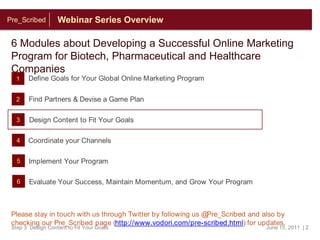
Webinar Series Overview6 Modules about Developing a Successful Online Marketing Program for Biotech, Pharmaceutical and Healthcare CompaniesPlease stay in touch with us through Twitter by following us @Pre_Scribed and also by checking our Pre_Scribed page (http://www.vodori.com/pre-scribed.html) for updates.1Define Goals for Your Global Online Marketing Program2Find Partners & Devise a Game Plan3Design Content to Fit Your Goals4Coordinate your Channels5Implement Your Program6Evaluate Your Success, Maintain Momentum, and Grow Your ProgramStep 3: Design Content to Fit Your GoalsJune 15, 2011  | 2
About VodoriUnderstand: current interactive portfolio
business objectives
user needs
competitive landscape To create a plan for relationship building onlineCreate: wireframes
visual design
content for all written and visual mediaTo cohesively express brand personality onlineFULL LIFECYCLESUPPORTApply:Vodori methodology coupled with best-in-class technologies To build the online presenceProvide:training
ongoing support
online marketing program management (SEM, Social Media, etc.)To ensure continued successStep 3: Design Content to Fit Your GoalsJune 15, 2011  | 3
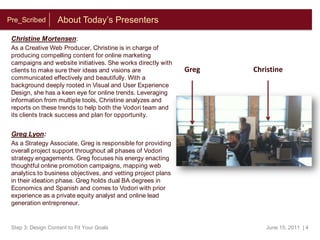
About Today’s PresentersChristine Mortensen:  As a Creative Web Producer, Christine is in charge of producing compelling content for online marketing campaigns and website initiatives. She works directly with clients to make sure their ideas and visions are communicated effectively and beautifully. With a background deeply rooted in Visual and User Experience Design, she has a keen eye for online trends. Leveraging information from multiple tools, Christine analyzes and reports on these trends to help both the Vodori team and its clients track success and plan for opportunity. Greg Lyon:  As a Strategy Associate, Greg is responsible for providing overall project support throughout all phases of Vodori strategy engagements. Greg focuses his energy enacting thoughtful online promotion campaigns, mapping web analytics to business objectives, and vetting project plans in their ideation phase. Greg holds dual BA degrees in Economics and Spanish and comes to Vodori with prior experience as a private equity analyst and online lead generation entrepreneur.GregChristineStep 3: Design Content to Fit Your GoalsJune 15, 2011  | 4
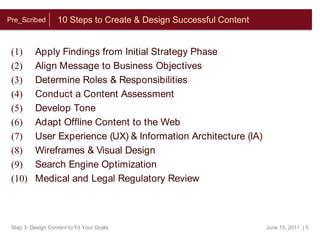
10 Steps to Create & Design Successful ContentStep 3: Design Content to Fit Your GoalsApplyFindings from Initial Strategy PhaseAlign Message to Business ObjectivesDetermine Roles & ResponsibilitiesConduct a Content AssessmentDevelop Tone Adapt Offline Content to the WebUser Experience (UX) & Information Architecture (IA)Wireframes & Visual DesignSearch Engine OptimizationMedical and Legal Regulatory ReviewJune 15, 2011  | 5
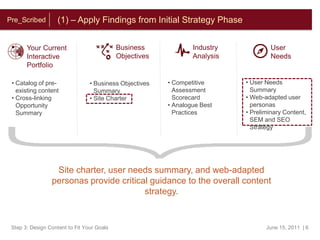
(1) – ApplyFindings from Initial Strategy PhaseStep 3: Design Content to Fit Your GoalsBusiness ObjectivesIndustryAnalysisUser NeedsYour Current Interactive PortfolioUser Needs SummaryWeb-adapted user personasPreliminary Content, SEM and SEO StrategyCompetitive Assessment ScorecardAnalogue Best PracticesCatalog of pre-existing content
Cross-linking Opportunity SummaryBusiness Objectives SummarySite CharterSite charter, user needs summary, and web-adapted personas provide critical guidance to the overall content strategy.June 15, 2011  | 6
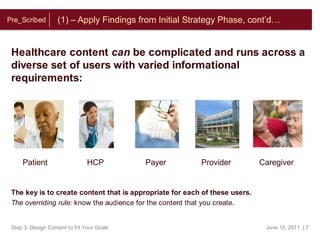
(1) – ApplyFindings from Initial Strategy Phase, cont’d…Healthcare content can be complicated and runs across a diverse set of users with varied informational requirements:The key is to create content that is appropriate for each of these users.  The overriding rule: know the audience for the content that you create.  PatientHCPPayerProviderCaregiverStep 3: Design Content to Fit Your GoalsJune 15, 2011  | 7
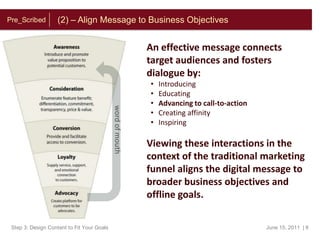
(2) – Align Message to Business ObjectivesStep 3: Design Content to Fit Your GoalsAn effective message connects target audiences and fosters dialogue by:Introducing
Educating
Advancing to call-to-action
Creating affinity
Inspiringword of mouthViewing these interactions in the context of the traditional marketing funnel aligns the digital message to broader business objectives and offline goals.June 15, 2011  | 8
(3) – Determine Roles & ResponsibilitiesStep 3: Design Content to Fit Your GoalsKnowing when to enlist help from a partner, hire a contractor, or devote internal resources to content creation can make or break your content’s success. Below are some of the roles and responsibilities you may need to account for:CopyVideoAudioCopywriter (Digital/short form focus)

Pre_Scribed Webinar 3: Design Content to Fit Your Goals

  • 1.
    6 doses fora healthy global online marketing launchWebinar 3: Design Content to Fit Your GoalsPresented by: Christine Mortensen & Greg LyonAsk questions:though the Chat window in the upper right corner of your screen to: Pre_Scribed - Questions
  • 2.
    via Twitter to@Pre_Scribed
  • 3.
    via email atPre_Scribed@vodori.comAudio access:Phone number: [1-866-469-3239]Access Code: [796 047 790]Meeting Password: Vodori1Pre_Scribed is a webinar series sponsored by:
  • 4.
    Webinar Series Overview6Modules about Developing a Successful Online Marketing Program for Biotech, Pharmaceutical and Healthcare CompaniesPlease stay in touch with us through Twitter by following us @Pre_Scribed and also by checking our Pre_Scribed page (http://www.vodori.com/pre-scribed.html) for updates.1Define Goals for Your Global Online Marketing Program2Find Partners & Devise a Game Plan3Design Content to Fit Your Goals4Coordinate your Channels5Implement Your Program6Evaluate Your Success, Maintain Momentum, and Grow Your ProgramStep 3: Design Content to Fit Your GoalsJune 15, 2011 | 2
  • 5.
    About VodoriUnderstand: currentinteractive portfolio
  • 6.
  • 7.
  • 8.
    competitive landscape Tocreate a plan for relationship building onlineCreate: wireframes
  • 9.
  • 10.
    content for allwritten and visual mediaTo cohesively express brand personality onlineFULL LIFECYCLESUPPORTApply:Vodori methodology coupled with best-in-class technologies To build the online presenceProvide:training
  • 11.
  • 12.
    online marketing programmanagement (SEM, Social Media, etc.)To ensure continued successStep 3: Design Content to Fit Your GoalsJune 15, 2011 | 3
  • 13.
    About Today’s PresentersChristineMortensen: As a Creative Web Producer, Christine is in charge of producing compelling content for online marketing campaigns and website initiatives. She works directly with clients to make sure their ideas and visions are communicated effectively and beautifully. With a background deeply rooted in Visual and User Experience Design, she has a keen eye for online trends. Leveraging information from multiple tools, Christine analyzes and reports on these trends to help both the Vodori team and its clients track success and plan for opportunity. Greg Lyon: As a Strategy Associate, Greg is responsible for providing overall project support throughout all phases of Vodori strategy engagements. Greg focuses his energy enacting thoughtful online promotion campaigns, mapping web analytics to business objectives, and vetting project plans in their ideation phase. Greg holds dual BA degrees in Economics and Spanish and comes to Vodori with prior experience as a private equity analyst and online lead generation entrepreneur.GregChristineStep 3: Design Content to Fit Your GoalsJune 15, 2011 | 4
  • 14.
    10 Steps toCreate & Design Successful ContentStep 3: Design Content to Fit Your GoalsApplyFindings from Initial Strategy PhaseAlign Message to Business ObjectivesDetermine Roles & ResponsibilitiesConduct a Content AssessmentDevelop Tone Adapt Offline Content to the WebUser Experience (UX) & Information Architecture (IA)Wireframes & Visual DesignSearch Engine OptimizationMedical and Legal Regulatory ReviewJune 15, 2011 | 5
  • 15.
    (1) – ApplyFindingsfrom Initial Strategy PhaseStep 3: Design Content to Fit Your GoalsBusiness ObjectivesIndustryAnalysisUser NeedsYour Current Interactive PortfolioUser Needs SummaryWeb-adapted user personasPreliminary Content, SEM and SEO StrategyCompetitive Assessment ScorecardAnalogue Best PracticesCatalog of pre-existing content
  • 16.
    Cross-linking Opportunity SummaryBusinessObjectives SummarySite CharterSite charter, user needs summary, and web-adapted personas provide critical guidance to the overall content strategy.June 15, 2011 | 6
  • 17.
    (1) – ApplyFindingsfrom Initial Strategy Phase, cont’d…Healthcare content can be complicated and runs across a diverse set of users with varied informational requirements:The key is to create content that is appropriate for each of these users. The overriding rule: know the audience for the content that you create. PatientHCPPayerProviderCaregiverStep 3: Design Content to Fit Your GoalsJune 15, 2011 | 7
  • 18.
    (2) – AlignMessage to Business ObjectivesStep 3: Design Content to Fit Your GoalsAn effective message connects target audiences and fosters dialogue by:Introducing
  • 19.
  • 20.
  • 21.
  • 22.
    Inspiringword of mouthViewingthese interactions in the context of the traditional marketing funnel aligns the digital message to broader business objectives and offline goals.June 15, 2011 | 8
  • 23.
    (3) – DetermineRoles & ResponsibilitiesStep 3: Design Content to Fit Your GoalsKnowing when to enlist help from a partner, hire a contractor, or devote internal resources to content creation can make or break your content’s success. Below are some of the roles and responsibilities you may need to account for:CopyVideoAudioCopywriter (Digital/short form focus)

Editor's Notes

  • #2 RobMention questions
  • #3 Rob
  • #4 Rob
  • #5 Rob to Introduce
  • #6 GregIntroduce Chapter (3) – Design Content to Fit Your GoalsBriefly walk through outline and what we hope to accomplish. Our aim in today’s webinar is to provide you with an arsenal of best practices and important considerations that will make your content strategy successful.
  • #7 If you’ve been following along with our webinar series, this slide should look familiar. In the first chapter where we discussed Defining Goals for Your Overall Marketing Program, we discussed four buckets of activities that result in the following deliverables or inputs to the overall strategy. Now that these strategic recommendations have materialized, it’s time to apply them to create meaningful and effective content.The most important parts of the initial strategy phase that should be leveraged when creating content are the:Site Charter – What your site needs to accomplish in order to be successfulUser Needs Summary & Personas – A deep understanding of your target audience and how to inspire them into an engaging dialoguePreliminary Content, SEM, SEO Strategy – A framework for the type of content that needs to be created and how it should be marketedIn healthcare content, the landscape of web-adapted user personas can be highly varied and multi-dimensional.
  • #8 GregTherefore, keeping your target audience or target user in mind is integrally important when moving from the application of the initial strategy findings and upholding business objectives into the plan for your content’s messaging, tone, and look and feel. We have listed some of the most common audience groups for healthcare content; but remember to embrace any unique qualities that your personas exhibit. The overriding rule in applying persona information into your content strategy is that regardless of channel or medium, your content must be created with the target user in mind; know the audience for the content that you create.
  • #9 GregOnce the scope of your content has been narrowed and target audience groups have been identified and studied, aligning the overall message to your business objectives will ensure a unified direction as the content undergoes the creative process.-As good digital marketers, our focus is on creating timely interactions that support a broader marketing objective, often the release of something “new”:New product or serviceNew indicationNew marketNew study/claimNew patient access or support programBriefly touch on the 5 points of dialogue facilitation: Introducing, Educating, Advancing to call-to-action, InspiringThough creating and guiding dialogue is an integral part of our content’s success, in most cases the most important step is advancing our users to call-to-action. Having macro and micro-conversion opportunities helps us to measure, assess, analyze, and re-work our content into what ultimately yields the most success for our business objectives. Not surprisingly, our goals in aligning the message to business objectives echo the ideas inspired by the traditional marketing funnel. Even if your digital content endeavors are a departure or innovation from tactics you have completed in the past, rooting them in a tried and tested marketing ideology helps to ensure goals are met.
  • #10 GregAfter the audience has been identified and the message is aligned to your business objectives, it’s time to start tackling some of the logistical aspects of ensuring that your content is created in a timely and effective manner. As we discussed in the second installment of our webinar series, the decision to enlist help from an agency partner, hire a contractor, or devote internal resources to accomplishing digital marketing objectives can be the single most important factor in ensuring success. The same holds true for the actual content creation; pulling resources from various channels and “experts” is a process that must be considered with meticulous attention to detail.Briefly describe each bucket of roles and responsibilities.Mention installment 2 again as a reminder that we have created an extremely comprehensive checklist for helping to choose an agency partner.
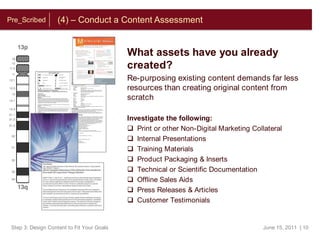
  • #11 GregConducting an inventory of existing content can lead to internal efficiencies as re-purposing existing content demands far less resources than creating original content from scratch. Although the format, location, and freshness of existing content to be leveraged can vary greatly, we recommend investigating the following sources:Especially if you’re creating a brand new website, your marketing, sales, and support messages will already be defined by the offline parts of business. Harvesting these assets allows you to move quickly through the up-front tasks associated with readying content.As a guide, we have created a checklist of sources you will want to Investigate. Every company is different, and it helps to be creative and collaborative with your co-workers when unearthing assets to be adapted for your digital marketing platform.Print or other Non-Digital Marketing CollateralProduct Packaging & InsertsTechnical or Scientific DocumentationOffline Sales AidsPress Releases & ArticlesCustomer Testimonials
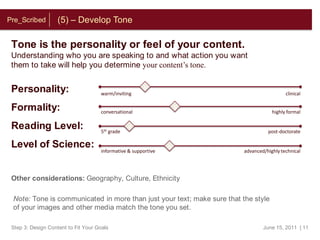
  • #12 GregOnce you have taken inventory of existing content and are prepared to start creating new content, we recommend an evaluation of your content’s tone to make sure it aligns with your target audience. Especially if you are leveraging content that has already been created (assuredly for a slightly different purpose), adapting tone to your current objectives is key.You know who you’re talking to; now tweak your content to make it as accessible as possible.Perhaps the four most important aspects of tone development are:PersonalityFormalityReading LevelLevel of “Science”.As we mentioned before, your audience can range from a demographically diverse patient population with “sliders” on opposite ends of the spectrum, or a highly specific population of biologists who are used to consuming dense, scientifically complex content.Other considerations for your content’s tone encompass geography, culture, and ethnicity. Subtleties in language and colloquialisms may be understood in region but not another. Furthermore, we would like to note that tone is communicated beyond the text of your content. Styling of images, video, audio, and other rich media should be concordant with the tone objectives you identify.Once tone has been established, thought should be given to adapting your content to best practices in web readability. With that, I’ll hand it over to Christine.
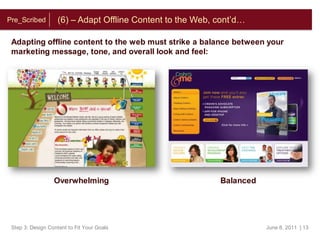
  • #13 ChristineSpeak to the plethora of content we mentioned that you’re already probably creating for offline purposes. Now that you’ve established your over all tone these are some guidelines to aid you through that process.http://web.hbr.org/email/archive/managementtip.php?date=061411In business writing, you get points for clarity, not style. Instead of trying to wax poetic about your division's plans for the next 60 days, just make your point. Here are three ways to do that: One idea per paragraph. Novels hold several complex ideas and emotions in a single paragraph. In business writing, limit your thoughts to one per paragraph. When you have another suggestion, thought or idea, start a new paragraph.Put your point in the first sentence. Don't entice your readers with background information and build-up. No one has time for that. Make your primary point first. Then go into supporting detail.Make it "scannable." Few people read every word in an email. Use headers and bullet points so that your audience can quickly scan your message and understand your point.
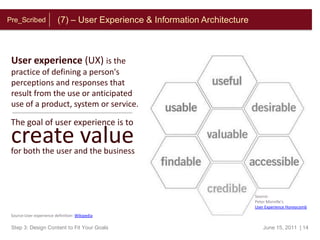
  • #15 ChristineContent is not just the text and images on a page. While these things are immensely important creating great content that no one can find, isn’t usable, and worse isn’t desirable gets you no where. To keep this from occurring make sure that attention is given to the entire user experience. User experience as a practice is…(definition above)While the concept of user experience most often applies to site design it’s not hard to stretch the idea to content; your content should be valuable to both the user and the business UCD: user-centered design (UCD) or pervasive usability[1] is a design philosophy and a process in which the needs, wants, and limitations of end users of a product are given extensive attention at each stage of the design process. (http://en.wikipedia.org/wiki/User-centered_design)User experience highlights the experiential, affective, meaningful and valuable aspects of human-computer interaction and product ownership, but it also includes a person’s perceptions of the practical aspects such as utility, ease of use and efficiency of the system.So user experience is taking those personas you’ve developed earlier and asking, “who does this person want to interact with my content?” “What kind of information is going to resonate with them?”
  • #16 ChristineUCD: user-centered design (UCD) or pervasive usability[1] is a design philosophy and a process in which the needs, wants, and limitations of end users of a product are given extensive attention at each stage of the design process. (http://en.wikipedia.org/wiki/User-centered_design)
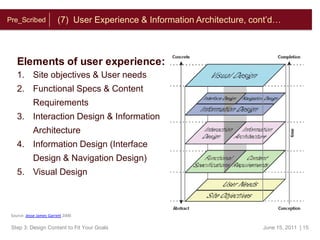
  • #17 Christine
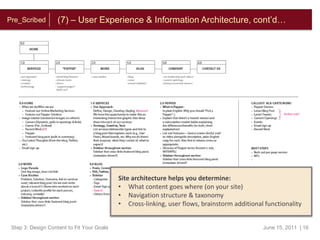
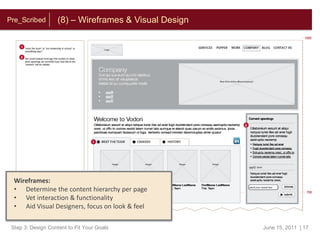
  • #18 ChristineAn example of how to leverage personas and tone to create a website .Sketches of pages and screens can focus us on structure, organization, navigation, and interaction before investing time and attention in color, typography, and image.
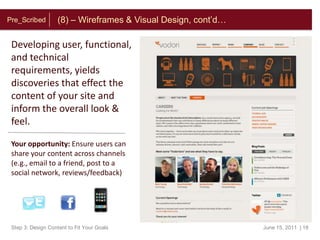
  • #19 ChristineAs you develop you user, functional, and technical requirements discoveries are made along the way that affect the content of your site as well as inform it’s look & feel. But content is more than just what you put on your site. Don’t forget that content needs to be created across channels (e.g., tweets, blog posts, YouTube videos, email campaigns, mobile campaigns, etc.)Example of creating cross-channel content: Careers- current job openings can be linked to from Twitter, FB, job sites, etc. Content from each person’s page can be shared in a variety of ways. If we were to expand the functionality of this page we could create interview videos that people could watch rather than only read. The text would still remain on the site so that we still have the SEO benefits.
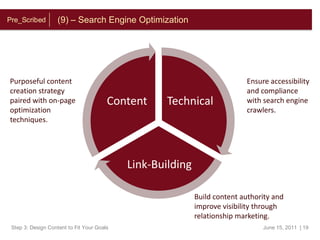
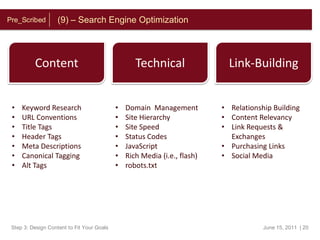
  • #20 GregEffective search engine optimization has its roots in the earliest parts of content creation in the keyword research phase and extends well beyond initial publishing with relationship marketing and link-building tactics. SEO is a vital part of any content strategy as organic search remains one of the most important drivers of traffic to websites. According to a Nielsen study released in October 2010, 37% of web users started their online journey at a search engine when looking for new information online. Put differently, more than a third of web users turn to search engines as their primary source in actively seeking new information; broadening your touchpoints and increasing visibility in organic rankings is vital to the success of your content.Walk through three broad “areas” of SEO focus:ContentTechnicalLink-Building
  • #21 GregSuccessful SEO starts with keyword research. Knowing which keywords your target audience uses to think about your brand, products, and services will inform on-page content. It is important to note that the keywords your customers or target audience use to think about your products may not be the same keywords that are used by you and your internal team. Once keyword research has been accomplished an a good idea of the important keywords has been established, optimizing on-page content such as URL’s, Title tags, header tags, meta descriptions, and alt tags gives search engines context clues as to what your content is about. Each one of these tactics has their own rules (i.e. character limits, etc.) and should be considered individually. In concert with on-page content SEO, there are numerous technical aspects that must be considered to ensure that search engine crawlers can “see” and “understand” the content that you’ve worked hard to create. Remember that a search engine crawler is not a human visitor; it requires a logical and simplified site hierarchy in order to rank your content, it rewards sites that use minimal rich media and that load fast.
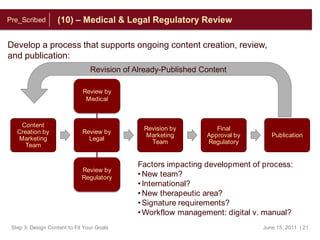
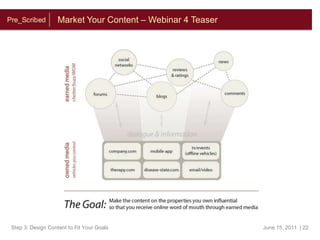
  • #22 GregIn closing, we would like to briefly re-visit a slide from the first installment of our webinar series that is especially pertinent to today’s discussion: that of a workflow procedure that encompasses necessary reviews for medical and regulatory teams. Ensuring a streamlined and logical workflow procedure up front, meaning before any content is created, ensures that individual roles and responsibilities are clear and transparent. There’s nothing more frustrating than creating great content that never gets published because of review teams that are unsure of where they fit into the overall process. We have outlined a potential medical and regulatory review structure but encourage you to adapt it to your company’s specific requirements. As always, be mindful of external factors which can have significant impacts on the workflow process:New teamInternational or de-centralized teamNew therapeutic areaSignature requirementsWorkflow management: digital v manual?
  • #23 Christine
  • #24 Rob