A Practitioner’s Guide to Product Strategy
Pandith Jantakahalli
Contents
1. What to build?
2. Actually building what you decide
3. Building
4. Acquiring customers
5. How do you know you are delivering outcomes?
6. Being/staying successful
– Sequencing
“Base your strategy on things that do
not change”
Jeff Bezos
1. What to Build?
• Determined by customer outcomes, competing solutions,
and your point of view
Start with Customer Outcomes
• Define customer outcomes using vocabulary that
customers would use
• Customer outcomes have functional, emotional, and
social attributes
– Pay attention to context, situations, motivations, constraints,
and how they are achieving these outcomes today
• Customers outcomes are not the same as business
outcomes for your company. But they are massively
linked
Build on Point-of-View
• Build is always involves choosing (trade-off )an attribute
(or consideration set) based on customer outcome and
context
• Choose attributes based on what is valued by customer
(importance), what competition offers (satisfaction)
– Align with hiring criteria
– Offer a path continuous greater “value”
• Point-of-view includes where to draw the line (product
scope), and this impacts who your customers are
• Don’t try to be everything for everybody
Image Source: Wikipedia
Side Note: What is “Product”?
• Every interaction with the prospect/customer is the
“product”
– Marketing messages of all kinds
• Website, blog, emails, brochures, ads
– Support interactions
– Customer manuals
– Training/user guides/seminars
– Community/forums/user groups
• Identify all interactions with your product, and
prioritize and rank for focus
Now that you have decided what to build , how to enable building …..
2. Actually Building What You Decide
• Having a set of product principles helps with alignment
and cohesion of activities across stakeholders
– Products usually have goals and metrics, but they do not provide
guidelines for action
Product Principles
• Product principles must be anchored around
customer outcomes and point-of-view
• Helps enable
– Consistent decision making across different stakeholders
at all levels
– Prioritization and deployment of resources is easier
– Emphasizes PoV
• Good product principles speaks to how users should feel
before, while, after using the product
What to keep in mind while building …..
3. Building
• When to build (a feature/functionality) is as important
as what to build
Sequencing
• Sequence based on impact and effort (project size)
– Impact is a function of what outcomes it enables, what
competition offers,
• Carefully access for compounding of benefits
– Impact of multiple small features vs one large feature
• Example: If you are having problems with activation, do
not focus on projects that drive more traffic
Now that you have built …..
4. Acquiring Customers
• Customer acquisition is greatly determined by
positioning, power of emotion in decision making, and
strategy to tackle objections/concerns
Positioning
• Position based on outcomes that competition is enabling,
and your point of view
– Note: Customers will instinctively place you among alternatives
that helps them achieve the same outcome
• Has a big impact on customer acquisition and pricing,
especially premium pricing
• Examples:
– Positioning the iPad against netbooks
– Dog food: animal vs like your baby
Power of Emotions
• “When dealing with people, remember you are not dealing
with creatures of logic, but with creatures of emotion” – Dale
Carnegie
• People find it extremely difficult to take decisions without
emotions
• Crucial to have a point-of-view on how your customers should
feel – before, during, and after using your product
– What can you do the set the right emotions?
– What can you do create the right emotions?
• Do everything you can do to eliminate negative emotions like
anxiety – before, during, and after product use
Handling Objections
• Customers do not buy your products they switch to your
product
– Focus on making this switch as easy and painless as possible
• Customers may have existing behaviors/habits and
workflows that may require a lot of time and effort to
overcome
– Example:
• Can I easily migrate all my bugs/tickets over to your product easily?
• Should I learn new skills, what kind of (negative) impact will this have on
adoption
• Note: Changing customer behavior is hard, try and
leverage existing behaviors, instead of creating new ones
– Increasing motivation is not the same as decreasing friction to
adoption
Now that you have acquired customers, what to focus on …..
5. Delivering Outcomes
• Buying/purchasing is not the same as delivering
outcomes
• Consumption/engagement/usage is a true indicator of
value delivery
• Reach and frequency of feature usage are critical metrics
to track if the product is delivering outcomes
Reach (How many people use a feature)
• Focus on improving feature adoption among all your
users
– Set targets for adoption by mapping how a feature contributes to
delivering customer outcomes
• Use “5 Whys” technique to understand reasons for poor
adoption, and take necessary steps to improve adoption
• Kill features that no one uses or is sparingly adopted:
– Simplifies the product
– Provides tons of flexibility during decision-making
Frequency (How many times a feature is used?)
• Focus on improving frequency of usage of all features
– Features that are being used all the time by all the users are high
leverage features
• Nir Eyal’s “Hook Canvas” a great framework for
improving frequency of usage of a feature
– Trigger, action, reward, investment
6. Staying Successful
• Product success is tied to helping users to become
successful
• Brutal NOs are necessary to maintain focus on customer
outcomes and point-of-views
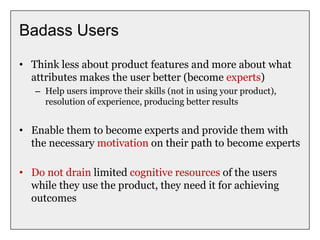
Badass Users
• Think less about product features and more about what
attributes makes the user better (become experts)
– Help users improve their skills (not in using your product),
resolution of experience, producing better results
• Enable them to become experts and provide them with
the necessary motivation on their path to become experts
• Do not drain limited cognitive resources of the users
while they use the product, they need it for achieving
outcomes
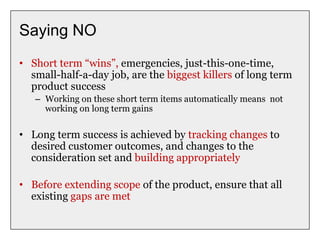
Saying NO
• Short term “wins”, emergencies, just-this-one-time,
small-half-a-day job, are the biggest killers of long term
product success
– Working on these short term items automatically means not
working on long term gains
• Long term success is achieved by tracking changes to
desired customer outcomes, and changes to the
consideration set and building appropriately
• Before extending scope of the product, ensure that all
existing gaps are met
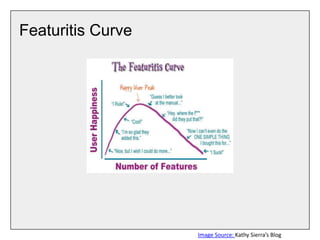
Featuritis Curve
Image Source: Kathy Sierra’s Blog
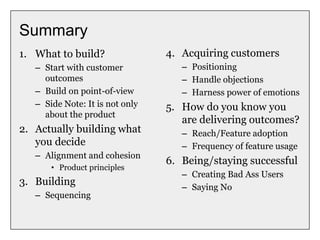
Summary
1. What to build?
– Start with customer
outcomes
– Build on point-of-view
– Side Note: It is not only
about the product
2. Actually building what
you decide
– Alignment and cohesion
• Product principles
3. Building
– Sequencing
4. Acquiring customers
– Positioning
– Handle objections
– Harness power of emotions
5. How do you know you
are delivering outcomes?
– Reach/Feature adoption
– Frequency of feature usage
6. Being/staying successful
– Creating Bad Ass Users
– Saying No
Sources / Acknowledgements
• Intercom.io on Product Management
• Kathy Sierra on creating Badass Users
• Articles by Rewired Group on jtbd.org and Alan Klement jtbd.info
• Ian MacAllister’s answers on Quora
• Photos belong to their respective copyright owners
About
Pandith Jantakahalli
Blog:
http://www.jppandith.in
https://medium.com/@jppandith
Twitter: @jppandith
Email: jppandith at gmail.com

Practitioners guide to_product_strategy

  • 1.
    A Practitioner’s Guideto Product Strategy Pandith Jantakahalli
  • 2.
    Contents 1. What tobuild? 2. Actually building what you decide 3. Building 4. Acquiring customers 5. How do you know you are delivering outcomes? 6. Being/staying successful – Sequencing
  • 3.
    “Base your strategyon things that do not change” Jeff Bezos
  • 4.
    1. What toBuild? • Determined by customer outcomes, competing solutions, and your point of view
  • 5.
    Start with CustomerOutcomes • Define customer outcomes using vocabulary that customers would use • Customer outcomes have functional, emotional, and social attributes – Pay attention to context, situations, motivations, constraints, and how they are achieving these outcomes today • Customers outcomes are not the same as business outcomes for your company. But they are massively linked
  • 6.
    Build on Point-of-View •Build is always involves choosing (trade-off )an attribute (or consideration set) based on customer outcome and context • Choose attributes based on what is valued by customer (importance), what competition offers (satisfaction) – Align with hiring criteria – Offer a path continuous greater “value” • Point-of-view includes where to draw the line (product scope), and this impacts who your customers are • Don’t try to be everything for everybody Image Source: Wikipedia
  • 7.
    Side Note: Whatis “Product”? • Every interaction with the prospect/customer is the “product” – Marketing messages of all kinds • Website, blog, emails, brochures, ads – Support interactions – Customer manuals – Training/user guides/seminars – Community/forums/user groups • Identify all interactions with your product, and prioritize and rank for focus Now that you have decided what to build , how to enable building …..
  • 8.
    2. Actually BuildingWhat You Decide • Having a set of product principles helps with alignment and cohesion of activities across stakeholders – Products usually have goals and metrics, but they do not provide guidelines for action
  • 9.
    Product Principles • Productprinciples must be anchored around customer outcomes and point-of-view • Helps enable – Consistent decision making across different stakeholders at all levels – Prioritization and deployment of resources is easier – Emphasizes PoV • Good product principles speaks to how users should feel before, while, after using the product What to keep in mind while building …..
  • 10.
    3. Building • Whento build (a feature/functionality) is as important as what to build
  • 11.
    Sequencing • Sequence basedon impact and effort (project size) – Impact is a function of what outcomes it enables, what competition offers, • Carefully access for compounding of benefits – Impact of multiple small features vs one large feature • Example: If you are having problems with activation, do not focus on projects that drive more traffic Now that you have built …..
  • 12.
    4. Acquiring Customers •Customer acquisition is greatly determined by positioning, power of emotion in decision making, and strategy to tackle objections/concerns
  • 13.
    Positioning • Position basedon outcomes that competition is enabling, and your point of view – Note: Customers will instinctively place you among alternatives that helps them achieve the same outcome • Has a big impact on customer acquisition and pricing, especially premium pricing • Examples: – Positioning the iPad against netbooks – Dog food: animal vs like your baby
  • 14.
    Power of Emotions •“When dealing with people, remember you are not dealing with creatures of logic, but with creatures of emotion” – Dale Carnegie • People find it extremely difficult to take decisions without emotions • Crucial to have a point-of-view on how your customers should feel – before, during, and after using your product – What can you do the set the right emotions? – What can you do create the right emotions? • Do everything you can do to eliminate negative emotions like anxiety – before, during, and after product use
  • 15.
    Handling Objections • Customersdo not buy your products they switch to your product – Focus on making this switch as easy and painless as possible • Customers may have existing behaviors/habits and workflows that may require a lot of time and effort to overcome – Example: • Can I easily migrate all my bugs/tickets over to your product easily? • Should I learn new skills, what kind of (negative) impact will this have on adoption • Note: Changing customer behavior is hard, try and leverage existing behaviors, instead of creating new ones – Increasing motivation is not the same as decreasing friction to adoption Now that you have acquired customers, what to focus on …..
  • 16.
    5. Delivering Outcomes •Buying/purchasing is not the same as delivering outcomes • Consumption/engagement/usage is a true indicator of value delivery • Reach and frequency of feature usage are critical metrics to track if the product is delivering outcomes
  • 17.
    Reach (How manypeople use a feature) • Focus on improving feature adoption among all your users – Set targets for adoption by mapping how a feature contributes to delivering customer outcomes • Use “5 Whys” technique to understand reasons for poor adoption, and take necessary steps to improve adoption • Kill features that no one uses or is sparingly adopted: – Simplifies the product – Provides tons of flexibility during decision-making
  • 18.
    Frequency (How manytimes a feature is used?) • Focus on improving frequency of usage of all features – Features that are being used all the time by all the users are high leverage features • Nir Eyal’s “Hook Canvas” a great framework for improving frequency of usage of a feature – Trigger, action, reward, investment
  • 19.
    6. Staying Successful •Product success is tied to helping users to become successful • Brutal NOs are necessary to maintain focus on customer outcomes and point-of-views
  • 20.
    Badass Users • Thinkless about product features and more about what attributes makes the user better (become experts) – Help users improve their skills (not in using your product), resolution of experience, producing better results • Enable them to become experts and provide them with the necessary motivation on their path to become experts • Do not drain limited cognitive resources of the users while they use the product, they need it for achieving outcomes
  • 21.
    Saying NO • Shortterm “wins”, emergencies, just-this-one-time, small-half-a-day job, are the biggest killers of long term product success – Working on these short term items automatically means not working on long term gains • Long term success is achieved by tracking changes to desired customer outcomes, and changes to the consideration set and building appropriately • Before extending scope of the product, ensure that all existing gaps are met
  • 22.
    Featuritis Curve Image Source:Kathy Sierra’s Blog
  • 23.
    Summary 1. What tobuild? – Start with customer outcomes – Build on point-of-view – Side Note: It is not only about the product 2. Actually building what you decide – Alignment and cohesion • Product principles 3. Building – Sequencing 4. Acquiring customers – Positioning – Handle objections – Harness power of emotions 5. How do you know you are delivering outcomes? – Reach/Feature adoption – Frequency of feature usage 6. Being/staying successful – Creating Bad Ass Users – Saying No
  • 24.
    Sources / Acknowledgements •Intercom.io on Product Management • Kathy Sierra on creating Badass Users • Articles by Rewired Group on jtbd.org and Alan Klement jtbd.info • Ian MacAllister’s answers on Quora • Photos belong to their respective copyright owners
  • 25.