A Technical Deep Dive into Practical Test
Automation
Fusion Meetup (Birmingham) March 2017
Alan Richardson
www.eviltester.com
www.compendiumdev.co.uk
@eviltester
@EvilTester 1
Synopsis
In this talk I'm going to focus on the technical aspects of 'test
automation', using examples of approaches from a variety of Agile
projects where we automated APIs, and GUIs. You'll learn about the
use of abstractions and how to think about modeling the system in
code to support automating it. Also how to use these abstractions to
support stress testing, exploratory testing, ongoing CI assertions and
the testing process in general. I'll also discuss the different styles of
coding used to support automating tactically vs automating
strategically.
@EvilTester 2
Secrets of Successful Practical
Automating
Get work done
Automate Flows
Multiple Abstractions
Abstract to libraries, not frameworks
@EvilTester 3
Testing field argues about
Testing vs Checking
You can't automate testing
"Test Automation" is contentious
@EvilTester 4
An Example "This is a test?"
@Test
public void createPreviewMVP() throws IOException {
  String args[] = { 
     new File(System.getProperty("user.dir"),
        "pandocifier.properties").getAbsolutePath()};
        
  new PandocifierCLI().main(args);
  String propertyFileName = args[0];
  File propertyFile = new File(propertyFileName);
  PandocifierConfig config;
  config = new PandocifierConfigFileReader().
               fromPropertyFile(propertyFile);
        
  Assert.assertTrue(new File(
                      config.getPreviewFileName()).exists());
}
@EvilTester 5
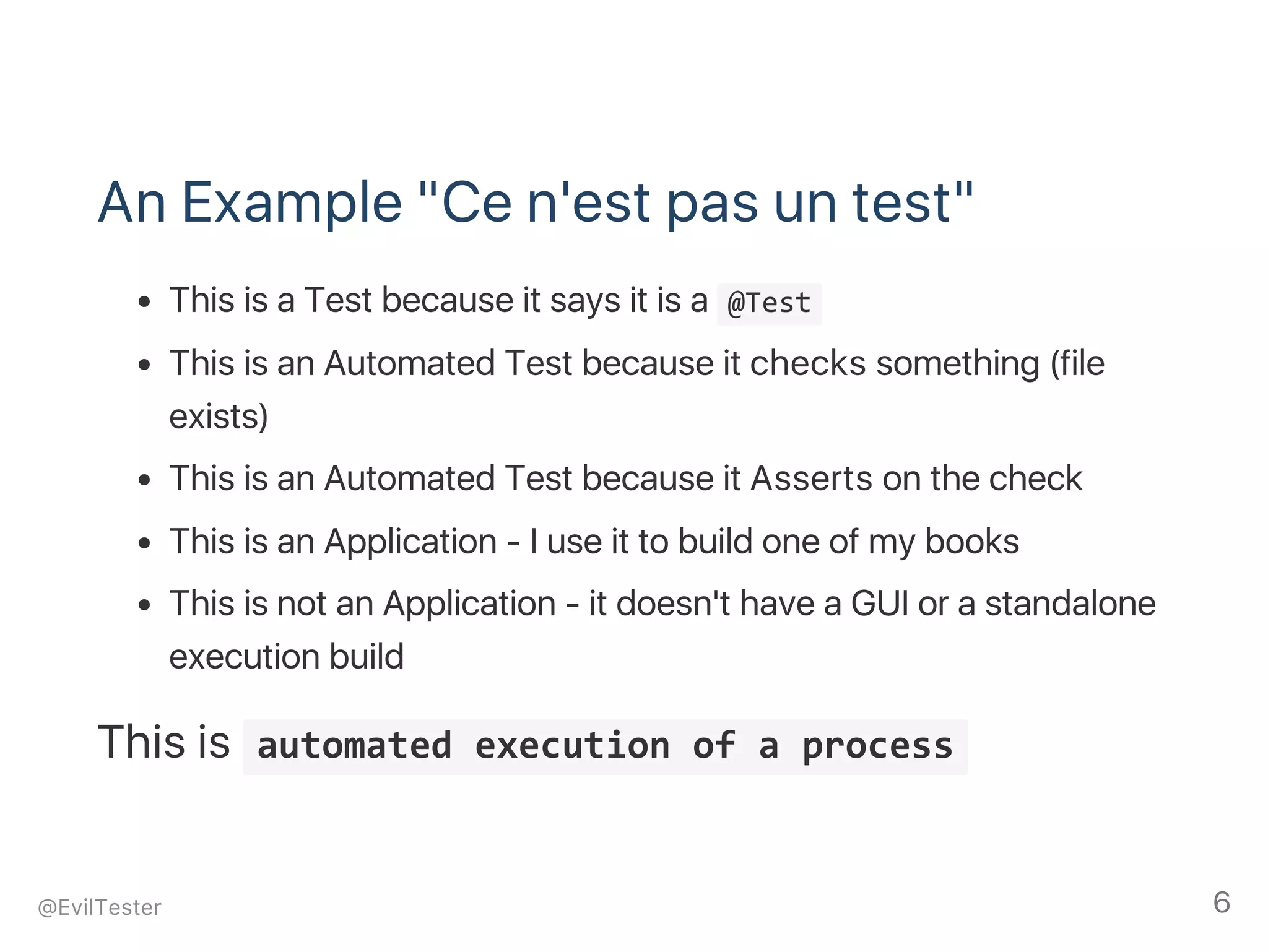
An Example "Ce n'est pas un test"
This is a Test because it says it is a  @Test 
This is an Automated Test because it checks something (file
exists)
This is an Automated Test because it Asserts on the check
This is an Application ‑ I use it to build one of my books
This is not an Application ‑ it doesn't have a GUI or a standalone
execution build
This is  automated execution of a process 
@EvilTester 6
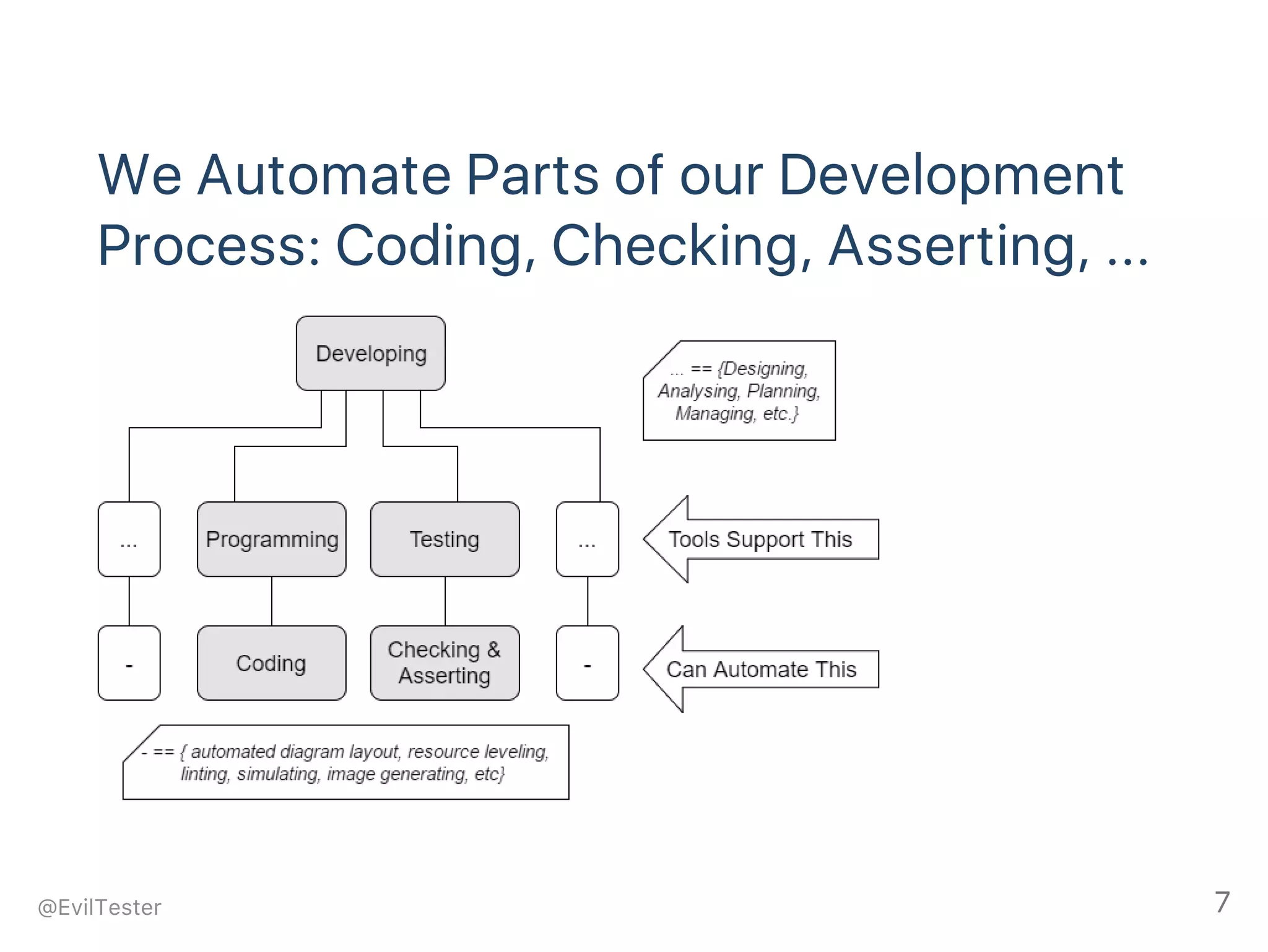
We Automate Parts of our Development
Process: Coding, Checking, Asserting, ...
@EvilTester 7
Tactical Reality ‑ I don't really care, I just
want to get work done
Suggests we also have 'strategic reality'
@EvilTester 8
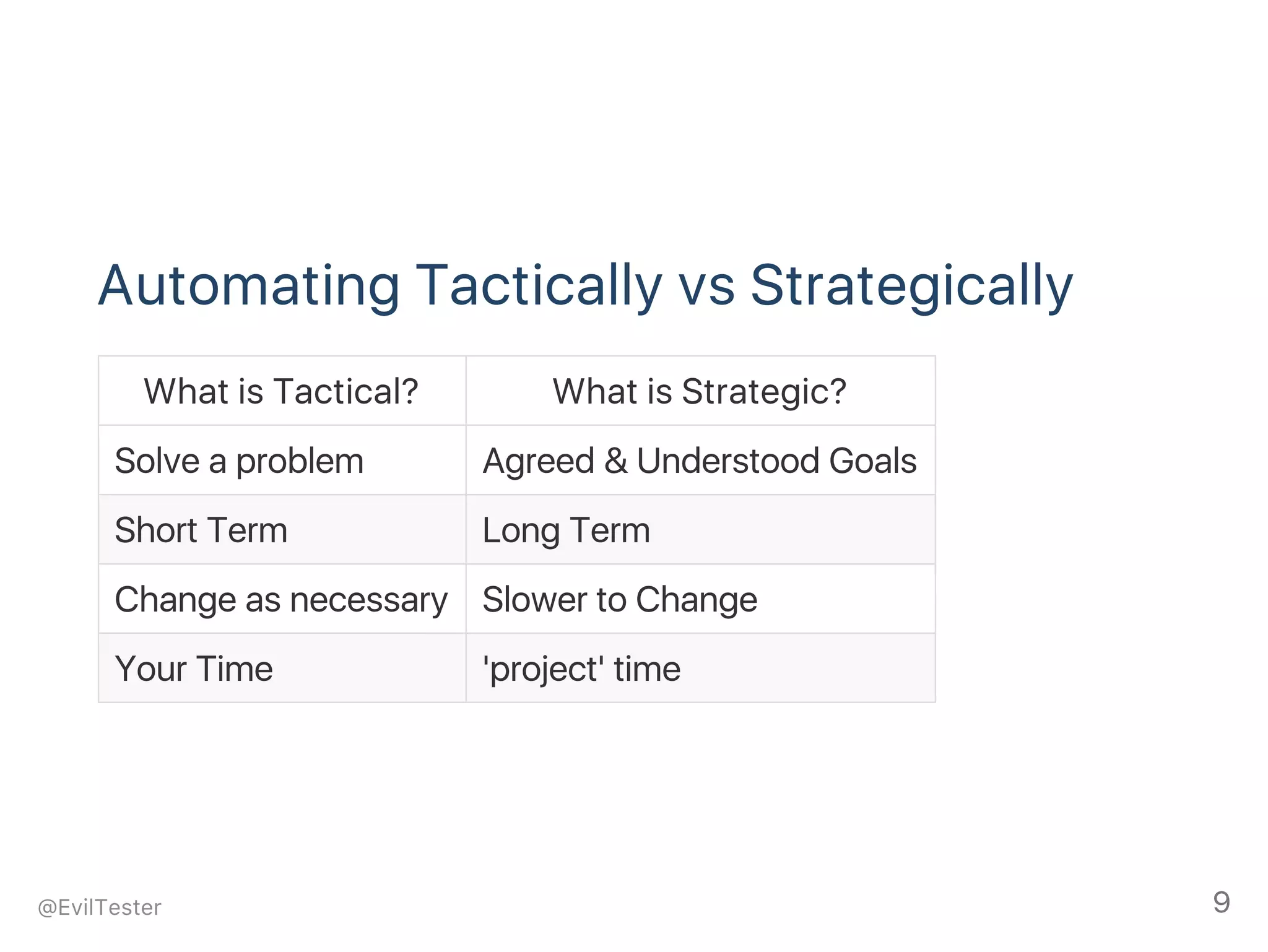
Automating Tactically vs Strategically
What is Tactical? What is Strategic?
Solve a problem Agreed & Understood Goals
Short Term Long Term
Change as necessary Slower to Change
Your Time 'project' time
@EvilTester 9
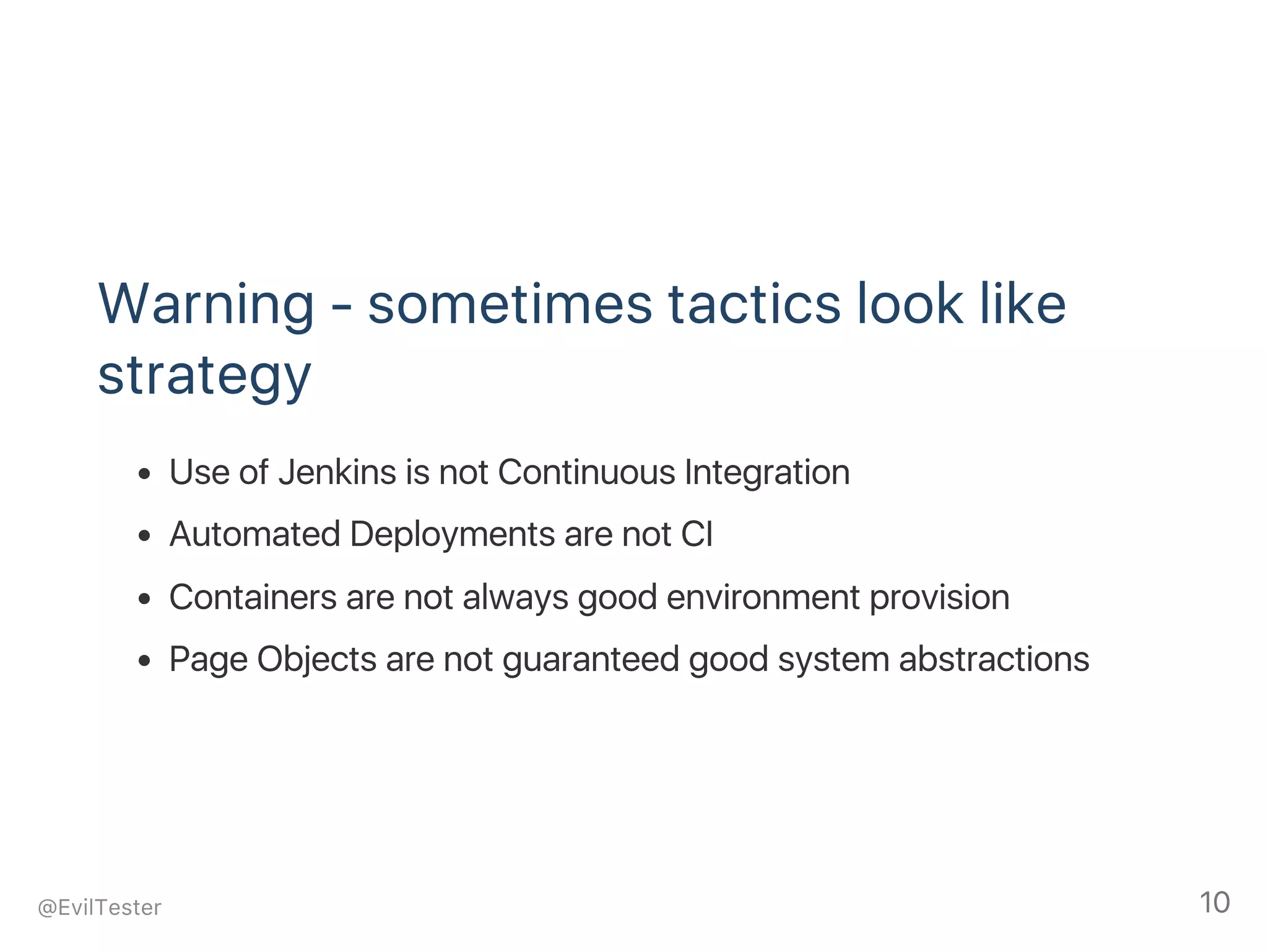
Warning ‑ sometimes tactics look like
strategy
Use of Jenkins is not Continuous Integration
Automated Deployments are not CI
Containers are not always good environment provision
Page Objects are not guaranteed good system abstractions
@EvilTester 10
You know you are Automating
strategically when...
Reduced Maintenance
Reduced change
Everyone agrees why
No fighting for 'time'
It's not about roles
It gets done
@EvilTester 11
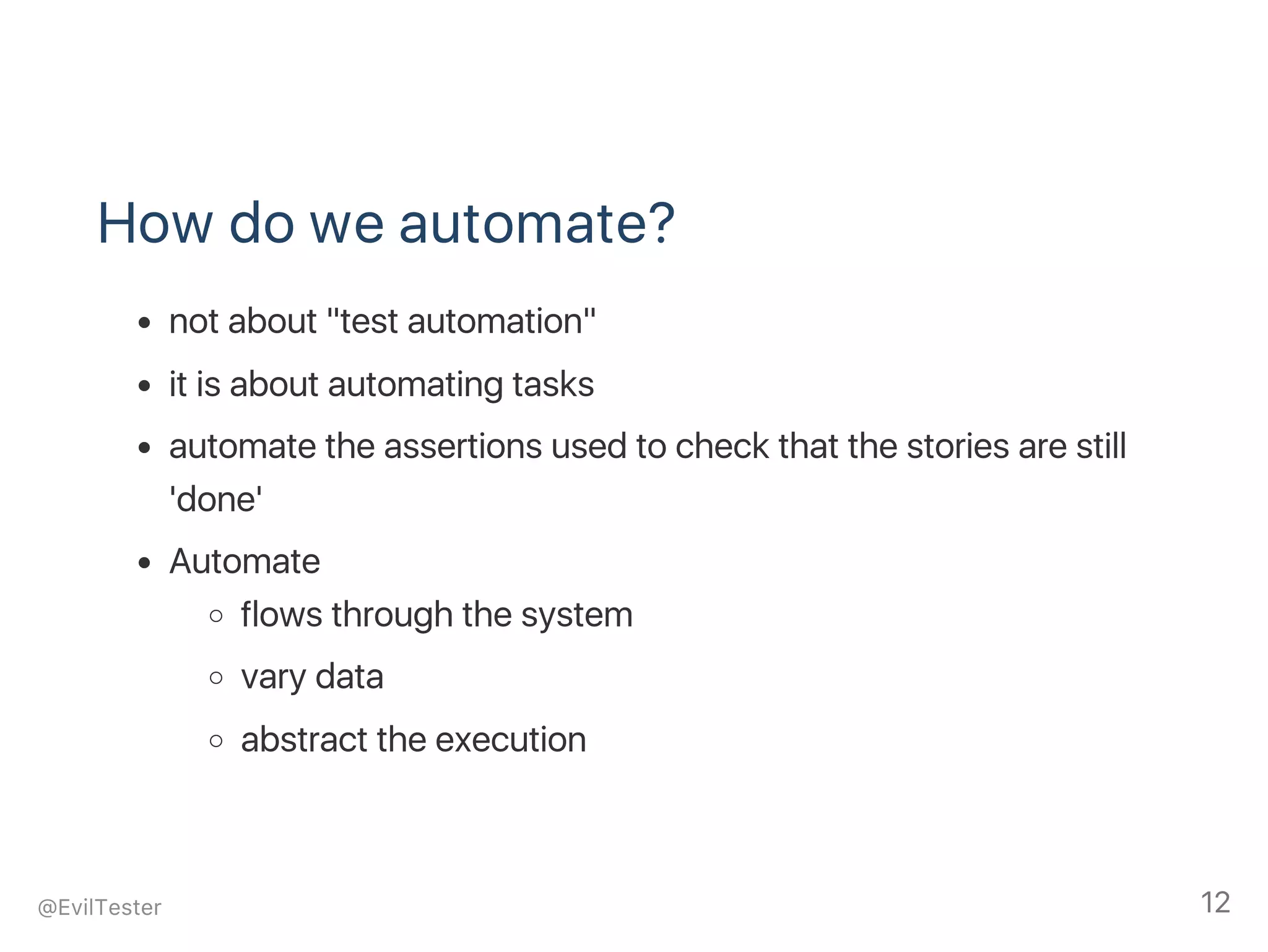
How do we automate?
not about "test automation"
it is about automating tasks
automate the assertions used to check that the stories are still
'done'
Automate
flows through the system
vary data
abstract the execution
@EvilTester 12
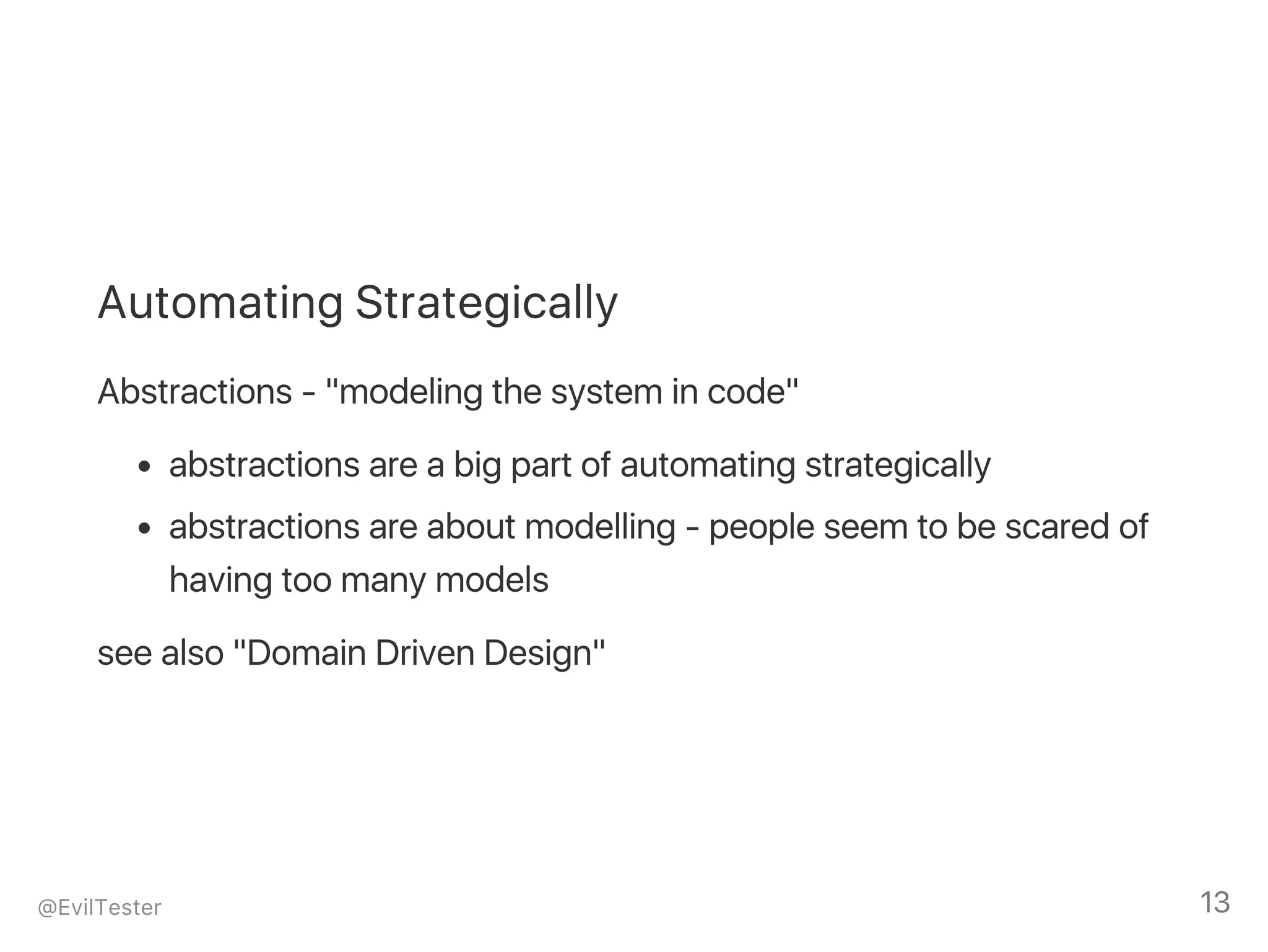
Automating Strategically
Abstractions ‑ "modeling the system in code"
abstractions are a big part of automating strategically
abstractions are about modelling ‑ people seem to be scared of
having too many models
see also "Domain Driven Design"
@EvilTester 13
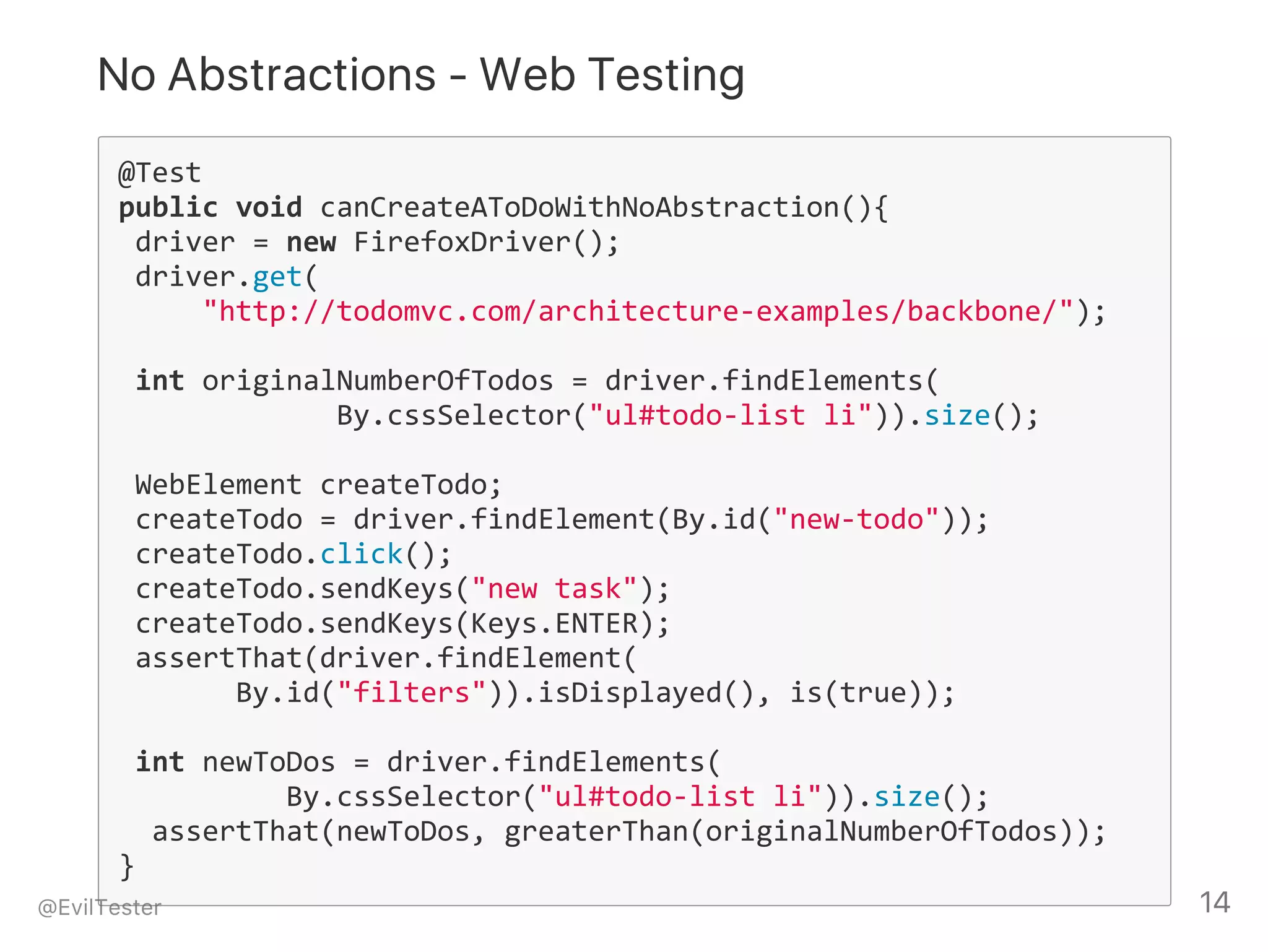
No Abstractions ‑ Web Testing
@Test
public void canCreateAToDoWithNoAbstraction(){
 driver = new FirefoxDriver();
 driver.get(
     "http://todomvc.com/architecture‐examples/backbone/");
 int originalNumberOfTodos = driver.findElements(
             By.cssSelector("ul#todo‐list li")).size();
 WebElement createTodo;
 createTodo = driver.findElement(By.id("new‐todo"));
 createTodo.click();
 createTodo.sendKeys("new task");
 createTodo.sendKeys(Keys.ENTER);
 assertThat(driver.findElement(
       By.id("filters")).isDisplayed(), is(true));
 int newToDos = driver.findElements(
          By.cssSelector("ul#todo‐list li")).size();
  assertThat(newToDos, greaterThan(originalNumberOfTodos));
}
@EvilTester 14
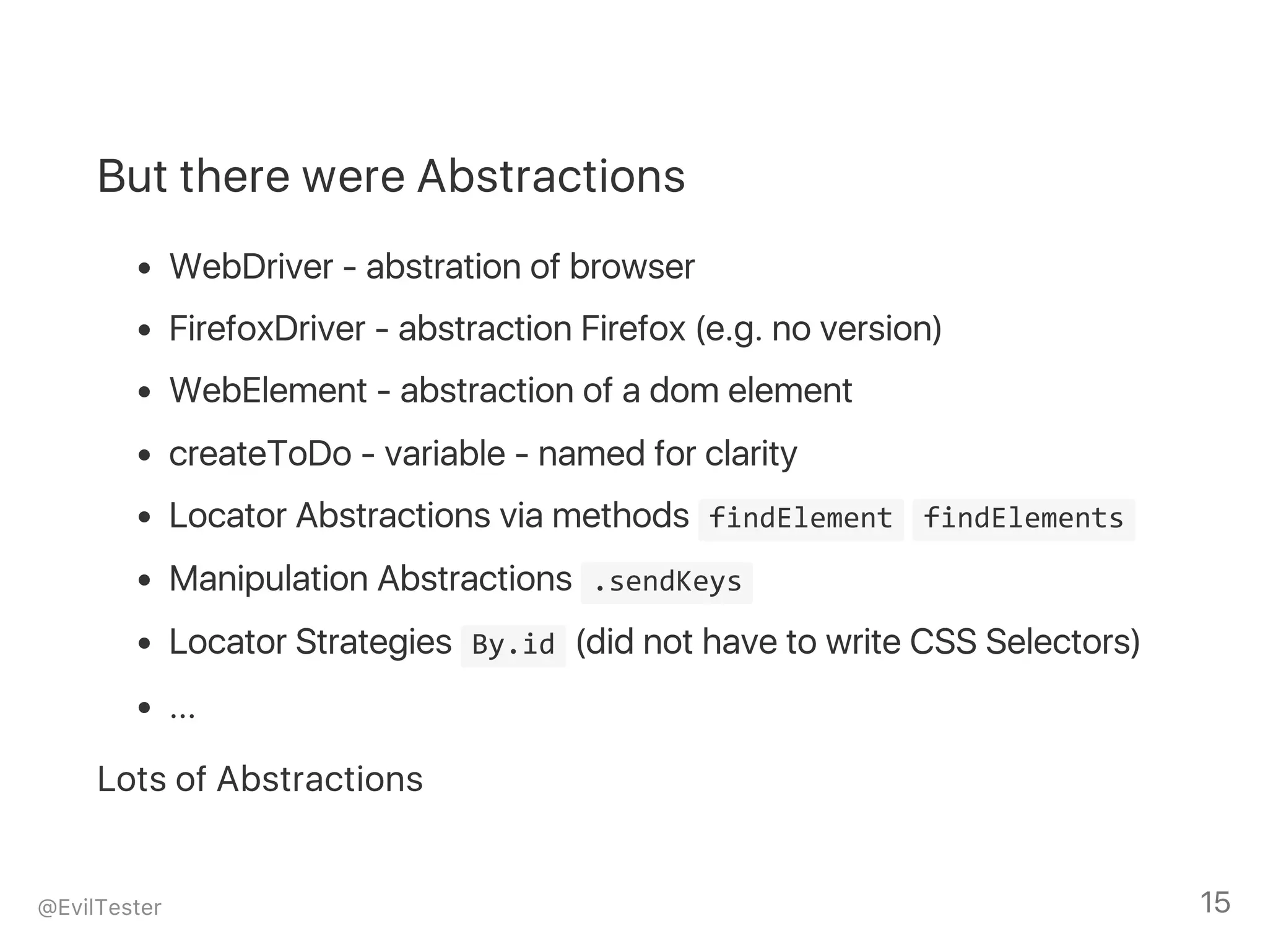
But there were Abstractions
WebDriver ‑ abstration of browser
FirefoxDriver ‑ abstraction Firefox (e.g. no version)
WebElement ‑ abstraction of a dom element
createToDo ‑ variable ‑ named for clarity
Locator Abstractions via methods  findElement  findElements 
Manipulation Abstractions  .sendKeys 
Locator Strategies  By.id (did not have to write CSS Selectors)
...
Lots of Abstractions
@EvilTester 15
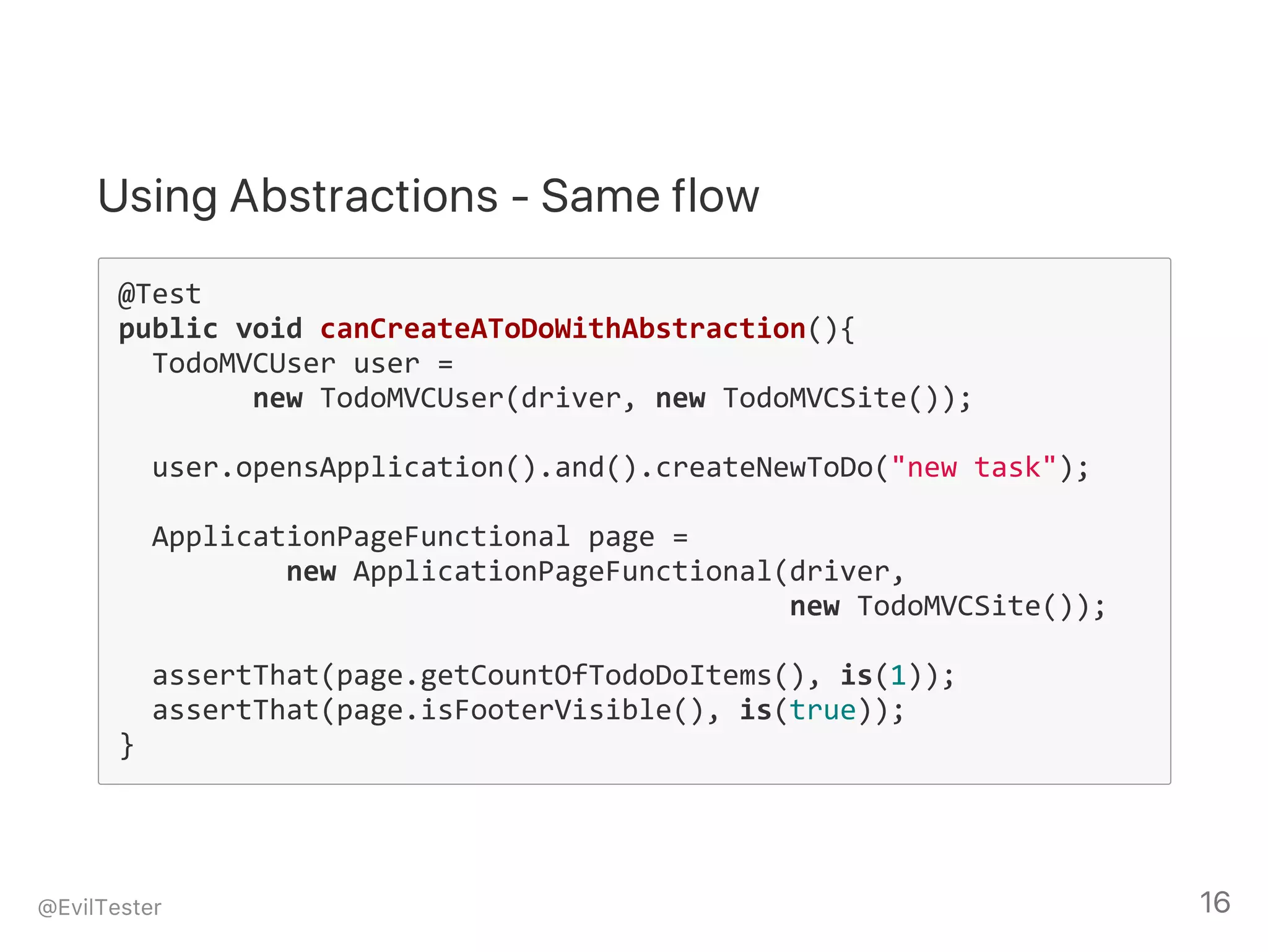
Using Abstractions ‑ Same flow
@Test
public void canCreateAToDoWithAbstraction(){
  TodoMVCUser user = 
        new TodoMVCUser(driver, new TodoMVCSite());
  user.opensApplication().and().createNewToDo("new task");
  ApplicationPageFunctional page = 
          new ApplicationPageFunctional(driver, 
          new TodoMVCSite());
  assertThat(page.getCountOfTodoDoItems(), is(1));
  assertThat(page.isFooterVisible(), is(true));
}
@EvilTester 16
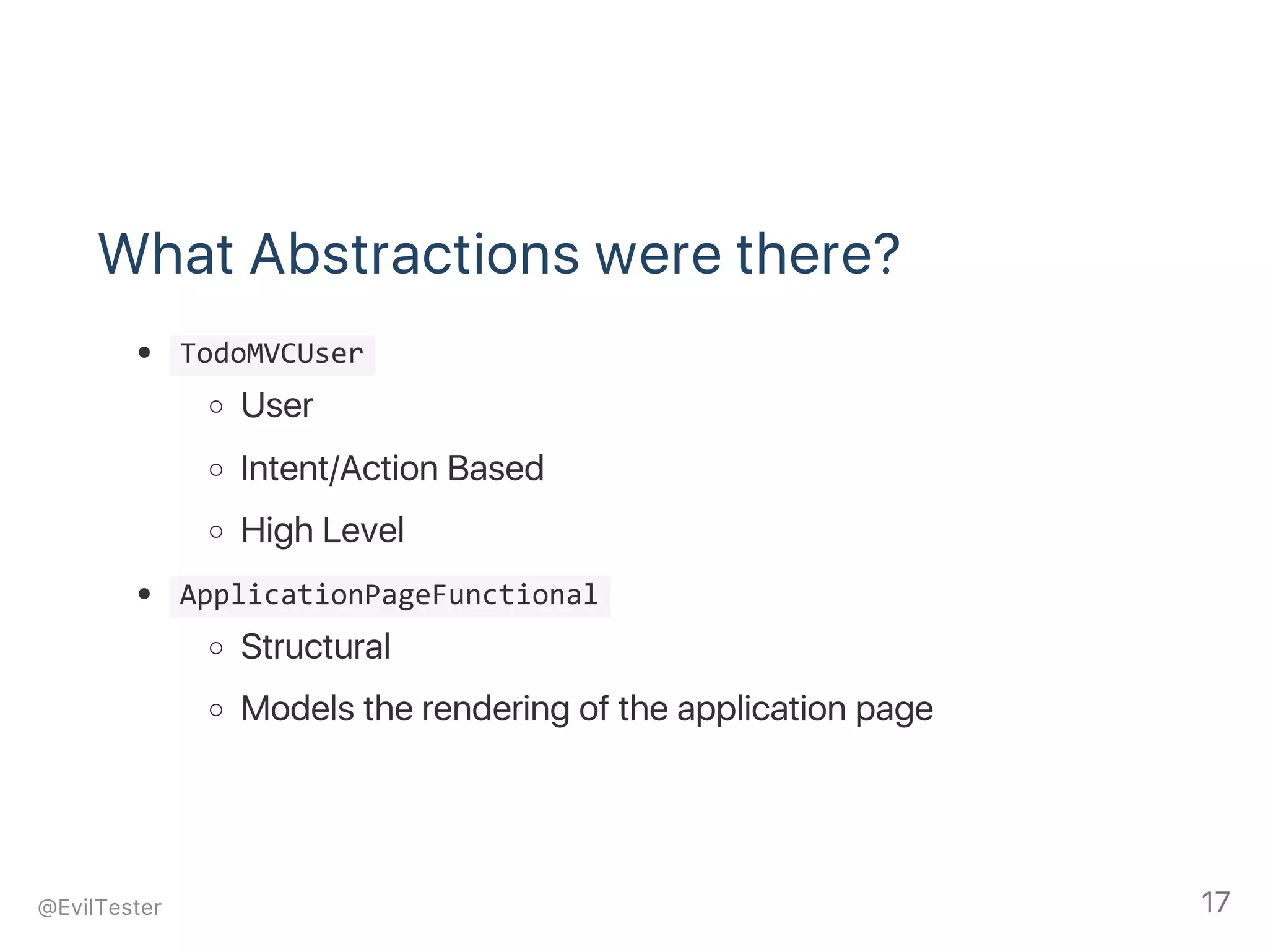
What Abstractions were there?
 TodoMVCUser 
User
Intent/Action Based
High Level
 ApplicationPageFunctional 
Structural
Models the rendering of the application page
@EvilTester 17
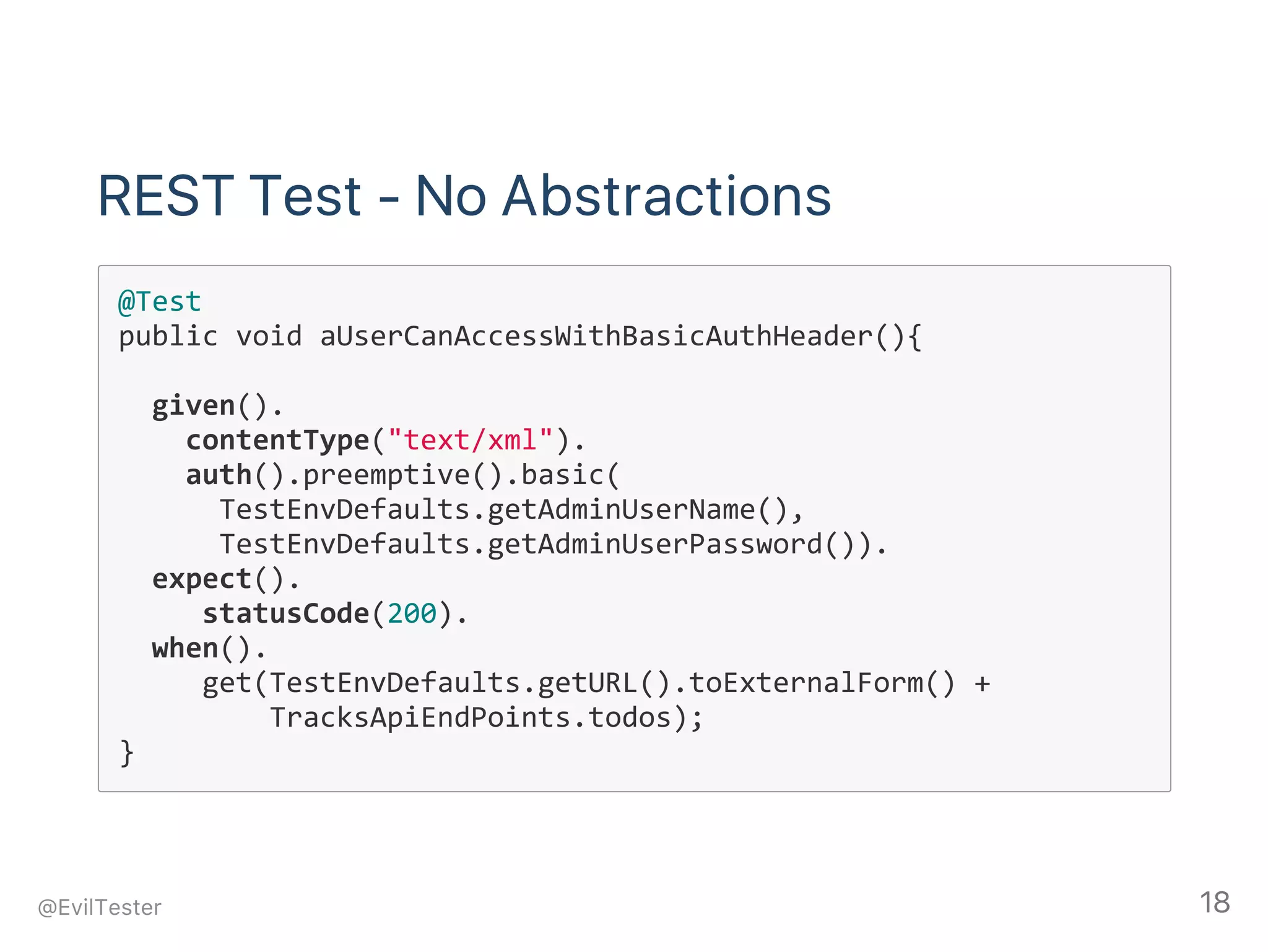
REST Test ‑ No Abstractions
@Test
public void aUserCanAccessWithBasicAuthHeader(){
  given().
    contentType("text/xml").
    auth().preemptive().basic(
      TestEnvDefaults.getAdminUserName(),
      TestEnvDefaults.getAdminUserPassword()).
  expect().
     statusCode(200).
  when().
     get(TestEnvDefaults.getURL().toExternalForm() +
         TracksApiEndPoints.todos);
}
@EvilTester 18
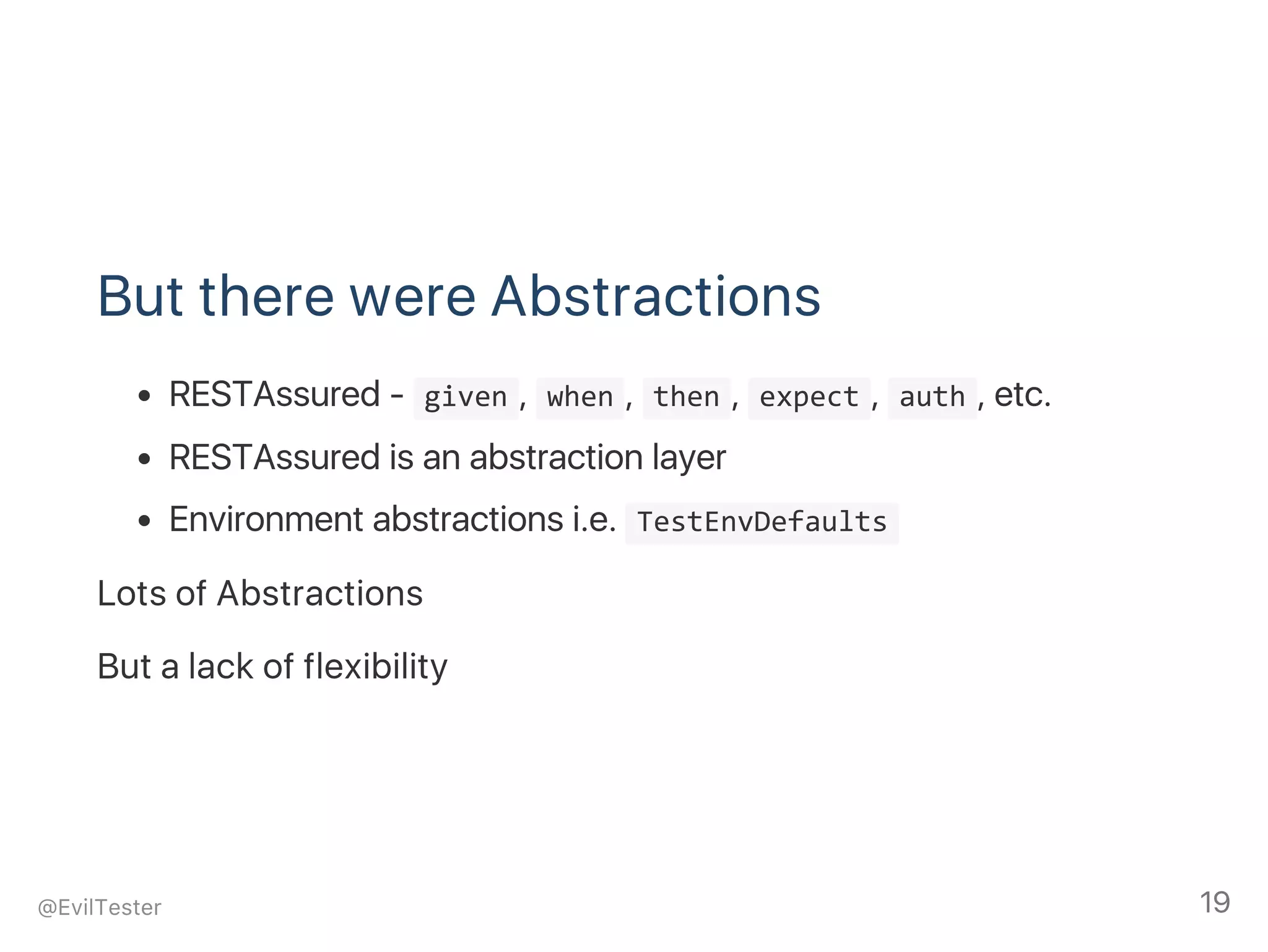
But there were Abstractions
RESTAssured ‑  given ,  when ,  then ,  expect ,  auth , etc.
RESTAssured is an abstraction layer
Environment abstractions i.e.  TestEnvDefaults 
Lots of Abstractions
But a lack of flexibility
@EvilTester 19
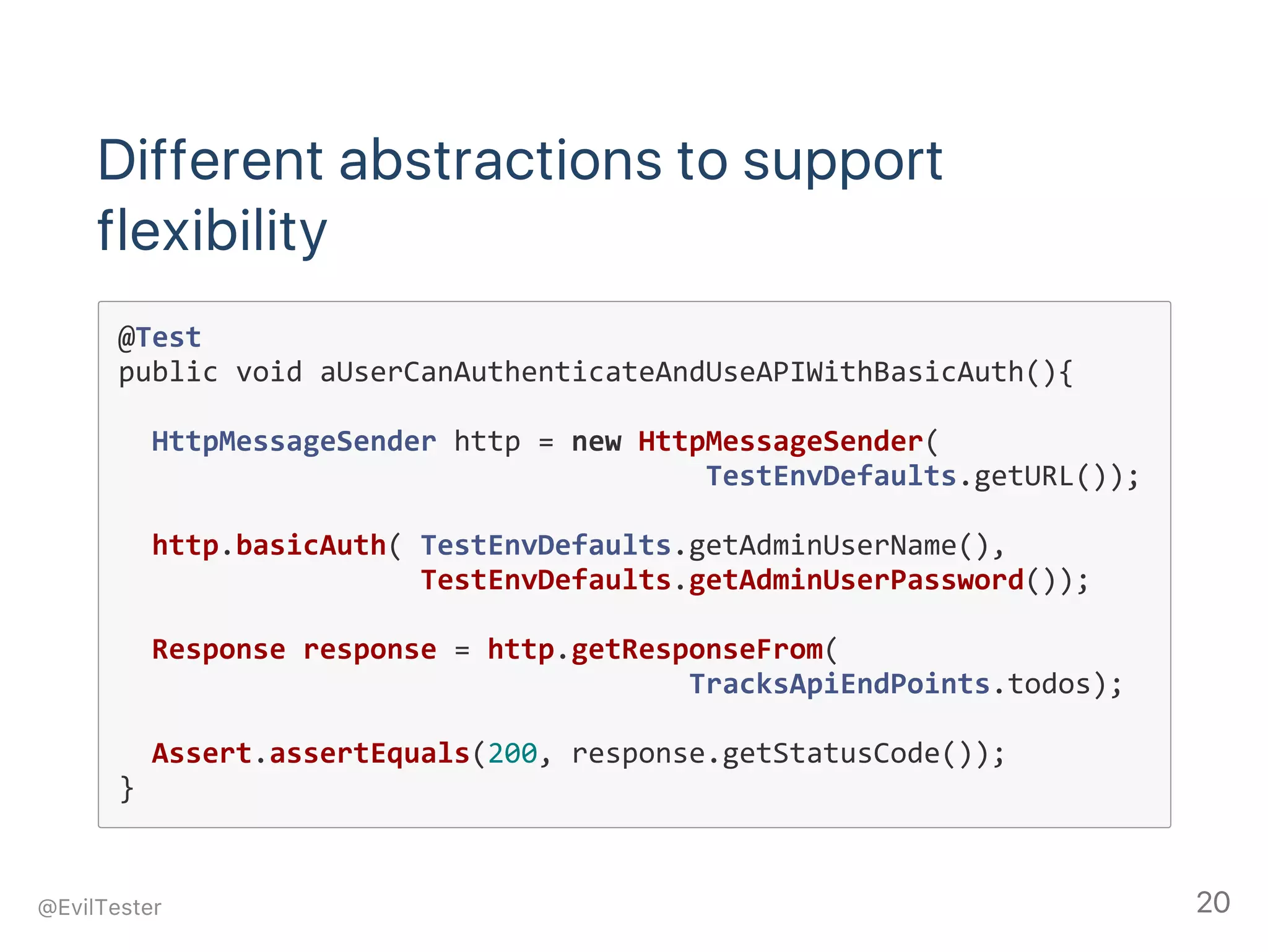
Different abstractions to support
flexibility
@Test
public void aUserCanAuthenticateAndUseAPIWithBasicAuth(){
  HttpMessageSender http = new HttpMessageSender(
                                   TestEnvDefaults.getURL());
  http.basicAuth( TestEnvDefaults.getAdminUserName(),
                  TestEnvDefaults.getAdminUserPassword());
  Response response = http.getResponseFrom(
                                  TracksApiEndPoints.todos);
  Assert.assertEquals(200, response.getStatusCode());
}
@EvilTester 20
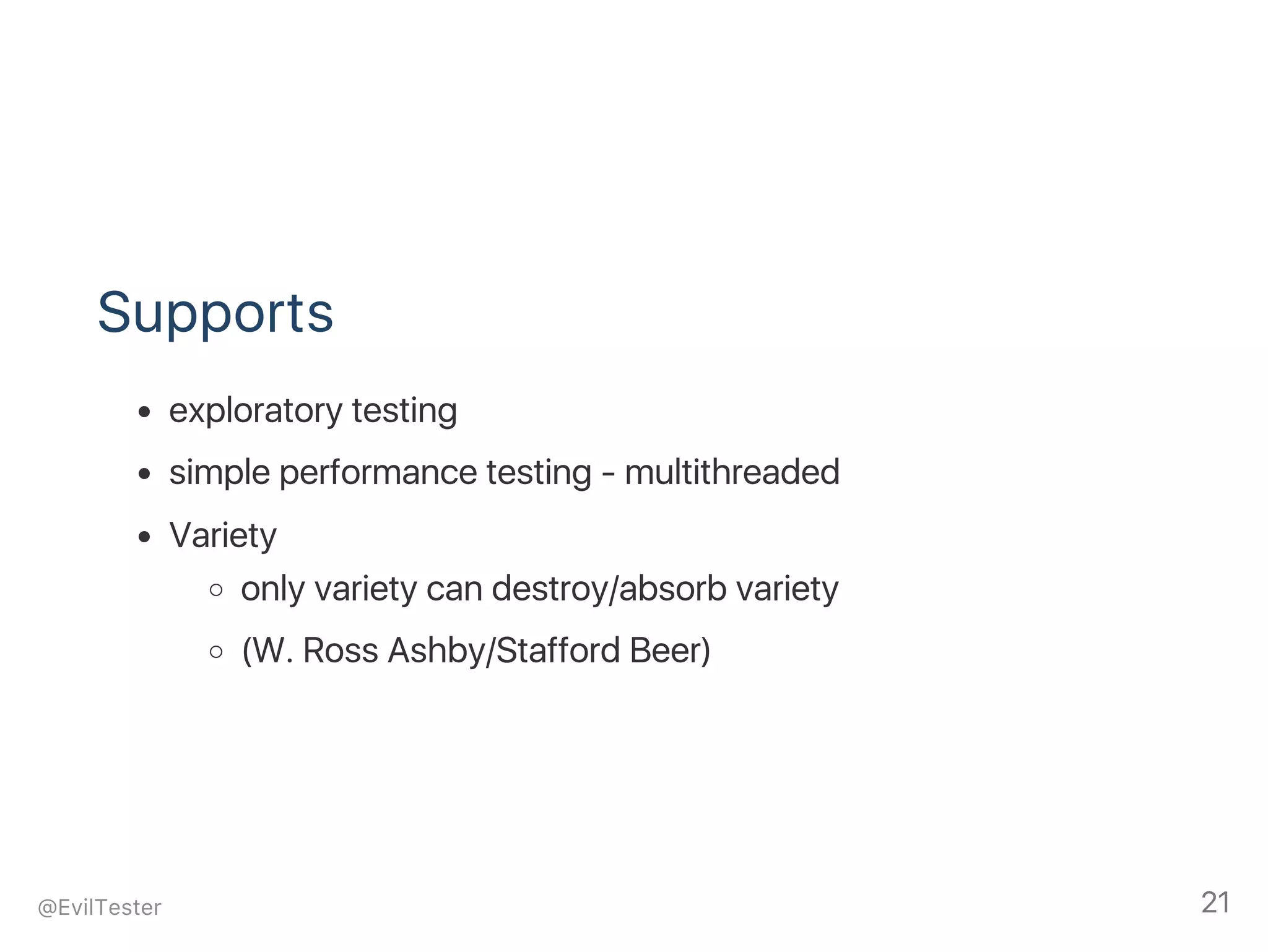
Supports
exploratory testing
simple performance testing ‑ multithreaded
Variety
only variety can destroy/absorb variety
(W. Ross Ashby/Stafford Beer)
@EvilTester 21
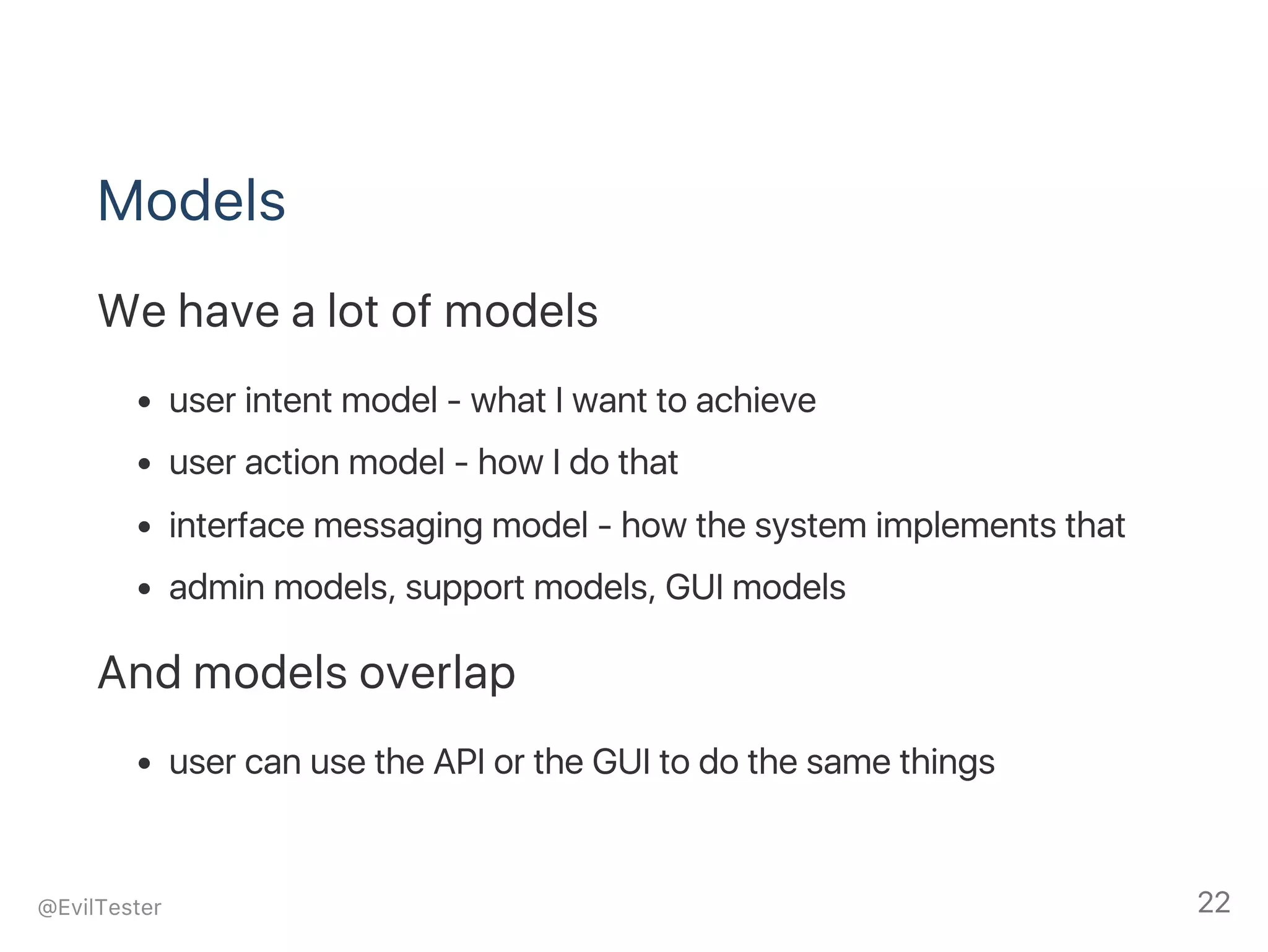
Models
We have a lot of models
user intent model ‑ what I want to achieve
user action model ‑ how I do that
interface messaging model ‑ how the system implements that
admin models, support models, GUI models
And models overlap
user can use the API or the GUI to do the same things
@EvilTester 22
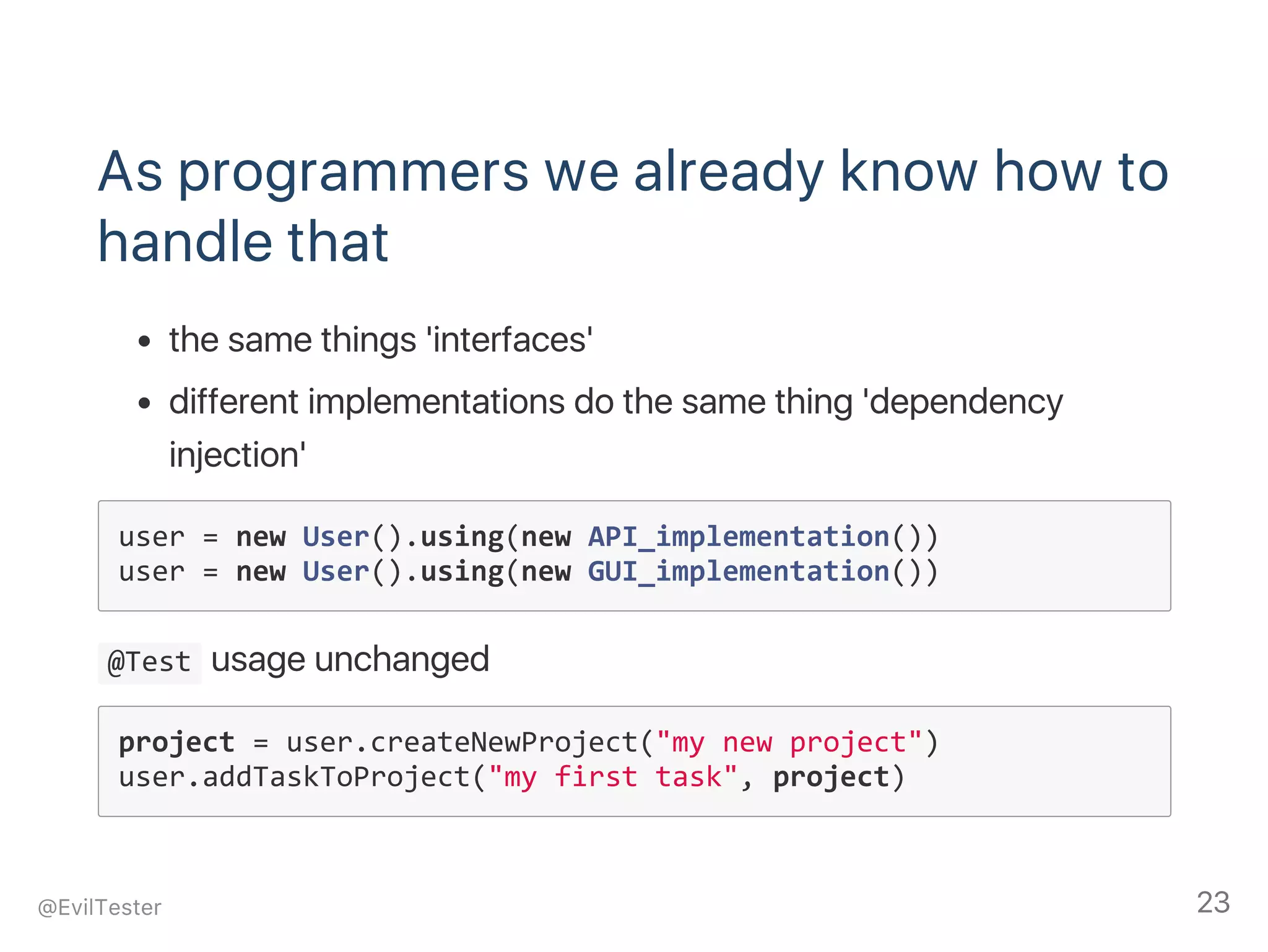
As programmers we already know how to
handle that
the same things 'interfaces'
different implementations do the same thing 'dependency
injection'
user = new User().using(new API_implementation())
user = new User().using(new GUI_implementation())
 @Test usage unchanged
project = user.createNewProject("my new project")
user.addTaskToProject("my first task", project)
@EvilTester 23
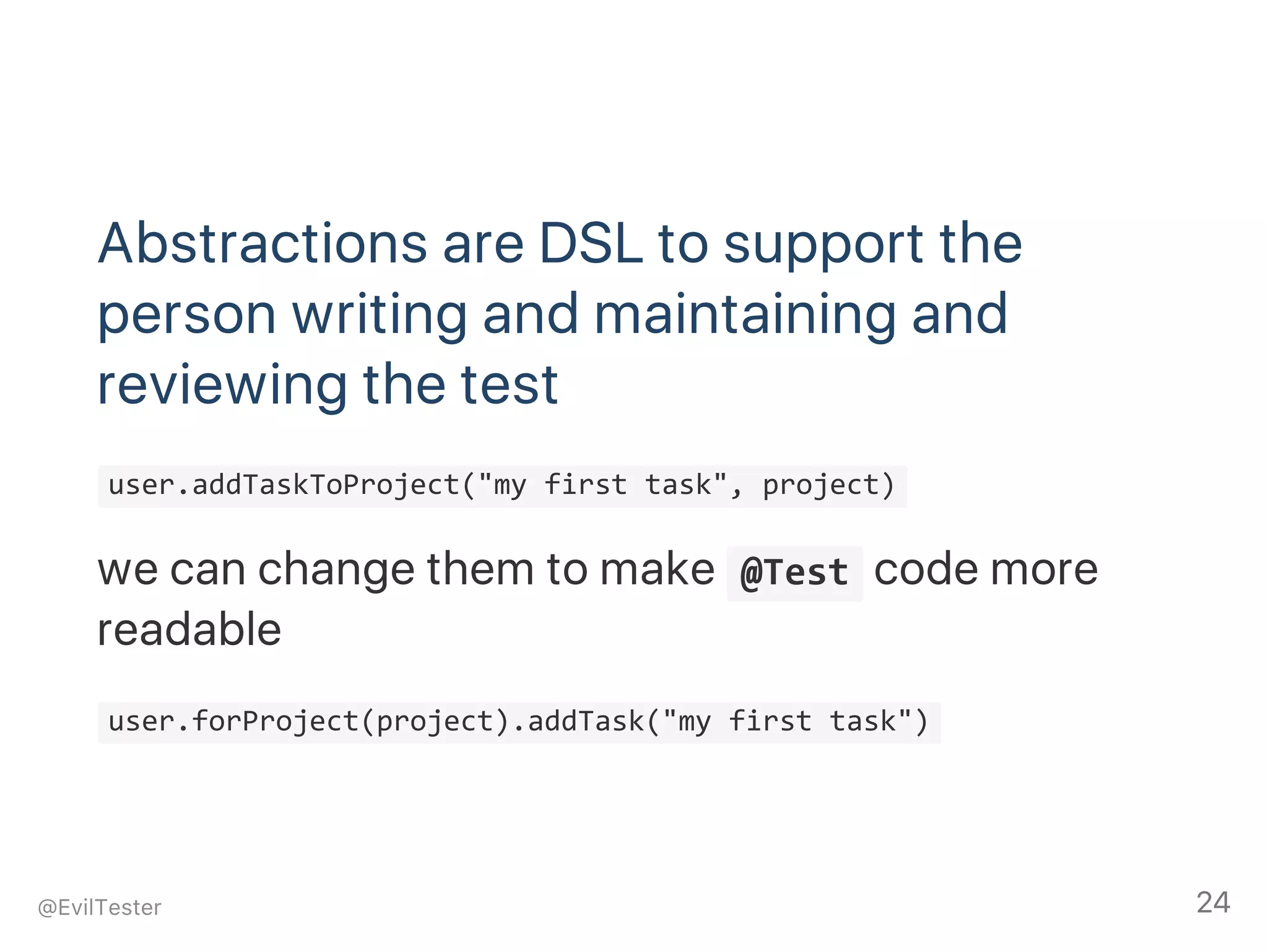
Abstractions are DSL to support the
person writing and maintaining and
reviewing the test
 user.addTaskToProject("my first task", project) 
we can change them to make  @Test code more
readable
 user.forProject(project).addTask("my first task") 
@EvilTester 24
Abstractions can make developers
nervous
too much code
too many layers
@EvilTester 25
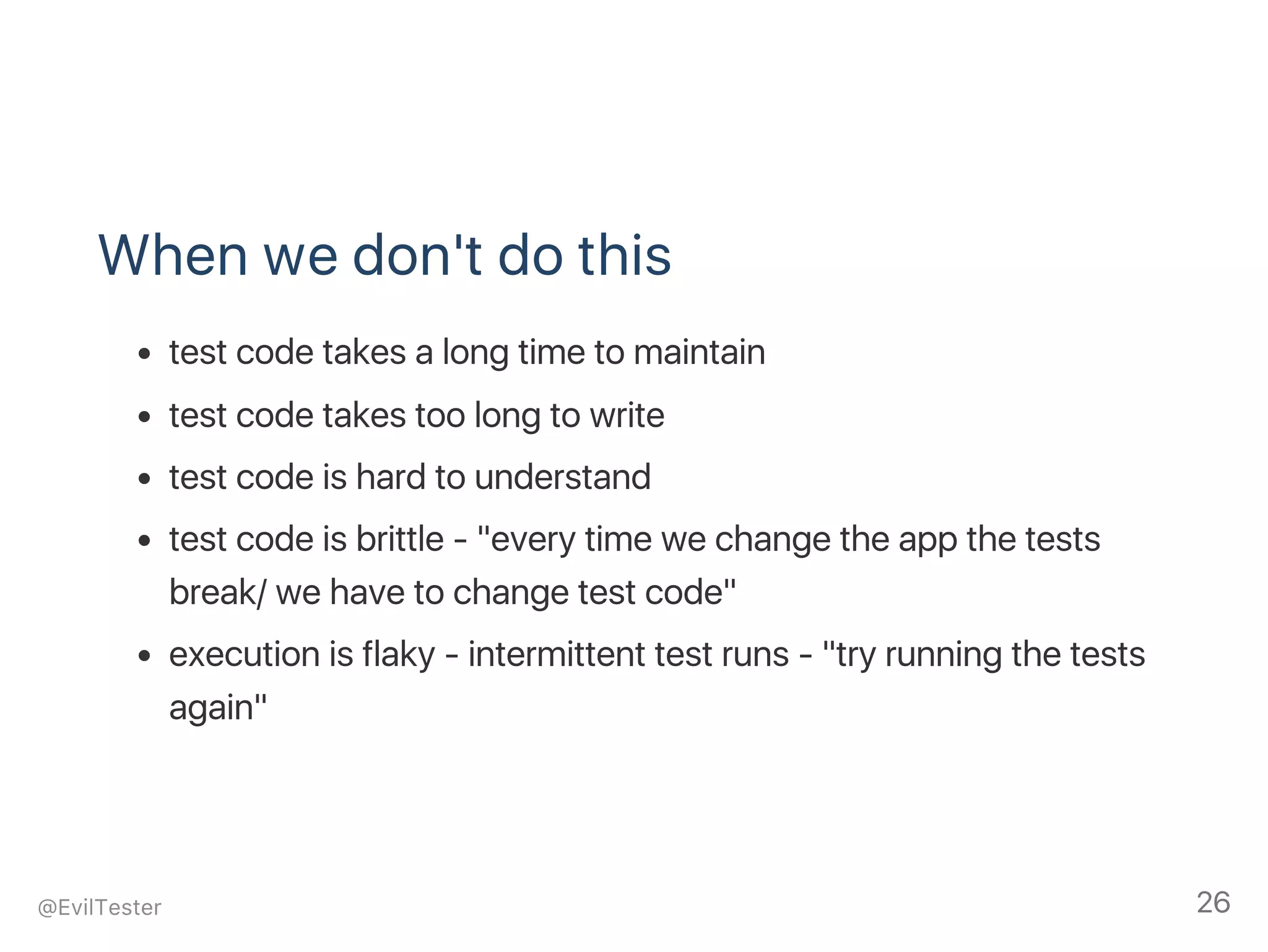
When we don't do this
test code takes a long time to maintain
test code takes too long to write
test code is hard to understand
test code is brittle ‑ "every time we change the app the tests
break/ we have to change test code"
execution is flaky ‑ intermittent test runs ‑ "try running the tests
again"
@EvilTester 26
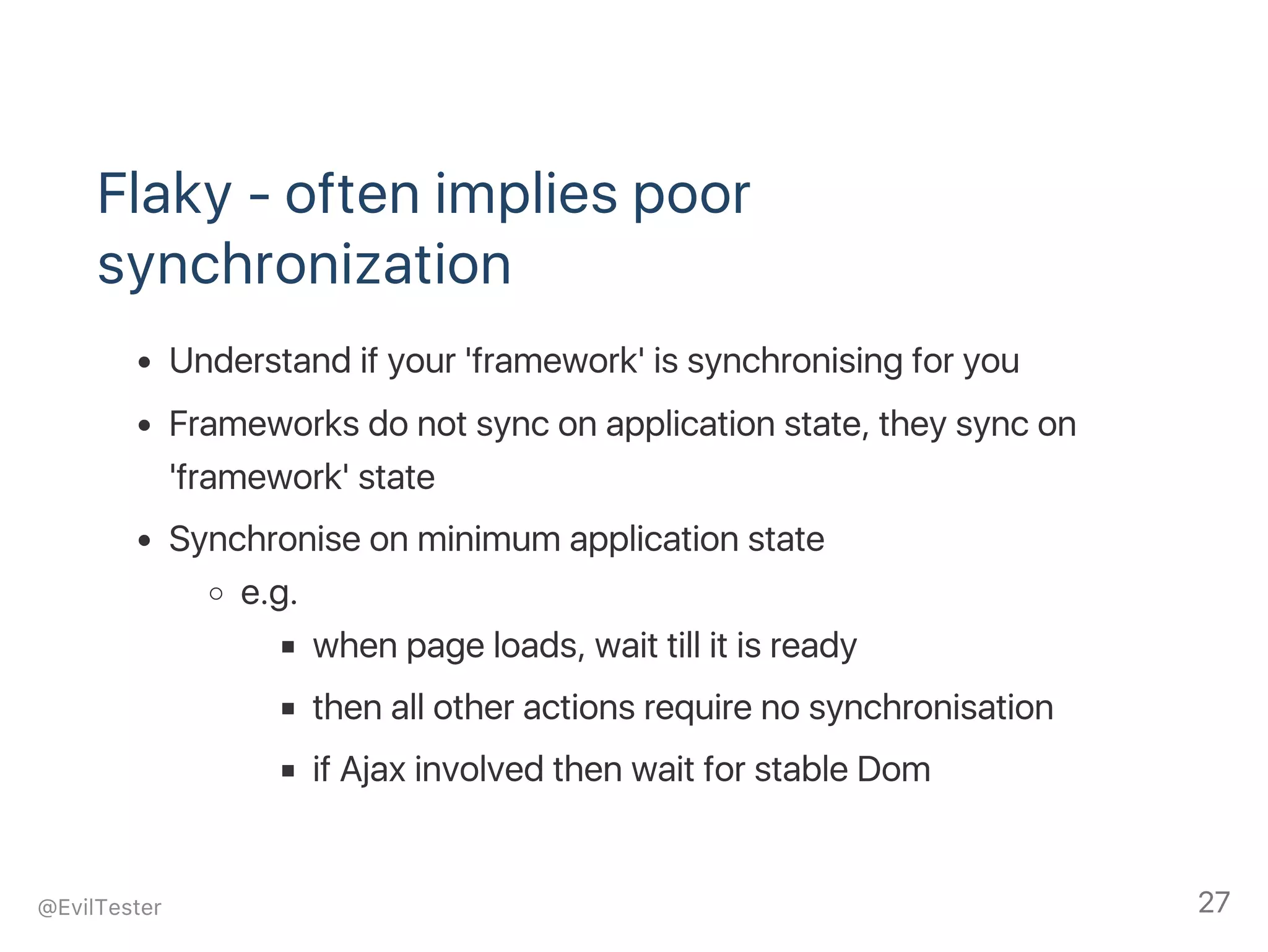
Flaky ‑ often implies poor
synchronization
Understand if your 'framework' is synchronising for you
Frameworks do not sync on application state, they sync on
'framework' state
Synchronise on minimum application state
e.g.
when page loads, wait till it is ready
then all other actions require no synchronisation
if Ajax involved then wait for stable Dom
@EvilTester 27
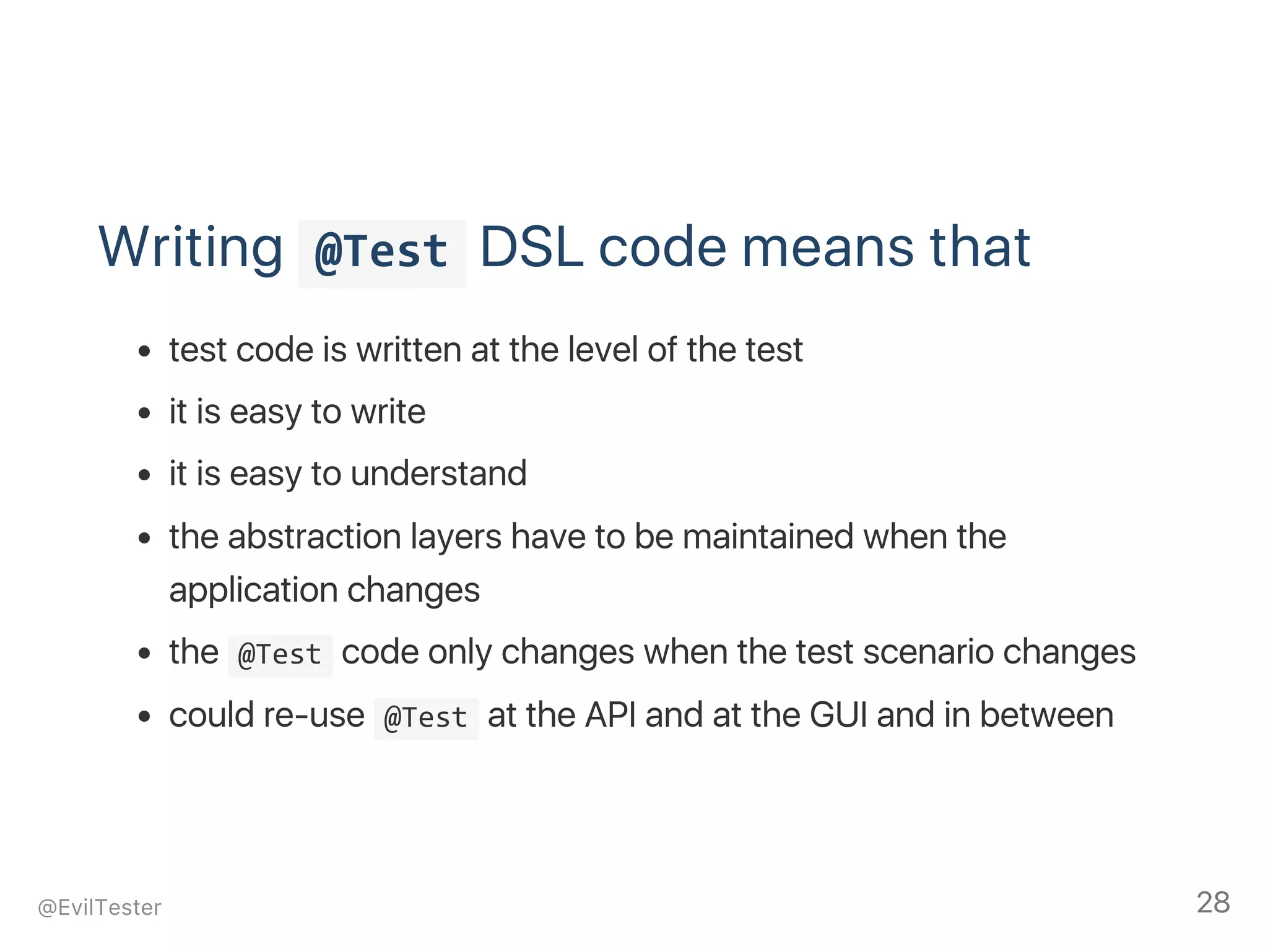
Writing  @Test DSL code means that
test code is written at the level of the test
it is easy to write
it is easy to understand
the abstraction layers have to be maintained when the
application changes
the  @Test code only changes when the test scenario changes
could re‑use  @Test at the API and at the GUI and in between
@EvilTester 28
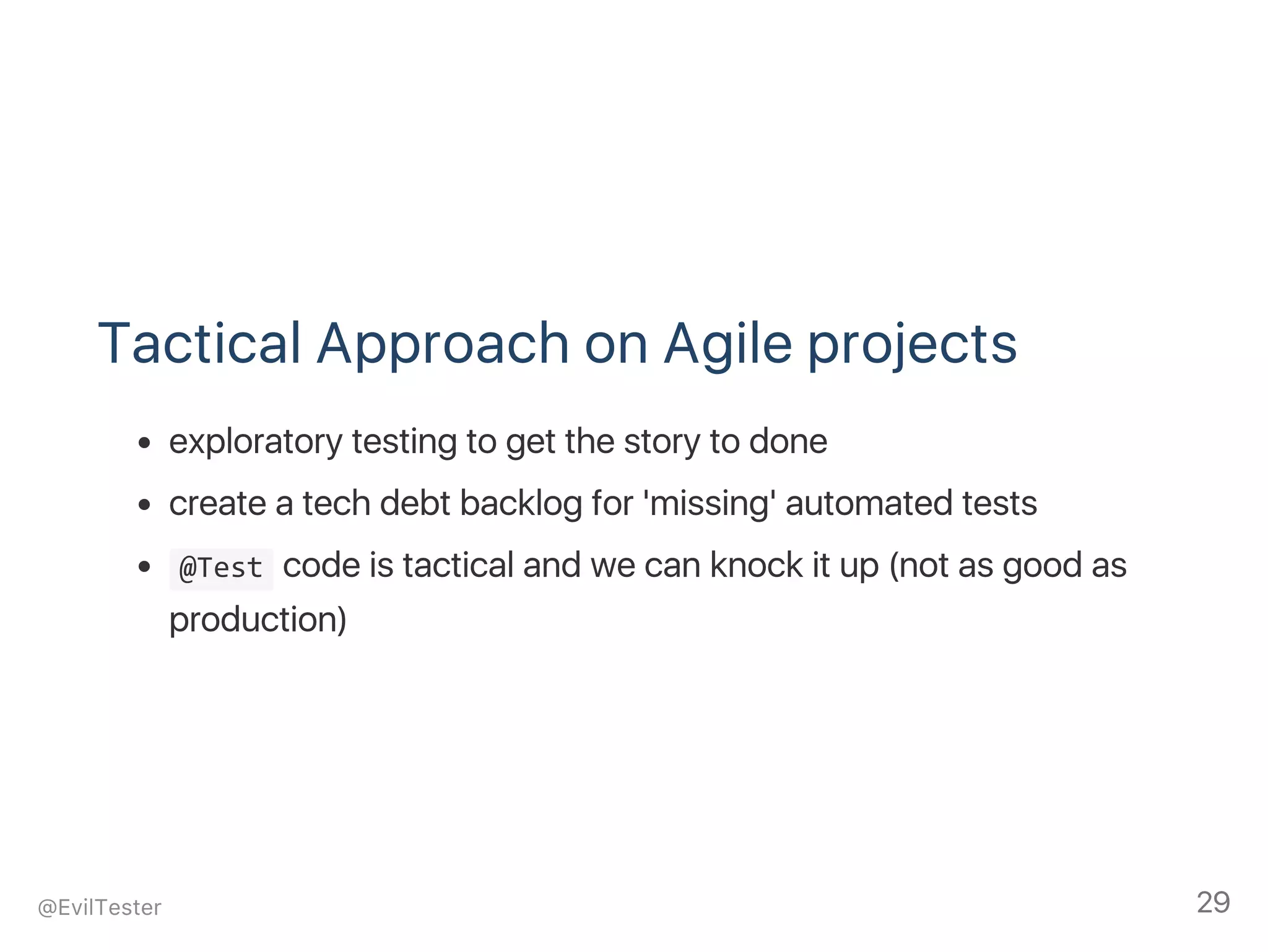
Tactical Approach on Agile projects
exploratory testing to get the story to done
create a tech debt backlog for 'missing' automated tests
 @Test code is tactical and we can knock it up (not as good as
production)
@EvilTester 29
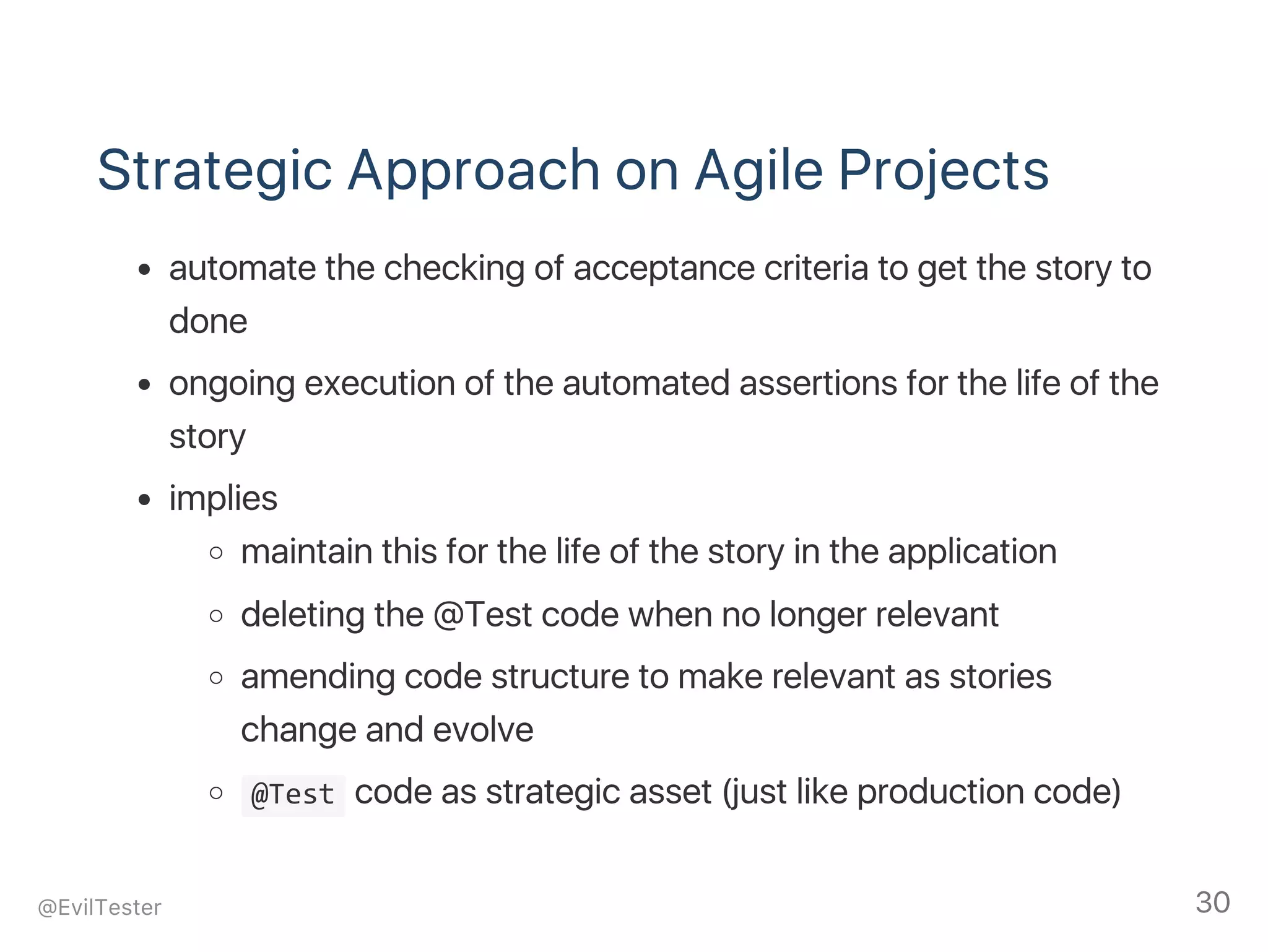
Strategic Approach on Agile Projects
automate the checking of acceptance criteria to get the story to
done
ongoing execution of the automated assertions for the life of the
story
implies
maintain this for the life of the story in the application
deleting the @Test code when no longer relevant
amending code structure to make relevant as stories
change and evolve
 @Test code as strategic asset (just like production code)
@EvilTester 30
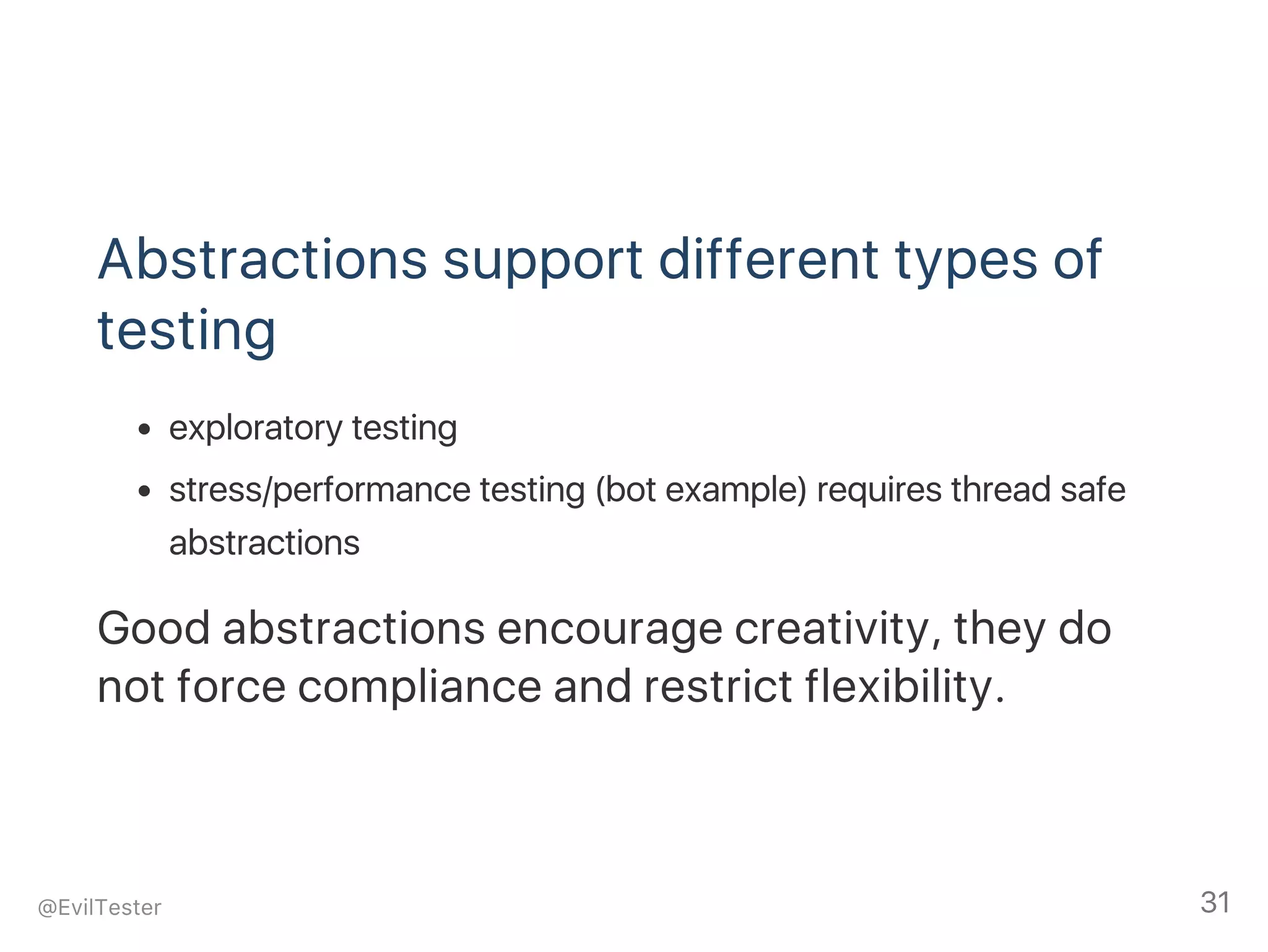
Abstractions support different types of
testing
exploratory testing
stress/performance testing (bot example) requires thread safe
abstractions
Good abstractions encourage creativity, they do
not force compliance and restrict flexibility.
@EvilTester 31
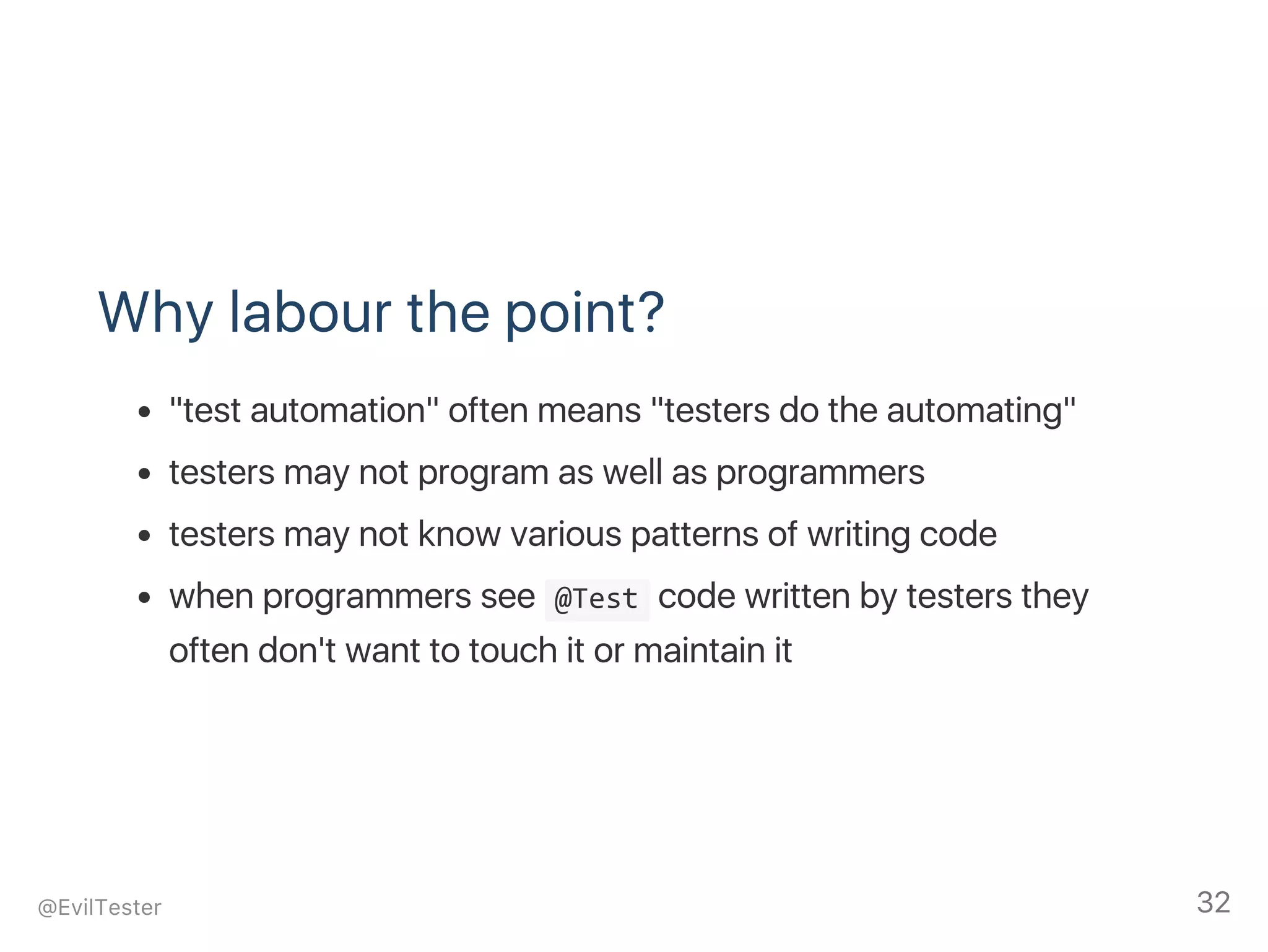
Why labour the point?
"test automation" often means "testers do the automating"
testers may not program as well as programmers
testers may not know various patterns of writing code
when programmers see  @Test code written by testers they
often don't want to touch it or maintain it
@EvilTester 32
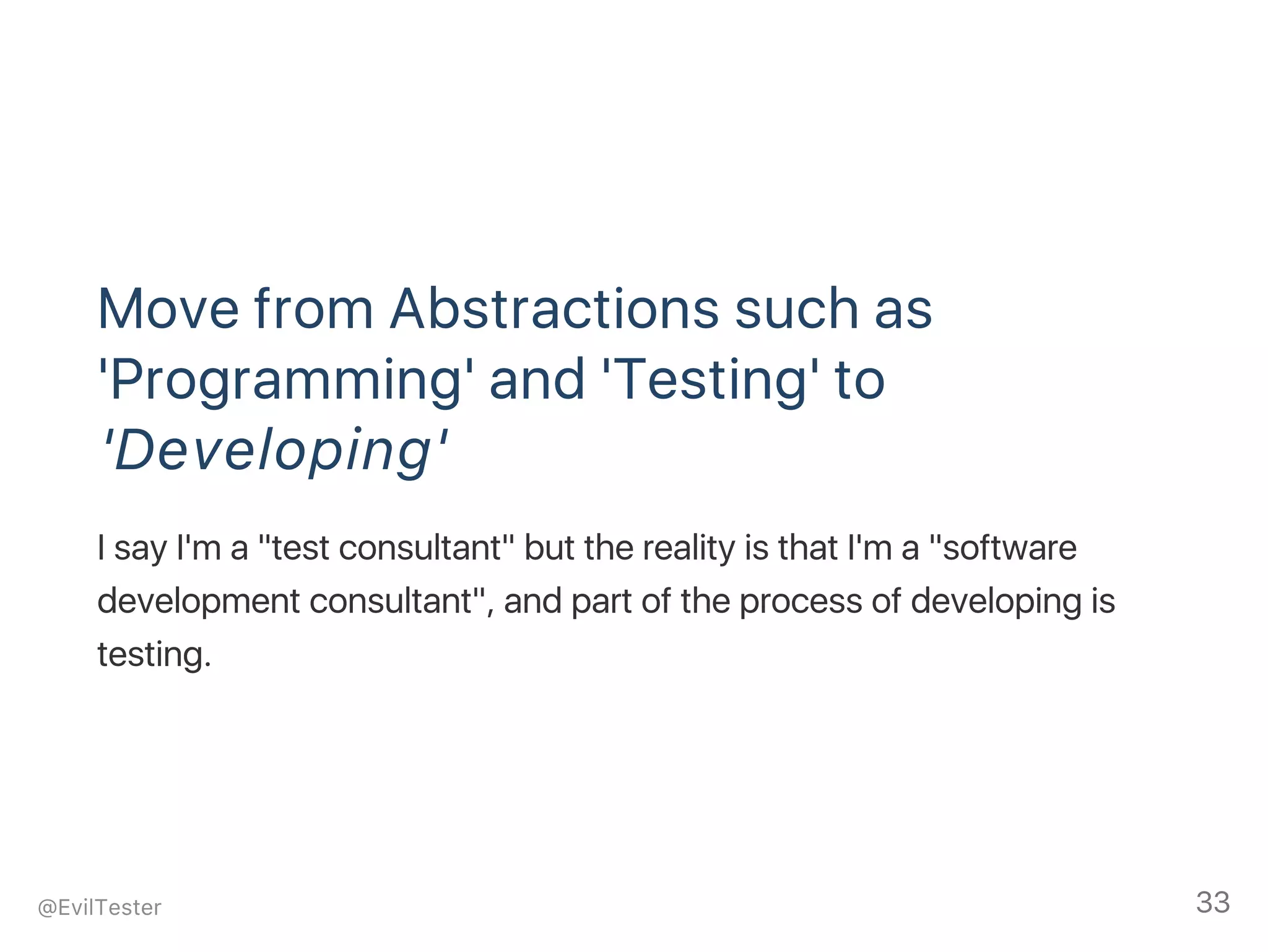
Move from Abstractions such as
'Programming' and 'Testing' to
'Developing'
I say I'm a "test consultant" but the reality is that I'm a "software
development consultant", and part of the process of developing is
testing.
@EvilTester 33
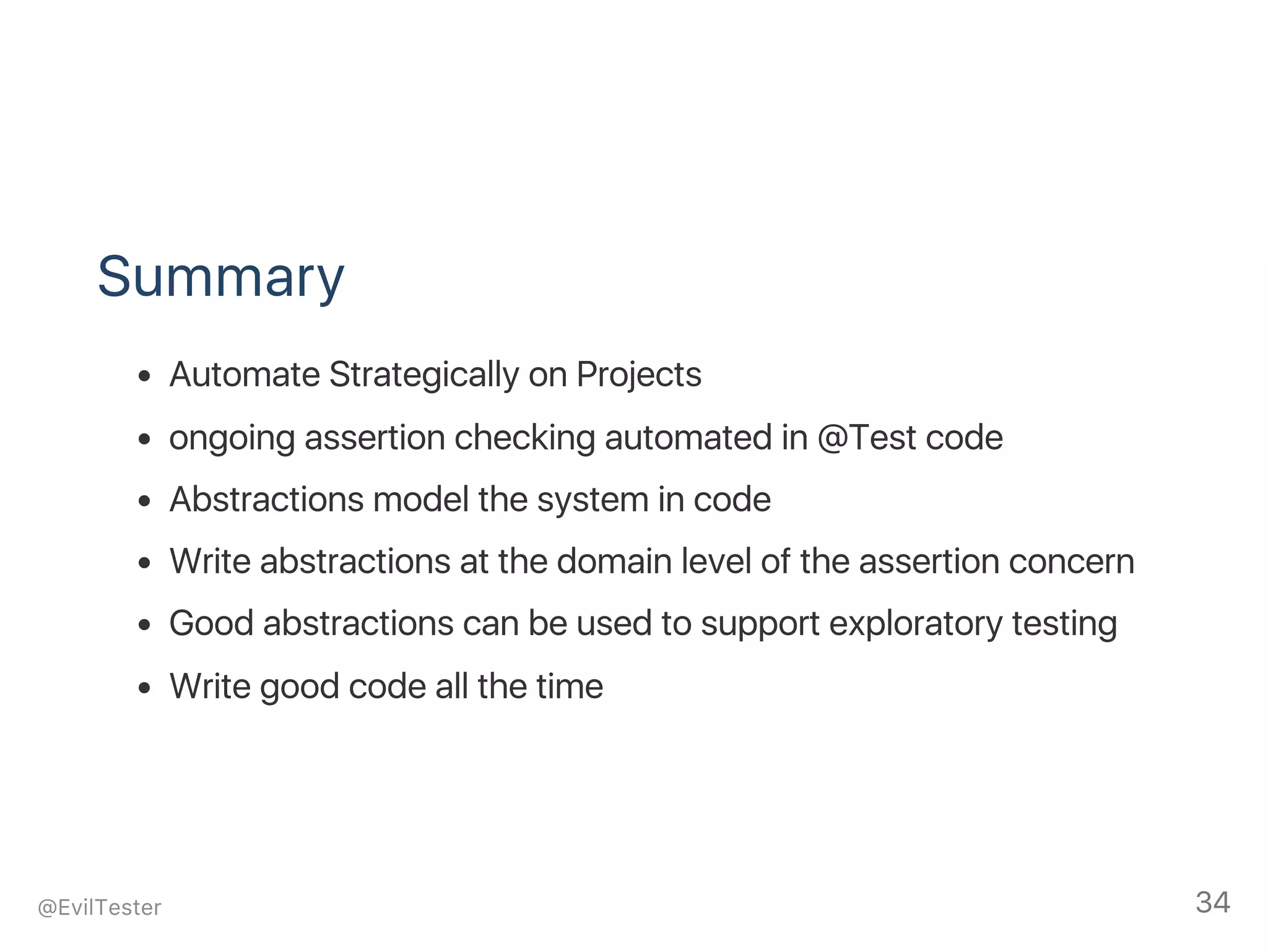
Summary
Automate Strategically on Projects
ongoing assertion checking automated in @Test code
Abstractions model the system in code
Write abstractions at the domain level of the assertion concern
Good abstractions can be used to support exploratory testing
Write good code all the time
@EvilTester 34
Learn to "Be Evil"
www.eviltester.com
@eviltester
www.youtube.com/user/EviltesterVideos
@EvilTester 35
Learn About Alan Richardson
www.compendiumdev.co.uk
uk.linkedin.com/in/eviltester
@EvilTester 36
Follow
Linkedin ‑ @eviltester
Twitter ‑ @eviltester
Instagram ‑ @eviltester
Facebook ‑ @eviltester
Youtube ‑ EvilTesterVideos
Pinterest ‑ @eviltester
Github ‑ @eviltester
Slideshare ‑ @eviltester
@EvilTester 37
BIO
Alan is a test consultant who enjoys testing at a technical level using
techniques from psychotherapy and computer science. In his spare
time Alan is currently programming a multi‑user text adventure game
and some buggy JavaScript games in the style of the Cascade
Cassette 50. Alan is the author of the books "Dear Evil Tester", "Java
For Testers" and "Automating and Testing a REST API". Alan's main
website is compendiumdev.co.uk and he blogs at blog.eviltester.com
@EvilTester 38

Practical Test Automation Deep Dive

  • 1.
    A Technical DeepDive into Practical Test Automation Fusion Meetup (Birmingham) March 2017 Alan Richardson www.eviltester.com www.compendiumdev.co.uk @eviltester @EvilTester 1
  • 2.
    Synopsis In this talkI'm going to focus on the technical aspects of 'test automation', using examples of approaches from a variety of Agile projects where we automated APIs, and GUIs. You'll learn about the use of abstractions and how to think about modeling the system in code to support automating it. Also how to use these abstractions to support stress testing, exploratory testing, ongoing CI assertions and the testing process in general. I'll also discuss the different styles of coding used to support automating tactically vs automating strategically. @EvilTester 2
  • 3.
    Secrets of SuccessfulPractical Automating Get work done Automate Flows Multiple Abstractions Abstract to libraries, not frameworks @EvilTester 3
  • 4.
    Testing field arguesabout Testing vs Checking You can't automate testing "Test Automation" is contentious @EvilTester 4
  • 5.
    An Example "Thisis a test?" @Test public void createPreviewMVP() throws IOException {   String args[] = {       new File(System.getProperty("user.dir"),         "pandocifier.properties").getAbsolutePath()};            new PandocifierCLI().main(args);   String propertyFileName = args[0];   File propertyFile = new File(propertyFileName);   PandocifierConfig config;   config = new PandocifierConfigFileReader().                fromPropertyFile(propertyFile);            Assert.assertTrue(new File(                       config.getPreviewFileName()).exists()); } @EvilTester 5
  • 6.
    An Example "Cen'est pas un test" This is a Test because it says it is a  @Test  This is an Automated Test because it checks something (file exists) This is an Automated Test because it Asserts on the check This is an Application ‑ I use it to build one of my books This is not an Application ‑ it doesn't have a GUI or a standalone execution build This is  automated execution of a process  @EvilTester 6
  • 7.
    We Automate Partsof our Development Process: Coding, Checking, Asserting, ... @EvilTester 7
  • 8.
    Tactical Reality ‑I don't really care, I just want to get work done Suggests we also have 'strategic reality' @EvilTester 8
  • 9.
    Automating Tactically vsStrategically What is Tactical? What is Strategic? Solve a problem Agreed & Understood Goals Short Term Long Term Change as necessary Slower to Change Your Time 'project' time @EvilTester 9
  • 10.
    Warning ‑ sometimestactics look like strategy Use of Jenkins is not Continuous Integration Automated Deployments are not CI Containers are not always good environment provision Page Objects are not guaranteed good system abstractions @EvilTester 10
  • 11.
    You know youare Automating strategically when... Reduced Maintenance Reduced change Everyone agrees why No fighting for 'time' It's not about roles It gets done @EvilTester 11
  • 12.
    How do weautomate? not about "test automation" it is about automating tasks automate the assertions used to check that the stories are still 'done' Automate flows through the system vary data abstract the execution @EvilTester 12
  • 13.
    Automating Strategically Abstractions ‑"modeling the system in code" abstractions are a big part of automating strategically abstractions are about modelling ‑ people seem to be scared of having too many models see also "Domain Driven Design" @EvilTester 13
  • 14.
    No Abstractions ‑Web Testing @Test public void canCreateAToDoWithNoAbstraction(){  driver = new FirefoxDriver();  driver.get(      "http://todomvc.com/architecture‐examples/backbone/");  int originalNumberOfTodos = driver.findElements(              By.cssSelector("ul#todo‐list li")).size();  WebElement createTodo;  createTodo = driver.findElement(By.id("new‐todo"));  createTodo.click();  createTodo.sendKeys("new task");  createTodo.sendKeys(Keys.ENTER);  assertThat(driver.findElement(        By.id("filters")).isDisplayed(), is(true));  int newToDos = driver.findElements(           By.cssSelector("ul#todo‐list li")).size();   assertThat(newToDos, greaterThan(originalNumberOfTodos)); } @EvilTester 14
  • 15.
    But there wereAbstractions WebDriver ‑ abstration of browser FirefoxDriver ‑ abstraction Firefox (e.g. no version) WebElement ‑ abstraction of a dom element createToDo ‑ variable ‑ named for clarity Locator Abstractions via methods  findElement  findElements  Manipulation Abstractions  .sendKeys  Locator Strategies  By.id (did not have to write CSS Selectors) ... Lots of Abstractions @EvilTester 15
  • 16.
    Using Abstractions ‑Same flow @Test public void canCreateAToDoWithAbstraction(){   TodoMVCUser user =          new TodoMVCUser(driver, new TodoMVCSite());   user.opensApplication().and().createNewToDo("new task");   ApplicationPageFunctional page =            new ApplicationPageFunctional(driver,            new TodoMVCSite());   assertThat(page.getCountOfTodoDoItems(), is(1));   assertThat(page.isFooterVisible(), is(true)); } @EvilTester 16
  • 17.
    What Abstractions werethere?  TodoMVCUser  User Intent/Action Based High Level  ApplicationPageFunctional  Structural Models the rendering of the application page @EvilTester 17
  • 18.
    REST Test ‑No Abstractions @Test public void aUserCanAccessWithBasicAuthHeader(){   given().     contentType("text/xml").     auth().preemptive().basic(       TestEnvDefaults.getAdminUserName(),       TestEnvDefaults.getAdminUserPassword()).   expect().      statusCode(200).   when().      get(TestEnvDefaults.getURL().toExternalForm() +          TracksApiEndPoints.todos); } @EvilTester 18
  • 19.
    But there wereAbstractions RESTAssured ‑  given ,  when ,  then ,  expect ,  auth , etc. RESTAssured is an abstraction layer Environment abstractions i.e.  TestEnvDefaults  Lots of Abstractions But a lack of flexibility @EvilTester 19
  • 20.
    Different abstractions tosupport flexibility @Test public void aUserCanAuthenticateAndUseAPIWithBasicAuth(){   HttpMessageSender http = new HttpMessageSender(                                    TestEnvDefaults.getURL());   http.basicAuth( TestEnvDefaults.getAdminUserName(),                   TestEnvDefaults.getAdminUserPassword());   Response response = http.getResponseFrom(                                   TracksApiEndPoints.todos);   Assert.assertEquals(200, response.getStatusCode()); } @EvilTester 20
  • 21.
    Supports exploratory testing simple performancetesting ‑ multithreaded Variety only variety can destroy/absorb variety (W. Ross Ashby/Stafford Beer) @EvilTester 21
  • 22.
    Models We have alot of models user intent model ‑ what I want to achieve user action model ‑ how I do that interface messaging model ‑ how the system implements that admin models, support models, GUI models And models overlap user can use the API or the GUI to do the same things @EvilTester 22
  • 23.
    As programmers wealready know how to handle that the same things 'interfaces' different implementations do the same thing 'dependency injection' user = new User().using(new API_implementation()) user = new User().using(new GUI_implementation())  @Test usage unchanged project = user.createNewProject("my new project") user.addTaskToProject("my first task", project) @EvilTester 23
  • 24.
    Abstractions are DSLto support the person writing and maintaining and reviewing the test  user.addTaskToProject("my first task", project)  we can change them to make  @Test code more readable  user.forProject(project).addTask("my first task")  @EvilTester 24
  • 25.
    Abstractions can makedevelopers nervous too much code too many layers @EvilTester 25
  • 26.
    When we don'tdo this test code takes a long time to maintain test code takes too long to write test code is hard to understand test code is brittle ‑ "every time we change the app the tests break/ we have to change test code" execution is flaky ‑ intermittent test runs ‑ "try running the tests again" @EvilTester 26
  • 27.
    Flaky ‑ oftenimplies poor synchronization Understand if your 'framework' is synchronising for you Frameworks do not sync on application state, they sync on 'framework' state Synchronise on minimum application state e.g. when page loads, wait till it is ready then all other actions require no synchronisation if Ajax involved then wait for stable Dom @EvilTester 27
  • 28.
    Writing  @Test DSL codemeans that test code is written at the level of the test it is easy to write it is easy to understand the abstraction layers have to be maintained when the application changes the  @Test code only changes when the test scenario changes could re‑use  @Test at the API and at the GUI and in between @EvilTester 28
  • 29.
    Tactical Approach onAgile projects exploratory testing to get the story to done create a tech debt backlog for 'missing' automated tests  @Test code is tactical and we can knock it up (not as good as production) @EvilTester 29
  • 30.
    Strategic Approach onAgile Projects automate the checking of acceptance criteria to get the story to done ongoing execution of the automated assertions for the life of the story implies maintain this for the life of the story in the application deleting the @Test code when no longer relevant amending code structure to make relevant as stories change and evolve  @Test code as strategic asset (just like production code) @EvilTester 30
  • 31.
    Abstractions support differenttypes of testing exploratory testing stress/performance testing (bot example) requires thread safe abstractions Good abstractions encourage creativity, they do not force compliance and restrict flexibility. @EvilTester 31
  • 32.
    Why labour thepoint? "test automation" often means "testers do the automating" testers may not program as well as programmers testers may not know various patterns of writing code when programmers see  @Test code written by testers they often don't want to touch it or maintain it @EvilTester 32
  • 33.
    Move from Abstractionssuch as 'Programming' and 'Testing' to 'Developing' I say I'm a "test consultant" but the reality is that I'm a "software development consultant", and part of the process of developing is testing. @EvilTester 33
  • 34.
    Summary Automate Strategically onProjects ongoing assertion checking automated in @Test code Abstractions model the system in code Write abstractions at the domain level of the assertion concern Good abstractions can be used to support exploratory testing Write good code all the time @EvilTester 34
  • 35.
    Learn to "BeEvil" www.eviltester.com @eviltester www.youtube.com/user/EviltesterVideos @EvilTester 35
  • 36.
    Learn About AlanRichardson www.compendiumdev.co.uk uk.linkedin.com/in/eviltester @EvilTester 36
  • 37.
    Follow Linkedin ‑ @eviltester Twitter‑ @eviltester Instagram ‑ @eviltester Facebook ‑ @eviltester Youtube ‑ EvilTesterVideos Pinterest ‑ @eviltester Github ‑ @eviltester Slideshare ‑ @eviltester @EvilTester 37
  • 38.
    BIO Alan is atest consultant who enjoys testing at a technical level using techniques from psychotherapy and computer science. In his spare time Alan is currently programming a multi‑user text adventure game and some buggy JavaScript games in the style of the Cascade Cassette 50. Alan is the author of the books "Dear Evil Tester", "Java For Testers" and "Automating and Testing a REST API". Alan's main website is compendiumdev.co.uk and he blogs at blog.eviltester.com @EvilTester 38