


@EvilTester | EvilTester.com/agile
Common Questions about Testing on
Agile Projects
@EvilTester | EvilTester.com/agile
What is Agile Testing?
A Test approach crafted uniquely for your specific environment.
Test in a way that fits, and adapts to, your Agile Development.
Nothing complicated. Involve everyone on the team in your
Testing process, because Testing is a major part of your
Software Development Process.
@EvilTester | EvilTester.com/agile
What is Agile Testing?
Every Agile project is unique ‐ staff mix, skill sets, business
concerns, tool sets. You need to adopt a Testing approach crafted
to your specific environment. To do that you need to understand
the essence of testing in terms of feedback, and as a means of
evaluating and exploring models of your system. Then test in a way
that fits, and adapts to, your approach to Agile Development.
Nothing complicated. Don't shoe horn in something you would
traditionally call 'Testing' and label it Agile. Do Adapt your process
to meet the needs of your project. And do involve everyone in your
Testing process, because Testing is a major part of your Software
Development Process.
@EvilTester | EvilTester.com/agile
Do we still need testers in Agile?
Once you've worked with a good tester, this question won't even
cross your mind.
You still need to test, and you need people to do that. You can
train other people to test, but they may not have the
motivation to learn testing in depth and push your System to
its limits.
@EvilTester | EvilTester.com/agile
Do we still need testers in Agile?
People often ask this question because they've never seen a good
tester in action. After working with a good tester, this question
won't even cross your mind. You still need to test, and you still need
people testing your software. You'll need the people doing that to
understand how to test, and to test well. Testers generally know
how to do that. But of course you can train other people to do your
testing. They may not have the same motivation to continue to
learn testing in depth and the nuances and subtleties of system and
risk exploration as people who view testing as their main focus.
@EvilTester | EvilTester.com/agile
What is an Agile Tester?
An Agile Tester brings flexibility to their role.
They take the essence of testing and implement it as part of
your Agile System of Development. They explore the System
deeply, spot Risks, and ask questions to help everyone think
differently about the quality of the software and the process of
development.
@EvilTester | EvilTester.com/agile
What is an Agile Tester?
An Agile Tester brings flexibility to the role of tester. They don't just
quote testing books at you and best practice definitions. They take
the essence of testing and help implement it as part of your Agile
System of Development. They will know how to test with minimal
information and ask questions to help other people think about the
quality of the software and the process of building the software.
They will know how to spot risks and target those risks with hands
on system manipulation. Very often they spot gaps in the
development process and help fill them.
@EvilTester | EvilTester.com/agile
What does a Software Tester Actually
Do?
Testing builds a model and compares it to the delivered system.
Models like: requirements, acceptance criteria, risk ﴾business,
technical, process﴿, flow, and functionality.
A tester expands the model by observing, exploring,
interrogating and manipulating the system.
@EvilTester | EvilTester.com/agile
What does a Software Tester Actually
Do?
The essence of Software Testing is building a model of the System
Under Test, and then comparing that model to the delivered
system. A tester builds lots of models; requirements, acceptance
criteria, risk ﴾business, technical, process﴿, flow, functionality, et. The
tester has different techniques to prioritise how they explore the
relationship between the model and the system. A good Tester
adapts their model based on the information they observe as the
interrogate and manipulate the system, the reflect on this
information to communicate effectively and expand their model.
@EvilTester | EvilTester.com/agile
Should we automate our testing?
Automate execution flows through the system to assert on
agreed acceptance conditions.
Humans automate the mechanistic, to free ourselves to use
emotion and imagination. We should look for opportunities to
automate parts of our testing process.
@EvilTester | EvilTester.com/agile
Should we automate our testing?
We are Human. Humans automate processes. We will automate the
mechanistic parts of our processes, to free ourselves from drudgery
and allow us to more fully exercise our emotion and imagination in
our Software Development. We use IDEs to automate parts of the
coding and refactoring processes, we automate builds and software
releases. We should look for opportunities to automate as part of
our testing process ‐ often this will be checking, and asserting on,
the agreed acceptance conditions. We can automate execution
flows through the system with pre‐agreed acceptance condition
assertions. This is only a small part of evaluating the risk associated
with releasing software, but it can be automated.
@EvilTester | EvilTester.com/agile
What tools should we use for our Agile
Testing?
That depends on your technology. Automate strategically and
tactically.
Strategically automate system execution making it
maintainable and robust.
Tactically use tools to support deep system Observation,
Exploration, Interrogation and Manipulation.
@EvilTester | EvilTester.com/agile
What tools should we use for our Agile
Testing?
Your tooling will vary depending on the technology you use. You'll
need tools to help you strategically automate system execution to
make it maintainable and robust. You'll need tools to support you
in tactically Observing the system functionality and message
passing in detail. Tools to help you Interrogate and Manipulate the
System in ways a User would never need to do, to help you Explore
the System in detail. I generally try to use the same tools as the rest
of the development team. I don't recommend separate "Test
Tracking" tools, when you do that you end up having only Testers
use them, and we want to harness the skills of all team members as
part of our Testing process.
@EvilTester | EvilTester.com/agile
How Much Should we Automate?
Automate to convince yourself the system continues to meet the
acceptance criteria.
Review the automated execution code, to ensure it is relevant,
delete anything that takes time to maintain but doesn't help
evaluate the risk of release.
@EvilTester | EvilTester.com/agile
How Much Should we Automate?
Automate as much as you need to. Are you convinced that you
have a low risk of changes unexpectedly and adversely impacting
previously tested areas of the System? Are you convinced that the
agreed Acceptance Criteria are still met by the System? As you
maintain your automated execution code, review what you have
created to make sure it still seems relevant, and delete anything
that takes time to maintain but doesn't help you evaluate the risk of
the release.
@EvilTester | EvilTester.com/agile
How can we automate and still finish the
sprint?
Commit to automating as part of your Definition of Done.
Don't just write code, commit to maintaining an system which
automatically asserts that you continue to meet the
acceptance criteria the code was designed to fulfil.
@EvilTester | EvilTester.com/agile
How can we automate and still finish the
sprint?
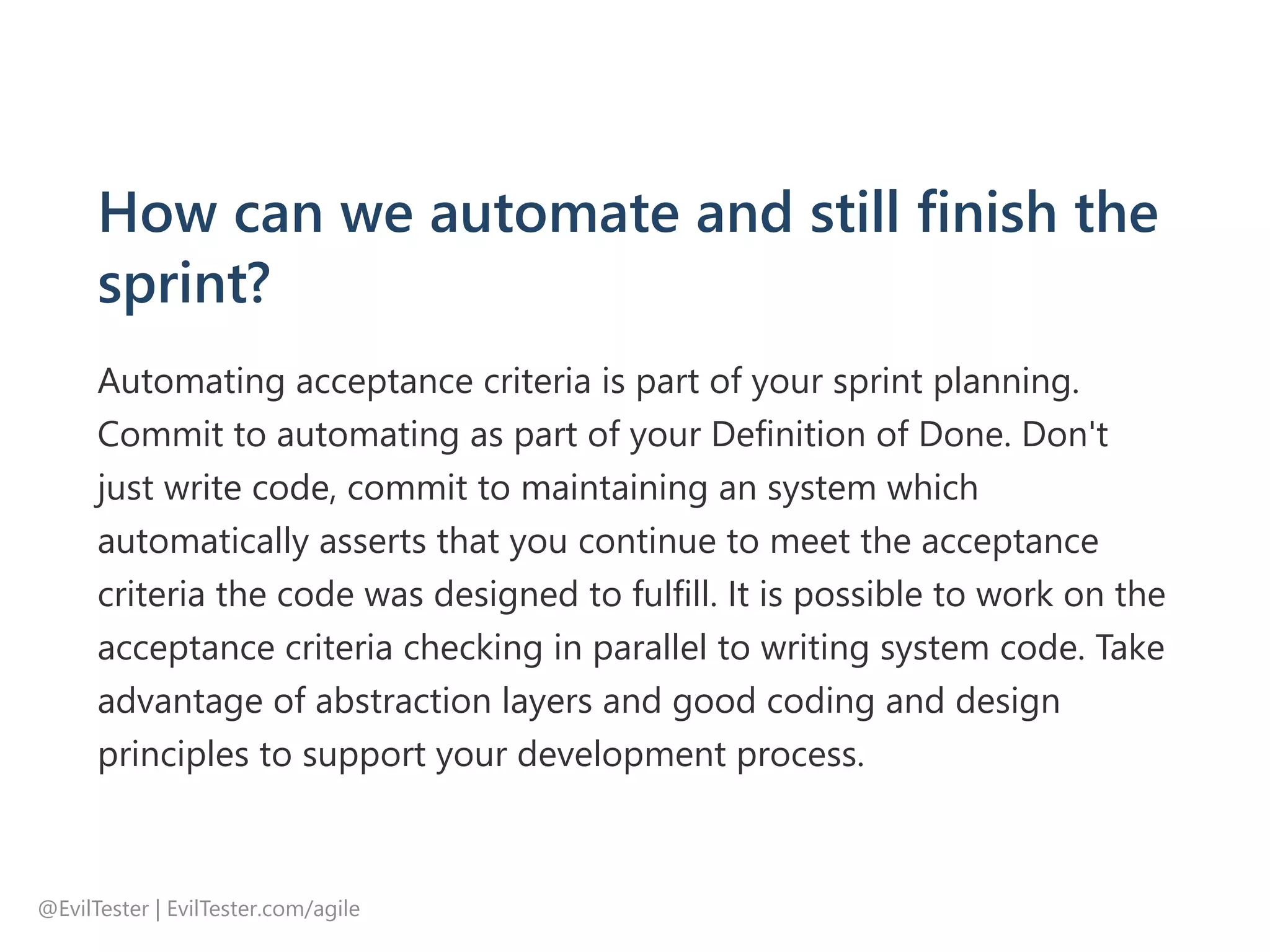
Automating acceptance criteria is part of your sprint planning.
Commit to automating as part of your Definition of Done. Don't
just write code, commit to maintaining an system which
automatically asserts that you continue to meet the acceptance
criteria the code was designed to fulfill. It is possible to work on the
acceptance criteria checking in parallel to writing system code. Take
advantage of abstraction layers and good coding and design
principles to support your development process.
@EvilTester | EvilTester.com/agile
How can we finish all our testing in the
sprint?
If you haven't finished testing, then you don't release that
functionality.
Everyone on the team tests to the best of their ability. Leave
the simple condition checking to the automated system or
people less skilled in testing.
@EvilTester | EvilTester.com/agile
How can we finish all our testing in the
sprint?
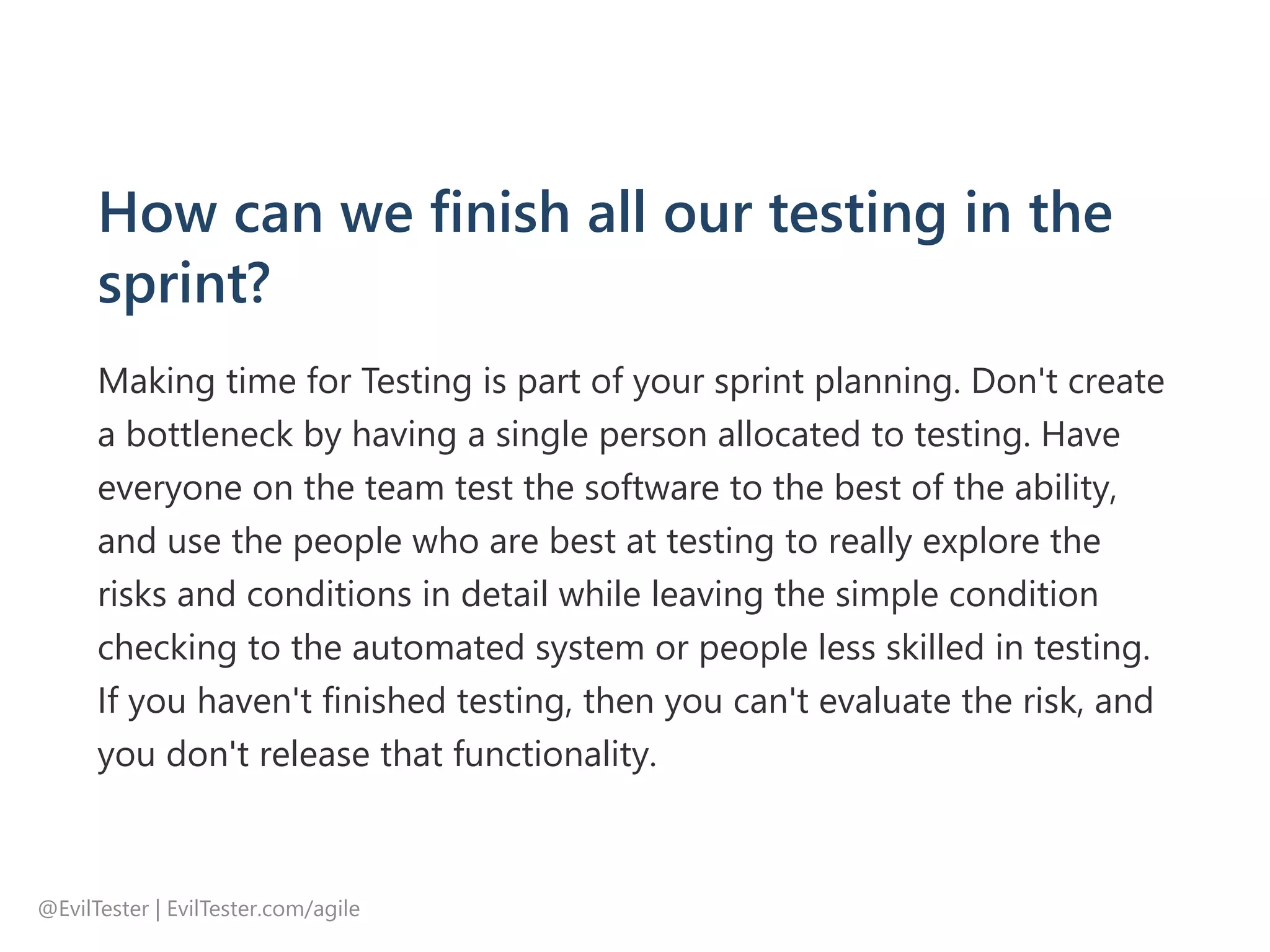
Making time for Testing is part of your sprint planning. Don't create
a bottleneck by having a single person allocated to testing. Have
everyone on the team test the software to the best of the ability,
and use the people who are best at testing to really explore the
risks and conditions in detail while leaving the simple condition
checking to the automated system or people less skilled in testing.
If you haven't finished testing, then you can't evaluate the risk, and
you don't release that functionality.
@EvilTester | EvilTester.com/agile
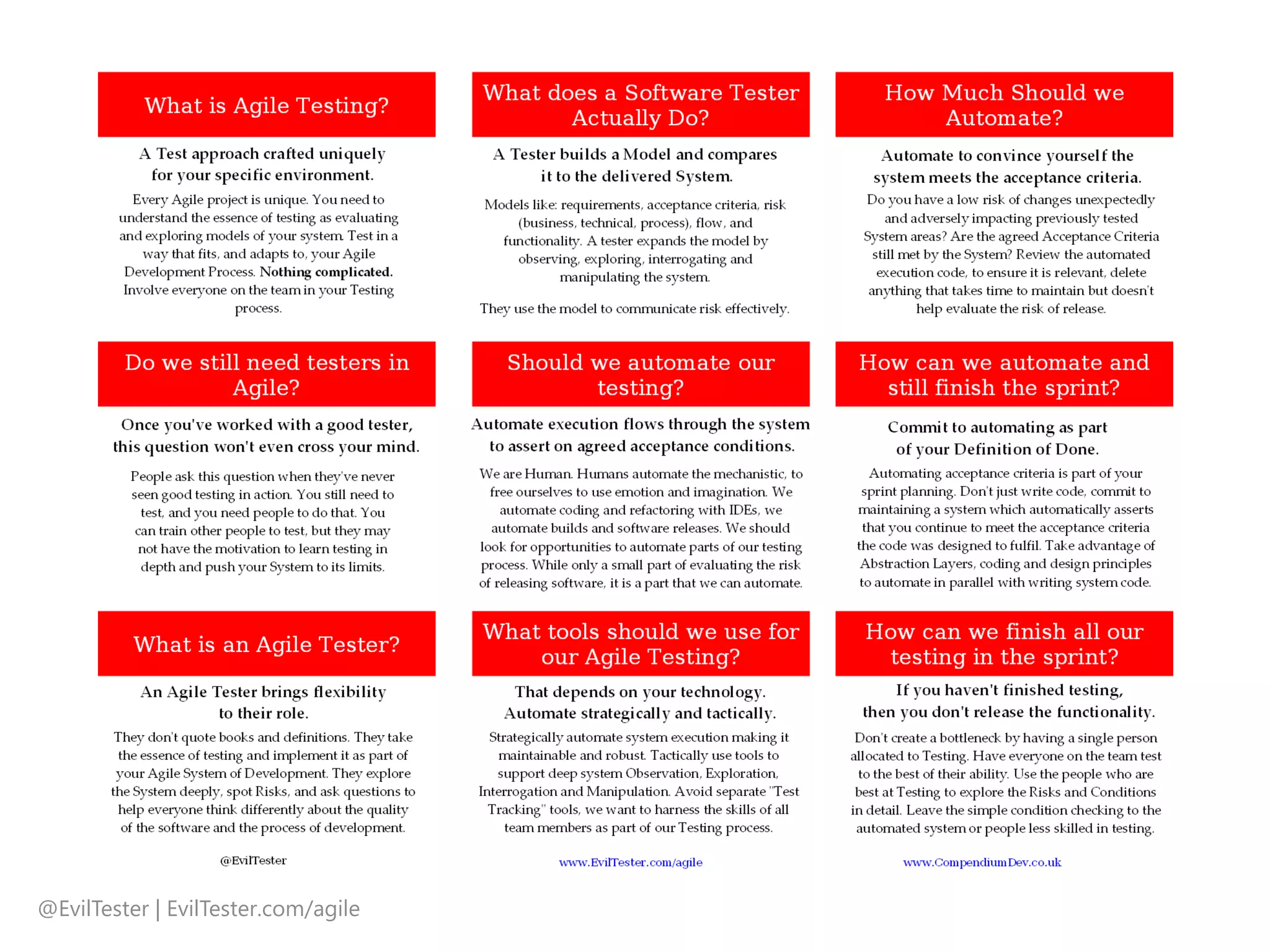
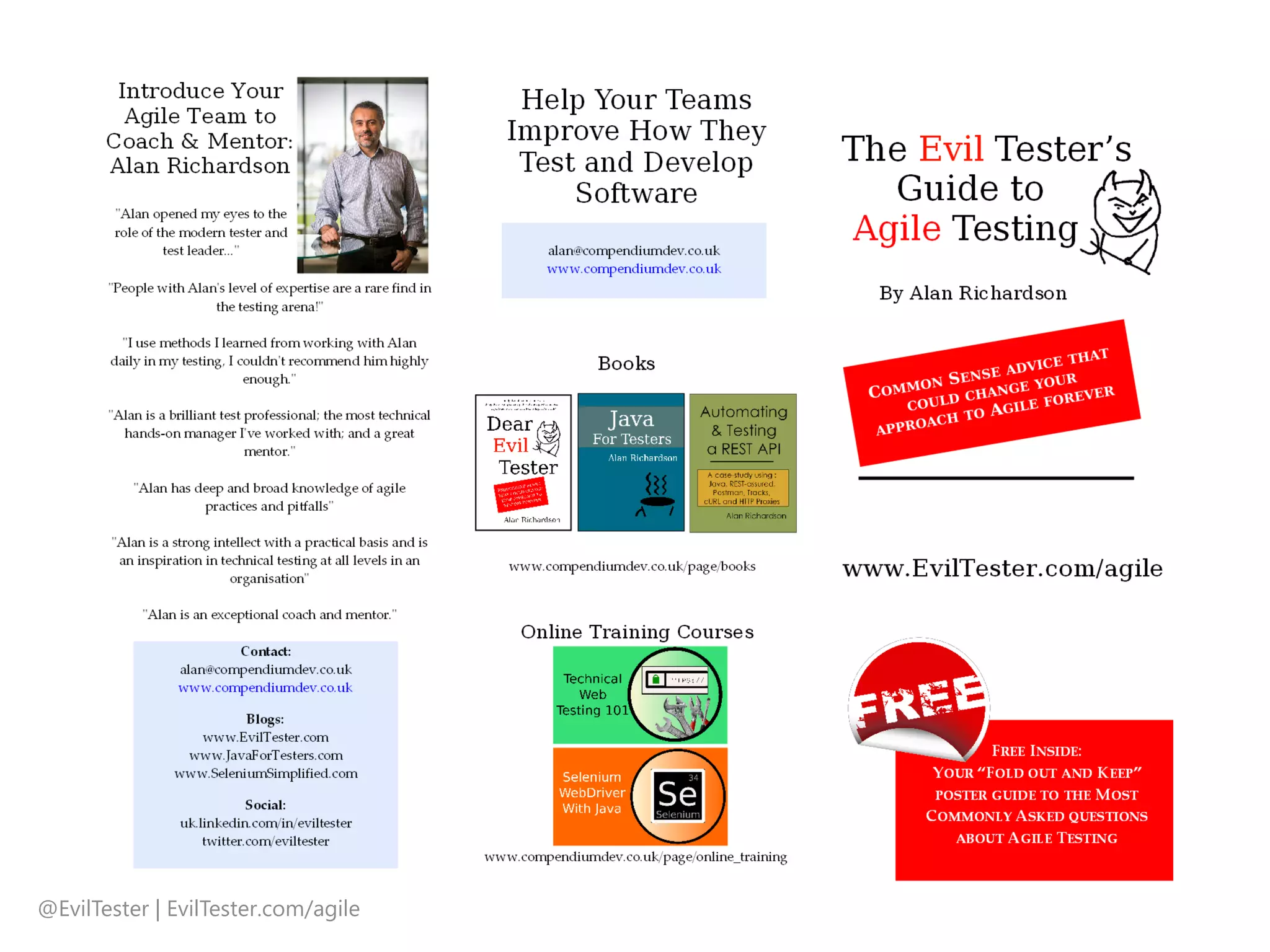
Free ‐ Download and Print Your Own
"The Evil Tester's Guide to Agile Testing
Brochure"
At EvilTester.com/agile
@EvilTester | EvilTester.com/agile
Help Your Teams Improve How They Test
and Develop Software
You can learn to test and develop software using Agile processes
through trial and error. You'll learn the hard way from your own
mistakes.
You could bring in contractors who are experienced in Agile to
work on your projects with you. They'll help you work in a more
Agile way but they'll be busy doing the work and might not have
the necessary time to pass on their experience to the rest of the
team.
You could bring in an Agile Coach and mentor who is there
specifically to help you improve. They are not on your project 100%
of the time, they work with you to help you improve.
@EvilTester | EvilTester.com/agile
An Agile Software Development coach and mentor can short cut
your learning and help you:
Automate your APIs
Automate to support Continuous Integration & Exploratory
Testing
Remove intermittent failures from your Automated execution
Refactor your code to make it more testable
Improve pairing on TDD and exploratory testing
Increase the value of your retrospectives so you take action
Improve your exploratory testing, making it more transparent,
thorough and technical.
@EvilTester | EvilTester.com/agile
Alan Richardson is someone who has done all of this before.
Combining a background in Testing and Programming, Alan can
work with all of your team members to help improve your Agile
Development Approach.
Alan consults through Compendium Developments Ltd and
helps teams improve their testing and development processes,
Alan blogs at Evil Tester, Java For Testers, and Selenium
Simplified
Alan has written 4 books "Java For Testers", "Dear Evil Tester",
"Automating and Testing a REST API" and "Selenium
Simplified"
Alan talks and keynotes at conferences world wide, also
providing workshops and tutorials.
@EvilTester | EvilTester.com/agile
Contact Alan to help you with your Agile
Testing and Development
Compendium Developments Ltd
Contact Alan
http://compendiumdev.co.uk/contact
@EvilTester | EvilTester.com/agile

Evil Tester's Guide to Agile Testing

  • 1.
  • 2.
    Common Questions aboutTesting on Agile Projects @EvilTester | EvilTester.com/agile
  • 3.
    What is AgileTesting? A Test approach crafted uniquely for your specific environment. Test in a way that fits, and adapts to, your Agile Development. Nothing complicated. Involve everyone on the team in your Testing process, because Testing is a major part of your Software Development Process. @EvilTester | EvilTester.com/agile
  • 4.
    What is AgileTesting? Every Agile project is unique ‐ staff mix, skill sets, business concerns, tool sets. You need to adopt a Testing approach crafted to your specific environment. To do that you need to understand the essence of testing in terms of feedback, and as a means of evaluating and exploring models of your system. Then test in a way that fits, and adapts to, your approach to Agile Development. Nothing complicated. Don't shoe horn in something you would traditionally call 'Testing' and label it Agile. Do Adapt your process to meet the needs of your project. And do involve everyone in your Testing process, because Testing is a major part of your Software Development Process. @EvilTester | EvilTester.com/agile
  • 5.
    Do we stillneed testers in Agile? Once you've worked with a good tester, this question won't even cross your mind. You still need to test, and you need people to do that. You can train other people to test, but they may not have the motivation to learn testing in depth and push your System to its limits. @EvilTester | EvilTester.com/agile
  • 6.
    Do we stillneed testers in Agile? People often ask this question because they've never seen a good tester in action. After working with a good tester, this question won't even cross your mind. You still need to test, and you still need people testing your software. You'll need the people doing that to understand how to test, and to test well. Testers generally know how to do that. But of course you can train other people to do your testing. They may not have the same motivation to continue to learn testing in depth and the nuances and subtleties of system and risk exploration as people who view testing as their main focus. @EvilTester | EvilTester.com/agile
  • 7.
    What is anAgile Tester? An Agile Tester brings flexibility to their role. They take the essence of testing and implement it as part of your Agile System of Development. They explore the System deeply, spot Risks, and ask questions to help everyone think differently about the quality of the software and the process of development. @EvilTester | EvilTester.com/agile
  • 8.
    What is anAgile Tester? An Agile Tester brings flexibility to the role of tester. They don't just quote testing books at you and best practice definitions. They take the essence of testing and help implement it as part of your Agile System of Development. They will know how to test with minimal information and ask questions to help other people think about the quality of the software and the process of building the software. They will know how to spot risks and target those risks with hands on system manipulation. Very often they spot gaps in the development process and help fill them. @EvilTester | EvilTester.com/agile
  • 9.
    What does aSoftware Tester Actually Do? Testing builds a model and compares it to the delivered system. Models like: requirements, acceptance criteria, risk ﴾business, technical, process﴿, flow, and functionality. A tester expands the model by observing, exploring, interrogating and manipulating the system. @EvilTester | EvilTester.com/agile
  • 10.
    What does aSoftware Tester Actually Do? The essence of Software Testing is building a model of the System Under Test, and then comparing that model to the delivered system. A tester builds lots of models; requirements, acceptance criteria, risk ﴾business, technical, process﴿, flow, functionality, et. The tester has different techniques to prioritise how they explore the relationship between the model and the system. A good Tester adapts their model based on the information they observe as the interrogate and manipulate the system, the reflect on this information to communicate effectively and expand their model. @EvilTester | EvilTester.com/agile
  • 11.
    Should we automateour testing? Automate execution flows through the system to assert on agreed acceptance conditions. Humans automate the mechanistic, to free ourselves to use emotion and imagination. We should look for opportunities to automate parts of our testing process. @EvilTester | EvilTester.com/agile
  • 12.
    Should we automateour testing? We are Human. Humans automate processes. We will automate the mechanistic parts of our processes, to free ourselves from drudgery and allow us to more fully exercise our emotion and imagination in our Software Development. We use IDEs to automate parts of the coding and refactoring processes, we automate builds and software releases. We should look for opportunities to automate as part of our testing process ‐ often this will be checking, and asserting on, the agreed acceptance conditions. We can automate execution flows through the system with pre‐agreed acceptance condition assertions. This is only a small part of evaluating the risk associated with releasing software, but it can be automated. @EvilTester | EvilTester.com/agile
  • 13.
    What tools shouldwe use for our Agile Testing? That depends on your technology. Automate strategically and tactically. Strategically automate system execution making it maintainable and robust. Tactically use tools to support deep system Observation, Exploration, Interrogation and Manipulation. @EvilTester | EvilTester.com/agile
  • 14.
    What tools shouldwe use for our Agile Testing? Your tooling will vary depending on the technology you use. You'll need tools to help you strategically automate system execution to make it maintainable and robust. You'll need tools to support you in tactically Observing the system functionality and message passing in detail. Tools to help you Interrogate and Manipulate the System in ways a User would never need to do, to help you Explore the System in detail. I generally try to use the same tools as the rest of the development team. I don't recommend separate "Test Tracking" tools, when you do that you end up having only Testers use them, and we want to harness the skills of all team members as part of our Testing process. @EvilTester | EvilTester.com/agile
  • 15.
    How Much Shouldwe Automate? Automate to convince yourself the system continues to meet the acceptance criteria. Review the automated execution code, to ensure it is relevant, delete anything that takes time to maintain but doesn't help evaluate the risk of release. @EvilTester | EvilTester.com/agile
  • 16.
    How Much Shouldwe Automate? Automate as much as you need to. Are you convinced that you have a low risk of changes unexpectedly and adversely impacting previously tested areas of the System? Are you convinced that the agreed Acceptance Criteria are still met by the System? As you maintain your automated execution code, review what you have created to make sure it still seems relevant, and delete anything that takes time to maintain but doesn't help you evaluate the risk of the release. @EvilTester | EvilTester.com/agile
  • 17.
    How can weautomate and still finish the sprint? Commit to automating as part of your Definition of Done. Don't just write code, commit to maintaining an system which automatically asserts that you continue to meet the acceptance criteria the code was designed to fulfil. @EvilTester | EvilTester.com/agile
  • 18.
    How can weautomate and still finish the sprint? Automating acceptance criteria is part of your sprint planning. Commit to automating as part of your Definition of Done. Don't just write code, commit to maintaining an system which automatically asserts that you continue to meet the acceptance criteria the code was designed to fulfill. It is possible to work on the acceptance criteria checking in parallel to writing system code. Take advantage of abstraction layers and good coding and design principles to support your development process. @EvilTester | EvilTester.com/agile
  • 19.
    How can wefinish all our testing in the sprint? If you haven't finished testing, then you don't release that functionality. Everyone on the team tests to the best of their ability. Leave the simple condition checking to the automated system or people less skilled in testing. @EvilTester | EvilTester.com/agile
  • 20.
    How can wefinish all our testing in the sprint? Making time for Testing is part of your sprint planning. Don't create a bottleneck by having a single person allocated to testing. Have everyone on the team test the software to the best of the ability, and use the people who are best at testing to really explore the risks and conditions in detail while leaving the simple condition checking to the automated system or people less skilled in testing. If you haven't finished testing, then you can't evaluate the risk, and you don't release that functionality. @EvilTester | EvilTester.com/agile
  • 21.
    Free ‐ Downloadand Print Your Own "The Evil Tester's Guide to Agile Testing Brochure" At EvilTester.com/agile @EvilTester | EvilTester.com/agile
  • 22.
  • 23.
  • 24.
    Help Your TeamsImprove How They Test and Develop Software You can learn to test and develop software using Agile processes through trial and error. You'll learn the hard way from your own mistakes. You could bring in contractors who are experienced in Agile to work on your projects with you. They'll help you work in a more Agile way but they'll be busy doing the work and might not have the necessary time to pass on their experience to the rest of the team. You could bring in an Agile Coach and mentor who is there specifically to help you improve. They are not on your project 100% of the time, they work with you to help you improve. @EvilTester | EvilTester.com/agile
  • 25.
    An Agile SoftwareDevelopment coach and mentor can short cut your learning and help you: Automate your APIs Automate to support Continuous Integration & Exploratory Testing Remove intermittent failures from your Automated execution Refactor your code to make it more testable Improve pairing on TDD and exploratory testing Increase the value of your retrospectives so you take action Improve your exploratory testing, making it more transparent, thorough and technical. @EvilTester | EvilTester.com/agile
  • 26.
    Alan Richardson issomeone who has done all of this before. Combining a background in Testing and Programming, Alan can work with all of your team members to help improve your Agile Development Approach. Alan consults through Compendium Developments Ltd and helps teams improve their testing and development processes, Alan blogs at Evil Tester, Java For Testers, and Selenium Simplified Alan has written 4 books "Java For Testers", "Dear Evil Tester", "Automating and Testing a REST API" and "Selenium Simplified" Alan talks and keynotes at conferences world wide, also providing workshops and tutorials. @EvilTester | EvilTester.com/agile
  • 27.
    Contact Alan tohelp you with your Agile Testing and Development Compendium Developments Ltd Contact Alan http://compendiumdev.co.uk/contact @EvilTester | EvilTester.com/agile