PRACTICAL RESEARCH 1
Learning from Others and
Reviewing the Literature
CHAPTER 2: REVIEW OF
RELATED LITERATURE
WHAT IS RRL?
According to Ramdhani, A., Ramdhani,
M., & Amin, A., 2014:
RRL discusses published information in a
particular subject area, and sometimes
information in a particular subject area
within a certain time period.
CHAPTER 2: REVIEW OF RELATED LITERATURE
WHAT IS RRL?
According to libguides.usc.edu, n.d.:
It is a survey of scholarly articles, books
and other sources relevant to a particular
issue, area of research, or theory, and by
so doing, providing a description, summary,
and critical evaluation of these works.
CHAPTER 2: REVIEW OF RELATED LITERATURE
WHAT IS RRL?
According to Okoli & Schabram, 2010:
It describes the content and quality of
knowledge already available, and readily
presents the reader the significance of
previous work.
CHAPTER 2: REVIEW OF RELATED LITERATURE
Traditional Review of
Literature
TRADITIONAL REVIEW OF LITERATURE
- summarize present forms of knowledge on
a specific subject
- aims to give a new understanding of an
existing work
TRADITIONAL REVIEW OF LITERATURE
- provides a concise summary of information
and data findings that describe current
knowledge and facts that offers a
rationale for conducting future
researchers.
TRADITIONAL REVIEW OF LITERATURE
Types of Traditional Review:
1. Conceptual Review
2. Critical Review
3. State-of-the-Art Review
4. Expert Review
5. Scoping Review
TRADITIONAL REVIEW OF LITERATURE
Types of Traditional Review:
1. Conceptual Review
- The goal of the conceptual literature review is
to categorize and describe concepts relevant to
the study or topic and outline a relationship
between them, including relevant theory and
empirical research.
TRADITIONAL REVIEW OF LITERATURE
Types of Traditional Review:
1. Conceptual Review
- Analysis of concepts or ideas to give meaning
to some national or world issues.
TRADITIONAL REVIEW OF LITERATURE
Types of Traditional Review:
2. Critical Review
- focuses on theories or hypotheses and
examines meanings and results of their
application to situations.
TRADITIONAL REVIEW OF LITERATURE
Types of Traditional Review:
3. State-of-the-Art Review
- makes the researcher deal with the latest
research studies on the subject.
TRADITIONAL REVIEW OF LITERATURE
Types of Traditional Review:
4. Expert Review
– encourages a well-known expert to do the
RRL because of the influence of a certain
ideology, paradigm, or belief on him.
TRADITIONAL REVIEW OF LITERATURE
Types of Traditional Review:
5. Scoping Review
– prepares a situation for a future research
work in the form of project making about
community development, government policies,
and health services, among others.
SYSTEMIC REVIEW OF LITERATURE
“systemic” which means methodical.
It’s a style of RRL that involves
sequential acts of a review of related
literature.
SYSTEMIC REVIEW OF LITERATURE
- rigorous way of obtaining data from written
works.
- vital for students undergoing literature
review
SYSTEMIC REVIEW OF LITERATURE
Steps in Doing Systemic Review of
Literature (Ridley, 2012):
1. Have a clear understanding of the
research questions
2. Plan your manner of obtaining the data
3. Do the Literature search
SYSTEMIC REVIEW OF LITERATURE
Steps in Doing Systemic Review of
Literature (Ridley, 2012):
4. Using a certain standard, determine
which data, studies or sources of knowledge
are valuable or not to warrant the
reasonableness of your decision to take
some data and junk the rest.
SYSTEMIC REVIEW OF LITERATURE
Steps in Doing Systemic Review of
Literature (Ridley, 2012):
5. Determine the methodological soundness
of the research studies.
6. Summarize what you have gathered from
various sources of data
SYSTEMIC REVIEW OF LITERATURE
Meta-analysis in Relation to RRL
- A process in which a researcher re-
examines and combines the results of two or
more statistical studies for coming out with
a grand total to indicate stronger effects
of the research outcome.
HOW TO WRITE A CONCISE REVIEW OF
RELATED LITERATURE?
Types of reference style will depend on the
research studies of the student namely:
1. APA (American Psychological Association)
- also called the "author-date" style.
HOW TO WRITE A CONCISE REVIEW OF
RELATED LITERATURE?
Types of reference style will depend on the
research studies of the student namely:
1. APA (American Psychological Association)
- commonly used in fields of Psychology,
Education and other Social Sciences;
HOW TO WRITE A CONCISE REVIEW OF
RELATED LITERATURE?
Types of reference style will depend on the
research studies of the student namely:
1. APA (American Psychological Association)
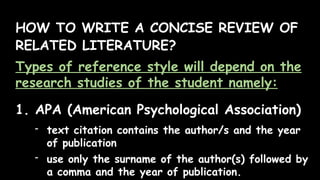
- text citation contains the author/s and the year
of publication
- use only the surname of the author(s) followed by
a comma and the year of publication.
Types of reference style will depend on the
research studies of the student namely:
1. APA (American Psychological Association)
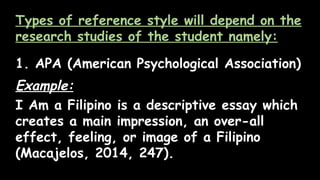
Example:
I Am a Filipino is a descriptive essay which
creates a main impression, an over-all
effect, feeling, or image of a Filipino
(Macajelos, 2014, 247).
Types of reference style will depend on the
research studies of the student namely:
1. APA (American Psychological Association)
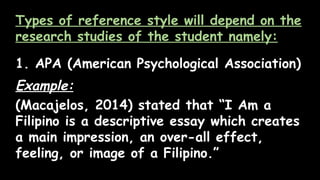
Example:
(Macajelos, 2014) stated that “I Am a
Filipino is a descriptive essay which creates
a main impression, an over-all effect,
feeling, or image of a Filipino.”
Types of reference style will depend on the
research studies of the student namely:
1. APA (American Psychological Association)
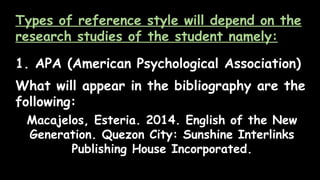
What will appear in the bibliography are the
following:
Macajelos, Esteria. 2014. English of the New
Generation. Quezon City: Sunshine Interlinks
Publishing House Incorporated.
Types of reference style will depend on the
research studies of the student namely:
2) MLA: Modern Language Association of
America
- Commonly used in fields of Arts and
Humanities
Types of reference style will depend on the
research studies of the student namely:
2) MLA: Modern Language Association of
America
- follows the author-page method of in-
text citation.
Types of reference style will depend on the
research studies of the student namely:
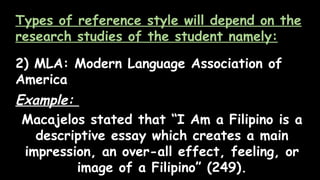
2) MLA: Modern Language Association of
America
Example:
Macajelos stated that “I Am a Filipino is a
descriptive essay which creates a main
impression, an over-all effect, feeling, or
image of a Filipino” (249).
Types of reference style will depend on the
research studies of the student namely:
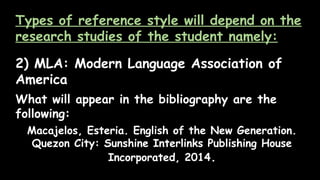
2) MLA: Modern Language Association of
America
What will appear in the bibliography are the
following:
Macajelos, Esteria. English of the New Generation.
Quezon City: Sunshine Interlinks Publishing House
Incorporated, 2014.
Types of reference style will depend on the
research studies of the student namely:
3. Chicago Manual of Style
- Commonly used in fields of History and
many other subjects in scholarly and non-
scholarly work.
Types of reference style will depend on the
research studies of the student namely:
3. Chicago Manual of Style
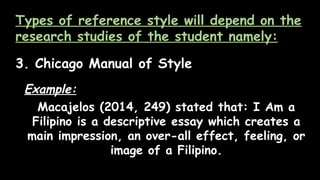
Example:
Macajelos (2014, 249) stated that: I Am a
Filipino is a descriptive essay which creates a
main impression, an over-all effect, feeling, or
image of a Filipino.
Types of reference style will depend on the
research studies of the student namely:
3. Chicago Manual of Style
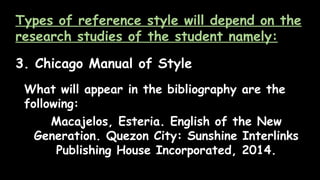
What will appear in the bibliography are the
following:
Macajelos, Esteria. English of the New
Generation. Quezon City: Sunshine Interlinks
Publishing House Incorporated, 2014.
WHY DO WE NEED TO CITE?
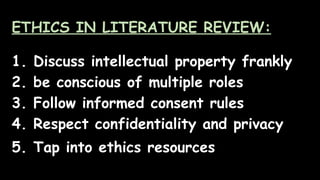
ETHICS IN LITERATURE REVIEW:
1. Discuss intellectual property frankly
2. be conscious of multiple roles
3. Follow informed consent rules
4. Respect confidentiality and privacy
5. Tap into ethics resources

Practical Research Topic Grade 11 Senior High School

  • 1.
  • 2.
    Learning from Othersand Reviewing the Literature
  • 3.
    CHAPTER 2: REVIEWOF RELATED LITERATURE
  • 4.
    WHAT IS RRL? Accordingto Ramdhani, A., Ramdhani, M., & Amin, A., 2014: RRL discusses published information in a particular subject area, and sometimes information in a particular subject area within a certain time period. CHAPTER 2: REVIEW OF RELATED LITERATURE
  • 5.
    WHAT IS RRL? Accordingto libguides.usc.edu, n.d.: It is a survey of scholarly articles, books and other sources relevant to a particular issue, area of research, or theory, and by so doing, providing a description, summary, and critical evaluation of these works. CHAPTER 2: REVIEW OF RELATED LITERATURE
  • 6.
    WHAT IS RRL? Accordingto Okoli & Schabram, 2010: It describes the content and quality of knowledge already available, and readily presents the reader the significance of previous work. CHAPTER 2: REVIEW OF RELATED LITERATURE
  • 7.
  • 8.
    TRADITIONAL REVIEW OFLITERATURE - summarize present forms of knowledge on a specific subject - aims to give a new understanding of an existing work
  • 9.
    TRADITIONAL REVIEW OFLITERATURE - provides a concise summary of information and data findings that describe current knowledge and facts that offers a rationale for conducting future researchers.
  • 10.
    TRADITIONAL REVIEW OFLITERATURE Types of Traditional Review: 1. Conceptual Review 2. Critical Review 3. State-of-the-Art Review 4. Expert Review 5. Scoping Review
  • 11.
    TRADITIONAL REVIEW OFLITERATURE Types of Traditional Review: 1. Conceptual Review - The goal of the conceptual literature review is to categorize and describe concepts relevant to the study or topic and outline a relationship between them, including relevant theory and empirical research.
  • 12.
    TRADITIONAL REVIEW OFLITERATURE Types of Traditional Review: 1. Conceptual Review - Analysis of concepts or ideas to give meaning to some national or world issues.
  • 13.
    TRADITIONAL REVIEW OFLITERATURE Types of Traditional Review: 2. Critical Review - focuses on theories or hypotheses and examines meanings and results of their application to situations.
  • 14.
    TRADITIONAL REVIEW OFLITERATURE Types of Traditional Review: 3. State-of-the-Art Review - makes the researcher deal with the latest research studies on the subject.
  • 15.
    TRADITIONAL REVIEW OFLITERATURE Types of Traditional Review: 4. Expert Review – encourages a well-known expert to do the RRL because of the influence of a certain ideology, paradigm, or belief on him.
  • 16.
    TRADITIONAL REVIEW OFLITERATURE Types of Traditional Review: 5. Scoping Review – prepares a situation for a future research work in the form of project making about community development, government policies, and health services, among others.
  • 17.
    SYSTEMIC REVIEW OFLITERATURE “systemic” which means methodical. It’s a style of RRL that involves sequential acts of a review of related literature.
  • 18.
    SYSTEMIC REVIEW OFLITERATURE - rigorous way of obtaining data from written works. - vital for students undergoing literature review
  • 19.
    SYSTEMIC REVIEW OFLITERATURE Steps in Doing Systemic Review of Literature (Ridley, 2012): 1. Have a clear understanding of the research questions 2. Plan your manner of obtaining the data 3. Do the Literature search
  • 20.
    SYSTEMIC REVIEW OFLITERATURE Steps in Doing Systemic Review of Literature (Ridley, 2012): 4. Using a certain standard, determine which data, studies or sources of knowledge are valuable or not to warrant the reasonableness of your decision to take some data and junk the rest.
  • 21.
    SYSTEMIC REVIEW OFLITERATURE Steps in Doing Systemic Review of Literature (Ridley, 2012): 5. Determine the methodological soundness of the research studies. 6. Summarize what you have gathered from various sources of data
  • 22.
    SYSTEMIC REVIEW OFLITERATURE Meta-analysis in Relation to RRL - A process in which a researcher re- examines and combines the results of two or more statistical studies for coming out with a grand total to indicate stronger effects of the research outcome.
  • 23.
    HOW TO WRITEA CONCISE REVIEW OF RELATED LITERATURE? Types of reference style will depend on the research studies of the student namely: 1. APA (American Psychological Association) - also called the "author-date" style.
  • 24.
    HOW TO WRITEA CONCISE REVIEW OF RELATED LITERATURE? Types of reference style will depend on the research studies of the student namely: 1. APA (American Psychological Association) - commonly used in fields of Psychology, Education and other Social Sciences;
  • 25.
    HOW TO WRITEA CONCISE REVIEW OF RELATED LITERATURE? Types of reference style will depend on the research studies of the student namely: 1. APA (American Psychological Association) - text citation contains the author/s and the year of publication - use only the surname of the author(s) followed by a comma and the year of publication.
  • 26.
    Types of referencestyle will depend on the research studies of the student namely: 1. APA (American Psychological Association) Example: I Am a Filipino is a descriptive essay which creates a main impression, an over-all effect, feeling, or image of a Filipino (Macajelos, 2014, 247).
  • 27.
    Types of referencestyle will depend on the research studies of the student namely: 1. APA (American Psychological Association) Example: (Macajelos, 2014) stated that “I Am a Filipino is a descriptive essay which creates a main impression, an over-all effect, feeling, or image of a Filipino.”
  • 28.
    Types of referencestyle will depend on the research studies of the student namely: 1. APA (American Psychological Association) What will appear in the bibliography are the following: Macajelos, Esteria. 2014. English of the New Generation. Quezon City: Sunshine Interlinks Publishing House Incorporated.
  • 29.
    Types of referencestyle will depend on the research studies of the student namely: 2) MLA: Modern Language Association of America - Commonly used in fields of Arts and Humanities
  • 30.
    Types of referencestyle will depend on the research studies of the student namely: 2) MLA: Modern Language Association of America - follows the author-page method of in- text citation.
  • 31.
    Types of referencestyle will depend on the research studies of the student namely: 2) MLA: Modern Language Association of America Example: Macajelos stated that “I Am a Filipino is a descriptive essay which creates a main impression, an over-all effect, feeling, or image of a Filipino” (249).
  • 32.
    Types of referencestyle will depend on the research studies of the student namely: 2) MLA: Modern Language Association of America What will appear in the bibliography are the following: Macajelos, Esteria. English of the New Generation. Quezon City: Sunshine Interlinks Publishing House Incorporated, 2014.
  • 33.
    Types of referencestyle will depend on the research studies of the student namely: 3. Chicago Manual of Style - Commonly used in fields of History and many other subjects in scholarly and non- scholarly work.
  • 34.
    Types of referencestyle will depend on the research studies of the student namely: 3. Chicago Manual of Style Example: Macajelos (2014, 249) stated that: I Am a Filipino is a descriptive essay which creates a main impression, an over-all effect, feeling, or image of a Filipino.
  • 35.
    Types of referencestyle will depend on the research studies of the student namely: 3. Chicago Manual of Style What will appear in the bibliography are the following: Macajelos, Esteria. English of the New Generation. Quezon City: Sunshine Interlinks Publishing House Incorporated, 2014.
  • 36.
    WHY DO WENEED TO CITE?
  • 37.
    ETHICS IN LITERATUREREVIEW: 1. Discuss intellectual property frankly 2. be conscious of multiple roles 3. Follow informed consent rules 4. Respect confidentiality and privacy 5. Tap into ethics resources

Editor's Notes

  • #30 This means that the author's last name and the page number(s) from which the quotation or paraphrase is taken must appear in the text, and a complete reference should appear on your Works Cited page.
  • #31 The author's name may appear either in the sentence itself or in parentheses following the quotation or paraphrase, but the page number(s) should always appear in the parentheses, not in the text of your sentence.
  • #32 The author's name may appear either in the sentence itself or in parentheses following the quotation or paraphrase, but the page number(s) should always appear in the parentheses, not in the text of your sentence.
  • #33 The author's name may appear either in the sentence itself or in parentheses following the quotation or paraphrase, but the page number(s) should always appear in the parentheses, not in the text of your sentence.
  • #34 The author's name may appear either in the sentence itself or in parentheses following the quotation or paraphrase, but the page number(s) should always appear in the parentheses, not in the text of your sentence.
  • #35 The author's name may appear either in the sentence itself or in parentheses following the quotation or paraphrase, but the page number(s) should always appear in the parentheses, not in the text of your sentence.
  • #36 The author's name may appear either in the sentence itself or in parentheses following the quotation or paraphrase, but the page number(s) should always appear in the parentheses, not in the text of your sentence.
  • #37 The author's name may appear either in the sentence itself or in parentheses following the quotation or paraphrase, but the page number(s) should always appear in the parentheses, not in the text of your sentence.