Learning from Others and
Reviewing the Literature
What is Research?
Research is “creative and systematic
work undertaken to increase the
stock of knowledge”.
Literature Review
It is a critical recap of what has already
been researched on a topic.
Why does literature review
important?
1. To find out what has already known about
your topic.
2. To give a reader a critical overview of what
you’ve found.
3.To find out what’s missing (gap)
RRL allows those who are reading
your work to locate your sources, in
order to learn more about the ideas
that you include in your paper.
Summary:
DIFFERENT TYPES OF RELATED
LITERATURE
Systematic
Literature
Review
Traditional
Literature
Review
Local Literature
& Foreign
Literature
TRADITIONAL
LITERATURE REVIEW
Traditional Literature Review
A narrative or traditional literature
review is a comprehensive, critical and
objective analysis of the current
knowledge on a topic. They are an
essential part of the research process
and help to establish a theoretical
framework and focus or context for
your research.
Onwuegbuzie
and Frels (pp 24-
25,
2016) define
four
common types
of narrative
reviews:
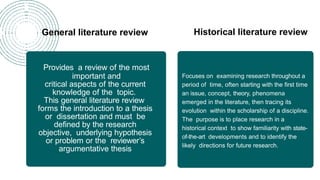
Provides a review of the most
important and
critical aspects of the current
knowledge of the topic.
This general literature review
forms the introduction to a thesis
or dissertation and must be
defined by the research
objective, underlying hypothesis
or problem or the reviewer’s
argumentative thesis
Focuses on examining research throughout a
period of time, often starting with the first time
an issue, concept, theory, phenomena
emerged in the literature, then tracing its
evolution within the scholarship of a discipline.
The purpose is to place research in a
historical context to show familiarity with state-
of-the-art developments and to identify the
likely directions for future research.
General literature review Historical literature review
Methodological
literature review
examines theory
shapes of form
research
Theoretical
literature review
Where the research methods
and design are described.
These methodological
reviews outline the strengths
and weaknesses of the
methods used and provide
future direction
IMPORTANCE OF TRADITIONAL
LITERATURE REVIEW?
• The purpose of a traditional literature review is to
demonstrate a gap or problem in your field that your research
seeks to address.
• To provide a reader with a comprehensive background for
understanding current knowledge and highlighting the
significance of new research.
Systematic Literature
Review
Systematic Literature Review
Systematic literature review examines
data and findings of other authors
relative to a specified research question
or questions.
According to Gough, Oliver, and Thomas, it stated that a
systematic literature review compiles a number of different
research papers and provides a summary of each to
respond to a research issue through the application of
rigorous methodologies.
The following is a list of the main activities that make up a
systematic review, as outlined by Gough, Oliver, and
Thomas.
• Identifying relevant research.
•Systematically critiquing research reports.
• Synthesising findings.
• Understanding conclusion.
Importance of Systematic
Literature Review
The review specifies the types of information
that were sought, evaluated, and submitted
withinpredetermined timeframes. The study
must include the search terms, search tactics
(including database names, platforms, and
search dates) and limits.
Local Literature and Foreign
Literature
Local literature is collection of published information/
materials on a particular area of research or topic that is
found in your own country.
Foreign Literature
Foreign Literature is collection of published information
/materials that is printed in other countries with information
related to the current study.
Local Literature
Local and Foreign Literature
- are found in books, professional journals and magazines, newspaper,
University publications published by the different colleges and other
publications.
RELATED STUDIES
Studies, inquiries, or investigations already conducted
to which the present proposed study is relate or has some
bearing or similarity.
They may be classified as:
• Local Studies
• Foreign Studies
Local Studies are the studies or investigations that are already
completed to which the present study is related and is conducted in your
own country.
Foreign Studies are the manuscripts, theses researches and
dissertations conducted in other countries.
RELATED STUDIES
• They are usually unpublished materials such as
manuscripts, theses, and dissertations.
Citation
Definition and importance of Citation
CITATION
A “citation” is the way you tell your readers that
certain material in your work came from another
source. It also gives your readers the information
necessary to find the location details of that source
on the reference or Works Cited page.
Citation gives your readers the information necessary to find
that source again, including:
• information about the author
• the title of the work
• the name and location of the company that published the copy
of the source
• the date the copy was published
• the page numbers of the material you are borrowing
• To uphold intellectual honesty or avoiding plagiarism.
Important Purposes of Citation
• To attribute prior or unoriginal work and ideas to the
correct sources.
• To allow the reader to determine independently
whether the referenced material supports the author’s
argument in the claimed way.
• To help the reader gauge the strength and validity of
the material the author has used.
• Whenever someone else’s work has been critical in
developing your own ideas.
When do we need to cite?
• Whenever you paraphrase
• Whenever you use an idea that someone else has
already expressed.
• Whenever you make specific reference to the work of
another.
• When another’s ideas, words or thoughts have
influenced your writing and research.
• Whenever you use quotes
Why do we need to cite?
• Gives credit where credit is due (so you’re not
stealing ideas- plagiarism)
• Allows the reader to easily get to the original source
themselves.
• Lends ethos (credibility) to you as a writer and
strengthens your argument
DIFFERENT STYLES OF CITATION
American
Psychological
Association
Modern
Language
Association
CHICAGO
American Psychological
Association (APA)
Citation Style
American Psychological
Association citation style
APA or American Psychological Association
Style of Citation is a writing style and format for
academic documents such as scholarly journal
articles and books.
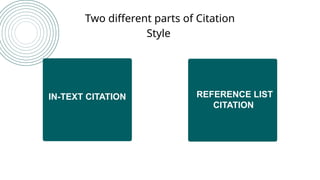
Two different parts of Citation
Style
IN-TEXT CITATION REFERENCE LIST
CITATION
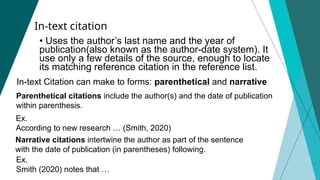
• Uses the author’s last name and the year of
publication(also known as the author-date system). It
use only a few details of the source, enough to locate
its matching reference citation in the reference list.
In-text citation
In-text Citation can make to forms: parenthetical and narrative
Parenthetical citations include the author(s) and the date of publication
within parenthesis.
Ex.
According to new research … (Smith, 2020)
Narrative citations intertwine the author as part of the sentence
with the date of publication (in parentheses) following.
Ex.
Smith (2020) notes that …
Reference List Citation
• Reference list citations provide more information about
the source, so that the reader can find it if they wish. Your
reference list should appear at the end of your paper.
What is MLA or (MODERN LANGUAGE
ASSOCIATION)?
MLA (Modern Language
Association) is one of the
most common citation styles
used by students and
academics. It establishes
values for acknowledging
sources use inresearch paper.
In-text citation
Every time you quote or
paraphrase a source, you
cite the author and
the page number in
parentheses.
Example of In-text Citation
WORKS CITED
At the end of your paper,
you give a full reference
for every source you
cited, alphabetized by the
author’s last name.
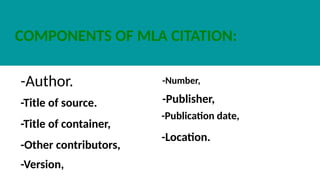
COMPONENTS OF MLA CITATION:
-Author.
-Title of source.
-Title of container,
-Other contributors,
-Version,
-Number,
-Publisher,
-Publication date,
-Location.
Example of Works Cited
Chicago Citation Style
Two different Styles of Chicago
Citation
NOTES AND
BIBLIOGRAPHY
STYLE
AUTHOR-DATE
STYLE
1. Notes and Bibliography Style
generally used for humanities(literature, history, arts)
cited in footnotes or endnotes with either a o or
shortened citation, depending on a whether a full
bibliography is provided.
highly flexible and can accommodate many types of
sources.
Notes Format
Author First Name Last Name, Title of Book
(Place of Publication: Publisher, Year), Page(s).
Bibliography
Author Last Name, First Name.Title of Book.
Place of Publication: Publisher, Year.
Bibliography Format
Example:
Trend, David. The Myth of Medial Violence:
A critical introduction. Maldon, MA: Blackwell,2007.
2. Author-date Style
Author-date style
Author Last Name, First Name. Year. Title of Book.
Place of Publication: Publisher.
Reference list format
Example:
Trend, David. 2007.The Myth of Medial Violence:
A critical introduction. Maldon, MA: Blackwell.
Author-date style
(Author’s Last Name, Year of Publication, Page
number(s)).
In-text Citation format
Example:
(Trend, 2007,98).
ETHICAL STANDARDS IN
WRITING LITERATURE
REVIEW
WHAT IS ETHICS?
Ethics examines the Rational justification for
our moral judgements; it studies what is morally
right or wrong , just or unjust.
Ethical standards in writing
literature review
Ethical standards in writing a literature review is
writing with a level of inclusion, respect , and
acknowledgement of diversity.
Basic principle in ethical standards in
writing literature review
1. Always acknowledge the source of information ,
whether it is primary or secondary source.
2. Recognize the ideas , theories , and the
original conceptualization of others.
3. Be critical in the studies you will include in the
literature review.
Why ethical standards are important in
doing literature review?
It is important to adhere the ethical principles in
order to protect the dignity , rights, and welfare of
research participants . As such , all research
involving human beings should be reviewed by an
ethics committee to ensure that the appropriate
ethical standards are being upheld.
THANK YOU FOR
LISTENING!!!

RRL - AND - CITATIONS - CHAPTER - 2.pptx

  • 1.
    Learning from Othersand Reviewing the Literature
  • 2.
    What is Research? Researchis “creative and systematic work undertaken to increase the stock of knowledge”.
  • 3.
    Literature Review It isa critical recap of what has already been researched on a topic.
  • 4.
    Why does literaturereview important? 1. To find out what has already known about your topic. 2. To give a reader a critical overview of what you’ve found. 3.To find out what’s missing (gap)
  • 5.
    RRL allows thosewho are reading your work to locate your sources, in order to learn more about the ideas that you include in your paper. Summary:
  • 6.
    DIFFERENT TYPES OFRELATED LITERATURE Systematic Literature Review Traditional Literature Review Local Literature & Foreign Literature
  • 7.
  • 8.
    Traditional Literature Review Anarrative or traditional literature review is a comprehensive, critical and objective analysis of the current knowledge on a topic. They are an essential part of the research process and help to establish a theoretical framework and focus or context for your research.
  • 9.
    Onwuegbuzie and Frels (pp24- 25, 2016) define four common types of narrative reviews:
  • 10.
    Provides a reviewof the most important and critical aspects of the current knowledge of the topic. This general literature review forms the introduction to a thesis or dissertation and must be defined by the research objective, underlying hypothesis or problem or the reviewer’s argumentative thesis Focuses on examining research throughout a period of time, often starting with the first time an issue, concept, theory, phenomena emerged in the literature, then tracing its evolution within the scholarship of a discipline. The purpose is to place research in a historical context to show familiarity with state- of-the-art developments and to identify the likely directions for future research. General literature review Historical literature review
  • 11.
    Methodological literature review examines theory shapesof form research Theoretical literature review Where the research methods and design are described. These methodological reviews outline the strengths and weaknesses of the methods used and provide future direction
  • 12.
    IMPORTANCE OF TRADITIONAL LITERATUREREVIEW? • The purpose of a traditional literature review is to demonstrate a gap or problem in your field that your research seeks to address. • To provide a reader with a comprehensive background for understanding current knowledge and highlighting the significance of new research.
  • 13.
  • 14.
    Systematic Literature Review Systematicliterature review examines data and findings of other authors relative to a specified research question or questions.
  • 15.
    According to Gough,Oliver, and Thomas, it stated that a systematic literature review compiles a number of different research papers and provides a summary of each to respond to a research issue through the application of rigorous methodologies. The following is a list of the main activities that make up a systematic review, as outlined by Gough, Oliver, and Thomas. • Identifying relevant research. •Systematically critiquing research reports. • Synthesising findings. • Understanding conclusion.
  • 16.
    Importance of Systematic LiteratureReview The review specifies the types of information that were sought, evaluated, and submitted withinpredetermined timeframes. The study must include the search terms, search tactics (including database names, platforms, and search dates) and limits.
  • 17.
    Local Literature andForeign Literature
  • 18.
    Local literature iscollection of published information/ materials on a particular area of research or topic that is found in your own country. Foreign Literature Foreign Literature is collection of published information /materials that is printed in other countries with information related to the current study. Local Literature
  • 19.
    Local and ForeignLiterature - are found in books, professional journals and magazines, newspaper, University publications published by the different colleges and other publications.
  • 20.
    RELATED STUDIES Studies, inquiries,or investigations already conducted to which the present proposed study is relate or has some bearing or similarity. They may be classified as: • Local Studies • Foreign Studies Local Studies are the studies or investigations that are already completed to which the present study is related and is conducted in your own country. Foreign Studies are the manuscripts, theses researches and dissertations conducted in other countries.
  • 21.
    RELATED STUDIES • Theyare usually unpublished materials such as manuscripts, theses, and dissertations.
  • 22.
  • 23.
    CITATION A “citation” isthe way you tell your readers that certain material in your work came from another source. It also gives your readers the information necessary to find the location details of that source on the reference or Works Cited page.
  • 24.
    Citation gives yourreaders the information necessary to find that source again, including: • information about the author • the title of the work • the name and location of the company that published the copy of the source • the date the copy was published • the page numbers of the material you are borrowing
  • 25.
    • To upholdintellectual honesty or avoiding plagiarism. Important Purposes of Citation • To attribute prior or unoriginal work and ideas to the correct sources. • To allow the reader to determine independently whether the referenced material supports the author’s argument in the claimed way. • To help the reader gauge the strength and validity of the material the author has used.
  • 26.
    • Whenever someoneelse’s work has been critical in developing your own ideas. When do we need to cite? • Whenever you paraphrase • Whenever you use an idea that someone else has already expressed. • Whenever you make specific reference to the work of another. • When another’s ideas, words or thoughts have influenced your writing and research. • Whenever you use quotes
  • 27.
    Why do weneed to cite? • Gives credit where credit is due (so you’re not stealing ideas- plagiarism) • Allows the reader to easily get to the original source themselves. • Lends ethos (credibility) to you as a writer and strengthens your argument
  • 28.
    DIFFERENT STYLES OFCITATION American Psychological Association Modern Language Association CHICAGO
  • 29.
  • 30.
    American Psychological Association citationstyle APA or American Psychological Association Style of Citation is a writing style and format for academic documents such as scholarly journal articles and books.
  • 31.
    Two different partsof Citation Style IN-TEXT CITATION REFERENCE LIST CITATION
  • 32.
    • Uses theauthor’s last name and the year of publication(also known as the author-date system). It use only a few details of the source, enough to locate its matching reference citation in the reference list. In-text citation In-text Citation can make to forms: parenthetical and narrative Parenthetical citations include the author(s) and the date of publication within parenthesis. Ex. According to new research … (Smith, 2020) Narrative citations intertwine the author as part of the sentence with the date of publication (in parentheses) following. Ex. Smith (2020) notes that …
  • 33.
    Reference List Citation •Reference list citations provide more information about the source, so that the reader can find it if they wish. Your reference list should appear at the end of your paper.
  • 36.
    What is MLAor (MODERN LANGUAGE ASSOCIATION)? MLA (Modern Language Association) is one of the most common citation styles used by students and academics. It establishes values for acknowledging sources use inresearch paper.
  • 37.
    In-text citation Every timeyou quote or paraphrase a source, you cite the author and the page number in parentheses.
  • 38.
  • 39.
    WORKS CITED At theend of your paper, you give a full reference for every source you cited, alphabetized by the author’s last name.
  • 40.
    COMPONENTS OF MLACITATION: -Author. -Title of source. -Title of container, -Other contributors, -Version, -Number, -Publisher, -Publication date, -Location.
  • 41.
  • 42.
  • 43.
    Two different Stylesof Chicago Citation NOTES AND BIBLIOGRAPHY STYLE AUTHOR-DATE STYLE
  • 44.
    1. Notes andBibliography Style generally used for humanities(literature, history, arts) cited in footnotes or endnotes with either a o or shortened citation, depending on a whether a full bibliography is provided. highly flexible and can accommodate many types of sources.
  • 46.
    Notes Format Author FirstName Last Name, Title of Book (Place of Publication: Publisher, Year), Page(s).
  • 47.
    Bibliography Author Last Name,First Name.Title of Book. Place of Publication: Publisher, Year. Bibliography Format Example: Trend, David. The Myth of Medial Violence: A critical introduction. Maldon, MA: Blackwell,2007.
  • 49.
  • 50.
    Author-date style Author LastName, First Name. Year. Title of Book. Place of Publication: Publisher. Reference list format Example: Trend, David. 2007.The Myth of Medial Violence: A critical introduction. Maldon, MA: Blackwell.
  • 51.
    Author-date style (Author’s LastName, Year of Publication, Page number(s)). In-text Citation format Example: (Trend, 2007,98).
  • 52.
  • 53.
    WHAT IS ETHICS? Ethicsexamines the Rational justification for our moral judgements; it studies what is morally right or wrong , just or unjust.
  • 54.
    Ethical standards inwriting literature review Ethical standards in writing a literature review is writing with a level of inclusion, respect , and acknowledgement of diversity.
  • 55.
    Basic principle inethical standards in writing literature review 1. Always acknowledge the source of information , whether it is primary or secondary source. 2. Recognize the ideas , theories , and the original conceptualization of others. 3. Be critical in the studies you will include in the literature review.
  • 56.
    Why ethical standardsare important in doing literature review? It is important to adhere the ethical principles in order to protect the dignity , rights, and welfare of research participants . As such , all research involving human beings should be reviewed by an ethics committee to ensure that the appropriate ethical standards are being upheld.
  • 57.