Research Title
A topic on Practical Research 2
by: Mr. Eric T. Rapirap
When the title is poorly constructed that it does
not accurately describe the objective of your
research, it can discredit the value of the entire
research, let alone the implication of your
research findings.
“Never judge a book by its
cover”
1. Use an accurate description of the
subject
2. Do not use abbreviations
3. Do not include the words like “The
Study of”, “Analysis of, “An Investigation
of” as this would lengthen the title
Basic Guidelines in Making a
Research Title
4. Include the main dependent and
independent variables
5. Proper grammar and punctuation
6. Capitalize all nouns, pronouns, verbs,
adjectives, adverbs
Basic Guidelines in Making a
Research Title
7. State in a declarative form
8. The year the study has been
conducted should not be included
9. Use current terminology
Basic Guidelines in Making a
Research Title
10. 5 to 15 words are sufficient to
describe the research study
11. Use the common name instead of the
formula (ex. Ammonium instead of NH4)
Basic Guidelines in Making a
Research Title
12. Make sure to reflect the tone of the
paper. An academic research paper has a
title which is not casual, or informal, or
does not contain humor.
Basic Guidelines in Making a
Research Title
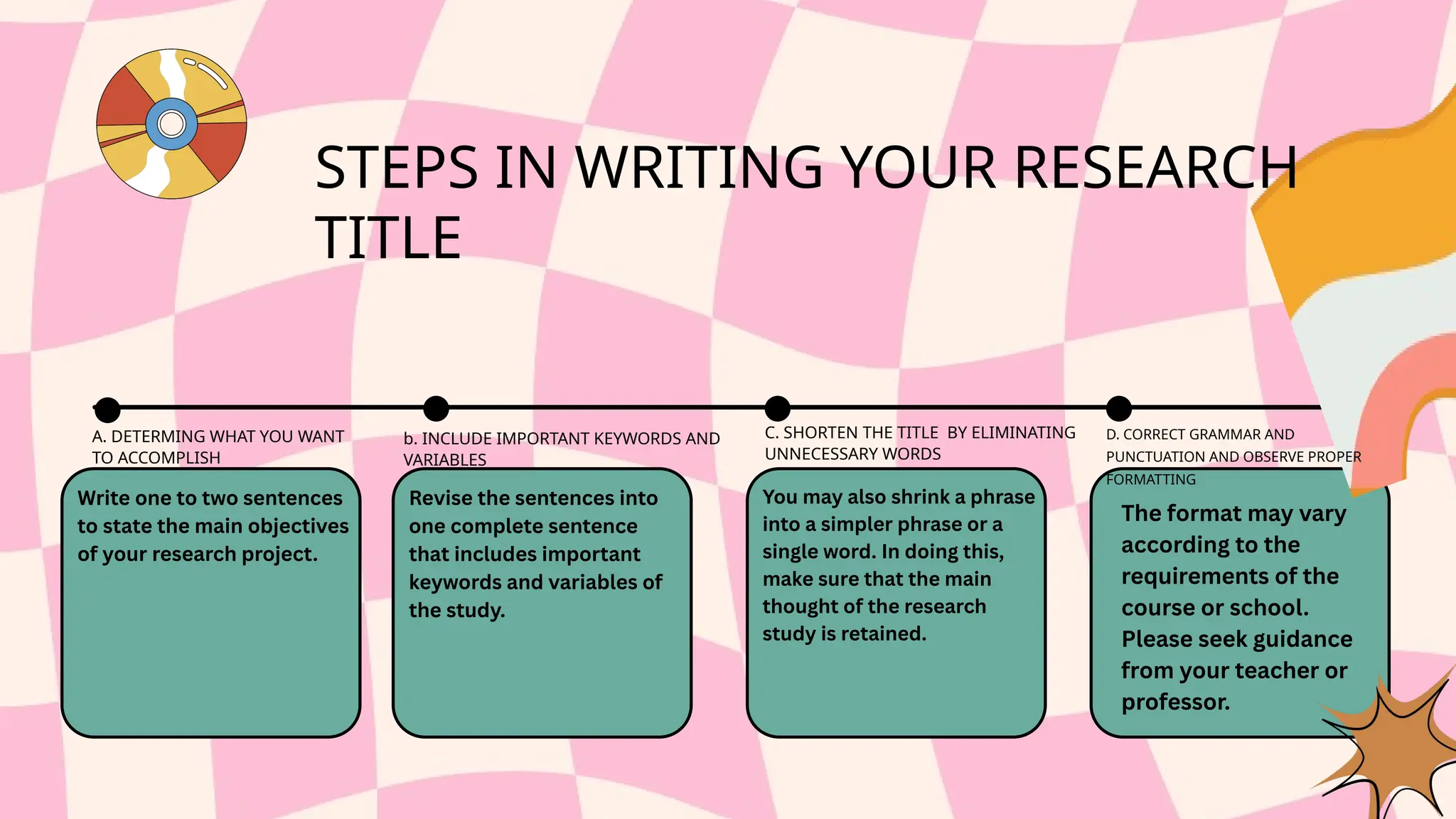
STEPS IN WRITING YOUR RESEARCH
TITLE
A. DETERMING WHAT YOU WANT
TO ACCOMPLISH
C. SHORTEN THE TITLE BY ELIMINATING
UNNECESSARY WORDS
D. CORRECT GRAMMAR AND
PUNCTUATION AND OBSERVE PROPER
FORMATTING
Write one to two sentences
to state the main objectives
of your research project.
Revise the sentences into
one complete sentence
that includes important
keywords and variables of
the study.
You may also shrink a phrase
into a simpler phrase or a
single word. In doing this,
make sure that the main
thought of the research
study is retained.
The format may vary
according to the
requirements of the
course or school.
Please seek guidance
from your teacher or
professor.
b. INCLUDE IMPORTANT KEYWORDS AND
VARIABLES
WHAT’S MORE
Directions: Evaluate the following erroneous
research title and justify what makes it wrong.
Example: Phytochemical analysis and antioxidant
activity of S. trifasciata leaves
Answer:
The scientific name was abbreviated and not
italicized.
WHAT’S MORE
Directions: Evaluate the following erroneous
research title and justify what makes it wrong.
1. An investigation of the effects of electronics
uses on Interpersonal Relationship in adults.
Answer:
_______________________________________________________
_
WHAT’S MORE
Directions: Evaluate the following erroneous
research title and justify what makes it wrong.
2. Effects of Coconut Oil and Beeswax Edible
coating.
Answer:
_______________________________________________________
_
WHAT’S MORE
Directions: Evaluate the following erroneous
research title and justify what makes it wrong.
3. The Effects of Arts-Integrated Instruction on
Arithmetic Skills of Students for S.Y. 2018-2019.
Answer:
_______________________________________________________
_
WHAT’S MORE
Directions: Evaluate the following erroneous
research title and justify what makes it wrong.
4. Antibacterial effects of C2H5OH extract of
Carica papaya leaves.
Answer:
_______________________________________________________
_
WHAT’S MORE
Directions: Evaluate the following erroneous
research title and justify what makes it wrong.
5. Managing business during global pandemic.
Answer:
_______________________________________________________
_
WHAT CAN YOU DO?
Directions: This activity is a continuation of what
you have done on your homework in the Lesson:
Designing Research Topic. You are to construct a
good research title for each of the quantitative
research questions made. Follow the format below:
WHAT CAN YOU DO?
Research question 1:___________________________
_________________________________________________
Proposed title A: ______________________________
Proposed title B: ______________________________
Proposed title C: ______________________________
WHAT CAN YOU DO?
Research question 2:___________________________
_________________________________________________
Proposed title A: ______________________________
Proposed title B: ______________________________
Proposed title C: ______________________________
WHAT CAN YOU DO?
Research question 3:___________________________
_________________________________________________
Proposed title A: ______________________________
Proposed title B: ______________________________
Proposed title C: ______________________________
THANK YOU

Research Title_A Lesson in Practical Research 2 Grade 12.pptx

  • 1.
    Research Title A topicon Practical Research 2 by: Mr. Eric T. Rapirap
  • 2.
    When the titleis poorly constructed that it does not accurately describe the objective of your research, it can discredit the value of the entire research, let alone the implication of your research findings. “Never judge a book by its cover”
  • 3.
    1. Use anaccurate description of the subject 2. Do not use abbreviations 3. Do not include the words like “The Study of”, “Analysis of, “An Investigation of” as this would lengthen the title Basic Guidelines in Making a Research Title
  • 4.
    4. Include themain dependent and independent variables 5. Proper grammar and punctuation 6. Capitalize all nouns, pronouns, verbs, adjectives, adverbs Basic Guidelines in Making a Research Title
  • 5.
    7. State ina declarative form 8. The year the study has been conducted should not be included 9. Use current terminology Basic Guidelines in Making a Research Title
  • 6.
    10. 5 to15 words are sufficient to describe the research study 11. Use the common name instead of the formula (ex. Ammonium instead of NH4) Basic Guidelines in Making a Research Title
  • 7.
    12. Make sureto reflect the tone of the paper. An academic research paper has a title which is not casual, or informal, or does not contain humor. Basic Guidelines in Making a Research Title
  • 8.
    STEPS IN WRITINGYOUR RESEARCH TITLE A. DETERMING WHAT YOU WANT TO ACCOMPLISH C. SHORTEN THE TITLE BY ELIMINATING UNNECESSARY WORDS D. CORRECT GRAMMAR AND PUNCTUATION AND OBSERVE PROPER FORMATTING Write one to two sentences to state the main objectives of your research project. Revise the sentences into one complete sentence that includes important keywords and variables of the study. You may also shrink a phrase into a simpler phrase or a single word. In doing this, make sure that the main thought of the research study is retained. The format may vary according to the requirements of the course or school. Please seek guidance from your teacher or professor. b. INCLUDE IMPORTANT KEYWORDS AND VARIABLES
  • 9.
    WHAT’S MORE Directions: Evaluatethe following erroneous research title and justify what makes it wrong. Example: Phytochemical analysis and antioxidant activity of S. trifasciata leaves Answer: The scientific name was abbreviated and not italicized.
  • 10.
    WHAT’S MORE Directions: Evaluatethe following erroneous research title and justify what makes it wrong. 1. An investigation of the effects of electronics uses on Interpersonal Relationship in adults. Answer: _______________________________________________________ _
  • 11.
    WHAT’S MORE Directions: Evaluatethe following erroneous research title and justify what makes it wrong. 2. Effects of Coconut Oil and Beeswax Edible coating. Answer: _______________________________________________________ _
  • 12.
    WHAT’S MORE Directions: Evaluatethe following erroneous research title and justify what makes it wrong. 3. The Effects of Arts-Integrated Instruction on Arithmetic Skills of Students for S.Y. 2018-2019. Answer: _______________________________________________________ _
  • 13.
    WHAT’S MORE Directions: Evaluatethe following erroneous research title and justify what makes it wrong. 4. Antibacterial effects of C2H5OH extract of Carica papaya leaves. Answer: _______________________________________________________ _
  • 14.
    WHAT’S MORE Directions: Evaluatethe following erroneous research title and justify what makes it wrong. 5. Managing business during global pandemic. Answer: _______________________________________________________ _
  • 15.
    WHAT CAN YOUDO? Directions: This activity is a continuation of what you have done on your homework in the Lesson: Designing Research Topic. You are to construct a good research title for each of the quantitative research questions made. Follow the format below:
  • 16.
    WHAT CAN YOUDO? Research question 1:___________________________ _________________________________________________ Proposed title A: ______________________________ Proposed title B: ______________________________ Proposed title C: ______________________________
  • 17.
    WHAT CAN YOUDO? Research question 2:___________________________ _________________________________________________ Proposed title A: ______________________________ Proposed title B: ______________________________ Proposed title C: ______________________________
  • 18.
    WHAT CAN YOUDO? Research question 3:___________________________ _________________________________________________ Proposed title A: ______________________________ Proposed title B: ______________________________ Proposed title C: ______________________________
  • 19.

Editor's Notes

  • #8 A. Therefore, your research topic must be something that you are passionate about. Review your answers in Activity 1, and it might lead you to the right path. After all, nothing is more satisfying than accomplishing something that matters to you. B. To be proactive and to take part in solving problems with socio-economic relevance gives a sense of accomplishment. You do not even have to look far, just take a look at your household, neighborhood, school, group of friends, or local community for a common problem or difficulty. Activity 2 will help you identify some main points that can serve as a basis for choosing your research study. C. Students taking TVL may consider choosing a topic about their major. Choosing a topic that you can relate will certainly make your research project less challenging. Department of Science and Technology (DOST) harmonized National R & D Agenda for 2017-2022. Early in 2017, DOST, together with researchers from the health, agriculture, industry, and academe, released research priorities for 2017 to 2022 that are relevant for the economic growth of the country. Visit this link https://bit.ly/3hHTf2Y for a list of suggested studies. Review of Literature. Some researchers reveal that reading previous studies fueled their minds with tons of research topics. Reviewing the literature lets them know what has been studied, what is not yet done, and what other researchers suggest working on. Journals, periodicals, and peer-reviewed articles are a good read. Field experts. Gather up some guts to approach anyone you know that are experts on the field of your choice because they may give valuable inputs or may currently be working on a study where you can collaborate. Your teacher may also give you some advice, especially on the possible obstacles, resource limitations, and expanse of the study. Brainstorming. Do not underestimate the ideas from classmates, friends, and family members. You may be overwhelmed at first by the outpouring of ideas. Just build a list, then cross off any topic unrelated to your field or not so interesting to you. Of course, you must take precautionary measures in doing this by observing physical distancing. You can use any social media platform to do this.