1
Practical 6 [25]
Examining Simple Plant tissue
Learning Outcome:
Afteryouhave completedthisinvestigationyoushouldbe able to handle andoperate amicroscope
inan efficientandsafe waytoinvestigateplanttissue.
At the endof the practical youshouldbe able to demonstrate the following assessmentcriteria:
 Be confidentinfocusingonpreparedslidesusingamicroscope.
 Identifyparenchymaandsclerenchymatissuesinplantsfrompreparedslides.
 Draw labelleddiagrams of parenchymaandsclerenchyma.
 Tabulate the characteristicsandfunctionsof parenchymaandsclerenchyma.
 Prepare a slide of stomatausingthe correcttechniques.
 Draw a labelleddiagramof sclerenchyma.
Introduction
A groupof cellsof the samesize andshape,orof amixedtype,havingacommonoriginand performing
an identical function is called tissue. Plant tissues are of two types—meristematic and permanent.
Meristematic tissue cellsare capable of dividing, while permanent tissue cells are not. Parenchyma,
collenchyma, and sclerenchyma are the three types of simple permanent tissues.
Instructions
Exercise 1
 Take the slide containing the prepared parenchyma tissue and place it on the stage of the
compound microscope.
 Observe the features of the tissue starting at the low power lens, medium and high power
objective lens of the compound microscope.
 In your nature study book, draw and label the parenchyma tissue using the medium power
objective lens.
 Repeat the same procedure for the slides containing the sclerenchyma, collenchyma and
tissues of the leaf.
 In yournature studybook, draw and label the sclerenchymatissueusing the mediumpower
objective lens.
(5x2=10)
Exercise 2
Describe your observation by redrawing and completing the table below:
Table 1: Structure of Parenchyma and sclerenchyma cells (8)
Type of tissue Structural Characteristics Function
Parenchyma
Sclerenchyma
2
Exercise 3
Adapted from http://dtc.pima.edu/blc/1004thed/004/004_Leaves_Stomata/stomata.html
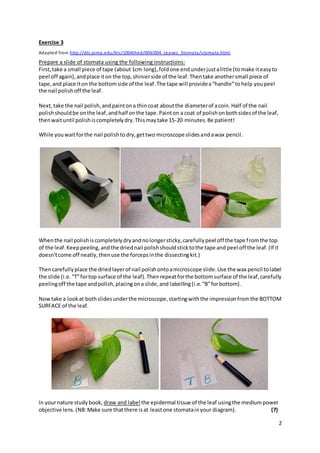
Prepare a slide of stomata using the following instructions:
First,take a small piece of tape (about 1cm long),foldone endunderjustalittle (tomake iteasyto
peel off again),andplace iton the top,shinierside of the leaf.Thentake anothersmall piece of
tape,and place iton the bottomside of the leaf.The tape will providea“handle”tohelp youpeel
the nail polishoff the leaf.
Next,take the nail polish,andpaintona thincoat aboutthe diameterof acoin.Half of the nail
polishshouldbe onthe leaf,andhalf onthe tape.Painton a coat of polishonbothsidesof the leaf,
thenwaituntil polishiscompletelydry.Thismaytake 15-20 minutes.Be patient!
While youwaitforthe nail polishtodry,gettwo microscope slidesandawax pencil.
Whenthe nail polishiscompletelydryandnolongersticky,carefullypeel off the tape fromthe top
of the leaf.Keeppeeling,andthe driednail polishshouldsticktothe tape and peel off the leaf.(If it
doesn'tcome off neatly,thenuse the forcepsinthe dissectingkit.)
Thencarefullyplace the driedlayerof nail polishontoamicroscope slide.Use the wax pencil tolabel
the slide (i.e.“T”fortop surface of the leaf).Thenrepeatforthe bottomsurface of the leaf,carefully
peelingoff the tape andpolish,placingona slide,and labelling(i.e.“B”forbottom).
Nowtake a lookat bothslidesunderthe microscope,startingwiththe impressionfromthe BOTTOM
SURFACE of the leaf.
In yournature studybook, draw and label the epidermal tissue of the leaf usingthe mediumpower
objective lens. (NB:Make sure thatthere isat leastone stomatainyour diagram). (7)

Practical plant tissues

  • 1.
    1 Practical 6 [25] ExaminingSimple Plant tissue Learning Outcome: Afteryouhave completedthisinvestigationyoushouldbe able to handle andoperate amicroscope inan efficientandsafe waytoinvestigateplanttissue. At the endof the practical youshouldbe able to demonstrate the following assessmentcriteria:  Be confidentinfocusingonpreparedslidesusingamicroscope.  Identifyparenchymaandsclerenchymatissuesinplantsfrompreparedslides.  Draw labelleddiagrams of parenchymaandsclerenchyma.  Tabulate the characteristicsandfunctionsof parenchymaandsclerenchyma.  Prepare a slide of stomatausingthe correcttechniques.  Draw a labelleddiagramof sclerenchyma. Introduction A groupof cellsof the samesize andshape,orof amixedtype,havingacommonoriginand performing an identical function is called tissue. Plant tissues are of two types—meristematic and permanent. Meristematic tissue cellsare capable of dividing, while permanent tissue cells are not. Parenchyma, collenchyma, and sclerenchyma are the three types of simple permanent tissues. Instructions Exercise 1  Take the slide containing the prepared parenchyma tissue and place it on the stage of the compound microscope.  Observe the features of the tissue starting at the low power lens, medium and high power objective lens of the compound microscope.  In your nature study book, draw and label the parenchyma tissue using the medium power objective lens.  Repeat the same procedure for the slides containing the sclerenchyma, collenchyma and tissues of the leaf.  In yournature studybook, draw and label the sclerenchymatissueusing the mediumpower objective lens. (5x2=10) Exercise 2 Describe your observation by redrawing and completing the table below: Table 1: Structure of Parenchyma and sclerenchyma cells (8) Type of tissue Structural Characteristics Function Parenchyma Sclerenchyma
  • 2.
    2 Exercise 3 Adapted fromhttp://dtc.pima.edu/blc/1004thed/004/004_Leaves_Stomata/stomata.html Prepare a slide of stomata using the following instructions: First,take a small piece of tape (about 1cm long),foldone endunderjustalittle (tomake iteasyto peel off again),andplace iton the top,shinierside of the leaf.Thentake anothersmall piece of tape,and place iton the bottomside of the leaf.The tape will providea“handle”tohelp youpeel the nail polishoff the leaf. Next,take the nail polish,andpaintona thincoat aboutthe diameterof acoin.Half of the nail polishshouldbe onthe leaf,andhalf onthe tape.Painton a coat of polishonbothsidesof the leaf, thenwaituntil polishiscompletelydry.Thismaytake 15-20 minutes.Be patient! While youwaitforthe nail polishtodry,gettwo microscope slidesandawax pencil. Whenthe nail polishiscompletelydryandnolongersticky,carefullypeel off the tape fromthe top of the leaf.Keeppeeling,andthe driednail polishshouldsticktothe tape and peel off the leaf.(If it doesn'tcome off neatly,thenuse the forcepsinthe dissectingkit.) Thencarefullyplace the driedlayerof nail polishontoamicroscope slide.Use the wax pencil tolabel the slide (i.e.“T”fortop surface of the leaf).Thenrepeatforthe bottomsurface of the leaf,carefully peelingoff the tape andpolish,placingona slide,and labelling(i.e.“B”forbottom). Nowtake a lookat bothslidesunderthe microscope,startingwiththe impressionfromthe BOTTOM SURFACE of the leaf. In yournature studybook, draw and label the epidermal tissue of the leaf usingthe mediumpower objective lens. (NB:Make sure thatthere isat leastone stomatainyour diagram). (7)