Practical NLP with Lisp

   Vsevolod Dyomkin
       Grammarly
Topics

*   Overview of NLP practice
*   Getting Data
*   Using Lisp: pros & cons
*   A couple of examples
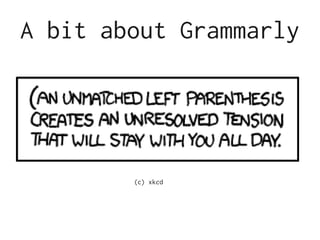
A bit about Grammarly


        (c) xkcd
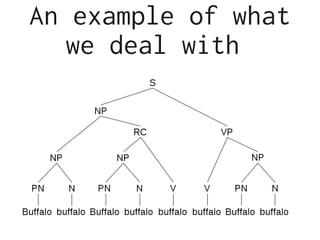
An example of what
   we deal with
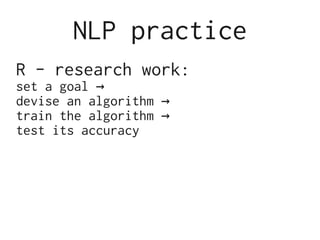
NLP practice
R - research work:
set a goal →
devise an algorithm →
train the algorithm →
test its accuracy
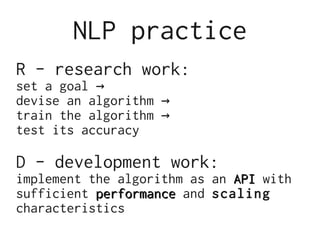
NLP practice
R - research work:
set a goal →
devise an algorithm →
train the algorithm →
test its accuracy

D - development work:
implement the algorithm as an API with
sufficient performance and scaling
characteristics
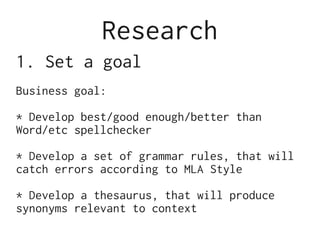
Research
1. Set a goal
Business goal:

* Develop best/good enough/better than
Word/etc spellchecker

* Develop a set of grammar rules, that will
catch errors according to MLA Style

* Develop a thesaurus, that will produce
synonyms relevant to context
Translate it to measurable goal
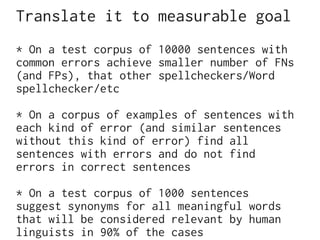
* On a test corpus of 10000 sentences with
common errors achieve smaller number of FNs
(and FPs), that other spellcheckers/Word
spellchecker/etc

* On a corpus of examples of sentences with
each kind of error (and similar sentences
without this kind of error) find all
sentences with errors and do not find
errors in correct sentences

* On a test corpus of 1000 sentences
suggest synonyms for all meaningful words
that will be considered relevant by human
linguists in 90% of the cases
A Note on
       Terminology
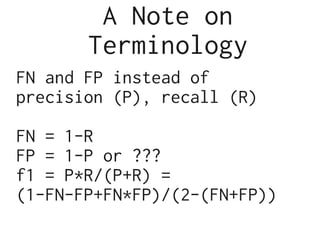
FN and FP instead of
precision (P), recall (R)

FN = 1-R
FP = 1-P or ???
f1 = P*R/(P+R) =
(1-FN-FP+FN*FP)/(2-(FN+FP))
Research contd.
2. Devise an algorithm
3. Train & improve the
algorithm
Research contd.
2. Devise an algorithm
3. Train & improve the
algorithm

http://nlp-class.org
4. Test its performance
ML: one corpus, divided into
training,development,test
4. Test its performance
ML: one corpus, divided into
training,development,test

Often — different corpora:
* for training some part (not
whole) of the algorithm
* for testing the whole
system
Theoretical maxima
Theoretical maxima are rarely
achievable. Why?
Theoretical maxima
Theoretical maxima are rarely
achievable. Why?

* Because you need their
data. (And data is key)
Theoretical maxima
Theoretical maxima are rarely
achievable. Why?

* Because you need their
data. (And data is key)

* Domains might differ
Pre/post-processing
What ultimately matters is
not crude performance, but...
Pre/post-processing
What ultimately matters is
not crude performance, but...

Acceptance to users (much
harder to measure & depends
on domain).
Pre/post-processing
What ultimately matters is
not crude performance, but...

Acceptance to users (much
harder to measure & depends
on domain).

Real-world is messier, than
any lab set-up.
Examples of
    pre-processing
For spellcheck:

* some people tend to use
words, separated by slashes,
like: spell/grammar check

* handling of abbreviations
Where to get data?
Well-known sources:
* Penn Tree Bank
* Wordnet
* Web1T Google N-gram Corpus
* Linguistic Data Consortium
  (http://www.ldc.upenn.edu/)
More data
Also well-known sources, but
with a twist:
* Wikipedia & Wiktionary,
DBPedia
* OpenWeb Common Crawl
(updated: 2010)
* Public APIs of some
services: Twitter, Wordnik
Obscure corpora
Academic resources:
* Stanford
* CoNLL
* Oxford (http://www.ota.ox.ac.uk/)
* CMU, MIT,...
* LingPipe, OpenNLP, NLTK,...
Human-powered?


http://goo.gl/hs4qB
Beyond corpora?

* Bootstrapping
* Seeding
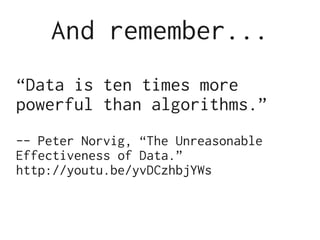
And remember...
“Data is ten times more
powerful than algorithms.”
-- Peter Norvig, “The Unreasonable
Effectiveness of Data.”
http://youtu.be/yvDCzhbjYWs
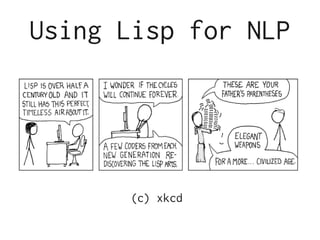
Using Lisp for NLP


      (c) xkcd
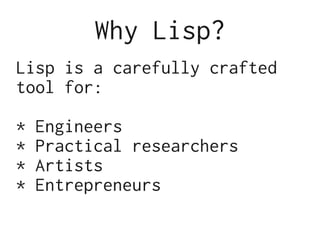
Why Lisp?
Lisp is a carefully crafted
tool for:

*   Engineers
*   Practical researchers
*   Artists
*   Entrepreneurs
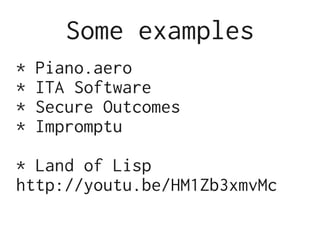
Some examples
*   Piano.aero
*   ITA Software
*   Secure Outcomes
*   Impromptu

* Land of Lisp
http://youtu.be/HM1Zb3xmvMc
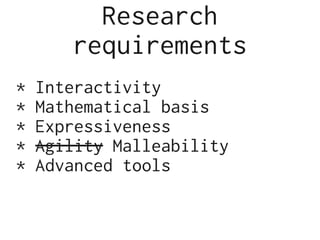
Research
       requirements
*   Interactivity
*   Mathematical basis
*   Expressiveness
*   Agility Malleability
*   Advanced tools
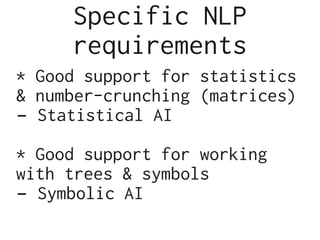
Specific NLP
     requirements
* Good support for statistics
& number-crunching (matrices)
– Statistical AI

* Good support for working
with trees & symbols
– Symbolic AI
Production
       requirements
*   Scalability
*   Maintainability
*   Integrability
*   ...
...eventually

* Speed
...eventually

* Speed
* Speed
...eventually

* Speed
* Speed
* Speed
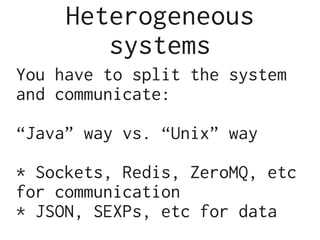
Heterogeneous
        systems
You have to split the system
and communicate:

“Java” way vs. “Unix” way

* Sockets, Redis, ZeroMQ, etc
for communication
* JSON, SEXPs, etc for data
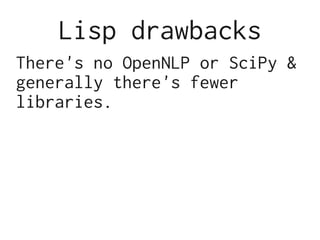
Lisp drawbacks
There's no OpenNLP or SciPy &
generally there's fewer
libraries.
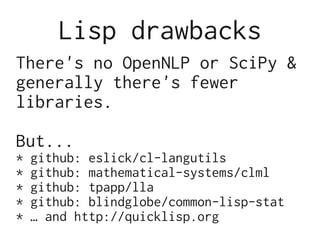
Lisp drawbacks
There's no OpenNLP or SciPy &
generally there's fewer
libraries.

But...
*   github: eslick/cl-langutils
*   github: mathematical-systems/clml
*   github: tpapp/lla
*   github: blindglobe/common-lisp-stat
*   … and http://quicklisp.org
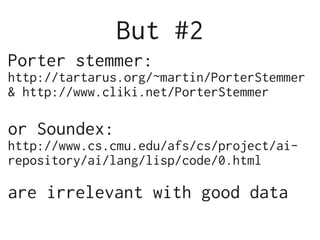
But #2
Porter stemmer:
http://tartarus.org/~martin/PorterStemmer
& http://www.cliki.net/PorterStemmer

or Soundex:
http://www.cs.cmu.edu/afs/cs/project/ai-
repository/ai/lang/lisp/code/0.html

are irrelevant with good data
More drawbacks

Lisp is a fringe language

   Not special language
  (like R, J or Octave)
Example #1


API interaction
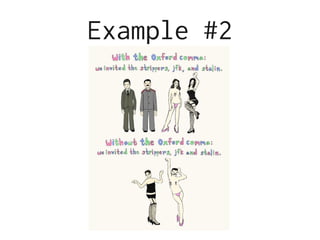
Example #2
Lisp FTW
* truly interactive
environment
* very flexible => DSLs
* native tree support
* fast and solid
Take-aways
* Take nlp-class

* Data is key, collect it, build tools
to work with it easily and efficiently

* A good language for R&D should be
first of all interactive & malleable,
with as few barriers as possible

* ... it also helps if you don't need to
port your code for production

* Lisp is one of the good examples
Thanks!

Vsevolod Dyomkin
    @vseloved

Practical NLP with Lisp

  • 1.
    Practical NLP with Lisp Vsevolod Dyomkin Grammarly
  • 2.
    Topics * Overview of NLP practice * Getting Data * Using Lisp: pros & cons * A couple of examples
  • 3.
    A bit aboutGrammarly (c) xkcd
  • 4.
    An example ofwhat we deal with
  • 5.
    NLP practice R -research work: set a goal → devise an algorithm → train the algorithm → test its accuracy
  • 6.
    NLP practice R -research work: set a goal → devise an algorithm → train the algorithm → test its accuracy D - development work: implement the algorithm as an API with sufficient performance and scaling characteristics
  • 7.
    Research 1. Set agoal Business goal: * Develop best/good enough/better than Word/etc spellchecker * Develop a set of grammar rules, that will catch errors according to MLA Style * Develop a thesaurus, that will produce synonyms relevant to context
  • 8.
    Translate it tomeasurable goal * On a test corpus of 10000 sentences with common errors achieve smaller number of FNs (and FPs), that other spellcheckers/Word spellchecker/etc * On a corpus of examples of sentences with each kind of error (and similar sentences without this kind of error) find all sentences with errors and do not find errors in correct sentences * On a test corpus of 1000 sentences suggest synonyms for all meaningful words that will be considered relevant by human linguists in 90% of the cases
  • 9.
    A Note on Terminology FN and FP instead of precision (P), recall (R) FN = 1-R FP = 1-P or ??? f1 = P*R/(P+R) = (1-FN-FP+FN*FP)/(2-(FN+FP))
  • 10.
    Research contd. 2. Devisean algorithm 3. Train & improve the algorithm
  • 11.
    Research contd. 2. Devisean algorithm 3. Train & improve the algorithm http://nlp-class.org
  • 12.
    4. Test itsperformance ML: one corpus, divided into training,development,test
  • 13.
    4. Test itsperformance ML: one corpus, divided into training,development,test Often — different corpora: * for training some part (not whole) of the algorithm * for testing the whole system
  • 14.
    Theoretical maxima Theoretical maximaare rarely achievable. Why?
  • 15.
    Theoretical maxima Theoretical maximaare rarely achievable. Why? * Because you need their data. (And data is key)
  • 16.
    Theoretical maxima Theoretical maximaare rarely achievable. Why? * Because you need their data. (And data is key) * Domains might differ
  • 17.
    Pre/post-processing What ultimately mattersis not crude performance, but...
  • 18.
    Pre/post-processing What ultimately mattersis not crude performance, but... Acceptance to users (much harder to measure & depends on domain).
  • 19.
    Pre/post-processing What ultimately mattersis not crude performance, but... Acceptance to users (much harder to measure & depends on domain). Real-world is messier, than any lab set-up.
  • 20.
    Examples of pre-processing For spellcheck: * some people tend to use words, separated by slashes, like: spell/grammar check * handling of abbreviations
  • 21.
    Where to getdata? Well-known sources: * Penn Tree Bank * Wordnet * Web1T Google N-gram Corpus * Linguistic Data Consortium (http://www.ldc.upenn.edu/)
  • 22.
    More data Also well-knownsources, but with a twist: * Wikipedia & Wiktionary, DBPedia * OpenWeb Common Crawl (updated: 2010) * Public APIs of some services: Twitter, Wordnik
  • 23.
    Obscure corpora Academic resources: *Stanford * CoNLL * Oxford (http://www.ota.ox.ac.uk/) * CMU, MIT,... * LingPipe, OpenNLP, NLTK,...
  • 24.
  • 25.
  • 26.
    And remember... “Data isten times more powerful than algorithms.” -- Peter Norvig, “The Unreasonable Effectiveness of Data.” http://youtu.be/yvDCzhbjYWs
  • 27.
    Using Lisp forNLP (c) xkcd
  • 28.
    Why Lisp? Lisp isa carefully crafted tool for: * Engineers * Practical researchers * Artists * Entrepreneurs
  • 29.
    Some examples * Piano.aero * ITA Software * Secure Outcomes * Impromptu * Land of Lisp http://youtu.be/HM1Zb3xmvMc
  • 30.
    Research requirements * Interactivity * Mathematical basis * Expressiveness * Agility Malleability * Advanced tools
  • 31.
    Specific NLP requirements * Good support for statistics & number-crunching (matrices) – Statistical AI * Good support for working with trees & symbols – Symbolic AI
  • 32.
    Production requirements * Scalability * Maintainability * Integrability * ...
  • 33.
  • 34.
  • 35.
  • 36.
    Heterogeneous systems You have to split the system and communicate: “Java” way vs. “Unix” way * Sockets, Redis, ZeroMQ, etc for communication * JSON, SEXPs, etc for data
  • 37.
    Lisp drawbacks There's noOpenNLP or SciPy & generally there's fewer libraries.
  • 38.
    Lisp drawbacks There's noOpenNLP or SciPy & generally there's fewer libraries. But... * github: eslick/cl-langutils * github: mathematical-systems/clml * github: tpapp/lla * github: blindglobe/common-lisp-stat * … and http://quicklisp.org
  • 39.
    But #2 Porter stemmer: http://tartarus.org/~martin/PorterStemmer &http://www.cliki.net/PorterStemmer or Soundex: http://www.cs.cmu.edu/afs/cs/project/ai- repository/ai/lang/lisp/code/0.html are irrelevant with good data
  • 40.
    More drawbacks Lisp isa fringe language Not special language (like R, J or Octave)
  • 41.
  • 42.
  • 43.
    Lisp FTW * trulyinteractive environment * very flexible => DSLs * native tree support * fast and solid
  • 44.
    Take-aways * Take nlp-class *Data is key, collect it, build tools to work with it easily and efficiently * A good language for R&D should be first of all interactive & malleable, with as few barriers as possible * ... it also helps if you don't need to port your code for production * Lisp is one of the good examples
  • 45.