Legal Research Skills
for legal practice
Elizabeth Moll
elizabeth.moll@uct.ac.za
021 650 5691
Anthea Paulsen
anthea.paulsen@uct.ac.za
021 650 1261
This work is licensed under a Creative CommonsAttribution-NonCommercial 4.0 International License.
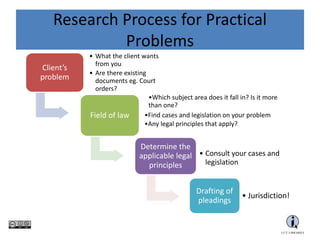
Research Process for Practical
Problems
Client’s
problem
• What the client wants
from you
• Are there existing
documents eg. Court
orders?
Field of law
•Which subject area does it fall in? Is it more
than one?
•Find cases and legislation on your problem
•Any legal principles that apply?
Determine the
applicable legal
principles
• Consult your cases and
legislation
Drafting of
pleadings
• Jurisdiction!
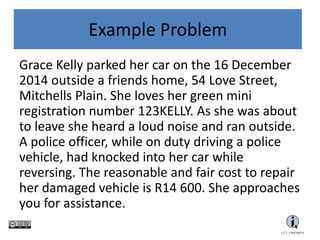
Example Problem
Grace Kelly parked her car on the 16 December
2014 outside a friends home, 54 Love Street,
Mitchells Plain. She loves her green mini
registration number 123KELLY. As she was about
to leave she heard a loud noise and ran outside.
A police officer, while on duty driving a police
vehicle, had knocked into her car while
reversing. The reasonable and fair cost to repair
her damaged vehicle is R14 600. She approaches
you for assistance.
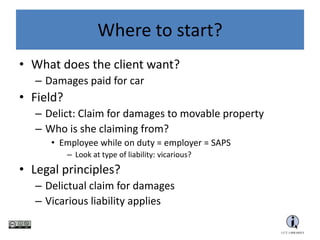
Where to start?
• What does the client want?
– Damages paid for car
• Field?
– Delict: Claim for damages to movable property
– Who is she claiming from?
• Employee while on duty = employer = SAPS
– Look at type of liability: vicarious?
• Legal principles?
– Delictual claim for damages
– Vicarious liability applies
Researching your field
• Narrow down to some specific topics in your field
if possible: eg. Vicarious liability
• Authority sources: cases and legislation!
– You can search for these by topic if you know it!
• Helpful sources: academic writings eg. Textbooks
– Can often show you exactly where to look and the
precedents that have already been set
– Don’t rely only on these – check up to make sure it
applies!
Using a textbook
• Our problem: law of delict
– Loubser and Midgley (eds.) The Law of Delict in
South Africa. Cape Town: OUP. 2012
– This has a specific chapter devoted to vicarious
liability – start there!
Databases for research within your
field
• LexisNexis SA
– Use to find cases and legislation that can help you
– Use to access forms and precedents
• Juta
– Use to find cases and legislation that can help you
• Sabinet Legal
– Use to find legislation and policy documents that can
help you
• SAFLII
– Use to find cases that can help you
Finding Primary Sources:
Cases and Legislation
• Case law:
– Use databases like LexisNexis, Juta and SAFLII
– Note the case citation:
• Legislation:
– Use databases like Sabinet, Juta, LexisNexis and SAFLII
Act Name Act Number Of Act Year
Water Act 36 of 1998
LexisNexis SA
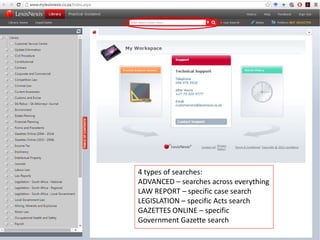
4 types of ‘focus’ searches:
ADVANCED – searches across everything
LAW REPORT – specific case search
LEGISLATION – specific Acts search
GAZETTES ONLINE – specific Government Gazette search
Can also browse through the
contents
Now you can also prefilter for the type of document you
want – this is not as effective as a law report search, but
useful for a keyword search
Tick the box you want, then type your keywords into the
red search box and click search
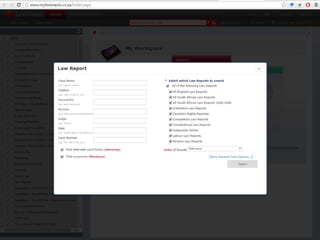
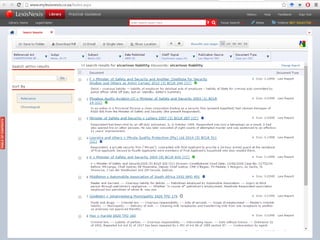
Using the ‘Law Reports’ search for cases by
keywords
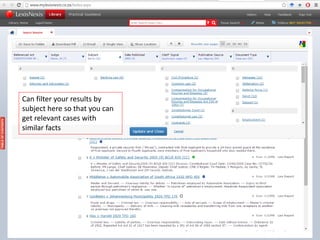
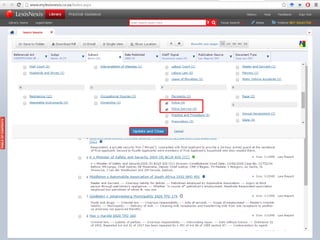
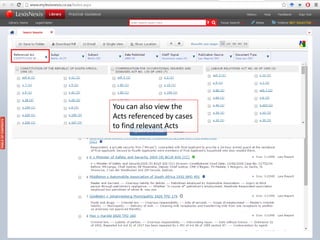
Can filter your results by
subject here so that you can
get relevant cases with
similar facts
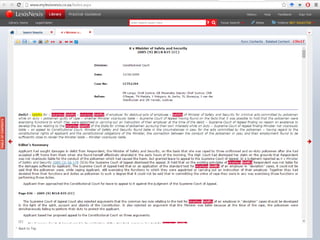
You can also view the
Acts referenced by cases
to find relevant Acts
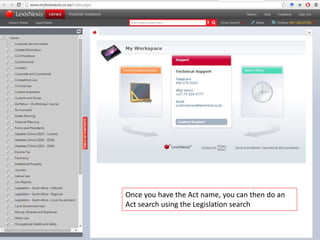
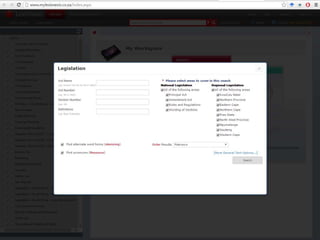
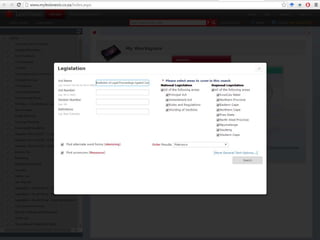
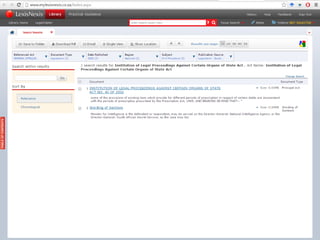
Using the ‘Legislation’ search for Acts
Once you have the Act name, you can then do an
Act search using the Legislation search
If your authority doesn’t come up…
• Use the contents on the left hand side to find
the legislation or case by year or title!
Not finding cases?
Use the Indexer and Noter-up to the All South
African Cases!
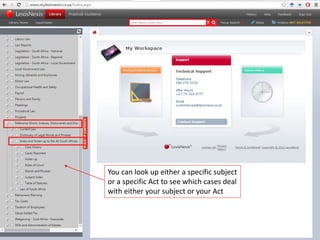
You can look up either a specific subject
or a specific Act to see which cases deal
with either your subject or your Act
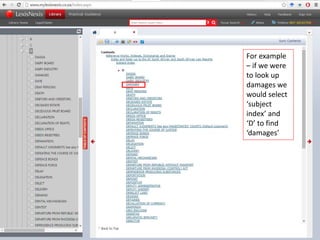
For example
– if we were
to look up
damages we
would select
‘subject
index’ and
‘D’ to find
‘damages’
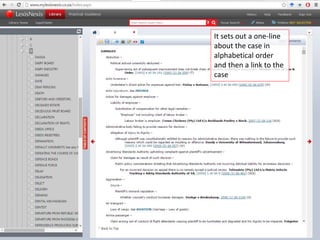
It sets out a one-line
about the case in
alphabetical order
and then a link to the
case
Using Amler’s Precedence of Pleadings
in LexisNexis
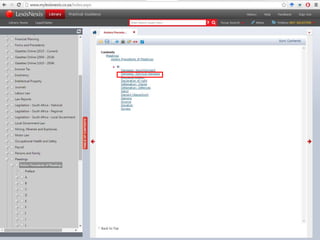
• Amler’s Precedents of Pleadings (LexisNexis
SA)
– Search by field of law / topic: there may be more
than one
You can click on the first letter of
your topic eg. D for Damages
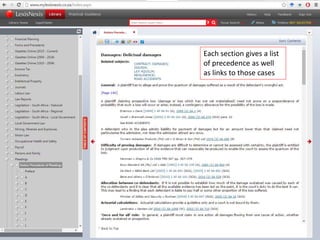
Each section gives a list
of precedence as well
as links to those cases
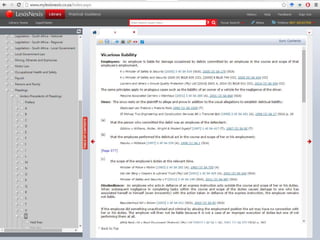
There can be more
than one applicable
section! In this case
“vicarious liability”
is also applicable
Using CiteIt to track case treatment
When you open a case, the legal citator
(“CiteIt”) will pop open.
Here you can see the details of the
judgment, subject analysis, judgment
history, judgment treatment and more.
So you can check if its good precedent
or not!
Click on judgment treatment:
Blue = neutral
Red = negative
Green = positive
Yellow = cautionary
White circle = no analysis
Black circle = conflicting analysis
Juta
Use the
dropdown
to choose
your
search
Can also browse here
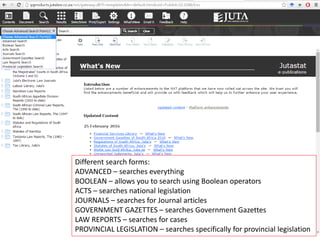
Different search forms:
ADVANCED – searches everything
BOOLEAN – allows you to search using Boolean operators
ACTS – searches national legislation
JOURNALS – searches for Journal articles
GOVERNMENT GAZETTES – searches Government Gazettes
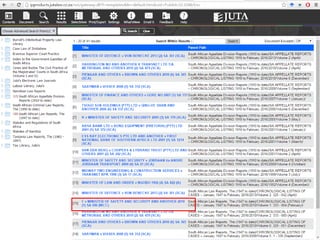
LAW REPORTS – searches for cases
PROVINCIAL LEGISLATION – searches specifically for provincial legislation
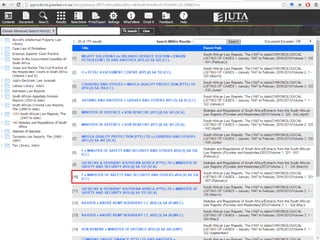
Using the ‘Law Reports’ search to search by
keyword
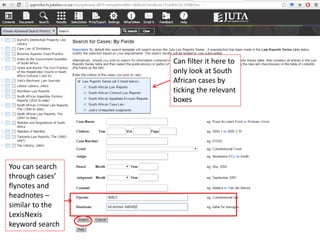
You can search
through cases’
flynotes and
headnotes –
similar to the
LexisNexis
keyword search
Can filter it here to
only look at South
African cases by
ticking the relevant
boxes
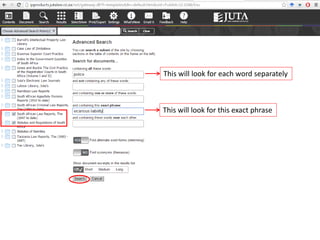
Using the advanced search to search by
keywords
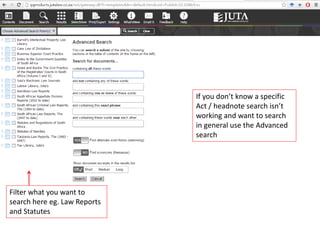
If you don’t know a specific
Act / headnote search isn’t
working and want to search
in general use the Advanced
search
Filter what you want to
search here eg. Law Reports
and Statutes
This will look for each word separately
This will look for this exact phrase
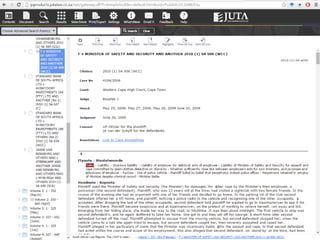
Using the case annotations to track a case’s
treatment
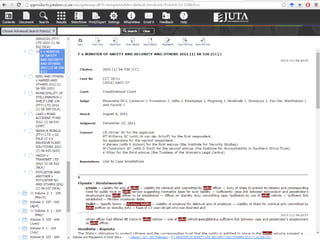
When you open a case, click on ‘link
to case annotations’
It will list what other cases did – you need to click
on the links to open each case
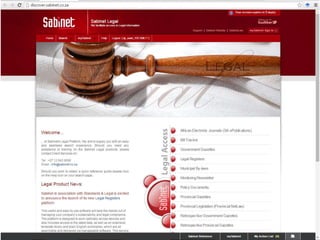
Sabinet Legal
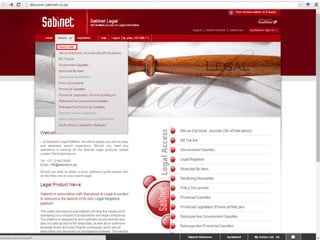
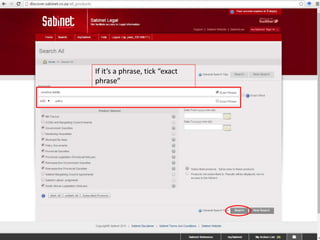
Can select and deselect
sources here – check the
subscription first
If it’s a phrase, tick “exact
phrase”
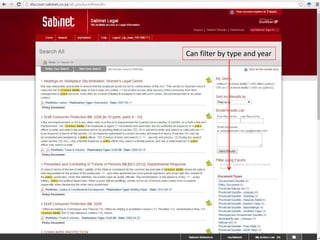
Can filter by type and year
SAFLII
This is a free access to law database –
and it contains documents from many
different courts and tribunals. It is a
very valuable resource and easy to use!
Topic search for materials
Simply type in your topic search into the
search box - use your search operators
eg. AND, OR, NOT and “ “ for phrases
Your results will come up in terms of
relevance to your keywords. The
percentage number behind each items
indicates how relevant it is to your topic
If you want to look for specific types eg.
Cases, use the ‘by databases’ tab and it
will show you how many documents in
each court
Click on the document number to open
the list
Using the advanced search to select specific
databases
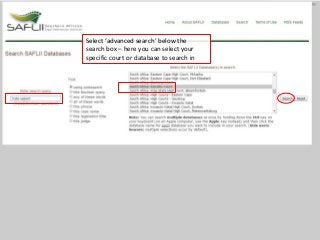
Select ‘advanced search’ below the
search box – here you can select your
specific court or database to search in
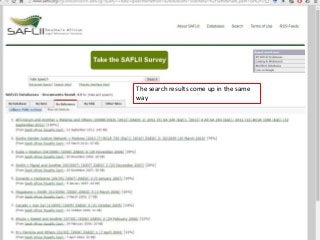
The search results come up in the same
way
Browsing SAFLII by source
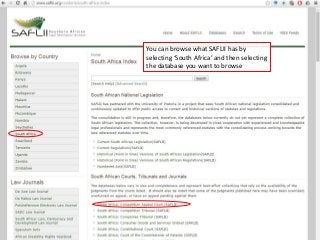
You can browse what SAFLII has by
selecting ‘South Africa’ and then selecting
the database you want to browse
Once in your database, browse by year or
title
Using LawCite to track case treatment
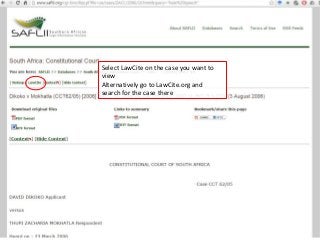
Select LawCite on the case you want to
view
Alternatively go to LawCite.org and
search for the case there
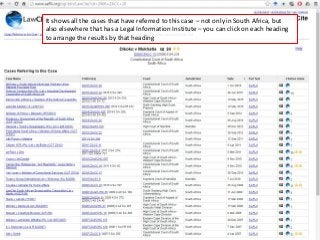
It shows all the cases that have referred to this case – not only in South Africa, but
also elsewhere that has a Legal Information Institute – you can click on each heading
to arrange the results by that heading
Nature of proceedings: jurisdiction and
precedents
• Consult your cases and legislation: any specific
principles that govern your problem? Any
similar cases?
– In certain cases textbooks are helpful in
identifying the elements you need to show
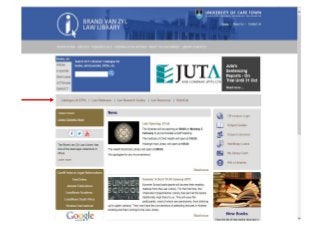
• Decide on your jurisdiction
Finding Secondary Sources:
Books, Journals, Commentaries
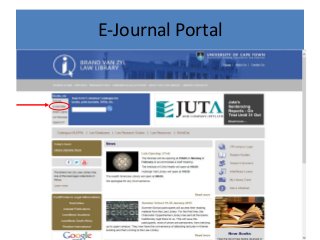
• Use the Aleph Catalogue to find books
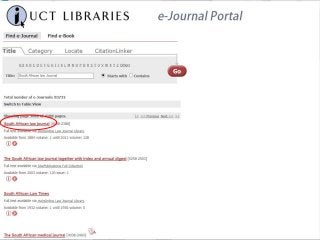
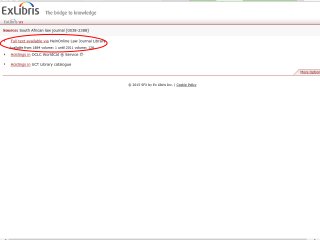
• Use the e-journal portal to find specific journals
• Use HeinOnline and SA ePublications to search
for articles
• Use OpenUCT to find theses as well as
publications from the law faculty staff
Aleph
• UCT Catalogue of books, journals that are in the library
• Note down the shelf number of an item!
– You need this to find the book on the shelf
• Different Law Library locations
– Law Library Reserve = Short Loan centre behind loans desk
– Law Library Open Shelves = Normal loan on Level 1 of library
– Law Library Reference Section = Not for loan, on Level 2
– Law Library Leisure Collection = 7 day loan, on Level 2
• Let’s look for the following book:
Wille’s principles of South African law./
Francois du Bois... [et al.] --
Cape Town : Juta, 2007.
Finding Books
using the UCT Catalogue
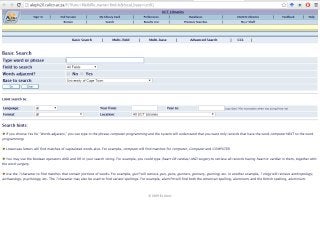
• The UCT Catalogue contains a list of all the
books, e-books, dvds and other materials in all
the UCT Libraries.
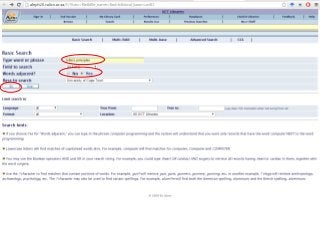
• Let’s look for the following book:
Wille’s principles of South African law./
Francois du Bois... [et al.] --
Cape Town : Juta, 2007.
If there aren’t many results, your
result screen will show you this
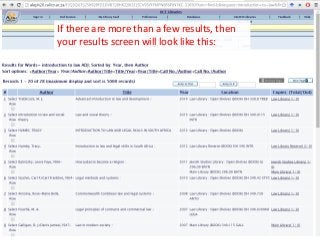
If there are more than a few results, then
your results screen will look like this:
Finding Journals / Journal Articles
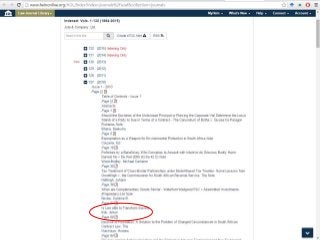
Article Citation Format:
Author Title (Year) Volume Journal Title Starting Page
Eg.
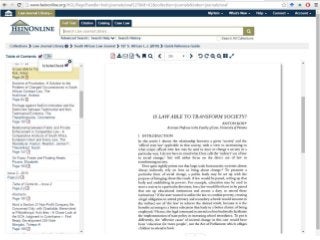
Kok, A. Is Law able to Transform Society (2010)
127 SALJ 59
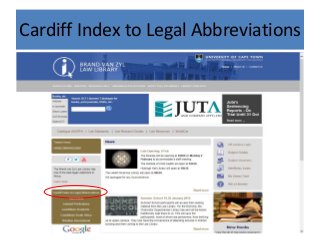
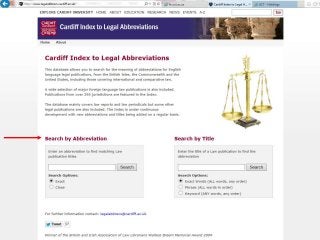
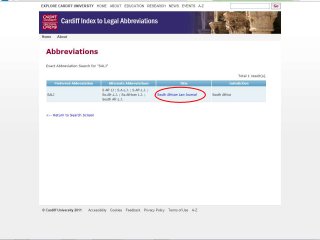
To find what ‘SALJ’ means – use Cardiff Index
Cardiff Index to Legal Abbreviations
E-Journal Portal
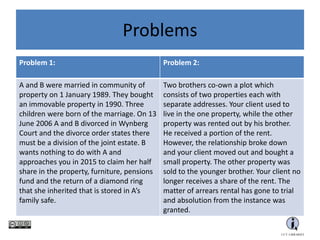
Problems
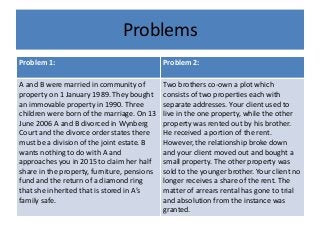
Problem 1: Problem 2:
A and B were married in community of
property on 1 January 1989. They bought
an immovable property in 1990. Three
children were born of the marriage. On 13
June 2006 A and B divorced in Wynberg
Court and the divorce order states there
must be a division of the joint estate. B
wants nothing to do with A and
approaches you in 2015 to claim her half
share in the property, furniture, pensions
fund and the return of a diamond ring
that she inherited that is stored in A’s
family safe.
Two brothers co-own a plot which
consists of two properties each with
separate addresses. Your client used to
live in the one property, while the other
property was rented out by his brother.
He received a portion of the rent.
However, the relationship broke down
and your client moved out and bought a
small property. The other property was
sold to the younger brother. Your client no
longer receives a share of the rent. The
matter of arrears rental has gone to trial
and absolution from the instance was
granted.
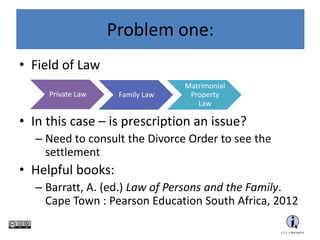
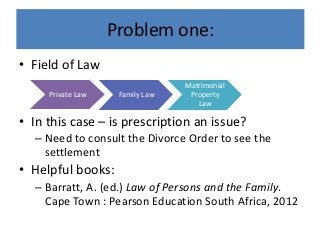
Problem one:
• Field of Law
• In this case – is prescription an issue?
– Need to consult the Divorce Order to see the
settlement
• Helpful books:
– Barratt, A. (ed.) Law of Persons and the Family.
Cape Town : Pearson Education South Africa, 2012
Private Law Family Law
Matrimonial
Property
Law
Problem one: suggested authorities
• Legislation:
– Divorce Act 70 of 1979
• Claim for half of assets:
– Legal principle: Marriage in community of property
has an equal division of the joint estate at divorce
• Case Law:
– Inheritance excluded from joint estate:
• Erasmus v Erasmus 1942 AD 265
– Pension fund case:
• Ex parte Randles: In re King v King [1998] 2 All SA 412 (D)
Problem one: suggested authorities
• Amler’s Precedents:
– Divorce
• Forms and precedents:
– Marriage and Settlement Contracts
Problem two:
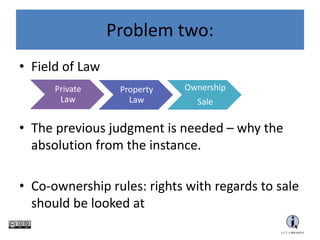
• Field of Law
• The previous judgment is needed – why the
absolution from the instance.
• Co-ownership rules: rights with regards to sale
should be looked at
Private
Law
Property
Law
Ownership
Sale
Problem two:
• Helpful books:
– Mostert & Pope (eds.) 2010. The Principles of the
Law of Property. Cape Town: OUP
– Bradfield & Lehmann. Principles of the Law of Sale
and Lease. Cape Town: Juta
– Van der Merwe, C.G. Things in Law of South Africa
Volume 27 2nd Edition.
Problem two: suggested authorities
• Legislation:
– Deeds Registries Act
– Alienation of Land Act 68 of 1981
• Case Law
– Claim for rent by co-owner:
• Pretorius v Botha [1961] 4 All SA 318
– Sale of property:
• Drummond v Dreyer [1954] 1 All SA 146 (N)
Problem two: suggested authorities
• Amler’s Precedents:
– Ownership
– Vindication
– Sale
More Problems
Problem 3: Problem 4:
Client X wishes to change her sex via
gender realignment. What services are
there in the western cape and after the
process which she thinks may take a few
years, would she be able to change her
sex on her birth certificate. Please advise.
Thomas, your client, quotes for the
painting of Mrs Conradie’s house. Mrs
Conradie accepts the offer and signs the
quote. Thomas indicates that he will first
finish the paint job and that Mrs Conradie
can settle the full amount outstanding
afterwards. On completion of the job, Mrs
Conradie refuses to pay Thomas, saying
that he had done a bad job. Thomas
argues that he did exactly what they
agreed to and that Mrs Conradie is trying
to enrich herself at his expense.
Problem three:
• Field of Law
• The question as to whether there are such services in
the Western Cape is not a legal one – it is a medical
one
• Helpful books:
– Barratt, A. (ed.) Law of Persons and the Family. Cape Town
: Pearson Education South Africa, 2012
Private
Law
Law of
Persons
Sex and
Gender
Problem three: suggested authorities
• Legislation:
– Alteration of Sex Description and Sex Status Act 49
of 2003
• Application to change sex on birth certificate:
– Department of Home Affairs sets out the
guidelines in terms of the above act and have a
specific form for this purpose (Form BI-526)
Problem four:
• Field of Law
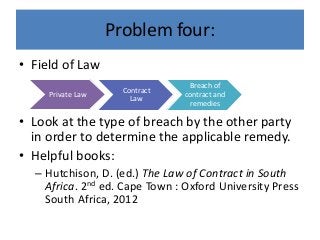
• Look at the type of breach by the other party
in order to determine the applicable remedy.
• Helpful books:
– Hutchison, D. (ed.) The Law of Contract in South
Africa. 2nd ed. Cape Town : Oxford University Press
South Africa, 2012
Private Law Contract
Law
Breach of
contract and
remedies
Problem four: suggested authorities
• Legislation:
– Contract law and its remedies are grounded in
Common Law (Roman-Dutch Law)
• Case Law
– Requirements for an order of Specific Performance:
• Farmers’ Co-operative Society (Reg) v Berry 1912 AD 343
• Amler’s Precedents:
– Contract: Specific performance
Research Assistance
• Use the Library’s Virtual Reference Service at:
www.law.lib.uct.ac.za
• Email us
elizabeth.moll@uct.ac.za OR
anthea.paulsen@uct.ac.za
• Call us (021) 650-1261 (Anthea)
(021) 650-5691(Elizabeth)
• Set up an appointment with us for a consultation
• Visit us in the Library! – Level 2, Kramer Building, Middle
Campus 
108
?
?
?
?
?
?
?
?
?
?
?
?
Thank you!
110

Practical legal research

  • 1.
    Legal Research Skills forlegal practice Elizabeth Moll elizabeth.moll@uct.ac.za 021 650 5691 Anthea Paulsen anthea.paulsen@uct.ac.za 021 650 1261 This work is licensed under a Creative CommonsAttribution-NonCommercial 4.0 International License.
  • 2.
    Research Process forPractical Problems Client’s problem • What the client wants from you • Are there existing documents eg. Court orders? Field of law •Which subject area does it fall in? Is it more than one? •Find cases and legislation on your problem •Any legal principles that apply? Determine the applicable legal principles • Consult your cases and legislation Drafting of pleadings • Jurisdiction!
  • 3.
    Example Problem Grace Kellyparked her car on the 16 December 2014 outside a friends home, 54 Love Street, Mitchells Plain. She loves her green mini registration number 123KELLY. As she was about to leave she heard a loud noise and ran outside. A police officer, while on duty driving a police vehicle, had knocked into her car while reversing. The reasonable and fair cost to repair her damaged vehicle is R14 600. She approaches you for assistance.
  • 4.
    Where to start? •What does the client want? – Damages paid for car • Field? – Delict: Claim for damages to movable property – Who is she claiming from? • Employee while on duty = employer = SAPS – Look at type of liability: vicarious? • Legal principles? – Delictual claim for damages – Vicarious liability applies
  • 5.
    Researching your field •Narrow down to some specific topics in your field if possible: eg. Vicarious liability • Authority sources: cases and legislation! – You can search for these by topic if you know it! • Helpful sources: academic writings eg. Textbooks – Can often show you exactly where to look and the precedents that have already been set – Don’t rely only on these – check up to make sure it applies!
  • 6.
    Using a textbook •Our problem: law of delict – Loubser and Midgley (eds.) The Law of Delict in South Africa. Cape Town: OUP. 2012 – This has a specific chapter devoted to vicarious liability – start there!
  • 7.
    Databases for researchwithin your field • LexisNexis SA – Use to find cases and legislation that can help you – Use to access forms and precedents • Juta – Use to find cases and legislation that can help you • Sabinet Legal – Use to find legislation and policy documents that can help you • SAFLII – Use to find cases that can help you
  • 8.
    Finding Primary Sources: Casesand Legislation • Case law: – Use databases like LexisNexis, Juta and SAFLII – Note the case citation: • Legislation: – Use databases like Sabinet, Juta, LexisNexis and SAFLII Act Name Act Number Of Act Year Water Act 36 of 1998
  • 9.
  • 10.
    4 types of‘focus’ searches: ADVANCED – searches across everything LAW REPORT – specific case search LEGISLATION – specific Acts search GAZETTES ONLINE – specific Government Gazette search Can also browse through the contents
  • 11.
    Now you canalso prefilter for the type of document you want – this is not as effective as a law report search, but useful for a keyword search Tick the box you want, then type your keywords into the red search box and click search
  • 12.
    Using the ‘LawReports’ search for cases by keywords
  • 16.
    Can filter yourresults by subject here so that you can get relevant cases with similar facts
  • 18.
    You can alsoview the Acts referenced by cases to find relevant Acts
  • 20.
  • 21.
    Once you havethe Act name, you can then do an Act search using the Legislation search
  • 25.
    If your authoritydoesn’t come up… • Use the contents on the left hand side to find the legislation or case by year or title! Not finding cases? Use the Indexer and Noter-up to the All South African Cases!
  • 26.
    You can lookup either a specific subject or a specific Act to see which cases deal with either your subject or your Act
  • 27.
    For example – ifwe were to look up damages we would select ‘subject index’ and ‘D’ to find ‘damages’
  • 28.
    It sets outa one-line about the case in alphabetical order and then a link to the case
  • 29.
    Using Amler’s Precedenceof Pleadings in LexisNexis • Amler’s Precedents of Pleadings (LexisNexis SA) – Search by field of law / topic: there may be more than one
  • 31.
    You can clickon the first letter of your topic eg. D for Damages
  • 33.
    Each section givesa list of precedence as well as links to those cases
  • 34.
    There can bemore than one applicable section! In this case “vicarious liability” is also applicable
  • 36.
    Using CiteIt totrack case treatment
  • 37.
    When you opena case, the legal citator (“CiteIt”) will pop open. Here you can see the details of the judgment, subject analysis, judgment history, judgment treatment and more. So you can check if its good precedent or not!
  • 38.
    Click on judgmenttreatment: Blue = neutral Red = negative Green = positive Yellow = cautionary White circle = no analysis Black circle = conflicting analysis
  • 39.
  • 40.
  • 41.
    Different search forms: ADVANCED– searches everything BOOLEAN – allows you to search using Boolean operators ACTS – searches national legislation JOURNALS – searches for Journal articles GOVERNMENT GAZETTES – searches Government Gazettes LAW REPORTS – searches for cases PROVINCIAL LEGISLATION – searches specifically for provincial legislation
  • 42.
    Using the ‘LawReports’ search to search by keyword
  • 43.
    You can search throughcases’ flynotes and headnotes – similar to the LexisNexis keyword search Can filter it here to only look at South African cases by ticking the relevant boxes
  • 46.
    Using the advancedsearch to search by keywords
  • 47.
    If you don’tknow a specific Act / headnote search isn’t working and want to search in general use the Advanced search Filter what you want to search here eg. Law Reports and Statutes
  • 48.
    This will lookfor each word separately This will look for this exact phrase
  • 51.
    Using the caseannotations to track a case’s treatment
  • 52.
    When you opena case, click on ‘link to case annotations’
  • 53.
    It will listwhat other cases did – you need to click on the links to open each case
  • 54.
  • 57.
    Can select anddeselect sources here – check the subscription first
  • 58.
    If it’s aphrase, tick “exact phrase”
  • 59.
    Can filter bytype and year
  • 60.
    SAFLII This is afree access to law database – and it contains documents from many different courts and tribunals. It is a very valuable resource and easy to use!
  • 61.
  • 62.
    Simply type inyour topic search into the search box - use your search operators eg. AND, OR, NOT and “ “ for phrases
  • 63.
    Your results willcome up in terms of relevance to your keywords. The percentage number behind each items indicates how relevant it is to your topic
  • 64.
    If you wantto look for specific types eg. Cases, use the ‘by databases’ tab and it will show you how many documents in each court Click on the document number to open the list
  • 66.
    Using the advancedsearch to select specific databases
  • 67.
    Select ‘advanced search’below the search box – here you can select your specific court or database to search in
  • 68.
    The search resultscome up in the same way
  • 69.
  • 70.
    You can browsewhat SAFLII has by selecting ‘South Africa’ and then selecting the database you want to browse
  • 71.
    Once in yourdatabase, browse by year or title
  • 72.
    Using LawCite totrack case treatment
  • 73.
    Select LawCite onthe case you want to view Alternatively go to LawCite.org and search for the case there
  • 74.
    It shows allthe cases that have referred to this case – not only in South Africa, but also elsewhere that has a Legal Information Institute – you can click on each heading to arrange the results by that heading
  • 75.
    Nature of proceedings:jurisdiction and precedents • Consult your cases and legislation: any specific principles that govern your problem? Any similar cases? – In certain cases textbooks are helpful in identifying the elements you need to show • Decide on your jurisdiction
  • 76.
    Finding Secondary Sources: Books,Journals, Commentaries • Use the Aleph Catalogue to find books • Use the e-journal portal to find specific journals • Use HeinOnline and SA ePublications to search for articles • Use OpenUCT to find theses as well as publications from the law faculty staff
  • 77.
    Aleph • UCT Catalogueof books, journals that are in the library • Note down the shelf number of an item! – You need this to find the book on the shelf • Different Law Library locations – Law Library Reserve = Short Loan centre behind loans desk – Law Library Open Shelves = Normal loan on Level 1 of library – Law Library Reference Section = Not for loan, on Level 2 – Law Library Leisure Collection = 7 day loan, on Level 2 • Let’s look for the following book: Wille’s principles of South African law./ Francois du Bois... [et al.] -- Cape Town : Juta, 2007.
  • 78.
    Finding Books using theUCT Catalogue • The UCT Catalogue contains a list of all the books, e-books, dvds and other materials in all the UCT Libraries. • Let’s look for the following book: Wille’s principles of South African law./ Francois du Bois... [et al.] -- Cape Town : Juta, 2007.
  • 82.
    If there aren’tmany results, your result screen will show you this
  • 83.
    If there aremore than a few results, then your results screen will look like this:
  • 84.
    Finding Journals /Journal Articles Article Citation Format: Author Title (Year) Volume Journal Title Starting Page Eg. Kok, A. Is Law able to Transform Society (2010) 127 SALJ 59 To find what ‘SALJ’ means – use Cardiff Index
  • 85.
    Cardiff Index toLegal Abbreviations
  • 88.
  • 95.
    Problems Problem 1: Problem2: A and B were married in community of property on 1 January 1989. They bought an immovable property in 1990. Three children were born of the marriage. On 13 June 2006 A and B divorced in Wynberg Court and the divorce order states there must be a division of the joint estate. B wants nothing to do with A and approaches you in 2015 to claim her half share in the property, furniture, pensions fund and the return of a diamond ring that she inherited that is stored in A’s family safe. Two brothers co-own a plot which consists of two properties each with separate addresses. Your client used to live in the one property, while the other property was rented out by his brother. He received a portion of the rent. However, the relationship broke down and your client moved out and bought a small property. The other property was sold to the younger brother. Your client no longer receives a share of the rent. The matter of arrears rental has gone to trial and absolution from the instance was granted.
  • 96.
    Problem one: • Fieldof Law • In this case – is prescription an issue? – Need to consult the Divorce Order to see the settlement • Helpful books: – Barratt, A. (ed.) Law of Persons and the Family. Cape Town : Pearson Education South Africa, 2012 Private Law Family Law Matrimonial Property Law
  • 97.
    Problem one: suggestedauthorities • Legislation: – Divorce Act 70 of 1979 • Claim for half of assets: – Legal principle: Marriage in community of property has an equal division of the joint estate at divorce • Case Law: – Inheritance excluded from joint estate: • Erasmus v Erasmus 1942 AD 265 – Pension fund case: • Ex parte Randles: In re King v King [1998] 2 All SA 412 (D)
  • 98.
    Problem one: suggestedauthorities • Amler’s Precedents: – Divorce • Forms and precedents: – Marriage and Settlement Contracts
  • 99.
    Problem two: • Fieldof Law • The previous judgment is needed – why the absolution from the instance. • Co-ownership rules: rights with regards to sale should be looked at Private Law Property Law Ownership Sale
  • 100.
    Problem two: • Helpfulbooks: – Mostert & Pope (eds.) 2010. The Principles of the Law of Property. Cape Town: OUP – Bradfield & Lehmann. Principles of the Law of Sale and Lease. Cape Town: Juta – Van der Merwe, C.G. Things in Law of South Africa Volume 27 2nd Edition.
  • 101.
    Problem two: suggestedauthorities • Legislation: – Deeds Registries Act – Alienation of Land Act 68 of 1981 • Case Law – Claim for rent by co-owner: • Pretorius v Botha [1961] 4 All SA 318 – Sale of property: • Drummond v Dreyer [1954] 1 All SA 146 (N)
  • 102.
    Problem two: suggestedauthorities • Amler’s Precedents: – Ownership – Vindication – Sale
  • 103.
    More Problems Problem 3:Problem 4: Client X wishes to change her sex via gender realignment. What services are there in the western cape and after the process which she thinks may take a few years, would she be able to change her sex on her birth certificate. Please advise. Thomas, your client, quotes for the painting of Mrs Conradie’s house. Mrs Conradie accepts the offer and signs the quote. Thomas indicates that he will first finish the paint job and that Mrs Conradie can settle the full amount outstanding afterwards. On completion of the job, Mrs Conradie refuses to pay Thomas, saying that he had done a bad job. Thomas argues that he did exactly what they agreed to and that Mrs Conradie is trying to enrich herself at his expense.
  • 104.
    Problem three: • Fieldof Law • The question as to whether there are such services in the Western Cape is not a legal one – it is a medical one • Helpful books: – Barratt, A. (ed.) Law of Persons and the Family. Cape Town : Pearson Education South Africa, 2012 Private Law Law of Persons Sex and Gender
  • 105.
    Problem three: suggestedauthorities • Legislation: – Alteration of Sex Description and Sex Status Act 49 of 2003 • Application to change sex on birth certificate: – Department of Home Affairs sets out the guidelines in terms of the above act and have a specific form for this purpose (Form BI-526)
  • 106.
    Problem four: • Fieldof Law • Look at the type of breach by the other party in order to determine the applicable remedy. • Helpful books: – Hutchison, D. (ed.) The Law of Contract in South Africa. 2nd ed. Cape Town : Oxford University Press South Africa, 2012 Private Law Contract Law Breach of contract and remedies
  • 107.
    Problem four: suggestedauthorities • Legislation: – Contract law and its remedies are grounded in Common Law (Roman-Dutch Law) • Case Law – Requirements for an order of Specific Performance: • Farmers’ Co-operative Society (Reg) v Berry 1912 AD 343 • Amler’s Precedents: – Contract: Specific performance
  • 108.
    Research Assistance • Usethe Library’s Virtual Reference Service at: www.law.lib.uct.ac.za • Email us elizabeth.moll@uct.ac.za OR anthea.paulsen@uct.ac.za • Call us (021) 650-1261 (Anthea) (021) 650-5691(Elizabeth) • Set up an appointment with us for a consultation • Visit us in the Library! – Level 2, Kramer Building, Middle Campus  108
  • 109.
  • 110.