Practical Issues in Various Types of
Assessments: Procedure and Approach
CA. Jugal Gala
Credits and Acknowledgments
Bharathi Priya R D
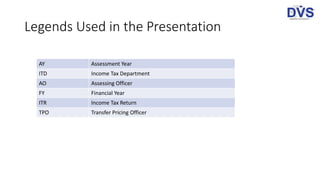
Legends Used in the Presentation
AY Assessment Year
ITD Income Tax Department
AO Assessing Officer
FY Financial Year
ITR Income Tax Return
TPO Transfer Pricing Officer
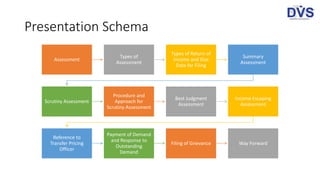
Presentation Schema
Assessment
Types of
Assessment
Types of Return of
Income and Due
Date for Filing
Summary
Assessment
Scrutiny Assessment
Procedure and
Approach for
Scrutiny Assessment
Best Judgment
Assessment
Income Escaping
Assessment
Reference to
Transfer Pricing
Officer
Payment of Demand
and Response to
Outstanding
Demand
Filing of Grievance Way Forward
Assessment
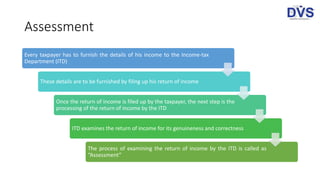
Every taxpayer has to furnish the details of his income to the Income-tax
Department (ITD)
These details are to be furnished by filing up his return of income
Once the return of income is filed up by the taxpayer, the next step is the
processing of the return of income by the ITD
ITD examines the return of income for its genuineness and correctness
The process of examining the return of income by the ITD is called as
“Assessment”
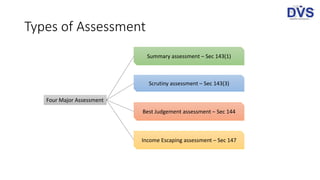
Types of Assessment
Four Major Assessment
Summary assessment – Sec 143(1)
Scrutiny assessment – Sec 143(3)
Best Judgement assessment – Sec 144
Income Escaping assessment – Sec 147
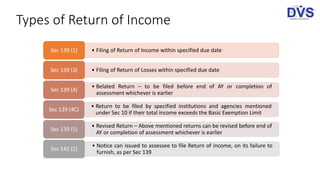
Types of Return of Income
• Filing of Return of Income within specified due dateSec 139 (1)
• Filing of Return of Losses within specified due dateSec 139 (3)
• Belated Return – to be filed before end of AY or completion of
assessment whichever is earlier
Sec 139 (4)
• Return to be filed by specified institutions and agencies mentioned
under Sec 10 if their total income exceeds the Basic Exemption Limit
Sec 139 (4C)
• Revised Return – Above mentioned returns can be revised before end of
AY or completion of assessment whichever is earlier
Sec 139 (5)
• Notice can issued to assessee to file Return of income, on its failure to
furnish, as per Sec 139
Sec 142 (1)
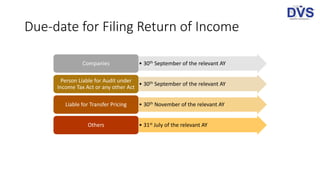
Due-date for Filing Return of Income
• 30th September of the relevant AYCompanies
• 30th September of the relevant AY
Person Liable for Audit under
Income Tax Act or any other Act
• 30th November of the relevant AYLiable for Transfer Pricing
• 31st July of the relevant AYOthers
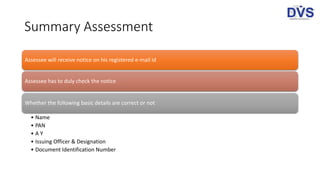
Summary Assessment
Assessee will receive notice on his registered e-mail id
Assessee has to duly check the notice
Whether the following basic details are correct or not
• Name
• PAN
• A Y
• Issuing Officer & Designation
• Document Identification Number
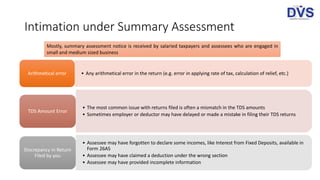
Intimation under Summary Assessment
Mostly, summary assessment notice is received by salaried taxpayers and assessees who are engaged in
small and medium sized business
• Any arithmetical error in the return (e.g. error in applying rate of tax, calculation of relief, etc.)Arithmetical error
• The most common issue with returns filed is often a mismatch in the TDS amounts
• Sometimes employer or deductor may have delayed or made a mistake in filing their TDS returns
TDS Amount Error
• Assessee may have forgotten to declare some incomes, like Interest from Fixed Deposits, available in
Form 26AS
• Assessee may have claimed a deduction under the wrong section
• Assessee may have provided incomplete information
Discrepancy in Return
Filed by you
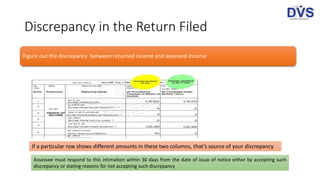
Discrepancy in the Return Filed
Figure out the discrepancy between returned income and assessed income
If a particular row shows different amounts in these two columns, that’s source of your discrepancy
Assessee must respond to this intimation within 30 days from the date of issue of notice either by accepting such
discrepancy or stating reasons for not accepting such discrepancy
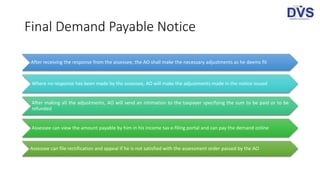
Final Demand Payable Notice
After receiving the response from the assessee, the AO shall make the necessary adjustments as he deems fit
Where no response has been made by the assessee, AO will make the adjustments made in the notice issued
After making all the adjustments, AO will send an intimation to the taxpayer specifying the sum to be paid or to be
refunded
Assessee can view the amount payable by him in his income tax e-filing portal and can pay the demand online
Assessee can file rectification and appeal if he is not satisfied with the assessment order passed by the AO
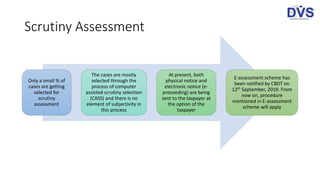
Scrutiny Assessment
Only a small % of
cases are getting
selected for
scrutiny
assessment
The cases are mostly
selected through the
process of computer
assisted scrutiny selection
(CASS) and there is no
element of subjectivity in
this process
At present, both
physical notice and
electronic notice (e-
proceeding) are being
sent to the taxpayer at
the option of the
taxpayer
E-assessment scheme has
been notified by CBDT on
12th September, 2019. From
now on, procedure
mentioned in E-assessment
scheme will apply
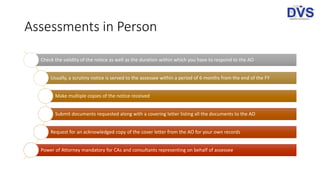
Assessments in Person
Check the validity of the notice as well as the duration within which you have to respond to the AO
Usually, a scrutiny notice is served to the assessee within a period of 6 months from the end of the FY
Make multiple copies of the notice received
Submit documents requested along with a covering letter listing all the documents to the AO
Request for an acknowledged copy of the cover letter from the AO for your own records
Power of Attorney mandatory for CAs and consultants representing on behalf of assessee
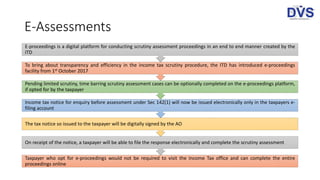
E-Assessments
Taxpayer who opt for e-proceedings would not be required to visit the Income Tax office and can complete the entire
proceedings online
On receipt of the notice, a taxpayer will be able to file the response electronically and complete the scrutiny assessment
The tax notice so issued to the taxpayer will be digitally signed by the AO
Income tax notice for enquiry before assessment under Sec 142(1) will now be issued electronically only in the taxpayers e-
filing account
Pending limited scrutiny, time barring scrutiny assessment cases can be optionally completed on the e-proceedings platform,
if opted for by the taxpayer
To bring about transparency and efficiency in the income tax scrutiny procedure, the ITD has introduced e-proceedings
facility from 1st October 2017
E-proceedings is a digital platform for conducting scrutiny assessment proceedings in an end to end manner created by the
ITD
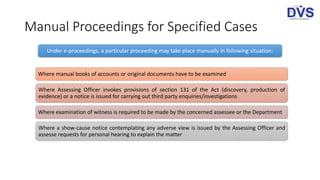
Manual Proceedings for Specified Cases
Under e-proceedings, a particular proceeding may take place manually in following situation:
Where manual books of accounts or original documents have to be examined
Where Assessing Officer invokes provisions of section 131 of the Act (discovery, production of
evidence) or a notice is issued for carrying out third party enquiries/investigations
Where examination of witness is required to be made by the concerned assessee or the Department
Where a show-cause notice contemplating any adverse view is issued by the Assessing Officer and
assesse requests for personal hearing to explain the matter
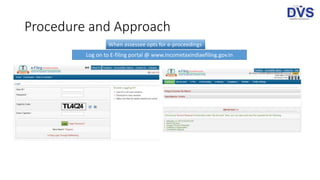
Procedure and Approach
Log on to E-filing portal @ www.incometaxindiaefiling.gov.in
When assessee opts for e-proceedings
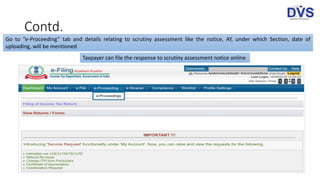
Contd.
Go to “e-Proceeding” tab and details relating to scrutiny assessment like the notice, AY, under which Section, date of
uploading, will be mentioned
Taxpayer can file the response to scrutiny assessment notice online
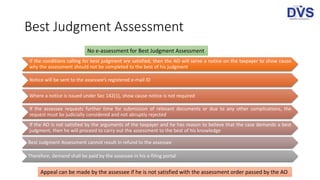
Best Judgment Assessment
If the conditions calling for best judgment are satisfied, then the AO will serve a notice on the taxpayer to show cause
why the assessment should not be completed to the best of his judgment
Notice will be sent to the assessee’s registered e-mail ID
Where a notice is issued under Sec 142(1), show cause notice is not required
If the assessee requests further time for submission of relevant documents or due to any other complications, the
request must be judicially considered and not abruptly rejected
If the AO is not satisfied by the arguments of the taxpayer and he has reason to believe that the case demands a best
judgment, then he will proceed to carry out the assessment to the best of his knowledge
Best Judgment Assessment cannot result in refund to the assessee
Therefore, demand shall be paid by the assessee in his e-filing portal
No e-assessment for Best Judgment Assessment
Appeal can be made by the assessee if he is not satisfied with the assessment order passed by the AO
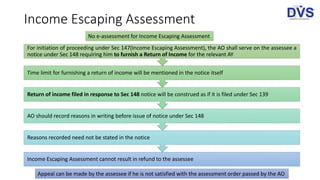
Income Escaping Assessment
Income Escaping Assessment cannot result in refund to the assessee
Reasons recorded need not be stated in the notice
AO should record reasons in writing before issue of notice under Sec 148
Return of income filed in response to Sec 148 notice will be construed as if it is filed under Sec 139
Time limit for furnishing a return of income will be mentioned in the notice itself
For initiation of proceeding under Sec 147(Income Escaping Assessment), the AO shall serve on the assessee a
notice under Sec 148 requiring him to furnish a Return of Income for the relevant AY
No e-assessment for Income Escaping Assessment
Appeal can be made by the assessee if he is not satisfied with the assessment order passed by the AO
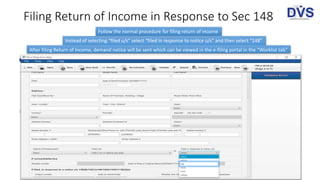
Filing Return of Income in Response to Sec 148
Follow the normal procedure for filing return of income
Instead of selecting “filed u/s” select “filed in response to notice u/s” and then select “148”
After filing Return of Income, demand notice will be sent which can be viewed in the e-filing portal in the “Worklist tab”
Reference to TPO during Assessment
During scrutiny assessment, where AO considers it necessary to refer the case to a transfer pricing Officer (TPO),
he/she may, with the previous approval of the Principal Commissioner or Commissioner, refer the computation of
arm’s length price to a TPO
TPO shall serve a notice to the assesse under Sec 92CA(2) on the assessee requiring him to produce any further
evidence as may be required
TPO shall pass an order in writing determining the arm’s length price for the transaction, after hearing such evidence
produced by assessee and taking into account all relevant materials gathered
Order of the TPO shall be binding on the AO
AO shall compute the total income of assessee based on the arm’s length price determined by the TPO, pass the final
order including the scrutiny assessment for non-TP related issues
Payment of Demand
Demand payable can be viewed by the assessee in his income tax e-filing portal
Assessee must pay the demand within 30 days from the date of issue of notice to avoid further consequences
If not paid within 30 days, then assessee will be deemed to be in default
Penalty will be levied and recovery proceedings will be initiated
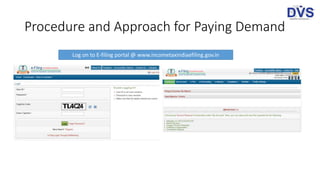
Procedure and Approach for Paying Demand
Log on to E-filing portal @ www.incometaxindiaefiling.gov.in
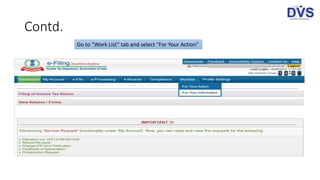
Contd.
Go to “Work List” tab and select “For Your Action”
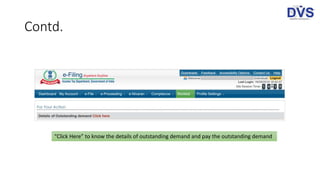
Contd.
“Click Here” to know the details of outstanding demand and pay the outstanding demand
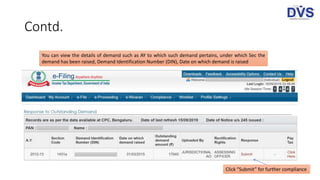
Contd.
You can view the details of demand such as AY to which such demand pertains, under which Sec the
demand has been raised, Demand Identification Number (DIN), Date on which demand is raised
Click “Submit” for further compliance
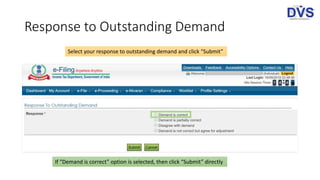
Response to Outstanding Demand
Select your response to outstanding demand and click “Submit”
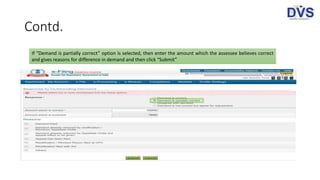
If “Demand is correct” option is selected, then click “Submit” directly
Contd.
If “Demand is partially correct” option is selected, then enter the amount which the assessee believes correct
and gives reasons for difference in demand and then click “Submit”
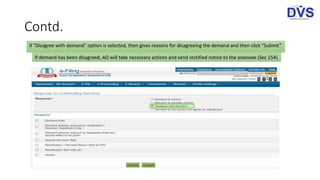
Contd.
If “Disagree with demand” option is selected, then gives reasons for disagreeing the demand and then click “Submit”
If demand has been disagreed, AO will take necessary actions and send rectified notice to the assessee (Sec 154)
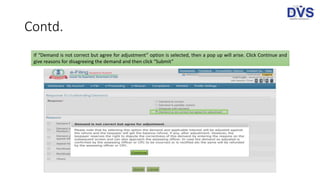
Contd.
If “Demand is not correct but agree for adjustment” option is selected, then a pop up will arise. Click Continue and
give reasons for disagreeing the demand and then click “Submit”
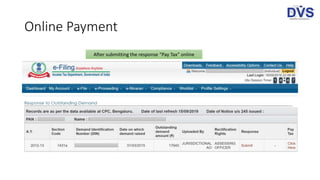
Online Payment
After submitting the response “Pay Tax” online
Filing Grievance
The ITD has launched a special electronic grievance redressal system called 'e-nivaran‘ in 2016 in order to fast track taxpayer
grievances and ensure early resolution of their complaints
‘E-nivaran' acts to integrate all online and physical complaints gathered by the department at this platform which will be
monitored by the AO of the case upto the supervisory officers in a paperless environment
Assessee can file grievance for all types of issues faced by him in his income tax e-filing portal
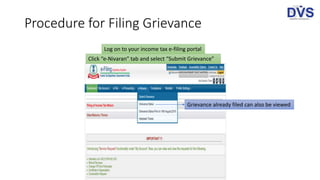
Procedure for Filing Grievance
Click “e-Nivaran” tab and select “Submit Grievance”
Log on to your income tax e-filing portal
Grievance already filed can also be viewed
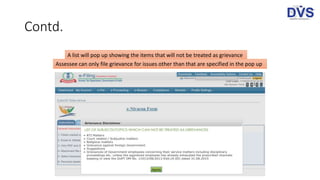
Contd.
A list will pop up showing the items that will not be treated as grievance
Assessee can only file grievance for issues other than that are specified in the pop up
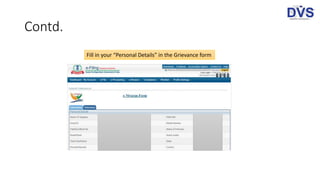
Contd.
Fill in your “Personal Details” in the Grievance form
Contd.
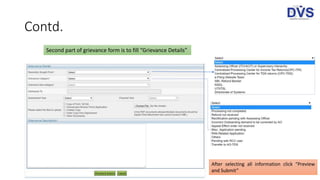
Second part of grievance form is to fill “Grievance Details”
After selecting all information click “Preview
and Submit”
Way Forward
Mandate of e-assessment - E-assessment Scheme notified on 12.09.2019
Summary & Scrutiny Assessments covered but Best Judgement and Income Escaping outside the purview
No geographical barriers
Great opportunity for professionals
Interesting to see bureaucratic attitude towards the initiative
Recomputation, re-assessment and appeals would be challenging for proceedings completed through e-assessment
Thank You
DVS Advisors LLP
India-Singapore-London-Dubai-Malaysia-Africa
www.dvsca.com
Copyrights © 2019 DVS Advisors LLP

Practical issues in various types of assessment

  • 1.
    Practical Issues inVarious Types of Assessments: Procedure and Approach CA. Jugal Gala
  • 2.
  • 3.
    Legends Used inthe Presentation AY Assessment Year ITD Income Tax Department AO Assessing Officer FY Financial Year ITR Income Tax Return TPO Transfer Pricing Officer
  • 4.
    Presentation Schema Assessment Types of Assessment Typesof Return of Income and Due Date for Filing Summary Assessment Scrutiny Assessment Procedure and Approach for Scrutiny Assessment Best Judgment Assessment Income Escaping Assessment Reference to Transfer Pricing Officer Payment of Demand and Response to Outstanding Demand Filing of Grievance Way Forward
  • 5.
    Assessment Every taxpayer hasto furnish the details of his income to the Income-tax Department (ITD) These details are to be furnished by filing up his return of income Once the return of income is filed up by the taxpayer, the next step is the processing of the return of income by the ITD ITD examines the return of income for its genuineness and correctness The process of examining the return of income by the ITD is called as “Assessment”
  • 6.
    Types of Assessment FourMajor Assessment Summary assessment – Sec 143(1) Scrutiny assessment – Sec 143(3) Best Judgement assessment – Sec 144 Income Escaping assessment – Sec 147
  • 7.
    Types of Returnof Income • Filing of Return of Income within specified due dateSec 139 (1) • Filing of Return of Losses within specified due dateSec 139 (3) • Belated Return – to be filed before end of AY or completion of assessment whichever is earlier Sec 139 (4) • Return to be filed by specified institutions and agencies mentioned under Sec 10 if their total income exceeds the Basic Exemption Limit Sec 139 (4C) • Revised Return – Above mentioned returns can be revised before end of AY or completion of assessment whichever is earlier Sec 139 (5) • Notice can issued to assessee to file Return of income, on its failure to furnish, as per Sec 139 Sec 142 (1)
  • 8.
    Due-date for FilingReturn of Income • 30th September of the relevant AYCompanies • 30th September of the relevant AY Person Liable for Audit under Income Tax Act or any other Act • 30th November of the relevant AYLiable for Transfer Pricing • 31st July of the relevant AYOthers
  • 9.
    Summary Assessment Assessee willreceive notice on his registered e-mail id Assessee has to duly check the notice Whether the following basic details are correct or not • Name • PAN • A Y • Issuing Officer & Designation • Document Identification Number
  • 10.
    Intimation under SummaryAssessment Mostly, summary assessment notice is received by salaried taxpayers and assessees who are engaged in small and medium sized business • Any arithmetical error in the return (e.g. error in applying rate of tax, calculation of relief, etc.)Arithmetical error • The most common issue with returns filed is often a mismatch in the TDS amounts • Sometimes employer or deductor may have delayed or made a mistake in filing their TDS returns TDS Amount Error • Assessee may have forgotten to declare some incomes, like Interest from Fixed Deposits, available in Form 26AS • Assessee may have claimed a deduction under the wrong section • Assessee may have provided incomplete information Discrepancy in Return Filed by you
  • 11.
    Discrepancy in theReturn Filed Figure out the discrepancy between returned income and assessed income If a particular row shows different amounts in these two columns, that’s source of your discrepancy Assessee must respond to this intimation within 30 days from the date of issue of notice either by accepting such discrepancy or stating reasons for not accepting such discrepancy
  • 12.
    Final Demand PayableNotice After receiving the response from the assessee, the AO shall make the necessary adjustments as he deems fit Where no response has been made by the assessee, AO will make the adjustments made in the notice issued After making all the adjustments, AO will send an intimation to the taxpayer specifying the sum to be paid or to be refunded Assessee can view the amount payable by him in his income tax e-filing portal and can pay the demand online Assessee can file rectification and appeal if he is not satisfied with the assessment order passed by the AO
  • 13.
    Scrutiny Assessment Only asmall % of cases are getting selected for scrutiny assessment The cases are mostly selected through the process of computer assisted scrutiny selection (CASS) and there is no element of subjectivity in this process At present, both physical notice and electronic notice (e- proceeding) are being sent to the taxpayer at the option of the taxpayer E-assessment scheme has been notified by CBDT on 12th September, 2019. From now on, procedure mentioned in E-assessment scheme will apply
  • 14.
    Assessments in Person Checkthe validity of the notice as well as the duration within which you have to respond to the AO Usually, a scrutiny notice is served to the assessee within a period of 6 months from the end of the FY Make multiple copies of the notice received Submit documents requested along with a covering letter listing all the documents to the AO Request for an acknowledged copy of the cover letter from the AO for your own records Power of Attorney mandatory for CAs and consultants representing on behalf of assessee
  • 15.
    E-Assessments Taxpayer who optfor e-proceedings would not be required to visit the Income Tax office and can complete the entire proceedings online On receipt of the notice, a taxpayer will be able to file the response electronically and complete the scrutiny assessment The tax notice so issued to the taxpayer will be digitally signed by the AO Income tax notice for enquiry before assessment under Sec 142(1) will now be issued electronically only in the taxpayers e- filing account Pending limited scrutiny, time barring scrutiny assessment cases can be optionally completed on the e-proceedings platform, if opted for by the taxpayer To bring about transparency and efficiency in the income tax scrutiny procedure, the ITD has introduced e-proceedings facility from 1st October 2017 E-proceedings is a digital platform for conducting scrutiny assessment proceedings in an end to end manner created by the ITD
  • 16.
    Manual Proceedings forSpecified Cases Under e-proceedings, a particular proceeding may take place manually in following situation: Where manual books of accounts or original documents have to be examined Where Assessing Officer invokes provisions of section 131 of the Act (discovery, production of evidence) or a notice is issued for carrying out third party enquiries/investigations Where examination of witness is required to be made by the concerned assessee or the Department Where a show-cause notice contemplating any adverse view is issued by the Assessing Officer and assesse requests for personal hearing to explain the matter
  • 17.
    Procedure and Approach Logon to E-filing portal @ www.incometaxindiaefiling.gov.in When assessee opts for e-proceedings
  • 18.
    Contd. Go to “e-Proceeding”tab and details relating to scrutiny assessment like the notice, AY, under which Section, date of uploading, will be mentioned Taxpayer can file the response to scrutiny assessment notice online
  • 19.
    Best Judgment Assessment Ifthe conditions calling for best judgment are satisfied, then the AO will serve a notice on the taxpayer to show cause why the assessment should not be completed to the best of his judgment Notice will be sent to the assessee’s registered e-mail ID Where a notice is issued under Sec 142(1), show cause notice is not required If the assessee requests further time for submission of relevant documents or due to any other complications, the request must be judicially considered and not abruptly rejected If the AO is not satisfied by the arguments of the taxpayer and he has reason to believe that the case demands a best judgment, then he will proceed to carry out the assessment to the best of his knowledge Best Judgment Assessment cannot result in refund to the assessee Therefore, demand shall be paid by the assessee in his e-filing portal No e-assessment for Best Judgment Assessment Appeal can be made by the assessee if he is not satisfied with the assessment order passed by the AO
  • 20.
    Income Escaping Assessment IncomeEscaping Assessment cannot result in refund to the assessee Reasons recorded need not be stated in the notice AO should record reasons in writing before issue of notice under Sec 148 Return of income filed in response to Sec 148 notice will be construed as if it is filed under Sec 139 Time limit for furnishing a return of income will be mentioned in the notice itself For initiation of proceeding under Sec 147(Income Escaping Assessment), the AO shall serve on the assessee a notice under Sec 148 requiring him to furnish a Return of Income for the relevant AY No e-assessment for Income Escaping Assessment Appeal can be made by the assessee if he is not satisfied with the assessment order passed by the AO
  • 21.
    Filing Return ofIncome in Response to Sec 148 Follow the normal procedure for filing return of income Instead of selecting “filed u/s” select “filed in response to notice u/s” and then select “148” After filing Return of Income, demand notice will be sent which can be viewed in the e-filing portal in the “Worklist tab”
  • 22.
    Reference to TPOduring Assessment During scrutiny assessment, where AO considers it necessary to refer the case to a transfer pricing Officer (TPO), he/she may, with the previous approval of the Principal Commissioner or Commissioner, refer the computation of arm’s length price to a TPO TPO shall serve a notice to the assesse under Sec 92CA(2) on the assessee requiring him to produce any further evidence as may be required TPO shall pass an order in writing determining the arm’s length price for the transaction, after hearing such evidence produced by assessee and taking into account all relevant materials gathered Order of the TPO shall be binding on the AO AO shall compute the total income of assessee based on the arm’s length price determined by the TPO, pass the final order including the scrutiny assessment for non-TP related issues
  • 23.
    Payment of Demand Demandpayable can be viewed by the assessee in his income tax e-filing portal Assessee must pay the demand within 30 days from the date of issue of notice to avoid further consequences If not paid within 30 days, then assessee will be deemed to be in default Penalty will be levied and recovery proceedings will be initiated
  • 24.
    Procedure and Approachfor Paying Demand Log on to E-filing portal @ www.incometaxindiaefiling.gov.in
  • 25.
    Contd. Go to “WorkList” tab and select “For Your Action”
  • 26.
    Contd. “Click Here” toknow the details of outstanding demand and pay the outstanding demand
  • 27.
    Contd. You can viewthe details of demand such as AY to which such demand pertains, under which Sec the demand has been raised, Demand Identification Number (DIN), Date on which demand is raised Click “Submit” for further compliance
  • 28.
    Response to OutstandingDemand Select your response to outstanding demand and click “Submit” If “Demand is correct” option is selected, then click “Submit” directly
  • 29.
    Contd. If “Demand ispartially correct” option is selected, then enter the amount which the assessee believes correct and gives reasons for difference in demand and then click “Submit”
  • 30.
    Contd. If “Disagree withdemand” option is selected, then gives reasons for disagreeing the demand and then click “Submit” If demand has been disagreed, AO will take necessary actions and send rectified notice to the assessee (Sec 154)
  • 31.
    Contd. If “Demand isnot correct but agree for adjustment” option is selected, then a pop up will arise. Click Continue and give reasons for disagreeing the demand and then click “Submit”
  • 32.
    Online Payment After submittingthe response “Pay Tax” online
  • 33.
    Filing Grievance The ITDhas launched a special electronic grievance redressal system called 'e-nivaran‘ in 2016 in order to fast track taxpayer grievances and ensure early resolution of their complaints ‘E-nivaran' acts to integrate all online and physical complaints gathered by the department at this platform which will be monitored by the AO of the case upto the supervisory officers in a paperless environment Assessee can file grievance for all types of issues faced by him in his income tax e-filing portal
  • 34.
    Procedure for FilingGrievance Click “e-Nivaran” tab and select “Submit Grievance” Log on to your income tax e-filing portal Grievance already filed can also be viewed
  • 35.
    Contd. A list willpop up showing the items that will not be treated as grievance Assessee can only file grievance for issues other than that are specified in the pop up
  • 36.
    Contd. Fill in your“Personal Details” in the Grievance form
  • 37.
    Contd. Second part ofgrievance form is to fill “Grievance Details” After selecting all information click “Preview and Submit”
  • 38.
    Way Forward Mandate ofe-assessment - E-assessment Scheme notified on 12.09.2019 Summary & Scrutiny Assessments covered but Best Judgement and Income Escaping outside the purview No geographical barriers Great opportunity for professionals Interesting to see bureaucratic attitude towards the initiative Recomputation, re-assessment and appeals would be challenging for proceedings completed through e-assessment
  • 39.
    Thank You DVS AdvisorsLLP India-Singapore-London-Dubai-Malaysia-Africa www.dvsca.com Copyrights © 2019 DVS Advisors LLP