SECRETARIAL AUDIT
Section 204 of the Companies Act, 2013
Gajendra Singh Sengar
csgajendrasengar@gmail.com
INTRODUCTION
 Secretarial Audit is a process of checking and verifying the records
and documents of the company and to check whether the company
is in compliance with the provisions of Companies Act, 2013 and
other applicable laws.
 The Secretarial Audit Report aims at confirming compliance by the
company with all the applicable provisions of the applicable laws
and pointing out non-compliances and recommendations for better
compliance.
 The compliances are verified and checked by an independent
professional [a company secretary in practice] to ensure that the
company has complied with all the legal, secretarial and procedural
requirements as required under various applicable laws.
NEED FOR SECRETARIAL AUDIT
Multiplicity and complexity of laws - Secretarial
audit facilitates to ensure compliance and avoid
risk associated with non-compliance. It has two-
fold objective:
• Firstly, to protect the interests of the customers,
employees, revenue, environment, directors and officers
of the company.
• Secondly, to avoid any unwarranted legal actions by the
law-enforcing agencies and other persons as well.
SECTION 204 - SECRETARIAL AUDIT FOR BIGGER
COMPANIES
 Section 204 of the Companies Act, 2013 read with the
Companies (Appointment and Remuneration of
Managerial Personnel) Rules, 2014, provides that:
(a) Every Listed Company;
(b) Every Public Company having a paid up share capital of
fifty crore rupees or more; and
(c) Every public company having a turnover of two hundred
fifty crore rupees or more
shall annex with its Board’s Report, a Secretarial Audit
Report, given by a Company Secretary in Practice, in
Form MR- 3.
FORM MR-3
SECRETARIAL AUDIT REPORT
FOR THE FINANCIAL YEAR ENDED … … …
[Pursuant to section 204(1) of the Companies Act, 2013 and rule No.9 of the
Companies (Appointment and Remuneration Personnel) Rules, 2014]
To,
The Members,
……….… Limited
I/We have conducted the secretarial audit of the compliance of
applicable statutory provisions and the adherence to good
corporate practices by……. (name of the company).(hereinafter
called the company). Secretarial Audit was conducted in a manner
that provided me/us a reasonable basis for evaluating the corporate
conducts/statutory compliances and expressing my opinion thereon.
Based on my/our verification of the .....………………………….. (name of the
company’s) books, papers, minute books, forms and returns filed and other
records maintained by the company and also the information provided by the
Company, its officers, agents and authorized representatives during the
conduct of secretarial audit, I/We hereby report that in my/our opinion, the
company has, during the audit period covering the financial year ended on
_____, _____ complied with the statutory provisions listed hereunder and also
that the Company has proper Board-processes and compliance-mechanism in
place to the extent, in the manner and subject to the reporting made
hereinafter:
I/we have examined the books, papers, minute books, forms and returns filed
and other records maintained by ………….. (“the Company”) for the financial
year ended on __, ______ according to the provisions of:
(i) The Companies Act, 2013 (the Act) and the rules made thereunder;
(ii) The Securities Contracts (Regulation) Act, 1956 (‘SCRA’) and the rules
made thereunder;
(iii) The Depositories Act, 1996 and the Regulations and Bye-laws framed
thereunder;
(iv) Foreign Exchange Management Act, 1999 and the rules and regulations made
thereunder to the extent of Foreign Direct Investment, Overseas Direct Investment
and External Commercial Borrowings;
(v) The following Regulations and Guidelines prescribed under the Securities and
Exchange Board of India Act, 1992 (‘SEBI Act’):-
(a) The Securities and Exchange Board of India (Substantial Acquisition of
Shares and Takeovers) Regulations, 2011;
(b) The Securities and Exchange Board of India (Prohibition of Insider
Trading) Regulations, 1992;
(c) The Securities and Exchange Board of India (Issue of Capital and
Disclosure Requirements) Regulations, 2009;
(d) The Securities and Exchange Board of India (Employee Stock Option
Scheme and Employee Stock Purchase Scheme) Guidelines, 1999;
(e) The Securities and Exchange Board of India (Issue and Listing of Debt
Securities) Regulations, 2008;
(f) The Securities and Exchange Board of India (Registrars to an 12 Issue
and Share Transfer Agents) Regulations, 1993 regarding the Companies
Act and dealing with client;
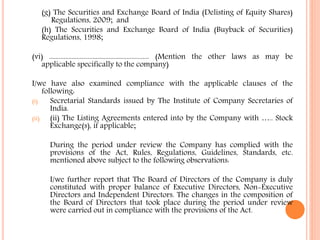
(g) The Securities and Exchange Board of India (Delisting of Equity Shares)
Regulations, 2009; and
(h) The Securities and Exchange Board of India (Buyback of Securities)
Regulations, 1998;
(vi) .............................................................. (Mention the other laws as may be
applicable specifically to the company)
I/we have also examined compliance with the applicable clauses of the
following:
(i) Secretarial Standards issued by The Institute of Company Secretaries of
India.
(ii) (ii) The Listing Agreements entered into by the Company with ….. Stock
Exchange(s), if applicable;
During the period under review the Company has complied with the
provisions of the Act, Rules, Regulations, Guidelines, Standards, etc.
mentioned above subject to the following observations:
I/we further report that The Board of Directors of the Company is duly
constituted with proper balance of Executive Directors, Non-Executive
Directors and Independent Directors. The changes in the composition of
the Board of Directors that took place during the period under review
were carried out in compliance with the provisions of the Act.
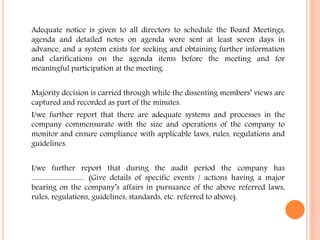
Adequate notice is given to all directors to schedule the Board Meetings,
agenda and detailed notes on agenda were sent at least seven days in
advance, and a system exists for seeking and obtaining further information
and clarifications on the agenda items before the meeting and for
meaningful participation at the meeting.
Majority decision is carried through while the dissenting members’ views are
captured and recorded as part of the minutes.
I/we further report that there are adequate systems and processes in the
company commensurate with the size and operations of the company to
monitor and ensure compliance with applicable laws, rules, regulations and
guidelines.
I/we further report that during the audit period the company has
................................. (Give details of specific events / actions having a major
bearing on the company’s affairs in pursuance of the above referred laws,
rules, regulations, guidelines, standards, etc. referred to above).
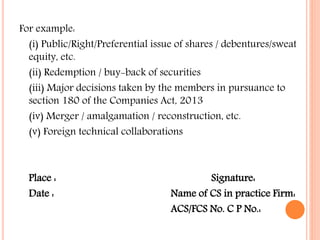
For example:
(i) Public/Right/Preferential issue of shares / debentures/sweat
equity, etc.
(ii) Redemption / buy-back of securities
(iii) Major decisions taken by the members in pursuance to
section 180 of the Companies Act, 2013
(iv) Merger / amalgamation / reconstruction, etc.
(v) Foreign technical collaborations
Place : Signature:
Date : Name of CS in practice Firm:
ACS/FCS No. C P No.:
APPOINTMENT OF SECRETARIAL AUDITOR
 The Secretarial Auditor would be required to be appointed in the
board meeting of the Company and the remuneration of the Auditor
will also be determined in the aforementioned board meeting
[Section 179(3)].
 Company is required to file the certified true copy of the resolution
passed in the aforementioned board meeting with the Registrar of
Companies as an attachment in e-form MGT – 14.
 However, prior to the appointment, the Company would be
required to obtain the consent of the Secretarial Auditor.
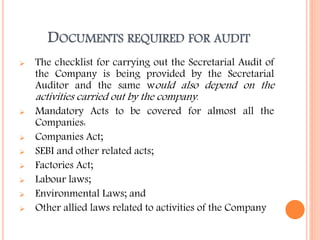
DOCUMENTS REQUIRED FOR AUDIT
 The checklist for carrying out the Secretarial Audit of
the Company is being provided by the Secretarial
Auditor and the same would also depend on the
activities carried out by the company.
 Mandatory Acts to be covered for almost all the
Companies:
 Companies Act;
 SEBI and other related acts;
 Factories Act;
 Labour laws;
 Environmental Laws; and
 Other allied laws related to activities of the Company
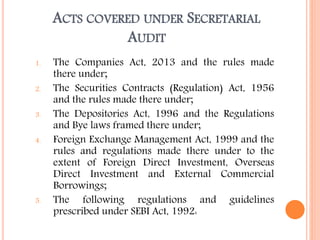
ACTS COVERED UNDER SECRETARIAL
AUDIT
1. The Companies Act, 2013 and the rules made
there under;
2. The Securities Contracts (Regulation) Act, 1956
and the rules made there under;
3. The Depositories Act, 1996 and the Regulations
and Bye laws framed there under;
4. Foreign Exchange Management Act, 1999 and the
rules and regulations made there under to the
extent of Foreign Direct Investment, Overseas
Direct Investment and External Commercial
Borrowings;
5. The following regulations and guidelines
prescribed under SEBI Act, 1992:
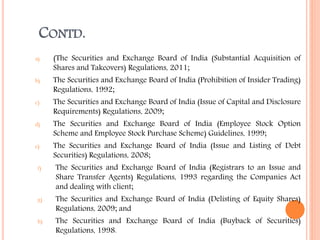
CONTD.
a) (The Securities and Exchange Board of India (Substantial Acquisition of
Shares and Takeovers) Regulations, 2011;
b) The Securities and Exchange Board of India (Prohibition of Insider Trading)
Regulations, 1992;
c) The Securities and Exchange Board of India (Issue of Capital and Disclosure
Requirements) Regulations, 2009;
d) The Securities and Exchange Board of India (Employee Stock Option
Scheme and Employee Stock Purchase Scheme) Guidelines, 1999;
e) The Securities and Exchange Board of India (Issue and Listing of Debt
Securities) Regulations, 2008;
f) The Securities and Exchange Board of India (Registrars to an Issue and
Share Transfer Agents) Regulations, 1993 regarding the Companies Act
and dealing with client;
g) The Securities and Exchange Board of India (Delisting of Equity Shares)
Regulations, 2009; and
h) The Securities and Exchange Board of India (Buyback of Securities)
Regulations, 1998.
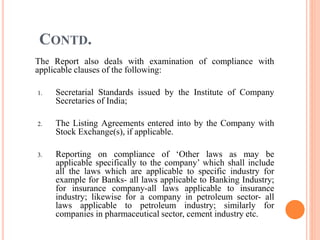
CONTD.
The Report also deals with examination of compliance with
applicable clauses of the following:
1. Secretarial Standards issued by the Institute of Company
Secretaries of India;
2. The Listing Agreements entered into by the Company with
Stock Exchange(s), if applicable.
3. Reporting on compliance of ‘Other laws as may be
applicable specifically to the company’ which shall include
all the laws which are applicable to specific industry for
example for Banks- all laws applicable to Banking Industry;
for insurance company-all laws applicable to insurance
industry; likewise for a company in petroleum sector- all
laws applicable to petroleum industry; similarly for
companies in pharmaceutical sector, cement industry etc.
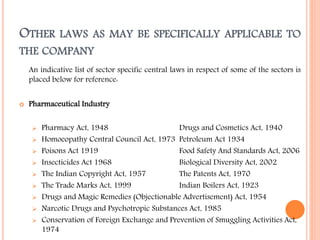
OTHER LAWS AS MAY BE SPECIFICALLY APPLICABLE TO
THE COMPANY
An indicative list of sector specific central laws in respect of some of the sectors is
placed below for reference:
 Pharmaceutical Industry
 Pharmacy Act, 1948 Drugs and Cosmetics Act, 1940
 Homoeopathy Central Council Act, 1973 Petroleum Act 1934
 Poisons Act 1919 Food Safety And Standards Act, 2006
 Insecticides Act 1968 Biological Diversity Act, 2002
 The Indian Copyright Act, 1957 The Patents Act, 1970
 The Trade Marks Act, 1999 Indian Boilers Act, 1923
 Drugs and Magic Remedies (Objectionable Advertisement) Act, 1954
 Narcotic Drugs and Psychotropic Substances Act, 1985
 Conservation of Foreign Exchange and Prevention of Smuggling Activities Act,
1974
CONTD.
 POWER
 The Electricity Act, 2003
 National Tariff Policy
 Essential Commodities Act, 1955
 Explosives Act, 1884
 Indian Boilers Act, 1923
 Mines Act, 1952 (wherever applicable)
 Mines and Mineral (Regulation and Development) Act, 1957
(wherever applicable)
the list provide is indicative only and not exhaustive. The list for
other sector specific central laws can be provided as and when
required by the client.
BENEFITS OF SECRETARIAL AUDIT
 Secretarial Audit can be an effective due diligence exercise for the prospective
acquirer of a company or controlling interest or a joint venture partner.
 It assures the owners and the management that the affairs of the company are
being conducted in accordance with requirements of laws and that the owners
stake is not being exposed to undue risk.
 It ensures the management of a company that those who are charged with the duty
and responsibility of compliance with the requirements of law are performing
their duties competently, effectively and efficiently, so that the people in charge of
the day-to-day management of the company are not likely to be exposed to penal
or other liability (and consequential risk and embarrassment) on account of non
compliance with law.
 It ensures them that they have done everything required under law and that the
company had complied with the laws and therefore, they are not likely to be
exposed to action by law enforcement agencies for non compliance by the
company.
 The Secretarial audit can assist bodies like SEBI, Stock Exchange, Financial
Institutions, banks etc., to gauge or measure the levels of compliance and non
compliance by the companies with whom they are concerned.
AN EFFECTIVE TOOL FOR EFFICIENT CORPORATE
COMPLIANCE MANAGEMENT
 The SA is an effective tool for corporate law
compliance management relating to corporate
laws. It helps ensure flawless compliance and
timely corrective action when non-compliance
is discovered.
 The benefits of SA are manifold, and its
beneficiaries are many, including promoters,
directors, investors, lenders, employees,
Government and government agencies, and the
last but not least, the public at large.
DUTIES OF SECRETARIAL AUDITOR – FRAUD
REPORTING [SEC 143(12)(14)]
 If Company Secretary in Practice, during conduct of Secretarial Audit,
has sufficient reason to believe that an offence involving fraud is being
committed or has been committed against the company by officers or
employees of the company, he shall report the same to the Central
Government immediately but not later than 60 days of his knowledge
with a copy to the Board / Audit Committee seeking their reply within 45
days;
 Board / Audit Committee to reply in writing the steps taken to address
the fraud;
 The Auditor to forward his report and reply of the Board / Audit
Committee with his Comments to the Central Government within 15
days of reply by Board / Audit Committee;
 The Report shall be in Form ADT – 4.
 Penalty – 1 lakh to 25 Lakh in case of default in complying of this
section.
PENALTY FOR NON-COMPLIANCE
 If the company or any officer of the company or the
company secretary in practice, contravenes any
provisions of the Section 204 then the Company and
every officer of the Company or the Company Secretary
in practice who is default, shall be punishable with fine
which shall not be less than 1,00,000 (One Lakh Only)
but which may extend to 5,00,000 (Five Lakh Rupees).
PUNISHMENT FOR FRAUD (SEC 447)
 Section 447 states that without prejudice to any liability including for
repayment of any debt under the Companies Act, 2013, or any other law for
the time being in force, any person who is found guilty of fraud, shall be
punishable with imprisonment for a term which shall not be less than six
months but which may extend to ten years and shall also be liable to fine
which shall not be less than the amount involved in the fraud but which may
extend to three times the amount involved in fraud
 The Section further states that where the fraud in question involves public
interest, the term of imprisonment shall not be less than three years.
 Fraud in relation to affairs of a company or any body corporate, includes any
act, omission, concealment of any fact or abuse of position committed by any
person or any other person with the connivance in any manner, with intent to
deceive, to gain undue advantage from, or to injure the interests of, the
company or its shareholders or its creditors or any other person, whether or
not there is any wrongful gain or wrongful loss.
PUNISHMENT FOR FALSE STATEMENT (SEC 448)
Section 448 states that, save as otherwise provided in the
Companies Act, 2013, if in any return, certificate, financial
statement, prospectus, statement or other document required by
the Act or Rules made there under, any person makes a
statement:
(a) which is false in any material particulars, knowing it to be
false; or
(b) which omits any material fact, knowing it to be material,
then such person shall be liable for punishment under Section
447 of the Companies Act, 2013.
CONCLUSION:
 Even though the Secretarial Audit is not mandatory for
private companies and small public companies, all these
companies should voluntarily adopt the practice of
annual secretarial audit to ensure compliance and avoid
the risks associated with non compliance. However its
scope is entirely a management’s decision. Prevention is
better than cure. It strengthens the image and goodwill
of a company in the minds of regulators and
stakeholders. It is an effective compliance risk
management tool. It is a governance tool. The benefits
are available to promoters, executive directors and
officers of the company, regulators, government
authorities, investors, financial institutions, banks,
creditors and consumers alike.
CERTIFICATIN OF ANNUAL
RETURN
Section 92(1) of the Companies Act, 2013
Gajendra Singh Sengar
csgajendrasengar@gmail.com
As per Section 92 (1) read with Rule 11 of Companies
(Management and administration) Rules, 2014, The
Annual Return of every listed Company and Companies
having:
 Paid-up capital of Rs. 10 Crore or more;
 Turnover of Rs. 50 Crore or more.
Shall be certified by a Company Secretary in
practice in Form MGT-8, stating that the Annual Return
discloses the facts correctly and adequately and that the
Company has complied with all the provisions of
Companies Act
PENALTY FOR NON-COMPLIANCE
 If the company secretary in practice certifies the Annual
Return otherwise than in conformity with the
Companies Act, then he shall be punishable with fine
which shall not be less than Rs. 50,000/- (Fifty thousand
Rupees) but which may extend to 5,00,000 (Five Lakh
Rupees).
CONTACT US
CS GAJENDRA SINGH SENGAR
Contact No.: 92296-26069
Email:
csgajendrasengar@gmail.com
THANK YOU

Secretarial Audit

  • 1.
    SECRETARIAL AUDIT Section 204of the Companies Act, 2013 Gajendra Singh Sengar csgajendrasengar@gmail.com
  • 2.
    INTRODUCTION  Secretarial Auditis a process of checking and verifying the records and documents of the company and to check whether the company is in compliance with the provisions of Companies Act, 2013 and other applicable laws.  The Secretarial Audit Report aims at confirming compliance by the company with all the applicable provisions of the applicable laws and pointing out non-compliances and recommendations for better compliance.  The compliances are verified and checked by an independent professional [a company secretary in practice] to ensure that the company has complied with all the legal, secretarial and procedural requirements as required under various applicable laws.
  • 3.
    NEED FOR SECRETARIALAUDIT Multiplicity and complexity of laws - Secretarial audit facilitates to ensure compliance and avoid risk associated with non-compliance. It has two- fold objective: • Firstly, to protect the interests of the customers, employees, revenue, environment, directors and officers of the company. • Secondly, to avoid any unwarranted legal actions by the law-enforcing agencies and other persons as well.
  • 4.
    SECTION 204 -SECRETARIAL AUDIT FOR BIGGER COMPANIES  Section 204 of the Companies Act, 2013 read with the Companies (Appointment and Remuneration of Managerial Personnel) Rules, 2014, provides that: (a) Every Listed Company; (b) Every Public Company having a paid up share capital of fifty crore rupees or more; and (c) Every public company having a turnover of two hundred fifty crore rupees or more shall annex with its Board’s Report, a Secretarial Audit Report, given by a Company Secretary in Practice, in Form MR- 3.
  • 5.
    FORM MR-3 SECRETARIAL AUDITREPORT FOR THE FINANCIAL YEAR ENDED … … … [Pursuant to section 204(1) of the Companies Act, 2013 and rule No.9 of the Companies (Appointment and Remuneration Personnel) Rules, 2014] To, The Members, ……….… Limited I/We have conducted the secretarial audit of the compliance of applicable statutory provisions and the adherence to good corporate practices by……. (name of the company).(hereinafter called the company). Secretarial Audit was conducted in a manner that provided me/us a reasonable basis for evaluating the corporate conducts/statutory compliances and expressing my opinion thereon.
  • 6.
    Based on my/ourverification of the .....………………………….. (name of the company’s) books, papers, minute books, forms and returns filed and other records maintained by the company and also the information provided by the Company, its officers, agents and authorized representatives during the conduct of secretarial audit, I/We hereby report that in my/our opinion, the company has, during the audit period covering the financial year ended on _____, _____ complied with the statutory provisions listed hereunder and also that the Company has proper Board-processes and compliance-mechanism in place to the extent, in the manner and subject to the reporting made hereinafter: I/we have examined the books, papers, minute books, forms and returns filed and other records maintained by ………….. (“the Company”) for the financial year ended on __, ______ according to the provisions of: (i) The Companies Act, 2013 (the Act) and the rules made thereunder; (ii) The Securities Contracts (Regulation) Act, 1956 (‘SCRA’) and the rules made thereunder; (iii) The Depositories Act, 1996 and the Regulations and Bye-laws framed thereunder;
  • 7.
    (iv) Foreign ExchangeManagement Act, 1999 and the rules and regulations made thereunder to the extent of Foreign Direct Investment, Overseas Direct Investment and External Commercial Borrowings; (v) The following Regulations and Guidelines prescribed under the Securities and Exchange Board of India Act, 1992 (‘SEBI Act’):- (a) The Securities and Exchange Board of India (Substantial Acquisition of Shares and Takeovers) Regulations, 2011; (b) The Securities and Exchange Board of India (Prohibition of Insider Trading) Regulations, 1992; (c) The Securities and Exchange Board of India (Issue of Capital and Disclosure Requirements) Regulations, 2009; (d) The Securities and Exchange Board of India (Employee Stock Option Scheme and Employee Stock Purchase Scheme) Guidelines, 1999; (e) The Securities and Exchange Board of India (Issue and Listing of Debt Securities) Regulations, 2008; (f) The Securities and Exchange Board of India (Registrars to an 12 Issue and Share Transfer Agents) Regulations, 1993 regarding the Companies Act and dealing with client;
  • 8.
    (g) The Securitiesand Exchange Board of India (Delisting of Equity Shares) Regulations, 2009; and (h) The Securities and Exchange Board of India (Buyback of Securities) Regulations, 1998; (vi) .............................................................. (Mention the other laws as may be applicable specifically to the company) I/we have also examined compliance with the applicable clauses of the following: (i) Secretarial Standards issued by The Institute of Company Secretaries of India. (ii) (ii) The Listing Agreements entered into by the Company with ….. Stock Exchange(s), if applicable; During the period under review the Company has complied with the provisions of the Act, Rules, Regulations, Guidelines, Standards, etc. mentioned above subject to the following observations: I/we further report that The Board of Directors of the Company is duly constituted with proper balance of Executive Directors, Non-Executive Directors and Independent Directors. The changes in the composition of the Board of Directors that took place during the period under review were carried out in compliance with the provisions of the Act.
  • 9.
    Adequate notice isgiven to all directors to schedule the Board Meetings, agenda and detailed notes on agenda were sent at least seven days in advance, and a system exists for seeking and obtaining further information and clarifications on the agenda items before the meeting and for meaningful participation at the meeting. Majority decision is carried through while the dissenting members’ views are captured and recorded as part of the minutes. I/we further report that there are adequate systems and processes in the company commensurate with the size and operations of the company to monitor and ensure compliance with applicable laws, rules, regulations and guidelines. I/we further report that during the audit period the company has ................................. (Give details of specific events / actions having a major bearing on the company’s affairs in pursuance of the above referred laws, rules, regulations, guidelines, standards, etc. referred to above).
  • 10.
    For example: (i) Public/Right/Preferentialissue of shares / debentures/sweat equity, etc. (ii) Redemption / buy-back of securities (iii) Major decisions taken by the members in pursuance to section 180 of the Companies Act, 2013 (iv) Merger / amalgamation / reconstruction, etc. (v) Foreign technical collaborations Place : Signature: Date : Name of CS in practice Firm: ACS/FCS No. C P No.:
  • 11.
    APPOINTMENT OF SECRETARIALAUDITOR  The Secretarial Auditor would be required to be appointed in the board meeting of the Company and the remuneration of the Auditor will also be determined in the aforementioned board meeting [Section 179(3)].  Company is required to file the certified true copy of the resolution passed in the aforementioned board meeting with the Registrar of Companies as an attachment in e-form MGT – 14.  However, prior to the appointment, the Company would be required to obtain the consent of the Secretarial Auditor.
  • 12.
    DOCUMENTS REQUIRED FORAUDIT  The checklist for carrying out the Secretarial Audit of the Company is being provided by the Secretarial Auditor and the same would also depend on the activities carried out by the company.  Mandatory Acts to be covered for almost all the Companies:  Companies Act;  SEBI and other related acts;  Factories Act;  Labour laws;  Environmental Laws; and  Other allied laws related to activities of the Company
  • 13.
    ACTS COVERED UNDERSECRETARIAL AUDIT 1. The Companies Act, 2013 and the rules made there under; 2. The Securities Contracts (Regulation) Act, 1956 and the rules made there under; 3. The Depositories Act, 1996 and the Regulations and Bye laws framed there under; 4. Foreign Exchange Management Act, 1999 and the rules and regulations made there under to the extent of Foreign Direct Investment, Overseas Direct Investment and External Commercial Borrowings; 5. The following regulations and guidelines prescribed under SEBI Act, 1992:
  • 14.
    CONTD. a) (The Securitiesand Exchange Board of India (Substantial Acquisition of Shares and Takeovers) Regulations, 2011; b) The Securities and Exchange Board of India (Prohibition of Insider Trading) Regulations, 1992; c) The Securities and Exchange Board of India (Issue of Capital and Disclosure Requirements) Regulations, 2009; d) The Securities and Exchange Board of India (Employee Stock Option Scheme and Employee Stock Purchase Scheme) Guidelines, 1999; e) The Securities and Exchange Board of India (Issue and Listing of Debt Securities) Regulations, 2008; f) The Securities and Exchange Board of India (Registrars to an Issue and Share Transfer Agents) Regulations, 1993 regarding the Companies Act and dealing with client; g) The Securities and Exchange Board of India (Delisting of Equity Shares) Regulations, 2009; and h) The Securities and Exchange Board of India (Buyback of Securities) Regulations, 1998.
  • 15.
    CONTD. The Report alsodeals with examination of compliance with applicable clauses of the following: 1. Secretarial Standards issued by the Institute of Company Secretaries of India; 2. The Listing Agreements entered into by the Company with Stock Exchange(s), if applicable. 3. Reporting on compliance of ‘Other laws as may be applicable specifically to the company’ which shall include all the laws which are applicable to specific industry for example for Banks- all laws applicable to Banking Industry; for insurance company-all laws applicable to insurance industry; likewise for a company in petroleum sector- all laws applicable to petroleum industry; similarly for companies in pharmaceutical sector, cement industry etc.
  • 16.
    OTHER LAWS ASMAY BE SPECIFICALLY APPLICABLE TO THE COMPANY An indicative list of sector specific central laws in respect of some of the sectors is placed below for reference:  Pharmaceutical Industry  Pharmacy Act, 1948 Drugs and Cosmetics Act, 1940  Homoeopathy Central Council Act, 1973 Petroleum Act 1934  Poisons Act 1919 Food Safety And Standards Act, 2006  Insecticides Act 1968 Biological Diversity Act, 2002  The Indian Copyright Act, 1957 The Patents Act, 1970  The Trade Marks Act, 1999 Indian Boilers Act, 1923  Drugs and Magic Remedies (Objectionable Advertisement) Act, 1954  Narcotic Drugs and Psychotropic Substances Act, 1985  Conservation of Foreign Exchange and Prevention of Smuggling Activities Act, 1974
  • 17.
    CONTD.  POWER  TheElectricity Act, 2003  National Tariff Policy  Essential Commodities Act, 1955  Explosives Act, 1884  Indian Boilers Act, 1923  Mines Act, 1952 (wherever applicable)  Mines and Mineral (Regulation and Development) Act, 1957 (wherever applicable) the list provide is indicative only and not exhaustive. The list for other sector specific central laws can be provided as and when required by the client.
  • 18.
    BENEFITS OF SECRETARIALAUDIT  Secretarial Audit can be an effective due diligence exercise for the prospective acquirer of a company or controlling interest or a joint venture partner.  It assures the owners and the management that the affairs of the company are being conducted in accordance with requirements of laws and that the owners stake is not being exposed to undue risk.  It ensures the management of a company that those who are charged with the duty and responsibility of compliance with the requirements of law are performing their duties competently, effectively and efficiently, so that the people in charge of the day-to-day management of the company are not likely to be exposed to penal or other liability (and consequential risk and embarrassment) on account of non compliance with law.  It ensures them that they have done everything required under law and that the company had complied with the laws and therefore, they are not likely to be exposed to action by law enforcement agencies for non compliance by the company.  The Secretarial audit can assist bodies like SEBI, Stock Exchange, Financial Institutions, banks etc., to gauge or measure the levels of compliance and non compliance by the companies with whom they are concerned.
  • 19.
    AN EFFECTIVE TOOLFOR EFFICIENT CORPORATE COMPLIANCE MANAGEMENT  The SA is an effective tool for corporate law compliance management relating to corporate laws. It helps ensure flawless compliance and timely corrective action when non-compliance is discovered.  The benefits of SA are manifold, and its beneficiaries are many, including promoters, directors, investors, lenders, employees, Government and government agencies, and the last but not least, the public at large.
  • 20.
    DUTIES OF SECRETARIALAUDITOR – FRAUD REPORTING [SEC 143(12)(14)]  If Company Secretary in Practice, during conduct of Secretarial Audit, has sufficient reason to believe that an offence involving fraud is being committed or has been committed against the company by officers or employees of the company, he shall report the same to the Central Government immediately but not later than 60 days of his knowledge with a copy to the Board / Audit Committee seeking their reply within 45 days;  Board / Audit Committee to reply in writing the steps taken to address the fraud;  The Auditor to forward his report and reply of the Board / Audit Committee with his Comments to the Central Government within 15 days of reply by Board / Audit Committee;  The Report shall be in Form ADT – 4.  Penalty – 1 lakh to 25 Lakh in case of default in complying of this section.
  • 21.
    PENALTY FOR NON-COMPLIANCE If the company or any officer of the company or the company secretary in practice, contravenes any provisions of the Section 204 then the Company and every officer of the Company or the Company Secretary in practice who is default, shall be punishable with fine which shall not be less than 1,00,000 (One Lakh Only) but which may extend to 5,00,000 (Five Lakh Rupees).
  • 22.
    PUNISHMENT FOR FRAUD(SEC 447)  Section 447 states that without prejudice to any liability including for repayment of any debt under the Companies Act, 2013, or any other law for the time being in force, any person who is found guilty of fraud, shall be punishable with imprisonment for a term which shall not be less than six months but which may extend to ten years and shall also be liable to fine which shall not be less than the amount involved in the fraud but which may extend to three times the amount involved in fraud  The Section further states that where the fraud in question involves public interest, the term of imprisonment shall not be less than three years.  Fraud in relation to affairs of a company or any body corporate, includes any act, omission, concealment of any fact or abuse of position committed by any person or any other person with the connivance in any manner, with intent to deceive, to gain undue advantage from, or to injure the interests of, the company or its shareholders or its creditors or any other person, whether or not there is any wrongful gain or wrongful loss.
  • 23.
    PUNISHMENT FOR FALSESTATEMENT (SEC 448) Section 448 states that, save as otherwise provided in the Companies Act, 2013, if in any return, certificate, financial statement, prospectus, statement or other document required by the Act or Rules made there under, any person makes a statement: (a) which is false in any material particulars, knowing it to be false; or (b) which omits any material fact, knowing it to be material, then such person shall be liable for punishment under Section 447 of the Companies Act, 2013.
  • 24.
    CONCLUSION:  Even thoughthe Secretarial Audit is not mandatory for private companies and small public companies, all these companies should voluntarily adopt the practice of annual secretarial audit to ensure compliance and avoid the risks associated with non compliance. However its scope is entirely a management’s decision. Prevention is better than cure. It strengthens the image and goodwill of a company in the minds of regulators and stakeholders. It is an effective compliance risk management tool. It is a governance tool. The benefits are available to promoters, executive directors and officers of the company, regulators, government authorities, investors, financial institutions, banks, creditors and consumers alike.
  • 25.
    CERTIFICATIN OF ANNUAL RETURN Section92(1) of the Companies Act, 2013 Gajendra Singh Sengar csgajendrasengar@gmail.com
  • 26.
    As per Section92 (1) read with Rule 11 of Companies (Management and administration) Rules, 2014, The Annual Return of every listed Company and Companies having:  Paid-up capital of Rs. 10 Crore or more;  Turnover of Rs. 50 Crore or more. Shall be certified by a Company Secretary in practice in Form MGT-8, stating that the Annual Return discloses the facts correctly and adequately and that the Company has complied with all the provisions of Companies Act
  • 27.
    PENALTY FOR NON-COMPLIANCE If the company secretary in practice certifies the Annual Return otherwise than in conformity with the Companies Act, then he shall be punishable with fine which shall not be less than Rs. 50,000/- (Fifty thousand Rupees) but which may extend to 5,00,000 (Five Lakh Rupees).
  • 28.
    CONTACT US CS GAJENDRASINGH SENGAR Contact No.: 92296-26069 Email: csgajendrasengar@gmail.com
  • 29.