Practical Byzantine Fault
Tolerance
Academic Study presentation for Distributed systems
By Altanai Bisht
Dept of Computer Science , Seattle University ( 2021)
About
Practical Byzantine Fault Tolerance and Proactive Recovery - MIGUEL CASTRO Microsoft Research
And BARBARA LISKOV MIT Laboratory for Computer Science
ACM Transactions on Computer Systems, 20(4):398–461, Nov. 2002. Cited on 458, 460
Challenges in Distributed Systems
Distributed systems are subject to a variety of failures and attacks -Hacker break-in, Data corruption,
Software/hardware failure. But in Byzantine failure model: Faulty nodes may exhibit arbitrary
behavior - Malicious attacks
Consensus Protocol Goals
● Liveness
● Clients receive replies to requests
● Safety
● Replicated service is linearizable
i.e. it appears centralized w/ atomic ops
We need n > 3f nodes
● 2f+1 to act with confidence, f may never respond
Accountable Systems
● Actions are undeniable
● State is tamper evident
● Correctness can be certified
[Yumerefendi05] Example: Building trust in federated
systems
Academic Study presentation for Distributed systems by Altanai Bisht
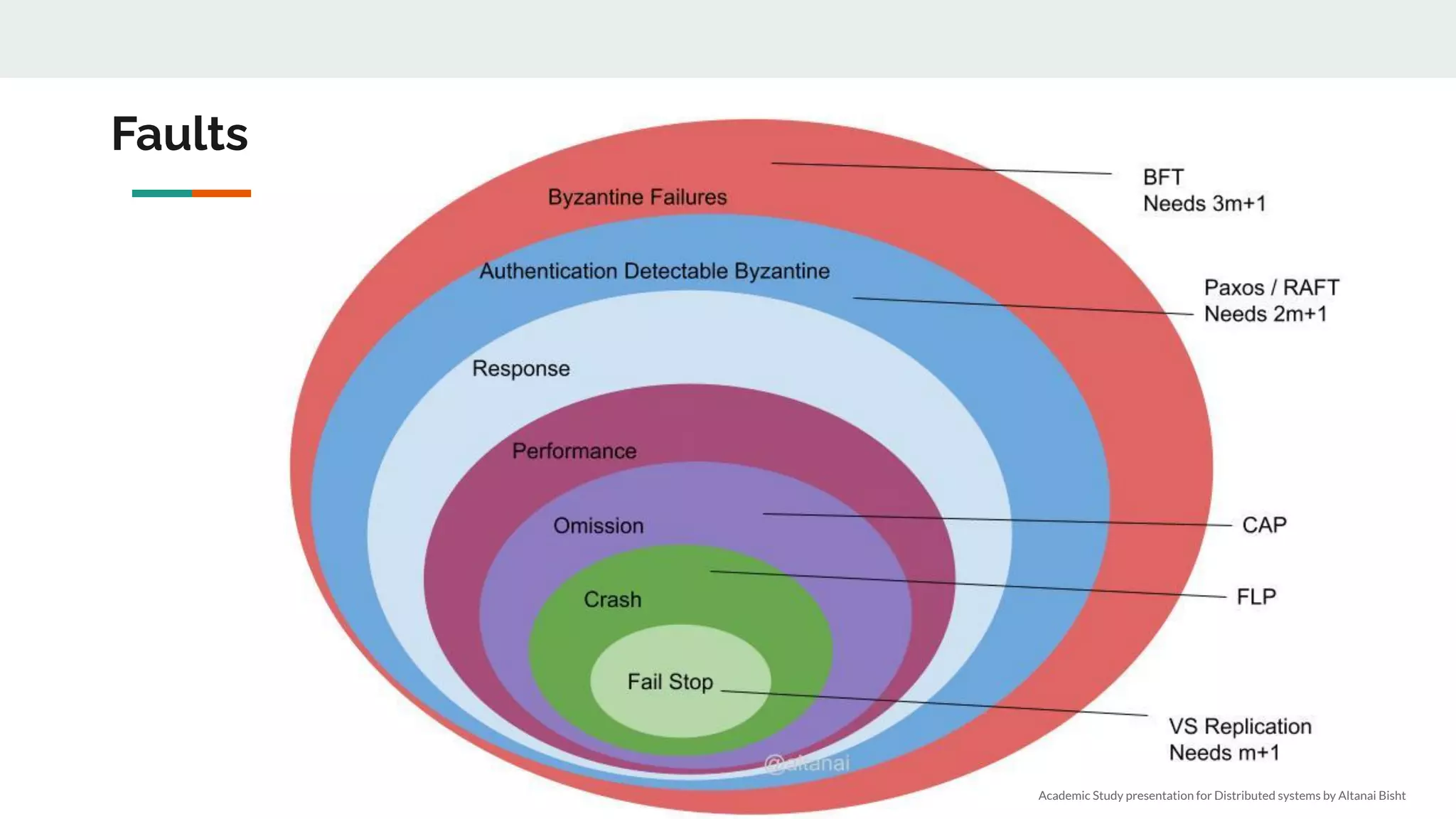
Faults
Academic Study presentation for Distributed systems by Altanai Bisht
Prior approaches
Prior approaches to replication tolerate benign faults
- Alsberg and Day [1976], Gifford [1979], Viewstamped Replication Oki and Liskov [1988], Paxos
Lamport [1989], and Liskov et al. [1991]
Earlier techniques to tolerate Byzantine faults were inefficient and could misclassify replica as faulty.
- synchrony [Lamport 1984] rely on bounds on message delays and process speeds
Earlier proactive security algorithms assume that program is in read only memory and non
compromisable with authenticated channel persisting between replicas even after a compromise
- [Ostrovsky and Yung 1991; Herzberg et al. 1995, 1997; Canetti et al. 1997; Garay et al. 2000]
Academic Study presentation for Distributed systems by Altanai Bisht
Paxos
Source IEEE 2018 [5] Academic Study presentation for Distributed systems by Altanai Bisht
Guarantee safety, but not liveness
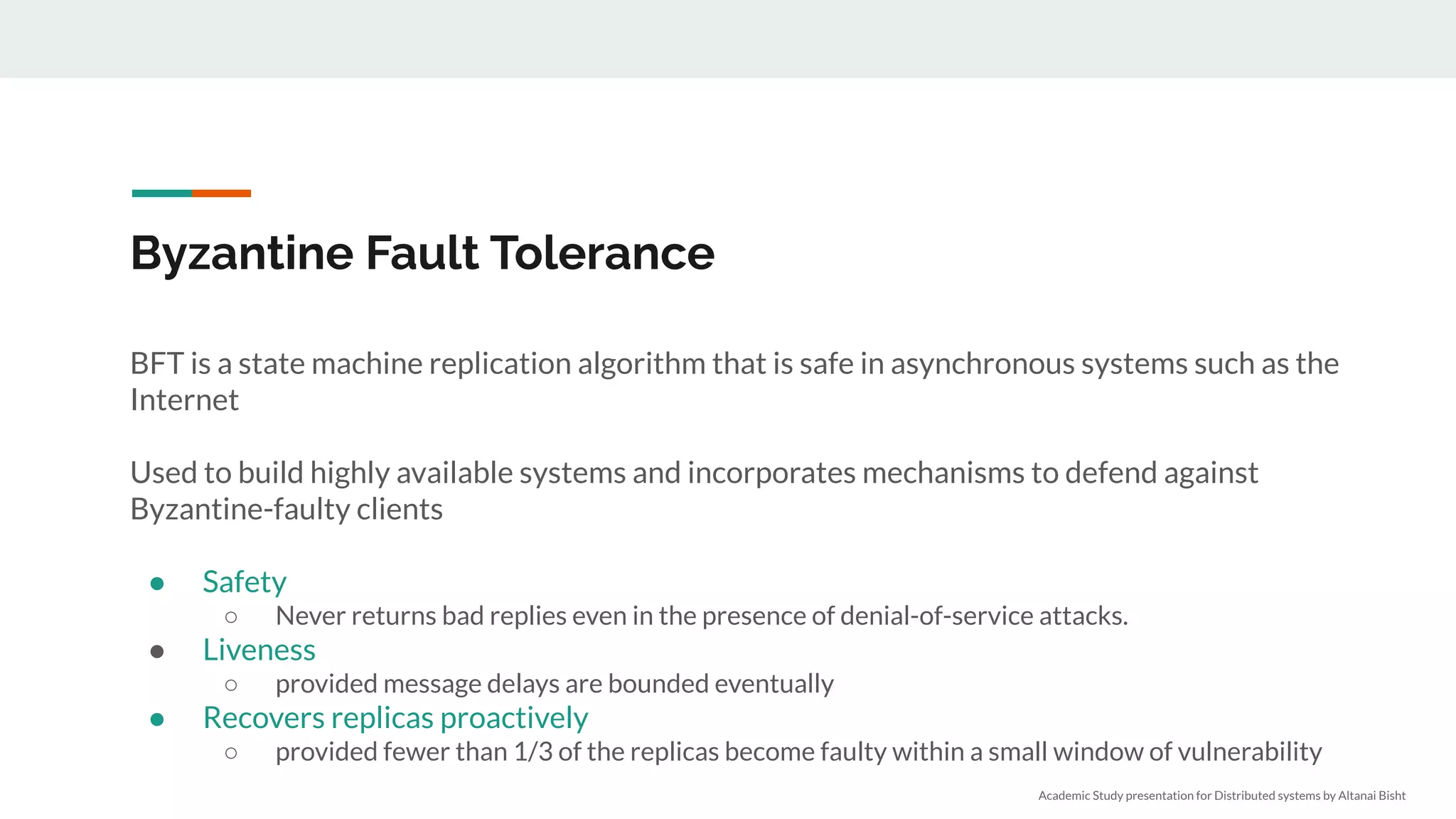
Byzantine Fault Tolerance
BFT is a state machine replication algorithm that is safe in asynchronous systems such as the
Internet
Used to build highly available systems and incorporates mechanisms to defend against
Byzantine-faulty clients
● Safety
○ Never returns bad replies even in the presence of denial-of-service attacks.
● Liveness
○ provided message delays are bounded eventually
● Recovers replicas proactively
○ provided fewer than 1/3 of the replicas become faulty within a small window of vulnerability
Academic Study presentation for Distributed systems by Altanai Bisht
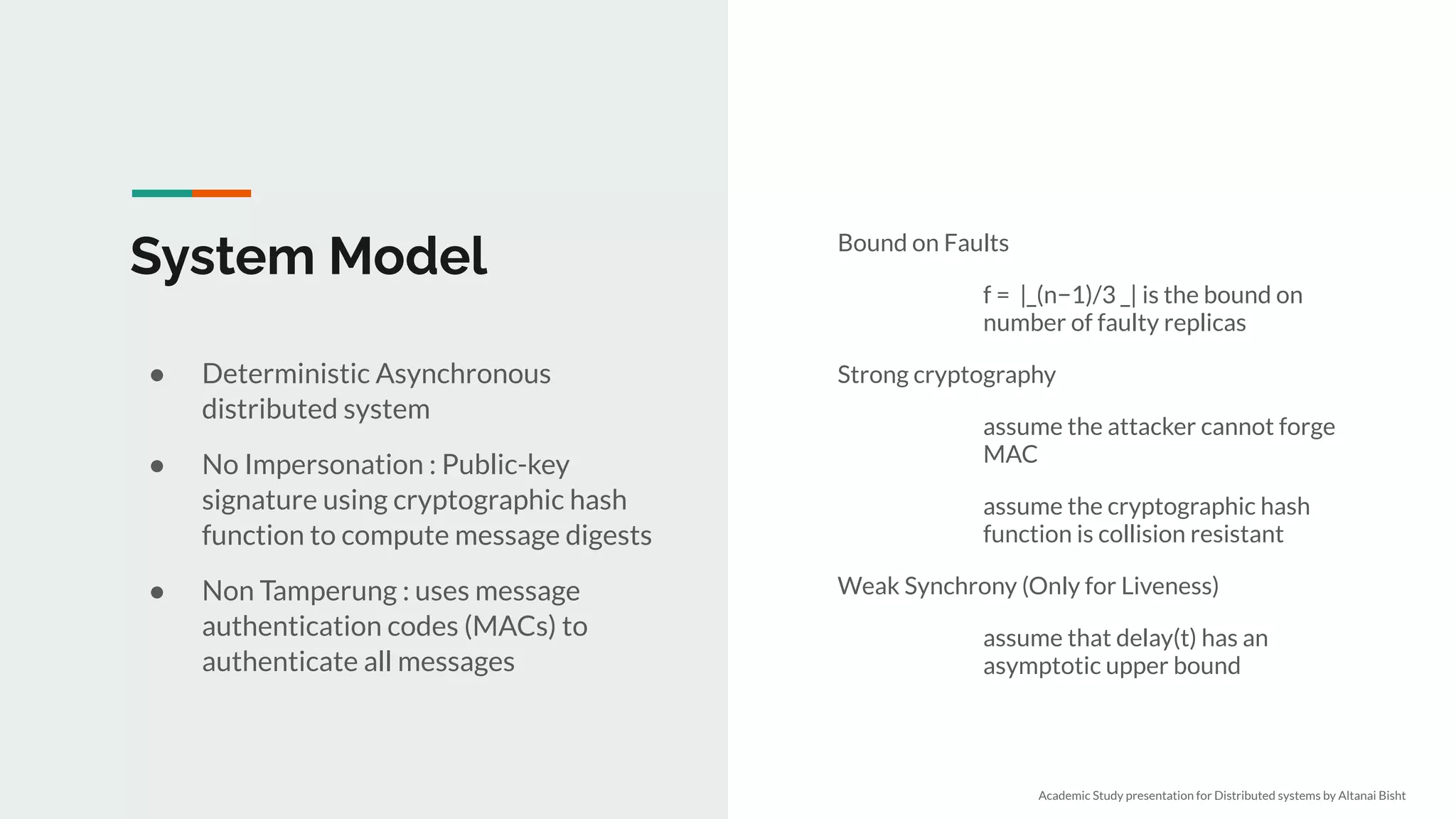
System Model Bound on Faults
f = |_(n−1)/3 _| is the bound on
number of faulty replicas
Strong cryptography
assume the attacker cannot forge
MAC
assume the cryptographic hash
function is collision resistant
Weak Synchrony (Only for Liveness)
assume that delay(t) has an
asymptotic upper bound
● Deterministic Asynchronous
distributed system
● No Impersonation : Public-key
signature using cryptographic hash
function to compute message digests
● Non Tamperung : uses message
authentication codes (MACs) to
authenticate all messages
Academic Study presentation for Distributed systems by Altanai Bisht
BFT algorithm
without proactive recovery
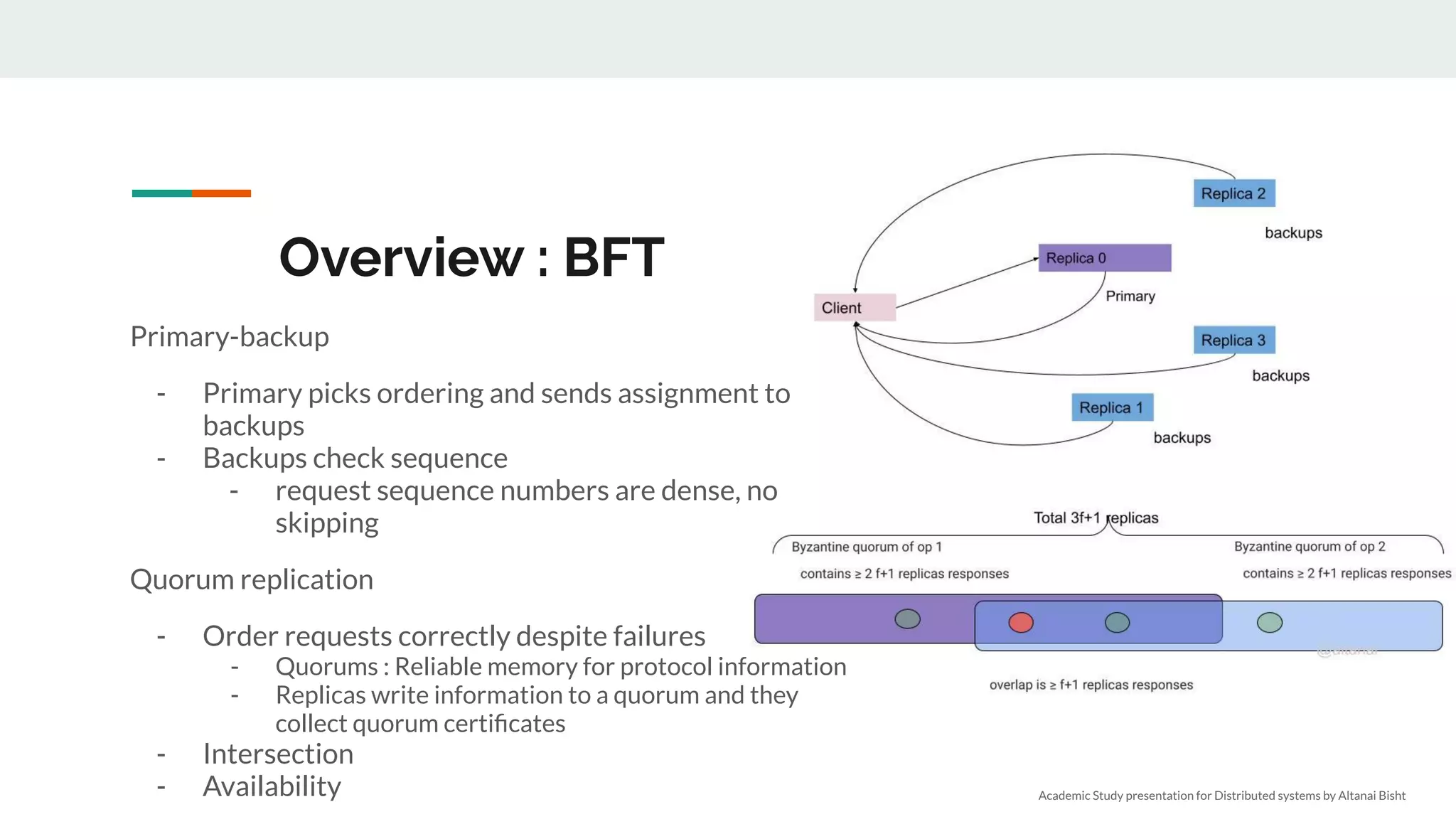
Overview : BFT
Primary-backup
- Primary picks ordering and sends assignment to
backups
- Backups check sequence
- request sequence numbers are dense, no
skipping
Quorum replication
- Order requests correctly despite failures
- Quorums : Reliable memory for protocol information
- Replicas write information to a quorum and they
collect quorum certificates
- Intersection
- Availability Academic Study presentation for Distributed systems by Altanai Bisht
BFT
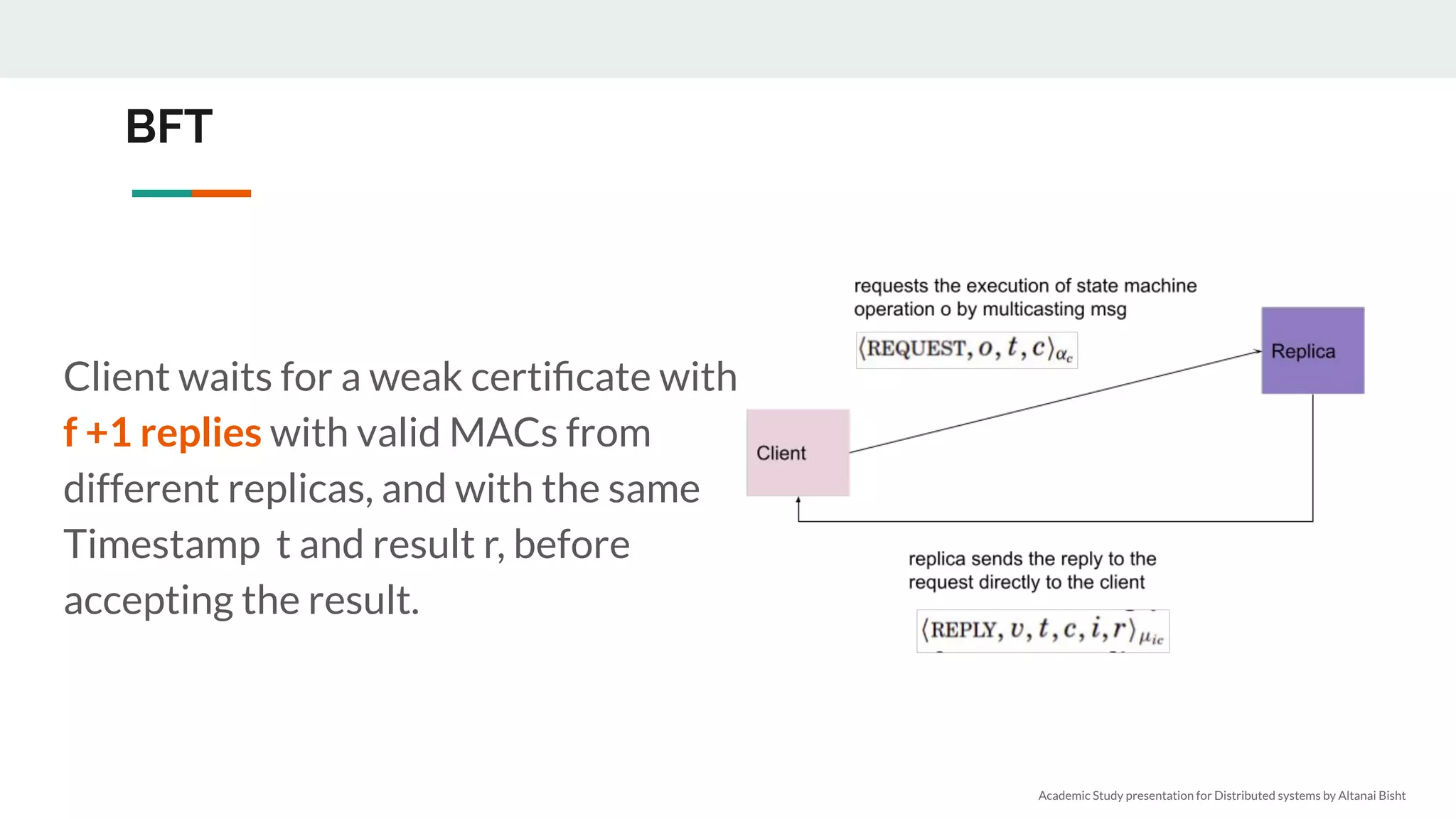
Client waits for a weak certificate with
f +1 replies with valid MACs from
different replicas, and with the same
Timestamp t and result r, before
accepting the result.
Academic Study presentation for Distributed systems by Altanai Bisht
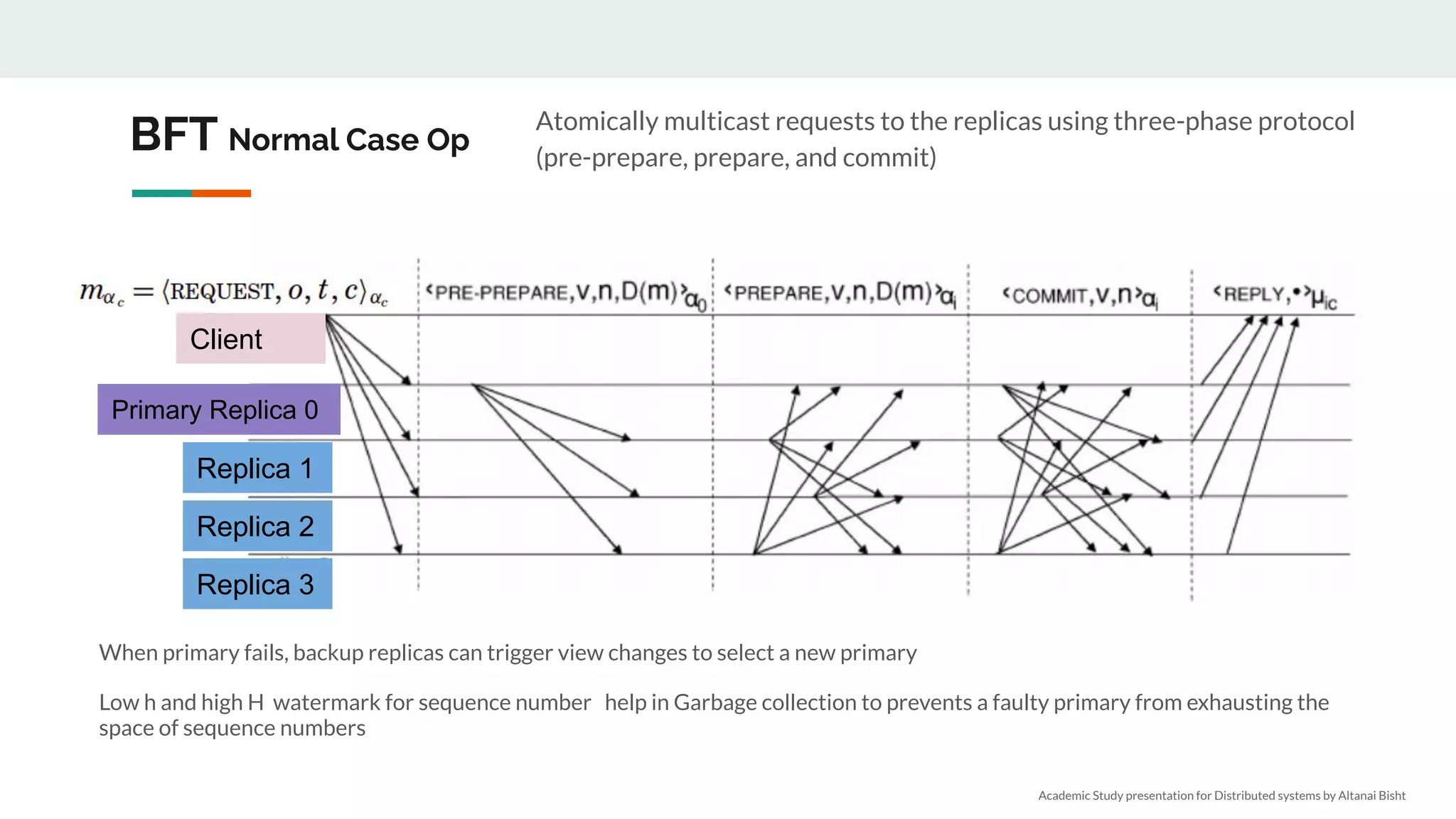
BFT Normal Case Op
When primary fails, backup replicas can trigger view changes to select a new primary
Low h and high H watermark for sequence number help in Garbage collection to prevents a faulty primary from exhausting the
space of sequence numbers
Client
Primary Replica 0
Replica 1
Replica 2
Replica 3
Atomically multicast requests to the replicas using three-phase protocol
(pre-prepare, prepare, and commit)
Academic Study presentation for Distributed systems by Altanai Bisht
Proactive recovery mechanism for
BFT ( BFT-PR)
Recovers replicas periodically even if there is no reason to
suspect that they are faulty.
Overview : BFT PR
Assumptions
● Secure Cryptography
● Read-Only Memory : memory storing public keys
survives failures, without being corrupted
● Watchdog timer , hands control to a recovery
monitor
Quorum certificate received by a non faulty replica
must be backed by a quorum
changing MAC keys during recoveries
● replicas and clients reject messages that are
authenticated with old keys or not part of
complete certificate
Refreshing session keys
Recovery and reboot
● Estimation Protocol for HM
● multicasts a recovery request
● Check and fetch state
Academic Study presentation for Distributed systems by Altanai Bisht
Limitations
1. Does not address the problem of fault-tolerant privacy: a
faulty replica may leak information to an attacker.
2. assumes static membership
3. assumes that a replica server’s memory acts as a stable,
persistent storage.
4. Strict upper bound on faulty processes ( only fewer than
1/3 of the replicas can fail ie strictly > ⅔ of the total
number of processors should be honest.)
5. High Communication overhead - increases exponentially
with every new node added
6. Susceptible to Sybill attack in p2p system [4]
1. Does not rely on client to order or synchronize
2. Better in energy efficiency than PoW ( proof of
Work) in Bitcoin where every node individually
verifies all the transactions
3. Detection of denial-of-service attacks
4. Garbage collection
Academic Study presentation for Distributed systems by Altanai Bisht
Advantages
Applications : 1. Byzantine-fault-tolerant NFS file
system using symmetric cryptography
to authenticate messages(
implemented in paper itself)
2. pBFT in distributed computing and
blockchain
a. pBFT + DPoS(Delegated
Proof-of-Stake)
b. pBFT in combination with PoW
consensus
Academic Study presentation for Distributed systems by Altanai Bisht
References
[1] Paxos - Leslie Lamport [1998] [Lampson, 1996; Prisco et al., 1997;Lamport, 2001; van Renesse and Altinbuken, 2015]
[2] CAP theorem - Gilbert and Lynch [2002]
[3] state machine replication [Lamport 1978; Schneider 1990]
[4] Sybil Attack - John R. Douceur at the Microsoft Research.
[5] Charapko, Aleksey, Ailidani Ailijiang and Murat Demirbas. “Bridging Paxos and Blockchain Consensus.” 2018 IEEE International Conference on Internet of Things
(iThings) and IEEE Green Computing and Communications (GreenCom) and IEEE Cyber, Physical and Social Computing (CPSCom) and IEEE Smart Data (SmartData)
(2018): 1545-1552.
[6] Core Concepts, Challenges, and Future Directions in Blockchain: A Centralized Tutorial , JOHN KOLB, MOUSTAFA ABDELBAKY, RANDY H. KATZ, and DAVID E.
CULLER, University of California – Berkeley, USA, ACM Comput. Surv., Vol. 53, No. 1, Article 9, Publication date: February 2020.

Practical byzantine fault tolerance by altanai

  • 1.
    Practical Byzantine Fault Tolerance AcademicStudy presentation for Distributed systems By Altanai Bisht Dept of Computer Science , Seattle University ( 2021)
  • 2.
    About Practical Byzantine FaultTolerance and Proactive Recovery - MIGUEL CASTRO Microsoft Research And BARBARA LISKOV MIT Laboratory for Computer Science ACM Transactions on Computer Systems, 20(4):398–461, Nov. 2002. Cited on 458, 460
  • 3.
    Challenges in DistributedSystems Distributed systems are subject to a variety of failures and attacks -Hacker break-in, Data corruption, Software/hardware failure. But in Byzantine failure model: Faulty nodes may exhibit arbitrary behavior - Malicious attacks Consensus Protocol Goals ● Liveness ● Clients receive replies to requests ● Safety ● Replicated service is linearizable i.e. it appears centralized w/ atomic ops We need n > 3f nodes ● 2f+1 to act with confidence, f may never respond Accountable Systems ● Actions are undeniable ● State is tamper evident ● Correctness can be certified [Yumerefendi05] Example: Building trust in federated systems Academic Study presentation for Distributed systems by Altanai Bisht
  • 4.
    Faults Academic Study presentationfor Distributed systems by Altanai Bisht
  • 5.
    Prior approaches Prior approachesto replication tolerate benign faults - Alsberg and Day [1976], Gifford [1979], Viewstamped Replication Oki and Liskov [1988], Paxos Lamport [1989], and Liskov et al. [1991] Earlier techniques to tolerate Byzantine faults were inefficient and could misclassify replica as faulty. - synchrony [Lamport 1984] rely on bounds on message delays and process speeds Earlier proactive security algorithms assume that program is in read only memory and non compromisable with authenticated channel persisting between replicas even after a compromise - [Ostrovsky and Yung 1991; Herzberg et al. 1995, 1997; Canetti et al. 1997; Garay et al. 2000] Academic Study presentation for Distributed systems by Altanai Bisht
  • 6.
    Paxos Source IEEE 2018[5] Academic Study presentation for Distributed systems by Altanai Bisht Guarantee safety, but not liveness
  • 7.
    Byzantine Fault Tolerance BFTis a state machine replication algorithm that is safe in asynchronous systems such as the Internet Used to build highly available systems and incorporates mechanisms to defend against Byzantine-faulty clients ● Safety ○ Never returns bad replies even in the presence of denial-of-service attacks. ● Liveness ○ provided message delays are bounded eventually ● Recovers replicas proactively ○ provided fewer than 1/3 of the replicas become faulty within a small window of vulnerability Academic Study presentation for Distributed systems by Altanai Bisht
  • 8.
    System Model Boundon Faults f = |_(n−1)/3 _| is the bound on number of faulty replicas Strong cryptography assume the attacker cannot forge MAC assume the cryptographic hash function is collision resistant Weak Synchrony (Only for Liveness) assume that delay(t) has an asymptotic upper bound ● Deterministic Asynchronous distributed system ● No Impersonation : Public-key signature using cryptographic hash function to compute message digests ● Non Tamperung : uses message authentication codes (MACs) to authenticate all messages Academic Study presentation for Distributed systems by Altanai Bisht
  • 9.
  • 10.
    Overview : BFT Primary-backup -Primary picks ordering and sends assignment to backups - Backups check sequence - request sequence numbers are dense, no skipping Quorum replication - Order requests correctly despite failures - Quorums : Reliable memory for protocol information - Replicas write information to a quorum and they collect quorum certificates - Intersection - Availability Academic Study presentation for Distributed systems by Altanai Bisht
  • 11.
    BFT Client waits fora weak certificate with f +1 replies with valid MACs from different replicas, and with the same Timestamp t and result r, before accepting the result. Academic Study presentation for Distributed systems by Altanai Bisht
  • 12.
    BFT Normal CaseOp When primary fails, backup replicas can trigger view changes to select a new primary Low h and high H watermark for sequence number help in Garbage collection to prevents a faulty primary from exhausting the space of sequence numbers Client Primary Replica 0 Replica 1 Replica 2 Replica 3 Atomically multicast requests to the replicas using three-phase protocol (pre-prepare, prepare, and commit) Academic Study presentation for Distributed systems by Altanai Bisht
  • 13.
    Proactive recovery mechanismfor BFT ( BFT-PR) Recovers replicas periodically even if there is no reason to suspect that they are faulty.
  • 14.
    Overview : BFTPR Assumptions ● Secure Cryptography ● Read-Only Memory : memory storing public keys survives failures, without being corrupted ● Watchdog timer , hands control to a recovery monitor Quorum certificate received by a non faulty replica must be backed by a quorum changing MAC keys during recoveries ● replicas and clients reject messages that are authenticated with old keys or not part of complete certificate Refreshing session keys Recovery and reboot ● Estimation Protocol for HM ● multicasts a recovery request ● Check and fetch state Academic Study presentation for Distributed systems by Altanai Bisht
  • 15.
    Limitations 1. Does notaddress the problem of fault-tolerant privacy: a faulty replica may leak information to an attacker. 2. assumes static membership 3. assumes that a replica server’s memory acts as a stable, persistent storage. 4. Strict upper bound on faulty processes ( only fewer than 1/3 of the replicas can fail ie strictly > ⅔ of the total number of processors should be honest.) 5. High Communication overhead - increases exponentially with every new node added 6. Susceptible to Sybill attack in p2p system [4] 1. Does not rely on client to order or synchronize 2. Better in energy efficiency than PoW ( proof of Work) in Bitcoin where every node individually verifies all the transactions 3. Detection of denial-of-service attacks 4. Garbage collection Academic Study presentation for Distributed systems by Altanai Bisht Advantages
  • 16.
    Applications : 1.Byzantine-fault-tolerant NFS file system using symmetric cryptography to authenticate messages( implemented in paper itself) 2. pBFT in distributed computing and blockchain a. pBFT + DPoS(Delegated Proof-of-Stake) b. pBFT in combination with PoW consensus Academic Study presentation for Distributed systems by Altanai Bisht
  • 17.
    References [1] Paxos -Leslie Lamport [1998] [Lampson, 1996; Prisco et al., 1997;Lamport, 2001; van Renesse and Altinbuken, 2015] [2] CAP theorem - Gilbert and Lynch [2002] [3] state machine replication [Lamport 1978; Schneider 1990] [4] Sybil Attack - John R. Douceur at the Microsoft Research. [5] Charapko, Aleksey, Ailidani Ailijiang and Murat Demirbas. “Bridging Paxos and Blockchain Consensus.” 2018 IEEE International Conference on Internet of Things (iThings) and IEEE Green Computing and Communications (GreenCom) and IEEE Cyber, Physical and Social Computing (CPSCom) and IEEE Smart Data (SmartData) (2018): 1545-1552. [6] Core Concepts, Challenges, and Future Directions in Blockchain: A Centralized Tutorial , JOHN KOLB, MOUSTAFA ABDELBAKY, RANDY H. KATZ, and DAVID E. CULLER, University of California – Berkeley, USA, ACM Comput. Surv., Vol. 53, No. 1, Article 9, Publication date: February 2020.