Chapter 7 - Fault Tolerance
2
 Introduction
 a major difference between distributed systems and single
machine systems is that with the former, partial failure is
possible, i.e., when one component in a distributed system
fails
 such a failure may affect some components while others
will continue to function properly
 an important goal of distributed systems design is to
construct a system that can automatically recover from
partial failure
 it should tolerate faults and continue to operate to some
extent
3
 Objectives of the Chapter
 we discuss
 fault tolerance, and making distributed systems fault
tolerant
 process resilience (techniques by which one or more
processes can fail without seriously disturbing the rest of
the system)
 reliable multicasting to keep processes synchronized (by
which message transmission to a collection of processes
is guaranteed to succeed)
 distributed commit protocols for ensuring atomicity in
distributed systems
 failure recovery by saving the state of a distributed
system (when and how)
4
7.1 Introduction to Fault Tolerance
 Basic Concepts
 fault tolerance is strongly related to dependable
systems
 dependability covers the following
 availability
 refers to the probability that the system is
operating correctly at any given time; defined in
terms of an instant in time
 reliability
 a property that a system can run continuously
without failure; defined in terms of a time interval
 safety
 refers to the situation that even when a system
temporarily fails to operate correctly, nothing
catastrophic happens
 maintainability
 how easily a failed system can be repaired
5
 dependable systems are also required to provide a high
degree of security
 a system is said to fail when it cannot meet its promises; for
instance failing to provide it users one or more of the
services it promises
 an error is a part of a system’s state the may lead to a failure;
e.g., damaged packets in communication
 the cause of an error is called a fault
 building dependable systems closely relates to controlling
faults
 a distinction is made between preventing, removing, and
forecasting faults
 a fault tolerant system is a system that can provide its
services even in the presence of faults
6
 faults are classified into three
 transient
 occurs once and then disappears; if the operation is
repeated, the fault goes away; e.g., a bird flying through a
beam of a microwave transmitter may cause some lost
bits
 intermittent
 it occurs, then vanishes on its own accord, then
reappears, ...; e.g., a loose connection; difficult to
diagnose; take your sick child to the nearest clinic, but
the child does not show any sickness by the time you
reach there
 permanent
 one that continues to exist until the faulty component is
repaired; e.g, disk head crash, software bug
7
 Failure Modes - 5 of them
 Crash failure: a server halts, but was working correctly until
it stopped
 Omission failure: a server fails to respond to incoming
requests
 Receive omission: a server fails to receive incoming
messages; e.g., may be no thread is listening
 Send omission: a server fails to send messages
 Timing failure: a server's response lies outside the
specified time interval; e.g., may be it is too fast over
flooding the receiver or too slow
 Response failure: the server's response is incorrect
 Value failure: the value of the response is wrong; e.g., a
search engine returning wrong Web pages as a result of
a search
 State transition failure: the server deviates from the
correct flow of control; e.g., taking default actions when it
fails to understand the request
8
 Arbitrary failure (or Byzantine failure): a server may
produce arbitrary responses at arbitrary times; most
serious
 Failure Masking by Redundancy
 to be fault tolerant, the system tries to hide the occurrence
of failures from other processes - masking
 the key technique for masking faults is redundancy
 three kinds are possible
 information redundancy; add extra bits to allow recovery
from garbled bits (error correction)
 time redundancy: an action is performed more than once
if needed; e.g., redo an aborted transaction; useful for
transient and intermittent faults
 physical redundancy: add (replicate) extra equipment
(hardware) or processes (software)
9
7.2 Process Resilience
 how can fault tolerance be achieved in distributed
systems
 one method is protection against process failures by
replicating processes into groups
 we discuss
 what are the general design issues of process groups
 what actually is a fault tolerant group
 how to reach agreement within a process group when
one or more of its members cannot be trusted to give
correct answers
10
 Design Issues
 the key approach to tolerating a faulty process is to
organize several identical processes into a group
 all members of a group receive a message hoping that if
one process fails, another one will take over
 process groups may be dynamic
 new groups can be created and old groups can be
destroyed
 a process can join or leave a group
 a process can be a member of several groups at the
same time
 hence group management and membership mechanisms
are required
 groups may be flat (all processes are equal) or hierarchical
(a coordinator and several workers)
11
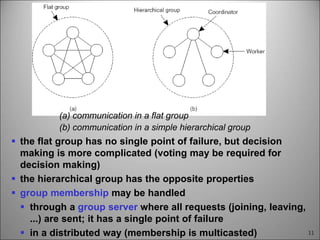
(a) communication in a flat group
(b) communication in a simple hierarchical group
 the flat group has no single point of failure, but decision
making is more complicated (voting may be required for
decision making)
 the hierarchical group has the opposite properties
 group membership may be handled
 through a group server where all requests (joining, leaving,
...) are sent; it has a single point of failure
 in a distributed way (membership is multicasted)
12
 Failure Masking and Replication
 how to replicate processes so that they can form groups?;
there are two ways (as discussed in the previous chapter):
 primary-based protocols: for fault tolerance, primary-
backup protocol is used; organize processes
hierarchically and let the primary coordinate all writes; if
the primary crashes, the backups hold an election
 replicated-write protocols: in the form of active replication
or by means of quorum-based protocols; processes are
organized as flat groups
13
 another important issue is how much replication is needed
 a system is said to be k fault tolerant if it can survive faults
in k components and still meets its specifications
 if the processes fail silently, then having k+1 replicas is
enough; if k of them fail, the remaining one can function
 if processes exhibit Byzantine failure, 2k+1 replicas are
required; if the k processes generate the same reply
(wrong), the k+1 will also produce the same answer
(correct); but which of the two is correct is difficult to
ascertain; unless we believe the majority
14
 Agreement in a Faulty System
 agreement is required in many cases; some examples are
 electing a coordinator
 deciding whether or not to commit a transaction
 dividing tasks among workers
 the objective of all agreement algorithms is to have all the
non-faulty processes reach consensus on some issue in a
finite number of steps
 but, reaching an agreement in a faulty environment (if
process and/or communication failure exists) is difficult;
two cases
 processes are perfect but communication is unreliable
 this is similar to the problem known as the two-army
problem; the sender of a message does not know that
its message has arrived
 even if the receiver acknowledges, it does not know
that its acknowledgement has been received
 hence, it is even difficult to reach an agreement when
there are only two perfect processes
15
 communication is perfect but processes are not
 this is also similar to the problem known as the Byzantine
generals problem, where out of n generals m are traitors
(they send wrong responses); can the loyal generals reach
an agreement?
 a recursive algorithm by Lamport
 each general is assumed to know how many troops s/he
has
 the goal is to exchange troop strengths (by telephone,
hence reliable communication)
 at the end of the algorithm, each general has a vector of
length n corresponding to all the armies
 if general i is loyal, then element i is his troop strength;
otherwise, it is undefined
16
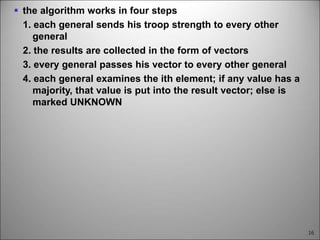
 the algorithm works in four steps
1. each general sends his troop strength to every other
general
2. the results are collected in the form of vectors
3. every general passes his vector to every other general
4. each general examines the ith element; if any value has a
majority, that value is put into the result vector; else is
marked UNKNOWN
17
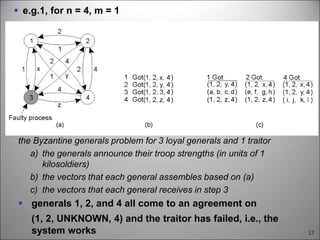
the Byzantine generals problem for 3 loyal generals and 1 traitor
a) the generals announce their troop strengths (in units of 1
kilosoldiers)
b) the vectors that each general assembles based on (a)
c) the vectors that each general receives in step 3
 generals 1, 2, and 4 all come to an agreement on
(1, 2, UNKNOWN, 4) and the traitor has failed, i.e., the
system works
 e.g.1, for n = 4, m = 1
18
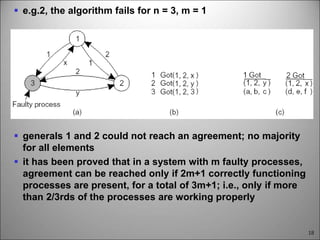
 e.g.2, the algorithm fails for n = 3, m = 1
 generals 1 and 2 could not reach an agreement; no majority
for all elements
 it has been proved that in a system with m faulty processes,
agreement can be reached only if 2m+1 correctly functioning
processes are present, for a total of 3m+1; i.e., only if more
than 2/3rds of the processes are working properly
19
7.3 Reliable Client-Server Communication
 fault tolerance in distributed systems concentrates on
faulty processes
 but communication failures also have to be considered
 a communication channel may exhibit failures in the
form of
 crash
 omission
 timing
 arbitrary (duplicate messages as a result of buffering
at nodes and the sender retransmitting)
 Point-to-Point Communication
 reliable transport protocols such as TCP can be used
that mask most communication failures such as
omissions (lost messages) using acknowledgements
and retransmissions
 however, crash failures are often not masked; e.g., a
broken TCP connection; in which case the system
may probably setup a new connection automatically
20
 RPC Semantics in the Presence of Failures
 the goal of RPC is to hide communication by making
remote procedure calls look like local ones; may be difficult
to mask remote calls when there are failures
 five different classes of failures can occur in RPC systems,
each requiring a different solution
 the client is unable to locate the sever
 the client’s request to the server is lost
 the server receives the request and crashes
 the reply message from the server to the client is lost
 the client crashes after sending a request
21
1.the client is unable to locate the sever
 may be the client is unable to locate a suitable server or the
server is down
 or an interface at the server has been changed making the
client’s stub obsolete (it was not used for a long time) and the
binder failing to match it with the server
 one solution: let the client raise an exception and have
exception handlers; inserted by the programmer
 examples are exceptions in Java or signal handlers in C
 but
 not every language may provide exceptions or signals
 the major objective of having transparency is violated
2.the client’s request to the server is lost
 let the OS or the client stub start a timer when sending a
request; if the timer expires before a reply or
acknowledgement comes back, the message is retransmitted
22
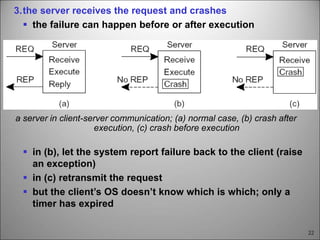
3.the server receives the request and crashes
 the failure can happen before or after execution
a server in client-server communication; (a) normal case, (b) crash after
execution, (c) crash before execution
 in (b), let the system report failure back to the client (raise
an exception)
 in (c) retransmit the request
 but the client’s OS doesn’t know which is which; only a
timer has expired
23
 three possible solutions
 the client tries the operation again after the server has
restarted (or rebooted) or rebinds to a new server, called at
least once semantics; keep on trying until a reply is
received; it guarantees that the RPC has been carried out at
least one time, but possibly more
 the client gives up after the first attempt and reports error,
called at most once semantics; it guarantees that the RPC
has been carried out at most one time, but possibly none at
all
 no guaranty at all (0-N times)
 none of the above is the right solution; what is required is
exactly once semantics; but difficult to achieve
24
 assume that
 a client would like to print some text
 the client receives an acknowledgement of receipt
 the server can send a completion message and print or can
print and then send a completion message (2 possibilities)
 assume the server crashes and recovers, announces this; the
client doesn’t know if its request will be carried out
 what should the client do?; four possibilities
 never reissue a request (the text may not be printed)
 reissue a request (the text may be printed twice)
 assuming the server crashed before the request was
delivered, it can decide to reissue a request only if it has not
received an acknowledgement
 reissue a request only if it has received an acknowledgement
 hence, with 2 strategies for the server and 4 for the client, there
are a total of 8 possibilities, none of which is satisfactory
25
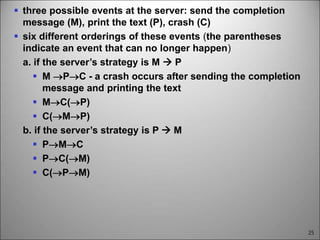
 three possible events at the server: send the completion
message (M), print the text (P), crash (C)
 six different orderings of these events (the parentheses
indicate an event that can no longer happen)
a. if the server’s strategy is M  P
 M PC - a crash occurs after sending the completion
message and printing the text
 MC(P)
 C(MP)
b. if the server’s strategy is P  M
 PMC
 PC(M)
 C(PM)
26
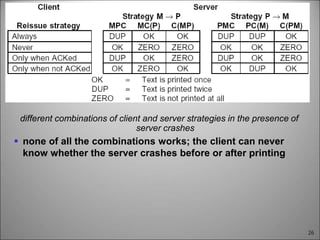
 none of all the combinations works; the client can never
know whether the server crashes before or after printing
different combinations of client and server strategies in the presence of
server crashes
27
4.the reply message from the server to the client is lost
 the client sets a timer and resends
 there is a risk that the request is sent more than once; may
be the server was slow
 however, if the operation is idempotent (an operation such
as requesting a read that can be repeated without any harm),
it does not create any problem; but what if the request is to
transfer money from one account to another?
 let the client assign a sequence number to each request so
that the server knows it is a duplicated one; but needs the
server to maintain information on each client
 in addition, we can have a bit in the message header that is
used to distinguish initial requests from retransmissions so
as to take more care on retransmissions
28
5.the client crashes after sending a request
 in this case a computation may be done without a parent
waiting for the result; such unwanted computations are
called orphans
 orphans
 waste CPU cycles
 can lock valuable resources such as files
 can cause confusion if the client reboots and does the
RPC again and the reply from the orphan comes back
immediately afterward
 proposed solutions
 extermination: let the client stub maintain a log before
sending an RPC message; after a reboot, inspect the log
and kill the orphan; some problems
 the expense of writing a log for every RPC
 it may not work if the orphans themselves do RPC,
creating grandorphans that are difficult to locate
29
 reincarnation: divide time into sequentially numbered epochs;
when a client reboots, it broadcasts a message to all machines
declaring the start of a new epoch; when such a broadcast
comes in, all remote computations on behalf of that client are
killed
 gentle reincarnation: when an epoch broadcast comes in, each
machine checks to see if it has remote computations, and if so,
tries to locate their owner; a computation is killed only if the
owner cannot be found
 expiration: each RPC is given a standard amount of time, T, to
do the job; if it cannot finish, it must explicitly ask for another
quantum; if after a crash the client waits a time T before
rebooting, all orphans are killed; the problem is how to choose
a reasonable value of T, since RPCs have differing needs
30
7.4 Reliable Group Communication
 how to reliably deliver messages to a process group
(multicasting)
 Basic Reliable-Multicasting Schemes
 reliable multicasting means a message sent to a
process group should be delivered to each member of
that group
 transport protocols do not offer reliable
communication to a collection of processes
 problems:
 what happens if a process joins a group during
communication?
 what happens if a (sending) process crashes
during communication?
 what if there are faulty processes?
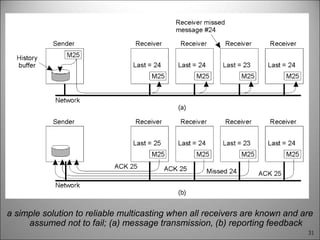
 a weaker solution assuming that all receivers are
known (and they are limited) and that none will fail is
for the sending process to assign a sequence number
to each message and to buffer all messages so that
lost ones can be retransmitted
31
a simple solution to reliable multicasting when all receivers are known and are
assumed not to fail; (a) message transmission, (b) reporting feedback
32
 Scalability in Reliable Multicasting
 a reliable multicast scheme does not support large number
of receivers; there will be feedback implosion
 two approaches for solving the problem
1. Nonhierarchical Feedback Control
 reduce the number of feedback messages returned to the
sender using feedback suppression
 the Scalable Reliable Multicasting Protocol (SRM) uses
this principle
 only negative acks are returned as feedback and they are
multicasted to all so that others that missed the message
will refrain from sending a negative ack
 a receiver R that did not receive a message M schedules
a feedback message with some random delay T; if
another message for retransmitting M reaches R, R
suppresses its transmission; else it transmits
 the sender will receive only a single negative ack and
retransmits M to all
33
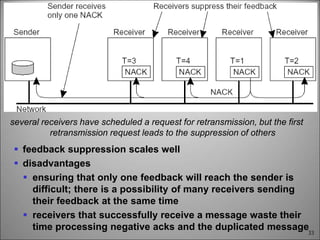
several receivers have scheduled a request for retransmission, but the first
retransmission request leads to the suppression of others
 feedback suppression scales well
 disadvantages
 ensuring that only one feedback will reach the sender is
difficult; there is a possibility of many receivers sending
their feedback at the same time
 receivers that successfully receive a message waste their
time processing negative acks and the duplicated message
34
2. Hierarchical Feedback Control
 hierarchical solutions are better to achieve scalability for
very large groups of receivers
 the group of receivers is partitioned into a number of
subgroups, subsequently organized into a tree; the
subgroup containing the sender forms the root of the tree
 within each subgroup, use any reliable multicasting
scheme that works for small groups
 each subgroup appoints a local coordinator, responsible
for handling retransmission requests in its subgroup;
hence it has its history buffer
 dynamically constructing the tree is a problem
building reliable multicast schemes that can scale to a large
number of receivers spread in a WAN is a difficult problem;
more research is required
35
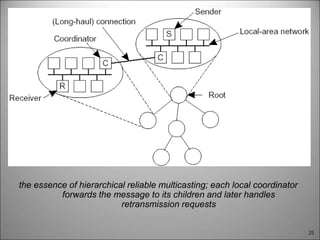
the essence of hierarchical reliable multicasting; each local coordinator
forwards the message to its children and later handles
retransmission requests
36
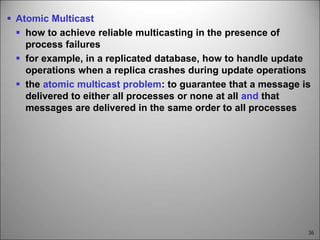
 Atomic Multicast
 how to achieve reliable multicasting in the presence of
process failures
 for example, in a replicated database, how to handle update
operations when a replica crashes during update operations
 the atomic multicast problem: to guarantee that a message is
delivered to either all processes or none at all and that
messages are delivered in the same order to all processes
37
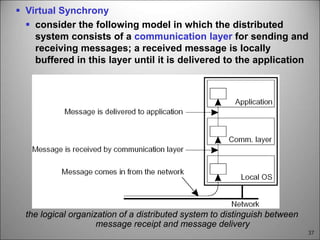
the logical organization of a distributed system to distinguish between
message receipt and message delivery
 Virtual Synchrony
 consider the following model in which the distributed
system consists of a communication layer for sending and
receiving messages; a received message is locally
buffered in this layer until it is delivered to the application
38
 the whole idea of atomic multicasting is that a multicast
message m is uniquely associated with a list of processes to
which it should be delivered; this delivery list corresponds to a
group view G, the view on the set of processes contained in the
group, which the sender had at the time message m was
multicast
 a view change takes place by multicasting a message vc
announcing the joining or leaving of a process, while the
multicasting takes place
 then there are two messages in transit: m and vc; we need a
guarantee that m is either delivered to all processes in G before
each of them receives vc, or m is not delivered at all
 a reliable multicast guarantees that a message multicast to
group G is delivered to each non-faulty process in G; if the
sender crashes during the multicast, the message may either
be delivered to all remaining processes or ignored by each of
them; a reliable multicast with this property is said to be
virtually synchronous
39
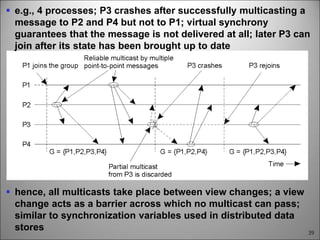
 e.g., 4 processes; P3 crashes after successfully multicasting a
message to P2 and P4 but not to P1; virtual synchrony
guarantees that the message is not delivered at all; later P3 can
join after its state has been brought up to date
 hence, all multicasts take place between view changes; a view
change acts as a barrier across which no multicast can pass;
similar to synchronization variables used in distributed data
stores
40
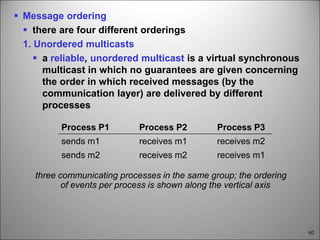
 Message ordering
 there are four different orderings
1. Unordered multicasts
 a reliable, unordered multicast is a virtual synchronous
multicast in which no guarantees are given concerning
the order in which received messages (by the
communication layer) are delivered by different
processes
three communicating processes in the same group; the ordering
of events per process is shown along the vertical axis
Process P1 Process P2 Process P3
sends m1 receives m1 receives m2
sends m2 receives m2 receives m1
41
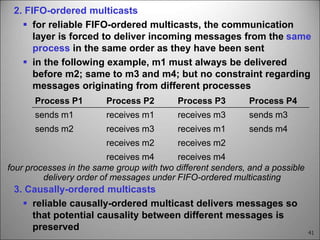
four processes in the same group with two different senders, and a possible
delivery order of messages under FIFO-ordered multicasting
Process P1 Process P2 Process P3 Process P4
sends m1 receives m1 receives m3 sends m3
sends m2 receives m3 receives m1 sends m4
receives m2 receives m2
receives m4 receives m4
2. FIFO-ordered multicasts
 for reliable FIFO-ordered multicasts, the communication
layer is forced to deliver incoming messages from the same
process in the same order as they have been sent
 in the following example, m1 must always be delivered
before m2; same to m3 and m4; but no constraint regarding
messages originating from different processes
3. Causally-ordered multicasts
 reliable causally-ordered multicast delivers messages so
that potential causality between different messages is
preserved
42
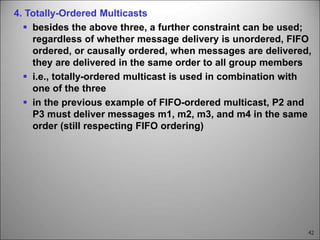
4. Totally-Ordered Multicasts
 besides the above three, a further constraint can be used;
regardless of whether message delivery is unordered, FIFO
ordered, or causally ordered, when messages are delivered,
they are delivered in the same order to all group members
 i.e., totally-ordered multicast is used in combination with
one of the three
 in the previous example of FIFO-ordered multicast, P2 and
P3 must deliver messages m1, m2, m3, and m4 in the same
order (still respecting FIFO ordering)
43
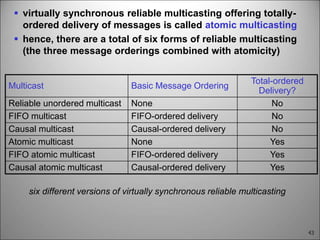
six different versions of virtually synchronous reliable multicasting
Multicast Basic Message Ordering
Total-ordered
Delivery?
Reliable unordered multicast None No
FIFO multicast FIFO-ordered delivery No
Causal multicast Causal-ordered delivery No
Atomic multicast None Yes
FIFO atomic multicast FIFO-ordered delivery Yes
Causal atomic multicast Causal-ordered delivery Yes
 virtually synchronous reliable multicasting offering totally-
ordered delivery of messages is called atomic multicasting
 hence, there are a total of six forms of reliable multicasting
(the three message orderings combined with atomicity)
44
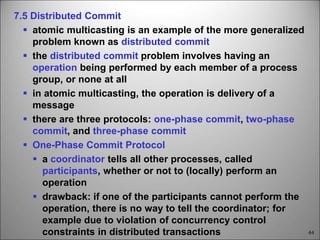
7.5 Distributed Commit
 atomic multicasting is an example of the more generalized
problem known as distributed commit
 the distributed commit problem involves having an
operation being performed by each member of a process
group, or none at all
 in atomic multicasting, the operation is delivery of a
message
 there are three protocols: one-phase commit, two-phase
commit, and three-phase commit
 One-Phase Commit Protocol
 a coordinator tells all other processes, called
participants, whether or not to (locally) perform an
operation
 drawback: if one of the participants cannot perform the
operation, there is no way to tell the coordinator; for
example due to violation of concurrency control
constraints in distributed transactions
45
 Two-Phase Commit Protocol (2PC)
 it has two phases: voting phase and decision phase, each
involving two steps
 voting phase
 the coordinator sends a VOTE_REQUEST message to all
participants
 each participant then sends a VOTE_COMMIT or
VOTE_ABORT message depending on its local situation
 decision phase
 the coordinator collects all votes; if all vote to commit the
transaction, it sends a GLOBAL_COMMIT message; if at
least one participant sends VOTE_ABORT, it sends a
GLOBAL_ABORT message
 each participant that voted for a commit waits for the
final reaction of the coordinator and commits or aborts
46
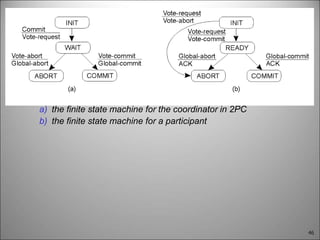
a) the finite state machine for the coordinator in 2PC
b) the finite state machine for a participant
47
 problems may occur in the event of failures
 the coordinator and participants have states in which they
block waiting for messages: INIT, READY, WAIT
 when a process crashes, other processes may wait
indefinitely
 hence, timeout mechanisms are required
 a participant waiting in its INIT state for VOTE_REQUEST
from the coordinator aborts and sends VOTE_ABORT if it
does not receive a vote request after some time
 the coordinator blocking in state WAIT aborts and sends
GLOBAL_ABORT if all votes have not been collected on time
 a participant P waiting in its READY state waiting for the
global vote cannot abort; instead it must find out which
message the coordinator actually sent
 by blocking until the coordinator recovers
 or requesting another participant, say Q
48
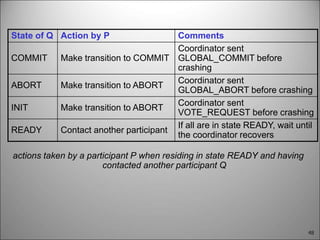
actions taken by a participant P when residing in state READY and having
contacted another participant Q
State of Q Action by P Comments
COMMIT Make transition to COMMIT
Coordinator sent
GLOBAL_COMMIT before
crashing
ABORT Make transition to ABORT
Coordinator sent
GLOBAL_ABORT before crashing
INIT Make transition to ABORT
Coordinator sent
VOTE_REQUEST before crashing
READY Contact another participant
If all are in state READY, wait until
the coordinator recovers
49
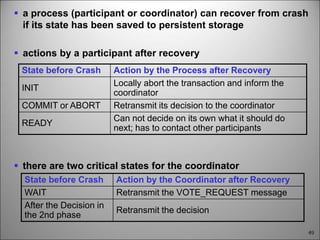
 a process (participant or coordinator) can recover from crash
if its state has been saved to persistent storage
 actions by a participant after recovery
 there are two critical states for the coordinator
State before Crash Action by the Process after Recovery
INIT
Locally abort the transaction and inform the
coordinator
COMMIT or ABORT Retransmit its decision to the coordinator
READY
Can not decide on its own what it should do
next; has to contact other participants
State before Crash Action by the Coordinator after Recovery
WAIT Retransmit the VOTE_REQUEST message
After the Decision in
the 2nd phase
Retransmit the decision
50
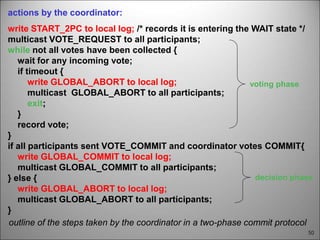
outline of the steps taken by the coordinator in a two-phase commit protocol
actions by the coordinator:
write START_2PC to local log; /* records it is entering the WAIT state */
multicast VOTE_REQUEST to all participants;
while not all votes have been collected {
wait for any incoming vote;
if timeout {
write GLOBAL_ABORT to local log;
multicast GLOBAL_ABORT to all participants;
exit;
}
record vote;
}
if all participants sent VOTE_COMMIT and coordinator votes COMMIT{
write GLOBAL_COMMIT to local log;
multicast GLOBAL_COMMIT to all participants;
} else {
write GLOBAL_ABORT to local log;
multicast GLOBAL_ABORT to all participants;
}
voting phase
decision phase
51
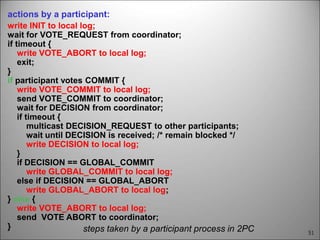
steps taken by a participant process in 2PC
actions by a participant:
write INIT to local log;
wait for VOTE_REQUEST from coordinator;
if timeout {
write VOTE_ABORT to local log;
exit;
}
if participant votes COMMIT {
write VOTE_COMMIT to local log;
send VOTE_COMMIT to coordinator;
wait for DECISION from coordinator;
if timeout {
multicast DECISION_REQUEST to other participants;
wait until DECISION is received; /* remain blocked */
write DECISION to local log;
}
if DECISION == GLOBAL_COMMIT
write GLOBAL_COMMIT to local log;
else if DECISION == GLOBAL_ABORT
write GLOBAL_ABORT to local log;
} else {
write VOTE_ABORT to local log;
send VOTE ABORT to coordinator;
}
52
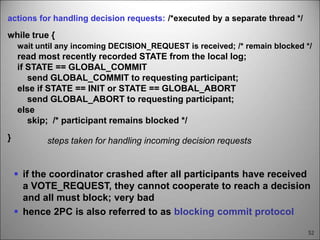
steps taken for handling incoming decision requests
actions for handling decision requests: /*executed by a separate thread */
while true {
wait until any incoming DECISION_REQUEST is received; /* remain blocked */
read most recently recorded STATE from the local log;
if STATE == GLOBAL_COMMIT
send GLOBAL_COMMIT to requesting participant;
else if STATE == INIT or STATE == GLOBAL_ABORT
send GLOBAL_ABORT to requesting participant;
else
skip; /* participant remains blocked */
}
 if the coordinator crashed after all participants have received
a VOTE_REQUEST, they cannot cooperate to reach a decision
and all must block; very bad
 hence 2PC is also referred to as blocking commit protocol
53
 Three-Phase Commit Protocol (3PC)
 the problem with 2PC is that, if the coordinator crashes,
participants will need to block until the coordinator
recovers
 3PC avoids blocking processes in the presence of crashes
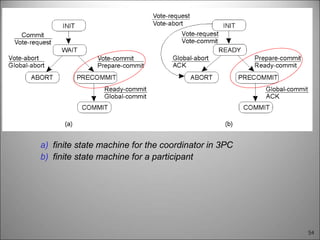
 the states of the coordinator and each participant satisfy
the following two conditions (necessary and sufficient
conditions for a commit protocol to be nonblocking)
 there is no single state from which it is possible to make
a transition directly to either COMMIT or an ABORT state
 there is no state in which it is not possible to make a final
decision, and from which a transition to a COMMIT state
can be made
54
a) finite state machine for the coordinator in 3PC
b) finite state machine for a participant
55
7.6 Recovery
 fundamental to fault tolerance is recovery from an error
 error recovery means to replace an erroneous state with an
error-free state
 two forms of error recovery: backward recovery and
forward recovery
 Backward Recovery
 bring the system from its present erroneous state back
into a previously correct state
 for this, the system’s state must be recorded from time to
time; each time a state is recorded, a checkpoint is said
to be made
 e.g., retransmitting lost or damaged packets in the
implementation of reliable communication
 most widely used method, since it is a generally
applicable method and can be integrated into the
middleware layer of a distributed system
56
 disadvantages:
 checkpointing and restoring a process to its previous
state are costly and performance bottlenecks
 no guarantee can be given that the error will not recur,
which may take an application into a loop of recovery
 some actions may be irreversible; e.g., deleting a file,
handing over cash to a customer
 Forward Recovery
 bring the system from its present erroneous state to a
correct new state from which it can continue to execute
 it has to be known in advance which errors may occur so
as to correct those errors
 e.g., erasure correction (or simply error correction) where a
lost or damaged packet is constructed from other
successfully delivered packets
57
 Stable Storage
 process states must be safely saved for recovery
 how to design a storage system that can survive most
problems
 use a pair of disks
 each block on drive 2 is an exact copy of the
corresponding block on drive 1
 when a block is updated, first the block on drive 1 is
updated and verified, then the same block on drive 2 is
done
58
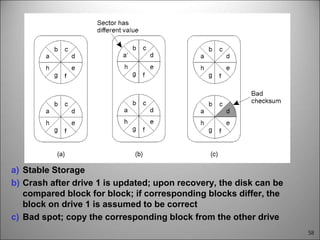
a) Stable Storage
b) Crash after drive 1 is updated; upon recovery, the disk can be
compared block for block; if corresponding blocks differ, the
block on drive 1 is assumed to be correct
c) Bad spot; copy the corresponding block from the other drive
59
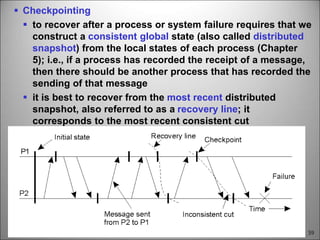
 Checkpointing
 to recover after a process or system failure requires that we
construct a consistent global state (also called distributed
snapshot) from the local states of each process (Chapter
5); i.e., if a process has recorded the receipt of a message,
then there should be another process that has recorded the
sending of that message
 it is best to recover from the most recent distributed
snapshot, also referred to as a recovery line; it
corresponds to the most recent consistent cut
60
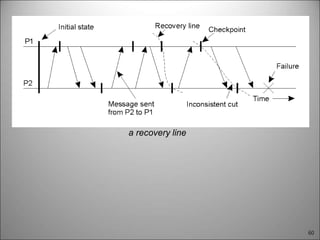
a recovery line
61
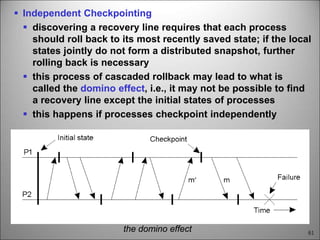
 Independent Checkpointing
 discovering a recovery line requires that each process
should roll back to its most recently saved state; if the local
states jointly do not form a distributed snapshot, further
rolling back is necessary
 this process of cascaded rollback may lead to what is
called the domino effect, i.e., it may not be possible to find
a recovery line except the initial states of processes
 this happens if processes checkpoint independently
the domino effect
62
 Coordinated Checkpointing
 all processes synchronize to jointly write their state to local
stable storage
 the saved state is automatically globally consistent, so that
cascaded rollback leading to the domino effect is avoided
 the distributed snapshot algorithm (Chapter 5) can be used
to coordinate checkpointing
 or a two-phase blocking protocol can be used (centralised)
 a coordinator multicasts a CHECKPOINT_REQUEST
message to all processes
 in receipt of such a message, each process takes a local
snapshot and acknowledges to the coordinator
 the coordinator then multicasts a CHECKPOINT_DONE
message
 Read about Message Logging (Pages 407-410)

Chapter 7-Fault Tolerance.ppt

  • 1.
    Chapter 7 -Fault Tolerance
  • 2.
    2  Introduction  amajor difference between distributed systems and single machine systems is that with the former, partial failure is possible, i.e., when one component in a distributed system fails  such a failure may affect some components while others will continue to function properly  an important goal of distributed systems design is to construct a system that can automatically recover from partial failure  it should tolerate faults and continue to operate to some extent
  • 3.
    3  Objectives ofthe Chapter  we discuss  fault tolerance, and making distributed systems fault tolerant  process resilience (techniques by which one or more processes can fail without seriously disturbing the rest of the system)  reliable multicasting to keep processes synchronized (by which message transmission to a collection of processes is guaranteed to succeed)  distributed commit protocols for ensuring atomicity in distributed systems  failure recovery by saving the state of a distributed system (when and how)
  • 4.
    4 7.1 Introduction toFault Tolerance  Basic Concepts  fault tolerance is strongly related to dependable systems  dependability covers the following  availability  refers to the probability that the system is operating correctly at any given time; defined in terms of an instant in time  reliability  a property that a system can run continuously without failure; defined in terms of a time interval  safety  refers to the situation that even when a system temporarily fails to operate correctly, nothing catastrophic happens  maintainability  how easily a failed system can be repaired
  • 5.
    5  dependable systemsare also required to provide a high degree of security  a system is said to fail when it cannot meet its promises; for instance failing to provide it users one or more of the services it promises  an error is a part of a system’s state the may lead to a failure; e.g., damaged packets in communication  the cause of an error is called a fault  building dependable systems closely relates to controlling faults  a distinction is made between preventing, removing, and forecasting faults  a fault tolerant system is a system that can provide its services even in the presence of faults
  • 6.
    6  faults areclassified into three  transient  occurs once and then disappears; if the operation is repeated, the fault goes away; e.g., a bird flying through a beam of a microwave transmitter may cause some lost bits  intermittent  it occurs, then vanishes on its own accord, then reappears, ...; e.g., a loose connection; difficult to diagnose; take your sick child to the nearest clinic, but the child does not show any sickness by the time you reach there  permanent  one that continues to exist until the faulty component is repaired; e.g, disk head crash, software bug
  • 7.
    7  Failure Modes- 5 of them  Crash failure: a server halts, but was working correctly until it stopped  Omission failure: a server fails to respond to incoming requests  Receive omission: a server fails to receive incoming messages; e.g., may be no thread is listening  Send omission: a server fails to send messages  Timing failure: a server's response lies outside the specified time interval; e.g., may be it is too fast over flooding the receiver or too slow  Response failure: the server's response is incorrect  Value failure: the value of the response is wrong; e.g., a search engine returning wrong Web pages as a result of a search  State transition failure: the server deviates from the correct flow of control; e.g., taking default actions when it fails to understand the request
  • 8.
    8  Arbitrary failure(or Byzantine failure): a server may produce arbitrary responses at arbitrary times; most serious  Failure Masking by Redundancy  to be fault tolerant, the system tries to hide the occurrence of failures from other processes - masking  the key technique for masking faults is redundancy  three kinds are possible  information redundancy; add extra bits to allow recovery from garbled bits (error correction)  time redundancy: an action is performed more than once if needed; e.g., redo an aborted transaction; useful for transient and intermittent faults  physical redundancy: add (replicate) extra equipment (hardware) or processes (software)
  • 9.
    9 7.2 Process Resilience how can fault tolerance be achieved in distributed systems  one method is protection against process failures by replicating processes into groups  we discuss  what are the general design issues of process groups  what actually is a fault tolerant group  how to reach agreement within a process group when one or more of its members cannot be trusted to give correct answers
  • 10.
    10  Design Issues the key approach to tolerating a faulty process is to organize several identical processes into a group  all members of a group receive a message hoping that if one process fails, another one will take over  process groups may be dynamic  new groups can be created and old groups can be destroyed  a process can join or leave a group  a process can be a member of several groups at the same time  hence group management and membership mechanisms are required  groups may be flat (all processes are equal) or hierarchical (a coordinator and several workers)
  • 11.
    11 (a) communication ina flat group (b) communication in a simple hierarchical group  the flat group has no single point of failure, but decision making is more complicated (voting may be required for decision making)  the hierarchical group has the opposite properties  group membership may be handled  through a group server where all requests (joining, leaving, ...) are sent; it has a single point of failure  in a distributed way (membership is multicasted)
  • 12.
    12  Failure Maskingand Replication  how to replicate processes so that they can form groups?; there are two ways (as discussed in the previous chapter):  primary-based protocols: for fault tolerance, primary- backup protocol is used; organize processes hierarchically and let the primary coordinate all writes; if the primary crashes, the backups hold an election  replicated-write protocols: in the form of active replication or by means of quorum-based protocols; processes are organized as flat groups
  • 13.
    13  another importantissue is how much replication is needed  a system is said to be k fault tolerant if it can survive faults in k components and still meets its specifications  if the processes fail silently, then having k+1 replicas is enough; if k of them fail, the remaining one can function  if processes exhibit Byzantine failure, 2k+1 replicas are required; if the k processes generate the same reply (wrong), the k+1 will also produce the same answer (correct); but which of the two is correct is difficult to ascertain; unless we believe the majority
  • 14.
    14  Agreement ina Faulty System  agreement is required in many cases; some examples are  electing a coordinator  deciding whether or not to commit a transaction  dividing tasks among workers  the objective of all agreement algorithms is to have all the non-faulty processes reach consensus on some issue in a finite number of steps  but, reaching an agreement in a faulty environment (if process and/or communication failure exists) is difficult; two cases  processes are perfect but communication is unreliable  this is similar to the problem known as the two-army problem; the sender of a message does not know that its message has arrived  even if the receiver acknowledges, it does not know that its acknowledgement has been received  hence, it is even difficult to reach an agreement when there are only two perfect processes
  • 15.
    15  communication isperfect but processes are not  this is also similar to the problem known as the Byzantine generals problem, where out of n generals m are traitors (they send wrong responses); can the loyal generals reach an agreement?  a recursive algorithm by Lamport  each general is assumed to know how many troops s/he has  the goal is to exchange troop strengths (by telephone, hence reliable communication)  at the end of the algorithm, each general has a vector of length n corresponding to all the armies  if general i is loyal, then element i is his troop strength; otherwise, it is undefined
  • 16.
    16  the algorithmworks in four steps 1. each general sends his troop strength to every other general 2. the results are collected in the form of vectors 3. every general passes his vector to every other general 4. each general examines the ith element; if any value has a majority, that value is put into the result vector; else is marked UNKNOWN
  • 17.
    17 the Byzantine generalsproblem for 3 loyal generals and 1 traitor a) the generals announce their troop strengths (in units of 1 kilosoldiers) b) the vectors that each general assembles based on (a) c) the vectors that each general receives in step 3  generals 1, 2, and 4 all come to an agreement on (1, 2, UNKNOWN, 4) and the traitor has failed, i.e., the system works  e.g.1, for n = 4, m = 1
  • 18.
    18  e.g.2, thealgorithm fails for n = 3, m = 1  generals 1 and 2 could not reach an agreement; no majority for all elements  it has been proved that in a system with m faulty processes, agreement can be reached only if 2m+1 correctly functioning processes are present, for a total of 3m+1; i.e., only if more than 2/3rds of the processes are working properly
  • 19.
    19 7.3 Reliable Client-ServerCommunication  fault tolerance in distributed systems concentrates on faulty processes  but communication failures also have to be considered  a communication channel may exhibit failures in the form of  crash  omission  timing  arbitrary (duplicate messages as a result of buffering at nodes and the sender retransmitting)  Point-to-Point Communication  reliable transport protocols such as TCP can be used that mask most communication failures such as omissions (lost messages) using acknowledgements and retransmissions  however, crash failures are often not masked; e.g., a broken TCP connection; in which case the system may probably setup a new connection automatically
  • 20.
    20  RPC Semanticsin the Presence of Failures  the goal of RPC is to hide communication by making remote procedure calls look like local ones; may be difficult to mask remote calls when there are failures  five different classes of failures can occur in RPC systems, each requiring a different solution  the client is unable to locate the sever  the client’s request to the server is lost  the server receives the request and crashes  the reply message from the server to the client is lost  the client crashes after sending a request
  • 21.
    21 1.the client isunable to locate the sever  may be the client is unable to locate a suitable server or the server is down  or an interface at the server has been changed making the client’s stub obsolete (it was not used for a long time) and the binder failing to match it with the server  one solution: let the client raise an exception and have exception handlers; inserted by the programmer  examples are exceptions in Java or signal handlers in C  but  not every language may provide exceptions or signals  the major objective of having transparency is violated 2.the client’s request to the server is lost  let the OS or the client stub start a timer when sending a request; if the timer expires before a reply or acknowledgement comes back, the message is retransmitted
  • 22.
    22 3.the server receivesthe request and crashes  the failure can happen before or after execution a server in client-server communication; (a) normal case, (b) crash after execution, (c) crash before execution  in (b), let the system report failure back to the client (raise an exception)  in (c) retransmit the request  but the client’s OS doesn’t know which is which; only a timer has expired
  • 23.
    23  three possiblesolutions  the client tries the operation again after the server has restarted (or rebooted) or rebinds to a new server, called at least once semantics; keep on trying until a reply is received; it guarantees that the RPC has been carried out at least one time, but possibly more  the client gives up after the first attempt and reports error, called at most once semantics; it guarantees that the RPC has been carried out at most one time, but possibly none at all  no guaranty at all (0-N times)  none of the above is the right solution; what is required is exactly once semantics; but difficult to achieve
  • 24.
    24  assume that a client would like to print some text  the client receives an acknowledgement of receipt  the server can send a completion message and print or can print and then send a completion message (2 possibilities)  assume the server crashes and recovers, announces this; the client doesn’t know if its request will be carried out  what should the client do?; four possibilities  never reissue a request (the text may not be printed)  reissue a request (the text may be printed twice)  assuming the server crashed before the request was delivered, it can decide to reissue a request only if it has not received an acknowledgement  reissue a request only if it has received an acknowledgement  hence, with 2 strategies for the server and 4 for the client, there are a total of 8 possibilities, none of which is satisfactory
  • 25.
    25  three possibleevents at the server: send the completion message (M), print the text (P), crash (C)  six different orderings of these events (the parentheses indicate an event that can no longer happen) a. if the server’s strategy is M  P  M PC - a crash occurs after sending the completion message and printing the text  MC(P)  C(MP) b. if the server’s strategy is P  M  PMC  PC(M)  C(PM)
  • 26.
    26  none ofall the combinations works; the client can never know whether the server crashes before or after printing different combinations of client and server strategies in the presence of server crashes
  • 27.
    27 4.the reply messagefrom the server to the client is lost  the client sets a timer and resends  there is a risk that the request is sent more than once; may be the server was slow  however, if the operation is idempotent (an operation such as requesting a read that can be repeated without any harm), it does not create any problem; but what if the request is to transfer money from one account to another?  let the client assign a sequence number to each request so that the server knows it is a duplicated one; but needs the server to maintain information on each client  in addition, we can have a bit in the message header that is used to distinguish initial requests from retransmissions so as to take more care on retransmissions
  • 28.
    28 5.the client crashesafter sending a request  in this case a computation may be done without a parent waiting for the result; such unwanted computations are called orphans  orphans  waste CPU cycles  can lock valuable resources such as files  can cause confusion if the client reboots and does the RPC again and the reply from the orphan comes back immediately afterward  proposed solutions  extermination: let the client stub maintain a log before sending an RPC message; after a reboot, inspect the log and kill the orphan; some problems  the expense of writing a log for every RPC  it may not work if the orphans themselves do RPC, creating grandorphans that are difficult to locate
  • 29.
    29  reincarnation: dividetime into sequentially numbered epochs; when a client reboots, it broadcasts a message to all machines declaring the start of a new epoch; when such a broadcast comes in, all remote computations on behalf of that client are killed  gentle reincarnation: when an epoch broadcast comes in, each machine checks to see if it has remote computations, and if so, tries to locate their owner; a computation is killed only if the owner cannot be found  expiration: each RPC is given a standard amount of time, T, to do the job; if it cannot finish, it must explicitly ask for another quantum; if after a crash the client waits a time T before rebooting, all orphans are killed; the problem is how to choose a reasonable value of T, since RPCs have differing needs
  • 30.
    30 7.4 Reliable GroupCommunication  how to reliably deliver messages to a process group (multicasting)  Basic Reliable-Multicasting Schemes  reliable multicasting means a message sent to a process group should be delivered to each member of that group  transport protocols do not offer reliable communication to a collection of processes  problems:  what happens if a process joins a group during communication?  what happens if a (sending) process crashes during communication?  what if there are faulty processes?  a weaker solution assuming that all receivers are known (and they are limited) and that none will fail is for the sending process to assign a sequence number to each message and to buffer all messages so that lost ones can be retransmitted
  • 31.
    31 a simple solutionto reliable multicasting when all receivers are known and are assumed not to fail; (a) message transmission, (b) reporting feedback
  • 32.
    32  Scalability inReliable Multicasting  a reliable multicast scheme does not support large number of receivers; there will be feedback implosion  two approaches for solving the problem 1. Nonhierarchical Feedback Control  reduce the number of feedback messages returned to the sender using feedback suppression  the Scalable Reliable Multicasting Protocol (SRM) uses this principle  only negative acks are returned as feedback and they are multicasted to all so that others that missed the message will refrain from sending a negative ack  a receiver R that did not receive a message M schedules a feedback message with some random delay T; if another message for retransmitting M reaches R, R suppresses its transmission; else it transmits  the sender will receive only a single negative ack and retransmits M to all
  • 33.
    33 several receivers havescheduled a request for retransmission, but the first retransmission request leads to the suppression of others  feedback suppression scales well  disadvantages  ensuring that only one feedback will reach the sender is difficult; there is a possibility of many receivers sending their feedback at the same time  receivers that successfully receive a message waste their time processing negative acks and the duplicated message
  • 34.
    34 2. Hierarchical FeedbackControl  hierarchical solutions are better to achieve scalability for very large groups of receivers  the group of receivers is partitioned into a number of subgroups, subsequently organized into a tree; the subgroup containing the sender forms the root of the tree  within each subgroup, use any reliable multicasting scheme that works for small groups  each subgroup appoints a local coordinator, responsible for handling retransmission requests in its subgroup; hence it has its history buffer  dynamically constructing the tree is a problem building reliable multicast schemes that can scale to a large number of receivers spread in a WAN is a difficult problem; more research is required
  • 35.
    35 the essence ofhierarchical reliable multicasting; each local coordinator forwards the message to its children and later handles retransmission requests
  • 36.
    36  Atomic Multicast how to achieve reliable multicasting in the presence of process failures  for example, in a replicated database, how to handle update operations when a replica crashes during update operations  the atomic multicast problem: to guarantee that a message is delivered to either all processes or none at all and that messages are delivered in the same order to all processes
  • 37.
    37 the logical organizationof a distributed system to distinguish between message receipt and message delivery  Virtual Synchrony  consider the following model in which the distributed system consists of a communication layer for sending and receiving messages; a received message is locally buffered in this layer until it is delivered to the application
  • 38.
    38  the wholeidea of atomic multicasting is that a multicast message m is uniquely associated with a list of processes to which it should be delivered; this delivery list corresponds to a group view G, the view on the set of processes contained in the group, which the sender had at the time message m was multicast  a view change takes place by multicasting a message vc announcing the joining or leaving of a process, while the multicasting takes place  then there are two messages in transit: m and vc; we need a guarantee that m is either delivered to all processes in G before each of them receives vc, or m is not delivered at all  a reliable multicast guarantees that a message multicast to group G is delivered to each non-faulty process in G; if the sender crashes during the multicast, the message may either be delivered to all remaining processes or ignored by each of them; a reliable multicast with this property is said to be virtually synchronous
  • 39.
    39  e.g., 4processes; P3 crashes after successfully multicasting a message to P2 and P4 but not to P1; virtual synchrony guarantees that the message is not delivered at all; later P3 can join after its state has been brought up to date  hence, all multicasts take place between view changes; a view change acts as a barrier across which no multicast can pass; similar to synchronization variables used in distributed data stores
  • 40.
    40  Message ordering there are four different orderings 1. Unordered multicasts  a reliable, unordered multicast is a virtual synchronous multicast in which no guarantees are given concerning the order in which received messages (by the communication layer) are delivered by different processes three communicating processes in the same group; the ordering of events per process is shown along the vertical axis Process P1 Process P2 Process P3 sends m1 receives m1 receives m2 sends m2 receives m2 receives m1
  • 41.
    41 four processes inthe same group with two different senders, and a possible delivery order of messages under FIFO-ordered multicasting Process P1 Process P2 Process P3 Process P4 sends m1 receives m1 receives m3 sends m3 sends m2 receives m3 receives m1 sends m4 receives m2 receives m2 receives m4 receives m4 2. FIFO-ordered multicasts  for reliable FIFO-ordered multicasts, the communication layer is forced to deliver incoming messages from the same process in the same order as they have been sent  in the following example, m1 must always be delivered before m2; same to m3 and m4; but no constraint regarding messages originating from different processes 3. Causally-ordered multicasts  reliable causally-ordered multicast delivers messages so that potential causality between different messages is preserved
  • 42.
    42 4. Totally-Ordered Multicasts besides the above three, a further constraint can be used; regardless of whether message delivery is unordered, FIFO ordered, or causally ordered, when messages are delivered, they are delivered in the same order to all group members  i.e., totally-ordered multicast is used in combination with one of the three  in the previous example of FIFO-ordered multicast, P2 and P3 must deliver messages m1, m2, m3, and m4 in the same order (still respecting FIFO ordering)
  • 43.
    43 six different versionsof virtually synchronous reliable multicasting Multicast Basic Message Ordering Total-ordered Delivery? Reliable unordered multicast None No FIFO multicast FIFO-ordered delivery No Causal multicast Causal-ordered delivery No Atomic multicast None Yes FIFO atomic multicast FIFO-ordered delivery Yes Causal atomic multicast Causal-ordered delivery Yes  virtually synchronous reliable multicasting offering totally- ordered delivery of messages is called atomic multicasting  hence, there are a total of six forms of reliable multicasting (the three message orderings combined with atomicity)
  • 44.
    44 7.5 Distributed Commit atomic multicasting is an example of the more generalized problem known as distributed commit  the distributed commit problem involves having an operation being performed by each member of a process group, or none at all  in atomic multicasting, the operation is delivery of a message  there are three protocols: one-phase commit, two-phase commit, and three-phase commit  One-Phase Commit Protocol  a coordinator tells all other processes, called participants, whether or not to (locally) perform an operation  drawback: if one of the participants cannot perform the operation, there is no way to tell the coordinator; for example due to violation of concurrency control constraints in distributed transactions
  • 45.
    45  Two-Phase CommitProtocol (2PC)  it has two phases: voting phase and decision phase, each involving two steps  voting phase  the coordinator sends a VOTE_REQUEST message to all participants  each participant then sends a VOTE_COMMIT or VOTE_ABORT message depending on its local situation  decision phase  the coordinator collects all votes; if all vote to commit the transaction, it sends a GLOBAL_COMMIT message; if at least one participant sends VOTE_ABORT, it sends a GLOBAL_ABORT message  each participant that voted for a commit waits for the final reaction of the coordinator and commits or aborts
  • 46.
    46 a) the finitestate machine for the coordinator in 2PC b) the finite state machine for a participant
  • 47.
    47  problems mayoccur in the event of failures  the coordinator and participants have states in which they block waiting for messages: INIT, READY, WAIT  when a process crashes, other processes may wait indefinitely  hence, timeout mechanisms are required  a participant waiting in its INIT state for VOTE_REQUEST from the coordinator aborts and sends VOTE_ABORT if it does not receive a vote request after some time  the coordinator blocking in state WAIT aborts and sends GLOBAL_ABORT if all votes have not been collected on time  a participant P waiting in its READY state waiting for the global vote cannot abort; instead it must find out which message the coordinator actually sent  by blocking until the coordinator recovers  or requesting another participant, say Q
  • 48.
    48 actions taken bya participant P when residing in state READY and having contacted another participant Q State of Q Action by P Comments COMMIT Make transition to COMMIT Coordinator sent GLOBAL_COMMIT before crashing ABORT Make transition to ABORT Coordinator sent GLOBAL_ABORT before crashing INIT Make transition to ABORT Coordinator sent VOTE_REQUEST before crashing READY Contact another participant If all are in state READY, wait until the coordinator recovers
  • 49.
    49  a process(participant or coordinator) can recover from crash if its state has been saved to persistent storage  actions by a participant after recovery  there are two critical states for the coordinator State before Crash Action by the Process after Recovery INIT Locally abort the transaction and inform the coordinator COMMIT or ABORT Retransmit its decision to the coordinator READY Can not decide on its own what it should do next; has to contact other participants State before Crash Action by the Coordinator after Recovery WAIT Retransmit the VOTE_REQUEST message After the Decision in the 2nd phase Retransmit the decision
  • 50.
    50 outline of thesteps taken by the coordinator in a two-phase commit protocol actions by the coordinator: write START_2PC to local log; /* records it is entering the WAIT state */ multicast VOTE_REQUEST to all participants; while not all votes have been collected { wait for any incoming vote; if timeout { write GLOBAL_ABORT to local log; multicast GLOBAL_ABORT to all participants; exit; } record vote; } if all participants sent VOTE_COMMIT and coordinator votes COMMIT{ write GLOBAL_COMMIT to local log; multicast GLOBAL_COMMIT to all participants; } else { write GLOBAL_ABORT to local log; multicast GLOBAL_ABORT to all participants; } voting phase decision phase
  • 51.
    51 steps taken bya participant process in 2PC actions by a participant: write INIT to local log; wait for VOTE_REQUEST from coordinator; if timeout { write VOTE_ABORT to local log; exit; } if participant votes COMMIT { write VOTE_COMMIT to local log; send VOTE_COMMIT to coordinator; wait for DECISION from coordinator; if timeout { multicast DECISION_REQUEST to other participants; wait until DECISION is received; /* remain blocked */ write DECISION to local log; } if DECISION == GLOBAL_COMMIT write GLOBAL_COMMIT to local log; else if DECISION == GLOBAL_ABORT write GLOBAL_ABORT to local log; } else { write VOTE_ABORT to local log; send VOTE ABORT to coordinator; }
  • 52.
    52 steps taken forhandling incoming decision requests actions for handling decision requests: /*executed by a separate thread */ while true { wait until any incoming DECISION_REQUEST is received; /* remain blocked */ read most recently recorded STATE from the local log; if STATE == GLOBAL_COMMIT send GLOBAL_COMMIT to requesting participant; else if STATE == INIT or STATE == GLOBAL_ABORT send GLOBAL_ABORT to requesting participant; else skip; /* participant remains blocked */ }  if the coordinator crashed after all participants have received a VOTE_REQUEST, they cannot cooperate to reach a decision and all must block; very bad  hence 2PC is also referred to as blocking commit protocol
  • 53.
    53  Three-Phase CommitProtocol (3PC)  the problem with 2PC is that, if the coordinator crashes, participants will need to block until the coordinator recovers  3PC avoids blocking processes in the presence of crashes  the states of the coordinator and each participant satisfy the following two conditions (necessary and sufficient conditions for a commit protocol to be nonblocking)  there is no single state from which it is possible to make a transition directly to either COMMIT or an ABORT state  there is no state in which it is not possible to make a final decision, and from which a transition to a COMMIT state can be made
  • 54.
    54 a) finite statemachine for the coordinator in 3PC b) finite state machine for a participant
  • 55.
    55 7.6 Recovery  fundamentalto fault tolerance is recovery from an error  error recovery means to replace an erroneous state with an error-free state  two forms of error recovery: backward recovery and forward recovery  Backward Recovery  bring the system from its present erroneous state back into a previously correct state  for this, the system’s state must be recorded from time to time; each time a state is recorded, a checkpoint is said to be made  e.g., retransmitting lost or damaged packets in the implementation of reliable communication  most widely used method, since it is a generally applicable method and can be integrated into the middleware layer of a distributed system
  • 56.
    56  disadvantages:  checkpointingand restoring a process to its previous state are costly and performance bottlenecks  no guarantee can be given that the error will not recur, which may take an application into a loop of recovery  some actions may be irreversible; e.g., deleting a file, handing over cash to a customer  Forward Recovery  bring the system from its present erroneous state to a correct new state from which it can continue to execute  it has to be known in advance which errors may occur so as to correct those errors  e.g., erasure correction (or simply error correction) where a lost or damaged packet is constructed from other successfully delivered packets
  • 57.
    57  Stable Storage process states must be safely saved for recovery  how to design a storage system that can survive most problems  use a pair of disks  each block on drive 2 is an exact copy of the corresponding block on drive 1  when a block is updated, first the block on drive 1 is updated and verified, then the same block on drive 2 is done
  • 58.
    58 a) Stable Storage b)Crash after drive 1 is updated; upon recovery, the disk can be compared block for block; if corresponding blocks differ, the block on drive 1 is assumed to be correct c) Bad spot; copy the corresponding block from the other drive
  • 59.
    59  Checkpointing  torecover after a process or system failure requires that we construct a consistent global state (also called distributed snapshot) from the local states of each process (Chapter 5); i.e., if a process has recorded the receipt of a message, then there should be another process that has recorded the sending of that message  it is best to recover from the most recent distributed snapshot, also referred to as a recovery line; it corresponds to the most recent consistent cut
  • 60.
  • 61.
    61  Independent Checkpointing discovering a recovery line requires that each process should roll back to its most recently saved state; if the local states jointly do not form a distributed snapshot, further rolling back is necessary  this process of cascaded rollback may lead to what is called the domino effect, i.e., it may not be possible to find a recovery line except the initial states of processes  this happens if processes checkpoint independently the domino effect
  • 62.
    62  Coordinated Checkpointing all processes synchronize to jointly write their state to local stable storage  the saved state is automatically globally consistent, so that cascaded rollback leading to the domino effect is avoided  the distributed snapshot algorithm (Chapter 5) can be used to coordinate checkpointing  or a two-phase blocking protocol can be used (centralised)  a coordinator multicasts a CHECKPOINT_REQUEST message to all processes  in receipt of such a message, each process takes a local snapshot and acknowledges to the coordinator  the coordinator then multicasts a CHECKPOINT_DONE message  Read about Message Logging (Pages 407-410)