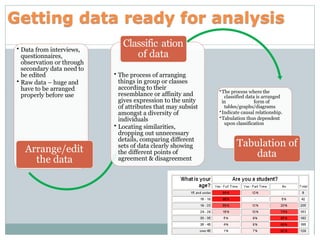
• Data frominterviews,
questionnaires,
observation or through
secondary data need to
be edited
• Raw data – huge and
have to be arranged
properly before use
Arrange/edit
the data
• The process of arranging
things in group or classes
according to their
resemblance or affinity and
gives expression to the unity
of attributes that may subsist
amongst a diversity of
individuals
• Locating similarities,
dropping out unnecessary
details, comparing different
sets of data clearly showing
the different points of
agreement & disagreement
Classific2ation
of data
•The process where the
classified data is arranged
in form of
tables/graphs/diagrams
•Indicate causal relationship.
•Tabulation thus dependent
upon classification
Tabulation of
data
3.
3
Editing
Itis aprocess of checking & adjusting the
data for omissions, legibility & consistency.
Detects errors, misunderstood & correct them by
maintaining the data quality.
4.
To ensurethe data is accurate, complete, consistent with
the intent of the question so as to simplify the coding and
tabulation processes.
Eg; an answer which is obviously impossible (birth year:
1850), not eligible interviewees (too young, mental
retarded)
Inconsistent answers: the Resp.
might unconsciously not answered or
deliberately
have
omitted
answering, given inconsistent answer between one Q to
the other.
4
5.
Handling blank responses/ item non-response
Reasons: the Resp. could5 not understand the
Q, unwilling to answer, indifferent to respond to
the entire questionnaire.
Uma Sekaran: if more than 25% the questionnaire
has been left blank – good idea to discard the
questionnaire + not to be included in the data set for
analysis.
6.
Dealing with don’tknow responses (DK)
6
Legitimate – when the R does not know the answer / has
formed no clear-cut opinion (no opinion) / when the R
simply does not want to answer (eg: Q on income)
Eg: how often each year do you go to the movies? – some
calculation need to be done by the R about a topic to which
they attach little importance
To avoid DK response – design better Q at the beginning,
motivate R to provide more usable answers.
7.
7
If theyare just a few – ignored + not countered for
tabulation
If they are many – place all legitimate responses
under a separate reply category
It may be useful for the researcher to know for the
purpose of analysis that on certain issue some Rs
have either no opinion of their own or are
reluctant to express opinion
8.
8
Field editing
Researchersoften do the editing work on the same day as
the interview – field editing
Possible only when the interviews + questionnaires are personally
distributed + collected
It is done by checking technical omissions, readability of the writing,
inconsistency of responses
Rapid follow up/daily field editing – enable the researcher to again
contact the R to fill in omissions bf the situation has changed.
9.
In-house editing
9
Referto editing job performed by a centralised office staff
Social research is often conducted by organisations, departments or
companies for which field workers are appointed to carry out
surveys
Data collected by the staff are edited by a central office staff
It also applies to an academic study -several persons are engaged to
gather data
It is done when the data gathering process is completed
(not simultaneous editing in the field)
The same goes to an academic study which is done by a
single individual
10.
10
Coding
itis a method symbols
(numbers/letters/words)
of assigning
to answers
limited
so that
the
number
of
responses can be grouped
into classes/categories
The symbol assigned is called a
code.
Eg: “M” – male, “F” – female
“1” – male, “2” – female
Coding scheme – the plan by which a
researcher organises responses for the purpose of
analysis.
11.
Helps researcherto reduce a large number of replies
to a few categories containing the
important information needed for analysis.
Importance of coding?
11
12.
Inductive & deductiveapproach to coding
12
Inductive approach to qualitative data?
- Codes are derived from the data
- Participants’ words / in vivo codes are used to code
the data
- No ready codes – create along the reading
- Codes are built and modified throughout the coding
process
13.
13
An inductiveapproach to coding legal research data
is a methodology that involves deriving codes
and categories directly from the data itself
rather than applying pre-existing theories or
frameworks.
This approach is particularly useful in exploratory
research where the goal is to uncover patterns,
themes, and insights that emerge naturally from the
data.
14.
process
14
Researchers engagein the process of identifying the
themes, patterns and concepts that emerge naturally
from the data without preconceived categories.
Codes are generated from the data itself, allowing for
a more flexible and open-ended analysis.
Researchers can effectively apply inductive coding in
grounded theory and qualitative content analysis.
15.
example
15
Researchers analyzeinterview transcripts without
predefined codes. They identify recurring
themes such as "increased workload," "client
awareness," and "complex procedures" from
the data, and then develop a theory
explaining the impact of legal reforms based
on these emergent themes.
16.
Deductive approach tocode qualitative data?
16
Researcher formulates pre set coding scheme.
Once the coding scheme is established, the
researcher applies the codes to the data.
Deductive coding is a structured approach to
qualitative data analysis where the coding process is
guided by pre-existing theories, hypotheses, or
frameworks.
This approach is typically used to confirm or refute
existing theories and involves applying a predefined
coding scheme to the data.
17.
process
17
Researchers beginwith a coding scheme developed
from prior research, theories, or hypotheses.
These codes are applied to the data
systematically.
The predefined codes are applied to the data to
confirm or disprove existing theories or hypotheses.
The process is more structured, with less flexibility to
adapt the coding scheme based on the data alone.
18.
example
18
Researchers usea predefined set of codes derived
from a theoretical model of organizational change.
They apply these codes to interview transcripts to see
if themes such as "leadership commitment,"
"employee resistance," and "communication
strategies" are present and to what extent they align
with the model.
19.
Coding rules
Certainbasic rules to be followed in coding:
(a) Appropriateness
-researcher should decide type of information that is
necessary for the purposes of the study
Eg: age / income of Rs are unnecessary in view of the
data collected– no need to create categories for them
for coding
-the entire data collected should be so classified as to
provide the best possible categories
19
20.
(b) Exhaustiveness
The codingcategories should be exhaustive in the
sense that they should be provided for all subjects /
objects of responses
The responses which may be useful for research
purposes should have separate code categories
Eg: the researcher might not bother to code “no
opinion” responses on the assumption that such
responses will not be involved in data analysis – such
“no opinion” responses may also be important
20
21.
(c) Mutualexclusivity
Coding categories should be mutually exclusive and
independent
Must ensure that there is no overlapping between the
categories so that the subject / response can be
placed in only one category
Eg: mutually exclusive category – categorising
persons as male / female
21
What is dataanalysis?
23
When the raw data (responses from interviews /
questionnaires) are collected, edited, coded and
entered into the computer, they are ready for
analysis.
Analysis is a process of examining, summarizing and
drawing inferences from the information contained
in the raw data.
24.
24
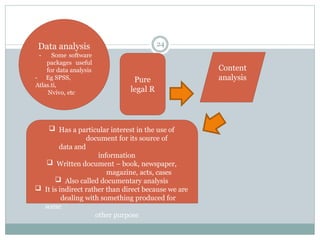
Data analysis
- Somesoftware
packages useful
for data analysis
- Eg SPSS,
Atlas.ti,
Nvivo, etc
Pure
legal R
Content
analysis
Has a particular interest in the use of
document for its source of
data and
information
Written document – book, newspaper,
magazine, acts, cases
Also called documentary analysis
It is indirect rather than direct because we are
dealing with something produced for
some
other purpose
25.
Content analysis?
Itis a specific analytical approach / technique that
focuses on the actual content and/or internal
features of any kind – word, picture, themes, text,
phrases, sentences
Researchers
relationships,
investigate concepts and
semantic instead of merely
counting +
tabulating the presence of particular elements
Both manifest + latent content are analysed.
25
26.
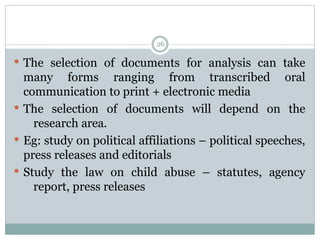
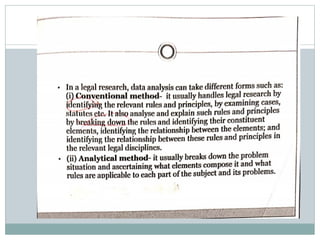
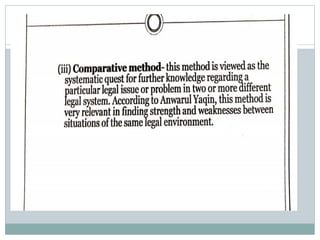
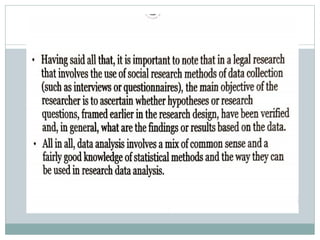
The selectionof documents for analysis can take
many forms ranging from transcribed oral
communication to print + electronic media
The selection of documents will depend on the
research area.
Eg: study on political affiliations – political speeches,
press releases and editorials
Study the law on child abuse – statutes, agency
report, press releases
26




![제 23회 보아즈(BOAZ) 빅데이터 컨퍼런스 - [MBOAX] : ABSA를 활용한 소비자 반응 분석 기반 운영 효율화 대시보드 설계](https://cdn.slidesharecdn.com/ss_thumbnails/3-1boaz23rdconferencemboax-260203102709-9d519923-thumbnail.jpg?width=640&height=640&fit=bounds)


