Develop afundamental understanding of research
and its methodologies.
Select relevant research topics effectively.
Identify, define, and refine the research problem.
Organize and conduct the research process
systematically.
Draft a well-structured research report and thesis.
Develop skills in writing scientific papers
Course Objectives
3.
What is research?
It’s the thing we do when we want to find something out.
It is what we are trained to do in a degree program.
It systematic investigation to establish facts; a search for
knowledge from known toward discovering the unknown.
"re" as a prefix meaning "again," "anew," or "over again,"
while "search" is a verb signifying to examine carefully,
test, try, or probe.
1. Definition of Research
4.
“Research” anoun that represents a systematic, patient
study or investigation in a particular field of
knowledge, aimed at establishing facts or principles.
( Grinnel 1993: 4 )
It is methodical examination of a specific subject or
problem using scientific methodologies to
characterize, explain, forecast, and manage the
observable event.
It involves gathering data, documenting key
information, then analyzing and interpreting that
data/information using methodologies established by
certain professional and academic disciplines.
Definition
5.
Methodology refersto the methods, techniques, and
procedures used to execute your research plan (design).
Research methods or techniques include all the strategies
researchers utilize to conduct research tasks (see research
instruments/tools).
A discipline focused on understanding how research is
systematically conducted in a scientific manner.
It entails a methodical approach to solving research
problems through a logical progression of steps.
2) SOME TERMINOLOGIES
6.
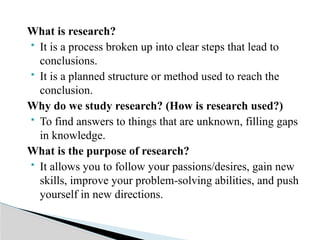
What is research?
It is a process broken up into clear steps that lead to
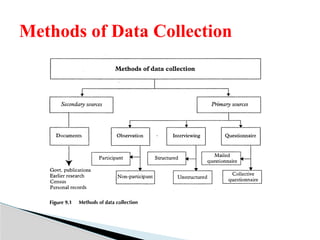
conclusions.
It is a planned structure or method used to reach the
conclusion.
Why do we study research? (How is research used?)
To find answers to things that are unknown, filling gaps
in knowledge.
What is the purpose of research?
It allows you to follow your passions/desires, gain new
skills, improve your problem-solving abilities, and push
yourself in new directions.
7.
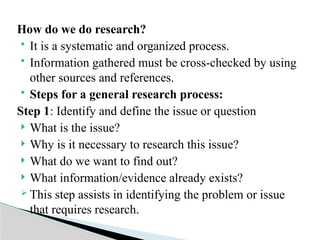
How do wedo research?
It is a systematic and organized process.
Information gathered must be cross-checked by using
other sources and references.
Steps for a general research process:
Step 1: Identify and define the issue or question
What is the issue?
Why is it necessary to research this issue?
What do we want to find out?
What information/evidence already exists?
This step assists in identifying the problem or issue
that requires research.
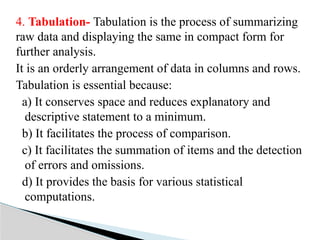
8.
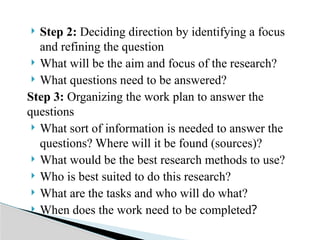
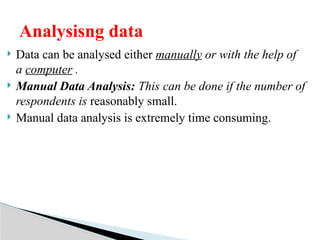
Step 2:Deciding direction by identifying a focus
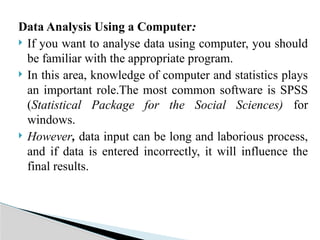
and refining the question
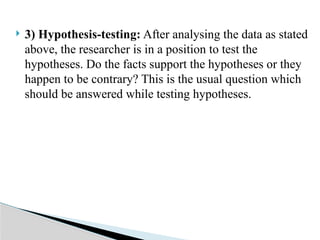
What will be the aim and focus of the research?
What questions need to be answered?
Step 3: Organizing the work plan to answer the
questions
What sort of information is needed to answer the
questions? Where will it be found (sources)?
What would be the best research methods to use?
Who is best suited to do this research?
What are the tasks and who will do what?
When does the work need to be completed?
9.
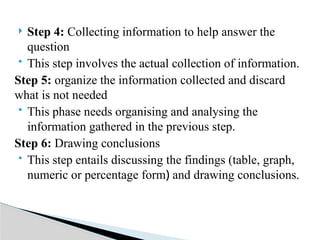
Step 4:Collecting information to help answer the
question
This step involves the actual collection of information.
Step 5: organize the information collected and discard
what is not needed
This phase needs organising and analysing the
information gathered in the previous step.
Step 6: Drawing conclusions
This step entails discussing the findings (table, graph,
numeric or percentage form) and drawing conclusions.
10.
Step 7:Writing a research report
It leaves a body of evidence that can be used by
politicians, planners, community organisations and
future researchers.
A report generally has six sections: introduction,
literature review, methodology, research results,
discussion, and conclusions and recommendations
Step 8: Reflecting on and evaluating the work done
Deciding on what action is needed and what steps should
be taken to use the research effectively.
12.
Research isa process that involves collecting, analyzing,
and interpreting information to answer specific questions.
For it to be recognized as true research, the process must
exhibit certain qualities.
It should, as much as possible, be:
i) Logical/ Reasonable ii)Rigorous/Thorough/precise
iii) Systematic iv) Valid and verifiable
v) Empirical vi) Critical
QUALITIES OF A GOOD RESEARCH
13.
Effective researchis logical, meaning it follows the
principles of sound reasoning. The use of induction and
deduction is crucial in the research process to ensure a
structured and rational approach.
Rigorous research requires careful attention to ensure that
the procedures used to answer questions are relevant,
appropriate, and well-justified. Additionally, the level of
rigor can vary significantly between the physical and social
sciences.
QUALITIES OF GOOD RESEARCH ( cont.)
14.
Effective researchis systematic, meaning the process
of conducting an investigation follows a structured and
logical sequence.
Each step must be carried out in a precise order, with
one procedure leading to the next.
This systematic nature of research discourages the use
of guesswork or intuition in drawing conclusions.
QUALITIES OF GOOD RESEARCH ( cont.)
15.
Effective researchis systematic because it adheres to a
specific set of steps, which include:
i) Identifying the problem
ii) Reviewing the literature
iii) Collecting data
iv) Analyzing the data
v) Drawing conclusions and making generalizations
SYSTEMATICNESS
16.
Valid andverifiable-this concept implies that whatever you
conclude on the basis of your findings is correct and can be
verified by you and others.
Empirical-this means that any conclusion drawn are based
upon hard evidence gathered from information collected from
real life experiences or observations.
Critical-critical scrutiny (examination) of the procedures used
and the methods employed is crucial to a research enquiry.
The process of investigation must be foolproof /safe
/guaranteed and free from drawbacks.
The process adopted and the procedures used must be able to
withstand critical scrutiny.
QUALITIES OF GOOD RESEARCH ( cont.)
17.
It issome difficulty which a researcher experiences in the
context of either a theoretical or practical situation and
wants to obtain a solution.
It is carefully selected.
“Well-crafted questions guide the systematic planning of
research. Formulating your questions precisely enables you
to design a study with a good chance of answering them.”
-- Light, Singer, Willett, By Design (1990)
What is a research problem?!
18.
After selectinga problem, it should be stated carefully by
the researcher to delimit/restrict his task and isolate a
specific problem before proceeding with active plane of the
study.
Kerlinger (1964) has identified three criteria of good
Problem Statements.
1. A problem should be concerned with relation between two
or more variables. (eg, age, sex . . . .etc)
2. It should be stated “clearly and unambiguously in question
form.
3. It should be amenable/responsive/agreeable to empirical
testing.
STATEMENT OF PROBLEM
19.
1. Interest: aresearch endeavour (attempt) is usually time
consuming, and involves hard work and possibly
unforeseen/unexpected problems.
One should select topic of great interest to sustain the
required motivation.
2. Magnitude(manageability): It is extremely important to
select a topic that you can manage within the time and
resources at your disposal.
Narrow the topic down to something manageable, specific
and clear.
Considerations in selecting a good
research problem
20.
3.Measurement of concepts:Make sure that you are clear
about the indicators and measurement of concepts (if used) in
your study.
Do not use in your research problem concepts that you are
not sure how to measure.
4. Level of expertise: Make sure that you have adequate
level of expertise (know how / knowledge) for the task you
are proposing since you need to do the work yourself.
21.
5. Relevance: Ensurethat your study adds to the existing body
of knowledge, bridges current gaps and is useful in policy
formulation.
This will help you to sustain interest in the study.
6. Availability of data: Before finalizing the topic, make sure
that data are available.
7. Ethical issues: How ethical issues can affect the study
population and how ethical problems can be overcome should
be thoroughly examined at the problem formulating stage.
22.
The secondstep in the research process of social study is to
formulate hypotheses.
The hypothesis is a tentative solution of a problem. The
research activities are planned to verify the hypothesis and
not to find out the solution of the problem or to seek an
answer of a question.
It is very essential to a research worker to understand the
meaning and nature of hypothesis.
The researcher always plan or formulate a hypothesis in the
beginning of the problem.
The Foundation of Hypotheses
23.
The wordhypothesis is made up of two Greek roots : Hypo
+ thesis = Hypothesis
‘Hypo’ means tentative or subject to the verification and
‘Thesis’ means statement about solution of a problem.
It is a tentative statement about the solution of the problem.
Hypothesis offers a solution of the problem that is to be
verified empirically based on some rationale.
It is designed to express relationships between variables.
If your question is more descriptive or explorative,
generating a hypothesis may not be appropriate.
MEANING OF HYPOTHESIS
24.
Objectives are thegoals you set out to attain in your study.
They inform a reader what you want to attain through the
study.
It is extremely important to word them clearly and
specifically.
Objectives should be listed under two headings:
a) main objectives ( aims)
b) sub-objectives.
The formulation of objectives:
25.
The mainobjective is an overall statement of the thrust
of /drive your study.
It is also a statement of the main associations and
relationships that you seek to discover or establish.
The sub-objectives are the specific aspects of the topic that
you want to investigate within the main framework of your
study.
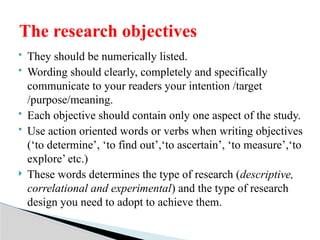
26.
They shouldbe numerically listed.
Wording should clearly, completely and specifically
communicate to your readers your intention /target
/purpose/meaning.
Each objective should contain only one aspect of the study.
Use action oriented words or verbs when writing objectives
(‘to determine’, ‘to find out’,‘to ascertain’, ‘to measure’,‘to
explore’ etc.)
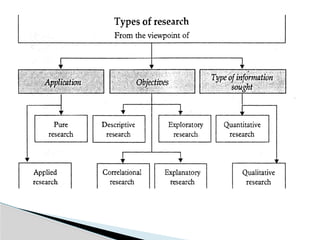
These words determines the type of research (descriptive,
correlational and experimental) and the type of research
design you need to adopt to achieve them.
The research objectives
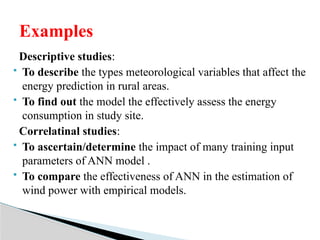
27.
Descriptive studies:
Todescribe the types meteorological variables that affect the
energy prediction in rural areas.
To find out the model the effectively assess the energy
consumption in study site.
Correlatinal studies:
To ascertain/determine the impact of many training input
parameters of ANN model .
To compare the effectiveness of ANN in the estimation of
wind power with empirical models.
Examples
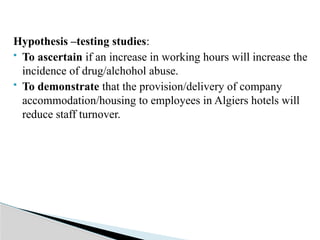
28.
Hypothesis –testing studies:
To ascertain if an increase in working hours will increase the
incidence of drug/alchohol abuse.
To demonstrate that the provision/delivery of company
accommodation/housing to employees in Algiers hotels will
reduce staff turnover.
29.
The phrase‘review of literature’ consists of two
words: Review and Literature.
‘Literature’ refers to the knowledge of a particular area
of investigation of any discipline (theoretical, practical
and its research studies).
‘review’ means to organize the knowledge of the
specific area of research to advance an organization
/structure of knowledge to show that the study would be
an addition to this field.
WHAT IS A LITERATURE
REVIEW?
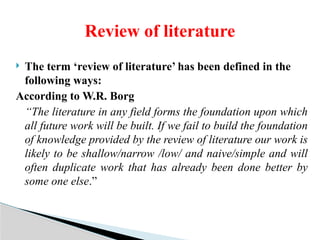
30.
The term‘review of literature’ has been defined in the
following ways:
According to W.R. Borg
“The literature in any field forms the foundation upon which
all future work will be built. If we fail to build the foundation
of knowledge provided by the review of literature our work is
likely to be shallow/narrow /low/ and naive/simple and will
often duplicate work that has already been done better by
some one else.”
Review of literature
31.
According toJohn W. Best
“Practically all human knowledge can be found in
books and libraries. Unlike other animals that must
start a new with each generation, man builds upon the
accumulated and recorded knowledge of the past. His
constant adding to the vast store of knowledge makes
possible progress in all areas of human endeavour.”
Some definitions of L.R:
32.
a. Bringclarity and focus to your research problem;
b. Improve your methodology;
c. Broaden your knowledge;
d. Contextualise your findings.
.
FUNCTIONS OF THE
LITERATURE
REVIEW
33.
The processof reviewing the literature helps you to
understand the subject area better and thus helps you to
conceptualise your research problem clearly and
precisely.
It also helps you to understand the relationship between
your research problem and the body of knowledge in
the area.
a) Bring clarity and focus to your research
problem
34.
A literaturereview tells you if others have used procedures
and methods similar to the ones that you are proposing,
which procedures and methods have worked well for them,
and what problems they have faced with them.
Thus you will be better positioned to select a methodology
that is capable of providing valid answer to your research
questions.
b) Improve your methodology
35.
It ensuresyou to read widely around the subject area in
which you intend to conduct your research study.
As you are expected to be an expert in your area of study, it
helps fulfill this expectation.
It also helps you to understand how the findings of your
study fit into the existing body of knowledge.
c. Broaden your knowledge base in your research
area
36.
How doanswers to your research questions compare
with what others have found?
What contribution have you been able to make in to the
existing body of knowledge?
How are your findings different from those of others?
For you to be able to answer these questions, you need
to go back to your literature review.
It is important to place your findings in the context of
what is already known in your field of enquiry.
d. Contextualise your findings:
37.
Search forexisting literature in your area of study
Review the literature selected
Develop a theoretical framework
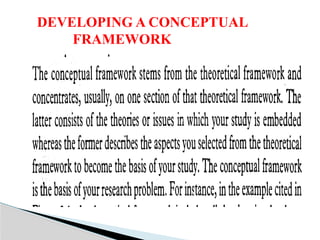
Develop a conceptual framework
Write your literature review
STEPS IN CONDUCTIONG A
LITERATURE REVIEW
38.
Read criticallythe contents of books and articles and look
for the following things:
The claims and theories put forward.
The criticisms of these and their basis.
The methodologies adopted, and the criticisms about
them.
The conclusions and findings advanced
Disagreements about the constructs you are investigating
The gaps you notice in the literature
REVIEWING THE LITERATURE
39.
The informationobtained from books and journals now
needs to be sorted under main themes and theories,
agreements and disagreements among authors, and
other aspects related to your research topic; all this
needs to be arranged so as each element will fit in a
slot of the theoretical framework
DEVELOPING A THEORETICAL
FRAMEWORK
BOOKS
INTERNET
JOURNALS
ARCHIVES
REPORTS
OBSERVATIONS
RECORDS…
WHERE TO FIND SOURCES FOR THE
LITERATURE REVIEW
42.
Some reviewsconsist of a largely unrelated annoted list
of studies.
Some reviews are not relevant to the investigation
Theories in the review might be mentionned or described,
but often without a clear, logical connection among the
theories, or without showing the relevance of each
description
PROBLEMS IDENTIFIED IN WRITING A
LITERATURE REVIEW
43.
The literatureyou decide to include must be relevant to the
area of your investigation
The pieces of literature you decide to include must be
logically connected to each other
ANSWERING SOME OF THE PROBLEMS
RELATED TO THE L.R.
44.
Use booksfirst as they gather a lot of information on a
topic
They also provide a good background information on a
topic
They also offer intersting extensive bibliographies
BOOKS
45.
Look for journalarticles second
They discuss one pespective
Each article makes a unique contribution
They can supplement information from books
They offer more up-to- date information
JOURNAL ARTICLES
46.
The termdata refers to any kind of information researchers
obtain on the subjects, respondents, or participants of the
study.
In research, data are collected and used to answer the
research questions and objectives of the study.
Data collection is an extremely important part of any
research because the conclusion of a study is based on what
the data reveal.
The choice of procedures usually depends on the objectives
and design of the study
WHAT ARE DATA ?
47.
Research dataare generally classified either as
quantitative or qualitative. Based on their sources, they
fall under two categories:
Primary data;
Secondary data
TYPES OF RESEARCH DATA
48.
Quantitative data:
Theseare information which can be counted or expressed
in numerical values
e.g. nb of students, age, grades, test scores…
Qualitative data:
These are descriptive information which has no numerical
values.
e.g. A person’s attitude, perception, or feelings
QUANTITATIVE AND QUALITATIVE
DATA
Primary dataare originated by a researcher for the
specific purpose of addressing the problem at hand.
They are collected directly from the subjects being
studied.
PRIMARY VS SECONDARY DATA
52.
Secondary data:
Theseare information already available. They have
been collected from other available sources ( recent
censuses and analysed by someone else for purposes
other than the problem at hand. Secondary data may be
published or unpublished.
PRIMARY VS SECONDARY DATA
53.
Research tools:
1.Questionnaires
2. Interview schedules
3. Observations
COLLECTING DATA USING PRIMARY
SOURCES
54.
The foursteps: Skimming, vocabulary, comprehension,
and analysis.
1. Skimming. Skim the paper quickly, noting basics like
headings, figures and the like.
2. Vocabulary. Go through the paper word by word and
line by line, underlining or highlighting every word and
phrase you don't understand.
HOW TO READ A RESEARCH PAPER: A
FOUR- STEP GUIDE
55.
3. Comprehension,section by section. Try to deal
with all the words and phrases, although a few technical
terms in the Methods section might remain. Now go
back and read the whole paper, section by section, for
comprehension.
Here are some qqs. that you might use to help you
better understand the article.
HOW TO READ A RESEARCH PAPER: A
FOUR- STEP GUIDE
56.
4. Analysis.After you understand the article and can
summarize it, then you can return to broader questions
and draw your own conclusions.
HOW TO READ A RESEARCH PAPER: A
FOUR- STEP GUIDE
57.
Here aresome questions that may be useful in
analysing research papers:
Introduction:
What is the overall purpose of the research?
How does the research fit into the context of its
field? Is it, for example, attempting to show the
effectiveness of a program? show the validity of a
new technique? open up a new field of inquiry?
Do you agree with the author's rationale for studying
the question with this particular methodology?
ANALYSING RESEARCH PAPERS
58.
Methods:
Werethe measurements appropriate for the questions
the researcher was approaching?
How is the study controlled? are there control
groups? If so, are they exactly comparable to the
experimental groups?
Were the measures in this research clearly related to
the variables in which the researchers (or you) were
interested?
If human subjects were studied, did they accurately
represent the populations under study?
ANALYSING RESEARCH PAPERS
59.
Results
Whatis the one major finding?
Were enough of the data presented so that you feel you
can judge for yourself how the experiment turned out?
Did you see patterns or trends in the data that the
author did not mention? Were there problems in data
interpretation that were not addressed
ANALYSING RESEARCH PAPERS
60.
Discussion
Doyou agree with the conclusions drawn from the
data?
Are these conclusions over-generalized or
appropriately careful?
Are there alternative interpretations of the data?
What further experiments can you think of, to
continue the research or to answer remaining
questions ?
ANALYSING RESEARCH PAPERS
61.
A researchdesign is a procedural plan that is adopted
by the researcher to answer questions validly,
objectively, accurately and economically
CONCEPTUALING A RESEARCH DESIGN
62.
Different conventionsfor sources, such as books,
journals, conference proceedings, and websites.
Note that for book referencing, the title of the book is
italicized, whereas for a journal it is the name of the
journal that is in italics.
Note below that the convention is to insert a full stop
(.) after the author’s name and year (e.g. ‘Dreyfuss, H.
L. (2001).’); however some publishers omit this
convention, preferring to implement their own house
style.
References (Bibliography):
How to cite the references
63.
There are tworules to follow in the References section:
First, you should list only significant, published references.
References to unpublished data, abstracts, theses, and other
secondary materials should not clutter up the References or
Literature Cited section. If this reference seems to be
essntial, you may add it parenthetically or as a foortnote in
the etxt.
Second, make sure that all references cited in the text are
indeed listed in the bibliography and that all the references
listed under the bibiography are indeed cited somewhere in
the text.
Rules to follow:
64.
Most journals citereferences in one of the of the three
general ways that may be referred to as :
1. Author and Year Sytem: often referred to as the
Harvard system. It has been very popular for many
years and is used in many journals and books.
Inside the text, you state only the AUTHOR + YEAR
either with a quotation or without.
Full details of the source are given in a reference list
( bibliography) at the end of the text.
This allows the writer to acknowledge his/her sources
without significantly interrupting the flow of the
writing.
65.
2. Alphabet-Number System:Citation by numbers is a
modification of the name and year system.
Citation by numbers keeps printing expenses within
bounds particularly if it is a long list.
Some authors who have habitually used name and year
tend to dislike the alphabet-number system, claiming
that citation of numbers cheat the reader.
The reader should be told, so the argument goes, the
name of the person associated with the cited
phenomenon; sometimes, the readershould also be told
the date, on the grounds that an 1897 reference might
be viewed differently than a 1997 reference.
66.
Fortunately, thesearguments can be overcome.
As you cite references in the text, decide whether names and dates are
imortant.
If they are not, use only the reference number:
3. Citation Order System: It is simply a system of citing the references
(by numbers) in the order they appear in the paper.
This system avoids the substantial printing expense of the name and
year system, and readers often like it because they can quickly refer to
the references if they so desire in one-two-three order as they come to
them in the text.
It is a useful system for a journal that is basically a " note " journal,
each paper contatining only a few references. For long papers, with
many references, citation order is probably not a good system.
67.
1) Introduction
Processing andanalyzing data involve a number of
closely related operations which are performed
with the purpose of summarizing the collected data
and organizing these in a manner that they answer
the research questions (objectives).
Processing and Analysing data:
68.
1. Editing- aprocess of examining the collected raw data
to detect errors and omissions and to correct these when
possible.
2. Coding: the process of translating information
gathered from questionnaires or other sources into
something that can be analyzed. It involves assigning a
value to the information given often value is given a
label.
2) The Data Processing Operations
69.
3. Classification- aprocess of arranging data in groups or
classes on the basis of common characteristics.
Depending on the nature of phenomenon involved.
a) Classification according to attributes: here data is
analysed on the basis of common characteristics which
can either be:
- descriptive such as literacy, sex, religion etc. or
- numerical such as weight, height, income etc.
b) Classification according to class –intervals: is done
with data relating to income, age, weight, tariff,
production, occupancy etc. Such quantitative data are
known as the statistics of variables and are classified on
the basis of class –intervals.
70.
4. Tabulation- Tabulationis the process of summarizing
raw data and displaying the same in compact form for
further analysis.
It is an orderly arrangement of data in columns and rows.
Tabulation is essential because:
a) It conserves space and reduces explanatory and
descriptive statement to a minimum.
b) It facilitates the process of comparison.
c) It facilitates the summation of items and the detection
of errors and omissions.
d) It provides the basis for various statistical
computations.
71.
Data canbe analysed either manually or with the help of
a computer .
Manual Data Analysis: This can be done if the number of
respondents is reasonably small.
Manual data analysis is extremely time consuming.
Analysisng data
72.
Data Analysis Usinga Computer:
If you want to analyse data using computer, you should
be familiar with the appropriate program.
In this area, knowledge of computer and statistics plays
an important role.The most common software is SPSS
(Statistical Package for the Social Sciences) for
windows.
However, data input can be long and laborious process,
and if data is entered incorrectly, it will influence the
final results.
73.
3) Hypothesis-testing:After analysing the data as stated
above, the researcher is in a position to test the
hypotheses. Do the facts support the hypotheses or they
happen to be contrary? This is the usual question which
should be answered while testing hypotheses.
74.
4) Generalisations andinterpretation: If a hypothesis is
tested and confirmed several times, it may be possible
for the researcher to arrive at generalisation, i.e., to build
a theory. As a matter of fact, the real value of research
lies in its ability to arrive at certain generalisations.
75.
5) Preparationof the report or the thesis:
Writing the report is the last, and for many, the most
difficult step of the research process. The report informs the
world what you have done, what you have discovered and
what conclusions you have drawn from your findings. The
report should be written in an academic style. Language
should be formal and not journalistic.








![谷歌留痕技术 [ 𝙩𝙤𝙥 𝟮𝟯𝟯. 𝙘 𝙤𝙢 ]](https://cdn.slidesharecdn.com/ss_thumbnails/top233-260130174328-3833018c-thumbnail.jpg?width=640&height=640&fit=bounds)
