2 Primary Waysof Doing the Data Analysis
1. Content Analysis
2. Thematic Analysis
Content Analysis This technique is appropriate when
gathered data had been collected through interviews,
focus groups, observations, and documentary analysis.
Steps of Content Analysis
1. Prepare your data
2. Determine the unit of analysis
3. Develop the categories and coding system 4. Pre-test
the coding system
5. Code all the textual data
6. Check the validity and reliability of the data
7. Draw inferences 8. Present the results
2.
Thematic Analysis Thisprocedure is a form of pattern recognition
within the data. It gives a simple interpretation and concise
description of themes and patterns in the data set.
Steps in Thematic Analysis
1. Familiarize yourself with your data
2. Generate initial codes
3. Search for themes
4. Review the themes
5. Define and name the themes
6. Prepare the repor
3.
Activity 1. Checkit! Directions: Check the statement that describes
qualitative data analysis.
1. ___ It is prone to examining words.
2. ___ It uses statistical treatment in data analysis.
3. ___ It is a time-saving process
4. ___ It includes coding and collating in analyzing subjective data.
5. ___ It examines verbal language.
6. ___ In most qualitative research, data collection and data analysis
occur at the same time.
7. ___ The researcher uses deductive method.
8. ___ It requires data to be reduced to certain patterns, categories,
or themes, which are then interpreted using some schema.
9. ___ Numerical data are being analyzed.
10.___ The data that were collected from observations, interviews,
documents, pictures, and forms are voluminous.
4.
Types of conclusionsfor research papers
1. Summarizing conclusionUsed for giving a clear summary of the
main points of your topic and research. The most common form of
conclusion. Examples are persuasive essays, problem and solution
research, argumentative papers, and scientific and historical topics.
2. Externalizing conclusion
Presents points or ideas that may not have been directly stated or
relevant to the way you presented your research and thesis.
3. Editorial conclusion
5.
Steps in writinga conclusion for your research
paper
1. Restate your research topic.
2. Restate the thesis.
3. Summarize the main points.
4. State the significance or results.
5. Conclude your thoughts.
6.
Strategies for writingan effective conclusion
1. Conclusions are intertwined with the intro-duction.
2. Conclusions are inferences and generalizations are
based upon the findings.
3. Conclusions should be specifically answering the
questions posted in the “Statement
of the Problem”
4. Conclusions should contain facts or actual results
from the inquiry or research study.
Conclusions should never be based on implied or
indirect implications of the findings.
7.
Things to Avoidedin Writing a Conclusion
1. Avoid beginning your conclusion with
statements like "in conclusion" or "in
summary".
2. Avoid summarizing
3. Avoid repeating information that you have
already discussed.
4. Avoid introducing new information
5. Avoid bring up minor points.
6. Avoid apologizing
8.
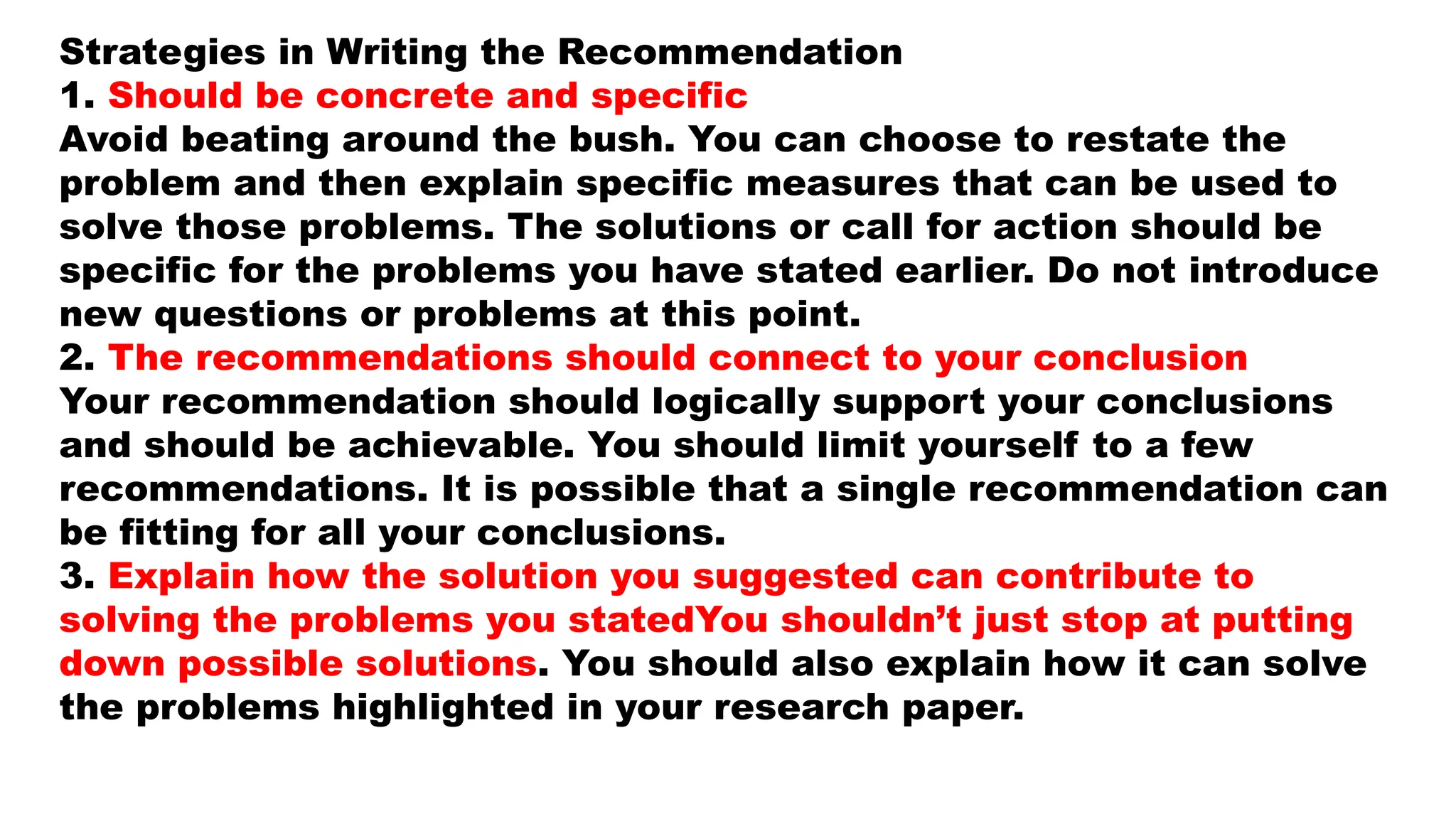
Strategies in Writingthe Recommendation
1. Should be concrete and specific
2. The recommendations should connect to your conclusion
3. Explain how the solution you suggested can contribute to solving the
problems you stated
Guidelines in Writing the Recommendations
1. Recommendations should aim to solve or help solve problems discovered in the
investigation.
2. No recommendations should be made for a problem, or anything for that matter,
that has not been discovered or discussed in the study.
3. There may also be recommendations for the continuance of a good practice or
system, or even recommendation for its improvement.
4. Recommendations should aim for the ideal, but they must be feasible, practical,
and attainable.
5. Recommendations should be logical and valid.
9.
Strategies in Writingthe Recommendation
1. Should be concrete and specific
Avoid beating around the bush. You can choose to restate the
problem and then explain specific measures that can be used to
solve those problems. The solutions or call for action should be
specific for the problems you have stated earlier. Do not introduce
new questions or problems at this point.
2. The recommendations should connect to your conclusion
Your recommendation should logically support your conclusions
and should be achievable. You should limit yourself to a few
recommendations. It is possible that a single recommendation can
be fitting for all your conclusions.
3. Explain how the solution you suggested can contribute to
solving the problems you statedYou shouldn’t just stop at putting
down possible solutions. You should also explain how it can solve
the problems highlighted in your research paper.