Nutrigenomics and its application in
aquaculture
Presented by: Simone Tharwat
Thabet
genetics and genetic
engineering lab
National institute of oceanography and fisheries
Branch of Alexandria 1
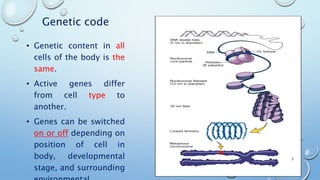
Genetic code
• Genetic content in all
cells of the body is the
same.
• Active genes differ
from cell type to
another.
• Genes can be switched
on or off depending on
position of cell in
body, developmental
stage, and surrounding
2
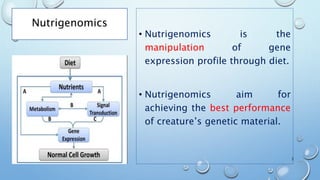
Nutrigenomics
• Nutrigenomics is the
manipulation of gene
expression profile through diet.
• Nutrigenomics aim for
achieving the best performance
of creature’s genetic material.
3
Classification of gene depending on
regulation
Constitutive genes
• Continuously expressed, its end
product present in all cells all the time
almost the same amount
• Example:-
• Β actin gene.
Regulated genes
• Genes which its expression pattern can
be modified depending on presence or
absence of certain chemical stimuli in
it’s environment.
• Example :-
• Genes of biosynsis (formation of amino
acids).
• Genes breakdown galactose, lactose
and fructose.
4
Disease control in aquaculture
• Disease outbreaks caused by Infectious pathogens lead
to mass mortality and great economic losses in
aquaculture.
• Antibiotics have been used for disease control in
aquaculture in last decades, but it have its drawbacks
such as residual toxicity, emerging drug resistance,
immune suppression and reduced consumer preference
for drug treated aquatic products.
5
Disease control in aquaculture
• Demands for non-antibiotic, environmentally friendly agents
for disease control led to the emergence of Nutrigenomic era
in aquaculture.
• Dietary supplement such as probiotic andor prebiotic provide
nonspecific disease protection also found to improve growth
rate and overall health of farmed fish.
6
1-Prebiotics and
aquaculture
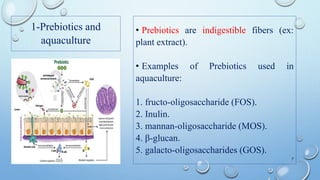
• Prebiotics are indigestible fibers (ex:
plant extract).
• Examples of Prebiotics used in
aquaculture:
1. fructo-oligosaccharide (FOS).
2. Inulin.
3. mannan-oligosaccharide (MOS).
4. β-glucan.
5. galacto-oligosaccharides (GOS).
7
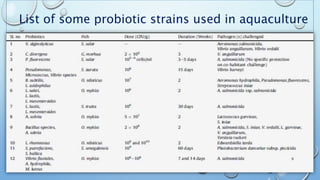
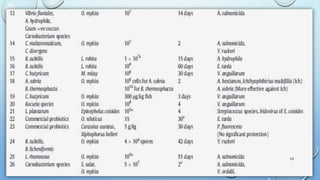
2-Probiotic applications in aquaculture
• Probiotics are live microbial feed supplement such as bacteria, yeast,
bacteriophage, and unicellular algae which beneficially affect the host
animal .
• Probiotics used in aquaculture either as a feed additive or as water
additive.
8
List of some probiotic strains used in aquaculture
9
10
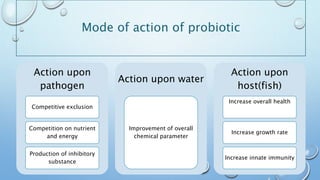
Mode of action of probiotic
11
Action upon
pathogen
Competitive exclusion
Competition on nutrient
and energy
Production of inhibitory
substance
Action upon water
Improvement of overall
chemical parameter
Action upon
host(fish)
Increase overall health
Increase growth rate
Increase innate immunity
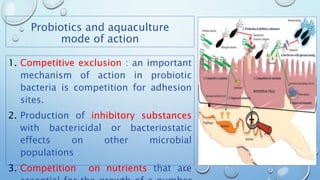
Probiotics and aquaculture
mode of action
1. Competitive exclusion : an important
mechanism of action in probiotic
bacteria is competition for adhesion
sites.
2. Production of inhibitory substances
with bactericidal or bacteriostatic
effects on other microbial
populations
3. Competition on nutrients that are
12
Probiotics and
aquaculture
4. Improving water quality by
converting organic matter into
carbon dioxide, subsequently
reducing stress.
5. Improve the nutritional value of
diet through producing
extracellular enzymes and
essential micronutrients.
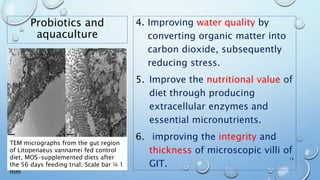
6. improving the integrity and
thickness of microscopic villi of
GIT.
13
TEM micrographs from the gut region
of Litopenaeus vannamei fed control
diet, MOS-supplemented diets after
the 56 days feeding trial. Scale bar ¼ 1
mm
Probiotics and gene expression manipulation
1-Growth related genes 2-immune related genes
14
Probiotics up-regulate growth related genes
in fish as
15
Insulin like growth
factor I
Insulin like growth
factor II
Growth hormone
receptor I
Growth hormone
receptor II
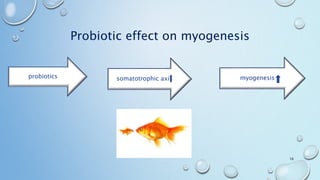
Probiotic effect on myogenesis
16
probiotics somatotrophic axis myogenesis
17
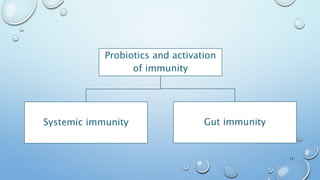
Probiotics and activation
of immunity
Systemic immunity Gut immunity
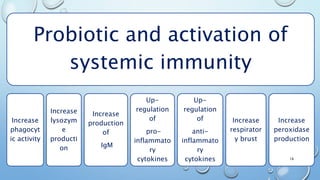
Probiotic and activation of
systemic immunity
Increase
phagocyt
ic activity
Increase
lysozym
e
producti
on
Increase
production
of
IgM
Up-
regulation
of
pro-
inflammato
ry
cytokines
Up-
regulation
of
anti-
inflammato
ry
cytokines
Increase
respirator
y brust
Increase
peroxidase
production
18
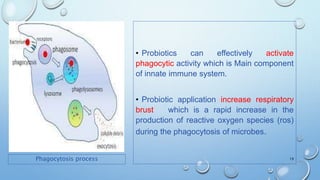
• Probiotics can effectively activate
phagocytic activity which is Main component
of innate immune system.
• Probiotic application increase respiratory
brust which is a rapid increase in the
production of reactive oxygen species (ros)
during the phagocytosis of microbes.
19
Phagocytosis process
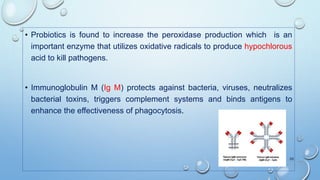
• Probiotics is found to increase the peroxidase production which is an
important enzyme that utilizes oxidative radicals to produce hypochlorous
acid to kill pathogens.
• Immunoglobulin M (Ig M) protects against bacteria, viruses, neutralizes
bacterial toxins, triggers complement systems and binds antigens to
enhance the effectiveness of phagocytosis.
20
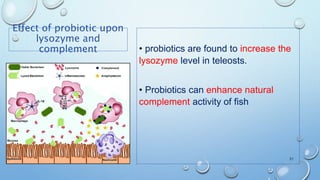
Effect of probiotic upon
lysozyme and
complement • probiotics are found to increase the
lysozyme level in teleosts.
• Probiotics can enhance natural
complement activity of fish
21
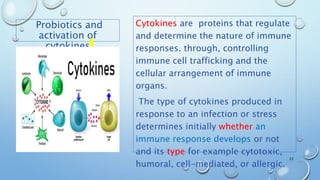
Probiotics and
activation of
cytokines
Cytokines are proteins that regulate
and determine the nature of immune
responses. through, controlling
immune cell trafficking and the
cellular arrangement of immune
organs.
The type of cytokines produced in
response to an infection or stress
determines initially whether an
immune response develops or not
and its type for example cytotoxic,
humoral, cell-mediated, or allergic.
22
probiotics and up regulation of immune
related genes in aquaculture as
1. Tumer necrosis factor α (TNFα).
2. Interferons γ (INF γ)
3. Interleukin-1 (IL1).
4. Interleukine-6 (Il6).
5. Interleukine 12 (IL12).
23
probiotics and up regulation of immune
related genes in aquaculture
6. Interleukine 10 (IL-10).
7. Transforming growth factor β (tgf β)
24
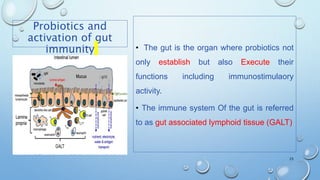
Probiotics and
activation of gut
immunity • The gut is the organ where probiotics not
only establish but also Execute their
functions including immunostimulaory
activity.
• The immune system Of the gut is referred
to as gut associated lymphoid tissue (GALT)
25
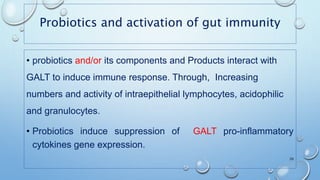
Probiotics and activation of gut immunity
• probiotics and/or its components and Products interact with
GALT to induce immune response. Through, Increasing
numbers and activity of intraepithelial lymphocytes, acidophilic
and granulocytes.
• Probiotics induce suppression of GALT pro-inflammatory
cytokines gene expression.
26
Symbiotic and aquaculture
• Symbiotic are a combination of probiotic and prebiotic it
exhibit synergistic action, as it produce greater beneficial
effects rather than application of only one of them.
• Several studies showed that symbiotic can improve
health, digestibility, feed absorption, specific growth
rate, and digestive enzyme growth performance.
27
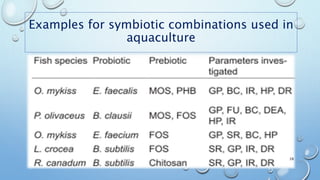
Examples for symbiotic combinations used in
aquaculture
28
List of Bibliography
• CEREZUELA, R. ET AL. 2011. CURRENT KNOWLEDGE IN SYNBIOTIC USE FOR FISH AQUACULTURE:
A REVIEW. JOURNAL OF AQUACULTURE RESEARCH AND DEVELOPMENT (SPEC. ISSUE 1), PP. 1–7.
DOI: 10.4172/2155-9546.S1-008.
• DO HUU, H. AND JONES, C.M. 2014. EFFECTS OF DIETARY MANNAN OLIGOSACCHARIDE
SUPPLEMENTATION ON JUVENILE SPINY LOBSTER PANULIRUS HOMARUS (PALINURIDAE).
AQUACULTURE 432, PP. 258–264. AVAILABLE AT:
HTTP://DX.DOI.ORG/10.1016/J.AQUACULTURE.2014.05.013.
• LAKSHMI, B. ET AL. 2013. PROBIOTICS AS ANTIVIRAL AGENTS IN SHRIMP AQUACULTURE.
JOURNAL OF PATHOGENS 2013, PP. 1–13. DOI: 10.1155/2013/424123.
29
• MIDHUN, S.J. ET AL. 2019. DIETARY SUPPLEMENTATION OF BACILLUS LICHENIFORMIS HGA8B
IMPROVES GROWTH PARAMETERS, ENZYMATIC PROFILE AND GENE EXPRESSION OF
OREOCHROMIS NILOTICUS. AQUACULTURE 505(FEBRUARY), PP. 289–296. AVAILABLE AT:
HTTPS://DOI.ORG/10.1016/J.AQUACULTURE.2019.02.064.
• NAYAK, S.K. 2010. PROBIOTICS AND IMMUNITY: A FISH PERSPECTIVE. FISH AND SHELLFISH
IMMUNOLOGY 29(1), PP. 2–14. AVAILABLE AT: HTTP://DX.DOI.ORG/10.1016/J.FSI.2010.02.017.
• PANIGRAHI, A. ET AL. 2011. REAL-TIME QUANTIFICATION OF THE IMMUNE GENE EXPRESSION IN
RAINBOW TROUT FED DIFFERENT FORMS OF PROBIOTIC BACTERIA LACTOBACILLUS RHAMNOSUS.
AQUACULTURE RESEARCH 42(7), PP. 906–917. DOI: 10.1111/J.1365-2109.2010.02633.X.
• ZORRIEHZAHRA, M.J. ET AL. 2016. PROBIOTICS AS BENEFICIAL MICROBES IN AQUACULTURE: AN
UPDATE ON THEIR MULTIPLE MODES OF ACTION: A REVIEW. VETERINARY QUARTERLY 36(4), PP.
228–241. AVAILABLE AT: HTTP://DX.DOI.ORG/10.1080/01652176.2016.1172132.
30
31

سمينار الشعبة.pptx

  • 1.
    Nutrigenomics and itsapplication in aquaculture Presented by: Simone Tharwat Thabet genetics and genetic engineering lab National institute of oceanography and fisheries Branch of Alexandria 1
  • 2.
    Genetic code • Geneticcontent in all cells of the body is the same. • Active genes differ from cell type to another. • Genes can be switched on or off depending on position of cell in body, developmental stage, and surrounding 2
  • 3.
    Nutrigenomics • Nutrigenomics isthe manipulation of gene expression profile through diet. • Nutrigenomics aim for achieving the best performance of creature’s genetic material. 3
  • 4.
    Classification of genedepending on regulation Constitutive genes • Continuously expressed, its end product present in all cells all the time almost the same amount • Example:- • Β actin gene. Regulated genes • Genes which its expression pattern can be modified depending on presence or absence of certain chemical stimuli in it’s environment. • Example :- • Genes of biosynsis (formation of amino acids). • Genes breakdown galactose, lactose and fructose. 4
  • 5.
    Disease control inaquaculture • Disease outbreaks caused by Infectious pathogens lead to mass mortality and great economic losses in aquaculture. • Antibiotics have been used for disease control in aquaculture in last decades, but it have its drawbacks such as residual toxicity, emerging drug resistance, immune suppression and reduced consumer preference for drug treated aquatic products. 5
  • 6.
    Disease control inaquaculture • Demands for non-antibiotic, environmentally friendly agents for disease control led to the emergence of Nutrigenomic era in aquaculture. • Dietary supplement such as probiotic andor prebiotic provide nonspecific disease protection also found to improve growth rate and overall health of farmed fish. 6
  • 7.
    1-Prebiotics and aquaculture • Prebioticsare indigestible fibers (ex: plant extract). • Examples of Prebiotics used in aquaculture: 1. fructo-oligosaccharide (FOS). 2. Inulin. 3. mannan-oligosaccharide (MOS). 4. β-glucan. 5. galacto-oligosaccharides (GOS). 7
  • 8.
    2-Probiotic applications inaquaculture • Probiotics are live microbial feed supplement such as bacteria, yeast, bacteriophage, and unicellular algae which beneficially affect the host animal . • Probiotics used in aquaculture either as a feed additive or as water additive. 8
  • 9.
    List of someprobiotic strains used in aquaculture 9
  • 10.
  • 11.
    Mode of actionof probiotic 11 Action upon pathogen Competitive exclusion Competition on nutrient and energy Production of inhibitory substance Action upon water Improvement of overall chemical parameter Action upon host(fish) Increase overall health Increase growth rate Increase innate immunity
  • 12.
    Probiotics and aquaculture modeof action 1. Competitive exclusion : an important mechanism of action in probiotic bacteria is competition for adhesion sites. 2. Production of inhibitory substances with bactericidal or bacteriostatic effects on other microbial populations 3. Competition on nutrients that are 12
  • 13.
    Probiotics and aquaculture 4. Improvingwater quality by converting organic matter into carbon dioxide, subsequently reducing stress. 5. Improve the nutritional value of diet through producing extracellular enzymes and essential micronutrients. 6. improving the integrity and thickness of microscopic villi of GIT. 13 TEM micrographs from the gut region of Litopenaeus vannamei fed control diet, MOS-supplemented diets after the 56 days feeding trial. Scale bar ¼ 1 mm
  • 14.
    Probiotics and geneexpression manipulation 1-Growth related genes 2-immune related genes 14
  • 15.
    Probiotics up-regulate growthrelated genes in fish as 15 Insulin like growth factor I Insulin like growth factor II Growth hormone receptor I Growth hormone receptor II
  • 16.
    Probiotic effect onmyogenesis 16 probiotics somatotrophic axis myogenesis
  • 17.
    17 Probiotics and activation ofimmunity Systemic immunity Gut immunity
  • 18.
    Probiotic and activationof systemic immunity Increase phagocyt ic activity Increase lysozym e producti on Increase production of IgM Up- regulation of pro- inflammato ry cytokines Up- regulation of anti- inflammato ry cytokines Increase respirator y brust Increase peroxidase production 18
  • 19.
    • Probiotics caneffectively activate phagocytic activity which is Main component of innate immune system. • Probiotic application increase respiratory brust which is a rapid increase in the production of reactive oxygen species (ros) during the phagocytosis of microbes. 19 Phagocytosis process
  • 20.
    • Probiotics isfound to increase the peroxidase production which is an important enzyme that utilizes oxidative radicals to produce hypochlorous acid to kill pathogens. • Immunoglobulin M (Ig M) protects against bacteria, viruses, neutralizes bacterial toxins, triggers complement systems and binds antigens to enhance the effectiveness of phagocytosis. 20
  • 21.
    Effect of probioticupon lysozyme and complement • probiotics are found to increase the lysozyme level in teleosts. • Probiotics can enhance natural complement activity of fish 21
  • 22.
    Probiotics and activation of cytokines Cytokinesare proteins that regulate and determine the nature of immune responses. through, controlling immune cell trafficking and the cellular arrangement of immune organs. The type of cytokines produced in response to an infection or stress determines initially whether an immune response develops or not and its type for example cytotoxic, humoral, cell-mediated, or allergic. 22
  • 23.
    probiotics and upregulation of immune related genes in aquaculture as 1. Tumer necrosis factor α (TNFα). 2. Interferons γ (INF γ) 3. Interleukin-1 (IL1). 4. Interleukine-6 (Il6). 5. Interleukine 12 (IL12). 23
  • 24.
    probiotics and upregulation of immune related genes in aquaculture 6. Interleukine 10 (IL-10). 7. Transforming growth factor β (tgf β) 24
  • 25.
    Probiotics and activation ofgut immunity • The gut is the organ where probiotics not only establish but also Execute their functions including immunostimulaory activity. • The immune system Of the gut is referred to as gut associated lymphoid tissue (GALT) 25
  • 26.
    Probiotics and activationof gut immunity • probiotics and/or its components and Products interact with GALT to induce immune response. Through, Increasing numbers and activity of intraepithelial lymphocytes, acidophilic and granulocytes. • Probiotics induce suppression of GALT pro-inflammatory cytokines gene expression. 26
  • 27.
    Symbiotic and aquaculture •Symbiotic are a combination of probiotic and prebiotic it exhibit synergistic action, as it produce greater beneficial effects rather than application of only one of them. • Several studies showed that symbiotic can improve health, digestibility, feed absorption, specific growth rate, and digestive enzyme growth performance. 27
  • 28.
    Examples for symbioticcombinations used in aquaculture 28
  • 29.
    List of Bibliography •CEREZUELA, R. ET AL. 2011. CURRENT KNOWLEDGE IN SYNBIOTIC USE FOR FISH AQUACULTURE: A REVIEW. JOURNAL OF AQUACULTURE RESEARCH AND DEVELOPMENT (SPEC. ISSUE 1), PP. 1–7. DOI: 10.4172/2155-9546.S1-008. • DO HUU, H. AND JONES, C.M. 2014. EFFECTS OF DIETARY MANNAN OLIGOSACCHARIDE SUPPLEMENTATION ON JUVENILE SPINY LOBSTER PANULIRUS HOMARUS (PALINURIDAE). AQUACULTURE 432, PP. 258–264. AVAILABLE AT: HTTP://DX.DOI.ORG/10.1016/J.AQUACULTURE.2014.05.013. • LAKSHMI, B. ET AL. 2013. PROBIOTICS AS ANTIVIRAL AGENTS IN SHRIMP AQUACULTURE. JOURNAL OF PATHOGENS 2013, PP. 1–13. DOI: 10.1155/2013/424123. 29
  • 30.
    • MIDHUN, S.J.ET AL. 2019. DIETARY SUPPLEMENTATION OF BACILLUS LICHENIFORMIS HGA8B IMPROVES GROWTH PARAMETERS, ENZYMATIC PROFILE AND GENE EXPRESSION OF OREOCHROMIS NILOTICUS. AQUACULTURE 505(FEBRUARY), PP. 289–296. AVAILABLE AT: HTTPS://DOI.ORG/10.1016/J.AQUACULTURE.2019.02.064. • NAYAK, S.K. 2010. PROBIOTICS AND IMMUNITY: A FISH PERSPECTIVE. FISH AND SHELLFISH IMMUNOLOGY 29(1), PP. 2–14. AVAILABLE AT: HTTP://DX.DOI.ORG/10.1016/J.FSI.2010.02.017. • PANIGRAHI, A. ET AL. 2011. REAL-TIME QUANTIFICATION OF THE IMMUNE GENE EXPRESSION IN RAINBOW TROUT FED DIFFERENT FORMS OF PROBIOTIC BACTERIA LACTOBACILLUS RHAMNOSUS. AQUACULTURE RESEARCH 42(7), PP. 906–917. DOI: 10.1111/J.1365-2109.2010.02633.X. • ZORRIEHZAHRA, M.J. ET AL. 2016. PROBIOTICS AS BENEFICIAL MICROBES IN AQUACULTURE: AN UPDATE ON THEIR MULTIPLE MODES OF ACTION: A REVIEW. VETERINARY QUARTERLY 36(4), PP. 228–241. AVAILABLE AT: HTTP://DX.DOI.ORG/10.1080/01652176.2016.1172132. 30
  • 31.

Editor's Notes

  • #16 لية قلت ال insulin like growth factor الاول