COUNTERFEITING
OF MONEY
Prepared by:
FRANCOIS NUR P CABATAY
JOAN B BUHAY
What is Counterfeiting of Money?
Counterfeiting of money is the reproduction of brand-new money with the
intent to deceive others into thinking the money is genuine. Counterfeiting of money is
a criminal activity that has long been a problem in countries around the world. It
involves the production of counterfeit currency and its circulation in the economy. This
activity has the potential to cause serious economic damage, as it can lead to a decline
in the value of the real currency and undermine the national economy. There are
several methods used to identify counterfeit money and prevent it from entering the
economy.
HISTORY
Counterfeiting of money has been a problem for centuries, with reported cases as far
back as the 15th century. It has been used to undermine governments and economies, fund
military campaigns, and even to pay for everyday expenses. In the 16th century, the first anti-
counterfeiting laws were introduced in England, and soon afterwards, other countries began
to follow suit. In the 19th century, advanced printing techniques and other technologies
enabled criminals to produce increasingly sophisticated counterfeit currency, and the use of
chemicals to detect counterfeit money became commonplace. Today, counterfeiting of money is
still a major problem, with governments around the world using advanced technology and
sophisticated detection methods to identify counterfeit money and prevent it from entering
the economy
The people behind counterfeiting of money are typically organized criminal networks.
These networks are commonly comprised of people who possess the skills and resources to
create counterfeit money. Professional print shops, computer equipment, and scanners are often
used to create high-quality counterfeit money. In addition, many counterfeiting networks will
employ individuals who possess knowledge of the security features used by different banknote
authorities, allowing the group to replicate these features effectively. Counterfeiting networks
often use the Internet to buy and sell counterfeit money and the necessary supplies for creating
it.
many governments have undertaken a number of physical measures to prevent the
counterfeiting of money. In the United States both printed bills and struck coins have been
given characteristic features that, when closely examined, will prove the money to be
genuine or counterfeit.
Most if not all big businesses or SMEs will be the recipient of fake bills. When a
business accepts fake bills, they bear the entire burden of profit losses. And though it's
true that counterfeiters' techniques are getting more and more complex (through digital
printing technologies), there are ways cashiers, employees, entrepreneurs or anyone can
do to recognize counterfeit money.
5 Successful Counterfeiters
Stephen Burroughs (1765 - 1840)
American counterfeiter who successfully counterfeited over $100,000 in the late
1700s. He was known for his skill in creating high-quality counterfeits.
The Lavender Hill Mob
A group of British Counterfeiters who operated in an early 20th century.
They were known for there ability to produce high quality counterfeits British
currency.
The Nazis
A group of German counterfeiters who operated during World War II . They
were known for their ability to produce large quantities of counterfeit currency.
Charles Ulrich
American Counterfeiters who operated in the late 19yth century. He was
known for his skills in creating high quality counterfeits of American currency.
Frank Abagnale (1960s-1970s)
American counterfeiter known for ability to produce high quality counterfeits of
American and foreign currency
WAYS TO DETECT MONEY
IN THE PHILIPPINES
✔️ FEEL
✔️ LOOK
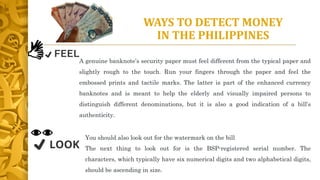
A genuine banknote’s security paper must feel different from the typical paper and
slightly rough to the touch. Run your fingers through the paper and feel the
embossed prints and tactile marks. The latter is part of the enhanced currency
banknotes and is meant to help the elderly and visually impaired persons to
distinguish different denominations, but it is also a good indication of a bill’s
authenticity.
You should also look out for the watermark on the bill
The next thing to look out for is the BSP-registered serial number. The
characters, which typically have six numerical digits and two alphabetical digits,
should be ascending in size.
The Bangko Sentral ng Pilipinas (BSP) reiterated that the public should to be vigilant
when it comes to handling and accepting money to avoid being deceived. Investing in
knowledge about our money will go a long way towards helping you protect yourself and
others from fraud and also preserve the rewards of your hard work.
Another way to spot fake money is by holding the bills on your hand and tilting them to
different angles. Once the notes are tilted, you should be able to see the vertically arranged
security thread that will display the movement of color and designs at different angles. The
thread’s shade and size should differ depending on the bill denomination.
An authentic Philippine peso bill should bear a concealed numerical value that matches the
currency’s denomination. For 500- and 1,000-peso bills, you should see a roller bar effect on the
currencies’ value panels, an added security feature that the BSP launched in 2020. For 1,000-
peso bank note, the central bank added an optically variable device patch visible on the left side
of the currency.
✔️ TILT
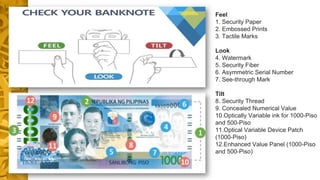
Feel
1. Security Paper
2. Embossed Prints
3. Tactile Marks
Look
4. Watermark
5. Security Fiber
6. Asymmetric Serial Number
7. See-through Mark
Tilt
8. Security Thread
9. Concealed Numerical Value
10.Optically Variable ink for 1000-Piso
and 500-Piso
11.Optical Variable Device Patch
(1000-Piso)
12.Enhanced Value Panel (1000-Piso
and 500-Piso)
IGNORANCE OF THE LAW EXCUSES
NO ONE
Section 50 of Republic Act 7653, BSP shall have the sole power
and authority to Issue currency within the Philippine territory. It
also has the authority to investigate, make arrests, conduct
searches and seizures to maintain the integrity of the currency.
LAW THAT PUNISHES THE CRIMINAL ACT
Section Two. — Counterfeiting Coins
Art. 163. Making and importing and uttering false coins. — Any person
who makes, imports, or utters, false coins, in connivance with counterfeiters, or
importers, shall suffer:
1. Prision mayor in its minimum and medium periods and a fine not to exceed P10,000 pesos,
if the counterfeited coin be silver coin of the Philippines or coin of the Central Bank of the
Philippines of ten centavo denomination or above.
2. 2. Prision correccional in its minimum and medium periods and a fine of not to exceed
P2,000 pesos, if the counterfeited coins be any of the minor coinage of the Philippines or of
the Central Bank of the Philippines below ten-centavo denomination.
3. 3. Prision correccional in its minimum period and a fine not to exceed P1,000 pesos, if the
counterfeited coin be currency of a foreign country. (As amended by R.A. No. 4202,
approved June 19, 1965).
LAW THAT PUNISHES THE CRIMINAL ACT
Art. 166. Forging treasury or bank notes on other documents
payable to bearer; importing, and uttering such false or forged notes
and documents. — The forging or falsification of treasury or bank
notes or certificates or other obligations and securities payable to
bearer and the importation and uttering in connivance with
forgers or importers of such false or forged obligations or notes.
Reclusion temporal in its minimum period and a fine
not to exceed P10,000 pesos, if the document which has been falsified,
counterfeited, or altered, is an obligations or security of the
Philippines Islands.
CONCLUSION
1. Lack of awareness on the security features of currency and process of reporting to proper
authorities to help prevent this illegal activity.
2. Severe negative consequences of money counterfeiting, such as a decrease in the value of real
money and inflation or an increase in prices as a result of more money being circulated in the
economy.
3. Continued circulation of counterfeited money in spite of the preventive measures taken by
government and authorities to prevent it.
Based on the information presented, the following
conclusions are drawn on the counterfeiting of money:
RECOMMENDATION
1. Increase peoples’ awareness on identifying counterfeit money including
security features of currency and proper way of reporting incidence of counterfeit
money.
2. Amend the current law to increase the penalty for the commission thereof
3. Organize a composite law enforcement unit which concentrates solely on the
enforcement of money counterfeiting violations
In the light of the findings and conclusions from the data
gathered on counterfeiting of money, the following
recommendations are endorsed:
REFERENCES
https://www.rba.gov.au/publications/bulletin/2019/sep/a-brief-history-of-currency-
counterfeiting.html
>https://www.philstar.com/the-freeman/cebu-business/2016/07/05/1599576/three-
ways-detect-counterfeit-philippine-money
>https://www.britannica.com/topic/counterfeiting
THANK YOU!

PPT-COUNTERFEITING-OF-MONEY-final.pdf

  • 1.
  • 2.
    What is Counterfeitingof Money? Counterfeiting of money is the reproduction of brand-new money with the intent to deceive others into thinking the money is genuine. Counterfeiting of money is a criminal activity that has long been a problem in countries around the world. It involves the production of counterfeit currency and its circulation in the economy. This activity has the potential to cause serious economic damage, as it can lead to a decline in the value of the real currency and undermine the national economy. There are several methods used to identify counterfeit money and prevent it from entering the economy.
  • 3.
    HISTORY Counterfeiting of moneyhas been a problem for centuries, with reported cases as far back as the 15th century. It has been used to undermine governments and economies, fund military campaigns, and even to pay for everyday expenses. In the 16th century, the first anti- counterfeiting laws were introduced in England, and soon afterwards, other countries began to follow suit. In the 19th century, advanced printing techniques and other technologies enabled criminals to produce increasingly sophisticated counterfeit currency, and the use of chemicals to detect counterfeit money became commonplace. Today, counterfeiting of money is still a major problem, with governments around the world using advanced technology and sophisticated detection methods to identify counterfeit money and prevent it from entering the economy
  • 4.
    The people behindcounterfeiting of money are typically organized criminal networks. These networks are commonly comprised of people who possess the skills and resources to create counterfeit money. Professional print shops, computer equipment, and scanners are often used to create high-quality counterfeit money. In addition, many counterfeiting networks will employ individuals who possess knowledge of the security features used by different banknote authorities, allowing the group to replicate these features effectively. Counterfeiting networks often use the Internet to buy and sell counterfeit money and the necessary supplies for creating it.
  • 5.
    many governments haveundertaken a number of physical measures to prevent the counterfeiting of money. In the United States both printed bills and struck coins have been given characteristic features that, when closely examined, will prove the money to be genuine or counterfeit. Most if not all big businesses or SMEs will be the recipient of fake bills. When a business accepts fake bills, they bear the entire burden of profit losses. And though it's true that counterfeiters' techniques are getting more and more complex (through digital printing technologies), there are ways cashiers, employees, entrepreneurs or anyone can do to recognize counterfeit money.
  • 6.
    5 Successful Counterfeiters StephenBurroughs (1765 - 1840) American counterfeiter who successfully counterfeited over $100,000 in the late 1700s. He was known for his skill in creating high-quality counterfeits. The Lavender Hill Mob A group of British Counterfeiters who operated in an early 20th century. They were known for there ability to produce high quality counterfeits British currency.
  • 7.
    The Nazis A groupof German counterfeiters who operated during World War II . They were known for their ability to produce large quantities of counterfeit currency. Charles Ulrich American Counterfeiters who operated in the late 19yth century. He was known for his skills in creating high quality counterfeits of American currency. Frank Abagnale (1960s-1970s) American counterfeiter known for ability to produce high quality counterfeits of American and foreign currency
  • 8.
    WAYS TO DETECTMONEY IN THE PHILIPPINES ✔️ FEEL ✔️ LOOK A genuine banknote’s security paper must feel different from the typical paper and slightly rough to the touch. Run your fingers through the paper and feel the embossed prints and tactile marks. The latter is part of the enhanced currency banknotes and is meant to help the elderly and visually impaired persons to distinguish different denominations, but it is also a good indication of a bill’s authenticity. You should also look out for the watermark on the bill The next thing to look out for is the BSP-registered serial number. The characters, which typically have six numerical digits and two alphabetical digits, should be ascending in size.
  • 9.
    The Bangko Sentralng Pilipinas (BSP) reiterated that the public should to be vigilant when it comes to handling and accepting money to avoid being deceived. Investing in knowledge about our money will go a long way towards helping you protect yourself and others from fraud and also preserve the rewards of your hard work. Another way to spot fake money is by holding the bills on your hand and tilting them to different angles. Once the notes are tilted, you should be able to see the vertically arranged security thread that will display the movement of color and designs at different angles. The thread’s shade and size should differ depending on the bill denomination. An authentic Philippine peso bill should bear a concealed numerical value that matches the currency’s denomination. For 500- and 1,000-peso bills, you should see a roller bar effect on the currencies’ value panels, an added security feature that the BSP launched in 2020. For 1,000- peso bank note, the central bank added an optically variable device patch visible on the left side of the currency. ✔️ TILT
  • 10.
    Feel 1. Security Paper 2.Embossed Prints 3. Tactile Marks Look 4. Watermark 5. Security Fiber 6. Asymmetric Serial Number 7. See-through Mark Tilt 8. Security Thread 9. Concealed Numerical Value 10.Optically Variable ink for 1000-Piso and 500-Piso 11.Optical Variable Device Patch (1000-Piso) 12.Enhanced Value Panel (1000-Piso and 500-Piso)
  • 11.
    IGNORANCE OF THELAW EXCUSES NO ONE Section 50 of Republic Act 7653, BSP shall have the sole power and authority to Issue currency within the Philippine territory. It also has the authority to investigate, make arrests, conduct searches and seizures to maintain the integrity of the currency.
  • 12.
    LAW THAT PUNISHESTHE CRIMINAL ACT Section Two. — Counterfeiting Coins Art. 163. Making and importing and uttering false coins. — Any person who makes, imports, or utters, false coins, in connivance with counterfeiters, or importers, shall suffer: 1. Prision mayor in its minimum and medium periods and a fine not to exceed P10,000 pesos, if the counterfeited coin be silver coin of the Philippines or coin of the Central Bank of the Philippines of ten centavo denomination or above. 2. 2. Prision correccional in its minimum and medium periods and a fine of not to exceed P2,000 pesos, if the counterfeited coins be any of the minor coinage of the Philippines or of the Central Bank of the Philippines below ten-centavo denomination. 3. 3. Prision correccional in its minimum period and a fine not to exceed P1,000 pesos, if the counterfeited coin be currency of a foreign country. (As amended by R.A. No. 4202, approved June 19, 1965).
  • 13.
    LAW THAT PUNISHESTHE CRIMINAL ACT Art. 166. Forging treasury or bank notes on other documents payable to bearer; importing, and uttering such false or forged notes and documents. — The forging or falsification of treasury or bank notes or certificates or other obligations and securities payable to bearer and the importation and uttering in connivance with forgers or importers of such false or forged obligations or notes. Reclusion temporal in its minimum period and a fine not to exceed P10,000 pesos, if the document which has been falsified, counterfeited, or altered, is an obligations or security of the Philippines Islands.
  • 14.
    CONCLUSION 1. Lack ofawareness on the security features of currency and process of reporting to proper authorities to help prevent this illegal activity. 2. Severe negative consequences of money counterfeiting, such as a decrease in the value of real money and inflation or an increase in prices as a result of more money being circulated in the economy. 3. Continued circulation of counterfeited money in spite of the preventive measures taken by government and authorities to prevent it. Based on the information presented, the following conclusions are drawn on the counterfeiting of money:
  • 15.
    RECOMMENDATION 1. Increase peoples’awareness on identifying counterfeit money including security features of currency and proper way of reporting incidence of counterfeit money. 2. Amend the current law to increase the penalty for the commission thereof 3. Organize a composite law enforcement unit which concentrates solely on the enforcement of money counterfeiting violations In the light of the findings and conclusions from the data gathered on counterfeiting of money, the following recommendations are endorsed:
  • 17.
  • 18.