Typhus fever
Presentar
sharada pakhrin
And
Shreedev sharma
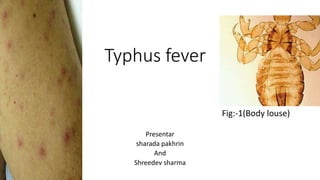
Fig:-1(Body louse)
Typhus fever
• Gaol Fever, Tabradillo,War Fever, Jail Fever.
It includes
• Epidemic typhus
Caused by rikkettsial agent- R.prowazekii
Vector=Body louse
• Murine typhus
Causative agent-R.typhi
Vector-Flea
• Scrub typhus
Causative agent-R.tsutsugamushi
Vector-mite
Overview
• Organism
• History
• WHO Data
• Epidemology
• Transmission
• Incubation period
• Clinical symptoms
• Diagnosis
• Differential diagnosiss
• Treatment
• Complication
• Prevention and Control
The Organism
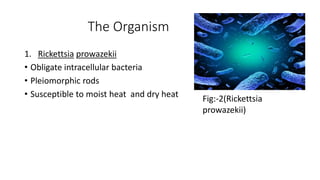
1. Rickettsia prowazekii
• Obligate intracellular bacteria
• Pleiomorphic rods
• Susceptible to moist heat and dry heat Fig:-2(Rickettsia
prowazekii)
History
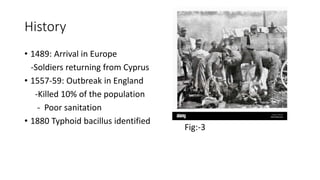
• 1489: Arrival in Europe
-Soldiers returning from Cyprus
• 1557-59: Outbreak in England
-Killed 10% of the population
- Poor sanitation
• 1880 Typhoid bacillus identified
Fig:-3
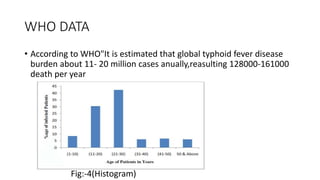
WHO DATA
• According to WHO"It is estimated that global typhoid fever disease
burden about 11- 20 million cases anually,reasulting 128000-161000
death per year
Fig:-4(Histogram)
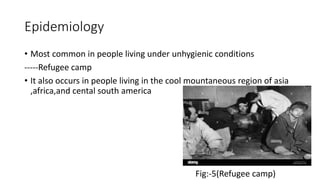
Epidemiology
• Most common in people living under unhygienic conditions
-----Refugee camp
• It also occurs in people living in the cool mountaneous region of asia
,africa,and cental south america
Fig:-5(Refugee camp)
Transmission
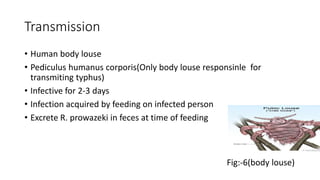
• Human body louse
• Pediculus humanus corporis(Only body louse responsinle for
transmiting typhus)
• Infective for 2-3 days
• Infection acquired by feeding on infected person
• Excrete R. prowazeki in feces at time of feeding
Fig:-6(body louse)
Transmission
• Inhalation of feces
• No person-to-person transmission
Incubation period
• 7-15 days( generally 1-2weeks)
• O.tsutugamushi is maintained by transovarian transmission in
tromboculid bodylouse
• -After hatching,infected larval mites inculate organism into skin.
Clinical Symptoms
• High fever
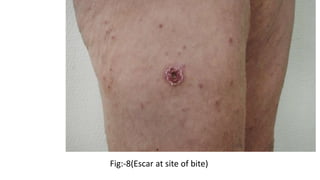
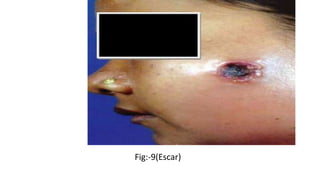
• Escar at the site of bite
• Headache
• Muscle pain
• Cough
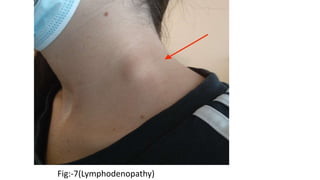
• Regionally lymphodenopathy and progresses to generalized
lymphodenopathy
• Pneumonitis,encephalitis,and myocarditis occurs in the late phase of
illness
Fig:-7(Lymphodenopathy)
Fig:-8(Escar at site of bite)
Fig:-9(Escar)
Diagnosis
• Initial diagnosis
• Clinical signs and history
• Laboratory tests not diagnostic
• Confirmatory diagnosis
• Culture
• Serology
• Biopsy
• PCR
Differential diagnosis
• Tuberculosis
• Kalazar
• Lymphoma
• Malaria
• Mumps
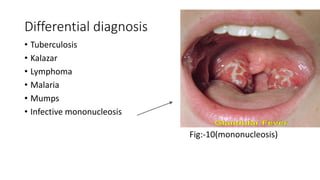
• Infective mononucleosis
Fig:-10(mononucleosis)
Treatment
General treatment
• Bed rest
• Good nursing care
• Care of mouth ,eye and skin
Medication
• Doxycycline(100 mg bid orally or chloramphenicol 500 mg qid for 7-15
days)
• Rifampicin, azithromycin arealternatives
• Azithromycin is alternative in children
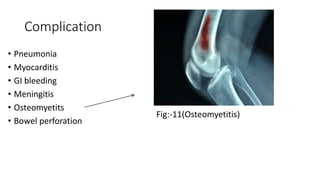
Complication
• Pneumonia
• Myocarditis
• GI bleeding
• Meningitis
• Osteomyetits
• Bowel perforation
Fig:-11(Osteomyetitis)
Prevention and control
• Avoiding over crowed areas
• Educate people regarding importance of hand wash
• Proper disposal ofhuman excreta
• Control fly breeding by spaying with insecticides
• Vaccine
• Typhoid vaccine
• Monovalent and b-valent typhoid vaccine
Thank you
Reference
Website:-Slideshare.com
Dr.Mohed shaker
Book:-Medicine-I
Tilak pathak
Revised edittion2018

Ppt typhus fever 01.pptx

  • 1.
  • 2.
    Typhus fever • GaolFever, Tabradillo,War Fever, Jail Fever. It includes • Epidemic typhus Caused by rikkettsial agent- R.prowazekii Vector=Body louse • Murine typhus Causative agent-R.typhi Vector-Flea • Scrub typhus Causative agent-R.tsutsugamushi Vector-mite
  • 3.
    Overview • Organism • History •WHO Data • Epidemology • Transmission • Incubation period • Clinical symptoms • Diagnosis • Differential diagnosiss • Treatment • Complication • Prevention and Control
  • 4.
    The Organism 1. Rickettsiaprowazekii • Obligate intracellular bacteria • Pleiomorphic rods • Susceptible to moist heat and dry heat Fig:-2(Rickettsia prowazekii)
  • 5.
    History • 1489: Arrivalin Europe -Soldiers returning from Cyprus • 1557-59: Outbreak in England -Killed 10% of the population - Poor sanitation • 1880 Typhoid bacillus identified Fig:-3
  • 6.
    WHO DATA • Accordingto WHO"It is estimated that global typhoid fever disease burden about 11- 20 million cases anually,reasulting 128000-161000 death per year Fig:-4(Histogram)
  • 7.
    Epidemiology • Most commonin people living under unhygienic conditions -----Refugee camp • It also occurs in people living in the cool mountaneous region of asia ,africa,and cental south america Fig:-5(Refugee camp)
  • 8.
    Transmission • Human bodylouse • Pediculus humanus corporis(Only body louse responsinle for transmiting typhus) • Infective for 2-3 days • Infection acquired by feeding on infected person • Excrete R. prowazeki in feces at time of feeding Fig:-6(body louse)
  • 9.
    Transmission • Inhalation offeces • No person-to-person transmission
  • 10.
    Incubation period • 7-15days( generally 1-2weeks) • O.tsutugamushi is maintained by transovarian transmission in tromboculid bodylouse • -After hatching,infected larval mites inculate organism into skin.
  • 11.
    Clinical Symptoms • Highfever • Escar at the site of bite • Headache • Muscle pain • Cough • Regionally lymphodenopathy and progresses to generalized lymphodenopathy • Pneumonitis,encephalitis,and myocarditis occurs in the late phase of illness
  • 12.
  • 13.
  • 14.
  • 15.
    Diagnosis • Initial diagnosis •Clinical signs and history • Laboratory tests not diagnostic • Confirmatory diagnosis • Culture • Serology • Biopsy • PCR
  • 16.
    Differential diagnosis • Tuberculosis •Kalazar • Lymphoma • Malaria • Mumps • Infective mononucleosis Fig:-10(mononucleosis)
  • 17.
    Treatment General treatment • Bedrest • Good nursing care • Care of mouth ,eye and skin Medication • Doxycycline(100 mg bid orally or chloramphenicol 500 mg qid for 7-15 days) • Rifampicin, azithromycin arealternatives • Azithromycin is alternative in children
  • 18.
    Complication • Pneumonia • Myocarditis •GI bleeding • Meningitis • Osteomyetits • Bowel perforation Fig:-11(Osteomyetitis)
  • 19.
    Prevention and control •Avoiding over crowed areas • Educate people regarding importance of hand wash • Proper disposal ofhuman excreta • Control fly breeding by spaying with insecticides • Vaccine • Typhoid vaccine • Monovalent and b-valent typhoid vaccine
  • 20.
  • 21.