Presented by:-
Divya suri
12d286
d.e.i. study center, ellora
 Social media is changing the landscape of recruiting.
 Social Media has a good potential in recruitment the right candidates
for companies.
 Social media is employ web- and mobile-based technologies to
support interactive dialogue and introduce substantial and pervasive
changes to communication between organizations, communities, and
individuals.
 With the advent of social media sites such as LinkedIn, Facebook
and Twitter, naukari.com, Monster recruitment procedures have
been dramatically transformed.
 To know up to what extent does the use of Social Networking
Sites leads to effective recruitment.
 To compare the traditional recruitment process with e-
Recruitment and also discuss the advantages and disadvantages
of e-Recruitment.
 To analyse the potential of e-Recruitment and the challenges
faced by it.
 Secondary data:
 Internet
 It follow an online recruitment channel for hiring their candidates,
and selection is done on the basis of campus written test.
 Online recruitment replaced the traditional method of recruitment.
 ICICI Bank invites all employees from every field for the vacant
and asks their candidates to prepare their resume properly, because
they have to upload their resume first while applying online.
Traditional Recruitment Methods
 Local Employment Office Postings:- Many organizations
have employed recruitment methods which are based on
postings at local unemployment offices.
 Temp Agencies
 Internal Hiring:-Company often promotes employees who
are already part of the organization into the positions for
which they are hiring.
The Power of Social Media
 It is quite common to use the services of social media, when you are
recruiting today, since it is both inexpensive and allows you to form a
vast pool of potential candidates, within a very short period of time.
 Social media websites such as LinkedIn, Facebook and Twitter have
communities where potential employees submit their resumes and
credentials in the hope of landing a job.
 In the past, to recruit employees, originations would simply
advertise opportunities in the local press; engage a
recruitment consultant or, more recently, post jobs online via
the company website or on popular job boards.
 This ‘passive approach’, many claim, is on the way out.
 Today, with the advent of social media, hiring managers and recruiters find
that they need to be more proactive in their approach, by engaging with
talent across a wide range of social networking platforms.
 Essentially, companies and recruiters need to be where their candidates are
in order to engage them in the recruitment process.
 As social media technology continues to evolve and become
more widespread, it presents an exciting opportunity for the
recruitment industry over the next decade.
 Recruiters are beginning to look at ways in which to extend their
services to the mobile device through the development of apps,
or taking advantage of it.
 It is worth noting that innovations such as these are generally
being used to recruit within the sectors that gave birth to the
technology namely the digital media and creative sectors
 PROS
 Cost effective – social media hiring is low cost and often
free.
 Fast – there are many examples of employers using sites
such as LinkedIn to make ‘quick’ hires.
 Employer branding and retention – there is a plethora of
social media tools online for companies to promote the
employer brand effectively to prospective hires and current
employees.
 Time consuming – too much information for companies who want
to conduct a detailed and robust search. This is where recruiters can
help.
 Lack of control – managing brand outposts is tricky and inevitably
negative content will slip through the net.
 Transparency – how reliable is candidate information online?
 Discrimination – personal information could lead to employers
being influenced by factors like race, religious views and age.
 Limited – ultimately the candidate can decide what information they
are willing to share.
 There are a number of reasons why organizations use social
media outlets as part of their recruitment strategy. The first is to
source candidates.
 Social media recruiting is a cost-effective way to source
candidates.
 Gone are the days of having to pay a premium to advertise in a
newspaper and hope that a group of candidates will see the job
posting.
 Now, social media outlets offer “reasonable” pricing for job
postings that reach high volumes of job seekers, and even passive
candidates.
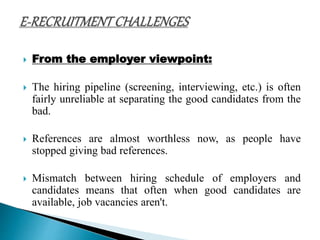
 From the employer viewpoint:
 The hiring pipeline (screening, interviewing, etc.) is often
fairly unreliable at separating the good candidates from the
bad.
 References are almost worthless now, as people have
stopped giving bad references.
 Mismatch between hiring schedule of employers and
candidates means that often when good candidates are
available, job vacancies aren't.
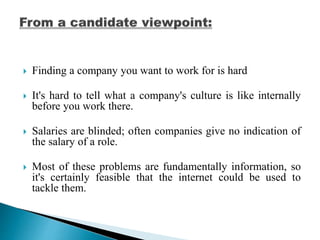
 Finding a company you want to work for is hard
 It's hard to tell what a company's culture is like internally
before you work there.
 Salaries are blinded; often companies give no indication of
the salary of a role.
 Most of these problems are fundamentally information, so
it's certainly feasible that the internet could be used to
tackle them.
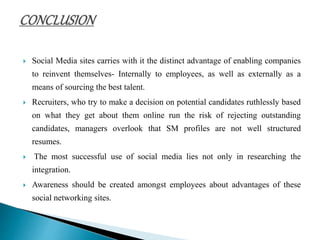
 Social Media sites carries with it the distinct advantage of enabling companies
to reinvent themselves- Internally to employees, as well as externally as a
means of sourcing the best talent.
 Recruiters, who try to make a decision on potential candidates ruthlessly based
on what they get about them online run the risk of rejecting outstanding
candidates, managers overlook that SM profiles are not well structured
resumes.
 The most successful use of social media lies not only in researching the
integration.
 Awareness should be created amongst employees about advantages of these
social networking sites.
Ppt recriutment
Ppt recriutment

Ppt recriutment

  • 1.
  • 2.
     Social mediais changing the landscape of recruiting.  Social Media has a good potential in recruitment the right candidates for companies.  Social media is employ web- and mobile-based technologies to support interactive dialogue and introduce substantial and pervasive changes to communication between organizations, communities, and individuals.  With the advent of social media sites such as LinkedIn, Facebook and Twitter, naukari.com, Monster recruitment procedures have been dramatically transformed.
  • 3.
     To knowup to what extent does the use of Social Networking Sites leads to effective recruitment.  To compare the traditional recruitment process with e- Recruitment and also discuss the advantages and disadvantages of e-Recruitment.  To analyse the potential of e-Recruitment and the challenges faced by it.
  • 4.
  • 5.
     It followan online recruitment channel for hiring their candidates, and selection is done on the basis of campus written test.  Online recruitment replaced the traditional method of recruitment.  ICICI Bank invites all employees from every field for the vacant and asks their candidates to prepare their resume properly, because they have to upload their resume first while applying online.
  • 6.
    Traditional Recruitment Methods Local Employment Office Postings:- Many organizations have employed recruitment methods which are based on postings at local unemployment offices.  Temp Agencies  Internal Hiring:-Company often promotes employees who are already part of the organization into the positions for which they are hiring.
  • 7.
    The Power ofSocial Media  It is quite common to use the services of social media, when you are recruiting today, since it is both inexpensive and allows you to form a vast pool of potential candidates, within a very short period of time.  Social media websites such as LinkedIn, Facebook and Twitter have communities where potential employees submit their resumes and credentials in the hope of landing a job.
  • 8.
     In thepast, to recruit employees, originations would simply advertise opportunities in the local press; engage a recruitment consultant or, more recently, post jobs online via the company website or on popular job boards.  This ‘passive approach’, many claim, is on the way out.
  • 9.
     Today, withthe advent of social media, hiring managers and recruiters find that they need to be more proactive in their approach, by engaging with talent across a wide range of social networking platforms.  Essentially, companies and recruiters need to be where their candidates are in order to engage them in the recruitment process.
  • 10.
     As socialmedia technology continues to evolve and become more widespread, it presents an exciting opportunity for the recruitment industry over the next decade.  Recruiters are beginning to look at ways in which to extend their services to the mobile device through the development of apps, or taking advantage of it.  It is worth noting that innovations such as these are generally being used to recruit within the sectors that gave birth to the technology namely the digital media and creative sectors
  • 11.
     PROS  Costeffective – social media hiring is low cost and often free.  Fast – there are many examples of employers using sites such as LinkedIn to make ‘quick’ hires.  Employer branding and retention – there is a plethora of social media tools online for companies to promote the employer brand effectively to prospective hires and current employees.
  • 12.
     Time consuming– too much information for companies who want to conduct a detailed and robust search. This is where recruiters can help.  Lack of control – managing brand outposts is tricky and inevitably negative content will slip through the net.  Transparency – how reliable is candidate information online?  Discrimination – personal information could lead to employers being influenced by factors like race, religious views and age.  Limited – ultimately the candidate can decide what information they are willing to share.
  • 13.
     There area number of reasons why organizations use social media outlets as part of their recruitment strategy. The first is to source candidates.  Social media recruiting is a cost-effective way to source candidates.  Gone are the days of having to pay a premium to advertise in a newspaper and hope that a group of candidates will see the job posting.  Now, social media outlets offer “reasonable” pricing for job postings that reach high volumes of job seekers, and even passive candidates.
  • 14.
     From theemployer viewpoint:  The hiring pipeline (screening, interviewing, etc.) is often fairly unreliable at separating the good candidates from the bad.  References are almost worthless now, as people have stopped giving bad references.  Mismatch between hiring schedule of employers and candidates means that often when good candidates are available, job vacancies aren't.
  • 15.
     Finding acompany you want to work for is hard  It's hard to tell what a company's culture is like internally before you work there.  Salaries are blinded; often companies give no indication of the salary of a role.  Most of these problems are fundamentally information, so it's certainly feasible that the internet could be used to tackle them.
  • 16.
     Social Mediasites carries with it the distinct advantage of enabling companies to reinvent themselves- Internally to employees, as well as externally as a means of sourcing the best talent.  Recruiters, who try to make a decision on potential candidates ruthlessly based on what they get about them online run the risk of rejecting outstanding candidates, managers overlook that SM profiles are not well structured resumes.  The most successful use of social media lies not only in researching the integration.  Awareness should be created amongst employees about advantages of these social networking sites.