 What is ‘social media for recruiting’, anyway? 
 The talent crisis 
 The Stages of Social Media for Recruiting – and how to 
overcome them 
 Marketing and recruiting need to work together 
 Best sites for social media for recruiting 
 Best practices (tips and tricks) 
 If you could do one thing…
Social media for recruiting is using social media tools to 
source and secure candidates and building recruitment and 
employment brands.
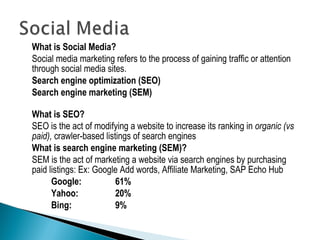
What is Social Media? 
Social media marketing refers to the process of gaining traffic or attention 
through social media sites. 
Search engine optimization (SEO) 
Search engine marketing (SEM) 
What is SEO? 
SEO is the act of modifying a website to increase its ranking in organic (vs 
paid), crawler-based listings of search engines 
What is search engine marketing (SEM)? 
SEM is the act of marketing a website via search engines by purchasing 
paid listings: Ex: Google Add words, Affiliate Marketing, SAP Echo Hub 
Google: 61% 
Yahoo: 20% 
Bing: 9%
 Today we’re going to focus on how to use social media for 
finding and attracting candidates 
 This presentation is designed for people who think of social 
media primarily as a marketing tool
 1: More is better 
 2: Referrals and word of mouth 
 3: Long-term relationships
TThhiiss iiss yyoouurr ttaalleenntt ppooooll..
TThhiiss iiss yyoouurr ttaalleenntt ppooooll 
uussiinngg ssoocciiaall mmeeddiiaa ffoorr 
rreeccrruuiittiinngg
 The economy has mitigated the talent crisis so far 
 Many industries are already facing shortages 
 Companies who don’t use all available channels will lose the 
war for top talent
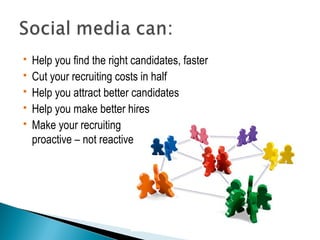
 Help you find the right candidates, faster 
 Cut your recruiting costs in half 
 Help you attract better candidates 
 Help you make better hires 
 Make your recruiting 
proactive – not reactive
 Only 10% of job-seekers expect 
to find their next job through a 
mainstream job board 
 86% of recruiters using social media to find candidates 
 79% say LinkedIn is their #1 source of A-list candidates 
 44% say it’s improved quality of hire 
 36% say it reduces time-to-hire significantly 
This survey report taken from Jobvite
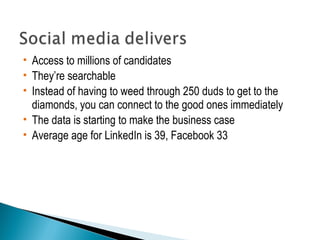
 Access to millions of candidates 
 They’re searchable 
 Instead of having to weed through 250 duds to get to the 
diamonds, you can connect to the good ones immediately 
 The data is starting to make the business case 
 Average age for LinkedIn is 39, Facebook 33
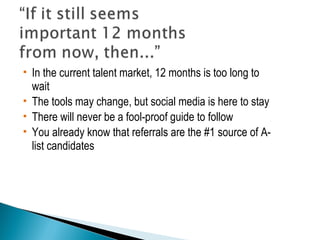
 In the current talent market, 12 months is too long to 
wait 
 The tools may change, but social media is here to stay 
 There will never be a fool-proof guide to follow 
 You already know that referrals are the #1 source of A-list 
candidates
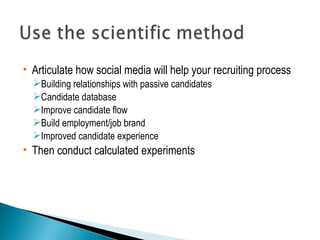
 Articulate how social media will help your recruiting process 
Building relationships with passive candidates 
Candidate database 
Improve candidate flow 
Build employment/job brand 
Improved candidate experience 
 Then conduct calculated experiments
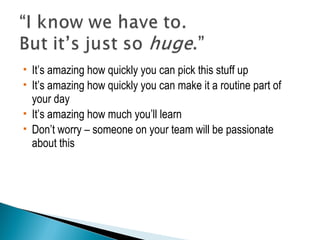
 It’s amazing how quickly you can pick this stuff up 
 It’s amazing how quickly you can make it a routine part of 
your day 
 It’s amazing how much you’ll learn 
 Don’t worry – someone on your team will be passionate 
about this
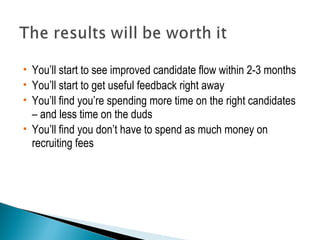
 You’ll start to see improved candidate flow within 2-3 months 
 You’ll start to get useful feedback right away 
 You’ll find you’re spending more time on the right candidates 
– and less time on the duds 
 You’ll find you don’t have to spend as much money on 
recruiting fees
 Ultimately, it’s all about the results
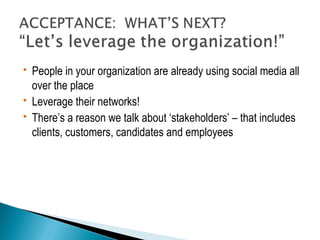
 People in your organization are already using social media all 
over the place 
 Leverage their networks! 
 There’s a reason we talk about ‘stakeholders’ – that includes 
clients, customers, candidates and employees
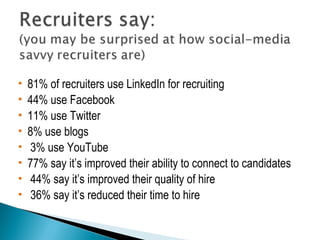
 81% of recruiters use LinkedIn for recruiting 
 44% use Facebook 
 11% use Twitter 
 8% use blogs 
 3% use YouTube 
 77% say it’s improved their ability to connect to candidates 
 44% say it’s improved their quality of hire 
 36% say it’s reduced their time to hire
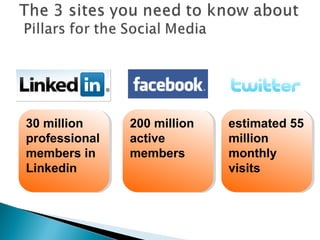
30 million 
professional 
members in 
Linkedin 
30 million 
professional 
members in 
Linkedin 
200 million 
active 
members 
200 million 
active 
members 
estimated 55 
million 
monthly 
visits 
estimated 55 
million 
monthly 
visits
 Use LinkedIn as an instant talent pool 
 Your entire recruiting and HR team should have complete 
profiles on LinkedIn 
 Create and participate in discussion groups among the candidate sectors you need 
most 
 Build your corporate and personal brand 
 Supercharge referrals and expand outreach programs 
 Strengthen professional relationships 
 Manage and track relationships including alumni 
 Post and broadcast jobs instantly 
 Target groups and associations 
 Build talent pipelines and warm leads
1. Improve your organization’s profile page 
2. Build your personal brand (top-of-mind) 
3. Create and administer corporate and alumni groups (referrals!) 
4. Participate in industry groups 
5. Broadcast job openings 
6. Ask and answer questions 
7. Create events 
8. Smart searching/saved searches 
9. Reference search 
10. Applications and polls 
11. Visit Consultant Profile even if have no option to connect him 
12. Choose for people to see your name and details when you have 
viewed their profile. It can have the effect of leaving a business 
card with someone. People will invariably click through to your 
profile.
 Face book is an example of how social tools have been adopted for 
commercial now many companies – including IT recruiters – are logging on 
for business purposes. Much like LinkedIn, IT recruiters can use Facebook 
to bring potential candidates altogether in one place, advertise their current 
positions and initiate conversations 
 Easy to create applications such as ‘HotJobs’ feeds 
 Easy to create groups and ‘pages’ 
 Great way to build employment brands 
 Helps tap into immediate personal networks 
 Can tap into diversity networks
 Twitter - not for twits 
 It's not just freelance brand managers and marketers who are exploring 
Twitter for better returns for their client companies 
 Posting links to news articles, . IT groups and recruiters, including in the 
contract market, are using Twitter to connect with influential people in the 
sector, start conversations, contribute to 'memes' and form alliances. 
 Community building (candidate communities) 
 Generating buzz about events 
 Engaging in stakeholder dialogue 
 Putting a ‘face’ on the organization 
 Demonstrating thought leadership
 More websites are going to an all-blog 
format 
 Don’t think the best and brightest aren’t checking 
 Transparency builds brands – including employment and 
recruitment brands 
 Own company Blogs 
 Word press, BlogSpot's, etc.,
 A blog with entries by various team 
members 
 Not just about how great it is to work there, but ‘neat stuff’ 
about what the company is doing 
 Blog RSS feeds can then update your LinkedIn profiles, 
Facebook groups, and Twitter account
 Have a strategy 
 Make someone responsible for social media 
 Know the privacy concerns 
 Recognize that it’s a 
long-term build 
 Talk to marketing!
1. Create a Marketing/Recruiting team for employment 
brand and social media for recruiting 
2. Review the ‘candidate experience’ on your website and 
application process 
3. Get a copy of your job postings or we can ask our expert 
to rewrite the postings– and then monitor how much 
better they perform 
4. Ask to participate in the next recruiting event 
5. Make sure recruiting knows the key marketing messages 
(internal and external!) 
6. Share databases
 Make sure everyone responsible for 
recruiting in your organization has a 
complete, compelling profile on LinkedIn 
– including updating their status twice a 
week
Social media presentation from aravind

Social media presentation from aravind

  • 2.
     What is‘social media for recruiting’, anyway?  The talent crisis  The Stages of Social Media for Recruiting – and how to overcome them  Marketing and recruiting need to work together  Best sites for social media for recruiting  Best practices (tips and tricks)  If you could do one thing…
  • 3.
    Social media forrecruiting is using social media tools to source and secure candidates and building recruitment and employment brands.
  • 4.
    What is SocialMedia? Social media marketing refers to the process of gaining traffic or attention through social media sites. Search engine optimization (SEO) Search engine marketing (SEM) What is SEO? SEO is the act of modifying a website to increase its ranking in organic (vs paid), crawler-based listings of search engines What is search engine marketing (SEM)? SEM is the act of marketing a website via search engines by purchasing paid listings: Ex: Google Add words, Affiliate Marketing, SAP Echo Hub Google: 61% Yahoo: 20% Bing: 9%
  • 5.
     Today we’regoing to focus on how to use social media for finding and attracting candidates  This presentation is designed for people who think of social media primarily as a marketing tool
  • 6.
     1: Moreis better  2: Referrals and word of mouth  3: Long-term relationships
  • 7.
    TThhiiss iiss yyoouurrttaalleenntt ppooooll..
  • 8.
    TThhiiss iiss yyoouurrttaalleenntt ppooooll uussiinngg ssoocciiaall mmeeddiiaa ffoorr rreeccrruuiittiinngg
  • 9.
     The economyhas mitigated the talent crisis so far  Many industries are already facing shortages  Companies who don’t use all available channels will lose the war for top talent
  • 10.
     Help youfind the right candidates, faster  Cut your recruiting costs in half  Help you attract better candidates  Help you make better hires  Make your recruiting proactive – not reactive
  • 11.
     Only 10%of job-seekers expect to find their next job through a mainstream job board  86% of recruiters using social media to find candidates  79% say LinkedIn is their #1 source of A-list candidates  44% say it’s improved quality of hire  36% say it reduces time-to-hire significantly This survey report taken from Jobvite
  • 12.
     Access tomillions of candidates  They’re searchable  Instead of having to weed through 250 duds to get to the diamonds, you can connect to the good ones immediately  The data is starting to make the business case  Average age for LinkedIn is 39, Facebook 33
  • 13.
     In thecurrent talent market, 12 months is too long to wait  The tools may change, but social media is here to stay  There will never be a fool-proof guide to follow  You already know that referrals are the #1 source of A-list candidates
  • 14.
     Articulate howsocial media will help your recruiting process Building relationships with passive candidates Candidate database Improve candidate flow Build employment/job brand Improved candidate experience  Then conduct calculated experiments
  • 15.
     It’s amazinghow quickly you can pick this stuff up  It’s amazing how quickly you can make it a routine part of your day  It’s amazing how much you’ll learn  Don’t worry – someone on your team will be passionate about this
  • 16.
     You’ll startto see improved candidate flow within 2-3 months  You’ll start to get useful feedback right away  You’ll find you’re spending more time on the right candidates – and less time on the duds  You’ll find you don’t have to spend as much money on recruiting fees
  • 17.
     Ultimately, it’sall about the results
  • 18.
     People inyour organization are already using social media all over the place  Leverage their networks!  There’s a reason we talk about ‘stakeholders’ – that includes clients, customers, candidates and employees
  • 20.
     81% ofrecruiters use LinkedIn for recruiting  44% use Facebook  11% use Twitter  8% use blogs  3% use YouTube  77% say it’s improved their ability to connect to candidates  44% say it’s improved their quality of hire  36% say it’s reduced their time to hire
  • 21.
    30 million professional members in Linkedin 30 million professional members in Linkedin 200 million active members 200 million active members estimated 55 million monthly visits estimated 55 million monthly visits
  • 22.
     Use LinkedInas an instant talent pool  Your entire recruiting and HR team should have complete profiles on LinkedIn  Create and participate in discussion groups among the candidate sectors you need most  Build your corporate and personal brand  Supercharge referrals and expand outreach programs  Strengthen professional relationships  Manage and track relationships including alumni  Post and broadcast jobs instantly  Target groups and associations  Build talent pipelines and warm leads
  • 23.
    1. Improve yourorganization’s profile page 2. Build your personal brand (top-of-mind) 3. Create and administer corporate and alumni groups (referrals!) 4. Participate in industry groups 5. Broadcast job openings 6. Ask and answer questions 7. Create events 8. Smart searching/saved searches 9. Reference search 10. Applications and polls 11. Visit Consultant Profile even if have no option to connect him 12. Choose for people to see your name and details when you have viewed their profile. It can have the effect of leaving a business card with someone. People will invariably click through to your profile.
  • 24.
     Face bookis an example of how social tools have been adopted for commercial now many companies – including IT recruiters – are logging on for business purposes. Much like LinkedIn, IT recruiters can use Facebook to bring potential candidates altogether in one place, advertise their current positions and initiate conversations  Easy to create applications such as ‘HotJobs’ feeds  Easy to create groups and ‘pages’  Great way to build employment brands  Helps tap into immediate personal networks  Can tap into diversity networks
  • 25.
     Twitter -not for twits  It's not just freelance brand managers and marketers who are exploring Twitter for better returns for their client companies  Posting links to news articles, . IT groups and recruiters, including in the contract market, are using Twitter to connect with influential people in the sector, start conversations, contribute to 'memes' and form alliances.  Community building (candidate communities)  Generating buzz about events  Engaging in stakeholder dialogue  Putting a ‘face’ on the organization  Demonstrating thought leadership
  • 26.
     More websitesare going to an all-blog format  Don’t think the best and brightest aren’t checking  Transparency builds brands – including employment and recruitment brands  Own company Blogs  Word press, BlogSpot's, etc.,
  • 27.
     A blogwith entries by various team members  Not just about how great it is to work there, but ‘neat stuff’ about what the company is doing  Blog RSS feeds can then update your LinkedIn profiles, Facebook groups, and Twitter account
  • 28.
     Have astrategy  Make someone responsible for social media  Know the privacy concerns  Recognize that it’s a long-term build  Talk to marketing!
  • 29.
    1. Create aMarketing/Recruiting team for employment brand and social media for recruiting 2. Review the ‘candidate experience’ on your website and application process 3. Get a copy of your job postings or we can ask our expert to rewrite the postings– and then monitor how much better they perform 4. Ask to participate in the next recruiting event 5. Make sure recruiting knows the key marketing messages (internal and external!) 6. Share databases
  • 30.
     Make sureeveryone responsible for recruiting in your organization has a complete, compelling profile on LinkedIn – including updating their status twice a week

Editor's Notes

  • #4 Social networking is the term applied to sites like Facebook, MySpace, Twitter, Tumblr, etc which allow people to share information with other people, but tends to do this by organizing people in groups. Social media is a broader term which encompasses social networking sites, but also sites like Flickr, Twitpic, YouTube, etc. which allow people to share information with large audiences, but doesn’t rely so heavily on the ‘group’ component. Social media is more difficult to control, because there’s no vetting of the audience members (in Facebook, you have to accept someone as a friend before they can see your info; on YouTube, strangers can browse your videos unless you specifically set them to ‘private’).