Protein Structure
Pembimbing
dr. Subandrate, M.Biomed
dr. I Made Bayu Wisnu Wardhana 04012782226007
dr. Jefry Angola 04012782226010
dr. Vandy Ikra 04012782226003
dr. Alif Alfiansyah 04012782226005
dr. Riki Saputra 041227822260003
dr. Dendy Riansyah 041227822260001
dr. Davin Caturputra Setiamanah 041227822260002
dr. Rio Yus Ramadhani 041227822260004
FAKULTAS KEDOKTERAN UNIVERSITAS SRIWIJAYA
RSUP DR. MUHAMMAD HOESIN PALEMBANG 2021
Protein
• Proteins are large, complex molecules that play many critical roles in the body.
• The Swedish chemists J. J. Berzelius in 1938 coined the name ’protein’ from the
Greek word proteios which means “of the first rank”.
• They function as catalysts, they transport and store other molecules such as
oxygen, they provide mechanical support and immune protection, they generate
movement, they transmit nerve impulses, and they control growth and
differentiation.
Primary Structure
• The primary structure of a protein is defined as a linear sequence of amino acids and the location of disulfide
(-S-S-) bonds, if any.
Tertiary structure
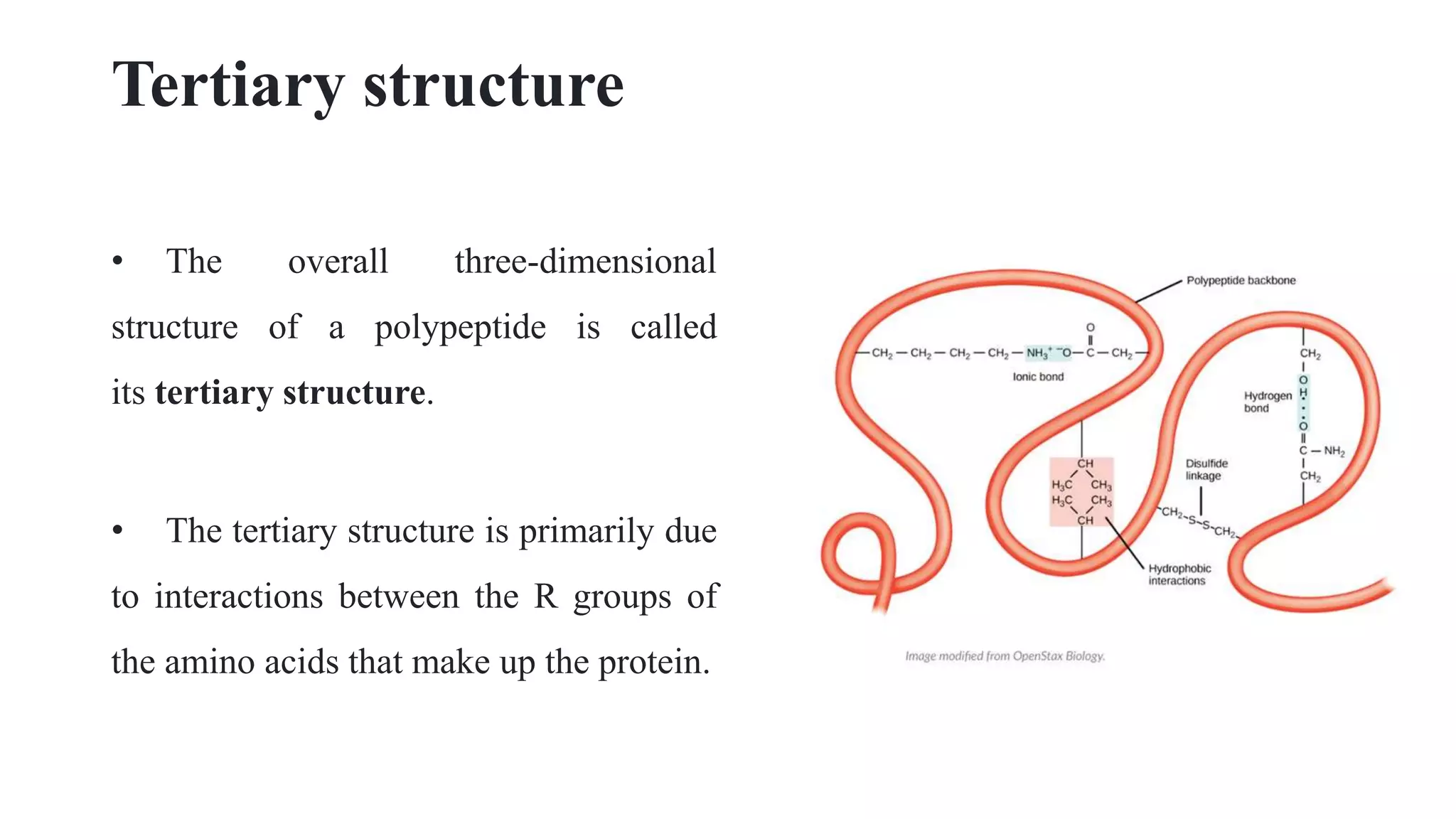
• The overall three-dimensional
structure of a polypeptide is called
its tertiary structure.
• The tertiary structure is primarily due
to interactions between the R groups of
the amino acids that make up the protein.
Tertiary structure
• R group interactions that contribute to tertiary structure include hydrogen bonding, ionic
bonding, dipole-dipole interactions, and London dispersion forces – basically, the whole gamut of
non-covalent bonds.
• For example, R groups with like charges repel one another, while those with opposite charges
can form an ionic bond.
• Similarly, polar R groups can form hydrogen bonds and other dipole-dipole interactions. Also
important to tertiary structure are hydrophobic interactions, in which amino acids with nonpolar,
hydrophobic R groups cluster together on the inside of the protein, leaving hydrophilic amino acids
on the outside to interact with surrounding water molecules.
Tertiary structure
• Finally, there’s one special type of covalent bond that can contribute to tertiary structure: the
disulfide bond.
• Disulfide bonds, covalent linkages between the sulfur-containing side chains of cysteines, are
much stronger than the other types of bonds that contribute to tertiary structure.
• They act like molecular "safety pins," keeping parts of the polypeptide firmly attached to one
another.
Quaternary structure
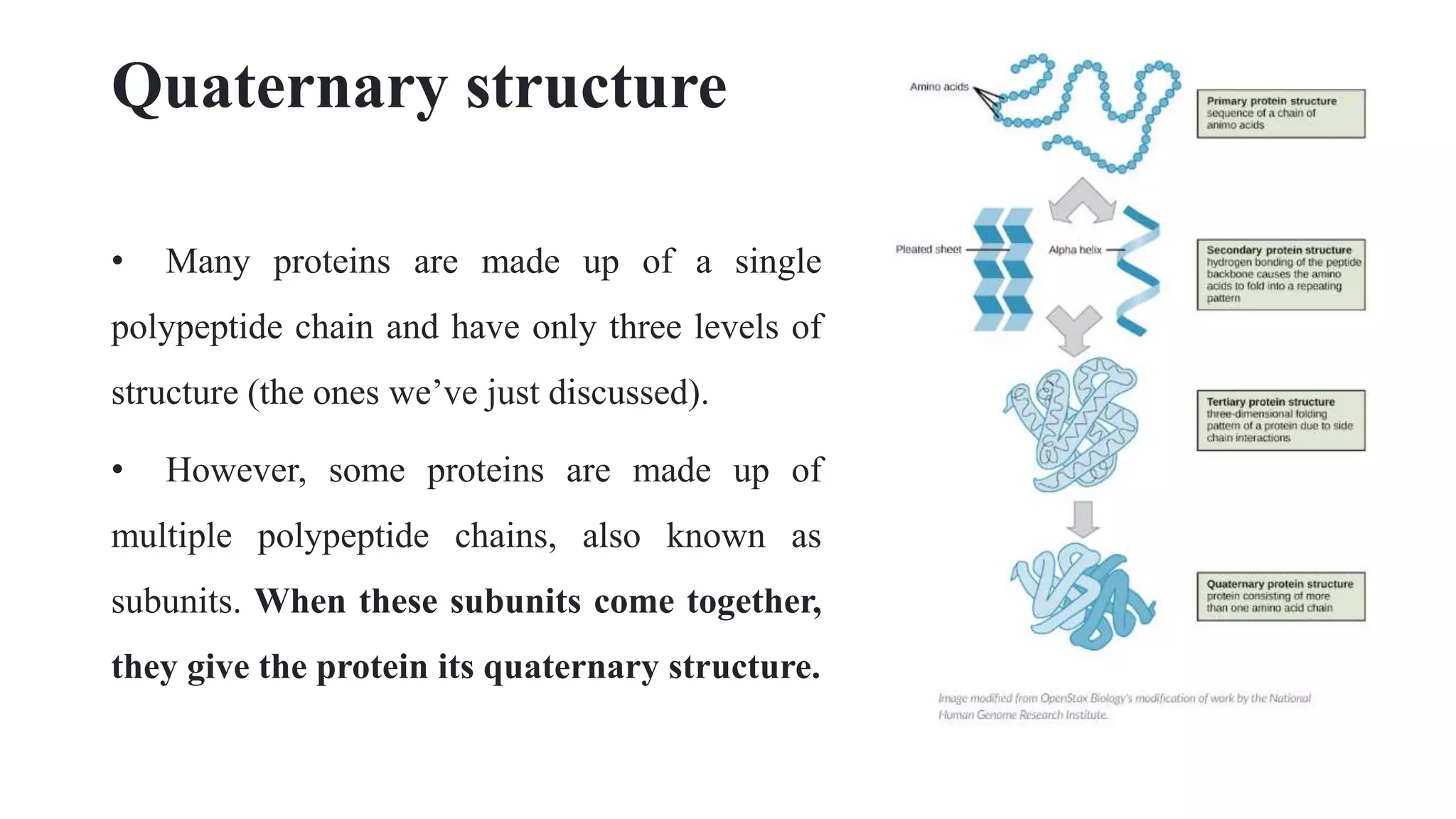
• Many proteins are made up of a single
polypeptide chain and have only three levels of
structure (the ones we’ve just discussed).
• However, some proteins are made up of
multiple polypeptide chains, also known as
subunits. When these subunits come together,
they give the protein its quaternary structure.
Quaternary structure
• Example of a protein with quaternary structure:
• hemoglobin. As mentioned earlier, hemoglobin carries oxygen in the blood
and is made up of four subunits, two each of the α and β types.
• Another example is DNA polymerase, an enzyme that synthesizes new
strands of DNA and is composed of ten subunits^55start superscript, 5, end
superscript.
Quaternary structure
• In general, the same types of interactions that contribute to
tertiary structure (mostly weak interactions, such as hydrogen
bonding and London dispersion forces) also hold the subunits
together to give quaternary structure.
Reference
1. Khan, R. H., Siddiqi, M. K., & Salahuddin, P. (2017). Protein structure and function. Basic
biochemistry, 5, 1-39.
2. Berg, J. M., Tymoczko, J. L., and Stryer, L. (2002). Tertiary structure: Water-soluble proteins fold
Into compact structures with nonpolar cores. In Biochemistry (5th ed., section 3.4). New York,
NY: W. H. Freeman. Retrieved from http://www.ncbi.nlm.nih.gov/books/NBK22375/.
3. 3. Berg JM, Tymoczko JL, Stryer L (2002). "Section 3.5Quaternary Structure: Polypeptide Chains
Can Assemble Into Multisubunit Structures". Biochemistry (5. ed., 4. print. ed.). New York, NY
[u.a.]: W. H. Freeman. ISBN 0-7167-3051-0.

PPT Protein Structure.pptx

  • 1.
    Protein Structure Pembimbing dr. Subandrate,M.Biomed dr. I Made Bayu Wisnu Wardhana 04012782226007 dr. Jefry Angola 04012782226010 dr. Vandy Ikra 04012782226003 dr. Alif Alfiansyah 04012782226005 dr. Riki Saputra 041227822260003 dr. Dendy Riansyah 041227822260001 dr. Davin Caturputra Setiamanah 041227822260002 dr. Rio Yus Ramadhani 041227822260004 FAKULTAS KEDOKTERAN UNIVERSITAS SRIWIJAYA RSUP DR. MUHAMMAD HOESIN PALEMBANG 2021
  • 2.
    Protein • Proteins arelarge, complex molecules that play many critical roles in the body. • The Swedish chemists J. J. Berzelius in 1938 coined the name ’protein’ from the Greek word proteios which means “of the first rank”. • They function as catalysts, they transport and store other molecules such as oxygen, they provide mechanical support and immune protection, they generate movement, they transmit nerve impulses, and they control growth and differentiation.
  • 3.
    Primary Structure • Theprimary structure of a protein is defined as a linear sequence of amino acids and the location of disulfide (-S-S-) bonds, if any.
  • 4.
    Tertiary structure • Theoverall three-dimensional structure of a polypeptide is called its tertiary structure. • The tertiary structure is primarily due to interactions between the R groups of the amino acids that make up the protein.
  • 5.
    Tertiary structure • Rgroup interactions that contribute to tertiary structure include hydrogen bonding, ionic bonding, dipole-dipole interactions, and London dispersion forces – basically, the whole gamut of non-covalent bonds. • For example, R groups with like charges repel one another, while those with opposite charges can form an ionic bond. • Similarly, polar R groups can form hydrogen bonds and other dipole-dipole interactions. Also important to tertiary structure are hydrophobic interactions, in which amino acids with nonpolar, hydrophobic R groups cluster together on the inside of the protein, leaving hydrophilic amino acids on the outside to interact with surrounding water molecules.
  • 6.
    Tertiary structure • Finally,there’s one special type of covalent bond that can contribute to tertiary structure: the disulfide bond. • Disulfide bonds, covalent linkages between the sulfur-containing side chains of cysteines, are much stronger than the other types of bonds that contribute to tertiary structure. • They act like molecular "safety pins," keeping parts of the polypeptide firmly attached to one another.
  • 7.
    Quaternary structure • Manyproteins are made up of a single polypeptide chain and have only three levels of structure (the ones we’ve just discussed). • However, some proteins are made up of multiple polypeptide chains, also known as subunits. When these subunits come together, they give the protein its quaternary structure.
  • 8.
    Quaternary structure • Exampleof a protein with quaternary structure: • hemoglobin. As mentioned earlier, hemoglobin carries oxygen in the blood and is made up of four subunits, two each of the α and β types. • Another example is DNA polymerase, an enzyme that synthesizes new strands of DNA and is composed of ten subunits^55start superscript, 5, end superscript.
  • 9.
    Quaternary structure • Ingeneral, the same types of interactions that contribute to tertiary structure (mostly weak interactions, such as hydrogen bonding and London dispersion forces) also hold the subunits together to give quaternary structure.
  • 10.
    Reference 1. Khan, R.H., Siddiqi, M. K., & Salahuddin, P. (2017). Protein structure and function. Basic biochemistry, 5, 1-39. 2. Berg, J. M., Tymoczko, J. L., and Stryer, L. (2002). Tertiary structure: Water-soluble proteins fold Into compact structures with nonpolar cores. In Biochemistry (5th ed., section 3.4). New York, NY: W. H. Freeman. Retrieved from http://www.ncbi.nlm.nih.gov/books/NBK22375/. 3. 3. Berg JM, Tymoczko JL, Stryer L (2002). "Section 3.5Quaternary Structure: Polypeptide Chains Can Assemble Into Multisubunit Structures". Biochemistry (5. ed., 4. print. ed.). New York, NY [u.a.]: W. H. Freeman. ISBN 0-7167-3051-0.