1
PT. RAVISHANKAR SHUKLA
UNIVERSITY
S.O.S in Biotechnology
GUIDED BY
DR. AFAQUE QURAISHI
MSC 1ST
SEM BIOTECHNOLOGY
2
protein : quart nary structure
By Saman zubabi
3
Contents
 PROTIENS
 LEVELS OF PROTEIN
 QUATERNARY STRUCTURE
 TYPES OF QUATNARY STRUCTURE
 TYPES OF BONDS PRESENT
4
Proteins
 The amino acids in a polypeptide chain are linked by peptide bonds . Once
linked in the protein chain, an individual amino acid is called a residue, and
the linked series of carbon, nitrogen, and oxygen atoms are known as the
main chain or protein backbone.
 The peptide bond has two resonance forms that contribute some double-
bond character and inhibit rotation around its axis, so that the alpha
carbons are roughly coplanar.
 The other two dihedral angles in the peptide bond determine the local
shape assumed by the protein backbone.
 The end of the protein with a free carboxyl group is known as the C-
terminus or carboxy terminus, whereas the end with a free amino group is
known as the N-terminus or amino terminus.
5
Levels of Protein
 Primary Structure
 Secondary Structure
 Tertiary Structure
 Quaternary Structure
6
QUATERNARY STRUCTURE
 Quaternary structure is the three-dimensional structure of a
multi-subunit protein.
 The quaternary structure is stabilized by the same non-covalent
interactions and disulfide bonds as the tertiary structure.
 Complexes of two or more polypeptides are called multimers.
 The quaternary protein structure involves the clustering of several
individual peptide or protein chains into a final specific shape.
 A variety of bonding interactions including hydrogen bonding,
salt bridges, and disulfide bonds hold the various chains into a
particular geometry.
7
TYPES OF QUARTERNARY PROTEIN
 FIBROUS PROTEIN
 GLOBULAR PROTEIN
8
FIBROUS PROTEIN
 Actually, the final beta-pleated sheet structure of silk is the result
of the interaction of many individual protein chains.
 Specifically, hydrogen bonding on amide groups on different
chains is the basis of beta-pleated sheet in silk proteins
 Other fibrous proteins such as the keratins in wool and hair are
composed of coiled alpha helical protein chains with other various
coils analogous to those found in a rope.
 Other keratins are found in skin, fur, hair, wool, claws, nails,
hooves, horns, scales, beaks, feathers, actin and myosin in muscle
tissues and fibrinogen needed for blood clots.
9
10
Globular protein
 On the other hand, globular proteins may have a combination of the above
types of structures and are mostly clumped into a shape of a ball.
 Major examples include insulin, haemoglobin, and most enzymes.
11
Haemoglobin
• Hemoglobin is found in red blood cells
• The haemoglobin molecule is a tetramer consisting of 4 polypeptide chains, known as globins,
which are usually:
• 2 alpha chains that are each 141 amino acids long. 2 beta chains that are each 146 amino acids
long
• Tetrameric Structure: Hemoglobin is a tetramer composed of four polypeptide chains: two alpha
(α) chains and two beta (β) chains. In adults, these chains are typically referred to as α2β2.
• Heme Groups: Each of the four subunits contains a heme group, which is the site of oxygen
binding. Thus, a single hemoglobin molecule can bind up to four oxygen molecules.
12
Insulin
 Human insulin contains two protein chains with a total of 51 amino acids.
 The chains are connected by two disulfide bonds.*
 Insulin is classified as a hormone and is needed for the proper utilization
of glucose
 Diabetics must take insulin injections to maintain health.
13
Forces involve in quaternary structure of
protein
 Disulphide bond
 Hydrogen bond
 Non polar hydrophobic interactions
 Protein protein interactions
 Peptide bond
14
Disulphide bond
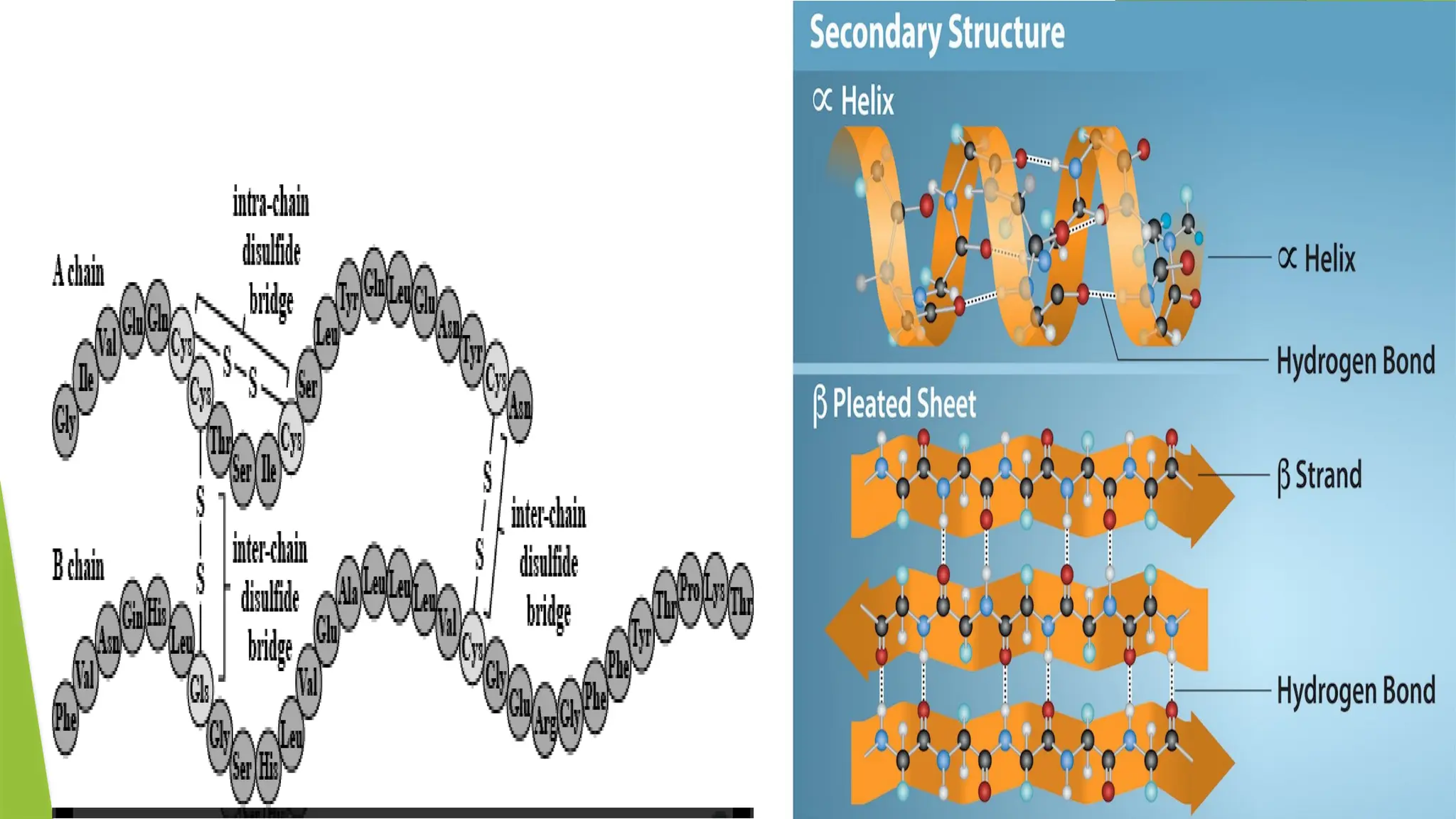
 A disulfide bond (or disulfide bridge) plays a crucial role in stabilizing the
quaternary structure of proteins, especially in multi-subunit proteins. These
bonds are covalent connections that form between the sulfur atoms of two
cysteine residues, a type of amino acid, within or between protein chains.
 In the context of quaternary structure, which refers to the higher-level
assembly of multiple polypeptide subunits into a functional protein complex,
disulfide bonds can occur:
1. Within a single subunit (in the tertiary structure), helping to stabilize the
folding of that individual subunit.
2. Between subunits (in the quaternary structure), holding together different
polypeptide chains to form a stable multi-subunit protein complex.
15
Hydrogen bond
 Hydrogen bonds also play a significant role in stabilizing the quaternary
structure of proteins. While they are weaker than covalent bonds like
disulfide bonds, hydrogen bonds are crucial for maintaining the structural
integrity of protein complexes formed by multiple polypeptide chains.
 Hydrogen Bonding in Quaternary Structure
 In the quaternary structure, hydrogen bonds can form between polar side
chains of amino acids from different subunits. These bonds help maintain the
association between the subunits without forming covalent links, offering
flexibility while contributing to overall stability.
16
17
Non polar hydrophobic bond
 Nonpolar hydrophobic interactions play a crucial role in stabilizing the
quaternary structure of proteins. These interactions occur between nonpolar
(hydrophobic) amino acid side chains, which tend to cluster together to avoid
water or aqueous environments. In multi-subunit proteins, hydrophobic bonds
are particularly important for maintaining the interface between subunits.
 Hydrophobic Interactions in Quaternary Structure
 Hydrophobic bonds or interactions arise due to the tendency of nonpolar
amino acids (such as leucine, isoleucine, valine, phenylalanine, etc.) to
aggregate together in an aqueous environment. These residues typically avoid
contact with water, driving the subunits to pack tightly and exclude water
molecules from the protein's interior.
18
Reference
 Biochemistry by Lehninger ( Nelson and Cox)
 www.google .com
19

protein quaternary structure .pptxSAMAN 4.pptx

  • 1.
    1 PT. RAVISHANKAR SHUKLA UNIVERSITY S.O.Sin Biotechnology GUIDED BY DR. AFAQUE QURAISHI MSC 1ST SEM BIOTECHNOLOGY
  • 2.
    2 protein : quartnary structure By Saman zubabi
  • 3.
    3 Contents  PROTIENS  LEVELSOF PROTEIN  QUATERNARY STRUCTURE  TYPES OF QUATNARY STRUCTURE  TYPES OF BONDS PRESENT
  • 4.
    4 Proteins  The aminoacids in a polypeptide chain are linked by peptide bonds . Once linked in the protein chain, an individual amino acid is called a residue, and the linked series of carbon, nitrogen, and oxygen atoms are known as the main chain or protein backbone.  The peptide bond has two resonance forms that contribute some double- bond character and inhibit rotation around its axis, so that the alpha carbons are roughly coplanar.  The other two dihedral angles in the peptide bond determine the local shape assumed by the protein backbone.  The end of the protein with a free carboxyl group is known as the C- terminus or carboxy terminus, whereas the end with a free amino group is known as the N-terminus or amino terminus.
  • 5.
    5 Levels of Protein Primary Structure  Secondary Structure  Tertiary Structure  Quaternary Structure
  • 6.
    6 QUATERNARY STRUCTURE  Quaternarystructure is the three-dimensional structure of a multi-subunit protein.  The quaternary structure is stabilized by the same non-covalent interactions and disulfide bonds as the tertiary structure.  Complexes of two or more polypeptides are called multimers.  The quaternary protein structure involves the clustering of several individual peptide or protein chains into a final specific shape.  A variety of bonding interactions including hydrogen bonding, salt bridges, and disulfide bonds hold the various chains into a particular geometry.
  • 7.
    7 TYPES OF QUARTERNARYPROTEIN  FIBROUS PROTEIN  GLOBULAR PROTEIN
  • 8.
    8 FIBROUS PROTEIN  Actually,the final beta-pleated sheet structure of silk is the result of the interaction of many individual protein chains.  Specifically, hydrogen bonding on amide groups on different chains is the basis of beta-pleated sheet in silk proteins  Other fibrous proteins such as the keratins in wool and hair are composed of coiled alpha helical protein chains with other various coils analogous to those found in a rope.  Other keratins are found in skin, fur, hair, wool, claws, nails, hooves, horns, scales, beaks, feathers, actin and myosin in muscle tissues and fibrinogen needed for blood clots.
  • 9.
  • 10.
    10 Globular protein  Onthe other hand, globular proteins may have a combination of the above types of structures and are mostly clumped into a shape of a ball.  Major examples include insulin, haemoglobin, and most enzymes.
  • 11.
    11 Haemoglobin • Hemoglobin isfound in red blood cells • The haemoglobin molecule is a tetramer consisting of 4 polypeptide chains, known as globins, which are usually: • 2 alpha chains that are each 141 amino acids long. 2 beta chains that are each 146 amino acids long • Tetrameric Structure: Hemoglobin is a tetramer composed of four polypeptide chains: two alpha (α) chains and two beta (β) chains. In adults, these chains are typically referred to as α2β2. • Heme Groups: Each of the four subunits contains a heme group, which is the site of oxygen binding. Thus, a single hemoglobin molecule can bind up to four oxygen molecules.
  • 12.
    12 Insulin  Human insulincontains two protein chains with a total of 51 amino acids.  The chains are connected by two disulfide bonds.*  Insulin is classified as a hormone and is needed for the proper utilization of glucose  Diabetics must take insulin injections to maintain health.
  • 13.
    13 Forces involve inquaternary structure of protein  Disulphide bond  Hydrogen bond  Non polar hydrophobic interactions  Protein protein interactions  Peptide bond
  • 14.
    14 Disulphide bond  Adisulfide bond (or disulfide bridge) plays a crucial role in stabilizing the quaternary structure of proteins, especially in multi-subunit proteins. These bonds are covalent connections that form between the sulfur atoms of two cysteine residues, a type of amino acid, within or between protein chains.  In the context of quaternary structure, which refers to the higher-level assembly of multiple polypeptide subunits into a functional protein complex, disulfide bonds can occur: 1. Within a single subunit (in the tertiary structure), helping to stabilize the folding of that individual subunit. 2. Between subunits (in the quaternary structure), holding together different polypeptide chains to form a stable multi-subunit protein complex.
  • 15.
    15 Hydrogen bond  Hydrogenbonds also play a significant role in stabilizing the quaternary structure of proteins. While they are weaker than covalent bonds like disulfide bonds, hydrogen bonds are crucial for maintaining the structural integrity of protein complexes formed by multiple polypeptide chains.  Hydrogen Bonding in Quaternary Structure  In the quaternary structure, hydrogen bonds can form between polar side chains of amino acids from different subunits. These bonds help maintain the association between the subunits without forming covalent links, offering flexibility while contributing to overall stability.
  • 16.
  • 17.
    17 Non polar hydrophobicbond  Nonpolar hydrophobic interactions play a crucial role in stabilizing the quaternary structure of proteins. These interactions occur between nonpolar (hydrophobic) amino acid side chains, which tend to cluster together to avoid water or aqueous environments. In multi-subunit proteins, hydrophobic bonds are particularly important for maintaining the interface between subunits.  Hydrophobic Interactions in Quaternary Structure  Hydrophobic bonds or interactions arise due to the tendency of nonpolar amino acids (such as leucine, isoleucine, valine, phenylalanine, etc.) to aggregate together in an aqueous environment. These residues typically avoid contact with water, driving the subunits to pack tightly and exclude water molecules from the protein's interior.
  • 18.
    18 Reference  Biochemistry byLehninger ( Nelson and Cox)  www.google .com
  • 19.