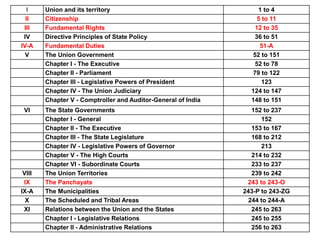
I Union and its territory 1 to 4
II Citizenship 5 to 11
III Fundamental Rights 12 to 35
IV Directive Principles of State Policy 36 to 51
IV-A Fundamental Duties 51-A
V The Union Government 52 to 151
Chapter I - The Executive 52 to 78
Chapter II - Parliament 79 to 122
Chapter III - Legislative Powers of President 123
Chapter IV - The Union Judiciary 124 to 147
Chapter V - Comptroller and Auditor-General of India 148 to 151
VI The State Governments 152 to 237
Chapter I - General 152
Chapter II - The Executive 153 to 167
Chapter III - The State Legislature 168 to 212
Chapter IV - Legislative Powers of Governor 213
Chapter V - The High Courts 214 to 232
Chapter VI - Subordinate Courts 233 to 237
VIII The Union Territories 239 to 242
IX The Panchayats 243 to 243-O
IX-A The Municipalities 243-P to 243-ZG
X The Scheduled and Tribal Areas 244 to 244-A
XI Relations between the Union and the States 245 to 263
Chapter I - Legislative Relations 245 to 255
Chapter II - Administrative Relations 256 to 263
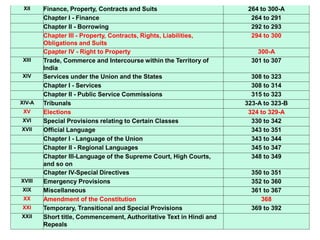
XII Finance, Property, Contracts and Suits 264 to 300-A
Chapter I - Finance 264 to 291
Chapter II - Borrowing 292 to 293
Chapter III - Property, Contracts, Rights, Liabilities,
Obligations and Suits
294 to 300
Cpapter IV - Right to Property 300-A
XIII Trade, Commerce and Intercourse within the Territory of
India
301 to 307
XIV Services under the Union and the States 308 to 323
Chapter I - Services 308 to 314
Chapter II - Public Service Commissions 315 to 323
XIV-A Tribunals 323-A to 323-B
XV Elections 324 to 329-A
XVI Special Provisions relating to Certain Classes 330 to 342
XVII Official Language 343 to 351
Chapter I - Language of the Union 343 to 344
Chapter II - Regional Languages 345 to 347
Chapter III-Language of the Supreme Court, High Courts,
and so on
348 to 349
Chapter IV-Special Directives 350 to 351
XVIII Emergency Provisions 352 to 360
XIX Miscellaneous 361 to 367
XX Amendment of the Constitution 368
XXI Temporary, Transitional and Special Provisions 369 to 392
XXII Short title, Commencement, Authoritative Text in Hindi and
Repeals
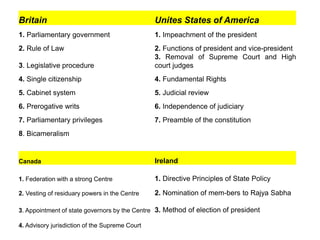
Britain Unites States of America
1. Parliamentary government 1. Impeachment of the president
2. Rule of Law 2. Functions of president and vice-president
3. Legislative procedure
3. Removal of Supreme Court and High
court judges
4. Single citizenship 4. Fundamental Rights
5. Cabinet system 5. Judicial review
6. Prerogative writs 6. Independence of judiciary
7. Parliamentary privileges 7. Preamble of the constitution
8. Bicameralism
Canada Ireland
1. Federation with a strong Centre 1. Directive Principles of State Policy
2. Vesting of residuary powers in the Centre 2. Nomination of mem-bers to Rajya Sabha
3. Appointment of state governors by the Centre 3. Method of election of president
4. Advisory jurisdiction of the Supreme Court
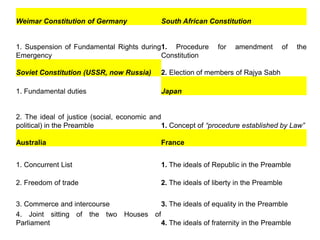
Weimar Constitution of Germany South African Constitution
1. Suspension of Fundamental Rights during
Emergency
1. Procedure for amendment of the
Constitution
Soviet Constitution (USSR, now Russia) 2. Election of members of Rajya Sabh
1. Fundamental duties Japan
2. The ideal of justice (social, economic and
political) in the Preamble 1. Concept of “procedure established by Law”
Australia France
1. Concurrent List 1. The ideals of Republic in the Preamble
2. Freedom of trade 2. The ideals of liberty in the Preamble
3. Commerce and intercourse 3. The ideals of equality in the Preamble
4. Joint sitting of the two Houses of
Parliament 4. The ideals of fraternity in the Preamble
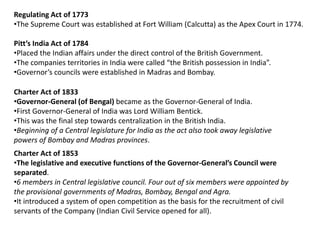
Regulating Act of 1773
•The Supreme Court was established at Fort William (Calcutta) as the Apex Court in 1774.
Pitt’s India Act of 1784
•Placed the Indian affairs under the direct control of the British Government.
•The companies territories in India were called “the British possession in India”.
•Governor’s councils were established in Madras and Bombay.
Charter Act of 1833
•Governor-General (of Bengal) became as the Governor-General of India.
•First Governor-General of India was Lord William Bentick.
•This was the final step towards centralization in the British India.
•Beginning of a Central legislature for India as the act also took away legislative
powers of Bombay and Madras provinces.
Charter Act of 1853
•The legislative and executive functions of the Governor-General’s Council were
separated.
•6 members in Central legislative council. Four out of six members were appointed by
the provisional governments of Madras, Bombay, Bengal and Agra.
•It introduced a system of open competition as the basis for the recruitment of civil
servants of the Company (Indian Civil Service opened for all).
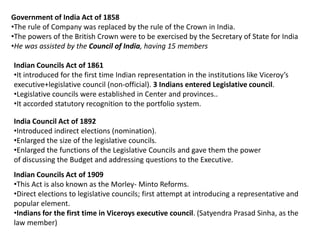
Government of India Act of 1858
•The rule of Company was replaced by the rule of the Crown in India.
•The powers of the British Crown were to be exercised by the Secretary of State for India
•He was assisted by the Council of India, having 15 members
Indian Councils Act of 1861
•It introduced for the first time Indian representation in the institutions like Viceroy’s
executive+legislative council (non-official). 3 Indians entered Legislative council.
•Legislative councils were established in Center and provinces..
•It accorded statutory recognition to the portfolio system.
India Council Act of 1892
•Introduced indirect elections (nomination).
•Enlarged the size of the legislative councils.
•Enlarged the functions of the Legislative Councils and gave them the power
of discussing the Budget and addressing questions to the Executive.
Indian Councils Act of 1909
•This Act is also known as the Morley- Minto Reforms.
•Direct elections to legislative councils; first attempt at introducing a representative and
popular element.
•Indians for the first time in Viceroys executive council. (Satyendra Prasad Sinha, as the
law member)
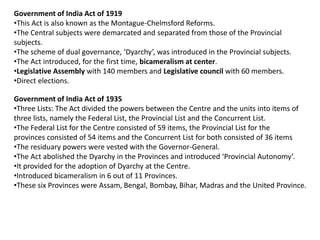
Government of India Act of 1919
•This Act is also known as the Montague-Chelmsford Reforms.
•The Central subjects were demarcated and separated from those of the Provincial
subjects.
•The scheme of dual governance, ‘Dyarchy’, was introduced in the Provincial subjects.
•The Act introduced, for the first time, bicameralism at center.
•Legislative Assembly with 140 members and Legislative council with 60 members.
•Direct elections.
Government of India Act of 1935
•Three Lists: The Act divided the powers between the Centre and the units into items of
three lists, namely the Federal List, the Provincial List and the Concurrent List.
•The Federal List for the Centre consisted of 59 items, the Provincial List for the
provinces consisted of 54 items and the Concurrent List for both consisted of 36 items
•The residuary powers were vested with the Governor-General.
•The Act abolished the Dyarchy in the Provinces and introduced ‘Provincial Autonomy’.
•It provided for the adoption of Dyarchy at the Centre.
•Introduced bicameralism in 6 out of 11 Provinces.
•These six Provinces were Assam, Bengal, Bombay, Bihar, Madras and the United Province.
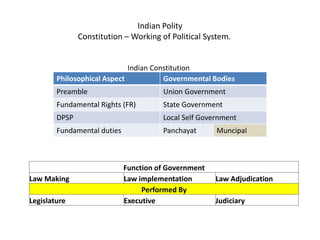
Indian Polity
Constitution – Working of Political System.
Indian Constitution
Philosophical Aspect Governmental Bodies
Preamble Union Government
Fundamental Rights (FR) State Government
DPSP Local Self Government
Fundamental duties Panchayat Muncipal
Function of Government
Law Making Law implementation Law Adjudication
Performed By
Legislature Executive Judiciary
Constituent Assembly
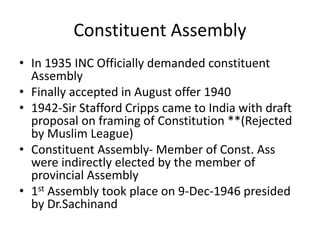
• In 1935 INC Officially demanded constituent
Assembly
• Finally accepted in August offer 1940
• 1942-Sir Stafford Cripps came to India with draft
proposal on framing of Constitution **(Rejected
by Muslim League)
• Constituent Assembly- Member of Const. Ass
were indirectly elected by the member of
provincial Assembly
• 1st Assembly took place on 9-Dec-1946 presided
by Dr.Sachinand
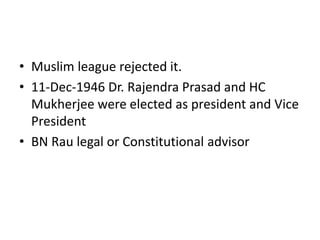
• Muslim league rejected it.
• 11-Dec-1946 Dr. Rajendra Prasad and HC
Mukherjee were elected as president and Vice
President
• BN Rau legal or Constitutional advisor
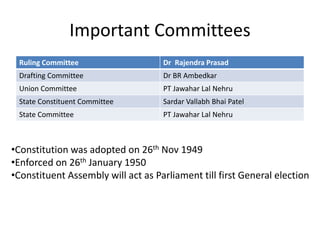
Important Committees
Ruling Committee Dr Rajendra Prasad
Drafting Committee Dr BR Ambedkar
Union Committee PT Jawahar Lal Nehru
State Constituent Committee Sardar Vallabh Bhai Patel
State Committee PT Jawahar Lal Nehru
•Constitution was adopted on 26th Nov 1949
•Enforced on 26th January 1950
•Constituent Assembly will act as Parliament till first General election
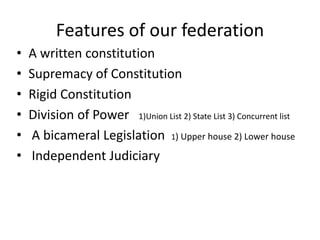
Features of our federation
• A written constitution
• Supremacy of Constitution
• Rigid Constitution
• Division of Power 1)Union List 2) State List 3) Concurrent list
• A bicameral Legislation 1) Upper house 2) Lower house
• Independent Judiciary
Distinct Features
• Single Constitution with Single Citizenship**
• Art-3, Authorizes the parliament to alter the state
boundary and Name
• National Emergency – “Division of Power is
suspended”
• Three List
• All India Services
• Governor who is executive head of State are
appointed by center
Preamble of Indian Constitution
• We, the people of India, having solemnly resolved to constitute
India into a SOVEREIGN, SOCIALIST, SECULAR,DEMOCRATIC,
REPUBLIC and to secure to all of its citizens;
– JUSTICE social, economic and political;
– LIBERTY of thought, expression, belief, faith and worship;
– EQUALITY of status and of opportunity, and to promote among them all.
– FRATERNITY assuring the dignity of the individual and the unity and
integrity of the nation;
– In our Constituent Assembly, this 26th day of November, 1949, do HEREBY
ADOPT, ENACT AND GIVE TO OURSELVES THIS CONSTITUTION
Preamble
• Not a mandatory part
• Summary of Constitution
• Contains the philosophy and Spirit
• It gives a bird eye of entire Constitution
1. It declares the Supremacy of the people
2. It Contain Ideas and Aspiration
Ideas Goals that are achieved Sovereignty, Socialism, Secularism
Aspiration Goals which are yet to Achieve Justice, Equality, Fraternity
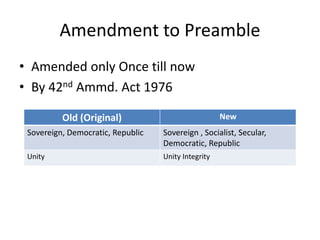
Amendment to Preamble
• Amended only Once till now
• By 42nd Ammd. Act 1976
Old (Original) New
Sovereign, Democratic, Republic Sovereign , Socialist, Secular,
Democratic, Republic
Unity Unity Integrity
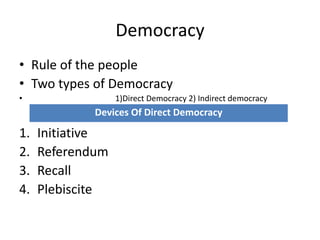
Democracy
• Rule of the people
• Two types of Democracy
• 1)Direct Democracy 2) Indirect democracy
1. Initiative
2. Referendum
3. Recall
4. Plebiscite
Devices Of Direct Democracy
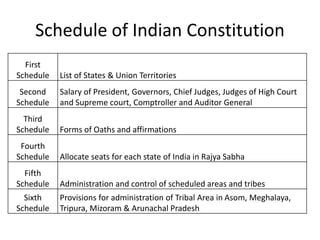
Schedule of Indian Constitution
First
Schedule List of States & Union Territories
Second
Schedule
Salary of President, Governors, Chief Judges, Judges of High Court
and Supreme court, Comptroller and Auditor General
Third
Schedule Forms of Oaths and affirmations
Fourth
Schedule Allocate seats for each state of India in Rajya Sabha
Fifth
Schedule Administration and control of scheduled areas and tribes
Sixth
Schedule
Provisions for administration of Tribal Area in Asom, Meghalaya,
Tripura, Mizoram & Arunachal Pradesh
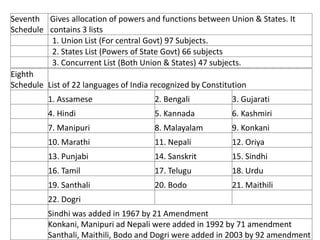
Seventh
Schedule
Gives allocation of powers and functions between Union & States. It
contains 3 lists
1. Union List (For central Govt) 97 Subjects.
2. States List (Powers of State Govt) 66 subjects
3. Concurrent List (Both Union & States) 47 subjects.
Eighth
Schedule List of 22 languages of India recognized by Constitution
1. Assamese 2. Bengali 3. Gujarati
4. Hindi 5. Kannada 6. Kashmiri
7. Manipuri 8. Malayalam 9. Konkani
10. Marathi 11. Nepali 12. Oriya
13. Punjabi 14. Sanskrit 15. Sindhi
16. Tamil 17. Telugu 18. Urdu
19. Santhali 20. Bodo 21. Maithili
22. Dogri
Sindhi was added in 1967 by 21 Amendment
Konkani, Manipuri ad Nepali were added in 1992 by 71 amendment
Santhali, Maithili, Bodo and Dogri were added in 2003 by 92 amendment
Ninth
Schedule
Added by Ist amendment in 1951. Contains acts & orders related to
land tenure, land tax, railways, industries.{Right of property not a
fundamental right now}
Tenth
Schedule
Added by 52nd amendment in 1985. Contains provisions of
disqualification of grounds of defection
Eleventh
Schedule By 73rd amendment in 1992. Contains provisions of Panchayati Raj.
Twelfth
Schedule
By 74thamendment in 1992. Contains provisions of Municipal
Corporation.
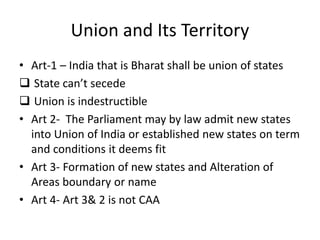
Union and Its Territory
• Art-1 – India that is Bharat shall be union of states
 State can’t secede
 Union is indestructible
• Art 2- The Parliament may by law admit new states
into Union of India or established new states on term
and conditions it deems fit
• Art 3- Formation of new states and Alteration of
Areas boundary or name
• Art 4- Art 3& 2 is not CAA
Citizenship
• Art 5 to 10 says only 2 things regarding Citizenship
 No dual Citizenship
 No Dual Nationality
• Citizens are full members of the Indian state, enjoy full
political and civil rights and owe allegiance to it.
• Aliens on the other hand are citizens of some other states and
do not enjoy it.
• Aliens are further classified into friendly aliens(people of
country with which India has cordial relations) and
• Enemy aliens (people of the country with which india is at
war).
• Enemy aliens do not enjoy protection against arrest and
detention (Article 22)
Citizenship
 Right to vote
 Right to contest for contest for membership
for parliament
 Right to hold certain public offices that is
President of India and Vice president
 Article- 15,16,19,29,30
Citizenship
Acquisition of Citizenship
 By Birth
 By Decent
 By Registration
1)PIO 2)Citizen of Common wealth states
3) Women married to Indian Men
4) Minor Children of Indian Parents
 By Naturalization
10 years – 90 days/Calendar year (Mother Teresa)
 By Incorporation of a new Territory
Loss of Citizenship
 By Renunciation- Surrendering the citizenship
 By Termination – If a person on acquiring the
citizenship of another country
By Deprivation
a) Fraud
b) Disloyalty to Constitution
c) Helped the enemy during War
Fundamental Rights (Art 12-35)
• Justifiable & Enforceable in the court of law
• Guaranteed and protected by the constitution
• UNDHR- Universal Declaration of Human
Rights
Declaration adopted by UN General Assembly of
10 Dec -1948
Absolute Rights- Absolute right is a right which has no exceptions in it
applicability while qualified right is available subject to certain
conditions.
Article- 17,24,25, 25(1)
• Amenability of Fundamental rights
 Golakhnath v/s State of Punjab (1967)
 Keshvanand Bharti v/s State of Kerala (1973)
Emergency
• National emergency under article 352
It can be declared on the basis of external aggression or
armed rebellion in the whole of India or a part of its
territory
– During emergency, President can suspend all other fundamental
rights also except Article 20 (protection in respect of conviction
for offences) and Article 21 (Protection of life and personal
liberty). Such suspension needs parliamentary approval.
– Art 19 can be suspended
• State Emergency under Article 356
If the President is satisfied, based on the report of the Governor of
the concerned state or from other sources, that the governance in
a state cannot be carried out according to the provisions in the
Constitution, he may declare an emergency in the state
• Financial Emergency Under Article 360
If the President is satisfied that there is an economic situation
in which the financial stability or credit of India is
threatened, he or she can declare financial emergency
Fundamental rights (Art 12-35)
Right to equality (14-18)
Right to Freedom (19-21,21A,22)
Right Against Exploitation (23-24)
Right to Religion (25-28)
Cultural & Educational Right (29-30)
Right to constitutional remedy (AA 32)
Right to Equality
 Art -14- Equality before law & Equal
protection of Law
 Art 15 – Right against Discrimination
-No discrimination on the basis of caste, race, religion, sex, or
place of birth
 Art 16 – Equality of Opportunity
 Art 17 – Abolition of Untouchability
Art 18 – Abolition of Titles
-Prohibits the state to confer titles to anyone citizen or non citizen,
exception Military & Academic Distinction
Right to freedom
• 19.1.A- Freedom of Speech & expression with
no geographical limitation
- (Right to Information) (Freedom of Press) (Right to privacy) (Right to
silence) (Right to demonstrate or hoist national Flag)
• 19.1.B- Freedom of Assembly
• 19.1.C- Freedom to form Association
- (Except Armed force, Police Force, Military etc)
• 19.1.D- Freedom of Movement
• 19.1.E- Freedom of Residence
• 19.1.G- Right to Trade & Occupation
-
• Art 20 – Protection in respect of conviction for
offense
(1) - No ex-post facto law – Punishment should
be proportionate
(2) - No double jeopardy – Punishment for the
same offence
(3) - No self incrimination – No self witness
• Art 21- Protection of Life
• Art 21(A) – Right to education
- Added by 86th Amend Act
- Free & Compulsory education to all children of age 6 to 14 years
-Only Elementary education not higher education
• Art 22 - Protection against arrest & detention
- To be brought before magistrate within 24 hrs . Exception Alien –
Enemy
- Preventive detention- Prevent him from doing Max-3month for
more than 3 months it must obtain a report from advisory
Right against exploitation
• Art 23- Prohibition of Human traffic & forced
Labour
• Art 24- Prohibition of employments of
children factories, mines, or any other
hazardous environment under 14 years of age
Right to freedom of Religion
• Art 25- Freedom of conscience & free
propagation, practice & Projection of Religion
Exceptions
1)- Public Order
2) – Morality
3)- Health
4) – Other Provision of constitution
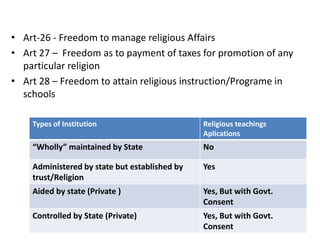
• Art-26 - Freedom to manage religious Affairs
• Art 27 – Freedom as to payment of taxes for promotion of any
particular religion
• Art 28 – Freedom to attain religious instruction/Programe in
schools
Types of Institution Religious teachings
Aplications
“Wholly” maintained by State No
Administered by state but established by
trust/Religion
Yes
Aided by state (Private ) Yes, But with Govt.
Consent
Controlled by State (Private) Yes, But with Govt.
Consent
Cultural and Educational Rights
• Art 29- Right to preserve, Language, script &
Culture.
• Art 30- Minorities will have the right to
establish and administer, educational institute
Rights to constitutional remedies
• Art 32(1)- Empower an individual to approach
the supreme court if the FR are voilated
 SC will release 5 writs to enforce to enforce fundamental
rights
 Parliament has power to empower any court power to issue
writs (Subordinate Courts)
 High Court has the power to issue writs
 Art 32 will not be suspended will not be suspended except
National emergency
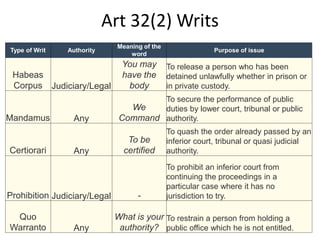
Art 32(2) Writs
Type of Writ Authority
Meaning of the
word
Purpose of issue
Habeas
Corpus Judiciary/Legal
You may
have the
body
To release a person who has been
detained unlawfully whether in prison or
in private custody.
Mandamus Any
We
Command
To secure the performance of public
duties by lower court, tribunal or public
authority.
Certiorari Any
To be
certified
To quash the order already passed by an
inferior court, tribunal or quasi judicial
authority.
Prohibition Judiciary/Legal -
To prohibit an inferior court from
continuing the proceedings in a
particular case where it has no
jurisdiction to try.
Quo
Warranto Any
What is your
authority?
To restrain a person from holding a
public office which he is not entitled.
• Art -33. Power of Parliament to modify the rights conferred by
this Part in their application etc Parliament may, by law,
determine to what extent any of the rights conferred by this
Part shall, in their application to,
– a.the members of the Armed Forces; or
– b.the members of the Forces charged with the maintenance of public
order; or
– c.persons employed in any bureau or other organisation established
by the State for purposes of intelligence or counter intelligence
• persons employed in, or in connection with, the
telecommunication systems set up for the purposes of any
Force, bureau or organisation referred to in clauses (a) to (c),
be restricted or abrogated so as to ensure the proper discharge
of their duties and the maintenance of discipline among them
• Article 34-, During the operation of Martial law in any area, the
Parliament may indemnify any person in the service of the central or a state
government for acts for the maintenance or restoration of law and order.
• Article 35 – Legislation to give effect to the provisions of this Part
Notwithstanding anything in this Constitution,
• (a) Parliament shall have, and the Legislature of a State shall not
have, power to make laws
– (i) with respect to any of the matters which under clause ( 3 ) of Article
16, clause ( 3 ) of Article 32, Article 33 and Article 34 may be provided
for by law made by Parliament; and
– (ii) for prescribing punishment for those acts which are declared to be
offences under this Part; and Parliament shall, as soon as may be after
the commencement of this Constitution, make laws for prescribing
punishment for the acts referred to in sub clause (ii);
Article 35(A)**
• Article 35A which does not allow people from
outside the state of Jammu & Kashmir to work, settle
or own property in the state. The text of Article 35A
is given below.
• “Saving of laws with respect to permanent residents
and their rights. — Notwithstanding anything
contained in this Constitution, no existing law in
force in the State of Jammu and Kashmir, and no law
hereafter enacted by the Legislature of the State:
• (a) defining the classes of persons who are, or shall
be, permanent residents of the State of Jammu and
Kashmir
ART- 35 A
• (b) conferring on such permanent residents any special
rights and privileges or imposing upon other persons
any restrictions as respects—
– (i) employment under the State Government;
– (ii) acquisition of immovable property in the State;
– (iii) settlement in the State; or
– (iv) right to scholarships and such other forms of aid as the
State Government may provide, shall be void on the ground
that it is inconsistent with or takes away or abridges any rights
conferred on the other citizens of India by any provision of this
part.”
Directive principle of State Policy
(DPSP) – Art 36 t0 51
• DPSP resemble of the “Instrument of Instruction”
• Borrowed from Irish Constitution
• They are non-Justifiable in nature i.e. they are not
legally enforceable by the courts for their
violation
• It imbibed the essence of following ideology.
 Socialist Principal
 Gandhian Principal
 Liberal- Intellectual principal
Socialist Principal
• • Art. 38: This directs the state to create a social order for the promotion of
welfare of the people.This social order must provide social, economic and
political justice.
• Art.38 which directs the state to minimize inequalities in income, to eliminate
inequalities in status, facilities and opportunities.
• Art 39- “Very important”
• Art. 41: Under this Article the state is directed to provide right to work, to
education and to public assistance subject to its economic capacity.
• Art. 42: Under this article, the state shall make provision for securing just and
humane conditions of work and maternity relief. The state has enacted laws
such as the industrial Disputes Act, Minimum Wages Act, Maternity Relief Act,
etc., to implement this article.
• Art. 43: This article directs the state to make efforts to secure living wages and
organize cottage industries in rural areas.
• Art. 43-A: Added by 42nd Amendment, 1976, this article calls for legislation by
the state to ensure workers participation in the management of industries.
• Art. 47: The state has been directed by this article to raise the level of nutrition
and the standard of living and to improve public health. This also includes
prohibition of liquor and intoxicating drugs.
Socialist Principal Art 39
• Art. 39: This is a very important article containing a number of directives which
go a long way to establish what is known as welfare state in India. It directs the
states to secure the following:-
– Adequate means of livelihood for citizens both men and women.
– Control and ownership of the material resources of the community to be
distributed in such a manner that it serves the common good.
– The operation of the economic system does not result in the
concentration of wealth and means of production to the common
detriment.
– Equal pay for equal work for both men and women.
– Health and strength of workers, men & women and children are not
abused and the citizens are not forced by economic necessity to enter
Avocations unsuited to their age or strength.
– Children are given opportunities and facilities to develop in a healthy
manner and their childhood and youth are protected against exploitation
and moral and material abandonment (added by 42nd Amendment, 1976).
Gandhian Principles as DPSP
• Most of the DPSPs reflect the ideology of socialism and welfare
state. Some of them are directly inculcating the Gandhian principles
for example:
• Article 40: Organization of village Panchayats
• Article 43: Promotion of cottage industries
• Article 46: Promotion and protection of interests of educational and
economic interests of SCs, STs, and other weaker sections of the
society and to protect them from social injustice and exploitation
• Article 47: Prohibition of consumption of intoxicating drinks and
drugs which are injurious to health
• Article 48: Prohibition of slaughter of cows, calves and other milch
and draught cattle and to improve their breeds
Liberal Intellectual Principals
• Art. 44: Implementation of a Uniform Civil Code for the citizens throughout
India. The state is supposed to take steps to establish a Uniform Civil code for all the
citizens irrespective of caste, creed or religion.
• Art. 45: Provision for free and compulsory education for children till the age of 14
years. However, this article has been amended by 86th Amendment Act, 2002 which
has inserted Art. 21A
• Art. 48: Organization of agriculture and animal husbandry. The state under this
article has to organize agriculture and animal husbandry on modern and scientific
lines.
• Art. 48A: Added by 42nd Amendment, 1976, this article enjoins on the state task
of protecting and improving environment, forests and wild life..
• Art. 49: This article obligates the state to protect monuments and places of
national importance.
• Art. 50: Separation of judiciary from the executive in the public services of the
state
• Art. 51: This article requires the state to promote international peace and
security, maintain good relations between nations and respect international laws.
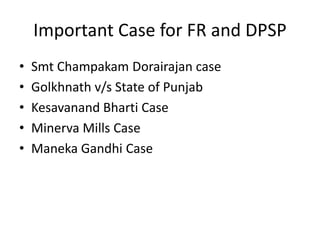
Important Case for FR and DPSP
• Smt Champakam Dorairajan case
• Golkhnath v/s State of Punjab
• Kesavanand Bharti Case
• Minerva Mills Case
• Maneka Gandhi Case
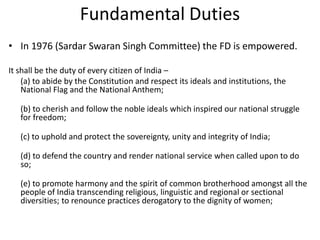
Fundamental Duties
• In 1976 (Sardar Swaran Singh Committee) the FD is empowered.
It shall be the duty of every citizen of India –
(a) to abide by the Constitution and respect its ideals and institutions, the
National Flag and the National Anthem;
(b) to cherish and follow the noble ideals which inspired our national struggle
for freedom;
(c) to uphold and protect the sovereignty, unity and integrity of India;
(d) to defend the country and render national service when called upon to do
so;
(e) to promote harmony and the spirit of common brotherhood amongst all the
people of India transcending religious, linguistic and regional or sectional
diversities; to renounce practices derogatory to the dignity of women;
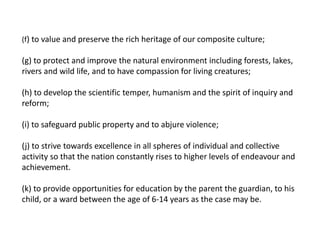
(f) to value and preserve the rich heritage of our composite culture;
(g) to protect and improve the natural environment including forests, lakes,
rivers and wild life, and to have compassion for living creatures;
(h) to develop the scientific temper, humanism and the spirit of inquiry and
reform;
(i) to safeguard public property and to abjure violence;
(j) to strive towards excellence in all spheres of individual and collective
activity so that the nation constantly rises to higher levels of endeavour and
achievement.
(k) to provide opportunities for education by the parent the guardian, to his
child, or a ward between the age of 6-14 years as the case may be.
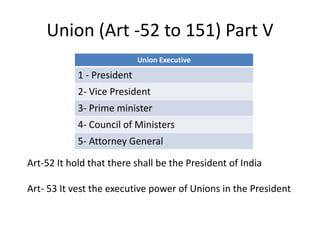
Union (Art -52 to 151) Part V
Union Executive
1 - President
2- Vice President
3- Prime minister
4- Council of Ministers
5- Attorney General
Art-52 It hold that there shall be the President of India
Art- 53 It vest the executive power of Unions in the President
Election of the President
I. Election Amend Act 1997 the security
deposit has been fixed to rupees 15000 in
the RBI
II. Candidate has been proposed by 50 electors
& seconded by another 50 electors .
III. Security Deposit of 15000 Rs to RBI
IV. The returning officer for the president
election is elections is the secretary General
of lok Sabha & Rajya Sabha in Rotation
Art 54- Under this, The president is elected by
an electoral college
President is not directly elected by the people but by
the member of electoral
 Elected members of both the house of Parliament
 Elected Member of Legislative Assembly
 Elected members of Delhi & Pondicherry (70th
Amendment Act 1992 & First time participate in
1997)
** Nominated Members & Nominated MLC do not take
part in the election of President.
Art 55- It says that the President is elected by the
method of Proportional representation with Single
transferable vote system
• Two Types of election are
1. FPTP – First Past the Post - principle, meaning that the
candidate with the plurality of votes is the winner of the
seat.
2. Single Transferable Vote - The single transferable
vote (STV) is a voting system designed to
achieve proportional representation through ranked
voting in multi-seat organizations
or constituencies (voting districts).Under STV, an elector
(voter) has a single vote that is initially allocated to their
most preferred candidate.
• In India, all key representatives except
President, Vice President, Members of Rajya
Sabha and Members of state legislative
council are elected via FPTP system.
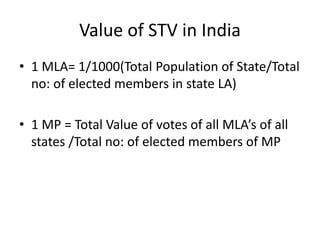
Value of STV in India
• 1 MLA= 1/1000(Total Population of State/Total
no: of elected members in state LA)
• 1 MP = Total Value of votes of all MLA’s of all
states /Total no: of elected members of MP
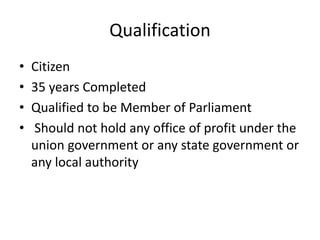
Qualification
• Citizen
• 35 years Completed
• Qualified to be Member of Parliament
• Should not hold any office of profit under the
union government or any state government or
any local authority
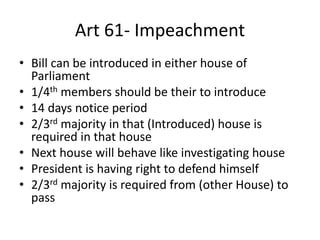
Art 61- Impeachment
• Bill can be introduced in either house of
Parliament
• 1/4th members should be their to introduce
• 14 days notice period
• 2/3rd majority in that (Introduced) house is
required in that house
• Next house will behave like investigating house
• President is having right to defend himself
• 2/3rd majority is required from (other House) to
pass
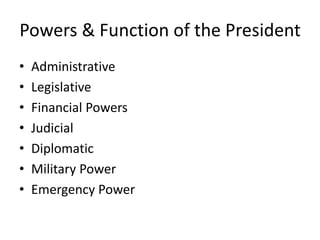
Powers & Function of the President
• Administrative
• Legislative
• Financial Powers
• Judicial
• Diplomatic
• Military Power
• Emergency Power
Art 74- PM &COM, Discretionary Power of
President
• Appointment of PM when no party has a clear
majority in the Lok Sabha or when the current
PM office terminate
• Dismissal of the council of ministers when it
can’t prove the confidence of the Lok sabha
• Dissolution of the Lok Sabha if the Council of
Minister has lost its majority
• PM duty is bound to communicate Day to Day
administration to the President
• President Veto Power
(1) Suspensive Veto –Non Moneybill Non CAA,
can send it back to Parliament only Once
(2) Pocket Veto- Non Moneybill Non CAA, bill can
declared that he is withholding his ascent
**Time period of withholding is not mentioned
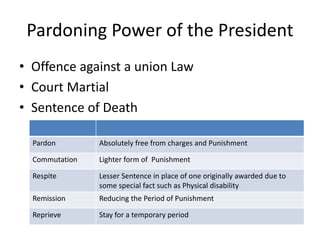
Pardoning Power of the President
• Offence against a union Law
• Court Martial
• Sentence of Death
Pardon Absolutely free from charges and Punishment
Commutation Lighter form of Punishment
Respite Lesser Sentence in place of one originally awarded due to
some special fact such as Physical disability
Remission Reducing the Period of Punishment
Reprieve Stay for a temporary period
Vice President
• Ex officio Chairman of Council of States (Rajya
Sabha)
• Presides over the Proceedings of Rajya Sabha
Qualification
Citizen of India
35 years of age
No office of Profit
Qualified to be member of Rajya Sabha
Ceases his post as MLA or MP if he becomes VP
Election of VP
• 20 Electors as Proposer 20 Electors as seconders
• Security Deposit of 15000 Rs to RBI
• Elected indirectly by electoral college consisting of
Members of Parliament (Both Elected and
Nominated)
**State government don’t participate in VP’s Election
• Proportional representation by means of Single
transferrable vote system
• S.Court has final jurisdiction for resolving dispute &
doubts relating to election of VP
Removal of V.P
• Resolution raised only in Rajya Sabha by
absolute Majority i.e. (Greater than 50% of
effective strength)(Total Membership –
Vacancy)
• Total of 14 days notice period
Governor
• Executive head of State
• Acts on Advice of Council of Ministers
• Same person can be appointed as governor of
one or more state
• All executive action of state in his name
Characteristics
• Salary of Governor is drawn from Consolidate
fund of State
• Shall not be answerable to any court
• Priviledge for non-criminal Proceedings
• Non Process for arrest or imprisonment
• Civil proceedings can be done with 2 months
notice
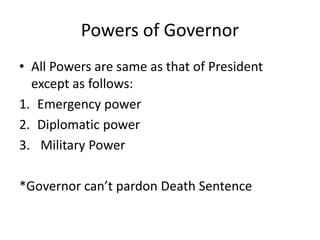
Powers of Governor
• All Powers are same as that of President
except as follows:
1. Emergency power
2. Diplomatic power
3. Military Power
*Governor can’t pardon Death Sentence
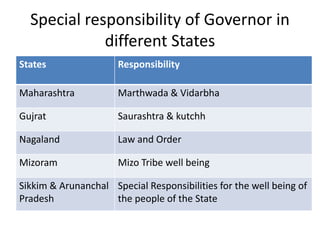
Special responsibility of Governor in
different States
States Responsibility
Maharashtra Marthwada & Vidarbha
Gujrat Saurashtra & kutchh
Nagaland Law and Order
Mizoram Mizo Tribe well being
Sikkim & Arunanchal
Pradesh
Special Responsibilities for the well being of
the people of the State
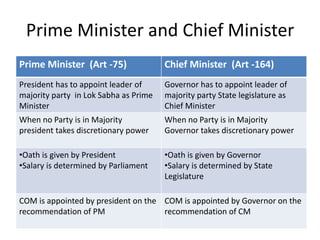
Prime Minister and Chief Minister
Prime Minister (Art -75) Chief Minister (Art -164)
President has to appoint leader of
majority party in Lok Sabha as Prime
Minister
Governor has to appoint leader of
majority party State legislature as
Chief Minister
When no Party is in Majority
president takes discretionary power
When no Party is in Majority
Governor takes discretionary power
•Oath is given by President
•Salary is determined by Parliament
•Oath is given by Governor
•Salary is determined by State
Legislature
COM is appointed by president on the
recommendation of PM
COM is appointed by Governor on the
recommendation of CM
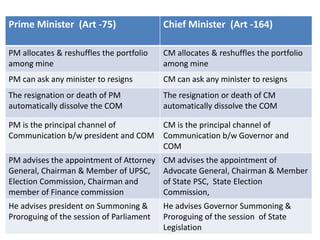
Prime Minister (Art -75) Chief Minister (Art -164)
PM allocates & reshuffles the portfolio
among mine
CM allocates & reshuffles the portfolio
among mine
PM can ask any minister to resigns CM can ask any minister to resigns
The resignation or death of PM
automatically dissolve the COM
The resignation or death of CM
automatically dissolve the COM
PM is the principal channel of
Communication b/w president and COM
CM is the principal channel of
Communication b/w Governor and
COM
PM advises the appointment of Attorney
General, Chairman & Member of UPSC,
Election Commission, Chairman and
member of Finance commission
CM advises the appointment of
Advocate General, Chairman & Member
of State PSC, State Election
Commission,
He advises president on Summoning &
Proroguing of the session of Parliament
He advises Governor Summoning &
Proroguing of the session of State
Legislation
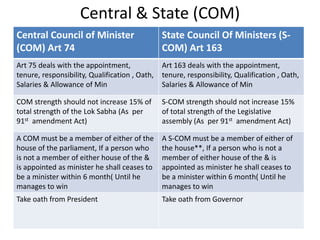
Central & State (COM)
Central Council of Minister
(COM) Art 74
State Council Of Ministers (S-
COM) Art 163
Art 75 deals with the appointment,
tenure, responsibility, Qualification , Oath,
Salaries & Allowance of Min
Art 163 deals with the appointment,
tenure, responsibility, Qualification , Oath,
Salaries & Allowance of Min
COM strength should not increase 15% of
total strength of the Lok Sabha (As per
91st amendment Act)
S-COM strength should not increase 15%
of total strength of the Legislative
assembly (As per 91st amendment Act)
A COM must be a member of either of the
house of the parliament, If a person who
is not a member of either house of the &
is appointed as minister he shall ceases to
be a minister within 6 month( Until he
manages to win
A S-COM must be a member of either of
the house**, If a person who is not a
member of either house of the & is
appointed as minister he shall ceases to
be a minister within 6 month( Until he
manages to win
Take oath from President Take oath from Governor
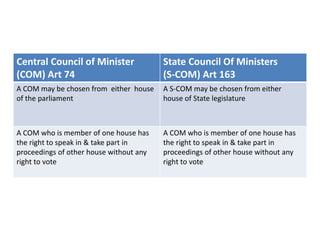
Central Council of Minister
(COM) Art 74
State Council Of Ministers
(S-COM) Art 163
A COM may be chosen from either house
of the parliament
A S-COM may be chosen from either
house of State legislature
A COM who is member of one house has
the right to speak in & take part in
proceedings of other house without any
right to vote
A COM who is member of one house has
the right to speak in & take part in
proceedings of other house without any
right to vote
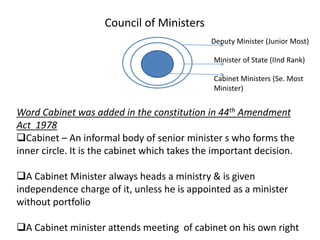
Council of Ministers
Deputy Minister (Junior Most)
Minister of State (IInd Rank)
Cabinet Ministers (Se. Most
Minister)
Word Cabinet was added in the constitution in 44th Amendment
Act 1978
Cabinet – An informal body of senior minister s who forms the
inner circle. It is the cabinet which takes the important decision.
A Cabinet Minister always heads a ministry & is given
independence charge of it, unless he is appointed as a minister
without portfolio
A Cabinet minister attends meeting of cabinet on his own right
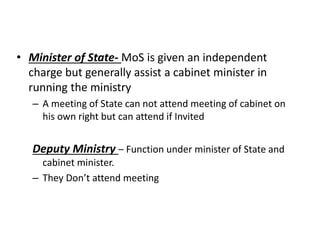
• Minister of State- MoS is given an independent
charge but generally assist a cabinet minister in
running the ministry
– A meeting of State can not attend meeting of cabinet on
his own right but can attend if Invited
Deputy Ministry – Function under minister of State and
cabinet minister.
– They Don’t attend meeting
Responsibility of COM
• COM’s is collectively responsible for lok
sabha/Legislative Assembly
• If a minister does not agree with the decision of
cabinet, he has no option but to resign from
COM’s . He can’t disapprove a decision of the
cabinet & at the same time remain as a member
of COM’s
• All ministers are individually responsible to the
president (Governor) ministers hold office during
the pleasure of President (Governor)
• If PM/CM resigns or dies, whole COM’s
dissolve or COM’s does not exist without the
PM/CM
• No confidence motion is introduced & passed
against a whole council of minister then
Government (Whole COM with PM/CM) have
to resign from the government ship
• No confidence motion can’t be introduced &
passed against individual Ministers
Parliament and State legislature
• It is legislative organ of Union government
Art 79 to 122 in Part V Union
Art 168 to 212 in Part VI State Legislature
• Two major function of legislation
I. Deliberative function
II. Function of Representation
• Deliberative
A. It makes laws for the country
B. It provides a platform for opposition to
scrutnise
C. It push control over the executive
D. Channel of Information
E. Discussion platform the issue of National
importance
• Function of Representation
i. It represent the people that is done through
the Lok Sabha
ii. It represents the state that is done through
the Rajya Sabha
iii. It represent the various section like SC,ST &
Anglo Indians Etc
State Legislature
• Most of the state have an unicameral system,
while others have a bicameral system
• There are 7 states have bicameral system
• These state are :- Andhra Pradesh, Telangana,
UP, Bihar, Maharashtra and Karnatka
• J&K has a bicameral legislature but according
to its own constitution
Lok Sabha and Rajya sabha
• Rajya Sabha- It is also Known as Permanent Home
& Federal chamber as its represent state
Maximum Strength 250
238 are elected members of state & UT
12 Members nominated by president
Nominated members can’t participate in the election
of president.
Rajya Sabha Office term 6 years, & 1/3rd of members
retiring every 2 years
Lok Sabha and Rajya sabha
Rajya Sabha Members are elected by legislative
assembly of states & UT’s by proportional
Representation by mean of single transferable
vote
Only 4 Members are elected from Union
Territory’s
o 3 from delhi
o 1 from Pondicherry
 No seat is reserved for SC & ST’s
The Presiding officer
• The Vice president is the ex-officio chairman
of the Rajya Sabha
• The deputy Chairman is elected from among
the member of Rajya sabha by a simple
majority & can be removed by an effective
majority
Qualification of Rajya Sabha Member
• Citizen of India
• Have attained 30 years of age
• Must be a registered voter in parliamentary
constituency in any of the state.
• Subscribe before election commission an oath
as prescribed by 3rd Schedule
Special Powers of Rajya Sabha
• A resolution seeking removal of VP can be
originated only in Rajya Sabha
• Art 249- It can make laws on state list subjects, If
Rajya Sabha passes a resolution of not less than 2/3
rd of member present & Voting, declares that
subject is of national interest.
• Under Art 252, It can make laws on state list subject
if the legislature of 2 or more states request
parliament to make law for an item in state list
• It can authorize the parliament to create new All
India Services common to both center & State
under Art 31
Lok Sabha
• Lower House or house of People
• Term is 5 years
• Lok Sabha can be dissolved by the President
• Total strength = 552
Present strength- 545
State – 530
Represents UT- 20
Anglo India- 02
• Seats are allocated proportionally to the
population
• Certain seats are reserved are reserved for
SC’s and ST’s (According to 87th amend
act,2003)
• Duration of Lok Sabha can be extended to 1
year during national emergency Art 352
Qualification of Member of Lok Sabha
• Citizen of India
• Attained the age 25
• Registered voter
Presiding officer- The speaker & Deputy speaker
are elected from among the members of the
House by the House by Simple Majority & can
be removed by effective Majority of the House
Power of the Speaker
• He preside over the joint sitting of both the
house of the parliament
• He certified whether a bill is money bill or not
to the Lok Sabha
• The parliamentary committee work under his
supervision of speaker
• He appoints the chairpersons of various
parliamentary committee
• If the speaker or deputy speaker are the
members of any of the Parliamentary committee
they will be the head of that committee
• He has a right to Vote**
• The speaker enjoys Cabinet Status
• Even after the dissolution of Lok Sabha the
speaker remains in office till the next general
election, that means till the new Lok Sabha is not
formed
Special Powers Lok Sabha
• Motion of “No-Confidence” can only be initiated
& Passed in Lok Sabha
• Money and Financial Bill can only be originated in
Lok Sabha
• R.S can’t amend or reject money bill, it must
return the bill to L.S with in 14 days with or
without recommendations
• Under Art 352, If the L.S in a special session
passes a resolution to discontinue an on going
national emergency, a national emergency will be
discontinued (As per the 44th Amend. Act 1978)
Protem Speaker
• After the lok Sabha is constituted by the
election commission, the president appoints
one of the members of the newly elected lok
sabha as Protem Speaker
• According to the established convention the
president appoints the senior most member
as the Protem Speaker. The oath of the
protem speaker is conducted by the president
Protem Speaker
• The Protem Speaker presides over the
meeting of the meeting of the newly elected
lok sabha. He conducted the oath to all the
members of the newly elected lok sabha
• He conduct the speaker election if the protem
speaker himself is candidate for the speakers
post then the president appoints another
member as the Protem speaker
Vidhan Sabha & Vidhan Parishad
• There is no uniformity in organization of State
Legislation
• Mostly Unicameral system, while 7 states have
a bicameral system.
• Andhra Pradesh, Telangana, Uttar Pradesh,
Bihar, Maharshtra, Karnatka & Jammu&
Kashmir
Vidhan Sabha
• Maximum- 500
• Minimum – 60
• Reservation for SC’s and ST’s in the Assembly
• 1 Member can be nominated by the governor
from the Anglo-Indian community if the
Governor feels that the community has not
been adequately represented in the Assembly
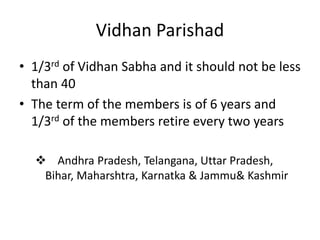
Vidhan Parishad
• 1/3rd of Vidhan Sabha and it should not be less
than 40
• The term of the members is of 6 years and
1/3rd of the members retire every two years
 Andhra Pradesh, Telangana, Uttar Pradesh,
Bihar, Maharshtra, Karnatka & Jammu& Kashmir
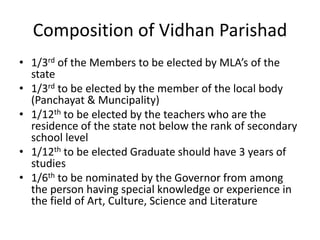
Composition of Vidhan Parishad
• 1/3rd of the Members to be elected by MLA’s of the
state
• 1/3rd to be elected by the member of the local body
(Panchayat & Muncipality)
• 1/12th to be elected by the teachers who are the
residence of the state not below the rank of secondary
school level
• 1/12th to be elected Graduate should have 3 years of
studies
• 1/6th to be nominated by the Governor from among
the person having special knowledge or experience in
the field of Art, Culture, Science and Literature
Note**- It is written in the Representation of People
Act , It is not written in the Constitution
Creation or Abolition of legislature Council
Concern Legislative assembly has to pass a
resolution by special majority U/A 368 request
the parliament to create/Abolish a legislative
council
Relationship between Legislative
council & Legislative Assembly
• Executive Relation-The members of both the
house can be appointed as ministers & it has
been seen that even the chief ministers are
some time from the legislative Council
**(Mayawati was MLC during her tenure as CM from 2007-12)
• The existence of the Legislative council
depends on Legislative Assembly
Session of Parliament
• Two types of Session:
1)Regular Session
Budget Session
Monsoon Session
Winter Session
2)Special Session
• Special Session – The Special sessions can be convert to
transact some special business or commemorate festive
 Regular session “Not written in constitution”
 Art-85- The intervening b/w the two session of the parliament shall not
exceed 6 months
• Budget Session- It is the first session of the years. It is
normally held from mid feb to may. It starts with the
address of president. It is most important as budget is
presented in this session
• Monsoon session- It is normally held from July to
August. Here normal legislative functions takes place
• Winter session- The winter session is the shortest
session is the shortest session of all the session. It is
normally held from Mid November to Mid December
Majority
• There are 4 types of majority :
Simple Majority
Absolute Majority
Effective Majority
Special Majority
• Simple Majority – More than 50% of the
members present & Voting (50%+1)
(Quoram is 1/10th of the total members to
process a meeting )
Simple Majority = Working Majority
** - Whenever the constitution is silent on the
type Majority required, it is assumed that
simple Majority is required
• Absolute Majority – More than 50 % of the
total membership or the strength of the house
Example – Total members in Lok sabha =545
Absolute Majority = (545+1)/2 = 273
• Effective Majority – More than 50% of the
effective or the available strength of the house
Effective Strength = Strength of the house-
Vacancies
Special Majority
• There are 3 types of application of special
Majority :
I. Not less than 2/3rd of members present and voting
(Under art- 249, Power of the parliament to legislate
with respect to a matter in the state list in the
national interest
II. Majority by 2/3rd of the strength of the
House(Absolute Majority) (Under Art-61,
Impeachment of President )
III. Absolute Majority + Majority 2/3rd members present
& Voting (Under Article 368-Amendment of the
constitution )

PPT POLITY- (1)22.pptx

  • 1.
    I Union andits territory 1 to 4 II Citizenship 5 to 11 III Fundamental Rights 12 to 35 IV Directive Principles of State Policy 36 to 51 IV-A Fundamental Duties 51-A V The Union Government 52 to 151 Chapter I - The Executive 52 to 78 Chapter II - Parliament 79 to 122 Chapter III - Legislative Powers of President 123 Chapter IV - The Union Judiciary 124 to 147 Chapter V - Comptroller and Auditor-General of India 148 to 151 VI The State Governments 152 to 237 Chapter I - General 152 Chapter II - The Executive 153 to 167 Chapter III - The State Legislature 168 to 212 Chapter IV - Legislative Powers of Governor 213 Chapter V - The High Courts 214 to 232 Chapter VI - Subordinate Courts 233 to 237 VIII The Union Territories 239 to 242 IX The Panchayats 243 to 243-O IX-A The Municipalities 243-P to 243-ZG X The Scheduled and Tribal Areas 244 to 244-A XI Relations between the Union and the States 245 to 263 Chapter I - Legislative Relations 245 to 255 Chapter II - Administrative Relations 256 to 263
  • 2.
    XII Finance, Property,Contracts and Suits 264 to 300-A Chapter I - Finance 264 to 291 Chapter II - Borrowing 292 to 293 Chapter III - Property, Contracts, Rights, Liabilities, Obligations and Suits 294 to 300 Cpapter IV - Right to Property 300-A XIII Trade, Commerce and Intercourse within the Territory of India 301 to 307 XIV Services under the Union and the States 308 to 323 Chapter I - Services 308 to 314 Chapter II - Public Service Commissions 315 to 323 XIV-A Tribunals 323-A to 323-B XV Elections 324 to 329-A XVI Special Provisions relating to Certain Classes 330 to 342 XVII Official Language 343 to 351 Chapter I - Language of the Union 343 to 344 Chapter II - Regional Languages 345 to 347 Chapter III-Language of the Supreme Court, High Courts, and so on 348 to 349 Chapter IV-Special Directives 350 to 351 XVIII Emergency Provisions 352 to 360 XIX Miscellaneous 361 to 367 XX Amendment of the Constitution 368 XXI Temporary, Transitional and Special Provisions 369 to 392 XXII Short title, Commencement, Authoritative Text in Hindi and Repeals
  • 3.
    Britain Unites Statesof America 1. Parliamentary government 1. Impeachment of the president 2. Rule of Law 2. Functions of president and vice-president 3. Legislative procedure 3. Removal of Supreme Court and High court judges 4. Single citizenship 4. Fundamental Rights 5. Cabinet system 5. Judicial review 6. Prerogative writs 6. Independence of judiciary 7. Parliamentary privileges 7. Preamble of the constitution 8. Bicameralism Canada Ireland 1. Federation with a strong Centre 1. Directive Principles of State Policy 2. Vesting of residuary powers in the Centre 2. Nomination of mem-bers to Rajya Sabha 3. Appointment of state governors by the Centre 3. Method of election of president 4. Advisory jurisdiction of the Supreme Court
  • 4.
    Weimar Constitution ofGermany South African Constitution 1. Suspension of Fundamental Rights during Emergency 1. Procedure for amendment of the Constitution Soviet Constitution (USSR, now Russia) 2. Election of members of Rajya Sabh 1. Fundamental duties Japan 2. The ideal of justice (social, economic and political) in the Preamble 1. Concept of “procedure established by Law” Australia France 1. Concurrent List 1. The ideals of Republic in the Preamble 2. Freedom of trade 2. The ideals of liberty in the Preamble 3. Commerce and intercourse 3. The ideals of equality in the Preamble 4. Joint sitting of the two Houses of Parliament 4. The ideals of fraternity in the Preamble
  • 5.
    Regulating Act of1773 •The Supreme Court was established at Fort William (Calcutta) as the Apex Court in 1774. Pitt’s India Act of 1784 •Placed the Indian affairs under the direct control of the British Government. •The companies territories in India were called “the British possession in India”. •Governor’s councils were established in Madras and Bombay. Charter Act of 1833 •Governor-General (of Bengal) became as the Governor-General of India. •First Governor-General of India was Lord William Bentick. •This was the final step towards centralization in the British India. •Beginning of a Central legislature for India as the act also took away legislative powers of Bombay and Madras provinces. Charter Act of 1853 •The legislative and executive functions of the Governor-General’s Council were separated. •6 members in Central legislative council. Four out of six members were appointed by the provisional governments of Madras, Bombay, Bengal and Agra. •It introduced a system of open competition as the basis for the recruitment of civil servants of the Company (Indian Civil Service opened for all).
  • 6.
    Government of IndiaAct of 1858 •The rule of Company was replaced by the rule of the Crown in India. •The powers of the British Crown were to be exercised by the Secretary of State for India •He was assisted by the Council of India, having 15 members Indian Councils Act of 1861 •It introduced for the first time Indian representation in the institutions like Viceroy’s executive+legislative council (non-official). 3 Indians entered Legislative council. •Legislative councils were established in Center and provinces.. •It accorded statutory recognition to the portfolio system. India Council Act of 1892 •Introduced indirect elections (nomination). •Enlarged the size of the legislative councils. •Enlarged the functions of the Legislative Councils and gave them the power of discussing the Budget and addressing questions to the Executive. Indian Councils Act of 1909 •This Act is also known as the Morley- Minto Reforms. •Direct elections to legislative councils; first attempt at introducing a representative and popular element. •Indians for the first time in Viceroys executive council. (Satyendra Prasad Sinha, as the law member)
  • 7.
    Government of IndiaAct of 1919 •This Act is also known as the Montague-Chelmsford Reforms. •The Central subjects were demarcated and separated from those of the Provincial subjects. •The scheme of dual governance, ‘Dyarchy’, was introduced in the Provincial subjects. •The Act introduced, for the first time, bicameralism at center. •Legislative Assembly with 140 members and Legislative council with 60 members. •Direct elections. Government of India Act of 1935 •Three Lists: The Act divided the powers between the Centre and the units into items of three lists, namely the Federal List, the Provincial List and the Concurrent List. •The Federal List for the Centre consisted of 59 items, the Provincial List for the provinces consisted of 54 items and the Concurrent List for both consisted of 36 items •The residuary powers were vested with the Governor-General. •The Act abolished the Dyarchy in the Provinces and introduced ‘Provincial Autonomy’. •It provided for the adoption of Dyarchy at the Centre. •Introduced bicameralism in 6 out of 11 Provinces. •These six Provinces were Assam, Bengal, Bombay, Bihar, Madras and the United Province.
  • 8.
    Indian Polity Constitution –Working of Political System. Indian Constitution Philosophical Aspect Governmental Bodies Preamble Union Government Fundamental Rights (FR) State Government DPSP Local Self Government Fundamental duties Panchayat Muncipal Function of Government Law Making Law implementation Law Adjudication Performed By Legislature Executive Judiciary
  • 9.
    Constituent Assembly • In1935 INC Officially demanded constituent Assembly • Finally accepted in August offer 1940 • 1942-Sir Stafford Cripps came to India with draft proposal on framing of Constitution **(Rejected by Muslim League) • Constituent Assembly- Member of Const. Ass were indirectly elected by the member of provincial Assembly • 1st Assembly took place on 9-Dec-1946 presided by Dr.Sachinand
  • 10.
    • Muslim leaguerejected it. • 11-Dec-1946 Dr. Rajendra Prasad and HC Mukherjee were elected as president and Vice President • BN Rau legal or Constitutional advisor
  • 11.
    Important Committees Ruling CommitteeDr Rajendra Prasad Drafting Committee Dr BR Ambedkar Union Committee PT Jawahar Lal Nehru State Constituent Committee Sardar Vallabh Bhai Patel State Committee PT Jawahar Lal Nehru •Constitution was adopted on 26th Nov 1949 •Enforced on 26th January 1950 •Constituent Assembly will act as Parliament till first General election
  • 12.
    Features of ourfederation • A written constitution • Supremacy of Constitution • Rigid Constitution • Division of Power 1)Union List 2) State List 3) Concurrent list • A bicameral Legislation 1) Upper house 2) Lower house • Independent Judiciary
  • 13.
    Distinct Features • SingleConstitution with Single Citizenship** • Art-3, Authorizes the parliament to alter the state boundary and Name • National Emergency – “Division of Power is suspended” • Three List • All India Services • Governor who is executive head of State are appointed by center
  • 14.
    Preamble of IndianConstitution • We, the people of India, having solemnly resolved to constitute India into a SOVEREIGN, SOCIALIST, SECULAR,DEMOCRATIC, REPUBLIC and to secure to all of its citizens; – JUSTICE social, economic and political; – LIBERTY of thought, expression, belief, faith and worship; – EQUALITY of status and of opportunity, and to promote among them all. – FRATERNITY assuring the dignity of the individual and the unity and integrity of the nation; – In our Constituent Assembly, this 26th day of November, 1949, do HEREBY ADOPT, ENACT AND GIVE TO OURSELVES THIS CONSTITUTION
  • 15.
    Preamble • Not amandatory part • Summary of Constitution • Contains the philosophy and Spirit • It gives a bird eye of entire Constitution 1. It declares the Supremacy of the people 2. It Contain Ideas and Aspiration Ideas Goals that are achieved Sovereignty, Socialism, Secularism Aspiration Goals which are yet to Achieve Justice, Equality, Fraternity
  • 16.
    Amendment to Preamble •Amended only Once till now • By 42nd Ammd. Act 1976 Old (Original) New Sovereign, Democratic, Republic Sovereign , Socialist, Secular, Democratic, Republic Unity Unity Integrity
  • 17.
    Democracy • Rule ofthe people • Two types of Democracy • 1)Direct Democracy 2) Indirect democracy 1. Initiative 2. Referendum 3. Recall 4. Plebiscite Devices Of Direct Democracy
  • 18.
    Schedule of IndianConstitution First Schedule List of States & Union Territories Second Schedule Salary of President, Governors, Chief Judges, Judges of High Court and Supreme court, Comptroller and Auditor General Third Schedule Forms of Oaths and affirmations Fourth Schedule Allocate seats for each state of India in Rajya Sabha Fifth Schedule Administration and control of scheduled areas and tribes Sixth Schedule Provisions for administration of Tribal Area in Asom, Meghalaya, Tripura, Mizoram & Arunachal Pradesh
  • 19.
    Seventh Schedule Gives allocation ofpowers and functions between Union & States. It contains 3 lists 1. Union List (For central Govt) 97 Subjects. 2. States List (Powers of State Govt) 66 subjects 3. Concurrent List (Both Union & States) 47 subjects. Eighth Schedule List of 22 languages of India recognized by Constitution 1. Assamese 2. Bengali 3. Gujarati 4. Hindi 5. Kannada 6. Kashmiri 7. Manipuri 8. Malayalam 9. Konkani 10. Marathi 11. Nepali 12. Oriya 13. Punjabi 14. Sanskrit 15. Sindhi 16. Tamil 17. Telugu 18. Urdu 19. Santhali 20. Bodo 21. Maithili 22. Dogri Sindhi was added in 1967 by 21 Amendment Konkani, Manipuri ad Nepali were added in 1992 by 71 amendment Santhali, Maithili, Bodo and Dogri were added in 2003 by 92 amendment
  • 20.
    Ninth Schedule Added by Istamendment in 1951. Contains acts & orders related to land tenure, land tax, railways, industries.{Right of property not a fundamental right now} Tenth Schedule Added by 52nd amendment in 1985. Contains provisions of disqualification of grounds of defection Eleventh Schedule By 73rd amendment in 1992. Contains provisions of Panchayati Raj. Twelfth Schedule By 74thamendment in 1992. Contains provisions of Municipal Corporation.
  • 21.
    Union and ItsTerritory • Art-1 – India that is Bharat shall be union of states  State can’t secede  Union is indestructible • Art 2- The Parliament may by law admit new states into Union of India or established new states on term and conditions it deems fit • Art 3- Formation of new states and Alteration of Areas boundary or name • Art 4- Art 3& 2 is not CAA
  • 22.
    Citizenship • Art 5to 10 says only 2 things regarding Citizenship  No dual Citizenship  No Dual Nationality • Citizens are full members of the Indian state, enjoy full political and civil rights and owe allegiance to it. • Aliens on the other hand are citizens of some other states and do not enjoy it. • Aliens are further classified into friendly aliens(people of country with which India has cordial relations) and • Enemy aliens (people of the country with which india is at war). • Enemy aliens do not enjoy protection against arrest and detention (Article 22)
  • 23.
    Citizenship  Right tovote  Right to contest for contest for membership for parliament  Right to hold certain public offices that is President of India and Vice president  Article- 15,16,19,29,30
  • 24.
    Citizenship Acquisition of Citizenship By Birth  By Decent  By Registration 1)PIO 2)Citizen of Common wealth states 3) Women married to Indian Men 4) Minor Children of Indian Parents
  • 25.
     By Naturalization 10years – 90 days/Calendar year (Mother Teresa)  By Incorporation of a new Territory
  • 26.
    Loss of Citizenship By Renunciation- Surrendering the citizenship  By Termination – If a person on acquiring the citizenship of another country By Deprivation a) Fraud b) Disloyalty to Constitution c) Helped the enemy during War
  • 27.
    Fundamental Rights (Art12-35) • Justifiable & Enforceable in the court of law • Guaranteed and protected by the constitution • UNDHR- Universal Declaration of Human Rights Declaration adopted by UN General Assembly of 10 Dec -1948
  • 28.
    Absolute Rights- Absoluteright is a right which has no exceptions in it applicability while qualified right is available subject to certain conditions. Article- 17,24,25, 25(1) • Amenability of Fundamental rights  Golakhnath v/s State of Punjab (1967)  Keshvanand Bharti v/s State of Kerala (1973)
  • 29.
    Emergency • National emergencyunder article 352 It can be declared on the basis of external aggression or armed rebellion in the whole of India or a part of its territory – During emergency, President can suspend all other fundamental rights also except Article 20 (protection in respect of conviction for offences) and Article 21 (Protection of life and personal liberty). Such suspension needs parliamentary approval. – Art 19 can be suspended
  • 30.
    • State Emergencyunder Article 356 If the President is satisfied, based on the report of the Governor of the concerned state or from other sources, that the governance in a state cannot be carried out according to the provisions in the Constitution, he may declare an emergency in the state • Financial Emergency Under Article 360 If the President is satisfied that there is an economic situation in which the financial stability or credit of India is threatened, he or she can declare financial emergency
  • 31.
    Fundamental rights (Art12-35) Right to equality (14-18) Right to Freedom (19-21,21A,22) Right Against Exploitation (23-24) Right to Religion (25-28) Cultural & Educational Right (29-30) Right to constitutional remedy (AA 32)
  • 32.
    Right to Equality Art -14- Equality before law & Equal protection of Law  Art 15 – Right against Discrimination -No discrimination on the basis of caste, race, religion, sex, or place of birth  Art 16 – Equality of Opportunity  Art 17 – Abolition of Untouchability Art 18 – Abolition of Titles -Prohibits the state to confer titles to anyone citizen or non citizen, exception Military & Academic Distinction
  • 33.
    Right to freedom •19.1.A- Freedom of Speech & expression with no geographical limitation - (Right to Information) (Freedom of Press) (Right to privacy) (Right to silence) (Right to demonstrate or hoist national Flag) • 19.1.B- Freedom of Assembly • 19.1.C- Freedom to form Association - (Except Armed force, Police Force, Military etc) • 19.1.D- Freedom of Movement • 19.1.E- Freedom of Residence • 19.1.G- Right to Trade & Occupation -
  • 34.
    • Art 20– Protection in respect of conviction for offense (1) - No ex-post facto law – Punishment should be proportionate (2) - No double jeopardy – Punishment for the same offence (3) - No self incrimination – No self witness
  • 35.
    • Art 21-Protection of Life • Art 21(A) – Right to education - Added by 86th Amend Act - Free & Compulsory education to all children of age 6 to 14 years -Only Elementary education not higher education • Art 22 - Protection against arrest & detention - To be brought before magistrate within 24 hrs . Exception Alien – Enemy - Preventive detention- Prevent him from doing Max-3month for more than 3 months it must obtain a report from advisory
  • 36.
    Right against exploitation •Art 23- Prohibition of Human traffic & forced Labour • Art 24- Prohibition of employments of children factories, mines, or any other hazardous environment under 14 years of age
  • 37.
    Right to freedomof Religion • Art 25- Freedom of conscience & free propagation, practice & Projection of Religion Exceptions 1)- Public Order 2) – Morality 3)- Health 4) – Other Provision of constitution
  • 38.
    • Art-26 -Freedom to manage religious Affairs • Art 27 – Freedom as to payment of taxes for promotion of any particular religion • Art 28 – Freedom to attain religious instruction/Programe in schools Types of Institution Religious teachings Aplications “Wholly” maintained by State No Administered by state but established by trust/Religion Yes Aided by state (Private ) Yes, But with Govt. Consent Controlled by State (Private) Yes, But with Govt. Consent
  • 39.
    Cultural and EducationalRights • Art 29- Right to preserve, Language, script & Culture. • Art 30- Minorities will have the right to establish and administer, educational institute
  • 40.
    Rights to constitutionalremedies • Art 32(1)- Empower an individual to approach the supreme court if the FR are voilated  SC will release 5 writs to enforce to enforce fundamental rights  Parliament has power to empower any court power to issue writs (Subordinate Courts)  High Court has the power to issue writs  Art 32 will not be suspended will not be suspended except National emergency
  • 41.
    Art 32(2) Writs Typeof Writ Authority Meaning of the word Purpose of issue Habeas Corpus Judiciary/Legal You may have the body To release a person who has been detained unlawfully whether in prison or in private custody. Mandamus Any We Command To secure the performance of public duties by lower court, tribunal or public authority. Certiorari Any To be certified To quash the order already passed by an inferior court, tribunal or quasi judicial authority. Prohibition Judiciary/Legal - To prohibit an inferior court from continuing the proceedings in a particular case where it has no jurisdiction to try. Quo Warranto Any What is your authority? To restrain a person from holding a public office which he is not entitled.
  • 42.
    • Art -33.Power of Parliament to modify the rights conferred by this Part in their application etc Parliament may, by law, determine to what extent any of the rights conferred by this Part shall, in their application to, – a.the members of the Armed Forces; or – b.the members of the Forces charged with the maintenance of public order; or – c.persons employed in any bureau or other organisation established by the State for purposes of intelligence or counter intelligence • persons employed in, or in connection with, the telecommunication systems set up for the purposes of any Force, bureau or organisation referred to in clauses (a) to (c), be restricted or abrogated so as to ensure the proper discharge of their duties and the maintenance of discipline among them
  • 43.
    • Article 34-,During the operation of Martial law in any area, the Parliament may indemnify any person in the service of the central or a state government for acts for the maintenance or restoration of law and order. • Article 35 – Legislation to give effect to the provisions of this Part Notwithstanding anything in this Constitution, • (a) Parliament shall have, and the Legislature of a State shall not have, power to make laws – (i) with respect to any of the matters which under clause ( 3 ) of Article 16, clause ( 3 ) of Article 32, Article 33 and Article 34 may be provided for by law made by Parliament; and – (ii) for prescribing punishment for those acts which are declared to be offences under this Part; and Parliament shall, as soon as may be after the commencement of this Constitution, make laws for prescribing punishment for the acts referred to in sub clause (ii);
  • 44.
    Article 35(A)** • Article35A which does not allow people from outside the state of Jammu & Kashmir to work, settle or own property in the state. The text of Article 35A is given below. • “Saving of laws with respect to permanent residents and their rights. — Notwithstanding anything contained in this Constitution, no existing law in force in the State of Jammu and Kashmir, and no law hereafter enacted by the Legislature of the State: • (a) defining the classes of persons who are, or shall be, permanent residents of the State of Jammu and Kashmir
  • 45.
    ART- 35 A •(b) conferring on such permanent residents any special rights and privileges or imposing upon other persons any restrictions as respects— – (i) employment under the State Government; – (ii) acquisition of immovable property in the State; – (iii) settlement in the State; or – (iv) right to scholarships and such other forms of aid as the State Government may provide, shall be void on the ground that it is inconsistent with or takes away or abridges any rights conferred on the other citizens of India by any provision of this part.”
  • 46.
    Directive principle ofState Policy (DPSP) – Art 36 t0 51 • DPSP resemble of the “Instrument of Instruction” • Borrowed from Irish Constitution • They are non-Justifiable in nature i.e. they are not legally enforceable by the courts for their violation • It imbibed the essence of following ideology.  Socialist Principal  Gandhian Principal  Liberal- Intellectual principal
  • 47.
    Socialist Principal • •Art. 38: This directs the state to create a social order for the promotion of welfare of the people.This social order must provide social, economic and political justice. • Art.38 which directs the state to minimize inequalities in income, to eliminate inequalities in status, facilities and opportunities. • Art 39- “Very important” • Art. 41: Under this Article the state is directed to provide right to work, to education and to public assistance subject to its economic capacity. • Art. 42: Under this article, the state shall make provision for securing just and humane conditions of work and maternity relief. The state has enacted laws such as the industrial Disputes Act, Minimum Wages Act, Maternity Relief Act, etc., to implement this article. • Art. 43: This article directs the state to make efforts to secure living wages and organize cottage industries in rural areas. • Art. 43-A: Added by 42nd Amendment, 1976, this article calls for legislation by the state to ensure workers participation in the management of industries. • Art. 47: The state has been directed by this article to raise the level of nutrition and the standard of living and to improve public health. This also includes prohibition of liquor and intoxicating drugs.
  • 48.
    Socialist Principal Art39 • Art. 39: This is a very important article containing a number of directives which go a long way to establish what is known as welfare state in India. It directs the states to secure the following:- – Adequate means of livelihood for citizens both men and women. – Control and ownership of the material resources of the community to be distributed in such a manner that it serves the common good. – The operation of the economic system does not result in the concentration of wealth and means of production to the common detriment. – Equal pay for equal work for both men and women. – Health and strength of workers, men & women and children are not abused and the citizens are not forced by economic necessity to enter Avocations unsuited to their age or strength. – Children are given opportunities and facilities to develop in a healthy manner and their childhood and youth are protected against exploitation and moral and material abandonment (added by 42nd Amendment, 1976).
  • 49.
    Gandhian Principles asDPSP • Most of the DPSPs reflect the ideology of socialism and welfare state. Some of them are directly inculcating the Gandhian principles for example: • Article 40: Organization of village Panchayats • Article 43: Promotion of cottage industries • Article 46: Promotion and protection of interests of educational and economic interests of SCs, STs, and other weaker sections of the society and to protect them from social injustice and exploitation • Article 47: Prohibition of consumption of intoxicating drinks and drugs which are injurious to health • Article 48: Prohibition of slaughter of cows, calves and other milch and draught cattle and to improve their breeds
  • 50.
    Liberal Intellectual Principals •Art. 44: Implementation of a Uniform Civil Code for the citizens throughout India. The state is supposed to take steps to establish a Uniform Civil code for all the citizens irrespective of caste, creed or religion. • Art. 45: Provision for free and compulsory education for children till the age of 14 years. However, this article has been amended by 86th Amendment Act, 2002 which has inserted Art. 21A • Art. 48: Organization of agriculture and animal husbandry. The state under this article has to organize agriculture and animal husbandry on modern and scientific lines. • Art. 48A: Added by 42nd Amendment, 1976, this article enjoins on the state task of protecting and improving environment, forests and wild life.. • Art. 49: This article obligates the state to protect monuments and places of national importance. • Art. 50: Separation of judiciary from the executive in the public services of the state • Art. 51: This article requires the state to promote international peace and security, maintain good relations between nations and respect international laws.
  • 51.
    Important Case forFR and DPSP • Smt Champakam Dorairajan case • Golkhnath v/s State of Punjab • Kesavanand Bharti Case • Minerva Mills Case • Maneka Gandhi Case
  • 52.
    Fundamental Duties • In1976 (Sardar Swaran Singh Committee) the FD is empowered. It shall be the duty of every citizen of India – (a) to abide by the Constitution and respect its ideals and institutions, the National Flag and the National Anthem; (b) to cherish and follow the noble ideals which inspired our national struggle for freedom; (c) to uphold and protect the sovereignty, unity and integrity of India; (d) to defend the country and render national service when called upon to do so; (e) to promote harmony and the spirit of common brotherhood amongst all the people of India transcending religious, linguistic and regional or sectional diversities; to renounce practices derogatory to the dignity of women;
  • 53.
    (f) to valueand preserve the rich heritage of our composite culture; (g) to protect and improve the natural environment including forests, lakes, rivers and wild life, and to have compassion for living creatures; (h) to develop the scientific temper, humanism and the spirit of inquiry and reform; (i) to safeguard public property and to abjure violence; (j) to strive towards excellence in all spheres of individual and collective activity so that the nation constantly rises to higher levels of endeavour and achievement. (k) to provide opportunities for education by the parent the guardian, to his child, or a ward between the age of 6-14 years as the case may be.
  • 54.
    Union (Art -52to 151) Part V Union Executive 1 - President 2- Vice President 3- Prime minister 4- Council of Ministers 5- Attorney General Art-52 It hold that there shall be the President of India Art- 53 It vest the executive power of Unions in the President
  • 55.
    Election of thePresident I. Election Amend Act 1997 the security deposit has been fixed to rupees 15000 in the RBI II. Candidate has been proposed by 50 electors & seconded by another 50 electors . III. Security Deposit of 15000 Rs to RBI IV. The returning officer for the president election is elections is the secretary General of lok Sabha & Rajya Sabha in Rotation
  • 56.
    Art 54- Underthis, The president is elected by an electoral college President is not directly elected by the people but by the member of electoral  Elected members of both the house of Parliament  Elected Member of Legislative Assembly  Elected members of Delhi & Pondicherry (70th Amendment Act 1992 & First time participate in 1997) ** Nominated Members & Nominated MLC do not take part in the election of President.
  • 57.
    Art 55- Itsays that the President is elected by the method of Proportional representation with Single transferable vote system • Two Types of election are 1. FPTP – First Past the Post - principle, meaning that the candidate with the plurality of votes is the winner of the seat. 2. Single Transferable Vote - The single transferable vote (STV) is a voting system designed to achieve proportional representation through ranked voting in multi-seat organizations or constituencies (voting districts).Under STV, an elector (voter) has a single vote that is initially allocated to their most preferred candidate.
  • 58.
    • In India,all key representatives except President, Vice President, Members of Rajya Sabha and Members of state legislative council are elected via FPTP system.
  • 59.
    Value of STVin India • 1 MLA= 1/1000(Total Population of State/Total no: of elected members in state LA) • 1 MP = Total Value of votes of all MLA’s of all states /Total no: of elected members of MP
  • 60.
    Qualification • Citizen • 35years Completed • Qualified to be Member of Parliament • Should not hold any office of profit under the union government or any state government or any local authority
  • 61.
    Art 61- Impeachment •Bill can be introduced in either house of Parliament • 1/4th members should be their to introduce • 14 days notice period • 2/3rd majority in that (Introduced) house is required in that house • Next house will behave like investigating house • President is having right to defend himself • 2/3rd majority is required from (other House) to pass
  • 62.
    Powers & Functionof the President • Administrative • Legislative • Financial Powers • Judicial • Diplomatic • Military Power • Emergency Power
  • 63.
    Art 74- PM&COM, Discretionary Power of President • Appointment of PM when no party has a clear majority in the Lok Sabha or when the current PM office terminate • Dismissal of the council of ministers when it can’t prove the confidence of the Lok sabha • Dissolution of the Lok Sabha if the Council of Minister has lost its majority
  • 64.
    • PM dutyis bound to communicate Day to Day administration to the President • President Veto Power (1) Suspensive Veto –Non Moneybill Non CAA, can send it back to Parliament only Once (2) Pocket Veto- Non Moneybill Non CAA, bill can declared that he is withholding his ascent **Time period of withholding is not mentioned
  • 65.
    Pardoning Power ofthe President • Offence against a union Law • Court Martial • Sentence of Death Pardon Absolutely free from charges and Punishment Commutation Lighter form of Punishment Respite Lesser Sentence in place of one originally awarded due to some special fact such as Physical disability Remission Reducing the Period of Punishment Reprieve Stay for a temporary period
  • 66.
    Vice President • Exofficio Chairman of Council of States (Rajya Sabha) • Presides over the Proceedings of Rajya Sabha Qualification Citizen of India 35 years of age No office of Profit Qualified to be member of Rajya Sabha Ceases his post as MLA or MP if he becomes VP
  • 67.
    Election of VP •20 Electors as Proposer 20 Electors as seconders • Security Deposit of 15000 Rs to RBI • Elected indirectly by electoral college consisting of Members of Parliament (Both Elected and Nominated) **State government don’t participate in VP’s Election • Proportional representation by means of Single transferrable vote system • S.Court has final jurisdiction for resolving dispute & doubts relating to election of VP
  • 68.
    Removal of V.P •Resolution raised only in Rajya Sabha by absolute Majority i.e. (Greater than 50% of effective strength)(Total Membership – Vacancy) • Total of 14 days notice period
  • 69.
    Governor • Executive headof State • Acts on Advice of Council of Ministers • Same person can be appointed as governor of one or more state • All executive action of state in his name
  • 70.
    Characteristics • Salary ofGovernor is drawn from Consolidate fund of State • Shall not be answerable to any court • Priviledge for non-criminal Proceedings • Non Process for arrest or imprisonment • Civil proceedings can be done with 2 months notice
  • 71.
    Powers of Governor •All Powers are same as that of President except as follows: 1. Emergency power 2. Diplomatic power 3. Military Power *Governor can’t pardon Death Sentence
  • 72.
    Special responsibility ofGovernor in different States States Responsibility Maharashtra Marthwada & Vidarbha Gujrat Saurashtra & kutchh Nagaland Law and Order Mizoram Mizo Tribe well being Sikkim & Arunanchal Pradesh Special Responsibilities for the well being of the people of the State
  • 73.
    Prime Minister andChief Minister Prime Minister (Art -75) Chief Minister (Art -164) President has to appoint leader of majority party in Lok Sabha as Prime Minister Governor has to appoint leader of majority party State legislature as Chief Minister When no Party is in Majority president takes discretionary power When no Party is in Majority Governor takes discretionary power •Oath is given by President •Salary is determined by Parliament •Oath is given by Governor •Salary is determined by State Legislature COM is appointed by president on the recommendation of PM COM is appointed by Governor on the recommendation of CM
  • 74.
    Prime Minister (Art-75) Chief Minister (Art -164) PM allocates & reshuffles the portfolio among mine CM allocates & reshuffles the portfolio among mine PM can ask any minister to resigns CM can ask any minister to resigns The resignation or death of PM automatically dissolve the COM The resignation or death of CM automatically dissolve the COM PM is the principal channel of Communication b/w president and COM CM is the principal channel of Communication b/w Governor and COM PM advises the appointment of Attorney General, Chairman & Member of UPSC, Election Commission, Chairman and member of Finance commission CM advises the appointment of Advocate General, Chairman & Member of State PSC, State Election Commission, He advises president on Summoning & Proroguing of the session of Parliament He advises Governor Summoning & Proroguing of the session of State Legislation
  • 75.
    Central & State(COM) Central Council of Minister (COM) Art 74 State Council Of Ministers (S- COM) Art 163 Art 75 deals with the appointment, tenure, responsibility, Qualification , Oath, Salaries & Allowance of Min Art 163 deals with the appointment, tenure, responsibility, Qualification , Oath, Salaries & Allowance of Min COM strength should not increase 15% of total strength of the Lok Sabha (As per 91st amendment Act) S-COM strength should not increase 15% of total strength of the Legislative assembly (As per 91st amendment Act) A COM must be a member of either of the house of the parliament, If a person who is not a member of either house of the & is appointed as minister he shall ceases to be a minister within 6 month( Until he manages to win A S-COM must be a member of either of the house**, If a person who is not a member of either house of the & is appointed as minister he shall ceases to be a minister within 6 month( Until he manages to win Take oath from President Take oath from Governor
  • 76.
    Central Council ofMinister (COM) Art 74 State Council Of Ministers (S-COM) Art 163 A COM may be chosen from either house of the parliament A S-COM may be chosen from either house of State legislature A COM who is member of one house has the right to speak in & take part in proceedings of other house without any right to vote A COM who is member of one house has the right to speak in & take part in proceedings of other house without any right to vote
  • 77.
    Council of Ministers DeputyMinister (Junior Most) Minister of State (IInd Rank) Cabinet Ministers (Se. Most Minister) Word Cabinet was added in the constitution in 44th Amendment Act 1978 Cabinet – An informal body of senior minister s who forms the inner circle. It is the cabinet which takes the important decision. A Cabinet Minister always heads a ministry & is given independence charge of it, unless he is appointed as a minister without portfolio A Cabinet minister attends meeting of cabinet on his own right
  • 78.
    • Minister ofState- MoS is given an independent charge but generally assist a cabinet minister in running the ministry – A meeting of State can not attend meeting of cabinet on his own right but can attend if Invited Deputy Ministry – Function under minister of State and cabinet minister. – They Don’t attend meeting
  • 79.
    Responsibility of COM •COM’s is collectively responsible for lok sabha/Legislative Assembly • If a minister does not agree with the decision of cabinet, he has no option but to resign from COM’s . He can’t disapprove a decision of the cabinet & at the same time remain as a member of COM’s • All ministers are individually responsible to the president (Governor) ministers hold office during the pleasure of President (Governor)
  • 80.
    • If PM/CMresigns or dies, whole COM’s dissolve or COM’s does not exist without the PM/CM • No confidence motion is introduced & passed against a whole council of minister then Government (Whole COM with PM/CM) have to resign from the government ship • No confidence motion can’t be introduced & passed against individual Ministers
  • 81.
    Parliament and Statelegislature • It is legislative organ of Union government Art 79 to 122 in Part V Union Art 168 to 212 in Part VI State Legislature • Two major function of legislation I. Deliberative function II. Function of Representation
  • 82.
    • Deliberative A. Itmakes laws for the country B. It provides a platform for opposition to scrutnise C. It push control over the executive D. Channel of Information E. Discussion platform the issue of National importance
  • 83.
    • Function ofRepresentation i. It represent the people that is done through the Lok Sabha ii. It represents the state that is done through the Rajya Sabha iii. It represent the various section like SC,ST & Anglo Indians Etc
  • 84.
    State Legislature • Mostof the state have an unicameral system, while others have a bicameral system • There are 7 states have bicameral system • These state are :- Andhra Pradesh, Telangana, UP, Bihar, Maharashtra and Karnatka • J&K has a bicameral legislature but according to its own constitution
  • 85.
    Lok Sabha andRajya sabha • Rajya Sabha- It is also Known as Permanent Home & Federal chamber as its represent state Maximum Strength 250 238 are elected members of state & UT 12 Members nominated by president Nominated members can’t participate in the election of president. Rajya Sabha Office term 6 years, & 1/3rd of members retiring every 2 years
  • 86.
    Lok Sabha andRajya sabha Rajya Sabha Members are elected by legislative assembly of states & UT’s by proportional Representation by mean of single transferable vote Only 4 Members are elected from Union Territory’s o 3 from delhi o 1 from Pondicherry  No seat is reserved for SC & ST’s
  • 87.
    The Presiding officer •The Vice president is the ex-officio chairman of the Rajya Sabha • The deputy Chairman is elected from among the member of Rajya sabha by a simple majority & can be removed by an effective majority
  • 88.
    Qualification of RajyaSabha Member • Citizen of India • Have attained 30 years of age • Must be a registered voter in parliamentary constituency in any of the state. • Subscribe before election commission an oath as prescribed by 3rd Schedule
  • 89.
    Special Powers ofRajya Sabha • A resolution seeking removal of VP can be originated only in Rajya Sabha • Art 249- It can make laws on state list subjects, If Rajya Sabha passes a resolution of not less than 2/3 rd of member present & Voting, declares that subject is of national interest. • Under Art 252, It can make laws on state list subject if the legislature of 2 or more states request parliament to make law for an item in state list • It can authorize the parliament to create new All India Services common to both center & State under Art 31
  • 90.
    Lok Sabha • LowerHouse or house of People • Term is 5 years • Lok Sabha can be dissolved by the President • Total strength = 552 Present strength- 545 State – 530 Represents UT- 20 Anglo India- 02
  • 91.
    • Seats areallocated proportionally to the population • Certain seats are reserved are reserved for SC’s and ST’s (According to 87th amend act,2003) • Duration of Lok Sabha can be extended to 1 year during national emergency Art 352
  • 92.
    Qualification of Memberof Lok Sabha • Citizen of India • Attained the age 25 • Registered voter Presiding officer- The speaker & Deputy speaker are elected from among the members of the House by the House by Simple Majority & can be removed by effective Majority of the House
  • 93.
    Power of theSpeaker • He preside over the joint sitting of both the house of the parliament • He certified whether a bill is money bill or not to the Lok Sabha • The parliamentary committee work under his supervision of speaker • He appoints the chairpersons of various parliamentary committee
  • 94.
    • If thespeaker or deputy speaker are the members of any of the Parliamentary committee they will be the head of that committee • He has a right to Vote** • The speaker enjoys Cabinet Status • Even after the dissolution of Lok Sabha the speaker remains in office till the next general election, that means till the new Lok Sabha is not formed
  • 95.
    Special Powers LokSabha • Motion of “No-Confidence” can only be initiated & Passed in Lok Sabha • Money and Financial Bill can only be originated in Lok Sabha • R.S can’t amend or reject money bill, it must return the bill to L.S with in 14 days with or without recommendations • Under Art 352, If the L.S in a special session passes a resolution to discontinue an on going national emergency, a national emergency will be discontinued (As per the 44th Amend. Act 1978)
  • 96.
    Protem Speaker • Afterthe lok Sabha is constituted by the election commission, the president appoints one of the members of the newly elected lok sabha as Protem Speaker • According to the established convention the president appoints the senior most member as the Protem Speaker. The oath of the protem speaker is conducted by the president
  • 97.
    Protem Speaker • TheProtem Speaker presides over the meeting of the meeting of the newly elected lok sabha. He conducted the oath to all the members of the newly elected lok sabha • He conduct the speaker election if the protem speaker himself is candidate for the speakers post then the president appoints another member as the Protem speaker
  • 98.
    Vidhan Sabha &Vidhan Parishad • There is no uniformity in organization of State Legislation • Mostly Unicameral system, while 7 states have a bicameral system. • Andhra Pradesh, Telangana, Uttar Pradesh, Bihar, Maharshtra, Karnatka & Jammu& Kashmir
  • 99.
    Vidhan Sabha • Maximum-500 • Minimum – 60 • Reservation for SC’s and ST’s in the Assembly • 1 Member can be nominated by the governor from the Anglo-Indian community if the Governor feels that the community has not been adequately represented in the Assembly
  • 100.
    Vidhan Parishad • 1/3rdof Vidhan Sabha and it should not be less than 40 • The term of the members is of 6 years and 1/3rd of the members retire every two years  Andhra Pradesh, Telangana, Uttar Pradesh, Bihar, Maharshtra, Karnatka & Jammu& Kashmir
  • 101.
    Composition of VidhanParishad • 1/3rd of the Members to be elected by MLA’s of the state • 1/3rd to be elected by the member of the local body (Panchayat & Muncipality) • 1/12th to be elected by the teachers who are the residence of the state not below the rank of secondary school level • 1/12th to be elected Graduate should have 3 years of studies • 1/6th to be nominated by the Governor from among the person having special knowledge or experience in the field of Art, Culture, Science and Literature
  • 102.
    Note**- It iswritten in the Representation of People Act , It is not written in the Constitution Creation or Abolition of legislature Council Concern Legislative assembly has to pass a resolution by special majority U/A 368 request the parliament to create/Abolish a legislative council
  • 103.
    Relationship between Legislative council& Legislative Assembly • Executive Relation-The members of both the house can be appointed as ministers & it has been seen that even the chief ministers are some time from the legislative Council **(Mayawati was MLC during her tenure as CM from 2007-12) • The existence of the Legislative council depends on Legislative Assembly
  • 104.
    Session of Parliament •Two types of Session: 1)Regular Session Budget Session Monsoon Session Winter Session 2)Special Session
  • 105.
    • Special Session– The Special sessions can be convert to transact some special business or commemorate festive  Regular session “Not written in constitution”  Art-85- The intervening b/w the two session of the parliament shall not exceed 6 months • Budget Session- It is the first session of the years. It is normally held from mid feb to may. It starts with the address of president. It is most important as budget is presented in this session • Monsoon session- It is normally held from July to August. Here normal legislative functions takes place • Winter session- The winter session is the shortest session is the shortest session of all the session. It is normally held from Mid November to Mid December
  • 106.
    Majority • There are4 types of majority : Simple Majority Absolute Majority Effective Majority Special Majority
  • 107.
    • Simple Majority– More than 50% of the members present & Voting (50%+1) (Quoram is 1/10th of the total members to process a meeting ) Simple Majority = Working Majority ** - Whenever the constitution is silent on the type Majority required, it is assumed that simple Majority is required
  • 108.
    • Absolute Majority– More than 50 % of the total membership or the strength of the house Example – Total members in Lok sabha =545 Absolute Majority = (545+1)/2 = 273 • Effective Majority – More than 50% of the effective or the available strength of the house Effective Strength = Strength of the house- Vacancies
  • 109.
    Special Majority • Thereare 3 types of application of special Majority : I. Not less than 2/3rd of members present and voting (Under art- 249, Power of the parliament to legislate with respect to a matter in the state list in the national interest II. Majority by 2/3rd of the strength of the House(Absolute Majority) (Under Art-61, Impeachment of President ) III. Absolute Majority + Majority 2/3rd members present & Voting (Under Article 368-Amendment of the constitution )