Made by Krishna
*
CONSTITUTION
 A constitution is a set of fundamental principles or
established precedents according to which a state or other
organization is governed. These rules together make up,
i.e. constitute, what the entity is. When these principles are
written down into a single document or set of legal
documents, those documents may be said to embody
a written constitution; if they are written down in a single
comprehensive document, it is said to embody
a codified constitution.
THE INDIAN CONSTITUTION
 The Constitution of India is the supreme law of India. It lays
down the framework defining fundamental political principles,
establishes the structure, procedures, powers, and duties of
government institutions, and sets out fundamental right, directive
principles, and the duties of citizens. . It is the longest written
constitution of any sovereign country in the world, containing
448 articles in 25 parts, 12 schedules, 5 appendices and 98
amendments (out of 120 Constitution Amendment Bills). Dr.
Bhimrao Ramji Ambedkar is widely regarded as the father of the
Indian Constitution.
*
1.What Is Constitution Anyway?
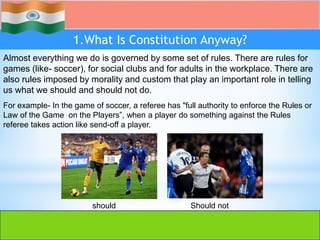
Almost everything we do is governed by some set of rules. There are rules for
games (like- soccer), for social clubs and for adults in the workplace. There are
also rules imposed by morality and custom that play an important role in telling
us what we should and should not do.
For example- In the game of soccer, a referee has "full authority to enforce the Rules or
Law of the Game on the Players”, when a player do something against the Rules
referee takes action like send-off a player.
should Should not
1.What Is Constitution Anyway?
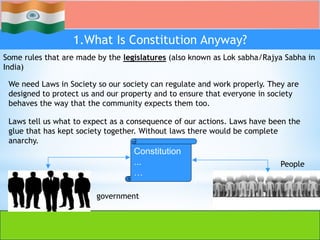
Some rules that are made by the legislatures (also known as Lok sabha/Rajya Sabha in
India)
We need Laws in Society so our society can regulate and work properly. They are
designed to protect us and our property and to ensure that everyone in society
behaves the way that the community expects them too.
Laws tell us what to expect as a consequence of our actions. Laws have been the
glue that has kept society together. Without laws there would be complete
anarchy.
Constitution
...
…
government
People
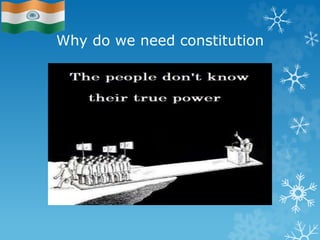
Why Do we need Constitution
In General-
I.We need a constitution to govern a country properly.
II.The constitution defines the nature of political system of a country.
III.sometimes we feel strongly about an issue that might go against our larger
interests and the constitution helps us guard against this.
IV.All the 3 organs of government (executive, legislature and judiciary) functions
within the constitution. All the 3 organs of government, including ordinary
citizens, derive their power and authority (i.e. Fundamental Right) from the
constitution. If they act against it, it is unconstitutional and unlawful.
So constitution is required to have authoritative allocation of power and
function, and also to restrict them within its limit.
Why do we need constitution
Why do we need Constitution
To perform following Functions we need Constitution-
I.The first function of a constitution is to provide a set of basic rules that
allow for minimal coordination amongst members of a society.
II.The second function of a constitution is to specify who has the power to
make decisions in a society. It decides how the government will be
constituted.
III.The third function of a constitution is to set some limits on what a
government can impose on its citizens. These limits are fundamental in the
sense that government may ever trespass them.
IV.The fourth function of a constitution is to enable the government to fulfill
the separations of a society and create conditions for a just society.
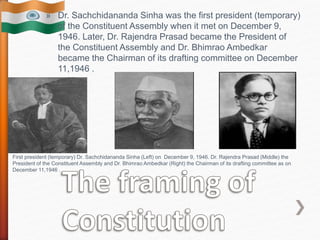
» Dr. Sachchidananda Sinha was the first president (temporary)
of the Constituent Assembly when it met on December 9,
1946. Later, Dr. Rajendra Prasad became the President of
the Constituent Assembly and Dr. Bhimrao Ambedkar
became the Chairman of its drafting committee on December
11,1946 .
First president (temporary) Dr. Sachchidananda Sinha (Left) on December 9, 1946. Dr. Rajendra Prasad (Middle) the
President of the Constituent Assembly and Dr. Bhimrao Ambedkar (Right) the Chairman of its drafting committee as on
December 11,1946 .
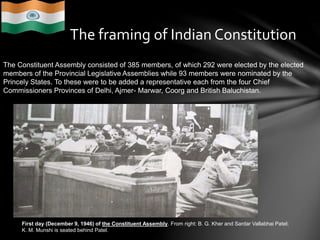
The framing of Indian Constitution
The Constituent Assembly consisted of 385 members, of which 292 were elected by the elected
members of the Provincial Legislative Assemblies while 93 members were nominated by the
Princely States. To these were to be added a representative each from the four Chief
Commissioners Provinces of Delhi, Ajmer- Marwar, Coorg and British Baluchistan.
First day (December 9, 1946) of the Constituent Assembly. From right: B. G. Kher and Sardar Vallabhai Patel;
K. M. Munshi is seated behind Patel.
Federalism
Parliamentary form of government
Separation of power
Fundamental rights
secularism
The Indian Constitution : Key
features
FEDERALISM
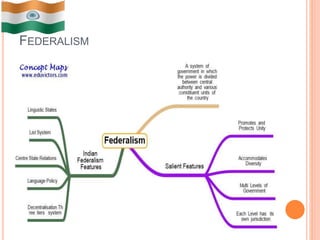
 Federalism is a political concept in which
a group of members are bound together by
covenant with a governing representative head.
The term "federalism" is also used to describe a
system of government in which sovereignty
is constitutionally divided between a central
governing authority and constituent political units
(such as states or provinces). Federalism is a
system based upon democratic rules and
institutions in which the power to govern is shared
between national and provincial/state governments,
creating what is often called a federation.
FEDERALISM
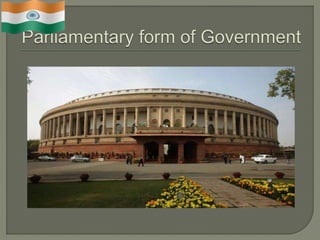
A parliamentary system is a system of democratic
governance of a state in which the executive
branch derives its democratic legitimacy from, and is
held accountable to, the legislature(parliament); the
executive and legislative branches are thus
interconnected. In a parliamentary system, the head of
state is normally a different person from the head of
government. This is in contrast to a presidential
system in a democracy, where the head of state often
is also the head of government, and most importantly:
the executive branch does not derive its democratic
legitimacy from the legislature.
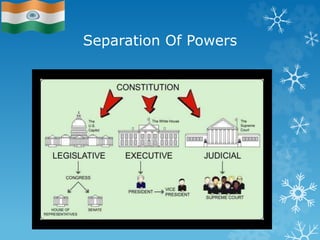
Separation Of Powers
The separation of powers, often imprecisely used
interchangeably with the political principle, is a model
for the governance of a state (or who controls the
state). The model was first developed in ancient Greece
and Rome. Under this model, the state is divided into
branches, each with separate and independent powers
and areas of responsibility so that the powers of one
branch are not in conflict with the powers associated
with the other branches.
Separation Of Powers
Fundamental Rights
Fundamental rights is a charter of rights contained in
the Constitution of India. It guarantees civil
liberties such that all Indians can lead their lives in
peace and harmony as citizens of India. These include
individual rights common to most liberal democracies,
such as equality before law, freedom of
speech and expression, and peaceful assembly, freedom
to practice religion, and the right to constitutional
remedies for the protection of civil rights by means
of writs such as habeas corpus.
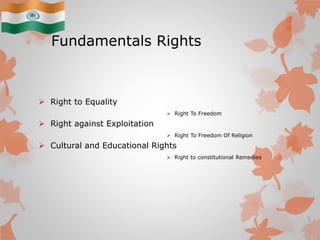
Fundamentals Rights
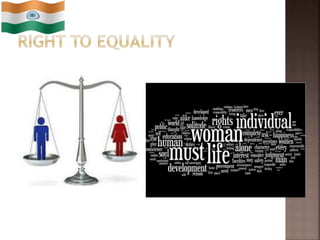
 Right to Equality
 Right To Freedom
 Right against Exploitation
 Right To Freedom Of Religion
 Cultural and Educational Rights
 Right to constitutional Remedies
Equality before law: Article 14 of the constitution guarantees
that all citizens shall be equally protected by the laws of the
country. It means that the State cannot discriminate any of the
Indian citizens on the basis of their religion, race, caste, sex or
place of birth
Social equality and equal access to public areas: Article 15 of the
constitution states that no person shall be discriminated on the
basis of religion, race, caste, sex or place of birth. Every person
shall have equal access to public places like public parks,
museums, wells, bathing Ghats and temples etc. However, the
State may make any special provision for women and children.
Special provisions may be made for the advancements of any
socially or educationally backward class or scheduled
castes or scheduled tribes.
Equality in matters of public employment: Article 16 of the
constitution lays down that the State cannot discriminate against
anyone in the matters of employment. All citizens can apply for
government jobs. There are some exceptions.
Right to Freedom
 Freedom to assemble peacefully without arms, on which the State can
impose reasonable restrictions in the interest of public order and the
sovereignty and integrity of India.
 Freedom to form associations or unions or co-operative societies on
which the State can impose reasonable restrictions on this freedom in
the interest of public order, morality and the sovereignty and integrity
of India.
 Freedom to move freely throughout the territory of India though
reasonable restrictions can be imposed on this right in the interest of
the general public, for example, restrictions may be imposed on
movement and travelling, so as to control epidemics.
Right to Freedom
Right against Exploitation
The right against exploitation, given in Articles 23 and 24, provides for
two provisions, namely the abolition of trafficking in human beings
and Beggar (forced labour), and abolition of employment of children
below the age of 14 years in dangerous jobs like factories, mines,
etc. Child labour is considered a gross violation of the spirit and
provisions of the constitution. Beggar, practiced in the past by
landlords, has been declared a crime and is punishable by law.
Trafficking in humans for the purpose of slave trade or prostitution is
also prohibited by law. An exception is made in employment without
payment for compulsory services for public purposes. Compulsory
military conscription is covered by this provision.
Right against Exploitation
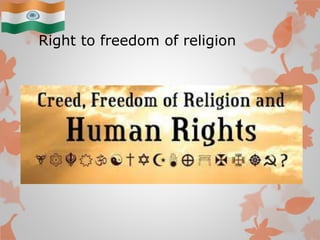
Right to freedom of religion
Right to freedom of religion, provides religious
freedom to all citizens of India. The objective of this
right is to sustain the principle of secularism in India.
According to the Constitution, all religions are equal
before the State and no religion shall be given
preference over the other. Citizens are free to preach,
practice and propagate any religion of their choice.
Religious communities can set up charitable institutions
of their own. However, activities in such institutions
which are not religious are performed according to the
laws laid down by the government. Establishing a
charitable institution can also be restricted in the
interest of public order, morality and health.
Right to freedom of religion
Cultural and Educational rights
As India is a country of many languages, religions,
and cultures, the Constitution provides special measures,
to protect the rights of the minorities. Any community which
has a language and a script of its own has the right to
conserve and develop it. No citizen can be discriminated
against for admission in State or State aided institutions.
All minorities, religious or linguistic, can set up their own
educational institutions to preserve and develop their own
culture. In granting aid to institutions, the State cannot
discriminate against any institution on the basis of the fact
that it is administered by a minority institution.
But the right to administer does not mean that the State
cannot interfere in case of maladministration.
Cultural and Educational rights
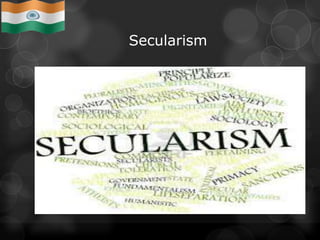
Secularism
Secularism is the principle of the separation of
government institutions and persons mandated to
represent the state from religious
institutions and religious dignitaries. One manifestation
of secularism is asserting the right to be free from
religious rule and teachings, or, in a state declared to be
neutral on matters of belief, from the imposition by
government of religion or religious practices upon its
people. Another manifestation of secularism is the view
that public activities and decisions,
especially political ones, should be uninfluenced by
religious beliefs and/or practices.
Secularism
The Krishna's PPT on Indian Constitution

The Krishna's PPT on Indian Constitution

  • 1.
  • 2.
    CONSTITUTION  A constitutionis a set of fundamental principles or established precedents according to which a state or other organization is governed. These rules together make up, i.e. constitute, what the entity is. When these principles are written down into a single document or set of legal documents, those documents may be said to embody a written constitution; if they are written down in a single comprehensive document, it is said to embody a codified constitution.
  • 3.
    THE INDIAN CONSTITUTION The Constitution of India is the supreme law of India. It lays down the framework defining fundamental political principles, establishes the structure, procedures, powers, and duties of government institutions, and sets out fundamental right, directive principles, and the duties of citizens. . It is the longest written constitution of any sovereign country in the world, containing 448 articles in 25 parts, 12 schedules, 5 appendices and 98 amendments (out of 120 Constitution Amendment Bills). Dr. Bhimrao Ramji Ambedkar is widely regarded as the father of the Indian Constitution.
  • 4.
  • 5.
    1.What Is ConstitutionAnyway? Almost everything we do is governed by some set of rules. There are rules for games (like- soccer), for social clubs and for adults in the workplace. There are also rules imposed by morality and custom that play an important role in telling us what we should and should not do. For example- In the game of soccer, a referee has "full authority to enforce the Rules or Law of the Game on the Players”, when a player do something against the Rules referee takes action like send-off a player. should Should not
  • 6.
    1.What Is ConstitutionAnyway? Some rules that are made by the legislatures (also known as Lok sabha/Rajya Sabha in India) We need Laws in Society so our society can regulate and work properly. They are designed to protect us and our property and to ensure that everyone in society behaves the way that the community expects them too. Laws tell us what to expect as a consequence of our actions. Laws have been the glue that has kept society together. Without laws there would be complete anarchy. Constitution ... … government People
  • 7.
    Why Do weneed Constitution In General- I.We need a constitution to govern a country properly. II.The constitution defines the nature of political system of a country. III.sometimes we feel strongly about an issue that might go against our larger interests and the constitution helps us guard against this. IV.All the 3 organs of government (executive, legislature and judiciary) functions within the constitution. All the 3 organs of government, including ordinary citizens, derive their power and authority (i.e. Fundamental Right) from the constitution. If they act against it, it is unconstitutional and unlawful. So constitution is required to have authoritative allocation of power and function, and also to restrict them within its limit.

  • 8.
    Why do weneed constitution
  • 9.
    Why do weneed Constitution To perform following Functions we need Constitution- I.The first function of a constitution is to provide a set of basic rules that allow for minimal coordination amongst members of a society. II.The second function of a constitution is to specify who has the power to make decisions in a society. It decides how the government will be constituted. III.The third function of a constitution is to set some limits on what a government can impose on its citizens. These limits are fundamental in the sense that government may ever trespass them. IV.The fourth function of a constitution is to enable the government to fulfill the separations of a society and create conditions for a just society.
  • 11.
    » Dr. SachchidanandaSinha was the first president (temporary) of the Constituent Assembly when it met on December 9, 1946. Later, Dr. Rajendra Prasad became the President of the Constituent Assembly and Dr. Bhimrao Ambedkar became the Chairman of its drafting committee on December 11,1946 . First president (temporary) Dr. Sachchidananda Sinha (Left) on December 9, 1946. Dr. Rajendra Prasad (Middle) the President of the Constituent Assembly and Dr. Bhimrao Ambedkar (Right) the Chairman of its drafting committee as on December 11,1946 .
  • 12.
    The framing ofIndian Constitution The Constituent Assembly consisted of 385 members, of which 292 were elected by the elected members of the Provincial Legislative Assemblies while 93 members were nominated by the Princely States. To these were to be added a representative each from the four Chief Commissioners Provinces of Delhi, Ajmer- Marwar, Coorg and British Baluchistan. First day (December 9, 1946) of the Constituent Assembly. From right: B. G. Kher and Sardar Vallabhai Patel; K. M. Munshi is seated behind Patel.
  • 13.
    Federalism Parliamentary form ofgovernment Separation of power Fundamental rights secularism The Indian Constitution : Key features
  • 14.
    FEDERALISM  Federalism isa political concept in which a group of members are bound together by covenant with a governing representative head. The term "federalism" is also used to describe a system of government in which sovereignty is constitutionally divided between a central governing authority and constituent political units (such as states or provinces). Federalism is a system based upon democratic rules and institutions in which the power to govern is shared between national and provincial/state governments, creating what is often called a federation.
  • 15.
  • 16.
    A parliamentary systemis a system of democratic governance of a state in which the executive branch derives its democratic legitimacy from, and is held accountable to, the legislature(parliament); the executive and legislative branches are thus interconnected. In a parliamentary system, the head of state is normally a different person from the head of government. This is in contrast to a presidential system in a democracy, where the head of state often is also the head of government, and most importantly: the executive branch does not derive its democratic legitimacy from the legislature.
  • 18.
    Separation Of Powers Theseparation of powers, often imprecisely used interchangeably with the political principle, is a model for the governance of a state (or who controls the state). The model was first developed in ancient Greece and Rome. Under this model, the state is divided into branches, each with separate and independent powers and areas of responsibility so that the powers of one branch are not in conflict with the powers associated with the other branches.
  • 19.
  • 20.
    Fundamental Rights Fundamental rightsis a charter of rights contained in the Constitution of India. It guarantees civil liberties such that all Indians can lead their lives in peace and harmony as citizens of India. These include individual rights common to most liberal democracies, such as equality before law, freedom of speech and expression, and peaceful assembly, freedom to practice religion, and the right to constitutional remedies for the protection of civil rights by means of writs such as habeas corpus.
  • 21.
    Fundamentals Rights  Rightto Equality  Right To Freedom  Right against Exploitation  Right To Freedom Of Religion  Cultural and Educational Rights  Right to constitutional Remedies
  • 22.
    Equality before law:Article 14 of the constitution guarantees that all citizens shall be equally protected by the laws of the country. It means that the State cannot discriminate any of the Indian citizens on the basis of their religion, race, caste, sex or place of birth Social equality and equal access to public areas: Article 15 of the constitution states that no person shall be discriminated on the basis of religion, race, caste, sex or place of birth. Every person shall have equal access to public places like public parks, museums, wells, bathing Ghats and temples etc. However, the State may make any special provision for women and children. Special provisions may be made for the advancements of any socially or educationally backward class or scheduled castes or scheduled tribes. Equality in matters of public employment: Article 16 of the constitution lays down that the State cannot discriminate against anyone in the matters of employment. All citizens can apply for government jobs. There are some exceptions.
  • 24.
    Right to Freedom Freedom to assemble peacefully without arms, on which the State can impose reasonable restrictions in the interest of public order and the sovereignty and integrity of India.  Freedom to form associations or unions or co-operative societies on which the State can impose reasonable restrictions on this freedom in the interest of public order, morality and the sovereignty and integrity of India.  Freedom to move freely throughout the territory of India though reasonable restrictions can be imposed on this right in the interest of the general public, for example, restrictions may be imposed on movement and travelling, so as to control epidemics.
  • 25.
  • 26.
    Right against Exploitation Theright against exploitation, given in Articles 23 and 24, provides for two provisions, namely the abolition of trafficking in human beings and Beggar (forced labour), and abolition of employment of children below the age of 14 years in dangerous jobs like factories, mines, etc. Child labour is considered a gross violation of the spirit and provisions of the constitution. Beggar, practiced in the past by landlords, has been declared a crime and is punishable by law. Trafficking in humans for the purpose of slave trade or prostitution is also prohibited by law. An exception is made in employment without payment for compulsory services for public purposes. Compulsory military conscription is covered by this provision.
  • 27.
  • 28.
    Right to freedomof religion Right to freedom of religion, provides religious freedom to all citizens of India. The objective of this right is to sustain the principle of secularism in India. According to the Constitution, all religions are equal before the State and no religion shall be given preference over the other. Citizens are free to preach, practice and propagate any religion of their choice. Religious communities can set up charitable institutions of their own. However, activities in such institutions which are not religious are performed according to the laws laid down by the government. Establishing a charitable institution can also be restricted in the interest of public order, morality and health.
  • 29.
    Right to freedomof religion
  • 30.
    Cultural and Educationalrights As India is a country of many languages, religions, and cultures, the Constitution provides special measures, to protect the rights of the minorities. Any community which has a language and a script of its own has the right to conserve and develop it. No citizen can be discriminated against for admission in State or State aided institutions. All minorities, religious or linguistic, can set up their own educational institutions to preserve and develop their own culture. In granting aid to institutions, the State cannot discriminate against any institution on the basis of the fact that it is administered by a minority institution. But the right to administer does not mean that the State cannot interfere in case of maladministration.
  • 31.
  • 34.
    Secularism Secularism is theprinciple of the separation of government institutions and persons mandated to represent the state from religious institutions and religious dignitaries. One manifestation of secularism is asserting the right to be free from religious rule and teachings, or, in a state declared to be neutral on matters of belief, from the imposition by government of religion or religious practices upon its people. Another manifestation of secularism is the view that public activities and decisions, especially political ones, should be uninfluenced by religious beliefs and/or practices.
  • 35.