Indian polity
Democracy’s 3 organs
 Legislature – Bicameralism(must in union)
 Executive ( Real & Nominal )
 Judiciary
• Democracy
• Republic
• Secular
• Federal
• Sovereign
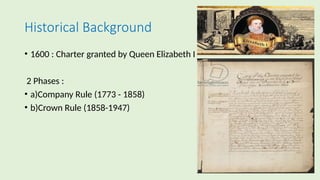
Historical Background
• 1600 : Charter granted by Queen Elizabeth I
2 Phases :
• a)Company Rule (1773 - 1858)
• b)Crown Rule (1858-1947)
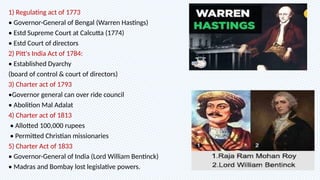
1) Regulating act of 1773
• Governor-General of Bengal (Warren Hastings)
• Estd Supreme Court at Calcutta (1774)
• Estd Court of directors
2) Pitt's India Act of 1784:
• Established Dyarchy
(board of control & court of directors)
3) Charter act of 1793
•Governor general can over ride council
• Abolition Mal Adalat
4) Charter act of 1813
• Allotted 100,000 rupees
• Permitted Christian missionaries
5) Charter Act of 1833
• Governor-General of India (Lord William Bentinck)
• Madras and Bombay lost legislative powers.
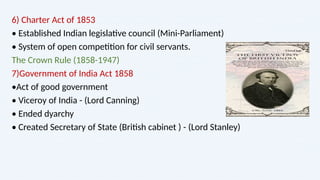
6) Charter Act of 1853
• Established Indian legislative council (Mini-Parliament)
• System of open competition for civil servants.
The Crown Rule (1858-1947)
7)Government of India Act 1858
•Act of good government
• Viceroy of India - (Lord Canning)
• Ended dyarchy
• Created Secretary of State (British cabinet ) - (Lord Stanley)
8) Indian council act : 1861
• Indians in law making process.
• Canning nominated 3 Indians.
• Decentralization of powers to Bombay and Madras.
• 1859 : Portfolio system
• Viceroy got Ordinance powers
9) Indian council act 1892
• Power to discuss budget for legislative councils (no vote & ques)
• Additional members in legislative council
10) Indian council act 1909 (Minto – Morley reforms)
• Enlarged functions of the legislative councils (Pass resolutions on budget )
• Communal representation for Muslims (Lord Minto : Father)
• Satyendra Prasad Sinha : Viceroy's Executive council ( Law member)
11) Government of India Act : 1919 (Montagu – Chelmsford reforms)
• Bicameralism and Direct election at centre
• Dyarchy in provinces
• Separate budget
• Central Public service commission – 1924 (TNPSC - 1929)
• Estd speaker and deputy speaker in central legislature.
• Communal representation (Sikhs, christians, Anglo Indians)
12) Government of India Act : 1935
• Established All-India Federation – 3 Lists
• Established Federal court (1937) and RBI
• Bicameralism at provinces
• Dyarchy at center
• Communal representation extended (women, SC&ST- Workers)
13) Indian Independence Act , 1947
• July 18, 1947
• Created 2 Separate dominions
• 2 Governor generals
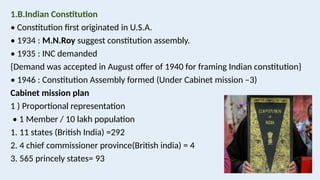
1.B.Indian Constitution
• Constitution first originated in U.S.A.
• 1934 : M.N.Roy suggest constitution assembly.
• 1935 : INC demanded
{Demand was accepted in August offer of 1940 for framing Indian constitution}
• 1946 : Constitution Assembly formed (Under Cabinet mission –3)
Cabinet mission plan
1 ) Proportional representation
• 1 Member / 10 lakh population
1. 11 states (British India) =292
2. 4 chief commissioner province(British india) = 4
3. 565 princely states= 93
• Total Strength – 389
• After partition : 299 (90 Left to Pak) (229(states) + 70 (princes))
2) Community based – Muslims, Sikhs ,General
• Partly Elected (Indirect)
• Partly Nominated
• Single transferable vote
FUNCTIONS PERFORMED
• Constitution assembly formed on : December 6,1946.
• Assembly’s first meeting : December 9, 1946.
• Temporary President : Dr. Sachchidananda Sinha.
• Permanent President : Dr. Rajendra Prasad
• Vice-Presidents :H.C. Mukherjee & V.T. Krishnamachari
•An “Objective Resolution“ was moved by J.Nehru on dec.13,1946 –later become preamble of Indian
constitution.
• Constitution adopted on November 26, 1949 (284 members) – Constitution day
• Came into force - 26th January, 1950 (Republic Day)
•Final meeting – Jan 24, 1950.
Immediate enforcement
• On Nov 26, 1949
• Citizenship
• Elections
Constituent Assembly has two functions:
1. Constitution assembly – Chairman (Dr.Rajendra Prasad)
2. Provincial parliament (formed-Nov 17, 1947) - Chairman (G.V.Mavlankar)
• Sir B.N.Rau as constitutional legal Advisor.
• Tenure : 2 yrs 11 months 18 days .
• Cost 64 lakhs
• July 22 1947 : Adopted National flag
• January 24, 1950 : Adopted the national anthem , national song
• January 24, 1950 : Rajendra Prasad : India’s first president
• Preamble, 22 parts, 395 Articles and 8 Schedules.
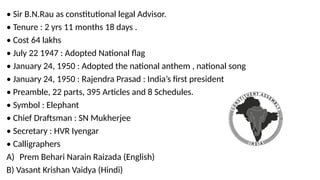
• Symbol : Elephant
• Chief Draftsman : SN Mukherjee
• Secretary : HVR Iyengar
• Calligraphers
A) Prem Behari Narain Raizada (English)
B) Vasant Krishan Vaidya (Hindi)
• Major committees
Total: 22 committees (8 major committees )
Jawaharlal Nehru
1.Union Power Committee
2. Union Constitution Committee
3. States Committee
Dr. Rajendra Prasad
4. Rules of Procedure Committee
5. Steering Committee
Sardar V.Patel
6. Provincial Constitution Committee
7. Advisory Committee on FR and Minorities
Dr.B.R.Ambedkar
8. Drafting Committee
DRAFTING COMMITTEE
• Set up on August 29, 1947.
Members
1. Dr.B.R.Ambedkar (Chairman) – Modern Manu
2. N.Gopalaswamy Ayyangar (art.370)
3. Alladi Krishswamy Ayyar
4. Dr.K.M.Munshi
5. Syed Mohammed Saadullah
6. N.Madhava Rau (Replaced B.L.Mitter )
7. T.T.Krishnamachari (Replaced D P Khaitan)
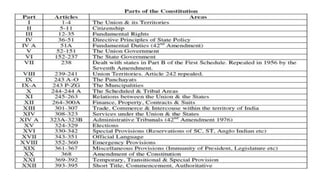
Parts and Schedules
Salient features of the Constitution
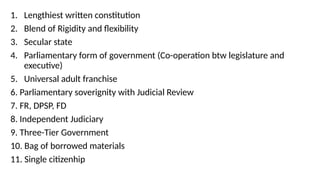
1. Lengthiest written constitution
2. Blend of Rigidity and flexibility
3. Secular state
4. Parliamentary form of government (Co-operation btw legislature and
executive)
5. Universal adult franchise
6. Parliamentary soverignity with Judicial Review
7. FR, DPSP, FD
8. Independent Judiciary
9. Three-Tier Government
10. Bag of borrowed materials
11. Single citizenhip
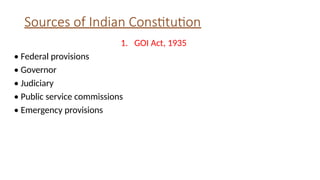
Sources of Indian Constitution
1. GOI Act, 1935
• Federal provisions
• Governor
• Judiciary
• Public service commissions
• Emergency provisions
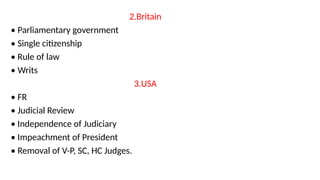
2.Britain
• Parliamentary government
• Single citizenship
• Rule of law
• Writs
3.USA
• FR
• Judicial Review
• Independence of Judiciary
• Impeachment of President
• Removal of V-P, SC, HC Judges.
4. Ireland : DPSP
5. Canada
• Federation with a strong centre (residuary powers to centre)
• Appointment of Governors by centre
6.Australia
• Freedom of trade, commerce
• Joint sitting, Concurrent list
7. Germany : Suspension of FR during Emergency.
8. Soviet Union
• FD
• Ideals of justice (social, economic and Political)
9.France
• Republic
• Liberty, Equality, and Fraternity in Preamble (French Revolution –
1789)
10.South Africa
• Amendment to the Constitution
• Election of the members of Rajya Sabha
11. Japan : Procedure established by Law
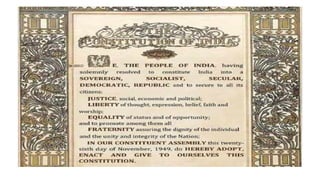
Preamble
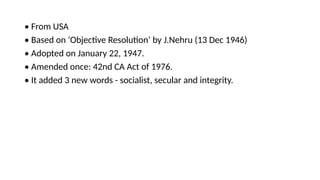
• From USA
• Based on ‘Objective Resolution’ by J.Nehru (13 Dec 1946)
• Adopted on January 22, 1947.
• Amended once: 42nd CA Act of 1976.
• It added 3 new words - socialist, secular and integrity.
Preamble denotes
1. Source of constitution
2. Nature of Indian state
3. Objectives of constiution (USSR & France)
4. Date of adoption
• Preamble is a Part of constitution with a proof of 3 cases
Berubari (1960), Kesav (1973) ,Lic case (1995)
• Soul, Key of constitution (as a preamble): Thakdur das bhargava
Constitutional Amendments
• Article 368 in Part XX
• Can’t change ‘basic structure’ of the Constitution (Kesavananda Bharati
case (1973) (Basic structure : Germany)
• Only in parliament and not in the SLA.
• No prior permission from president
• No joint sitting
• The president must give assent to the bill (cannot return bill)
Type of amendments
1) Amended by simple majority (50%+1 P&V)
2) Amended by special majority (2/3 rd P&V and 50%+1 Total)
3) Special majority with ratification of half of the state legislatures.
EXAMPLE
1) By Simple Majority of Parliament
• Admission or establishment of new states
• Abolition or creation of legislative councils (Art.169)
• Citizenship acquisition and termination.
• 2nd
, 5th
and 6th
schedule
• Not in Art.368
2) By special Majority of Parliament
• Fundamental Rights
• DPSP
3) By Special Majority and Consent of States
• Distribution of legislative powers between Union and states
• Seventh Schedule.
• Article 368 itself
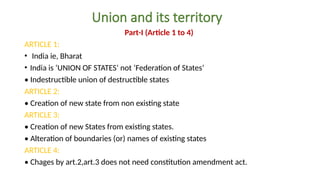
Union and its territory
Part-I (Article 1 to 4)
ARTICLE 1:
• India ie, Bharat
• India is ‘UNION OF STATES’ not ‘Federation of States’
• Indestructible union of destructible states
ARTICLE 2:
• Creation of new state from non existing state
ARTICLE 3:
• Creation of new States from existing states.
• Alteration of boundaries (or) names of existing states
ARTICLE 4:
• Chages by art.2,art.3 does not need constitution amendment act.
State reorganisation commitees
1) Dhar commission : June 1948
2) JVP commission : Dec 1948
• Potti sriramalu died(1952)- Andhra pradesh formed (1953)
3) Fazl ali commission- 3 Members (1953-55)
• Accepted Linguistic based classification(no one language one state
formula)
State reorganization act-1956 by 7th
CAA
• 14 states – 6 UT
Citizenship
Article 5 -11 ( Part II )
Who are all citizens on jan 26,1950?
• Article 5
Domicile of India.
• Article 6
Migrated to India from Pakistan (within 19.07.1948)
• Article 7
Migrated to Pakistan from India after Mar 1,1947
Later sought Indian citizenship.
• Article 8
Persons of Indian orgin
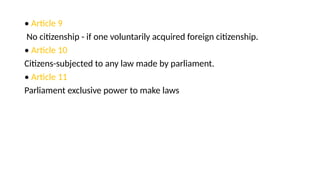
• Article 9
No citizenship - if one voluntarily acquired foreign citizenship.
• Article 10
Citizens-subjected to any law made by parliament.
• Article 11
Parliament exclusive power to make laws
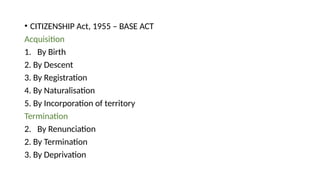
• CITIZENSHIP Act, 1955 – BASE ACT
Acquisition
1. By Birth
2. By Descent
3. By Registration
4. By Naturalisation
5. By Incorporation of territory
Termination
2. By Renunciation
2. By Termination
3. By Deprivation
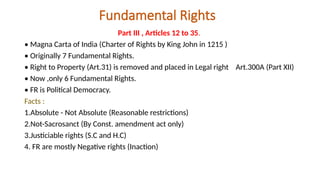
Fundamental Rights
Part III , Articles 12 to 35.
• Magna Carta of India (Charter of Rights by King John in 1215 )
• Originally 7 Fundamental Rights.
• Right to Property (Art.31) is removed and placed in Legal right Art.300A (Part XII)
• Now ,only 6 Fundamental Rights.
• FR is Political Democracy.
Facts :
1.Absolute - Not Absolute (Reasonable restrictions)
2.Not-Sacrosanct (By Const. amendment act only)
3.Justiciable rights (S.C and H.C)
4. FR are mostly Negative rights (Inaction)
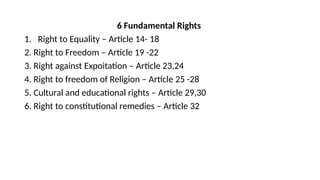
6 Fundamental Rights
1. Right to Equality – Article 14- 18
2. Right to Freedom – Article 19 -22
3. Right against Expoitation – Article 23,24
4. Right to freedom of Religion – Article 25 -28
5. Cultural and educational rights – Article 29,30
6. Right to constitutional remedies – Article 32
Article 12
• Definiton of State
Article 13
• Doctrine of severability
Article 14
1) Equality before law
2) Equal protection of Law.
Article 15
Prohibition of discrimination on grounds only of RRCSP.
Article 16
Equality of opportunity in Public employment.
No discrimination on RRRCSP
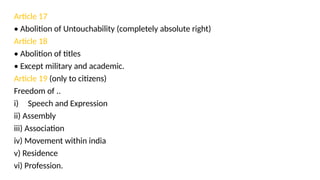
Article 17
• Abolition of Untouchability (completely absolute right)
Article 18
• Abolition of titles
• Except military and academic.
Article 19 (only to citizens)
Freedom of ..
i) Speech and Expression
ii) Assembly
iii) Association
iv) Movement within india
v) Residence
vi) Profession.
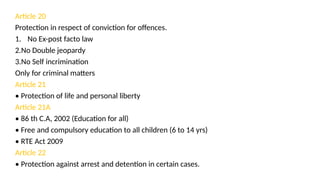
Article 20
Protection in respect of conviction for offences.
1. No Ex-post facto law
2.No Double jeopardy
3.No Self incrimination
Only for criminal matters
Article 21
• Protection of life and personal liberty
Article 21A
• 86 th C.A, 2002 (Education for all)
• Free and compulsory education to all children (6 to 14 yrs)
• RTE Act 2009
Article 22
• Protection against arrest and detention in certain cases.
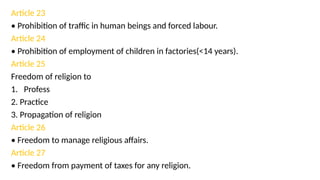
Article 23
• Prohibition of traffic in human beings and forced labour.
Article 24
• Prohibition of employment of children in factories(<14 years).
Article 25
Freedom of religion to
1. Profess
2. Practice
3. Propagation of religion
Article 26
• Freedom to manage religious affairs.
Article 27
• Freedom from payment of taxes for any religion.
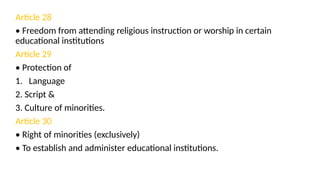
Article 28
• Freedom from attending religious instruction or worship in certain
educational institutions
Article 29
• Protection of
1. Language
2. Script &
3. Culture of minorities.
Article 30
• Right of minorities (exclusively)
• To establish and administer educational institutions.
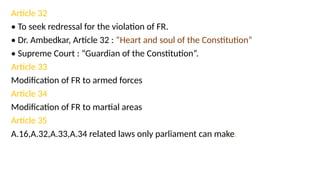
Article 32
• To seek redressal for the violation of FR.
• Dr. Ambedkar, Article 32 : “Heart and soul of the Constitution”
• Supreme Court : “Guardian of the Constitution”.
Article 33
Modification of FR to armed forces
Article 34
Modification of FR to martial areas
Article 35
A.16,A.32,A.33,A.34 related laws only parliament can make.
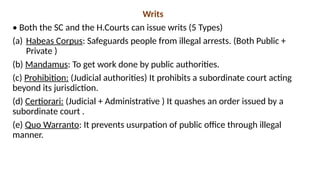
Writs
• Both the SC and the H.Courts can issue writs (5 Types)
(a) Habeas Corpus: Safeguards people from illegal arrests. (Both Public +
Private )
(b) Mandamus: To get work done by public authorities.
(c) Prohibition: (Judicial authorities) It prohibits a subordinate court acting
beyond its jurisdiction.
(d) Certiorari: (Judicial + Administrative ) It quashes an order issued by a
subordinate court .
(e) Quo Warranto: It prevents usurpation of public office through illegal
manner.
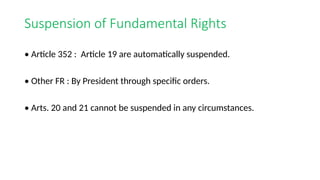
Suspension of Fundamental Rights
• Article 352 : Article 19 are automatically suspended.
• Other FR : By President through specific orders.
• Arts. 20 and 21 cannot be suspended in any circumstances.
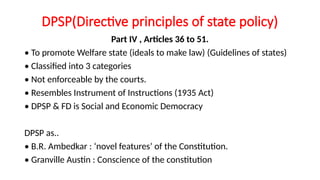
DPSP(Directive principles of state policy)
Part IV , Articles 36 to 51.
• To promote Welfare state (ideals to make law) (Guidelines of states)
• Classified into 3 categories
• Not enforceable by the courts.
• Resembles Instrument of Instructions (1935 Act)
• DPSP & FD is Social and Economic Democracy
DPSP as..
• B.R. Ambedkar : ‘novel features’ of the Constitution.
• Granville Austin : Conscience of the constitution
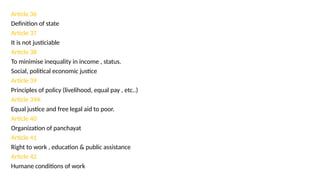
Article 36
Definition of state
Article 37
It is not justiciable
Article 38
To minimise inequality in income , status.
Social, political economic justice
Article 39
Principles of policy (livelihood, equal pay , etc..)
Article 39A
Equal justice and free legal aid to poor.
Article 40
Organization of panchayat
Article 41
Right to work , education & public assistance
Article 42
Humane conditions of work
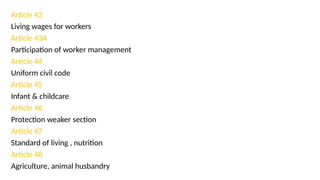
Article 43
Living wages for workers
Article 43A
Participation of worker management
Article 44
Uniform civil code
Article 45
Infant & childcare
Article 46
Protection weaker section
Article 47
Standard of living , nutrition
Article 48
Agriculture, animal husbandry
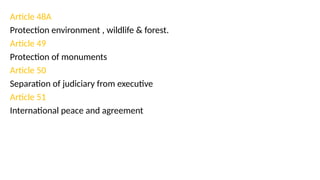
Article 48A
Protection environment , wildlife & forest.
Article 49
Protection of monuments
Article 50
Separation of judiciary from executive
Article 51
International peace and agreement
42nd
CAA 1976 – Art.39,39A,43A,48A
44th
CAA 1978 – Art.38
97th
CAA 2011 – Art.43B
Gandhian principle – Art. 40,43,43B,46,47,48
Socialistic principle – Art. 38,39,41,42,43,43A,47
Liberal intellectual – Art. 44,45,48,48A,49,50,51
Fundamental Duties
• 42nd Amendment Act of 1976 added new Part IVA , Article 51A
• 1976 : Sardar Swaran Singh Committee.
• 11(10+1) fundamental duties of the citizens. (not for foreigners)
• 11th
FD added by 86th
CAA,2002
Indian polity for NDA...................

Indian polity for NDA...................

  • 1.
  • 2.
    Democracy’s 3 organs Legislature – Bicameralism(must in union)  Executive ( Real & Nominal )  Judiciary • Democracy • Republic • Secular • Federal • Sovereign
  • 3.
    Historical Background • 1600: Charter granted by Queen Elizabeth I 2 Phases : • a)Company Rule (1773 - 1858) • b)Crown Rule (1858-1947)
  • 4.
    1) Regulating actof 1773 • Governor-General of Bengal (Warren Hastings) • Estd Supreme Court at Calcutta (1774) • Estd Court of directors 2) Pitt's India Act of 1784: • Established Dyarchy (board of control & court of directors) 3) Charter act of 1793 •Governor general can over ride council • Abolition Mal Adalat 4) Charter act of 1813 • Allotted 100,000 rupees • Permitted Christian missionaries 5) Charter Act of 1833 • Governor-General of India (Lord William Bentinck) • Madras and Bombay lost legislative powers.
  • 5.
    6) Charter Actof 1853 • Established Indian legislative council (Mini-Parliament) • System of open competition for civil servants. The Crown Rule (1858-1947) 7)Government of India Act 1858 •Act of good government • Viceroy of India - (Lord Canning) • Ended dyarchy • Created Secretary of State (British cabinet ) - (Lord Stanley)
  • 6.
    8) Indian councilact : 1861 • Indians in law making process. • Canning nominated 3 Indians. • Decentralization of powers to Bombay and Madras. • 1859 : Portfolio system • Viceroy got Ordinance powers 9) Indian council act 1892 • Power to discuss budget for legislative councils (no vote & ques) • Additional members in legislative council
  • 7.
    10) Indian councilact 1909 (Minto – Morley reforms) • Enlarged functions of the legislative councils (Pass resolutions on budget ) • Communal representation for Muslims (Lord Minto : Father) • Satyendra Prasad Sinha : Viceroy's Executive council ( Law member) 11) Government of India Act : 1919 (Montagu – Chelmsford reforms) • Bicameralism and Direct election at centre • Dyarchy in provinces • Separate budget • Central Public service commission – 1924 (TNPSC - 1929) • Estd speaker and deputy speaker in central legislature. • Communal representation (Sikhs, christians, Anglo Indians)
  • 8.
    12) Government ofIndia Act : 1935 • Established All-India Federation – 3 Lists • Established Federal court (1937) and RBI • Bicameralism at provinces • Dyarchy at center • Communal representation extended (women, SC&ST- Workers) 13) Indian Independence Act , 1947 • July 18, 1947 • Created 2 Separate dominions • 2 Governor generals
  • 9.
    1.B.Indian Constitution • Constitutionfirst originated in U.S.A. • 1934 : M.N.Roy suggest constitution assembly. • 1935 : INC demanded {Demand was accepted in August offer of 1940 for framing Indian constitution} • 1946 : Constitution Assembly formed (Under Cabinet mission –3) Cabinet mission plan 1 ) Proportional representation • 1 Member / 10 lakh population 1. 11 states (British India) =292 2. 4 chief commissioner province(British india) = 4 3. 565 princely states= 93
  • 10.
    • Total Strength– 389 • After partition : 299 (90 Left to Pak) (229(states) + 70 (princes)) 2) Community based – Muslims, Sikhs ,General • Partly Elected (Indirect) • Partly Nominated • Single transferable vote FUNCTIONS PERFORMED • Constitution assembly formed on : December 6,1946. • Assembly’s first meeting : December 9, 1946. • Temporary President : Dr. Sachchidananda Sinha. • Permanent President : Dr. Rajendra Prasad • Vice-Presidents :H.C. Mukherjee & V.T. Krishnamachari •An “Objective Resolution“ was moved by J.Nehru on dec.13,1946 –later become preamble of Indian constitution. • Constitution adopted on November 26, 1949 (284 members) – Constitution day • Came into force - 26th January, 1950 (Republic Day) •Final meeting – Jan 24, 1950.
  • 11.
    Immediate enforcement • OnNov 26, 1949 • Citizenship • Elections Constituent Assembly has two functions: 1. Constitution assembly – Chairman (Dr.Rajendra Prasad) 2. Provincial parliament (formed-Nov 17, 1947) - Chairman (G.V.Mavlankar)
  • 12.
    • Sir B.N.Rauas constitutional legal Advisor. • Tenure : 2 yrs 11 months 18 days . • Cost 64 lakhs • July 22 1947 : Adopted National flag • January 24, 1950 : Adopted the national anthem , national song • January 24, 1950 : Rajendra Prasad : India’s first president • Preamble, 22 parts, 395 Articles and 8 Schedules. • Symbol : Elephant • Chief Draftsman : SN Mukherjee • Secretary : HVR Iyengar • Calligraphers A) Prem Behari Narain Raizada (English) B) Vasant Krishan Vaidya (Hindi)
  • 13.
    • Major committees Total:22 committees (8 major committees ) Jawaharlal Nehru 1.Union Power Committee 2. Union Constitution Committee 3. States Committee Dr. Rajendra Prasad 4. Rules of Procedure Committee 5. Steering Committee Sardar V.Patel 6. Provincial Constitution Committee 7. Advisory Committee on FR and Minorities Dr.B.R.Ambedkar 8. Drafting Committee
  • 14.
    DRAFTING COMMITTEE • Setup on August 29, 1947. Members 1. Dr.B.R.Ambedkar (Chairman) – Modern Manu 2. N.Gopalaswamy Ayyangar (art.370) 3. Alladi Krishswamy Ayyar 4. Dr.K.M.Munshi 5. Syed Mohammed Saadullah 6. N.Madhava Rau (Replaced B.L.Mitter ) 7. T.T.Krishnamachari (Replaced D P Khaitan)
  • 15.
  • 18.
    Salient features ofthe Constitution
  • 19.
    1. Lengthiest writtenconstitution 2. Blend of Rigidity and flexibility 3. Secular state 4. Parliamentary form of government (Co-operation btw legislature and executive) 5. Universal adult franchise 6. Parliamentary soverignity with Judicial Review 7. FR, DPSP, FD 8. Independent Judiciary 9. Three-Tier Government 10. Bag of borrowed materials 11. Single citizenhip
  • 20.
    Sources of IndianConstitution 1. GOI Act, 1935 • Federal provisions • Governor • Judiciary • Public service commissions • Emergency provisions
  • 21.
    2.Britain • Parliamentary government •Single citizenship • Rule of law • Writs 3.USA • FR • Judicial Review • Independence of Judiciary • Impeachment of President • Removal of V-P, SC, HC Judges.
  • 22.
    4. Ireland :DPSP 5. Canada • Federation with a strong centre (residuary powers to centre) • Appointment of Governors by centre 6.Australia • Freedom of trade, commerce • Joint sitting, Concurrent list 7. Germany : Suspension of FR during Emergency. 8. Soviet Union • FD • Ideals of justice (social, economic and Political)
  • 23.
    9.France • Republic • Liberty,Equality, and Fraternity in Preamble (French Revolution – 1789) 10.South Africa • Amendment to the Constitution • Election of the members of Rajya Sabha 11. Japan : Procedure established by Law
  • 24.
  • 26.
    • From USA •Based on ‘Objective Resolution’ by J.Nehru (13 Dec 1946) • Adopted on January 22, 1947. • Amended once: 42nd CA Act of 1976. • It added 3 new words - socialist, secular and integrity.
  • 27.
    Preamble denotes 1. Sourceof constitution 2. Nature of Indian state 3. Objectives of constiution (USSR & France) 4. Date of adoption • Preamble is a Part of constitution with a proof of 3 cases Berubari (1960), Kesav (1973) ,Lic case (1995) • Soul, Key of constitution (as a preamble): Thakdur das bhargava
  • 28.
    Constitutional Amendments • Article368 in Part XX • Can’t change ‘basic structure’ of the Constitution (Kesavananda Bharati case (1973) (Basic structure : Germany) • Only in parliament and not in the SLA. • No prior permission from president • No joint sitting • The president must give assent to the bill (cannot return bill)
  • 29.
    Type of amendments 1)Amended by simple majority (50%+1 P&V) 2) Amended by special majority (2/3 rd P&V and 50%+1 Total) 3) Special majority with ratification of half of the state legislatures.
  • 30.
    EXAMPLE 1) By SimpleMajority of Parliament • Admission or establishment of new states • Abolition or creation of legislative councils (Art.169) • Citizenship acquisition and termination. • 2nd , 5th and 6th schedule • Not in Art.368
  • 31.
    2) By specialMajority of Parliament • Fundamental Rights • DPSP 3) By Special Majority and Consent of States • Distribution of legislative powers between Union and states • Seventh Schedule. • Article 368 itself
  • 32.
    Union and itsterritory Part-I (Article 1 to 4) ARTICLE 1: • India ie, Bharat • India is ‘UNION OF STATES’ not ‘Federation of States’ • Indestructible union of destructible states ARTICLE 2: • Creation of new state from non existing state ARTICLE 3: • Creation of new States from existing states. • Alteration of boundaries (or) names of existing states ARTICLE 4: • Chages by art.2,art.3 does not need constitution amendment act.
  • 33.
    State reorganisation commitees 1)Dhar commission : June 1948 2) JVP commission : Dec 1948 • Potti sriramalu died(1952)- Andhra pradesh formed (1953) 3) Fazl ali commission- 3 Members (1953-55) • Accepted Linguistic based classification(no one language one state formula) State reorganization act-1956 by 7th CAA • 14 states – 6 UT
  • 34.
    Citizenship Article 5 -11( Part II ) Who are all citizens on jan 26,1950? • Article 5 Domicile of India. • Article 6 Migrated to India from Pakistan (within 19.07.1948) • Article 7 Migrated to Pakistan from India after Mar 1,1947 Later sought Indian citizenship. • Article 8 Persons of Indian orgin
  • 35.
    • Article 9 Nocitizenship - if one voluntarily acquired foreign citizenship. • Article 10 Citizens-subjected to any law made by parliament. • Article 11 Parliament exclusive power to make laws
  • 36.
    • CITIZENSHIP Act,1955 – BASE ACT Acquisition 1. By Birth 2. By Descent 3. By Registration 4. By Naturalisation 5. By Incorporation of territory Termination 2. By Renunciation 2. By Termination 3. By Deprivation
  • 37.
    Fundamental Rights Part III, Articles 12 to 35. • Magna Carta of India (Charter of Rights by King John in 1215 ) • Originally 7 Fundamental Rights. • Right to Property (Art.31) is removed and placed in Legal right Art.300A (Part XII) • Now ,only 6 Fundamental Rights. • FR is Political Democracy. Facts : 1.Absolute - Not Absolute (Reasonable restrictions) 2.Not-Sacrosanct (By Const. amendment act only) 3.Justiciable rights (S.C and H.C) 4. FR are mostly Negative rights (Inaction)
  • 38.
    6 Fundamental Rights 1.Right to Equality – Article 14- 18 2. Right to Freedom – Article 19 -22 3. Right against Expoitation – Article 23,24 4. Right to freedom of Religion – Article 25 -28 5. Cultural and educational rights – Article 29,30 6. Right to constitutional remedies – Article 32
  • 39.
    Article 12 • Definitonof State Article 13 • Doctrine of severability Article 14 1) Equality before law 2) Equal protection of Law. Article 15 Prohibition of discrimination on grounds only of RRCSP. Article 16 Equality of opportunity in Public employment. No discrimination on RRRCSP
  • 40.
    Article 17 • Abolitionof Untouchability (completely absolute right) Article 18 • Abolition of titles • Except military and academic. Article 19 (only to citizens) Freedom of .. i) Speech and Expression ii) Assembly iii) Association iv) Movement within india v) Residence vi) Profession.
  • 41.
    Article 20 Protection inrespect of conviction for offences. 1. No Ex-post facto law 2.No Double jeopardy 3.No Self incrimination Only for criminal matters Article 21 • Protection of life and personal liberty Article 21A • 86 th C.A, 2002 (Education for all) • Free and compulsory education to all children (6 to 14 yrs) • RTE Act 2009 Article 22 • Protection against arrest and detention in certain cases.
  • 42.
    Article 23 • Prohibitionof traffic in human beings and forced labour. Article 24 • Prohibition of employment of children in factories(<14 years). Article 25 Freedom of religion to 1. Profess 2. Practice 3. Propagation of religion Article 26 • Freedom to manage religious affairs. Article 27 • Freedom from payment of taxes for any religion.
  • 43.
    Article 28 • Freedomfrom attending religious instruction or worship in certain educational institutions Article 29 • Protection of 1. Language 2. Script & 3. Culture of minorities. Article 30 • Right of minorities (exclusively) • To establish and administer educational institutions.
  • 44.
    Article 32 • Toseek redressal for the violation of FR. • Dr. Ambedkar, Article 32 : “Heart and soul of the Constitution” • Supreme Court : “Guardian of the Constitution”. Article 33 Modification of FR to armed forces Article 34 Modification of FR to martial areas Article 35 A.16,A.32,A.33,A.34 related laws only parliament can make.
  • 45.
    Writs • Both theSC and the H.Courts can issue writs (5 Types) (a) Habeas Corpus: Safeguards people from illegal arrests. (Both Public + Private ) (b) Mandamus: To get work done by public authorities. (c) Prohibition: (Judicial authorities) It prohibits a subordinate court acting beyond its jurisdiction. (d) Certiorari: (Judicial + Administrative ) It quashes an order issued by a subordinate court . (e) Quo Warranto: It prevents usurpation of public office through illegal manner.
  • 46.
    Suspension of FundamentalRights • Article 352 : Article 19 are automatically suspended. • Other FR : By President through specific orders. • Arts. 20 and 21 cannot be suspended in any circumstances.
  • 47.
    DPSP(Directive principles ofstate policy) Part IV , Articles 36 to 51. • To promote Welfare state (ideals to make law) (Guidelines of states) • Classified into 3 categories • Not enforceable by the courts. • Resembles Instrument of Instructions (1935 Act) • DPSP & FD is Social and Economic Democracy DPSP as.. • B.R. Ambedkar : ‘novel features’ of the Constitution. • Granville Austin : Conscience of the constitution
  • 48.
    Article 36 Definition ofstate Article 37 It is not justiciable Article 38 To minimise inequality in income , status. Social, political economic justice Article 39 Principles of policy (livelihood, equal pay , etc..) Article 39A Equal justice and free legal aid to poor. Article 40 Organization of panchayat Article 41 Right to work , education & public assistance Article 42 Humane conditions of work
  • 49.
    Article 43 Living wagesfor workers Article 43A Participation of worker management Article 44 Uniform civil code Article 45 Infant & childcare Article 46 Protection weaker section Article 47 Standard of living , nutrition Article 48 Agriculture, animal husbandry
  • 50.
    Article 48A Protection environment, wildlife & forest. Article 49 Protection of monuments Article 50 Separation of judiciary from executive Article 51 International peace and agreement
  • 51.
    42nd CAA 1976 –Art.39,39A,43A,48A 44th CAA 1978 – Art.38 97th CAA 2011 – Art.43B Gandhian principle – Art. 40,43,43B,46,47,48 Socialistic principle – Art. 38,39,41,42,43,43A,47 Liberal intellectual – Art. 44,45,48,48A,49,50,51
  • 52.
    Fundamental Duties • 42ndAmendment Act of 1976 added new Part IVA , Article 51A • 1976 : Sardar Swaran Singh Committee. • 11(10+1) fundamental duties of the citizens. (not for foreigners) • 11th FD added by 86th CAA,2002