A Comprehensive Overview MySQL
MySQL is a robust and widely-used open-source relational database
management system (RDBMS). This presentation will delve into key aspects of
MySQL, covering its architecture, core features, advantages, and practical use
cases.
BAKHAT ALI
Institute of Geoinformatics and Earth Observation,
Pir Mehr Ali Shah Arid Agriculture University Rawalpindi , Punjab, Pakistan
bakhtali21uaar@gmail.com
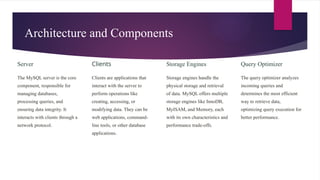
Architecture and Components
Server
The MySQL server is the core
component, responsible for
managing databases,
processing queries, and
ensuring data integrity. It
interacts with clients through a
network protocol.
Clients
Clients are applications that
interact with the server to
perform operations like
creating, accessing, or
modifying data. They can be
web applications, command-
line tools, or other database
applications.
Storage Engines
Storage engines handle the
physical storage and retrieval
of data. MySQL offers multiple
storage engines like InnoDB,
MyISAM, and Memory, each
with its own characteristics and
performance trade-offs.
Query Optimizer
The query optimizer analyzes
incoming queries and
determines the most efficient
way to retrieve data,
optimizing query execution for
better performance.
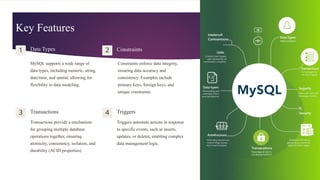
Key Features
1 Data Types
MySQL supports a wide range of
data types, including numeric, string,
date/time, and spatial, allowing for
flexibility in data modeling.
2 Constraints
Constraints enforce data integrity,
ensuring data accuracy and
consistency. Examples include
primary keys, foreign keys, and
unique constraints.
3 Transactions
Transactions provide a mechanism
for grouping multiple database
operations together, ensuring
atomicity, consistency, isolation, and
durability (ACID properties).
4 Triggers
Triggers automate actions in response
to specific events, such as inserts,
updates, or deletes, enabling complex
data management logic.
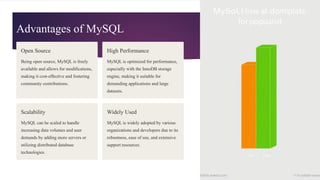
Advantages of MySQL
Open Source
Being open source, MySQL is freely
available and allows for modifications,
making it cost-effective and fostering
community contributions.
High Performance
MySQL is optimized for performance,
especially with the InnoDB storage
engine, making it suitable for
demanding applications and large
datasets.
Scalability
MySQL can be scaled to handle
increasing data volumes and user
demands by adding more servers or
utilizing distributed database
technologies.
Widely Used
MySQL is widely adopted by various
organizations and developers due to its
robustness, ease of use, and extensive
support resources.
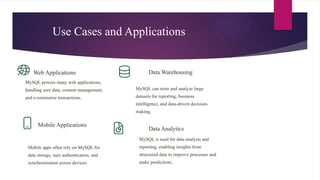
Use Cases and Applications
Web Applications
MySQL powers many web applications,
handling user data, content management,
and e-commerce transactions.
Data Warehousing
MySQL can store and analyze large
datasets for reporting, business
intelligence, and data-driven decision-
making.
Mobile Applications
Mobile apps often rely on MySQL for
data storage, user authentication, and
synchronization across devices.
Data Analytics
MySQL is used for data analysis and
reporting, enabling insights from
structured data to improve processes and
make predictions.
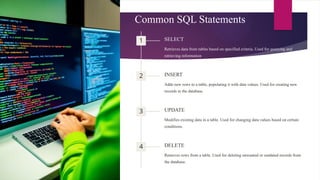
Common SQL Statements
1 SELECT
Retrieves data from tables based on specified criteria. Used for querying and
retrieving information.
2 INSERT
Adds new rows to a table, populating it with data values. Used for creating new
records in the database.
3 UPDATE
Modifies existing data in a table. Used for changing data values based on certain
conditions.
4 DELETE
Removes rows from a table. Used for deleting unwanted or outdated records from
the database.
Security Best Practices
Strong Passwords
Use complex passwords for database accounts and avoid using default
credentials.
Access Control
Implement granular access control mechanisms, granting specific permissions
to users based on their roles.
Data Encryption
Encrypt sensitive data at rest and in transit to protect it from unauthorized
access.
Regular Updates
Keep MySQL and related software up to date to patch vulnerabilities and
enhance security.
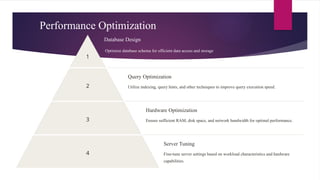
Performance Optimization
1
Database Design
Optimize database schema for efficient data access and storage.
2
Query Optimization
Utilize indexing, query hints, and other techniques to improve query execution speed.
3
Hardware Optimization
Ensure sufficient RAM, disk space, and network bandwidth for optimal performance.
4
Server Tuning
Fine-tune server settings based on workload characteristics and hardware
capabilities.
Conclusion:
MySQL is a powerful and versatile RDBMS that continues to
be relevant in modern application development. Its open-source
nature, performance, scalability, and vast community support
make it a reliable choice for various use cases. By understanding
its architecture, features, and best practices, developers and
database administrators can effectively utilize MySQL for
building robust and scalable applications.

MySQL-A-Comprehensive-Overvie web design w.pptx

  • 1.
    A Comprehensive OverviewMySQL MySQL is a robust and widely-used open-source relational database management system (RDBMS). This presentation will delve into key aspects of MySQL, covering its architecture, core features, advantages, and practical use cases. BAKHAT ALI Institute of Geoinformatics and Earth Observation, Pir Mehr Ali Shah Arid Agriculture University Rawalpindi , Punjab, Pakistan bakhtali21uaar@gmail.com
  • 2.
    Architecture and Components Server TheMySQL server is the core component, responsible for managing databases, processing queries, and ensuring data integrity. It interacts with clients through a network protocol. Clients Clients are applications that interact with the server to perform operations like creating, accessing, or modifying data. They can be web applications, command- line tools, or other database applications. Storage Engines Storage engines handle the physical storage and retrieval of data. MySQL offers multiple storage engines like InnoDB, MyISAM, and Memory, each with its own characteristics and performance trade-offs. Query Optimizer The query optimizer analyzes incoming queries and determines the most efficient way to retrieve data, optimizing query execution for better performance.
  • 3.
    Key Features 1 DataTypes MySQL supports a wide range of data types, including numeric, string, date/time, and spatial, allowing for flexibility in data modeling. 2 Constraints Constraints enforce data integrity, ensuring data accuracy and consistency. Examples include primary keys, foreign keys, and unique constraints. 3 Transactions Transactions provide a mechanism for grouping multiple database operations together, ensuring atomicity, consistency, isolation, and durability (ACID properties). 4 Triggers Triggers automate actions in response to specific events, such as inserts, updates, or deletes, enabling complex data management logic.
  • 4.
    Advantages of MySQL OpenSource Being open source, MySQL is freely available and allows for modifications, making it cost-effective and fostering community contributions. High Performance MySQL is optimized for performance, especially with the InnoDB storage engine, making it suitable for demanding applications and large datasets. Scalability MySQL can be scaled to handle increasing data volumes and user demands by adding more servers or utilizing distributed database technologies. Widely Used MySQL is widely adopted by various organizations and developers due to its robustness, ease of use, and extensive support resources.
  • 5.
    Use Cases andApplications Web Applications MySQL powers many web applications, handling user data, content management, and e-commerce transactions. Data Warehousing MySQL can store and analyze large datasets for reporting, business intelligence, and data-driven decision- making. Mobile Applications Mobile apps often rely on MySQL for data storage, user authentication, and synchronization across devices. Data Analytics MySQL is used for data analysis and reporting, enabling insights from structured data to improve processes and make predictions.
  • 6.
    Common SQL Statements 1SELECT Retrieves data from tables based on specified criteria. Used for querying and retrieving information. 2 INSERT Adds new rows to a table, populating it with data values. Used for creating new records in the database. 3 UPDATE Modifies existing data in a table. Used for changing data values based on certain conditions. 4 DELETE Removes rows from a table. Used for deleting unwanted or outdated records from the database.
  • 7.
    Security Best Practices StrongPasswords Use complex passwords for database accounts and avoid using default credentials. Access Control Implement granular access control mechanisms, granting specific permissions to users based on their roles. Data Encryption Encrypt sensitive data at rest and in transit to protect it from unauthorized access. Regular Updates Keep MySQL and related software up to date to patch vulnerabilities and enhance security.
  • 8.
    Performance Optimization 1 Database Design Optimizedatabase schema for efficient data access and storage. 2 Query Optimization Utilize indexing, query hints, and other techniques to improve query execution speed. 3 Hardware Optimization Ensure sufficient RAM, disk space, and network bandwidth for optimal performance. 4 Server Tuning Fine-tune server settings based on workload characteristics and hardware capabilities.
  • 9.
    Conclusion: MySQL is apowerful and versatile RDBMS that continues to be relevant in modern application development. Its open-source nature, performance, scalability, and vast community support make it a reliable choice for various use cases. By understanding its architecture, features, and best practices, developers and database administrators can effectively utilize MySQL for building robust and scalable applications.