1
Flood Extent and Disaster Management in DG Khan
Division, Pakistan: A GIS-Based Approach
BAKHAT ALI
Institute of Geoinformatics and Earth Observation,
Pir Mehr Ali Shah Arid Agriculture University Rawalpindi , Punjab, Pakistan
bakhtali21uaar@gmail.com
Abstract:
This paper shall be able to show that while work flood have measures to avoid them, flooding is
one of the most severe natural disasters in the world and is a reoccurring disaster that highly
impacts Pakistan depending on its geographical location and weather conditions. The most
threatened province is the Punjab particularly the Southeast of the study area, which covers the
Sulaiman Mountain Range of DG Khan Division that receives the Indus River system flood
zone; as a result, this research employed GIS techniques to systematically study and evaluate the
flood behavior within the entire DG Khan Division. objectives: . The following can be generated
as factors that could be useful in achieving the management goals of attaining effective and
accurate strategies for managing the impacts of flood Disaster warnings that are also important
when it comes to occurrence of disasters Structural patterns of disasters which are important
since they will help Structure Disaster which relates with the mitigation process in disaster.
Therefore, despite the fact that the study has chosen the notion of the recommendation of
measures of flood management as its major conclusion, it is in fact designed to draw people’s
attention to the understanding of the fact that it is important to think about the possibility of the
fact that the dynamics of such a flood type may be useful in terms of the planning of an adaptive
strategy for a future event and real flood control, which should be practiced in other such areas
Keywords: GIS techniques are flood risk analysis; Flood susceptibility mapping; and Remote
sensing and GIS based flood zonation.
2
Contents
Flood Extent and Disaster Management in DG Khan Division, Pakistan: A GIS-Based Approach.. 1
Abstract:...................................................................................................................................... 1
1. Introduction............................................................................................................................. 3
1.1 Aim..................................................................................................................................... 3
1.2 Objectives ........................................................................................................................... 3
2. Methodology............................................................................................................................. 4
2.1 Process Flow Diagram......................................................................................................... 4
2.2 Study Area.......................................................................................................................... 5
2.3 Datasets............................................................................................................................... 6
3. Material and Methods.............................................................................................................. 7
3.1 Geo-database Creation........................................................................................................ 7
3.2 Data Processing................................................................................................................... 7
4. Results...................................................................................................................................... 8
4.1 Land Use Land Cover (LULC) Analysis ............................................................................. 8
4.2 Slope Analysis..................................................................................................................... 9
4.3 Watershed Characteristics................................................................................................ 10
4.4 Digital Elevation Model (DEM) Analysis............................................................................. 11
4.5 Flood Extent Mapping ...................................................................................................... 12
5. Discussion............................................................................................................................... 13
6. Conclusion.............................................................................................................................. 13
References.................................................................................................................................. 13
3
1. Introduction
Flooding is a recurrent natural disaster that poses significant threats to regions globally, with
Pakistan being notably vulnerable due to its diverse and complex terrain. The Dera Ghazi Khan
(DG Khan) Division in Punjab, Pakistan, is particularly prone to severe floods due to its unique
geographical and climatic conditions. The frequent flooding in this region results in profound
socio-economic impacts, underscoring the need for effective disaster management strategies.
Geographic Information Systems (GIS) provide powerful tools for assessing, mapping, and
visualizing flood extents, which are essential for the development of robust flood management
plans. This study aims to leverage GIS technology to analyze flood risks and propose strategic
interventions to mitigate the impacts of flooding and enhance preparedness and response
mechanisms within the DG Khan Division.
1.1 Aim
The primary aim of this project is to analyze the flood extent and develop disaster management
strategies for the DG Khan Division using GIS-based methodologies.
1.2 Objectives
The specific objectives of this study are to:
ā–Ŗ Map Flood Extents: Utilize historical flood data and satellite imagery to create detailed
flood extent maps.
ā–Ŗ Identify Flood-Prone Areas: Analyze key factors contributing to flooding, including land
use, topography, and watershed characteristics.
ā–Ŗ Propose Disaster Management Strategies: Recommend effective measures to mitigate
flood impacts and enhance resilience.
ā–Ŗ Enhance Preparedness and Response: Improve mechanisms for flood preparedness and
emergency response to future flood events.
4
2. Methodology
2.1 Process Flow Diagram
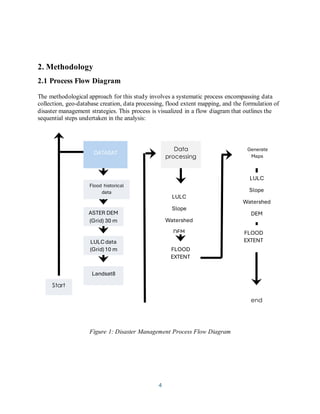
The methodological approach for this study involves a systematic process encompassing data
collection, geo-database creation, data processing, flood extent mapping, and the formulation of
disaster management strategies. This process is visualized in a flow diagram that outlines the
sequential steps undertaken in the analysis:
Figure 1: Disaster Management Process Flow Diagram
Data
processing
LULC
Slope
Watershed
DEM
Generate
Maps
FLOOD
EXTENT
end
DATASAT
Flood historical
data
ASTER DEM
(Grid) 30 m
LULCdata
(Grid)10 m
Landsat8
Start
FLOOD
EXTENT
LULC
Slope
Watershed
DEM
5
2.2 Study Area
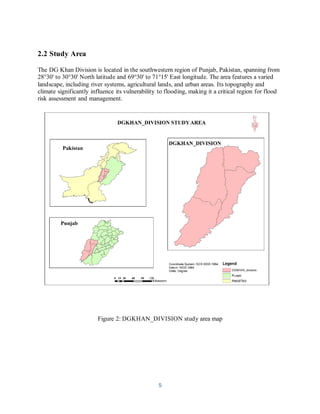
The DG Khan Division is located in the southwestern region of Punjab, Pakistan, spanning from
28°30' to 30°30' North latitude and 69°30' to 71°15' East longitude. The area features a varied
landscape, including river systems, agricultural lands, and urban areas. Its topography and
climate significantly influence its vulnerability to flooding, making it a critical region for flood
risk assessment and management.
Figure 2: DGKHAN_DIVISION study area map
6
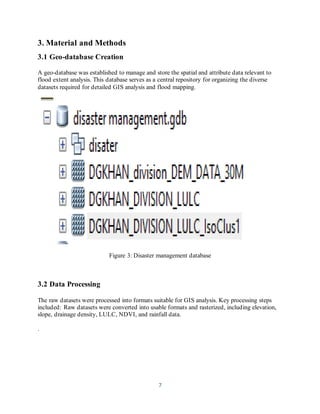
2.3 Datasets
The study utilized a diverse range of datasets from various authoritative sources to conduct a
comprehensive flood analysis. These datasets include:
S.
No
Type of data Source of extracted data Extracted data
I Flood historical
data
NDMA, PDMA, and Irrigation Department Past flood events
II ASTER DEM
(Grid) 30 m Ɨ 30 m
resolution
NASA’s official website
https://search.earthdata. nasa.gov
Hillshade, Slope,
Elevation, Curvature,
Drainage Density, and
TWI
III LULC data (Grid)
10 m Ɨ 10 m
resolution
ESRI 2020 data,
https://livingatlas.arcgis.com/landcover/
Land use/land cover
map
IV Landsat8 Imagery
(band5, band4)
USGS official website
https://earthexplorer.usgs.gov
NDVI map
V Precipitation
(TRMM data)
NASA’s official website
https://giovanni.gsfc.nasa.gov/ giovanni/
Rainfall map
Table1 : Datasets
7
3. Material and Methods
3.1 Geo-database Creation
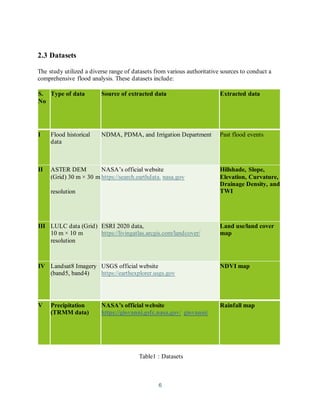
A geo-database was established to manage and store the spatial and attribute data relevant to
flood extent analysis. This database serves as a central repository for organizing the diverse
datasets required for detailed GIS analysis and flood mapping.
Figure 3: Disaster management database
3.2 Data Processing
The raw datasets were processed into formats suitable for GIS analysis. Key processing steps
included: Raw datasets were converted into usable formats and rasterized, including elevation,
slope, drainage density, LULC, NDVI, and rainfall data.
.
8
4. Results
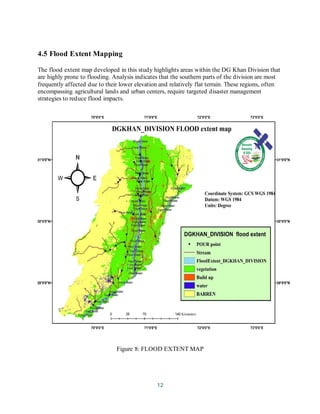
The flood extent map revealed: Significant areas in the southern parts of the DG Khan Division
are frequently flooded due to land use land cover ,slope, watershed, lower elevations and
flatter terrain..
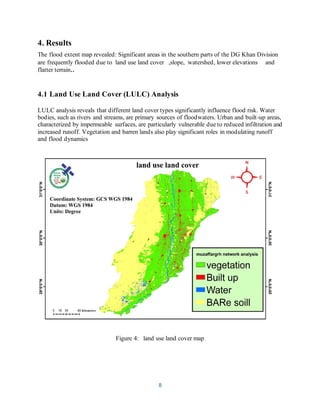
4.1 Land Use Land Cover (LULC) Analysis
LULC analysis reveals that different land cover types significantly influence flood risk. Water
bodies, such as rivers and streams, are primary sources of floodwaters. Urban and built-up areas,
characterized by impermeable surfaces, are particularly vulnerable due to reduced infiltration and
increased runoff. Vegetation and barren lands also play significant roles in modulating runoff
and flood dynamics
Figure 4: land use land cover map
9
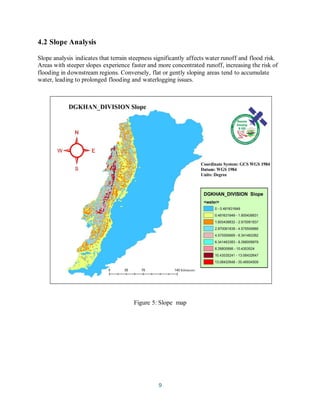
4.2 Slope Analysis
Slope analysis indicates that terrain steepness significantly affects water runoff and flood risk.
Areas with steeper slopes experience faster and more concentrated runoff, increasing the risk of
flooding in downstream regions. Conversely, flat or gently sloping areas tend to accumulate
water, leading to prolonged flooding and waterlogging issues.
Figure 5: Slope map
10
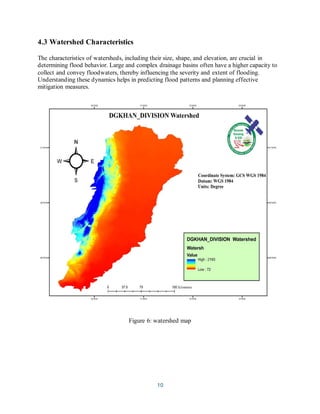
4.3 Watershed Characteristics
The characteristics of watersheds, including their size, shape, and elevation, are crucial in
determining flood behavior. Large and complex drainage basins often have a higher capacity to
collect and convey floodwaters, thereby influencing the severity and extent of flooding.
Understanding these dynamics helps in predicting flood patterns and planning effective
mitigation measures.
Figure 6: watershed map
11
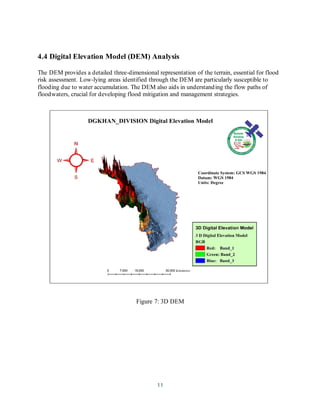
4.4 Digital Elevation Model (DEM) Analysis
The DEM provides a detailed three-dimensional representation of the terrain, essential for flood
risk assessment. Low-lying areas identified through the DEM are particularly susceptible to
flooding due to water accumulation. The DEM also aids in understanding the flow paths of
floodwaters, crucial for developing flood mitigation and management strategies.
Figure 7: 3D DEM
12
4.5 Flood Extent Mapping
The flood extent map developed in this study highlights areas within the DG Khan Division that
are highly prone to flooding. Analysis indicates that the southern parts of the division are most
frequently affected due to their lower elevation and relatively flat terrain. These regions, often
encompassing agricultural lands and urban centers, require targeted disaster management
strategies to reduce flood impacts.
Figure 8: FLOOD EXTENT MAP
13
5. Discussion
The flood extent analysis provides crucial insights into the areas most at risk of flooding in the
DG Khan Division. Implementing effective disaster management strategies is essential to
mitigate the impacts of flooding, protect lives, and reduce economic losses
6. Conclusion
This study successfully mapped the flood extents in the DG Khan Division and proposed
comprehensive disaster management strategies to mitigate flood impacts. By integrating GIS
technology, the study provides a robust framework for understanding flood dynamics and
enhancing preparedness and response mechanisms. The findings offer valuable insights for
policymakers and planners to improve flood management practices. Future research should focus
on incorporating real-time data and advanced modeling techniques to further refine flood
prediction and management capabilities.
References
[1] Abbas, A., Bhatti, A. S., Ullah, S., Ullah, W., Waseem, M., Zhao, C., et al. (2023). Projection
of precipitationextremesoverSouthAsiafrom CMIP6 GCMs. Journal of Arid Land, 15, 274–
296. doi:10.1007/s40333-023-0050-3
[2] Abbas, A., Ullah, S., Ullah, W., Waseem, M., Dou, X., Zhao, C., et al. (2022). Evaluation and
projection of precipitation in Pakistan using the coupled model intercomparison project
phase 6 model simulations. International Journal of Climatology, 42, 6665–6684.
doi:10.1002/joc.7602
[3] Ahmad, I., Tang, D., Wang, T., Wang, M., & Wagan, B. (2015). Precipitation trends over time
using Mann-Kendall and Spearman’s rho tests in Swat River Basin, Pakistan. Advances in
Meteorology, 2015, 1–15. doi:10.1155/2015/431860
[4] Ahmad, I., Zhang, F., Liu, J., Anjum, M. N., Zaman, M., Tayyab, M., et al. (2018). A linear bi-
level multi-objective program for optimal allocation of water resources. PLOS ONE, 13,
e0192294. doi:10.1371/journal.pone.0192294
[5] Ali, K., Bajracharya, R. M., & Koirala, H. (2016). A review of flood risk assessment.
International Journal of Environment, Agriculture and Biotechnology, 1, 1065–1077.
doi:10.22161/ijeab/1.4.62

flood extent DGKHAN_DIVISION(bakhat ali ).pdf

  • 1.
    1 Flood Extent andDisaster Management in DG Khan Division, Pakistan: A GIS-Based Approach BAKHAT ALI Institute of Geoinformatics and Earth Observation, Pir Mehr Ali Shah Arid Agriculture University Rawalpindi , Punjab, Pakistan bakhtali21uaar@gmail.com Abstract: This paper shall be able to show that while work flood have measures to avoid them, flooding is one of the most severe natural disasters in the world and is a reoccurring disaster that highly impacts Pakistan depending on its geographical location and weather conditions. The most threatened province is the Punjab particularly the Southeast of the study area, which covers the Sulaiman Mountain Range of DG Khan Division that receives the Indus River system flood zone; as a result, this research employed GIS techniques to systematically study and evaluate the flood behavior within the entire DG Khan Division. objectives: . The following can be generated as factors that could be useful in achieving the management goals of attaining effective and accurate strategies for managing the impacts of flood Disaster warnings that are also important when it comes to occurrence of disasters Structural patterns of disasters which are important since they will help Structure Disaster which relates with the mitigation process in disaster. Therefore, despite the fact that the study has chosen the notion of the recommendation of measures of flood management as its major conclusion, it is in fact designed to draw people’s attention to the understanding of the fact that it is important to think about the possibility of the fact that the dynamics of such a flood type may be useful in terms of the planning of an adaptive strategy for a future event and real flood control, which should be practiced in other such areas Keywords: GIS techniques are flood risk analysis; Flood susceptibility mapping; and Remote sensing and GIS based flood zonation.
  • 2.
    2 Contents Flood Extent andDisaster Management in DG Khan Division, Pakistan: A GIS-Based Approach.. 1 Abstract:...................................................................................................................................... 1 1. Introduction............................................................................................................................. 3 1.1 Aim..................................................................................................................................... 3 1.2 Objectives ........................................................................................................................... 3 2. Methodology............................................................................................................................. 4 2.1 Process Flow Diagram......................................................................................................... 4 2.2 Study Area.......................................................................................................................... 5 2.3 Datasets............................................................................................................................... 6 3. Material and Methods.............................................................................................................. 7 3.1 Geo-database Creation........................................................................................................ 7 3.2 Data Processing................................................................................................................... 7 4. Results...................................................................................................................................... 8 4.1 Land Use Land Cover (LULC) Analysis ............................................................................. 8 4.2 Slope Analysis..................................................................................................................... 9 4.3 Watershed Characteristics................................................................................................ 10 4.4 Digital Elevation Model (DEM) Analysis............................................................................. 11 4.5 Flood Extent Mapping ...................................................................................................... 12 5. Discussion............................................................................................................................... 13 6. Conclusion.............................................................................................................................. 13 References.................................................................................................................................. 13
  • 3.
    3 1. Introduction Flooding isa recurrent natural disaster that poses significant threats to regions globally, with Pakistan being notably vulnerable due to its diverse and complex terrain. The Dera Ghazi Khan (DG Khan) Division in Punjab, Pakistan, is particularly prone to severe floods due to its unique geographical and climatic conditions. The frequent flooding in this region results in profound socio-economic impacts, underscoring the need for effective disaster management strategies. Geographic Information Systems (GIS) provide powerful tools for assessing, mapping, and visualizing flood extents, which are essential for the development of robust flood management plans. This study aims to leverage GIS technology to analyze flood risks and propose strategic interventions to mitigate the impacts of flooding and enhance preparedness and response mechanisms within the DG Khan Division. 1.1 Aim The primary aim of this project is to analyze the flood extent and develop disaster management strategies for the DG Khan Division using GIS-based methodologies. 1.2 Objectives The specific objectives of this study are to: ā–Ŗ Map Flood Extents: Utilize historical flood data and satellite imagery to create detailed flood extent maps. ā–Ŗ Identify Flood-Prone Areas: Analyze key factors contributing to flooding, including land use, topography, and watershed characteristics. ā–Ŗ Propose Disaster Management Strategies: Recommend effective measures to mitigate flood impacts and enhance resilience. ā–Ŗ Enhance Preparedness and Response: Improve mechanisms for flood preparedness and emergency response to future flood events.
  • 4.
    4 2. Methodology 2.1 ProcessFlow Diagram The methodological approach for this study involves a systematic process encompassing data collection, geo-database creation, data processing, flood extent mapping, and the formulation of disaster management strategies. This process is visualized in a flow diagram that outlines the sequential steps undertaken in the analysis: Figure 1: Disaster Management Process Flow Diagram Data processing LULC Slope Watershed DEM Generate Maps FLOOD EXTENT end DATASAT Flood historical data ASTER DEM (Grid) 30 m LULCdata (Grid)10 m Landsat8 Start FLOOD EXTENT LULC Slope Watershed DEM
  • 5.
    5 2.2 Study Area TheDG Khan Division is located in the southwestern region of Punjab, Pakistan, spanning from 28°30' to 30°30' North latitude and 69°30' to 71°15' East longitude. The area features a varied landscape, including river systems, agricultural lands, and urban areas. Its topography and climate significantly influence its vulnerability to flooding, making it a critical region for flood risk assessment and management. Figure 2: DGKHAN_DIVISION study area map
  • 6.
    6 2.3 Datasets The studyutilized a diverse range of datasets from various authoritative sources to conduct a comprehensive flood analysis. These datasets include: S. No Type of data Source of extracted data Extracted data I Flood historical data NDMA, PDMA, and Irrigation Department Past flood events II ASTER DEM (Grid) 30 m Ɨ 30 m resolution NASA’s official website https://search.earthdata. nasa.gov Hillshade, Slope, Elevation, Curvature, Drainage Density, and TWI III LULC data (Grid) 10 m Ɨ 10 m resolution ESRI 2020 data, https://livingatlas.arcgis.com/landcover/ Land use/land cover map IV Landsat8 Imagery (band5, band4) USGS official website https://earthexplorer.usgs.gov NDVI map V Precipitation (TRMM data) NASA’s official website https://giovanni.gsfc.nasa.gov/ giovanni/ Rainfall map Table1 : Datasets
  • 7.
    7 3. Material andMethods 3.1 Geo-database Creation A geo-database was established to manage and store the spatial and attribute data relevant to flood extent analysis. This database serves as a central repository for organizing the diverse datasets required for detailed GIS analysis and flood mapping. Figure 3: Disaster management database 3.2 Data Processing The raw datasets were processed into formats suitable for GIS analysis. Key processing steps included: Raw datasets were converted into usable formats and rasterized, including elevation, slope, drainage density, LULC, NDVI, and rainfall data. .
  • 8.
    8 4. Results The floodextent map revealed: Significant areas in the southern parts of the DG Khan Division are frequently flooded due to land use land cover ,slope, watershed, lower elevations and flatter terrain.. 4.1 Land Use Land Cover (LULC) Analysis LULC analysis reveals that different land cover types significantly influence flood risk. Water bodies, such as rivers and streams, are primary sources of floodwaters. Urban and built-up areas, characterized by impermeable surfaces, are particularly vulnerable due to reduced infiltration and increased runoff. Vegetation and barren lands also play significant roles in modulating runoff and flood dynamics Figure 4: land use land cover map
  • 9.
    9 4.2 Slope Analysis Slopeanalysis indicates that terrain steepness significantly affects water runoff and flood risk. Areas with steeper slopes experience faster and more concentrated runoff, increasing the risk of flooding in downstream regions. Conversely, flat or gently sloping areas tend to accumulate water, leading to prolonged flooding and waterlogging issues. Figure 5: Slope map
  • 10.
    10 4.3 Watershed Characteristics Thecharacteristics of watersheds, including their size, shape, and elevation, are crucial in determining flood behavior. Large and complex drainage basins often have a higher capacity to collect and convey floodwaters, thereby influencing the severity and extent of flooding. Understanding these dynamics helps in predicting flood patterns and planning effective mitigation measures. Figure 6: watershed map
  • 11.
    11 4.4 Digital ElevationModel (DEM) Analysis The DEM provides a detailed three-dimensional representation of the terrain, essential for flood risk assessment. Low-lying areas identified through the DEM are particularly susceptible to flooding due to water accumulation. The DEM also aids in understanding the flow paths of floodwaters, crucial for developing flood mitigation and management strategies. Figure 7: 3D DEM
  • 12.
    12 4.5 Flood ExtentMapping The flood extent map developed in this study highlights areas within the DG Khan Division that are highly prone to flooding. Analysis indicates that the southern parts of the division are most frequently affected due to their lower elevation and relatively flat terrain. These regions, often encompassing agricultural lands and urban centers, require targeted disaster management strategies to reduce flood impacts. Figure 8: FLOOD EXTENT MAP
  • 13.
    13 5. Discussion The floodextent analysis provides crucial insights into the areas most at risk of flooding in the DG Khan Division. Implementing effective disaster management strategies is essential to mitigate the impacts of flooding, protect lives, and reduce economic losses 6. Conclusion This study successfully mapped the flood extents in the DG Khan Division and proposed comprehensive disaster management strategies to mitigate flood impacts. By integrating GIS technology, the study provides a robust framework for understanding flood dynamics and enhancing preparedness and response mechanisms. The findings offer valuable insights for policymakers and planners to improve flood management practices. Future research should focus on incorporating real-time data and advanced modeling techniques to further refine flood prediction and management capabilities. References [1] Abbas, A., Bhatti, A. S., Ullah, S., Ullah, W., Waseem, M., Zhao, C., et al. (2023). Projection of precipitationextremesoverSouthAsiafrom CMIP6 GCMs. Journal of Arid Land, 15, 274– 296. doi:10.1007/s40333-023-0050-3 [2] Abbas, A., Ullah, S., Ullah, W., Waseem, M., Dou, X., Zhao, C., et al. (2022). Evaluation and projection of precipitation in Pakistan using the coupled model intercomparison project phase 6 model simulations. International Journal of Climatology, 42, 6665–6684. doi:10.1002/joc.7602 [3] Ahmad, I., Tang, D., Wang, T., Wang, M., & Wagan, B. (2015). Precipitation trends over time using Mann-Kendall and Spearman’s rho tests in Swat River Basin, Pakistan. Advances in Meteorology, 2015, 1–15. doi:10.1155/2015/431860 [4] Ahmad, I., Zhang, F., Liu, J., Anjum, M. N., Zaman, M., Tayyab, M., et al. (2018). A linear bi- level multi-objective program for optimal allocation of water resources. PLOS ONE, 13, e0192294. doi:10.1371/journal.pone.0192294 [5] Ali, K., Bajracharya, R. M., & Koirala, H. (2016). A review of flood risk assessment. International Journal of Environment, Agriculture and Biotechnology, 1, 1065–1077. doi:10.22161/ijeab/1.4.62